Vi använder cookies för att ge dig bästa möjliga upplevelse. Välj vilka cookies du tillåter.
Läs mer i vår integritetspolicy
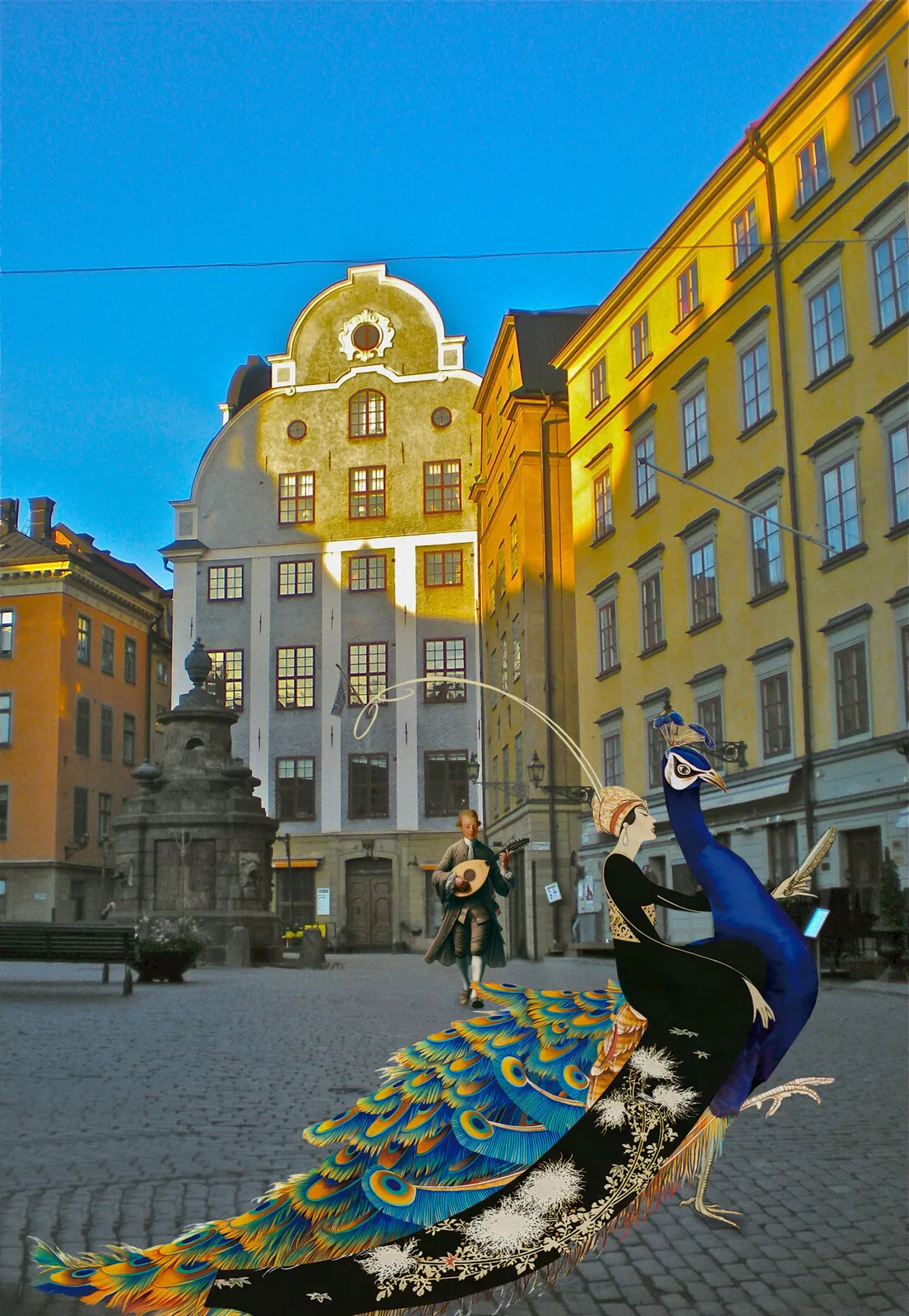
Jörgen Thornberg
Through a Glass Darkly, 2024
Digital
50 x 70 cm
3 200 kr
The magnificent Peacock is a bird of myth and majesty and has stirred much lore and myth in almost every society. So fantastic did the description of the peacock sound that European naturalists initially dismissed sightings of the bird as figments of an over-active imagination of Asian artists. The blue-green iridescent colour itself creates a sense of awe in the beholder. The “eyes” within the gorgeous feathering have often been thought to represent more excellent vision, wisdom, and watchfulness. The “peacock-blue” tint of its beautiful plumage, usually worn by royalty, fascinates all who encounter this magnificent bird. The same remarkable blue defines this glorious creature's head, neck, and crest.
The peacock’s resplendent train of colours is not a tail but an ornament of 150 – 200 long feathers that grow from the bird’s low back and conceal the short and drab-coloured natural tail. The eyes develop from a modification in the shape of the filaments of the feathers that flatten and twist so that the broad side faces outward. Microscopic particles of melanin split the light like oil film does on water. What you see varies according to the angle at which you view the peacock.
Of all the birds, the peacock resembles the traditional phoenix description. The phoenix is the legendary bird of resurrection sacrificed in the fires of life and then rises from the flames out of its ashes. As a reflection of the phoenix, the peacock was often associated with immortality and rebirth and considered sacred by many cultures and religions, including the Greek, Egyptian, Chinese, Christian, and Hindu.
In Greek mythology, when Argus, the guard assigned to watch over the goddess Hera, fell asleep, his one hundred eyes were given to the peacock – Hera’s favourite bird. Chinese mythology states that the peacock’s plumage is a blending of five colours that create the sweet harmony of sound. In Egypt, the bird was linked to the worship of the sun god, Amon-Ra, and associated with the all-seeing eye of Horus. To the Hindus, the peacock was associated with Hindra, the god of thunder, who became a peacock endowed with one hundred eyes that enabled him to watch out for the demon Ravana. Christianity assigns the peacock as a symbol of the death and resurrection of Jesus Christ.
There are three species within the peacock family, two of which reside naturally in Asia and one in the African Congo. Peacocks live in deciduous tropical forests and feed in open places such as clearings and cultivated fields. They are home in cities and temple grounds and were once kept to destroy poisonous snakes. Interestingly, peacocks often live within proximity to tigers. Although they have excellent eyesight and hearing and can quickly fly, they are sometimes exterminated by tigers, leopards, and eagles. They are non-migratory, although they can fly to the top branches of trees. (Now, that’s a sight to see!). Their nests, often concealed in thorny undergrowth or low branches, are shallow, hollow, bare, and sometimes lined with sticks, leaves, and grass. Their diet comprises seeds, fruit, plants, worms, insects, mice, and small snakes.
As with many birds, the male has brighter and more ostentatious feathers. Although the peahen lacks the bright train of feathers, she is no less magnificent in her own right. The peahen is a protective and powerful bird in the kingdom, one that nature has endowed with colours that provide her with perfect camouflage when protecting her unborn and young.
Peacocks live as families in small groups, except in the breeding season when the cock reverts to solitary and contentious behaviour. The raucous call emits as the male attempts to establish territorial rights with the females. He proudly and confidently backs into the female as he prepares to win her attention. A loud shaking of his feathers brings each eye into place before suddenly turning around to expose the shimmering constellation of iridescence. The fan-created by this strutting display seems to engulf the female. Scientists believe the peahen is hypnotised by the loud rustle of feathers and the glitter of haunting eyes. Over a few days, the male mates with flocks of females that he attracts to himself. The female chooses the most extravagantly decorated male and the one with the most eyes. These males are considered to be the older and more experienced of the peacocks. She then departs to the nest on her own.
The most outstanding features of the peacock are its feathers and eerie and raucous call. The call has a kind of laughter quality as if the peacock reminds us to laugh at life. One story about its vocalisations is tied to the appearance of its feet. Some (not this author!) think the peacock has ugly feet and screeches every time it sees them!
For anyone strongly attracted to the peacock or having the peacock as a totem, examining the mysticism and symbolism of feet is undoubtedly called for. The feet are our support system; they are our structure's foundation. They enable us to move forward and to be upright. What are the peacock’s feet telling you about your life? What stories do your own feet have to tell? Mythologists claim that the study and practice of foot reflexology benefit anyone with a peacock as a totem.
The Peacock's Mythological Significance and Symbol of Royal Power. Peacocks held a significant place in Greek mythology, representing royalty and power. They were closely associated with the goddess Hera, the consort of Zeus. Originating from India, where they were revered as symbols of royalty, peacocks were introduced to ancient Babylon by Indian traders several centuries ago before making their way to the mythological narratives of ancient Greece.
Peacocks and their symbolism came to ancient Greece from Babylon, but they took on a Greek provenance when they became a symbol of the goddess Hera, whose chariot they pulled. Hera, the goddess of the stars and skies, was not only the sister but the wife of the Greek god Zeus, the king of all the gods on Mount Olympus. With their majestic plumage and regal bearing, Peacocks were chosen to pull the chariot of Hera, the goddess of the stars and skies. This role in Hera's divine transportation further solidified their symbolism of power and grandeur in Greek mythology.
However, Hera had longstanding problems with Zeus, as his eye was known to wander, to put it mildly. He soon became interested in a priestess of Hera’s called Io, guarded by Hera’s servant, an enormous giant with one hundred eyes known as Argos Panoptis. The tale of the peacock's origin is a testament to Greek mythology's dramatic twists and turns. In a bid to possess the woman, Zeus commanded the death of Argus. However, before this could be executed, Hera immortalised her loyal servant by transforming his one hundred eyes into the spectacular “eyes” on a peacock's tail, forever marking the bird with a symbol of her power.
In the version of the myth told in “Prometheus Bound,” Io initially rejected Zeus’ advances until her father threw her out of his house on the advice of oracles. According to some stories, Zeus then turns Io into a heifer to hide her from his wife; others maintain that Hera herself transforms Io.
In the version of the story in which Zeus transformed Io, the deception failed, and Hera begged Zeus to give her the heifer as a present, which he did, having no reason to refuse. Hera then sent Argus Panoptis to watch over Io and prevent Zeus from visiting her, so Zeus sent Hermes to distract and eventually slay Argus. According to the Roman writer Ovid, he did so by lulling him to sleep by playing the panpipes and telling stories. Zeus freed Io, who was still in the form of a heifer.
The peacock is perhaps featured prominently in stories and mythology because many cultures see it as a symbol of immortality; the ancients believed that its flesh did not decay, even after death. The bird also completely replaced its feathers each year, adding to the concept of renewal and resurrection with which it was associated. Even early Christians paid homage to this concept in their iconography.
The Legend of Erinona
Another Greek myth involving Athena, Adonis, Artemis, Zeus, and Hera also features the spectacularly beautiful peacock. This legend is about the Cypriot girl known as Erinona. Erinona and Adonis were the victims of the gods' rivalry, who clashed with each other in their continual power plays. The goddesses Athena and Artemis admired the mortal girl Erinona for her wisdom and purity. Aphrodite, angry that the girl did not honour her as well, tried to make Zeus fall in love with her.
Hera, ever jealous of Zeus’ innumerable dalliances, arranged for Adonis to rape the virgin girl, which caused Zeus to lose all interest in her. Now enraged over the scam, Zeus struck and killed Adonis, while Artemis transformed Erinona into a peacock — and then the peacock into a human being. Aphrodite then begged Zeus to allow a shadow of Adonis to return to the world of the living, guided by Hermes. The resurrected Adonis then married the transformed and re-transformed Erinona, and they had a son called Taleas or Talos.
Historical Influence
In the real world of Hellenic-era Greece, Alexander the Great was said to have been so dazzled by the beauty of peacocks that he made it illegal to kill them.
Centuries later, the peacock remained such a symbol of power in India that two birds were enshrined in bejewelled magnificence in the “Peacock Throne,” created in the 17th century for Emperor Shah Jahan. Subsequent emperors of the Mughal Empire used it.
Gilani and his workers from the imperial goldsmiths’ department were commissioned to construct this new throne, which took seven years to complete. Large amounts of solid gold, precious stones, and pearls were used, creating a masterful piece of Mughal artistry that was unsurpassed before or after its creation. It was an opulent indulgence that could only be seen by a few courtiers, aristocrats, and visiting dignitaries. Even by Golden Age Mughal standards, the throne was supremely extravagant, costing twice as much as the construction of the Taj Mahal.
During the Battle of Karnal, on February 13, 1739, upon the defeat of Muhammad Shah, Nadir Shah entered Delhi and sacked the city. When Persian troops left Delhi at the beginning of May 1739, they took the Peacock Throne as a war trophy. The tremendous treasure haul amounted to an enormous reduction in Mughal wealth and an irreplaceable loss of cultural artefacts. Among the known precious stones that were looted that are thought to have been part of the Peacock Throne or were owned by the Shah were the Akbar Shah, Great Mughal, Great Table, Koh-i-Noor, and Shah diamonds, as well as the Samarian spinel and the Timur ruby. The Akbar Shah Diamond was said to form one of the eyes of a peacock, as did the Koh-i-Noor.
Jean-Baptiste Tavernier described the Shah diamond as being on the side of the throne. Many of these stones became part of the Persian and, later, the British crown jewels due to Great Britain’s colonial expansion into the region. When Nader Shah was assassinated by his officers on June 19, 1747, the throne disappeared, most probably being dismantled or destroyed in the ensuing chaos for its incredible wealth of gems and gold; the Peacock Throne was used in the West as a byword for the Persian monarchy.
The Peacock Throne was a throne made for the Indian Mughal emperor during the reign of Shah Jahan. It received its name because its jewel-encrusted back resembled a peacock's tail. The Persian ruler Nadir Shah took the throne as booty when he conquered Delhi in 1739.
After Nadir Shah's assassination, the throne remained in Iran, and subsequent Qajar kings sat on it. The Qajar rulers also had their thrones made, referred to as Peacock Thrones, but none achieved the same status as Nadir Shah's Peacock Throne. The last Persian monarch, Shah Mohammad Reza Pahlavi, sat on the throne during his coronation in 1967, when his consort, Farah Pahlavi, was also crowned.
During the Persian Pahlavi dynasty (1925-1979), the Peacock Throne became associated with the Iranian monarchy. It is currently stored in Iran's National Bank in Tehran. A famous avenue in the Iranian capital is named after the throne.
Several other Asian rulers have had Peacock Thrones made, but this designation is internationally reserved for the Mughal version.
Two Telling Anecdotes About the Peacock and Its Background. Peacocks are vain creatures. Therefore, the rider holds up a mirror so that the narcissist can keep track of his beauty. She is probably of the same ilk, with sixteen wardrobes packed full of clothes: short, medium-length, and long dresses in endless rows, skirts stretched on special hangers, drawers full of jumpers and tops, hundreds of shoes neatly lined up in other cabinets, and countless handbags in different nooks and crannies. Her narcissism stretches to the attic and down to the basement. The peacock only has his plumage, but he thinks it's more beautiful than anything else. Like the bird, the rider sees life as a theatre, with herself on stage as the centre of the action. For her, no day is the same, by matching her outfits. It doesn't take an Einstein to figure out 2,000,000 possible combinations of these garments. Sixty years of varied use becomes just over 20,000 combinations. Thus, the rider's ensemble could last one hundred people for sixty years.
The peacock lost a feather now and then, but they grew back so that the plumage was always as new.
The encyclopedia tells us that the standard turkey was domesticated for the first time in Mexico long before the conquest and was taken to Europe by the Spanish conquerors at the beginning of the XVI century. The Yucatecan variety is the woodland turkey.
One story led to another, and another, leading to a mythical tale of our land: "Cutz, woodland turkey," recorded in the research "The myths about the birds in the state of Yucatán," by the authors Carlos Augusto Evia Cervantes and Herbert Francisco Ciau Yah.
Here, it is told that the Great Spirit, tired of the constant quarrels between the birds, decided to call an assembly to determine who would govern all the rest. They all felt they deserved this critical election.
The Peacock, driven by his ambition and aware of the minimal beauty of his plumage, hatched a plan. He convinced the unsuspecting Puhuy to lend him his plumage, promising to enhance his elegance and distribute the kingdom's wealth. This act of deceit and vanity would soon lead to a harsh lesson for the Peacock.
Puhuy, unsuspecting, agreed. He shed his feathers, and Cutz fitted them onto his sleek body. Soon, he was parading his exquisite suit with the long tail adorned with the lapis lazuli of the Maya sky, the jade of the sacred serpent, and the vibrant colours of the tropical twilight.
In this way, strutting with his wings slightly tilted to the sides and his head held up high, Dzul Cutz entered the place where all the birds of the Mayab were gathered for the election. Surprise reigned. The Great Spirit was pleased with the marvellous change and proclaimed him king of all the birds.
A group of birds began a search, noting Puhuy's absence from the assembly. They finally found him under a bush, shivering with cold and almost dead of hunger. Then they learned what happened, and all the birds of the Mayab wrote a letter to the Great Spirit, asking that the peacock be duly punished.
As a result of his deceit, every time the Peacock opens his beak, instead of the melodious song of earlier times, a harsh and unpleasant sound emerges. This is a constant reminder of his past actions, inviting mockery from all around.
‘The Peacock’ by Aesop is probably, for Westerners, the most well-known fable.
Once upon a time, the Peacock was a humble bird, devoid of the resplendent feathers he now proudly displays. He was content with his simple life. Then, one fateful day, Juno, his beloved, granted his wish for a magnificent train of feathers, a gift to set him apart from his avian peers. Bedecked in his new attire, shimmering with emerald, gold, purple, and azure hues, he paraded among the birds, who could only gaze at him in envy. Even the most stunning pheasant had to admit that his beauty was unmatched.
However, the Peacock's newfound beauty came at a cost as he watched an Eagle majestically soaring in the sky, a deep longing to fly as he once did stirred within him. He spread his wings, attempting to take flight. But the weight of his splendid train proved too much, grounding him. No longer could he greet the morning sun from the heights or bask in the ethereal glow of sunset among the clouds. He was now a prisoner of his beauty, more burdened and oppressed than the lowliest barnyard fowl. Once solid and accessible, his wings were now mere decorations, useless for their intended purpose.
Do not sacrifice your freedom for the sake of pomp and show. The Peacock, now burdened and oppressed, regretted his choice. His once joyful life was now a prison, a stark reminder of the importance of freedom over vanity.
Talking about mirrors, let’s take a deep dive into the film 'Through a Glass Darkly'. Ingmar Bergman's 1961 film "Through a Glass Darkly" - "Såsom i en Spegel") Ingmar Bergman's 1961 film 'Through a Glass Darkly'-'Såsom i en Spegel ') is a compelling and intense drama that delves into the intricate web of human emotions and relationships. The film, written and directed by Bergman, features a stellar cast, including Harriet Andersson, Gunnar Björnstrand, Max von Sydow, and Lars Passgård. Set on the remote island of Fårö, it tells the harrowing story of a young woman who has schizophrenia and is vacationing with her family.
Bergman, renowned for his introspective works, structured 'Through a Glass Darkly' as a three-act play. This unique approach infuses the film with a theatrical intimacy, drawing viewers into the intense personal drama of its characters. Moreover, Bergman's personal experiences and relationships significantly shaped the narrative, adding a layer of authenticity and raw emotion that resonates with the audience.
Harriet Andersson's portrayal of Karin, the young woman grappling with her mental illness, is hauntingly sensitive and intense. Her performance captures the fragility and turmoil of her character, evoking empathy from the audience. Karin's husband, Max von Sydow, brings a stoic yet tender presence, while Gunnar Björnstrand, playing her father, embodies the detached, exploitative artist. Lars Passgård, as her younger brother, represents youthful frustration and confusion, adding to the family's dynamic tension. Filled with raw emotion, these performances draw the audience into the characters' struggles, fostering a deep connection.
In 'Through a Glass Darkly', Bergman ingeniously uses the remote island setting to symbolise isolation and emotional confinement. The island's isolation mirrors the characters' emotional isolation, accentuating their profound loneliness. The vast, empty landscapes and the harsh, unforgiving weather are metaphors for the characters' emotional struggles, intensifying the audience's experience of their emotional turmoil. The film's title, derived from a Biblical passage, reflects the characters' blurred perception of reality and their struggles to understand themselves and each other.
Cinematographer Sven Nykvist's work on the film is masterful, utilising the stark, windswept beauty of Fårö to enhance the story's emotional weight. His recommendation to shoot on the island was pivotal, as the location became a significant element in Bergman's cinematic language. The score, incorporating the music of Johann Sebastian Bach, plays a crucial role in setting the film's sombre, reflective tone. The music, with its haunting melodies and melancholic harmonies, profoundly resonates with the film's themes of isolation, mental illness, and familial tension, making the audience feel the story's emotional depth.
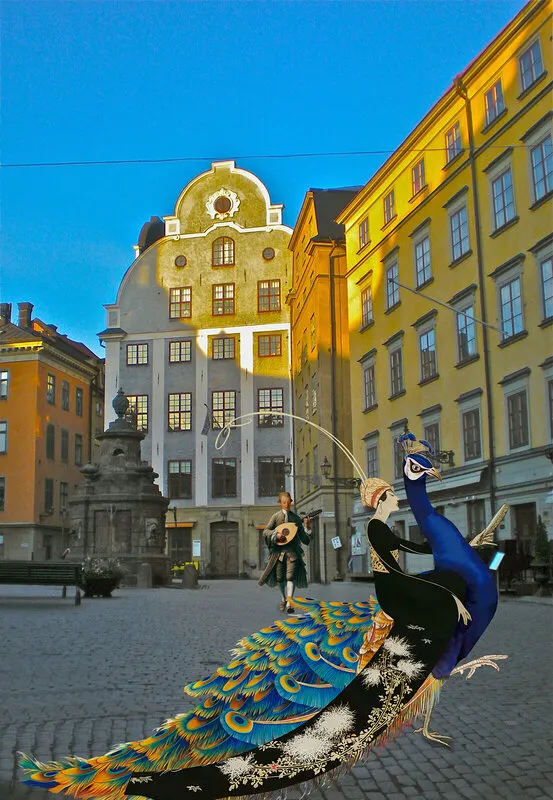
Jörgen Thornberg
Through a Glass Darkly, 2024
Digital
50 x 70 cm
3 200 kr
The magnificent Peacock is a bird of myth and majesty and has stirred much lore and myth in almost every society. So fantastic did the description of the peacock sound that European naturalists initially dismissed sightings of the bird as figments of an over-active imagination of Asian artists. The blue-green iridescent colour itself creates a sense of awe in the beholder. The “eyes” within the gorgeous feathering have often been thought to represent more excellent vision, wisdom, and watchfulness. The “peacock-blue” tint of its beautiful plumage, usually worn by royalty, fascinates all who encounter this magnificent bird. The same remarkable blue defines this glorious creature's head, neck, and crest.
The peacock’s resplendent train of colours is not a tail but an ornament of 150 – 200 long feathers that grow from the bird’s low back and conceal the short and drab-coloured natural tail. The eyes develop from a modification in the shape of the filaments of the feathers that flatten and twist so that the broad side faces outward. Microscopic particles of melanin split the light like oil film does on water. What you see varies according to the angle at which you view the peacock.
Of all the birds, the peacock resembles the traditional phoenix description. The phoenix is the legendary bird of resurrection sacrificed in the fires of life and then rises from the flames out of its ashes. As a reflection of the phoenix, the peacock was often associated with immortality and rebirth and considered sacred by many cultures and religions, including the Greek, Egyptian, Chinese, Christian, and Hindu.
In Greek mythology, when Argus, the guard assigned to watch over the goddess Hera, fell asleep, his one hundred eyes were given to the peacock – Hera’s favourite bird. Chinese mythology states that the peacock’s plumage is a blending of five colours that create the sweet harmony of sound. In Egypt, the bird was linked to the worship of the sun god, Amon-Ra, and associated with the all-seeing eye of Horus. To the Hindus, the peacock was associated with Hindra, the god of thunder, who became a peacock endowed with one hundred eyes that enabled him to watch out for the demon Ravana. Christianity assigns the peacock as a symbol of the death and resurrection of Jesus Christ.
There are three species within the peacock family, two of which reside naturally in Asia and one in the African Congo. Peacocks live in deciduous tropical forests and feed in open places such as clearings and cultivated fields. They are home in cities and temple grounds and were once kept to destroy poisonous snakes. Interestingly, peacocks often live within proximity to tigers. Although they have excellent eyesight and hearing and can quickly fly, they are sometimes exterminated by tigers, leopards, and eagles. They are non-migratory, although they can fly to the top branches of trees. (Now, that’s a sight to see!). Their nests, often concealed in thorny undergrowth or low branches, are shallow, hollow, bare, and sometimes lined with sticks, leaves, and grass. Their diet comprises seeds, fruit, plants, worms, insects, mice, and small snakes.
As with many birds, the male has brighter and more ostentatious feathers. Although the peahen lacks the bright train of feathers, she is no less magnificent in her own right. The peahen is a protective and powerful bird in the kingdom, one that nature has endowed with colours that provide her with perfect camouflage when protecting her unborn and young.
Peacocks live as families in small groups, except in the breeding season when the cock reverts to solitary and contentious behaviour. The raucous call emits as the male attempts to establish territorial rights with the females. He proudly and confidently backs into the female as he prepares to win her attention. A loud shaking of his feathers brings each eye into place before suddenly turning around to expose the shimmering constellation of iridescence. The fan-created by this strutting display seems to engulf the female. Scientists believe the peahen is hypnotised by the loud rustle of feathers and the glitter of haunting eyes. Over a few days, the male mates with flocks of females that he attracts to himself. The female chooses the most extravagantly decorated male and the one with the most eyes. These males are considered to be the older and more experienced of the peacocks. She then departs to the nest on her own.
The most outstanding features of the peacock are its feathers and eerie and raucous call. The call has a kind of laughter quality as if the peacock reminds us to laugh at life. One story about its vocalisations is tied to the appearance of its feet. Some (not this author!) think the peacock has ugly feet and screeches every time it sees them!
For anyone strongly attracted to the peacock or having the peacock as a totem, examining the mysticism and symbolism of feet is undoubtedly called for. The feet are our support system; they are our structure's foundation. They enable us to move forward and to be upright. What are the peacock’s feet telling you about your life? What stories do your own feet have to tell? Mythologists claim that the study and practice of foot reflexology benefit anyone with a peacock as a totem.
The Peacock's Mythological Significance and Symbol of Royal Power. Peacocks held a significant place in Greek mythology, representing royalty and power. They were closely associated with the goddess Hera, the consort of Zeus. Originating from India, where they were revered as symbols of royalty, peacocks were introduced to ancient Babylon by Indian traders several centuries ago before making their way to the mythological narratives of ancient Greece.
Peacocks and their symbolism came to ancient Greece from Babylon, but they took on a Greek provenance when they became a symbol of the goddess Hera, whose chariot they pulled. Hera, the goddess of the stars and skies, was not only the sister but the wife of the Greek god Zeus, the king of all the gods on Mount Olympus. With their majestic plumage and regal bearing, Peacocks were chosen to pull the chariot of Hera, the goddess of the stars and skies. This role in Hera's divine transportation further solidified their symbolism of power and grandeur in Greek mythology.
However, Hera had longstanding problems with Zeus, as his eye was known to wander, to put it mildly. He soon became interested in a priestess of Hera’s called Io, guarded by Hera’s servant, an enormous giant with one hundred eyes known as Argos Panoptis. The tale of the peacock's origin is a testament to Greek mythology's dramatic twists and turns. In a bid to possess the woman, Zeus commanded the death of Argus. However, before this could be executed, Hera immortalised her loyal servant by transforming his one hundred eyes into the spectacular “eyes” on a peacock's tail, forever marking the bird with a symbol of her power.
In the version of the myth told in “Prometheus Bound,” Io initially rejected Zeus’ advances until her father threw her out of his house on the advice of oracles. According to some stories, Zeus then turns Io into a heifer to hide her from his wife; others maintain that Hera herself transforms Io.
In the version of the story in which Zeus transformed Io, the deception failed, and Hera begged Zeus to give her the heifer as a present, which he did, having no reason to refuse. Hera then sent Argus Panoptis to watch over Io and prevent Zeus from visiting her, so Zeus sent Hermes to distract and eventually slay Argus. According to the Roman writer Ovid, he did so by lulling him to sleep by playing the panpipes and telling stories. Zeus freed Io, who was still in the form of a heifer.
The peacock is perhaps featured prominently in stories and mythology because many cultures see it as a symbol of immortality; the ancients believed that its flesh did not decay, even after death. The bird also completely replaced its feathers each year, adding to the concept of renewal and resurrection with which it was associated. Even early Christians paid homage to this concept in their iconography.
The Legend of Erinona
Another Greek myth involving Athena, Adonis, Artemis, Zeus, and Hera also features the spectacularly beautiful peacock. This legend is about the Cypriot girl known as Erinona. Erinona and Adonis were the victims of the gods' rivalry, who clashed with each other in their continual power plays. The goddesses Athena and Artemis admired the mortal girl Erinona for her wisdom and purity. Aphrodite, angry that the girl did not honour her as well, tried to make Zeus fall in love with her.
Hera, ever jealous of Zeus’ innumerable dalliances, arranged for Adonis to rape the virgin girl, which caused Zeus to lose all interest in her. Now enraged over the scam, Zeus struck and killed Adonis, while Artemis transformed Erinona into a peacock — and then the peacock into a human being. Aphrodite then begged Zeus to allow a shadow of Adonis to return to the world of the living, guided by Hermes. The resurrected Adonis then married the transformed and re-transformed Erinona, and they had a son called Taleas or Talos.
Historical Influence
In the real world of Hellenic-era Greece, Alexander the Great was said to have been so dazzled by the beauty of peacocks that he made it illegal to kill them.
Centuries later, the peacock remained such a symbol of power in India that two birds were enshrined in bejewelled magnificence in the “Peacock Throne,” created in the 17th century for Emperor Shah Jahan. Subsequent emperors of the Mughal Empire used it.
Gilani and his workers from the imperial goldsmiths’ department were commissioned to construct this new throne, which took seven years to complete. Large amounts of solid gold, precious stones, and pearls were used, creating a masterful piece of Mughal artistry that was unsurpassed before or after its creation. It was an opulent indulgence that could only be seen by a few courtiers, aristocrats, and visiting dignitaries. Even by Golden Age Mughal standards, the throne was supremely extravagant, costing twice as much as the construction of the Taj Mahal.
During the Battle of Karnal, on February 13, 1739, upon the defeat of Muhammad Shah, Nadir Shah entered Delhi and sacked the city. When Persian troops left Delhi at the beginning of May 1739, they took the Peacock Throne as a war trophy. The tremendous treasure haul amounted to an enormous reduction in Mughal wealth and an irreplaceable loss of cultural artefacts. Among the known precious stones that were looted that are thought to have been part of the Peacock Throne or were owned by the Shah were the Akbar Shah, Great Mughal, Great Table, Koh-i-Noor, and Shah diamonds, as well as the Samarian spinel and the Timur ruby. The Akbar Shah Diamond was said to form one of the eyes of a peacock, as did the Koh-i-Noor.
Jean-Baptiste Tavernier described the Shah diamond as being on the side of the throne. Many of these stones became part of the Persian and, later, the British crown jewels due to Great Britain’s colonial expansion into the region. When Nader Shah was assassinated by his officers on June 19, 1747, the throne disappeared, most probably being dismantled or destroyed in the ensuing chaos for its incredible wealth of gems and gold; the Peacock Throne was used in the West as a byword for the Persian monarchy.
The Peacock Throne was a throne made for the Indian Mughal emperor during the reign of Shah Jahan. It received its name because its jewel-encrusted back resembled a peacock's tail. The Persian ruler Nadir Shah took the throne as booty when he conquered Delhi in 1739.
After Nadir Shah's assassination, the throne remained in Iran, and subsequent Qajar kings sat on it. The Qajar rulers also had their thrones made, referred to as Peacock Thrones, but none achieved the same status as Nadir Shah's Peacock Throne. The last Persian monarch, Shah Mohammad Reza Pahlavi, sat on the throne during his coronation in 1967, when his consort, Farah Pahlavi, was also crowned.
During the Persian Pahlavi dynasty (1925-1979), the Peacock Throne became associated with the Iranian monarchy. It is currently stored in Iran's National Bank in Tehran. A famous avenue in the Iranian capital is named after the throne.
Several other Asian rulers have had Peacock Thrones made, but this designation is internationally reserved for the Mughal version.
Two Telling Anecdotes About the Peacock and Its Background. Peacocks are vain creatures. Therefore, the rider holds up a mirror so that the narcissist can keep track of his beauty. She is probably of the same ilk, with sixteen wardrobes packed full of clothes: short, medium-length, and long dresses in endless rows, skirts stretched on special hangers, drawers full of jumpers and tops, hundreds of shoes neatly lined up in other cabinets, and countless handbags in different nooks and crannies. Her narcissism stretches to the attic and down to the basement. The peacock only has his plumage, but he thinks it's more beautiful than anything else. Like the bird, the rider sees life as a theatre, with herself on stage as the centre of the action. For her, no day is the same, by matching her outfits. It doesn't take an Einstein to figure out 2,000,000 possible combinations of these garments. Sixty years of varied use becomes just over 20,000 combinations. Thus, the rider's ensemble could last one hundred people for sixty years.
The peacock lost a feather now and then, but they grew back so that the plumage was always as new.
The encyclopedia tells us that the standard turkey was domesticated for the first time in Mexico long before the conquest and was taken to Europe by the Spanish conquerors at the beginning of the XVI century. The Yucatecan variety is the woodland turkey.
One story led to another, and another, leading to a mythical tale of our land: "Cutz, woodland turkey," recorded in the research "The myths about the birds in the state of Yucatán," by the authors Carlos Augusto Evia Cervantes and Herbert Francisco Ciau Yah.
Here, it is told that the Great Spirit, tired of the constant quarrels between the birds, decided to call an assembly to determine who would govern all the rest. They all felt they deserved this critical election.
The Peacock, driven by his ambition and aware of the minimal beauty of his plumage, hatched a plan. He convinced the unsuspecting Puhuy to lend him his plumage, promising to enhance his elegance and distribute the kingdom's wealth. This act of deceit and vanity would soon lead to a harsh lesson for the Peacock.
Puhuy, unsuspecting, agreed. He shed his feathers, and Cutz fitted them onto his sleek body. Soon, he was parading his exquisite suit with the long tail adorned with the lapis lazuli of the Maya sky, the jade of the sacred serpent, and the vibrant colours of the tropical twilight.
In this way, strutting with his wings slightly tilted to the sides and his head held up high, Dzul Cutz entered the place where all the birds of the Mayab were gathered for the election. Surprise reigned. The Great Spirit was pleased with the marvellous change and proclaimed him king of all the birds.
A group of birds began a search, noting Puhuy's absence from the assembly. They finally found him under a bush, shivering with cold and almost dead of hunger. Then they learned what happened, and all the birds of the Mayab wrote a letter to the Great Spirit, asking that the peacock be duly punished.
As a result of his deceit, every time the Peacock opens his beak, instead of the melodious song of earlier times, a harsh and unpleasant sound emerges. This is a constant reminder of his past actions, inviting mockery from all around.
‘The Peacock’ by Aesop is probably, for Westerners, the most well-known fable.
Once upon a time, the Peacock was a humble bird, devoid of the resplendent feathers he now proudly displays. He was content with his simple life. Then, one fateful day, Juno, his beloved, granted his wish for a magnificent train of feathers, a gift to set him apart from his avian peers. Bedecked in his new attire, shimmering with emerald, gold, purple, and azure hues, he paraded among the birds, who could only gaze at him in envy. Even the most stunning pheasant had to admit that his beauty was unmatched.
However, the Peacock's newfound beauty came at a cost as he watched an Eagle majestically soaring in the sky, a deep longing to fly as he once did stirred within him. He spread his wings, attempting to take flight. But the weight of his splendid train proved too much, grounding him. No longer could he greet the morning sun from the heights or bask in the ethereal glow of sunset among the clouds. He was now a prisoner of his beauty, more burdened and oppressed than the lowliest barnyard fowl. Once solid and accessible, his wings were now mere decorations, useless for their intended purpose.
Do not sacrifice your freedom for the sake of pomp and show. The Peacock, now burdened and oppressed, regretted his choice. His once joyful life was now a prison, a stark reminder of the importance of freedom over vanity.
Talking about mirrors, let’s take a deep dive into the film 'Through a Glass Darkly'. Ingmar Bergman's 1961 film "Through a Glass Darkly" - "Såsom i en Spegel") Ingmar Bergman's 1961 film 'Through a Glass Darkly'-'Såsom i en Spegel ') is a compelling and intense drama that delves into the intricate web of human emotions and relationships. The film, written and directed by Bergman, features a stellar cast, including Harriet Andersson, Gunnar Björnstrand, Max von Sydow, and Lars Passgård. Set on the remote island of Fårö, it tells the harrowing story of a young woman who has schizophrenia and is vacationing with her family.
Bergman, renowned for his introspective works, structured 'Through a Glass Darkly' as a three-act play. This unique approach infuses the film with a theatrical intimacy, drawing viewers into the intense personal drama of its characters. Moreover, Bergman's personal experiences and relationships significantly shaped the narrative, adding a layer of authenticity and raw emotion that resonates with the audience.
Harriet Andersson's portrayal of Karin, the young woman grappling with her mental illness, is hauntingly sensitive and intense. Her performance captures the fragility and turmoil of her character, evoking empathy from the audience. Karin's husband, Max von Sydow, brings a stoic yet tender presence, while Gunnar Björnstrand, playing her father, embodies the detached, exploitative artist. Lars Passgård, as her younger brother, represents youthful frustration and confusion, adding to the family's dynamic tension. Filled with raw emotion, these performances draw the audience into the characters' struggles, fostering a deep connection.
In 'Through a Glass Darkly', Bergman ingeniously uses the remote island setting to symbolise isolation and emotional confinement. The island's isolation mirrors the characters' emotional isolation, accentuating their profound loneliness. The vast, empty landscapes and the harsh, unforgiving weather are metaphors for the characters' emotional struggles, intensifying the audience's experience of their emotional turmoil. The film's title, derived from a Biblical passage, reflects the characters' blurred perception of reality and their struggles to understand themselves and each other.
Cinematographer Sven Nykvist's work on the film is masterful, utilising the stark, windswept beauty of Fårö to enhance the story's emotional weight. His recommendation to shoot on the island was pivotal, as the location became a significant element in Bergman's cinematic language. The score, incorporating the music of Johann Sebastian Bach, plays a crucial role in setting the film's sombre, reflective tone. The music, with its haunting melodies and melancholic harmonies, profoundly resonates with the film's themes of isolation, mental illness, and familial tension, making the audience feel the story's emotional depth.
3 200 kr

Jörgen Thornberg
Malmö
Lite om bilder och mig. Translation in English at the end.
Jag är en nyfiken person som ser allt i bilder, även det jag fäster i ord, gärna tillsammans för bakom alla mina bilder finns en berättelse. Till vissa bilder hör en kortare eller längre novell som följer med bilden.
Bilder berättar historier. Jag omges av naturlig skönhet, intressanta människor och historia var jag än går. Jag använder min kamera för att dokumentera världen och blanda det jag ser med vad jag känner för att fånga den dolda magin.
Mina bilder berättar mina historier. Genom mina bilder, tryck och berättelser. Jag bjuder in dig att ta del av dessa berättelser, in i ditt liv och hem och dela min mycket personliga syn på vår värld. Mer än vad ögat ser. Jag tänker i bilder, drömmer och skriver och pratar om dem; följaktligen måste jag också skapa bilder. De blir vad jag ser, inte nödvändigtvis begränsade till verkligheten. Det finns en bild runt varje hörn. Jag hoppas att du kommer att se vad jag såg och gilla det.
Jag är också en skrivande person och till många bilder hör en kortare eller längre essay. Den följer med tavlan, tryckt på fint papper och med en personlig hälsning från mig.
Flertalet bilder startar sin resa i min kamera. Enkelt förklarat beskriver jag bilden jag ser i mitt inre, upplevd eller fantiserad. Bilden uppstår inom mig redan innan jag fått okularet till ögat. På bråkdelen av ett ögonblick ser jag vad jag vill ha och vad som kan göras med bilden. Här skall jag stoppa in en giraff, stålmannen, Titanic eller vad det är min fantasi finner ut. Ännu märkligare är att jag kommer ihåg minnesbilden långt efteråt när det blir tid att skapa verket. Om jag lyckas eller inte, är upp till betraktaren, oftast präglat av en stråk av svart humor – meningen är att man skall bli underhållen. Mina bilder blir ofta en snackis där de hänger.
Jag föredrar bilder som förmedlar ett budskap i flera lager. Vid första anblicken fylld av feel-good, en vacker utsikt, fint väder, solen skiner, blommor på ängen eller vattnet som ligger förrädiskt spegelblankt. I en sådan bild kan jag gömma min egentliga berättelse, mitt förakt för förtryckare och våldsverkare, rasister och fördomsfulla människor - ett gärna återkommande motiv mer eller mindre dolt i det vackra motivet. Jag försöker förena dem i ett gemensamt narrativ.
Bild och formgivning har löpt som en röd tråd genom livet. Fotokonst känns som en värdig final som jag gärna delar med mig.
Min genre är vid som framgår av mina bilder, temat en blandning av pop- och gatukonst i kollage som kan bestå av hundratals lager. Vissa bilder kan ta veckor, andra någon dag innan det är dags att överlämna resultatet till printverkstaden. Fine Art Prints är digitala fotocollage. I dessa kollage sker rivandet, klippandet, pusslandet, målandet, ritandet och sprayningen digitalt. Det jag monterar in kan vara hundratals år gamla bilder som jag omsorgsfullt frilägger så att de ser ut att vara en del av tavlan men också bilder skapade av mig själv efter min egen fantasi. Därefter besöks printstudion och för vissa bilder numrera en limiterad upplaga (oftast 7 exemplar) och signera för hand. Vissa bilder kan köpas i olika format. Det är bara att fråga efter vilka. Gillar man en bild som är 70x100 men inte har plats på väggen, går den kanske att få i 50x70 cm istället. Frågan är fri.
Metoden Giclée eller Fine Art Print som det också kallas är det moderna sättet för framställning av grafisk konst. Villkoret för denna typ av utskrifter är att en högkvalitativ storformatskrivare används med åldersbeständigt färgpigment och konstnärspapper eller i förekommande fall på duk. Pappret som används möter de krav på livslängd som ställs av museer och gallerier. Normalt säljer jag mina bilder oinramade så att den nya ägaren själv kan bestämma hur de skall se ut, med eller utan passepartout färg på ram, med eller utan glas etc..
Under många år ställde jag bara ut på nätet, i valda grupper och på min egen Facebooksida - https://www.facebook.com/jorgen.thornberg.9
Jag finns också på en egen hemsida som tyvärr inte alltid är uppdaterad – https://www.jth.life/ Där kan du också läsa en del av de berättelser som följer med bilden.
UTSTÄLLNINGAR
Luftkastellet, oktober 2022
Konst i Lund, november 2022
Luftkastellet, mars 2023
Engleson Galleri Caroli, april 2023
Hydra, Greece June 2023
Engleson Galleri Caroli, oktober 2023
Toppen, Höllviken december 2023
Luftkastellet, mars 2024
Torups Galleri, mars 2024
Venice, May 2024
Luftkastellet, oktober 2024
Konst i Advent, December 2024
Galleri Engleson, Caroli December 2024
Jäger & Jansson Galleri, april 2025
A bit about pictures and me.
I'm a curious person who sees everything in pictures, even what I express in words, often combining them, for behind all my pictures lies a story. These narratives, some as short as a single image and others as long as a novel, are the heart and soul of my work.
Pictures tell stories. Wherever I go, I'm surrounded by natural beauty, exciting people, and history. I use my camera to document the world and blend what I see with what I feel to capture the hidden magic.
My images tell my stories. Through my pictures, prints, and narratives, I invite you to partake in these stories in your life and home and share my deeply personal perspective of our world. More than meets the eye. I think in pictures, dream, write, and talk about them; consequently, I must create images too. They become what I see, not necessarily confined to reality. There's a picture around every corner. I hope you'll see what I saw and enjoy it.
I'm also a writer, and many images come with a shorter or longer essay. It accompanies the painting, printed on fine paper with my personal greeting.
Many pictures start their journey on my camera. Simply put, I describe the image I see in my mind, experienced or imagined. The image arises within me even before I bring the eyepiece to my eye. In a fraction of a moment, I see what I want and what can be done with the picture. Here, I'll insert a giraffe, Superman, the Titanic, or whatever my imagination conjures up. Even stranger is that I remember the mental image long after it's time to create the work. Whether I succeed is up to the observer, often imbued with a streak of black humour – the aim is to entertain. My pictures usually become a talking point wherever they hang.
I prefer pictures that convey a message in multiple layers. At first glance, they're filled with feel-good vibes, a beautiful view, lovely weather, the sun shining, flowers in the meadow, or the water lying deceptively calm. But beneath this surface beauty, I often conceal a deeper story, a narrative that challenges societal norms or explores the human condition. I invite you to delve into these hidden narratives and discover the layers of meaning within my work.
Picture and design have been a thread running through my life. Photographic art feels like a fitting finale, and I'm happy to share it.
My genre is varied, as seen in my pictures; the theme is a blend of pop and street art in collages that can consist of hundreds of layers. Some images can take weeks, others just a day before it's time to hand over the result to the print workshop. Fine Art Prints are digital photo collages. In these collages, tearing, cutting, puzzling, painting, drawing, and spraying happen digitally. What I insert can be images hundreds of years old that I carefully extract so they appear to be part of the painting, but also images created by myself, now also generated from my imagination. Next, visit the print studio and, for certain images, number a limited edition (usually 7 copies) and sign them by hand. Some images may be available in other formats. Just ask which ones. If you like an image that's 70x100 but doesn't have space on the wall, you might be able to get it in 50x70 cm instead. The question is open.
The Giclée method, or Fine Art Print as it's also called, is the modern way of producing graphic art. This method ensures the highest quality and longevity of the artwork, using a high-quality large-format printer with archival pigment inks and artist paper or, in some cases, canvas. The paper used meets the longevity requirements set by museums and galleries. I sell my pictures unframed, allowing the new owner to personalise their artwork, confident in the lasting value and quality of the piece.
For many years, I only exhibited online, in selected groups, and on my Facebook page - https://www.facebook.com/jorgen.thornberg.9. I also have my website, which unfortunately is not constantly updated - https://www.jth.life/. You can also read some of the stories accompanying the pictures there.
EXHIBITIONS
Luftkastellet, October 2022
Art in Lund, November 2022
Luftkastellet, March 2023
Engleson Gallery Caroli, April 2023
Hydra, Greece June 2023
Engleson Gallery Caroli, October 2023
Toppen, Höllviken December 2023
Luftkastellet, March 2024
Torup Gallery, March 2024
Venice, May 2024
UTSTÄLLNINGAR
Luftkastellet, oktober 2022
Konst i Lund, november 2022
Luftkastellet, mars 2023
Engleson Galleri Caroli, april 2023
Hydra, Greece June 2023
Engleson Galleri Caroli, oktober 2023
Toppen, Höllviken december 2023
Luftkastellet, mars 2024
Torups Galleri, mars 2024
Venice, May 2024
Luftkastellet, October 2024
Konst i Advent, December 2024
Galleri Engleson, Caroli December 2024
Jäger & Jansson Galleri, April 2025
Utbildning
Autodidakt
Medlem i konstnärsförening
Öppna Sinnen
Med i konstrunda
Konstrundan i Skåne
Utställningar
Luftkastellet, October 2022
Art in Lund, November 2022
Luftkastellet, March 2023
Engleson Gallery Caroli, April 2023
Hydra, Greece June 2023
Engleson Gallery Caroli, October 2023
Toppen, Höllviken December 2023
Luftkastellet, March 2024
Torup Gallery, March 2024
Venice, May 2024