Vi använder cookies för att ge dig bästa möjliga upplevelse. Välj vilka cookies du tillåter.
Läs mer i vår integritetspolicy
Jörgen Thornberg
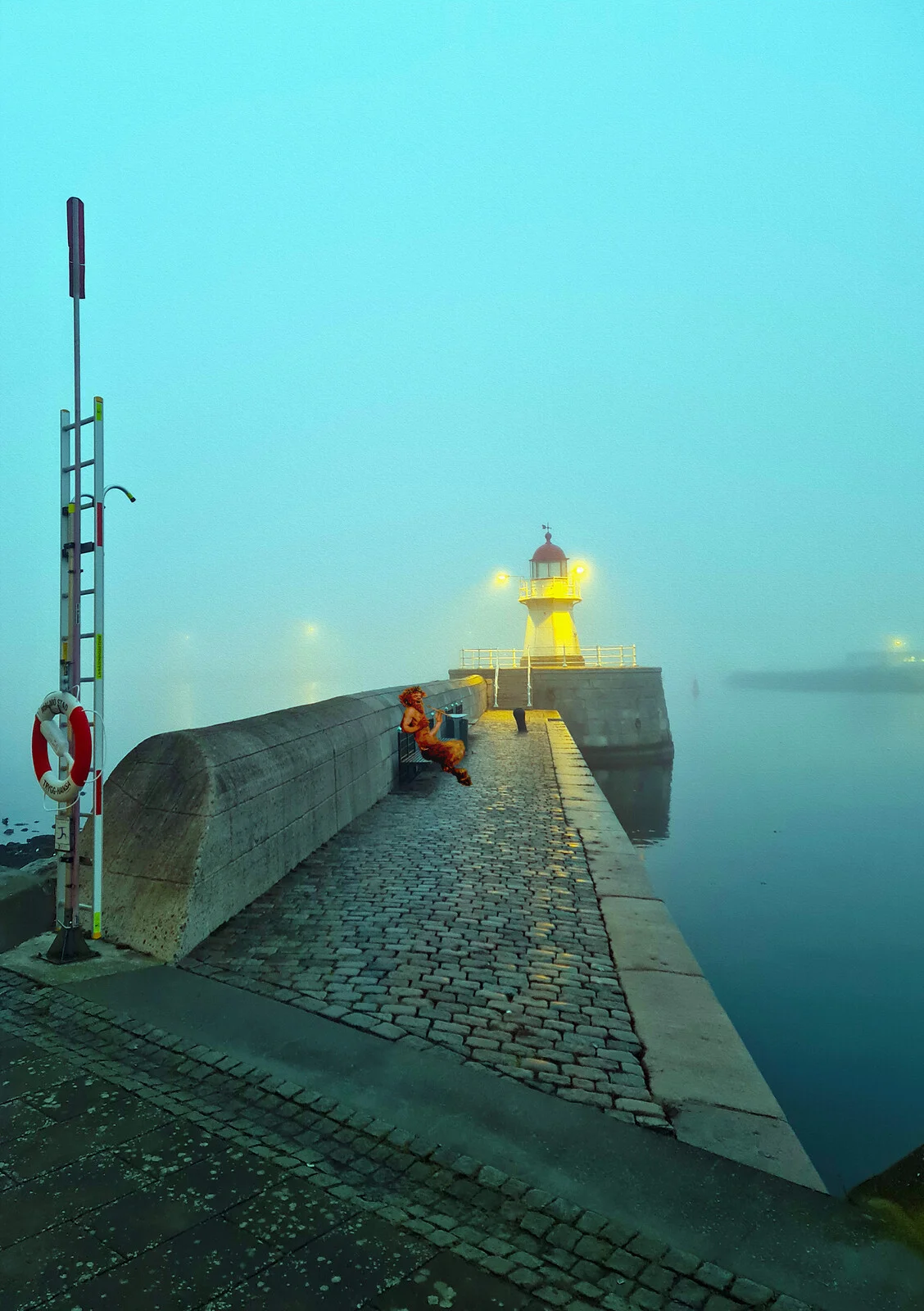
Solitude in Blue and Brown, 2019
Digital
50 x 70 cm
3 200 kr
On a misty evening in the harbour, a mystical union seemed to have occurred between the sky and the sea. Now enveloped in a soft, ethereal glow, the street lamps cast their light upon the almost still water in the harbour basin. In this enchanting setting, I first heard the distant, haunting notes of a flute, a melody that, for some inexplicable reason, brought to mind the god Pan.
Samuel Barber's 'Adagio for Strings', played on the flute, is a poignant tribute to Pan's eternal longing and profound connection with nature. The melody, with its echoes of Pan's mythic tales, stirs a complex blend of beauty and sorrow, mirroring the emotional depths of his character. The piece, renowned for its profound emotional resonance and melancholic beauty, resonates with Pan's feelings of loss and unrequited love, particularly his tragic love for the nymph Syrinx. The music in 'Adagio for Strings' is a breathtaking and profoundly sorrowful testament to Pan's timeless and melancholy spirit, a spirit that the flautist, whoever they may be, captured with remarkable skill.
I had stopped so my footsteps and breathing would not disturb the magical moment. After a while, the flute fell silent, and I was about to start walking again when the tones of Claude Debussy's 'Clair de Lune' wafted over the water. I now understood that the player must be sitting on the old lighthouse next to where I live. I crept quietly to satisfy my curiosity about who the flautist was. Pan continued to figure in my thoughts. 'Clair de Lune', with its dreamy and reflective qualities, could well illustrate Pan's nocturnal wanderings through the forests and his constant quest to reconcile with his nature. 'Clair de Lune', which translates to 'moonlight', could also connect to the myth of Pan and the moon goddess Selene, adding an extra layer of meaning to the melody about Pan's life and legends.
With their rich emotional landscape, these melodies could be perfect for Pan to express the deeper parts of his being on his flute, giving voice to his joy and endless melancholy.
As I stealthily approached the short pier with the small lighthouse, the figure of the lone flautist emerged from the mist. To my astonishment, it was Pan! Here he was, a mythical figure, traversing time and space, yet his presence in Malmö, Sweden, remained an enigma, deepening the intrigue and mystery.
Pan, the rustic and often mischievous god of the wild, is not only known for his musical talents and connection to nature but also for his vibrant erotic exploits. Famous for his sexual prowess, Pan is frequently depicted in ancient art and literature with a prominently raised phallus, symbolising his uninhibited nature and primal instincts.
The legendary tales of Pan's libidinous adventures include various accounts that highlight his unbridled desire. Diogenes of Sinope humorously recounted a tale wherein Pan learned the art of masturbation from his father, Hermes, and subsequently passed this knowledge onto his shepherds, further emphasising his role as a disseminator of both musical and sensual knowledge.
Among his romantic conquests was the moon goddess Selene. Pan, ever the schemer, managed to seduce her by disguising himself with a sheep's fleece, a testament to his cunning and ability to deceive for the sake of passion. This encounter blends his animalistic nature with his knack for trickery, painting a picture of a god as resourceful as he is lustful.
Perhaps the most poignant story of Pan's love affairs is the tale of Syrinx, a beautiful wood nymph and the daughter of Ladon, the river god. Syrinx was returning from a hunt when she encountered Pan, who immediately became infatuated with her. As she fled from his advances, she reached her sisters, who transformed her into a reed to protect her. Undeterred, Pan still felt the wind blow through the reeds, producing a sad melody. Unable to discern which reed was Syrinx, he crafted the first pan flute from her transformed body, arranging the reeds in order of decreasing length. This instrument, named after his beloved, symbolised his eternal longing and a constant reminder of his lost love.
The erotic nature of Pan extends even to more shocking imagery, such as depictions of Pan engaging in sexual activities with a goat—a statue found in the Villa of the Papyri at Herculaneum illustrates this vividly. These portrayals underscore his connection to the feral and untamed aspects of nature. Yet, he generally preferred the company of ladies, both mortal and divine. His voracious appetites and unchecked behaviour would certainly not withstand the scrutiny of modern movements like #MeToo, making figures like Weinstein appear tame by comparison.
Another nymph, Echo, became one of Pan's notable victims of unrequited love. When Echo, known for dancing and singing, rejected him, a spurned Pan commanded his followers to kill her. Torn to pieces, her remains were scattered across the earth, though Gaia, the Earth goddess, preserved her voice, which continued to resonate in caves, endlessly repeating the last words spoken to her. In some versions of the myth, Echo and Pan are said to have had children, while in others, she remains fixated on Narcissus, leading to her tragic demise.
Pan's love was also directed at Pitys, a nymph who turned into a pine tree to escape his advances. In a dramatic version of this story, Pan and the North wind god Boreas vied for her affection. Although Pitys initially chooses Pan, Boreas' jealousy leads him to chase her off a cliff, resulting in her death and subsequent transformation by Gaia into a pine tree.
Furthermore, Pan's teachings extended to Daphnis, the rustic son of Hermes, whom he taught to play the panpipes. Pan's affection for Daphnis highlights his role as both mentor and lover, further intertwining his sexual and pedagogical roles.
Women with multiple sexual partners were sometimes derogatorily called "Pan girls," reflecting societal views on promiscuity associated with Pan's uninhibited sexual nature.
Through these myths, Pan emerges as a complex figure whose eroticism is as wild and untamed as the landscapes he governs. His stories reveal ancient attitudes toward sexuality, nature, and the divine, illustrating a deity whose essence is woven into the very fabric of pastoral and wild realms.
There were many questions I would have liked to ask this mythological figure if I had dared to approach him. But I did not reach him before Pan stopped playing, and a faint breeze caused the mists to thicken, momentarily hiding the pier and the lighthouse, which disappeared into the fog. So did Pan, for when the mist cleared again, he was gone.
Jörgen Thornberg
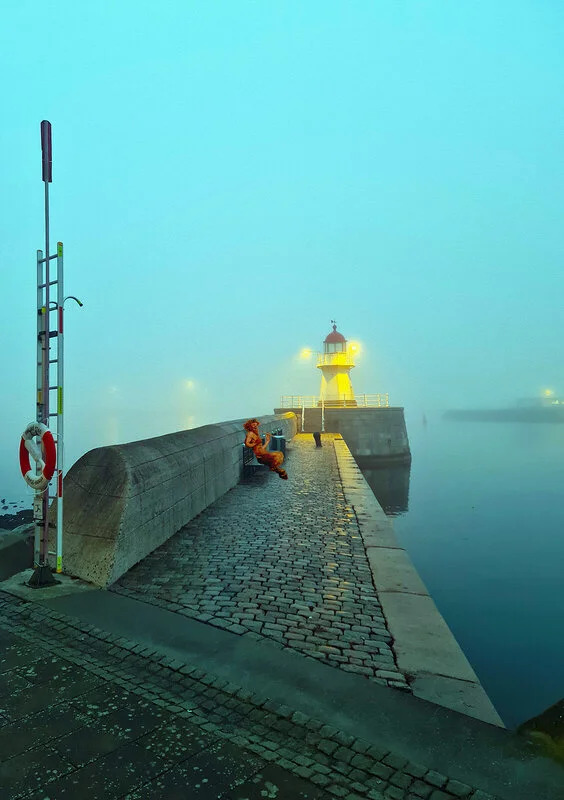
Solitude in Blue and Brown, 2019
Digital
50 x 70 cm
3 200 kr
On a misty evening in the harbour, a mystical union seemed to have occurred between the sky and the sea. Now enveloped in a soft, ethereal glow, the street lamps cast their light upon the almost still water in the harbour basin. In this enchanting setting, I first heard the distant, haunting notes of a flute, a melody that, for some inexplicable reason, brought to mind the god Pan.
Samuel Barber's 'Adagio for Strings', played on the flute, is a poignant tribute to Pan's eternal longing and profound connection with nature. The melody, with its echoes of Pan's mythic tales, stirs a complex blend of beauty and sorrow, mirroring the emotional depths of his character. The piece, renowned for its profound emotional resonance and melancholic beauty, resonates with Pan's feelings of loss and unrequited love, particularly his tragic love for the nymph Syrinx. The music in 'Adagio for Strings' is a breathtaking and profoundly sorrowful testament to Pan's timeless and melancholy spirit, a spirit that the flautist, whoever they may be, captured with remarkable skill.
I had stopped so my footsteps and breathing would not disturb the magical moment. After a while, the flute fell silent, and I was about to start walking again when the tones of Claude Debussy's 'Clair de Lune' wafted over the water. I now understood that the player must be sitting on the old lighthouse next to where I live. I crept quietly to satisfy my curiosity about who the flautist was. Pan continued to figure in my thoughts. 'Clair de Lune', with its dreamy and reflective qualities, could well illustrate Pan's nocturnal wanderings through the forests and his constant quest to reconcile with his nature. 'Clair de Lune', which translates to 'moonlight', could also connect to the myth of Pan and the moon goddess Selene, adding an extra layer of meaning to the melody about Pan's life and legends.
With their rich emotional landscape, these melodies could be perfect for Pan to express the deeper parts of his being on his flute, giving voice to his joy and endless melancholy.
As I stealthily approached the short pier with the small lighthouse, the figure of the lone flautist emerged from the mist. To my astonishment, it was Pan! Here he was, a mythical figure, traversing time and space, yet his presence in Malmö, Sweden, remained an enigma, deepening the intrigue and mystery.
Pan, the rustic and often mischievous god of the wild, is not only known for his musical talents and connection to nature but also for his vibrant erotic exploits. Famous for his sexual prowess, Pan is frequently depicted in ancient art and literature with a prominently raised phallus, symbolising his uninhibited nature and primal instincts.
The legendary tales of Pan's libidinous adventures include various accounts that highlight his unbridled desire. Diogenes of Sinope humorously recounted a tale wherein Pan learned the art of masturbation from his father, Hermes, and subsequently passed this knowledge onto his shepherds, further emphasising his role as a disseminator of both musical and sensual knowledge.
Among his romantic conquests was the moon goddess Selene. Pan, ever the schemer, managed to seduce her by disguising himself with a sheep's fleece, a testament to his cunning and ability to deceive for the sake of passion. This encounter blends his animalistic nature with his knack for trickery, painting a picture of a god as resourceful as he is lustful.
Perhaps the most poignant story of Pan's love affairs is the tale of Syrinx, a beautiful wood nymph and the daughter of Ladon, the river god. Syrinx was returning from a hunt when she encountered Pan, who immediately became infatuated with her. As she fled from his advances, she reached her sisters, who transformed her into a reed to protect her. Undeterred, Pan still felt the wind blow through the reeds, producing a sad melody. Unable to discern which reed was Syrinx, he crafted the first pan flute from her transformed body, arranging the reeds in order of decreasing length. This instrument, named after his beloved, symbolised his eternal longing and a constant reminder of his lost love.
The erotic nature of Pan extends even to more shocking imagery, such as depictions of Pan engaging in sexual activities with a goat—a statue found in the Villa of the Papyri at Herculaneum illustrates this vividly. These portrayals underscore his connection to the feral and untamed aspects of nature. Yet, he generally preferred the company of ladies, both mortal and divine. His voracious appetites and unchecked behaviour would certainly not withstand the scrutiny of modern movements like #MeToo, making figures like Weinstein appear tame by comparison.
Another nymph, Echo, became one of Pan's notable victims of unrequited love. When Echo, known for dancing and singing, rejected him, a spurned Pan commanded his followers to kill her. Torn to pieces, her remains were scattered across the earth, though Gaia, the Earth goddess, preserved her voice, which continued to resonate in caves, endlessly repeating the last words spoken to her. In some versions of the myth, Echo and Pan are said to have had children, while in others, she remains fixated on Narcissus, leading to her tragic demise.
Pan's love was also directed at Pitys, a nymph who turned into a pine tree to escape his advances. In a dramatic version of this story, Pan and the North wind god Boreas vied for her affection. Although Pitys initially chooses Pan, Boreas' jealousy leads him to chase her off a cliff, resulting in her death and subsequent transformation by Gaia into a pine tree.
Furthermore, Pan's teachings extended to Daphnis, the rustic son of Hermes, whom he taught to play the panpipes. Pan's affection for Daphnis highlights his role as both mentor and lover, further intertwining his sexual and pedagogical roles.
Women with multiple sexual partners were sometimes derogatorily called "Pan girls," reflecting societal views on promiscuity associated with Pan's uninhibited sexual nature.
Through these myths, Pan emerges as a complex figure whose eroticism is as wild and untamed as the landscapes he governs. His stories reveal ancient attitudes toward sexuality, nature, and the divine, illustrating a deity whose essence is woven into the very fabric of pastoral and wild realms.
There were many questions I would have liked to ask this mythological figure if I had dared to approach him. But I did not reach him before Pan stopped playing, and a faint breeze caused the mists to thicken, momentarily hiding the pier and the lighthouse, which disappeared into the fog. So did Pan, for when the mist cleared again, he was gone.
3 200 kr

Jörgen Thornberg
Malmö
Lite om bilder och mig. Translation in English at the end.
Jag är en nyfiken person som ser allt i bilder, även det jag fäster i ord, gärna tillsammans för bakom alla mina bilder finns en berättelse. Till vissa bilder hör en kortare eller längre novell som följer med bilden.
Bilder berättar historier. Jag omges av naturlig skönhet, intressanta människor och historia var jag än går. Jag använder min kamera för att dokumentera världen och blanda det jag ser med vad jag känner för att fånga den dolda magin.
Mina bilder berättar mina historier. Genom mina bilder, tryck och berättelser. Jag bjuder in dig att ta del av dessa berättelser, in i ditt liv och hem och dela min mycket personliga syn på vår värld. Mer än vad ögat ser. Jag tänker i bilder, drömmer och skriver och pratar om dem; följaktligen måste jag också skapa bilder. De blir vad jag ser, inte nödvändigtvis begränsade till verkligheten. Det finns en bild runt varje hörn. Jag hoppas att du kommer att se vad jag såg och gilla det.
Jag är också en skrivande person och till många bilder hör en kortare eller längre essay. Den följer med tavlan, tryckt på fint papper och med en personlig hälsning från mig.
Flertalet bilder startar sin resa i min kamera. Enkelt förklarat beskriver jag bilden jag ser i mitt inre, upplevd eller fantiserad. Bilden uppstår inom mig redan innan jag fått okularet till ögat. På bråkdelen av ett ögonblick ser jag vad jag vill ha och vad som kan göras med bilden. Här skall jag stoppa in en giraff, stålmannen, Titanic eller vad det är min fantasi finner ut. Ännu märkligare är att jag kommer ihåg minnesbilden långt efteråt när det blir tid att skapa verket. Om jag lyckas eller inte, är upp till betraktaren, oftast präglat av en stråk av svart humor – meningen är att man skall bli underhållen. Mina bilder blir ofta en snackis där de hänger.
Jag föredrar bilder som förmedlar ett budskap i flera lager. Vid första anblicken fylld av feel-good, en vacker utsikt, fint väder, solen skiner, blommor på ängen eller vattnet som ligger förrädiskt spegelblankt. I en sådan bild kan jag gömma min egentliga berättelse, mitt förakt för förtryckare och våldsverkare, rasister och fördomsfulla människor - ett gärna återkommande motiv mer eller mindre dolt i det vackra motivet. Jag försöker förena dem i ett gemensamt narrativ.
Bild och formgivning har löpt som en röd tråd genom livet. Fotokonst känns som en värdig final som jag gärna delar med mig.
Min genre är vid som framgår av mina bilder, temat en blandning av pop- och gatukonst i kollage som kan bestå av hundratals lager. Vissa bilder kan ta veckor, andra någon dag innan det är dags att överlämna resultatet till printverkstaden. Fine Art Prints är digitala fotocollage. I dessa kollage sker rivandet, klippandet, pusslandet, målandet, ritandet och sprayningen digitalt. Det jag monterar in kan vara hundratals år gamla bilder som jag omsorgsfullt frilägger så att de ser ut att vara en del av tavlan men också bilder skapade av mig själv efter min egen fantasi. Därefter besöks printstudion och för vissa bilder numrera en limiterad upplaga (oftast 7 exemplar) och signera för hand. Vissa bilder kan köpas i olika format. Det är bara att fråga efter vilka. Gillar man en bild som är 70x100 men inte har plats på väggen, går den kanske att få i 50x70 cm istället. Frågan är fri.
Metoden Giclée eller Fine Art Print som det också kallas är det moderna sättet för framställning av grafisk konst. Villkoret för denna typ av utskrifter är att en högkvalitativ storformatskrivare används med åldersbeständigt färgpigment och konstnärspapper eller i förekommande fall på duk. Pappret som används möter de krav på livslängd som ställs av museer och gallerier. Normalt säljer jag mina bilder oinramade så att den nya ägaren själv kan bestämma hur de skall se ut, med eller utan passepartout färg på ram, med eller utan glas etc..
Under många år ställde jag bara ut på nätet, i valda grupper och på min egen Facebooksida - https://www.facebook.com/jorgen.thornberg.9
Jag finns också på en egen hemsida som tyvärr inte alltid är uppdaterad – https://www.jth.life/ Där kan du också läsa en del av de berättelser som följer med bilden.
UTSTÄLLNINGAR
Luftkastellet, oktober 2022
Konst i Lund, november 2022
Luftkastellet, mars 2023
Engleson Galleri Caroli, april 2023
Hydra, Greece June 2023
Engleson Galleri Caroli, oktober 2023
Toppen, Höllviken december 2023
Luftkastellet, mars 2024
Torups Galleri, mars 2024
Venice, May 2024
Luftkastellet, oktober 2024
Konst i Advent, December 2024
Galleri Engleson, Caroli December 2024
Jäger & Jansson Galleri, april 2025
A bit about pictures and me.
I'm a curious person who sees everything in pictures, even what I express in words, often combining them, for behind all my pictures lies a story. These narratives, some as short as a single image and others as long as a novel, are the heart and soul of my work.
Pictures tell stories. Wherever I go, I'm surrounded by natural beauty, exciting people, and history. I use my camera to document the world and blend what I see with what I feel to capture the hidden magic.
My images tell my stories. Through my pictures, prints, and narratives, I invite you to partake in these stories in your life and home and share my deeply personal perspective of our world. More than meets the eye. I think in pictures, dream, write, and talk about them; consequently, I must create images too. They become what I see, not necessarily confined to reality. There's a picture around every corner. I hope you'll see what I saw and enjoy it.
I'm also a writer, and many images come with a shorter or longer essay. It accompanies the painting, printed on fine paper with my personal greeting.
Many pictures start their journey on my camera. Simply put, I describe the image I see in my mind, experienced or imagined. The image arises within me even before I bring the eyepiece to my eye. In a fraction of a moment, I see what I want and what can be done with the picture. Here, I'll insert a giraffe, Superman, the Titanic, or whatever my imagination conjures up. Even stranger is that I remember the mental image long after it's time to create the work. Whether I succeed is up to the observer, often imbued with a streak of black humour – the aim is to entertain. My pictures usually become a talking point wherever they hang.
I prefer pictures that convey a message in multiple layers. At first glance, they're filled with feel-good vibes, a beautiful view, lovely weather, the sun shining, flowers in the meadow, or the water lying deceptively calm. But beneath this surface beauty, I often conceal a deeper story, a narrative that challenges societal norms or explores the human condition. I invite you to delve into these hidden narratives and discover the layers of meaning within my work.
Picture and design have been a thread running through my life. Photographic art feels like a fitting finale, and I'm happy to share it.
My genre is varied, as seen in my pictures; the theme is a blend of pop and street art in collages that can consist of hundreds of layers. Some images can take weeks, others just a day before it's time to hand over the result to the print workshop. Fine Art Prints are digital photo collages. In these collages, tearing, cutting, puzzling, painting, drawing, and spraying happen digitally. What I insert can be images hundreds of years old that I carefully extract so they appear to be part of the painting, but also images created by myself, now also generated from my imagination. Next, visit the print studio and, for certain images, number a limited edition (usually 7 copies) and sign them by hand. Some images may be available in other formats. Just ask which ones. If you like an image that's 70x100 but doesn't have space on the wall, you might be able to get it in 50x70 cm instead. The question is open.
The Giclée method, or Fine Art Print as it's also called, is the modern way of producing graphic art. This method ensures the highest quality and longevity of the artwork, using a high-quality large-format printer with archival pigment inks and artist paper or, in some cases, canvas. The paper used meets the longevity requirements set by museums and galleries. I sell my pictures unframed, allowing the new owner to personalise their artwork, confident in the lasting value and quality of the piece.
For many years, I only exhibited online, in selected groups, and on my Facebook page - https://www.facebook.com/jorgen.thornberg.9. I also have my website, which unfortunately is not constantly updated - https://www.jth.life/. You can also read some of the stories accompanying the pictures there.
EXHIBITIONS
Luftkastellet, October 2022
Art in Lund, November 2022
Luftkastellet, March 2023
Engleson Gallery Caroli, April 2023
Hydra, Greece June 2023
Engleson Gallery Caroli, October 2023
Toppen, Höllviken December 2023
Luftkastellet, March 2024
Torup Gallery, March 2024
Venice, May 2024
UTSTÄLLNINGAR
Luftkastellet, oktober 2022
Konst i Lund, november 2022
Luftkastellet, mars 2023
Engleson Galleri Caroli, april 2023
Hydra, Greece June 2023
Engleson Galleri Caroli, oktober 2023
Toppen, Höllviken december 2023
Luftkastellet, mars 2024
Torups Galleri, mars 2024
Venice, May 2024
Luftkastellet, October 2024
Konst i Advent, December 2024
Galleri Engleson, Caroli December 2024
Jäger & Jansson Galleri, April 2025
Utbildning
Autodidakt
Medlem i konstnärsförening
Öppna Sinnen
Med i konstrunda
Konstrundan i Skåne
Utställningar
Luftkastellet, October 2022
Art in Lund, November 2022
Luftkastellet, March 2023
Engleson Gallery Caroli, April 2023
Hydra, Greece June 2023
Engleson Gallery Caroli, October 2023
Toppen, Höllviken December 2023
Luftkastellet, March 2024
Torup Gallery, March 2024
Venice, May 2024