Vi använder cookies för att ge dig bästa möjliga upplevelse. Välj vilka cookies du tillåter.
Läs mer i vår integritetspolicy
Jörgen Thornberg
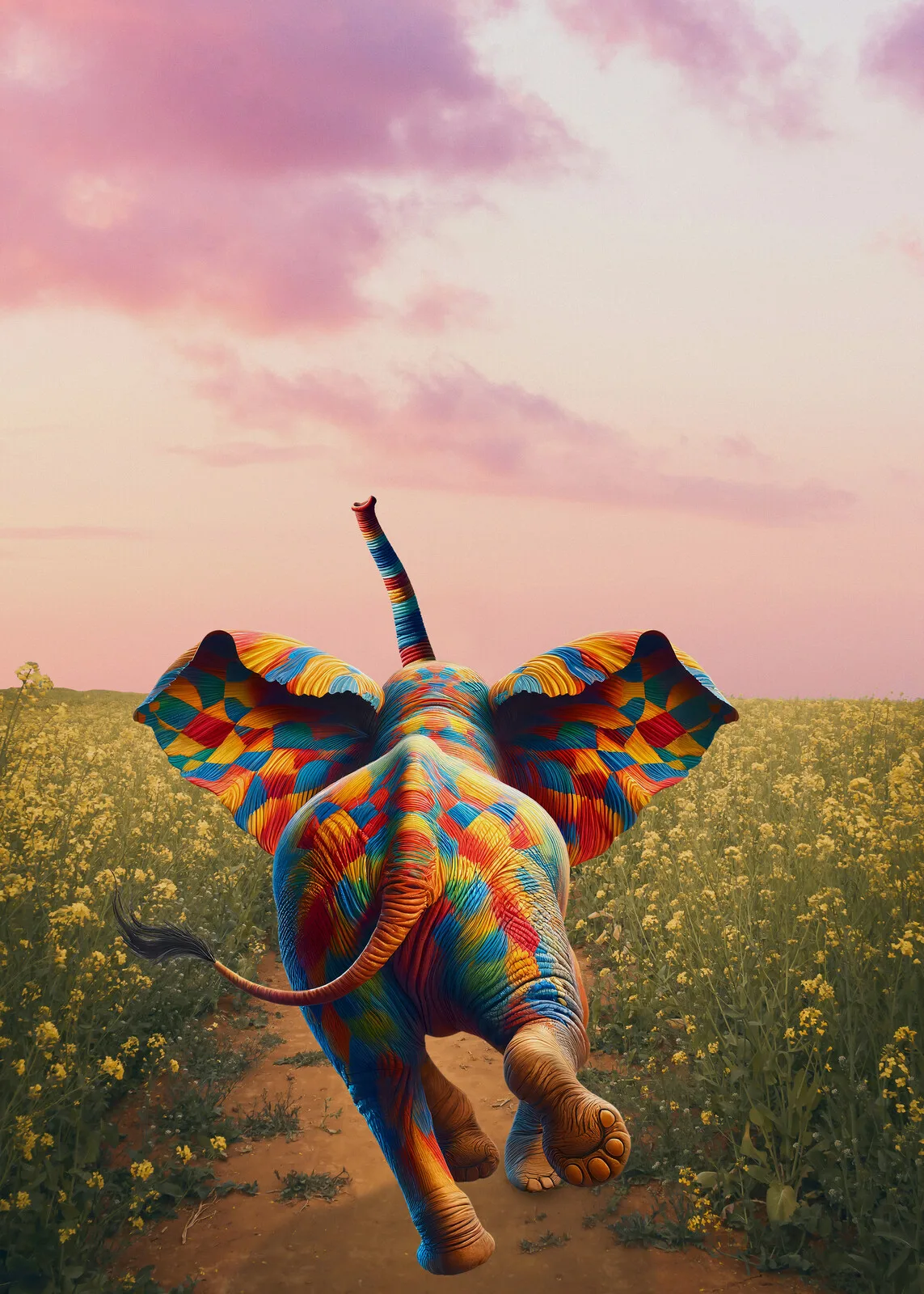
A Harlequin in the Rapeseed, 2024
Digital
50 x 70 cm
3 200 kr
It was evening, and the sky began to turn pink, which made the yellow rapeseed appear even more beautiful. No wonder the character Harlequin, who could be a devilish trickster and a romantic hero, inspired the elephant to dress up in a harlequin costume. The elephant, like Harlequin, runs like mad towards the pink horizon beyond the rapeseed fields due to his excellent sense of smell. The elephant smells the scent of fresh green grass, a spring delicacy, and his favourite salad. The cows can keep the rapeseed. The colour is nice, but the strong smell is not his favourite.
He was a retired circus elephant, now living a quieter life far from the big top. Despite the ban on elephants in circuses—implemented because of concerns about animal welfare—he couldn't help but reminisce about the roaring crowds and the excitement of his performances. Nonetheless, he found peace in his retirement, grazing freely on lush fields. However, the thrill of the circus never indeed left him.
Once he had filled his belly with the fresh green grass, a springtime treat he thoroughly enjoyed, he planned to go to Lund. A circus had recently arrived there, and although he could no longer be a part of the spectacle, he could still partake in the joy it brought. He looked forward to watching the clowns, whose antics reminded him of his younger days under the circus tent. Their skilled comedy, reminiscent of his past companions, promised a delightful distraction and a touch of nostalgia.
This evening's outing wasn't just about feeding on fresh grass—it was about feeding his soul with the cherished memories of his past life and embracing the laughter that had always fueled his spirit. As he headed toward the University town Lund, the retired circus elephant felt a spark of his old self, excited to be near the circus atmosphere once again, even if just as a spectator.
Interestingly, no one had ever asked the elephants what they thought about these bans. Being a circus elephant had its perks—tusks were left intact and not hunted by African poachers. Moreover, the food provided by the circus was often better than what the savannah could offer. In the safety and camaraderie of the circus, many elephants found a life removed from the dangers of the wild, enjoying regular meals and the protection of their human caretakers.
Amidst the cavalcade of characters in the grand tapestry of Commedia dell'Arte, a form of Italian theatre that emerged in the 16th century, none dances quite so vividly through the annals of history as the Harlequin. Cloaked in his iconic checkered costume, Harlequin embodies the quintessential trickster, his antics woven from the threads of medieval mischief and romantic intrigue.
The character of Harlequin, known initially as Arlecchino in Italian, is steeped in a rich history that traces back to a darker origin—a devilish figure in medieval Passion plays. This mischievous devil, known as Hellequin or Alichino in Dante's Inferno, pranked souls with a carnivalesque glee that eerily mirrored the zany exploits of his theatrical descendant. However, during Commedia dell'Arte's stages, Arlecchino came into his own, evolving from his devilish roots into a Clever, light-hearted servant whose agility was as sharp as his wit. This transformation from a sinister figure to a playful servant is a fascinating journey that piques the curiosity of those interested in the character's evolution.
Yet, on the stages of Commedia dell'Arte, Arlecchino came into his own, evolving from his devilish roots into a clever, light-hearted servant whose agility was as sharp as his wit. No mere walk from one side of the stage to another, Harlequin would vault, tumble, and cartwheel, turning every movement into a spectacle. His physical prowess was unmatched. He famously performed feats of acrobatics that left audiences spellbound, always without the aid of artificial padding despite his seemingly humpbacked appearance. Harlequin's physical appearance, with his humpback and checkered costume, was as iconic as his character.
Harlequin's antics were not limited to physical comedy. He was a master of improvisation and disguise, using his wooden sword as if it were a fan one moment or devouring food with comedic gusto the next. His parody of bel canto would have audiences in stitches as he mimicked the operatic elite with exaggerated flamboyance. But perhaps the most magical of his attributes was his battle or 'slapstick,' a prop that he wielded to transform scenes with a comedic bang. Slapstick refers to a type of physical comedy involving exaggerated movements and gestures, often accompanied by a loud, slapping sound, that Harlequin used to shift settings with the ease of a magician conjuring illusions from thin air.
As the English pantomime tradition took hold, Harlequin's role expanded in the Harlequinade, where he was often paired with the Clown. Together, they created a dynamic duo that chased scenes across imaginative landscapes. Harlequin was always one step ahead of his comedic counterpart, navigating through chaotic realms with a lover's quarrel or a master's plan hanging in the balance.
In love, as in jest, Harlequin was a romantic at heart. His pursuit of Columbina, a character often portrayed as a maidservant, often in competition with the melancholic Pierrot, a character known for his sad clown persona, added a layer of romantic comedy to his character, showcasing his ability to outwit rivals and win hearts, not merely through slapstick but through genuine emotional appeal. This transformation marked Harlequin's final leap from his origins as a demon trickster to a prototype of the romantic hero, a figure capable of inspiring laughter and love. This emotional depth and ability to evoke admiration and respect in the readers interested in the character's emotional depth.
Today, Harlequin's legacy continues in various forms, influencing characters across popular culture. From Harley Quinn's chaotic allure in the DC Comics universe to Arlecchino's multiple incarnations in video games like 'Genshin Impact' and 'Lies of P,' his spirit thrives in narratives that celebrate the blend of mischief, agility, and wit that originally defined him. For instance, Harley Quinn, a character in the DC Comics universe, draws inspiration from Harlequin's playful and mischievous nature. Similarly, Arlecchino, a character in the video game 'Genshin Impact,' mirrors Harlequin's acrobatic skills and wit. This widespread influence and recognition in popular culture is a testament to the enduring allure of a character who can dance between the comic and the profound, the diabolical and the divine, and it is sure to be appreciated by readers interested in the character's influence.
Harlequin's journey from the medieval stages of passion plays to the bright lights of modern media illustrates not just the adaptability of a character but the timeless appeal of a persona that encapsulates the human experience: joy, sorrow, love, and above all, an irrepressible zest for life.
Commedia dell'Arte, an improvisational form of theatre that originated in Italy in the 16th century, is distinguished by its vivid characters. These characters are divided into distinct groups, each serving specific roles within the story. These groups and their members contribute uniquely to the dynamism and humour of the performances.
Character Groups and Their Roles
Zanni: Typically servants or clowns, these characters are essential for their cunning and street-smart antics, often driving the comedic aspect of the plays. Prominent members include:
Arlecchino (Harlequin). As mentioned, he is a clever and mischievous servant known for his acrobatic and agile movements.
Brighella: A more corrupt and self-serving version of Arlecchino.
Scapino: Another crafty servant known for concocting elaborate schemes.
Pulcinella, often depicted in a baggy, white outfit, is known for his macabre humour and connection to the Neapolitan tradition.
Pedrolino: A gentle and endearing clown, often the sad romantic in the troupe.
Vecchi: These are the wealthy old men or masters, representing authority or the status quo, often the butt of jokes due to their gullibility or passionate tendencies. They include:
Pantalone: A miserly old merchant dressed in red trousers and dark capes, symbolic of old Venetian wealth.
Il Dottore: The pompous academic from Bologna, often robed in black, adds a scholarly air to his comic ignorance.
Innamorati: These characters are young lovers from the upper class, naive and overly dramatic, generally oblivious to the scheming around them. Typical names are:
Flavio and Isabella Represent the quintessential romantic duo, dressed in contemporary fashions that signify their wealth and status.
The braggarts, self-styled captains, or the matriarch if a female character takes the role. They include:
Il Capitano: Often a swaggering soldier in a military uniform, boasting of fictitious exploits.
La Signora (if applicable): A commanding female counterpart, sometimes a widow or a woman of means.
Other Characters
Scaramouche (Scaramuccia): Known for his black Spanish dress and duplicitous nature, he is initially a braggart with villainous traits.
Sandrone: A shrewd peasant in a corduroy jacket and pants, often sporting red and white cross-striped socks.
Tartaglia is a stuttering politician who is often caught in the bureaucratic absurdity of his own making.
Commedia dell'Arte in Art
The vibrant characters of Commedia dell'Arte have also captured the imagination of visual artists. A French painter, Jean-Antoine Watteau, famously depicted these theatrical figures, most notably in his portrayal of Pierrot (identified as "Gilles"). This painting, housed in the Louvre in Paris, shows the sad Clown in a poignant stance, dressed in the traditional white garb that highlights his isolative and melancholic nature amidst a festive backdrop. This stark contrast embodies the inherent tension in Commedia dell'Arte between the joyous exterior and the complex, often darker human emotions lurking beneath.
Commedia dell'Arte profoundly influences the performing arts due to its dynamic characters, whose exaggerated personas and interactions reflect broader human truths. The interplay of these characters, from the cunning Zanni to the hapless Vecchi, creates a lively and engaging spectacle that continues to resonate with audiences and influence modern theatre. By weaving together humour, social commentary, and human emotion, Commedia dell'Arte celebrates the complexity of life through the simple yet profound act of masked performance.
As we trace the evolution of Commedia dell'Arte into modern times, we see its spirit and structure adapting to new forms of entertainment while maintaining its core elements of masked characters and improvised performance. This theatrical tradition has survived and thrived, continually influencing a wide array of performance arts, from puppetry to circus acts.
In puppetry, the essence of Commedia dell'Arte is vividly alive in the form of marionettes and hand puppets, such as the German Kasperle (Kasper dolls), which are direct descendants of the Commedia character Pulcinella. These puppets, utilised in comedic storytelling, embody the Commedia's flair for expressive character-driven plots and have become central to children's theatre in many cultures. The lively, impromptu interactions defining Commedia performances are ideally suited to puppet shows, where the exaggerated actions and vibrant dialogues captivate young and old audiences.
The influence of Commedia dell'Arte is also distinctly visible in the circus world, particularly in the personas of clowns. Much like their theatrical predecessors, circus clowns perform routines that blend slapstick humour with acrobatic feats, often involving audience interaction and improvised antics. The Clown's sad and happy faces can be traced back to the masks of Commedia, embodying the dual nature of human emotion. Like the Zanni, Clowns use physical comedy and exaggerated expressions to tell stories of misfortune and resilience, bringing laughter and joy to diverse audiences.
Moreover, modern improv theatre owes an outstanding debt to Commedia dell'Arte. The very principles of spontaneous performance and character archetypes central to shows such as "Whose Line Is It Anyway?" are inherited from the streets and stages of 16th-century Italy. These performers tap into the universal appeal of characters like the crafty servant or the braggart captain, proving that the archetypal stories of Commedia dell'Arte are as engaging today as they were over four centuries ago.
The legacy of Commedia dell'Arte is also vividly present in the world of film, notably through the iconic works of Charlie Chaplin. His character, The Tramp, embodies many traits of the Commedia's Zanni—resourceful, agile, and with a penchant for causing and resolving chaos. Chaplin's mastery of physical comedy and ability to convey profound emotion through subtle gestures and expressions draw directly from the Commedia tradition. Much like the Commedia performances, his films combine humour with a sharp critique of society and human nature, resonating with audiences across different cultures and eras.
In conclusion, Commedia dell'Arte continues to resonate within the modern fabric of performing arts through its dynamic characters and the fundamental human truths they embody. Its legacy is a testament to the enduring appeal of storytelling through bold expressions and imaginative improvisation. Whether through the subtle gestures of a puppet, the vibrant antics of a circus clown, or the witty exchanges of improv actors, the spirit of Commedia dell'Arte lives on, bringing joy and reflection to new generations.
Immersed in the heart of a rapeseed field, the air is filled with the sweet scent of spring, and the eyes are met with a vibrant yellow blanket stretching in every direction. This sensory experience stirs something deep within as the warm hues conjure memories of sunny afternoons, gentle breezes, and childhood games. The bright yellow flowers of rapeseed radiate unparalleled warmth and vitality; their colour is often associated with optimism, creativity, and energy. Combined with the clear blue sky and the verdant green of surrounding hills or woods, the fields evoke a sense of endless possibilities and the intoxicating promise of spring.
The delicate petals flutter as the breeze sweeps through the fields, creating a rustling sound like a gentle whisper. This harmonious symphony and the song of birds returning from winter migrations complete the idyllic scene. The heady scent of rapeseed flowers fills the air, making spring sensations vibrate in the nostrils, sparking the spirit and igniting a sense of renewal. From a distance, the rapeseed fields resemble a vast quilt stitched together by nature. The varying shades of yellow, depending on the sun's angle and the field's maturity, provide a rich mosaic that complements the surrounding landscape and accentuates the vibrant colours of spring.
Yet, beyond their romantic allure, these fields represent something much more. Rapeseed, scientifically known as *Brassica napus*, is one of the world's most important oilseed crops. It thrives in temperate climates and has been cultivated for thousands of years. Traditionally used for lamp oil and animal fodder, the crop's modern resurgence is due to its versatile crude, known as canola oil in North America. This oil is prized for its light flavour, high smoke point, and heart-healthy properties, making it a staple in kitchens worldwide. Beyond culinary uses, rapeseed oil is also used in biodiesel production, reducing our reliance on fossil fuels and offering a sustainable energy alternative.
The economic significance of rapeseed fields extends beyond oil production. Their cultivation is a vital part of maintaining soil health. As a cover crop, rapeseed prevents erosion, enriches the soil with organic matter, and suppresses weeds. Its deep roots also help break up compacted soils, promoting better water infiltration and nutrient uptake for subsequent crops. The fields serve as a crucial habitat for pollinators like bees, drawn to the flowers' nectar. This symbiotic relationship not only supports biodiversity but also ensures the successful pollination of the crop, highlighting the ecological importance of rapeseed fields.
Rapeseed fields have become an iconic symbol of spring in many parts of Europe, particularly in the UK, France, and Germany. In the coastal regions of southern Sweden, the fields seem to emerge from the sea, draping the undulating hills in a golden blanket. The landscape transforms into a paradise for photographers, nature lovers, and those seeking solace in the beauty of nature. The golden fields have inspired countless artists, poets, and writers, capturing the imagination with their vibrancy and splendour, underscoring the cultural significance of rapeseed fields.
Witnessing nature's cycles and rhythms has a certain romance, and the rapeseed fields embody this beautifully. They remind us that even after the darkest winters, the sun will rise again, and life will burst forth in glorious colours. In a world that often feels disconnected from the natural rhythms of life, these fields offer a moment of grounding and reconnection.
Yet, the story of rapeseed is not just one of beauty and economy but also one of resilience and adaptation. Despite facing challenges such as climate change, pests, and diseases, farmers have continued to innovate, developing more resilient varieties and sustainable farming practices. This determination and ingenuity ensure that the fields will continue to bloom, year after year, painting the landscape in golden hues and filling the air with the sweet scent of spring. Their unwavering commitment to the land is a testament to the human spirit and our deep connection with nature.
As the chill of winter subsides and spring awakens the earth, the landscape in many parts of the world transforms into a tapestry of golden yellow, heralding the arrival of one of nature's most captivating crops: rapeseed. Fields stretching to the horizon, bathed in sunlight and shimmering like a sea of gold, evoke a sense of renewal, beauty, and abundance. The sight of rapeseed in bloom is a feast for the senses and a reminder of nature's capacity to inspire joy and wonder, maybe not to elephants but to humans.
So, the next time you find yourself near a rapeseed field, take a moment to breathe in the fragrant air, listen to the whispering breeze, and marvel at the sea of gold stretching to the horizon. It is a reminder that amidst the chaos and uncertainty of life, there is still beauty and wonder in the world, waiting to be discovered in the golden fields of spring.
Jörgen Thornberg
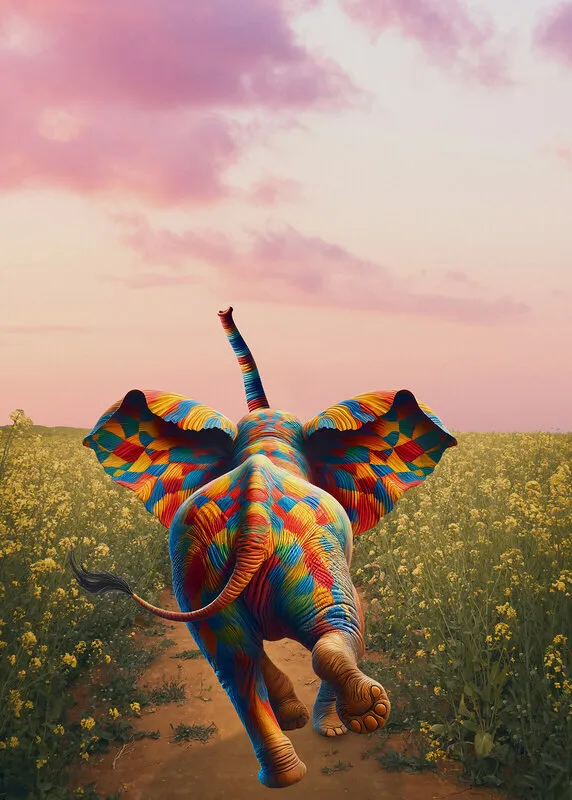
A Harlequin in the Rapeseed, 2024
Digital
50 x 70 cm
3 200 kr
It was evening, and the sky began to turn pink, which made the yellow rapeseed appear even more beautiful. No wonder the character Harlequin, who could be a devilish trickster and a romantic hero, inspired the elephant to dress up in a harlequin costume. The elephant, like Harlequin, runs like mad towards the pink horizon beyond the rapeseed fields due to his excellent sense of smell. The elephant smells the scent of fresh green grass, a spring delicacy, and his favourite salad. The cows can keep the rapeseed. The colour is nice, but the strong smell is not his favourite.
He was a retired circus elephant, now living a quieter life far from the big top. Despite the ban on elephants in circuses—implemented because of concerns about animal welfare—he couldn't help but reminisce about the roaring crowds and the excitement of his performances. Nonetheless, he found peace in his retirement, grazing freely on lush fields. However, the thrill of the circus never indeed left him.
Once he had filled his belly with the fresh green grass, a springtime treat he thoroughly enjoyed, he planned to go to Lund. A circus had recently arrived there, and although he could no longer be a part of the spectacle, he could still partake in the joy it brought. He looked forward to watching the clowns, whose antics reminded him of his younger days under the circus tent. Their skilled comedy, reminiscent of his past companions, promised a delightful distraction and a touch of nostalgia.
This evening's outing wasn't just about feeding on fresh grass—it was about feeding his soul with the cherished memories of his past life and embracing the laughter that had always fueled his spirit. As he headed toward the University town Lund, the retired circus elephant felt a spark of his old self, excited to be near the circus atmosphere once again, even if just as a spectator.
Interestingly, no one had ever asked the elephants what they thought about these bans. Being a circus elephant had its perks—tusks were left intact and not hunted by African poachers. Moreover, the food provided by the circus was often better than what the savannah could offer. In the safety and camaraderie of the circus, many elephants found a life removed from the dangers of the wild, enjoying regular meals and the protection of their human caretakers.
Amidst the cavalcade of characters in the grand tapestry of Commedia dell'Arte, a form of Italian theatre that emerged in the 16th century, none dances quite so vividly through the annals of history as the Harlequin. Cloaked in his iconic checkered costume, Harlequin embodies the quintessential trickster, his antics woven from the threads of medieval mischief and romantic intrigue.
The character of Harlequin, known initially as Arlecchino in Italian, is steeped in a rich history that traces back to a darker origin—a devilish figure in medieval Passion plays. This mischievous devil, known as Hellequin or Alichino in Dante's Inferno, pranked souls with a carnivalesque glee that eerily mirrored the zany exploits of his theatrical descendant. However, during Commedia dell'Arte's stages, Arlecchino came into his own, evolving from his devilish roots into a Clever, light-hearted servant whose agility was as sharp as his wit. This transformation from a sinister figure to a playful servant is a fascinating journey that piques the curiosity of those interested in the character's evolution.
Yet, on the stages of Commedia dell'Arte, Arlecchino came into his own, evolving from his devilish roots into a clever, light-hearted servant whose agility was as sharp as his wit. No mere walk from one side of the stage to another, Harlequin would vault, tumble, and cartwheel, turning every movement into a spectacle. His physical prowess was unmatched. He famously performed feats of acrobatics that left audiences spellbound, always without the aid of artificial padding despite his seemingly humpbacked appearance. Harlequin's physical appearance, with his humpback and checkered costume, was as iconic as his character.
Harlequin's antics were not limited to physical comedy. He was a master of improvisation and disguise, using his wooden sword as if it were a fan one moment or devouring food with comedic gusto the next. His parody of bel canto would have audiences in stitches as he mimicked the operatic elite with exaggerated flamboyance. But perhaps the most magical of his attributes was his battle or 'slapstick,' a prop that he wielded to transform scenes with a comedic bang. Slapstick refers to a type of physical comedy involving exaggerated movements and gestures, often accompanied by a loud, slapping sound, that Harlequin used to shift settings with the ease of a magician conjuring illusions from thin air.
As the English pantomime tradition took hold, Harlequin's role expanded in the Harlequinade, where he was often paired with the Clown. Together, they created a dynamic duo that chased scenes across imaginative landscapes. Harlequin was always one step ahead of his comedic counterpart, navigating through chaotic realms with a lover's quarrel or a master's plan hanging in the balance.
In love, as in jest, Harlequin was a romantic at heart. His pursuit of Columbina, a character often portrayed as a maidservant, often in competition with the melancholic Pierrot, a character known for his sad clown persona, added a layer of romantic comedy to his character, showcasing his ability to outwit rivals and win hearts, not merely through slapstick but through genuine emotional appeal. This transformation marked Harlequin's final leap from his origins as a demon trickster to a prototype of the romantic hero, a figure capable of inspiring laughter and love. This emotional depth and ability to evoke admiration and respect in the readers interested in the character's emotional depth.
Today, Harlequin's legacy continues in various forms, influencing characters across popular culture. From Harley Quinn's chaotic allure in the DC Comics universe to Arlecchino's multiple incarnations in video games like 'Genshin Impact' and 'Lies of P,' his spirit thrives in narratives that celebrate the blend of mischief, agility, and wit that originally defined him. For instance, Harley Quinn, a character in the DC Comics universe, draws inspiration from Harlequin's playful and mischievous nature. Similarly, Arlecchino, a character in the video game 'Genshin Impact,' mirrors Harlequin's acrobatic skills and wit. This widespread influence and recognition in popular culture is a testament to the enduring allure of a character who can dance between the comic and the profound, the diabolical and the divine, and it is sure to be appreciated by readers interested in the character's influence.
Harlequin's journey from the medieval stages of passion plays to the bright lights of modern media illustrates not just the adaptability of a character but the timeless appeal of a persona that encapsulates the human experience: joy, sorrow, love, and above all, an irrepressible zest for life.
Commedia dell'Arte, an improvisational form of theatre that originated in Italy in the 16th century, is distinguished by its vivid characters. These characters are divided into distinct groups, each serving specific roles within the story. These groups and their members contribute uniquely to the dynamism and humour of the performances.
Character Groups and Their Roles
Zanni: Typically servants or clowns, these characters are essential for their cunning and street-smart antics, often driving the comedic aspect of the plays. Prominent members include:
Arlecchino (Harlequin). As mentioned, he is a clever and mischievous servant known for his acrobatic and agile movements.
Brighella: A more corrupt and self-serving version of Arlecchino.
Scapino: Another crafty servant known for concocting elaborate schemes.
Pulcinella, often depicted in a baggy, white outfit, is known for his macabre humour and connection to the Neapolitan tradition.
Pedrolino: A gentle and endearing clown, often the sad romantic in the troupe.
Vecchi: These are the wealthy old men or masters, representing authority or the status quo, often the butt of jokes due to their gullibility or passionate tendencies. They include:
Pantalone: A miserly old merchant dressed in red trousers and dark capes, symbolic of old Venetian wealth.
Il Dottore: The pompous academic from Bologna, often robed in black, adds a scholarly air to his comic ignorance.
Innamorati: These characters are young lovers from the upper class, naive and overly dramatic, generally oblivious to the scheming around them. Typical names are:
Flavio and Isabella Represent the quintessential romantic duo, dressed in contemporary fashions that signify their wealth and status.
The braggarts, self-styled captains, or the matriarch if a female character takes the role. They include:
Il Capitano: Often a swaggering soldier in a military uniform, boasting of fictitious exploits.
La Signora (if applicable): A commanding female counterpart, sometimes a widow or a woman of means.
Other Characters
Scaramouche (Scaramuccia): Known for his black Spanish dress and duplicitous nature, he is initially a braggart with villainous traits.
Sandrone: A shrewd peasant in a corduroy jacket and pants, often sporting red and white cross-striped socks.
Tartaglia is a stuttering politician who is often caught in the bureaucratic absurdity of his own making.
Commedia dell'Arte in Art
The vibrant characters of Commedia dell'Arte have also captured the imagination of visual artists. A French painter, Jean-Antoine Watteau, famously depicted these theatrical figures, most notably in his portrayal of Pierrot (identified as "Gilles"). This painting, housed in the Louvre in Paris, shows the sad Clown in a poignant stance, dressed in the traditional white garb that highlights his isolative and melancholic nature amidst a festive backdrop. This stark contrast embodies the inherent tension in Commedia dell'Arte between the joyous exterior and the complex, often darker human emotions lurking beneath.
Commedia dell'Arte profoundly influences the performing arts due to its dynamic characters, whose exaggerated personas and interactions reflect broader human truths. The interplay of these characters, from the cunning Zanni to the hapless Vecchi, creates a lively and engaging spectacle that continues to resonate with audiences and influence modern theatre. By weaving together humour, social commentary, and human emotion, Commedia dell'Arte celebrates the complexity of life through the simple yet profound act of masked performance.
As we trace the evolution of Commedia dell'Arte into modern times, we see its spirit and structure adapting to new forms of entertainment while maintaining its core elements of masked characters and improvised performance. This theatrical tradition has survived and thrived, continually influencing a wide array of performance arts, from puppetry to circus acts.
In puppetry, the essence of Commedia dell'Arte is vividly alive in the form of marionettes and hand puppets, such as the German Kasperle (Kasper dolls), which are direct descendants of the Commedia character Pulcinella. These puppets, utilised in comedic storytelling, embody the Commedia's flair for expressive character-driven plots and have become central to children's theatre in many cultures. The lively, impromptu interactions defining Commedia performances are ideally suited to puppet shows, where the exaggerated actions and vibrant dialogues captivate young and old audiences.
The influence of Commedia dell'Arte is also distinctly visible in the circus world, particularly in the personas of clowns. Much like their theatrical predecessors, circus clowns perform routines that blend slapstick humour with acrobatic feats, often involving audience interaction and improvised antics. The Clown's sad and happy faces can be traced back to the masks of Commedia, embodying the dual nature of human emotion. Like the Zanni, Clowns use physical comedy and exaggerated expressions to tell stories of misfortune and resilience, bringing laughter and joy to diverse audiences.
Moreover, modern improv theatre owes an outstanding debt to Commedia dell'Arte. The very principles of spontaneous performance and character archetypes central to shows such as "Whose Line Is It Anyway?" are inherited from the streets and stages of 16th-century Italy. These performers tap into the universal appeal of characters like the crafty servant or the braggart captain, proving that the archetypal stories of Commedia dell'Arte are as engaging today as they were over four centuries ago.
The legacy of Commedia dell'Arte is also vividly present in the world of film, notably through the iconic works of Charlie Chaplin. His character, The Tramp, embodies many traits of the Commedia's Zanni—resourceful, agile, and with a penchant for causing and resolving chaos. Chaplin's mastery of physical comedy and ability to convey profound emotion through subtle gestures and expressions draw directly from the Commedia tradition. Much like the Commedia performances, his films combine humour with a sharp critique of society and human nature, resonating with audiences across different cultures and eras.
In conclusion, Commedia dell'Arte continues to resonate within the modern fabric of performing arts through its dynamic characters and the fundamental human truths they embody. Its legacy is a testament to the enduring appeal of storytelling through bold expressions and imaginative improvisation. Whether through the subtle gestures of a puppet, the vibrant antics of a circus clown, or the witty exchanges of improv actors, the spirit of Commedia dell'Arte lives on, bringing joy and reflection to new generations.
Immersed in the heart of a rapeseed field, the air is filled with the sweet scent of spring, and the eyes are met with a vibrant yellow blanket stretching in every direction. This sensory experience stirs something deep within as the warm hues conjure memories of sunny afternoons, gentle breezes, and childhood games. The bright yellow flowers of rapeseed radiate unparalleled warmth and vitality; their colour is often associated with optimism, creativity, and energy. Combined with the clear blue sky and the verdant green of surrounding hills or woods, the fields evoke a sense of endless possibilities and the intoxicating promise of spring.
The delicate petals flutter as the breeze sweeps through the fields, creating a rustling sound like a gentle whisper. This harmonious symphony and the song of birds returning from winter migrations complete the idyllic scene. The heady scent of rapeseed flowers fills the air, making spring sensations vibrate in the nostrils, sparking the spirit and igniting a sense of renewal. From a distance, the rapeseed fields resemble a vast quilt stitched together by nature. The varying shades of yellow, depending on the sun's angle and the field's maturity, provide a rich mosaic that complements the surrounding landscape and accentuates the vibrant colours of spring.
Yet, beyond their romantic allure, these fields represent something much more. Rapeseed, scientifically known as *Brassica napus*, is one of the world's most important oilseed crops. It thrives in temperate climates and has been cultivated for thousands of years. Traditionally used for lamp oil and animal fodder, the crop's modern resurgence is due to its versatile crude, known as canola oil in North America. This oil is prized for its light flavour, high smoke point, and heart-healthy properties, making it a staple in kitchens worldwide. Beyond culinary uses, rapeseed oil is also used in biodiesel production, reducing our reliance on fossil fuels and offering a sustainable energy alternative.
The economic significance of rapeseed fields extends beyond oil production. Their cultivation is a vital part of maintaining soil health. As a cover crop, rapeseed prevents erosion, enriches the soil with organic matter, and suppresses weeds. Its deep roots also help break up compacted soils, promoting better water infiltration and nutrient uptake for subsequent crops. The fields serve as a crucial habitat for pollinators like bees, drawn to the flowers' nectar. This symbiotic relationship not only supports biodiversity but also ensures the successful pollination of the crop, highlighting the ecological importance of rapeseed fields.
Rapeseed fields have become an iconic symbol of spring in many parts of Europe, particularly in the UK, France, and Germany. In the coastal regions of southern Sweden, the fields seem to emerge from the sea, draping the undulating hills in a golden blanket. The landscape transforms into a paradise for photographers, nature lovers, and those seeking solace in the beauty of nature. The golden fields have inspired countless artists, poets, and writers, capturing the imagination with their vibrancy and splendour, underscoring the cultural significance of rapeseed fields.
Witnessing nature's cycles and rhythms has a certain romance, and the rapeseed fields embody this beautifully. They remind us that even after the darkest winters, the sun will rise again, and life will burst forth in glorious colours. In a world that often feels disconnected from the natural rhythms of life, these fields offer a moment of grounding and reconnection.
Yet, the story of rapeseed is not just one of beauty and economy but also one of resilience and adaptation. Despite facing challenges such as climate change, pests, and diseases, farmers have continued to innovate, developing more resilient varieties and sustainable farming practices. This determination and ingenuity ensure that the fields will continue to bloom, year after year, painting the landscape in golden hues and filling the air with the sweet scent of spring. Their unwavering commitment to the land is a testament to the human spirit and our deep connection with nature.
As the chill of winter subsides and spring awakens the earth, the landscape in many parts of the world transforms into a tapestry of golden yellow, heralding the arrival of one of nature's most captivating crops: rapeseed. Fields stretching to the horizon, bathed in sunlight and shimmering like a sea of gold, evoke a sense of renewal, beauty, and abundance. The sight of rapeseed in bloom is a feast for the senses and a reminder of nature's capacity to inspire joy and wonder, maybe not to elephants but to humans.
So, the next time you find yourself near a rapeseed field, take a moment to breathe in the fragrant air, listen to the whispering breeze, and marvel at the sea of gold stretching to the horizon. It is a reminder that amidst the chaos and uncertainty of life, there is still beauty and wonder in the world, waiting to be discovered in the golden fields of spring.
3 200 kr

Jörgen Thornberg
Malmö
Lite om bilder och mig. Translation in English at the end.
Jag är en nyfiken person som ser allt i bilder, även det jag fäster i ord, gärna tillsammans för bakom alla mina bilder finns en berättelse. Till vissa bilder hör en kortare eller längre novell som följer med bilden.
Bilder berättar historier. Jag omges av naturlig skönhet, intressanta människor och historia var jag än går. Jag använder min kamera för att dokumentera världen och blanda det jag ser med vad jag känner för att fånga den dolda magin.
Mina bilder berättar mina historier. Genom mina bilder, tryck och berättelser. Jag bjuder in dig att ta del av dessa berättelser, in i ditt liv och hem och dela min mycket personliga syn på vår värld. Mer än vad ögat ser. Jag tänker i bilder, drömmer och skriver och pratar om dem; följaktligen måste jag också skapa bilder. De blir vad jag ser, inte nödvändigtvis begränsade till verkligheten. Det finns en bild runt varje hörn. Jag hoppas att du kommer att se vad jag såg och gilla det.
Jag är också en skrivande person och till många bilder hör en kortare eller längre essay. Den följer med tavlan, tryckt på fint papper och med en personlig hälsning från mig.
Flertalet bilder startar sin resa i min kamera. Enkelt förklarat beskriver jag bilden jag ser i mitt inre, upplevd eller fantiserad. Bilden uppstår inom mig redan innan jag fått okularet till ögat. På bråkdelen av ett ögonblick ser jag vad jag vill ha och vad som kan göras med bilden. Här skall jag stoppa in en giraff, stålmannen, Titanic eller vad det är min fantasi finner ut. Ännu märkligare är att jag kommer ihåg minnesbilden långt efteråt när det blir tid att skapa verket. Om jag lyckas eller inte, är upp till betraktaren, oftast präglat av en stråk av svart humor – meningen är att man skall bli underhållen. Mina bilder blir ofta en snackis där de hänger.
Jag föredrar bilder som förmedlar ett budskap i flera lager. Vid första anblicken fylld av feel-good, en vacker utsikt, fint väder, solen skiner, blommor på ängen eller vattnet som ligger förrädiskt spegelblankt. I en sådan bild kan jag gömma min egentliga berättelse, mitt förakt för förtryckare och våldsverkare, rasister och fördomsfulla människor - ett gärna återkommande motiv mer eller mindre dolt i det vackra motivet. Jag försöker förena dem i ett gemensamt narrativ.
Bild och formgivning har löpt som en röd tråd genom livet. Fotokonst känns som en värdig final som jag gärna delar med mig.
Min genre är vid som framgår av mina bilder, temat en blandning av pop- och gatukonst i kollage som kan bestå av hundratals lager. Vissa bilder kan ta veckor, andra någon dag innan det är dags att överlämna resultatet till printverkstaden. Fine Art Prints är digitala fotocollage. I dessa kollage sker rivandet, klippandet, pusslandet, målandet, ritandet och sprayningen digitalt. Det jag monterar in kan vara hundratals år gamla bilder som jag omsorgsfullt frilägger så att de ser ut att vara en del av tavlan men också bilder skapade av mig själv efter min egen fantasi. Därefter besöks printstudion och för vissa bilder numrera en limiterad upplaga (oftast 7 exemplar) och signera för hand. Vissa bilder kan köpas i olika format. Det är bara att fråga efter vilka. Gillar man en bild som är 70x100 men inte har plats på väggen, går den kanske att få i 50x70 cm istället. Frågan är fri.
Metoden Giclée eller Fine Art Print som det också kallas är det moderna sättet för framställning av grafisk konst. Villkoret för denna typ av utskrifter är att en högkvalitativ storformatskrivare används med åldersbeständigt färgpigment och konstnärspapper eller i förekommande fall på duk. Pappret som används möter de krav på livslängd som ställs av museer och gallerier. Normalt säljer jag mina bilder oinramade så att den nya ägaren själv kan bestämma hur de skall se ut, med eller utan passepartout färg på ram, med eller utan glas etc..
Under många år ställde jag bara ut på nätet, i valda grupper och på min egen Facebooksida - https://www.facebook.com/jorgen.thornberg.9
Jag finns också på en egen hemsida som tyvärr inte alltid är uppdaterad – https://www.jth.life/ Där kan du också läsa en del av de berättelser som följer med bilden.
UTSTÄLLNINGAR
Luftkastellet, oktober 2022
Konst i Lund, november 2022
Luftkastellet, mars 2023
Engleson Galleri Caroli, april 2023
Hydra, Greece June 2023
Engleson Galleri Caroli, oktober 2023
Toppen, Höllviken december 2023
Luftkastellet, mars 2024
Torups Galleri, mars 2024
Venice, May 2024
Luftkastellet, oktober 2024
Konst i Advent, December 2024
Galleri Engleson, Caroli December 2024
Jäger & Jansson Galleri, april 2025
A bit about pictures and me.
I'm a curious person who sees everything in pictures, even what I express in words, often combining them, for behind all my pictures lies a story. These narratives, some as short as a single image and others as long as a novel, are the heart and soul of my work.
Pictures tell stories. Wherever I go, I'm surrounded by natural beauty, exciting people, and history. I use my camera to document the world and blend what I see with what I feel to capture the hidden magic.
My images tell my stories. Through my pictures, prints, and narratives, I invite you to partake in these stories in your life and home and share my deeply personal perspective of our world. More than meets the eye. I think in pictures, dream, write, and talk about them; consequently, I must create images too. They become what I see, not necessarily confined to reality. There's a picture around every corner. I hope you'll see what I saw and enjoy it.
I'm also a writer, and many images come with a shorter or longer essay. It accompanies the painting, printed on fine paper with my personal greeting.
Many pictures start their journey on my camera. Simply put, I describe the image I see in my mind, experienced or imagined. The image arises within me even before I bring the eyepiece to my eye. In a fraction of a moment, I see what I want and what can be done with the picture. Here, I'll insert a giraffe, Superman, the Titanic, or whatever my imagination conjures up. Even stranger is that I remember the mental image long after it's time to create the work. Whether I succeed is up to the observer, often imbued with a streak of black humour – the aim is to entertain. My pictures usually become a talking point wherever they hang.
I prefer pictures that convey a message in multiple layers. At first glance, they're filled with feel-good vibes, a beautiful view, lovely weather, the sun shining, flowers in the meadow, or the water lying deceptively calm. But beneath this surface beauty, I often conceal a deeper story, a narrative that challenges societal norms or explores the human condition. I invite you to delve into these hidden narratives and discover the layers of meaning within my work.
Picture and design have been a thread running through my life. Photographic art feels like a fitting finale, and I'm happy to share it.
My genre is varied, as seen in my pictures; the theme is a blend of pop and street art in collages that can consist of hundreds of layers. Some images can take weeks, others just a day before it's time to hand over the result to the print workshop. Fine Art Prints are digital photo collages. In these collages, tearing, cutting, puzzling, painting, drawing, and spraying happen digitally. What I insert can be images hundreds of years old that I carefully extract so they appear to be part of the painting, but also images created by myself, now also generated from my imagination. Next, visit the print studio and, for certain images, number a limited edition (usually 7 copies) and sign them by hand. Some images may be available in other formats. Just ask which ones. If you like an image that's 70x100 but doesn't have space on the wall, you might be able to get it in 50x70 cm instead. The question is open.
The Giclée method, or Fine Art Print as it's also called, is the modern way of producing graphic art. This method ensures the highest quality and longevity of the artwork, using a high-quality large-format printer with archival pigment inks and artist paper or, in some cases, canvas. The paper used meets the longevity requirements set by museums and galleries. I sell my pictures unframed, allowing the new owner to personalise their artwork, confident in the lasting value and quality of the piece.
For many years, I only exhibited online, in selected groups, and on my Facebook page - https://www.facebook.com/jorgen.thornberg.9. I also have my website, which unfortunately is not constantly updated - https://www.jth.life/. You can also read some of the stories accompanying the pictures there.
EXHIBITIONS
Luftkastellet, October 2022
Art in Lund, November 2022
Luftkastellet, March 2023
Engleson Gallery Caroli, April 2023
Hydra, Greece June 2023
Engleson Gallery Caroli, October 2023
Toppen, Höllviken December 2023
Luftkastellet, March 2024
Torup Gallery, March 2024
Venice, May 2024
UTSTÄLLNINGAR
Luftkastellet, oktober 2022
Konst i Lund, november 2022
Luftkastellet, mars 2023
Engleson Galleri Caroli, april 2023
Hydra, Greece June 2023
Engleson Galleri Caroli, oktober 2023
Toppen, Höllviken december 2023
Luftkastellet, mars 2024
Torups Galleri, mars 2024
Venice, May 2024
Luftkastellet, October 2024
Konst i Advent, December 2024
Galleri Engleson, Caroli December 2024
Jäger & Jansson Galleri, April 2025
Utbildning
Autodidakt
Medlem i konstnärsförening
Öppna Sinnen
Med i konstrunda
Konstrundan i Skåne
Utställningar
Luftkastellet, October 2022
Art in Lund, November 2022
Luftkastellet, March 2023
Engleson Gallery Caroli, April 2023
Hydra, Greece June 2023
Engleson Gallery Caroli, October 2023
Toppen, Höllviken December 2023
Luftkastellet, March 2024
Torup Gallery, March 2024
Venice, May 2024