Vi använder cookies för att ge dig bästa möjliga upplevelse. Välj vilka cookies du tillåter.
Läs mer i vår integritetspolicy
Jörgen Thornberg
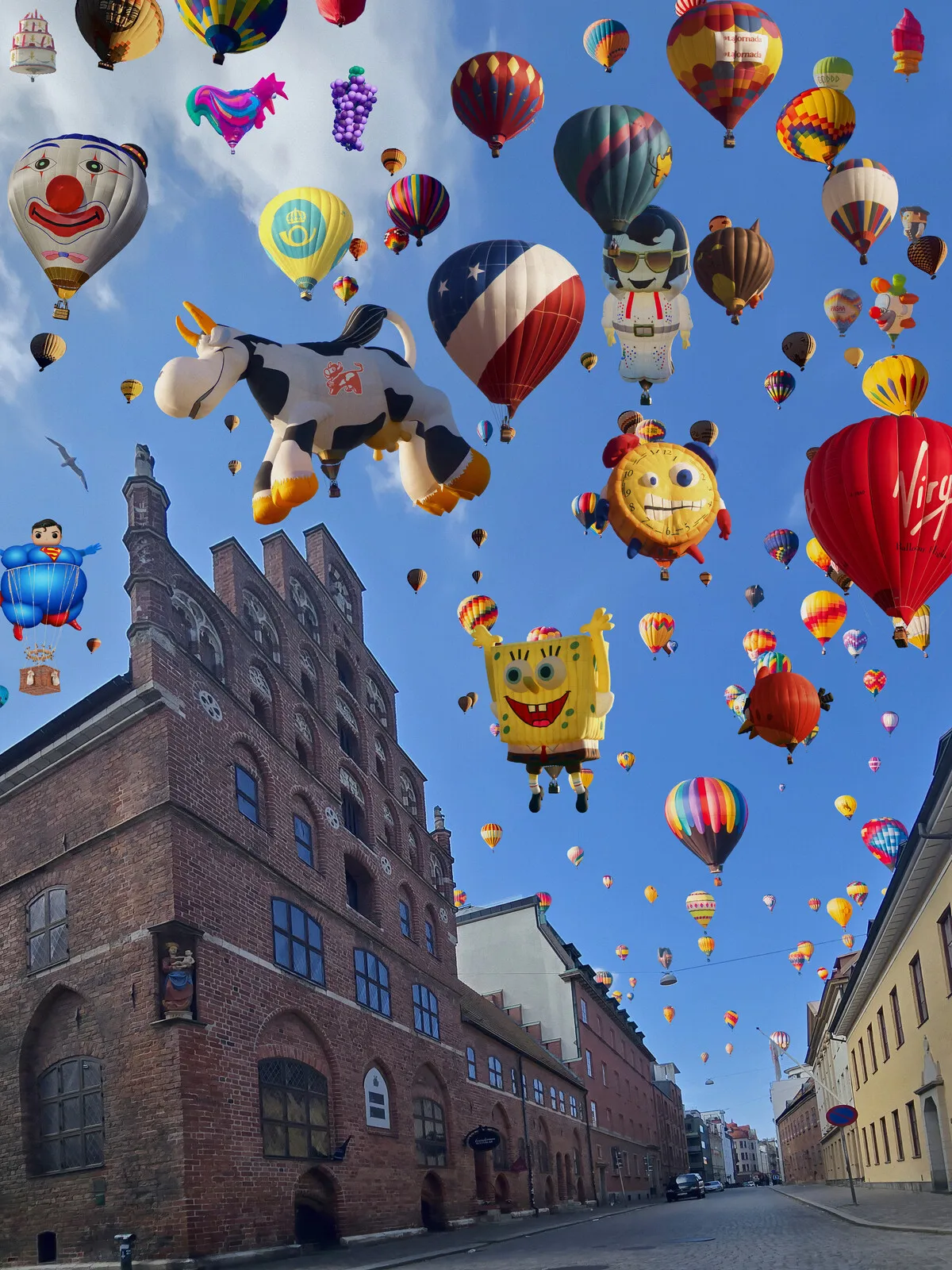
Balloons Over the City, 2024
Digital
100 x 70 cm
5 200 kr
The noon sky was painted with the vibrant colours of hundreds of balloons floating gently over the urban landscape. This scene is not from a dream but a festive reality in many cities worldwide, where balloon festivals transform the sky into a canvas of whimsy and wonder. The hot air balloons drifted over the city in the westerly breeze, almost scraping the stepped gable of the city's oldest house, built by Jörgen Kock in the 16th century.
Balloons of all shapes and sizes take flight, a spectacle that draws crowds from far and wide. The anticipation is palpable as people gather in parks and open spaces, their eyes eagerly turned skyward. The best time to experience this thrill is usually in the early morning when the weather is calm and the balloons are most likely to take flight. It's a good idea to bring a blanket and some snacks and be prepared for a bit of a wait as the balloons are meticulously prepared for launch.
Children clutch their parents' hands excitedly, pointing at balloons shaped like their favourite cartoon characters or fantastic beasts. I remember the first time I attended a hot air balloon festival; the joy and excitement in the air were palpable. Photographers clicked their cameras, capturing the play of light and colour as the sun rose, setting the balloons aglow against the city backdrop.
As the balloons gracefully ascend above the rooftops, they unveil a new perspective of the city. The streets and landmarks, once familiar, transform into a miniature world below, a tapestry of daily life unfolding. Even the most engrossed office workers pause their routines, captivated by the unexpected spectacle in the sky.
The sight of balloons soaring over the city is not merely a visual delight. It's a moment of shared jubilation, a collective experience that transcends the mundane and rekindles the magic in the hearts of urban dwellers. Whether observed from the ground or admired from above, the sight of balloons drifting over the city is a gentle nudge, reminding us of life's simple pleasures and the profound joy of shared experiences.
Imagine the sky above a bustling cityscape dotted not with birds or planes but with an extraordinary parade of hot air balloons. Each balloon, a testament to human creativity and perhaps a bit of madness, floats serenely in the breeze, painting the skyline with a palette that even rainbows might envy.
Here, we see spectacular balloons—some striped and checkered, embodying every hue imaginable. There are whimsical ones, like a balloon shaped like a giant cupcake, and then there are even more bizarre ones, like a balloon shaped like a giant octopus. From massive giants to their slightly smaller cousins, the sky is a canvas of fun and colour.
Now, let's focus on some of these airborne wonders. There's a balloon shaped like a chimpanzee, complete with a puzzled expression as if wondering how it ended up so high in the sky. Beside it, an elephant balloon majestically floats by, its ears flapping gently in the wind. These balloons, often designed to reflect local culture or current events, add a unique and meaningful touch to the festival. They are not just whimsical creations but a testament to the diverse cultures and creative spirit of the people who make them.
Look over there! It's the balloon of "The Post," no longer royal but still proudly bearing its iconic logo, floating past a Superman balloon that drifts with calm vigilance. A giant alarm clock balloon ticks away for the sleepyheads below, a whimsical wake-up call for city dwellers.
The scene gets even stranger. A flying saucer hovers with an eerie glow, and nearby, an Elvis balloon swivels its hips in the wind. Celestial bodies aren't left out either; suns, moons, stars, and even comets blaze through the sky, adding a cosmic twist to the tableau.
And what's a spectacle without a bit of humour? Gigantic old men and enormous old ladies, caricatures of grumpy grandparents, float by, shaking their inflatable fists at noisy birds. A scarecrow balloon floats eerily among them, its raggedy form a stark contrast to a rather risqué, upside-down balloon shaped like a scrotum, eliciting giggles and blushes from the crowd below.
In the realm of hot air balloons, it's evident that human creativity knows no bounds—nor does their willingness to invest in such magnificent skyward ventures. Each launch is not just a display of hot air and fabric but a vibrant celebration of whimsy, a floating gallery of art and humour where the sky is not the limit but the beginning. As these vibrant giants drift on the breeze, they inspire us to look up and dream big, for up there in the blue, the only rules that apply are those of imagination and the occasional gust of wind.
The journey of ballooning, a whimsical adventure through history, is a testament to human ingenuity and curiosity. Imagine a world where the skies are not dominated by the roar of jet engines but by the gentle whisper of hot air rising from a colourful fabric envelope. This is not a mere daydream; it's a fascinating history of ballooning, a narrative that spans ancient Chinese military signals, Branson's globe-circling exploits, and even NASA's lofty scientific experiments, engaging and informing us about our past and future.
Early Ascents: Smoke and Fire
The story of human flight begins not with a bang but with a puff of smoke. As early as the 3rd century BCE, the Chinese used airborne lanterns during military campaigns. These 'Kongming lanterns' were essentially small hot air balloons made of paper designed to signal troops. Imagine the sight—fields dotted with glowing orbs, a silent symphony of light guiding the path to conquest.
European Skyward Endeavors
Let's leap to 1783, Paris. This was a year that would change the course of human flight history. The Montgolfier brothers, Joseph-Michel and Jacques-Étienne, made a decision that would resonate for centuries. They believed that even sheep, ducks, and roosters deserved a view from above. And so, they launched the first hot air balloon with live animals, a feat that succeeded and sparked a wave of animal rights awareness. This was when humans took to the skies, with Jean-François Pilâtre de Rozier and François Laurent d'Arlandes making the first human-crewed flight. The flight covered a mere 5.5 miles across Paris, but its impact was revolutionary. Parisians looked up, their croissants forgotten, and realised that the heavens were no longer a distant dream but a tangible reality.
High Society and Higher Flights
Ballooning quickly became the 18th-century equivalent of a viral sensation. Balloon-themed everything was in vogue—dresses, hats, even furniture. If you weren't discussing balloon flight, you were simply démodé. But it wasn't all smooth sailing. The pursuit of higher altitudes brought its own set of challenges, notably the need for oxygen. Many early aeronauts were gasping for air, a stark reminder of the harsh realities of high-altitude flight. This was a testament to their bravery and determination, proving that while it's nice to be in high society, it's essential to have high oxygen!
Round the World and Records Galore
Fast-forward to more modern times and enter the era of daring adventurers like Richard Branson. In 1999, Branson, Steve Fossett, and Per Lindstrand made a record-breaking non-stop flight worldwide in the GlobalFlyer. Their balloon was not just a bag of hot air but a marvel of engineering, demonstrating that you can make headlines and history with enough money and helium.
NASA and the Final Frontier
Not to be outdone by billionaires with a penchant for publicity, NASA took ballooning from the circus to the cosmos. They've used super-pressure balloons—massive, durable structures capable of lingering in the stratosphere for weeks or months—to gather data on cosmic rays, ozone concentrations, and other atmospheric mysteries. Who knew balloons could go from party favours to providing pivotal scientific data?
The Sky's the Limit
From ancient Chinese signals to French nobles soaring over Paris, from Victorian fashion trends to modern scientific tools, the history of ballooning is a tapestry woven with threads of human ingenuity, daring, and a pinch of madness. Balloons remind us of our eternal quest to rise above the ground, see beyond our horizons, and perhaps touch the stars. So the next time you visit a balloon drifting gracefully above, remember—it's not just a pretty sight; it's a chapter in the ongoing story of humanity's ascent into the skies.
From the quaint beginnings of hot air ballooning to the grandeur of airships, the ambition to conquer the skies has led humanity to remarkable engineering feats. The era of great airships, or dirigibles, marked a significant chapter in the history of aviation, demonstrating both the potential and the peril of these sky-bound leviathans.
The Age of the Airship
The development of airships began in earnest in the late 19th and early 20th centuries, with the zeppelin, named after the German inventor Count Ferdinand von Zeppelin, being among the most famous. These giant vessels, filled with hydrogen, floated majestically across the skies, carrying passengers in a luxury that rivalled ocean liners. The appeal of airships lay in their serene mode of travel, offering panoramic views and a smooth ride that aeroplanes of the time could not match.
However, the golden age of airships came to a dramatic and fiery end with the 1937 Hindenburg disaster. The German passenger airship LZ 129 Hindenburg caught fire while attempting to dock in New Jersey, killing 36 people. The catastrophe, captured on film and broadcast worldwide, severely undermined public confidence in airships and marked the decline of their use in passenger travel.
Resurgence of Airships in Modern Times
Despite the setbacks of the early 20th century, the concept of lighter-than-air travel did not disappear entirely. There has been a renewed interest in airship technology in recent years, particularly with the advent of helium-filled giants. Unlike hydrogen, helium is non-flammable, significantly reducing the risks that led to past disasters.
Modern airships are designed for passenger travel and their potential in cargo transportation. With their large payload capacities, these contemporary behemoths are particularly appealing for carrying heavy and oversized loads to remote or hard-to-reach locations without needing a runway. The ability to hover and land in various terrains makes them an attractive option for logistics and aid delivery in disaster-stricken areas or regions lacking infrastructure.
The Future of Airships
Today's airship innovations include safety improvements, energy efficiency, and environmental impact enhancements. Some designs feature hybrid systems that combine lighter-than-air technology with fixed-wing or rotary-wing capabilities, allowing for greater control and versatility. The vision for future airships also extends to roles in environmental monitoring and surveillance and even as platforms for leisure and tourism.
The story of balloons, from simple hot air constructs to sophisticated airships, reflects a continuum of human curiosity and the relentless pursuit of advancement. The revival of airship technology demonstrates a classic return to the principles of lighter-than-air flight, combined with modern engineering to ensure safety and efficiency. As we look to the skies, the gentle giants of the air remind us of our enduring desire to rise above the Earth and dream big. The history of ballooning, rich with innovation and adventure, continues to evolve, promising new chapters of discovery and exploration in the realm of the skies.
A Piece of Malmö History
During the early decades of the 16th century, Malmö became a canvas for architectural expression as mayors and prominent members of the bourgeoisie erected grandiose structures. These buildings, including the magnificent Jörgen Kock's manor, stand as exceptional examples of the emerging bourgeoisie's ambitions to establish a robust economic and political foothold in society at that time. Located at the intersection of Västergatan and Frans Suellsgatan in central Malmö, this manor is a testament to the grandeur of the era. Its construction symbolised wealth, power, and a strategic move to establish a prominent presence in the city's political and economic landscape.
Named after its influential creator, Jörgen Kock, who held the dual roles of mint master and mayor, the manor was constructed between 1522 and 1525. Today, it stands as a listed historical monument, narrowly missing an encounter with drifting balloons on one remarkable day.
The property's roots stretch back to 1392 when Lady Margaretha Strangesdotter bequeathed it and its existing structures to the Cathedral of Lund. Strategically positioned at the junction of 'Den lange Adelgatan' and 'Stredet,' which led to the harbour gate and Malmö's crucial ship pier, the site was a vital commercial hub during the era. Under the stewardship of Jörgen Kock, who held the dual roles of mint master and mayor, the estate evolved significantly, comprising multiple buildings and functioning as a primary estate for several subordinate properties in the city. Jörgen Kock played a pivotal role in the manor's history, overseeing its expansion and transformation into a significant commercial and political hub. This evolution is a fascinating part of the manor's history.
From 1444, Denmark's coinage operations were centred in Malmö. By 1518, Jörgen Kock was appointed as the mint master for all of Denmark by King Christian II and resided at Myntergården, located east of Erik of Pomerania's castle, the precursor to the current Malmöhus Castle. Following the establishment of Malmöhus as a separate county in 1526, coin manufacturing was relocated from the castle area to Kock's manor. This move reflected the manor's growing importance and role in the city's economic and political landscape. However, mint operations in Malmö ceased entirely in 1536, marking the end of an era for the manor.
After Kock died in 1556, the manor changed hands among various noble families, each leaving their mark on the property. These changes in ownership led to adaptations in its use and stylistic ideals over the years. In 1770, the merchant Frans Suell acquired the manor, transformed it into his residence and built a tobacco factory on the large plot. Suell, one of Sweden's wealthiest burghers at the time, also established a sugar and clothing factory in the city, among other industrial ventures. This period of industrialisation and commercialisation significantly influenced the manor's use and appearance, reflecting the changing times and the city's evolving economic landscape.
The manor eventually passed to Suell's son-in-law, Lorens Kockum, and in 1825 to his son, Frans Henrik Kockum. Frans Henrik Kockum became a prominent industrial magnate in Malmö, founding Kockums Mechanical Workshop and shipyard. In the 1960s, the historical connection to the manor led Kockums to purchase and fund the extensive renovation of Jörgen Kock's old manor. This act of preservation and restoration by Kockums saved the manor from potential deterioration and ensured future generations would appreciate its historical and architectural significance.
Today, three original buildings remain, each a unique testament to the manor's architectural evolution. The large red brick facades, embellishments in shaped brick and limestone, and the foundation of smoothly hewn limestone all contribute to the manor's unique design. Painted initially with lime in English red and detailed with whitewashed blindings in the niches, these buildings blend medieval building traditions and Renaissance-style ideals, showing brick Gothic and early Dutch Renaissance features. These architectural features are not just historical but intriguing, inviting us to delve deeper into their significance.
Jörgen Kock and his wife, Citze Kortzdatter van Nuland, resided in the main building, which also housed Kock's chancellery. The building's monumental north gable faces the sea, preserving much of its original brick, chalkstone, and Danian limestone decorations. The richly decorated gable, unique among preserved Nordic houses, features spiral-carved finials topped with shield-bearing lions, tracery, and circle rosettes, all carved in chalkstone. These unique architectural features, such as the spiral-carved finials and the use of chalkstone, set the manor apart and contribute to its historical and architectural significance.
The identity of the master builder remains uncertain. However, it is strongly speculated that Michiel Heinrick van Haerlem, the master builder responsible for Christian II's construction lodge in Copenhagen, might have been involved, reflecting the building's early Dutch Renaissance characteristics.
Jörgen Kock's manor, a significant historical landmark, was restored and reconstructed in 1967 to preserve its historical value. The original floor plan is mainly unknown. The reconstruction is based on assumptions and comparisons with other 16th-century building floor plans, a meticulous process that aimed to recreate the manor's original layout. Remnants of original decorative paintings, a valuable insight into the manor's past, are found in the main building and the Stortorget wing, further enhancing its historical significance.
A Nostalgic Culinary Experience at Kockska Krogen – Too Late.
Once upon a time, there was a culinary dream I could have started this part. During the late 90s, I embarked on a culinary journey to Kockska Krogen, a renowned historical tavern in the heart of Malmö. Having heard much about its storied past, I was eager to dine in an environment that whispered tales of yore. Conveniently located and with my wallet unusually tolerant for a bit of splurging, I set out with anticipation. At that time, there were two historic buildings to watch: the Town Hall with its tavern and Jörgen Kock's old house. Back then, the tavern was still known by its old name, Kockska Krogen, as it had been for decades, though today it goes by "Årstiderna."
Descending a staircase, I stepped into a Malmö from long ago. The winding cellar vaults, dimly lit and cosy, transported me back in time, although my Italian friends who prefer to see their food might have found it a bit too dark for their taste.
The cellar vaults, dating back to the Renaissance when Malmö could rival Copenhagen in size, served as the dining hall of Kockska Krogen. I enjoyed many magnificent meals there, some of which were less remarkable. The golden days under Lars Lendrop were indeed something special. The grandeur and gravity of those ancient times linger in the air, emphasised by the dimly lit setting created by modest electric lighting and the candles flickering on the tables. This darkness, while potentially cosy, instead lends a certain chill, a hint of aloofness, reminiscent of cellars meant for guests other than the willing and paying.
Lars Lendrop, the legendary founder of Kockska, trained at culinary schools in Stockholm and Lausanne but preferred not to stand behind the stove himself. "I can flip a steak, but I was never interested in the actual cooking. My patience doesn't stretch that far," he used to say. Instead, his passion was in the organisation and, significantly, in the interactions with guests, preferring to identify as a creative restaurateur. He held a fondness for classic French cuisine as well as traditional Swedish dishes ("Given the choice between oysters and foie gras, I'd pick potato pancakes with lingonberries any day"), and he revered the French chef Auguste Escoffier as his patron saint. Those were the days.
Lars Lendrop owned or leased several other taverns, all mourned and missed today—the most abundant, Savoy with its grill room and famed silver cart, Nobel's summer haunt Falsterbohus, and Skanör's Inn with its crossing for geese. He also ran Restaurant Stäket in Lund for a few years before establishing Kockska Krogen in Malmö, his very own creation, while the others had taken over. He sold Kockska in 1986, so no shadows from my late '90s visit should fall upon him.
The prices towards the end of the twentieth century did their utmost to deter the commoner. Indeed, some people frequented not for the food but to feel refined. Many appetisers cost over a hundred kronor, such as herring in a pot for 110, bleak roe toast for 130, and a salmon symphony for 179. Main courses often approached 300, with a few—like sole and reindeer fillet—exceeding that mark significantly. My favourite, the steak tartare at 245, almost tasted as it did in Lendrop's era.
The menu was rambling, filled with unnecessary and pompous descriptions that did little to enhance the ordinary outcome. While not as extensive as a phone book nor as brief as a telegram, the wine list offered bottles mostly between 300 and 400 kronor, with house wines in French and Spanish varieties just over 200 kronor. Many of the wines were Kockska Krogen's imports, an effort that inspires. The house's Spanish red from 1992, priced at 240 kronor, proved robust without overpowering, offering great value for money.
However, despite the menu's many superlatives, the food's value for money was another story. The lobster ragout appetiser was soft and watery, as if it had waited too long to be served, and the sauce was flavourless. The same applied to the much cheaper appetiser of black roots gratinated with Emmental cheese—dry, chewy, and bland, seemingly reheated in a microwave. It was pretty tasteless.
The honey-roasted duck breast with orange sauce and rösti, priced at 297 kronor, should have been one of the tavern's signature dishes. The verbose menu claimed it featured the finest duck cuts. In reality, the duck lacked character, though the sauce was distinctly orangey. But little else. The plate bore no garnish, not a single vegetable, reminiscent of what one might have found at an old department store cafeteria.
The grilled veal liver was one of the cheapest main dishes but was hidden beneath a mountain of capers and bacon, perhaps to mask the liver's lack of character. The bacon, at least, was perfectly crispy and flavorful. There was plenty of food on the plate, but not much taste.
Desserts, as often happens, played the role of dinner's saving grace. The showpiece among the desserts, a prune soufflé with punch cream priced at 127 kronor, was a delightful creation. As large as a whole hat and just as fluffy, sweet, and pleasant as one could dream, the portion was large enough to satisfy an entire family. This rare dessert was worth every penny. Although most desserts stayed under one hundred kronor, a few approached that mark, such as punch-marinated strawberries and Creme Royal. Keeping a three-course meal for two under one thousand kronor here would be difficult.
When the bill arrived, it was discreetly packaged in a music box. Upon opening it, a melody played—I can't recall which, perhaps, it was "Now I'm broke and bird-free" from the operetta The Beggar Student or "If I Were a Rich Man" from Fiddler on the Roof. Either would have been apt. One must consider that it was almost thirty years ago, and the price level then still commands respect today.
Jörgen Thornberg
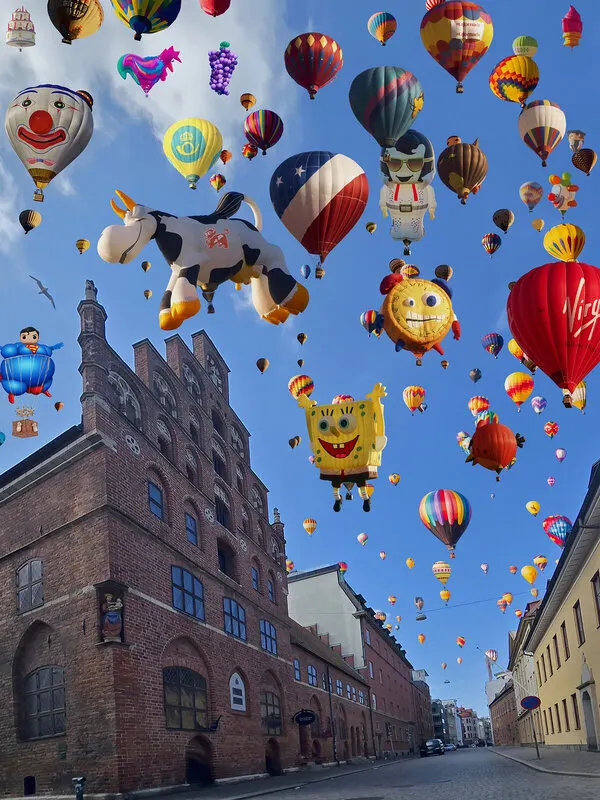
Balloons Over the City, 2024
Digital
100 x 70 cm
5 200 kr
The noon sky was painted with the vibrant colours of hundreds of balloons floating gently over the urban landscape. This scene is not from a dream but a festive reality in many cities worldwide, where balloon festivals transform the sky into a canvas of whimsy and wonder. The hot air balloons drifted over the city in the westerly breeze, almost scraping the stepped gable of the city's oldest house, built by Jörgen Kock in the 16th century.
Balloons of all shapes and sizes take flight, a spectacle that draws crowds from far and wide. The anticipation is palpable as people gather in parks and open spaces, their eyes eagerly turned skyward. The best time to experience this thrill is usually in the early morning when the weather is calm and the balloons are most likely to take flight. It's a good idea to bring a blanket and some snacks and be prepared for a bit of a wait as the balloons are meticulously prepared for launch.
Children clutch their parents' hands excitedly, pointing at balloons shaped like their favourite cartoon characters or fantastic beasts. I remember the first time I attended a hot air balloon festival; the joy and excitement in the air were palpable. Photographers clicked their cameras, capturing the play of light and colour as the sun rose, setting the balloons aglow against the city backdrop.
As the balloons gracefully ascend above the rooftops, they unveil a new perspective of the city. The streets and landmarks, once familiar, transform into a miniature world below, a tapestry of daily life unfolding. Even the most engrossed office workers pause their routines, captivated by the unexpected spectacle in the sky.
The sight of balloons soaring over the city is not merely a visual delight. It's a moment of shared jubilation, a collective experience that transcends the mundane and rekindles the magic in the hearts of urban dwellers. Whether observed from the ground or admired from above, the sight of balloons drifting over the city is a gentle nudge, reminding us of life's simple pleasures and the profound joy of shared experiences.
Imagine the sky above a bustling cityscape dotted not with birds or planes but with an extraordinary parade of hot air balloons. Each balloon, a testament to human creativity and perhaps a bit of madness, floats serenely in the breeze, painting the skyline with a palette that even rainbows might envy.
Here, we see spectacular balloons—some striped and checkered, embodying every hue imaginable. There are whimsical ones, like a balloon shaped like a giant cupcake, and then there are even more bizarre ones, like a balloon shaped like a giant octopus. From massive giants to their slightly smaller cousins, the sky is a canvas of fun and colour.
Now, let's focus on some of these airborne wonders. There's a balloon shaped like a chimpanzee, complete with a puzzled expression as if wondering how it ended up so high in the sky. Beside it, an elephant balloon majestically floats by, its ears flapping gently in the wind. These balloons, often designed to reflect local culture or current events, add a unique and meaningful touch to the festival. They are not just whimsical creations but a testament to the diverse cultures and creative spirit of the people who make them.
Look over there! It's the balloon of "The Post," no longer royal but still proudly bearing its iconic logo, floating past a Superman balloon that drifts with calm vigilance. A giant alarm clock balloon ticks away for the sleepyheads below, a whimsical wake-up call for city dwellers.
The scene gets even stranger. A flying saucer hovers with an eerie glow, and nearby, an Elvis balloon swivels its hips in the wind. Celestial bodies aren't left out either; suns, moons, stars, and even comets blaze through the sky, adding a cosmic twist to the tableau.
And what's a spectacle without a bit of humour? Gigantic old men and enormous old ladies, caricatures of grumpy grandparents, float by, shaking their inflatable fists at noisy birds. A scarecrow balloon floats eerily among them, its raggedy form a stark contrast to a rather risqué, upside-down balloon shaped like a scrotum, eliciting giggles and blushes from the crowd below.
In the realm of hot air balloons, it's evident that human creativity knows no bounds—nor does their willingness to invest in such magnificent skyward ventures. Each launch is not just a display of hot air and fabric but a vibrant celebration of whimsy, a floating gallery of art and humour where the sky is not the limit but the beginning. As these vibrant giants drift on the breeze, they inspire us to look up and dream big, for up there in the blue, the only rules that apply are those of imagination and the occasional gust of wind.
The journey of ballooning, a whimsical adventure through history, is a testament to human ingenuity and curiosity. Imagine a world where the skies are not dominated by the roar of jet engines but by the gentle whisper of hot air rising from a colourful fabric envelope. This is not a mere daydream; it's a fascinating history of ballooning, a narrative that spans ancient Chinese military signals, Branson's globe-circling exploits, and even NASA's lofty scientific experiments, engaging and informing us about our past and future.
Early Ascents: Smoke and Fire
The story of human flight begins not with a bang but with a puff of smoke. As early as the 3rd century BCE, the Chinese used airborne lanterns during military campaigns. These 'Kongming lanterns' were essentially small hot air balloons made of paper designed to signal troops. Imagine the sight—fields dotted with glowing orbs, a silent symphony of light guiding the path to conquest.
European Skyward Endeavors
Let's leap to 1783, Paris. This was a year that would change the course of human flight history. The Montgolfier brothers, Joseph-Michel and Jacques-Étienne, made a decision that would resonate for centuries. They believed that even sheep, ducks, and roosters deserved a view from above. And so, they launched the first hot air balloon with live animals, a feat that succeeded and sparked a wave of animal rights awareness. This was when humans took to the skies, with Jean-François Pilâtre de Rozier and François Laurent d'Arlandes making the first human-crewed flight. The flight covered a mere 5.5 miles across Paris, but its impact was revolutionary. Parisians looked up, their croissants forgotten, and realised that the heavens were no longer a distant dream but a tangible reality.
High Society and Higher Flights
Ballooning quickly became the 18th-century equivalent of a viral sensation. Balloon-themed everything was in vogue—dresses, hats, even furniture. If you weren't discussing balloon flight, you were simply démodé. But it wasn't all smooth sailing. The pursuit of higher altitudes brought its own set of challenges, notably the need for oxygen. Many early aeronauts were gasping for air, a stark reminder of the harsh realities of high-altitude flight. This was a testament to their bravery and determination, proving that while it's nice to be in high society, it's essential to have high oxygen!
Round the World and Records Galore
Fast-forward to more modern times and enter the era of daring adventurers like Richard Branson. In 1999, Branson, Steve Fossett, and Per Lindstrand made a record-breaking non-stop flight worldwide in the GlobalFlyer. Their balloon was not just a bag of hot air but a marvel of engineering, demonstrating that you can make headlines and history with enough money and helium.
NASA and the Final Frontier
Not to be outdone by billionaires with a penchant for publicity, NASA took ballooning from the circus to the cosmos. They've used super-pressure balloons—massive, durable structures capable of lingering in the stratosphere for weeks or months—to gather data on cosmic rays, ozone concentrations, and other atmospheric mysteries. Who knew balloons could go from party favours to providing pivotal scientific data?
The Sky's the Limit
From ancient Chinese signals to French nobles soaring over Paris, from Victorian fashion trends to modern scientific tools, the history of ballooning is a tapestry woven with threads of human ingenuity, daring, and a pinch of madness. Balloons remind us of our eternal quest to rise above the ground, see beyond our horizons, and perhaps touch the stars. So the next time you visit a balloon drifting gracefully above, remember—it's not just a pretty sight; it's a chapter in the ongoing story of humanity's ascent into the skies.
From the quaint beginnings of hot air ballooning to the grandeur of airships, the ambition to conquer the skies has led humanity to remarkable engineering feats. The era of great airships, or dirigibles, marked a significant chapter in the history of aviation, demonstrating both the potential and the peril of these sky-bound leviathans.
The Age of the Airship
The development of airships began in earnest in the late 19th and early 20th centuries, with the zeppelin, named after the German inventor Count Ferdinand von Zeppelin, being among the most famous. These giant vessels, filled with hydrogen, floated majestically across the skies, carrying passengers in a luxury that rivalled ocean liners. The appeal of airships lay in their serene mode of travel, offering panoramic views and a smooth ride that aeroplanes of the time could not match.
However, the golden age of airships came to a dramatic and fiery end with the 1937 Hindenburg disaster. The German passenger airship LZ 129 Hindenburg caught fire while attempting to dock in New Jersey, killing 36 people. The catastrophe, captured on film and broadcast worldwide, severely undermined public confidence in airships and marked the decline of their use in passenger travel.
Resurgence of Airships in Modern Times
Despite the setbacks of the early 20th century, the concept of lighter-than-air travel did not disappear entirely. There has been a renewed interest in airship technology in recent years, particularly with the advent of helium-filled giants. Unlike hydrogen, helium is non-flammable, significantly reducing the risks that led to past disasters.
Modern airships are designed for passenger travel and their potential in cargo transportation. With their large payload capacities, these contemporary behemoths are particularly appealing for carrying heavy and oversized loads to remote or hard-to-reach locations without needing a runway. The ability to hover and land in various terrains makes them an attractive option for logistics and aid delivery in disaster-stricken areas or regions lacking infrastructure.
The Future of Airships
Today's airship innovations include safety improvements, energy efficiency, and environmental impact enhancements. Some designs feature hybrid systems that combine lighter-than-air technology with fixed-wing or rotary-wing capabilities, allowing for greater control and versatility. The vision for future airships also extends to roles in environmental monitoring and surveillance and even as platforms for leisure and tourism.
The story of balloons, from simple hot air constructs to sophisticated airships, reflects a continuum of human curiosity and the relentless pursuit of advancement. The revival of airship technology demonstrates a classic return to the principles of lighter-than-air flight, combined with modern engineering to ensure safety and efficiency. As we look to the skies, the gentle giants of the air remind us of our enduring desire to rise above the Earth and dream big. The history of ballooning, rich with innovation and adventure, continues to evolve, promising new chapters of discovery and exploration in the realm of the skies.
A Piece of Malmö History
During the early decades of the 16th century, Malmö became a canvas for architectural expression as mayors and prominent members of the bourgeoisie erected grandiose structures. These buildings, including the magnificent Jörgen Kock's manor, stand as exceptional examples of the emerging bourgeoisie's ambitions to establish a robust economic and political foothold in society at that time. Located at the intersection of Västergatan and Frans Suellsgatan in central Malmö, this manor is a testament to the grandeur of the era. Its construction symbolised wealth, power, and a strategic move to establish a prominent presence in the city's political and economic landscape.
Named after its influential creator, Jörgen Kock, who held the dual roles of mint master and mayor, the manor was constructed between 1522 and 1525. Today, it stands as a listed historical monument, narrowly missing an encounter with drifting balloons on one remarkable day.
The property's roots stretch back to 1392 when Lady Margaretha Strangesdotter bequeathed it and its existing structures to the Cathedral of Lund. Strategically positioned at the junction of 'Den lange Adelgatan' and 'Stredet,' which led to the harbour gate and Malmö's crucial ship pier, the site was a vital commercial hub during the era. Under the stewardship of Jörgen Kock, who held the dual roles of mint master and mayor, the estate evolved significantly, comprising multiple buildings and functioning as a primary estate for several subordinate properties in the city. Jörgen Kock played a pivotal role in the manor's history, overseeing its expansion and transformation into a significant commercial and political hub. This evolution is a fascinating part of the manor's history.
From 1444, Denmark's coinage operations were centred in Malmö. By 1518, Jörgen Kock was appointed as the mint master for all of Denmark by King Christian II and resided at Myntergården, located east of Erik of Pomerania's castle, the precursor to the current Malmöhus Castle. Following the establishment of Malmöhus as a separate county in 1526, coin manufacturing was relocated from the castle area to Kock's manor. This move reflected the manor's growing importance and role in the city's economic and political landscape. However, mint operations in Malmö ceased entirely in 1536, marking the end of an era for the manor.
After Kock died in 1556, the manor changed hands among various noble families, each leaving their mark on the property. These changes in ownership led to adaptations in its use and stylistic ideals over the years. In 1770, the merchant Frans Suell acquired the manor, transformed it into his residence and built a tobacco factory on the large plot. Suell, one of Sweden's wealthiest burghers at the time, also established a sugar and clothing factory in the city, among other industrial ventures. This period of industrialisation and commercialisation significantly influenced the manor's use and appearance, reflecting the changing times and the city's evolving economic landscape.
The manor eventually passed to Suell's son-in-law, Lorens Kockum, and in 1825 to his son, Frans Henrik Kockum. Frans Henrik Kockum became a prominent industrial magnate in Malmö, founding Kockums Mechanical Workshop and shipyard. In the 1960s, the historical connection to the manor led Kockums to purchase and fund the extensive renovation of Jörgen Kock's old manor. This act of preservation and restoration by Kockums saved the manor from potential deterioration and ensured future generations would appreciate its historical and architectural significance.
Today, three original buildings remain, each a unique testament to the manor's architectural evolution. The large red brick facades, embellishments in shaped brick and limestone, and the foundation of smoothly hewn limestone all contribute to the manor's unique design. Painted initially with lime in English red and detailed with whitewashed blindings in the niches, these buildings blend medieval building traditions and Renaissance-style ideals, showing brick Gothic and early Dutch Renaissance features. These architectural features are not just historical but intriguing, inviting us to delve deeper into their significance.
Jörgen Kock and his wife, Citze Kortzdatter van Nuland, resided in the main building, which also housed Kock's chancellery. The building's monumental north gable faces the sea, preserving much of its original brick, chalkstone, and Danian limestone decorations. The richly decorated gable, unique among preserved Nordic houses, features spiral-carved finials topped with shield-bearing lions, tracery, and circle rosettes, all carved in chalkstone. These unique architectural features, such as the spiral-carved finials and the use of chalkstone, set the manor apart and contribute to its historical and architectural significance.
The identity of the master builder remains uncertain. However, it is strongly speculated that Michiel Heinrick van Haerlem, the master builder responsible for Christian II's construction lodge in Copenhagen, might have been involved, reflecting the building's early Dutch Renaissance characteristics.
Jörgen Kock's manor, a significant historical landmark, was restored and reconstructed in 1967 to preserve its historical value. The original floor plan is mainly unknown. The reconstruction is based on assumptions and comparisons with other 16th-century building floor plans, a meticulous process that aimed to recreate the manor's original layout. Remnants of original decorative paintings, a valuable insight into the manor's past, are found in the main building and the Stortorget wing, further enhancing its historical significance.
A Nostalgic Culinary Experience at Kockska Krogen – Too Late.
Once upon a time, there was a culinary dream I could have started this part. During the late 90s, I embarked on a culinary journey to Kockska Krogen, a renowned historical tavern in the heart of Malmö. Having heard much about its storied past, I was eager to dine in an environment that whispered tales of yore. Conveniently located and with my wallet unusually tolerant for a bit of splurging, I set out with anticipation. At that time, there were two historic buildings to watch: the Town Hall with its tavern and Jörgen Kock's old house. Back then, the tavern was still known by its old name, Kockska Krogen, as it had been for decades, though today it goes by "Årstiderna."
Descending a staircase, I stepped into a Malmö from long ago. The winding cellar vaults, dimly lit and cosy, transported me back in time, although my Italian friends who prefer to see their food might have found it a bit too dark for their taste.
The cellar vaults, dating back to the Renaissance when Malmö could rival Copenhagen in size, served as the dining hall of Kockska Krogen. I enjoyed many magnificent meals there, some of which were less remarkable. The golden days under Lars Lendrop were indeed something special. The grandeur and gravity of those ancient times linger in the air, emphasised by the dimly lit setting created by modest electric lighting and the candles flickering on the tables. This darkness, while potentially cosy, instead lends a certain chill, a hint of aloofness, reminiscent of cellars meant for guests other than the willing and paying.
Lars Lendrop, the legendary founder of Kockska, trained at culinary schools in Stockholm and Lausanne but preferred not to stand behind the stove himself. "I can flip a steak, but I was never interested in the actual cooking. My patience doesn't stretch that far," he used to say. Instead, his passion was in the organisation and, significantly, in the interactions with guests, preferring to identify as a creative restaurateur. He held a fondness for classic French cuisine as well as traditional Swedish dishes ("Given the choice between oysters and foie gras, I'd pick potato pancakes with lingonberries any day"), and he revered the French chef Auguste Escoffier as his patron saint. Those were the days.
Lars Lendrop owned or leased several other taverns, all mourned and missed today—the most abundant, Savoy with its grill room and famed silver cart, Nobel's summer haunt Falsterbohus, and Skanör's Inn with its crossing for geese. He also ran Restaurant Stäket in Lund for a few years before establishing Kockska Krogen in Malmö, his very own creation, while the others had taken over. He sold Kockska in 1986, so no shadows from my late '90s visit should fall upon him.
The prices towards the end of the twentieth century did their utmost to deter the commoner. Indeed, some people frequented not for the food but to feel refined. Many appetisers cost over a hundred kronor, such as herring in a pot for 110, bleak roe toast for 130, and a salmon symphony for 179. Main courses often approached 300, with a few—like sole and reindeer fillet—exceeding that mark significantly. My favourite, the steak tartare at 245, almost tasted as it did in Lendrop's era.
The menu was rambling, filled with unnecessary and pompous descriptions that did little to enhance the ordinary outcome. While not as extensive as a phone book nor as brief as a telegram, the wine list offered bottles mostly between 300 and 400 kronor, with house wines in French and Spanish varieties just over 200 kronor. Many of the wines were Kockska Krogen's imports, an effort that inspires. The house's Spanish red from 1992, priced at 240 kronor, proved robust without overpowering, offering great value for money.
However, despite the menu's many superlatives, the food's value for money was another story. The lobster ragout appetiser was soft and watery, as if it had waited too long to be served, and the sauce was flavourless. The same applied to the much cheaper appetiser of black roots gratinated with Emmental cheese—dry, chewy, and bland, seemingly reheated in a microwave. It was pretty tasteless.
The honey-roasted duck breast with orange sauce and rösti, priced at 297 kronor, should have been one of the tavern's signature dishes. The verbose menu claimed it featured the finest duck cuts. In reality, the duck lacked character, though the sauce was distinctly orangey. But little else. The plate bore no garnish, not a single vegetable, reminiscent of what one might have found at an old department store cafeteria.
The grilled veal liver was one of the cheapest main dishes but was hidden beneath a mountain of capers and bacon, perhaps to mask the liver's lack of character. The bacon, at least, was perfectly crispy and flavorful. There was plenty of food on the plate, but not much taste.
Desserts, as often happens, played the role of dinner's saving grace. The showpiece among the desserts, a prune soufflé with punch cream priced at 127 kronor, was a delightful creation. As large as a whole hat and just as fluffy, sweet, and pleasant as one could dream, the portion was large enough to satisfy an entire family. This rare dessert was worth every penny. Although most desserts stayed under one hundred kronor, a few approached that mark, such as punch-marinated strawberries and Creme Royal. Keeping a three-course meal for two under one thousand kronor here would be difficult.
When the bill arrived, it was discreetly packaged in a music box. Upon opening it, a melody played—I can't recall which, perhaps, it was "Now I'm broke and bird-free" from the operetta The Beggar Student or "If I Were a Rich Man" from Fiddler on the Roof. Either would have been apt. One must consider that it was almost thirty years ago, and the price level then still commands respect today.
5 200 kr

Jörgen Thornberg
Malmö
Lite om bilder och mig. Translation in English at the end.
Jag är en nyfiken person som ser allt i bilder, även det jag fäster i ord, gärna tillsammans för bakom alla mina bilder finns en berättelse. Till vissa bilder hör en kortare eller längre novell som följer med bilden.
Bilder berättar historier. Jag omges av naturlig skönhet, intressanta människor och historia var jag än går. Jag använder min kamera för att dokumentera världen och blanda det jag ser med vad jag känner för att fånga den dolda magin.
Mina bilder berättar mina historier. Genom mina bilder, tryck och berättelser. Jag bjuder in dig att ta del av dessa berättelser, in i ditt liv och hem och dela min mycket personliga syn på vår värld. Mer än vad ögat ser. Jag tänker i bilder, drömmer och skriver och pratar om dem; följaktligen måste jag också skapa bilder. De blir vad jag ser, inte nödvändigtvis begränsade till verkligheten. Det finns en bild runt varje hörn. Jag hoppas att du kommer att se vad jag såg och gilla det.
Jag är också en skrivande person och till många bilder hör en kortare eller längre essay. Den följer med tavlan, tryckt på fint papper och med en personlig hälsning från mig.
Flertalet bilder startar sin resa i min kamera. Enkelt förklarat beskriver jag bilden jag ser i mitt inre, upplevd eller fantiserad. Bilden uppstår inom mig redan innan jag fått okularet till ögat. På bråkdelen av ett ögonblick ser jag vad jag vill ha och vad som kan göras med bilden. Här skall jag stoppa in en giraff, stålmannen, Titanic eller vad det är min fantasi finner ut. Ännu märkligare är att jag kommer ihåg minnesbilden långt efteråt när det blir tid att skapa verket. Om jag lyckas eller inte, är upp till betraktaren, oftast präglat av en stråk av svart humor – meningen är att man skall bli underhållen. Mina bilder blir ofta en snackis där de hänger.
Jag föredrar bilder som förmedlar ett budskap i flera lager. Vid första anblicken fylld av feel-good, en vacker utsikt, fint väder, solen skiner, blommor på ängen eller vattnet som ligger förrädiskt spegelblankt. I en sådan bild kan jag gömma min egentliga berättelse, mitt förakt för förtryckare och våldsverkare, rasister och fördomsfulla människor - ett gärna återkommande motiv mer eller mindre dolt i det vackra motivet. Jag försöker förena dem i ett gemensamt narrativ.
Bild och formgivning har löpt som en röd tråd genom livet. Fotokonst känns som en värdig final som jag gärna delar med mig.
Min genre är vid som framgår av mina bilder, temat en blandning av pop- och gatukonst i kollage som kan bestå av hundratals lager. Vissa bilder kan ta veckor, andra någon dag innan det är dags att överlämna resultatet till printverkstaden. Fine Art Prints är digitala fotocollage. I dessa kollage sker rivandet, klippandet, pusslandet, målandet, ritandet och sprayningen digitalt. Det jag monterar in kan vara hundratals år gamla bilder som jag omsorgsfullt frilägger så att de ser ut att vara en del av tavlan men också bilder skapade av mig själv efter min egen fantasi. Därefter besöks printstudion och för vissa bilder numrera en limiterad upplaga (oftast 7 exemplar) och signera för hand. Vissa bilder kan köpas i olika format. Det är bara att fråga efter vilka. Gillar man en bild som är 70x100 men inte har plats på väggen, går den kanske att få i 50x70 cm istället. Frågan är fri.
Metoden Giclée eller Fine Art Print som det också kallas är det moderna sättet för framställning av grafisk konst. Villkoret för denna typ av utskrifter är att en högkvalitativ storformatskrivare används med åldersbeständigt färgpigment och konstnärspapper eller i förekommande fall på duk. Pappret som används möter de krav på livslängd som ställs av museer och gallerier. Normalt säljer jag mina bilder oinramade så att den nya ägaren själv kan bestämma hur de skall se ut, med eller utan passepartout färg på ram, med eller utan glas etc..
Under många år ställde jag bara ut på nätet, i valda grupper och på min egen Facebooksida - https://www.facebook.com/jorgen.thornberg.9
Jag finns också på en egen hemsida som tyvärr inte alltid är uppdaterad – https://www.jth.life/ Där kan du också läsa en del av de berättelser som följer med bilden.
UTSTÄLLNINGAR
Luftkastellet, oktober 2022
Konst i Lund, november 2022
Luftkastellet, mars 2023
Engleson Galleri Caroli, april 2023
Hydra, Greece June 2023
Engleson Galleri Caroli, oktober 2023
Toppen, Höllviken december 2023
Luftkastellet, mars 2024
Torups Galleri, mars 2024
Venice, May 2024
Luftkastellet, oktober 2024
Konst i Advent, December 2024
Galleri Engleson, Caroli December 2024
Jäger & Jansson Galleri, april 2025
A bit about pictures and me.
I'm a curious person who sees everything in pictures, even what I express in words, often combining them, for behind all my pictures lies a story. These narratives, some as short as a single image and others as long as a novel, are the heart and soul of my work.
Pictures tell stories. Wherever I go, I'm surrounded by natural beauty, exciting people, and history. I use my camera to document the world and blend what I see with what I feel to capture the hidden magic.
My images tell my stories. Through my pictures, prints, and narratives, I invite you to partake in these stories in your life and home and share my deeply personal perspective of our world. More than meets the eye. I think in pictures, dream, write, and talk about them; consequently, I must create images too. They become what I see, not necessarily confined to reality. There's a picture around every corner. I hope you'll see what I saw and enjoy it.
I'm also a writer, and many images come with a shorter or longer essay. It accompanies the painting, printed on fine paper with my personal greeting.
Many pictures start their journey on my camera. Simply put, I describe the image I see in my mind, experienced or imagined. The image arises within me even before I bring the eyepiece to my eye. In a fraction of a moment, I see what I want and what can be done with the picture. Here, I'll insert a giraffe, Superman, the Titanic, or whatever my imagination conjures up. Even stranger is that I remember the mental image long after it's time to create the work. Whether I succeed is up to the observer, often imbued with a streak of black humour – the aim is to entertain. My pictures usually become a talking point wherever they hang.
I prefer pictures that convey a message in multiple layers. At first glance, they're filled with feel-good vibes, a beautiful view, lovely weather, the sun shining, flowers in the meadow, or the water lying deceptively calm. But beneath this surface beauty, I often conceal a deeper story, a narrative that challenges societal norms or explores the human condition. I invite you to delve into these hidden narratives and discover the layers of meaning within my work.
Picture and design have been a thread running through my life. Photographic art feels like a fitting finale, and I'm happy to share it.
My genre is varied, as seen in my pictures; the theme is a blend of pop and street art in collages that can consist of hundreds of layers. Some images can take weeks, others just a day before it's time to hand over the result to the print workshop. Fine Art Prints are digital photo collages. In these collages, tearing, cutting, puzzling, painting, drawing, and spraying happen digitally. What I insert can be images hundreds of years old that I carefully extract so they appear to be part of the painting, but also images created by myself, now also generated from my imagination. Next, visit the print studio and, for certain images, number a limited edition (usually 7 copies) and sign them by hand. Some images may be available in other formats. Just ask which ones. If you like an image that's 70x100 but doesn't have space on the wall, you might be able to get it in 50x70 cm instead. The question is open.
The Giclée method, or Fine Art Print as it's also called, is the modern way of producing graphic art. This method ensures the highest quality and longevity of the artwork, using a high-quality large-format printer with archival pigment inks and artist paper or, in some cases, canvas. The paper used meets the longevity requirements set by museums and galleries. I sell my pictures unframed, allowing the new owner to personalise their artwork, confident in the lasting value and quality of the piece.
For many years, I only exhibited online, in selected groups, and on my Facebook page - https://www.facebook.com/jorgen.thornberg.9. I also have my website, which unfortunately is not constantly updated - https://www.jth.life/. You can also read some of the stories accompanying the pictures there.
EXHIBITIONS
Luftkastellet, October 2022
Art in Lund, November 2022
Luftkastellet, March 2023
Engleson Gallery Caroli, April 2023
Hydra, Greece June 2023
Engleson Gallery Caroli, October 2023
Toppen, Höllviken December 2023
Luftkastellet, March 2024
Torup Gallery, March 2024
Venice, May 2024
UTSTÄLLNINGAR
Luftkastellet, oktober 2022
Konst i Lund, november 2022
Luftkastellet, mars 2023
Engleson Galleri Caroli, april 2023
Hydra, Greece June 2023
Engleson Galleri Caroli, oktober 2023
Toppen, Höllviken december 2023
Luftkastellet, mars 2024
Torups Galleri, mars 2024
Venice, May 2024
Luftkastellet, October 2024
Konst i Advent, December 2024
Galleri Engleson, Caroli December 2024
Jäger & Jansson Galleri, April 2025
Utbildning
Autodidakt
Medlem i konstnärsförening
Öppna Sinnen
Med i konstrunda
Konstrundan i Skåne
Utställningar
Luftkastellet, October 2022
Art in Lund, November 2022
Luftkastellet, March 2023
Engleson Gallery Caroli, April 2023
Hydra, Greece June 2023
Engleson Gallery Caroli, October 2023
Toppen, Höllviken December 2023
Luftkastellet, March 2024
Torup Gallery, March 2024
Venice, May 2024