Vi använder cookies för att ge dig bästa möjliga upplevelse. Välj vilka cookies du tillåter.
Läs mer i vår integritetspolicy
Jörgen Thornberg
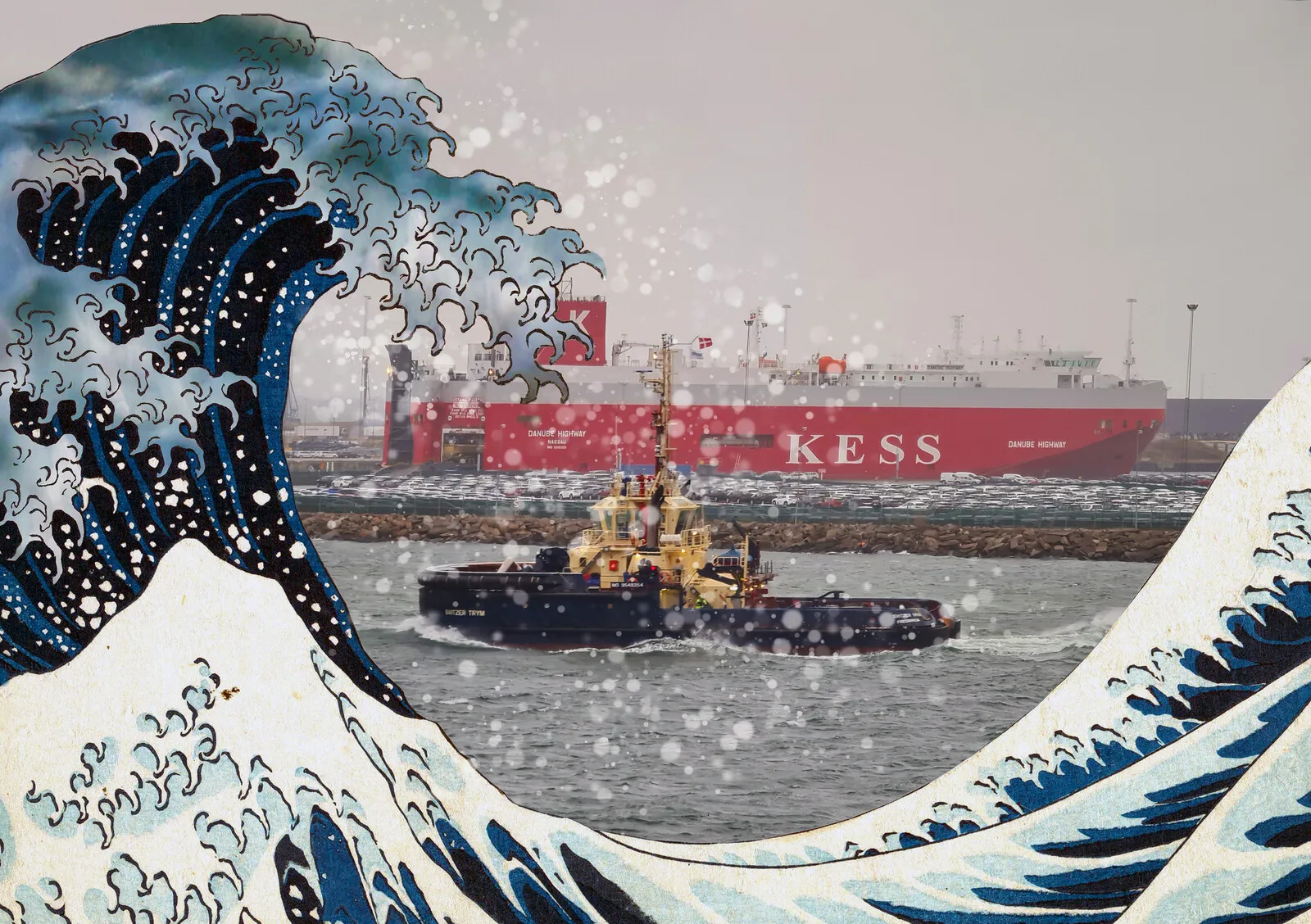
It's a bit windy in the harbour, 2021
Digital
70 x 50 cm
3 200 kr
I could hardly stand upright but couldn't help but be awestruck by the fury of the elements and the breathtaking beauty when nature takes command. Leaning against a house wall, I stood ready in case something happened. It always does when the wind blows. The wind was hauling like crazy, and the entire sea was pressing so much water in from the Öresund that the water rose over the quays, and foam lashed against the houses behind them. Suddenly, a colossal wave emerged that had journeyed far and wide, which Hokusai immortalised in 1831. Since then, the most majestic waves have rolled over the world, and it has arrived at Malmö’s harbour. Somewhere along the way, it had lost its three oshiokuri-bune, fast barges used to transport live fish. Either they had been swallowed by the wave or sailed home to deliver their catch. It’s high time if they’ve been on their way for nearly two hundred years.
The 33-meter-long and 14-meter-wide tugboat ‘Svitzer Trym’ is sturdy and will handle the waves brilliantly. The vehicle carrier ‘Danube Highway’, the red ship in the background, is well protected in the inner harbour. It is currently unloading hundreds of cars it picked up in Zeebrugge, Belgium.
‘The Great Wave off Kanagawa’ by the Japanese ukiyo-e artist Hokusai is one of the most recognisable images in art history. Part of the series ‘Thirty-Six Views of Mount Fuji’ depicts a towering wave about to crash on three boats off the coast of Kanagawa Prefecture, with Mount Fuji visible in the background. This woodblock print, dating to the early 1830s during the Edo period, has captivated viewers' imaginations across centuries and continents and has significantly influenced art and culture. Understanding the scientific origins of such waves can deepen our appreciation for their beauty and power.
Hokusai, born in 1760, was a master of ukiyo-e, a genre of Japanese art that flourished from the 17th to the 19th centuries. Ukiyo-e, meaning 'pictures of the floating world,' was a popular art form that depicted scenes from everyday life, landscapes, and famous actors and courtesans. Hokusai’s career spanned several periods, during which he created thousands of works ranging from prints to paintings and even illustrated books, contributing significantly to the ukiyo-e tradition.
‘The Great Wave’ was created around 1831 during the late Edo period, a time of relative peace and economic prosperity in Japan. The Edo period, also known as the Tokugawa period, was a time of strict social order and isolationist policies. Despite this, the flourishing merchant class increasingly consumed artistic works, leading to a surge in demand for prints like Hokusai’s ‘Thirty-Six Views of Mount Fuji’. This series, conceived when Hokusai was in his seventies, represents his deep reverence for Mount Fuji, a symbol of national identity and a sacred site in Japanese culture. The myths and legends surrounding these waves can pique our curiosity and deepen our understanding of their significance.
‘The Great Wave’ is notable for its dynamic composition. The enormous wave curves over the frame, creating a dramatic diagonal that draws the viewer’s eye from the wave's crest down to the three boats and Mount Fuji. The boats, filled with fishermen, appear dwarfed and vulnerable in the face of the impending wave. The composition blends traditional Japanese and European influences, particularly the use of linear perspective, which Hokusai likely learned from Dutch prints circulating in Japan.
The print's focal point is the wave itself, a symbol of nature's power. Rendered with remarkable precision, its frothy crest resembles claws or fingers, ready to snatch the fishermen below. The meticulous detail of the wave’s foam creates a sense of motion and power. In stark contrast, the distant Mount Fuji stands serene and calm, a symbol of nature's beauty and stability.
In Hokusai’s original work, in the background, Mount Fuji is a serene and stable presence amidst the chaos. Though relatively small compared to the wave, it holds symbolic importance as a sacred and iconic peak in Japanese culture. Its conical shape mirrors the curves of the wave, creating a visual harmony that beautifully anchors the composition.
The striking use of Prussian blue, a synthetic pigment imported from Europe, distinguishes ‘The Great Wave’ from other prints of the time. This pigment, known for its intense blue colour, was expensive but allowed for a deeper, more vibrant blue than the traditional Japanese indigo. Hokusai’s use of bokashi (gradation) in the sky and water adds depth and realism to the print, enhancing the viewer's immersion in the scene.
The woodblock print was not a simple creation but a masterpiece of art and craftsmanship. It was created using multiple blocks for each colour, each carved in relief and printed sequentially. This technique, known as ukiyo-e, was a popular method of printmaking in Japan during the Edo period. Hokusai’s collaborator, the publisher Nishimuraya Yohachi, oversaw the production, ensuring the quality of the final prints. This collaborative process was a hallmark of ukiyo-e production, with the artist, carver, and publisher each contributing their expertise to create the final print.
‘The Great Wave’ has profoundly influenced both Japanese and Western art. Within Japan, Hokusai’s 'Thirty-Six Views of Mount Fuji' was a commercial success, expanding the series to include ten additional prints. This series, which Hokusai began in his seventies, marked a significant shift in his artistic style and subject matter. His innovative compositions and techniques influenced many contemporaries and later artists in the ukiyo-e tradition, and the series remains a cornerstone of Japanese art history.
In the West, ‘The Great Wave’ became synonymous with Japonism, a term describing the influence of Japanese art on European artists in the late 19th century. Hokusai's bold compositions and vibrant colours were particularly influential. Claude Monet, Vincent van Gogh, and Edgar Degas were among the artists deeply inspired by Hokusai’s work. Monet even collected several of Hokusai’s prints, which can still be seen in his house in Giverny. Van Gogh famously painted ‘Flowering Plum Tree (after Hiroshige)’, directly referencing Japanese prints.
The image's timeless appeal has led to its appropriation and reinterpretation in various forms, from contemporary artwork to commercial products and digital memes. It remains an emblem of Japan’s artistic heritage and a testament to Hokusai’s enduring genius.
‘The Great Wave’ has often been interpreted as a representation of the power of nature and humanity’s frailty in the face of it. The fishermen's stoic demeanour in the boats suggests resilience and acceptance of their fate, reflecting the Japanese philosophy of stoicism. The wave, with its claw-like crest and spiral form, can be seen as a symbol of nature's unpredictable and uncontrollable forces. At the same time, Mount Fuji, in the background, represents stability and endurance.
Some scholars have seen the wave as a metaphor for Western influence sweeping over Japan during a period of isolationism. However, Hokusai’s motivation seems less political and more rooted in the universal themes of nature, beauty, and spirituality.
‘The Great Wave off Kanagawa’ stands as one of the pinnacles of Japanese art. Its innovative composition, vibrant colour, and symbolic depth make it a masterpiece that continues to captivate audiences worldwide. Hokusai’s ability to blend Japanese and European influences resulted in a work transcending borders and time, leaving an indelible mark on the art world.
The legacy of ‘The Great Wave’ is not just in its visual impact but also in its embodiment of the universal themes of beauty, impermanence, and humanity’s relationship with nature. Whether viewed as a symbol of Japanese culture, a technical marvel, or a testament to artistic genius, ‘The Great Wave’ remains a timeless icon that inspires and mesmerises.
Let us look at nature's power and beauty: Waves, Tsunamis, and Killer Waves. The ocean, a captivating entity, is a testament to the duality of nature's beauty and its immense power. Waves, the ever-moving undulations of the sea surface, embody this duality. They can inspire tranquillity with a gentle ripple, yet a tsunami or rogue wave can reveal the ocean's terrifying potential. This essay delves into the nature of waves, from their scientific origins to the myths and realities surrounding tsunamis and killer waves, enhancing your understanding and appreciation of the ocean's power and beauty.
Waves form due to the interaction between wind and water. As the wind blows across the ocean's surface, frictional drag causes the water to ripple, creating small capillary waves. As the wind speed increases and blows over the surface, these ripples become more giant gravity waves.
Several vital parameters characterise waves:
• Wavelength: The distance between successive wave crests.
• Amplitude: The height from the wave crest to the still water level.
• Period: The time it takes for successive wave crests to pass a fixed point.
• Frequency: The number of waves passing a point per unit time.
Ocean waves can be broadly classified into wind-generated waves and swells. Wind-generated waves form near their origin and have a choppy appearance, while swells travel long distances from their source and have smoother crests.
Tsunamis have shown the Ocean’s fury unleashed throughout history. While waves generated by wind are the most common, tsunamis represent a different phenomenon entirely. Tsunamis are long-wavelength ocean waves caused by the sudden displacement of a large volume of water. This displacement can be due to underwater earthquakes, volcanic eruptions, landslides, or even meteorite impacts.
The Mechanics of Tsunamis: Most tsunamis are caused by underwater earthquakes where tectonic plates slip, displacing a massive amount of water. The 2004 Indian Ocean tsunami was triggered by a 9.1-magnitude earthquake off the coast of Sumatra, resulting in one of the deadliest natural disasters in recorded history.
Once generated, tsunamis can travel across ocean basins at speeds exceeding 800 km/h (500 mph). In deep water, their wavelengths can reach up to 200 km (125 miles), but their heights are usually less than a meter, making them difficult to detect.
As tsunamis approach shallow coastal waters, their speed decreases, and their height increases dramatically. This awe-inspiring phenomenon, known as wave shoaling, can cause tsunami waves to rise to heights of 30 meters (100 feet) or more, creating immense devastation upon impact.
A tsunami's impact can obliterate coastal communities, and the receding waters often leave behind a wasteland of debris and destruction.
Rogue Waves, the Monsters of the Deep, also known as killer waves or freak waves, are a particularly treacherous phenomenon that has captured the imaginations of sailors and scientists alike. These waves, reaching over 20 meters (66 feet), appear suddenly, often without warning, adding an element of unpredictability to the ocean's narrative.
The Mystery and Reality of Rogue Waves. Such Rogue waves can form due to constructive interference, where multiple smaller waves align in phase to produce a much larger wave. They can also result from focusing wave energy due to ocean currents or underwater topography.
For centuries, sailors have shared gripping encounters with rogue waves, often describing them as 'walls of water.' These accounts, once dismissed as maritime folklore, now stand as a testament to the untamed power of the sea.
The first confirmed measurement of a rogue wave was in 1995 when the Draupner oil platform in the North Sea recorded a wave reaching 25.6 meters (84 feet) during a storm. Known as the "Draupner wave," it prompted significant scientific interest in studying rogue waves.
Rogue waves have been implicated in the sinking of many ships, including large vessels like oil tankers and container ships. Due to their unpredictable nature and immense force, they pose a severe threat to maritime safety.
Waves, tsunamis, and rogue waves have long been the subject of myths and legends, reflecting humanity's struggle to understand and cope with the forces of nature.
•Poseidon's Wrath: In Greek mythology, Poseidon, the god of the sea, was said to control the waves and unleash storms upon those who displeased him. Sailors often made offerings to appease him and ensure safe passage.
•The Kraken: The legendary sea monster known as the Kraken was said to dwell off the coast of Norway and would create giant waves as it surfaced to attack ships. This myth likely originated from encounters with giant squids and rogue waves.
•The Great Wave: In Japanese art, Hokusai's The Great Wave off Kanagawa embodies the beauty and terror of the sea. This woodblock print, created in the early 1830s, depicts a massive wave threatening boats, symbolising human life's fragility and resilience.
The ocean is a realm of contrasts, offering serene beauty and unimaginable destruction. Waves, in their myriad forms, capture the interplay between these extremes. From gentle ripples caressing the shore to towering tsunamis and rogue waves, the ocean's undulating surface reflects nature's elegance and power.
Understanding waves, tsunamis, and killer waves is not just about knowledge but about developing a deep respect for the sea's majesty. It underscores the importance of preparedness and respect in the face of natural disasters. As science unravels the ocean's mysteries, our relationship with the sea remains as complex and compelling as ever, reminding us of the need for caution and respect.
Jörgen Thornberg
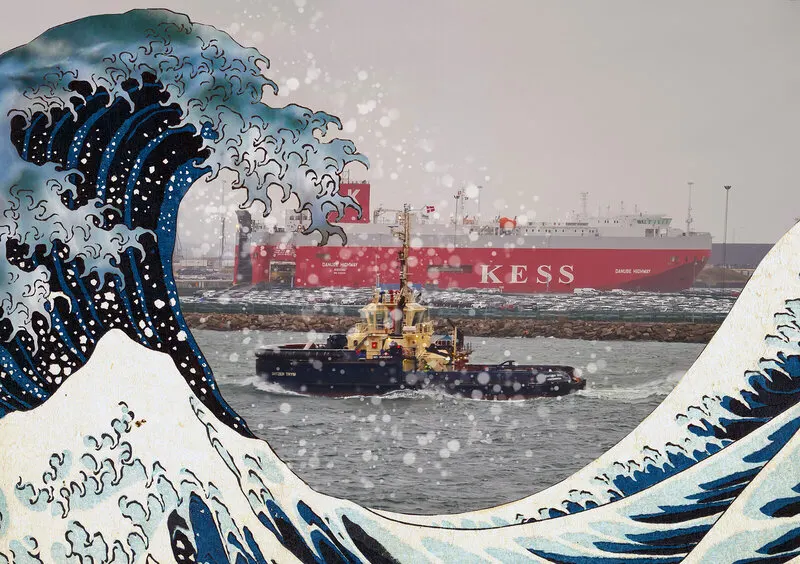
It's a bit windy in the harbour, 2021
Digital
70 x 50 cm
3 200 kr
I could hardly stand upright but couldn't help but be awestruck by the fury of the elements and the breathtaking beauty when nature takes command. Leaning against a house wall, I stood ready in case something happened. It always does when the wind blows. The wind was hauling like crazy, and the entire sea was pressing so much water in from the Öresund that the water rose over the quays, and foam lashed against the houses behind them. Suddenly, a colossal wave emerged that had journeyed far and wide, which Hokusai immortalised in 1831. Since then, the most majestic waves have rolled over the world, and it has arrived at Malmö’s harbour. Somewhere along the way, it had lost its three oshiokuri-bune, fast barges used to transport live fish. Either they had been swallowed by the wave or sailed home to deliver their catch. It’s high time if they’ve been on their way for nearly two hundred years.
The 33-meter-long and 14-meter-wide tugboat ‘Svitzer Trym’ is sturdy and will handle the waves brilliantly. The vehicle carrier ‘Danube Highway’, the red ship in the background, is well protected in the inner harbour. It is currently unloading hundreds of cars it picked up in Zeebrugge, Belgium.
‘The Great Wave off Kanagawa’ by the Japanese ukiyo-e artist Hokusai is one of the most recognisable images in art history. Part of the series ‘Thirty-Six Views of Mount Fuji’ depicts a towering wave about to crash on three boats off the coast of Kanagawa Prefecture, with Mount Fuji visible in the background. This woodblock print, dating to the early 1830s during the Edo period, has captivated viewers' imaginations across centuries and continents and has significantly influenced art and culture. Understanding the scientific origins of such waves can deepen our appreciation for their beauty and power.
Hokusai, born in 1760, was a master of ukiyo-e, a genre of Japanese art that flourished from the 17th to the 19th centuries. Ukiyo-e, meaning 'pictures of the floating world,' was a popular art form that depicted scenes from everyday life, landscapes, and famous actors and courtesans. Hokusai’s career spanned several periods, during which he created thousands of works ranging from prints to paintings and even illustrated books, contributing significantly to the ukiyo-e tradition.
‘The Great Wave’ was created around 1831 during the late Edo period, a time of relative peace and economic prosperity in Japan. The Edo period, also known as the Tokugawa period, was a time of strict social order and isolationist policies. Despite this, the flourishing merchant class increasingly consumed artistic works, leading to a surge in demand for prints like Hokusai’s ‘Thirty-Six Views of Mount Fuji’. This series, conceived when Hokusai was in his seventies, represents his deep reverence for Mount Fuji, a symbol of national identity and a sacred site in Japanese culture. The myths and legends surrounding these waves can pique our curiosity and deepen our understanding of their significance.
‘The Great Wave’ is notable for its dynamic composition. The enormous wave curves over the frame, creating a dramatic diagonal that draws the viewer’s eye from the wave's crest down to the three boats and Mount Fuji. The boats, filled with fishermen, appear dwarfed and vulnerable in the face of the impending wave. The composition blends traditional Japanese and European influences, particularly the use of linear perspective, which Hokusai likely learned from Dutch prints circulating in Japan.
The print's focal point is the wave itself, a symbol of nature's power. Rendered with remarkable precision, its frothy crest resembles claws or fingers, ready to snatch the fishermen below. The meticulous detail of the wave’s foam creates a sense of motion and power. In stark contrast, the distant Mount Fuji stands serene and calm, a symbol of nature's beauty and stability.
In Hokusai’s original work, in the background, Mount Fuji is a serene and stable presence amidst the chaos. Though relatively small compared to the wave, it holds symbolic importance as a sacred and iconic peak in Japanese culture. Its conical shape mirrors the curves of the wave, creating a visual harmony that beautifully anchors the composition.
The striking use of Prussian blue, a synthetic pigment imported from Europe, distinguishes ‘The Great Wave’ from other prints of the time. This pigment, known for its intense blue colour, was expensive but allowed for a deeper, more vibrant blue than the traditional Japanese indigo. Hokusai’s use of bokashi (gradation) in the sky and water adds depth and realism to the print, enhancing the viewer's immersion in the scene.
The woodblock print was not a simple creation but a masterpiece of art and craftsmanship. It was created using multiple blocks for each colour, each carved in relief and printed sequentially. This technique, known as ukiyo-e, was a popular method of printmaking in Japan during the Edo period. Hokusai’s collaborator, the publisher Nishimuraya Yohachi, oversaw the production, ensuring the quality of the final prints. This collaborative process was a hallmark of ukiyo-e production, with the artist, carver, and publisher each contributing their expertise to create the final print.
‘The Great Wave’ has profoundly influenced both Japanese and Western art. Within Japan, Hokusai’s 'Thirty-Six Views of Mount Fuji' was a commercial success, expanding the series to include ten additional prints. This series, which Hokusai began in his seventies, marked a significant shift in his artistic style and subject matter. His innovative compositions and techniques influenced many contemporaries and later artists in the ukiyo-e tradition, and the series remains a cornerstone of Japanese art history.
In the West, ‘The Great Wave’ became synonymous with Japonism, a term describing the influence of Japanese art on European artists in the late 19th century. Hokusai's bold compositions and vibrant colours were particularly influential. Claude Monet, Vincent van Gogh, and Edgar Degas were among the artists deeply inspired by Hokusai’s work. Monet even collected several of Hokusai’s prints, which can still be seen in his house in Giverny. Van Gogh famously painted ‘Flowering Plum Tree (after Hiroshige)’, directly referencing Japanese prints.
The image's timeless appeal has led to its appropriation and reinterpretation in various forms, from contemporary artwork to commercial products and digital memes. It remains an emblem of Japan’s artistic heritage and a testament to Hokusai’s enduring genius.
‘The Great Wave’ has often been interpreted as a representation of the power of nature and humanity’s frailty in the face of it. The fishermen's stoic demeanour in the boats suggests resilience and acceptance of their fate, reflecting the Japanese philosophy of stoicism. The wave, with its claw-like crest and spiral form, can be seen as a symbol of nature's unpredictable and uncontrollable forces. At the same time, Mount Fuji, in the background, represents stability and endurance.
Some scholars have seen the wave as a metaphor for Western influence sweeping over Japan during a period of isolationism. However, Hokusai’s motivation seems less political and more rooted in the universal themes of nature, beauty, and spirituality.
‘The Great Wave off Kanagawa’ stands as one of the pinnacles of Japanese art. Its innovative composition, vibrant colour, and symbolic depth make it a masterpiece that continues to captivate audiences worldwide. Hokusai’s ability to blend Japanese and European influences resulted in a work transcending borders and time, leaving an indelible mark on the art world.
The legacy of ‘The Great Wave’ is not just in its visual impact but also in its embodiment of the universal themes of beauty, impermanence, and humanity’s relationship with nature. Whether viewed as a symbol of Japanese culture, a technical marvel, or a testament to artistic genius, ‘The Great Wave’ remains a timeless icon that inspires and mesmerises.
Let us look at nature's power and beauty: Waves, Tsunamis, and Killer Waves. The ocean, a captivating entity, is a testament to the duality of nature's beauty and its immense power. Waves, the ever-moving undulations of the sea surface, embody this duality. They can inspire tranquillity with a gentle ripple, yet a tsunami or rogue wave can reveal the ocean's terrifying potential. This essay delves into the nature of waves, from their scientific origins to the myths and realities surrounding tsunamis and killer waves, enhancing your understanding and appreciation of the ocean's power and beauty.
Waves form due to the interaction between wind and water. As the wind blows across the ocean's surface, frictional drag causes the water to ripple, creating small capillary waves. As the wind speed increases and blows over the surface, these ripples become more giant gravity waves.
Several vital parameters characterise waves:
• Wavelength: The distance between successive wave crests.
• Amplitude: The height from the wave crest to the still water level.
• Period: The time it takes for successive wave crests to pass a fixed point.
• Frequency: The number of waves passing a point per unit time.
Ocean waves can be broadly classified into wind-generated waves and swells. Wind-generated waves form near their origin and have a choppy appearance, while swells travel long distances from their source and have smoother crests.
Tsunamis have shown the Ocean’s fury unleashed throughout history. While waves generated by wind are the most common, tsunamis represent a different phenomenon entirely. Tsunamis are long-wavelength ocean waves caused by the sudden displacement of a large volume of water. This displacement can be due to underwater earthquakes, volcanic eruptions, landslides, or even meteorite impacts.
The Mechanics of Tsunamis: Most tsunamis are caused by underwater earthquakes where tectonic plates slip, displacing a massive amount of water. The 2004 Indian Ocean tsunami was triggered by a 9.1-magnitude earthquake off the coast of Sumatra, resulting in one of the deadliest natural disasters in recorded history.
Once generated, tsunamis can travel across ocean basins at speeds exceeding 800 km/h (500 mph). In deep water, their wavelengths can reach up to 200 km (125 miles), but their heights are usually less than a meter, making them difficult to detect.
As tsunamis approach shallow coastal waters, their speed decreases, and their height increases dramatically. This awe-inspiring phenomenon, known as wave shoaling, can cause tsunami waves to rise to heights of 30 meters (100 feet) or more, creating immense devastation upon impact.
A tsunami's impact can obliterate coastal communities, and the receding waters often leave behind a wasteland of debris and destruction.
Rogue Waves, the Monsters of the Deep, also known as killer waves or freak waves, are a particularly treacherous phenomenon that has captured the imaginations of sailors and scientists alike. These waves, reaching over 20 meters (66 feet), appear suddenly, often without warning, adding an element of unpredictability to the ocean's narrative.
The Mystery and Reality of Rogue Waves. Such Rogue waves can form due to constructive interference, where multiple smaller waves align in phase to produce a much larger wave. They can also result from focusing wave energy due to ocean currents or underwater topography.
For centuries, sailors have shared gripping encounters with rogue waves, often describing them as 'walls of water.' These accounts, once dismissed as maritime folklore, now stand as a testament to the untamed power of the sea.
The first confirmed measurement of a rogue wave was in 1995 when the Draupner oil platform in the North Sea recorded a wave reaching 25.6 meters (84 feet) during a storm. Known as the "Draupner wave," it prompted significant scientific interest in studying rogue waves.
Rogue waves have been implicated in the sinking of many ships, including large vessels like oil tankers and container ships. Due to their unpredictable nature and immense force, they pose a severe threat to maritime safety.
Waves, tsunamis, and rogue waves have long been the subject of myths and legends, reflecting humanity's struggle to understand and cope with the forces of nature.
•Poseidon's Wrath: In Greek mythology, Poseidon, the god of the sea, was said to control the waves and unleash storms upon those who displeased him. Sailors often made offerings to appease him and ensure safe passage.
•The Kraken: The legendary sea monster known as the Kraken was said to dwell off the coast of Norway and would create giant waves as it surfaced to attack ships. This myth likely originated from encounters with giant squids and rogue waves.
•The Great Wave: In Japanese art, Hokusai's The Great Wave off Kanagawa embodies the beauty and terror of the sea. This woodblock print, created in the early 1830s, depicts a massive wave threatening boats, symbolising human life's fragility and resilience.
The ocean is a realm of contrasts, offering serene beauty and unimaginable destruction. Waves, in their myriad forms, capture the interplay between these extremes. From gentle ripples caressing the shore to towering tsunamis and rogue waves, the ocean's undulating surface reflects nature's elegance and power.
Understanding waves, tsunamis, and killer waves is not just about knowledge but about developing a deep respect for the sea's majesty. It underscores the importance of preparedness and respect in the face of natural disasters. As science unravels the ocean's mysteries, our relationship with the sea remains as complex and compelling as ever, reminding us of the need for caution and respect.
3 200 kr

Jörgen Thornberg
Malmö
Lite om bilder och mig. Translation in English at the end.
Jag är en nyfiken person som ser allt i bilder, även det jag fäster i ord, gärna tillsammans för bakom alla mina bilder finns en berättelse. Till vissa bilder hör en kortare eller längre novell som följer med bilden.
Bilder berättar historier. Jag omges av naturlig skönhet, intressanta människor och historia var jag än går. Jag använder min kamera för att dokumentera världen och blanda det jag ser med vad jag känner för att fånga den dolda magin.
Mina bilder berättar mina historier. Genom mina bilder, tryck och berättelser. Jag bjuder in dig att ta del av dessa berättelser, in i ditt liv och hem och dela min mycket personliga syn på vår värld. Mer än vad ögat ser. Jag tänker i bilder, drömmer och skriver och pratar om dem; följaktligen måste jag också skapa bilder. De blir vad jag ser, inte nödvändigtvis begränsade till verkligheten. Det finns en bild runt varje hörn. Jag hoppas att du kommer att se vad jag såg och gilla det.
Jag är också en skrivande person och till många bilder hör en kortare eller längre essay. Den följer med tavlan, tryckt på fint papper och med en personlig hälsning från mig.
Flertalet bilder startar sin resa i min kamera. Enkelt förklarat beskriver jag bilden jag ser i mitt inre, upplevd eller fantiserad. Bilden uppstår inom mig redan innan jag fått okularet till ögat. På bråkdelen av ett ögonblick ser jag vad jag vill ha och vad som kan göras med bilden. Här skall jag stoppa in en giraff, stålmannen, Titanic eller vad det är min fantasi finner ut. Ännu märkligare är att jag kommer ihåg minnesbilden långt efteråt när det blir tid att skapa verket. Om jag lyckas eller inte, är upp till betraktaren, oftast präglat av en stråk av svart humor – meningen är att man skall bli underhållen. Mina bilder blir ofta en snackis där de hänger.
Jag föredrar bilder som förmedlar ett budskap i flera lager. Vid första anblicken fylld av feel-good, en vacker utsikt, fint väder, solen skiner, blommor på ängen eller vattnet som ligger förrädiskt spegelblankt. I en sådan bild kan jag gömma min egentliga berättelse, mitt förakt för förtryckare och våldsverkare, rasister och fördomsfulla människor - ett gärna återkommande motiv mer eller mindre dolt i det vackra motivet. Jag försöker förena dem i ett gemensamt narrativ.
Bild och formgivning har löpt som en röd tråd genom livet. Fotokonst känns som en värdig final som jag gärna delar med mig.
Min genre är vid som framgår av mina bilder, temat en blandning av pop- och gatukonst i kollage som kan bestå av hundratals lager. Vissa bilder kan ta veckor, andra någon dag innan det är dags att överlämna resultatet till printverkstaden. Fine Art Prints är digitala fotocollage. I dessa kollage sker rivandet, klippandet, pusslandet, målandet, ritandet och sprayningen digitalt. Det jag monterar in kan vara hundratals år gamla bilder som jag omsorgsfullt frilägger så att de ser ut att vara en del av tavlan men också bilder skapade av mig själv efter min egen fantasi. Därefter besöks printstudion och för vissa bilder numrera en limiterad upplaga (oftast 7 exemplar) och signera för hand. Vissa bilder kan köpas i olika format. Det är bara att fråga efter vilka. Gillar man en bild som är 70x100 men inte har plats på väggen, går den kanske att få i 50x70 cm istället. Frågan är fri.
Metoden Giclée eller Fine Art Print som det också kallas är det moderna sättet för framställning av grafisk konst. Villkoret för denna typ av utskrifter är att en högkvalitativ storformatskrivare används med åldersbeständigt färgpigment och konstnärspapper eller i förekommande fall på duk. Pappret som används möter de krav på livslängd som ställs av museer och gallerier. Normalt säljer jag mina bilder oinramade så att den nya ägaren själv kan bestämma hur de skall se ut, med eller utan passepartout färg på ram, med eller utan glas etc..
Under många år ställde jag bara ut på nätet, i valda grupper och på min egen Facebooksida - https://www.facebook.com/jorgen.thornberg.9
Jag finns också på en egen hemsida som tyvärr inte alltid är uppdaterad – https://www.jth.life/ Där kan du också läsa en del av de berättelser som följer med bilden.
UTSTÄLLNINGAR
Luftkastellet, oktober 2022
Konst i Lund, november 2022
Luftkastellet, mars 2023
Engleson Galleri Caroli, april 2023
Hydra, Greece June 2023
Engleson Galleri Caroli, oktober 2023
Toppen, Höllviken december 2023
Luftkastellet, mars 2024
Torups Galleri, mars 2024
Venice, May 2024
Luftkastellet, oktober 2024
Konst i Advent, December 2024
Galleri Engleson, Caroli December 2024
Jäger & Jansson Galleri, april 2025
A bit about pictures and me.
I'm a curious person who sees everything in pictures, even what I express in words, often combining them, for behind all my pictures lies a story. These narratives, some as short as a single image and others as long as a novel, are the heart and soul of my work.
Pictures tell stories. Wherever I go, I'm surrounded by natural beauty, exciting people, and history. I use my camera to document the world and blend what I see with what I feel to capture the hidden magic.
My images tell my stories. Through my pictures, prints, and narratives, I invite you to partake in these stories in your life and home and share my deeply personal perspective of our world. More than meets the eye. I think in pictures, dream, write, and talk about them; consequently, I must create images too. They become what I see, not necessarily confined to reality. There's a picture around every corner. I hope you'll see what I saw and enjoy it.
I'm also a writer, and many images come with a shorter or longer essay. It accompanies the painting, printed on fine paper with my personal greeting.
Many pictures start their journey on my camera. Simply put, I describe the image I see in my mind, experienced or imagined. The image arises within me even before I bring the eyepiece to my eye. In a fraction of a moment, I see what I want and what can be done with the picture. Here, I'll insert a giraffe, Superman, the Titanic, or whatever my imagination conjures up. Even stranger is that I remember the mental image long after it's time to create the work. Whether I succeed is up to the observer, often imbued with a streak of black humour – the aim is to entertain. My pictures usually become a talking point wherever they hang.
I prefer pictures that convey a message in multiple layers. At first glance, they're filled with feel-good vibes, a beautiful view, lovely weather, the sun shining, flowers in the meadow, or the water lying deceptively calm. But beneath this surface beauty, I often conceal a deeper story, a narrative that challenges societal norms or explores the human condition. I invite you to delve into these hidden narratives and discover the layers of meaning within my work.
Picture and design have been a thread running through my life. Photographic art feels like a fitting finale, and I'm happy to share it.
My genre is varied, as seen in my pictures; the theme is a blend of pop and street art in collages that can consist of hundreds of layers. Some images can take weeks, others just a day before it's time to hand over the result to the print workshop. Fine Art Prints are digital photo collages. In these collages, tearing, cutting, puzzling, painting, drawing, and spraying happen digitally. What I insert can be images hundreds of years old that I carefully extract so they appear to be part of the painting, but also images created by myself, now also generated from my imagination. Next, visit the print studio and, for certain images, number a limited edition (usually 7 copies) and sign them by hand. Some images may be available in other formats. Just ask which ones. If you like an image that's 70x100 but doesn't have space on the wall, you might be able to get it in 50x70 cm instead. The question is open.
The Giclée method, or Fine Art Print as it's also called, is the modern way of producing graphic art. This method ensures the highest quality and longevity of the artwork, using a high-quality large-format printer with archival pigment inks and artist paper or, in some cases, canvas. The paper used meets the longevity requirements set by museums and galleries. I sell my pictures unframed, allowing the new owner to personalise their artwork, confident in the lasting value and quality of the piece.
For many years, I only exhibited online, in selected groups, and on my Facebook page - https://www.facebook.com/jorgen.thornberg.9. I also have my website, which unfortunately is not constantly updated - https://www.jth.life/. You can also read some of the stories accompanying the pictures there.
EXHIBITIONS
Luftkastellet, October 2022
Art in Lund, November 2022
Luftkastellet, March 2023
Engleson Gallery Caroli, April 2023
Hydra, Greece June 2023
Engleson Gallery Caroli, October 2023
Toppen, Höllviken December 2023
Luftkastellet, March 2024
Torup Gallery, March 2024
Venice, May 2024
UTSTÄLLNINGAR
Luftkastellet, oktober 2022
Konst i Lund, november 2022
Luftkastellet, mars 2023
Engleson Galleri Caroli, april 2023
Hydra, Greece June 2023
Engleson Galleri Caroli, oktober 2023
Toppen, Höllviken december 2023
Luftkastellet, mars 2024
Torups Galleri, mars 2024
Venice, May 2024
Luftkastellet, October 2024
Konst i Advent, December 2024
Galleri Engleson, Caroli December 2024
Jäger & Jansson Galleri, April 2025
Utbildning
Autodidakt
Medlem i konstnärsförening
Öppna Sinnen
Med i konstrunda
Konstrundan i Skåne
Utställningar
Luftkastellet, October 2022
Art in Lund, November 2022
Luftkastellet, March 2023
Engleson Gallery Caroli, April 2023
Hydra, Greece June 2023
Engleson Gallery Caroli, October 2023
Toppen, Höllviken December 2023
Luftkastellet, March 2024
Torup Gallery, March 2024
Venice, May 2024