Vi använder cookies för att ge dig bästa möjliga upplevelse. Välj vilka cookies du tillåter.
Läs mer i vår integritetspolicy
Jörgen Thornberg
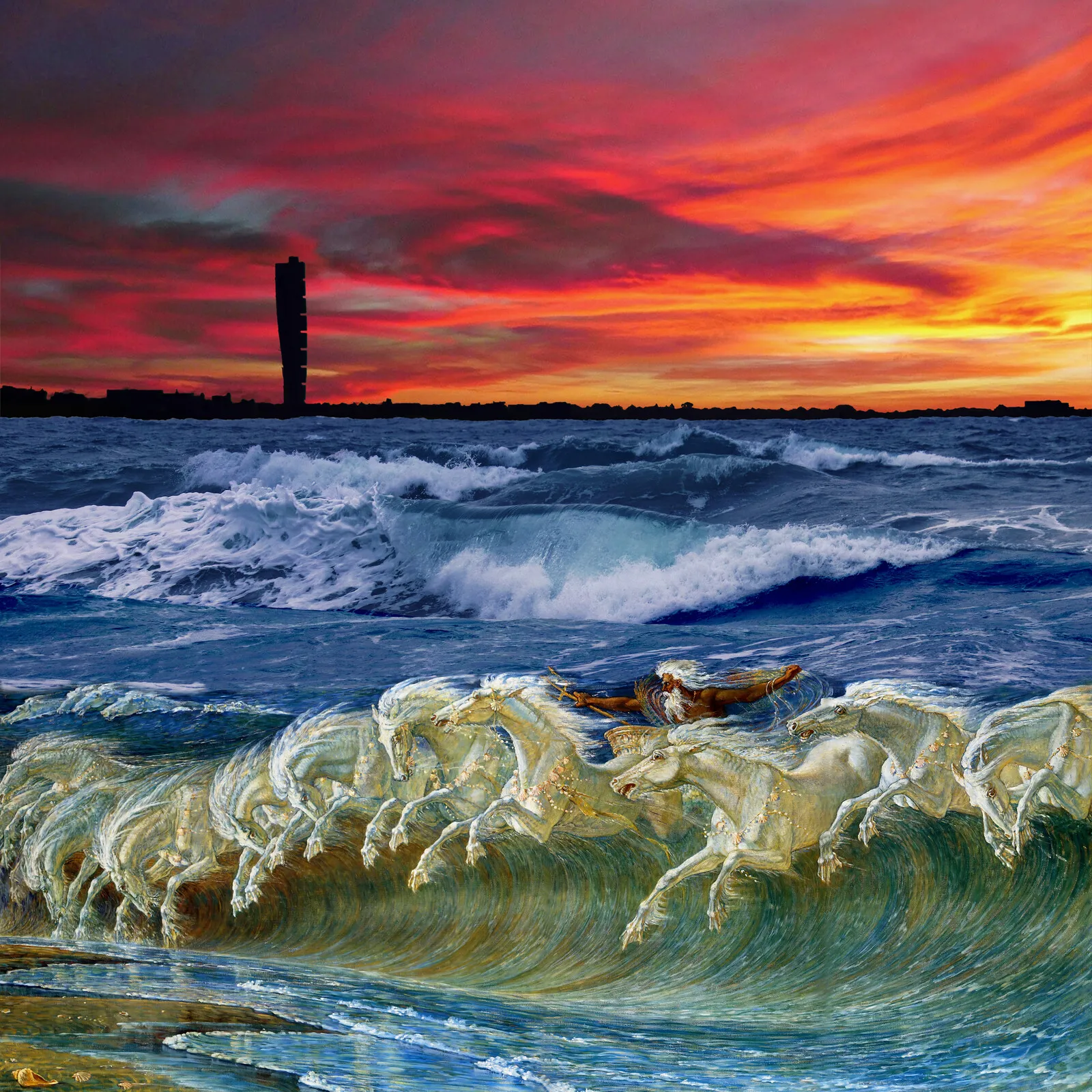
Poseidon strides his horses, 2023
Digital
70 x 70 cm
3 200 kr
When the sea roars with strength, one can glimpse the etymology behind the English expression 'white horses at sea'. The term' white horses' describes the foam on the waves, likely originating from observing how the waves break and form foam resembling the manes of white horses as they rush across the sea. This is where the sea god Poseidon, a figure of friend and foe, comes into the picture. In Swedish, we say 'vita gäss.' Many idiomatic expressions have simple and concrete origins that can acquire associations and meanings in different cultures and contexts over time. The interpretation of the Greeks, dating back three millennia, is particularly intriguing.
In the realm of ancient cults, Poseidon stood out as a deity worshipped in the form of a horse. His lineage was equally unique, with the mythical horse Arion and the winged Pegasus among his offspring. The latter, Pegasus, was born from the fearsome Medusa and Poseidon, emerging as a creature of unparalleled grace and splendour.
In Greek mythology, where tales flicker like dancing flames, a creature of unparalleled grace and splendour exists. This is Pegasus, the majestic winged horse born from the frothy embrace of the ocean's foam. Pegasus emerged as the offspring of the sea god Poseidon and the fearsome Medusa, a being whose gaze could turn mortals to stone.
The saga of Pegasus, a creature of myth and wonder, has left an indelible mark on the tapestry of human imagination. From the hallowed pages of literature to the storied halls of art, Pegasus has transcended the confines of myth to become a symbol of awe and inspiration. Even ancient coins bear his likeness, a testament to his enduring cultural significance.
Legend weaves a tale of Pegasus's celestial birth, a moment bathed in the pristine white of the sea's foam. This immortal steed of ethereal beauty was a gift from Poseidon, the god of the seas, to his son Bellerophon. Together, they soared through the heavens, their hooves tracing constellations in the night sky, a sight that must have been truly breathtaking.
Yet, like all tales of grandeur, Pegasus's journey was not without its trials. In a tragic turn reminiscent of the fall of Icarus, Bellerophon's hubris led him too close to the sun-kissed peaks of Olympus. In a moment of divine retribution, Pegasus cast his rider aside, returning to the heavens to serve a new master.
Some say Pegasus found solace in the embrace of Eos, goddess of the dawn, guiding her chariot across the azure expanse of the morning sky. Others whisper that he ascended to the stars, becoming a celestial beacon in service to Zeus, the thundering god of Olympus.
Through the ages, Pegasus's legend has endured, immortalised in the artistry of Roman artisans and the vibrant imaginations of storytellers. Today, his likeness graces the pages of cherished children's books, dances across the silver screen, and inspires wonder in all who behold him.
In mythology, where dreams take flight on wings of imagination, Pegasus reigns supreme—a testament to the enduring power of myth and the timeless allure of the fantastic.
Whether the horses’ master is friend or foe is a natural question for those who have been at sea in harsh weather. When the sun is blazing, the sea lies mirror-smooth, and one almost expects the birth of the exquisite Venus, who emerges from a seashell like Sandro Botticelli's naked goddess, it is easy to appreciate Poseidon. Then, the horses seem safely standing in the stable at the bottom of the sea, not disturbing anyone with their violent gallop over the waves. But the horses don't stand in any stable; it's constantly blowing somewhere on Earth. The toll of lives lost at sea throughout history has been significant and profound, and many are the children and widows who cry over their drowned.
Historically, significant maritime disasters such as the sinking of the Titanic in 1912, the loss of the Spanish Armada in 1588, and numerous naval battles throughout history have resulted in the deaths of millions of sailors. Additionally, the dangers of sea travel were especially pronounced during the Age of Exploration when sailors ventured into uncharted waters in search of new trade routes and territories. For those affected, Poseidon must be likened to the devil himself. Likewise, his responsibility for earthquakes and tsunamis must add millions more lives to his conscience. In competition with the war god Mars, the cruel Zeus with lightning and thunder, weapons that could cause significant harm, Poseidon should still have the most lives on his conscience among the gods.
In Greek mythology, Poseidon is often depicted as a complex figure who can be both friend and foe, depending on the context. As the god of the sea, earthquakes, and horses, Poseidon wields tremendous power and influence over the natural world. He is known for his erratic nature and can be benevolent to those who honour him and treat him with respect while also displaying wrath and vengefulness towards those who defy or anger him.
Poseidon is often portrayed as a protector of sailors and seafarers, offering safe passage to those who pay him homage. He is also associated with fertility and abundance, as seen in his role as the god of horses and the creator of springs and water sources. In this sense, Poseidon can be viewed as a friend to humanity, providing essential resources and blessings to those who revere him.
However, Poseidon is also depicted as a formidable and sometimes dangerous deity, capable of unleashing devastating storms, earthquakes, and floods upon those who provoke his anger. His conflicts with other gods, such as Athena and Zeus, often result in destructive consequences for mortals caught in the crossfire. In this aspect, Poseidon can be seen as a formidable foe whose wrath must be appeased and whose power must be respected, a reminder of the sea's unpredictable and often treacherous nature.
Overall, Poseidon embodies the benevolent and wrathful aspects of the natural world, making him a complex and multifaceted figure in Greek mythology.
However, identifying the "deadliest" god among the ancient deities is a subjective judgment that depends on how one defines deadly. If we look at ancient Greek mythology and its gods, Poseidon and his horses can be considered among the most feared for their ability to cause destruction and death.
In Greek mythology, Poseidon was the god of the sea, earthquakes, tidal waves, and horses. His domains included all seas, rivers, and lakes, and he had the power to evoke and control storms, waves, and tsunamis. The sea was considered a dangerous and unpredictable place for the ancient Greeks, and Poseidon was seen as both a protector and a perpetrator of sailors and ships. His wrath could unleash devastation in the form of shipwrecks and drowning.
In addition to his power over the sea, Poseidon could evoke earthquakes by shaking the earth with his trident. Earthquakes were feared because they could cause extensive destruction and loss of life, especially in coastal areas and among seafaring communities.
In summary, Poseidon should be regarded as one of the deadliest gods in ancient Greek mythology due to his ability to cause destruction and death through the sea, earthquakes, and tsunamis. But indeed, his horses are beautiful to behold when observing them from the land.
Jörgen Thornberg
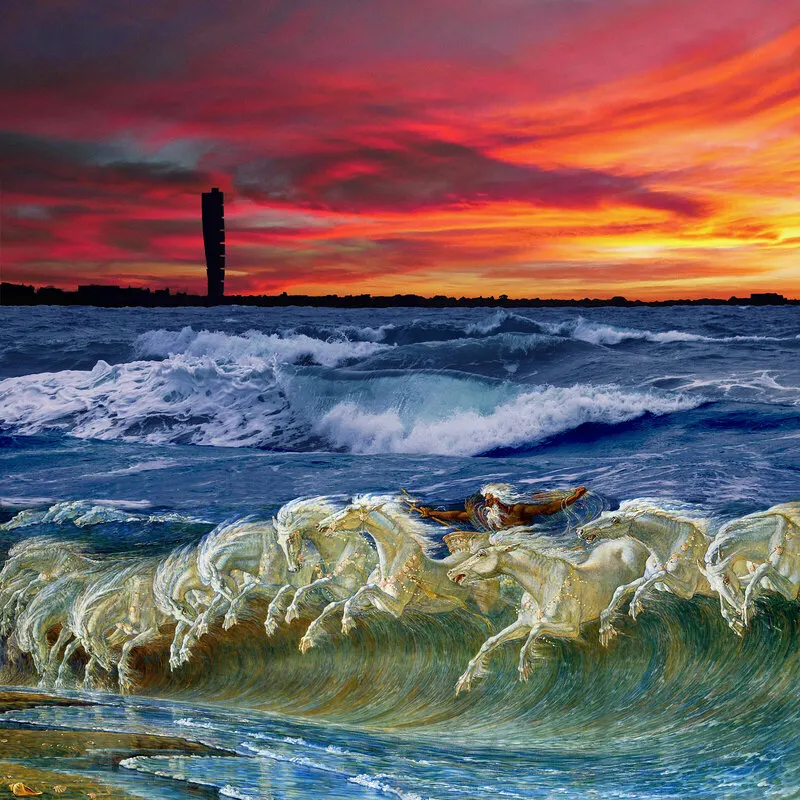
Poseidon strides his horses, 2023
Digital
70 x 70 cm
3 200 kr
When the sea roars with strength, one can glimpse the etymology behind the English expression 'white horses at sea'. The term' white horses' describes the foam on the waves, likely originating from observing how the waves break and form foam resembling the manes of white horses as they rush across the sea. This is where the sea god Poseidon, a figure of friend and foe, comes into the picture. In Swedish, we say 'vita gäss.' Many idiomatic expressions have simple and concrete origins that can acquire associations and meanings in different cultures and contexts over time. The interpretation of the Greeks, dating back three millennia, is particularly intriguing.
In the realm of ancient cults, Poseidon stood out as a deity worshipped in the form of a horse. His lineage was equally unique, with the mythical horse Arion and the winged Pegasus among his offspring. The latter, Pegasus, was born from the fearsome Medusa and Poseidon, emerging as a creature of unparalleled grace and splendour.
In Greek mythology, where tales flicker like dancing flames, a creature of unparalleled grace and splendour exists. This is Pegasus, the majestic winged horse born from the frothy embrace of the ocean's foam. Pegasus emerged as the offspring of the sea god Poseidon and the fearsome Medusa, a being whose gaze could turn mortals to stone.
The saga of Pegasus, a creature of myth and wonder, has left an indelible mark on the tapestry of human imagination. From the hallowed pages of literature to the storied halls of art, Pegasus has transcended the confines of myth to become a symbol of awe and inspiration. Even ancient coins bear his likeness, a testament to his enduring cultural significance.
Legend weaves a tale of Pegasus's celestial birth, a moment bathed in the pristine white of the sea's foam. This immortal steed of ethereal beauty was a gift from Poseidon, the god of the seas, to his son Bellerophon. Together, they soared through the heavens, their hooves tracing constellations in the night sky, a sight that must have been truly breathtaking.
Yet, like all tales of grandeur, Pegasus's journey was not without its trials. In a tragic turn reminiscent of the fall of Icarus, Bellerophon's hubris led him too close to the sun-kissed peaks of Olympus. In a moment of divine retribution, Pegasus cast his rider aside, returning to the heavens to serve a new master.
Some say Pegasus found solace in the embrace of Eos, goddess of the dawn, guiding her chariot across the azure expanse of the morning sky. Others whisper that he ascended to the stars, becoming a celestial beacon in service to Zeus, the thundering god of Olympus.
Through the ages, Pegasus's legend has endured, immortalised in the artistry of Roman artisans and the vibrant imaginations of storytellers. Today, his likeness graces the pages of cherished children's books, dances across the silver screen, and inspires wonder in all who behold him.
In mythology, where dreams take flight on wings of imagination, Pegasus reigns supreme—a testament to the enduring power of myth and the timeless allure of the fantastic.
Whether the horses’ master is friend or foe is a natural question for those who have been at sea in harsh weather. When the sun is blazing, the sea lies mirror-smooth, and one almost expects the birth of the exquisite Venus, who emerges from a seashell like Sandro Botticelli's naked goddess, it is easy to appreciate Poseidon. Then, the horses seem safely standing in the stable at the bottom of the sea, not disturbing anyone with their violent gallop over the waves. But the horses don't stand in any stable; it's constantly blowing somewhere on Earth. The toll of lives lost at sea throughout history has been significant and profound, and many are the children and widows who cry over their drowned.
Historically, significant maritime disasters such as the sinking of the Titanic in 1912, the loss of the Spanish Armada in 1588, and numerous naval battles throughout history have resulted in the deaths of millions of sailors. Additionally, the dangers of sea travel were especially pronounced during the Age of Exploration when sailors ventured into uncharted waters in search of new trade routes and territories. For those affected, Poseidon must be likened to the devil himself. Likewise, his responsibility for earthquakes and tsunamis must add millions more lives to his conscience. In competition with the war god Mars, the cruel Zeus with lightning and thunder, weapons that could cause significant harm, Poseidon should still have the most lives on his conscience among the gods.
In Greek mythology, Poseidon is often depicted as a complex figure who can be both friend and foe, depending on the context. As the god of the sea, earthquakes, and horses, Poseidon wields tremendous power and influence over the natural world. He is known for his erratic nature and can be benevolent to those who honour him and treat him with respect while also displaying wrath and vengefulness towards those who defy or anger him.
Poseidon is often portrayed as a protector of sailors and seafarers, offering safe passage to those who pay him homage. He is also associated with fertility and abundance, as seen in his role as the god of horses and the creator of springs and water sources. In this sense, Poseidon can be viewed as a friend to humanity, providing essential resources and blessings to those who revere him.
However, Poseidon is also depicted as a formidable and sometimes dangerous deity, capable of unleashing devastating storms, earthquakes, and floods upon those who provoke his anger. His conflicts with other gods, such as Athena and Zeus, often result in destructive consequences for mortals caught in the crossfire. In this aspect, Poseidon can be seen as a formidable foe whose wrath must be appeased and whose power must be respected, a reminder of the sea's unpredictable and often treacherous nature.
Overall, Poseidon embodies the benevolent and wrathful aspects of the natural world, making him a complex and multifaceted figure in Greek mythology.
However, identifying the "deadliest" god among the ancient deities is a subjective judgment that depends on how one defines deadly. If we look at ancient Greek mythology and its gods, Poseidon and his horses can be considered among the most feared for their ability to cause destruction and death.
In Greek mythology, Poseidon was the god of the sea, earthquakes, tidal waves, and horses. His domains included all seas, rivers, and lakes, and he had the power to evoke and control storms, waves, and tsunamis. The sea was considered a dangerous and unpredictable place for the ancient Greeks, and Poseidon was seen as both a protector and a perpetrator of sailors and ships. His wrath could unleash devastation in the form of shipwrecks and drowning.
In addition to his power over the sea, Poseidon could evoke earthquakes by shaking the earth with his trident. Earthquakes were feared because they could cause extensive destruction and loss of life, especially in coastal areas and among seafaring communities.
In summary, Poseidon should be regarded as one of the deadliest gods in ancient Greek mythology due to his ability to cause destruction and death through the sea, earthquakes, and tsunamis. But indeed, his horses are beautiful to behold when observing them from the land.
3 200 kr

Jörgen Thornberg
Malmö
Lite om bilder och mig. Translation in English at the end.
Jag är en nyfiken person som ser allt i bilder, även det jag fäster i ord, gärna tillsammans för bakom alla mina bilder finns en berättelse. Till vissa bilder hör en kortare eller längre novell som följer med bilden.
Bilder berättar historier. Jag omges av naturlig skönhet, intressanta människor och historia var jag än går. Jag använder min kamera för att dokumentera världen och blanda det jag ser med vad jag känner för att fånga den dolda magin.
Mina bilder berättar mina historier. Genom mina bilder, tryck och berättelser. Jag bjuder in dig att ta del av dessa berättelser, in i ditt liv och hem och dela min mycket personliga syn på vår värld. Mer än vad ögat ser. Jag tänker i bilder, drömmer och skriver och pratar om dem; följaktligen måste jag också skapa bilder. De blir vad jag ser, inte nödvändigtvis begränsade till verkligheten. Det finns en bild runt varje hörn. Jag hoppas att du kommer att se vad jag såg och gilla det.
Jag är också en skrivande person och till många bilder hör en kortare eller längre essay. Den följer med tavlan, tryckt på fint papper och med en personlig hälsning från mig.
Flertalet bilder startar sin resa i min kamera. Enkelt förklarat beskriver jag bilden jag ser i mitt inre, upplevd eller fantiserad. Bilden uppstår inom mig redan innan jag fått okularet till ögat. På bråkdelen av ett ögonblick ser jag vad jag vill ha och vad som kan göras med bilden. Här skall jag stoppa in en giraff, stålmannen, Titanic eller vad det är min fantasi finner ut. Ännu märkligare är att jag kommer ihåg minnesbilden långt efteråt när det blir tid att skapa verket. Om jag lyckas eller inte, är upp till betraktaren, oftast präglat av en stråk av svart humor – meningen är att man skall bli underhållen. Mina bilder blir ofta en snackis där de hänger.
Jag föredrar bilder som förmedlar ett budskap i flera lager. Vid första anblicken fylld av feel-good, en vacker utsikt, fint väder, solen skiner, blommor på ängen eller vattnet som ligger förrädiskt spegelblankt. I en sådan bild kan jag gömma min egentliga berättelse, mitt förakt för förtryckare och våldsverkare, rasister och fördomsfulla människor - ett gärna återkommande motiv mer eller mindre dolt i det vackra motivet. Jag försöker förena dem i ett gemensamt narrativ.
Bild och formgivning har löpt som en röd tråd genom livet. Fotokonst känns som en värdig final som jag gärna delar med mig.
Min genre är vid som framgår av mina bilder, temat en blandning av pop- och gatukonst i kollage som kan bestå av hundratals lager. Vissa bilder kan ta veckor, andra någon dag innan det är dags att överlämna resultatet till printverkstaden. Fine Art Prints är digitala fotocollage. I dessa kollage sker rivandet, klippandet, pusslandet, målandet, ritandet och sprayningen digitalt. Det jag monterar in kan vara hundratals år gamla bilder som jag omsorgsfullt frilägger så att de ser ut att vara en del av tavlan men också bilder skapade av mig själv efter min egen fantasi. Därefter besöks printstudion och för vissa bilder numrera en limiterad upplaga (oftast 7 exemplar) och signera för hand. Vissa bilder kan köpas i olika format. Det är bara att fråga efter vilka. Gillar man en bild som är 70x100 men inte har plats på väggen, går den kanske att få i 50x70 cm istället. Frågan är fri.
Metoden Giclée eller Fine Art Print som det också kallas är det moderna sättet för framställning av grafisk konst. Villkoret för denna typ av utskrifter är att en högkvalitativ storformatskrivare används med åldersbeständigt färgpigment och konstnärspapper eller i förekommande fall på duk. Pappret som används möter de krav på livslängd som ställs av museer och gallerier. Normalt säljer jag mina bilder oinramade så att den nya ägaren själv kan bestämma hur de skall se ut, med eller utan passepartout färg på ram, med eller utan glas etc..
Under många år ställde jag bara ut på nätet, i valda grupper och på min egen Facebooksida - https://www.facebook.com/jorgen.thornberg.9
Jag finns också på en egen hemsida som tyvärr inte alltid är uppdaterad – https://www.jth.life/ Där kan du också läsa en del av de berättelser som följer med bilden.
UTSTÄLLNINGAR
Luftkastellet, oktober 2022
Konst i Lund, november 2022
Luftkastellet, mars 2023
Engleson Galleri Caroli, april 2023
Hydra, Greece June 2023
Engleson Galleri Caroli, oktober 2023
Toppen, Höllviken december 2023
Luftkastellet, mars 2024
Torups Galleri, mars 2024
Venice, May 2024
Luftkastellet, oktober 2024
Konst i Advent, December 2024
Galleri Engleson, Caroli December 2024
Jäger & Jansson Galleri, april 2025
A bit about pictures and me.
I'm a curious person who sees everything in pictures, even what I express in words, often combining them, for behind all my pictures lies a story. These narratives, some as short as a single image and others as long as a novel, are the heart and soul of my work.
Pictures tell stories. Wherever I go, I'm surrounded by natural beauty, exciting people, and history. I use my camera to document the world and blend what I see with what I feel to capture the hidden magic.
My images tell my stories. Through my pictures, prints, and narratives, I invite you to partake in these stories in your life and home and share my deeply personal perspective of our world. More than meets the eye. I think in pictures, dream, write, and talk about them; consequently, I must create images too. They become what I see, not necessarily confined to reality. There's a picture around every corner. I hope you'll see what I saw and enjoy it.
I'm also a writer, and many images come with a shorter or longer essay. It accompanies the painting, printed on fine paper with my personal greeting.
Many pictures start their journey on my camera. Simply put, I describe the image I see in my mind, experienced or imagined. The image arises within me even before I bring the eyepiece to my eye. In a fraction of a moment, I see what I want and what can be done with the picture. Here, I'll insert a giraffe, Superman, the Titanic, or whatever my imagination conjures up. Even stranger is that I remember the mental image long after it's time to create the work. Whether I succeed is up to the observer, often imbued with a streak of black humour – the aim is to entertain. My pictures usually become a talking point wherever they hang.
I prefer pictures that convey a message in multiple layers. At first glance, they're filled with feel-good vibes, a beautiful view, lovely weather, the sun shining, flowers in the meadow, or the water lying deceptively calm. But beneath this surface beauty, I often conceal a deeper story, a narrative that challenges societal norms or explores the human condition. I invite you to delve into these hidden narratives and discover the layers of meaning within my work.
Picture and design have been a thread running through my life. Photographic art feels like a fitting finale, and I'm happy to share it.
My genre is varied, as seen in my pictures; the theme is a blend of pop and street art in collages that can consist of hundreds of layers. Some images can take weeks, others just a day before it's time to hand over the result to the print workshop. Fine Art Prints are digital photo collages. In these collages, tearing, cutting, puzzling, painting, drawing, and spraying happen digitally. What I insert can be images hundreds of years old that I carefully extract so they appear to be part of the painting, but also images created by myself, now also generated from my imagination. Next, visit the print studio and, for certain images, number a limited edition (usually 7 copies) and sign them by hand. Some images may be available in other formats. Just ask which ones. If you like an image that's 70x100 but doesn't have space on the wall, you might be able to get it in 50x70 cm instead. The question is open.
The Giclée method, or Fine Art Print as it's also called, is the modern way of producing graphic art. This method ensures the highest quality and longevity of the artwork, using a high-quality large-format printer with archival pigment inks and artist paper or, in some cases, canvas. The paper used meets the longevity requirements set by museums and galleries. I sell my pictures unframed, allowing the new owner to personalise their artwork, confident in the lasting value and quality of the piece.
For many years, I only exhibited online, in selected groups, and on my Facebook page - https://www.facebook.com/jorgen.thornberg.9. I also have my website, which unfortunately is not constantly updated - https://www.jth.life/. You can also read some of the stories accompanying the pictures there.
EXHIBITIONS
Luftkastellet, October 2022
Art in Lund, November 2022
Luftkastellet, March 2023
Engleson Gallery Caroli, April 2023
Hydra, Greece June 2023
Engleson Gallery Caroli, October 2023
Toppen, Höllviken December 2023
Luftkastellet, March 2024
Torup Gallery, March 2024
Venice, May 2024
UTSTÄLLNINGAR
Luftkastellet, oktober 2022
Konst i Lund, november 2022
Luftkastellet, mars 2023
Engleson Galleri Caroli, april 2023
Hydra, Greece June 2023
Engleson Galleri Caroli, oktober 2023
Toppen, Höllviken december 2023
Luftkastellet, mars 2024
Torups Galleri, mars 2024
Venice, May 2024
Luftkastellet, October 2024
Konst i Advent, December 2024
Galleri Engleson, Caroli December 2024
Jäger & Jansson Galleri, April 2025
Utbildning
Autodidakt
Medlem i konstnärsförening
Öppna Sinnen
Med i konstrunda
Konstrundan i Skåne
Utställningar
Luftkastellet, October 2022
Art in Lund, November 2022
Luftkastellet, March 2023
Engleson Gallery Caroli, April 2023
Hydra, Greece June 2023
Engleson Gallery Caroli, October 2023
Toppen, Höllviken December 2023
Luftkastellet, March 2024
Torup Gallery, March 2024
Venice, May 2024