Vi använder cookies för att ge dig bästa möjliga upplevelse. Välj vilka cookies du tillåter.
Läs mer i vår integritetspolicy
Jörgen Thornberg
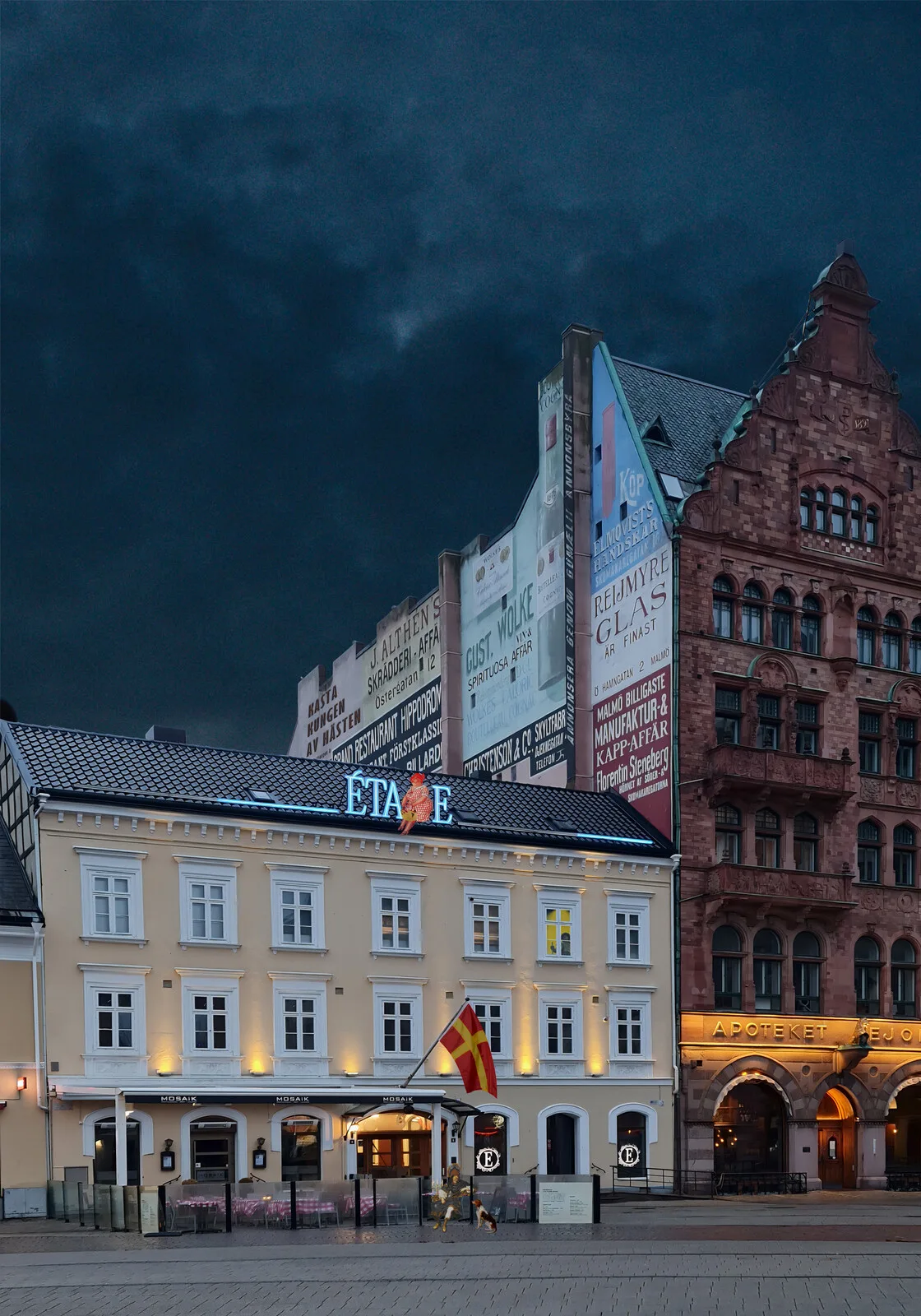
Lady with a handbag, 2023
Digital
50 x 70 cm
3 200 kr
Below, under the Scania red flag with a yellow cross, sits the controversial King Charles X Gustav, who naturally despises the flag above. The dog isn't his; it's a stray dog that, like any good Scanian, feels responsible for ensuring that the detested monarch doesn't attempt any foolishness. In that case, the pooch has a good eye on the older man's shins.
In the middle of the picture, next to the Entrance sign above Stortorget, sits a proud, plump woman with her handbag, gazing down at the even thicker King Charles X Gustav, who became king of Sweden in 1654 after Queen Christina abdicated. He was a well-educated professional soldier and is considered to have been a skilled military leader. Charles had no hereditary right to the Swedish throne. It was Queen Christina who appointed him as her successor. This is something many Scanians and Danes regret. Thick Charles, they call him.
As a person, Charles was proud, sensitive, hot-tempered, fond of food and overly sexual. During the periods when he, as heir to the throne, had no political or military tasks, he often expressed depressive moods. Due to his education, he had a cultural orientation, which he sometimes used, but he hardly had any primary cultural interests. He was evidently more interested in sex. Both before and during his marriage, he had countless women with illegitimate children as a result. He is a real womaniser, according to his detractors. He even proposed to Queen Christina, who politely declined. Whether Charles could harbour personal feelings is difficult to determine; much suggests that his political interests drove him, and a rendezvous with a queen carries weight.
The woman and her handbag have little to do with the background of this picture. It's about Charles and the person with whom the story revolves. As indicated by the large mural advertisement above her, 'THROW THE KING OFF THE HORSE,' his person has stirred strong emotions among Scanians in general but women in particular. Why should a woman abuser, likely to have pushed Weinstein off the top spot of male pigs, be allowed to have his way on the city's largest square? To further illustrate the struggle against him as a person and his person, here's an excerpt from my novel 'With Tony Blair and Audrey Hepburn in Malmö.'
"Niels didn't particularly have anything against kings, whether mounted or seated on a throne adorned with a crown and orb, and sceptre in each hand. He was relatively neutral towards the phenomenon. Nor did Niels harbour any particular animosity towards Charles X Gustav, his gaze fixed in the distance beyond the facade of the Town Hall. Born in Denmark, Niels could have had strong feelings towards the Swedish king who annexed Scania from his old homeland. As a naturalized Scanian, Niels had accepted the course of history. They hadn't fantasised counterfactually about the ice breaking under the fat king during the march across the Great and Little Belts in the winter of 1658. Niels was content with his life and felt no longing for the fatherland. There was nothing left there but bitter memories and his mother's grave.
He also didn't care about the variant of Columba livia. This city pigeon divided the people of Malmö into roughly equal parts on whether the king should stay. In a way, it was the opposite. The pigeons finally convinced the authorities to decide to cleanse the old king properly. Without the city council's decision and the notice in the daily Sydsvenskan, Niels would hardly have come up with his brilliant idea. A stroke of genius for which he was grateful to the cooing feathered ones, which had filled his waking hours for sixty-five years, as well as an occasional constructive dream.
The inspiration indeed stemmed from something Niels truly disliked - Nazis and their collaborators. Even seventy-three years after the war, that sort of thing still made itself felt even if they had changed their spots. In February 2018, Niels was preparing for an event that stirred up memories. It was now, as then, about male egos carved in stone, carved in wood, or cast in bronze, with artists' carefully crafted looks exuding brutality and contempt for humanity.
Like a pandemic, the movement spread across the world, those who wanted to topple statues erected for oppressors, racists, thugs, slave traders, and rapists. An old good tradition for disagreeable figures had been toppled by humanity since time immemorial. From the Moai statues of Easter Island to Stalin and Saddam Hussein, monuments and sculptures have been toppled flat - despised and hated by new generations. In Malmö, an old king caused some agitation. In England, people wanted to rid the world of all traces of colonisers like Cecil Rhodes, and in the big country to the West, citizens took physical action against statues honouring men who fought for the preservation of slavery during the Civil War. Justifying the removal of the king in Malmö was the fact that if Charles X Gustav had lived today, he would undoubtedly have been tried before the war crimes tribunal in The Hague.
"It's time to beautify Stortorget in Malmö, give the square new symbolism, and make it pedestrian-friendly," wrote a citizen in the daily Sydsvenskan. Between the lines, the man aimed more for a king on horseback than pedestrian access for the people of Malmö. The fat king had been controversial for more than 350 years. Especially in Malmö. Even among the women, as it would turn out."
The city was again set ablaze, and Malmö divided into for or against or a bit of both. Some vehemently advocated for pouring more gasoline on the fire, but some appealed for restraint. Lately, the crowd had expanded to include others wishing for something feminine instead. The latter group had gained momentum, which Nils Nilsson Sten had missed entirely, despite the newspapers writing more about this than controversial kings this winter.
The previous year, the letter to the editor the day after Lucia had been the spark. But another fire raged concurrently with this local concern. This fire spread globally, and smoke penetrated the old city theatre's lodges. The dirt thrown had splattered on, among others, the theatre's most excellent director of all time. And it had splattered. Throughout Christmas, there had been burning in and around the tree and at events with innocent Lucias and equally innocent maids. Niels thought the star boys had fallen out of line this winter. Don't mention Santa Claus, who hunched over like an ugly old man in the public square. There was no talk of giving candy to small children or patting them on the head, especially not their mothers.
The New Year they had started as the old one ended with fights. However, the question of a particular statue's existence or non-existence seemed like a negligible brushfire compared to #metoo. The protest movement had exploded under Hollywood producer Harvey Weinstein's scandal, dragging a whole bunch of wrongdoers down with him. Unfortunately, many others, too. Suddenly, it seemed like the cultural world mainly consisted of male oppressors and their victims. Shakespeare's view of women was questioned, and there was propaganda that his works should be removed from the city library. Statues of the great playwright had police protection here and there. Since he wasn't a Scanian, Shakespeare would have drowned in the sea of local candidates, and the books would stay put for the time being. A theatre manager had committed suicide, and Ingmar Bergman couldn't defend himself since he had left the earthly realm. "May he burn in hell," chanted militant feminists. Considering how he behaved among the city's women, the demon director had been in a precarious position. If one became pregnant, there was always someone else. The official history only talks about his strong women; the weaker ones had fallen silent but suffered terribly. Niels had insider information from the theatre, not gossip but a couple of friends' memories. They weren't pretty.
One woman after another joined and told their experiences. Like an uncontrollable grass fire, the reaction spread across the world. A dammed-up realisation. Who cared about an old king then? Well, quite a few. There were plenty of points of contact.
February 26, 2018, was exactly 360 years since the Peace of Roskilde when Denmark lost Scania. Of more local significance was a famous meeting in Malmö one hundred and fifty years earlier, when Chief Equerry Tornérhielm and Professor Weibull started a fundraising campaign to erect a statue. In truth, neither that meeting nor the evening's gathering at the Town Hall Cellar had anything to do with #metoo. It just happened that way. That was where Niels was headed in a drizzle to express what he thought in Skåne about the too-common southern Swedish winter weather. Niels liked to walk, rain or shine and enjoyed the thoughts that lined up inside him as he passed places that had played a role before he moved to Italy in the late 70s. That time had its problems, but few cared about a fat relic on horseback when the world risked going under in a nuclear war.
John Börjesson's equestrian statue in Stortorget had, since its unveiling in 1896, been the subject of animated debate. The polemics divided families and had the power to split friends. Like other civil wars, people became enemies for life. Some criticised the artistic qualities of the work, while others considered it one of the world's finest in its genre. Regardless, many questioned the appropriateness of allowing Charles X Gustav to ride on his bronze horse in the middle of Malmö - the centre of Scania, which the same king snatched from Denmark. He even claimed to have hated Scania and taken the province just to shut it down. Niels undoubtedly sat on two horses as a half-Dane but thought it was about the same as if Copenhagen had the traitor Struensee riding outside the queen's office at Amalienborg. Or if Stalin had been allowed to remain as a statue in Hungary's capital. The Russian dictator had indeed stood – not ridden – eight meters tall in the middle of Budapest but was torn down by enraged Hungarians during the 1956 uprising. The uprising was crushed, but Khrushchev was wise enough not to let his old boss rise again. "If the Hungarians could, why not us," thought many Malmo residents. It was because of Charles X that Niels was on his way. He had just passed Ohlsson's corner, which hadn't been Ohlsson's for decades. He felt a pang of longing.
Shipbroker Nils Nilsson Sten was a figure in shipping circles. He was named Nils after his grandfather and Sten after his mother descended from an odalman who fought at Poltava in 1709. The daily interaction with pirates—as the shipbroker called his customers—and the ancestor's warlike past made Nilsson Sten well suited to handle the battle over the fat king's existence or non-existence—at least that's what he thought.
A few days into the new year, the shipbroker had published a twelve-page pamphlet and been called to a meeting for the good of Skåne. The sender was KMFF - the Committee for the Beautification and Skåne-ifying of Malmö. Behind the acronym, there were resources. The pamphlet was printed on thick, glossy paper and in four colours. After the business, the committee had reserved the entire Town Hall Cellar and enticed with a well-stocked buffet, a lure as good as any. The pamphlet allowed for different opinions to be voiced for appearance's sake, but there was no doubt about what the committee stood for. And the committee's chairman, Nils Nilsson Sten's opinions were well known. Despite that, Niels had decided to attend.
A picture occupied one whole page in the brochure, so softened that it was impossible to determine what it depicted other than someone riding a white horse. Below, it was stated that a finished proposal would be presented at the Town Hall Cellar. Out of sheer curiosity, people would be drawn to the meeting. Niels felt that way.
A photoshopped proposal advocated for Charles X Gustav to be replaced by a snapphane (a member of the pro-Danish guerrilla organisation), even though such individuals had never been active this far south. The king himself never set foot in Malmö. When the people of Malmö collectively pledged their allegiance to the Swedish king, they had to do it to an empty chair just outside where people were now gathering in the town hall cellar.
The city was again set ablaze, and Malmö divided into for or against or a bit of both. Some vehemently advocated for pouring more gasoline on the fire, but some appealed for restraint. Lately, the crowd had expanded to include others wishing for something feminine instead. The latter group had gained momentum, which Nils Nilsson Sten had missed entirely, despite the newspapers writing more about this than controversial kings this winter.
The previous year, the letter to the editor the day after Lucia had been the spark. But another fire raged concurrently with this local concern. This fire spread globally, and smoke penetrated the old city theatre's lodges. The dirt thrown had splattered on, among others, the theatre's most excellent director of all time. And it had splattered. Throughout Christmas, there had been burning in and around the tree and at events with innocent Lucias and equally innocent maids. Niels thought the star boys had fallen out of line this winter. Don't mention Santa Claus, who hunched over like an ugly old man in the public square. There was no talk of giving candy to small children or patting them on the head, especially not their mothers.
The New Year they had started as the old one ended with fights. However, the question of a particular statue's existence or non-existence seemed like a negligible brushfire compared to #metoo. The protest movement had exploded under Hollywood producer Harvey Weinstein's scandal, dragging a whole bunch of wrongdoers down with him. Unfortunately, many others, too. Suddenly, it seemed like the cultural world mainly consisted of male oppressors and their victims. Shakespeare's view of women was questioned, and there was propaganda that his works should be removed from the city library. Statues of the great playwright had police protection here and there. Since he wasn't a Scanian, Shakespeare would have drowned in the sea of local candidates, and the books would stay put for the time being. A theatre manager had committed suicide, and Ingmar Bergman couldn't defend himself since he had left the earthly realm. "May he burn in hell," chanted militant feminists. Considering how he behaved among the city's women, the demon director had been in a precarious position. If one became pregnant, there was always someone else. The official history only talks about his strong women; the weaker ones had fallen silent but suffered terribly. Niels had insider information from the theatre, not gossip but a couple of friends' memories. They weren't pretty.
One woman after another joined and told their experiences. Like an uncontrollable grass fire, the reaction spread across the world. A dammed-up realisation. Who cared about an old king then? Well, quite a few. There were plenty of points of contact.
February 26, 2018, was exactly 360 years since the Peace of Roskilde when Denmark lost Scania. Of more local significance was a famous meeting in Malmö one hundred and fifty years earlier, when Chief Equerry Tornérhielm and Professor Weibull started a fundraising campaign to erect a statue. In truth, neither that meeting nor the evening's gathering at the Town Hall Cellar had anything to do with #metoo. It just happened that way. That was where Niels was headed in a drizzle to express what he thought in Skåne about the too-common southern Swedish winter weather. Niels liked to walk, rain or shine and enjoyed the thoughts that lined up inside him as he passed places that had played a role before he moved to Italy in the late 70s. That time had its problems, but few cared about a fat relic on horseback when the world risked going under in a nuclear war.
John Börjesson's equestrian statue in Stortorget had, since its unveiling in 1896, been the subject of animated debate. The polemics divided families and had the power to split friends. Like other civil wars, people became enemies for life. Some criticised the artistic qualities of the work, while others considered it one of the world's finest in its genre. Regardless, many questioned the appropriateness of allowing Charles X Gustav to ride on his bronze horse in the middle of Malmö - the centre of Scania, which the same king snatched from Denmark. He even claimed to have hated Scania and taken the province just to shut it down. Niels undoubtedly sat on two horses as a half-Dane but thought it was about the same as if Copenhagen had the traitor Struensee riding outside the queen's office at Amalienborg. Or if Stalin had been allowed to remain as a statue in Hungary's capital. The Russian dictator had indeed stood – not ridden – eight meters tall in the middle of Budapest but was torn down by enraged Hungarians during the 1956 uprising. The uprising was crushed, but Khrushchev was wise enough not to let his old boss rise again. "If the Hungarians could, why not us," thought many Malmo residents. It was because of Charles X that Niels was on his way. He had just passed Ohlsson's corner, which hadn't been Ohlsson's for decades. He felt a pang of longing.
Shipbroker Nils Nilsson Sten was a figure in shipping circles. He was named Nils after his grandfather, and Sten, after his mother, descended from an odalman who fought at Poltava in 1709. The shipbroker's daily interaction with pirates—as the ancestor called his customers—and the ancestor's warlike past made Nilsson Sten well suited to handle the battle over the fat king's existence or non-existence—at least that's what he thought.
A few days into the new year, the shipbroker had published a twelve-page pamphlet and been called to a meeting for the good of Skåne. The sender was KMFF - the Committee for the Beautification and Skåne-ifying of Malmö. Behind the acronym, there were resources. The pamphlet was printed on thick, glossy paper and in four colours. After the business, the committee had reserved the entire Town Hall Cellar and enticed with a well-stocked buffet, a lure as good as any. The pamphlet allowed for different opinions to be voiced for appearance's sake, but there was no doubt about what the committee stood for. And the committee's chairman, Nils Nilsson Sten's opinions were well known. Despite that, Niels had decided to attend.
A picture occupied one whole page in the brochure, so softened that it was impossible to determine what it depicted other than someone riding a white horse. Below, it was stated that a finished proposal would be presented at the Town Hall Cellar. Out of sheer curiosity, people would be drawn to the meeting. Niels felt that way.
A photoshopped proposal advocated for Charles X Gustav to be replaced by a snapphane (a member of the pro-Danish guerrilla organisation), even though such individuals had never been active this far south. The king himself never set foot in Malmö. When the people of Malmö collectively pledged their allegiance to the Swedish king, they had to do it to an empty chair just outside where people were now gathering in the town hall cellar.
Another patriot suggested that Tubby-Karl – as the Swedish king was mockingly called - should be replaced with a less provocative artwork. For example, the city could put Frans Suell on a horse instead, considering that he, for centuries, had to toil in the harbour. Niels couldn't help but smirk at the jest. However, he found the idea of a German being honoured with the city's foremost spot hard to swallow.
An economically minded citizen proposed selling the statue to Karlshamn, the city that got Tubby-Karl's name. "They can have a discount," the citizen emphasised. He had no opinion on what should replace it but suggested that the profit should go towards preserving the Skåne dialect.
The signature 'Angry Kirseberg Resident' wanted the statue removed because it attracted all sorts of non-Skåne elements. It wasn't clear who was being referred to. Niels sensed that as a half-Dane, he was in a tough spot, along with other ethnic curiosities. If one were to lump him and all other minorities together, logically, it would be the angry Kirseberg resident who would have to make room. Kirseberg, the old haunt of thieves and bandits, was now the flashiest place to live in Malmö. There, the Sweden Democrats are the second largest party with over a fifth of the votes. "Perhaps it would be a better place for the statue," Niels thought as he passed the old pharmacy Lejonet.
For appearances' sake, the committee had allowed a pale counterproposal to be voiced. 'Care and Activate' was the headline. The text argued for alternative use, preserving history, and revitalising the Scandinavianism that once led to the statue's creation. For example, many appreciate the statue as a base for a quick lunch from the hamburger restaurant nearby. The statue could be lightened up, becoming an installation. A picture montage showed the statue with the king draped in a Skåne flag; the hat painted red, the plume golden yellow, and in hand, a graceful bouquet of daisies, Skåne's provincial flower. Tubby-Karl's horse Hannibal had been disguised as a deer, and the magnificent crown painted yellow like blooming rapeseed. It was hard for Niels to decide whether to laugh or cry. He did neither, instead pushing open the heavy door to the tavern and leaving the raw air behind.
February darkness had enveloped the old town hall in a blanket of mist, the temperature outside insignificantly lower than last year's Midsummer. The subject of the evening's debate couldn't even be discerned out there, and it was just as well. A group of revolutionaries, counter-revolutionaries, and revisionists had begun to gather at the Town Hall Tavern, where Niels felt called. The tavern's kitchen was decent, but this evening, indecently grand. A Skåne buffet is always a Skåne buffet, even if the invitation hinted at 'a different' one.
"Welcome, dear friends, patriots, and guardians of culture. We back into the future, with Skåne's hindquarters in front of us - the fat arses of a king and his horse," began Nilsson Sten, coarse-mouthed like the dockworkers of yesteryear. The chairman was a trained marketer, so he should know how to express himself. "It can hardly be considered a crime of majesty to claim that Karl X Gustav was a real scoundrel and dirtbag." Just over half of the audience hummed in agreement, and the Pageboy at Niels' side nodded. Others shifted uncomfortably. Nilsson Sten poked at his computer and lit a picture on the wall behind him. A portrait of the evening's main character emerged.
"A repulsive man," said the Pageboy. "So disgustingly ugly!" Niels agreed, for the Palatine count honestly looked ghastly. "Isn't it true that an ugly man can go as far as he pleases, while for a less attractive woman, it's worse," he thought. Niels wondered if he could pose the question to his new acquaintance. It probably wasn't necessary, as both he and the Pageboy knew the answer. The statue was an excellent example of the hypothesis. Besides, the Pageboy looked good and exuded confidence. "Some sort of boss," thought Niels.
"In just under six years on the throne, the king caused nothing but misery," continued Nilsson Sten, his voice an octave higher. "Two wars against Denmark, and one each against Russia and Poland. The Poles still call the incident – 'the Swedish deluge' – and they're not referring to Skåne men's whoring and drinking trips in the 70s." The chairman blinked with his whole face. "Instead, the term refers to the worst disaster that befell their country, and one must know that the competition is tough. Nearly a third of the population perished when the Swedes ravaged and raped."
"With the king at the helm," clarified the Pageboy sharply.
"For our beloved Skåne, things didn't get much better. Not the war itself, as it happened on the other side of the Sound. However, the brutal Swedification meant a monumental catastrophe on par with the Black Death." Nilsson Sten's voice approached falsetto, and the chairman had to take a sip of water before continuing:
"Tubby-Karl had horrendous consequences for our city. In the early 1500s, Malmö and Stockholm were roughly the same size. Fifty years of Swedish rule, he left a city barely a thirtieth as large. War, tariffs, confiscations, and other legal abuses, along with elements of serfdom, characterised Skåne for a long time. Those with dissenting views were imprisoned or killed," the chairman almost shouted. Niels heard the Pageboy sigh. "It wasn't until the late 1700s that the city began to recover," continued Nilsson Sten in a slightly lower voice. "Then came the debacle with the Bank Discount, and the city was once again impoverished, but that's another story. No, my dear..." Nilsson Sten stopped when he realised the audience composition hadn't been as expected.
"Ladies and gentlemen. It's time for a change. The invitation contains some examples of possible solutions. Perhaps one of you has further opinions or suggestions." It was evident that the chairman immediately regretted the last sentence. The backs of the women to the right of the podium straightened, necks were craned, the rosettes of the tie blouses fluttered, and sensible shoes scraped against the floor. The collective inhale could be heard. Niels saw from the corner of his eye that the Pageboy at his right side smirked.
"Mr. Chairman," called a determined voice from a woman in a suit. "Enough talk. The old man must go, and the horse too. A lot of other old men as well. And we won't wait any longer!" Those were words, not tunes. It was clear from her entire demeanour that she meant business. From the woman in the suit, no troublemaker could expect mercy.
”The whole town is full of guys who should never have had a statue erected over them,” interrupted a trouser suit with a short-waisted jacket.
"It should be toppled over them instead," shouted one in sensible shoes, receiving spontaneous applause from the nearby crowd.
"Thugs and womanisers," hissed a third woman dressed in the same collarless power jacket as the German Chancellor. One of the waiters who had stood nearby, ready with a carafe of premixed Kir, cautiously withdrew.
"Isn't it strange that you have to be a bastard, a man, or a naked woman to have a statue erected? It's unimaginative to the extreme," roared a practically dressed woman in her thirties. For that, she received sparse applause. Niels applauded along and received an approving look from the Pageboy. He had read somewhere that less than five per cent of artists were women, while nudity in art was theirs to almost ninety per cent. On the other hand, Niels found it hard to imagine the woman who, even in his prime, would have wanted to paint him naked. "One must be realistic when it comes to aesthetics," he thought, assuming the Pageboy would agree.
"What the imagination is full of, colours the canvas," Niels muttered aloud, and the Pageboy smiled.
"Violence shouldn't be associated with public ornamentation! So why this fat bandit?" rang out a new voice, a woman with a swelling bosom and the text 'STUNNING' printed over her chest. "As usual, male inconsistency. Do you remember the uproar surrounding a proposed statue with the handbag as a weapon? It certainly wasn't allowed to be erected." Her indignation was apparent, but Niels looked like a question mark.
"You might have missed the incident," said the Pageboy, understanding that Niels had lived in Italy for many years. "Miss Stunning refers to the Småland heroine who bashed her handbag over a Nazi's head in Växjö in the 80s. It was the predecessor of the Sweden Democrats, the Nordic Reich Party, that was parading. However, the municipality declined the statue as a donation, even though the artist wanted to remind us that the fight never ends."
"That was commendable," said Niels, who had no objections to what one hit a Nazi over the head with.
"One might think so, but the city authorities considered the artwork to be perceived as endorsing violence," the Pageboy smirked.
"What happened to the statue?"
"She, with the handbag, actually ended up in Alingsås. The statue was inaugurated as recently as mid-June last year to symbolise Swedish auntie's courage."
"Hope the auntie had lead in her handbag," Niels laughed and turned his attention to a man who had risen.
"I think there's a lot of talk and little action. In Skåne, there are Scanians, and those are the ones we should praise. Moreover, I believe the old statue should symbolically be dumped in the canal," growled a man in a brown corduroy suit with an academic Lund accent in his voice.
"I agree with the previous speaker. There's a classic story about Timoclea who pushes her rapist into a well," said a woman in a tailored suit and her dialect revealed that she, too, had studied in Lund.
"I can't think of anyone in Nordic history who has been as violent as Charles X Gustav. Not only on the battlefield but also towards women," snarled a fashionable woman introducing herself as Dorothea Kaiser Nilsson (MP). "It's an insult to Malmö's women that such a man dominates the city's largest square. Our contempt should also be directed at those who erected the statue. Those men, for it must be men, should end up in the same historical rubbish heap as their king."
"Like father, like daughter," said the Pageboy. "If you haven't already realised, DKN is the chairman's child even though they represent different ideologies. She not only wants to go after Fat-Karl but abolish and prohibit most things." "Where are the public works honouring women?" DKN continued angrily. "If there are any, they don't depict individuals but are associations like fisherwomen, Madonna, or non-figurative maternal joy. Why don't we see women who have been significant for Malmö? For example, the philanthropist Citze Kortsdotter, who was overshadowed by her husband, Mayor Kock; the author Alice Lyttkens with her excellent historical novels; the politician and innovator Anna Stenberg, who did much more than getting men public toilets - yes, why not Anita Ekberg, who put our city on the world map. Where is she, for example? Buried in Skanör, of all places. The only trace of the film star left in her hometown of Malmö is a pair of bronze shoes on Davidshallsbron. Imagine. Exactly what one thinks of when it comes to La Ekberg, her feet." The room laughed except for the sensible shoes that didn't consider Anita Ekberg a suitable feminist symbol.
"I knew her," Niels whispered to the Pageboy, who wasn't impressed. He, who had met Anita with Aniiita who taught her how to put on makeup, wouldn't have minded a statue of the famous movie star. Niels thought it was paltry, the casting of her high-heeled shoes within walking distance of Ebba Lindqvist, Malmö's first female film director's more sensible boots. The ladies never met despite being in the same industry. Ebba passed away before Anita was discovered. No, Anita truly deserved her statue. Why not in Kungsparken's fountain, where she practised her skills as a bathing nymph? In solemn grandeur and not squeezed among Lasse Holmqvist's and Kal P Dahl's worn-out shoes. There was a clatter as a lady pushed back her chair and quickly stood up.
"We don't need historical precedents. I just say MeToo. In October, another kind of oppressor ran amok worldwide: men who couldn't keep their hands to themselves but groped women. Even more severe assaults that often went unnoticed. The list of victims already exceeds sixty thousand. Just the tip of the iceberg," roared a stately middle-aged woman so upset that the air vibrated. "And the perpetrators, many of them still alive and, in many cases, still active. If we were to extend the list to include historical figures like Fat-Karl, one book wouldn't suffice; it would require an entire library of posthumous signatures." Unified applause from the female part, more sporadic from the rest. Though some men looked ashamed. Not Niels, for he had no reason to be. However, he applauded because, fundamentally, the movement was on the right track. Niels whispered to the Pageboy that what the public had forgotten was that the same sort of men didn't just disdain women - their oppression was directed at everyone, women and men alike. "We're talking about predators, a wolverine that kills if there's something else to kill. The difference is sexual harassment, for men who stand in the way of their progress are violated just as much. Rarely physically, but mentally." The Pageboy nodded in agreement.
"I don't think even cyberspace is enough," continued the stately woman. "The worst part is that many of these historical rapists are immortalised on central squares worldwide. Like here in Malmö," she concluded her tirade with a careless gesture upwards towards the square on the other side of a meter-thick wall. New applause faded, and a light voice chirped through the room.
"For those who don't know me, my name is Peder Rask." Helan, who was neither Helan nor Sam, didn't ask for the floor or even attempt to rise but opened his mouth nonetheless. His belly rested on his knees, and he was stuck behind the table like a vice. "I don't speak as a monarchist since I'm a republican. Yet, I think the previous speaker forgets one thing."
Although the snaps-song ‘Helan’ started level with the chairs' plank, his voice didn't resemble, as Niels expected, the thundering principal voice of Petrikyrkan's organ but rather its bright treble flute. His chins trembled with anger, and the effect was downright comical. Yet Niels thought they were wise words worth considering.
"Done is done, and the truth is hidden, to paraphrase the great author Fritiof Nilsson Piraten. Karl X was indeed violent in most aspects, but he held the table's manners high. I don't think we should turn back the clock. No one can either carve, paint, or rewrite the past. It exists until the end of time." ‘Helan’ had to take a breath after the flute's tone became too squeaky. "The king's actions, like his statue, belong to history. If we were to remove all statues, monuments, paintings, and images of anyone objectionable, the streets and squares would be empty, and so would our museums. It's the same with literature. Written is written and can't be rejected. The libraries would be emptied, and the book pyres would burn like hell. If one were to dive into the past, it's no wiser than fighting windmills. Moreover, conversations cease, and existence fades." ‘Helan’ took another breath. "Perhaps it would be better to, like advertisements for wine and spirits, put a warning text underneath the artwork. Whoever looks at this statue and remembers the king's history is cautioned about strong internal images," Helan chirped and grabbed the glass before him. More than half of the congregation laughed self-critically. The realisation was probably painful that history isn't rewritten by either toppling, melting down, or drowning a dead king. While Helan cooled off from the inside with a few glasses of Kir, the discussions gained momentum.
Nilsson Sten fiddled with his computer and changed the image on the projector. On the whit
The washed wall now flashes a photoshopped image of Stortorget without the robber king. Instead, Edvard Persson was there on horseback. The chairman had done an excellent job. The famous actor - in his soft felt hat slouched over curly hair and dressed in a stylish wide-striped jacket, wide trousers, and sturdy boots - straddled a sturdy white steed. Safe and secure in the saddle befitting a true king. Nilsson Sten declared the actor the first true king Skåne had had since Ragnar Lodbrok.
"My ancestor," Niels proudly told his dining companion, who mainly looked puzzled.
"A Skåne native must handle all situations, at sea and on land, on foot and horseback, behind the plough and at the mitten. Once Skåne Vikings ruled the entire known world. From Greenland and America in the west, Russia and Ukraine in the east, to Normandy and England in the south. They were even reaching Byzantium and Sicily. Odin was feared by the Christians' god, trembling were everyone from Saracens to Franks and Germans. It's time to remember our heyday," the chairman declaimed solemnly.
"Excuse me, Mr. Chairman, but what does Edvard Persson have to do with a horse? I remember him mostly singing with Ingeborg Nyberg," protested a woman insignificantly younger than Niels.
"Let me tell you. Edvard's adventures on horseback and the hunt are among his funniest adventures. The lady can see them in the movie A Sailor on Horseback. That's the image I've used as inspiration for the statue idea. The character wasn't a sailor but a chef and sprung from Skåne soil," Nilsson Sten corrected. The woman looked satisfied.
"Ah, ‘Kräng en beda’," came an anonymous voice that the chairman ignored. It literally means you should press a full-size sugar beet into your mouth. It's not a friendly request!
"It's not a cinematographic or literary masterpiece, but nevertheless Skåne's King Edward the Great on horseback. A sturdy white Skåne Ardennes is more muscular than its predecessor.
"Why let a poor horse suffer from another fat man," protested one of the animal activists. Virtually everyone ignored the contribution.
"A fund for the creation of the artwork has already been started, and there's already half a million in the pot. If we're terrific, King Edward the Great can rise above the square's stones just in time for the thousandth anniversary of his namesake King Canute the Great's ascension to the throne in 1018. Never has a Skåne king ruled over more land, King of Skåne and Denmark, King of England and Norway, and ruler of Schleswig and Pomerania. And my friends, we're close to where it all began. Not many spear throws, just seventy kilometres. King Canute the Great is directly descended from Foteviken and the ancestor Ragnar Lodbrok in the 9th century." It fell utterly silent in the hall.
Niels felt his Viking roots surging in his thoughts. It was actually about his family. Perhaps the idea wasn't so bad to replace the robber king with a Viking. On the other hand, none of Niels's ancient relatives had been particularly kind either.
Even though the novella contains much more, the statue still stands for the pigeons' enjoyment.
Jörgen Thornberg
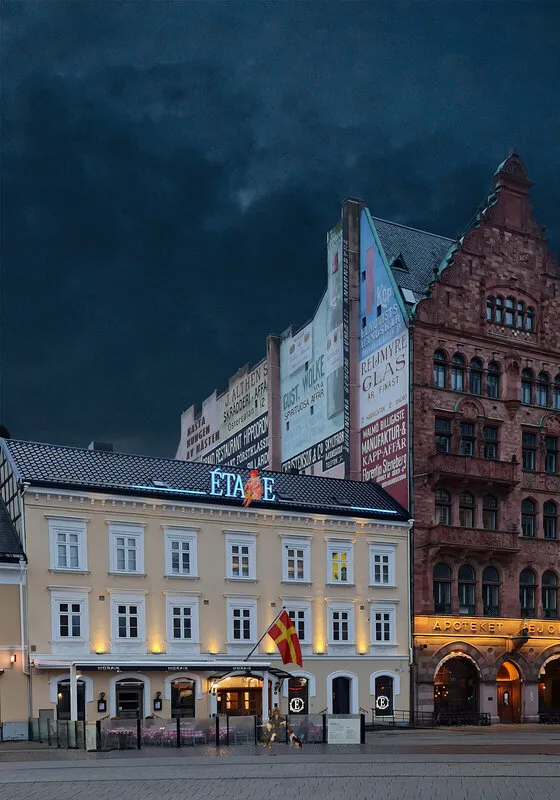
Lady with a handbag, 2023
Digital
50 x 70 cm
3 200 kr
Below, under the Scania red flag with a yellow cross, sits the controversial King Charles X Gustav, who naturally despises the flag above. The dog isn't his; it's a stray dog that, like any good Scanian, feels responsible for ensuring that the detested monarch doesn't attempt any foolishness. In that case, the pooch has a good eye on the older man's shins.
In the middle of the picture, next to the Entrance sign above Stortorget, sits a proud, plump woman with her handbag, gazing down at the even thicker King Charles X Gustav, who became king of Sweden in 1654 after Queen Christina abdicated. He was a well-educated professional soldier and is considered to have been a skilled military leader. Charles had no hereditary right to the Swedish throne. It was Queen Christina who appointed him as her successor. This is something many Scanians and Danes regret. Thick Charles, they call him.
As a person, Charles was proud, sensitive, hot-tempered, fond of food and overly sexual. During the periods when he, as heir to the throne, had no political or military tasks, he often expressed depressive moods. Due to his education, he had a cultural orientation, which he sometimes used, but he hardly had any primary cultural interests. He was evidently more interested in sex. Both before and during his marriage, he had countless women with illegitimate children as a result. He is a real womaniser, according to his detractors. He even proposed to Queen Christina, who politely declined. Whether Charles could harbour personal feelings is difficult to determine; much suggests that his political interests drove him, and a rendezvous with a queen carries weight.
The woman and her handbag have little to do with the background of this picture. It's about Charles and the person with whom the story revolves. As indicated by the large mural advertisement above her, 'THROW THE KING OFF THE HORSE,' his person has stirred strong emotions among Scanians in general but women in particular. Why should a woman abuser, likely to have pushed Weinstein off the top spot of male pigs, be allowed to have his way on the city's largest square? To further illustrate the struggle against him as a person and his person, here's an excerpt from my novel 'With Tony Blair and Audrey Hepburn in Malmö.'
"Niels didn't particularly have anything against kings, whether mounted or seated on a throne adorned with a crown and orb, and sceptre in each hand. He was relatively neutral towards the phenomenon. Nor did Niels harbour any particular animosity towards Charles X Gustav, his gaze fixed in the distance beyond the facade of the Town Hall. Born in Denmark, Niels could have had strong feelings towards the Swedish king who annexed Scania from his old homeland. As a naturalized Scanian, Niels had accepted the course of history. They hadn't fantasised counterfactually about the ice breaking under the fat king during the march across the Great and Little Belts in the winter of 1658. Niels was content with his life and felt no longing for the fatherland. There was nothing left there but bitter memories and his mother's grave.
He also didn't care about the variant of Columba livia. This city pigeon divided the people of Malmö into roughly equal parts on whether the king should stay. In a way, it was the opposite. The pigeons finally convinced the authorities to decide to cleanse the old king properly. Without the city council's decision and the notice in the daily Sydsvenskan, Niels would hardly have come up with his brilliant idea. A stroke of genius for which he was grateful to the cooing feathered ones, which had filled his waking hours for sixty-five years, as well as an occasional constructive dream.
The inspiration indeed stemmed from something Niels truly disliked - Nazis and their collaborators. Even seventy-three years after the war, that sort of thing still made itself felt even if they had changed their spots. In February 2018, Niels was preparing for an event that stirred up memories. It was now, as then, about male egos carved in stone, carved in wood, or cast in bronze, with artists' carefully crafted looks exuding brutality and contempt for humanity.
Like a pandemic, the movement spread across the world, those who wanted to topple statues erected for oppressors, racists, thugs, slave traders, and rapists. An old good tradition for disagreeable figures had been toppled by humanity since time immemorial. From the Moai statues of Easter Island to Stalin and Saddam Hussein, monuments and sculptures have been toppled flat - despised and hated by new generations. In Malmö, an old king caused some agitation. In England, people wanted to rid the world of all traces of colonisers like Cecil Rhodes, and in the big country to the West, citizens took physical action against statues honouring men who fought for the preservation of slavery during the Civil War. Justifying the removal of the king in Malmö was the fact that if Charles X Gustav had lived today, he would undoubtedly have been tried before the war crimes tribunal in The Hague.
"It's time to beautify Stortorget in Malmö, give the square new symbolism, and make it pedestrian-friendly," wrote a citizen in the daily Sydsvenskan. Between the lines, the man aimed more for a king on horseback than pedestrian access for the people of Malmö. The fat king had been controversial for more than 350 years. Especially in Malmö. Even among the women, as it would turn out."
The city was again set ablaze, and Malmö divided into for or against or a bit of both. Some vehemently advocated for pouring more gasoline on the fire, but some appealed for restraint. Lately, the crowd had expanded to include others wishing for something feminine instead. The latter group had gained momentum, which Nils Nilsson Sten had missed entirely, despite the newspapers writing more about this than controversial kings this winter.
The previous year, the letter to the editor the day after Lucia had been the spark. But another fire raged concurrently with this local concern. This fire spread globally, and smoke penetrated the old city theatre's lodges. The dirt thrown had splattered on, among others, the theatre's most excellent director of all time. And it had splattered. Throughout Christmas, there had been burning in and around the tree and at events with innocent Lucias and equally innocent maids. Niels thought the star boys had fallen out of line this winter. Don't mention Santa Claus, who hunched over like an ugly old man in the public square. There was no talk of giving candy to small children or patting them on the head, especially not their mothers.
The New Year they had started as the old one ended with fights. However, the question of a particular statue's existence or non-existence seemed like a negligible brushfire compared to #metoo. The protest movement had exploded under Hollywood producer Harvey Weinstein's scandal, dragging a whole bunch of wrongdoers down with him. Unfortunately, many others, too. Suddenly, it seemed like the cultural world mainly consisted of male oppressors and their victims. Shakespeare's view of women was questioned, and there was propaganda that his works should be removed from the city library. Statues of the great playwright had police protection here and there. Since he wasn't a Scanian, Shakespeare would have drowned in the sea of local candidates, and the books would stay put for the time being. A theatre manager had committed suicide, and Ingmar Bergman couldn't defend himself since he had left the earthly realm. "May he burn in hell," chanted militant feminists. Considering how he behaved among the city's women, the demon director had been in a precarious position. If one became pregnant, there was always someone else. The official history only talks about his strong women; the weaker ones had fallen silent but suffered terribly. Niels had insider information from the theatre, not gossip but a couple of friends' memories. They weren't pretty.
One woman after another joined and told their experiences. Like an uncontrollable grass fire, the reaction spread across the world. A dammed-up realisation. Who cared about an old king then? Well, quite a few. There were plenty of points of contact.
February 26, 2018, was exactly 360 years since the Peace of Roskilde when Denmark lost Scania. Of more local significance was a famous meeting in Malmö one hundred and fifty years earlier, when Chief Equerry Tornérhielm and Professor Weibull started a fundraising campaign to erect a statue. In truth, neither that meeting nor the evening's gathering at the Town Hall Cellar had anything to do with #metoo. It just happened that way. That was where Niels was headed in a drizzle to express what he thought in Skåne about the too-common southern Swedish winter weather. Niels liked to walk, rain or shine and enjoyed the thoughts that lined up inside him as he passed places that had played a role before he moved to Italy in the late 70s. That time had its problems, but few cared about a fat relic on horseback when the world risked going under in a nuclear war.
John Börjesson's equestrian statue in Stortorget had, since its unveiling in 1896, been the subject of animated debate. The polemics divided families and had the power to split friends. Like other civil wars, people became enemies for life. Some criticised the artistic qualities of the work, while others considered it one of the world's finest in its genre. Regardless, many questioned the appropriateness of allowing Charles X Gustav to ride on his bronze horse in the middle of Malmö - the centre of Scania, which the same king snatched from Denmark. He even claimed to have hated Scania and taken the province just to shut it down. Niels undoubtedly sat on two horses as a half-Dane but thought it was about the same as if Copenhagen had the traitor Struensee riding outside the queen's office at Amalienborg. Or if Stalin had been allowed to remain as a statue in Hungary's capital. The Russian dictator had indeed stood – not ridden – eight meters tall in the middle of Budapest but was torn down by enraged Hungarians during the 1956 uprising. The uprising was crushed, but Khrushchev was wise enough not to let his old boss rise again. "If the Hungarians could, why not us," thought many Malmo residents. It was because of Charles X that Niels was on his way. He had just passed Ohlsson's corner, which hadn't been Ohlsson's for decades. He felt a pang of longing.
Shipbroker Nils Nilsson Sten was a figure in shipping circles. He was named Nils after his grandfather and Sten after his mother descended from an odalman who fought at Poltava in 1709. The daily interaction with pirates—as the shipbroker called his customers—and the ancestor's warlike past made Nilsson Sten well suited to handle the battle over the fat king's existence or non-existence—at least that's what he thought.
A few days into the new year, the shipbroker had published a twelve-page pamphlet and been called to a meeting for the good of Skåne. The sender was KMFF - the Committee for the Beautification and Skåne-ifying of Malmö. Behind the acronym, there were resources. The pamphlet was printed on thick, glossy paper and in four colours. After the business, the committee had reserved the entire Town Hall Cellar and enticed with a well-stocked buffet, a lure as good as any. The pamphlet allowed for different opinions to be voiced for appearance's sake, but there was no doubt about what the committee stood for. And the committee's chairman, Nils Nilsson Sten's opinions were well known. Despite that, Niels had decided to attend.
A picture occupied one whole page in the brochure, so softened that it was impossible to determine what it depicted other than someone riding a white horse. Below, it was stated that a finished proposal would be presented at the Town Hall Cellar. Out of sheer curiosity, people would be drawn to the meeting. Niels felt that way.
A photoshopped proposal advocated for Charles X Gustav to be replaced by a snapphane (a member of the pro-Danish guerrilla organisation), even though such individuals had never been active this far south. The king himself never set foot in Malmö. When the people of Malmö collectively pledged their allegiance to the Swedish king, they had to do it to an empty chair just outside where people were now gathering in the town hall cellar.
The city was again set ablaze, and Malmö divided into for or against or a bit of both. Some vehemently advocated for pouring more gasoline on the fire, but some appealed for restraint. Lately, the crowd had expanded to include others wishing for something feminine instead. The latter group had gained momentum, which Nils Nilsson Sten had missed entirely, despite the newspapers writing more about this than controversial kings this winter.
The previous year, the letter to the editor the day after Lucia had been the spark. But another fire raged concurrently with this local concern. This fire spread globally, and smoke penetrated the old city theatre's lodges. The dirt thrown had splattered on, among others, the theatre's most excellent director of all time. And it had splattered. Throughout Christmas, there had been burning in and around the tree and at events with innocent Lucias and equally innocent maids. Niels thought the star boys had fallen out of line this winter. Don't mention Santa Claus, who hunched over like an ugly old man in the public square. There was no talk of giving candy to small children or patting them on the head, especially not their mothers.
The New Year they had started as the old one ended with fights. However, the question of a particular statue's existence or non-existence seemed like a negligible brushfire compared to #metoo. The protest movement had exploded under Hollywood producer Harvey Weinstein's scandal, dragging a whole bunch of wrongdoers down with him. Unfortunately, many others, too. Suddenly, it seemed like the cultural world mainly consisted of male oppressors and their victims. Shakespeare's view of women was questioned, and there was propaganda that his works should be removed from the city library. Statues of the great playwright had police protection here and there. Since he wasn't a Scanian, Shakespeare would have drowned in the sea of local candidates, and the books would stay put for the time being. A theatre manager had committed suicide, and Ingmar Bergman couldn't defend himself since he had left the earthly realm. "May he burn in hell," chanted militant feminists. Considering how he behaved among the city's women, the demon director had been in a precarious position. If one became pregnant, there was always someone else. The official history only talks about his strong women; the weaker ones had fallen silent but suffered terribly. Niels had insider information from the theatre, not gossip but a couple of friends' memories. They weren't pretty.
One woman after another joined and told their experiences. Like an uncontrollable grass fire, the reaction spread across the world. A dammed-up realisation. Who cared about an old king then? Well, quite a few. There were plenty of points of contact.
February 26, 2018, was exactly 360 years since the Peace of Roskilde when Denmark lost Scania. Of more local significance was a famous meeting in Malmö one hundred and fifty years earlier, when Chief Equerry Tornérhielm and Professor Weibull started a fundraising campaign to erect a statue. In truth, neither that meeting nor the evening's gathering at the Town Hall Cellar had anything to do with #metoo. It just happened that way. That was where Niels was headed in a drizzle to express what he thought in Skåne about the too-common southern Swedish winter weather. Niels liked to walk, rain or shine and enjoyed the thoughts that lined up inside him as he passed places that had played a role before he moved to Italy in the late 70s. That time had its problems, but few cared about a fat relic on horseback when the world risked going under in a nuclear war.
John Börjesson's equestrian statue in Stortorget had, since its unveiling in 1896, been the subject of animated debate. The polemics divided families and had the power to split friends. Like other civil wars, people became enemies for life. Some criticised the artistic qualities of the work, while others considered it one of the world's finest in its genre. Regardless, many questioned the appropriateness of allowing Charles X Gustav to ride on his bronze horse in the middle of Malmö - the centre of Scania, which the same king snatched from Denmark. He even claimed to have hated Scania and taken the province just to shut it down. Niels undoubtedly sat on two horses as a half-Dane but thought it was about the same as if Copenhagen had the traitor Struensee riding outside the queen's office at Amalienborg. Or if Stalin had been allowed to remain as a statue in Hungary's capital. The Russian dictator had indeed stood – not ridden – eight meters tall in the middle of Budapest but was torn down by enraged Hungarians during the 1956 uprising. The uprising was crushed, but Khrushchev was wise enough not to let his old boss rise again. "If the Hungarians could, why not us," thought many Malmo residents. It was because of Charles X that Niels was on his way. He had just passed Ohlsson's corner, which hadn't been Ohlsson's for decades. He felt a pang of longing.
Shipbroker Nils Nilsson Sten was a figure in shipping circles. He was named Nils after his grandfather, and Sten, after his mother, descended from an odalman who fought at Poltava in 1709. The shipbroker's daily interaction with pirates—as the ancestor called his customers—and the ancestor's warlike past made Nilsson Sten well suited to handle the battle over the fat king's existence or non-existence—at least that's what he thought.
A few days into the new year, the shipbroker had published a twelve-page pamphlet and been called to a meeting for the good of Skåne. The sender was KMFF - the Committee for the Beautification and Skåne-ifying of Malmö. Behind the acronym, there were resources. The pamphlet was printed on thick, glossy paper and in four colours. After the business, the committee had reserved the entire Town Hall Cellar and enticed with a well-stocked buffet, a lure as good as any. The pamphlet allowed for different opinions to be voiced for appearance's sake, but there was no doubt about what the committee stood for. And the committee's chairman, Nils Nilsson Sten's opinions were well known. Despite that, Niels had decided to attend.
A picture occupied one whole page in the brochure, so softened that it was impossible to determine what it depicted other than someone riding a white horse. Below, it was stated that a finished proposal would be presented at the Town Hall Cellar. Out of sheer curiosity, people would be drawn to the meeting. Niels felt that way.
A photoshopped proposal advocated for Charles X Gustav to be replaced by a snapphane (a member of the pro-Danish guerrilla organisation), even though such individuals had never been active this far south. The king himself never set foot in Malmö. When the people of Malmö collectively pledged their allegiance to the Swedish king, they had to do it to an empty chair just outside where people were now gathering in the town hall cellar.
Another patriot suggested that Tubby-Karl – as the Swedish king was mockingly called - should be replaced with a less provocative artwork. For example, the city could put Frans Suell on a horse instead, considering that he, for centuries, had to toil in the harbour. Niels couldn't help but smirk at the jest. However, he found the idea of a German being honoured with the city's foremost spot hard to swallow.
An economically minded citizen proposed selling the statue to Karlshamn, the city that got Tubby-Karl's name. "They can have a discount," the citizen emphasised. He had no opinion on what should replace it but suggested that the profit should go towards preserving the Skåne dialect.
The signature 'Angry Kirseberg Resident' wanted the statue removed because it attracted all sorts of non-Skåne elements. It wasn't clear who was being referred to. Niels sensed that as a half-Dane, he was in a tough spot, along with other ethnic curiosities. If one were to lump him and all other minorities together, logically, it would be the angry Kirseberg resident who would have to make room. Kirseberg, the old haunt of thieves and bandits, was now the flashiest place to live in Malmö. There, the Sweden Democrats are the second largest party with over a fifth of the votes. "Perhaps it would be a better place for the statue," Niels thought as he passed the old pharmacy Lejonet.
For appearances' sake, the committee had allowed a pale counterproposal to be voiced. 'Care and Activate' was the headline. The text argued for alternative use, preserving history, and revitalising the Scandinavianism that once led to the statue's creation. For example, many appreciate the statue as a base for a quick lunch from the hamburger restaurant nearby. The statue could be lightened up, becoming an installation. A picture montage showed the statue with the king draped in a Skåne flag; the hat painted red, the plume golden yellow, and in hand, a graceful bouquet of daisies, Skåne's provincial flower. Tubby-Karl's horse Hannibal had been disguised as a deer, and the magnificent crown painted yellow like blooming rapeseed. It was hard for Niels to decide whether to laugh or cry. He did neither, instead pushing open the heavy door to the tavern and leaving the raw air behind.
February darkness had enveloped the old town hall in a blanket of mist, the temperature outside insignificantly lower than last year's Midsummer. The subject of the evening's debate couldn't even be discerned out there, and it was just as well. A group of revolutionaries, counter-revolutionaries, and revisionists had begun to gather at the Town Hall Tavern, where Niels felt called. The tavern's kitchen was decent, but this evening, indecently grand. A Skåne buffet is always a Skåne buffet, even if the invitation hinted at 'a different' one.
"Welcome, dear friends, patriots, and guardians of culture. We back into the future, with Skåne's hindquarters in front of us - the fat arses of a king and his horse," began Nilsson Sten, coarse-mouthed like the dockworkers of yesteryear. The chairman was a trained marketer, so he should know how to express himself. "It can hardly be considered a crime of majesty to claim that Karl X Gustav was a real scoundrel and dirtbag." Just over half of the audience hummed in agreement, and the Pageboy at Niels' side nodded. Others shifted uncomfortably. Nilsson Sten poked at his computer and lit a picture on the wall behind him. A portrait of the evening's main character emerged.
"A repulsive man," said the Pageboy. "So disgustingly ugly!" Niels agreed, for the Palatine count honestly looked ghastly. "Isn't it true that an ugly man can go as far as he pleases, while for a less attractive woman, it's worse," he thought. Niels wondered if he could pose the question to his new acquaintance. It probably wasn't necessary, as both he and the Pageboy knew the answer. The statue was an excellent example of the hypothesis. Besides, the Pageboy looked good and exuded confidence. "Some sort of boss," thought Niels.
"In just under six years on the throne, the king caused nothing but misery," continued Nilsson Sten, his voice an octave higher. "Two wars against Denmark, and one each against Russia and Poland. The Poles still call the incident – 'the Swedish deluge' – and they're not referring to Skåne men's whoring and drinking trips in the 70s." The chairman blinked with his whole face. "Instead, the term refers to the worst disaster that befell their country, and one must know that the competition is tough. Nearly a third of the population perished when the Swedes ravaged and raped."
"With the king at the helm," clarified the Pageboy sharply.
"For our beloved Skåne, things didn't get much better. Not the war itself, as it happened on the other side of the Sound. However, the brutal Swedification meant a monumental catastrophe on par with the Black Death." Nilsson Sten's voice approached falsetto, and the chairman had to take a sip of water before continuing:
"Tubby-Karl had horrendous consequences for our city. In the early 1500s, Malmö and Stockholm were roughly the same size. Fifty years of Swedish rule, he left a city barely a thirtieth as large. War, tariffs, confiscations, and other legal abuses, along with elements of serfdom, characterised Skåne for a long time. Those with dissenting views were imprisoned or killed," the chairman almost shouted. Niels heard the Pageboy sigh. "It wasn't until the late 1700s that the city began to recover," continued Nilsson Sten in a slightly lower voice. "Then came the debacle with the Bank Discount, and the city was once again impoverished, but that's another story. No, my dear..." Nilsson Sten stopped when he realised the audience composition hadn't been as expected.
"Ladies and gentlemen. It's time for a change. The invitation contains some examples of possible solutions. Perhaps one of you has further opinions or suggestions." It was evident that the chairman immediately regretted the last sentence. The backs of the women to the right of the podium straightened, necks were craned, the rosettes of the tie blouses fluttered, and sensible shoes scraped against the floor. The collective inhale could be heard. Niels saw from the corner of his eye that the Pageboy at his right side smirked.
"Mr. Chairman," called a determined voice from a woman in a suit. "Enough talk. The old man must go, and the horse too. A lot of other old men as well. And we won't wait any longer!" Those were words, not tunes. It was clear from her entire demeanour that she meant business. From the woman in the suit, no troublemaker could expect mercy.
”The whole town is full of guys who should never have had a statue erected over them,” interrupted a trouser suit with a short-waisted jacket.
"It should be toppled over them instead," shouted one in sensible shoes, receiving spontaneous applause from the nearby crowd.
"Thugs and womanisers," hissed a third woman dressed in the same collarless power jacket as the German Chancellor. One of the waiters who had stood nearby, ready with a carafe of premixed Kir, cautiously withdrew.
"Isn't it strange that you have to be a bastard, a man, or a naked woman to have a statue erected? It's unimaginative to the extreme," roared a practically dressed woman in her thirties. For that, she received sparse applause. Niels applauded along and received an approving look from the Pageboy. He had read somewhere that less than five per cent of artists were women, while nudity in art was theirs to almost ninety per cent. On the other hand, Niels found it hard to imagine the woman who, even in his prime, would have wanted to paint him naked. "One must be realistic when it comes to aesthetics," he thought, assuming the Pageboy would agree.
"What the imagination is full of, colours the canvas," Niels muttered aloud, and the Pageboy smiled.
"Violence shouldn't be associated with public ornamentation! So why this fat bandit?" rang out a new voice, a woman with a swelling bosom and the text 'STUNNING' printed over her chest. "As usual, male inconsistency. Do you remember the uproar surrounding a proposed statue with the handbag as a weapon? It certainly wasn't allowed to be erected." Her indignation was apparent, but Niels looked like a question mark.
"You might have missed the incident," said the Pageboy, understanding that Niels had lived in Italy for many years. "Miss Stunning refers to the Småland heroine who bashed her handbag over a Nazi's head in Växjö in the 80s. It was the predecessor of the Sweden Democrats, the Nordic Reich Party, that was parading. However, the municipality declined the statue as a donation, even though the artist wanted to remind us that the fight never ends."
"That was commendable," said Niels, who had no objections to what one hit a Nazi over the head with.
"One might think so, but the city authorities considered the artwork to be perceived as endorsing violence," the Pageboy smirked.
"What happened to the statue?"
"She, with the handbag, actually ended up in Alingsås. The statue was inaugurated as recently as mid-June last year to symbolise Swedish auntie's courage."
"Hope the auntie had lead in her handbag," Niels laughed and turned his attention to a man who had risen.
"I think there's a lot of talk and little action. In Skåne, there are Scanians, and those are the ones we should praise. Moreover, I believe the old statue should symbolically be dumped in the canal," growled a man in a brown corduroy suit with an academic Lund accent in his voice.
"I agree with the previous speaker. There's a classic story about Timoclea who pushes her rapist into a well," said a woman in a tailored suit and her dialect revealed that she, too, had studied in Lund.
"I can't think of anyone in Nordic history who has been as violent as Charles X Gustav. Not only on the battlefield but also towards women," snarled a fashionable woman introducing herself as Dorothea Kaiser Nilsson (MP). "It's an insult to Malmö's women that such a man dominates the city's largest square. Our contempt should also be directed at those who erected the statue. Those men, for it must be men, should end up in the same historical rubbish heap as their king."
"Like father, like daughter," said the Pageboy. "If you haven't already realised, DKN is the chairman's child even though they represent different ideologies. She not only wants to go after Fat-Karl but abolish and prohibit most things." "Where are the public works honouring women?" DKN continued angrily. "If there are any, they don't depict individuals but are associations like fisherwomen, Madonna, or non-figurative maternal joy. Why don't we see women who have been significant for Malmö? For example, the philanthropist Citze Kortsdotter, who was overshadowed by her husband, Mayor Kock; the author Alice Lyttkens with her excellent historical novels; the politician and innovator Anna Stenberg, who did much more than getting men public toilets - yes, why not Anita Ekberg, who put our city on the world map. Where is she, for example? Buried in Skanör, of all places. The only trace of the film star left in her hometown of Malmö is a pair of bronze shoes on Davidshallsbron. Imagine. Exactly what one thinks of when it comes to La Ekberg, her feet." The room laughed except for the sensible shoes that didn't consider Anita Ekberg a suitable feminist symbol.
"I knew her," Niels whispered to the Pageboy, who wasn't impressed. He, who had met Anita with Aniiita who taught her how to put on makeup, wouldn't have minded a statue of the famous movie star. Niels thought it was paltry, the casting of her high-heeled shoes within walking distance of Ebba Lindqvist, Malmö's first female film director's more sensible boots. The ladies never met despite being in the same industry. Ebba passed away before Anita was discovered. No, Anita truly deserved her statue. Why not in Kungsparken's fountain, where she practised her skills as a bathing nymph? In solemn grandeur and not squeezed among Lasse Holmqvist's and Kal P Dahl's worn-out shoes. There was a clatter as a lady pushed back her chair and quickly stood up.
"We don't need historical precedents. I just say MeToo. In October, another kind of oppressor ran amok worldwide: men who couldn't keep their hands to themselves but groped women. Even more severe assaults that often went unnoticed. The list of victims already exceeds sixty thousand. Just the tip of the iceberg," roared a stately middle-aged woman so upset that the air vibrated. "And the perpetrators, many of them still alive and, in many cases, still active. If we were to extend the list to include historical figures like Fat-Karl, one book wouldn't suffice; it would require an entire library of posthumous signatures." Unified applause from the female part, more sporadic from the rest. Though some men looked ashamed. Not Niels, for he had no reason to be. However, he applauded because, fundamentally, the movement was on the right track. Niels whispered to the Pageboy that what the public had forgotten was that the same sort of men didn't just disdain women - their oppression was directed at everyone, women and men alike. "We're talking about predators, a wolverine that kills if there's something else to kill. The difference is sexual harassment, for men who stand in the way of their progress are violated just as much. Rarely physically, but mentally." The Pageboy nodded in agreement.
"I don't think even cyberspace is enough," continued the stately woman. "The worst part is that many of these historical rapists are immortalised on central squares worldwide. Like here in Malmö," she concluded her tirade with a careless gesture upwards towards the square on the other side of a meter-thick wall. New applause faded, and a light voice chirped through the room.
"For those who don't know me, my name is Peder Rask." Helan, who was neither Helan nor Sam, didn't ask for the floor or even attempt to rise but opened his mouth nonetheless. His belly rested on his knees, and he was stuck behind the table like a vice. "I don't speak as a monarchist since I'm a republican. Yet, I think the previous speaker forgets one thing."
Although the snaps-song ‘Helan’ started level with the chairs' plank, his voice didn't resemble, as Niels expected, the thundering principal voice of Petrikyrkan's organ but rather its bright treble flute. His chins trembled with anger, and the effect was downright comical. Yet Niels thought they were wise words worth considering.
"Done is done, and the truth is hidden, to paraphrase the great author Fritiof Nilsson Piraten. Karl X was indeed violent in most aspects, but he held the table's manners high. I don't think we should turn back the clock. No one can either carve, paint, or rewrite the past. It exists until the end of time." ‘Helan’ had to take a breath after the flute's tone became too squeaky. "The king's actions, like his statue, belong to history. If we were to remove all statues, monuments, paintings, and images of anyone objectionable, the streets and squares would be empty, and so would our museums. It's the same with literature. Written is written and can't be rejected. The libraries would be emptied, and the book pyres would burn like hell. If one were to dive into the past, it's no wiser than fighting windmills. Moreover, conversations cease, and existence fades." ‘Helan’ took another breath. "Perhaps it would be better to, like advertisements for wine and spirits, put a warning text underneath the artwork. Whoever looks at this statue and remembers the king's history is cautioned about strong internal images," Helan chirped and grabbed the glass before him. More than half of the congregation laughed self-critically. The realisation was probably painful that history isn't rewritten by either toppling, melting down, or drowning a dead king. While Helan cooled off from the inside with a few glasses of Kir, the discussions gained momentum.
Nilsson Sten fiddled with his computer and changed the image on the projector. On the whit
The washed wall now flashes a photoshopped image of Stortorget without the robber king. Instead, Edvard Persson was there on horseback. The chairman had done an excellent job. The famous actor - in his soft felt hat slouched over curly hair and dressed in a stylish wide-striped jacket, wide trousers, and sturdy boots - straddled a sturdy white steed. Safe and secure in the saddle befitting a true king. Nilsson Sten declared the actor the first true king Skåne had had since Ragnar Lodbrok.
"My ancestor," Niels proudly told his dining companion, who mainly looked puzzled.
"A Skåne native must handle all situations, at sea and on land, on foot and horseback, behind the plough and at the mitten. Once Skåne Vikings ruled the entire known world. From Greenland and America in the west, Russia and Ukraine in the east, to Normandy and England in the south. They were even reaching Byzantium and Sicily. Odin was feared by the Christians' god, trembling were everyone from Saracens to Franks and Germans. It's time to remember our heyday," the chairman declaimed solemnly.
"Excuse me, Mr. Chairman, but what does Edvard Persson have to do with a horse? I remember him mostly singing with Ingeborg Nyberg," protested a woman insignificantly younger than Niels.
"Let me tell you. Edvard's adventures on horseback and the hunt are among his funniest adventures. The lady can see them in the movie A Sailor on Horseback. That's the image I've used as inspiration for the statue idea. The character wasn't a sailor but a chef and sprung from Skåne soil," Nilsson Sten corrected. The woman looked satisfied.
"Ah, ‘Kräng en beda’," came an anonymous voice that the chairman ignored. It literally means you should press a full-size sugar beet into your mouth. It's not a friendly request!
"It's not a cinematographic or literary masterpiece, but nevertheless Skåne's King Edward the Great on horseback. A sturdy white Skåne Ardennes is more muscular than its predecessor.
"Why let a poor horse suffer from another fat man," protested one of the animal activists. Virtually everyone ignored the contribution.
"A fund for the creation of the artwork has already been started, and there's already half a million in the pot. If we're terrific, King Edward the Great can rise above the square's stones just in time for the thousandth anniversary of his namesake King Canute the Great's ascension to the throne in 1018. Never has a Skåne king ruled over more land, King of Skåne and Denmark, King of England and Norway, and ruler of Schleswig and Pomerania. And my friends, we're close to where it all began. Not many spear throws, just seventy kilometres. King Canute the Great is directly descended from Foteviken and the ancestor Ragnar Lodbrok in the 9th century." It fell utterly silent in the hall.
Niels felt his Viking roots surging in his thoughts. It was actually about his family. Perhaps the idea wasn't so bad to replace the robber king with a Viking. On the other hand, none of Niels's ancient relatives had been particularly kind either.
Even though the novella contains much more, the statue still stands for the pigeons' enjoyment.
3 200 kr

Jörgen Thornberg
Malmö
Lite om bilder och mig. Translation in English at the end.
Jag är en nyfiken person som ser allt i bilder, även det jag fäster i ord, gärna tillsammans för bakom alla mina bilder finns en berättelse. Till vissa bilder hör en kortare eller längre novell som följer med bilden.
Bilder berättar historier. Jag omges av naturlig skönhet, intressanta människor och historia var jag än går. Jag använder min kamera för att dokumentera världen och blanda det jag ser med vad jag känner för att fånga den dolda magin.
Mina bilder berättar mina historier. Genom mina bilder, tryck och berättelser. Jag bjuder in dig att ta del av dessa berättelser, in i ditt liv och hem och dela min mycket personliga syn på vår värld. Mer än vad ögat ser. Jag tänker i bilder, drömmer och skriver och pratar om dem; följaktligen måste jag också skapa bilder. De blir vad jag ser, inte nödvändigtvis begränsade till verkligheten. Det finns en bild runt varje hörn. Jag hoppas att du kommer att se vad jag såg och gilla det.
Jag är också en skrivande person och till många bilder hör en kortare eller längre essay. Den följer med tavlan, tryckt på fint papper och med en personlig hälsning från mig.
Flertalet bilder startar sin resa i min kamera. Enkelt förklarat beskriver jag bilden jag ser i mitt inre, upplevd eller fantiserad. Bilden uppstår inom mig redan innan jag fått okularet till ögat. På bråkdelen av ett ögonblick ser jag vad jag vill ha och vad som kan göras med bilden. Här skall jag stoppa in en giraff, stålmannen, Titanic eller vad det är min fantasi finner ut. Ännu märkligare är att jag kommer ihåg minnesbilden långt efteråt när det blir tid att skapa verket. Om jag lyckas eller inte, är upp till betraktaren, oftast präglat av en stråk av svart humor – meningen är att man skall bli underhållen. Mina bilder blir ofta en snackis där de hänger.
Jag föredrar bilder som förmedlar ett budskap i flera lager. Vid första anblicken fylld av feel-good, en vacker utsikt, fint väder, solen skiner, blommor på ängen eller vattnet som ligger förrädiskt spegelblankt. I en sådan bild kan jag gömma min egentliga berättelse, mitt förakt för förtryckare och våldsverkare, rasister och fördomsfulla människor - ett gärna återkommande motiv mer eller mindre dolt i det vackra motivet. Jag försöker förena dem i ett gemensamt narrativ.
Bild och formgivning har löpt som en röd tråd genom livet. Fotokonst känns som en värdig final som jag gärna delar med mig.
Min genre är vid som framgår av mina bilder, temat en blandning av pop- och gatukonst i kollage som kan bestå av hundratals lager. Vissa bilder kan ta veckor, andra någon dag innan det är dags att överlämna resultatet till printverkstaden. Fine Art Prints är digitala fotocollage. I dessa kollage sker rivandet, klippandet, pusslandet, målandet, ritandet och sprayningen digitalt. Det jag monterar in kan vara hundratals år gamla bilder som jag omsorgsfullt frilägger så att de ser ut att vara en del av tavlan men också bilder skapade av mig själv efter min egen fantasi. Därefter besöks printstudion och för vissa bilder numrera en limiterad upplaga (oftast 7 exemplar) och signera för hand. Vissa bilder kan köpas i olika format. Det är bara att fråga efter vilka. Gillar man en bild som är 70x100 men inte har plats på väggen, går den kanske att få i 50x70 cm istället. Frågan är fri.
Metoden Giclée eller Fine Art Print som det också kallas är det moderna sättet för framställning av grafisk konst. Villkoret för denna typ av utskrifter är att en högkvalitativ storformatskrivare används med åldersbeständigt färgpigment och konstnärspapper eller i förekommande fall på duk. Pappret som används möter de krav på livslängd som ställs av museer och gallerier. Normalt säljer jag mina bilder oinramade så att den nya ägaren själv kan bestämma hur de skall se ut, med eller utan passepartout färg på ram, med eller utan glas etc..
Under många år ställde jag bara ut på nätet, i valda grupper och på min egen Facebooksida - https://www.facebook.com/jorgen.thornberg.9
Jag finns också på en egen hemsida som tyvärr inte alltid är uppdaterad – https://www.jth.life/ Där kan du också läsa en del av de berättelser som följer med bilden.
UTSTÄLLNINGAR
Luftkastellet, oktober 2022
Konst i Lund, november 2022
Luftkastellet, mars 2023
Engleson Galleri Caroli, april 2023
Hydra, Greece June 2023
Engleson Galleri Caroli, oktober 2023
Toppen, Höllviken december 2023
Luftkastellet, mars 2024
Torups Galleri, mars 2024
Venice, May 2024
Luftkastellet, oktober 2024
Konst i Advent, December 2024
Galleri Engleson, Caroli December 2024
Jäger & Jansson Galleri, april 2025
A bit about pictures and me.
I'm a curious person who sees everything in pictures, even what I express in words, often combining them, for behind all my pictures lies a story. These narratives, some as short as a single image and others as long as a novel, are the heart and soul of my work.
Pictures tell stories. Wherever I go, I'm surrounded by natural beauty, exciting people, and history. I use my camera to document the world and blend what I see with what I feel to capture the hidden magic.
My images tell my stories. Through my pictures, prints, and narratives, I invite you to partake in these stories in your life and home and share my deeply personal perspective of our world. More than meets the eye. I think in pictures, dream, write, and talk about them; consequently, I must create images too. They become what I see, not necessarily confined to reality. There's a picture around every corner. I hope you'll see what I saw and enjoy it.
I'm also a writer, and many images come with a shorter or longer essay. It accompanies the painting, printed on fine paper with my personal greeting.
Many pictures start their journey on my camera. Simply put, I describe the image I see in my mind, experienced or imagined. The image arises within me even before I bring the eyepiece to my eye. In a fraction of a moment, I see what I want and what can be done with the picture. Here, I'll insert a giraffe, Superman, the Titanic, or whatever my imagination conjures up. Even stranger is that I remember the mental image long after it's time to create the work. Whether I succeed is up to the observer, often imbued with a streak of black humour – the aim is to entertain. My pictures usually become a talking point wherever they hang.
I prefer pictures that convey a message in multiple layers. At first glance, they're filled with feel-good vibes, a beautiful view, lovely weather, the sun shining, flowers in the meadow, or the water lying deceptively calm. But beneath this surface beauty, I often conceal a deeper story, a narrative that challenges societal norms or explores the human condition. I invite you to delve into these hidden narratives and discover the layers of meaning within my work.
Picture and design have been a thread running through my life. Photographic art feels like a fitting finale, and I'm happy to share it.
My genre is varied, as seen in my pictures; the theme is a blend of pop and street art in collages that can consist of hundreds of layers. Some images can take weeks, others just a day before it's time to hand over the result to the print workshop. Fine Art Prints are digital photo collages. In these collages, tearing, cutting, puzzling, painting, drawing, and spraying happen digitally. What I insert can be images hundreds of years old that I carefully extract so they appear to be part of the painting, but also images created by myself, now also generated from my imagination. Next, visit the print studio and, for certain images, number a limited edition (usually 7 copies) and sign them by hand. Some images may be available in other formats. Just ask which ones. If you like an image that's 70x100 but doesn't have space on the wall, you might be able to get it in 50x70 cm instead. The question is open.
The Giclée method, or Fine Art Print as it's also called, is the modern way of producing graphic art. This method ensures the highest quality and longevity of the artwork, using a high-quality large-format printer with archival pigment inks and artist paper or, in some cases, canvas. The paper used meets the longevity requirements set by museums and galleries. I sell my pictures unframed, allowing the new owner to personalise their artwork, confident in the lasting value and quality of the piece.
For many years, I only exhibited online, in selected groups, and on my Facebook page - https://www.facebook.com/jorgen.thornberg.9. I also have my website, which unfortunately is not constantly updated - https://www.jth.life/. You can also read some of the stories accompanying the pictures there.
EXHIBITIONS
Luftkastellet, October 2022
Art in Lund, November 2022
Luftkastellet, March 2023
Engleson Gallery Caroli, April 2023
Hydra, Greece June 2023
Engleson Gallery Caroli, October 2023
Toppen, Höllviken December 2023
Luftkastellet, March 2024
Torup Gallery, March 2024
Venice, May 2024
UTSTÄLLNINGAR
Luftkastellet, oktober 2022
Konst i Lund, november 2022
Luftkastellet, mars 2023
Engleson Galleri Caroli, april 2023
Hydra, Greece June 2023
Engleson Galleri Caroli, oktober 2023
Toppen, Höllviken december 2023
Luftkastellet, mars 2024
Torups Galleri, mars 2024
Venice, May 2024
Luftkastellet, October 2024
Konst i Advent, December 2024
Galleri Engleson, Caroli December 2024
Jäger & Jansson Galleri, April 2025
Utbildning
Autodidakt
Medlem i konstnärsförening
Öppna Sinnen
Med i konstrunda
Konstrundan i Skåne
Utställningar
Luftkastellet, October 2022
Art in Lund, November 2022
Luftkastellet, March 2023
Engleson Gallery Caroli, April 2023
Hydra, Greece June 2023
Engleson Gallery Caroli, October 2023
Toppen, Höllviken December 2023
Luftkastellet, March 2024
Torup Gallery, March 2024
Venice, May 2024