Vi använder cookies för att ge dig bästa möjliga upplevelse. Välj vilka cookies du tillåter.
Läs mer i vår integritetspolicy
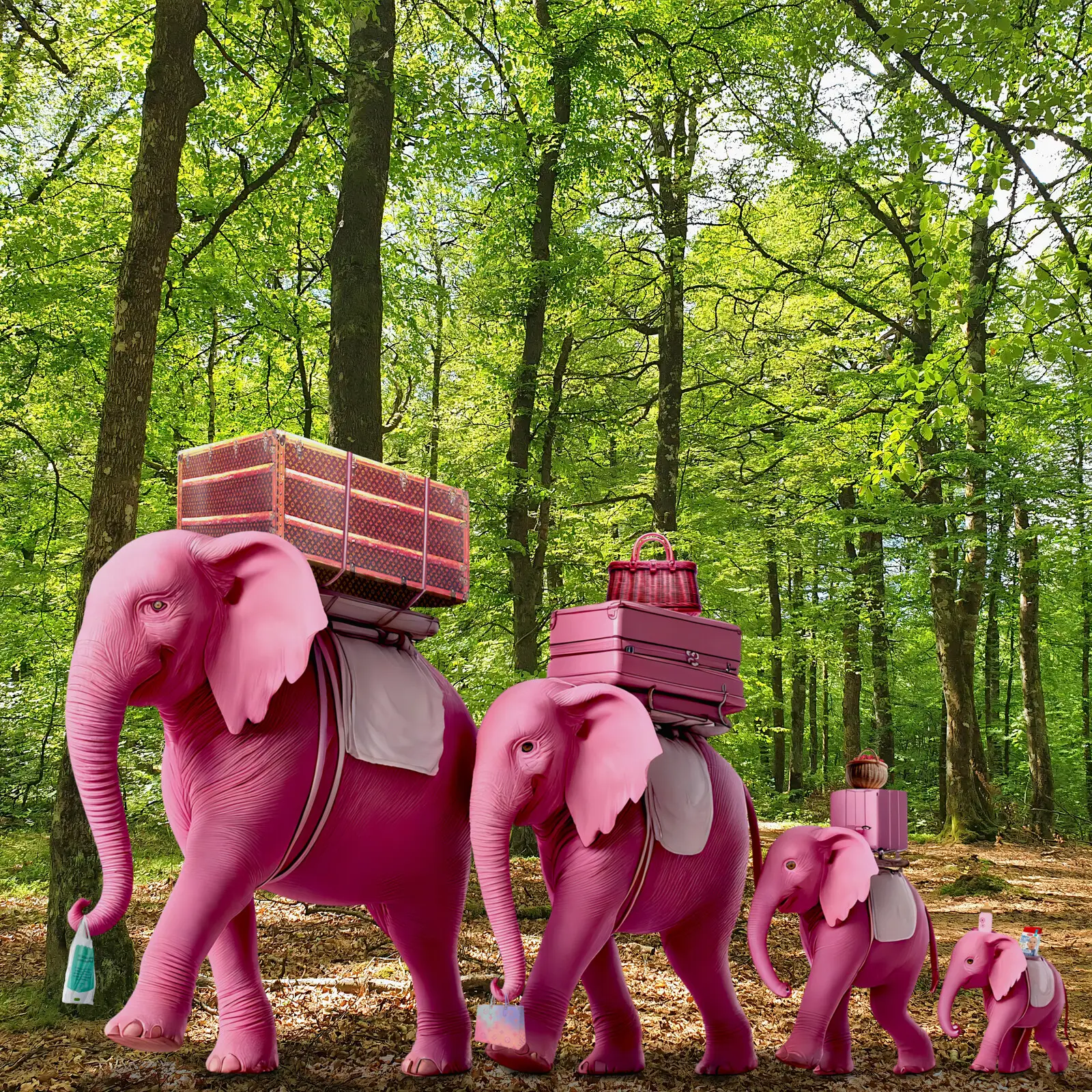
Jörgen Thornberg
Sunday outing to Bokskogen, 2023
Digital
50 x 50 cm
2 500 kr
With anticipation, a family embarked on a journey to a picnic in Bokskogen, just outside Malmö in southern Sweden. From dad down to the youngest daughter, they were laden with gear and gadgets, ready for a day of leisure. They carried a camping table, wind shelter, books, mobile phones and tablets to stave off any boredom in the rural landscape. Each family member brought what they needed, while the parents shouldered the rest, with the most essential items being food and drink.
"It's said that the renowned cookbook author and housekeeper Cajsa Warg declared, 'You use what you have,'" goes the famous but inaccurate saying", Dad explained. "No, Cajsa Warg never wrote "you use what you have" in her cookbook. On the contrary, she was very meticulous about the ingredients, which were sometimes quite luxurious. However, the phrase "you use if you can get it" appears in several places in her book.
For this family, their picnic was a combination of both expressions. They took what they had in their cupboards and shopped some delicacies on the way. After parking the car, they walked along one of the leafy paths towards a clearing that Dad knew—sunny yet sheltered from the ever-present wind in Skåne.
On the way, Dad began recounting the history of their picnic, which dated back more than a thousand years. The family continued walking through the dappled sunlight, with Dad narrating the picnic story as they made their way deeper into Bokskogen.
"In Sweden, picnicking has long been part of our culture," Dad explained. "From the early feasts of hunters in the woods to the lavish outdoor meals of the Victorian era, sharing food in nature has always been about bringing people together."
They reached their clearing and began unpacking. The camping table was set up, a wind shelter erected, and each member found a comfortable spot. Out came the sandwiches, fruit, drinks, and, of course, some sweets. Even the youngest daughter, who had brought her favourite stuffed animal, felt at ease as the family settled into their al fresco feast.
"Do you think Cajsa Warg would approve of our picnic?" the mother asked with a grin.
"Well, she might raise an eyebrow at the mobile phones and tablets," Dad replied, "but she'd certainly appreciate the care we took in packing the food, he said before continuing his story about the picnic's history.
"Far from a mere outdoor meal, a picnic is a captivating tradition that has traversed centuries, mirroring the ebb and flow of social norms and cultural tides. Born from the French term' pique-nique,' the picnic has metamorphosed into a symbol of leisure and conviviality, adapting to diverse formats and settings throughout its dynamic and intriguing history.
The picnic's origins can be traced back to medieval Europe and Renaissance Revelry, specifically around the 13th and 14th centuries, where the nobility often associated outdoor feasts with hunting expeditions. The al fresco meals of this era were grand affairs, though not yet dubbed picnics. François Lemoyne's 1723 masterpiece, 'Hunt Picnic,' encapsulates the spirit of the time with a noble gathering relishing roast chicken and wine atop a white tablecloth in a tranquil, wooded setting.
In Renaissance Europe, picnicking took on a more communal dimension. The 15th-century French manuscript 'The Hunting Book of Gaston Phoebus' shows noblemen sharing a meal on grassy slopes with their entourages. Although these feasts resemble modern-day picnics, the English did not adopt the term until the early 19th century.
The French Revolution, a pivotal moment in European history, also played a significant role in the evolution of the picnic. The subsequent migration of aristocrats to other parts of Europe due to the political upheaval popularised the picnic beyond France and transformed its social dynamics. In London, the Pic Nic Society was formed in 1802. Theatrical performances, card games, and extravagant meals characterised it. Members brought their share of the refreshments, creating a potluck atmosphere. Held in hired rooms on Tottenham Street, these gatherings embodied the spirit of 'joie de vivre' despite the ongoing Napoleonic Wars.
The Victorian era, known for its opulence and grandeur, brought a new level of extravagance to picnics. This shift in picnic customs can be attributed to various societal and cultural factors. Not merely content with cold meats and simple fare, these Victorian feasts often featured Champagne and delicate pastries served on porcelain china, with silver cutlery and crystal glasses.
The picnic has also served as a stage for political protest and more aggressive or peaceful picnicking. A notable instance is the Pan-European Picnic on August 19, 1989, along the Hungarian-Austrian border, which was pivotal in ending the Cold War. Hundreds gathered for a symbolic mass picnic that led to the breaching of the Iron Curtain and, eventually, the fall of the Soviet Union. This event underscored the potency of picnics as a peaceful protest and a catalyst for change, illuminating their potential beyond leisure activities.
In France, Bastille Day 2000 saw the creation of ‘l'incroyable pique-nique’, stretching over 1,000 kilometers along the ‘Méridienne verte’. This remarkable event brought together thousands of people for a peaceful meal to celebrate the new millennium.
The picnic has been a recurring theme in literature, film, and art, leaving an indelible mark on our cultural landscape. For instance, in Jane Austen's 'Emma' (1816), two memorable picnics at Donwell Abbey and Box Hill are pivotal in the plot. At Donwell Abbey, guests plucked strawberries while Mrs Elton chattered away with her large bonnet and basket. At Box Hill, however, the picnic ended in ruffled tempers and hurt feelings, showcasing the emotional depth that picnics can evoke and their role in social dynamics.
Alfred Tennyson's poem 'Audley Court' (1838) vividly describes a picnic on a grassy slope:
"Francis laid a damask napkin wrought with horse and hound,
Brought out a dusky loaf that smelt of home,
And, half-cut-down, a pasty, costly-made,
Where quail and pigeon, lark and leveret lay,
Like fossils of the rock, with golden yolks
Embedded and injellied; last, with these,
A flask of cider from his father's vats,
Prime, which I knew, and so we sat and ate
And talked old matters over…"
Both girls thought the poem was cosy, and they became starving from all the delicious things it described. Dad continued his story.
"In art, Édouard Manet's 'Le déjeuner sur l'herbe' (1862) juxtaposes two fully clothed men with a nude and scantily dressed female bather, set against a lush backdrop of rural greenery. Similarly, Thomas Cole's 'The Pic-Nic' (1846) depicts a genteel gathering serenaded by a guitarist in the Hudson River Valley.
In 1886, Georges Seurat presented a scandalous work at the Salon des Indépendants. However, A Sunday Afternoon at l’Île de la Grande Jatte only depicts a few wealthy families enjoying the sun by the Seine. During that time, Impressionists represented very similar types of scenes. So why so much outrage? 'Un Dimanche Après-Midi', or A Sunday Afternoon, drastically differs from usual Impressionism at the time. One quickly recognises an exact and geometrical structure, which is relatively uncommon for 19th-century art. The figures are entirely static, whereas Impressionism values the feeling of mobility as if we were part of the work.
The film The 1975 Mystery 'Picnic at Hanging Rock' captures the eerie side of outdoor leisure with its story of schoolgirls mysteriously disappearing during a picnic. In the children's literature classic 'The Wind in the Willows' (1908), Rat's well-stocked picnic basket symbolises the quintessential English outing.
Modern Picnics have become simpler and more elegant when combined. Today's picnics range from simple to sophisticated, encompassing everything from sandwiches and sodas to Champagne and caviar. Glyndebourne Opera picnickers indulge in 'Mousse de Caviare' and 'Chaudfroid de Canard' while casual park-goers share hard-boiled eggs, cold chicken, and pies. 'The Teddy Bears' Picnic' song, popularised in 1932, and the Swedish duo Roxette's "June Afternoon" evoke images of warm summer days filled with laughter and shared meals, reflecting the enduring appeal of picnics as a leisure activity.
Whether it's a political statement, a leisurely activity, a historical event, or a contemporary trend, the picnic is a testament to our enduring love for good food, great company, and the beauty of the outdoors. From its aristocratic origins to its role in peaceful protests, the picnic symbolises simplicity and togetherness in a complex world, resonating with our shared human experiences.
The history of picnics is a vibrant tapestry woven with tales of leisurely outdoor feasts, shared laughter, and scenic landscapes. From humble beginnings to modern-day incarnations, picnics have been cherished as a source of respite, a catalyst for communal bonding, and a gateway to culinary delight, bringing joy and relaxation to all who partake.
"Imagine my sweet girls stepping back into the refined 19th century in Europe, where the concept of a shared meal in nature's embrace first took hold. Picture picnickers dressed in their finest, venturing into picturesque surroundings, escaping urban life for a day of countryside indulgence. These gatherings were not just meals but social events, with lavish spreads on the ground featuring delicacies from roast meats to decadent pastries. Contrast this with our modern picnics, where we often opt for more casual attire and simpler, yet still delicious, food choices. Over time, this stark difference in the setting and style of picnics has been a fascinating testament to the evolution of this beloved leisure activity.
Delve into the history of picnics, and you'll uncover the illustrious Pic Nic Society, a gathering of London's aristocratic elite in the early 19th century. These Francophiles, enamoured with all things French, sought to emulate the opulent dining experiences of their European counterparts. The Pic Nic Society was more than just a social club; it was a vibrant hub of cultural exchange between nations. Its members revelled in theatrical entertainments, sumptuous meals, and spirited conversation, creating a unique blend of French and British culture. This aspect of picnics, as a platform for cultural exchange, is a significant part of their history that often goes unnoticed.
Victorian picnics, as depicted in Mrs. Beeton's famed cookbook, were affairs of grandeur and extravagance. Imagine tables groaning under the weight of roast beef, game pies, lobsters, and an array of desserts fit for royalty. These feasts were not merely about sustenance but expressions of wealth, status, and refined taste.
Picnics have been about leisure and indulgence, political expression, and social change. The Pan-European Picnic held on the Hungarian-Austrian border in 1989 was a powerful symbol of the yearning for freedom and unity in the face of oppressive regimes. Masses gathered to share a meal, transcending borders and ideologies, and their peaceful protest ultimately played a significant role in the collapse of the Soviet Union. This event underscores the transformative power of picnics, showing that they can be more than just a leisure activity but a catalyst for change. This historical context adds depth to understanding picnics as a cultural phenomenon, inspiring us with the potential of such simple yet impactful gatherings.
In literature and art, picnics have been immortalised as idyllic scenes of leisure and camaraderie. From Jane Austen's romantic rendezvous in the countryside to Édouard Manet's iconic Luncheon on the Grass, these depictions evoke a sense of nostalgia for simpler times and pastoral pleasures.
The cultural significance of picnics extends beyond literature and art, permeating popular culture through music and film. From the whimsical melodies of 'Teddy Bears' Picnic' to the sun-drenched imagery of Roxette's 'June Afternoon', picnics have inspired countless artists to celebrate the joy of outdoor dining and communal revelry.
Picnic history is a testament to the timeless appeal of simple pleasures shared in nature's embrace. Whether it's a sumptuous feast in the countryside or a casual gathering in the local park, the spirit of the picnic endures as a celebration of good food, good company, and the beauty of the great outdoors.
Picnics, those joyous outdoor meals where nature meets gastronomy, have a fascinating history that spans continents, centuries, and cultures. They are not just about food and leisure but also about the cultural values and traditions of those who partake in them. From ancient Chinese scholars relaxing under bamboo groves to British aristocrats opening hampers on the banks of the Thames, the picnic remains a symbol of shared leisure and simple pleasures, offering a unique insight into the social fabric of different societies.
Picnicking was already part of the artistic and intellectual tradition in ancient China. Paintings from over 1,000 years ago depict The Seven Sages of the Bamboo Grove, a motif celebrating the intellectual gatherings of scholars. These gatherings were not just about leisure but also about exchanging ideas and cultivating friendships. A 10th-century silk handscroll painting shows two sages lounging on colourful cushions, sipping wine from finely detailed bronze bowls offered by a servant. An intricately crafted wine basin with a ladle sits between them, highlighting their refined taste.
By the Ming Dynasty (1368-1644) and the Qing Dynasty (1644-1912), portable picnic sets became highly sought after among urban elites. These lacquerware containers, constructed with thin wooden cores, waterproof lacquer, and woven bamboo exteriors, were elegantly designed yet immensely practical. They contained everything needed for an outdoor feast: bowls, dishes, cups, and a gourd-shaped carafe. The insulating bamboo kept food fresh and wine cool, embodying a blend of art and utility.
Japanese Adaptations and the Art of the Bento have also influenced Europe. The art of lacquerware picnic boxes travelled from China to Japan, where it quickly became popular. In the detailed hanging scroll 'A Picnic Party,' a red and black lacquered box contains a white sake bottle, while the left side is tiered for storing food trays. Japanese picnic sets of the Edo period (1603-1868) often featured tiered trays, drawers, and compartments ingeniously designed for complete meals.
These beautifully crafted picnic boxes were not just containers; they were luxurious symbols of status and taste, often given as wedding gifts among the wealthy residents of Tokyo and Kyoto.
The English Picnic became more romantic and resilient. Across the world, in England, the tradition of picnicking has evolved differently but no less charmingly. It was a practical activity from the Middle Ages involving hunters carrying provisions. The pork pie and Cornish pasty, designed as complete meals to be eaten away from home, trace their origins to this time.
The Romantic movement of the early 19th century ushered in a new era for the picnic, fueled by a longing to escape the dining room's formality. Inspired by poets who rhapsodised about 'mists and mellow fruitfulness,' the upper classes sought nature as a fashionable backdrop for their meals. Delicacies were explicitly crafted for outdoor dining. Fortnum & Mason claimed the Scotch Egg in 1738, while cooks set cold meats in aspic jelly. Mrs. Beeton's Book of Household Management (1861) contains an extravagant menu for picnics featuring a variety of meats and poultry, salads and desserts, and a selection of wines and spirits.
Meats and Poultry: Cold roast beef, boiled beef, ribs and shoulders of lamb, roast fowls and ducks, ham, tongue, veal and ham pies, pigeon pies, and lobsters.
Salads and Desserts: Collared calves' heads, lettuces, cucumbers, stewed fruit, fruit turnovers, cheesecakes, and puddings.
Charles Dickens vividly described the societal summer scene at the Epsom Derby: "All the hampers fly wide open, and the green downs burst into a blossom of lobster salad!"
The Victorian adventures and Edwardian elegance marked the golden age of the British picnic. At the Henley Regatta, Ascot, and Goodwood, aristocrats gathered under marquee tents, sipping Champagne and nibbling on cucumber sandwiches. These picnics were about the food, socialising, and networking. Elaborate displays unfolded in the savannahs of Africa and the foothills of India, with Persian rugs, china crockery, and cut glass.
Fortnum & Mason capitalised on the age of adventure, creating an expedition department to send home comforts overseas. The 1922 British Everest expedition famously included 60 tins of quail in foie gras and four dozen bottles of Champagne.
Modern convenience has married tradition- The rise of supermarkets and packaged foods democratised the picnic, extending the joy to everyone. With pre-sliced ham, pork pies, and thermoses, families could quickly load their cars and head for a day out. British cuisine expanded to include olives, hummus, and satay, while staples like strawberries at Wimbledon and Pimm's at Henley Regatta remained timeless.
Laurie Lee's 'Cider With Rosie' recounts his mother's monumental picnics, always starting with high expectations before succumbing to the inevitable: "The milk turned sour, the butter fried on the bread, cake crumbs got stuck to the cucumber, wasps seized the treacle, the kettle wouldn't boil, and we ended by drinking the jellies."
In Evelyn Waugh's novels and 'The Wind in the Willows, picnics were idyllic and indulgent. Rat's wicker hamper opened to reveal "cold chicken, cold tongue, cold ham, cold beef, pickled gherkins, salad, French rolls, cress sandwiches, potted meat, ginger beer, lemonade, soda water."
Picnics are about the food and shared experiences and memories they create. They are a timeless pleasure, often accompanied by unpredictable circumstances like weather, loose cattle, wasps and ants. Yet, despite these challenges, the picnic tradition remains resilient, a testament to the enduring human spirit. Claudia Roden aptly notes in 'Picnics: And Other Outdoor Feasts', "Everything tastes better outdoors." The fresh air and liberating effect of nature sharpen appetites and heighten sensations. Despite warm white wine, wasps, and rain, the picnic remains a joyous tradition, embodying the simple pleasure of breaking bread together in nature.
Whether lounging on colourful cushions under a bamboo grove or sharing sandwiches in a Cornish cove, the picnic transcends time, class, and geography. It is a universal experience, a great leveller that unites people from all walks of life to celebrate good food and the great outdoors. In this shared experience, we find a common thread that binds us all, reminding us of our shared humanity and the simple joys life offers", Dad concluded after a monologue that lasted all the way to the clearing. At the same time, Mom had already unloaded most of the treats, set up the table and chairs, and laid everything out.
The day passed in laughter, storytelling, and the inevitable game of hide-and-seek in the trees. As the sun dipped lower, casting long shadows across the forest floor, the family packed up their things, leaving the clearing as pristine as they had found it.
Back on the path to their car, Dad shared one final thought: "It's not about what you bring or where you go. Picnics are about the joy of being together, surrounded by nature."
The family nodded in agreement. Their picnic in Bokskogen was a memory to cherish and a reminder that whether it's Cajsa Warg's precision or simply taking what you have, the spirit of a picnic endures.
"It's hard to understand why people wish to picnic in the nude. There would be ants in dreadful places," Dad thought, but not out loud, as Mom wouldn't have appreciated that.
Jörgen Thornberg
Sunday outing to Bokskogen, 2023
Digital
50 x 50 cm
2 500 kr
With anticipation, a family embarked on a journey to a picnic in Bokskogen, just outside Malmö in southern Sweden. From dad down to the youngest daughter, they were laden with gear and gadgets, ready for a day of leisure. They carried a camping table, wind shelter, books, mobile phones and tablets to stave off any boredom in the rural landscape. Each family member brought what they needed, while the parents shouldered the rest, with the most essential items being food and drink.
"It's said that the renowned cookbook author and housekeeper Cajsa Warg declared, 'You use what you have,'" goes the famous but inaccurate saying", Dad explained. "No, Cajsa Warg never wrote "you use what you have" in her cookbook. On the contrary, she was very meticulous about the ingredients, which were sometimes quite luxurious. However, the phrase "you use if you can get it" appears in several places in her book.
For this family, their picnic was a combination of both expressions. They took what they had in their cupboards and shopped some delicacies on the way. After parking the car, they walked along one of the leafy paths towards a clearing that Dad knew—sunny yet sheltered from the ever-present wind in Skåne.
On the way, Dad began recounting the history of their picnic, which dated back more than a thousand years. The family continued walking through the dappled sunlight, with Dad narrating the picnic story as they made their way deeper into Bokskogen.
"In Sweden, picnicking has long been part of our culture," Dad explained. "From the early feasts of hunters in the woods to the lavish outdoor meals of the Victorian era, sharing food in nature has always been about bringing people together."
They reached their clearing and began unpacking. The camping table was set up, a wind shelter erected, and each member found a comfortable spot. Out came the sandwiches, fruit, drinks, and, of course, some sweets. Even the youngest daughter, who had brought her favourite stuffed animal, felt at ease as the family settled into their al fresco feast.
"Do you think Cajsa Warg would approve of our picnic?" the mother asked with a grin.
"Well, she might raise an eyebrow at the mobile phones and tablets," Dad replied, "but she'd certainly appreciate the care we took in packing the food, he said before continuing his story about the picnic's history.
"Far from a mere outdoor meal, a picnic is a captivating tradition that has traversed centuries, mirroring the ebb and flow of social norms and cultural tides. Born from the French term' pique-nique,' the picnic has metamorphosed into a symbol of leisure and conviviality, adapting to diverse formats and settings throughout its dynamic and intriguing history.
The picnic's origins can be traced back to medieval Europe and Renaissance Revelry, specifically around the 13th and 14th centuries, where the nobility often associated outdoor feasts with hunting expeditions. The al fresco meals of this era were grand affairs, though not yet dubbed picnics. François Lemoyne's 1723 masterpiece, 'Hunt Picnic,' encapsulates the spirit of the time with a noble gathering relishing roast chicken and wine atop a white tablecloth in a tranquil, wooded setting.
In Renaissance Europe, picnicking took on a more communal dimension. The 15th-century French manuscript 'The Hunting Book of Gaston Phoebus' shows noblemen sharing a meal on grassy slopes with their entourages. Although these feasts resemble modern-day picnics, the English did not adopt the term until the early 19th century.
The French Revolution, a pivotal moment in European history, also played a significant role in the evolution of the picnic. The subsequent migration of aristocrats to other parts of Europe due to the political upheaval popularised the picnic beyond France and transformed its social dynamics. In London, the Pic Nic Society was formed in 1802. Theatrical performances, card games, and extravagant meals characterised it. Members brought their share of the refreshments, creating a potluck atmosphere. Held in hired rooms on Tottenham Street, these gatherings embodied the spirit of 'joie de vivre' despite the ongoing Napoleonic Wars.
The Victorian era, known for its opulence and grandeur, brought a new level of extravagance to picnics. This shift in picnic customs can be attributed to various societal and cultural factors. Not merely content with cold meats and simple fare, these Victorian feasts often featured Champagne and delicate pastries served on porcelain china, with silver cutlery and crystal glasses.
The picnic has also served as a stage for political protest and more aggressive or peaceful picnicking. A notable instance is the Pan-European Picnic on August 19, 1989, along the Hungarian-Austrian border, which was pivotal in ending the Cold War. Hundreds gathered for a symbolic mass picnic that led to the breaching of the Iron Curtain and, eventually, the fall of the Soviet Union. This event underscored the potency of picnics as a peaceful protest and a catalyst for change, illuminating their potential beyond leisure activities.
In France, Bastille Day 2000 saw the creation of ‘l'incroyable pique-nique’, stretching over 1,000 kilometers along the ‘Méridienne verte’. This remarkable event brought together thousands of people for a peaceful meal to celebrate the new millennium.
The picnic has been a recurring theme in literature, film, and art, leaving an indelible mark on our cultural landscape. For instance, in Jane Austen's 'Emma' (1816), two memorable picnics at Donwell Abbey and Box Hill are pivotal in the plot. At Donwell Abbey, guests plucked strawberries while Mrs Elton chattered away with her large bonnet and basket. At Box Hill, however, the picnic ended in ruffled tempers and hurt feelings, showcasing the emotional depth that picnics can evoke and their role in social dynamics.
Alfred Tennyson's poem 'Audley Court' (1838) vividly describes a picnic on a grassy slope:
"Francis laid a damask napkin wrought with horse and hound,
Brought out a dusky loaf that smelt of home,
And, half-cut-down, a pasty, costly-made,
Where quail and pigeon, lark and leveret lay,
Like fossils of the rock, with golden yolks
Embedded and injellied; last, with these,
A flask of cider from his father's vats,
Prime, which I knew, and so we sat and ate
And talked old matters over…"
Both girls thought the poem was cosy, and they became starving from all the delicious things it described. Dad continued his story.
"In art, Édouard Manet's 'Le déjeuner sur l'herbe' (1862) juxtaposes two fully clothed men with a nude and scantily dressed female bather, set against a lush backdrop of rural greenery. Similarly, Thomas Cole's 'The Pic-Nic' (1846) depicts a genteel gathering serenaded by a guitarist in the Hudson River Valley.
In 1886, Georges Seurat presented a scandalous work at the Salon des Indépendants. However, A Sunday Afternoon at l’Île de la Grande Jatte only depicts a few wealthy families enjoying the sun by the Seine. During that time, Impressionists represented very similar types of scenes. So why so much outrage? 'Un Dimanche Après-Midi', or A Sunday Afternoon, drastically differs from usual Impressionism at the time. One quickly recognises an exact and geometrical structure, which is relatively uncommon for 19th-century art. The figures are entirely static, whereas Impressionism values the feeling of mobility as if we were part of the work.
The film The 1975 Mystery 'Picnic at Hanging Rock' captures the eerie side of outdoor leisure with its story of schoolgirls mysteriously disappearing during a picnic. In the children's literature classic 'The Wind in the Willows' (1908), Rat's well-stocked picnic basket symbolises the quintessential English outing.
Modern Picnics have become simpler and more elegant when combined. Today's picnics range from simple to sophisticated, encompassing everything from sandwiches and sodas to Champagne and caviar. Glyndebourne Opera picnickers indulge in 'Mousse de Caviare' and 'Chaudfroid de Canard' while casual park-goers share hard-boiled eggs, cold chicken, and pies. 'The Teddy Bears' Picnic' song, popularised in 1932, and the Swedish duo Roxette's "June Afternoon" evoke images of warm summer days filled with laughter and shared meals, reflecting the enduring appeal of picnics as a leisure activity.
Whether it's a political statement, a leisurely activity, a historical event, or a contemporary trend, the picnic is a testament to our enduring love for good food, great company, and the beauty of the outdoors. From its aristocratic origins to its role in peaceful protests, the picnic symbolises simplicity and togetherness in a complex world, resonating with our shared human experiences.
The history of picnics is a vibrant tapestry woven with tales of leisurely outdoor feasts, shared laughter, and scenic landscapes. From humble beginnings to modern-day incarnations, picnics have been cherished as a source of respite, a catalyst for communal bonding, and a gateway to culinary delight, bringing joy and relaxation to all who partake.
"Imagine my sweet girls stepping back into the refined 19th century in Europe, where the concept of a shared meal in nature's embrace first took hold. Picture picnickers dressed in their finest, venturing into picturesque surroundings, escaping urban life for a day of countryside indulgence. These gatherings were not just meals but social events, with lavish spreads on the ground featuring delicacies from roast meats to decadent pastries. Contrast this with our modern picnics, where we often opt for more casual attire and simpler, yet still delicious, food choices. Over time, this stark difference in the setting and style of picnics has been a fascinating testament to the evolution of this beloved leisure activity.
Delve into the history of picnics, and you'll uncover the illustrious Pic Nic Society, a gathering of London's aristocratic elite in the early 19th century. These Francophiles, enamoured with all things French, sought to emulate the opulent dining experiences of their European counterparts. The Pic Nic Society was more than just a social club; it was a vibrant hub of cultural exchange between nations. Its members revelled in theatrical entertainments, sumptuous meals, and spirited conversation, creating a unique blend of French and British culture. This aspect of picnics, as a platform for cultural exchange, is a significant part of their history that often goes unnoticed.
Victorian picnics, as depicted in Mrs. Beeton's famed cookbook, were affairs of grandeur and extravagance. Imagine tables groaning under the weight of roast beef, game pies, lobsters, and an array of desserts fit for royalty. These feasts were not merely about sustenance but expressions of wealth, status, and refined taste.
Picnics have been about leisure and indulgence, political expression, and social change. The Pan-European Picnic held on the Hungarian-Austrian border in 1989 was a powerful symbol of the yearning for freedom and unity in the face of oppressive regimes. Masses gathered to share a meal, transcending borders and ideologies, and their peaceful protest ultimately played a significant role in the collapse of the Soviet Union. This event underscores the transformative power of picnics, showing that they can be more than just a leisure activity but a catalyst for change. This historical context adds depth to understanding picnics as a cultural phenomenon, inspiring us with the potential of such simple yet impactful gatherings.
In literature and art, picnics have been immortalised as idyllic scenes of leisure and camaraderie. From Jane Austen's romantic rendezvous in the countryside to Édouard Manet's iconic Luncheon on the Grass, these depictions evoke a sense of nostalgia for simpler times and pastoral pleasures.
The cultural significance of picnics extends beyond literature and art, permeating popular culture through music and film. From the whimsical melodies of 'Teddy Bears' Picnic' to the sun-drenched imagery of Roxette's 'June Afternoon', picnics have inspired countless artists to celebrate the joy of outdoor dining and communal revelry.
Picnic history is a testament to the timeless appeal of simple pleasures shared in nature's embrace. Whether it's a sumptuous feast in the countryside or a casual gathering in the local park, the spirit of the picnic endures as a celebration of good food, good company, and the beauty of the great outdoors.
Picnics, those joyous outdoor meals where nature meets gastronomy, have a fascinating history that spans continents, centuries, and cultures. They are not just about food and leisure but also about the cultural values and traditions of those who partake in them. From ancient Chinese scholars relaxing under bamboo groves to British aristocrats opening hampers on the banks of the Thames, the picnic remains a symbol of shared leisure and simple pleasures, offering a unique insight into the social fabric of different societies.
Picnicking was already part of the artistic and intellectual tradition in ancient China. Paintings from over 1,000 years ago depict The Seven Sages of the Bamboo Grove, a motif celebrating the intellectual gatherings of scholars. These gatherings were not just about leisure but also about exchanging ideas and cultivating friendships. A 10th-century silk handscroll painting shows two sages lounging on colourful cushions, sipping wine from finely detailed bronze bowls offered by a servant. An intricately crafted wine basin with a ladle sits between them, highlighting their refined taste.
By the Ming Dynasty (1368-1644) and the Qing Dynasty (1644-1912), portable picnic sets became highly sought after among urban elites. These lacquerware containers, constructed with thin wooden cores, waterproof lacquer, and woven bamboo exteriors, were elegantly designed yet immensely practical. They contained everything needed for an outdoor feast: bowls, dishes, cups, and a gourd-shaped carafe. The insulating bamboo kept food fresh and wine cool, embodying a blend of art and utility.
Japanese Adaptations and the Art of the Bento have also influenced Europe. The art of lacquerware picnic boxes travelled from China to Japan, where it quickly became popular. In the detailed hanging scroll 'A Picnic Party,' a red and black lacquered box contains a white sake bottle, while the left side is tiered for storing food trays. Japanese picnic sets of the Edo period (1603-1868) often featured tiered trays, drawers, and compartments ingeniously designed for complete meals.
These beautifully crafted picnic boxes were not just containers; they were luxurious symbols of status and taste, often given as wedding gifts among the wealthy residents of Tokyo and Kyoto.
The English Picnic became more romantic and resilient. Across the world, in England, the tradition of picnicking has evolved differently but no less charmingly. It was a practical activity from the Middle Ages involving hunters carrying provisions. The pork pie and Cornish pasty, designed as complete meals to be eaten away from home, trace their origins to this time.
The Romantic movement of the early 19th century ushered in a new era for the picnic, fueled by a longing to escape the dining room's formality. Inspired by poets who rhapsodised about 'mists and mellow fruitfulness,' the upper classes sought nature as a fashionable backdrop for their meals. Delicacies were explicitly crafted for outdoor dining. Fortnum & Mason claimed the Scotch Egg in 1738, while cooks set cold meats in aspic jelly. Mrs. Beeton's Book of Household Management (1861) contains an extravagant menu for picnics featuring a variety of meats and poultry, salads and desserts, and a selection of wines and spirits.
Meats and Poultry: Cold roast beef, boiled beef, ribs and shoulders of lamb, roast fowls and ducks, ham, tongue, veal and ham pies, pigeon pies, and lobsters.
Salads and Desserts: Collared calves' heads, lettuces, cucumbers, stewed fruit, fruit turnovers, cheesecakes, and puddings.
Charles Dickens vividly described the societal summer scene at the Epsom Derby: "All the hampers fly wide open, and the green downs burst into a blossom of lobster salad!"
The Victorian adventures and Edwardian elegance marked the golden age of the British picnic. At the Henley Regatta, Ascot, and Goodwood, aristocrats gathered under marquee tents, sipping Champagne and nibbling on cucumber sandwiches. These picnics were about the food, socialising, and networking. Elaborate displays unfolded in the savannahs of Africa and the foothills of India, with Persian rugs, china crockery, and cut glass.
Fortnum & Mason capitalised on the age of adventure, creating an expedition department to send home comforts overseas. The 1922 British Everest expedition famously included 60 tins of quail in foie gras and four dozen bottles of Champagne.
Modern convenience has married tradition- The rise of supermarkets and packaged foods democratised the picnic, extending the joy to everyone. With pre-sliced ham, pork pies, and thermoses, families could quickly load their cars and head for a day out. British cuisine expanded to include olives, hummus, and satay, while staples like strawberries at Wimbledon and Pimm's at Henley Regatta remained timeless.
Laurie Lee's 'Cider With Rosie' recounts his mother's monumental picnics, always starting with high expectations before succumbing to the inevitable: "The milk turned sour, the butter fried on the bread, cake crumbs got stuck to the cucumber, wasps seized the treacle, the kettle wouldn't boil, and we ended by drinking the jellies."
In Evelyn Waugh's novels and 'The Wind in the Willows, picnics were idyllic and indulgent. Rat's wicker hamper opened to reveal "cold chicken, cold tongue, cold ham, cold beef, pickled gherkins, salad, French rolls, cress sandwiches, potted meat, ginger beer, lemonade, soda water."
Picnics are about the food and shared experiences and memories they create. They are a timeless pleasure, often accompanied by unpredictable circumstances like weather, loose cattle, wasps and ants. Yet, despite these challenges, the picnic tradition remains resilient, a testament to the enduring human spirit. Claudia Roden aptly notes in 'Picnics: And Other Outdoor Feasts', "Everything tastes better outdoors." The fresh air and liberating effect of nature sharpen appetites and heighten sensations. Despite warm white wine, wasps, and rain, the picnic remains a joyous tradition, embodying the simple pleasure of breaking bread together in nature.
Whether lounging on colourful cushions under a bamboo grove or sharing sandwiches in a Cornish cove, the picnic transcends time, class, and geography. It is a universal experience, a great leveller that unites people from all walks of life to celebrate good food and the great outdoors. In this shared experience, we find a common thread that binds us all, reminding us of our shared humanity and the simple joys life offers", Dad concluded after a monologue that lasted all the way to the clearing. At the same time, Mom had already unloaded most of the treats, set up the table and chairs, and laid everything out.
The day passed in laughter, storytelling, and the inevitable game of hide-and-seek in the trees. As the sun dipped lower, casting long shadows across the forest floor, the family packed up their things, leaving the clearing as pristine as they had found it.
Back on the path to their car, Dad shared one final thought: "It's not about what you bring or where you go. Picnics are about the joy of being together, surrounded by nature."
The family nodded in agreement. Their picnic in Bokskogen was a memory to cherish and a reminder that whether it's Cajsa Warg's precision or simply taking what you have, the spirit of a picnic endures.
"It's hard to understand why people wish to picnic in the nude. There would be ants in dreadful places," Dad thought, but not out loud, as Mom wouldn't have appreciated that.
2 500 kr

Jörgen Thornberg
Malmö
Lite om bilder och mig. Translation in English at the end.
Jag är en nyfiken person som ser allt i bilder, även det jag fäster i ord, gärna tillsammans för bakom alla mina bilder finns en berättelse. Till vissa bilder hör en kortare eller längre novell som följer med bilden.
Bilder berättar historier. Jag omges av naturlig skönhet, intressanta människor och historia var jag än går. Jag använder min kamera för att dokumentera världen och blanda det jag ser med vad jag känner för att fånga den dolda magin.
Mina bilder berättar mina historier. Genom mina bilder, tryck och berättelser. Jag bjuder in dig att ta del av dessa berättelser, in i ditt liv och hem och dela min mycket personliga syn på vår värld. Mer än vad ögat ser. Jag tänker i bilder, drömmer och skriver och pratar om dem; följaktligen måste jag också skapa bilder. De blir vad jag ser, inte nödvändigtvis begränsade till verkligheten. Det finns en bild runt varje hörn. Jag hoppas att du kommer att se vad jag såg och gilla det.
Jag är också en skrivande person och till många bilder hör en kortare eller längre essay. Den följer med tavlan, tryckt på fint papper och med en personlig hälsning från mig.
Flertalet bilder startar sin resa i min kamera. Enkelt förklarat beskriver jag bilden jag ser i mitt inre, upplevd eller fantiserad. Bilden uppstår inom mig redan innan jag fått okularet till ögat. På bråkdelen av ett ögonblick ser jag vad jag vill ha och vad som kan göras med bilden. Här skall jag stoppa in en giraff, stålmannen, Titanic eller vad det är min fantasi finner ut. Ännu märkligare är att jag kommer ihåg minnesbilden långt efteråt när det blir tid att skapa verket. Om jag lyckas eller inte, är upp till betraktaren, oftast präglat av en stråk av svart humor – meningen är att man skall bli underhållen. Mina bilder blir ofta en snackis där de hänger.
Jag föredrar bilder som förmedlar ett budskap i flera lager. Vid första anblicken fylld av feel-good, en vacker utsikt, fint väder, solen skiner, blommor på ängen eller vattnet som ligger förrädiskt spegelblankt. I en sådan bild kan jag gömma min egentliga berättelse, mitt förakt för förtryckare och våldsverkare, rasister och fördomsfulla människor - ett gärna återkommande motiv mer eller mindre dolt i det vackra motivet. Jag försöker förena dem i ett gemensamt narrativ.
Bild och formgivning har löpt som en röd tråd genom livet. Fotokonst känns som en värdig final som jag gärna delar med mig.
Min genre är vid som framgår av mina bilder, temat en blandning av pop- och gatukonst i kollage som kan bestå av hundratals lager. Vissa bilder kan ta veckor, andra någon dag innan det är dags att överlämna resultatet till printverkstaden. Fine Art Prints är digitala fotocollage. I dessa kollage sker rivandet, klippandet, pusslandet, målandet, ritandet och sprayningen digitalt. Det jag monterar in kan vara hundratals år gamla bilder som jag omsorgsfullt frilägger så att de ser ut att vara en del av tavlan men också bilder skapade av mig själv efter min egen fantasi. Därefter besöks printstudion och för vissa bilder numrera en limiterad upplaga (oftast 7 exemplar) och signera för hand. Vissa bilder kan köpas i olika format. Det är bara att fråga efter vilka. Gillar man en bild som är 70x100 men inte har plats på väggen, går den kanske att få i 50x70 cm istället. Frågan är fri.
Metoden Giclée eller Fine Art Print som det också kallas är det moderna sättet för framställning av grafisk konst. Villkoret för denna typ av utskrifter är att en högkvalitativ storformatskrivare används med åldersbeständigt färgpigment och konstnärspapper eller i förekommande fall på duk. Pappret som används möter de krav på livslängd som ställs av museer och gallerier. Normalt säljer jag mina bilder oinramade så att den nya ägaren själv kan bestämma hur de skall se ut, med eller utan passepartout färg på ram, med eller utan glas etc..
Under många år ställde jag bara ut på nätet, i valda grupper och på min egen Facebooksida - https://www.facebook.com/jorgen.thornberg.9
Jag finns också på en egen hemsida som tyvärr inte alltid är uppdaterad – https://www.jth.life/ Där kan du också läsa en del av de berättelser som följer med bilden.
UTSTÄLLNINGAR
Luftkastellet, oktober 2022
Konst i Lund, november 2022
Luftkastellet, mars 2023
Engleson Galleri Caroli, april 2023
Hydra, Greece June 2023
Engleson Galleri Caroli, oktober 2023
Toppen, Höllviken december 2023
Luftkastellet, mars 2024
Torups Galleri, mars 2024
Venice, May 2024
Luftkastellet, oktober 2024
Konst i Advent, December 2024
Galleri Engleson, Caroli December 2024
Jäger & Jansson Galleri, april 2025
A bit about pictures and me.
I'm a curious person who sees everything in pictures, even what I express in words, often combining them, for behind all my pictures lies a story. These narratives, some as short as a single image and others as long as a novel, are the heart and soul of my work.
Pictures tell stories. Wherever I go, I'm surrounded by natural beauty, exciting people, and history. I use my camera to document the world and blend what I see with what I feel to capture the hidden magic.
My images tell my stories. Through my pictures, prints, and narratives, I invite you to partake in these stories in your life and home and share my deeply personal perspective of our world. More than meets the eye. I think in pictures, dream, write, and talk about them; consequently, I must create images too. They become what I see, not necessarily confined to reality. There's a picture around every corner. I hope you'll see what I saw and enjoy it.
I'm also a writer, and many images come with a shorter or longer essay. It accompanies the painting, printed on fine paper with my personal greeting.
Many pictures start their journey on my camera. Simply put, I describe the image I see in my mind, experienced or imagined. The image arises within me even before I bring the eyepiece to my eye. In a fraction of a moment, I see what I want and what can be done with the picture. Here, I'll insert a giraffe, Superman, the Titanic, or whatever my imagination conjures up. Even stranger is that I remember the mental image long after it's time to create the work. Whether I succeed is up to the observer, often imbued with a streak of black humour – the aim is to entertain. My pictures usually become a talking point wherever they hang.
I prefer pictures that convey a message in multiple layers. At first glance, they're filled with feel-good vibes, a beautiful view, lovely weather, the sun shining, flowers in the meadow, or the water lying deceptively calm. But beneath this surface beauty, I often conceal a deeper story, a narrative that challenges societal norms or explores the human condition. I invite you to delve into these hidden narratives and discover the layers of meaning within my work.
Picture and design have been a thread running through my life. Photographic art feels like a fitting finale, and I'm happy to share it.
My genre is varied, as seen in my pictures; the theme is a blend of pop and street art in collages that can consist of hundreds of layers. Some images can take weeks, others just a day before it's time to hand over the result to the print workshop. Fine Art Prints are digital photo collages. In these collages, tearing, cutting, puzzling, painting, drawing, and spraying happen digitally. What I insert can be images hundreds of years old that I carefully extract so they appear to be part of the painting, but also images created by myself, now also generated from my imagination. Next, visit the print studio and, for certain images, number a limited edition (usually 7 copies) and sign them by hand. Some images may be available in other formats. Just ask which ones. If you like an image that's 70x100 but doesn't have space on the wall, you might be able to get it in 50x70 cm instead. The question is open.
The Giclée method, or Fine Art Print as it's also called, is the modern way of producing graphic art. This method ensures the highest quality and longevity of the artwork, using a high-quality large-format printer with archival pigment inks and artist paper or, in some cases, canvas. The paper used meets the longevity requirements set by museums and galleries. I sell my pictures unframed, allowing the new owner to personalise their artwork, confident in the lasting value and quality of the piece.
For many years, I only exhibited online, in selected groups, and on my Facebook page - https://www.facebook.com/jorgen.thornberg.9. I also have my website, which unfortunately is not constantly updated - https://www.jth.life/. You can also read some of the stories accompanying the pictures there.
EXHIBITIONS
Luftkastellet, October 2022
Art in Lund, November 2022
Luftkastellet, March 2023
Engleson Gallery Caroli, April 2023
Hydra, Greece June 2023
Engleson Gallery Caroli, October 2023
Toppen, Höllviken December 2023
Luftkastellet, March 2024
Torup Gallery, March 2024
Venice, May 2024
UTSTÄLLNINGAR
Luftkastellet, oktober 2022
Konst i Lund, november 2022
Luftkastellet, mars 2023
Engleson Galleri Caroli, april 2023
Hydra, Greece June 2023
Engleson Galleri Caroli, oktober 2023
Toppen, Höllviken december 2023
Luftkastellet, mars 2024
Torups Galleri, mars 2024
Venice, May 2024
Luftkastellet, October 2024
Konst i Advent, December 2024
Galleri Engleson, Caroli December 2024
Jäger & Jansson Galleri, April 2025
Utbildning
Autodidakt
Medlem i konstnärsförening
Öppna Sinnen
Med i konstrunda
Konstrundan i Skåne
Utställningar
Luftkastellet, October 2022
Art in Lund, November 2022
Luftkastellet, March 2023
Engleson Gallery Caroli, April 2023
Hydra, Greece June 2023
Engleson Gallery Caroli, October 2023
Toppen, Höllviken December 2023
Luftkastellet, March 2024
Torup Gallery, March 2024
Venice, May 2024