Vi använder cookies för att ge dig bästa möjliga upplevelse. Välj vilka cookies du tillåter.
Läs mer i vår integritetspolicy
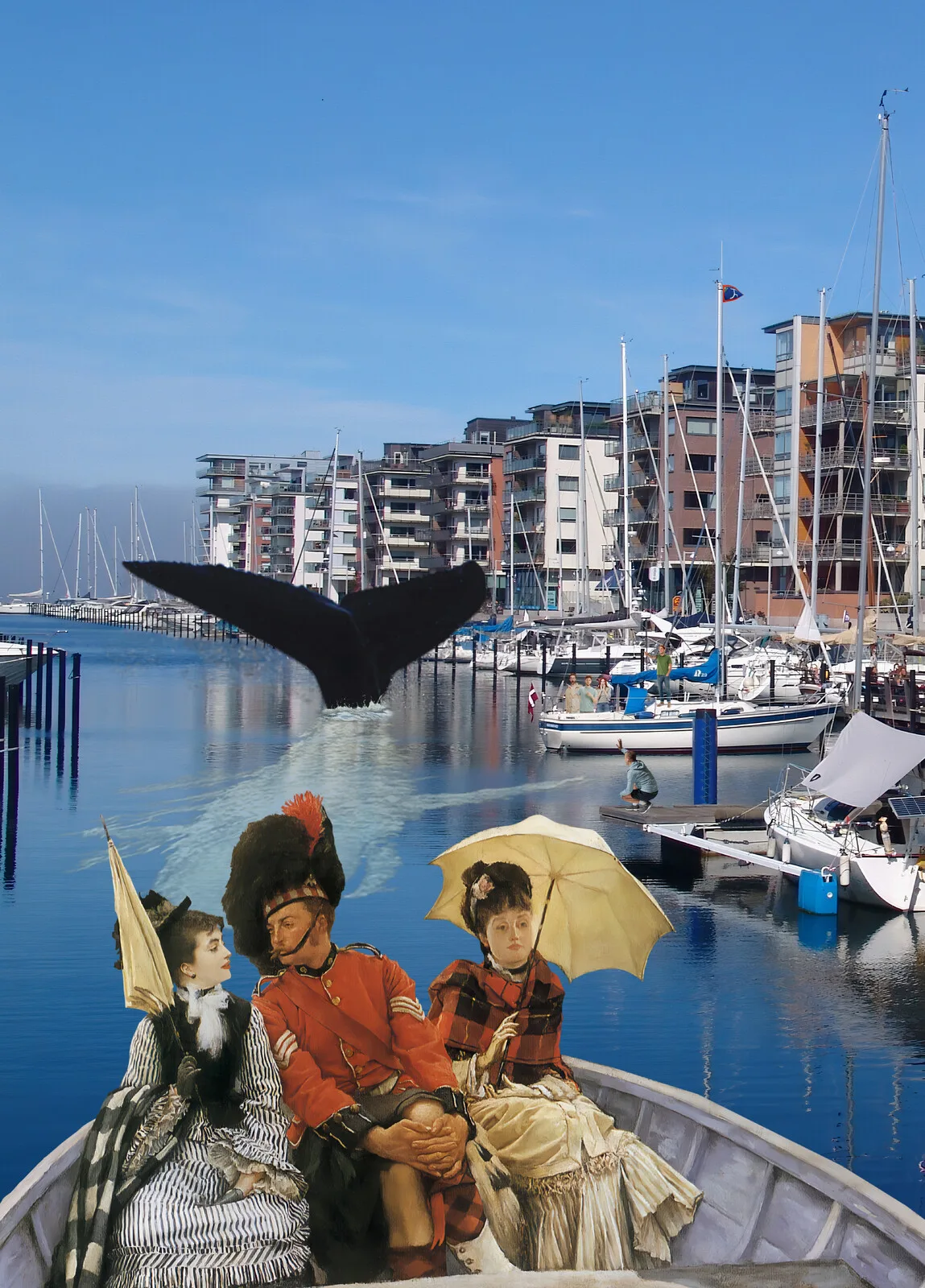
Jörgen Thornberg
The dock sailor's terror, 2023
Digital
50 x 70 cm
3 200 kr
A dock sailor is often a pathetic man, boasting about his exploits at sea even though he never leaves the Dock and probably never has. Despite his sorry state, he is popular; many stop by for a chat or are invited aboard for some brandy and a story they've heard many times before. What matters is that the brandy is of a good vintage.
Indeed, most boats lie still in their home harbour most of the time. One could 'rent' someone else's boat, for the greatest pleasure of owning a boat is tinkering with it. This can be done in autumn, winter, spring, and quite a bit in the summer. Since you do the work, the rent, including brandy, can be set at zero. The owner can dock-sail for weeks while you 'rent' another boat.
"As you know, I've been through many adventures," the Dock Sailor began, taking a hearty sip of brandy to lubricate his tongue. "But let me tell you, they're nothing compared to what my great-great-great-grandfather experienced on the infamous ghost ship Mary Celeste."
The Dock Sailor leaned back, his gaze drifting into the distance as if peering through the mists of time. "My old ancestor was a young crewman on that cursed brigantine. They said he was the only one who survived because he passed out drunk in an empty barrel of rum. The oak soaked up the fumes and got him so drunk that he was dead to the world. When he finally woke up, he was all alone. The captain had loaded the lifeboat and sailed away with the rest of the crew."
The Dock Sailor then leaned forward, his eyes now glittering with intrigue. "Mary Celeste, often erroneously called Marie Celeste, was a Canadian-built, American-registered merchant brigantine found adrift and deserted in the Atlantic Ocean off the Azores. The Canadian brigantine Dei Gratia encountered her in a dishevelled but seaworthy state. She was under partial sail and missing her lifeboat. The last entry in her log was dated ten days earlier. She had left New York City for Genoa on November 7, 1872, and was still well-provisioned when found. Her cargo of alcohol was intact, and the captain's and crew's belongings were undisturbed. Not a soul from that ship was ever seen or heard from again."
The Dock Sailor paused for another sip of brandy before continuing. "Mary Celeste was built in Spencer's Island, Nova Scotia, and launched in 1861 under the name Amazon. In 1868, she was transferred to American ownership and renamed. Her voyages were mostly uneventful until that ill-fated journey in 1872."
"After the ship was found abandoned, the authorities investigated, suspecting foul play. They considered mutiny by the crew, piracy by the Dei Gratia, and even conspiracy to commit insurance fraud. Yet, no convincing evidence supported any of these theories."
He leaned closer and lowered his voice. "Instead, other explanations surfaced over time, like the effects of alcohol fumes rising from the cargo, submarine earthquakes, waterspouts, and even attacks by a giant squid or paranormal intervention. My ancestor insisted it was the fumes. He swore that he awoke with the worst headache of his life, his nostrils filled with the stench of rum, and the ship eerily silent."
The Dock Sailor sat back and chuckled softly. "After those hearings in Gibraltar, Mary Celeste went through a string of new owners. Her captain in 1885 deliberately wrecked her off the coast of Haiti for insurance fraud. Yet her unexplained abandonment in 1872 became famous, with countless books, plays, and films trying to unravel the mystery."
He refilled his glass, his voice growing more animated. "My great-great-great-grandfather always said, 'A man has to be lucky, lad, lucky to survive the Mary Celeste!' So when he climbed out of that barrel and found the ship empty, he realised luck had smiled on him that Day."
With a final swig of brandy, the Dock Sailor concluded his tale. "So here's to him, the luckiest sailor who ever lived, and the ghost ship Mary Celeste, whose mystery remains unsolved today."
And so, with that brandy-lubricated tongue and a twinkle in his eye, the Dock Sailor unravelled the infamous tale of Mary Celeste, weaving fact and legend into a sailor's yarn that lingers long after the final glass is emptied.
The Dock Sailor leaned back, relighting his pipe and savouring the moment as his guests grew quiet around him. "Now, let's dive deeper into the ghostly voyage of the Mary Celeste."
"In October 1872, Captain Benjamin Spooner Briggs took command of the Mary Celeste, fresh out of an extensive refit in New York. He was a God-fearing man, born to a long line of sea captains. For this voyage to Genoa, he brought his wife Sarah and their two-year-old daughter Sophia along, leaving their young son Arthur in the care of his grandmother."
"Briggs was meticulous in selecting his crew. He chose his first mate, Albert G. Richardson, who had sailed with him before and was married to a niece of one of the ship's owners. Andrew Gilling, the second mate, was a Dane by birth but had lived in New York for years. Steward Edward William Head, a newlywed, came highly recommended by the ship's owner, James H. Winchester. Four German seamen from the Frisian Islands completed the crew, and by all accounts, they were capable and peaceable."
The Dock Sailor took a long drag from his pipe, the smoke swirling around him like mist over the sea. "On November 5, 1872, Mary Celeste left Pier 50 in New York Harbor, her sails billowing in the Atlantic breeze. But the weather was uncertain, so Captain Briggs anchored off Staten Island, waiting for calmer seas. It wasn't until November 7 that she finally set sail for Genoa."
"As fate would have it, Captain David Morehouse of the Dei Gratia had also left New York, bound for Gibraltar, a week later. Some say Briggs and Morehouse were acquaintances; others claim they were close friends. Either way, their paths would soon intertwine most mysteriously."
The Dock Sailor paused, savoring the suspense. "On December 4, 1872, the Dei Gratia reached a point midway between the Azores and the coast of Portugal. Captain Morehouse came on deck and noticed a ship swaying aimlessly six miles away. As they approached, he could see no one on deck, and signals went unanswered. He dispatched First Mate Oliver Deveau and Second Mate John Wright to investigate."
The Dock Sailor leaned in, his voice barely a whisper. "They found the Mary Celeste drifting, sails partly set, her rigging loose and damaged. The main hatch cover was secure, but the fore and lazarette hatches were wide open. Her single lifeboat was missing, and the binnacle's compass was shattered. Below deck, there was about three and a half feet of water in the hold, but the ship was otherwise seaworthy."
"The galley was stocked, but no food was being prepared. The captain's cabin was cluttered with personal effects, but his navigational instruments and the ship's papers were missing. The logbook, last dated November 25, placed Mary Celeste off the coast of Santa Maria Island in the Azores."
The Dock Sailor tapped his pipe on the table, emptying the ashes. "Captain Morehouse decided to bring the derelict ship into Gibraltar, 600 nautical miles away. But they were under-crewed, and progress was slow. The Dei Gratia arrived on December 12, and Mary Celeste followed a day later, shrouded in fog."
"In Gibraltar, the Vice-Admiralty Court held salvage hearings. The Attorney General, Frederick Solly-Flood, was convinced that a crime had been committed. He suspected mutiny or foul play, particularly because Mary Celeste's cargo was intact, and her valuable alcohol was untouched."
"But Solly-Flood's theories couldn't hold water. No bloodstains were found, despite the diver's report that there were marks on the bow possibly caused by a sharp instrument. The ship's sword stains were tested and proven not to be blood. Moreover, Captain Morehouse and his crew faced scrutiny but were ultimately cleared of wrongdoing."
"Still, the low salvage award reflected the court's unresolved suspicions, and the mystery of Mary Celeste was far from solved. Hypotheses ranged from alcohol fumes causing panic to submarine earthquakes and waterspouts. Some speculated about pirates, while others spoke of giant squids and sea monsters."
The Dock Sailor shook his head. "Yet my great-great-great-grandfather remained adamant that it was the alcohol fumes. He said, 'The pungent smell was everywhere. The crew must've feared an explosion and fled in the lifeboat, leaving me slumped in that empty rum barrel.' But why didn't they come back? Why didn't they?"
He took a long swig of brandy as if trying to chase away the ghosts of the past. "After those hearings in Gibraltar, Mary Celeste changed hands several times. She even deliberately wrecked off Haiti's coast in 1885 by Captain Gilman C. Parker, who tried to pull off an insurance fraud."
The Dock Sailor chuckled ruefully. "But the curse of the Mary Celeste got him in the end. He died in poverty, his reputation ruined."
He looked around the tavern, meeting each listener's gaze. "So, there you have it, lads. The mysterious tale of the ghost ship Mary Celeste, whose name became synonymous with unexplained desertion. My great-great-great-grandfather might have been lucky that Day, but the ship itself was cursed."
He raised his glass, his voice firm. "Here's to the Mary Celeste and her lost souls. May the sea one Day reveal their fate."
The boat was silent as the Dock Sailor finished his tale. The patrons stared into their glasses, their minds adrift on the ghostly Atlantic waves of the Mary Celeste. The Dock Sailor leaned back at the rail, relighting his pipe and savouring the brandy-fueled warmth that settled deep in his bones.
"But that's a tale for another day," he said finally, a sly grin spreading across his face. "For now, let us toast to the sea's mysteries."
And so they did. But his guests persuaded him to tell a few more stories about his ancestor. Since one of the others had brought along a Greek Metaxa, there was a whole bottle full of reasons to continue.
"Alright," said the Dock Sailor after sipping the Metaxa and clearing his throat. "I will tell you more terrible true tales of life at sea. Many tragic and awful things happened to mariners and other seafarers in the age of deep-sea sailing ships."
He began with the grim tale of the American schooner Sallie M. Steelman. "In December 1877, she was battered by a storm off Cape Hatteras and drifted, derelict, for over a month. One sailor shot and killed another, and the desperate crew turned to cannibalism. Barrett, who butchered the corpse and ate about a pound and a half of the flesh, declared that it tasted as 'good as any beef steak he ever ate', and my poor great-great-great-grandfather had to agree. Otherwise, he would have ended up on the same menu.
The Dock Sailor took another sip and continued, "It wasn't a unique case of the so-called 'custom of the sea,' where shipmates cannibalised the dead so others might survive."
"Twenty years later, it was time again. He was now in his forties. In August 1899, the Norwegian barque Drot was sunk by a hurricane in the Florida Straits. Six men survived on one raft. One of the men lost his mind from thirst and hunger and jumped overboard. Another died a natural death, but 'before the breath was well out of his body, his comrades drank his blood and devoured his flesh.' A second man met a similar fate."
"What a fate, the deceased said when he died", joked one of the guests to lighten the seriousness, washing down the horrific story with some Metaxa.
"Lots were cast to decide who would be next," continued the Dock Sailor. "A big German drew the short straw. He was stabbed in the heart, and Anderson and Thomas drank his blood as it gushed from the wound. They also cut strips of flesh from his body and devoured them. A British steamship in the mid-Atlantic eventually picked up the two survivors. Only my great-great-great-grandfather and another man survived."
The Dock Sailor shuddered. "And then there's the story of the yacht Mignonette. In 1884, she was being sailed from England to Australia with three men and a 17-year-old boy, Richard Parker, as crew. The Mignonette sank in a storm in the South Atlantic, and the four crew members drifted in a small dinghy for several weeks. Finally, Captain Dudley decided that the boy, Parker, would have to be sacrificed and cannibalised so the others might survive."
He took another sip of Metaxa. "The captain said to Parker, 'Now, Dick, your hour has come.' Parker feebly replied, 'What! Me, sir? Oh, don't!' But Dudley did it anyway—he ran a penknife into Parker's jugular vein, and he died in a few seconds. They stripped the boy and for five days subsisted on his body before they were rescued by the ship Montezuma and taken to Falmouth."
The Dock Sailor leaned back, his eyes darkened by the tales of desperation. "Cannibalism is a desperate act, but it was once considered a tragic necessity of survival in the cruel, unforgiving ocean."
"Before that dreadful story, in April 1876, the labour recruitment schooner Dancing Wave took on some islanders in the Solomon Islands", the Dock Sailor went on. "Soon after, the Solomon men massacred most of the schooner's crew, including her captain, and took over the vessel—another vessel, the Sydney, under the command of Capt. Woodhouse finally caught up with the Dancing Wave and saved my forefather, who was almost starved to death.
Having come up to the schooner, Captain Woodhouse, accompanied by 12 of his crew (principally natives), boarded the Dancing Wave and found that the vessel had been ransacked from stem to stern; the natives had murdered the captain and all his crew except my ancestor and had pillaged the whole place, carrying off everything that they could lay their hands to, and destroying life as well as property. The decks and the cabin floor were all bespattered with blood and other human remains, and in the saloon, pickle and pepper bottles were found to have been emptied. Their contents cast upon the floor, mixing themselves in heterogeneous masses with the blood. Near the mainmast, the head of one of the native crew was found. My forefather explained that it was this that saved his life; decapitating one of the natives scared the rest off.
It was reported, 'As soon as Captain Woodhouse could make it convenient, he had the decks washed and removed, as far as possible, all signs of the fearful outrages that had been perpetrated on board her…'
Strict discipline was essential for the safety and management of crews, ships and cargo. Brass-knuckle and iron hard belaying pin discipline was something else entirely: brutal, vicious, barbaric cruelty. For which some ships were tarred, quite rightly, as hell-ships.
The Harvester was another Pacific ship with a bad record. Her captain had my great-great-great-grandfather put in a barrel, the head of which was then fastened up, and nails were driven into the sides. When the captain thought it had enough spikes, he rolled the barrel up and down the deck. My unfortunate progenitor was nearly dead when released.
The Craigmullen, with twenty-five crew, left Singapore at the end of July 1895, bound for Callao, Peru. The barque was soon beset by a hundred days of a supernatural calm. According to my ancestor, 'Day succeeded Day; week succeeded week; month succeeded month, and still the wind came not. Each morning, the sun would rise out of the sea in the east, burn a path across the brazen sky, and sink in the west in endless, unchanging monotony. Oh, it was maddening – terrible!… I wonder some of them did not go mad with thirst, hunger, or terror at this supernatural calm.'
Worse was to come. Then, the men began to fall sick. Too weak to help themselves, they lay down in corners and passed into a sort of coma. The first to die was our youngest apprentice, a boy of fifteen and one who had endeared himself to all of us by his kindness of disposition. It was Christmas morning, I remember, when he died – Christmas, of all days in the year, and what a Christmas! The captain was the next to go; he died raving. After that, not a week passed without one man dying. Sometimes, they went with quite a fluttering of the heart and a sigh; at others, shrieking in maniac fury and cursing with foam-flecked lips. My forefather and three other survivors buried them all in the same grave – beneath the oily surface of that leaden sea.'
And then – arrived a typhoon. When they were finally rescued – just three hundred miles from Callao – my great-great-great-grandfather and the other three wretched sole survivors of that trans-Pacific death drift had been reduced to 'skeletal shadows of their former selves'.
The German schooner Johanna left Port Louis, Mauritius, for Melbourne on 3 April 1890. Most of the crew caught a tropical disease in Port Louis and dropped like flies during the voyage, which, in the southern Indian Ocean of boisterous westerly winds, was rough and stormy. The mate, my forefather, was the only crew member well enough to run the ship – and dispose of the dead:
'The forecastle,' my ancestor said, 'as you know, is small and closed up, as it was in the rough weather, and the air was so fearfully bad that when a man died, I had to get the body away at once. When I went into the forecastle, the men called out for water and, in their agony, threw themselves on the floor. The poor men who died were all young, smart fellows, and we had been together so long that it was a terrible task for me to have to throw them overboard like dogs, but it could not be helped. Then my forefather had to destroy the bedding, and it was a terrible time, the like of which he hoped never to experience again.'
To this Day, seamen are vulnerable to the dreadful perils of their trade. A sea captain friend once told me that he had witnessed, or was told about, a particularly atrocious circumstance (probably in the 1950s) when a wire mooring line on a vessel docking snapped. The wire, as it whipped back, cut a sailor in two.
The Dock - where Malmö meets the sea and the city's pulse blends with the sound of the waves. In the heart of the Öresund region, in a historic part of Malmö, lies the district known as The Dock—an area showcasing the new Malmö tailored for European businesses and Nordic living. The area has gradually transformed from industrial buildings to a mixed urban environment.
When Kockums embarked on its shipbuilding industry in Western Harbor at the dawn of the 20th century, it heralded the start of a remarkable era that endured for nearly a century. The harbour, in use since the late 18th century, underwent a profound transformation with numerous new constructions, a testament to the resilience and adaptability of the Kockums area.
For most of the 20th century, Kockums shipyard operated in the area, which is now being carefully transformed into a vibrant maritime district. Let's take a brief look back at a unique neighbourhood where
The old Kockums area in Malmö is on the verge of a thrilling transformation, evolving from a shipyard into a dynamic blend of residences, offices, and other activities. The city's metamorphosis is a sight to behold, a testament to the power of urban development.
The Dock and Western Harbor are a tribute to old Malmö's industrial flagship: Kockums Shipyard. The shipyard, which started in tobacco and agricultural machinery, became a symbol of success, with boats crowning its achievements. From its humble beginnings in the city centre (Davidshall), all activities were eventually relocated to the sea in 1870 on newly reclaimed land.
The old port founder, Frans Suell, had his economic base in tobacco, lime (which became the cement industry), and shipping. His son-in-law, Frans Henrik Kockum, took over an existing dry dock in the port (which still exists down there) and founded the shipyard. Kockums' very first ship was delivered in 1873. At the same time - in 1871 - Skånska cementaktiebolaget was established and quickly branched out into Skånska cementgjuteriet - today's Skanska.
The period 1870 - 1914 can be seen as an awakening in Malmö after a long, long slumber that had lasted since the Swedish takeover in the 17th century. The period saw fantastic population growth, mainly through immigration from the surrounding countryside. From 1860 to 1910, the city's population quadrupled, thus a much more powerful increase than the one ongoing in our time. It gave rise to similar problems as today, revolving around the labour market, exclusion, and social unrest.
During this time, Malmö became Sweden's leading industrial city, focusing on clothing, shoes, and textiles. As much as half of the workforce worked in textiles. At the same time as Malmö became Sweden's leading industrial city, the Social Democrats established their future hold on power. In 1881, August Palm held his famous lecture "What Do the Socialists Want?". Fairly quickly a strong labour movement was formed in Malmö, and just as quickly, the idea of consensus was established - that the leaders of business and labour should work together to create better living conditions for all.
The inner shipyard basin, where Kockums had its new heart, was created in the 1850s. When Kockums arrived here in 1870, there was already a dry dock from 1857, which they took over. Dock 1 still exists and will be preserved for future generations. The yard's largest Dock—Dock 2—is now a water-filled harbour basin that has become a pleasure boat harbour with surrounding residences named The Dock.
The shipyard basin will become the heart of a new district emerging among the old houses and facilities - Shipyard City. Some have already been residents here for some time. Sweden's television has been located here since 2010, right next to the old drawbridge, which used to be the entrance to the actual shipyard area. On the facade of the building still hangs the giant clock that used to help Kockums workers and officials keep track of time.
Next to SVT is the media cluster Media Evolution City, an industry member organisation with 350 members. The premises include offices for rent, conference facilities, and a restaurant. Since 2018, the growing Media Evolution has also had premises on the other side of the street, in the iconic Gängtappen —once the headquarters of Kockums.
Now, 2,500 residences are being planned and constructed. A kilometre-long promenade will be built around the shipyard basin. Two new bridges will cross the basin to connect the area better and provide better conditions for people to come and go. A pedestrian and bicycle bridge and a larger one will also be intended for public transport.
Several of the old buildings are preserved to make room for new activities. Among them, we find, for example, the old Administration building from 1912, which has been converted into a hotel by Wingårds architects. The Warehouse, from 1917, has already been used by many businesses, and plans are also in place for a couple of restaurants, one of which - Aster - is opening now. These buildings, like the Foundry (1910), the Machine and Assembly Hall (1912/1923) and the Carriage Workshop (1913), have Axel Stenberg as the architect. The style is robust brick architecture, whose most distinctive feature is the beautifully arched windows.
Historical curiosities also remain. The best examples are the old Dock from 1857, the "point bunker" from the 1940s, and the small park between the Administration building and the Warehouse, where the old Kockums bust still stands.
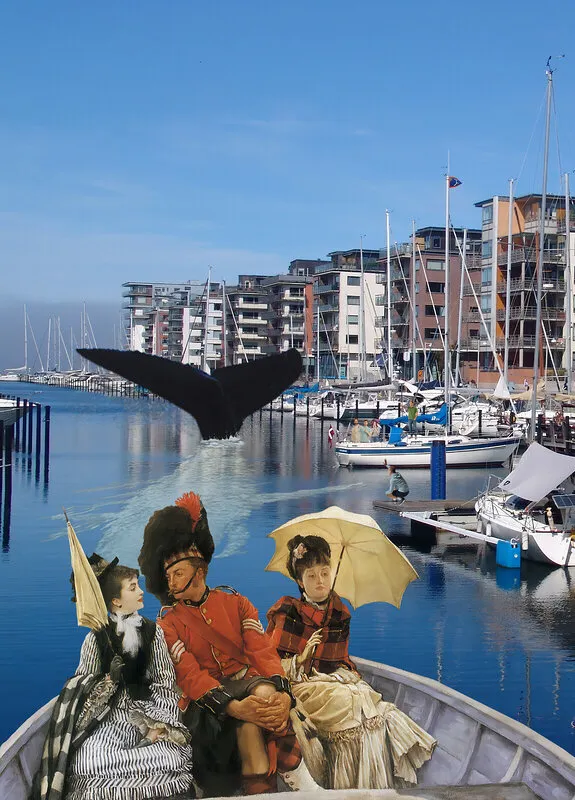
Jörgen Thornberg
The dock sailor's terror, 2023
Digital
50 x 70 cm
3 200 kr
A dock sailor is often a pathetic man, boasting about his exploits at sea even though he never leaves the Dock and probably never has. Despite his sorry state, he is popular; many stop by for a chat or are invited aboard for some brandy and a story they've heard many times before. What matters is that the brandy is of a good vintage.
Indeed, most boats lie still in their home harbour most of the time. One could 'rent' someone else's boat, for the greatest pleasure of owning a boat is tinkering with it. This can be done in autumn, winter, spring, and quite a bit in the summer. Since you do the work, the rent, including brandy, can be set at zero. The owner can dock-sail for weeks while you 'rent' another boat.
"As you know, I've been through many adventures," the Dock Sailor began, taking a hearty sip of brandy to lubricate his tongue. "But let me tell you, they're nothing compared to what my great-great-great-grandfather experienced on the infamous ghost ship Mary Celeste."
The Dock Sailor leaned back, his gaze drifting into the distance as if peering through the mists of time. "My old ancestor was a young crewman on that cursed brigantine. They said he was the only one who survived because he passed out drunk in an empty barrel of rum. The oak soaked up the fumes and got him so drunk that he was dead to the world. When he finally woke up, he was all alone. The captain had loaded the lifeboat and sailed away with the rest of the crew."
The Dock Sailor then leaned forward, his eyes now glittering with intrigue. "Mary Celeste, often erroneously called Marie Celeste, was a Canadian-built, American-registered merchant brigantine found adrift and deserted in the Atlantic Ocean off the Azores. The Canadian brigantine Dei Gratia encountered her in a dishevelled but seaworthy state. She was under partial sail and missing her lifeboat. The last entry in her log was dated ten days earlier. She had left New York City for Genoa on November 7, 1872, and was still well-provisioned when found. Her cargo of alcohol was intact, and the captain's and crew's belongings were undisturbed. Not a soul from that ship was ever seen or heard from again."
The Dock Sailor paused for another sip of brandy before continuing. "Mary Celeste was built in Spencer's Island, Nova Scotia, and launched in 1861 under the name Amazon. In 1868, she was transferred to American ownership and renamed. Her voyages were mostly uneventful until that ill-fated journey in 1872."
"After the ship was found abandoned, the authorities investigated, suspecting foul play. They considered mutiny by the crew, piracy by the Dei Gratia, and even conspiracy to commit insurance fraud. Yet, no convincing evidence supported any of these theories."
He leaned closer and lowered his voice. "Instead, other explanations surfaced over time, like the effects of alcohol fumes rising from the cargo, submarine earthquakes, waterspouts, and even attacks by a giant squid or paranormal intervention. My ancestor insisted it was the fumes. He swore that he awoke with the worst headache of his life, his nostrils filled with the stench of rum, and the ship eerily silent."
The Dock Sailor sat back and chuckled softly. "After those hearings in Gibraltar, Mary Celeste went through a string of new owners. Her captain in 1885 deliberately wrecked her off the coast of Haiti for insurance fraud. Yet her unexplained abandonment in 1872 became famous, with countless books, plays, and films trying to unravel the mystery."
He refilled his glass, his voice growing more animated. "My great-great-great-grandfather always said, 'A man has to be lucky, lad, lucky to survive the Mary Celeste!' So when he climbed out of that barrel and found the ship empty, he realised luck had smiled on him that Day."
With a final swig of brandy, the Dock Sailor concluded his tale. "So here's to him, the luckiest sailor who ever lived, and the ghost ship Mary Celeste, whose mystery remains unsolved today."
And so, with that brandy-lubricated tongue and a twinkle in his eye, the Dock Sailor unravelled the infamous tale of Mary Celeste, weaving fact and legend into a sailor's yarn that lingers long after the final glass is emptied.
The Dock Sailor leaned back, relighting his pipe and savouring the moment as his guests grew quiet around him. "Now, let's dive deeper into the ghostly voyage of the Mary Celeste."
"In October 1872, Captain Benjamin Spooner Briggs took command of the Mary Celeste, fresh out of an extensive refit in New York. He was a God-fearing man, born to a long line of sea captains. For this voyage to Genoa, he brought his wife Sarah and their two-year-old daughter Sophia along, leaving their young son Arthur in the care of his grandmother."
"Briggs was meticulous in selecting his crew. He chose his first mate, Albert G. Richardson, who had sailed with him before and was married to a niece of one of the ship's owners. Andrew Gilling, the second mate, was a Dane by birth but had lived in New York for years. Steward Edward William Head, a newlywed, came highly recommended by the ship's owner, James H. Winchester. Four German seamen from the Frisian Islands completed the crew, and by all accounts, they were capable and peaceable."
The Dock Sailor took a long drag from his pipe, the smoke swirling around him like mist over the sea. "On November 5, 1872, Mary Celeste left Pier 50 in New York Harbor, her sails billowing in the Atlantic breeze. But the weather was uncertain, so Captain Briggs anchored off Staten Island, waiting for calmer seas. It wasn't until November 7 that she finally set sail for Genoa."
"As fate would have it, Captain David Morehouse of the Dei Gratia had also left New York, bound for Gibraltar, a week later. Some say Briggs and Morehouse were acquaintances; others claim they were close friends. Either way, their paths would soon intertwine most mysteriously."
The Dock Sailor paused, savoring the suspense. "On December 4, 1872, the Dei Gratia reached a point midway between the Azores and the coast of Portugal. Captain Morehouse came on deck and noticed a ship swaying aimlessly six miles away. As they approached, he could see no one on deck, and signals went unanswered. He dispatched First Mate Oliver Deveau and Second Mate John Wright to investigate."
The Dock Sailor leaned in, his voice barely a whisper. "They found the Mary Celeste drifting, sails partly set, her rigging loose and damaged. The main hatch cover was secure, but the fore and lazarette hatches were wide open. Her single lifeboat was missing, and the binnacle's compass was shattered. Below deck, there was about three and a half feet of water in the hold, but the ship was otherwise seaworthy."
"The galley was stocked, but no food was being prepared. The captain's cabin was cluttered with personal effects, but his navigational instruments and the ship's papers were missing. The logbook, last dated November 25, placed Mary Celeste off the coast of Santa Maria Island in the Azores."
The Dock Sailor tapped his pipe on the table, emptying the ashes. "Captain Morehouse decided to bring the derelict ship into Gibraltar, 600 nautical miles away. But they were under-crewed, and progress was slow. The Dei Gratia arrived on December 12, and Mary Celeste followed a day later, shrouded in fog."
"In Gibraltar, the Vice-Admiralty Court held salvage hearings. The Attorney General, Frederick Solly-Flood, was convinced that a crime had been committed. He suspected mutiny or foul play, particularly because Mary Celeste's cargo was intact, and her valuable alcohol was untouched."
"But Solly-Flood's theories couldn't hold water. No bloodstains were found, despite the diver's report that there were marks on the bow possibly caused by a sharp instrument. The ship's sword stains were tested and proven not to be blood. Moreover, Captain Morehouse and his crew faced scrutiny but were ultimately cleared of wrongdoing."
"Still, the low salvage award reflected the court's unresolved suspicions, and the mystery of Mary Celeste was far from solved. Hypotheses ranged from alcohol fumes causing panic to submarine earthquakes and waterspouts. Some speculated about pirates, while others spoke of giant squids and sea monsters."
The Dock Sailor shook his head. "Yet my great-great-great-grandfather remained adamant that it was the alcohol fumes. He said, 'The pungent smell was everywhere. The crew must've feared an explosion and fled in the lifeboat, leaving me slumped in that empty rum barrel.' But why didn't they come back? Why didn't they?"
He took a long swig of brandy as if trying to chase away the ghosts of the past. "After those hearings in Gibraltar, Mary Celeste changed hands several times. She even deliberately wrecked off Haiti's coast in 1885 by Captain Gilman C. Parker, who tried to pull off an insurance fraud."
The Dock Sailor chuckled ruefully. "But the curse of the Mary Celeste got him in the end. He died in poverty, his reputation ruined."
He looked around the tavern, meeting each listener's gaze. "So, there you have it, lads. The mysterious tale of the ghost ship Mary Celeste, whose name became synonymous with unexplained desertion. My great-great-great-grandfather might have been lucky that Day, but the ship itself was cursed."
He raised his glass, his voice firm. "Here's to the Mary Celeste and her lost souls. May the sea one Day reveal their fate."
The boat was silent as the Dock Sailor finished his tale. The patrons stared into their glasses, their minds adrift on the ghostly Atlantic waves of the Mary Celeste. The Dock Sailor leaned back at the rail, relighting his pipe and savouring the brandy-fueled warmth that settled deep in his bones.
"But that's a tale for another day," he said finally, a sly grin spreading across his face. "For now, let us toast to the sea's mysteries."
And so they did. But his guests persuaded him to tell a few more stories about his ancestor. Since one of the others had brought along a Greek Metaxa, there was a whole bottle full of reasons to continue.
"Alright," said the Dock Sailor after sipping the Metaxa and clearing his throat. "I will tell you more terrible true tales of life at sea. Many tragic and awful things happened to mariners and other seafarers in the age of deep-sea sailing ships."
He began with the grim tale of the American schooner Sallie M. Steelman. "In December 1877, she was battered by a storm off Cape Hatteras and drifted, derelict, for over a month. One sailor shot and killed another, and the desperate crew turned to cannibalism. Barrett, who butchered the corpse and ate about a pound and a half of the flesh, declared that it tasted as 'good as any beef steak he ever ate', and my poor great-great-great-grandfather had to agree. Otherwise, he would have ended up on the same menu.
The Dock Sailor took another sip and continued, "It wasn't a unique case of the so-called 'custom of the sea,' where shipmates cannibalised the dead so others might survive."
"Twenty years later, it was time again. He was now in his forties. In August 1899, the Norwegian barque Drot was sunk by a hurricane in the Florida Straits. Six men survived on one raft. One of the men lost his mind from thirst and hunger and jumped overboard. Another died a natural death, but 'before the breath was well out of his body, his comrades drank his blood and devoured his flesh.' A second man met a similar fate."
"What a fate, the deceased said when he died", joked one of the guests to lighten the seriousness, washing down the horrific story with some Metaxa.
"Lots were cast to decide who would be next," continued the Dock Sailor. "A big German drew the short straw. He was stabbed in the heart, and Anderson and Thomas drank his blood as it gushed from the wound. They also cut strips of flesh from his body and devoured them. A British steamship in the mid-Atlantic eventually picked up the two survivors. Only my great-great-great-grandfather and another man survived."
The Dock Sailor shuddered. "And then there's the story of the yacht Mignonette. In 1884, she was being sailed from England to Australia with three men and a 17-year-old boy, Richard Parker, as crew. The Mignonette sank in a storm in the South Atlantic, and the four crew members drifted in a small dinghy for several weeks. Finally, Captain Dudley decided that the boy, Parker, would have to be sacrificed and cannibalised so the others might survive."
He took another sip of Metaxa. "The captain said to Parker, 'Now, Dick, your hour has come.' Parker feebly replied, 'What! Me, sir? Oh, don't!' But Dudley did it anyway—he ran a penknife into Parker's jugular vein, and he died in a few seconds. They stripped the boy and for five days subsisted on his body before they were rescued by the ship Montezuma and taken to Falmouth."
The Dock Sailor leaned back, his eyes darkened by the tales of desperation. "Cannibalism is a desperate act, but it was once considered a tragic necessity of survival in the cruel, unforgiving ocean."
"Before that dreadful story, in April 1876, the labour recruitment schooner Dancing Wave took on some islanders in the Solomon Islands", the Dock Sailor went on. "Soon after, the Solomon men massacred most of the schooner's crew, including her captain, and took over the vessel—another vessel, the Sydney, under the command of Capt. Woodhouse finally caught up with the Dancing Wave and saved my forefather, who was almost starved to death.
Having come up to the schooner, Captain Woodhouse, accompanied by 12 of his crew (principally natives), boarded the Dancing Wave and found that the vessel had been ransacked from stem to stern; the natives had murdered the captain and all his crew except my ancestor and had pillaged the whole place, carrying off everything that they could lay their hands to, and destroying life as well as property. The decks and the cabin floor were all bespattered with blood and other human remains, and in the saloon, pickle and pepper bottles were found to have been emptied. Their contents cast upon the floor, mixing themselves in heterogeneous masses with the blood. Near the mainmast, the head of one of the native crew was found. My forefather explained that it was this that saved his life; decapitating one of the natives scared the rest off.
It was reported, 'As soon as Captain Woodhouse could make it convenient, he had the decks washed and removed, as far as possible, all signs of the fearful outrages that had been perpetrated on board her…'
Strict discipline was essential for the safety and management of crews, ships and cargo. Brass-knuckle and iron hard belaying pin discipline was something else entirely: brutal, vicious, barbaric cruelty. For which some ships were tarred, quite rightly, as hell-ships.
The Harvester was another Pacific ship with a bad record. Her captain had my great-great-great-grandfather put in a barrel, the head of which was then fastened up, and nails were driven into the sides. When the captain thought it had enough spikes, he rolled the barrel up and down the deck. My unfortunate progenitor was nearly dead when released.
The Craigmullen, with twenty-five crew, left Singapore at the end of July 1895, bound for Callao, Peru. The barque was soon beset by a hundred days of a supernatural calm. According to my ancestor, 'Day succeeded Day; week succeeded week; month succeeded month, and still the wind came not. Each morning, the sun would rise out of the sea in the east, burn a path across the brazen sky, and sink in the west in endless, unchanging monotony. Oh, it was maddening – terrible!… I wonder some of them did not go mad with thirst, hunger, or terror at this supernatural calm.'
Worse was to come. Then, the men began to fall sick. Too weak to help themselves, they lay down in corners and passed into a sort of coma. The first to die was our youngest apprentice, a boy of fifteen and one who had endeared himself to all of us by his kindness of disposition. It was Christmas morning, I remember, when he died – Christmas, of all days in the year, and what a Christmas! The captain was the next to go; he died raving. After that, not a week passed without one man dying. Sometimes, they went with quite a fluttering of the heart and a sigh; at others, shrieking in maniac fury and cursing with foam-flecked lips. My forefather and three other survivors buried them all in the same grave – beneath the oily surface of that leaden sea.'
And then – arrived a typhoon. When they were finally rescued – just three hundred miles from Callao – my great-great-great-grandfather and the other three wretched sole survivors of that trans-Pacific death drift had been reduced to 'skeletal shadows of their former selves'.
The German schooner Johanna left Port Louis, Mauritius, for Melbourne on 3 April 1890. Most of the crew caught a tropical disease in Port Louis and dropped like flies during the voyage, which, in the southern Indian Ocean of boisterous westerly winds, was rough and stormy. The mate, my forefather, was the only crew member well enough to run the ship – and dispose of the dead:
'The forecastle,' my ancestor said, 'as you know, is small and closed up, as it was in the rough weather, and the air was so fearfully bad that when a man died, I had to get the body away at once. When I went into the forecastle, the men called out for water and, in their agony, threw themselves on the floor. The poor men who died were all young, smart fellows, and we had been together so long that it was a terrible task for me to have to throw them overboard like dogs, but it could not be helped. Then my forefather had to destroy the bedding, and it was a terrible time, the like of which he hoped never to experience again.'
To this Day, seamen are vulnerable to the dreadful perils of their trade. A sea captain friend once told me that he had witnessed, or was told about, a particularly atrocious circumstance (probably in the 1950s) when a wire mooring line on a vessel docking snapped. The wire, as it whipped back, cut a sailor in two.
The Dock - where Malmö meets the sea and the city's pulse blends with the sound of the waves. In the heart of the Öresund region, in a historic part of Malmö, lies the district known as The Dock—an area showcasing the new Malmö tailored for European businesses and Nordic living. The area has gradually transformed from industrial buildings to a mixed urban environment.
When Kockums embarked on its shipbuilding industry in Western Harbor at the dawn of the 20th century, it heralded the start of a remarkable era that endured for nearly a century. The harbour, in use since the late 18th century, underwent a profound transformation with numerous new constructions, a testament to the resilience and adaptability of the Kockums area.
For most of the 20th century, Kockums shipyard operated in the area, which is now being carefully transformed into a vibrant maritime district. Let's take a brief look back at a unique neighbourhood where
The old Kockums area in Malmö is on the verge of a thrilling transformation, evolving from a shipyard into a dynamic blend of residences, offices, and other activities. The city's metamorphosis is a sight to behold, a testament to the power of urban development.
The Dock and Western Harbor are a tribute to old Malmö's industrial flagship: Kockums Shipyard. The shipyard, which started in tobacco and agricultural machinery, became a symbol of success, with boats crowning its achievements. From its humble beginnings in the city centre (Davidshall), all activities were eventually relocated to the sea in 1870 on newly reclaimed land.
The old port founder, Frans Suell, had his economic base in tobacco, lime (which became the cement industry), and shipping. His son-in-law, Frans Henrik Kockum, took over an existing dry dock in the port (which still exists down there) and founded the shipyard. Kockums' very first ship was delivered in 1873. At the same time - in 1871 - Skånska cementaktiebolaget was established and quickly branched out into Skånska cementgjuteriet - today's Skanska.
The period 1870 - 1914 can be seen as an awakening in Malmö after a long, long slumber that had lasted since the Swedish takeover in the 17th century. The period saw fantastic population growth, mainly through immigration from the surrounding countryside. From 1860 to 1910, the city's population quadrupled, thus a much more powerful increase than the one ongoing in our time. It gave rise to similar problems as today, revolving around the labour market, exclusion, and social unrest.
During this time, Malmö became Sweden's leading industrial city, focusing on clothing, shoes, and textiles. As much as half of the workforce worked in textiles. At the same time as Malmö became Sweden's leading industrial city, the Social Democrats established their future hold on power. In 1881, August Palm held his famous lecture "What Do the Socialists Want?". Fairly quickly a strong labour movement was formed in Malmö, and just as quickly, the idea of consensus was established - that the leaders of business and labour should work together to create better living conditions for all.
The inner shipyard basin, where Kockums had its new heart, was created in the 1850s. When Kockums arrived here in 1870, there was already a dry dock from 1857, which they took over. Dock 1 still exists and will be preserved for future generations. The yard's largest Dock—Dock 2—is now a water-filled harbour basin that has become a pleasure boat harbour with surrounding residences named The Dock.
The shipyard basin will become the heart of a new district emerging among the old houses and facilities - Shipyard City. Some have already been residents here for some time. Sweden's television has been located here since 2010, right next to the old drawbridge, which used to be the entrance to the actual shipyard area. On the facade of the building still hangs the giant clock that used to help Kockums workers and officials keep track of time.
Next to SVT is the media cluster Media Evolution City, an industry member organisation with 350 members. The premises include offices for rent, conference facilities, and a restaurant. Since 2018, the growing Media Evolution has also had premises on the other side of the street, in the iconic Gängtappen —once the headquarters of Kockums.
Now, 2,500 residences are being planned and constructed. A kilometre-long promenade will be built around the shipyard basin. Two new bridges will cross the basin to connect the area better and provide better conditions for people to come and go. A pedestrian and bicycle bridge and a larger one will also be intended for public transport.
Several of the old buildings are preserved to make room for new activities. Among them, we find, for example, the old Administration building from 1912, which has been converted into a hotel by Wingårds architects. The Warehouse, from 1917, has already been used by many businesses, and plans are also in place for a couple of restaurants, one of which - Aster - is opening now. These buildings, like the Foundry (1910), the Machine and Assembly Hall (1912/1923) and the Carriage Workshop (1913), have Axel Stenberg as the architect. The style is robust brick architecture, whose most distinctive feature is the beautifully arched windows.
Historical curiosities also remain. The best examples are the old Dock from 1857, the "point bunker" from the 1940s, and the small park between the Administration building and the Warehouse, where the old Kockums bust still stands.
3 200 kr

Jörgen Thornberg
Malmö
Lite om bilder och mig. Translation in English at the end.
Jag är en nyfiken person som ser allt i bilder, även det jag fäster i ord, gärna tillsammans för bakom alla mina bilder finns en berättelse. Till vissa bilder hör en kortare eller längre novell som följer med bilden.
Bilder berättar historier. Jag omges av naturlig skönhet, intressanta människor och historia var jag än går. Jag använder min kamera för att dokumentera världen och blanda det jag ser med vad jag känner för att fånga den dolda magin.
Mina bilder berättar mina historier. Genom mina bilder, tryck och berättelser. Jag bjuder in dig att ta del av dessa berättelser, in i ditt liv och hem och dela min mycket personliga syn på vår värld. Mer än vad ögat ser. Jag tänker i bilder, drömmer och skriver och pratar om dem; följaktligen måste jag också skapa bilder. De blir vad jag ser, inte nödvändigtvis begränsade till verkligheten. Det finns en bild runt varje hörn. Jag hoppas att du kommer att se vad jag såg och gilla det.
Jag är också en skrivande person och till många bilder hör en kortare eller längre essay. Den följer med tavlan, tryckt på fint papper och med en personlig hälsning från mig.
Flertalet bilder startar sin resa i min kamera. Enkelt förklarat beskriver jag bilden jag ser i mitt inre, upplevd eller fantiserad. Bilden uppstår inom mig redan innan jag fått okularet till ögat. På bråkdelen av ett ögonblick ser jag vad jag vill ha och vad som kan göras med bilden. Här skall jag stoppa in en giraff, stålmannen, Titanic eller vad det är min fantasi finner ut. Ännu märkligare är att jag kommer ihåg minnesbilden långt efteråt när det blir tid att skapa verket. Om jag lyckas eller inte, är upp till betraktaren, oftast präglat av en stråk av svart humor – meningen är att man skall bli underhållen. Mina bilder blir ofta en snackis där de hänger.
Jag föredrar bilder som förmedlar ett budskap i flera lager. Vid första anblicken fylld av feel-good, en vacker utsikt, fint väder, solen skiner, blommor på ängen eller vattnet som ligger förrädiskt spegelblankt. I en sådan bild kan jag gömma min egentliga berättelse, mitt förakt för förtryckare och våldsverkare, rasister och fördomsfulla människor - ett gärna återkommande motiv mer eller mindre dolt i det vackra motivet. Jag försöker förena dem i ett gemensamt narrativ.
Bild och formgivning har löpt som en röd tråd genom livet. Fotokonst känns som en värdig final som jag gärna delar med mig.
Min genre är vid som framgår av mina bilder, temat en blandning av pop- och gatukonst i kollage som kan bestå av hundratals lager. Vissa bilder kan ta veckor, andra någon dag innan det är dags att överlämna resultatet till printverkstaden. Fine Art Prints är digitala fotocollage. I dessa kollage sker rivandet, klippandet, pusslandet, målandet, ritandet och sprayningen digitalt. Det jag monterar in kan vara hundratals år gamla bilder som jag omsorgsfullt frilägger så att de ser ut att vara en del av tavlan men också bilder skapade av mig själv efter min egen fantasi. Därefter besöks printstudion och för vissa bilder numrera en limiterad upplaga (oftast 7 exemplar) och signera för hand. Vissa bilder kan köpas i olika format. Det är bara att fråga efter vilka. Gillar man en bild som är 70x100 men inte har plats på väggen, går den kanske att få i 50x70 cm istället. Frågan är fri.
Metoden Giclée eller Fine Art Print som det också kallas är det moderna sättet för framställning av grafisk konst. Villkoret för denna typ av utskrifter är att en högkvalitativ storformatskrivare används med åldersbeständigt färgpigment och konstnärspapper eller i förekommande fall på duk. Pappret som används möter de krav på livslängd som ställs av museer och gallerier. Normalt säljer jag mina bilder oinramade så att den nya ägaren själv kan bestämma hur de skall se ut, med eller utan passepartout färg på ram, med eller utan glas etc..
Under många år ställde jag bara ut på nätet, i valda grupper och på min egen Facebooksida - https://www.facebook.com/jorgen.thornberg.9
Jag finns också på en egen hemsida som tyvärr inte alltid är uppdaterad – https://www.jth.life/ Där kan du också läsa en del av de berättelser som följer med bilden.
UTSTÄLLNINGAR
Luftkastellet, oktober 2022
Konst i Lund, november 2022
Luftkastellet, mars 2023
Engleson Galleri Caroli, april 2023
Hydra, Greece June 2023
Engleson Galleri Caroli, oktober 2023
Toppen, Höllviken december 2023
Luftkastellet, mars 2024
Torups Galleri, mars 2024
Venice, May 2024
Luftkastellet, oktober 2024
Konst i Advent, December 2024
Galleri Engleson, Caroli December 2024
Jäger & Jansson Galleri, april 2025
A bit about pictures and me.
I'm a curious person who sees everything in pictures, even what I express in words, often combining them, for behind all my pictures lies a story. These narratives, some as short as a single image and others as long as a novel, are the heart and soul of my work.
Pictures tell stories. Wherever I go, I'm surrounded by natural beauty, exciting people, and history. I use my camera to document the world and blend what I see with what I feel to capture the hidden magic.
My images tell my stories. Through my pictures, prints, and narratives, I invite you to partake in these stories in your life and home and share my deeply personal perspective of our world. More than meets the eye. I think in pictures, dream, write, and talk about them; consequently, I must create images too. They become what I see, not necessarily confined to reality. There's a picture around every corner. I hope you'll see what I saw and enjoy it.
I'm also a writer, and many images come with a shorter or longer essay. It accompanies the painting, printed on fine paper with my personal greeting.
Many pictures start their journey on my camera. Simply put, I describe the image I see in my mind, experienced or imagined. The image arises within me even before I bring the eyepiece to my eye. In a fraction of a moment, I see what I want and what can be done with the picture. Here, I'll insert a giraffe, Superman, the Titanic, or whatever my imagination conjures up. Even stranger is that I remember the mental image long after it's time to create the work. Whether I succeed is up to the observer, often imbued with a streak of black humour – the aim is to entertain. My pictures usually become a talking point wherever they hang.
I prefer pictures that convey a message in multiple layers. At first glance, they're filled with feel-good vibes, a beautiful view, lovely weather, the sun shining, flowers in the meadow, or the water lying deceptively calm. But beneath this surface beauty, I often conceal a deeper story, a narrative that challenges societal norms or explores the human condition. I invite you to delve into these hidden narratives and discover the layers of meaning within my work.
Picture and design have been a thread running through my life. Photographic art feels like a fitting finale, and I'm happy to share it.
My genre is varied, as seen in my pictures; the theme is a blend of pop and street art in collages that can consist of hundreds of layers. Some images can take weeks, others just a day before it's time to hand over the result to the print workshop. Fine Art Prints are digital photo collages. In these collages, tearing, cutting, puzzling, painting, drawing, and spraying happen digitally. What I insert can be images hundreds of years old that I carefully extract so they appear to be part of the painting, but also images created by myself, now also generated from my imagination. Next, visit the print studio and, for certain images, number a limited edition (usually 7 copies) and sign them by hand. Some images may be available in other formats. Just ask which ones. If you like an image that's 70x100 but doesn't have space on the wall, you might be able to get it in 50x70 cm instead. The question is open.
The Giclée method, or Fine Art Print as it's also called, is the modern way of producing graphic art. This method ensures the highest quality and longevity of the artwork, using a high-quality large-format printer with archival pigment inks and artist paper or, in some cases, canvas. The paper used meets the longevity requirements set by museums and galleries. I sell my pictures unframed, allowing the new owner to personalise their artwork, confident in the lasting value and quality of the piece.
For many years, I only exhibited online, in selected groups, and on my Facebook page - https://www.facebook.com/jorgen.thornberg.9. I also have my website, which unfortunately is not constantly updated - https://www.jth.life/. You can also read some of the stories accompanying the pictures there.
EXHIBITIONS
Luftkastellet, October 2022
Art in Lund, November 2022
Luftkastellet, March 2023
Engleson Gallery Caroli, April 2023
Hydra, Greece June 2023
Engleson Gallery Caroli, October 2023
Toppen, Höllviken December 2023
Luftkastellet, March 2024
Torup Gallery, March 2024
Venice, May 2024
UTSTÄLLNINGAR
Luftkastellet, oktober 2022
Konst i Lund, november 2022
Luftkastellet, mars 2023
Engleson Galleri Caroli, april 2023
Hydra, Greece June 2023
Engleson Galleri Caroli, oktober 2023
Toppen, Höllviken december 2023
Luftkastellet, mars 2024
Torups Galleri, mars 2024
Venice, May 2024
Luftkastellet, October 2024
Konst i Advent, December 2024
Galleri Engleson, Caroli December 2024
Jäger & Jansson Galleri, April 2025
Utbildning
Autodidakt
Medlem i konstnärsförening
Öppna Sinnen
Med i konstrunda
Konstrundan i Skåne
Utställningar
Luftkastellet, October 2022
Art in Lund, November 2022
Luftkastellet, March 2023
Engleson Gallery Caroli, April 2023
Hydra, Greece June 2023
Engleson Gallery Caroli, October 2023
Toppen, Höllviken December 2023
Luftkastellet, March 2024
Torup Gallery, March 2024
Venice, May 2024