Vi använder cookies för att ge dig bästa möjliga upplevelse. Välj vilka cookies du tillåter.
Läs mer i vår integritetspolicy
Jörgen Thornberg
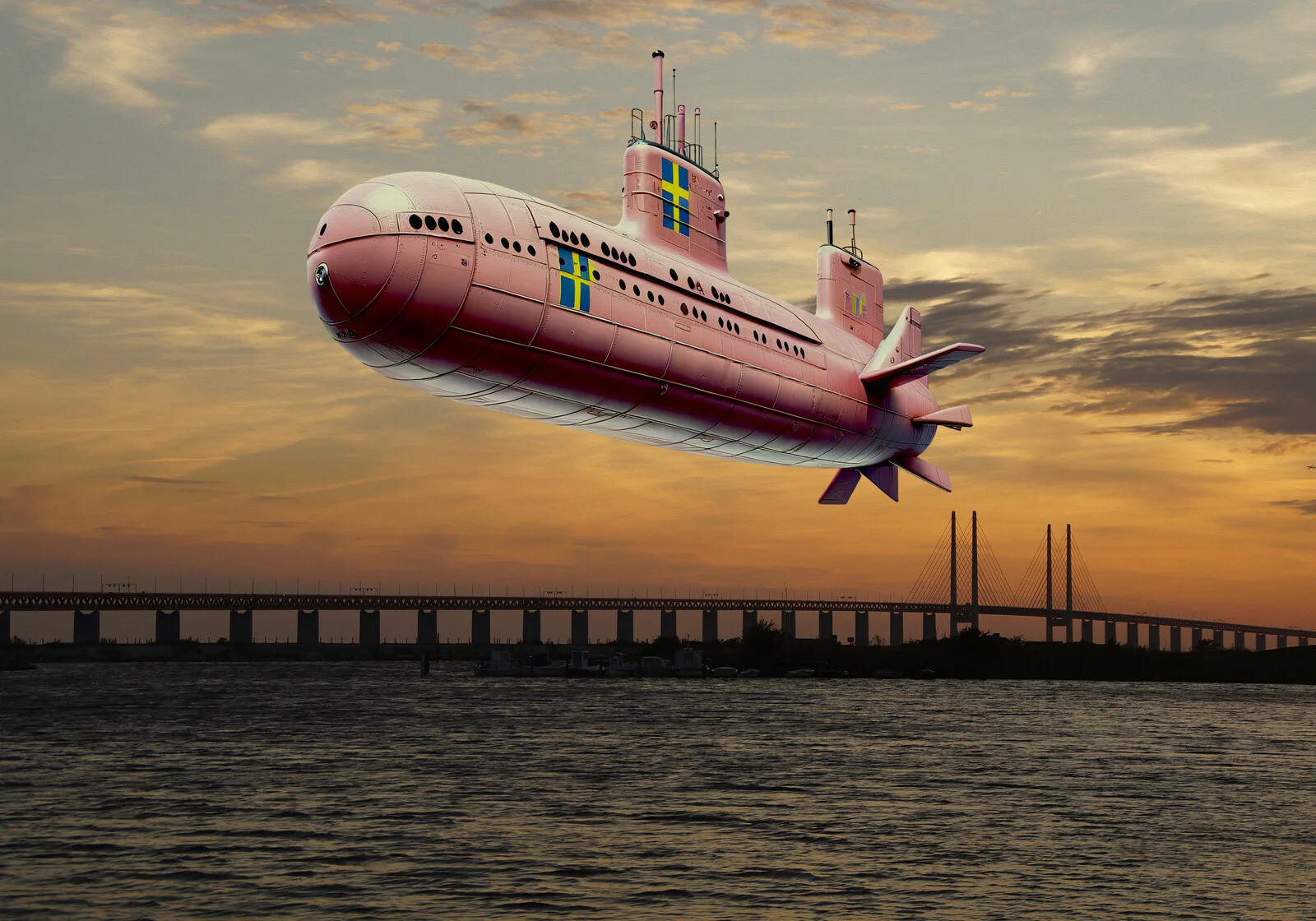
Pink Submarine – Sunset on the sea, 2022
Digital
70 x 50 cm
3 200 kr
A Whimsical Odyssey Beyond the Stars
I'm flying over a town of pink
Where the skies are oh so neat
There's a man who's scared of rain
In his pink submarine, so sweet
And we glide up past the clouds
To a world of cotton candy dreams
Where we dance upon the stars
In our pink submarine, it seems
We all fly in a pink submarine
Pink submarine, pink submarine
We all fly in a pink submarine
Pink submarine, pink submarine
In Malmö, where I was born, a man named Pär lived. He was not an ordinary man; his imagination soared beyond the confines of the everyday. Inspired by Jules Verne's "20,000 Leagues Under the Sea," Pär embarked on a remarkable journey to craft his seafaring vessel, but with a whimsical twist—it would be a pink submarine. This fantastical creation, lovingly named the Pink Nautilus, was not just any submarine; it was a marvel of engineering and creativity.
The pink city Malmö exists only twice daily, at dawn and dusk, provided the weather is fair and the clouds parted as if defending Pär's ambitions. When the weather gods smiled upon him, Pär would open the gates to his colossal garage, and the Nautilus would gracefully glide into the world. Its ballast tanks were filled alternately with helium and a super-lightweight substance known as 'Light Thoughts.' Pär abhorred rain and his submarine was not particularly fond of moisture either; its hull was woven from spun sugar. Yet, once above the clouds, eternal sunshine prevailed as long as the Nautilus maintained the same speed as the Earth rotated on its axis.
Pär's fascination with Jules Verne's tale led him to dream of a vessel that could explore the blue above. The blue surrounding Malmö was out of the question. Pär harboured a lifelong fear of water since nearly drowning in a puddle as a small child. However, with the wealth accumulated from selling spun sugar at markets across Sweden and Europe, Pär could finally realise his dreams. He sold his business and patented technology to the Sugar Company for billions, paving the way for his extraordinary venture.
The Pink Nautilus, modelled after Verne's Nautilus, boasted all the amenities of a luxurious submarine, from airlocks to panoramic windows. But it was not just any submarine; it was meticulously crafted from spun sugar that rivalled the strength of carbon fibre. It was a marvel of modern engineering, with one notable exception—it couldn't withstand water. Nonetheless, Pär found solace in occasional trips to the moon, an endeavour made possible by his innovative propulsion system fueled by 'Light Thoughts,' materialising out of nothingness as quickly as it was consumed.
The interior of the Pink Nautilus was a testament to Pär's impeccable taste and flair for the dramatic. Each room was adorned with opulent furnishings reminiscent of a bygone era of luxury and elegance. From the exquisite captain's quarters to the cosy lounge area, every corner of the submarine exuded charm and sophistication.
But the true marvel of the Pink Nautilus lay in its ability to transcend the confines of the Earth and soar through the skies. Pär and his intrepid crew donned frogman suits equipped with oxygen tanks on their backs, allowing them to embark on daring excursions and explore the far reaches of the cosmos. Their adventures, filled with the thrill of the unknown, took them to the furthest reaches of the galaxy, where they encountered strange new worlds and myriad exotic creatures.
Among Pär's many quests was a mission to sabotage satellites armed with dangerous weapons. With cunning viruses and stealthy manoeuvres, he ensured these satellites would be rendered harmless when deployed. It was a task that required both skill and ingenuity, but Pär was more than up to the challenge.
As the Pink Nautilus sailed through the cosmos, it carried with it the hopes and aspirations of its crew and passengers alike. It was a shining beacon of ingenuity and imagination in a universe brimming with possibility. Though its journey may have begun in the town where Pär was born, its destination was nothing short of the stars.
The Pink Nautilus, much like its inspiration in Jules Verne's masterpiece, is a testament to engineering brilliance and ingenuity. Commanded by the visionary Pär, it is a vessel of unparalleled design and functionality, earning it the epithet of "a masterpiece containing masterpieces." The interior is inspired by palaces such as Drottningholm and Versailles.
Like Captain Nemo's Nautilus, the Pink Nautilus is double-hulled and divided into hermetically tight compartments, ensuring its durability and safety in the vast expanses of the cosmos. Its primary power source is a solar engine run by the super-light medium 'Light Thoughts.' With a top speed a million times faster than thought, the Pink Nautilus is a marvel of speed and manoeuvrability. Its dimensions, meticulously crafted by Pär, allow optimal performance and efficiency, ensuring smooth navigation through the celestial emptiness.
Despite its technological prowess, the Pink Nautilus is more than just a vessel of exploration; it is a home to its crew, who gather food from the stars and enjoy the comforts of luxury unparalleled in seafaring vessels. A lavish galley prepares gourmet meals from celestial bounty while a distillation machine converts the smallest oxygen atom into drinking water. Additionally, all water is recycled, minimising the need for replenishment. The ship's library, boasting over twelve thousand books and cosy rooms filled with priceless works of art, offers a sanctuary of knowledge and culture amidst the vastness of space. Among its many amenities, the Pink Nautilus features a lavish dining room, an organ for evening entertainment, and even duplicates of bridge instruments in Captain Pär's quarters, allowing him to monitor the vessel's operations efficiently. These luxuries, however, are not just for show but are reserved for Pär, his esteemed guests, and companions, ensuring their comfort and well-being on their cosmic adventures.
Much like Captain Nemo's Nautilus, the Pink Nautilus symbolises exploration, innovation, and the boundless possibilities of the human imagination. As it sails through the cosmos, it carries with it the legacy of its creator and the spirit of adventure that drives its crew ever onward into the unknown.
Now that we've become acquainted with Pär's Pink Nautilus, perhaps someone is curious about how submarines came to be.
The history of submarines is a captivating tale of human ingenuity and the relentless pursuit of exploration beneath the waves. From Leonardo da Vinci's early sketches to Cornelius Drebbel's pioneering endeavours, the evolution of underwater vessels has been marked by innovation, perseverance, and a thirst for discovery.
Leonardo da Vinci, the quintessential Renaissance polymath, envisioned a world beneath the waves long before submarines became a reality. In his sketches dating back to 1515, da Vinci explored the mechanics of fish swimming and pondered ways for humans to navigate underwater. Among his many designs was a concept for a primitive submarine, a vessel that could plunge into the depths and remain submerged for extended periods. However, da Vinci kept the details of his invention secret, wary of its potential for use as a weapon of war.
Despite the secrecy surrounding da Vinci's designs, his insights laid the groundwork for future developments in submarine technology. His meticulous observations of water movements and pioneering use of images as scientific documentation foreshadowed the interdisciplinary approach that would define submarine engineering in the centuries to come.
This collection of images, which he used as references for his designs, would not be matched until the advent of photography and the film camera. His 'image bank' was a precursor to these technologies, demonstrating his innovative approach to documenting and understanding the natural world. Equally impressive is the dictionary of verbs and nouns that he compiled to match the communicative power of images with words, a testament to his multidisciplinary approach to his work.
Cornelius Drebbel, a Dutch inventor and artisan, fearlessly brought da Vinci's vision to life in the early 17th century. In 1620, Drebbel courageously tested the world's first navigable submarine in the Thames River. Constructed of wood and sealed with greased leather, Drebbel's vessel was propelled by oars and operated 12 to 15 feet beneath the surface. Despite its rudimentary design, Drebbel's submarine demonstrated the feasibility of human-controlled underwater travel, marking a significant milestone in the history of marine exploration.
Drebbel's submarine, though primitive by modern standards, captured the imagination of contemporaries and sparked a wave of interest in underwater technology. Its success paved the way for further advancements in submarine design and construction, laying the foundation for future innovations.
Over the centuries, submarines have evolved from superficial wooden vessels to sophisticated machines capable of exploring the ocean's deepest reaches. For instance, the steam-powered submarines of the 19th century, such as the USS Holland, revolutionised underwater travel with their ability to operate for extended periods. In the modern era, we have nuclear-powered behemoths like the USS Ohio, which can stay submerged for months and carry a payload of ballistic missiles. Each iteration has pushed the boundaries of underwater exploration and expanded our understanding of the ocean's mysteries.
Submarines, the unsung heroes of scientific research, military operations, and commercial endeavours, enable scientists to study marine life, map the ocean floor, and investigate underwater phenomena with unprecedented precision. They serve as strategic assets for navies worldwide, providing a silent and stealthy means of surveillance and defence. They facilitate the exploration and exploitation of underwater resources, from oil and gas reserves to rare minerals and metals, opening up a world of endless possibilities for marine discovery.
In an age of space exploration and interstellar travel, submarines remain a testament to humanity's enduring fascination with the unknown. They are the silent sentinels of the deep, venturing into realms where light cannot penetrate and life exists in forms beyond imagination. As our understanding of the oceans continues to deepen, so will our appreciation for the remarkable machines that allow us to explore them. Looking ahead, the future of submarines is promising. We are seeing advancements in areas such as autonomous underwater vehicles and biomimetic designs, which mimic nature to enhance performance. These innovations will further revolutionise underwater exploration and our relationship with the oceans.
In the ancient mythology of many cultures, the ocean's depths were believed to be inhabited by a myriad of fantastical creatures and deities. Among them was Poseidon, the Greek god of the sea, often depicted riding his majestic chariot pulled by a team of powerful sea horses. These magnificent creatures, known as hippocampi, were said to embody the ocean's untamed beauty and raw power.
According to legend, Poseidon ruled over the seas and all its inhabitants, commanding respect and fear from mortals and immortals alike. His domain was vast and mysterious, teeming with mythical creatures and beings beyond human comprehension. From the fearsome Kraken to the graceful mermaids, the ocean's depths were said to be home to animals of every shape and size.
One of the earliest depictions of these underwater wonders can be found in the Carta Marina, a map created by the Swedish historian Olaus Magnus in the 16th century. This elaborate map offers a glimpse into the rich tapestry of marine life that fascinated and terrified sailors of the time. From sea serpents to giant lobsters, the Carta Marina is a testament to the imagination and curiosity of early cartographers and explorers.
But beyond mythology and folklore, the ocean remains a realm of wonder and mystery, with countless species yet to be discovered and understood. From the depths of the Marianas Trench to the sun-drenched coral reefs, the ocean continues to captivate and inspire us with its beauty and complexity.
As we venture into the 21st century, our understanding of the ocean and its inhabitants continues to deepen, thanks to advances in technology and exploration. Yet, even as we unlock the secrets of the deep, the ocean remains a place of endless fascination and wonder, reminding us of the boundless mysteries that still await discovery beneath the waves.
Jörgen Thornberg
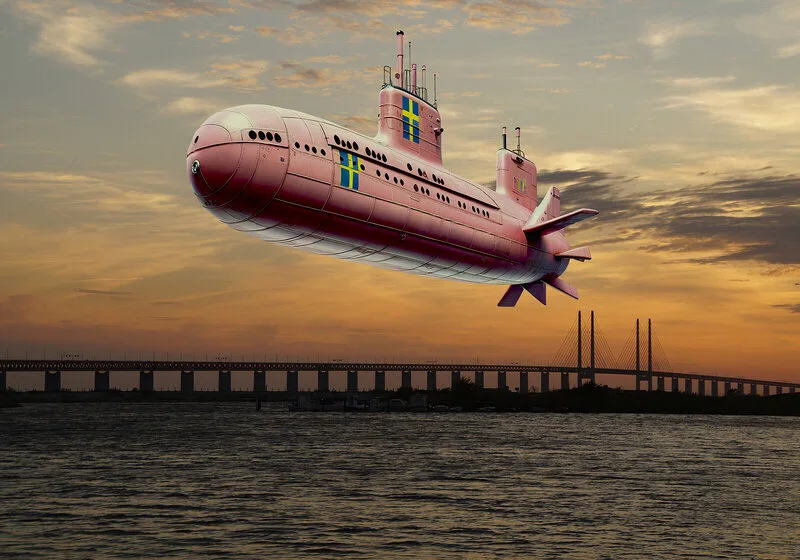
Pink Submarine – Sunset on the sea, 2022
Digital
70 x 50 cm
3 200 kr
A Whimsical Odyssey Beyond the Stars
I'm flying over a town of pink
Where the skies are oh so neat
There's a man who's scared of rain
In his pink submarine, so sweet
And we glide up past the clouds
To a world of cotton candy dreams
Where we dance upon the stars
In our pink submarine, it seems
We all fly in a pink submarine
Pink submarine, pink submarine
We all fly in a pink submarine
Pink submarine, pink submarine
In Malmö, where I was born, a man named Pär lived. He was not an ordinary man; his imagination soared beyond the confines of the everyday. Inspired by Jules Verne's "20,000 Leagues Under the Sea," Pär embarked on a remarkable journey to craft his seafaring vessel, but with a whimsical twist—it would be a pink submarine. This fantastical creation, lovingly named the Pink Nautilus, was not just any submarine; it was a marvel of engineering and creativity.
The pink city Malmö exists only twice daily, at dawn and dusk, provided the weather is fair and the clouds parted as if defending Pär's ambitions. When the weather gods smiled upon him, Pär would open the gates to his colossal garage, and the Nautilus would gracefully glide into the world. Its ballast tanks were filled alternately with helium and a super-lightweight substance known as 'Light Thoughts.' Pär abhorred rain and his submarine was not particularly fond of moisture either; its hull was woven from spun sugar. Yet, once above the clouds, eternal sunshine prevailed as long as the Nautilus maintained the same speed as the Earth rotated on its axis.
Pär's fascination with Jules Verne's tale led him to dream of a vessel that could explore the blue above. The blue surrounding Malmö was out of the question. Pär harboured a lifelong fear of water since nearly drowning in a puddle as a small child. However, with the wealth accumulated from selling spun sugar at markets across Sweden and Europe, Pär could finally realise his dreams. He sold his business and patented technology to the Sugar Company for billions, paving the way for his extraordinary venture.
The Pink Nautilus, modelled after Verne's Nautilus, boasted all the amenities of a luxurious submarine, from airlocks to panoramic windows. But it was not just any submarine; it was meticulously crafted from spun sugar that rivalled the strength of carbon fibre. It was a marvel of modern engineering, with one notable exception—it couldn't withstand water. Nonetheless, Pär found solace in occasional trips to the moon, an endeavour made possible by his innovative propulsion system fueled by 'Light Thoughts,' materialising out of nothingness as quickly as it was consumed.
The interior of the Pink Nautilus was a testament to Pär's impeccable taste and flair for the dramatic. Each room was adorned with opulent furnishings reminiscent of a bygone era of luxury and elegance. From the exquisite captain's quarters to the cosy lounge area, every corner of the submarine exuded charm and sophistication.
But the true marvel of the Pink Nautilus lay in its ability to transcend the confines of the Earth and soar through the skies. Pär and his intrepid crew donned frogman suits equipped with oxygen tanks on their backs, allowing them to embark on daring excursions and explore the far reaches of the cosmos. Their adventures, filled with the thrill of the unknown, took them to the furthest reaches of the galaxy, where they encountered strange new worlds and myriad exotic creatures.
Among Pär's many quests was a mission to sabotage satellites armed with dangerous weapons. With cunning viruses and stealthy manoeuvres, he ensured these satellites would be rendered harmless when deployed. It was a task that required both skill and ingenuity, but Pär was more than up to the challenge.
As the Pink Nautilus sailed through the cosmos, it carried with it the hopes and aspirations of its crew and passengers alike. It was a shining beacon of ingenuity and imagination in a universe brimming with possibility. Though its journey may have begun in the town where Pär was born, its destination was nothing short of the stars.
The Pink Nautilus, much like its inspiration in Jules Verne's masterpiece, is a testament to engineering brilliance and ingenuity. Commanded by the visionary Pär, it is a vessel of unparalleled design and functionality, earning it the epithet of "a masterpiece containing masterpieces." The interior is inspired by palaces such as Drottningholm and Versailles.
Like Captain Nemo's Nautilus, the Pink Nautilus is double-hulled and divided into hermetically tight compartments, ensuring its durability and safety in the vast expanses of the cosmos. Its primary power source is a solar engine run by the super-light medium 'Light Thoughts.' With a top speed a million times faster than thought, the Pink Nautilus is a marvel of speed and manoeuvrability. Its dimensions, meticulously crafted by Pär, allow optimal performance and efficiency, ensuring smooth navigation through the celestial emptiness.
Despite its technological prowess, the Pink Nautilus is more than just a vessel of exploration; it is a home to its crew, who gather food from the stars and enjoy the comforts of luxury unparalleled in seafaring vessels. A lavish galley prepares gourmet meals from celestial bounty while a distillation machine converts the smallest oxygen atom into drinking water. Additionally, all water is recycled, minimising the need for replenishment. The ship's library, boasting over twelve thousand books and cosy rooms filled with priceless works of art, offers a sanctuary of knowledge and culture amidst the vastness of space. Among its many amenities, the Pink Nautilus features a lavish dining room, an organ for evening entertainment, and even duplicates of bridge instruments in Captain Pär's quarters, allowing him to monitor the vessel's operations efficiently. These luxuries, however, are not just for show but are reserved for Pär, his esteemed guests, and companions, ensuring their comfort and well-being on their cosmic adventures.
Much like Captain Nemo's Nautilus, the Pink Nautilus symbolises exploration, innovation, and the boundless possibilities of the human imagination. As it sails through the cosmos, it carries with it the legacy of its creator and the spirit of adventure that drives its crew ever onward into the unknown.
Now that we've become acquainted with Pär's Pink Nautilus, perhaps someone is curious about how submarines came to be.
The history of submarines is a captivating tale of human ingenuity and the relentless pursuit of exploration beneath the waves. From Leonardo da Vinci's early sketches to Cornelius Drebbel's pioneering endeavours, the evolution of underwater vessels has been marked by innovation, perseverance, and a thirst for discovery.
Leonardo da Vinci, the quintessential Renaissance polymath, envisioned a world beneath the waves long before submarines became a reality. In his sketches dating back to 1515, da Vinci explored the mechanics of fish swimming and pondered ways for humans to navigate underwater. Among his many designs was a concept for a primitive submarine, a vessel that could plunge into the depths and remain submerged for extended periods. However, da Vinci kept the details of his invention secret, wary of its potential for use as a weapon of war.
Despite the secrecy surrounding da Vinci's designs, his insights laid the groundwork for future developments in submarine technology. His meticulous observations of water movements and pioneering use of images as scientific documentation foreshadowed the interdisciplinary approach that would define submarine engineering in the centuries to come.
This collection of images, which he used as references for his designs, would not be matched until the advent of photography and the film camera. His 'image bank' was a precursor to these technologies, demonstrating his innovative approach to documenting and understanding the natural world. Equally impressive is the dictionary of verbs and nouns that he compiled to match the communicative power of images with words, a testament to his multidisciplinary approach to his work.
Cornelius Drebbel, a Dutch inventor and artisan, fearlessly brought da Vinci's vision to life in the early 17th century. In 1620, Drebbel courageously tested the world's first navigable submarine in the Thames River. Constructed of wood and sealed with greased leather, Drebbel's vessel was propelled by oars and operated 12 to 15 feet beneath the surface. Despite its rudimentary design, Drebbel's submarine demonstrated the feasibility of human-controlled underwater travel, marking a significant milestone in the history of marine exploration.
Drebbel's submarine, though primitive by modern standards, captured the imagination of contemporaries and sparked a wave of interest in underwater technology. Its success paved the way for further advancements in submarine design and construction, laying the foundation for future innovations.
Over the centuries, submarines have evolved from superficial wooden vessels to sophisticated machines capable of exploring the ocean's deepest reaches. For instance, the steam-powered submarines of the 19th century, such as the USS Holland, revolutionised underwater travel with their ability to operate for extended periods. In the modern era, we have nuclear-powered behemoths like the USS Ohio, which can stay submerged for months and carry a payload of ballistic missiles. Each iteration has pushed the boundaries of underwater exploration and expanded our understanding of the ocean's mysteries.
Submarines, the unsung heroes of scientific research, military operations, and commercial endeavours, enable scientists to study marine life, map the ocean floor, and investigate underwater phenomena with unprecedented precision. They serve as strategic assets for navies worldwide, providing a silent and stealthy means of surveillance and defence. They facilitate the exploration and exploitation of underwater resources, from oil and gas reserves to rare minerals and metals, opening up a world of endless possibilities for marine discovery.
In an age of space exploration and interstellar travel, submarines remain a testament to humanity's enduring fascination with the unknown. They are the silent sentinels of the deep, venturing into realms where light cannot penetrate and life exists in forms beyond imagination. As our understanding of the oceans continues to deepen, so will our appreciation for the remarkable machines that allow us to explore them. Looking ahead, the future of submarines is promising. We are seeing advancements in areas such as autonomous underwater vehicles and biomimetic designs, which mimic nature to enhance performance. These innovations will further revolutionise underwater exploration and our relationship with the oceans.
In the ancient mythology of many cultures, the ocean's depths were believed to be inhabited by a myriad of fantastical creatures and deities. Among them was Poseidon, the Greek god of the sea, often depicted riding his majestic chariot pulled by a team of powerful sea horses. These magnificent creatures, known as hippocampi, were said to embody the ocean's untamed beauty and raw power.
According to legend, Poseidon ruled over the seas and all its inhabitants, commanding respect and fear from mortals and immortals alike. His domain was vast and mysterious, teeming with mythical creatures and beings beyond human comprehension. From the fearsome Kraken to the graceful mermaids, the ocean's depths were said to be home to animals of every shape and size.
One of the earliest depictions of these underwater wonders can be found in the Carta Marina, a map created by the Swedish historian Olaus Magnus in the 16th century. This elaborate map offers a glimpse into the rich tapestry of marine life that fascinated and terrified sailors of the time. From sea serpents to giant lobsters, the Carta Marina is a testament to the imagination and curiosity of early cartographers and explorers.
But beyond mythology and folklore, the ocean remains a realm of wonder and mystery, with countless species yet to be discovered and understood. From the depths of the Marianas Trench to the sun-drenched coral reefs, the ocean continues to captivate and inspire us with its beauty and complexity.
As we venture into the 21st century, our understanding of the ocean and its inhabitants continues to deepen, thanks to advances in technology and exploration. Yet, even as we unlock the secrets of the deep, the ocean remains a place of endless fascination and wonder, reminding us of the boundless mysteries that still await discovery beneath the waves.
3 200 kr

Jörgen Thornberg
Malmö
Lite om bilder och mig. Translation in English at the end.
Jag är en nyfiken person som ser allt i bilder, även det jag fäster i ord, gärna tillsammans för bakom alla mina bilder finns en berättelse. Till vissa bilder hör en kortare eller längre novell som följer med bilden.
Bilder berättar historier. Jag omges av naturlig skönhet, intressanta människor och historia var jag än går. Jag använder min kamera för att dokumentera världen och blanda det jag ser med vad jag känner för att fånga den dolda magin.
Mina bilder berättar mina historier. Genom mina bilder, tryck och berättelser. Jag bjuder in dig att ta del av dessa berättelser, in i ditt liv och hem och dela min mycket personliga syn på vår värld. Mer än vad ögat ser. Jag tänker i bilder, drömmer och skriver och pratar om dem; följaktligen måste jag också skapa bilder. De blir vad jag ser, inte nödvändigtvis begränsade till verkligheten. Det finns en bild runt varje hörn. Jag hoppas att du kommer att se vad jag såg och gilla det.
Jag är också en skrivande person och till många bilder hör en kortare eller längre essay. Den följer med tavlan, tryckt på fint papper och med en personlig hälsning från mig.
Flertalet bilder startar sin resa i min kamera. Enkelt förklarat beskriver jag bilden jag ser i mitt inre, upplevd eller fantiserad. Bilden uppstår inom mig redan innan jag fått okularet till ögat. På bråkdelen av ett ögonblick ser jag vad jag vill ha och vad som kan göras med bilden. Här skall jag stoppa in en giraff, stålmannen, Titanic eller vad det är min fantasi finner ut. Ännu märkligare är att jag kommer ihåg minnesbilden långt efteråt när det blir tid att skapa verket. Om jag lyckas eller inte, är upp till betraktaren, oftast präglat av en stråk av svart humor – meningen är att man skall bli underhållen. Mina bilder blir ofta en snackis där de hänger.
Jag föredrar bilder som förmedlar ett budskap i flera lager. Vid första anblicken fylld av feel-good, en vacker utsikt, fint väder, solen skiner, blommor på ängen eller vattnet som ligger förrädiskt spegelblankt. I en sådan bild kan jag gömma min egentliga berättelse, mitt förakt för förtryckare och våldsverkare, rasister och fördomsfulla människor - ett gärna återkommande motiv mer eller mindre dolt i det vackra motivet. Jag försöker förena dem i ett gemensamt narrativ.
Bild och formgivning har löpt som en röd tråd genom livet. Fotokonst känns som en värdig final som jag gärna delar med mig.
Min genre är vid som framgår av mina bilder, temat en blandning av pop- och gatukonst i kollage som kan bestå av hundratals lager. Vissa bilder kan ta veckor, andra någon dag innan det är dags att överlämna resultatet till printverkstaden. Fine Art Prints är digitala fotocollage. I dessa kollage sker rivandet, klippandet, pusslandet, målandet, ritandet och sprayningen digitalt. Det jag monterar in kan vara hundratals år gamla bilder som jag omsorgsfullt frilägger så att de ser ut att vara en del av tavlan men också bilder skapade av mig själv efter min egen fantasi. Därefter besöks printstudion och för vissa bilder numrera en limiterad upplaga (oftast 7 exemplar) och signera för hand. Vissa bilder kan köpas i olika format. Det är bara att fråga efter vilka. Gillar man en bild som är 70x100 men inte har plats på väggen, går den kanske att få i 50x70 cm istället. Frågan är fri.
Metoden Giclée eller Fine Art Print som det också kallas är det moderna sättet för framställning av grafisk konst. Villkoret för denna typ av utskrifter är att en högkvalitativ storformatskrivare används med åldersbeständigt färgpigment och konstnärspapper eller i förekommande fall på duk. Pappret som används möter de krav på livslängd som ställs av museer och gallerier. Normalt säljer jag mina bilder oinramade så att den nya ägaren själv kan bestämma hur de skall se ut, med eller utan passepartout färg på ram, med eller utan glas etc..
Under många år ställde jag bara ut på nätet, i valda grupper och på min egen Facebooksida - https://www.facebook.com/jorgen.thornberg.9
Jag finns också på en egen hemsida som tyvärr inte alltid är uppdaterad – https://www.jth.life/ Där kan du också läsa en del av de berättelser som följer med bilden.
UTSTÄLLNINGAR
Luftkastellet, oktober 2022
Konst i Lund, november 2022
Luftkastellet, mars 2023
Engleson Galleri Caroli, april 2023
Hydra, Greece June 2023
Engleson Galleri Caroli, oktober 2023
Toppen, Höllviken december 2023
Luftkastellet, mars 2024
Torups Galleri, mars 2024
Venice, May 2024
Luftkastellet, oktober 2024
Konst i Advent, December 2024
Galleri Engleson, Caroli December 2024
Jäger & Jansson Galleri, april 2025
A bit about pictures and me.
I'm a curious person who sees everything in pictures, even what I express in words, often combining them, for behind all my pictures lies a story. These narratives, some as short as a single image and others as long as a novel, are the heart and soul of my work.
Pictures tell stories. Wherever I go, I'm surrounded by natural beauty, exciting people, and history. I use my camera to document the world and blend what I see with what I feel to capture the hidden magic.
My images tell my stories. Through my pictures, prints, and narratives, I invite you to partake in these stories in your life and home and share my deeply personal perspective of our world. More than meets the eye. I think in pictures, dream, write, and talk about them; consequently, I must create images too. They become what I see, not necessarily confined to reality. There's a picture around every corner. I hope you'll see what I saw and enjoy it.
I'm also a writer, and many images come with a shorter or longer essay. It accompanies the painting, printed on fine paper with my personal greeting.
Many pictures start their journey on my camera. Simply put, I describe the image I see in my mind, experienced or imagined. The image arises within me even before I bring the eyepiece to my eye. In a fraction of a moment, I see what I want and what can be done with the picture. Here, I'll insert a giraffe, Superman, the Titanic, or whatever my imagination conjures up. Even stranger is that I remember the mental image long after it's time to create the work. Whether I succeed is up to the observer, often imbued with a streak of black humour – the aim is to entertain. My pictures usually become a talking point wherever they hang.
I prefer pictures that convey a message in multiple layers. At first glance, they're filled with feel-good vibes, a beautiful view, lovely weather, the sun shining, flowers in the meadow, or the water lying deceptively calm. But beneath this surface beauty, I often conceal a deeper story, a narrative that challenges societal norms or explores the human condition. I invite you to delve into these hidden narratives and discover the layers of meaning within my work.
Picture and design have been a thread running through my life. Photographic art feels like a fitting finale, and I'm happy to share it.
My genre is varied, as seen in my pictures; the theme is a blend of pop and street art in collages that can consist of hundreds of layers. Some images can take weeks, others just a day before it's time to hand over the result to the print workshop. Fine Art Prints are digital photo collages. In these collages, tearing, cutting, puzzling, painting, drawing, and spraying happen digitally. What I insert can be images hundreds of years old that I carefully extract so they appear to be part of the painting, but also images created by myself, now also generated from my imagination. Next, visit the print studio and, for certain images, number a limited edition (usually 7 copies) and sign them by hand. Some images may be available in other formats. Just ask which ones. If you like an image that's 70x100 but doesn't have space on the wall, you might be able to get it in 50x70 cm instead. The question is open.
The Giclée method, or Fine Art Print as it's also called, is the modern way of producing graphic art. This method ensures the highest quality and longevity of the artwork, using a high-quality large-format printer with archival pigment inks and artist paper or, in some cases, canvas. The paper used meets the longevity requirements set by museums and galleries. I sell my pictures unframed, allowing the new owner to personalise their artwork, confident in the lasting value and quality of the piece.
For many years, I only exhibited online, in selected groups, and on my Facebook page - https://www.facebook.com/jorgen.thornberg.9. I also have my website, which unfortunately is not constantly updated - https://www.jth.life/. You can also read some of the stories accompanying the pictures there.
EXHIBITIONS
Luftkastellet, October 2022
Art in Lund, November 2022
Luftkastellet, March 2023
Engleson Gallery Caroli, April 2023
Hydra, Greece June 2023
Engleson Gallery Caroli, October 2023
Toppen, Höllviken December 2023
Luftkastellet, March 2024
Torup Gallery, March 2024
Venice, May 2024
UTSTÄLLNINGAR
Luftkastellet, oktober 2022
Konst i Lund, november 2022
Luftkastellet, mars 2023
Engleson Galleri Caroli, april 2023
Hydra, Greece June 2023
Engleson Galleri Caroli, oktober 2023
Toppen, Höllviken december 2023
Luftkastellet, mars 2024
Torups Galleri, mars 2024
Venice, May 2024
Luftkastellet, October 2024
Konst i Advent, December 2024
Galleri Engleson, Caroli December 2024
Jäger & Jansson Galleri, April 2025
Utbildning
Autodidakt
Medlem i konstnärsförening
Öppna Sinnen
Med i konstrunda
Konstrundan i Skåne
Utställningar
Luftkastellet, October 2022
Art in Lund, November 2022
Luftkastellet, March 2023
Engleson Gallery Caroli, April 2023
Hydra, Greece June 2023
Engleson Gallery Caroli, October 2023
Toppen, Höllviken December 2023
Luftkastellet, March 2024
Torup Gallery, March 2024
Venice, May 2024