Vi använder cookies för att ge dig bästa möjliga upplevelse. Välj vilka cookies du tillåter.
Läs mer i vår integritetspolicy
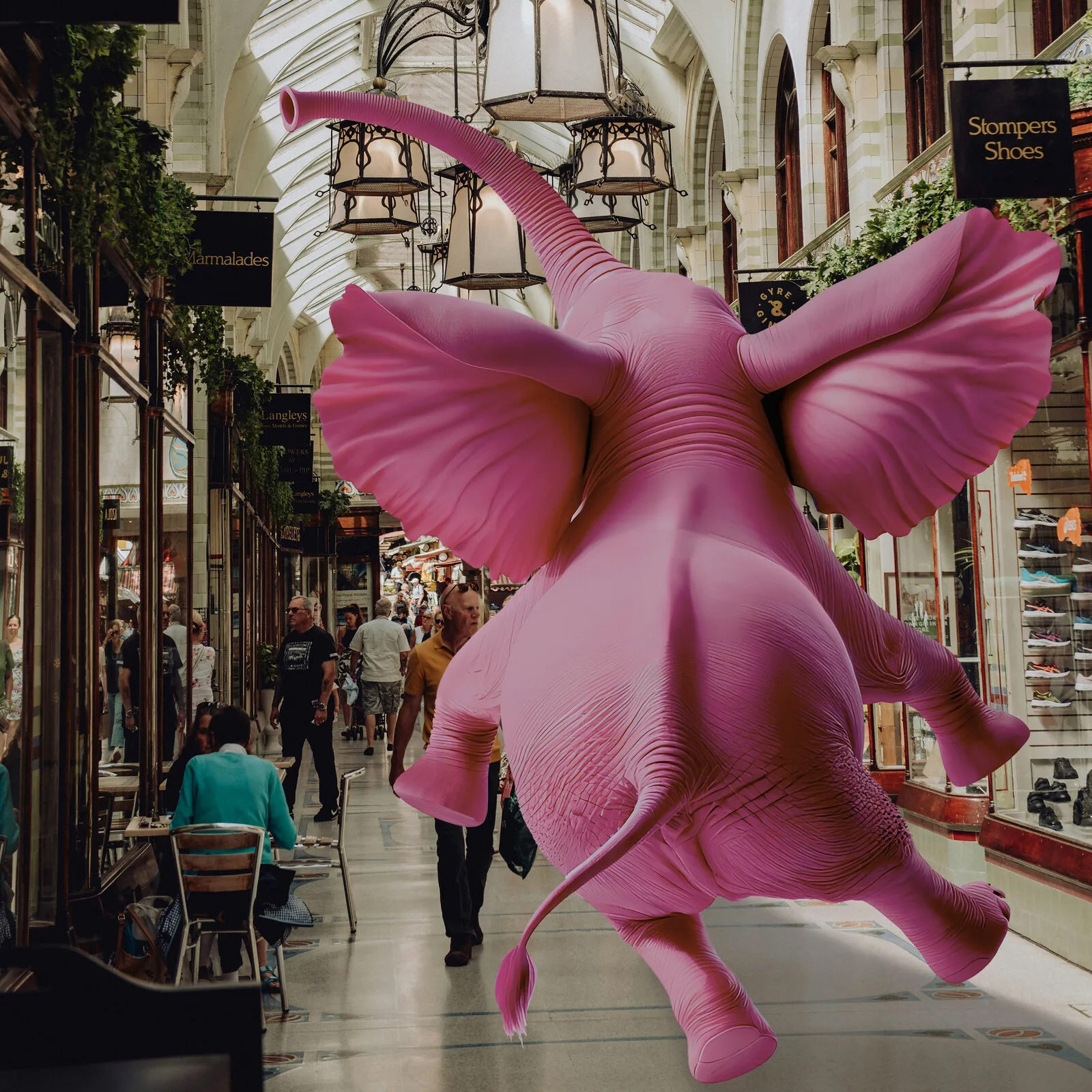
Jörgen Thornberg
Happy Elephant in a Royal Arcade, 2022
Digital
70 x 70 cm
3 500 kr
Daisy, the lively pink elephant, was delighted when she discovered two of her favourites lying next door in the Royal Arcade in Norwich. Her morning toast favourite, a bitter Seville orange marmalade, was sold side by side with another favourite, the classic toy shop Langleys. There she was welcome, but not in the next shop, the china shop because elephants aren't welcome there.
Daisy's great-grandfather coined the phrase right here at the beginning of the last century. He was a bit drunk and stumbled into the china shop. It wasn't a good idea, and elephants have not been welcome since that day.
The Royal Shopping Arcade was designed by G. J. Skipper in 1899. Ceramic tiles surmount the shops, while the arcade has a glass and timber roof. Covered arcades like this one were the Victorian equivalent of the malls and hypermarkets of today, inspired by the ancient Roman predecessors.
Long before shopping malls dotted every cityscape, Victorian shopping arcades reigned supreme, offering the epitome of retail indulgence. Nestled between Gentleman’s Walk and Castle Street in the heart of Norwich, the Royal Arcade remains a beacon of refined shopping, boasting exquisite architecture and a curated selection of unique boutiques.
Unveiled in 1899, this 247-foot-long covered thoroughfare was the brainchild of Dereham-born architect George Skipper, renowned for his iconic designs across Norwich. One such masterpiece is the St. Giles House Hotel. Embodying the essence of Art Nouveau, the arcade's first-floor walls are adorned with ornate tiles depicting classical motifs—think flowing florals and majestic peacocks—crafted by WJ Neatby, famed for his work at Harrods Food Hall and manufactured by Doulton. Echoing the elegance, the floor tiles and majestic wrought iron and glass lanterns, added during the 1980s restoration, complete the ensemble.
But the site's history is as colourful as its architecture. Once home to ‘The Angel’ inn since at least the 15th century, it was a hub of entertainment, hosting everything from travelling shows to political gatherings. The 1830s saw it as the battleground for a fierce clash between political factions—the Norwich Whigs and the Tories—prompting the mayor to call the military to restore order! Ironically, when the Royal Arcade replaced it, the entrance of White Lion Street became the Conservative Club's gateway.
Evolving, the site transitioned from inn to hotel, eventually making way for the Royal Arcade, which emerged on the stables and yard, preserving the original layout. Initially, it housed 24 bow-fronted shops, a pub, and a clubroom.
Today, the Royal Arcade is a haven for shoppers, boasting diverse shops and cafes. Among the gems is Langleys Toy Shop, a beloved Norwich institution.
Whether you're a local on a shopping spree or a visitor exploring the city, the Royal Arcade beckons with its charm. Wander through its delightful boutiques, and as you do, remember to pause and soak in the splendour of your surroundings—it's an experience worth savouring.
My favourite among the many galleries I've visited is the magnificent Galleria Vittorio Emanuele II in Milan, where the spirit of history meets the vibrant energy of the modern world. With its impressive glass roof and elegant arcades, this iconic gallery invites visitors to a unique experience of culture, food, and architecture.
As you enter the gallery, you are immediately enveloped by its grand architecture. The glass roof stretches high above, allowing radiant natural light to bathe the marbled floor in enchanting brilliance. The elegant arches and decorative details along the walls testify to an ancient European luxury and style era. In the centre of the gallery rises the majestic facade of the cathedral, its presence a reminder of Italy's rich cultural heritage.
The gallery is not just a place for shopping but also a gastronomic destination. Visitors can enjoy a delicious meal at one of the first-class restaurants that adorn its arcades. Here, you can experience authentic Italian food culture in an elegant and historical setting. From fresh pasta and pizza dishes to delicate seafood and delicious desserts, there is something for every taste and appetite.
After a delightful meal, it's time to relax with a refreshing drink at one of the gallery's many cafes or bars. While sipping on your espresso or enjoying a cocktail, you can soak in the atmosphere and observe the lively bustle pulsating through the gallery. Sitting at one of the outdoor terraces facing the cathedral provides a unique sense of intimacy and wonder at the magnificent architecture surrounding you.
Galleria Vittorio Emanuele II is not just a place for shopping and dining but also a symbol of Milan and its rich historical heritage. Its proximity to the cathedral, Duomo di Milano, enhances the site's religious and cultural significance. Admiring the exquisite Gothic facade from the gallery's arcades transports you back to a bygone era of artistic and architectural greatness.
In summary, Galleria Vittorio Emanuele II intersects in history and modernity. Its impressive architecture, gourmet experiences, and proximity to the cathedral offer visitors an unforgettable journey through Milan's cultural and culinary treasures.
After a delightful meal at one of the first-class restaurants in the gallery, such as the renowned Savini restaurant, known for its exquisite cuisine and elegant ambience, visitors can indulge in a sumptuous dining experience. With its rich history dating back to 1867, Savini has been a culinary institution in Milan for generations. Every bite celebrates Italian gastronomy at its finest, from succulent steak dishes to decadent desserts.
A leisurely stroll to Biffi Caffè is a must for a post-dinner coffee following dinner. Founded in 1867 by Paolo Biffi, pastry chef to the monarch, Biffi Caffè is steeped in tradition and charm. As you step into the cafe, the aroma of freshly brewed coffee fills the air, enticing patrons to linger and savour the moment. The interior exudes old-world charm, with ornate decor and plush furnishings reminiscent of a bygone era. Whether you prefer a classic espresso or a frothy cappuccino, each sip is a testament to the artistry and craftsmanship that have defined Biffi Caffè for over a century.
Trajan's Markets in Rome is an ancient counterpart to today's Royal Arcade and other malls. Once a bustling hub of ancient commerce and communal life, these markets are a testament to the vibrant tapestry of daily existence in the heart of the Roman Empire. Nestled against the slopes of Quirinal Hill, these markets were not just places of trade but vibrant social spaces where the pulse of Roman life thrived.
The ancient Galleria, a small Hemicycle, also structured across three tiers, extends into a semicircular space, now inaccessible, situated behind the Northern Hall. Here, remnants of the original black mosaic floor are still visible.
Similar to the ground level, the second floor of the Small Hemicycle adopts a semicircular layout and boasts expansive windows. The corridor continues straight ahead on the northern side, accommodating a staircase and additional side chambers. Beyond these chambers lies the building's opening onto Via Biberatica road.
As the sun rose over the Eternal City in 110 AD, the labyrinthine alleys and arcades of Trajan's Markets stirred to life. Here, merchants and traders from all corners of the empire converged, their wares spilling out onto stone counters and wooden stalls, enticing passersby with an array of goods and commodities.
But it wasn't just goods that drew people to Trajan's Markets but also the promise of food, drink, and entertainment. Taverns and eateries lined the streets, opening doors to welcome weary travellers and hungry shoppers. Inside, patrons would gather around rough-hewn tables, swapping stories and sharing a meal of bread, olives, cheese, and wine. Meanwhile, outside the bustling squares and courtyards, performers and entertainers would ply their trade, delighting the crowds with acrobatics, music, and theatre.
Imagine the scene: the aroma of freshly baked bread wafting through the air, mingling with the rich scent of spices from the East. Bustling crowds meandered through the maze of stalls, their voices rising in a cacophony of languages and dialects. Trajan's Markets offered a cornucopia of goods to suit every taste and budget, from exotic silks and precious jewels to everyday essentials like pottery and household goods.
In many ways, Trajan's Markets were the beating heart of ancient Rome, a microcosm of the empire itself. Here, the rich rubbed shoulders with the poor, the powerful with the powerless, in a vibrant tapestry of humanity.
Fast-forward to the present day, Trajan's Markets still stands as a testament to the enduring legacy of ancient Rome. While the hustle and bustle of ancient commerce may have faded, the markets continue to draw visitors worldwide eager to glimpse the past.
Today, the markets have been transformed into a museum complex, where visitors can explore the ruins of the ancient shops and stalls, marvel at the intricate architecture, and immerse themselves in the rich history of Rome. And yet, despite the passage of centuries, there is still a palpable sense of life and energy here, a reminder of the vibrant community that once thrived within these walls.
As I wander through the labyrinthine alleys and arcades of Trajan's Markets, I can't help but marvel at the resilience of the human spirit. In a constantly changing world, these ancient ruins are a testament to the enduring power of community, commerce, and culture. As I reflect on the bustling markets of ancient Rome, I can't help but wonder what stories lie buried beneath the stones, waiting to be discovered by future generations.
The word "galleria" can be traced back to the Italian language and its use in architecture and art. "galleria" originates from the Italian word "gallerie," which refers to an arcade or a raised walkway open on one side and surrounded by arches or columns.
In architectural terms, a galleria typically refers to a covered passage or walkway with shops, stores, or residences along the sides. These structures primarily emerged during the Italian Renaissance and have since been an integral part of urban environments in cities worldwide.
Galleries have served as commercial spaces and social and cultural hubs where people gather, socialise, and shop. This combination of function and aesthetics has made galleries iconic destinations that attract visitors from near and far.
With this historical background in mind, we can understand how the Galleria Vittorio Emanuele II in Milan, The Royal Arcade in Norwich and other similar structures have embodied this concept by offering an elegant and inviting environment where shopping, dining, and architecture come together for a unique experience.
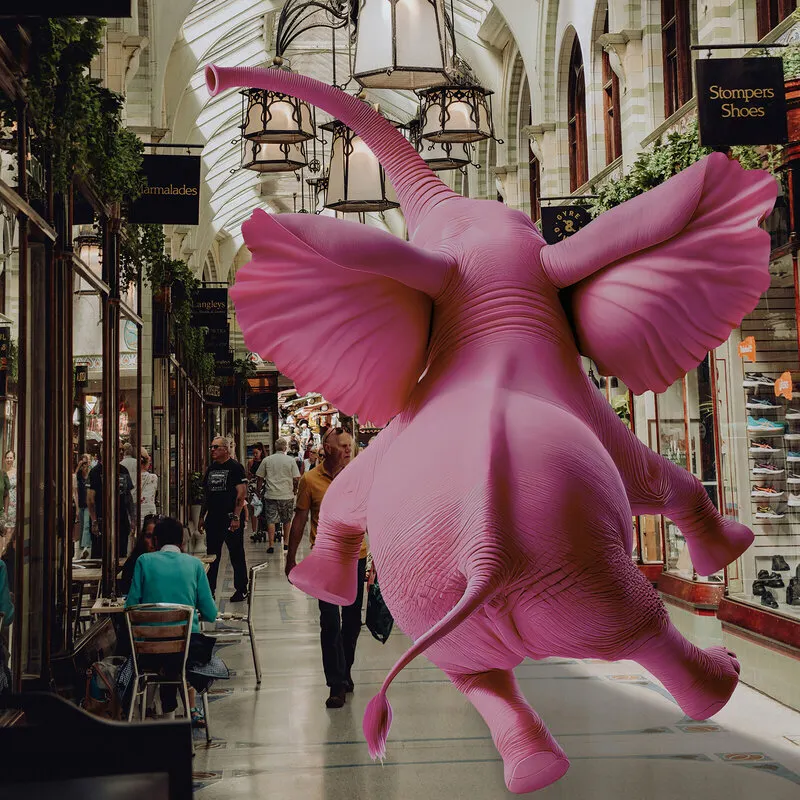
Jörgen Thornberg
Happy Elephant in a Royal Arcade, 2022
Digital
70 x 70 cm
3 500 kr
Daisy, the lively pink elephant, was delighted when she discovered two of her favourites lying next door in the Royal Arcade in Norwich. Her morning toast favourite, a bitter Seville orange marmalade, was sold side by side with another favourite, the classic toy shop Langleys. There she was welcome, but not in the next shop, the china shop because elephants aren't welcome there.
Daisy's great-grandfather coined the phrase right here at the beginning of the last century. He was a bit drunk and stumbled into the china shop. It wasn't a good idea, and elephants have not been welcome since that day.
The Royal Shopping Arcade was designed by G. J. Skipper in 1899. Ceramic tiles surmount the shops, while the arcade has a glass and timber roof. Covered arcades like this one were the Victorian equivalent of the malls and hypermarkets of today, inspired by the ancient Roman predecessors.
Long before shopping malls dotted every cityscape, Victorian shopping arcades reigned supreme, offering the epitome of retail indulgence. Nestled between Gentleman’s Walk and Castle Street in the heart of Norwich, the Royal Arcade remains a beacon of refined shopping, boasting exquisite architecture and a curated selection of unique boutiques.
Unveiled in 1899, this 247-foot-long covered thoroughfare was the brainchild of Dereham-born architect George Skipper, renowned for his iconic designs across Norwich. One such masterpiece is the St. Giles House Hotel. Embodying the essence of Art Nouveau, the arcade's first-floor walls are adorned with ornate tiles depicting classical motifs—think flowing florals and majestic peacocks—crafted by WJ Neatby, famed for his work at Harrods Food Hall and manufactured by Doulton. Echoing the elegance, the floor tiles and majestic wrought iron and glass lanterns, added during the 1980s restoration, complete the ensemble.
But the site's history is as colourful as its architecture. Once home to ‘The Angel’ inn since at least the 15th century, it was a hub of entertainment, hosting everything from travelling shows to political gatherings. The 1830s saw it as the battleground for a fierce clash between political factions—the Norwich Whigs and the Tories—prompting the mayor to call the military to restore order! Ironically, when the Royal Arcade replaced it, the entrance of White Lion Street became the Conservative Club's gateway.
Evolving, the site transitioned from inn to hotel, eventually making way for the Royal Arcade, which emerged on the stables and yard, preserving the original layout. Initially, it housed 24 bow-fronted shops, a pub, and a clubroom.
Today, the Royal Arcade is a haven for shoppers, boasting diverse shops and cafes. Among the gems is Langleys Toy Shop, a beloved Norwich institution.
Whether you're a local on a shopping spree or a visitor exploring the city, the Royal Arcade beckons with its charm. Wander through its delightful boutiques, and as you do, remember to pause and soak in the splendour of your surroundings—it's an experience worth savouring.
My favourite among the many galleries I've visited is the magnificent Galleria Vittorio Emanuele II in Milan, where the spirit of history meets the vibrant energy of the modern world. With its impressive glass roof and elegant arcades, this iconic gallery invites visitors to a unique experience of culture, food, and architecture.
As you enter the gallery, you are immediately enveloped by its grand architecture. The glass roof stretches high above, allowing radiant natural light to bathe the marbled floor in enchanting brilliance. The elegant arches and decorative details along the walls testify to an ancient European luxury and style era. In the centre of the gallery rises the majestic facade of the cathedral, its presence a reminder of Italy's rich cultural heritage.
The gallery is not just a place for shopping but also a gastronomic destination. Visitors can enjoy a delicious meal at one of the first-class restaurants that adorn its arcades. Here, you can experience authentic Italian food culture in an elegant and historical setting. From fresh pasta and pizza dishes to delicate seafood and delicious desserts, there is something for every taste and appetite.
After a delightful meal, it's time to relax with a refreshing drink at one of the gallery's many cafes or bars. While sipping on your espresso or enjoying a cocktail, you can soak in the atmosphere and observe the lively bustle pulsating through the gallery. Sitting at one of the outdoor terraces facing the cathedral provides a unique sense of intimacy and wonder at the magnificent architecture surrounding you.
Galleria Vittorio Emanuele II is not just a place for shopping and dining but also a symbol of Milan and its rich historical heritage. Its proximity to the cathedral, Duomo di Milano, enhances the site's religious and cultural significance. Admiring the exquisite Gothic facade from the gallery's arcades transports you back to a bygone era of artistic and architectural greatness.
In summary, Galleria Vittorio Emanuele II intersects in history and modernity. Its impressive architecture, gourmet experiences, and proximity to the cathedral offer visitors an unforgettable journey through Milan's cultural and culinary treasures.
After a delightful meal at one of the first-class restaurants in the gallery, such as the renowned Savini restaurant, known for its exquisite cuisine and elegant ambience, visitors can indulge in a sumptuous dining experience. With its rich history dating back to 1867, Savini has been a culinary institution in Milan for generations. Every bite celebrates Italian gastronomy at its finest, from succulent steak dishes to decadent desserts.
A leisurely stroll to Biffi Caffè is a must for a post-dinner coffee following dinner. Founded in 1867 by Paolo Biffi, pastry chef to the monarch, Biffi Caffè is steeped in tradition and charm. As you step into the cafe, the aroma of freshly brewed coffee fills the air, enticing patrons to linger and savour the moment. The interior exudes old-world charm, with ornate decor and plush furnishings reminiscent of a bygone era. Whether you prefer a classic espresso or a frothy cappuccino, each sip is a testament to the artistry and craftsmanship that have defined Biffi Caffè for over a century.
Trajan's Markets in Rome is an ancient counterpart to today's Royal Arcade and other malls. Once a bustling hub of ancient commerce and communal life, these markets are a testament to the vibrant tapestry of daily existence in the heart of the Roman Empire. Nestled against the slopes of Quirinal Hill, these markets were not just places of trade but vibrant social spaces where the pulse of Roman life thrived.
The ancient Galleria, a small Hemicycle, also structured across three tiers, extends into a semicircular space, now inaccessible, situated behind the Northern Hall. Here, remnants of the original black mosaic floor are still visible.
Similar to the ground level, the second floor of the Small Hemicycle adopts a semicircular layout and boasts expansive windows. The corridor continues straight ahead on the northern side, accommodating a staircase and additional side chambers. Beyond these chambers lies the building's opening onto Via Biberatica road.
As the sun rose over the Eternal City in 110 AD, the labyrinthine alleys and arcades of Trajan's Markets stirred to life. Here, merchants and traders from all corners of the empire converged, their wares spilling out onto stone counters and wooden stalls, enticing passersby with an array of goods and commodities.
But it wasn't just goods that drew people to Trajan's Markets but also the promise of food, drink, and entertainment. Taverns and eateries lined the streets, opening doors to welcome weary travellers and hungry shoppers. Inside, patrons would gather around rough-hewn tables, swapping stories and sharing a meal of bread, olives, cheese, and wine. Meanwhile, outside the bustling squares and courtyards, performers and entertainers would ply their trade, delighting the crowds with acrobatics, music, and theatre.
Imagine the scene: the aroma of freshly baked bread wafting through the air, mingling with the rich scent of spices from the East. Bustling crowds meandered through the maze of stalls, their voices rising in a cacophony of languages and dialects. Trajan's Markets offered a cornucopia of goods to suit every taste and budget, from exotic silks and precious jewels to everyday essentials like pottery and household goods.
In many ways, Trajan's Markets were the beating heart of ancient Rome, a microcosm of the empire itself. Here, the rich rubbed shoulders with the poor, the powerful with the powerless, in a vibrant tapestry of humanity.
Fast-forward to the present day, Trajan's Markets still stands as a testament to the enduring legacy of ancient Rome. While the hustle and bustle of ancient commerce may have faded, the markets continue to draw visitors worldwide eager to glimpse the past.
Today, the markets have been transformed into a museum complex, where visitors can explore the ruins of the ancient shops and stalls, marvel at the intricate architecture, and immerse themselves in the rich history of Rome. And yet, despite the passage of centuries, there is still a palpable sense of life and energy here, a reminder of the vibrant community that once thrived within these walls.
As I wander through the labyrinthine alleys and arcades of Trajan's Markets, I can't help but marvel at the resilience of the human spirit. In a constantly changing world, these ancient ruins are a testament to the enduring power of community, commerce, and culture. As I reflect on the bustling markets of ancient Rome, I can't help but wonder what stories lie buried beneath the stones, waiting to be discovered by future generations.
The word "galleria" can be traced back to the Italian language and its use in architecture and art. "galleria" originates from the Italian word "gallerie," which refers to an arcade or a raised walkway open on one side and surrounded by arches or columns.
In architectural terms, a galleria typically refers to a covered passage or walkway with shops, stores, or residences along the sides. These structures primarily emerged during the Italian Renaissance and have since been an integral part of urban environments in cities worldwide.
Galleries have served as commercial spaces and social and cultural hubs where people gather, socialise, and shop. This combination of function and aesthetics has made galleries iconic destinations that attract visitors from near and far.
With this historical background in mind, we can understand how the Galleria Vittorio Emanuele II in Milan, The Royal Arcade in Norwich and other similar structures have embodied this concept by offering an elegant and inviting environment where shopping, dining, and architecture come together for a unique experience.
3 500 kr

Jörgen Thornberg
Malmö
Lite om bilder och mig. Translation in English at the end.
Jag är en nyfiken person som ser allt i bilder, även det jag fäster i ord, gärna tillsammans för bakom alla mina bilder finns en berättelse. Till vissa bilder hör en kortare eller längre novell som följer med bilden.
Bilder berättar historier. Jag omges av naturlig skönhet, intressanta människor och historia var jag än går. Jag använder min kamera för att dokumentera världen och blanda det jag ser med vad jag känner för att fånga den dolda magin.
Mina bilder berättar mina historier. Genom mina bilder, tryck och berättelser. Jag bjuder in dig att ta del av dessa berättelser, in i ditt liv och hem och dela min mycket personliga syn på vår värld. Mer än vad ögat ser. Jag tänker i bilder, drömmer och skriver och pratar om dem; följaktligen måste jag också skapa bilder. De blir vad jag ser, inte nödvändigtvis begränsade till verkligheten. Det finns en bild runt varje hörn. Jag hoppas att du kommer att se vad jag såg och gilla det.
Jag är också en skrivande person och till många bilder hör en kortare eller längre essay. Den följer med tavlan, tryckt på fint papper och med en personlig hälsning från mig.
Flertalet bilder startar sin resa i min kamera. Enkelt förklarat beskriver jag bilden jag ser i mitt inre, upplevd eller fantiserad. Bilden uppstår inom mig redan innan jag fått okularet till ögat. På bråkdelen av ett ögonblick ser jag vad jag vill ha och vad som kan göras med bilden. Här skall jag stoppa in en giraff, stålmannen, Titanic eller vad det är min fantasi finner ut. Ännu märkligare är att jag kommer ihåg minnesbilden långt efteråt när det blir tid att skapa verket. Om jag lyckas eller inte, är upp till betraktaren, oftast präglat av en stråk av svart humor – meningen är att man skall bli underhållen. Mina bilder blir ofta en snackis där de hänger.
Jag föredrar bilder som förmedlar ett budskap i flera lager. Vid första anblicken fylld av feel-good, en vacker utsikt, fint väder, solen skiner, blommor på ängen eller vattnet som ligger förrädiskt spegelblankt. I en sådan bild kan jag gömma min egentliga berättelse, mitt förakt för förtryckare och våldsverkare, rasister och fördomsfulla människor - ett gärna återkommande motiv mer eller mindre dolt i det vackra motivet. Jag försöker förena dem i ett gemensamt narrativ.
Bild och formgivning har löpt som en röd tråd genom livet. Fotokonst känns som en värdig final som jag gärna delar med mig.
Min genre är vid som framgår av mina bilder, temat en blandning av pop- och gatukonst i kollage som kan bestå av hundratals lager. Vissa bilder kan ta veckor, andra någon dag innan det är dags att överlämna resultatet till printverkstaden. Fine Art Prints är digitala fotocollage. I dessa kollage sker rivandet, klippandet, pusslandet, målandet, ritandet och sprayningen digitalt. Det jag monterar in kan vara hundratals år gamla bilder som jag omsorgsfullt frilägger så att de ser ut att vara en del av tavlan men också bilder skapade av mig själv efter min egen fantasi. Därefter besöks printstudion och för vissa bilder numrera en limiterad upplaga (oftast 7 exemplar) och signera för hand. Vissa bilder kan köpas i olika format. Det är bara att fråga efter vilka. Gillar man en bild som är 70x100 men inte har plats på väggen, går den kanske att få i 50x70 cm istället. Frågan är fri.
Metoden Giclée eller Fine Art Print som det också kallas är det moderna sättet för framställning av grafisk konst. Villkoret för denna typ av utskrifter är att en högkvalitativ storformatskrivare används med åldersbeständigt färgpigment och konstnärspapper eller i förekommande fall på duk. Pappret som används möter de krav på livslängd som ställs av museer och gallerier. Normalt säljer jag mina bilder oinramade så att den nya ägaren själv kan bestämma hur de skall se ut, med eller utan passepartout färg på ram, med eller utan glas etc..
Under många år ställde jag bara ut på nätet, i valda grupper och på min egen Facebooksida - https://www.facebook.com/jorgen.thornberg.9
Jag finns också på en egen hemsida som tyvärr inte alltid är uppdaterad – https://www.jth.life/ Där kan du också läsa en del av de berättelser som följer med bilden.
UTSTÄLLNINGAR
Luftkastellet, oktober 2022
Konst i Lund, november 2022
Luftkastellet, mars 2023
Engleson Galleri Caroli, april 2023
Hydra, Greece June 2023
Engleson Galleri Caroli, oktober 2023
Toppen, Höllviken december 2023
Luftkastellet, mars 2024
Torups Galleri, mars 2024
Venice, May 2024
Luftkastellet, oktober 2024
Konst i Advent, December 2024
Galleri Engleson, Caroli December 2024
Jäger & Jansson Galleri, april 2025
A bit about pictures and me.
I'm a curious person who sees everything in pictures, even what I express in words, often combining them, for behind all my pictures lies a story. These narratives, some as short as a single image and others as long as a novel, are the heart and soul of my work.
Pictures tell stories. Wherever I go, I'm surrounded by natural beauty, exciting people, and history. I use my camera to document the world and blend what I see with what I feel to capture the hidden magic.
My images tell my stories. Through my pictures, prints, and narratives, I invite you to partake in these stories in your life and home and share my deeply personal perspective of our world. More than meets the eye. I think in pictures, dream, write, and talk about them; consequently, I must create images too. They become what I see, not necessarily confined to reality. There's a picture around every corner. I hope you'll see what I saw and enjoy it.
I'm also a writer, and many images come with a shorter or longer essay. It accompanies the painting, printed on fine paper with my personal greeting.
Many pictures start their journey on my camera. Simply put, I describe the image I see in my mind, experienced or imagined. The image arises within me even before I bring the eyepiece to my eye. In a fraction of a moment, I see what I want and what can be done with the picture. Here, I'll insert a giraffe, Superman, the Titanic, or whatever my imagination conjures up. Even stranger is that I remember the mental image long after it's time to create the work. Whether I succeed is up to the observer, often imbued with a streak of black humour – the aim is to entertain. My pictures usually become a talking point wherever they hang.
I prefer pictures that convey a message in multiple layers. At first glance, they're filled with feel-good vibes, a beautiful view, lovely weather, the sun shining, flowers in the meadow, or the water lying deceptively calm. But beneath this surface beauty, I often conceal a deeper story, a narrative that challenges societal norms or explores the human condition. I invite you to delve into these hidden narratives and discover the layers of meaning within my work.
Picture and design have been a thread running through my life. Photographic art feels like a fitting finale, and I'm happy to share it.
My genre is varied, as seen in my pictures; the theme is a blend of pop and street art in collages that can consist of hundreds of layers. Some images can take weeks, others just a day before it's time to hand over the result to the print workshop. Fine Art Prints are digital photo collages. In these collages, tearing, cutting, puzzling, painting, drawing, and spraying happen digitally. What I insert can be images hundreds of years old that I carefully extract so they appear to be part of the painting, but also images created by myself, now also generated from my imagination. Next, visit the print studio and, for certain images, number a limited edition (usually 7 copies) and sign them by hand. Some images may be available in other formats. Just ask which ones. If you like an image that's 70x100 but doesn't have space on the wall, you might be able to get it in 50x70 cm instead. The question is open.
The Giclée method, or Fine Art Print as it's also called, is the modern way of producing graphic art. This method ensures the highest quality and longevity of the artwork, using a high-quality large-format printer with archival pigment inks and artist paper or, in some cases, canvas. The paper used meets the longevity requirements set by museums and galleries. I sell my pictures unframed, allowing the new owner to personalise their artwork, confident in the lasting value and quality of the piece.
For many years, I only exhibited online, in selected groups, and on my Facebook page - https://www.facebook.com/jorgen.thornberg.9. I also have my website, which unfortunately is not constantly updated - https://www.jth.life/. You can also read some of the stories accompanying the pictures there.
EXHIBITIONS
Luftkastellet, October 2022
Art in Lund, November 2022
Luftkastellet, March 2023
Engleson Gallery Caroli, April 2023
Hydra, Greece June 2023
Engleson Gallery Caroli, October 2023
Toppen, Höllviken December 2023
Luftkastellet, March 2024
Torup Gallery, March 2024
Venice, May 2024
UTSTÄLLNINGAR
Luftkastellet, oktober 2022
Konst i Lund, november 2022
Luftkastellet, mars 2023
Engleson Galleri Caroli, april 2023
Hydra, Greece June 2023
Engleson Galleri Caroli, oktober 2023
Toppen, Höllviken december 2023
Luftkastellet, mars 2024
Torups Galleri, mars 2024
Venice, May 2024
Luftkastellet, October 2024
Konst i Advent, December 2024
Galleri Engleson, Caroli December 2024
Jäger & Jansson Galleri, April 2025
Utbildning
Autodidakt
Medlem i konstnärsförening
Öppna Sinnen
Med i konstrunda
Konstrundan i Skåne
Utställningar
Luftkastellet, October 2022
Art in Lund, November 2022
Luftkastellet, March 2023
Engleson Gallery Caroli, April 2023
Hydra, Greece June 2023
Engleson Gallery Caroli, October 2023
Toppen, Höllviken December 2023
Luftkastellet, March 2024
Torup Gallery, March 2024
Venice, May 2024