Vi använder cookies för att ge dig bästa möjliga upplevelse. Välj vilka cookies du tillåter.
Läs mer i vår integritetspolicy
Jörgen Thornberg
With age, 2022
Digital
70 x 70 cm
3 500 kr
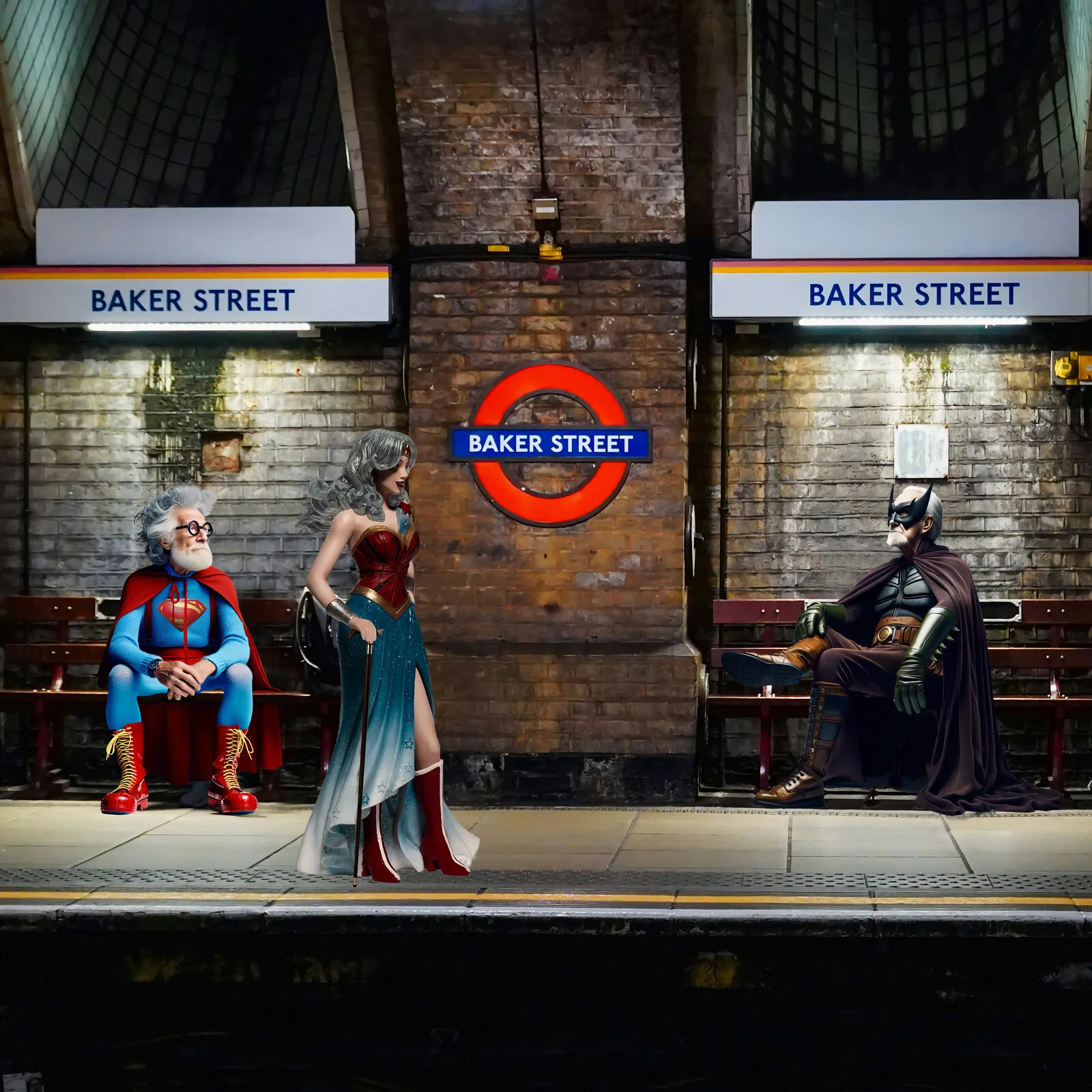
Our superheroes are ageing and becoming increasingly passé. No one buys their comics anymore, and no royalties are paid out. The meagre pension from Gotham City only covers the rent and essentials. The days are long, but Baker Street station is a sanctuary.
Diana Prince, Wonder Woman, was in her heyday a superheroine, super-just, super-strong, super-sassy, super-beautiful, and super-sexy. She still wears a red bustier that accentuates her bust. The blue mini-skirt with flaps that sexily fluttered around her thighs and buttocks as Wonder flew through the air to rescue people in distress has been replaced by a more modestly cut skirt with a deep slit that shows her thighs still maintain their shape. She has traded her once-long tight-fitting red boots for a pair equally red but made of suede, which is softer and gentler on her old feet. Her golden belt with the emblem sits nicely over her hips, swaying as she strides along the platform. Her once luxuriant black hair still cascades but is now silver-grey and is held in place by the golden headband. She is still a handsome woman, although she no longer possesses many of her superpowers.
She needed strength to combat a new enemy, Russia's new tsar, Vlad Putin, who annexed her childhood island in the Black Sea. Diana, the daughter of Queen Hippolyta, was raised on the hidden island of Themyscira, home to the Amazons, women warriors created by the Olympian gods to protect humanity. What good does that do in times when the ancient Greek gods are scattered among the stars? Diana limps lightly with her worn-out hips and leans on a cane of black ebony. At home on Baker Street, she uses a walker, but her vanity prevents her from using it in public.
But some things have improved for Diana in her old age. Wonder Woman's archenemy, the former archaeologist and treasure hunter Barbara Ann Minerva, is dead and buried. Circe and Ares remain neutralised among her archenemies because no one believes in the old gods anymore, and neither does Diana need to.
She shares an apartment with her former comrades Charlie and Bru. Charlie is Kal-El, or Superman as we know him, and Bru is the formerly wealthy Bruce Wayne, Batman. They live a few blocks from Baker Street station at a well-known address. Baker Street 221B is a street familiar to many in the Marylebone district of the City of Westminster in London. It is a sublease she has taken over from the retired private detective Sherlock Holmes. Now, she lives with her old comrades in the room where Holmes's friend Watson once lodged.
Superman, or Clark Joseph Kent as he is registered, is a shadow of his former self. Tousled grey hair and equally grey bushy beard. He still has his cape; it is indestructible. He no longer fits into his old tights; medium has become XL, especially around the stomach. There isn't a sewing machine in the world that can handle the material from Krypton. Instead, he wears a tight-fitting blue outfit he begged from the ballet at Covent Garden. He looks like an old ficus. Practical, bright red rubber boots have replaced the previous red boots with lacing on the front. The advantage of rubber is that they don't need polishing. Charlie once wore glasses with window glass in the frames for disguise. Now, he wears large glasses with high strength after burning his eyes with all the rays he used to annihilate his enemies. Swine flu recurs, as his optician has said.
Bru sits on the other side of the station sign and has nothing left of his old attire. What he wears vaguely resembles his former Batman suit. Today's attire is something he put together from container finds. He is a laughable shadow of his former self and doesn't even scare the neighbour's cat at Baker Street Station, a shelter for the trio, so the expensive coal doesn't bankrupt them. They spend their days recounting their old adventures together as The World's Greatest Super Heroes, the Justice League, and the Earth's premiere team of champions. Many of their now-extinct readers wondered which of the boys Wonder Woman preferred. Between the comic book panels, one could sense sex. Because, of course, even superheroes need to have sex. Wonder Woman was always leaning more towards Batman rather than Superman. But in fierce threesomes, they could shake the ground in Gotham in their heyday. Now, there was little of that. It required someone to lift on and off. Since neither Charlie nor Bru could lift the other, the sex had to wait until they could afford to get one of those lifts they have in hospitals.
Now and then, old super friends show up, ranging from Aquaman, Spiderman, and Catwoman to She-Hulk. Once a week, she goes window shopping with her old friend, Donna Troy.
Wonder Woman's origin story recounts that she was crafted from clay by her mother, Queen Hippolyta, and endowed with life as an Amazon, along with superhuman abilities bestowed upon her as gifts by the Greek gods. In 2011, DC Comics altered her backstory by revealing her as the biological daughter of Zeus and Hippolyta, raised jointly by her mother and her aunts Antiope and Menalippe. The character has undergone various depictions throughout the decades, including a brief period in the late 1960s when she temporarily lost her powers. By the 1980s, artist George Perez revamped her appearance, giving her a more athletic physique and accentuating her Amazonian lineage. Wonder Woman possesses an array of magical artefacts, including the Lasso of Truth, indestructible bracelets, a tiara capable of being used as a projectile, and, in earlier tales, a selection of devices rooted in Amazonian technology.
Wonder Woman is a heroine for the Ages. In the pantheon of superheroes, one figure shines like a beacon of justice, clad in her iconic red, blue, and gold attire, with a lasso that could give even Indiana Jones a run for his money. Yes, I’m talking about none other than Wonder Woman – the epitome of strength, grace, and the occasional battle cry that could make even Zeus pause.
Firstly, let’s address the invisible jet in the room – Wonder Woman’s accessories. Sure, Batman has his Batmobile, but Wonder Woman? She has an invisible plane. I know what you’re thinking: "How does she find it in the parking lot?" It’s a valid concern that has baffled scholars and comic book enthusiasts for decades. Perhaps she has a perfect memory or whistles and hopes for the best. Either way, it’s a testament to her unparalleled ability to navigate the skies with style.
And let’s not forget her trusty Lasso of Truth – the ultimate tool for escaping awkward social situations. Imagine being at a party, and someone asks, "Do these pants make me look fat?" Before you can respond, Wonder Woman swoops in with her lasso and saves the day. "Yes, they do," she smiles as the truth magically compels the asker to accept their fate.
But beyond her accessories, Wonder Woman embodies the spirit of empowerment like no other. She’s not just a symbol of strength; she’s a beacon of hope for little girls and boys everywhere. Her determination and unwavering compassion remind us that true heroism knows no gender.
Of course, no discussion of Wonder Woman would be complete without mentioning her arch-nemesis, Cheetah. I don’t want to say that Wonder Woman has a thing for feline-themed foes, but it makes you wonder if she has a secret catnip stash hidden somewhere in the Batcave.
In conclusion, Wonder Woman isn’t just a superhero; she’s an icon. She embodies truth, justice, and the Amazonian way. So the next time you need a hero, remember: anything is possible with a bit of courage and a lot of lasso.
In the ever-evolving world of superheroes and supervillains, one femme fatale has crept her way into the hearts of fans and the depths of London’s underworld: the retired Wonderwoman. With her still sleek moves, sharp wit, and even sharper nails, she's a striking blend of sass and sophistication. But behind her grey hair and those mesmerising green eyes lies a question that's been the subject of much debate among comic book fans: Is Wonderwoman a feminist icon, or does she have a complicated relationship with feminism?
So, is she a feminist? That's a question that's as elusive as the ageing superwoman herself. But one thing's for sure: whether you see her as a symbol of female empowerment or a cautionary tale of femme fatale allure, there's no denying that Wonder Woman is one extraordinary girl who's always got people talking. And in a world where everyone's looking for their slice of empowerment, maybe that's the most perfect role she could ever play. However, still, men at the tube station turn their heads.
And then her Not-So-Super Superman, an ageing hero.
In the illustrious halls of superhero lore, a figure is draped in blue and red, with a cape billowing behind him like a flag of hope in the wind. Yes, I’m talking about none other than Superman – the Man of Steel, the Last Son of Krypton, and the guy who can’t seem to catch a break.
Once the pinnacle of heroism, Superman navigates the murky waters of retirement homes and senior discounts. Gone are the days of leaping tall buildings in a single bound; now, it’s more like hobbling over small curbs with a cane in hand.
Let’s talk about his outfit, shall we? The iconic red cape? It's more like a red shawl these days, draped over his shoulders as he shuffles down the street. And those tights? Let’s say they’re a bit more snug than they used to be. Superman may still be faster than a speeding bullet, but he’s not as agile as before.
And then there’s his super hearing – once a blessing, now a curse. Imagine hearing every creak of your ageing bones, every groan of your tired muscles. It's enough to drive even the strongest superhero a little batty.
But despite the aches and pains, Superman still finds ways to save the day. Whether helping little old ladies cross the street or rescuing kittens from trees, he’s always there when people need him most. Sure, he may not be able to fly at supersonic speeds anymore, but he can still lend a hand (albeit a slightly shaky one).
Of course, there are some perks to being a retired superhero. For one, Superman finally has time to pursue his hobbies. He’s taken up knitting (those capes don’t mend themselves) and has even joined a book club. Who knew the Man of Steel had a soft spot for romance novels?
And let’s not forget about his social life. Superman may be past his prime, but he still knows how to have a good time. Whether it’s bingo night at the retirement home or a game of shuffleboard down at the park, he’s always the life of the party.
So here’s to Superman – the hero we may not deserve, but the one we certainly need in our golden years. Even though he may not be as super as once, he’s still pretty darn super in Wonder Woman’s book.
The Dark Knight's Twilight is still a man close to Wonder Woman’s heart. In the shadowy alleys of London City, a figure is cloaked in darkness, a symbol of fear and justice intertwined. Yes, I’m talking about none other than Batman – the Caped Crusader, the World's Greatest Detective, and the guy who refuses to let old age slow him down.
Once the epitome of brooding heroism, Batman faces a new foe: Father Time. Gone are the days of effortlessly swinging from rooftop to rooftop; now, it’s more like carefully navigating the stairs with aching knees and a bad back.
Let’s talk about his iconic outfit, shall we? The sleek black suit? These days, it's more like a slightly faded costume with a few extra wrinkles here and there. And that utility belt? Let’s say it's a bit snugger than it used to be. Batman may still be as stealthy as ever, but he’s not as elegant as he once was.
And then there’s his bat signal – once a beacon of hope in the night, now a reminder of his waning glory. Imagine being summoned to action, only to realise that your joints aren’t quite as cooperative as they used to be. It's enough to make even the most stoic vigilante shed a tear.
But despite the wear and tear, Batman still finds ways to protect his city. Whether mentoring the next generation of crimefighters or solving cold cases from the comfort of his Batcave, he’s always there when Gotham needs him most. Sure, he may not be able to go toe-to-toe with every villain anymore, but he can still outsmart them with his keen intellect (and maybe a little help from Alfred).
Of course, there are some perks to being a retired superhero. For one, Batman finally has time to indulge in his other passions. He’s taken up gardening (those bat caves don’t tend to themselves) and has even started a weekly poker night with Commissioner Gordon. Who knew the Dark Knight had a knack for bluffing?
And let’s not forget about his social life. Batman may prefer the shadows, but he still knows how to let loose occasionally. Whether hosting a fancy dinner party at Wayne Manor or hitting the local karaoke bar for a rendition of "Bat Out of Hell," he’s always the talk of the town.
So here’s to Batman – the hero we may not understand, but the one we certainly respect in our twilight years. Because even though he may not be as invincible as he once was, he’s still a force to be reckoned with in our hearts and minds.
This was an Ode to Aging Vigilantes. Then, let’s look at the Evolution of Superheroes from this super trio to Modern Icons.
Superheroes have become integral to popular culture, captivating audiences worldwide with their extraordinary abilities and unwavering commitment to justice. While Superman is often credited as the archetype of the modern superhero, the concept of super-powered beings fighting for the greater good has much deeper roots in human imagination and mythology.
The idea of beings with exceptional abilities has existed for centuries, rooted in ancient mythologies and folklore. From Hercules in Greek mythology to Hanuman in Hindu mythology, stories of individuals endowed with superhuman strength or abilities have permeated human culture. These mythological figures were symbols of strength, courage, and the triumph of good over evil, laying the groundwork for the modern superhero archetype.
However, it was not until the 20th century that the superhero concept truly flourished in popular culture. The debut of Superman in Action Comics #1 in 1938 marked a revolutionary moment in the history of comic books and popular fiction. Created by Jerry Siegel and Joe Shuster, Superman was portrayed as an alien from the planet Krypton with incredible powers granted by Earth's yellow sun. His alter ego, Clark Kent, was a mild-mannered reporter, offering a relatable contrast to his superhuman persona.
Superman's arrival heralded the dawn of the Golden Age of Comic Books, inspiring a wave of imitators and establishing the superhero genre as a cultural phenomenon. Characters like Batman, Wonder Woman, and Captain America soon followed, embodying different facets of heroism and virtue.
The universal desire for justice and redemption is at the heart of the superhero narrative. Superheroes represent the idealised versions of ourselves, possessing the power to confront and overcome the challenges that plague society. They stand as beacons of hope in a world fraught with adversity, inspiring ordinary individuals to aspire to greatness and make a difference in their communities.
The superhero genre has evolved and diversified over the decades, reflecting the changing social and cultural landscape. While early superheroes often adhered to traditional moral codes and simplistic narratives, modern iterations have embraced complexity and moral ambiguity. Characters like Spider-Man, the X-Men, and the Watchmen explore themes of identity, responsibility, and the consequences of power, adding depth and nuance to the genre.
The enduring popularity of superheroes can be attributed to their ability to resonate with audiences deeply emotionally. Whether battling supervillains or confronting personal demons, superheroes embody the timeless struggle between good and evil, light and darkness. They remind us of the inherent potential for heroism within each of us and the importance of standing up for what is right, even in the face of overwhelming odds.
In conclusion, the phenomenon of superheroes has its roots in ancient mythology but found its true expression in the 20th century with the emergence of iconic characters like Superman. As symbols of hope, courage, and resilience, superheroes continue to captivate audiences and inspire generations with their enduring tales of heroism and selflessness. In a world filled with uncertainty and chaos, they serve as reminders of the power of the human spirit to overcome adversity and strive for a better tomorrow.
This list represents only a fraction of popular culture's vast array of superheroes. Countless other characters, both mainstream and obscure, continue to capture the imaginations of fans around the world. A complete list is a monumental task due to the vast number of characters across various comic book publishers, movies, television shows, and other media. However, here is a selection of some well-known superheroes from different publishers and universes: Superman (DC Comics) / Batman (DC Comics) / Wonder Woman (DC Comics) / Spider-Man (Marvel Comics) / Iron Man (Marvel Comics) / Captain America (Marvel Comics) / Thor (Marvel Comics) / Hulk (Marvel Comics) / Wolverine (Marvel Comics) / The Flash (DC Comics) / Green Lantern (DC Comics) / Aquaman (DC Comics) / Black Widow (Marvel Comics) / Black Panther (Marvel Comics) / Doctor Strange (Marvel Comics) / Green Arrow (DC Comics) / Supergirl (DC Comics) / The Punisher (Marvel Comics) / Deadpool (Marvel Comics) / Ant-Man (Marvel Comics) / Captain Marvel (Marvel Comics) / Hawkman (DC Comics) / Hawkwoman (DC Comics) / Martian Manhunter (DC Comics) / Shazam (DC Comics) / Daredevil (Marvel Comics) / Jessica Jones (Marvel Comics) / Luke Cage (Marvel Comics) / Iron Fist (Marvel Comics) / Storm (Marvel Comics) / Jean Grey (Marvel Comics) / Cyclops (Marvel Comics) / Rogue (Marvel Comics) / Nightwing (DC Comics) / Batgirl (DC Comics) / Robin (DC Comics) / Catwoman (DC Comics) / The Thing (Marvel Comics) / Invisible Woman (Marvel Comics) / Mr. Fantastic (Marvel Comics) / Human Torch (Marvel Comics) / Silver Surfer (Marvel Comics) / Doctor Fate (DC Comics) / Zatanna (DC Comics) / Swamp Thing (DC Comics) / Hellboy (Dark Horse Comics) / Spawn (Image Comics) / The Tick (New England Comics) / She-Hulk (Marvel Comics) / Red Sonja (Dynamite Entertainment)
Jörgen Thornberg
With age, 2022
Digital
70 x 70 cm
3 500 kr
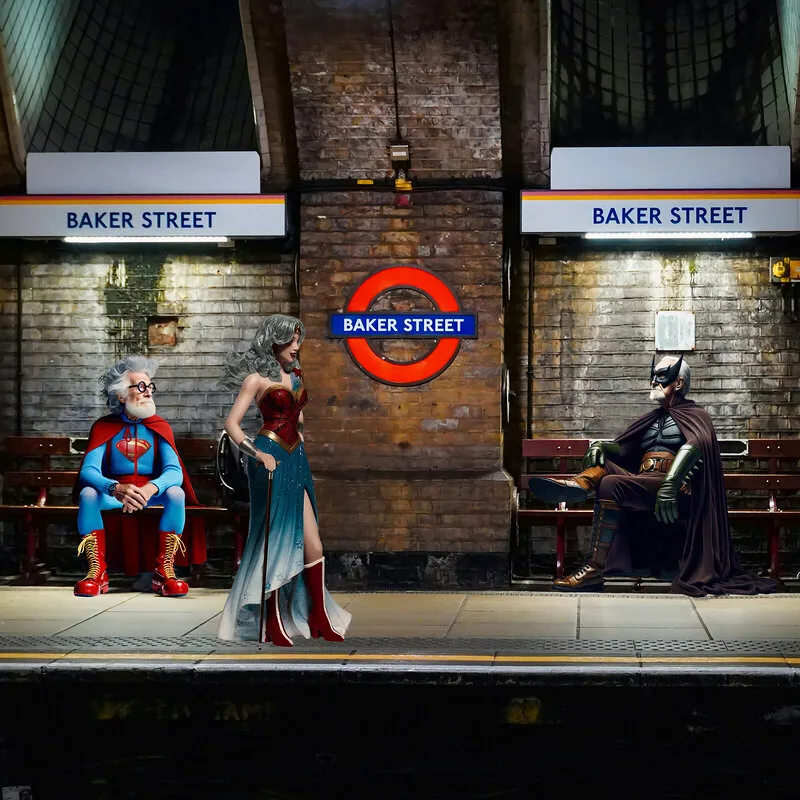
Our superheroes are ageing and becoming increasingly passé. No one buys their comics anymore, and no royalties are paid out. The meagre pension from Gotham City only covers the rent and essentials. The days are long, but Baker Street station is a sanctuary.
Diana Prince, Wonder Woman, was in her heyday a superheroine, super-just, super-strong, super-sassy, super-beautiful, and super-sexy. She still wears a red bustier that accentuates her bust. The blue mini-skirt with flaps that sexily fluttered around her thighs and buttocks as Wonder flew through the air to rescue people in distress has been replaced by a more modestly cut skirt with a deep slit that shows her thighs still maintain their shape. She has traded her once-long tight-fitting red boots for a pair equally red but made of suede, which is softer and gentler on her old feet. Her golden belt with the emblem sits nicely over her hips, swaying as she strides along the platform. Her once luxuriant black hair still cascades but is now silver-grey and is held in place by the golden headband. She is still a handsome woman, although she no longer possesses many of her superpowers.
She needed strength to combat a new enemy, Russia's new tsar, Vlad Putin, who annexed her childhood island in the Black Sea. Diana, the daughter of Queen Hippolyta, was raised on the hidden island of Themyscira, home to the Amazons, women warriors created by the Olympian gods to protect humanity. What good does that do in times when the ancient Greek gods are scattered among the stars? Diana limps lightly with her worn-out hips and leans on a cane of black ebony. At home on Baker Street, she uses a walker, but her vanity prevents her from using it in public.
But some things have improved for Diana in her old age. Wonder Woman's archenemy, the former archaeologist and treasure hunter Barbara Ann Minerva, is dead and buried. Circe and Ares remain neutralised among her archenemies because no one believes in the old gods anymore, and neither does Diana need to.
She shares an apartment with her former comrades Charlie and Bru. Charlie is Kal-El, or Superman as we know him, and Bru is the formerly wealthy Bruce Wayne, Batman. They live a few blocks from Baker Street station at a well-known address. Baker Street 221B is a street familiar to many in the Marylebone district of the City of Westminster in London. It is a sublease she has taken over from the retired private detective Sherlock Holmes. Now, she lives with her old comrades in the room where Holmes's friend Watson once lodged.
Superman, or Clark Joseph Kent as he is registered, is a shadow of his former self. Tousled grey hair and equally grey bushy beard. He still has his cape; it is indestructible. He no longer fits into his old tights; medium has become XL, especially around the stomach. There isn't a sewing machine in the world that can handle the material from Krypton. Instead, he wears a tight-fitting blue outfit he begged from the ballet at Covent Garden. He looks like an old ficus. Practical, bright red rubber boots have replaced the previous red boots with lacing on the front. The advantage of rubber is that they don't need polishing. Charlie once wore glasses with window glass in the frames for disguise. Now, he wears large glasses with high strength after burning his eyes with all the rays he used to annihilate his enemies. Swine flu recurs, as his optician has said.
Bru sits on the other side of the station sign and has nothing left of his old attire. What he wears vaguely resembles his former Batman suit. Today's attire is something he put together from container finds. He is a laughable shadow of his former self and doesn't even scare the neighbour's cat at Baker Street Station, a shelter for the trio, so the expensive coal doesn't bankrupt them. They spend their days recounting their old adventures together as The World's Greatest Super Heroes, the Justice League, and the Earth's premiere team of champions. Many of their now-extinct readers wondered which of the boys Wonder Woman preferred. Between the comic book panels, one could sense sex. Because, of course, even superheroes need to have sex. Wonder Woman was always leaning more towards Batman rather than Superman. But in fierce threesomes, they could shake the ground in Gotham in their heyday. Now, there was little of that. It required someone to lift on and off. Since neither Charlie nor Bru could lift the other, the sex had to wait until they could afford to get one of those lifts they have in hospitals.
Now and then, old super friends show up, ranging from Aquaman, Spiderman, and Catwoman to She-Hulk. Once a week, she goes window shopping with her old friend, Donna Troy.
Wonder Woman's origin story recounts that she was crafted from clay by her mother, Queen Hippolyta, and endowed with life as an Amazon, along with superhuman abilities bestowed upon her as gifts by the Greek gods. In 2011, DC Comics altered her backstory by revealing her as the biological daughter of Zeus and Hippolyta, raised jointly by her mother and her aunts Antiope and Menalippe. The character has undergone various depictions throughout the decades, including a brief period in the late 1960s when she temporarily lost her powers. By the 1980s, artist George Perez revamped her appearance, giving her a more athletic physique and accentuating her Amazonian lineage. Wonder Woman possesses an array of magical artefacts, including the Lasso of Truth, indestructible bracelets, a tiara capable of being used as a projectile, and, in earlier tales, a selection of devices rooted in Amazonian technology.
Wonder Woman is a heroine for the Ages. In the pantheon of superheroes, one figure shines like a beacon of justice, clad in her iconic red, blue, and gold attire, with a lasso that could give even Indiana Jones a run for his money. Yes, I’m talking about none other than Wonder Woman – the epitome of strength, grace, and the occasional battle cry that could make even Zeus pause.
Firstly, let’s address the invisible jet in the room – Wonder Woman’s accessories. Sure, Batman has his Batmobile, but Wonder Woman? She has an invisible plane. I know what you’re thinking: "How does she find it in the parking lot?" It’s a valid concern that has baffled scholars and comic book enthusiasts for decades. Perhaps she has a perfect memory or whistles and hopes for the best. Either way, it’s a testament to her unparalleled ability to navigate the skies with style.
And let’s not forget her trusty Lasso of Truth – the ultimate tool for escaping awkward social situations. Imagine being at a party, and someone asks, "Do these pants make me look fat?" Before you can respond, Wonder Woman swoops in with her lasso and saves the day. "Yes, they do," she smiles as the truth magically compels the asker to accept their fate.
But beyond her accessories, Wonder Woman embodies the spirit of empowerment like no other. She’s not just a symbol of strength; she’s a beacon of hope for little girls and boys everywhere. Her determination and unwavering compassion remind us that true heroism knows no gender.
Of course, no discussion of Wonder Woman would be complete without mentioning her arch-nemesis, Cheetah. I don’t want to say that Wonder Woman has a thing for feline-themed foes, but it makes you wonder if she has a secret catnip stash hidden somewhere in the Batcave.
In conclusion, Wonder Woman isn’t just a superhero; she’s an icon. She embodies truth, justice, and the Amazonian way. So the next time you need a hero, remember: anything is possible with a bit of courage and a lot of lasso.
In the ever-evolving world of superheroes and supervillains, one femme fatale has crept her way into the hearts of fans and the depths of London’s underworld: the retired Wonderwoman. With her still sleek moves, sharp wit, and even sharper nails, she's a striking blend of sass and sophistication. But behind her grey hair and those mesmerising green eyes lies a question that's been the subject of much debate among comic book fans: Is Wonderwoman a feminist icon, or does she have a complicated relationship with feminism?
So, is she a feminist? That's a question that's as elusive as the ageing superwoman herself. But one thing's for sure: whether you see her as a symbol of female empowerment or a cautionary tale of femme fatale allure, there's no denying that Wonder Woman is one extraordinary girl who's always got people talking. And in a world where everyone's looking for their slice of empowerment, maybe that's the most perfect role she could ever play. However, still, men at the tube station turn their heads.
And then her Not-So-Super Superman, an ageing hero.
In the illustrious halls of superhero lore, a figure is draped in blue and red, with a cape billowing behind him like a flag of hope in the wind. Yes, I’m talking about none other than Superman – the Man of Steel, the Last Son of Krypton, and the guy who can’t seem to catch a break.
Once the pinnacle of heroism, Superman navigates the murky waters of retirement homes and senior discounts. Gone are the days of leaping tall buildings in a single bound; now, it’s more like hobbling over small curbs with a cane in hand.
Let’s talk about his outfit, shall we? The iconic red cape? It's more like a red shawl these days, draped over his shoulders as he shuffles down the street. And those tights? Let’s say they’re a bit more snug than they used to be. Superman may still be faster than a speeding bullet, but he’s not as agile as before.
And then there’s his super hearing – once a blessing, now a curse. Imagine hearing every creak of your ageing bones, every groan of your tired muscles. It's enough to drive even the strongest superhero a little batty.
But despite the aches and pains, Superman still finds ways to save the day. Whether helping little old ladies cross the street or rescuing kittens from trees, he’s always there when people need him most. Sure, he may not be able to fly at supersonic speeds anymore, but he can still lend a hand (albeit a slightly shaky one).
Of course, there are some perks to being a retired superhero. For one, Superman finally has time to pursue his hobbies. He’s taken up knitting (those capes don’t mend themselves) and has even joined a book club. Who knew the Man of Steel had a soft spot for romance novels?
And let’s not forget about his social life. Superman may be past his prime, but he still knows how to have a good time. Whether it’s bingo night at the retirement home or a game of shuffleboard down at the park, he’s always the life of the party.
So here’s to Superman – the hero we may not deserve, but the one we certainly need in our golden years. Even though he may not be as super as once, he’s still pretty darn super in Wonder Woman’s book.
The Dark Knight's Twilight is still a man close to Wonder Woman’s heart. In the shadowy alleys of London City, a figure is cloaked in darkness, a symbol of fear and justice intertwined. Yes, I’m talking about none other than Batman – the Caped Crusader, the World's Greatest Detective, and the guy who refuses to let old age slow him down.
Once the epitome of brooding heroism, Batman faces a new foe: Father Time. Gone are the days of effortlessly swinging from rooftop to rooftop; now, it’s more like carefully navigating the stairs with aching knees and a bad back.
Let’s talk about his iconic outfit, shall we? The sleek black suit? These days, it's more like a slightly faded costume with a few extra wrinkles here and there. And that utility belt? Let’s say it's a bit snugger than it used to be. Batman may still be as stealthy as ever, but he’s not as elegant as he once was.
And then there’s his bat signal – once a beacon of hope in the night, now a reminder of his waning glory. Imagine being summoned to action, only to realise that your joints aren’t quite as cooperative as they used to be. It's enough to make even the most stoic vigilante shed a tear.
But despite the wear and tear, Batman still finds ways to protect his city. Whether mentoring the next generation of crimefighters or solving cold cases from the comfort of his Batcave, he’s always there when Gotham needs him most. Sure, he may not be able to go toe-to-toe with every villain anymore, but he can still outsmart them with his keen intellect (and maybe a little help from Alfred).
Of course, there are some perks to being a retired superhero. For one, Batman finally has time to indulge in his other passions. He’s taken up gardening (those bat caves don’t tend to themselves) and has even started a weekly poker night with Commissioner Gordon. Who knew the Dark Knight had a knack for bluffing?
And let’s not forget about his social life. Batman may prefer the shadows, but he still knows how to let loose occasionally. Whether hosting a fancy dinner party at Wayne Manor or hitting the local karaoke bar for a rendition of "Bat Out of Hell," he’s always the talk of the town.
So here’s to Batman – the hero we may not understand, but the one we certainly respect in our twilight years. Because even though he may not be as invincible as he once was, he’s still a force to be reckoned with in our hearts and minds.
This was an Ode to Aging Vigilantes. Then, let’s look at the Evolution of Superheroes from this super trio to Modern Icons.
Superheroes have become integral to popular culture, captivating audiences worldwide with their extraordinary abilities and unwavering commitment to justice. While Superman is often credited as the archetype of the modern superhero, the concept of super-powered beings fighting for the greater good has much deeper roots in human imagination and mythology.
The idea of beings with exceptional abilities has existed for centuries, rooted in ancient mythologies and folklore. From Hercules in Greek mythology to Hanuman in Hindu mythology, stories of individuals endowed with superhuman strength or abilities have permeated human culture. These mythological figures were symbols of strength, courage, and the triumph of good over evil, laying the groundwork for the modern superhero archetype.
However, it was not until the 20th century that the superhero concept truly flourished in popular culture. The debut of Superman in Action Comics #1 in 1938 marked a revolutionary moment in the history of comic books and popular fiction. Created by Jerry Siegel and Joe Shuster, Superman was portrayed as an alien from the planet Krypton with incredible powers granted by Earth's yellow sun. His alter ego, Clark Kent, was a mild-mannered reporter, offering a relatable contrast to his superhuman persona.
Superman's arrival heralded the dawn of the Golden Age of Comic Books, inspiring a wave of imitators and establishing the superhero genre as a cultural phenomenon. Characters like Batman, Wonder Woman, and Captain America soon followed, embodying different facets of heroism and virtue.
The universal desire for justice and redemption is at the heart of the superhero narrative. Superheroes represent the idealised versions of ourselves, possessing the power to confront and overcome the challenges that plague society. They stand as beacons of hope in a world fraught with adversity, inspiring ordinary individuals to aspire to greatness and make a difference in their communities.
The superhero genre has evolved and diversified over the decades, reflecting the changing social and cultural landscape. While early superheroes often adhered to traditional moral codes and simplistic narratives, modern iterations have embraced complexity and moral ambiguity. Characters like Spider-Man, the X-Men, and the Watchmen explore themes of identity, responsibility, and the consequences of power, adding depth and nuance to the genre.
The enduring popularity of superheroes can be attributed to their ability to resonate with audiences deeply emotionally. Whether battling supervillains or confronting personal demons, superheroes embody the timeless struggle between good and evil, light and darkness. They remind us of the inherent potential for heroism within each of us and the importance of standing up for what is right, even in the face of overwhelming odds.
In conclusion, the phenomenon of superheroes has its roots in ancient mythology but found its true expression in the 20th century with the emergence of iconic characters like Superman. As symbols of hope, courage, and resilience, superheroes continue to captivate audiences and inspire generations with their enduring tales of heroism and selflessness. In a world filled with uncertainty and chaos, they serve as reminders of the power of the human spirit to overcome adversity and strive for a better tomorrow.
This list represents only a fraction of popular culture's vast array of superheroes. Countless other characters, both mainstream and obscure, continue to capture the imaginations of fans around the world. A complete list is a monumental task due to the vast number of characters across various comic book publishers, movies, television shows, and other media. However, here is a selection of some well-known superheroes from different publishers and universes: Superman (DC Comics) / Batman (DC Comics) / Wonder Woman (DC Comics) / Spider-Man (Marvel Comics) / Iron Man (Marvel Comics) / Captain America (Marvel Comics) / Thor (Marvel Comics) / Hulk (Marvel Comics) / Wolverine (Marvel Comics) / The Flash (DC Comics) / Green Lantern (DC Comics) / Aquaman (DC Comics) / Black Widow (Marvel Comics) / Black Panther (Marvel Comics) / Doctor Strange (Marvel Comics) / Green Arrow (DC Comics) / Supergirl (DC Comics) / The Punisher (Marvel Comics) / Deadpool (Marvel Comics) / Ant-Man (Marvel Comics) / Captain Marvel (Marvel Comics) / Hawkman (DC Comics) / Hawkwoman (DC Comics) / Martian Manhunter (DC Comics) / Shazam (DC Comics) / Daredevil (Marvel Comics) / Jessica Jones (Marvel Comics) / Luke Cage (Marvel Comics) / Iron Fist (Marvel Comics) / Storm (Marvel Comics) / Jean Grey (Marvel Comics) / Cyclops (Marvel Comics) / Rogue (Marvel Comics) / Nightwing (DC Comics) / Batgirl (DC Comics) / Robin (DC Comics) / Catwoman (DC Comics) / The Thing (Marvel Comics) / Invisible Woman (Marvel Comics) / Mr. Fantastic (Marvel Comics) / Human Torch (Marvel Comics) / Silver Surfer (Marvel Comics) / Doctor Fate (DC Comics) / Zatanna (DC Comics) / Swamp Thing (DC Comics) / Hellboy (Dark Horse Comics) / Spawn (Image Comics) / The Tick (New England Comics) / She-Hulk (Marvel Comics) / Red Sonja (Dynamite Entertainment)
3 500 kr

Jörgen Thornberg
Malmö
Lite om bilder och mig. Translation in English at the end.
Jag är en nyfiken person som ser allt i bilder, även det jag fäster i ord, gärna tillsammans för bakom alla mina bilder finns en berättelse. Till vissa bilder hör en kortare eller längre novell som följer med bilden.
Bilder berättar historier. Jag omges av naturlig skönhet, intressanta människor och historia var jag än går. Jag använder min kamera för att dokumentera världen och blanda det jag ser med vad jag känner för att fånga den dolda magin.
Mina bilder berättar mina historier. Genom mina bilder, tryck och berättelser. Jag bjuder in dig att ta del av dessa berättelser, in i ditt liv och hem och dela min mycket personliga syn på vår värld. Mer än vad ögat ser. Jag tänker i bilder, drömmer och skriver och pratar om dem; följaktligen måste jag också skapa bilder. De blir vad jag ser, inte nödvändigtvis begränsade till verkligheten. Det finns en bild runt varje hörn. Jag hoppas att du kommer att se vad jag såg och gilla det.
Jag är också en skrivande person och till många bilder hör en kortare eller längre essay. Den följer med tavlan, tryckt på fint papper och med en personlig hälsning från mig.
Flertalet bilder startar sin resa i min kamera. Enkelt förklarat beskriver jag bilden jag ser i mitt inre, upplevd eller fantiserad. Bilden uppstår inom mig redan innan jag fått okularet till ögat. På bråkdelen av ett ögonblick ser jag vad jag vill ha och vad som kan göras med bilden. Här skall jag stoppa in en giraff, stålmannen, Titanic eller vad det är min fantasi finner ut. Ännu märkligare är att jag kommer ihåg minnesbilden långt efteråt när det blir tid att skapa verket. Om jag lyckas eller inte, är upp till betraktaren, oftast präglat av en stråk av svart humor – meningen är att man skall bli underhållen. Mina bilder blir ofta en snackis där de hänger.
Jag föredrar bilder som förmedlar ett budskap i flera lager. Vid första anblicken fylld av feel-good, en vacker utsikt, fint väder, solen skiner, blommor på ängen eller vattnet som ligger förrädiskt spegelblankt. I en sådan bild kan jag gömma min egentliga berättelse, mitt förakt för förtryckare och våldsverkare, rasister och fördomsfulla människor - ett gärna återkommande motiv mer eller mindre dolt i det vackra motivet. Jag försöker förena dem i ett gemensamt narrativ.
Bild och formgivning har löpt som en röd tråd genom livet. Fotokonst känns som en värdig final som jag gärna delar med mig.
Min genre är vid som framgår av mina bilder, temat en blandning av pop- och gatukonst i kollage som kan bestå av hundratals lager. Vissa bilder kan ta veckor, andra någon dag innan det är dags att överlämna resultatet till printverkstaden. Fine Art Prints är digitala fotocollage. I dessa kollage sker rivandet, klippandet, pusslandet, målandet, ritandet och sprayningen digitalt. Det jag monterar in kan vara hundratals år gamla bilder som jag omsorgsfullt frilägger så att de ser ut att vara en del av tavlan men också bilder skapade av mig själv efter min egen fantasi. Därefter besöks printstudion och för vissa bilder numrera en limiterad upplaga (oftast 7 exemplar) och signera för hand. Vissa bilder kan köpas i olika format. Det är bara att fråga efter vilka. Gillar man en bild som är 70x100 men inte har plats på väggen, går den kanske att få i 50x70 cm istället. Frågan är fri.
Metoden Giclée eller Fine Art Print som det också kallas är det moderna sättet för framställning av grafisk konst. Villkoret för denna typ av utskrifter är att en högkvalitativ storformatskrivare används med åldersbeständigt färgpigment och konstnärspapper eller i förekommande fall på duk. Pappret som används möter de krav på livslängd som ställs av museer och gallerier. Normalt säljer jag mina bilder oinramade så att den nya ägaren själv kan bestämma hur de skall se ut, med eller utan passepartout färg på ram, med eller utan glas etc..
Under många år ställde jag bara ut på nätet, i valda grupper och på min egen Facebooksida - https://www.facebook.com/jorgen.thornberg.9
Jag finns också på en egen hemsida som tyvärr inte alltid är uppdaterad – https://www.jth.life/ Där kan du också läsa en del av de berättelser som följer med bilden.
UTSTÄLLNINGAR
Luftkastellet, oktober 2022
Konst i Lund, november 2022
Luftkastellet, mars 2023
Engleson Galleri Caroli, april 2023
Hydra, Greece June 2023
Engleson Galleri Caroli, oktober 2023
Toppen, Höllviken december 2023
Luftkastellet, mars 2024
Torups Galleri, mars 2024
Venice, May 2024
Luftkastellet, oktober 2024
Konst i Advent, December 2024
Galleri Engleson, Caroli December 2024
Jäger & Jansson Galleri, april 2025
A bit about pictures and me.
I'm a curious person who sees everything in pictures, even what I express in words, often combining them, for behind all my pictures lies a story. These narratives, some as short as a single image and others as long as a novel, are the heart and soul of my work.
Pictures tell stories. Wherever I go, I'm surrounded by natural beauty, exciting people, and history. I use my camera to document the world and blend what I see with what I feel to capture the hidden magic.
My images tell my stories. Through my pictures, prints, and narratives, I invite you to partake in these stories in your life and home and share my deeply personal perspective of our world. More than meets the eye. I think in pictures, dream, write, and talk about them; consequently, I must create images too. They become what I see, not necessarily confined to reality. There's a picture around every corner. I hope you'll see what I saw and enjoy it.
I'm also a writer, and many images come with a shorter or longer essay. It accompanies the painting, printed on fine paper with my personal greeting.
Many pictures start their journey on my camera. Simply put, I describe the image I see in my mind, experienced or imagined. The image arises within me even before I bring the eyepiece to my eye. In a fraction of a moment, I see what I want and what can be done with the picture. Here, I'll insert a giraffe, Superman, the Titanic, or whatever my imagination conjures up. Even stranger is that I remember the mental image long after it's time to create the work. Whether I succeed is up to the observer, often imbued with a streak of black humour – the aim is to entertain. My pictures usually become a talking point wherever they hang.
I prefer pictures that convey a message in multiple layers. At first glance, they're filled with feel-good vibes, a beautiful view, lovely weather, the sun shining, flowers in the meadow, or the water lying deceptively calm. But beneath this surface beauty, I often conceal a deeper story, a narrative that challenges societal norms or explores the human condition. I invite you to delve into these hidden narratives and discover the layers of meaning within my work.
Picture and design have been a thread running through my life. Photographic art feels like a fitting finale, and I'm happy to share it.
My genre is varied, as seen in my pictures; the theme is a blend of pop and street art in collages that can consist of hundreds of layers. Some images can take weeks, others just a day before it's time to hand over the result to the print workshop. Fine Art Prints are digital photo collages. In these collages, tearing, cutting, puzzling, painting, drawing, and spraying happen digitally. What I insert can be images hundreds of years old that I carefully extract so they appear to be part of the painting, but also images created by myself, now also generated from my imagination. Next, visit the print studio and, for certain images, number a limited edition (usually 7 copies) and sign them by hand. Some images may be available in other formats. Just ask which ones. If you like an image that's 70x100 but doesn't have space on the wall, you might be able to get it in 50x70 cm instead. The question is open.
The Giclée method, or Fine Art Print as it's also called, is the modern way of producing graphic art. This method ensures the highest quality and longevity of the artwork, using a high-quality large-format printer with archival pigment inks and artist paper or, in some cases, canvas. The paper used meets the longevity requirements set by museums and galleries. I sell my pictures unframed, allowing the new owner to personalise their artwork, confident in the lasting value and quality of the piece.
For many years, I only exhibited online, in selected groups, and on my Facebook page - https://www.facebook.com/jorgen.thornberg.9. I also have my website, which unfortunately is not constantly updated - https://www.jth.life/. You can also read some of the stories accompanying the pictures there.
EXHIBITIONS
Luftkastellet, October 2022
Art in Lund, November 2022
Luftkastellet, March 2023
Engleson Gallery Caroli, April 2023
Hydra, Greece June 2023
Engleson Gallery Caroli, October 2023
Toppen, Höllviken December 2023
Luftkastellet, March 2024
Torup Gallery, March 2024
Venice, May 2024
UTSTÄLLNINGAR
Luftkastellet, oktober 2022
Konst i Lund, november 2022
Luftkastellet, mars 2023
Engleson Galleri Caroli, april 2023
Hydra, Greece June 2023
Engleson Galleri Caroli, oktober 2023
Toppen, Höllviken december 2023
Luftkastellet, mars 2024
Torups Galleri, mars 2024
Venice, May 2024
Luftkastellet, October 2024
Konst i Advent, December 2024
Galleri Engleson, Caroli December 2024
Jäger & Jansson Galleri, April 2025
Utbildning
Autodidakt
Medlem i konstnärsförening
Öppna Sinnen
Med i konstrunda
Konstrundan i Skåne
Utställningar
Luftkastellet, October 2022
Art in Lund, November 2022
Luftkastellet, March 2023
Engleson Gallery Caroli, April 2023
Hydra, Greece June 2023
Engleson Gallery Caroli, October 2023
Toppen, Höllviken December 2023
Luftkastellet, March 2024
Torup Gallery, March 2024
Venice, May 2024