Vi använder cookies för att ge dig bästa möjliga upplevelse. Välj vilka cookies du tillåter.
Läs mer i vår integritetspolicy
Jörgen Thornberg
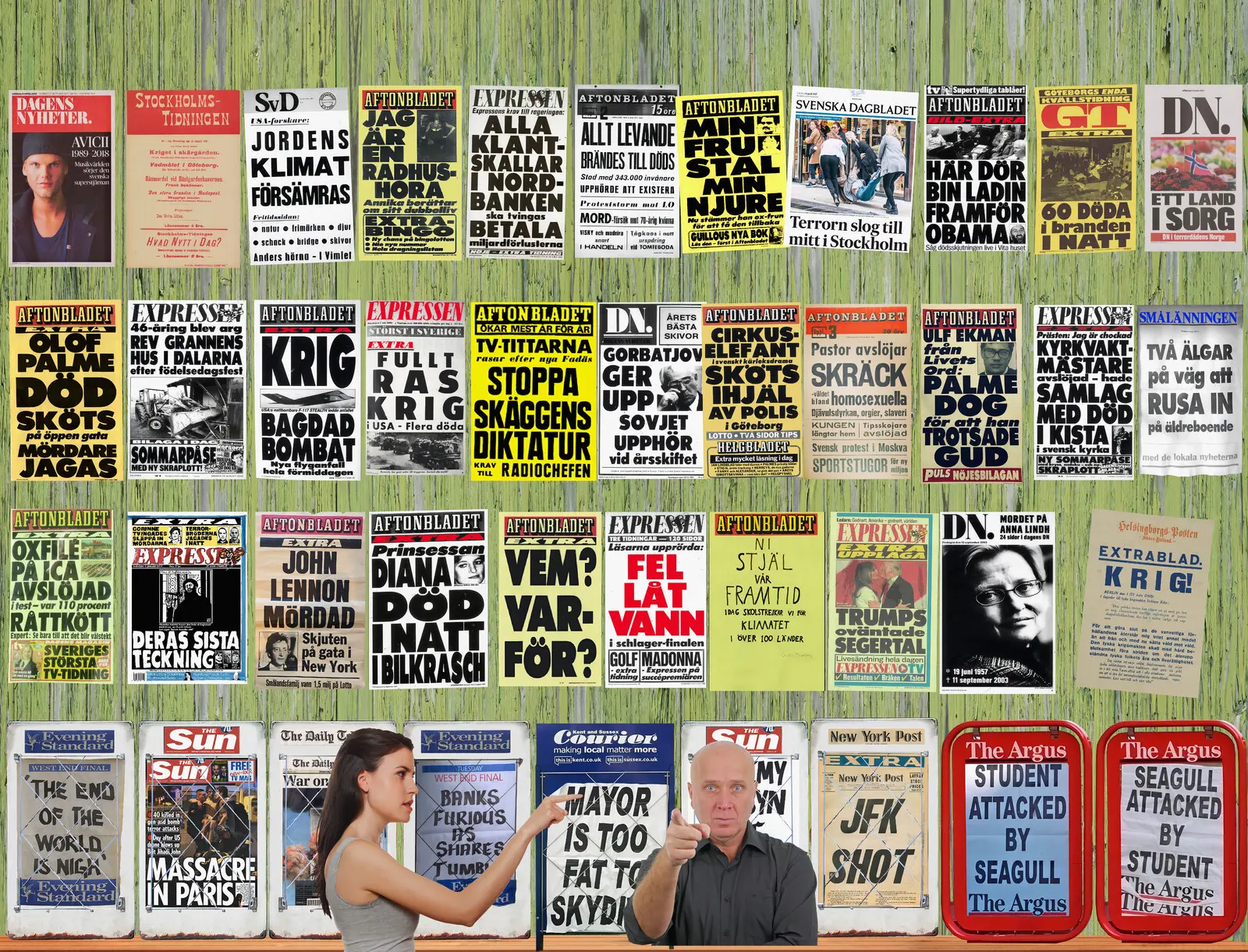
Blame Game, 2023
Digital
100 x 70 cm
5 200 kr
My image "Blame Game" depicts the view of whose fault it is when something goes wrong – yours, mine, or everyone's? "Mea culpa" is a concept rarely heard in political or official contexts, nor often elsewhere, because it's always someone else's or the circumstances' fault. The woman in the picture, probably the man's wife, is upset about something, and the focus shifts to him. "It's your and every other man's fault that things are so bad in the world," she exclaims angrily, pointing her finger accusingly at him. He pauses and instead turns to the viewer, all of us, and says, "No, it's everyone's fault, yours and mine - Nostra Maxima Culpa- It's All Our Fault. "The phrase ‘Mea Culpa’ is a direct admission of guilt or fault. It originates from a Roman Catholic prayer for confessing sin and seeking forgiveness. One line of this prayer is ‘mea culpa, mea culpa, mea maxima culpa’, which is typically translated as “through my fault, through my fault, through my most grievous fault.”
In the prayer, the individual acknowledges their guilt before God: mea culpa, mea culpa, mea maxima culpa – my fault, my fault, my very great fault. It's only their fault, no one else's, and primarily not God's fault, even though he's claimed to have created man in his image.
When history is one day to be written about the decline of democracy, few can claim "non mea culpa" – without guilt. The struggle for democracy must be fought daily, in big and small ways.
Power corrupts. Just as money burns a hole in our pockets, power ignites a fire within our souls. The burden to uphold one's true self intensifies, akin to Basil Fawlty's struggle. He strains to suppress any mention of World War II to his German guests. Yet, his fixation grows until it consumes him entirely, bursting forth like a dam under pressure, unleashing the truth in a cataclysmic explosion.
Nostra Maxima Culpa - It's All Our Fault is a concept with broader implications. My artwork delves into collective guilt rather than individual blame. Indeed, Hitler bore the ultimate responsibility, wielding evil as his weapon and setting the world ablaze. Equally guilty were those in his inner circle; there were no excuses. They acted out of self-interest, driven by personal gain. Thousands of officials shared the same selfish motives: career advancement, power, and wealth. Some military and bureaucracy may have cited fear for their safety, but it's a feeble excuse. Ultimately, the blame lies with those who did nothing - the entire population that remained silent, allowing atrocities to unfold - Nostra Maxima Culpa.
In today's Russia, a solid majority still supports Putin in his war against Ukraine and his assault on democracy and free speech. The Russian people cling to their glorious history, asserting their right to others' territories and blaming external forces for all their woes. This sentiment isn't just Putin's propaganda; it's deeply ingrained in the fabric of Russian society, reminiscent of the Tsarist era.
Corruption lurks everywhere, even in the bastion of democracy, the USA. Amidst what happens during the presidential campaign, all lies, the subsequent cover-up, and the ensuing frenzy of self-reflection, blame-shifting, and finger-pointing, politicians face a stark reality. The truth is evident, and all Americans should have the courage to acknowledge it.
In expecting Republicans to uphold certain principles, we inadvertently pushed them to betray their inherent nature. We forced them into a life of secrecy and deception, living "in the closet" while maintaining a façade of empty gestures.
“This is on us. All of us”, a friend of mine said, a Democrat. “When I say "us," I mean all non-Republican individuals in the U.S. political landscape: Democrats, Independents, Libertarians, Anarchists, Socialists, and even those whimsically named factions like Whigs, Tories, and Mugwumps and absolute idiots. It's our collective responsibility that Republicans now find themselves grappling with such embarrassment and disgrace, and we must strive to do better in supporting them.
The scandals within the Catholic Church have plagued various popes for decades. In 2013, filmmaker Alex Gibney unveiled ‘Mea Maxima Culpa’, a documentary delving into the sexual abuse of deaf children at a Catholic residential school in Milwaukee, Wisconsin. More significantly, it shed light on the alleged involvement of Church officials, possibly up to the Vatican, in shielding priests accused of abuse. Shortly after the film's release, Pope Benedict XVI stunned the world by resigning, prompting Gibney to suggest a possible connection to the sexual abuse crisis. While this conjecture remains debatable, the mounting evidence and unease surrounding the Church's history of sexual abuse undeniably demand a more comprehensive response.
Shooting the messenger means blaming the bearer of bad news for the bad news itself. In ancient times, messengers were sent to deliver official news, and these messengers sometimes incurred the wrath of those receiving the bad news. The sentiment was expressed in the play Antigone, written by Sophocles around 440 BC: "For no one loves the messenger who brings bad news."
Don't shoot the messenger, which is a warning not to blame the bearer of bad news. It is often used when someone reveals a problematic truth the listener does not want to hear. It reminds the listener that the truth is not at fault for revealing its faults.
"Shooting the messenger" or "killing the messenger" is a powerful metaphor for blaming the bearer of bad news despite their lack of responsibility for the news or its consequences.
Before modern communication, messages were conveyed by human envoys. For instance, a messenger might be dispatched from one camp to another in warfare. If the message brings unwelcome tidings, the recipient might unfairly direct their anger at the messenger.
An ancient example of this sentiment can be found in Plutarch's Lives, where Tigranes executed a messenger who brought news of Lucullus' arrival for his unfortunate message. No one dared to get further information, leaving Tigranes oblivious to the war brewing around him.
The sentiment was echoed in Sophocles' Antigone: "No one loves the messenger who brings bad news." Even Shakespeare touched on it, illustrating in Henry IV and Antony and Cleopatra the risk faced by those who deliver unwelcome news. Cleopatra, the female Pharao, threatens to treat the messenger's eyes as balls when told Antony has married another, eliciting the response, "Gracious madam, that I do bring the news made not the match."
In modern media, "shooting the messenger" occurs when individuals blame the press for reporting unfavourable news about their favoured cause or entity. While it may be a knee-jerk reaction to unwanted information, it does little to promote awareness or understanding.
News has always been in demand, whether it's bringing tidings of joy or tales of woe. But how did news travel in the days of yore, before the age of digital media and 24-hour news cycles?
Consider the thirst for information even in ancient civilisations. These bustling societies, filled with travellers from all corners, returning soldiers with tales, and wandering peddlers spreading gossip, were the unsung heroes of news dissemination. They were the unofficial news carriers, passing on stories and rumours from one place to another.
Delve into the intriguing role of kings and rulers in shaping public opinion. Driven to ensure their version of the truth reached the masses, they disseminated their messages far and wide through official heralds and government-sanctioned publications. This maintained their authority and laid the foundation for manipulating public opinion through media, a practice that continues today.
But it wasn't just in politics and power where news found its footing. Ancient civilisations like Egypt had their versions of newspapers, publishing on papyrus and water hyacinth leaves. Imagine a newsprint dating back thousands of years, documenting the deeds of pharaohs and the pulse of the people. Some papyri even reveal the existence of an opposition press, critiquing the actions of rulers like Pharaoh Ramses III.
Meanwhile, on the other side of the world, imperial China was also in the news business, with publications known as Dibao circulating reports from central and local governments. These early newspapers, akin to gazettes in the Western world, provided updates on matters of state and served as official bulletins from the imperial court. Dibao continued to inform and influence public discourse from the Han Dynasty to the Qing Dynasty.
Fast forward to ancient Rome, where Acta Diurna, one of the earliest daily newspapers, chronicled the activities of the Roman Senate. It was a primitive newssheet, but it laid the groundwork for the modern newspaper as we know it today.
In Europe, the birthplace of the modern newspaper, handwritten news sheets were widely circulated in Venice during the 16th century. These weekly updates on wars and politics eventually gave way to printed newspapers in Germany. Despite being subject to government censorship, they paved the way for a new era of journalism.
Queen Christina of Sweden made her mark on media history by founding the first still-published newspaper, the Ordinary Post Tijdender, later known as Post—och Inrikes Tidningar (Regular Mail-Times), in 1645. Serving as Sweden's government newspaper and gazette, it has stood the test of time, transitioning to an internet-only format in recent years but still preserving its legacy in print archives. It is the oldest newspaper currently published in the world, although as of the 1 January 2007 edition, it has switched to an internet-only format. However, four copies of each update to PoIT are still printed and archived at the National Library of Sweden.
And speaking of endurance, the Gazzetta di Mantova holds the title of the oldest living newspaper in the world, with a publication history dating back to 1664. Through wars, revolutions, and the rise of digital media, it has remained a steadfast source of news for the people of Mantua, a testament to the enduring power of the press.
Appreciate the significant role of the Enlightenment in the expansion of newspapers and the promotion of free speech. This era marked a turning point in Europe, where people were encouraged to critique the priest's words in the pulpit, not the religion or the church, but how he pronounced them. This was a crucial step in breaking down the church's monopolised authority, paving the way for the flourishing of literacy during the 19th century when even ordinary people learned to read and write in organised schools.
Knowledge and finding out things give power and money. The story of how the Rothschild family became richer through their information about Napoleon's fate is a well-known part of financial history. It is often told as an example of how insider information, being well-informed, and the ability to act quickly in the market can lead to enormous profits.
When the rumour that Napoleon might have won the Battle of Waterloo reached London on June 20, 1815, panic initially ensued in the markets. Many investors sold their assets for fear that Napoleon would prevail and cause economic uncertainty.
According to legend, Nathan Rothschild, one of the family's leading members, acted swiftly. He is said to have received information about Napoleon's actual loss through his couriers before the truth was announced almost a day later. While other investors panicked and sold their assets, Rothschild used his information to his advantage.
When panic peaked, Rothschild reportedly began buying large quantities of British government bonds and other assets at heavily discounted prices. When news of Napoleon's defeat became widely known, and the market recovered, Rothschild had already accumulated many holdings at low prices.
By taking advantage of his information and acting quickly, the Rothschild family made enormous profits when the market rebounded. This event is considered one of the early examples of how insider trading and the ability to act on private information can significantly impact financial markets. Who should be blamed? Poor communications? Or not keeping oneself informed? Mea Culpa! Don't blame anyone else!
Jörgen Thornberg
Blame Game, 2023
Digital
100 x 70 cm
5 200 kr
My image "Blame Game" depicts the view of whose fault it is when something goes wrong – yours, mine, or everyone's? "Mea culpa" is a concept rarely heard in political or official contexts, nor often elsewhere, because it's always someone else's or the circumstances' fault. The woman in the picture, probably the man's wife, is upset about something, and the focus shifts to him. "It's your and every other man's fault that things are so bad in the world," she exclaims angrily, pointing her finger accusingly at him. He pauses and instead turns to the viewer, all of us, and says, "No, it's everyone's fault, yours and mine - Nostra Maxima Culpa- It's All Our Fault. "The phrase ‘Mea Culpa’ is a direct admission of guilt or fault. It originates from a Roman Catholic prayer for confessing sin and seeking forgiveness. One line of this prayer is ‘mea culpa, mea culpa, mea maxima culpa’, which is typically translated as “through my fault, through my fault, through my most grievous fault.”
In the prayer, the individual acknowledges their guilt before God: mea culpa, mea culpa, mea maxima culpa – my fault, my fault, my very great fault. It's only their fault, no one else's, and primarily not God's fault, even though he's claimed to have created man in his image.
When history is one day to be written about the decline of democracy, few can claim "non mea culpa" – without guilt. The struggle for democracy must be fought daily, in big and small ways.
Power corrupts. Just as money burns a hole in our pockets, power ignites a fire within our souls. The burden to uphold one's true self intensifies, akin to Basil Fawlty's struggle. He strains to suppress any mention of World War II to his German guests. Yet, his fixation grows until it consumes him entirely, bursting forth like a dam under pressure, unleashing the truth in a cataclysmic explosion.
Nostra Maxima Culpa - It's All Our Fault is a concept with broader implications. My artwork delves into collective guilt rather than individual blame. Indeed, Hitler bore the ultimate responsibility, wielding evil as his weapon and setting the world ablaze. Equally guilty were those in his inner circle; there were no excuses. They acted out of self-interest, driven by personal gain. Thousands of officials shared the same selfish motives: career advancement, power, and wealth. Some military and bureaucracy may have cited fear for their safety, but it's a feeble excuse. Ultimately, the blame lies with those who did nothing - the entire population that remained silent, allowing atrocities to unfold - Nostra Maxima Culpa.
In today's Russia, a solid majority still supports Putin in his war against Ukraine and his assault on democracy and free speech. The Russian people cling to their glorious history, asserting their right to others' territories and blaming external forces for all their woes. This sentiment isn't just Putin's propaganda; it's deeply ingrained in the fabric of Russian society, reminiscent of the Tsarist era.
Corruption lurks everywhere, even in the bastion of democracy, the USA. Amidst what happens during the presidential campaign, all lies, the subsequent cover-up, and the ensuing frenzy of self-reflection, blame-shifting, and finger-pointing, politicians face a stark reality. The truth is evident, and all Americans should have the courage to acknowledge it.
In expecting Republicans to uphold certain principles, we inadvertently pushed them to betray their inherent nature. We forced them into a life of secrecy and deception, living "in the closet" while maintaining a façade of empty gestures.
“This is on us. All of us”, a friend of mine said, a Democrat. “When I say "us," I mean all non-Republican individuals in the U.S. political landscape: Democrats, Independents, Libertarians, Anarchists, Socialists, and even those whimsically named factions like Whigs, Tories, and Mugwumps and absolute idiots. It's our collective responsibility that Republicans now find themselves grappling with such embarrassment and disgrace, and we must strive to do better in supporting them.
The scandals within the Catholic Church have plagued various popes for decades. In 2013, filmmaker Alex Gibney unveiled ‘Mea Maxima Culpa’, a documentary delving into the sexual abuse of deaf children at a Catholic residential school in Milwaukee, Wisconsin. More significantly, it shed light on the alleged involvement of Church officials, possibly up to the Vatican, in shielding priests accused of abuse. Shortly after the film's release, Pope Benedict XVI stunned the world by resigning, prompting Gibney to suggest a possible connection to the sexual abuse crisis. While this conjecture remains debatable, the mounting evidence and unease surrounding the Church's history of sexual abuse undeniably demand a more comprehensive response.
Shooting the messenger means blaming the bearer of bad news for the bad news itself. In ancient times, messengers were sent to deliver official news, and these messengers sometimes incurred the wrath of those receiving the bad news. The sentiment was expressed in the play Antigone, written by Sophocles around 440 BC: "For no one loves the messenger who brings bad news."
Don't shoot the messenger, which is a warning not to blame the bearer of bad news. It is often used when someone reveals a problematic truth the listener does not want to hear. It reminds the listener that the truth is not at fault for revealing its faults.
"Shooting the messenger" or "killing the messenger" is a powerful metaphor for blaming the bearer of bad news despite their lack of responsibility for the news or its consequences.
Before modern communication, messages were conveyed by human envoys. For instance, a messenger might be dispatched from one camp to another in warfare. If the message brings unwelcome tidings, the recipient might unfairly direct their anger at the messenger.
An ancient example of this sentiment can be found in Plutarch's Lives, where Tigranes executed a messenger who brought news of Lucullus' arrival for his unfortunate message. No one dared to get further information, leaving Tigranes oblivious to the war brewing around him.
The sentiment was echoed in Sophocles' Antigone: "No one loves the messenger who brings bad news." Even Shakespeare touched on it, illustrating in Henry IV and Antony and Cleopatra the risk faced by those who deliver unwelcome news. Cleopatra, the female Pharao, threatens to treat the messenger's eyes as balls when told Antony has married another, eliciting the response, "Gracious madam, that I do bring the news made not the match."
In modern media, "shooting the messenger" occurs when individuals blame the press for reporting unfavourable news about their favoured cause or entity. While it may be a knee-jerk reaction to unwanted information, it does little to promote awareness or understanding.
News has always been in demand, whether it's bringing tidings of joy or tales of woe. But how did news travel in the days of yore, before the age of digital media and 24-hour news cycles?
Consider the thirst for information even in ancient civilisations. These bustling societies, filled with travellers from all corners, returning soldiers with tales, and wandering peddlers spreading gossip, were the unsung heroes of news dissemination. They were the unofficial news carriers, passing on stories and rumours from one place to another.
Delve into the intriguing role of kings and rulers in shaping public opinion. Driven to ensure their version of the truth reached the masses, they disseminated their messages far and wide through official heralds and government-sanctioned publications. This maintained their authority and laid the foundation for manipulating public opinion through media, a practice that continues today.
But it wasn't just in politics and power where news found its footing. Ancient civilisations like Egypt had their versions of newspapers, publishing on papyrus and water hyacinth leaves. Imagine a newsprint dating back thousands of years, documenting the deeds of pharaohs and the pulse of the people. Some papyri even reveal the existence of an opposition press, critiquing the actions of rulers like Pharaoh Ramses III.
Meanwhile, on the other side of the world, imperial China was also in the news business, with publications known as Dibao circulating reports from central and local governments. These early newspapers, akin to gazettes in the Western world, provided updates on matters of state and served as official bulletins from the imperial court. Dibao continued to inform and influence public discourse from the Han Dynasty to the Qing Dynasty.
Fast forward to ancient Rome, where Acta Diurna, one of the earliest daily newspapers, chronicled the activities of the Roman Senate. It was a primitive newssheet, but it laid the groundwork for the modern newspaper as we know it today.
In Europe, the birthplace of the modern newspaper, handwritten news sheets were widely circulated in Venice during the 16th century. These weekly updates on wars and politics eventually gave way to printed newspapers in Germany. Despite being subject to government censorship, they paved the way for a new era of journalism.
Queen Christina of Sweden made her mark on media history by founding the first still-published newspaper, the Ordinary Post Tijdender, later known as Post—och Inrikes Tidningar (Regular Mail-Times), in 1645. Serving as Sweden's government newspaper and gazette, it has stood the test of time, transitioning to an internet-only format in recent years but still preserving its legacy in print archives. It is the oldest newspaper currently published in the world, although as of the 1 January 2007 edition, it has switched to an internet-only format. However, four copies of each update to PoIT are still printed and archived at the National Library of Sweden.
And speaking of endurance, the Gazzetta di Mantova holds the title of the oldest living newspaper in the world, with a publication history dating back to 1664. Through wars, revolutions, and the rise of digital media, it has remained a steadfast source of news for the people of Mantua, a testament to the enduring power of the press.
Appreciate the significant role of the Enlightenment in the expansion of newspapers and the promotion of free speech. This era marked a turning point in Europe, where people were encouraged to critique the priest's words in the pulpit, not the religion or the church, but how he pronounced them. This was a crucial step in breaking down the church's monopolised authority, paving the way for the flourishing of literacy during the 19th century when even ordinary people learned to read and write in organised schools.
Knowledge and finding out things give power and money. The story of how the Rothschild family became richer through their information about Napoleon's fate is a well-known part of financial history. It is often told as an example of how insider information, being well-informed, and the ability to act quickly in the market can lead to enormous profits.
When the rumour that Napoleon might have won the Battle of Waterloo reached London on June 20, 1815, panic initially ensued in the markets. Many investors sold their assets for fear that Napoleon would prevail and cause economic uncertainty.
According to legend, Nathan Rothschild, one of the family's leading members, acted swiftly. He is said to have received information about Napoleon's actual loss through his couriers before the truth was announced almost a day later. While other investors panicked and sold their assets, Rothschild used his information to his advantage.
When panic peaked, Rothschild reportedly began buying large quantities of British government bonds and other assets at heavily discounted prices. When news of Napoleon's defeat became widely known, and the market recovered, Rothschild had already accumulated many holdings at low prices.
By taking advantage of his information and acting quickly, the Rothschild family made enormous profits when the market rebounded. This event is considered one of the early examples of how insider trading and the ability to act on private information can significantly impact financial markets. Who should be blamed? Poor communications? Or not keeping oneself informed? Mea Culpa! Don't blame anyone else!
5 200 kr

Jörgen Thornberg
Malmö
Lite om bilder och mig. Translation in English at the end.
Jag är en nyfiken person som ser allt i bilder, även det jag fäster i ord, gärna tillsammans för bakom alla mina bilder finns en berättelse. Till vissa bilder hör en kortare eller längre novell som följer med bilden.
Bilder berättar historier. Jag omges av naturlig skönhet, intressanta människor och historia var jag än går. Jag använder min kamera för att dokumentera världen och blanda det jag ser med vad jag känner för att fånga den dolda magin.
Mina bilder berättar mina historier. Genom mina bilder, tryck och berättelser. Jag bjuder in dig att ta del av dessa berättelser, in i ditt liv och hem och dela min mycket personliga syn på vår värld. Mer än vad ögat ser. Jag tänker i bilder, drömmer och skriver och pratar om dem; följaktligen måste jag också skapa bilder. De blir vad jag ser, inte nödvändigtvis begränsade till verkligheten. Det finns en bild runt varje hörn. Jag hoppas att du kommer att se vad jag såg och gilla det.
Jag är också en skrivande person och till många bilder hör en kortare eller längre essay. Den följer med tavlan, tryckt på fint papper och med en personlig hälsning från mig.
Flertalet bilder startar sin resa i min kamera. Enkelt förklarat beskriver jag bilden jag ser i mitt inre, upplevd eller fantiserad. Bilden uppstår inom mig redan innan jag fått okularet till ögat. På bråkdelen av ett ögonblick ser jag vad jag vill ha och vad som kan göras med bilden. Här skall jag stoppa in en giraff, stålmannen, Titanic eller vad det är min fantasi finner ut. Ännu märkligare är att jag kommer ihåg minnesbilden långt efteråt när det blir tid att skapa verket. Om jag lyckas eller inte, är upp till betraktaren, oftast präglat av en stråk av svart humor – meningen är att man skall bli underhållen. Mina bilder blir ofta en snackis där de hänger.
Jag föredrar bilder som förmedlar ett budskap i flera lager. Vid första anblicken fylld av feel-good, en vacker utsikt, fint väder, solen skiner, blommor på ängen eller vattnet som ligger förrädiskt spegelblankt. I en sådan bild kan jag gömma min egentliga berättelse, mitt förakt för förtryckare och våldsverkare, rasister och fördomsfulla människor - ett gärna återkommande motiv mer eller mindre dolt i det vackra motivet. Jag försöker förena dem i ett gemensamt narrativ.
Bild och formgivning har löpt som en röd tråd genom livet. Fotokonst känns som en värdig final som jag gärna delar med mig.
Min genre är vid som framgår av mina bilder, temat en blandning av pop- och gatukonst i kollage som kan bestå av hundratals lager. Vissa bilder kan ta veckor, andra någon dag innan det är dags att överlämna resultatet till printverkstaden. Fine Art Prints är digitala fotocollage. I dessa kollage sker rivandet, klippandet, pusslandet, målandet, ritandet och sprayningen digitalt. Det jag monterar in kan vara hundratals år gamla bilder som jag omsorgsfullt frilägger så att de ser ut att vara en del av tavlan men också bilder skapade av mig själv efter min egen fantasi. Därefter besöks printstudion och för vissa bilder numrera en limiterad upplaga (oftast 7 exemplar) och signera för hand. Vissa bilder kan köpas i olika format. Det är bara att fråga efter vilka. Gillar man en bild som är 70x100 men inte har plats på väggen, går den kanske att få i 50x70 cm istället. Frågan är fri.
Metoden Giclée eller Fine Art Print som det också kallas är det moderna sättet för framställning av grafisk konst. Villkoret för denna typ av utskrifter är att en högkvalitativ storformatskrivare används med åldersbeständigt färgpigment och konstnärspapper eller i förekommande fall på duk. Pappret som används möter de krav på livslängd som ställs av museer och gallerier. Normalt säljer jag mina bilder oinramade så att den nya ägaren själv kan bestämma hur de skall se ut, med eller utan passepartout färg på ram, med eller utan glas etc..
Under många år ställde jag bara ut på nätet, i valda grupper och på min egen Facebooksida - https://www.facebook.com/jorgen.thornberg.9
Jag finns också på en egen hemsida som tyvärr inte alltid är uppdaterad – https://www.jth.life/ Där kan du också läsa en del av de berättelser som följer med bilden.
UTSTÄLLNINGAR
Luftkastellet, oktober 2022
Konst i Lund, november 2022
Luftkastellet, mars 2023
Engleson Galleri Caroli, april 2023
Hydra, Greece June 2023
Engleson Galleri Caroli, oktober 2023
Toppen, Höllviken december 2023
Luftkastellet, mars 2024
Torups Galleri, mars 2024
Venice, May 2024
Luftkastellet, oktober 2024
Konst i Advent, December 2024
Galleri Engleson, Caroli December 2024
Jäger & Jansson Galleri, april 2025
A bit about pictures and me.
I'm a curious person who sees everything in pictures, even what I express in words, often combining them, for behind all my pictures lies a story. These narratives, some as short as a single image and others as long as a novel, are the heart and soul of my work.
Pictures tell stories. Wherever I go, I'm surrounded by natural beauty, exciting people, and history. I use my camera to document the world and blend what I see with what I feel to capture the hidden magic.
My images tell my stories. Through my pictures, prints, and narratives, I invite you to partake in these stories in your life and home and share my deeply personal perspective of our world. More than meets the eye. I think in pictures, dream, write, and talk about them; consequently, I must create images too. They become what I see, not necessarily confined to reality. There's a picture around every corner. I hope you'll see what I saw and enjoy it.
I'm also a writer, and many images come with a shorter or longer essay. It accompanies the painting, printed on fine paper with my personal greeting.
Many pictures start their journey on my camera. Simply put, I describe the image I see in my mind, experienced or imagined. The image arises within me even before I bring the eyepiece to my eye. In a fraction of a moment, I see what I want and what can be done with the picture. Here, I'll insert a giraffe, Superman, the Titanic, or whatever my imagination conjures up. Even stranger is that I remember the mental image long after it's time to create the work. Whether I succeed is up to the observer, often imbued with a streak of black humour – the aim is to entertain. My pictures usually become a talking point wherever they hang.
I prefer pictures that convey a message in multiple layers. At first glance, they're filled with feel-good vibes, a beautiful view, lovely weather, the sun shining, flowers in the meadow, or the water lying deceptively calm. But beneath this surface beauty, I often conceal a deeper story, a narrative that challenges societal norms or explores the human condition. I invite you to delve into these hidden narratives and discover the layers of meaning within my work.
Picture and design have been a thread running through my life. Photographic art feels like a fitting finale, and I'm happy to share it.
My genre is varied, as seen in my pictures; the theme is a blend of pop and street art in collages that can consist of hundreds of layers. Some images can take weeks, others just a day before it's time to hand over the result to the print workshop. Fine Art Prints are digital photo collages. In these collages, tearing, cutting, puzzling, painting, drawing, and spraying happen digitally. What I insert can be images hundreds of years old that I carefully extract so they appear to be part of the painting, but also images created by myself, now also generated from my imagination. Next, visit the print studio and, for certain images, number a limited edition (usually 7 copies) and sign them by hand. Some images may be available in other formats. Just ask which ones. If you like an image that's 70x100 but doesn't have space on the wall, you might be able to get it in 50x70 cm instead. The question is open.
The Giclée method, or Fine Art Print as it's also called, is the modern way of producing graphic art. This method ensures the highest quality and longevity of the artwork, using a high-quality large-format printer with archival pigment inks and artist paper or, in some cases, canvas. The paper used meets the longevity requirements set by museums and galleries. I sell my pictures unframed, allowing the new owner to personalise their artwork, confident in the lasting value and quality of the piece.
For many years, I only exhibited online, in selected groups, and on my Facebook page - https://www.facebook.com/jorgen.thornberg.9. I also have my website, which unfortunately is not constantly updated - https://www.jth.life/. You can also read some of the stories accompanying the pictures there.
EXHIBITIONS
Luftkastellet, October 2022
Art in Lund, November 2022
Luftkastellet, March 2023
Engleson Gallery Caroli, April 2023
Hydra, Greece June 2023
Engleson Gallery Caroli, October 2023
Toppen, Höllviken December 2023
Luftkastellet, March 2024
Torup Gallery, March 2024
Venice, May 2024
UTSTÄLLNINGAR
Luftkastellet, oktober 2022
Konst i Lund, november 2022
Luftkastellet, mars 2023
Engleson Galleri Caroli, april 2023
Hydra, Greece June 2023
Engleson Galleri Caroli, oktober 2023
Toppen, Höllviken december 2023
Luftkastellet, mars 2024
Torups Galleri, mars 2024
Venice, May 2024
Luftkastellet, October 2024
Konst i Advent, December 2024
Galleri Engleson, Caroli December 2024
Jäger & Jansson Galleri, April 2025
Utbildning
Autodidakt
Medlem i konstnärsförening
Öppna Sinnen
Med i konstrunda
Konstrundan i Skåne
Utställningar
Luftkastellet, October 2022
Art in Lund, November 2022
Luftkastellet, March 2023
Engleson Gallery Caroli, April 2023
Hydra, Greece June 2023
Engleson Gallery Caroli, October 2023
Toppen, Höllviken December 2023
Luftkastellet, March 2024
Torup Gallery, March 2024
Venice, May 2024