Vi använder cookies för att ge dig bästa möjliga upplevelse. Välj vilka cookies du tillåter.
Läs mer i vår integritetspolicy
Jörgen Thornberg
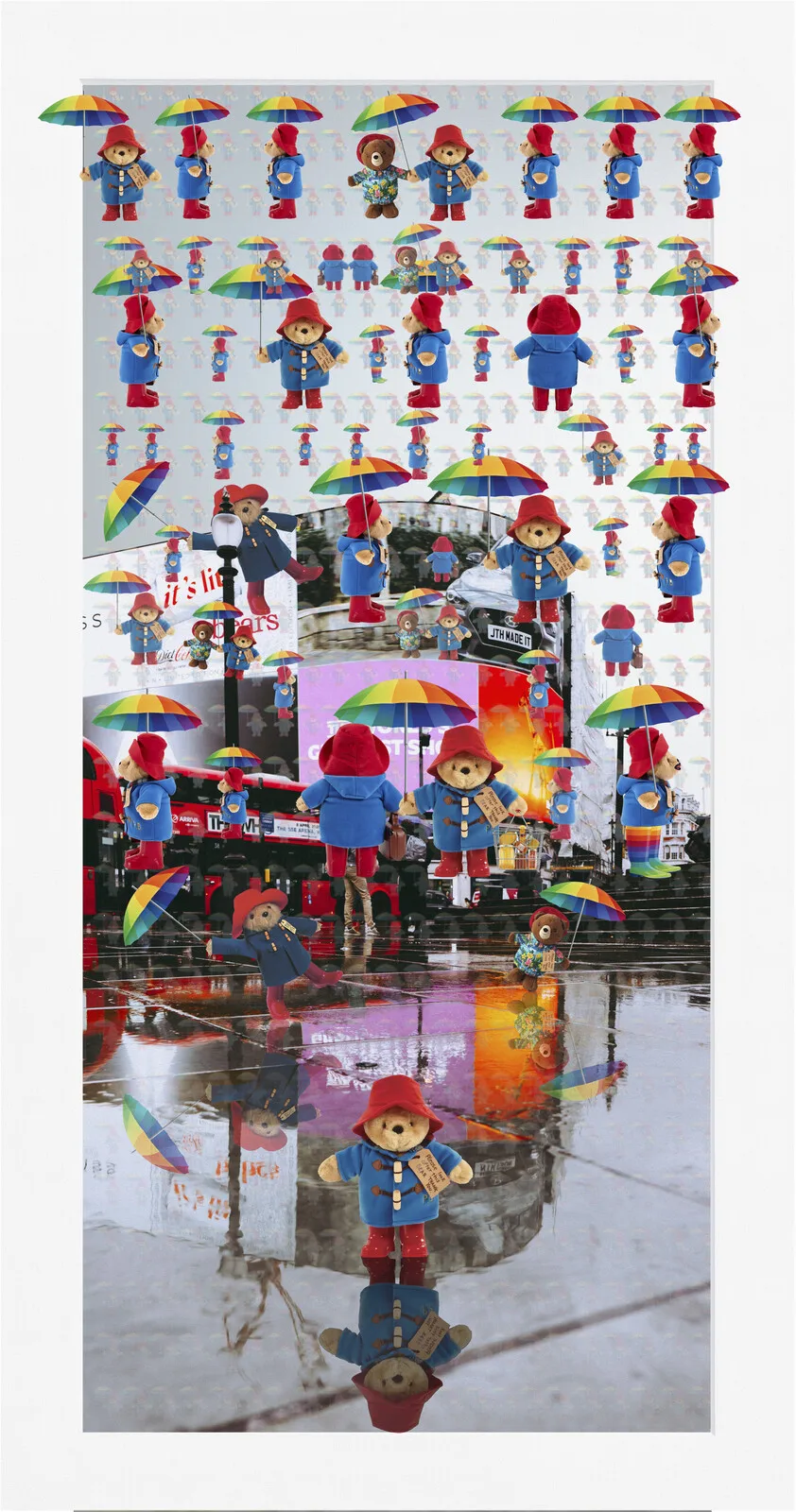
It's raining Paddingtons at Piccadilly Circus, 2023
Digital
100 x 210 cm
15 600 kr
"It's raining cats and dogs" is an idiomatic expression used to describe heavy rain. The expression is not literal but carries a more profound meaning beyond heavy rainfall. The origin of this expression is somewhat unclear, and several theories are behind it.
One popular theory is that the expression originated in England in the 1500s, where roof constructions were not always tight enough, allowing rain to come into houses through the roof. When it rained heavily, small animals like cats and dogs could seek shelter on the roofs and then be washed down when the rain became heavy.
Another theory suggests that the expression comes from Norse mythology, where cats were symbols of storms and dogs of rain. When it rained heavily, people believed it was a battle between cats and dogs in the sky, resulting in the heavy rain on earth.
Or that it's weather so extreme that only dogs and cats are forced to be outside seeking shelter wherever they can, reinforcing the image of extreme and inhospitable weather. In the past, pets were not allowed in the bed, unlike today. It also provides insight into how people's relationship with pets has changed and how the traditional view of pets as outdoor animals differs from today's more inclusive attitude towards pets.
Regardless of its origin, the expression has become part of the English language and is used worldwide to describe intense rain. Its poetic and figurative nature adds drama and surprise when used. Despite being an old expression, it is still commonly used and enriches the language with colourful and vivid expressions.
If you don't want to involve our beloved pets in lousy weather, they are probably safe and sound on the sofa; English has other strong expressions that express disgust for the fury of the elements—deluge, flooding, monsoon, or more informal pissing down. Swedish 'skitväder' has its English counterpart - shitty weather—the same metaphor.
This brings us to a much more pleasant variant, that it's raining Paddingtons. Then perhaps it's not about pouring rain but rather a gentle drizzle strong enough to open the umbrella, which the Paddingtons in my picture have also done. Once, when I was in London, and it was drizzling just right from above, I coined the phrase 'It’s raining Paddingtons at Piccadilly Circus.' Look at the picture, and you'll understand why. The memory of that moment inspired me to compose a picture from London back then. It wasn't that difficult, even though it took many days to realise the memory images, for Paddington has lived with me for many years. He stands at the foot of my bed, guarding me regardless of the weather.
In the heart of London, in the picturesque neighbourhood of Notting Hill, where the warmth of the people meets the scent of freshly brewed tea, we find a four-legged friend known worldwide - Paddington Bear.
It may seem strange to the uninitiated that a little bear with a blue coat and a red hat can evoke so much joy and appreciation, but that's precisely what this little bear has done since he first appeared on the pages of a children's book. Paddington was born from pen and paper by the talented author Michael Bond in 1958, and his popularity has only grown since then, like a smiling bear's wide-eyed appeal.
Paddington Bear, a fluffy and clumsy figure who loves marmalade sandwiches and is passionate about kindness, has won hearts all over the world. But let's dig deeper into the story of this delightful bear and his unexpected journey to fame.
It all started in the Peruvian jungle, where Paddington was born and raised among his relatives. He took a detour, but one day, he was discovered by a friendly man named Mr. Brown, who took him under his wing and named him after Paddington Station, where they first met.
But what makes Paddington so unique? Besides his charming naivety and unbreakable optimism, I believe his story captures our hearts. Being born in the jungle in Peru, only later to find himself on a deserted platform in London, is not the journey most of us can relate to. But that's precisely what makes Paddington's story so universal. He's an outsider trying to fit in, a stranger in a strange city, but with an unwavering willingness to embrace life and the people around him.
One of the most iconic parts of Paddington's look is undoubtedly his luggage tag, the little tag around his neck that states his name and address: "Please look after this bear. Thank you." This simple yet powerful tag truly captures the essence of Paddington. He's a little bear in a big city, a stranger asking for help and kindness, and he's often embraced and cared for by the people he meets.
But Paddington is not just a symbol of innocence and kindness; he's also known for his many adventures and funny anecdotes. From rescuing the cat from the neighbour's roof to trying to fix a mess in Mr Brown's kitchen, Paddington has had many memorable moments that have captured our hearts and made us laugh out loud.
Paddington's popularity knows no bounds. From his early adventures in Michael Bond's books to the beloved children's film, he has charmed generations of readers and viewers with his innocence and goodwill. His unlikely everyday mishaps and attempts to understand the human world have made him an icon of friendship and tolerance.
One of the most memorable anecdotes about Paddington is his passion for marmalade sandwiches. This bear cannot resist the temptation of a good layer of marmalade between two slices of bread, and his love for this simple pleasure has become part of his personality. In his world, a dropped marmalade sandwich always lands marmalade side up. It couldn't be otherwise.
But Paddington is more than just a bear with a sweet tooth. He also represents the courage to be different and to embrace the unknown with open arms. Despite coming from another world, he feels at home in London and spreads joy and warmth to everyone he meets.
Paddington's passion for marmalade sandwiches often leads to problems with handling them smoothly. He gets into sticky situations when making them, like squeezing out too much marmalade or getting it everywhere except on the bread.
Once, Paddington decides to wash his dirty coat, but he has no idea how to use the washing machine, so he puts the entire jacket in there with disastrous results. He frantically presses all the buttons on the machine, and soon, water and foam are spraying all over the laundry room. Poor Paddington looks like a living snowball until the Brown family hears the commotion and rushes to help Paddington. Together, they stop the washing machine and save the coat and Paddington from a wet fate.
Another time, Paddington visits a flea market and gets so excited about all the desirable items that he accidentally messes up the entire place when trying to get a closer look at everything. Paddington manages to mistake an old clock for an alarm clock, which causes chaos when it starts ringing in the middle of the flea market.
Paddington joins an art class and tries to create a masterpiece. But when he accidentally spills paint all over the canvas, he improvises and turns his failed artwork into a colourful abstract painting that unexpectedly succeeds. The Swedish artist Bengt Lindström may have been inspired, or vice versa. Lindström was known for his bright and expressive style, with paintings characterised by bold colours and abstract shapes. Lindström had a significant international career, with exhibitions worldwide, including in Paris, where he also lived and worked for parts of his life. If you can get hold of one of Paddington's paintings, they will likely be as expensive as Lindström's.
In conclusion, Paddington is a bear who wears a red hat and a red thread of kindness, humanity, and anti-racism that runs through all his adventures. He reminds us of the importance of being kind to others and always keeping hope alive, even when life throws us into unexpected situations. So the next time you see a little bear with a red hat, remember to smile at him and maybe some marmalade sandwiches - for that's precisely what he would do for you.
If you pass Paddington Station, look at the little bear with the friendly sign around his neck. He reminds us that the world is full of beautiful surprises and that sometimes it's worth being open to the unexpected. With his innocent charm and eternal optimism, Paddington Bear symbolises hope and kindness that continues to enchant us all.
Jörgen Thornberg
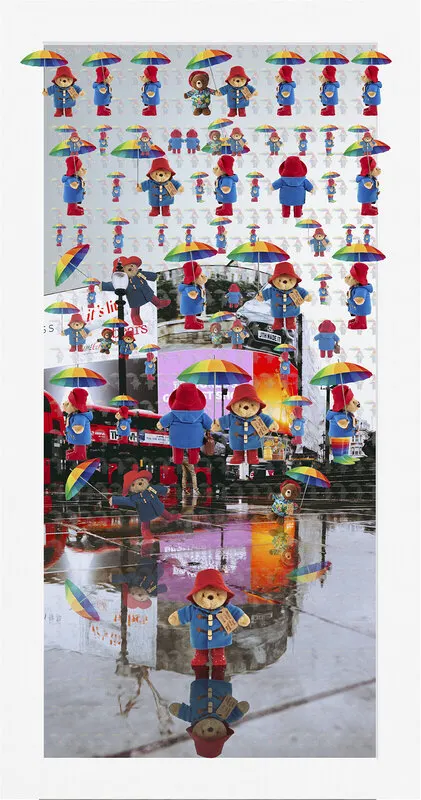
It's raining Paddingtons at Piccadilly Circus, 2023
Digital
100 x 210 cm
15 600 kr
"It's raining cats and dogs" is an idiomatic expression used to describe heavy rain. The expression is not literal but carries a more profound meaning beyond heavy rainfall. The origin of this expression is somewhat unclear, and several theories are behind it.
One popular theory is that the expression originated in England in the 1500s, where roof constructions were not always tight enough, allowing rain to come into houses through the roof. When it rained heavily, small animals like cats and dogs could seek shelter on the roofs and then be washed down when the rain became heavy.
Another theory suggests that the expression comes from Norse mythology, where cats were symbols of storms and dogs of rain. When it rained heavily, people believed it was a battle between cats and dogs in the sky, resulting in the heavy rain on earth.
Or that it's weather so extreme that only dogs and cats are forced to be outside seeking shelter wherever they can, reinforcing the image of extreme and inhospitable weather. In the past, pets were not allowed in the bed, unlike today. It also provides insight into how people's relationship with pets has changed and how the traditional view of pets as outdoor animals differs from today's more inclusive attitude towards pets.
Regardless of its origin, the expression has become part of the English language and is used worldwide to describe intense rain. Its poetic and figurative nature adds drama and surprise when used. Despite being an old expression, it is still commonly used and enriches the language with colourful and vivid expressions.
If you don't want to involve our beloved pets in lousy weather, they are probably safe and sound on the sofa; English has other strong expressions that express disgust for the fury of the elements—deluge, flooding, monsoon, or more informal pissing down. Swedish 'skitväder' has its English counterpart - shitty weather—the same metaphor.
This brings us to a much more pleasant variant, that it's raining Paddingtons. Then perhaps it's not about pouring rain but rather a gentle drizzle strong enough to open the umbrella, which the Paddingtons in my picture have also done. Once, when I was in London, and it was drizzling just right from above, I coined the phrase 'It’s raining Paddingtons at Piccadilly Circus.' Look at the picture, and you'll understand why. The memory of that moment inspired me to compose a picture from London back then. It wasn't that difficult, even though it took many days to realise the memory images, for Paddington has lived with me for many years. He stands at the foot of my bed, guarding me regardless of the weather.
In the heart of London, in the picturesque neighbourhood of Notting Hill, where the warmth of the people meets the scent of freshly brewed tea, we find a four-legged friend known worldwide - Paddington Bear.
It may seem strange to the uninitiated that a little bear with a blue coat and a red hat can evoke so much joy and appreciation, but that's precisely what this little bear has done since he first appeared on the pages of a children's book. Paddington was born from pen and paper by the talented author Michael Bond in 1958, and his popularity has only grown since then, like a smiling bear's wide-eyed appeal.
Paddington Bear, a fluffy and clumsy figure who loves marmalade sandwiches and is passionate about kindness, has won hearts all over the world. But let's dig deeper into the story of this delightful bear and his unexpected journey to fame.
It all started in the Peruvian jungle, where Paddington was born and raised among his relatives. He took a detour, but one day, he was discovered by a friendly man named Mr. Brown, who took him under his wing and named him after Paddington Station, where they first met.
But what makes Paddington so unique? Besides his charming naivety and unbreakable optimism, I believe his story captures our hearts. Being born in the jungle in Peru, only later to find himself on a deserted platform in London, is not the journey most of us can relate to. But that's precisely what makes Paddington's story so universal. He's an outsider trying to fit in, a stranger in a strange city, but with an unwavering willingness to embrace life and the people around him.
One of the most iconic parts of Paddington's look is undoubtedly his luggage tag, the little tag around his neck that states his name and address: "Please look after this bear. Thank you." This simple yet powerful tag truly captures the essence of Paddington. He's a little bear in a big city, a stranger asking for help and kindness, and he's often embraced and cared for by the people he meets.
But Paddington is not just a symbol of innocence and kindness; he's also known for his many adventures and funny anecdotes. From rescuing the cat from the neighbour's roof to trying to fix a mess in Mr Brown's kitchen, Paddington has had many memorable moments that have captured our hearts and made us laugh out loud.
Paddington's popularity knows no bounds. From his early adventures in Michael Bond's books to the beloved children's film, he has charmed generations of readers and viewers with his innocence and goodwill. His unlikely everyday mishaps and attempts to understand the human world have made him an icon of friendship and tolerance.
One of the most memorable anecdotes about Paddington is his passion for marmalade sandwiches. This bear cannot resist the temptation of a good layer of marmalade between two slices of bread, and his love for this simple pleasure has become part of his personality. In his world, a dropped marmalade sandwich always lands marmalade side up. It couldn't be otherwise.
But Paddington is more than just a bear with a sweet tooth. He also represents the courage to be different and to embrace the unknown with open arms. Despite coming from another world, he feels at home in London and spreads joy and warmth to everyone he meets.
Paddington's passion for marmalade sandwiches often leads to problems with handling them smoothly. He gets into sticky situations when making them, like squeezing out too much marmalade or getting it everywhere except on the bread.
Once, Paddington decides to wash his dirty coat, but he has no idea how to use the washing machine, so he puts the entire jacket in there with disastrous results. He frantically presses all the buttons on the machine, and soon, water and foam are spraying all over the laundry room. Poor Paddington looks like a living snowball until the Brown family hears the commotion and rushes to help Paddington. Together, they stop the washing machine and save the coat and Paddington from a wet fate.
Another time, Paddington visits a flea market and gets so excited about all the desirable items that he accidentally messes up the entire place when trying to get a closer look at everything. Paddington manages to mistake an old clock for an alarm clock, which causes chaos when it starts ringing in the middle of the flea market.
Paddington joins an art class and tries to create a masterpiece. But when he accidentally spills paint all over the canvas, he improvises and turns his failed artwork into a colourful abstract painting that unexpectedly succeeds. The Swedish artist Bengt Lindström may have been inspired, or vice versa. Lindström was known for his bright and expressive style, with paintings characterised by bold colours and abstract shapes. Lindström had a significant international career, with exhibitions worldwide, including in Paris, where he also lived and worked for parts of his life. If you can get hold of one of Paddington's paintings, they will likely be as expensive as Lindström's.
In conclusion, Paddington is a bear who wears a red hat and a red thread of kindness, humanity, and anti-racism that runs through all his adventures. He reminds us of the importance of being kind to others and always keeping hope alive, even when life throws us into unexpected situations. So the next time you see a little bear with a red hat, remember to smile at him and maybe some marmalade sandwiches - for that's precisely what he would do for you.
If you pass Paddington Station, look at the little bear with the friendly sign around his neck. He reminds us that the world is full of beautiful surprises and that sometimes it's worth being open to the unexpected. With his innocent charm and eternal optimism, Paddington Bear symbolises hope and kindness that continues to enchant us all.
15 600 kr

Jörgen Thornberg
Malmö
Lite om bilder och mig. Translation in English at the end.
Jag är en nyfiken person som ser allt i bilder, även det jag fäster i ord, gärna tillsammans för bakom alla mina bilder finns en berättelse. Till vissa bilder hör en kortare eller längre novell som följer med bilden.
Bilder berättar historier. Jag omges av naturlig skönhet, intressanta människor och historia var jag än går. Jag använder min kamera för att dokumentera världen och blanda det jag ser med vad jag känner för att fånga den dolda magin.
Mina bilder berättar mina historier. Genom mina bilder, tryck och berättelser. Jag bjuder in dig att ta del av dessa berättelser, in i ditt liv och hem och dela min mycket personliga syn på vår värld. Mer än vad ögat ser. Jag tänker i bilder, drömmer och skriver och pratar om dem; följaktligen måste jag också skapa bilder. De blir vad jag ser, inte nödvändigtvis begränsade till verkligheten. Det finns en bild runt varje hörn. Jag hoppas att du kommer att se vad jag såg och gilla det.
Jag är också en skrivande person och till många bilder hör en kortare eller längre essay. Den följer med tavlan, tryckt på fint papper och med en personlig hälsning från mig.
Flertalet bilder startar sin resa i min kamera. Enkelt förklarat beskriver jag bilden jag ser i mitt inre, upplevd eller fantiserad. Bilden uppstår inom mig redan innan jag fått okularet till ögat. På bråkdelen av ett ögonblick ser jag vad jag vill ha och vad som kan göras med bilden. Här skall jag stoppa in en giraff, stålmannen, Titanic eller vad det är min fantasi finner ut. Ännu märkligare är att jag kommer ihåg minnesbilden långt efteråt när det blir tid att skapa verket. Om jag lyckas eller inte, är upp till betraktaren, oftast präglat av en stråk av svart humor – meningen är att man skall bli underhållen. Mina bilder blir ofta en snackis där de hänger.
Jag föredrar bilder som förmedlar ett budskap i flera lager. Vid första anblicken fylld av feel-good, en vacker utsikt, fint väder, solen skiner, blommor på ängen eller vattnet som ligger förrädiskt spegelblankt. I en sådan bild kan jag gömma min egentliga berättelse, mitt förakt för förtryckare och våldsverkare, rasister och fördomsfulla människor - ett gärna återkommande motiv mer eller mindre dolt i det vackra motivet. Jag försöker förena dem i ett gemensamt narrativ.
Bild och formgivning har löpt som en röd tråd genom livet. Fotokonst känns som en värdig final som jag gärna delar med mig.
Min genre är vid som framgår av mina bilder, temat en blandning av pop- och gatukonst i kollage som kan bestå av hundratals lager. Vissa bilder kan ta veckor, andra någon dag innan det är dags att överlämna resultatet till printverkstaden. Fine Art Prints är digitala fotocollage. I dessa kollage sker rivandet, klippandet, pusslandet, målandet, ritandet och sprayningen digitalt. Det jag monterar in kan vara hundratals år gamla bilder som jag omsorgsfullt frilägger så att de ser ut att vara en del av tavlan men också bilder skapade av mig själv efter min egen fantasi. Därefter besöks printstudion och för vissa bilder numrera en limiterad upplaga (oftast 7 exemplar) och signera för hand. Vissa bilder kan köpas i olika format. Det är bara att fråga efter vilka. Gillar man en bild som är 70x100 men inte har plats på väggen, går den kanske att få i 50x70 cm istället. Frågan är fri.
Metoden Giclée eller Fine Art Print som det också kallas är det moderna sättet för framställning av grafisk konst. Villkoret för denna typ av utskrifter är att en högkvalitativ storformatskrivare används med åldersbeständigt färgpigment och konstnärspapper eller i förekommande fall på duk. Pappret som används möter de krav på livslängd som ställs av museer och gallerier. Normalt säljer jag mina bilder oinramade så att den nya ägaren själv kan bestämma hur de skall se ut, med eller utan passepartout färg på ram, med eller utan glas etc..
Under många år ställde jag bara ut på nätet, i valda grupper och på min egen Facebooksida - https://www.facebook.com/jorgen.thornberg.9
Jag finns också på en egen hemsida som tyvärr inte alltid är uppdaterad – https://www.jth.life/ Där kan du också läsa en del av de berättelser som följer med bilden.
UTSTÄLLNINGAR
Luftkastellet, oktober 2022
Konst i Lund, november 2022
Luftkastellet, mars 2023
Engleson Galleri Caroli, april 2023
Hydra, Greece June 2023
Engleson Galleri Caroli, oktober 2023
Toppen, Höllviken december 2023
Luftkastellet, mars 2024
Torups Galleri, mars 2024
Venice, May 2024
Luftkastellet, oktober 2024
Konst i Advent, December 2024
Galleri Engleson, Caroli December 2024
Jäger & Jansson Galleri, april 2025
A bit about pictures and me.
I'm a curious person who sees everything in pictures, even what I express in words, often combining them, for behind all my pictures lies a story. These narratives, some as short as a single image and others as long as a novel, are the heart and soul of my work.
Pictures tell stories. Wherever I go, I'm surrounded by natural beauty, exciting people, and history. I use my camera to document the world and blend what I see with what I feel to capture the hidden magic.
My images tell my stories. Through my pictures, prints, and narratives, I invite you to partake in these stories in your life and home and share my deeply personal perspective of our world. More than meets the eye. I think in pictures, dream, write, and talk about them; consequently, I must create images too. They become what I see, not necessarily confined to reality. There's a picture around every corner. I hope you'll see what I saw and enjoy it.
I'm also a writer, and many images come with a shorter or longer essay. It accompanies the painting, printed on fine paper with my personal greeting.
Many pictures start their journey on my camera. Simply put, I describe the image I see in my mind, experienced or imagined. The image arises within me even before I bring the eyepiece to my eye. In a fraction of a moment, I see what I want and what can be done with the picture. Here, I'll insert a giraffe, Superman, the Titanic, or whatever my imagination conjures up. Even stranger is that I remember the mental image long after it's time to create the work. Whether I succeed is up to the observer, often imbued with a streak of black humour – the aim is to entertain. My pictures usually become a talking point wherever they hang.
I prefer pictures that convey a message in multiple layers. At first glance, they're filled with feel-good vibes, a beautiful view, lovely weather, the sun shining, flowers in the meadow, or the water lying deceptively calm. But beneath this surface beauty, I often conceal a deeper story, a narrative that challenges societal norms or explores the human condition. I invite you to delve into these hidden narratives and discover the layers of meaning within my work.
Picture and design have been a thread running through my life. Photographic art feels like a fitting finale, and I'm happy to share it.
My genre is varied, as seen in my pictures; the theme is a blend of pop and street art in collages that can consist of hundreds of layers. Some images can take weeks, others just a day before it's time to hand over the result to the print workshop. Fine Art Prints are digital photo collages. In these collages, tearing, cutting, puzzling, painting, drawing, and spraying happen digitally. What I insert can be images hundreds of years old that I carefully extract so they appear to be part of the painting, but also images created by myself, now also generated from my imagination. Next, visit the print studio and, for certain images, number a limited edition (usually 7 copies) and sign them by hand. Some images may be available in other formats. Just ask which ones. If you like an image that's 70x100 but doesn't have space on the wall, you might be able to get it in 50x70 cm instead. The question is open.
The Giclée method, or Fine Art Print as it's also called, is the modern way of producing graphic art. This method ensures the highest quality and longevity of the artwork, using a high-quality large-format printer with archival pigment inks and artist paper or, in some cases, canvas. The paper used meets the longevity requirements set by museums and galleries. I sell my pictures unframed, allowing the new owner to personalise their artwork, confident in the lasting value and quality of the piece.
For many years, I only exhibited online, in selected groups, and on my Facebook page - https://www.facebook.com/jorgen.thornberg.9. I also have my website, which unfortunately is not constantly updated - https://www.jth.life/. You can also read some of the stories accompanying the pictures there.
EXHIBITIONS
Luftkastellet, October 2022
Art in Lund, November 2022
Luftkastellet, March 2023
Engleson Gallery Caroli, April 2023
Hydra, Greece June 2023
Engleson Gallery Caroli, October 2023
Toppen, Höllviken December 2023
Luftkastellet, March 2024
Torup Gallery, March 2024
Venice, May 2024
UTSTÄLLNINGAR
Luftkastellet, oktober 2022
Konst i Lund, november 2022
Luftkastellet, mars 2023
Engleson Galleri Caroli, april 2023
Hydra, Greece June 2023
Engleson Galleri Caroli, oktober 2023
Toppen, Höllviken december 2023
Luftkastellet, mars 2024
Torups Galleri, mars 2024
Venice, May 2024
Luftkastellet, October 2024
Konst i Advent, December 2024
Galleri Engleson, Caroli December 2024
Jäger & Jansson Galleri, April 2025
Utbildning
Autodidakt
Medlem i konstnärsförening
Öppna Sinnen
Med i konstrunda
Konstrundan i Skåne
Utställningar
Luftkastellet, October 2022
Art in Lund, November 2022
Luftkastellet, March 2023
Engleson Gallery Caroli, April 2023
Hydra, Greece June 2023
Engleson Gallery Caroli, October 2023
Toppen, Höllviken December 2023
Luftkastellet, March 2024
Torup Gallery, March 2024
Venice, May 2024