Vi använder cookies för att ge dig bästa möjliga upplevelse. Välj vilka cookies du tillåter.
Läs mer i vår integritetspolicy
Jörgen Thornberg
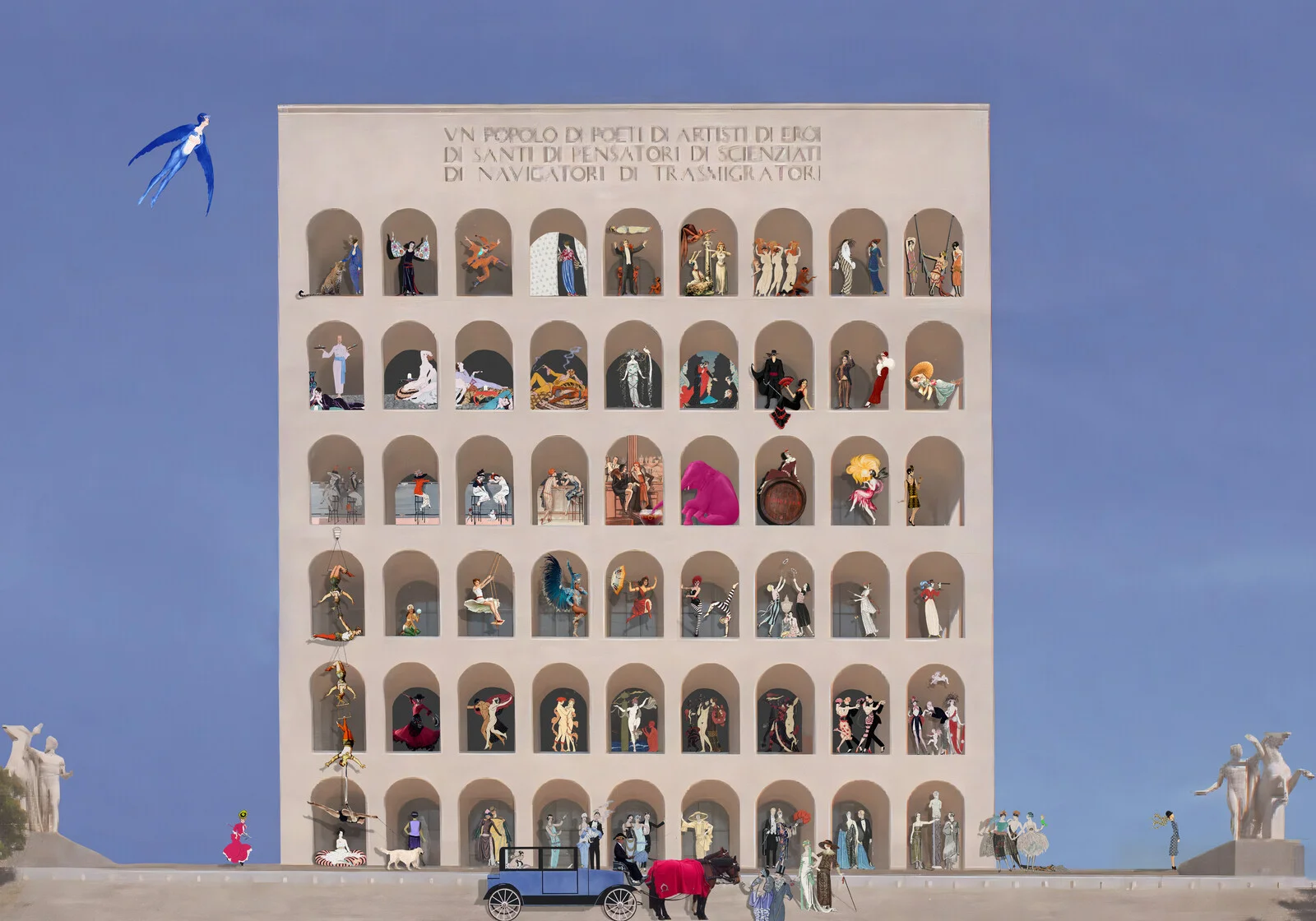
The party house Palazzo della Civiltà in Rome, 2023
Digital
100 x 70 cm
5 200 kr
My painting is about revelries, some more forbidden than others but most depicted, undoubtedly alluring to many. Humans have celebrated throughout time, even though the traces have long disappeared for most. Some parties have been preserved in oral tradition until they were recorded much later. The Bible contains some memorable ones, like when King Solomon raped Bathsheba at a party thousands of years ago. A few thousand years earlier, Eve's party with the forbidden fruit also made waves in the Garden of Eden at the dawn of time. It was held in a place overflowing with everything, with only the apple tree off-limits amidst streams of liquid honey and flowing rivers of wine. The guest list was short then; it was just a serpent and Eve with her fiancé Adam. After the incident with the apple, the party ended for a while, but later, descendants compensated so much that God unleashed the rain. The flood lasted 40 days and 40 nights, drowning everything and everyone who didn't make it onto Noah's ark. Humanity didn't learn any lessons and soon returned to their indulgences. And I can't help but chuckle at the thought of Eve's famous party in the Garden of Eden. Imagine that the apple was the only forbidden thing but the most tempting. And poor Noah! A 40-day party in the middle of a flood must have been quite a soaking experience. Perhaps it was God's way of getting people to stop partying so much! Unlike the Bible, we must curse King Solomon for raping Bathsheba at a party long before #MeToo. He deserved a good slap violent enough to send him into oblivion, not to an honoured place in the Bible.
Let’s face the history of Revelry making a whimsical journey through the Ages. Throughout history, the elite have indulged in extravagant forms of entertainment, from the ancient civilisations of Egypt and Babylon to the lavish courts of Europe and the opulent gatherings of New York's high society in the late 1800s and during the 1920s. Let us embark on a humorous exploration of the whims and excesses of the upper class, where feasting, debauchery, and eccentricity knew no bounds.
In ancient Egypt, the land of the pharaohs, the elite revelled in grand banquets adorned with delicacies fit for the gods themselves. Feasts were accompanied by music, dance, and copious amounts of wine. But perhaps most famously, the Egyptians delighted in elaborate games, including senet, a board game believed to represent the soul's journey through the afterlife.
The ancient Babylonians were renowned for their extravagant festivals and Bacchanalia, where the wealthy would gather to celebrate with feasting, music, and revelry. One particularly legendary event was the Feast of Belshazzar, described in the biblical Book of Daniel, where the king famously saw the writing on the wall during a drunken revelry.
The Grecian Grandeur didn’t lag. In classical Greece, symposia were the epitome of aristocratic entertainment. These lavish banquets combined philosophical discourse with excessive drinking and entertainment, often featuring performances by skilled musicians, dancers, and even acrobats. The philosopher Socrates was known to frequent such gatherings, engaging in lively debates amidst the revelry.
I especially want to mention two historical parties with a touch of myth and drama. Let's start with the real Greek Bacchanalia. In ancient Greece, Bacchanalia celebrations honoured the god Dionysus, known for wine, ecstasy, and excess. During these festivities, people gathered in forests and wilderness to dance, sing, and indulge in lavish meals and drinks. The highlight was when participants, inspired by Dionysus' liberation and intoxication, fell into an ecstatic trance. They believed that losing themselves in orgiastic behaviour could achieve spiritual renewal and connection with god. This was a true bacchanal of passion and joy, where social boundaries dissolved, and human instincts ran wild. It was not a party for the participants' wives, as they had to settle for naked girls and boys ready for action.
Rome took feasting to new heights of excess, with extravagant banquets known as "convivial" that could last for days. One notorious example is the banquet hosted by Emperor Nero, where guests dined on delicacies such as roasted peacock tongues and dormice stuffed with minced meat, nuts, and fish sauce.
The Romans were eager learners and adopted the Greek gods, renaming them, and embraced their festive habits to surpass their mentors. Nero's infamous orgies and excesses during his reign as Roman emperor have fascinated people for centuries. These scandalous events are a prime example of how eager the Romans were to outdo everything with the decadence and extravagant revelries typical of Nero's court. Guests included aristocrats, courtesans, and gladiators, and they would feast on exquisite food and drink, be entertained by theatre and music, and engage in all forms of indecent acts. These party bashes provide a dramatic insight into the corruption and moral decay that characterised Nero's rule while allowing us to explore his complex psyche and relationships with those closest to him. It was a tale of power, desire, and betrayal, where each character struggled to fulfil their ambitions and survive in a world where nothing was sacred. The theme is too good not to end up on film.
"Fellini Satyricon" is a 1969 film directed by Italian director Federico Fellini. The film is loosely based on Petronius' work "Satyricon," a Roman literary classic from the first century AD, which depicts the everyday life and decadence of people in ancient Rome. Fellini's version is known for its surrealistic and evocative style, blending the ancient world with imaginative elements and surreal scenes. The film explores themes of sexuality, power, and decadence and is considered one of Fellini's most provocative and visually striking works. "Fellini Satyricon" is a bold and controversial artistic expression that continues to fascinate and challenge viewers worldwide. A contemporary eyewitness summarised his visit. He managed to write it down before the wine made it impossible.
"The sun set over Rome's Palatine Hill, and the moon has risen over Nero's magnificent palace. On the grand terrace, aristocrats, artists, and courtesans from across the empire have gathered to attend Nero's grand feast. Oil lamps and torches illuminate the beautiful gardens with a soft glow as music echoes fill the air, and guests dance naked under the starry sky.
The tables are adorned with golden plates and silverware, and the abundance of exquisite food and wine is endless. Delicacies from across the empire are laid before the guests, and servants have scattered rose petals on the ground to welcome them. The list of dishes is as astounding as the feast itself. Hundreds of dishes, each more lavish than the last, but the smallest surpasses everything: Roasted Flamingo and Nightingale's tongues on the menu cut in marble. We didn't have pizza, pasta, tomatoes, or lemons, and garlic was only used medicinally.
Emperor Nero welcomed in all his glory, dressed in his most elaborate attire and with a crown of gemstones on his head. He is surrounded by his courtiers and received tributes and praise from his subjects. With a gesture, he guests to dance and enjoy the night. He pointed out that there was no nook in the palace too small for sex.
But behind the outward facade of revelry, the most erotic things happen by the detested Christians seen as forbidden acts taking place. Party poopers! That’s why we slaughter them in our arenas. Guests explore their innermost desires behind the drapes and in the shadows while courtesans and servants ensure that every wish is fulfilled. Nudity is a natural part of the party atmosphere, and passionate encounters and acts of love flourish around every corner. There is not a position in the world that isn't practised by these fucking couples, helter-skelter and gender by gender. It’s suitable for Roman nativity.
At the same time, the sounds of revelry mingle with the laughter and chatter of those whispering schemes in the shadows. Conspiracies and intrigues lurk around every corner, and dangers and betrayal hide beneath the surface of joy and abundance.
It is a night of enchantment and forbidden pleasure, where guests taste the decadence and luxury only the emperor can offer. But beneath the glow of the party's lights lay dark secrets and a sense of uncertainty about what tomorrow might bring. One must take tomorrow as it comes, and now I intend to partake in the orgies.”
In ancient Imperial China, the wealthy aristocracy indulged in sumptuous feasts accompanied by elaborate rituals and entertainment. Banquets served as opportunities for social networking and political manoeuvring, with hosts vying to outdo each other in displays of luxury and hospitality. That's how fireworks were invented.
As a Swede, I must highlight Viking Victuals. These feared warriors didn't hesitate to drink from glasses filled with solid mead. Even the fierce warriors of the Viking age knew how to enjoy a sound feast. Viking gatherings, known as "blóts," were lavish affairs where mead flowed freely, and guests feasted on roasted meats, fish, and wild game. These raucous celebrations often culminated in wild displays of strength and bravery, including feats of wrestling and axe-throwing. The parties were so intense that some brave Vikings departed for Valhalla prematurely.
Much later, Europe was hit by Viennese Wonders. The imperial court of Vienna was renowned for its extravagant balls and masquerades, where nobles and aristocrats would don elaborate costumes and masks to indulge in nights of revelry and romance. The opulent Hofburg Palace was the setting for many such events, where guests danced until dawn in a whirl of decadence and delight. Vienna danced and smiled while Europe lay in ashes during the Habsburg Wars.
Meanwhile, the archenemy amused themselves with French frolics. At the Court of Versailles, under the reign of Louis XIV, extravagant feasts and entertainments were staged to showcase the monarch's power and wealth. The palace gardens were transformed into elaborate theatrical productions with music, dance, and pyrotechnic displays that dazzled the senses. There was also plenty of rustling in the bushes and under flowing silk dresses. The wine was served in fountains in the park, giving the lovers a head start on their escapades.
Even later, we come to English Elegance, at least on the surface. The double standards were severe, and nudity existed only on the walls in the form of nymphs, and goddesses posed as the gods created them. But certainly, there was rustling under those wide skirts here as well. Those who paid for the party were enslaved people in the British Empire.
In Victorian England, the upper class indulged in elaborate dinner parties and balls, where guests donned their finest attire and mingled in opulent surroundings. These social events were carefully orchestrated affairs designed to showcase wealth, status, and refinement.
While the people starved, the nobility enjoyed Russian Revels. For understandable reasons, revolutionaries were not on the guest list. That injustice eventually cost the emperor and many aristocrats their lives.
In imperial Russia, the aristocracy hosted lavish banquets and balls that rivalled their European counterparts. The Winter Palace in St. Petersburg was the setting for many such events, where guests were treated to sumptuous feasts, dazzling entertainment, and extravagant displays of wealth and power.
New York's Extravagance around the turn of the last century outshone party lions of the past. In the Gilded Age of New York City, the elite indulged in extravagant masquerade balls and soirées that captured the imagination of society's brightest stars. From the opulent gatherings of the Astor family to the legendary parties hosted by the Vanderbilts, these events were spectacles of wealth, excess, and eccentricity.
From these few examples, one can draw a conclusion, which is what I wanted to show with my painting. Instead of busts in every arcade, guests entertain themselves in various ways, often fortified by alcohol and other stimulants. What is forbidden today was allowed back then; the more robust, the better.
From the ancient civilisations of Egypt and Babylon to the glittering soirées of New York's high society, the history of revelry is a testament to the enduring allure of excess and extravagance. While the forms of entertainment may have evolved over the centuries, one thing remains constant: the insatiable appetite of the elite for luxury, indulgence, and merriment. As we reflect on the whims and follies of the past, let us raise a glass to the enduring spirit of celebration that transcends time and place. Cheers to the history of revelry!
Here are some of the worst bashes in party history. It might be a terrifying read for many, but for some, perhaps exhilarating.
Get Ready to Party Like It's 587 BC!
When throwing legendary bashes, history has some wild tales to tell. Imagine being Belshazzar, the ultimate host of Babylon, who decided to take "sit down, be humble" to a new level by inviting 1,000 of his nearest and dearest for a grand feast. But here's the kicker: he whipped out the sacred goblets from Jerusalem's temple, swigging beer like it was nobody's business. Let's say things took a divine turn when the hand of God crashed the party, leaving Belshazzar without a kingdom or a pulse.
Setting Sail for a Boozy Adventure
Fast forward to 1694, when Admiral Russell of the Mediterranean fleet decided to redefine the term "drunk as a sailor" with his epic week-long cocktail extravaganza; think of five thousand invited sailors, a fountain overflowing with brandy wine punch, big enough for canoe-rowing bartenders to navigate. Talk about making a splash! And if you're looking to recreate the magic at home, all you need is a boatload of brandy, wine, lemons, and a sprinkle of nutmeg. Ahoy, mateys! If you want to recreate his party at home, you need more than 225 gallons of brandy, wine, six hundred kilos of sugar, 2,500 lemons, seventy-five litres of lime juice, and two kilos of nutmeg. It serves best as if James Bond would like it. You are shaken, not stirred or paddled. Then, sing the song that was written and sung that night.
What will we do with a drunken sailor?
What will we do with a drunken sailor?
What will we do with a drunken sailor?
Early in the morning!
Say Cheese!
Meanwhile, in 1836, President Andrew Jackson knew how to throw a genuinely great bash. When a dairy farmer gifted him a wheel of cheese the size of a small planet, Jackson didn't just let it gather dust – he aged it like a fine wine for a year in the White House. Then, he threw open the doors and invited the public to dig in during a birthday bash fit for a king. The only downside? The smell lingered longer than last night's regrets.
Riverboat Revelry
1923 Paris was excitedly buzzing as Igor Stravinsky’s ballet Les Noces premiered. But the real party wasn't on land – it was on a Seine river barge hosted by legendary party duo Gerald and Sara Murphy. Think Fitzgerald's Great Gatsby came to life with guests like Picasso, Fitzgerald himself, and even Stravinsky. With Sara's quirky decorations and Picasso's artistic flair, the night was a masterpiece. And let's not forget ‘the pièce de résistance’ – The not remarkably sober Stravinsky leapt through a giant laurel wreath at the end of the soirée.
A Presidential Party to Remember
JFK celebrated his 45th birthday with a Democratic fundraising rally of about 15,000 persons in Madison Square Garden. Jack Benny hosted, and performers included Ella Fitzgerald and Marilyn Monroe, dressed in a silver lamé dress fitting so tight that the naked body underneath might as well have been without the dress. To make her message, she sang a breathy, sultry rendition of "Happy Birthday," moving invitingly in what later became the world's most expensive dress.
A Surrealist Soirée
Ever showed up at a themed party with a flimsy mask, wishing for a dash of imagination? Well, get ready to have your wildest dreams come true. Marie-Hélène de Rothschild, known for her opulent soirées, outdid herself with a Surrealist Ball at Château Ferrières in December 1972. Eating on fur-covered dinner plates was no choice, and you had to get used to mannequin corpses as table decor and having fellow guests don deer masks adorned with diamond tears. Talk about joining Alice on a trip down the rabbit hole!
Horseplay at Studio 54
Of the many glamorous and epic parties held at Studio 54, Bianca Jagger's 30th birthday in 1977 comes out on top. Fashion designer Halston hosted and clothed the guest of honour, who — for the record — didn't ride the horse into Studio 54, as the legend goes. Jagger was too much of an animal lover to do that. She instead jumped up on it unplanned and had a nude man covered in gold glitter lead her and the white steed around the dance floor. We are sure the horse still really loved that.
A Metropolitan Mayhem
The 2014 Met Gala is epic because, without it, Solange, Jay-Z, Beyoncé, and their billions of dollars wouldn't have come together in the elevator brawl that launched one thousand musical hits. We can thank a 58-second security video clip for rocking the nation and altering the face of pop music forever.
A Bushwick Bash to Remember
Fashion designer Alexander Wang consistently threw the most epic parties of fashion week. It was no surprise when he brought the hype to Bushwick for a party flooding with champagne and a lot of doughnuts and droves of Kardashians and Jenners.
Time traveling party
The strangest party bash is one without visible guests. In 2009, the legendary Stephen Hawking decided to shake things up in science by throwing a champagne party. Just popping bottles and mingling wasn't enough for this genius! Nope, he had to spice things up with a mind-bending experiment.
So, what's this experiment, you ask? Strap in for a wild ride because it was none other than tackling the age-old question: Can humans time travel? Hawking went full-on Doc Brown and decided to test it out at his soiree.
Imagine ten bottles of fancy Krug champagne ready to be popped, balloons floating around, and Hawking himself decked out in his party best. Everything was set for a night to remember. But here's the kicker – no one showed up. And that's when things got interesting.
"I have experimental evidence that time travel is impossible," Hawking told reporters later. "I threw a bash for time-travellers, but get this – I didn't send out the invites until after the party. I waited, but it was just me and the champagne."
If a bunch of party-hopping time-travellers had crashed the scene, it would've been game over – proof that time travel is legit. But since the guest list was as empty as a black hole, it seems time travel might still be on the drawing board, at least for now.
And get this, Hawking even sent out invites for his shindig – to the past, no less! "You are cordially invited to a reception for time-travellers hosted by Professor Stephen Hawking," the invite read. "Held in the past, at the University of Cambridge Gonville & Caius College, Trinity Street, Cambridge." Talk about a party that's out of this world!
On the other hand, we believe that a black hole contains entire stars but is so densely packed that nothing can be seen or heard, nor can anyone escape from the party. Some sceptics claim the party might've occurred in an alternate reality timeline. But regardless of the naysayers, you've got to hand it to Hawking – he sure knew how to throw a killer party and make science fun!
I must not forget to present the venue for my historical bash. It is south of the Autostrada between Fiumicino Airport and Rome.
Ah, the Palazzo della Civiltà Italiana, or as it's colloquially known, the "Square Colosseum." If ever there was a building that embodied the grandiose aspirations and peculiarities of Italian Fascist architecture, this would be it. Built as part of Mussolini's grand plan to reshape Rome into a modern metropolis, the Palazzo stands as a monument to that era's glory and absurdity.
Inspired by the iconic Colosseum, Mussolini envisioned the Palazzo as a modern tribute to Rome's ancient glory. With its six rows of nine arches, the building's facade echoes the grandeur of its ancient counterpart, albeit with a distinct fascist twist. Legend has it that the number of arches corresponds to the letters in Mussolini's name, a subtle yet not-so-subtle nod to the dictator's influence over its construction.
Picture rows upon rows of majestic arches, rising like a modern-day Colosseum, but instead of hosting gladiatorial combat, it hosts... well, not much of anything. Despite Mussolini's grand vision, the Palazzo stood empty and unused for many years, like a giant white elephant in the EUR district.
The niches of the Colosseum, which were located around the amphitheatre, were once adorned with statues or busts of gods, emperors, and other prominent figures within the Roman Empire. These decorations enhanced the majestic atmosphere and symbolism of the Colosseum as a place of entertainment and power display. Mussolini thought it was a great idea. Legend has it that Mussolini insisted on having a bust of himself in every window of the Palazzo. Whether this is true or just a colourful exaggeration, we may never know for sure. But it certainly adds to the building's aura of eccentricity.
But let's not dwell too much on Mussolini's ego. The Palazzo has a charm all its own, even if it's a bit... unconventional. Clad entirely in travertine, it gleams like a beacon of Fascist ambition, its sheer enormity a testament to the regime's desire to leave its mark on Italian history.
Yet, for all its pomp and circumstance, the Palazzo remained largely empty, a symbol of the contradictions inherent in Fascist ideology. It was meant to represent the new Italy, the Italy of the future, yet it stood as a monument to a past that many would rather forget.
Since 2015, it has housed the headquarters of the Italian luxury fashion label Fendi, which will continue for at least 15 years. Fendi will reportedly pay 2.8 million euros per year to occupy the space.
Let's not get too philosophical here. The Palazzo may have a strange and storied past, but it's also undeniably iconic. With its rows of arches and its imposing presence, it's a reminder of a bygone era, for better or for worse. So the next time you find yourself in Rome, stroll through the EUR district and visit the Square Colosseum. Who knows, you might find yourself charmed by its peculiar charm.
Jörgen Thornberg
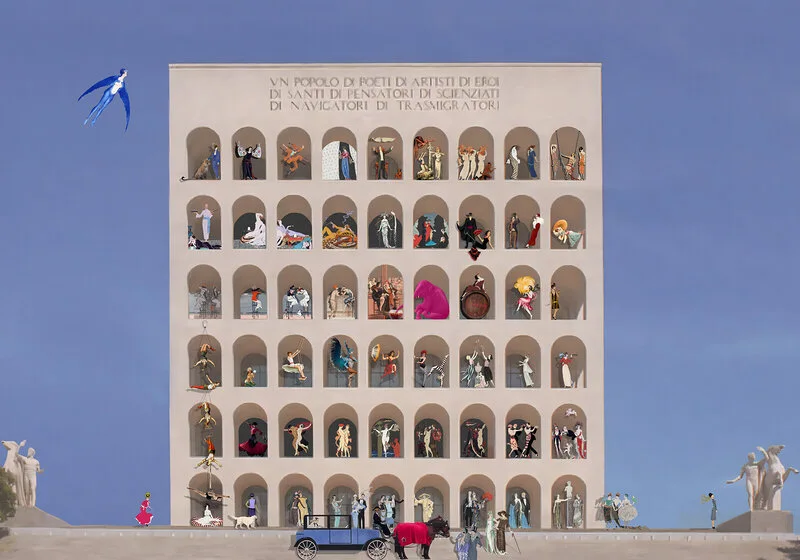
The party house Palazzo della Civiltà in Rome, 2023
Digital
100 x 70 cm
5 200 kr
My painting is about revelries, some more forbidden than others but most depicted, undoubtedly alluring to many. Humans have celebrated throughout time, even though the traces have long disappeared for most. Some parties have been preserved in oral tradition until they were recorded much later. The Bible contains some memorable ones, like when King Solomon raped Bathsheba at a party thousands of years ago. A few thousand years earlier, Eve's party with the forbidden fruit also made waves in the Garden of Eden at the dawn of time. It was held in a place overflowing with everything, with only the apple tree off-limits amidst streams of liquid honey and flowing rivers of wine. The guest list was short then; it was just a serpent and Eve with her fiancé Adam. After the incident with the apple, the party ended for a while, but later, descendants compensated so much that God unleashed the rain. The flood lasted 40 days and 40 nights, drowning everything and everyone who didn't make it onto Noah's ark. Humanity didn't learn any lessons and soon returned to their indulgences. And I can't help but chuckle at the thought of Eve's famous party in the Garden of Eden. Imagine that the apple was the only forbidden thing but the most tempting. And poor Noah! A 40-day party in the middle of a flood must have been quite a soaking experience. Perhaps it was God's way of getting people to stop partying so much! Unlike the Bible, we must curse King Solomon for raping Bathsheba at a party long before #MeToo. He deserved a good slap violent enough to send him into oblivion, not to an honoured place in the Bible.
Let’s face the history of Revelry making a whimsical journey through the Ages. Throughout history, the elite have indulged in extravagant forms of entertainment, from the ancient civilisations of Egypt and Babylon to the lavish courts of Europe and the opulent gatherings of New York's high society in the late 1800s and during the 1920s. Let us embark on a humorous exploration of the whims and excesses of the upper class, where feasting, debauchery, and eccentricity knew no bounds.
In ancient Egypt, the land of the pharaohs, the elite revelled in grand banquets adorned with delicacies fit for the gods themselves. Feasts were accompanied by music, dance, and copious amounts of wine. But perhaps most famously, the Egyptians delighted in elaborate games, including senet, a board game believed to represent the soul's journey through the afterlife.
The ancient Babylonians were renowned for their extravagant festivals and Bacchanalia, where the wealthy would gather to celebrate with feasting, music, and revelry. One particularly legendary event was the Feast of Belshazzar, described in the biblical Book of Daniel, where the king famously saw the writing on the wall during a drunken revelry.
The Grecian Grandeur didn’t lag. In classical Greece, symposia were the epitome of aristocratic entertainment. These lavish banquets combined philosophical discourse with excessive drinking and entertainment, often featuring performances by skilled musicians, dancers, and even acrobats. The philosopher Socrates was known to frequent such gatherings, engaging in lively debates amidst the revelry.
I especially want to mention two historical parties with a touch of myth and drama. Let's start with the real Greek Bacchanalia. In ancient Greece, Bacchanalia celebrations honoured the god Dionysus, known for wine, ecstasy, and excess. During these festivities, people gathered in forests and wilderness to dance, sing, and indulge in lavish meals and drinks. The highlight was when participants, inspired by Dionysus' liberation and intoxication, fell into an ecstatic trance. They believed that losing themselves in orgiastic behaviour could achieve spiritual renewal and connection with god. This was a true bacchanal of passion and joy, where social boundaries dissolved, and human instincts ran wild. It was not a party for the participants' wives, as they had to settle for naked girls and boys ready for action.
Rome took feasting to new heights of excess, with extravagant banquets known as "convivial" that could last for days. One notorious example is the banquet hosted by Emperor Nero, where guests dined on delicacies such as roasted peacock tongues and dormice stuffed with minced meat, nuts, and fish sauce.
The Romans were eager learners and adopted the Greek gods, renaming them, and embraced their festive habits to surpass their mentors. Nero's infamous orgies and excesses during his reign as Roman emperor have fascinated people for centuries. These scandalous events are a prime example of how eager the Romans were to outdo everything with the decadence and extravagant revelries typical of Nero's court. Guests included aristocrats, courtesans, and gladiators, and they would feast on exquisite food and drink, be entertained by theatre and music, and engage in all forms of indecent acts. These party bashes provide a dramatic insight into the corruption and moral decay that characterised Nero's rule while allowing us to explore his complex psyche and relationships with those closest to him. It was a tale of power, desire, and betrayal, where each character struggled to fulfil their ambitions and survive in a world where nothing was sacred. The theme is too good not to end up on film.
"Fellini Satyricon" is a 1969 film directed by Italian director Federico Fellini. The film is loosely based on Petronius' work "Satyricon," a Roman literary classic from the first century AD, which depicts the everyday life and decadence of people in ancient Rome. Fellini's version is known for its surrealistic and evocative style, blending the ancient world with imaginative elements and surreal scenes. The film explores themes of sexuality, power, and decadence and is considered one of Fellini's most provocative and visually striking works. "Fellini Satyricon" is a bold and controversial artistic expression that continues to fascinate and challenge viewers worldwide. A contemporary eyewitness summarised his visit. He managed to write it down before the wine made it impossible.
"The sun set over Rome's Palatine Hill, and the moon has risen over Nero's magnificent palace. On the grand terrace, aristocrats, artists, and courtesans from across the empire have gathered to attend Nero's grand feast. Oil lamps and torches illuminate the beautiful gardens with a soft glow as music echoes fill the air, and guests dance naked under the starry sky.
The tables are adorned with golden plates and silverware, and the abundance of exquisite food and wine is endless. Delicacies from across the empire are laid before the guests, and servants have scattered rose petals on the ground to welcome them. The list of dishes is as astounding as the feast itself. Hundreds of dishes, each more lavish than the last, but the smallest surpasses everything: Roasted Flamingo and Nightingale's tongues on the menu cut in marble. We didn't have pizza, pasta, tomatoes, or lemons, and garlic was only used medicinally.
Emperor Nero welcomed in all his glory, dressed in his most elaborate attire and with a crown of gemstones on his head. He is surrounded by his courtiers and received tributes and praise from his subjects. With a gesture, he guests to dance and enjoy the night. He pointed out that there was no nook in the palace too small for sex.
But behind the outward facade of revelry, the most erotic things happen by the detested Christians seen as forbidden acts taking place. Party poopers! That’s why we slaughter them in our arenas. Guests explore their innermost desires behind the drapes and in the shadows while courtesans and servants ensure that every wish is fulfilled. Nudity is a natural part of the party atmosphere, and passionate encounters and acts of love flourish around every corner. There is not a position in the world that isn't practised by these fucking couples, helter-skelter and gender by gender. It’s suitable for Roman nativity.
At the same time, the sounds of revelry mingle with the laughter and chatter of those whispering schemes in the shadows. Conspiracies and intrigues lurk around every corner, and dangers and betrayal hide beneath the surface of joy and abundance.
It is a night of enchantment and forbidden pleasure, where guests taste the decadence and luxury only the emperor can offer. But beneath the glow of the party's lights lay dark secrets and a sense of uncertainty about what tomorrow might bring. One must take tomorrow as it comes, and now I intend to partake in the orgies.”
In ancient Imperial China, the wealthy aristocracy indulged in sumptuous feasts accompanied by elaborate rituals and entertainment. Banquets served as opportunities for social networking and political manoeuvring, with hosts vying to outdo each other in displays of luxury and hospitality. That's how fireworks were invented.
As a Swede, I must highlight Viking Victuals. These feared warriors didn't hesitate to drink from glasses filled with solid mead. Even the fierce warriors of the Viking age knew how to enjoy a sound feast. Viking gatherings, known as "blóts," were lavish affairs where mead flowed freely, and guests feasted on roasted meats, fish, and wild game. These raucous celebrations often culminated in wild displays of strength and bravery, including feats of wrestling and axe-throwing. The parties were so intense that some brave Vikings departed for Valhalla prematurely.
Much later, Europe was hit by Viennese Wonders. The imperial court of Vienna was renowned for its extravagant balls and masquerades, where nobles and aristocrats would don elaborate costumes and masks to indulge in nights of revelry and romance. The opulent Hofburg Palace was the setting for many such events, where guests danced until dawn in a whirl of decadence and delight. Vienna danced and smiled while Europe lay in ashes during the Habsburg Wars.
Meanwhile, the archenemy amused themselves with French frolics. At the Court of Versailles, under the reign of Louis XIV, extravagant feasts and entertainments were staged to showcase the monarch's power and wealth. The palace gardens were transformed into elaborate theatrical productions with music, dance, and pyrotechnic displays that dazzled the senses. There was also plenty of rustling in the bushes and under flowing silk dresses. The wine was served in fountains in the park, giving the lovers a head start on their escapades.
Even later, we come to English Elegance, at least on the surface. The double standards were severe, and nudity existed only on the walls in the form of nymphs, and goddesses posed as the gods created them. But certainly, there was rustling under those wide skirts here as well. Those who paid for the party were enslaved people in the British Empire.
In Victorian England, the upper class indulged in elaborate dinner parties and balls, where guests donned their finest attire and mingled in opulent surroundings. These social events were carefully orchestrated affairs designed to showcase wealth, status, and refinement.
While the people starved, the nobility enjoyed Russian Revels. For understandable reasons, revolutionaries were not on the guest list. That injustice eventually cost the emperor and many aristocrats their lives.
In imperial Russia, the aristocracy hosted lavish banquets and balls that rivalled their European counterparts. The Winter Palace in St. Petersburg was the setting for many such events, where guests were treated to sumptuous feasts, dazzling entertainment, and extravagant displays of wealth and power.
New York's Extravagance around the turn of the last century outshone party lions of the past. In the Gilded Age of New York City, the elite indulged in extravagant masquerade balls and soirées that captured the imagination of society's brightest stars. From the opulent gatherings of the Astor family to the legendary parties hosted by the Vanderbilts, these events were spectacles of wealth, excess, and eccentricity.
From these few examples, one can draw a conclusion, which is what I wanted to show with my painting. Instead of busts in every arcade, guests entertain themselves in various ways, often fortified by alcohol and other stimulants. What is forbidden today was allowed back then; the more robust, the better.
From the ancient civilisations of Egypt and Babylon to the glittering soirées of New York's high society, the history of revelry is a testament to the enduring allure of excess and extravagance. While the forms of entertainment may have evolved over the centuries, one thing remains constant: the insatiable appetite of the elite for luxury, indulgence, and merriment. As we reflect on the whims and follies of the past, let us raise a glass to the enduring spirit of celebration that transcends time and place. Cheers to the history of revelry!
Here are some of the worst bashes in party history. It might be a terrifying read for many, but for some, perhaps exhilarating.
Get Ready to Party Like It's 587 BC!
When throwing legendary bashes, history has some wild tales to tell. Imagine being Belshazzar, the ultimate host of Babylon, who decided to take "sit down, be humble" to a new level by inviting 1,000 of his nearest and dearest for a grand feast. But here's the kicker: he whipped out the sacred goblets from Jerusalem's temple, swigging beer like it was nobody's business. Let's say things took a divine turn when the hand of God crashed the party, leaving Belshazzar without a kingdom or a pulse.
Setting Sail for a Boozy Adventure
Fast forward to 1694, when Admiral Russell of the Mediterranean fleet decided to redefine the term "drunk as a sailor" with his epic week-long cocktail extravaganza; think of five thousand invited sailors, a fountain overflowing with brandy wine punch, big enough for canoe-rowing bartenders to navigate. Talk about making a splash! And if you're looking to recreate the magic at home, all you need is a boatload of brandy, wine, lemons, and a sprinkle of nutmeg. Ahoy, mateys! If you want to recreate his party at home, you need more than 225 gallons of brandy, wine, six hundred kilos of sugar, 2,500 lemons, seventy-five litres of lime juice, and two kilos of nutmeg. It serves best as if James Bond would like it. You are shaken, not stirred or paddled. Then, sing the song that was written and sung that night.
What will we do with a drunken sailor?
What will we do with a drunken sailor?
What will we do with a drunken sailor?
Early in the morning!
Say Cheese!
Meanwhile, in 1836, President Andrew Jackson knew how to throw a genuinely great bash. When a dairy farmer gifted him a wheel of cheese the size of a small planet, Jackson didn't just let it gather dust – he aged it like a fine wine for a year in the White House. Then, he threw open the doors and invited the public to dig in during a birthday bash fit for a king. The only downside? The smell lingered longer than last night's regrets.
Riverboat Revelry
1923 Paris was excitedly buzzing as Igor Stravinsky’s ballet Les Noces premiered. But the real party wasn't on land – it was on a Seine river barge hosted by legendary party duo Gerald and Sara Murphy. Think Fitzgerald's Great Gatsby came to life with guests like Picasso, Fitzgerald himself, and even Stravinsky. With Sara's quirky decorations and Picasso's artistic flair, the night was a masterpiece. And let's not forget ‘the pièce de résistance’ – The not remarkably sober Stravinsky leapt through a giant laurel wreath at the end of the soirée.
A Presidential Party to Remember
JFK celebrated his 45th birthday with a Democratic fundraising rally of about 15,000 persons in Madison Square Garden. Jack Benny hosted, and performers included Ella Fitzgerald and Marilyn Monroe, dressed in a silver lamé dress fitting so tight that the naked body underneath might as well have been without the dress. To make her message, she sang a breathy, sultry rendition of "Happy Birthday," moving invitingly in what later became the world's most expensive dress.
A Surrealist Soirée
Ever showed up at a themed party with a flimsy mask, wishing for a dash of imagination? Well, get ready to have your wildest dreams come true. Marie-Hélène de Rothschild, known for her opulent soirées, outdid herself with a Surrealist Ball at Château Ferrières in December 1972. Eating on fur-covered dinner plates was no choice, and you had to get used to mannequin corpses as table decor and having fellow guests don deer masks adorned with diamond tears. Talk about joining Alice on a trip down the rabbit hole!
Horseplay at Studio 54
Of the many glamorous and epic parties held at Studio 54, Bianca Jagger's 30th birthday in 1977 comes out on top. Fashion designer Halston hosted and clothed the guest of honour, who — for the record — didn't ride the horse into Studio 54, as the legend goes. Jagger was too much of an animal lover to do that. She instead jumped up on it unplanned and had a nude man covered in gold glitter lead her and the white steed around the dance floor. We are sure the horse still really loved that.
A Metropolitan Mayhem
The 2014 Met Gala is epic because, without it, Solange, Jay-Z, Beyoncé, and their billions of dollars wouldn't have come together in the elevator brawl that launched one thousand musical hits. We can thank a 58-second security video clip for rocking the nation and altering the face of pop music forever.
A Bushwick Bash to Remember
Fashion designer Alexander Wang consistently threw the most epic parties of fashion week. It was no surprise when he brought the hype to Bushwick for a party flooding with champagne and a lot of doughnuts and droves of Kardashians and Jenners.
Time traveling party
The strangest party bash is one without visible guests. In 2009, the legendary Stephen Hawking decided to shake things up in science by throwing a champagne party. Just popping bottles and mingling wasn't enough for this genius! Nope, he had to spice things up with a mind-bending experiment.
So, what's this experiment, you ask? Strap in for a wild ride because it was none other than tackling the age-old question: Can humans time travel? Hawking went full-on Doc Brown and decided to test it out at his soiree.
Imagine ten bottles of fancy Krug champagne ready to be popped, balloons floating around, and Hawking himself decked out in his party best. Everything was set for a night to remember. But here's the kicker – no one showed up. And that's when things got interesting.
"I have experimental evidence that time travel is impossible," Hawking told reporters later. "I threw a bash for time-travellers, but get this – I didn't send out the invites until after the party. I waited, but it was just me and the champagne."
If a bunch of party-hopping time-travellers had crashed the scene, it would've been game over – proof that time travel is legit. But since the guest list was as empty as a black hole, it seems time travel might still be on the drawing board, at least for now.
And get this, Hawking even sent out invites for his shindig – to the past, no less! "You are cordially invited to a reception for time-travellers hosted by Professor Stephen Hawking," the invite read. "Held in the past, at the University of Cambridge Gonville & Caius College, Trinity Street, Cambridge." Talk about a party that's out of this world!
On the other hand, we believe that a black hole contains entire stars but is so densely packed that nothing can be seen or heard, nor can anyone escape from the party. Some sceptics claim the party might've occurred in an alternate reality timeline. But regardless of the naysayers, you've got to hand it to Hawking – he sure knew how to throw a killer party and make science fun!
I must not forget to present the venue for my historical bash. It is south of the Autostrada between Fiumicino Airport and Rome.
Ah, the Palazzo della Civiltà Italiana, or as it's colloquially known, the "Square Colosseum." If ever there was a building that embodied the grandiose aspirations and peculiarities of Italian Fascist architecture, this would be it. Built as part of Mussolini's grand plan to reshape Rome into a modern metropolis, the Palazzo stands as a monument to that era's glory and absurdity.
Inspired by the iconic Colosseum, Mussolini envisioned the Palazzo as a modern tribute to Rome's ancient glory. With its six rows of nine arches, the building's facade echoes the grandeur of its ancient counterpart, albeit with a distinct fascist twist. Legend has it that the number of arches corresponds to the letters in Mussolini's name, a subtle yet not-so-subtle nod to the dictator's influence over its construction.
Picture rows upon rows of majestic arches, rising like a modern-day Colosseum, but instead of hosting gladiatorial combat, it hosts... well, not much of anything. Despite Mussolini's grand vision, the Palazzo stood empty and unused for many years, like a giant white elephant in the EUR district.
The niches of the Colosseum, which were located around the amphitheatre, were once adorned with statues or busts of gods, emperors, and other prominent figures within the Roman Empire. These decorations enhanced the majestic atmosphere and symbolism of the Colosseum as a place of entertainment and power display. Mussolini thought it was a great idea. Legend has it that Mussolini insisted on having a bust of himself in every window of the Palazzo. Whether this is true or just a colourful exaggeration, we may never know for sure. But it certainly adds to the building's aura of eccentricity.
But let's not dwell too much on Mussolini's ego. The Palazzo has a charm all its own, even if it's a bit... unconventional. Clad entirely in travertine, it gleams like a beacon of Fascist ambition, its sheer enormity a testament to the regime's desire to leave its mark on Italian history.
Yet, for all its pomp and circumstance, the Palazzo remained largely empty, a symbol of the contradictions inherent in Fascist ideology. It was meant to represent the new Italy, the Italy of the future, yet it stood as a monument to a past that many would rather forget.
Since 2015, it has housed the headquarters of the Italian luxury fashion label Fendi, which will continue for at least 15 years. Fendi will reportedly pay 2.8 million euros per year to occupy the space.
Let's not get too philosophical here. The Palazzo may have a strange and storied past, but it's also undeniably iconic. With its rows of arches and its imposing presence, it's a reminder of a bygone era, for better or for worse. So the next time you find yourself in Rome, stroll through the EUR district and visit the Square Colosseum. Who knows, you might find yourself charmed by its peculiar charm.
5 200 kr

Jörgen Thornberg
Malmö
Lite om bilder och mig. Translation in English at the end.
Jag är en nyfiken person som ser allt i bilder, även det jag fäster i ord, gärna tillsammans för bakom alla mina bilder finns en berättelse. Till vissa bilder hör en kortare eller längre novell som följer med bilden.
Bilder berättar historier. Jag omges av naturlig skönhet, intressanta människor och historia var jag än går. Jag använder min kamera för att dokumentera världen och blanda det jag ser med vad jag känner för att fånga den dolda magin.
Mina bilder berättar mina historier. Genom mina bilder, tryck och berättelser. Jag bjuder in dig att ta del av dessa berättelser, in i ditt liv och hem och dela min mycket personliga syn på vår värld. Mer än vad ögat ser. Jag tänker i bilder, drömmer och skriver och pratar om dem; följaktligen måste jag också skapa bilder. De blir vad jag ser, inte nödvändigtvis begränsade till verkligheten. Det finns en bild runt varje hörn. Jag hoppas att du kommer att se vad jag såg och gilla det.
Jag är också en skrivande person och till många bilder hör en kortare eller längre essay. Den följer med tavlan, tryckt på fint papper och med en personlig hälsning från mig.
Flertalet bilder startar sin resa i min kamera. Enkelt förklarat beskriver jag bilden jag ser i mitt inre, upplevd eller fantiserad. Bilden uppstår inom mig redan innan jag fått okularet till ögat. På bråkdelen av ett ögonblick ser jag vad jag vill ha och vad som kan göras med bilden. Här skall jag stoppa in en giraff, stålmannen, Titanic eller vad det är min fantasi finner ut. Ännu märkligare är att jag kommer ihåg minnesbilden långt efteråt när det blir tid att skapa verket. Om jag lyckas eller inte, är upp till betraktaren, oftast präglat av en stråk av svart humor – meningen är att man skall bli underhållen. Mina bilder blir ofta en snackis där de hänger.
Jag föredrar bilder som förmedlar ett budskap i flera lager. Vid första anblicken fylld av feel-good, en vacker utsikt, fint väder, solen skiner, blommor på ängen eller vattnet som ligger förrädiskt spegelblankt. I en sådan bild kan jag gömma min egentliga berättelse, mitt förakt för förtryckare och våldsverkare, rasister och fördomsfulla människor - ett gärna återkommande motiv mer eller mindre dolt i det vackra motivet. Jag försöker förena dem i ett gemensamt narrativ.
Bild och formgivning har löpt som en röd tråd genom livet. Fotokonst känns som en värdig final som jag gärna delar med mig.
Min genre är vid som framgår av mina bilder, temat en blandning av pop- och gatukonst i kollage som kan bestå av hundratals lager. Vissa bilder kan ta veckor, andra någon dag innan det är dags att överlämna resultatet till printverkstaden. Fine Art Prints är digitala fotocollage. I dessa kollage sker rivandet, klippandet, pusslandet, målandet, ritandet och sprayningen digitalt. Det jag monterar in kan vara hundratals år gamla bilder som jag omsorgsfullt frilägger så att de ser ut att vara en del av tavlan men också bilder skapade av mig själv efter min egen fantasi. Därefter besöks printstudion och för vissa bilder numrera en limiterad upplaga (oftast 7 exemplar) och signera för hand. Vissa bilder kan köpas i olika format. Det är bara att fråga efter vilka. Gillar man en bild som är 70x100 men inte har plats på väggen, går den kanske att få i 50x70 cm istället. Frågan är fri.
Metoden Giclée eller Fine Art Print som det också kallas är det moderna sättet för framställning av grafisk konst. Villkoret för denna typ av utskrifter är att en högkvalitativ storformatskrivare används med åldersbeständigt färgpigment och konstnärspapper eller i förekommande fall på duk. Pappret som används möter de krav på livslängd som ställs av museer och gallerier. Normalt säljer jag mina bilder oinramade så att den nya ägaren själv kan bestämma hur de skall se ut, med eller utan passepartout färg på ram, med eller utan glas etc..
Under många år ställde jag bara ut på nätet, i valda grupper och på min egen Facebooksida - https://www.facebook.com/jorgen.thornberg.9
Jag finns också på en egen hemsida som tyvärr inte alltid är uppdaterad – https://www.jth.life/ Där kan du också läsa en del av de berättelser som följer med bilden.
UTSTÄLLNINGAR
Luftkastellet, oktober 2022
Konst i Lund, november 2022
Luftkastellet, mars 2023
Engleson Galleri Caroli, april 2023
Hydra, Greece June 2023
Engleson Galleri Caroli, oktober 2023
Toppen, Höllviken december 2023
Luftkastellet, mars 2024
Torups Galleri, mars 2024
Venice, May 2024
Luftkastellet, oktober 2024
Konst i Advent, December 2024
Galleri Engleson, Caroli December 2024
Jäger & Jansson Galleri, april 2025
A bit about pictures and me.
I'm a curious person who sees everything in pictures, even what I express in words, often combining them, for behind all my pictures lies a story. These narratives, some as short as a single image and others as long as a novel, are the heart and soul of my work.
Pictures tell stories. Wherever I go, I'm surrounded by natural beauty, exciting people, and history. I use my camera to document the world and blend what I see with what I feel to capture the hidden magic.
My images tell my stories. Through my pictures, prints, and narratives, I invite you to partake in these stories in your life and home and share my deeply personal perspective of our world. More than meets the eye. I think in pictures, dream, write, and talk about them; consequently, I must create images too. They become what I see, not necessarily confined to reality. There's a picture around every corner. I hope you'll see what I saw and enjoy it.
I'm also a writer, and many images come with a shorter or longer essay. It accompanies the painting, printed on fine paper with my personal greeting.
Many pictures start their journey on my camera. Simply put, I describe the image I see in my mind, experienced or imagined. The image arises within me even before I bring the eyepiece to my eye. In a fraction of a moment, I see what I want and what can be done with the picture. Here, I'll insert a giraffe, Superman, the Titanic, or whatever my imagination conjures up. Even stranger is that I remember the mental image long after it's time to create the work. Whether I succeed is up to the observer, often imbued with a streak of black humour – the aim is to entertain. My pictures usually become a talking point wherever they hang.
I prefer pictures that convey a message in multiple layers. At first glance, they're filled with feel-good vibes, a beautiful view, lovely weather, the sun shining, flowers in the meadow, or the water lying deceptively calm. But beneath this surface beauty, I often conceal a deeper story, a narrative that challenges societal norms or explores the human condition. I invite you to delve into these hidden narratives and discover the layers of meaning within my work.
Picture and design have been a thread running through my life. Photographic art feels like a fitting finale, and I'm happy to share it.
My genre is varied, as seen in my pictures; the theme is a blend of pop and street art in collages that can consist of hundreds of layers. Some images can take weeks, others just a day before it's time to hand over the result to the print workshop. Fine Art Prints are digital photo collages. In these collages, tearing, cutting, puzzling, painting, drawing, and spraying happen digitally. What I insert can be images hundreds of years old that I carefully extract so they appear to be part of the painting, but also images created by myself, now also generated from my imagination. Next, visit the print studio and, for certain images, number a limited edition (usually 7 copies) and sign them by hand. Some images may be available in other formats. Just ask which ones. If you like an image that's 70x100 but doesn't have space on the wall, you might be able to get it in 50x70 cm instead. The question is open.
The Giclée method, or Fine Art Print as it's also called, is the modern way of producing graphic art. This method ensures the highest quality and longevity of the artwork, using a high-quality large-format printer with archival pigment inks and artist paper or, in some cases, canvas. The paper used meets the longevity requirements set by museums and galleries. I sell my pictures unframed, allowing the new owner to personalise their artwork, confident in the lasting value and quality of the piece.
For many years, I only exhibited online, in selected groups, and on my Facebook page - https://www.facebook.com/jorgen.thornberg.9. I also have my website, which unfortunately is not constantly updated - https://www.jth.life/. You can also read some of the stories accompanying the pictures there.
EXHIBITIONS
Luftkastellet, October 2022
Art in Lund, November 2022
Luftkastellet, March 2023
Engleson Gallery Caroli, April 2023
Hydra, Greece June 2023
Engleson Gallery Caroli, October 2023
Toppen, Höllviken December 2023
Luftkastellet, March 2024
Torup Gallery, March 2024
Venice, May 2024
UTSTÄLLNINGAR
Luftkastellet, oktober 2022
Konst i Lund, november 2022
Luftkastellet, mars 2023
Engleson Galleri Caroli, april 2023
Hydra, Greece June 2023
Engleson Galleri Caroli, oktober 2023
Toppen, Höllviken december 2023
Luftkastellet, mars 2024
Torups Galleri, mars 2024
Venice, May 2024
Luftkastellet, October 2024
Konst i Advent, December 2024
Galleri Engleson, Caroli December 2024
Jäger & Jansson Galleri, April 2025
Utbildning
Autodidakt
Medlem i konstnärsförening
Öppna Sinnen
Med i konstrunda
Konstrundan i Skåne
Utställningar
Luftkastellet, October 2022
Art in Lund, November 2022
Luftkastellet, March 2023
Engleson Gallery Caroli, April 2023
Hydra, Greece June 2023
Engleson Gallery Caroli, October 2023
Toppen, Höllviken December 2023
Luftkastellet, March 2024
Torup Gallery, March 2024
Venice, May 2024