Vi använder cookies för att ge dig bästa möjliga upplevelse. Välj vilka cookies du tillåter.
Läs mer i vår integritetspolicy
Jörgen Thornberg
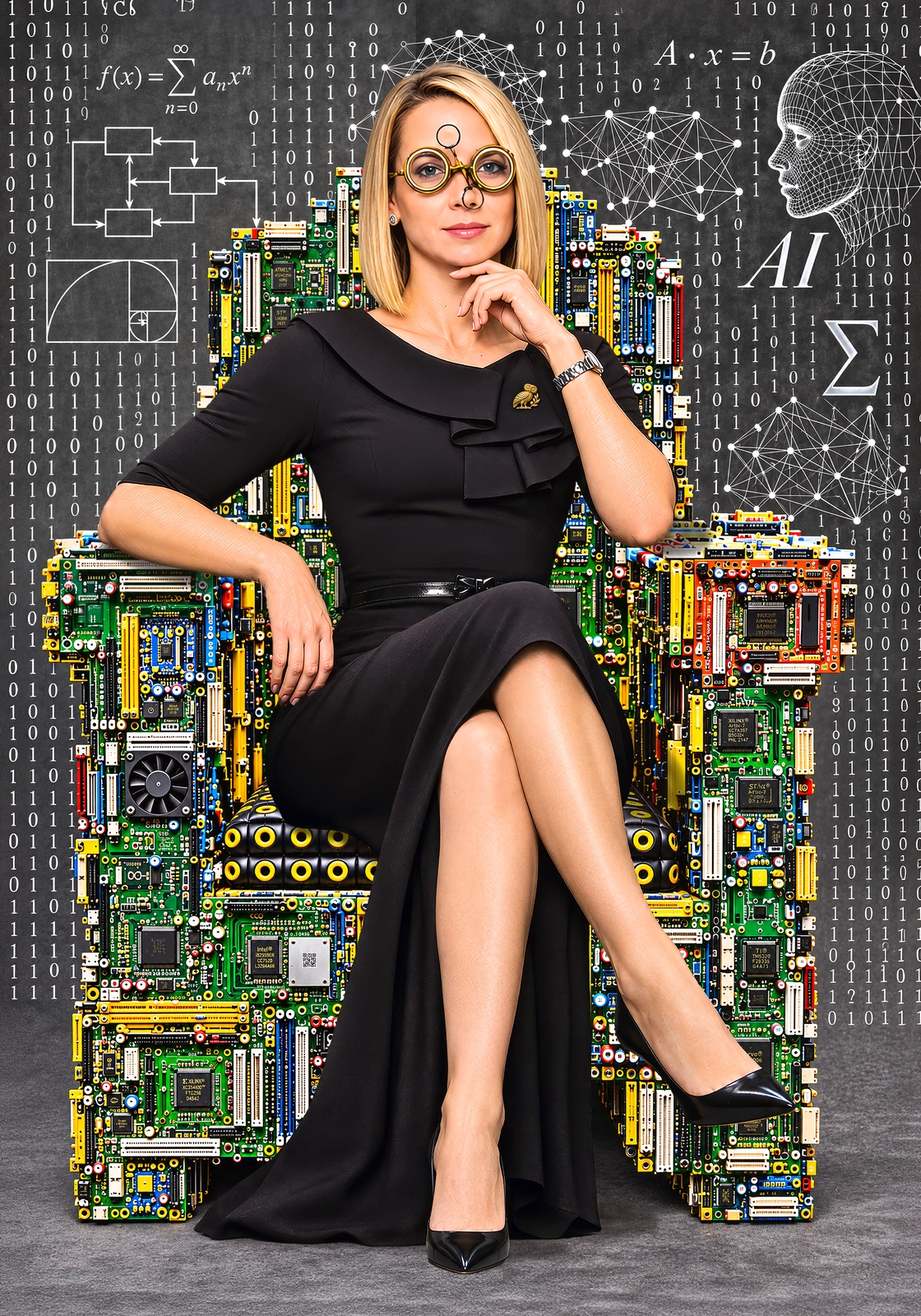
The Queen of Search, 2026
Digital
50 × 70 cm
2 900 kr
The Queen of Search
INTRODUCTION
Some women change history without ever setting out to become symbols of a movement. Through intelligence, determination, and personal achievement, they cross boundaries that earlier generations struggled to overcome. Yet they do not necessarily identify with the causes that made their success possible.
Marissa Mayer is one of these women. As Google's first female software engineer and later as chief executive of Yahoo, she reached the highest levels of an industry long dominated by men. She became a role model for what women could achieve in the technology sector, while firmly rejecting the label of feminist.
This paradox invites both admiration and reflection. Can a woman embody feminism’s achievements without embracing its identity? Can individual success be separated from the collective struggle that made it possible? And perhaps most intriguingly, who has the right to decide whether a woman is a feminist – society, history, or the woman herself?
The poem “The Feminist Who Wasn't” explores this contradiction with a touch of irony. At the same time, the essay that follows traces the remarkable life of a woman who challenged Silicon Valley, questioned conventional labels, and chose to define herself on her own terms.
“Ophelia – From Shakespeare to Chicago
Beneath the willow, where the waters weep,
Fair Ophelia lay among the flowers of spring;
While Shakespeare sent her to the silent deep,
Her fading lips remembered how to sing.
Then Millais gave her beauty, pale and bright,
And held her in a dream that would not end;
Four hundred years she slept beyond the light,
Until young Taylor came to be her friend.
From Taylor's bath she rose to greet the day,
And left behind the sorrow of her fate;
To Chicago's golden fountain made her way,
Where love and life beside the waters wait.
Now Buckingham's bright waters softly gleam,
And Ophelia lives beyond her ancient dream.”
Malmö, November 2026
Marissa Mayer – The Woman Who Challenged Silicon Valley
Prolouge
Some people change the world without ever wishing to become symbols of anything beyond their own achievements. They do not seek to be pioneers, revolutionaries, or representatives of a social movement. Yet that is precisely what they become, because their lives and accomplishments challenge long-held assumptions. Marissa Mayer belongs to this category. She became one of the first female engineers at Google, rose to the top of the American technology industry, and, at 37, was appointed chief executive officer of the internet giant Yahoo. She accomplished all this in a world where men dominated both programming and corporate boardrooms.
But when asked whether she considered herself a feminist, her answer was surprising. No, she did not. She believed in gender equality, equal rights, and women's ability to compete with men in every field. Still, she did not want to be associated with a feminism she saw as militant and overly concerned with conflict between the sexes. This position provoked both surprise and criticism, not least because she herself had become a role model for the very emancipation of women for which feminism had long fought.
Marissa Mayer's story is therefore more than a simple tale of a successful programmer and business executive. It is about talent and ambition, power and setbacks, femininity and identity, and a fundamental question: Must a woman who breaks through a male monopoly on power also consider herself a feminist?
The Girl Who Did Not Know She Was Different
Marissa Ann Mayer was born on May 30, 1975, in Wausau, Wisconsin, in the United States. Her father was an engineer, and her mother an art teacher, a combination that, almost remarkably, foreshadowed their daughter's future interests. She grew up in an environment where mathematics and science could coexist with music, dance, colour, and design. Even as a child, she displayed an unusual ability to combine the analytical with the aesthetic, two qualities that would later prove crucial to her work on some of the world's most widely used digital services.
What was remarkable was that, during her childhood, she hardly considered her interest in mathematics and technology unusual for a girl. Her teachers encouraged her, and, by her own account, she faced few of the expectations that might otherwise have limited young women's educational and professional choices. When she later began studying at Stanford University, where she earned a degree in Symbolic Systems followed by a master's in computer science specialising in artificial intelligence, she continued to regard herself primarily as a student and future engineer.
Only during her advanced computer science studies did she fully realise how few women were around her. In a 2024 interview with Wired magazine, she recalled that the student newspaper had drawn attention to the female student in certain courses, and she didn't immediately realise it referred to her. She had never learned to regard her gender as a limitation or her presence as particularly remarkable.
That experience helps explain her later attitude to feminism. For Mayer, success was less about overcoming a system of gender-related obstacles than about being allowed to develop her interests and use her abilities. She knew other women had faced far greater difficulties, yet her own life had instilled in her a strong belief in individual opportunity and personal achievement.
GOOGLE and the New Digital World
When Marissa Mayer joined Google in 1999, the company was still a small, little-known technology venture. She became its twentieth employee and its first female software engineer. The internet was experiencing explosive growth, and the young entrepreneurs Larry Page and Sergey Brin had set themselves the task of organising the world's information and making it accessible to everyone.
Mayer remained with the company for thirteen years. During that time, Google evolved from a promising experiment into one of the world's most powerful companies, and she took on significant responsibility for developing its products and user experiences. She worked on the search engine, Google Maps, Gmail, and Google News, among other products, and became known for combining advanced technology with simple, appealing design.
It was no coincidence that an almost demonstrative simplicity long characterised Google's search page. Mayer was among those who understood that the best technology is not necessarily the one that displays its complexity, but rather the one that conceals it behind an intuitive, easy-to-understand interface. Behind every colour choice, every button, and every small adjustment lay extensive analyses of how people actually used the services.
At the same time, she became an influential leader and mentor to younger product managers. Her career became living proof that women could reach senior positions in an industry where they were still severely underrepresented. But Mayer wanted to be judged above all for her technical and organisational achievements. She was an engineer and business executive, not primarily a woman engineer or a woman business executive.
The Feminism She Did Not Want to Belong To
As early as 2011, in an interview for the documentary project “Makers: Women Who Make America”, Mayer expressed a view that would later make her a controversial figure in the American debate over gender equality. When asked whether she considered herself a feminist, she replied:
“I don't think I would consider myself a feminist.”
The statement attracted considerable attention when it was published in 2013. Mayer explained that she naturally believed in equal rights and opportunities for women and men, but she associated feminism with a militant, negative attitude she did not identify with. She did not want to frame her life as a conflict between the sexes and believed that individual ability should take centre stage.
The position could seem contradictory. Here was a woman who had risen higher than almost anyone else in one of the world's most male-dominated industries, yet had distanced herself from the movement that had worked for generations to secure such opportunities for women in the first place.
When journalist Virginia Heffernan revisited the subject in Wired in October 2024, Mayer had not altered her fundamental position. She explained that, even as a teenager, she had viewed feminism as overly militant and still preferred to emphasise competence and individual merit rather than gender. At the same time, she expressed strong admiration for successful women and female role models, including gymnast Simone Biles and singer Taylor Swift.
However, an important distinction exists between feminism as a principle and feminism as an identity. If the term means that women and men should have the same rights, opportunities, and worth, Mayer's stated convictions closely align with feminism's core principles. But if feminism also entails identifying with a political and social movement, her rejection of the label is unmistakable.
Her position therefore raises a question that extends far beyond her own life. Can a woman realise the goals of feminism without wishing to belong to feminism? And is it possible that her relatively privileged upbringing made it more difficult for her to understand the structural barriers other women encounter fully?
YAHOO – From Triumph to Disappointment
In July 2012, Marissa Mayer was appointed chief executive officer of Yahoo. She was 37 and pregnant with her first child. The appointment made international headlines not only because she was one of the technology industry's most prominent women, but also because she was expected to rescue a company that had once pioneered the internet.
Yahoo had been losing ground for years, particularly to Google and Facebook. The company struggled to find its identity in a digital world that was changing faster than its management could keep pace. Mayer attempted a comprehensive modernisation, improving mobile products, enhancing the user experience, and fostering a more cohesive corporate culture.
She also oversaw numerous acquisitions, including the purchase of the blogging platform Tumblr. The aim was to equip Yahoo with new technical expertise, a younger user base, and greater relevance in the rapidly expanding mobile market. However, the results were mixed. Some products improved, and the mobile business grew, but the company's underlying problems remained.
Critics argued that she had invested too heavily in acquisitions and too little in building a sustainable business model. Others maintained that she had inherited a company whose decline had already progressed so far that a genuine recovery was barely possible. When Verizon bought Yahoo's core internet business in 2017, it became clear that her attempt to restore the company to its former position had failed.
At the same time, the picture is more complicated than a simple failure. During this period, Yahoo's shareholders also benefited from the company's substantial stake in the Chinese internet group Alibaba, whose value rose sharply. Mayer has since emphasised that Yahoo's core problem was starting the necessary transition to mobile technology several years too late.
Motherhood and the Great Contradiction
Perhaps the most widely discussed controversy during Mayer's time at Yahoo concerned not the company's finances but her views on work, motherhood, and family life.
In 2009, she married investor Zachary Bogue. When the couple's first child was born in 2012, she took only about two weeks' maternity leave. She also had a nursery installed next to her office, at her own expense, so she could care for her child while fulfilling her duties as chief executive officer. The couple later had twin daughters.
To some, she seemed a role model for the modern professional woman, refusing to accept that motherhood should curtail her ambitions. To others, her situation highlighted the stark divide between an exceptionally well-paid corporate executive and ordinary working parents.
Criticism intensified in 2013 when Yahoo sharply restricted employees' ability to work from home. Mayer justified the decision by citing the need for better collaboration, a stronger corporate culture, and higher productivity. However, for many employees, especially parents of young children, the change made it harder to balance work and family life.
Here, the contradiction between her personal philosophy of success and feminism's discussion of structural barriers became particularly apparent. Mayer herself had the resources to organise her family life in a way few others could replicate. Her example showed that a woman could combine motherhood with an exceptional career, but not necessarily that the same opportunity would be available to women in general.
It also became clear here that she was reluctant to identify as a feminist. She had broken through the glass ceiling, but her leadership did not automatically imply she wanted to improve working conditions for other women.
A New Career in the Age of Artificial Intelligence
After leaving Yahoo, Mayer did not step away from technology. She founded Sunshine, a company that developed digital services for contact lists, photographs, and social planning, among other things, using artificial intelligence.
In 2025, she moved to Dazzle AI, which focuses on personal AI assistants. In December of that year, TechCrunch reported that the company had raised $8 million in an early-stage funding round.
In a sense, Mayer had returned to her academic roots. During her studies at Stanford, she took an interest in artificial intelligence long before the field became one of the world's most widely debated and economically significant areas of development.
She has also continued to operate at the highest levels of the business world through board positions at companies including Walmart, AT&T, Hilton, and Starbucks, as well as through her involvement with the San Francisco Ballet.
Now in her early fifties, she therefore appears not as a former executive whose most significant achievements lie behind her, but as an entrepreneur who continues to pursue new opportunities in technological innovation.
Fashion, Femininity, and Personal Identity
Another aspect of Marissa Mayer that has often attracted attention is her interest in fashion, art, and design. She has been photographed wearing exclusive designer clothes, appeared in fashion magazines, and attended public events with an elegance that contrasts with the traditional image of Silicon Valley technology entrepreneurs in jeans and simple T-shirts.
Her interest in fashion, however, does not conflict with her technical abilities. On the contrary, the same aesthetic awareness is evident in her work on digital products. For her, beauty, function, and precision seem part of the same pursuit of a carefully considered outcome.
Her refusal to let others dictate how a female engineer or business executive should look also has an independent quality. She has not attempted to downplay her femininity to be accepted in a male-dominated environment. But neither has she wished to make her femininity the principal explanation for her success.
This attitude can be interpreted in several ways. For some, it signifies individual emancipation; for others, it signals an unwillingness to acknowledge the collective efforts that made her career possible. Both perspectives reveal something essential about the debate her life has come to embody.
Epilogue – Athena's Owl
In ancient Athens, the owl was Athena's companion, the goddess of wisdom, and a symbol of knowledge, insight, and reason. As early as the fifth century BC, it adorned the city's famous silver tetradrachms, with the goddess's head on one side and her owl on the other. Beside the owl, an olive branch often appeared, another symbol closely associated with Athena and her city.
It suits Marissa Mayer unusually well. Not because she represents some modern goddess or is infallible in her decisions, but because her life has, to such a remarkable extent, revolved around knowledge, intelligence, and the ability to turn ideas into practical reality.
A golden owl of Athena on her black dress could tell us more about her than many of the awards and titles she has accumulated over her career. It would unite the ancient ideal of wisdom with the modern technological world's pursuit of innovation, while also reflecting her interest in art and design.
But the symbol also carries a historical irony. Athena was one of antiquity's most powerful female deities, worshipped as the patroness of wisdom, craftsmanship, and strategic skill, in a society where women lacked many of the political rights men enjoyed. The goddess could reign over the city's imagination, while the city's women were largely excluded from public power.
Two thousand four hundred years later, Marissa Mayer has reached a position that the women of ancient Athens could scarcely have imagined. She has helped shape the digital world in which billions of people live, led one of the internet's most famous companies, and continued her career amid the new possibilities of artificial intelligence.
Yet she does not wish to call herself a feminist.
Perhaps that is precisely what makes her story so interesting. In practice, she has realised the opportunities for which earlier generations of women fought, yet she does not necessarily wish to identify with the movement that helped secure them. Her life shows that individual and collective emancipation are not always the same, even for those who have benefited from both.
Athena's owl therefore becomes more than a mere piece of jewellery. It reminds us that wisdom is not merely about possessing knowledge, but also about understanding the historical and human contexts in which that knowledge is applied.
And perhaps her true significance lies not in the label Marissa Mayer chooses for herself, but in the question itself.
Jörgen Thornberg
The Queen of Search, 2026
Digital
50 × 70 cm
2 900 kr
The Queen of Search
INTRODUCTION
Some women change history without ever setting out to become symbols of a movement. Through intelligence, determination, and personal achievement, they cross boundaries that earlier generations struggled to overcome. Yet they do not necessarily identify with the causes that made their success possible.
Marissa Mayer is one of these women. As Google's first female software engineer and later as chief executive of Yahoo, she reached the highest levels of an industry long dominated by men. She became a role model for what women could achieve in the technology sector, while firmly rejecting the label of feminist.
This paradox invites both admiration and reflection. Can a woman embody feminism’s achievements without embracing its identity? Can individual success be separated from the collective struggle that made it possible? And perhaps most intriguingly, who has the right to decide whether a woman is a feminist – society, history, or the woman herself?
The poem “The Feminist Who Wasn't” explores this contradiction with a touch of irony. At the same time, the essay that follows traces the remarkable life of a woman who challenged Silicon Valley, questioned conventional labels, and chose to define herself on her own terms.
“Ophelia – From Shakespeare to Chicago
Beneath the willow, where the waters weep,
Fair Ophelia lay among the flowers of spring;
While Shakespeare sent her to the silent deep,
Her fading lips remembered how to sing.
Then Millais gave her beauty, pale and bright,
And held her in a dream that would not end;
Four hundred years she slept beyond the light,
Until young Taylor came to be her friend.
From Taylor's bath she rose to greet the day,
And left behind the sorrow of her fate;
To Chicago's golden fountain made her way,
Where love and life beside the waters wait.
Now Buckingham's bright waters softly gleam,
And Ophelia lives beyond her ancient dream.”
Malmö, November 2026
Marissa Mayer – The Woman Who Challenged Silicon Valley
Prolouge
Some people change the world without ever wishing to become symbols of anything beyond their own achievements. They do not seek to be pioneers, revolutionaries, or representatives of a social movement. Yet that is precisely what they become, because their lives and accomplishments challenge long-held assumptions. Marissa Mayer belongs to this category. She became one of the first female engineers at Google, rose to the top of the American technology industry, and, at 37, was appointed chief executive officer of the internet giant Yahoo. She accomplished all this in a world where men dominated both programming and corporate boardrooms.
But when asked whether she considered herself a feminist, her answer was surprising. No, she did not. She believed in gender equality, equal rights, and women's ability to compete with men in every field. Still, she did not want to be associated with a feminism she saw as militant and overly concerned with conflict between the sexes. This position provoked both surprise and criticism, not least because she herself had become a role model for the very emancipation of women for which feminism had long fought.
Marissa Mayer's story is therefore more than a simple tale of a successful programmer and business executive. It is about talent and ambition, power and setbacks, femininity and identity, and a fundamental question: Must a woman who breaks through a male monopoly on power also consider herself a feminist?
The Girl Who Did Not Know She Was Different
Marissa Ann Mayer was born on May 30, 1975, in Wausau, Wisconsin, in the United States. Her father was an engineer, and her mother an art teacher, a combination that, almost remarkably, foreshadowed their daughter's future interests. She grew up in an environment where mathematics and science could coexist with music, dance, colour, and design. Even as a child, she displayed an unusual ability to combine the analytical with the aesthetic, two qualities that would later prove crucial to her work on some of the world's most widely used digital services.
What was remarkable was that, during her childhood, she hardly considered her interest in mathematics and technology unusual for a girl. Her teachers encouraged her, and, by her own account, she faced few of the expectations that might otherwise have limited young women's educational and professional choices. When she later began studying at Stanford University, where she earned a degree in Symbolic Systems followed by a master's in computer science specialising in artificial intelligence, she continued to regard herself primarily as a student and future engineer.
Only during her advanced computer science studies did she fully realise how few women were around her. In a 2024 interview with Wired magazine, she recalled that the student newspaper had drawn attention to the female student in certain courses, and she didn't immediately realise it referred to her. She had never learned to regard her gender as a limitation or her presence as particularly remarkable.
That experience helps explain her later attitude to feminism. For Mayer, success was less about overcoming a system of gender-related obstacles than about being allowed to develop her interests and use her abilities. She knew other women had faced far greater difficulties, yet her own life had instilled in her a strong belief in individual opportunity and personal achievement.
GOOGLE and the New Digital World
When Marissa Mayer joined Google in 1999, the company was still a small, little-known technology venture. She became its twentieth employee and its first female software engineer. The internet was experiencing explosive growth, and the young entrepreneurs Larry Page and Sergey Brin had set themselves the task of organising the world's information and making it accessible to everyone.
Mayer remained with the company for thirteen years. During that time, Google evolved from a promising experiment into one of the world's most powerful companies, and she took on significant responsibility for developing its products and user experiences. She worked on the search engine, Google Maps, Gmail, and Google News, among other products, and became known for combining advanced technology with simple, appealing design.
It was no coincidence that an almost demonstrative simplicity long characterised Google's search page. Mayer was among those who understood that the best technology is not necessarily the one that displays its complexity, but rather the one that conceals it behind an intuitive, easy-to-understand interface. Behind every colour choice, every button, and every small adjustment lay extensive analyses of how people actually used the services.
At the same time, she became an influential leader and mentor to younger product managers. Her career became living proof that women could reach senior positions in an industry where they were still severely underrepresented. But Mayer wanted to be judged above all for her technical and organisational achievements. She was an engineer and business executive, not primarily a woman engineer or a woman business executive.
The Feminism She Did Not Want to Belong To
As early as 2011, in an interview for the documentary project “Makers: Women Who Make America”, Mayer expressed a view that would later make her a controversial figure in the American debate over gender equality. When asked whether she considered herself a feminist, she replied:
“I don't think I would consider myself a feminist.”
The statement attracted considerable attention when it was published in 2013. Mayer explained that she naturally believed in equal rights and opportunities for women and men, but she associated feminism with a militant, negative attitude she did not identify with. She did not want to frame her life as a conflict between the sexes and believed that individual ability should take centre stage.
The position could seem contradictory. Here was a woman who had risen higher than almost anyone else in one of the world's most male-dominated industries, yet had distanced herself from the movement that had worked for generations to secure such opportunities for women in the first place.
When journalist Virginia Heffernan revisited the subject in Wired in October 2024, Mayer had not altered her fundamental position. She explained that, even as a teenager, she had viewed feminism as overly militant and still preferred to emphasise competence and individual merit rather than gender. At the same time, she expressed strong admiration for successful women and female role models, including gymnast Simone Biles and singer Taylor Swift.
However, an important distinction exists between feminism as a principle and feminism as an identity. If the term means that women and men should have the same rights, opportunities, and worth, Mayer's stated convictions closely align with feminism's core principles. But if feminism also entails identifying with a political and social movement, her rejection of the label is unmistakable.
Her position therefore raises a question that extends far beyond her own life. Can a woman realise the goals of feminism without wishing to belong to feminism? And is it possible that her relatively privileged upbringing made it more difficult for her to understand the structural barriers other women encounter fully?
YAHOO – From Triumph to Disappointment
In July 2012, Marissa Mayer was appointed chief executive officer of Yahoo. She was 37 and pregnant with her first child. The appointment made international headlines not only because she was one of the technology industry's most prominent women, but also because she was expected to rescue a company that had once pioneered the internet.
Yahoo had been losing ground for years, particularly to Google and Facebook. The company struggled to find its identity in a digital world that was changing faster than its management could keep pace. Mayer attempted a comprehensive modernisation, improving mobile products, enhancing the user experience, and fostering a more cohesive corporate culture.
She also oversaw numerous acquisitions, including the purchase of the blogging platform Tumblr. The aim was to equip Yahoo with new technical expertise, a younger user base, and greater relevance in the rapidly expanding mobile market. However, the results were mixed. Some products improved, and the mobile business grew, but the company's underlying problems remained.
Critics argued that she had invested too heavily in acquisitions and too little in building a sustainable business model. Others maintained that she had inherited a company whose decline had already progressed so far that a genuine recovery was barely possible. When Verizon bought Yahoo's core internet business in 2017, it became clear that her attempt to restore the company to its former position had failed.
At the same time, the picture is more complicated than a simple failure. During this period, Yahoo's shareholders also benefited from the company's substantial stake in the Chinese internet group Alibaba, whose value rose sharply. Mayer has since emphasised that Yahoo's core problem was starting the necessary transition to mobile technology several years too late.
Motherhood and the Great Contradiction
Perhaps the most widely discussed controversy during Mayer's time at Yahoo concerned not the company's finances but her views on work, motherhood, and family life.
In 2009, she married investor Zachary Bogue. When the couple's first child was born in 2012, she took only about two weeks' maternity leave. She also had a nursery installed next to her office, at her own expense, so she could care for her child while fulfilling her duties as chief executive officer. The couple later had twin daughters.
To some, she seemed a role model for the modern professional woman, refusing to accept that motherhood should curtail her ambitions. To others, her situation highlighted the stark divide between an exceptionally well-paid corporate executive and ordinary working parents.
Criticism intensified in 2013 when Yahoo sharply restricted employees' ability to work from home. Mayer justified the decision by citing the need for better collaboration, a stronger corporate culture, and higher productivity. However, for many employees, especially parents of young children, the change made it harder to balance work and family life.
Here, the contradiction between her personal philosophy of success and feminism's discussion of structural barriers became particularly apparent. Mayer herself had the resources to organise her family life in a way few others could replicate. Her example showed that a woman could combine motherhood with an exceptional career, but not necessarily that the same opportunity would be available to women in general.
It also became clear here that she was reluctant to identify as a feminist. She had broken through the glass ceiling, but her leadership did not automatically imply she wanted to improve working conditions for other women.
A New Career in the Age of Artificial Intelligence
After leaving Yahoo, Mayer did not step away from technology. She founded Sunshine, a company that developed digital services for contact lists, photographs, and social planning, among other things, using artificial intelligence.
In 2025, she moved to Dazzle AI, which focuses on personal AI assistants. In December of that year, TechCrunch reported that the company had raised $8 million in an early-stage funding round.
In a sense, Mayer had returned to her academic roots. During her studies at Stanford, she took an interest in artificial intelligence long before the field became one of the world's most widely debated and economically significant areas of development.
She has also continued to operate at the highest levels of the business world through board positions at companies including Walmart, AT&T, Hilton, and Starbucks, as well as through her involvement with the San Francisco Ballet.
Now in her early fifties, she therefore appears not as a former executive whose most significant achievements lie behind her, but as an entrepreneur who continues to pursue new opportunities in technological innovation.
Fashion, Femininity, and Personal Identity
Another aspect of Marissa Mayer that has often attracted attention is her interest in fashion, art, and design. She has been photographed wearing exclusive designer clothes, appeared in fashion magazines, and attended public events with an elegance that contrasts with the traditional image of Silicon Valley technology entrepreneurs in jeans and simple T-shirts.
Her interest in fashion, however, does not conflict with her technical abilities. On the contrary, the same aesthetic awareness is evident in her work on digital products. For her, beauty, function, and precision seem part of the same pursuit of a carefully considered outcome.
Her refusal to let others dictate how a female engineer or business executive should look also has an independent quality. She has not attempted to downplay her femininity to be accepted in a male-dominated environment. But neither has she wished to make her femininity the principal explanation for her success.
This attitude can be interpreted in several ways. For some, it signifies individual emancipation; for others, it signals an unwillingness to acknowledge the collective efforts that made her career possible. Both perspectives reveal something essential about the debate her life has come to embody.
Epilogue – Athena's Owl
In ancient Athens, the owl was Athena's companion, the goddess of wisdom, and a symbol of knowledge, insight, and reason. As early as the fifth century BC, it adorned the city's famous silver tetradrachms, with the goddess's head on one side and her owl on the other. Beside the owl, an olive branch often appeared, another symbol closely associated with Athena and her city.
It suits Marissa Mayer unusually well. Not because she represents some modern goddess or is infallible in her decisions, but because her life has, to such a remarkable extent, revolved around knowledge, intelligence, and the ability to turn ideas into practical reality.
A golden owl of Athena on her black dress could tell us more about her than many of the awards and titles she has accumulated over her career. It would unite the ancient ideal of wisdom with the modern technological world's pursuit of innovation, while also reflecting her interest in art and design.
But the symbol also carries a historical irony. Athena was one of antiquity's most powerful female deities, worshipped as the patroness of wisdom, craftsmanship, and strategic skill, in a society where women lacked many of the political rights men enjoyed. The goddess could reign over the city's imagination, while the city's women were largely excluded from public power.
Two thousand four hundred years later, Marissa Mayer has reached a position that the women of ancient Athens could scarcely have imagined. She has helped shape the digital world in which billions of people live, led one of the internet's most famous companies, and continued her career amid the new possibilities of artificial intelligence.
Yet she does not wish to call herself a feminist.
Perhaps that is precisely what makes her story so interesting. In practice, she has realised the opportunities for which earlier generations of women fought, yet she does not necessarily wish to identify with the movement that helped secure them. Her life shows that individual and collective emancipation are not always the same, even for those who have benefited from both.
Athena's owl therefore becomes more than a mere piece of jewellery. It reminds us that wisdom is not merely about possessing knowledge, but also about understanding the historical and human contexts in which that knowledge is applied.
And perhaps her true significance lies not in the label Marissa Mayer chooses for herself, but in the question itself.
2 900 kr

Jörgen Thornberg
Malmö
Lite om bilder och mig. Translation in English at the end.
Jag är en nyfiken person som ser allt i bilder, även det jag fäster i ord, gärna tillsammans för bakom alla mina bilder finns en berättelse. Till vissa bilder hör en kortare eller längre novell som följer med bilden.
Bilder berättar historier. Jag omges av naturlig skönhet, intressanta människor och historia var jag än går. Jag använder min kamera för att dokumentera världen och blanda det jag ser med vad jag känner för att fånga den dolda magin.
Mina bilder berättar mina historier. Genom mina bilder, tryck och berättelser. Jag bjuder in dig att ta del av dessa berättelser, in i ditt liv och hem och dela min mycket personliga syn på vår värld. Mer än vad ögat ser. Jag tänker i bilder, drömmer och skriver och pratar om dem; följaktligen måste jag också skapa bilder. De blir vad jag ser, inte nödvändigtvis begränsade till verkligheten. Det finns en bild runt varje hörn. Jag hoppas att du kommer att se vad jag såg och gilla det.
Jag är också en skrivande person och till många bilder hör en kortare eller längre essay. Den följer med tavlan, tryckt på fint papper och med en personlig hälsning från mig.
Flertalet bilder startar sin resa i min kamera. Enkelt förklarat beskriver jag bilden jag ser i mitt inre, upplevd eller fantiserad. Bilden uppstår inom mig redan innan jag fått okularet till ögat. På bråkdelen av ett ögonblick ser jag vad jag vill ha och vad som kan göras med bilden. Här skall jag stoppa in en giraff, stålmannen, Titanic eller vad det är min fantasi finner ut. Ännu märkligare är att jag kommer ihåg minnesbilden långt efteråt när det blir tid att skapa verket. Om jag lyckas eller inte, är upp till betraktaren, oftast präglat av en stråk av svart humor – meningen är att man skall bli underhållen. Mina bilder blir ofta en snackis där de hänger.
Jag föredrar bilder som förmedlar ett budskap i flera lager. Vid första anblicken fylld av feel-good, en vacker utsikt, fint väder, solen skiner, blommor på ängen eller vattnet som ligger förrädiskt spegelblankt. I en sådan bild kan jag gömma min egentliga berättelse, mitt förakt för förtryckare och våldsverkare, rasister och fördomsfulla människor - ett gärna återkommande motiv mer eller mindre dolt i det vackra motivet. Jag försöker förena dem i ett gemensamt narrativ.
Bild och formgivning har löpt som en röd tråd genom livet. Fotokonst känns som en värdig final som jag gärna delar med mig.
Min genre är vid som framgår av mina bilder, temat en blandning av pop- och gatukonst i kollage som kan bestå av hundratals lager. Vissa bilder kan ta veckor, andra någon dag innan det är dags att överlämna resultatet till printverkstaden. Fine Art Prints är digitala fotocollage. I dessa kollage sker rivandet, klippandet, pusslandet, målandet, ritandet och sprayningen digitalt. Det jag monterar in kan vara hundratals år gamla bilder som jag omsorgsfullt frilägger så att de ser ut att vara en del av tavlan men också bilder skapade av mig själv efter min egen fantasi. Därefter besöks printstudion och för vissa bilder numrera en limiterad upplaga (oftast 7 exemplar) och signera för hand. Vissa bilder kan köpas i olika format. Det är bara att fråga efter vilka. Gillar man en bild som är 70x100 men inte har plats på väggen, går den kanske att få i 50x70 cm istället. Frågan är fri.
Metoden Giclée eller Fine Art Print som det också kallas är det moderna sättet för framställning av grafisk konst. Villkoret för denna typ av utskrifter är att en högkvalitativ storformatskrivare används med åldersbeständigt färgpigment och konstnärspapper eller i förekommande fall på duk. Pappret som används möter de krav på livslängd som ställs av museer och gallerier. Normalt säljer jag mina bilder oinramade så att den nya ägaren själv kan bestämma hur de skall se ut, med eller utan passepartout färg på ram, med eller utan glas etc..
Under många år ställde jag bara ut på nätet, i valda grupper och på min egen Facebooksida - https://www.facebook.com/jorgen.thornberg.9
Jag finns också på en egen hemsida som tyvärr inte alltid är uppdaterad – https://www.jth.life/ Där kan du också läsa en del av de berättelser som följer med bilden.
UTSTÄLLNINGAR
Luftkastellet, oktober 2022
Konst i Lund, november 2022
Luftkastellet, mars 2023
Engleson Galleri Caroli, april 2023
Hydra, Greece June 2023
Engleson Galleri Caroli, oktober 2023
Toppen, Höllviken december 2023
Luftkastellet, mars 2024
Torups Galleri, mars 2024
Venice, May 2024
Luftkastellet, oktober 2024
Konst i Advent, December 2024
Galleri Engleson, Caroli December 2024
Jäger & Jansson Galleri, april 2025
A bit about pictures and me.
I'm a curious person who sees everything in pictures, even what I express in words, often combining them, for behind all my pictures lies a story. These narratives, some as short as a single image and others as long as a novel, are the heart and soul of my work.
Pictures tell stories. Wherever I go, I'm surrounded by natural beauty, exciting people, and history. I use my camera to document the world and blend what I see with what I feel to capture the hidden magic.
My images tell my stories. Through my pictures, prints, and narratives, I invite you to partake in these stories in your life and home and share my deeply personal perspective of our world. More than meets the eye. I think in pictures, dream, write, and talk about them; consequently, I must create images too. They become what I see, not necessarily confined to reality. There's a picture around every corner. I hope you'll see what I saw and enjoy it.
I'm also a writer, and many images come with a shorter or longer essay. It accompanies the painting, printed on fine paper with my personal greeting.
Many pictures start their journey on my camera. Simply put, I describe the image I see in my mind, experienced or imagined. The image arises within me even before I bring the eyepiece to my eye. In a fraction of a moment, I see what I want and what can be done with the picture. Here, I'll insert a giraffe, Superman, the Titanic, or whatever my imagination conjures up. Even stranger is that I remember the mental image long after it's time to create the work. Whether I succeed is up to the observer, often imbued with a streak of black humour – the aim is to entertain. My pictures usually become a talking point wherever they hang.
I prefer pictures that convey a message in multiple layers. At first glance, they're filled with feel-good vibes, a beautiful view, lovely weather, the sun shining, flowers in the meadow, or the water lying deceptively calm. But beneath this surface beauty, I often conceal a deeper story, a narrative that challenges societal norms or explores the human condition. I invite you to delve into these hidden narratives and discover the layers of meaning within my work.
Picture and design have been a thread running through my life. Photographic art feels like a fitting finale, and I'm happy to share it.
My genre is varied, as seen in my pictures; the theme is a blend of pop and street art in collages that can consist of hundreds of layers. Some images can take weeks, others just a day before it's time to hand over the result to the print workshop. Fine Art Prints are digital photo collages. In these collages, tearing, cutting, puzzling, painting, drawing, and spraying happen digitally. What I insert can be images hundreds of years old that I carefully extract so they appear to be part of the painting, but also images created by myself, now also generated from my imagination. Next, visit the print studio and, for certain images, number a limited edition (usually 7 copies) and sign them by hand. Some images may be available in other formats. Just ask which ones. If you like an image that's 70x100 but doesn't have space on the wall, you might be able to get it in 50x70 cm instead. The question is open.
The Giclée method, or Fine Art Print as it's also called, is the modern way of producing graphic art. This method ensures the highest quality and longevity of the artwork, using a high-quality large-format printer with archival pigment inks and artist paper or, in some cases, canvas. The paper used meets the longevity requirements set by museums and galleries. I sell my pictures unframed, allowing the new owner to personalise their artwork, confident in the lasting value and quality of the piece.
For many years, I only exhibited online, in selected groups, and on my Facebook page - https://www.facebook.com/jorgen.thornberg.9. I also have my website, which unfortunately is not constantly updated - https://www.jth.life/. You can also read some of the stories accompanying the pictures there.
EXHIBITIONS
Luftkastellet, October 2022
Art in Lund, November 2022
Luftkastellet, March 2023
Engleson Gallery Caroli, April 2023
Hydra, Greece June 2023
Engleson Gallery Caroli, October 2023
Toppen, Höllviken December 2023
Luftkastellet, March 2024
Torup Gallery, March 2024
Venice, May 2024
UTSTÄLLNINGAR
Luftkastellet, oktober 2022
Konst i Lund, november 2022
Luftkastellet, mars 2023
Engleson Galleri Caroli, april 2023
Hydra, Greece June 2023
Engleson Galleri Caroli, oktober 2023
Toppen, Höllviken december 2023
Luftkastellet, mars 2024
Torups Galleri, mars 2024
Venice, May 2024
Luftkastellet, October 2024
Konst i Advent, December 2024
Galleri Engleson, Caroli December 2024
Jäger & Jansson Galleri, April 2025
Utbildning
Autodidakt
Medlem i konstnärsförening
Öppna Sinnen
Med i konstrunda
Konstrundan i Skåne
Utställningar
Luftkastellet, October 2022
Art in Lund, November 2022
Luftkastellet, March 2023
Engleson Gallery Caroli, April 2023
Hydra, Greece June 2023
Engleson Gallery Caroli, October 2023
Toppen, Höllviken December 2023
Luftkastellet, March 2024
Torup Gallery, March 2024
Venice, May 2024