Vi använder cookies för att ge dig bästa möjliga upplevelse. Välj vilka cookies du tillåter.
Läs mer i vår integritetspolicy
Jörgen Thornberg
Concrete, Furs and Stardust - English version, 2026
Digital
70 x 50 cm
3 200 kr
Concrete, Furs and Stardust - Betong, Pälsar och Stjärnstoft
Svensk text i slutet
INTRODUCTION
Some houses seem to have lived more lives than the people who have inhabited them. Behind their façades, fortunes have been made, dreams have been born, secrets have been kept, and generations have come and gone, unaware of the extraordinary destinies that would one day converge beneath the same roof. One such house stands at 98 Norra Vallgatan in Malmö, where, in the 1870s, one of the city's most powerful industrialists commissioned a residence that would also become part of Sweden's industrial history.
Here, experiments with cement were conducted in the basement; here, the female pioneers of telephony found their place in the working life of a modern city; and here, for more than a century, the ladies of Malmö society could wrap themselves in furs from one of the country's most prestigious fashion houses. The house has outlasted its founder and his ideals, technological revolutions, changing social customs, and a spectacular robbery more reminiscent of a gangster film than of a respectable shop beside the canal. Now, almost 150 years after its first occupants moved in, it stands on the threshold of yet another transformation.
But this is not merely the house's real history. On a Saturday in June 2026, when Malmö experienced its hottest day since temperature records began, something happened that likely won't appear in the municipal planning authorities' records. Women from different centuries, fairy tales, films, and myths gathered at open windows, on balconies, and on the dark metal roof. Some had been queens, others film stars or rebellious figures whom history had never quite managed to tame. These time travellers had one thing in common: they no longer intended to let anyone else decide how they should live.
What happens next is a story about Malmö, power, and women's emancipation; about the permanence of concrete and the transience of fashion; and about the curious possibility that an old house may achieve its true revenge only when its occupants stop behaving as expected. Somewhere between historical reality and an utterly improbable party lies a question that may matter more than it first appears: who, after all, has the right to decide what a house is for?
“The House That Learned to Dance
Upon a roof where summer's furnace burned,
The ladies danced, and all the heavens turned.
Through windows wide came queens of ages past,
And stars whose earthly fame was built to last.
Where once stern Berg had ruled with pious hand,
Now laughter swept across his former land.
His walls of stone, his proud industrial schemes,
Were filled with champagne, music, love and dreams.
Fair Marilyn let summer winds caress
The floating folds of her immortal dress.
And Eve, who'd borne the blame for humanity's fall,
Wore not a fig leaf, nor felt shame at all.
A pirate princess raised her glass on high,
While England's Queen looked on with watchful eye.
And Mary Poppins, perched above the street,
Declared the rooftop dancing quite a treat.
But opposite, behind a meaner wall,
The mighty men stood watching one and all.
In masks and capes, with thunder in their eyes,
They stared across in poorly hidden spite.
They'd fought with gods, made evil villains flee,
Had conquered space and crossed the boundless sea.
Yet none could solve the mystery that night:
Why women laughed without them in their sight.
One clenched his fist, another frowned in red,
A third scratched at the helmet on his head.
Their powers failed, their wounded pride grew sore,
For no one called upon their strength once more.
And worst of all, beneath the evening skies,
The ladies owned the fairer house — the prize!
While heroes sulked in architectural shame,
The dancers neither knew nor cared their name.
Then down the street the golden twilight fell,
And every open window seemed to tell
That stone and steel, though built to stand apart,
May find a second life, a beating heart.
So let the jealous heroes brood till dawn,
Their glory dimmed, their grand importance gone.
For joy needs neither rescue nor command,
Nor any mighty hero's guiding hand.
And when the final stars began to glow,
The old house smiled upon the street below.
For all its years of concrete, pride and pain,
It had discovered how to live again.
No crown, no sword, no solemn grand decree,
Could give those women what they chose to be.
A little stardust, laughter without end —
And champagne shared with every fearless friend.”
Malmö, October 2026
Concrete, Furs and Stardust - 98 Norra Vallgatan and the Revenge of Time
PROLOGUE – The Scorching Saturday
It was Saturday, 27 June 2026, and Malmö had surrendered to the heat. At four o'clock, the temperature reached 35.1 degrees Celsius, the city's highest recorded since measurements began in 1917. The previous record, set in 1947, had stood for almost eighty years, but now hot air from the continent had swept across Skåne, turning Malmö into a boiling cauldron. Heat rose from the cobblestones, the air shimmered above the canal, and most who could had sought refuge at Ribersborg, Sibbarp, or elsewhere where the Öresund offered at least the illusion of relief.
On Norra Vallgatan stood the old Berg House, with its white façade and dark sheet-metal roof. The construction workers had gone for the weekend, and behind the closed windows lay almost a century and a half of history. Here, the cement industry's future had once been planned; here, telephone operators had connected calls between people who would never meet; and here, generations of Malmö residents had tried on furs that cost more than many workers earned in a year. Now it was quiet. Or rather, it ought to have been.
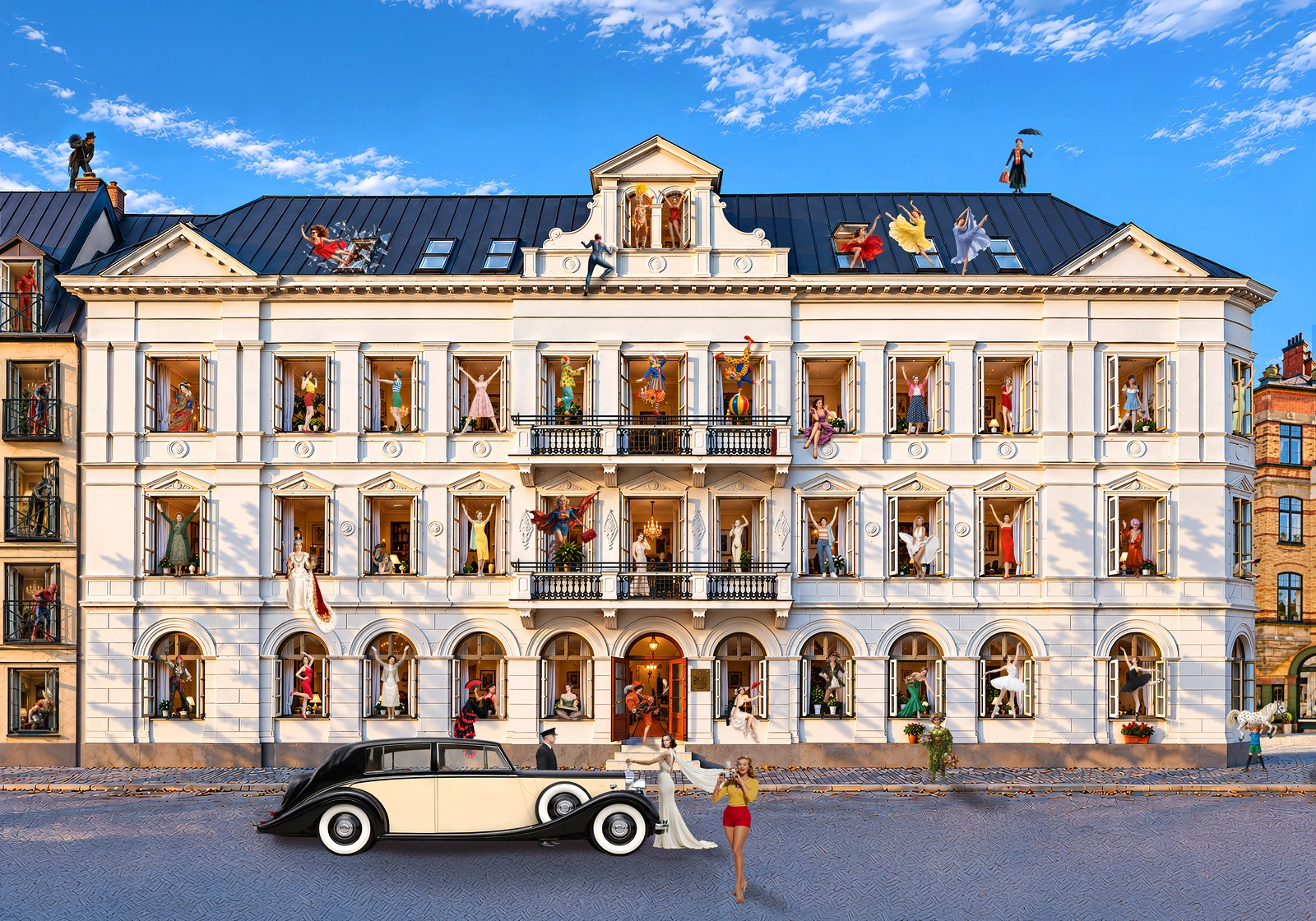
It began with a window opening. Then another, and soon the casements swung wide along the façade, as though the house had taken a deep breath after holding it for 150 years. A woman in a glittering dress appeared at one window. Another threw a feather boa over her shoulders, and laughter drifted from one room, only to be answered by the next. Mary Poppins landed on the roof with her umbrella, apparently quite unaffected by the Scanian summer heat. Three dancing women dressed in red, yellow, and blue had already emerged through the skylights and discovered that a metal roof could serve as a dance floor, at least when one no longer needed to concern oneself with gravity.
Down in the street, an elegant black-and-white motorcar had pulled up. A woman in a long white dress stood beside it, while another, wearing a yellow top and red shorts, photographed the extraordinary spectacle. Farther along came Pippi Longstocking, carrying the Little Old Man high above her head, while the horse seemed to take the whole affair more calmly than most horses would. On a balcony, a female clown balanced on a ball, and in the neighbouring building several men in peculiar fancy-dress costumes leaned inquisitively out of the windows.
None of those who occupied the house that day had arrived by any conventional means of transport. They were time travellers, inhabitants of distant stars, and they had chosen this particular Saturday for their visit. Some had once lived on Earth; others had existed only in fairy tales, films, paintings, or the human imagination. What they had in common was that their earthly stories had, in one way or another, confined them. Now they had the chance to return, and they had no intention of wasting it.
But why had they chosen this particular house? What lay within its walls that could draw such an extraordinary gathering? To understand that, we must leave the scorching summer day behind and return to a time when Malmö was still struggling to free itself from its defensive ramparts.
From Defensive Ramparts to a City of the Future
For centuries, Malmö had faced the sea with a mixture of hope and suspicion. The Öresund was the city's lifeline, but also the route an enemy might take. Fortifications, earthen ramparts, and moats therefore surrounded Malmö. Today, Norra Vallgatan marks where the city's military boundary once lay. Inside the walls lay merchants' houses, churches, and narrow streets, while the land beyond long belonged to another world.
When the fortifications began to be demolished in the early nineteenth century, the city's appearance changed, and so did its self-understanding. Malmö no longer needed, above all else, to defend itself against the outside world. Instead, it could begin to grow outward. The moats were partly filled in, new streets were laid out, and land that had previously served military purposes could be used for commerce, industry, and housing. The transformation was gradual, but it gathered momentum as the century progressed.
The railway, the harbour, and the emerging industries fundamentally transformed Malmö. Where artisans' workshops and small-scale trading establishments once stood, factories, warehouses, and imposing office buildings began to rise. The city's new men of influence were no longer exclusively merchants and shipowners but also engineers, manufacturers, and technicians. They spoke of production, efficiency, and the future, and among the materials that would give physical form to their ambitions, cement held a special place.
One of these men was Rudolf Fredrik Berg, commonly known as R. F. Berg or Fritz Berg. When he arrived in Skåne from Stockholm in 1873 to become managing director of Skånska Cementaktiebolaget, he was still a relatively young engineer. He could scarcely have imagined how closely his name would become associated with Limhamn's development, the Scanian cement industry, and a company that would eventually grow into one of the world's major construction groups.
But Berg needed more than factories and harbours. He also needed a place to direct his expanding operations and to live in a manner befitting a successful industrialist. Between 1876 and 1877, he therefore had an imposing house built on Norra Vallgatan, then numbered 110 and now numbered 98. The master builder, Christian Mortensen, oversaw its construction, following plans attributed to Berg himself.
The result was a building with an unusual dual identity. One part housed Skånska Cementaktiebolaget's headquarters, while the other served as Berg's private residence. Business and family life coexisted side by side, divided by doors and corridors yet united by the man who saw both as parts of the same life's work.
The white façade, large windows, balconies, and reception rooms expressed a belief in order, permanence, and progress. It was a house designed to impress and endure. That almost 150 years later it would become the scene of an invasion by dancing women, flying children's-book characters, and masked superheroines had probably never entered its creator's imagination.
The Cement King and His Conscience
Rudolf Fredrik Berg was a man of contradictions. He was an industrial leader and community builder, a technological visionary and a religious moralist, a philanthropist and a hard-nosed employer. He wanted to improve people's lives, yet he preferred to decide for himself how to do so. His Christian convictions were sincere, his social commitment extensive, and his faith in his own authority almost unshakeable.
In the house on Norra Vallgatan, he initially lived with his wife, Amelie, and their foster daughter, Anna. After Amelie's death, he married Stefanie Westman, who became the hostess in a home where private life scarcely differed from the industrialist's growing public standing.
One can imagine the evenings in the grand reception rooms, with heavy curtains, polished furniture, dining tables, and guests drawn from the city's bourgeois circles. Conversation would often have centred on factories, harbours, railways, and the social questions that occupied Berg's thoughts. A man who made temperance central to his philosophy of life would hardly encourage a culture of excessive drinking. Yet no one needs to imagine a joyless household. People who believe strongly in order can still enjoy social gatherings, as long as they happen on their own terms.
Beneath the reception rooms lay another world.
In the house's basement, Berg and his associate Carl Åkerman conducted experiments with cement, marble chips, and cast building components. In 1879, they began developing methods for manufacturing floor tiles, and their work became a key starting point for Skånska Cementgjuteriet, founded in 1887 and known today as Skanska, a multinational construction giant.
It's fascinating that one of Sweden's most important construction companies began in the basement of a bourgeois residence in Malmö. While the dinner guests upstairs discussed society's future, the house's owner could descend the stairs and, quite literally, try to cast that future in concrete.
Cement, however, was not the only thing Berg sought to shape. He also held firm views on how people ought to live. He engaged with public kitchens, seamen's homes, education, and housing, contributing to organisations that aimed to improve living conditions for the city's less fortunate inhabitants. Yet his benevolence was paternalistic. Workers were to be helped, educated, and guided, preferably without questioning the social order that placed Berg himself at the top.
When the workers at the cement factory in Lomma organised and entered into an industrial dispute in 1889, Berg responded with a lockout. To the labour movement, he consequently became a symbol of an employer's authority that sought to combine Christian charity with resistance to trade-union independence. In the newspaper Arbetet, he acquired the distinctly unflattering nickname Cement Jesus, sometimes accompanied by the observation that he had a heart of stone.
A particular irony is that a man who wanted to create stronger, better building materials found it hard to accept that people might want to build a society on foundations other than his own.
That contradiction becomes particularly clear in Gustav Möller's story.
Möller grew up in poverty in Malmö and worked as an errand boy in the cement industry. Berg recognised his abilities, helped him advance, and funded his education at Malmö's commercial college. The young man also served as Berg's private secretary, thereby gaining close familiarity with the administration and organisational thinking that characterised the industrialist's activities.
But when Möller joined the Social Democratic Party, Berg's goodwill ended. He did not want a socialist in his immediate circle, and the young man was forced to leave his position. Möller went on to work for the newspaper Arbetet and would eventually become one of Sweden's most influential Social Democratic politicians, serving as Minister for Social Affairs during the development of the Swedish welfare state.
It is hard to imagine a more telling historical paradox. The man who sought to keep socialism out of his company helped educate one of those who would later play a major role in shaping the Swedish welfare state. Berg taught Möller the importance of organisation, administration, and social initiatives, but he could not predict what political conclusions his pupil would draw from those experiences.
Towards the end of his life, Berg appears to have reconsidered at least parts of his earlier position. In a 1906 lecture, he argued that employers and workers should meet through negotiation and collective agreements. It marked a considerable departure from the uncompromising attitude that had characterised the conflict in Lomma seventeen years earlier.
When Berg died in 1907, he left behind factories, companies, social institutions, and an extensive industrial legacy. He also left a house whose walls had heard discussions of both religious devotion and industrial progress.
What he could hardly have imagined, however, was that those same walls would one day witness a party where everyone abandoned all rules of temperance and no one sought a man's permission. A woman once expelled from Paradise would dance without even a fig leaf.
The Women Who Connected the World
When Berg and the cement company left Norra Vallgatan around 1906, the house entered a new era. According to historical sources, Telegrafverket, the Swedish Telegraph Administration, took over the property, and its operations expanded as the telephone became an increasingly important instrument in modern society.
In many respects, the change was as far-reaching as the Industrial Revolution that made Berg's career possible. Where people had previously relied on letters, messengers, and face-to-face meetings, they could now communicate over great distances. The distance between Malmö and Stockholm, between businesses and customers, between lovers, relatives, and commercial partners, shrank to the length of a telephone wire.
But this technological revolution had not yet been automated. It required human beings, especially women.
Manual telephone exchanges became workplaces for young female operators who sat before large switchboards fitted with cords, plugs, and indicators. When a subscriber requested a call, operators established the connection through a system that demanded speed, concentration, a good memory, and considerable accuracy. The work could be monotonous yet intense, especially when many people wanted to speak at once.
In the story of the Berg House, these women take on particular significance. They represent a new generation no longer defined solely by home and family. They worked in a technological field, earned their own money, and became an essential part of modern society's communications. At the same time, their working lives were strictly regulated. They were expected to be correct, polite, efficient, and discreet. They transmitted other people's words but were not expected to make themselves heard.
The house must have undergone a remarkable transformation. Where Berg's family once entertained dinner guests, desks, technical equipment, and telephone switchboards might now stand. Where religious and business discussions had once taken place, voices from across the country could now pass through wires and connections.
The roof, too, belonged to this new technological world. Early telephony infrastructure included overhead wires, masts, and iron frameworks that altered the appearance of many towns and cities. Above the rooftops, a network of wires grew, an invisible society that had suddenly acquired visible connections. It is a fascinating image of technological progress: while Rudolf Fredrik Berg wanted to improve the world with cement and concrete, a new generation began to bind it together with copper wires and human voices.
And perhaps it was here that something began to take root within the walls.
When the telephone operators went home after their shifts and the switchboards fell silent, all the voices they had transmitted remained somewhere in the house's memory. Glad tidings, declarations of love, arguments, despair, business transactions, and everyday questions had passed through their hands. They had heard life unfolding without being allowed to participate in more than a fraction of it.
When three young women, on a summer's day many years later, opened the skylights and stepped out onto the metal roof to dance, it was tempting to imagine they had once been among those very telephone operators. Perhaps they had sat side by side at the switchboards, connected thousands of calls, and listened to other people's joys and troubles without ever being able to share in them. Perhaps, during their long working days, they had dreamed of one day throwing off their headsets, leaving their chairs, and doing exactly as they pleased. Now they had returned, not to convey someone else's voice, but finally to use their own. They no longer needed anyone's permission to speak, laugh, or dance. And if anyone down on Norra Vallgatan objected to their behaviour, he was perfectly welcome to telephone and complain. No one was left who intended to put his call through.
When Malmö Dressed in Fur
The next great chapter in the house's history was linked to an enterprise far removed from both cement experiments and telephone exchanges. In 1913, Mandis and Lars Mattsson founded the fur business that would become one of Malmö's best-known and longest-lasting fashion institutions.
For generations, Mattssons Päls stood for elegance, craftsmanship, and international glamour. Here, the city's wealthy women could have furs made or altered, and over time the business also began offering exclusive garments from international fashion houses, including Dior and Nina Ricci.
Under Lars-Åke Hankell's leadership, beginning in 1956, the business developed into an institution of considerable ambition. He had trained in New York and brought with him knowledge and influences from a fashion world far larger than the one typically associated with Malmö. Later, his son Mats Hankell continued the business and upheld the family's tradition of craftsmanship. Norra Vallgatan 98 had become Sweden's fur capital.
It is easy to imagine the house in those years: the characteristic awnings facing the canal, the arched display windows, customers arriving to try on furs and coats, and the atelier's work on skins, linings, and seams. In the grand rooms, a woman could, for a moment, become someone else simply by putting on a garment selected, cut, and sewn with the utmost care.
Fur was not merely protection against winter. It was a social language, speaking of money, taste, status, and sometimes a husband's financial success. An expensive mink coat could be a lifelong source of pride, worn on special occasions and later inherited by a daughter or granddaughter.
But society changed, and with it, the garment's meaning transformed.
During the 1980s and 1990s, the fur industry came under mounting scrutiny. Criticism from the animal-rights movement gained broader support, and what had once been an unquestioned status symbol could now provoke discomfort or even open hostility. Women who had inherited expensive furs faced a curious dilemma. The garments could represent both considerable financial value and cherished personal memories, yet they were no longer necessarily acceptable to wear in public.
As a result, a new kind of work emerged in the ateliers. Old furs could be remodelled into collars, scarves, linings, throws, or decorative cushions. What had once been worn openly as a sign of wealth could now be concealed beneath a raincoat or moved from the wardrobe to the living-room sofa.
In its own way, this was a small cultural revolution. A garment meant to be seen became something to hide, reuse, or imbue with an entirely different meaning. The old material remained, but its social language had changed.
The house itself was beginning to change too.
Around the turn of the millennium, Mattssons Päls was the victim of a series of violent burglaries. The most dramatic raid occurred in December 2001, when thieves used a stolen Jeep to tear down the protective barrier at the entrance before forcing their way into the shop. They stole furs worth approximately 1.5 million Swedish kronor within minutes. It was a crime whose brutality stood in stark contrast to the world of elegance, exclusive craftsmanship, and bourgeois respectability that the business had embodied for so many years.
One of the owners, who lived above the shop, woke to the commotion and hurled decorative stones from a window at the thieves' getaway car. The criminals escaped in a stolen Audi, and when the police gave chase, they scattered caltrops along Pildammsvägen. The sharp metal obstacles punctured the police cars' tyres, bringing the pursuit to a halt.
It is an incident that might almost have come from a crime comedy, had the consequences for those affected not been so serious. The house, once a monument to bourgeois security and industrial success, became a siege site. Security grilles and protective devices came to characterise a business previously associated with elegance and trust.
When Mattssons Päls finally closed on 16 January 2021, an era spanning 107 years came to an end. It was not merely a shop that closed, but a part of Malmö's social and commercial history.
Behind the closed doors, the house remained, carrying memories of furs, telephone exchanges, cement experiments, and of an industrialist who once sought to determine how people ought to live.
A House Begins a New Life
After the fur shop closed, large parts of the property stood empty. In 2023, attention turned to the sale of the almost 2,000-square-metre building, which ran the length of the block towards Lilla Bruksgatan and the courtyard facing Västergatan.
Plans for a new use took shape as “Skepparen 1876”. The house is being transformed into sixteen individually designed homes, where historic architecture meets modern expectations for comfort and functionality.
Curiously, this transformation recalls what women once did with their old furs. Rather than discard the past, the intention is to give it a new purpose.
The generous room proportions, decorative plasterwork, panelled doors, and deep window recesses will be paired with new materials and modern solutions. The project encompasses three distinct design concepts: ”The Craftsmanship of the Turn of the Century”, ”Contemporary Refinement”, and ”The Visionary's Workshop”. The last characterises the planned attic apartments, where older roof structures and modern materials come together to create an environment that recalls the spirit of experimentation once associated with R. F. Berg.
Work to transform the old house into residences is still underway in autumn 2026. The aim is to complete the conversion in autumn and begin sales before the end of the year. It is an extensive undertaking, not least because the building's historic character must be preserved while adapting it for modern living.
Something is appealing in the idea that the man who once had the house built to unite his professional and private lives should now have his name associated with a new kind of residential environment. But there is also a difference. Berg wanted to shape the future according to his own ideals. By contrast, the new homes are intended to accommodate people whose lives and values may be entirely different from his.
The building has survived industrial transformations, technological progress, shifting fashions, and violent burglaries. It has taken on many identities without losing its own.
Yet no architect, builder, or property developer has planned a transformation without needing planning permission.
It began with open windows on a sweltering Saturday in June.
EPILOGUE – When the Women Took Over the House
By the time Mary Poppins landed on the roof ridge, the party had already started.
She folded her umbrella, straightened her hat, and watched the three dancing women glide across the dark metal roof. They had chosen red, yellow, and blue, and their exuberant dancing made the entire building seem to keep time with them. Someone had opened another skylight, and through it a ballerina dressed in red was attempting to climb onto the roof, apparently quite unconcerned about the metres separating her from the street below.
Mary Poppins had always regarded order as essential to a good life, but she had also learned that a little magic sometimes made it bearable. She looked around, saw that nobody seemed to need her help, and decided to remain.
Down in the street, Anita Ekberg had already begun taking photographs. She wore a yellow top and red shorts, a far cry from the evening gowns and elegant creations that had once made her an international film star. She had returned to Malmö to see what had become of her old hometown, but she had hardly expected to find an entire house filled with women from different centuries and imaginary worlds. Furs had accompanied her throughout her career, from the fashion photographs of her Swedish youth to the international glamour portraits in which she was draped in expensive mink. She found it amusing to stand outside Malmö's former fur mecca, dressed in shorts on the hottest day of the year so far.
Anita began by photographing the photographer, a joke so funny that she laughed out loud. Then she turned her camera towards the façade, where new figures kept appearing in the windows.
Returning to Malmö this way felt strange. Here, she had once been a young girl with dreams stretching far beyond the city's boundaries, and now she stood here, after a lifetime among film stars, directors, and some of the world's most famous people, photographing a gathering no Hollywood director would have dared assemble in a single film. She smiled to herself. Malmö had evidently become much more imaginative since she left.
In one of the house's open windows, Marilyn Monroe stood, letting the wind play with her white dress. She had long since grown tired of being remembered only for those few seconds above a New York subway ventilation grille, although she had to admit it was a rather successful image. Now, however, she had decided that she herself would determine when her dress should flutter and when it should remain still.
When Marilyn noticed Eve in a window farther down, she couldn't help laughing. There stood a woman who had become the most notorious sinner in world history without ever having owned a dress for the wind to lift. Eve returned her smile. They had never met, yet they needed few words to understand one another. Generations of men had observed, depicted, and judged both their bodies, and both had ultimately become symbols of what others had decided for them. Marilyn raised her glass of champagne towards Eve, who returned the salute. For the first time in a very long while, neither felt any need to cover herself for anyone else's sake.
In another window, Queen Elizabeth II had settled down to watch the spectacle, her expression one her former courtiers would scarcely have recognised. Throughout her life, she had displayed a degree of self-control that almost exceeded human capabilities. She had opened buildings, received heads of state, delivered speeches, and worn hats on a scale that must surely have been without parallel in world history. Now, at last, she had been granted an afternoon when nobody expected anything of her.
When someone suggested she join the dancing, she replied that she would first like to finish her glass of champagne. After that, she might consider the matter.
On another floor, the pirate princess Alwilda had opened her window. According to the old tales, she had once fled an arranged marriage, disguised herself as a man, and led a band of pirates. Her historical existence was highly uncertain, but it didn't trouble her in the slightest. For a woman who had spent most of her afterlife in legend, the question of historical authenticity was almost insulting.
Her pirate raids had been launched from a place called Skvalperup, said to have stood where the Berg House was built a thousand years later. She therefore considered herself particularly entitled to attend the party. Nobody had yet dared object. Nobody knew either that her buried pirate treasure still lay beneath the house, more precisely beneath the basement where Rudolf Fredrik Berg and Carl Åkerman had experimented with cement and marble chips. Had they dug just half a metre deeper, they would have made a discovery that would probably have changed the history of the Scanian cement industry. Alwilda, however, had never spoken of the treasure. She was still ashamed that she had eventually surrendered her free life as a pirate and married the man her father, the king, had chosen for her. The treasure was the only thing she had left from the time when she was mistress of her own destiny. And since money is useless in eternity, it might as well stay where it was.
Meanwhile, Queen Elizabeth II had noticed the pirate princess and regarded her with an interest none of her former palace officials could explain. Here stood a woman of royal birth who had solved the problem of an arranged marriage by becoming a pirate. Elizabeth had spent her entire life respecting traditions, ceremonies, and expectations, and although she would never have admitted it openly, she found Alwilda's solution rather appealing. When the pirate princess suggested commandeering a boat and sailing out onto the Öresund, the Queen regarded her thoughtfully. After all, she had spent much of her life aboard royal yachts, never allowed to decide where they should sail. The proposal certainly had its merits, but first she wanted to know whether there would be champagne on board. After that, they could discuss the matter. Alwilda observed that this was at least progress. Most of the royals she had encountered wanted to arrest her before the conversation even began.
More and more figures gathered on the balconies and at the windows. Superheroines in brightly coloured costumes showed they were no longer obliged to save the world every time an unfortunate human being had trouble. Some danced, others sang, and one particularly energetic participant tried to persuade the others that a balcony was a perfectly suitable place for acrobatics.
In the neighbouring building, their male counterparts had begun gathering at the windows. One wore a costume resembling a spider, another chose a red outfit, and a third looked as though he had drawn inspiration from the Norse gods' wardrobe. They watched the women's party with a mixture of astonishment, envy, and the slightly wounded pride that sometimes afflicts men when they realise they are no longer the centre of attention.
None of the women seemed to notice them.
Amid it all, Eve stood at an open window, without even a fig leaf.
Eve had left the Garden of Eden long ago, and only now was she beginning to understand how absurd the whole arrangement had been. She had been blamed for humanity's misfortunes, forced to feel ashamed of her body, and then spent millennia as a symbol of sin and temptation. Now she had decided that she would no longer accept either the guilt or the fig leaf. She had found her way to Norra Vallgatan through her friend Agata, who had once worked as a maid for Berg's first wife, Amelie. Agata had told her a great deal about life in the grand house, the bourgeois dinner parties, the strict discipline, and a master with very definite opinions on both religious devotion and human behaviour. Eve had listened with growing interest. She recognised the reasoning. In the Garden, too, a man believed he knew best, and above him another decided everything. The difference was that this time she had no intention of allowing anyone to throw her out.
So, she danced as she should have been allowed to dance in Paradise, without anyone standing beside her to explain what she was and wasn't permitted to do.
At that very moment, the house seemed to shift.
Not that the walls moved or the façade cracked. On the contrary, it stood as firmly as it had since the 1870s. But something in its expression had changed. The great windows, which in Berg's day had admitted light into bourgeois reception rooms and later illuminated the telephone operators' workplaces, now opened onto a world where nobody needed to ask permission any more.
On the central balcony, a winged figure had settled, and another window sent out a song that the floor above soon answered. The clown continued her balancing tricks, Mary Poppins watched the dancers on the roof with satisfaction, and Pippi Longstocking had persuaded the spotted horse, Little Old Man, to pose for Anita Ekberg's camera.
Dame Edna had naturally arrived, too. She had never respected conventions, and the chance to attend a party where every age and identity mingled was too tempting to resist. With her characteristic spectacles and extravagant appearance, she quickly took her place among the other guests. After inspecting the façade, the dancing women, and the envious men in the neighbouring building, she observed that she had seen many peculiar performances in her long life, but never one in which the audience was so much less well dressed than the performers. She then demanded champagne and declared that she had no intention of paying admission to a show in which she herself was the greatest attraction.
In one of the old reception rooms, some of the guests had discovered remnants of the house's former life as a fur establishment. Before long, an improvised fashion show had taken shape, with elegant coats, feather boas, and fanciful headwear changing hands at a pace that would have driven the old fur director to despair. Nobody cared about a garment's original price or whether it suited the wearer's social standing. All that mattered was whether one could dance in it. A particularly magnificent fur eventually found its way onto the shoulders of a woman who declared it far too warm for a day when the temperature exceeded 35 degrees. She tore off the coat and continued dancing.
Outside on the pavement stood another curious figure, apparently composed of fruit, vegetables, and flowers. This was Giuseppe Arcimboldo's contribution to the party, a figure that reminded everyone that human identity can sometimes be far more imaginative than the sum of its anatomical parts.
As afternoon gave way to evening, the worst of the heat began to subside. The sky above Malmö softened, and the light from the open windows mingled with the sunset. Someone had lit a chandelier in one of the grand rooms, and music still drifted down from the roof.
Anita Ekberg lowered her camera and looked at the house.
In her lifetime, she had seen much of the world, met people regarded as immortal, and become part of film history herself. Yet she had never experienced anything quite like this. Here stood a house that had once belonged to a stern industrialist and now seemed to have become a refuge for all the women who, throughout history, had been told to be obedient, beautiful, discreet, virtuous, or simply silent.
Now none of them was silent.
They laughed, danced, sang, and spoke to one another across centuries. Some had been queens, others film stars, fairy-tale characters, or mythological women. Some had never existed beyond the human imagination. Yet here it made no difference. They had all been granted the same right to join the party, and no one had to explain why she had come.
Perhaps this was precisely what the house had been waiting for.
For almost 150 years, it had served human labour, ambition, vanity, and ideas about how life ought to be lived. It had seen industrialists planning the future, telephone operators transmitting other people's conversations, society ladies trying on furs, and thieves attempting to force their way through the door. It had witnessed both success and disappointment, as well as joy and sorrow.
But nothing had ever been quite so simple as a place where people gathered solely for enjoyment.
As the last sunlight disappeared behind the rooftops of Gamla Väster, the party continued. The windows stood open, music poured out along Norra Vallgatan, and somewhere above the roof ridge, Mary Poppins's umbrella floated towards the darkening sky.
The old Berg House had finally exacted its revenge.
And if Rudolf Fredrik Berg had returned that evening to see what had become of his life's work, he would probably have stopped before the façade, gazed at the dancing women, and realised with mounting horror that no one seemed to believe in temperance.
But perhaps, after a moment's hesitation, he would have discovered something he had never quite understood in his lifetime: that a house can be well built, a society well organised, and a life filled with good intentions, without any of them necessarily being complete.
It also takes a little stardust.
And a great deal of champagne.
P.S. In the neighbouring building, the male superheroes have gathered to watch the spectacle. They have saved the world countless times, defeated villains, and defied the laws of nature, yet not one of them has managed to understand why the women on the other side are having so much more fun. And as if that were not enough, the women have also taken possession of the more beautiful building. The men have never felt quite so superfluous.
Jörgen Thornberg
Concrete, Furs and Stardust - English version, 2026
Digital
70 x 50 cm
3 200 kr
Concrete, Furs and Stardust - Betong, Pälsar och Stjärnstoft
Svensk text i slutet
INTRODUCTION
Some houses seem to have lived more lives than the people who have inhabited them. Behind their façades, fortunes have been made, dreams have been born, secrets have been kept, and generations have come and gone, unaware of the extraordinary destinies that would one day converge beneath the same roof. One such house stands at 98 Norra Vallgatan in Malmö, where, in the 1870s, one of the city's most powerful industrialists commissioned a residence that would also become part of Sweden's industrial history.
Here, experiments with cement were conducted in the basement; here, the female pioneers of telephony found their place in the working life of a modern city; and here, for more than a century, the ladies of Malmö society could wrap themselves in furs from one of the country's most prestigious fashion houses. The house has outlasted its founder and his ideals, technological revolutions, changing social customs, and a spectacular robbery more reminiscent of a gangster film than of a respectable shop beside the canal. Now, almost 150 years after its first occupants moved in, it stands on the threshold of yet another transformation.
But this is not merely the house's real history. On a Saturday in June 2026, when Malmö experienced its hottest day since temperature records began, something happened that likely won't appear in the municipal planning authorities' records. Women from different centuries, fairy tales, films, and myths gathered at open windows, on balconies, and on the dark metal roof. Some had been queens, others film stars or rebellious figures whom history had never quite managed to tame. These time travellers had one thing in common: they no longer intended to let anyone else decide how they should live.
What happens next is a story about Malmö, power, and women's emancipation; about the permanence of concrete and the transience of fashion; and about the curious possibility that an old house may achieve its true revenge only when its occupants stop behaving as expected. Somewhere between historical reality and an utterly improbable party lies a question that may matter more than it first appears: who, after all, has the right to decide what a house is for?
“The House That Learned to Dance
Upon a roof where summer's furnace burned,
The ladies danced, and all the heavens turned.
Through windows wide came queens of ages past,
And stars whose earthly fame was built to last.
Where once stern Berg had ruled with pious hand,
Now laughter swept across his former land.
His walls of stone, his proud industrial schemes,
Were filled with champagne, music, love and dreams.
Fair Marilyn let summer winds caress
The floating folds of her immortal dress.
And Eve, who'd borne the blame for humanity's fall,
Wore not a fig leaf, nor felt shame at all.
A pirate princess raised her glass on high,
While England's Queen looked on with watchful eye.
And Mary Poppins, perched above the street,
Declared the rooftop dancing quite a treat.
But opposite, behind a meaner wall,
The mighty men stood watching one and all.
In masks and capes, with thunder in their eyes,
They stared across in poorly hidden spite.
They'd fought with gods, made evil villains flee,
Had conquered space and crossed the boundless sea.
Yet none could solve the mystery that night:
Why women laughed without them in their sight.
One clenched his fist, another frowned in red,
A third scratched at the helmet on his head.
Their powers failed, their wounded pride grew sore,
For no one called upon their strength once more.
And worst of all, beneath the evening skies,
The ladies owned the fairer house — the prize!
While heroes sulked in architectural shame,
The dancers neither knew nor cared their name.
Then down the street the golden twilight fell,
And every open window seemed to tell
That stone and steel, though built to stand apart,
May find a second life, a beating heart.
So let the jealous heroes brood till dawn,
Their glory dimmed, their grand importance gone.
For joy needs neither rescue nor command,
Nor any mighty hero's guiding hand.
And when the final stars began to glow,
The old house smiled upon the street below.
For all its years of concrete, pride and pain,
It had discovered how to live again.
No crown, no sword, no solemn grand decree,
Could give those women what they chose to be.
A little stardust, laughter without end —
And champagne shared with every fearless friend.”
Malmö, October 2026
Concrete, Furs and Stardust - 98 Norra Vallgatan and the Revenge of Time
PROLOGUE – The Scorching Saturday
It was Saturday, 27 June 2026, and Malmö had surrendered to the heat. At four o'clock, the temperature reached 35.1 degrees Celsius, the city's highest recorded since measurements began in 1917. The previous record, set in 1947, had stood for almost eighty years, but now hot air from the continent had swept across Skåne, turning Malmö into a boiling cauldron. Heat rose from the cobblestones, the air shimmered above the canal, and most who could had sought refuge at Ribersborg, Sibbarp, or elsewhere where the Öresund offered at least the illusion of relief.
On Norra Vallgatan stood the old Berg House, with its white façade and dark sheet-metal roof. The construction workers had gone for the weekend, and behind the closed windows lay almost a century and a half of history. Here, the cement industry's future had once been planned; here, telephone operators had connected calls between people who would never meet; and here, generations of Malmö residents had tried on furs that cost more than many workers earned in a year. Now it was quiet. Or rather, it ought to have been.
It began with a window opening. Then another, and soon the casements swung wide along the façade, as though the house had taken a deep breath after holding it for 150 years. A woman in a glittering dress appeared at one window. Another threw a feather boa over her shoulders, and laughter drifted from one room, only to be answered by the next. Mary Poppins landed on the roof with her umbrella, apparently quite unaffected by the Scanian summer heat. Three dancing women dressed in red, yellow, and blue had already emerged through the skylights and discovered that a metal roof could serve as a dance floor, at least when one no longer needed to concern oneself with gravity.
Down in the street, an elegant black-and-white motorcar had pulled up. A woman in a long white dress stood beside it, while another, wearing a yellow top and red shorts, photographed the extraordinary spectacle. Farther along came Pippi Longstocking, carrying the Little Old Man high above her head, while the horse seemed to take the whole affair more calmly than most horses would. On a balcony, a female clown balanced on a ball, and in the neighbouring building several men in peculiar fancy-dress costumes leaned inquisitively out of the windows.
None of those who occupied the house that day had arrived by any conventional means of transport. They were time travellers, inhabitants of distant stars, and they had chosen this particular Saturday for their visit. Some had once lived on Earth; others had existed only in fairy tales, films, paintings, or the human imagination. What they had in common was that their earthly stories had, in one way or another, confined them. Now they had the chance to return, and they had no intention of wasting it.
But why had they chosen this particular house? What lay within its walls that could draw such an extraordinary gathering? To understand that, we must leave the scorching summer day behind and return to a time when Malmö was still struggling to free itself from its defensive ramparts.
From Defensive Ramparts to a City of the Future
For centuries, Malmö had faced the sea with a mixture of hope and suspicion. The Öresund was the city's lifeline, but also the route an enemy might take. Fortifications, earthen ramparts, and moats therefore surrounded Malmö. Today, Norra Vallgatan marks where the city's military boundary once lay. Inside the walls lay merchants' houses, churches, and narrow streets, while the land beyond long belonged to another world.
When the fortifications began to be demolished in the early nineteenth century, the city's appearance changed, and so did its self-understanding. Malmö no longer needed, above all else, to defend itself against the outside world. Instead, it could begin to grow outward. The moats were partly filled in, new streets were laid out, and land that had previously served military purposes could be used for commerce, industry, and housing. The transformation was gradual, but it gathered momentum as the century progressed.
The railway, the harbour, and the emerging industries fundamentally transformed Malmö. Where artisans' workshops and small-scale trading establishments once stood, factories, warehouses, and imposing office buildings began to rise. The city's new men of influence were no longer exclusively merchants and shipowners but also engineers, manufacturers, and technicians. They spoke of production, efficiency, and the future, and among the materials that would give physical form to their ambitions, cement held a special place.
One of these men was Rudolf Fredrik Berg, commonly known as R. F. Berg or Fritz Berg. When he arrived in Skåne from Stockholm in 1873 to become managing director of Skånska Cementaktiebolaget, he was still a relatively young engineer. He could scarcely have imagined how closely his name would become associated with Limhamn's development, the Scanian cement industry, and a company that would eventually grow into one of the world's major construction groups.
But Berg needed more than factories and harbours. He also needed a place to direct his expanding operations and to live in a manner befitting a successful industrialist. Between 1876 and 1877, he therefore had an imposing house built on Norra Vallgatan, then numbered 110 and now numbered 98. The master builder, Christian Mortensen, oversaw its construction, following plans attributed to Berg himself.
The result was a building with an unusual dual identity. One part housed Skånska Cementaktiebolaget's headquarters, while the other served as Berg's private residence. Business and family life coexisted side by side, divided by doors and corridors yet united by the man who saw both as parts of the same life's work.
The white façade, large windows, balconies, and reception rooms expressed a belief in order, permanence, and progress. It was a house designed to impress and endure. That almost 150 years later it would become the scene of an invasion by dancing women, flying children's-book characters, and masked superheroines had probably never entered its creator's imagination.
The Cement King and His Conscience
Rudolf Fredrik Berg was a man of contradictions. He was an industrial leader and community builder, a technological visionary and a religious moralist, a philanthropist and a hard-nosed employer. He wanted to improve people's lives, yet he preferred to decide for himself how to do so. His Christian convictions were sincere, his social commitment extensive, and his faith in his own authority almost unshakeable.
In the house on Norra Vallgatan, he initially lived with his wife, Amelie, and their foster daughter, Anna. After Amelie's death, he married Stefanie Westman, who became the hostess in a home where private life scarcely differed from the industrialist's growing public standing.
One can imagine the evenings in the grand reception rooms, with heavy curtains, polished furniture, dining tables, and guests drawn from the city's bourgeois circles. Conversation would often have centred on factories, harbours, railways, and the social questions that occupied Berg's thoughts. A man who made temperance central to his philosophy of life would hardly encourage a culture of excessive drinking. Yet no one needs to imagine a joyless household. People who believe strongly in order can still enjoy social gatherings, as long as they happen on their own terms.
Beneath the reception rooms lay another world.
In the house's basement, Berg and his associate Carl Åkerman conducted experiments with cement, marble chips, and cast building components. In 1879, they began developing methods for manufacturing floor tiles, and their work became a key starting point for Skånska Cementgjuteriet, founded in 1887 and known today as Skanska, a multinational construction giant.
It's fascinating that one of Sweden's most important construction companies began in the basement of a bourgeois residence in Malmö. While the dinner guests upstairs discussed society's future, the house's owner could descend the stairs and, quite literally, try to cast that future in concrete.
Cement, however, was not the only thing Berg sought to shape. He also held firm views on how people ought to live. He engaged with public kitchens, seamen's homes, education, and housing, contributing to organisations that aimed to improve living conditions for the city's less fortunate inhabitants. Yet his benevolence was paternalistic. Workers were to be helped, educated, and guided, preferably without questioning the social order that placed Berg himself at the top.
When the workers at the cement factory in Lomma organised and entered into an industrial dispute in 1889, Berg responded with a lockout. To the labour movement, he consequently became a symbol of an employer's authority that sought to combine Christian charity with resistance to trade-union independence. In the newspaper Arbetet, he acquired the distinctly unflattering nickname Cement Jesus, sometimes accompanied by the observation that he had a heart of stone.
A particular irony is that a man who wanted to create stronger, better building materials found it hard to accept that people might want to build a society on foundations other than his own.
That contradiction becomes particularly clear in Gustav Möller's story.
Möller grew up in poverty in Malmö and worked as an errand boy in the cement industry. Berg recognised his abilities, helped him advance, and funded his education at Malmö's commercial college. The young man also served as Berg's private secretary, thereby gaining close familiarity with the administration and organisational thinking that characterised the industrialist's activities.
But when Möller joined the Social Democratic Party, Berg's goodwill ended. He did not want a socialist in his immediate circle, and the young man was forced to leave his position. Möller went on to work for the newspaper Arbetet and would eventually become one of Sweden's most influential Social Democratic politicians, serving as Minister for Social Affairs during the development of the Swedish welfare state.
It is hard to imagine a more telling historical paradox. The man who sought to keep socialism out of his company helped educate one of those who would later play a major role in shaping the Swedish welfare state. Berg taught Möller the importance of organisation, administration, and social initiatives, but he could not predict what political conclusions his pupil would draw from those experiences.
Towards the end of his life, Berg appears to have reconsidered at least parts of his earlier position. In a 1906 lecture, he argued that employers and workers should meet through negotiation and collective agreements. It marked a considerable departure from the uncompromising attitude that had characterised the conflict in Lomma seventeen years earlier.
When Berg died in 1907, he left behind factories, companies, social institutions, and an extensive industrial legacy. He also left a house whose walls had heard discussions of both religious devotion and industrial progress.
What he could hardly have imagined, however, was that those same walls would one day witness a party where everyone abandoned all rules of temperance and no one sought a man's permission. A woman once expelled from Paradise would dance without even a fig leaf.
The Women Who Connected the World
When Berg and the cement company left Norra Vallgatan around 1906, the house entered a new era. According to historical sources, Telegrafverket, the Swedish Telegraph Administration, took over the property, and its operations expanded as the telephone became an increasingly important instrument in modern society.
In many respects, the change was as far-reaching as the Industrial Revolution that made Berg's career possible. Where people had previously relied on letters, messengers, and face-to-face meetings, they could now communicate over great distances. The distance between Malmö and Stockholm, between businesses and customers, between lovers, relatives, and commercial partners, shrank to the length of a telephone wire.
But this technological revolution had not yet been automated. It required human beings, especially women.
Manual telephone exchanges became workplaces for young female operators who sat before large switchboards fitted with cords, plugs, and indicators. When a subscriber requested a call, operators established the connection through a system that demanded speed, concentration, a good memory, and considerable accuracy. The work could be monotonous yet intense, especially when many people wanted to speak at once.
In the story of the Berg House, these women take on particular significance. They represent a new generation no longer defined solely by home and family. They worked in a technological field, earned their own money, and became an essential part of modern society's communications. At the same time, their working lives were strictly regulated. They were expected to be correct, polite, efficient, and discreet. They transmitted other people's words but were not expected to make themselves heard.
The house must have undergone a remarkable transformation. Where Berg's family once entertained dinner guests, desks, technical equipment, and telephone switchboards might now stand. Where religious and business discussions had once taken place, voices from across the country could now pass through wires and connections.
The roof, too, belonged to this new technological world. Early telephony infrastructure included overhead wires, masts, and iron frameworks that altered the appearance of many towns and cities. Above the rooftops, a network of wires grew, an invisible society that had suddenly acquired visible connections. It is a fascinating image of technological progress: while Rudolf Fredrik Berg wanted to improve the world with cement and concrete, a new generation began to bind it together with copper wires and human voices.
And perhaps it was here that something began to take root within the walls.
When the telephone operators went home after their shifts and the switchboards fell silent, all the voices they had transmitted remained somewhere in the house's memory. Glad tidings, declarations of love, arguments, despair, business transactions, and everyday questions had passed through their hands. They had heard life unfolding without being allowed to participate in more than a fraction of it.
When three young women, on a summer's day many years later, opened the skylights and stepped out onto the metal roof to dance, it was tempting to imagine they had once been among those very telephone operators. Perhaps they had sat side by side at the switchboards, connected thousands of calls, and listened to other people's joys and troubles without ever being able to share in them. Perhaps, during their long working days, they had dreamed of one day throwing off their headsets, leaving their chairs, and doing exactly as they pleased. Now they had returned, not to convey someone else's voice, but finally to use their own. They no longer needed anyone's permission to speak, laugh, or dance. And if anyone down on Norra Vallgatan objected to their behaviour, he was perfectly welcome to telephone and complain. No one was left who intended to put his call through.
When Malmö Dressed in Fur
The next great chapter in the house's history was linked to an enterprise far removed from both cement experiments and telephone exchanges. In 1913, Mandis and Lars Mattsson founded the fur business that would become one of Malmö's best-known and longest-lasting fashion institutions.
For generations, Mattssons Päls stood for elegance, craftsmanship, and international glamour. Here, the city's wealthy women could have furs made or altered, and over time the business also began offering exclusive garments from international fashion houses, including Dior and Nina Ricci.
Under Lars-Åke Hankell's leadership, beginning in 1956, the business developed into an institution of considerable ambition. He had trained in New York and brought with him knowledge and influences from a fashion world far larger than the one typically associated with Malmö. Later, his son Mats Hankell continued the business and upheld the family's tradition of craftsmanship. Norra Vallgatan 98 had become Sweden's fur capital.
It is easy to imagine the house in those years: the characteristic awnings facing the canal, the arched display windows, customers arriving to try on furs and coats, and the atelier's work on skins, linings, and seams. In the grand rooms, a woman could, for a moment, become someone else simply by putting on a garment selected, cut, and sewn with the utmost care.
Fur was not merely protection against winter. It was a social language, speaking of money, taste, status, and sometimes a husband's financial success. An expensive mink coat could be a lifelong source of pride, worn on special occasions and later inherited by a daughter or granddaughter.
But society changed, and with it, the garment's meaning transformed.
During the 1980s and 1990s, the fur industry came under mounting scrutiny. Criticism from the animal-rights movement gained broader support, and what had once been an unquestioned status symbol could now provoke discomfort or even open hostility. Women who had inherited expensive furs faced a curious dilemma. The garments could represent both considerable financial value and cherished personal memories, yet they were no longer necessarily acceptable to wear in public.
As a result, a new kind of work emerged in the ateliers. Old furs could be remodelled into collars, scarves, linings, throws, or decorative cushions. What had once been worn openly as a sign of wealth could now be concealed beneath a raincoat or moved from the wardrobe to the living-room sofa.
In its own way, this was a small cultural revolution. A garment meant to be seen became something to hide, reuse, or imbue with an entirely different meaning. The old material remained, but its social language had changed.
The house itself was beginning to change too.
Around the turn of the millennium, Mattssons Päls was the victim of a series of violent burglaries. The most dramatic raid occurred in December 2001, when thieves used a stolen Jeep to tear down the protective barrier at the entrance before forcing their way into the shop. They stole furs worth approximately 1.5 million Swedish kronor within minutes. It was a crime whose brutality stood in stark contrast to the world of elegance, exclusive craftsmanship, and bourgeois respectability that the business had embodied for so many years.
One of the owners, who lived above the shop, woke to the commotion and hurled decorative stones from a window at the thieves' getaway car. The criminals escaped in a stolen Audi, and when the police gave chase, they scattered caltrops along Pildammsvägen. The sharp metal obstacles punctured the police cars' tyres, bringing the pursuit to a halt.
It is an incident that might almost have come from a crime comedy, had the consequences for those affected not been so serious. The house, once a monument to bourgeois security and industrial success, became a siege site. Security grilles and protective devices came to characterise a business previously associated with elegance and trust.
When Mattssons Päls finally closed on 16 January 2021, an era spanning 107 years came to an end. It was not merely a shop that closed, but a part of Malmö's social and commercial history.
Behind the closed doors, the house remained, carrying memories of furs, telephone exchanges, cement experiments, and of an industrialist who once sought to determine how people ought to live.
A House Begins a New Life
After the fur shop closed, large parts of the property stood empty. In 2023, attention turned to the sale of the almost 2,000-square-metre building, which ran the length of the block towards Lilla Bruksgatan and the courtyard facing Västergatan.
Plans for a new use took shape as “Skepparen 1876”. The house is being transformed into sixteen individually designed homes, where historic architecture meets modern expectations for comfort and functionality.
Curiously, this transformation recalls what women once did with their old furs. Rather than discard the past, the intention is to give it a new purpose.
The generous room proportions, decorative plasterwork, panelled doors, and deep window recesses will be paired with new materials and modern solutions. The project encompasses three distinct design concepts: ”The Craftsmanship of the Turn of the Century”, ”Contemporary Refinement”, and ”The Visionary's Workshop”. The last characterises the planned attic apartments, where older roof structures and modern materials come together to create an environment that recalls the spirit of experimentation once associated with R. F. Berg.
Work to transform the old house into residences is still underway in autumn 2026. The aim is to complete the conversion in autumn and begin sales before the end of the year. It is an extensive undertaking, not least because the building's historic character must be preserved while adapting it for modern living.
Something is appealing in the idea that the man who once had the house built to unite his professional and private lives should now have his name associated with a new kind of residential environment. But there is also a difference. Berg wanted to shape the future according to his own ideals. By contrast, the new homes are intended to accommodate people whose lives and values may be entirely different from his.
The building has survived industrial transformations, technological progress, shifting fashions, and violent burglaries. It has taken on many identities without losing its own.
Yet no architect, builder, or property developer has planned a transformation without needing planning permission.
It began with open windows on a sweltering Saturday in June.
EPILOGUE – When the Women Took Over the House
By the time Mary Poppins landed on the roof ridge, the party had already started.
She folded her umbrella, straightened her hat, and watched the three dancing women glide across the dark metal roof. They had chosen red, yellow, and blue, and their exuberant dancing made the entire building seem to keep time with them. Someone had opened another skylight, and through it a ballerina dressed in red was attempting to climb onto the roof, apparently quite unconcerned about the metres separating her from the street below.
Mary Poppins had always regarded order as essential to a good life, but she had also learned that a little magic sometimes made it bearable. She looked around, saw that nobody seemed to need her help, and decided to remain.
Down in the street, Anita Ekberg had already begun taking photographs. She wore a yellow top and red shorts, a far cry from the evening gowns and elegant creations that had once made her an international film star. She had returned to Malmö to see what had become of her old hometown, but she had hardly expected to find an entire house filled with women from different centuries and imaginary worlds. Furs had accompanied her throughout her career, from the fashion photographs of her Swedish youth to the international glamour portraits in which she was draped in expensive mink. She found it amusing to stand outside Malmö's former fur mecca, dressed in shorts on the hottest day of the year so far.
Anita began by photographing the photographer, a joke so funny that she laughed out loud. Then she turned her camera towards the façade, where new figures kept appearing in the windows.
Returning to Malmö this way felt strange. Here, she had once been a young girl with dreams stretching far beyond the city's boundaries, and now she stood here, after a lifetime among film stars, directors, and some of the world's most famous people, photographing a gathering no Hollywood director would have dared assemble in a single film. She smiled to herself. Malmö had evidently become much more imaginative since she left.
In one of the house's open windows, Marilyn Monroe stood, letting the wind play with her white dress. She had long since grown tired of being remembered only for those few seconds above a New York subway ventilation grille, although she had to admit it was a rather successful image. Now, however, she had decided that she herself would determine when her dress should flutter and when it should remain still.
When Marilyn noticed Eve in a window farther down, she couldn't help laughing. There stood a woman who had become the most notorious sinner in world history without ever having owned a dress for the wind to lift. Eve returned her smile. They had never met, yet they needed few words to understand one another. Generations of men had observed, depicted, and judged both their bodies, and both had ultimately become symbols of what others had decided for them. Marilyn raised her glass of champagne towards Eve, who returned the salute. For the first time in a very long while, neither felt any need to cover herself for anyone else's sake.
In another window, Queen Elizabeth II had settled down to watch the spectacle, her expression one her former courtiers would scarcely have recognised. Throughout her life, she had displayed a degree of self-control that almost exceeded human capabilities. She had opened buildings, received heads of state, delivered speeches, and worn hats on a scale that must surely have been without parallel in world history. Now, at last, she had been granted an afternoon when nobody expected anything of her.
When someone suggested she join the dancing, she replied that she would first like to finish her glass of champagne. After that, she might consider the matter.
On another floor, the pirate princess Alwilda had opened her window. According to the old tales, she had once fled an arranged marriage, disguised herself as a man, and led a band of pirates. Her historical existence was highly uncertain, but it didn't trouble her in the slightest. For a woman who had spent most of her afterlife in legend, the question of historical authenticity was almost insulting.
Her pirate raids had been launched from a place called Skvalperup, said to have stood where the Berg House was built a thousand years later. She therefore considered herself particularly entitled to attend the party. Nobody had yet dared object. Nobody knew either that her buried pirate treasure still lay beneath the house, more precisely beneath the basement where Rudolf Fredrik Berg and Carl Åkerman had experimented with cement and marble chips. Had they dug just half a metre deeper, they would have made a discovery that would probably have changed the history of the Scanian cement industry. Alwilda, however, had never spoken of the treasure. She was still ashamed that she had eventually surrendered her free life as a pirate and married the man her father, the king, had chosen for her. The treasure was the only thing she had left from the time when she was mistress of her own destiny. And since money is useless in eternity, it might as well stay where it was.
Meanwhile, Queen Elizabeth II had noticed the pirate princess and regarded her with an interest none of her former palace officials could explain. Here stood a woman of royal birth who had solved the problem of an arranged marriage by becoming a pirate. Elizabeth had spent her entire life respecting traditions, ceremonies, and expectations, and although she would never have admitted it openly, she found Alwilda's solution rather appealing. When the pirate princess suggested commandeering a boat and sailing out onto the Öresund, the Queen regarded her thoughtfully. After all, she had spent much of her life aboard royal yachts, never allowed to decide where they should sail. The proposal certainly had its merits, but first she wanted to know whether there would be champagne on board. After that, they could discuss the matter. Alwilda observed that this was at least progress. Most of the royals she had encountered wanted to arrest her before the conversation even began.
More and more figures gathered on the balconies and at the windows. Superheroines in brightly coloured costumes showed they were no longer obliged to save the world every time an unfortunate human being had trouble. Some danced, others sang, and one particularly energetic participant tried to persuade the others that a balcony was a perfectly suitable place for acrobatics.
In the neighbouring building, their male counterparts had begun gathering at the windows. One wore a costume resembling a spider, another chose a red outfit, and a third looked as though he had drawn inspiration from the Norse gods' wardrobe. They watched the women's party with a mixture of astonishment, envy, and the slightly wounded pride that sometimes afflicts men when they realise they are no longer the centre of attention.
None of the women seemed to notice them.
Amid it all, Eve stood at an open window, without even a fig leaf.
Eve had left the Garden of Eden long ago, and only now was she beginning to understand how absurd the whole arrangement had been. She had been blamed for humanity's misfortunes, forced to feel ashamed of her body, and then spent millennia as a symbol of sin and temptation. Now she had decided that she would no longer accept either the guilt or the fig leaf. She had found her way to Norra Vallgatan through her friend Agata, who had once worked as a maid for Berg's first wife, Amelie. Agata had told her a great deal about life in the grand house, the bourgeois dinner parties, the strict discipline, and a master with very definite opinions on both religious devotion and human behaviour. Eve had listened with growing interest. She recognised the reasoning. In the Garden, too, a man believed he knew best, and above him another decided everything. The difference was that this time she had no intention of allowing anyone to throw her out.
So, she danced as she should have been allowed to dance in Paradise, without anyone standing beside her to explain what she was and wasn't permitted to do.
At that very moment, the house seemed to shift.
Not that the walls moved or the façade cracked. On the contrary, it stood as firmly as it had since the 1870s. But something in its expression had changed. The great windows, which in Berg's day had admitted light into bourgeois reception rooms and later illuminated the telephone operators' workplaces, now opened onto a world where nobody needed to ask permission any more.
On the central balcony, a winged figure had settled, and another window sent out a song that the floor above soon answered. The clown continued her balancing tricks, Mary Poppins watched the dancers on the roof with satisfaction, and Pippi Longstocking had persuaded the spotted horse, Little Old Man, to pose for Anita Ekberg's camera.
Dame Edna had naturally arrived, too. She had never respected conventions, and the chance to attend a party where every age and identity mingled was too tempting to resist. With her characteristic spectacles and extravagant appearance, she quickly took her place among the other guests. After inspecting the façade, the dancing women, and the envious men in the neighbouring building, she observed that she had seen many peculiar performances in her long life, but never one in which the audience was so much less well dressed than the performers. She then demanded champagne and declared that she had no intention of paying admission to a show in which she herself was the greatest attraction.
In one of the old reception rooms, some of the guests had discovered remnants of the house's former life as a fur establishment. Before long, an improvised fashion show had taken shape, with elegant coats, feather boas, and fanciful headwear changing hands at a pace that would have driven the old fur director to despair. Nobody cared about a garment's original price or whether it suited the wearer's social standing. All that mattered was whether one could dance in it. A particularly magnificent fur eventually found its way onto the shoulders of a woman who declared it far too warm for a day when the temperature exceeded 35 degrees. She tore off the coat and continued dancing.
Outside on the pavement stood another curious figure, apparently composed of fruit, vegetables, and flowers. This was Giuseppe Arcimboldo's contribution to the party, a figure that reminded everyone that human identity can sometimes be far more imaginative than the sum of its anatomical parts.
As afternoon gave way to evening, the worst of the heat began to subside. The sky above Malmö softened, and the light from the open windows mingled with the sunset. Someone had lit a chandelier in one of the grand rooms, and music still drifted down from the roof.
Anita Ekberg lowered her camera and looked at the house.
In her lifetime, she had seen much of the world, met people regarded as immortal, and become part of film history herself. Yet she had never experienced anything quite like this. Here stood a house that had once belonged to a stern industrialist and now seemed to have become a refuge for all the women who, throughout history, had been told to be obedient, beautiful, discreet, virtuous, or simply silent.
Now none of them was silent.
They laughed, danced, sang, and spoke to one another across centuries. Some had been queens, others film stars, fairy-tale characters, or mythological women. Some had never existed beyond the human imagination. Yet here it made no difference. They had all been granted the same right to join the party, and no one had to explain why she had come.
Perhaps this was precisely what the house had been waiting for.
For almost 150 years, it had served human labour, ambition, vanity, and ideas about how life ought to be lived. It had seen industrialists planning the future, telephone operators transmitting other people's conversations, society ladies trying on furs, and thieves attempting to force their way through the door. It had witnessed both success and disappointment, as well as joy and sorrow.
But nothing had ever been quite so simple as a place where people gathered solely for enjoyment.
As the last sunlight disappeared behind the rooftops of Gamla Väster, the party continued. The windows stood open, music poured out along Norra Vallgatan, and somewhere above the roof ridge, Mary Poppins's umbrella floated towards the darkening sky.
The old Berg House had finally exacted its revenge.
And if Rudolf Fredrik Berg had returned that evening to see what had become of his life's work, he would probably have stopped before the façade, gazed at the dancing women, and realised with mounting horror that no one seemed to believe in temperance.
But perhaps, after a moment's hesitation, he would have discovered something he had never quite understood in his lifetime: that a house can be well built, a society well organised, and a life filled with good intentions, without any of them necessarily being complete.
It also takes a little stardust.
And a great deal of champagne.
P.S. In the neighbouring building, the male superheroes have gathered to watch the spectacle. They have saved the world countless times, defeated villains, and defied the laws of nature, yet not one of them has managed to understand why the women on the other side are having so much more fun. And as if that were not enough, the women have also taken possession of the more beautiful building. The men have never felt quite so superfluous.
3 200 kr

Jörgen Thornberg
Malmö
Lite om bilder och mig. Translation in English at the end.
Jag är en nyfiken person som ser allt i bilder, även det jag fäster i ord, gärna tillsammans för bakom alla mina bilder finns en berättelse. Till vissa bilder hör en kortare eller längre novell som följer med bilden.
Bilder berättar historier. Jag omges av naturlig skönhet, intressanta människor och historia var jag än går. Jag använder min kamera för att dokumentera världen och blanda det jag ser med vad jag känner för att fånga den dolda magin.
Mina bilder berättar mina historier. Genom mina bilder, tryck och berättelser. Jag bjuder in dig att ta del av dessa berättelser, in i ditt liv och hem och dela min mycket personliga syn på vår värld. Mer än vad ögat ser. Jag tänker i bilder, drömmer och skriver och pratar om dem; följaktligen måste jag också skapa bilder. De blir vad jag ser, inte nödvändigtvis begränsade till verkligheten. Det finns en bild runt varje hörn. Jag hoppas att du kommer att se vad jag såg och gilla det.
Jag är också en skrivande person och till många bilder hör en kortare eller längre essay. Den följer med tavlan, tryckt på fint papper och med en personlig hälsning från mig.
Flertalet bilder startar sin resa i min kamera. Enkelt förklarat beskriver jag bilden jag ser i mitt inre, upplevd eller fantiserad. Bilden uppstår inom mig redan innan jag fått okularet till ögat. På bråkdelen av ett ögonblick ser jag vad jag vill ha och vad som kan göras med bilden. Här skall jag stoppa in en giraff, stålmannen, Titanic eller vad det är min fantasi finner ut. Ännu märkligare är att jag kommer ihåg minnesbilden långt efteråt när det blir tid att skapa verket. Om jag lyckas eller inte, är upp till betraktaren, oftast präglat av en stråk av svart humor – meningen är att man skall bli underhållen. Mina bilder blir ofta en snackis där de hänger.
Jag föredrar bilder som förmedlar ett budskap i flera lager. Vid första anblicken fylld av feel-good, en vacker utsikt, fint väder, solen skiner, blommor på ängen eller vattnet som ligger förrädiskt spegelblankt. I en sådan bild kan jag gömma min egentliga berättelse, mitt förakt för förtryckare och våldsverkare, rasister och fördomsfulla människor - ett gärna återkommande motiv mer eller mindre dolt i det vackra motivet. Jag försöker förena dem i ett gemensamt narrativ.
Bild och formgivning har löpt som en röd tråd genom livet. Fotokonst känns som en värdig final som jag gärna delar med mig.
Min genre är vid som framgår av mina bilder, temat en blandning av pop- och gatukonst i kollage som kan bestå av hundratals lager. Vissa bilder kan ta veckor, andra någon dag innan det är dags att överlämna resultatet till printverkstaden. Fine Art Prints är digitala fotocollage. I dessa kollage sker rivandet, klippandet, pusslandet, målandet, ritandet och sprayningen digitalt. Det jag monterar in kan vara hundratals år gamla bilder som jag omsorgsfullt frilägger så att de ser ut att vara en del av tavlan men också bilder skapade av mig själv efter min egen fantasi. Därefter besöks printstudion och för vissa bilder numrera en limiterad upplaga (oftast 7 exemplar) och signera för hand. Vissa bilder kan köpas i olika format. Det är bara att fråga efter vilka. Gillar man en bild som är 70x100 men inte har plats på väggen, går den kanske att få i 50x70 cm istället. Frågan är fri.
Metoden Giclée eller Fine Art Print som det också kallas är det moderna sättet för framställning av grafisk konst. Villkoret för denna typ av utskrifter är att en högkvalitativ storformatskrivare används med åldersbeständigt färgpigment och konstnärspapper eller i förekommande fall på duk. Pappret som används möter de krav på livslängd som ställs av museer och gallerier. Normalt säljer jag mina bilder oinramade så att den nya ägaren själv kan bestämma hur de skall se ut, med eller utan passepartout färg på ram, med eller utan glas etc..
Under många år ställde jag bara ut på nätet, i valda grupper och på min egen Facebooksida - https://www.facebook.com/jorgen.thornberg.9
Jag finns också på en egen hemsida som tyvärr inte alltid är uppdaterad – https://www.jth.life/ Där kan du också läsa en del av de berättelser som följer med bilden.
UTSTÄLLNINGAR
Luftkastellet, oktober 2022
Konst i Lund, november 2022
Luftkastellet, mars 2023
Engleson Galleri Caroli, april 2023
Hydra, Greece June 2023
Engleson Galleri Caroli, oktober 2023
Toppen, Höllviken december 2023
Luftkastellet, mars 2024
Torups Galleri, mars 2024
Venice, May 2024
Luftkastellet, oktober 2024
Konst i Advent, December 2024
Galleri Engleson, Caroli December 2024
Jäger & Jansson Galleri, april 2025
A bit about pictures and me.
I'm a curious person who sees everything in pictures, even what I express in words, often combining them, for behind all my pictures lies a story. These narratives, some as short as a single image and others as long as a novel, are the heart and soul of my work.
Pictures tell stories. Wherever I go, I'm surrounded by natural beauty, exciting people, and history. I use my camera to document the world and blend what I see with what I feel to capture the hidden magic.
My images tell my stories. Through my pictures, prints, and narratives, I invite you to partake in these stories in your life and home and share my deeply personal perspective of our world. More than meets the eye. I think in pictures, dream, write, and talk about them; consequently, I must create images too. They become what I see, not necessarily confined to reality. There's a picture around every corner. I hope you'll see what I saw and enjoy it.
I'm also a writer, and many images come with a shorter or longer essay. It accompanies the painting, printed on fine paper with my personal greeting.
Many pictures start their journey on my camera. Simply put, I describe the image I see in my mind, experienced or imagined. The image arises within me even before I bring the eyepiece to my eye. In a fraction of a moment, I see what I want and what can be done with the picture. Here, I'll insert a giraffe, Superman, the Titanic, or whatever my imagination conjures up. Even stranger is that I remember the mental image long after it's time to create the work. Whether I succeed is up to the observer, often imbued with a streak of black humour – the aim is to entertain. My pictures usually become a talking point wherever they hang.
I prefer pictures that convey a message in multiple layers. At first glance, they're filled with feel-good vibes, a beautiful view, lovely weather, the sun shining, flowers in the meadow, or the water lying deceptively calm. But beneath this surface beauty, I often conceal a deeper story, a narrative that challenges societal norms or explores the human condition. I invite you to delve into these hidden narratives and discover the layers of meaning within my work.
Picture and design have been a thread running through my life. Photographic art feels like a fitting finale, and I'm happy to share it.
My genre is varied, as seen in my pictures; the theme is a blend of pop and street art in collages that can consist of hundreds of layers. Some images can take weeks, others just a day before it's time to hand over the result to the print workshop. Fine Art Prints are digital photo collages. In these collages, tearing, cutting, puzzling, painting, drawing, and spraying happen digitally. What I insert can be images hundreds of years old that I carefully extract so they appear to be part of the painting, but also images created by myself, now also generated from my imagination. Next, visit the print studio and, for certain images, number a limited edition (usually 7 copies) and sign them by hand. Some images may be available in other formats. Just ask which ones. If you like an image that's 70x100 but doesn't have space on the wall, you might be able to get it in 50x70 cm instead. The question is open.
The Giclée method, or Fine Art Print as it's also called, is the modern way of producing graphic art. This method ensures the highest quality and longevity of the artwork, using a high-quality large-format printer with archival pigment inks and artist paper or, in some cases, canvas. The paper used meets the longevity requirements set by museums and galleries. I sell my pictures unframed, allowing the new owner to personalise their artwork, confident in the lasting value and quality of the piece.
For many years, I only exhibited online, in selected groups, and on my Facebook page - https://www.facebook.com/jorgen.thornberg.9. I also have my website, which unfortunately is not constantly updated - https://www.jth.life/. You can also read some of the stories accompanying the pictures there.
EXHIBITIONS
Luftkastellet, October 2022
Art in Lund, November 2022
Luftkastellet, March 2023
Engleson Gallery Caroli, April 2023
Hydra, Greece June 2023
Engleson Gallery Caroli, October 2023
Toppen, Höllviken December 2023
Luftkastellet, March 2024
Torup Gallery, March 2024
Venice, May 2024
UTSTÄLLNINGAR
Luftkastellet, oktober 2022
Konst i Lund, november 2022
Luftkastellet, mars 2023
Engleson Galleri Caroli, april 2023
Hydra, Greece June 2023
Engleson Galleri Caroli, oktober 2023
Toppen, Höllviken december 2023
Luftkastellet, mars 2024
Torups Galleri, mars 2024
Venice, May 2024
Luftkastellet, October 2024
Konst i Advent, December 2024
Galleri Engleson, Caroli December 2024
Jäger & Jansson Galleri, April 2025
Utbildning
Autodidakt
Medlem i konstnärsförening
Öppna Sinnen
Med i konstrunda
Konstrundan i Skåne
Utställningar
Luftkastellet, October 2022
Art in Lund, November 2022
Luftkastellet, March 2023
Engleson Gallery Caroli, April 2023
Hydra, Greece June 2023
Engleson Gallery Caroli, October 2023
Toppen, Höllviken December 2023
Luftkastellet, March 2024
Torup Gallery, March 2024
Venice, May 2024