Vi använder cookies för att ge dig bästa möjliga upplevelse. Välj vilka cookies du tillåter.
Läs mer i vår integritetspolicy
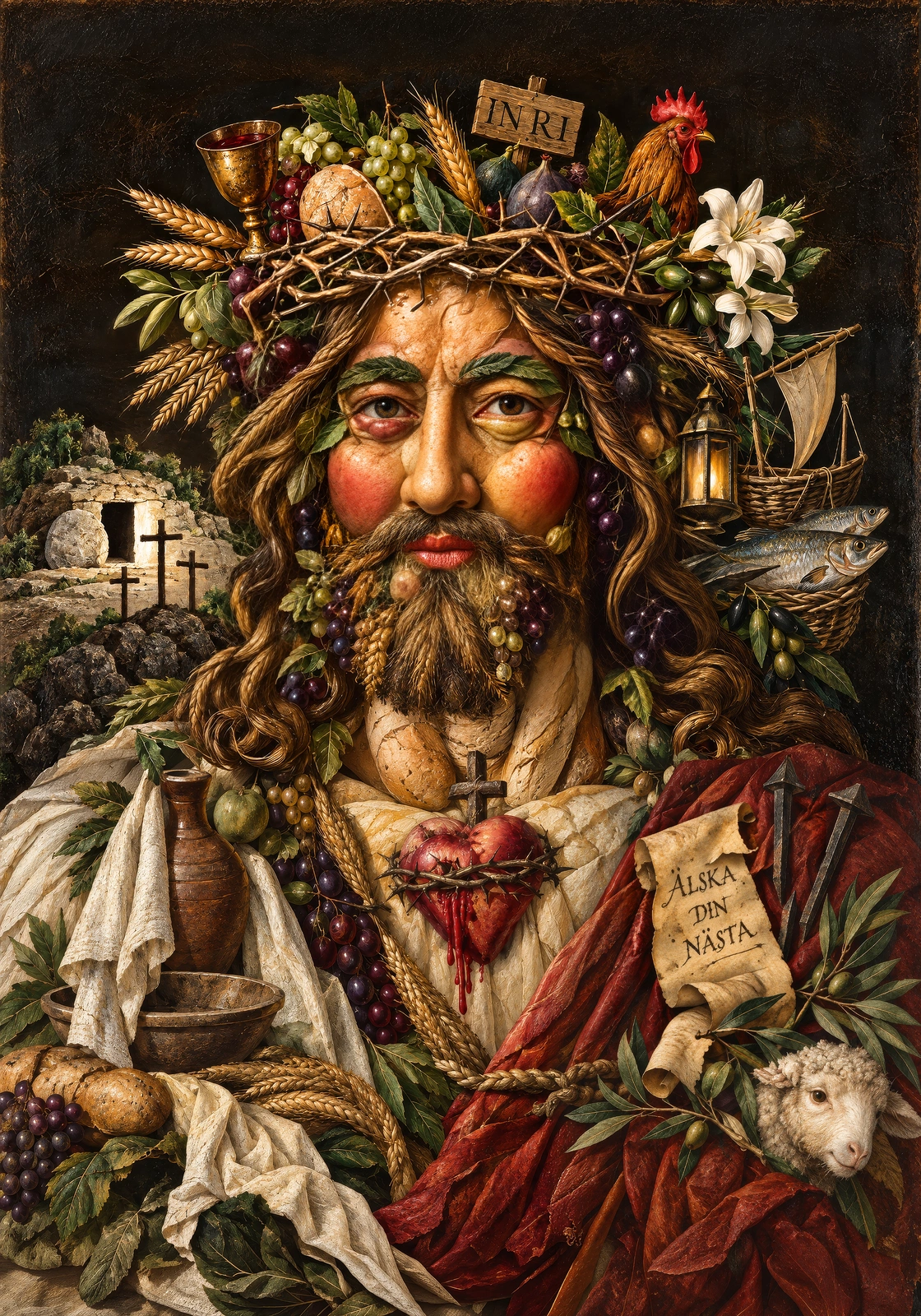
Jörgen Thornberg
Arcimboldo’s delayed portrait – Arcimboldos försenade porträtt, 2026
Digital
50 x 70 cm
Arcimboldo’s delayed portrait – Arcimboldos försenade porträtt
“The Portrait I Was Not Allowed to Paint
I had already painted the Emperor when I began to think about Christ. I had constructed Rudolf from the things that surrounded him and could be said to represent his world: fruits, flowers, grain and plants were joined together until, from a distance, they became a man, only to return, at close range, to being themselves. It was then that the thought occurred to me that the same method might be used for something infinitely greater. If an emperor could be told through the things that symbolised his power and his realm, why should the face of Jesus not be built from the things that told the story of his life?
I saw the painting before me long before I ever put brush to canvas. The bread and wine would be there, the fish and the wheat, the olive and the lamb, the cross and the thorns. I did not want to paint yet another Christ surrounded by his attributes, for the world already had more such paintings than it needed. I wanted to do with Jesus what I had done with the Emperor, but go one step further and let the Gospels themselves paint every detail. From a distance, one would encounter Christ; as one came closer, his face would dissolve, and his life would emerge.
I had not progressed very far with my plans when an abbot heard about them.
He did not like them.
To him, the difference between constructing the Emperor’s face from pears, grapes and ears of wheat and doing something similar with the Saviour was not a matter of subject but of blasphemy. The face of Christ, he informed me, was not an artistic experiment, and above all it was not to be transformed into the sort of optical game that had made me famous at court. I tried to explain that the opposite was true. I did not wish to ridicule Christ by making him from food and plants; I wanted every part of him to tell a story from the Gospels. The bread would be there because he had broken it. The wine because he had offered the cup to his disciples. The fish because fishermen had become apostles. The olive because the road to the Cross passed through Gethsemane.
The abbot was not reassured by my explanation.
Quite the contrary.
In the end, he made it clear that if I went ahead with the painting, the matter could be brought before the Church’s authorities, and that “excommunication” was not an empty threat. In the sixteenth century, even an imperial court painter was wise to take that seriously. And so I put away my sketches, and the portrait was never painted.
The strange thing is that some ideas seem to outlast their creators better than paintings do.
Four centuries later, I found myself in Milan once again, travelling from my star. The city was, of course, no longer the one I had known, nor was the Church quite the same. The abbot had been dead for centuries; his threat had lost its force, and I myself enjoyed the considerable advantage of having been absent from the earth for several hundred years. Excommunicating me now would hardly alter my prospects for the hereafter. Besides, one can only die once.
So, I brought back my old idea.
This time I began with the crown of thorns, resting heavily on the brow. It was not to be a decorative crown but to carry the Passion, the humiliation and the Crucifixion at the very summit of the portrait. Above it I placed the simple wooden tablet bearing the four letters INRI, Iesus Nazarenus Rex Iudaeorum, Jesus of Nazareth, King of the Jews. What had once been the Romans’ notice stating the condemned man’s crime had survived both those who condemned him and the empire in whose name the sentence had been carried out.
From there, I let the story spread across the painting. On the left, I opened the rock and left the tomb empty, the stone rolled away, because a portrait of Jesus ending at Golgotha would tell only half the story. In the same landscape, I raised the three crosses, Christ’s and those of the two criminals, and allowed the cross to appear again closer to the body. On the opposite side, I placed the nails against the deep red cloak, where the colour could carry both the mockery of the proclaimed king and the blood of the man who would soon be crucified. Across the cloak runs the rope, recalling the arrest and captivity, while the lantern above can be both the light of the world and the lantern light of those who came to seize him in Gethsemane.
But if I had filled the portrait only with the instruments of his death, perhaps the abbot would have been right about me after all. So I placed the bleeding heart at the centre of the picture. It is encircled by thorns and marked by suffering, but above all, love holds the image together. Beside the red cloak, the lamb looks out, Agnus Dei, the Lamb of God, while olive leaves and olives grow around it, leading back to the Mount of Olives and Gethsemane.
On the other side stand the basin of water and the white towel, and there I wanted to evoke one of the most powerful scenes from Jesus’ final evening with his disciples. He whom they called Lord and Master bent down and washed their feet. The act was that of a servant, and for precisely that reason it could say something essential about the man whose face I was trying to create: the greatest makes himself the least, not through words but by kneeling before another human being with water, a towel and his own hands.
And here, the bread, the grapes and the wheat are present. Here, at last, I could use my old method without turning it into an artistic trick for the court's amusement. The bread does not merely lie before him but forms his neck; the grapes run through his hair and beard; and the wheat grows into the figure itself. In the upper left stands the cup of wine, so that the Last Supper is present without my having to paint the table or the disciples around it. The grain of wheat also carries its own story of that which must fall into the earth and die before it can bear fruit, and thus the meal, death and resurrection meet in the same simple ear of wheat.
On the right, I allowed the fish to carry the story back to its beginning: the Sea of Galilee and the men who left their nets to follow him. That is why the boat and the fishing net are there as well. Although I did not paint Peter himself, I allowed him to be present through the rooster above. I need only to crow for the whole story of the promise, the fear and the three denials to spring to life. Among all this, the lilies grow, with their purity and their echo of the lilies of the field, together with the olive and the figs, plants belonging to the world in which the stories of the Gospels unfold and which, time and again, are themselves made to carry their meanings.
At last, there remained the parchment upon the red cloak. I could have written much there, but the longer I worked, the less I needed to say. If the bread, the wine, the washing of the feet, the lamb, the heart, and even the Cross could all be traced back to a single thought, there were a few words that came closer than any others:
‘LOVE THY NEIGHBOUR.’
When I finally stepped back a few paces from the painting, I saw that it had arranged the story for me. On the left, the tomb and the crosses joined the bread, the wine, and the meal, while the other side drew the eye towards Peter, the fish and the boat, and onward towards Gethsemane, the arrest, and the Passion. Between these two movements stood Jesus himself, with the crown of thorns above his brow and the wounded heart below. The longer I looked at him, the harder it became to tell where the man ended and the symbols began.
It was there, too, that I finally understood what had been missing when I first conceived the painting four centuries earlier. At the time, I had imagined doing with Jesus what I had done with the Emperor, but in truth it was not the same thing at all. Rudolf I had been constructed from the riches of nature to create an image of him and his world, whereas the bread, the wine, the wheat, the fish, the olive, the lamb and the thorns already carried the story of Christ before I ever took them into my hands. When they were joined together, therefore, they did not become objects disguised as a face, but fragments of a story slowly assuming human form. Perhaps the abbot had understood, after all, that the painting was more dangerous than I myself realised in the sixteenth century. However, for entirely the wrong reason: when, four hundred years later, I finally completed it, I had not painted Jesus and constructed him from his symbols. I had let his life, his death, his resurrection, and his teaching together shape his face.
I always do my best. So here it is."
Giuseppe Arcimboldo, Milan, Anno 2026
”Porträttet jag inte fick måla
Jag hade redan målat kejsaren när jag började fundera på Kristus. Rudolf hade jag byggt av det som omgav honom och det som kunde sägas representera hans värld: frukter, blommor, säd och växter fogades samman tills de på avstånd blev en människa och på nära håll återgick till att vara sig själva. Det var då tanken slog mig att samma metod borde kunna användas till något betydligt större. Om en kejsare kunde berättas genom de ting som symboliserade hans makt och hans rike, varför skulle inte Jesu ansikte kunna byggas av de ting som berättade om hans liv?
Jag såg målningen framför mig långt innan jag satte penseln mot duken. Brödet och vinet skulle finnas där, fisken och vetet, oliven och lammet, korset och törnet. Jag ville inte måla ännu en Kristus omgiven av sina attribut, för sådana målningar fanns det redan fler av än världen behövde. Jag ville göra med Jesus vad jag hade gjort med kejsaren, men gå ett steg längre och låta själva evangelierna måla alla detaljer. På avstånd skulle man möta Kristus; när man kom närmare skulle hans ansikte lösas upp och hans liv träda fram.
Jag hann inte långt med planerna innan en abbot fick höra talas om dem.
Han tyckte inte om dem.
För honom var skillnaden mellan att bygga kejsarens ansikte av päron, druvor och sädesax och att göra något liknande med Frälsaren inte en fråga om motiv utan om hädelse. Kristi ansikte var inget konstnärligt experiment, förklarade han för mig, och det fick framför allt inte förvandlas till den sorts optiska lek som hade gjort mig berömd vid hovet. Jag försökte förklara att det var precis tvärtom. Jag ville inte förlöjliga Kristus genom att göra honom av mat och växter; jag ville låta varje del av honom bära på en berättelse ur evangelierna. Brödet skulle vara där eftersom han hade brutit det. Vinet därför att han hade räckt kalken till sina lärjungar. Fisken därför att fiskare hade blivit apostlar. Oliven därför att vägen mot korset gick genom Getsemane.
Abboten blev inte lugnare av förklaringen.
Tvärtom.
Till slut gjorde han klart för mig att om jag genomförde målningen kunde saken föras vidare till kyrkans myndigheter och att ”bannlysning’ inte var något jag borde betrakta som ett tomt hot. På 1500-talet var det ett argument som även en kejserlig hovmålare gjorde klokt i att ta på allvar. Jag lade därför undan skisserna, och porträttet blev aldrig målat.
Det märkliga är att vissa idéer tycks överleva sin upphovsman bättre än målningar gör.
Fyra sekler senare befann jag mig åter i Milano. Staden var naturligtvis inte den jag hade känt, och inte heller var kyrkan densamma. Abboten var sedan länge död; hans hot hade förlorat sin kraft och jag hade själv den betydande fördelen att redan ha varit borta från jorden i flera hundra år. Att bannlysa mig nu skulle inte förändra mina framtidsutsikter. Och dessutom kan man bara dö en gång.
Så jag tog fram min gamla idé igen.
Den här gången började jag med ‘törnekronan’, som vilade tungt på pannan. Den skulle inte vara en dekorativ krona utan bära passionen, förnedringen och korsfästelsen i själva porträttets översta del. Ovanför den satte jag den enkla träskylten med de fyra bokstäverna ‘INRI’, ’Iesus Nazarenus Rex Iudaeorum’, Jesus från Nasaret, judarnas konung. Det som en gång hade varit romarnas upplysning om den dömdes brott hade överlevt både dem som dömde honom och det imperium i vars namn domen verkställdes.
Därifrån fick berättelsen breda ut sig över målningen. Till vänster öppnade jag klippan och lät ‘graven stå tom’, med stenen undanrullad, eftersom ett porträtt av Jesus som slutade på Golgata bara skulle berätta halva historien. I samma landskap reste jag ‘de tre korsen’, Kristi och de båda förbrytarnas, och lät korset återkomma närmare kroppen. På motsatt sida placerade jag ‘spikarna’ mot den djupt ‘röda manteln’, där färgen fick bära både hånet mot den utropade kungen och blodet från den människa som snart skulle korsfästas. Över manteln löper repet som för tanken tillbaka till gripandet och fångenskapen, medan ‘lyktan’ högre upp kan vara både ljuset i världen och lyktskenet från dem som kom för att gripa honom i Getsemane.
Men om jag bara hade fyllt porträttet med redskapen för hans död hade abboten kanske trots allt haft rätt om mig. Därför lät jag ‘det blödande hjärtat’ inta bildens centrum. Det är omgivet av törnen och märkt av lidandet, men det är framför allt kärleken som håller samman bilden. Intill den röda manteln tittar ‘lammet’ fram, *Agnus Dei*, Guds lamm, och runt omkring växer olivbladen och oliverna som leder tillbaka till Oljeberget och Getsemane.
På den andra sidan står ‘vattenfatet och den vita duken’, och där ville jag påminna om en av de mäktigaste scenerna under Jesu sista kväll med lärjungarna. Han, som de kallade Herre och Mästare, böjde sig ned och tvättade deras fötter. Handlingen var tjänarens, och just därför fick den säga något väsentligt om den människa vars ansikte jag försökte skapa: den störste gör sig till den minste, inte genom ord utan genom att knäböja framför en annan människa med vatten, handduk och sina egna händer.
Och här och där finns ‘brödet, druvorna och vetet’. Här kunde jag äntligen använda min gamla metod utan att den blev ett konststycke för hovets förströelse. Brödet ligger inte bara framför honom utan bygger upp hans hals, druvorna löper genom håret och skägget, och vetet växer in i gestalten. Uppe till vänster står ‘kalken med vinet’, så att den sista måltiden finns närvarande utan att jag behöver måla bordet eller lärjungarna omkring det. Vetekornet bär dessutom sin egen berättelse om det som måste falla i jorden och dö för att kunna bära frukt, och därmed möts måltiden, döden och uppståndelsen i samma enkla sädesax.
Till höger fick ”fiskarna’ föra berättelsen tillbaka till början, till Galileiska sjön och de män som lämnade sina nät för att följa honom. Därför finns också ”båten och fisknätet’, och trots att jag inte målade Petrus själv lät jag honom finnas med genom ”tuppen’ ovanför. Den behöver bara gala för att hela berättelsen om löftet, rädslan och de tre förnekelserna ska väckas till liv. Bland allt detta växer ”liljorna’, med sin renhet och sin erinran om liljorna på marken, tillsammans med ”oliven och fikonen’, växter som hör till den värld där evangeliernas berättelser utspelar sig och som gång på gång själva får bära deras betydelser.
Till sist återstod pergamentet på den röda manteln. Där kunde jag ha skrivit mycket, men ju längre jag arbetade, desto mindre behövde jag säga. Om brödet, vinet, fotatvagningen, lammet, hjärtat och till och med korset skulle kunna föras tillbaka till en gemensam tanke, fanns det några få ord som kom närmare än alla andra:
ÄLSKA DIN NÄSTA.
När jag sedan gick några steg tillbaka från målningen såg jag att den hade ordnat berättelsen åt mig. Till vänster hade graven och korsen förenats med brödet, vinet och måltiden, medan den andra sidan förde blicken mot Petrus, fiskarna och båten och vidare mot Getsemane, gripandet och passionen. Mellan dessa båda rörelser fanns Jesus själv, med törnekronan över pannan och det sårade hjärtat nedanför, men ju längre jag betraktade honom, desto svårare blev det att avgöra var människan slutade och symbolerna började.
Det var också där jag till sist förstod vad som hade saknats när jag först tänkte ut målningen för fyra sekler sedan. Jag hade då föreställt mig att jag skulle göra med Jesus vad jag hade gjort med kejsaren, men det var egentligen inte samma sak alls. Rudolf hade jag byggt av naturens rikedomar för att skapa en bild av honom och hans värld, medan brödet, vinet, vetet, fisken, oliven, lammet och törnet redan bar på berättelsen om Kristus innan jag tog dem i min hand. När de fogades samman blev de därför inte föremål som maskerades till ett ansikte, utan delar av en berättelse som långsamt antog en mänsklig gestalt. Kanske hade abboten trots allt förstått att målningen var farligare än jag själv gjorde på 1500-talet, fast av helt fel anledning, för när jag fyra hundra år senare äntligen kunde avsluta den hade jag inte målat Jesus och byggt upp honom med hans symboler. Jag hade låtit hans liv, hans död, hans uppståndelse och hans lära tillsammans forma hans ansikte.
Jag gör alltid mitt bästa. Så håll tillgodo.”
Giuseppe Arcimboldo, Milano Anno 2026
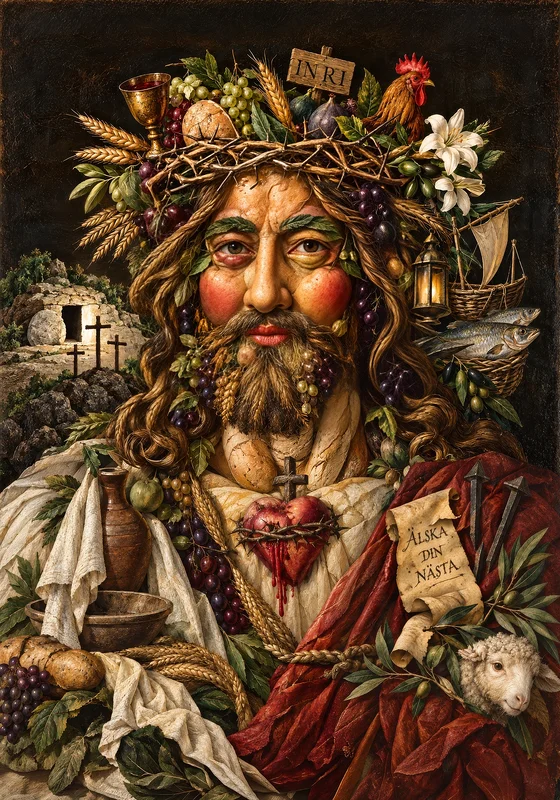
Jörgen Thornberg
Arcimboldo’s delayed portrait – Arcimboldos försenade porträtt, 2026
Digital
50 x 70 cm
Arcimboldo’s delayed portrait – Arcimboldos försenade porträtt
“The Portrait I Was Not Allowed to Paint
I had already painted the Emperor when I began to think about Christ. I had constructed Rudolf from the things that surrounded him and could be said to represent his world: fruits, flowers, grain and plants were joined together until, from a distance, they became a man, only to return, at close range, to being themselves. It was then that the thought occurred to me that the same method might be used for something infinitely greater. If an emperor could be told through the things that symbolised his power and his realm, why should the face of Jesus not be built from the things that told the story of his life?
I saw the painting before me long before I ever put brush to canvas. The bread and wine would be there, the fish and the wheat, the olive and the lamb, the cross and the thorns. I did not want to paint yet another Christ surrounded by his attributes, for the world already had more such paintings than it needed. I wanted to do with Jesus what I had done with the Emperor, but go one step further and let the Gospels themselves paint every detail. From a distance, one would encounter Christ; as one came closer, his face would dissolve, and his life would emerge.
I had not progressed very far with my plans when an abbot heard about them.
He did not like them.
To him, the difference between constructing the Emperor’s face from pears, grapes and ears of wheat and doing something similar with the Saviour was not a matter of subject but of blasphemy. The face of Christ, he informed me, was not an artistic experiment, and above all it was not to be transformed into the sort of optical game that had made me famous at court. I tried to explain that the opposite was true. I did not wish to ridicule Christ by making him from food and plants; I wanted every part of him to tell a story from the Gospels. The bread would be there because he had broken it. The wine because he had offered the cup to his disciples. The fish because fishermen had become apostles. The olive because the road to the Cross passed through Gethsemane.
The abbot was not reassured by my explanation.
Quite the contrary.
In the end, he made it clear that if I went ahead with the painting, the matter could be brought before the Church’s authorities, and that “excommunication” was not an empty threat. In the sixteenth century, even an imperial court painter was wise to take that seriously. And so I put away my sketches, and the portrait was never painted.
The strange thing is that some ideas seem to outlast their creators better than paintings do.
Four centuries later, I found myself in Milan once again, travelling from my star. The city was, of course, no longer the one I had known, nor was the Church quite the same. The abbot had been dead for centuries; his threat had lost its force, and I myself enjoyed the considerable advantage of having been absent from the earth for several hundred years. Excommunicating me now would hardly alter my prospects for the hereafter. Besides, one can only die once.
So, I brought back my old idea.
This time I began with the crown of thorns, resting heavily on the brow. It was not to be a decorative crown but to carry the Passion, the humiliation and the Crucifixion at the very summit of the portrait. Above it I placed the simple wooden tablet bearing the four letters INRI, Iesus Nazarenus Rex Iudaeorum, Jesus of Nazareth, King of the Jews. What had once been the Romans’ notice stating the condemned man’s crime had survived both those who condemned him and the empire in whose name the sentence had been carried out.
From there, I let the story spread across the painting. On the left, I opened the rock and left the tomb empty, the stone rolled away, because a portrait of Jesus ending at Golgotha would tell only half the story. In the same landscape, I raised the three crosses, Christ’s and those of the two criminals, and allowed the cross to appear again closer to the body. On the opposite side, I placed the nails against the deep red cloak, where the colour could carry both the mockery of the proclaimed king and the blood of the man who would soon be crucified. Across the cloak runs the rope, recalling the arrest and captivity, while the lantern above can be both the light of the world and the lantern light of those who came to seize him in Gethsemane.
But if I had filled the portrait only with the instruments of his death, perhaps the abbot would have been right about me after all. So I placed the bleeding heart at the centre of the picture. It is encircled by thorns and marked by suffering, but above all, love holds the image together. Beside the red cloak, the lamb looks out, Agnus Dei, the Lamb of God, while olive leaves and olives grow around it, leading back to the Mount of Olives and Gethsemane.
On the other side stand the basin of water and the white towel, and there I wanted to evoke one of the most powerful scenes from Jesus’ final evening with his disciples. He whom they called Lord and Master bent down and washed their feet. The act was that of a servant, and for precisely that reason it could say something essential about the man whose face I was trying to create: the greatest makes himself the least, not through words but by kneeling before another human being with water, a towel and his own hands.
And here, the bread, the grapes and the wheat are present. Here, at last, I could use my old method without turning it into an artistic trick for the court's amusement. The bread does not merely lie before him but forms his neck; the grapes run through his hair and beard; and the wheat grows into the figure itself. In the upper left stands the cup of wine, so that the Last Supper is present without my having to paint the table or the disciples around it. The grain of wheat also carries its own story of that which must fall into the earth and die before it can bear fruit, and thus the meal, death and resurrection meet in the same simple ear of wheat.
On the right, I allowed the fish to carry the story back to its beginning: the Sea of Galilee and the men who left their nets to follow him. That is why the boat and the fishing net are there as well. Although I did not paint Peter himself, I allowed him to be present through the rooster above. I need only to crow for the whole story of the promise, the fear and the three denials to spring to life. Among all this, the lilies grow, with their purity and their echo of the lilies of the field, together with the olive and the figs, plants belonging to the world in which the stories of the Gospels unfold and which, time and again, are themselves made to carry their meanings.
At last, there remained the parchment upon the red cloak. I could have written much there, but the longer I worked, the less I needed to say. If the bread, the wine, the washing of the feet, the lamb, the heart, and even the Cross could all be traced back to a single thought, there were a few words that came closer than any others:
‘LOVE THY NEIGHBOUR.’
When I finally stepped back a few paces from the painting, I saw that it had arranged the story for me. On the left, the tomb and the crosses joined the bread, the wine, and the meal, while the other side drew the eye towards Peter, the fish and the boat, and onward towards Gethsemane, the arrest, and the Passion. Between these two movements stood Jesus himself, with the crown of thorns above his brow and the wounded heart below. The longer I looked at him, the harder it became to tell where the man ended and the symbols began.
It was there, too, that I finally understood what had been missing when I first conceived the painting four centuries earlier. At the time, I had imagined doing with Jesus what I had done with the Emperor, but in truth it was not the same thing at all. Rudolf I had been constructed from the riches of nature to create an image of him and his world, whereas the bread, the wine, the wheat, the fish, the olive, the lamb and the thorns already carried the story of Christ before I ever took them into my hands. When they were joined together, therefore, they did not become objects disguised as a face, but fragments of a story slowly assuming human form. Perhaps the abbot had understood, after all, that the painting was more dangerous than I myself realised in the sixteenth century. However, for entirely the wrong reason: when, four hundred years later, I finally completed it, I had not painted Jesus and constructed him from his symbols. I had let his life, his death, his resurrection, and his teaching together shape his face.
I always do my best. So here it is."
Giuseppe Arcimboldo, Milan, Anno 2026
”Porträttet jag inte fick måla
Jag hade redan målat kejsaren när jag började fundera på Kristus. Rudolf hade jag byggt av det som omgav honom och det som kunde sägas representera hans värld: frukter, blommor, säd och växter fogades samman tills de på avstånd blev en människa och på nära håll återgick till att vara sig själva. Det var då tanken slog mig att samma metod borde kunna användas till något betydligt större. Om en kejsare kunde berättas genom de ting som symboliserade hans makt och hans rike, varför skulle inte Jesu ansikte kunna byggas av de ting som berättade om hans liv?
Jag såg målningen framför mig långt innan jag satte penseln mot duken. Brödet och vinet skulle finnas där, fisken och vetet, oliven och lammet, korset och törnet. Jag ville inte måla ännu en Kristus omgiven av sina attribut, för sådana målningar fanns det redan fler av än världen behövde. Jag ville göra med Jesus vad jag hade gjort med kejsaren, men gå ett steg längre och låta själva evangelierna måla alla detaljer. På avstånd skulle man möta Kristus; när man kom närmare skulle hans ansikte lösas upp och hans liv träda fram.
Jag hann inte långt med planerna innan en abbot fick höra talas om dem.
Han tyckte inte om dem.
För honom var skillnaden mellan att bygga kejsarens ansikte av päron, druvor och sädesax och att göra något liknande med Frälsaren inte en fråga om motiv utan om hädelse. Kristi ansikte var inget konstnärligt experiment, förklarade han för mig, och det fick framför allt inte förvandlas till den sorts optiska lek som hade gjort mig berömd vid hovet. Jag försökte förklara att det var precis tvärtom. Jag ville inte förlöjliga Kristus genom att göra honom av mat och växter; jag ville låta varje del av honom bära på en berättelse ur evangelierna. Brödet skulle vara där eftersom han hade brutit det. Vinet därför att han hade räckt kalken till sina lärjungar. Fisken därför att fiskare hade blivit apostlar. Oliven därför att vägen mot korset gick genom Getsemane.
Abboten blev inte lugnare av förklaringen.
Tvärtom.
Till slut gjorde han klart för mig att om jag genomförde målningen kunde saken föras vidare till kyrkans myndigheter och att ”bannlysning’ inte var något jag borde betrakta som ett tomt hot. På 1500-talet var det ett argument som även en kejserlig hovmålare gjorde klokt i att ta på allvar. Jag lade därför undan skisserna, och porträttet blev aldrig målat.
Det märkliga är att vissa idéer tycks överleva sin upphovsman bättre än målningar gör.
Fyra sekler senare befann jag mig åter i Milano. Staden var naturligtvis inte den jag hade känt, och inte heller var kyrkan densamma. Abboten var sedan länge död; hans hot hade förlorat sin kraft och jag hade själv den betydande fördelen att redan ha varit borta från jorden i flera hundra år. Att bannlysa mig nu skulle inte förändra mina framtidsutsikter. Och dessutom kan man bara dö en gång.
Så jag tog fram min gamla idé igen.
Den här gången började jag med ‘törnekronan’, som vilade tungt på pannan. Den skulle inte vara en dekorativ krona utan bära passionen, förnedringen och korsfästelsen i själva porträttets översta del. Ovanför den satte jag den enkla träskylten med de fyra bokstäverna ‘INRI’, ’Iesus Nazarenus Rex Iudaeorum’, Jesus från Nasaret, judarnas konung. Det som en gång hade varit romarnas upplysning om den dömdes brott hade överlevt både dem som dömde honom och det imperium i vars namn domen verkställdes.
Därifrån fick berättelsen breda ut sig över målningen. Till vänster öppnade jag klippan och lät ‘graven stå tom’, med stenen undanrullad, eftersom ett porträtt av Jesus som slutade på Golgata bara skulle berätta halva historien. I samma landskap reste jag ‘de tre korsen’, Kristi och de båda förbrytarnas, och lät korset återkomma närmare kroppen. På motsatt sida placerade jag ‘spikarna’ mot den djupt ‘röda manteln’, där färgen fick bära både hånet mot den utropade kungen och blodet från den människa som snart skulle korsfästas. Över manteln löper repet som för tanken tillbaka till gripandet och fångenskapen, medan ‘lyktan’ högre upp kan vara både ljuset i världen och lyktskenet från dem som kom för att gripa honom i Getsemane.
Men om jag bara hade fyllt porträttet med redskapen för hans död hade abboten kanske trots allt haft rätt om mig. Därför lät jag ‘det blödande hjärtat’ inta bildens centrum. Det är omgivet av törnen och märkt av lidandet, men det är framför allt kärleken som håller samman bilden. Intill den röda manteln tittar ‘lammet’ fram, *Agnus Dei*, Guds lamm, och runt omkring växer olivbladen och oliverna som leder tillbaka till Oljeberget och Getsemane.
På den andra sidan står ‘vattenfatet och den vita duken’, och där ville jag påminna om en av de mäktigaste scenerna under Jesu sista kväll med lärjungarna. Han, som de kallade Herre och Mästare, böjde sig ned och tvättade deras fötter. Handlingen var tjänarens, och just därför fick den säga något väsentligt om den människa vars ansikte jag försökte skapa: den störste gör sig till den minste, inte genom ord utan genom att knäböja framför en annan människa med vatten, handduk och sina egna händer.
Och här och där finns ‘brödet, druvorna och vetet’. Här kunde jag äntligen använda min gamla metod utan att den blev ett konststycke för hovets förströelse. Brödet ligger inte bara framför honom utan bygger upp hans hals, druvorna löper genom håret och skägget, och vetet växer in i gestalten. Uppe till vänster står ‘kalken med vinet’, så att den sista måltiden finns närvarande utan att jag behöver måla bordet eller lärjungarna omkring det. Vetekornet bär dessutom sin egen berättelse om det som måste falla i jorden och dö för att kunna bära frukt, och därmed möts måltiden, döden och uppståndelsen i samma enkla sädesax.
Till höger fick ”fiskarna’ föra berättelsen tillbaka till början, till Galileiska sjön och de män som lämnade sina nät för att följa honom. Därför finns också ”båten och fisknätet’, och trots att jag inte målade Petrus själv lät jag honom finnas med genom ”tuppen’ ovanför. Den behöver bara gala för att hela berättelsen om löftet, rädslan och de tre förnekelserna ska väckas till liv. Bland allt detta växer ”liljorna’, med sin renhet och sin erinran om liljorna på marken, tillsammans med ”oliven och fikonen’, växter som hör till den värld där evangeliernas berättelser utspelar sig och som gång på gång själva får bära deras betydelser.
Till sist återstod pergamentet på den röda manteln. Där kunde jag ha skrivit mycket, men ju längre jag arbetade, desto mindre behövde jag säga. Om brödet, vinet, fotatvagningen, lammet, hjärtat och till och med korset skulle kunna föras tillbaka till en gemensam tanke, fanns det några få ord som kom närmare än alla andra:
ÄLSKA DIN NÄSTA.
När jag sedan gick några steg tillbaka från målningen såg jag att den hade ordnat berättelsen åt mig. Till vänster hade graven och korsen förenats med brödet, vinet och måltiden, medan den andra sidan förde blicken mot Petrus, fiskarna och båten och vidare mot Getsemane, gripandet och passionen. Mellan dessa båda rörelser fanns Jesus själv, med törnekronan över pannan och det sårade hjärtat nedanför, men ju längre jag betraktade honom, desto svårare blev det att avgöra var människan slutade och symbolerna började.
Det var också där jag till sist förstod vad som hade saknats när jag först tänkte ut målningen för fyra sekler sedan. Jag hade då föreställt mig att jag skulle göra med Jesus vad jag hade gjort med kejsaren, men det var egentligen inte samma sak alls. Rudolf hade jag byggt av naturens rikedomar för att skapa en bild av honom och hans värld, medan brödet, vinet, vetet, fisken, oliven, lammet och törnet redan bar på berättelsen om Kristus innan jag tog dem i min hand. När de fogades samman blev de därför inte föremål som maskerades till ett ansikte, utan delar av en berättelse som långsamt antog en mänsklig gestalt. Kanske hade abboten trots allt förstått att målningen var farligare än jag själv gjorde på 1500-talet, fast av helt fel anledning, för när jag fyra hundra år senare äntligen kunde avsluta den hade jag inte målat Jesus och byggt upp honom med hans symboler. Jag hade låtit hans liv, hans död, hans uppståndelse och hans lära tillsammans forma hans ansikte.
Jag gör alltid mitt bästa. Så håll tillgodo.”
Giuseppe Arcimboldo, Milano Anno 2026

Jörgen Thornberg
Malmö
Lite om bilder och mig. Translation in English at the end.
Jag är en nyfiken person som ser allt i bilder, även det jag fäster i ord, gärna tillsammans för bakom alla mina bilder finns en berättelse. Till vissa bilder hör en kortare eller längre novell som följer med bilden.
Bilder berättar historier. Jag omges av naturlig skönhet, intressanta människor och historia var jag än går. Jag använder min kamera för att dokumentera världen och blanda det jag ser med vad jag känner för att fånga den dolda magin.
Mina bilder berättar mina historier. Genom mina bilder, tryck och berättelser. Jag bjuder in dig att ta del av dessa berättelser, in i ditt liv och hem och dela min mycket personliga syn på vår värld. Mer än vad ögat ser. Jag tänker i bilder, drömmer och skriver och pratar om dem; följaktligen måste jag också skapa bilder. De blir vad jag ser, inte nödvändigtvis begränsade till verkligheten. Det finns en bild runt varje hörn. Jag hoppas att du kommer att se vad jag såg och gilla det.
Jag är också en skrivande person och till många bilder hör en kortare eller längre essay. Den följer med tavlan, tryckt på fint papper och med en personlig hälsning från mig.
Flertalet bilder startar sin resa i min kamera. Enkelt förklarat beskriver jag bilden jag ser i mitt inre, upplevd eller fantiserad. Bilden uppstår inom mig redan innan jag fått okularet till ögat. På bråkdelen av ett ögonblick ser jag vad jag vill ha och vad som kan göras med bilden. Här skall jag stoppa in en giraff, stålmannen, Titanic eller vad det är min fantasi finner ut. Ännu märkligare är att jag kommer ihåg minnesbilden långt efteråt när det blir tid att skapa verket. Om jag lyckas eller inte, är upp till betraktaren, oftast präglat av en stråk av svart humor – meningen är att man skall bli underhållen. Mina bilder blir ofta en snackis där de hänger.
Jag föredrar bilder som förmedlar ett budskap i flera lager. Vid första anblicken fylld av feel-good, en vacker utsikt, fint väder, solen skiner, blommor på ängen eller vattnet som ligger förrädiskt spegelblankt. I en sådan bild kan jag gömma min egentliga berättelse, mitt förakt för förtryckare och våldsverkare, rasister och fördomsfulla människor - ett gärna återkommande motiv mer eller mindre dolt i det vackra motivet. Jag försöker förena dem i ett gemensamt narrativ.
Bild och formgivning har löpt som en röd tråd genom livet. Fotokonst känns som en värdig final som jag gärna delar med mig.
Min genre är vid som framgår av mina bilder, temat en blandning av pop- och gatukonst i kollage som kan bestå av hundratals lager. Vissa bilder kan ta veckor, andra någon dag innan det är dags att överlämna resultatet till printverkstaden. Fine Art Prints är digitala fotocollage. I dessa kollage sker rivandet, klippandet, pusslandet, målandet, ritandet och sprayningen digitalt. Det jag monterar in kan vara hundratals år gamla bilder som jag omsorgsfullt frilägger så att de ser ut att vara en del av tavlan men också bilder skapade av mig själv efter min egen fantasi. Därefter besöks printstudion och för vissa bilder numrera en limiterad upplaga (oftast 7 exemplar) och signera för hand. Vissa bilder kan köpas i olika format. Det är bara att fråga efter vilka. Gillar man en bild som är 70x100 men inte har plats på väggen, går den kanske att få i 50x70 cm istället. Frågan är fri.
Metoden Giclée eller Fine Art Print som det också kallas är det moderna sättet för framställning av grafisk konst. Villkoret för denna typ av utskrifter är att en högkvalitativ storformatskrivare används med åldersbeständigt färgpigment och konstnärspapper eller i förekommande fall på duk. Pappret som används möter de krav på livslängd som ställs av museer och gallerier. Normalt säljer jag mina bilder oinramade så att den nya ägaren själv kan bestämma hur de skall se ut, med eller utan passepartout färg på ram, med eller utan glas etc..
Under många år ställde jag bara ut på nätet, i valda grupper och på min egen Facebooksida - https://www.facebook.com/jorgen.thornberg.9
Jag finns också på en egen hemsida som tyvärr inte alltid är uppdaterad – https://www.jth.life/ Där kan du också läsa en del av de berättelser som följer med bilden.
UTSTÄLLNINGAR
Luftkastellet, oktober 2022
Konst i Lund, november 2022
Luftkastellet, mars 2023
Engleson Galleri Caroli, april 2023
Hydra, Greece June 2023
Engleson Galleri Caroli, oktober 2023
Toppen, Höllviken december 2023
Luftkastellet, mars 2024
Torups Galleri, mars 2024
Venice, May 2024
Luftkastellet, oktober 2024
Konst i Advent, December 2024
Galleri Engleson, Caroli December 2024
Jäger & Jansson Galleri, april 2025
A bit about pictures and me.
I'm a curious person who sees everything in pictures, even what I express in words, often combining them, for behind all my pictures lies a story. These narratives, some as short as a single image and others as long as a novel, are the heart and soul of my work.
Pictures tell stories. Wherever I go, I'm surrounded by natural beauty, exciting people, and history. I use my camera to document the world and blend what I see with what I feel to capture the hidden magic.
My images tell my stories. Through my pictures, prints, and narratives, I invite you to partake in these stories in your life and home and share my deeply personal perspective of our world. More than meets the eye. I think in pictures, dream, write, and talk about them; consequently, I must create images too. They become what I see, not necessarily confined to reality. There's a picture around every corner. I hope you'll see what I saw and enjoy it.
I'm also a writer, and many images come with a shorter or longer essay. It accompanies the painting, printed on fine paper with my personal greeting.
Many pictures start their journey on my camera. Simply put, I describe the image I see in my mind, experienced or imagined. The image arises within me even before I bring the eyepiece to my eye. In a fraction of a moment, I see what I want and what can be done with the picture. Here, I'll insert a giraffe, Superman, the Titanic, or whatever my imagination conjures up. Even stranger is that I remember the mental image long after it's time to create the work. Whether I succeed is up to the observer, often imbued with a streak of black humour – the aim is to entertain. My pictures usually become a talking point wherever they hang.
I prefer pictures that convey a message in multiple layers. At first glance, they're filled with feel-good vibes, a beautiful view, lovely weather, the sun shining, flowers in the meadow, or the water lying deceptively calm. But beneath this surface beauty, I often conceal a deeper story, a narrative that challenges societal norms or explores the human condition. I invite you to delve into these hidden narratives and discover the layers of meaning within my work.
Picture and design have been a thread running through my life. Photographic art feels like a fitting finale, and I'm happy to share it.
My genre is varied, as seen in my pictures; the theme is a blend of pop and street art in collages that can consist of hundreds of layers. Some images can take weeks, others just a day before it's time to hand over the result to the print workshop. Fine Art Prints are digital photo collages. In these collages, tearing, cutting, puzzling, painting, drawing, and spraying happen digitally. What I insert can be images hundreds of years old that I carefully extract so they appear to be part of the painting, but also images created by myself, now also generated from my imagination. Next, visit the print studio and, for certain images, number a limited edition (usually 7 copies) and sign them by hand. Some images may be available in other formats. Just ask which ones. If you like an image that's 70x100 but doesn't have space on the wall, you might be able to get it in 50x70 cm instead. The question is open.
The Giclée method, or Fine Art Print as it's also called, is the modern way of producing graphic art. This method ensures the highest quality and longevity of the artwork, using a high-quality large-format printer with archival pigment inks and artist paper or, in some cases, canvas. The paper used meets the longevity requirements set by museums and galleries. I sell my pictures unframed, allowing the new owner to personalise their artwork, confident in the lasting value and quality of the piece.
For many years, I only exhibited online, in selected groups, and on my Facebook page - https://www.facebook.com/jorgen.thornberg.9. I also have my website, which unfortunately is not constantly updated - https://www.jth.life/. You can also read some of the stories accompanying the pictures there.
EXHIBITIONS
Luftkastellet, October 2022
Art in Lund, November 2022
Luftkastellet, March 2023
Engleson Gallery Caroli, April 2023
Hydra, Greece June 2023
Engleson Gallery Caroli, October 2023
Toppen, Höllviken December 2023
Luftkastellet, March 2024
Torup Gallery, March 2024
Venice, May 2024
UTSTÄLLNINGAR
Luftkastellet, oktober 2022
Konst i Lund, november 2022
Luftkastellet, mars 2023
Engleson Galleri Caroli, april 2023
Hydra, Greece June 2023
Engleson Galleri Caroli, oktober 2023
Toppen, Höllviken december 2023
Luftkastellet, mars 2024
Torups Galleri, mars 2024
Venice, May 2024
Luftkastellet, October 2024
Konst i Advent, December 2024
Galleri Engleson, Caroli December 2024
Jäger & Jansson Galleri, April 2025
Utbildning
Autodidakt
Medlem i konstnärsförening
Öppna Sinnen
Med i konstrunda
Konstrundan i Skåne
Utställningar
Luftkastellet, October 2022
Art in Lund, November 2022
Luftkastellet, March 2023
Engleson Gallery Caroli, April 2023
Hydra, Greece June 2023
Engleson Gallery Caroli, October 2023
Toppen, Höllviken December 2023
Luftkastellet, March 2024
Torup Gallery, March 2024
Venice, May 2024