Vi använder cookies för att ge dig bästa möjliga upplevelse. Välj vilka cookies du tillåter.
Läs mer i vår integritetspolicy
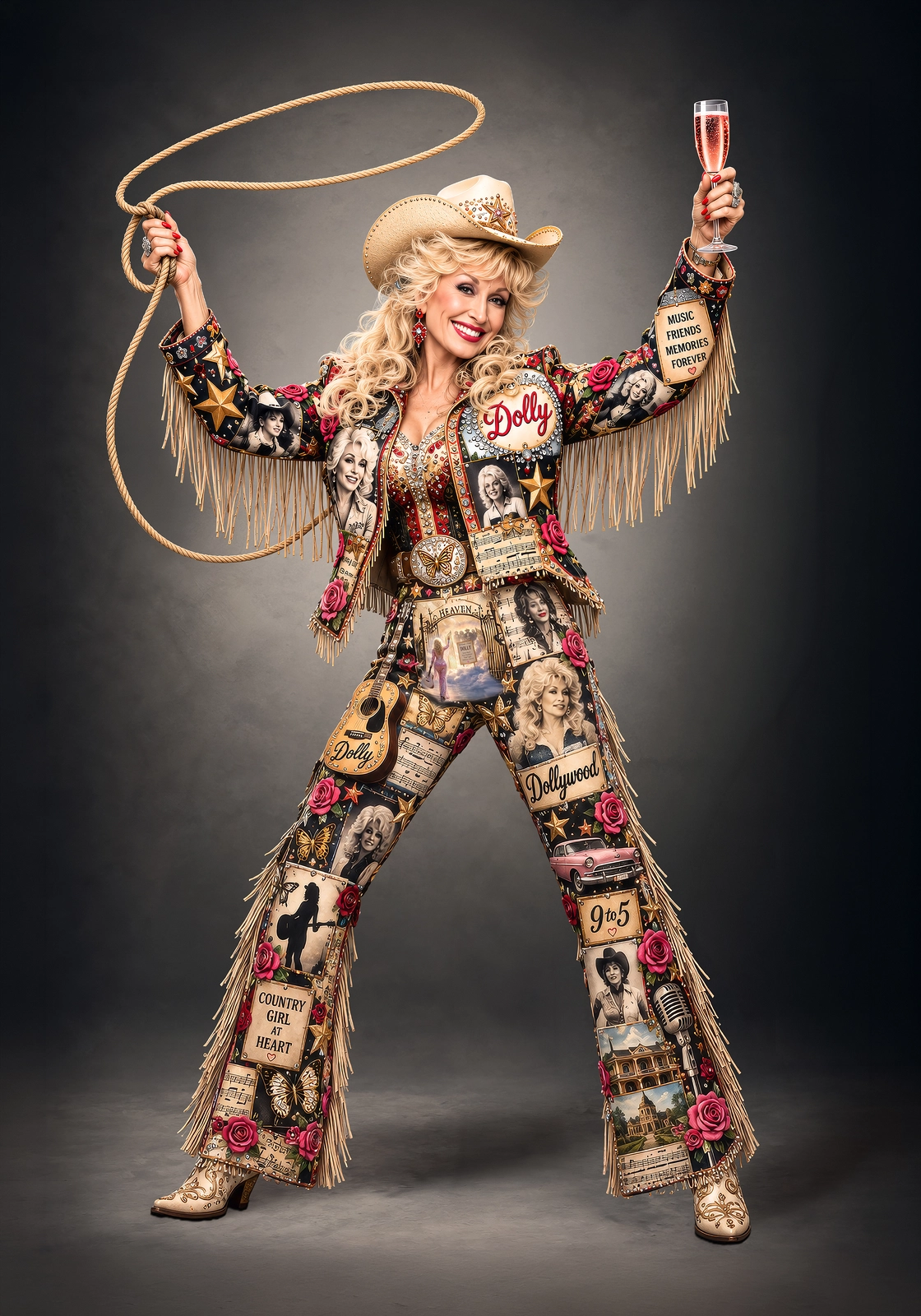
Jörgen Thornberg
9 to 5 - English version, 2026
Digital
50 x 70 cm
2 900 kr
9 to 5
INTRODUCTION — Three Little Words
Few songs announce themselves as quickly as 9 to 5. Before Dolly Parton has sung a word, the rhythm is already there: sharp, impatient and unmistakably mechanical. It sounds like a typewriter racing through another morning at the office. Except it is not a typewriter. It is Dolly Parton playing her acrylic fingernails.
It is hard to imagine a more fitting beginning.
Almost everything about 9 to 5 blends seriousness and playfulness, anger and optimism, hard reality and show-business sparkle. The song makes exploitation sound cheerful. The film turns sexism and workplace inequality into comedy. And at the centre of both stands a woman with enormous blonde hair, impossible heels, and a talent for letting people underestimate her to their own cost.
Yet 9 to 5 did not originate with Dolly Parton.
Before it was a song, it was a film. Before it was a film, it was the name of a movement of women demanding fairer treatment in the American workplace. And long before Dolly encountered any of them, the phrase described something much larger: the bargain by which millions of people trade the greater part of their waking lives for a pay cheque.
For Dolly, the phrase carried an added irony. Few people could have been less suited to a nine-to-five existence. She grew up in the mountains of East Tennessee, watching parents whose working days were dictated by necessity rather than office hours. She left home for Nashville straight after high school and built a career in a business where ambition didn't clock out at five. By the time Hollywood came calling, she had already learned a lesson familiar to the women in the film: working hard was one thing; getting the recognition, money, and control her work deserved was quite another.
That is what makes the story of 9 to 5 more interesting than the story of how a hit song was written.
It is the story of three women making a comedy about women who had stopped laughing at how they were treated. It is the story of Jane Fonda bringing workplace politics into mainstream Hollywood, of Lily Tomlin turning frustration into comedy, and of Dolly Parton discovering that her first major film role bore an uncanny resemblance to battles she had already fought in another industry. It is also the story of how a pair of acrylic fingernails transformed the sound of office machinery into one of popular music’s most recognisable rhythms.
Most of all, it is a story about work.
Work as necessity and work as ambition. Work that provides dignity and work that steals it. The invisible work done in homes, the poorly rewarded work done in offices, the physical work that wears out bodies, and the creative work people struggle to own. It is about the peculiar human habit of spending much of our lives dreaming of what we will do when the working day is finally over.
More than four decades after the film and song appeared, much of their physical world has vanished. The typewriters have fallen silent. Secretarial pools have largely disappeared. The office can now live inside a laptop, and the boss no longer needs to be in the same building to reach you. Nine-to-five may have become eight-to-six, six-to-two, midnight-to-eight, two jobs stitched together, or a working day that never quite ends because the telephone in your pocket refuses to let it.
And the song still works.
Perhaps that is because beneath the wigs, jokes, fantasies, typewriters and irresistible chorus lies a question that technology has never rendered obsolete:
How much of your life should work be allowed to take up?
Dolly Parton never set out to write a philosophical answer to that question. She was meant to write a theme song for a comedy.
Then she tapped her two fingernails together.
And heard a typewriter.
“The Ballad of Nine to Five
When morning strikes her brazen bell
And drives the dreamer from his bed,
The streets awake, the chimneys swell,
And weary feet to work are led.
The merchant counts, the mill wheels turn,
The clerk bends low where ledgers thrive;
For bread and shelter all must earn
Between the hours of nine and five.
”O Time, thou master stern and sly,
Who sellest hours that none may buy;
We give thee youth to stay alive,
And call the bargain nine to five.”
The lord sits high in cushioned ease
And signs his name where others toil;
He gathers fruit from unseen trees
And drinks the wine of others’ soil.
Yet every kingdom, proud and tall,
By humble hands is kept alive;
For should those hands forsake the hall,
No throne would last from nine to five.
”O Time, thou master stern and sly,
Who sellest hours that none may buy;
We give thee youth to stay alive,
And call the bargain nine to five.”
A woman sits before the keys,
Her fingers quick, her wages small;
She knows the books, the men, the fees,
Yet bears no name upon the wall.
Another wears the crown she made,
Another takes the praise they give;
Her clever hands remain in shade
Though by their work the great men live.
”O Time, thou master stern and sly,
Who sellest hours that none may buy;
We give thee youth to stay alive,
And call the bargain nine to five.”
But mark how Fortune loves disguise:
The fool may wear the sober crown,
While wisdom hides in laughing eyes
And golden hair that tumbles down.
Mistake not silk for simple mind,
Nor painted lips for wit deprived;
The brightest blade thou yet may find
May flash unseen from nine to five.
Three women meet beneath one roof,
Three roads have brought them to one door;
Each bear within her living proof
That patience need endure no more.
They laugh, and in their laughter grow
More dangerous than swords alive;
For tyrants have good cause to know
What laughter breeds from nine to five.
”O Time, thou master stern and sly,
Who sellest hours that none may buy;
We give thee youth to stay alive,
And call the bargain nine to five.”
Then from two nails a rhythm springs,
A little clack, a little beat;
No minstrel knows what fate it brings
When chance and inspiration meet.
The typewriter begins to sing,
The sleeping words awake and thrive,
And suddenly the rafters ring
With all the world from nine to five.
The factory hears, the waitress knows,
The nurse looks up, the driver smiles;
The mother folds another load,
The miner walks his weary miles.
Though each may serve a different clock,
The self-same hopes in each survive:
A fair day’s wage, a door unlocked,
A life beyond the nine to five.
”O Time, thou master stern and sly,
Who sellest hours that none may buy;
We give thee youth to stay alive,
And call the bargain nine to five.”
The years advance; the machines depart,
The paper yields to screens of light;
The office travels in the heart
Of little glass held day and night.
The ancient clock has changed its face,
Yet still its hungry hands survive;
For work may follow any place
And long outlive the nine-to-five.
So, spend thy hours, but guard thy soul,
For gold restores no vanished day;
Let labour serve a worthy goal,
But give not all thy life away.
No king, no master, clock nor bell
Can make a captive dream survive;
For life begins where we rebel
Against the walls of nine to five.
”O Time, thou master stern and sly,
Thou takest all that gold can’t buy;
So let us work, and love, and strive—
But let us live beyond the five.”
And when at last the clocks are still,
And silent lies the working day,
No ledger tells what heart or will
We gave, or what we dreamed away.
Then judge us not by wealth or fame,
Nor hours from which we did derive,
But whether we remained the same
When we came home from nine to five.
”Clack, clack—the little fingers play;”
”Clack, clack—and years have flown away.”
”The typewriter no more survives—”
”But still the human spirit strives.”
Malmö, September 2026
PROLOGUE — At Her Fingertips
Clack. Clack. Clack.
It was such a small sound that nobody on the set would have paid much attention to it—the clicking of two long acrylic fingernails against each other. But to me, sitting there between takes with a little time to kill and a movie full of secretaries running through my head, it sounded like something else.
A typewriter.
Clack-clack. Clack-clack.
And suddenly there it was: the rhythm of people arriving at work in the morning, coffee in hand, settling at their desks, answering telephones, typing letters, watching the clock and wondering how on earth it could still be only ten fifteen.
That little rhythm would become “9 to 5.”
Funny thing about a song, though. Sometimes you think you’ve just written it, when in fact you’ve been writing it all your life.
Long before I knew Jane Fonda or Lily Tomlin, long before anyone called me an actress, and long before I sat on a Hollywood set, clicking my fingernails together, I knew something about work. I grew up watching my daddy leave before daylight and come home after dark. I watched my mama stretch almost nothing to feed twelve children. And I learned pretty early that dreams don’t amount to much unless you’re prepared to work for them.
My own nine-to-five never really ran from nine to five. It began in the mountains of East Tennessee and followed me all the way to Nashville. It meant songs scribbled whenever they came into my head, long nights, early mornings, closed doors, open doors, and plenty of men who saw the blonde hair and the high heels before they noticed the woman beneath them.
Then, in 1980, three little words took on a new meaning.
”9 to 5” became a movie.
It became Doralee Rhodes, Violet Newstead and Judy Bernly. It became three women trying to survive in an office ruled by a man who underestimated them. We made people laugh, but beneath all the comedy was something millions of women already knew perfectly well: you could work harder than the man above you, know more than he did, keep the whole place running — and still be treated as though you ought to be grateful to have a desk.
And then ”9 to 5” became a song.
That may be the strangest part of all. A few minutes of music, born from the sound of my fingernails, somehow escaped from the movie that created it. It went out into factories and offices, supermarkets and hospitals, cars and kitchens. People who had never met Doralee Rhodes knew exactly what she was singing about.
Which brings us to the third meaning of those words — perhaps the biggest one.
The real nine to five.
Not the movie. Not the record. Not Hollywood.
Millions of people get up every morning because someone has to pay the rent, put food on the table, raise the children, and keep the world turning. Some love what they do. Some hate every minute of it. Most probably live somewhere in between. But almost everybody knows what it feels like to look at a clock and wish it would move a little faster—or to have a dream that has to wait until the working day is over.
So, when I look back now, I don’t really see one ”9 to 5”.
I see the life I lived, the film we made, the song I wrote, and the working lives of all the people who made that song their own.
And the funny thing is that all of it seems to fit into that one little sound.
Clack.
Clack.
Clack.
So, pour yourself a cup of ambition, honey.
We’ve got some work to do.
My Own Kind of “9 to 5” - From the Mountains to the Spotlight
Long before I ever sang about working nine-to-five, I knew what work looked like. I watched it throughout my childhood in the mountains of East Tennessee, though nobody around us would have thought to measure a workday by the hands of a clock. My father, Robert Lee Parton, was one of the smartest men I ever knew, even though he never had the opportunity to learn to read or write. He worked the land, took on construction jobs and did whatever else was necessary to keep a family of fourteen going. His working day began before daylight and often ended long after the sun had disappeared behind the mountains. There was no five o’clock whistle to tell him he was finished. Work was finished when the work was done.
My mother, Avie Lee, worked just as hard, though much of her labour took place within the walls of our home. Raising twelve children in a little cabin meant there was always somebody hungry, somebody needing clothes washed or mended, somebody crying, somebody sick, and somebody getting into the sort of trouble that twelve children can manufacture with remarkable efficiency. If Daddy went out into the world to earn what money he could, Mama somehow managed to contain an entire world inside that house. Looking back, I suppose those were my first lessons in something I would understand much better years later: some of the hardest work in the world is also the work most easily taken for granted.
We were poor, and there is no point in putting rhinestones on that fact, but poverty looks very different when you are a child living inside it. You do not wake every morning and assess your circumstances economically. You think about breakfast, your brothers and sisters, whether it is cold outside, what game you are going to play, and what kind of trouble you might get into before supper. We had very little money, but we had stories, faith, laughter, mountains and music, and the music seemed to find its way into almost everything. Church gave me a stage before I really understood what one was, and gospel songs, mountain songs and the voices of my family taught me that a song could make a hard life seem lighter, if only for a few minutes.
Before long, I began writing songs of my own. At first, I had no grand plan for them; I knew words and melodies kept appearing in my head, and I wanted somewhere to put them. Gradually, however, the dream acquired a name and a destination. The name was Nashville, and by the time I finished high school, I had little doubt I would go there. The day after I graduated in 1964, I left East Tennessee for Music City, eighteen years old and carrying far more ambition than experience. I knew I wanted to write songs and sing them. What I did not yet understand was how much work it would take to persuade other people that I had the right to do either.
Nashville was crowded with talented singers and songwriters, but it was also a place where a young woman was likely to receive a great deal of advice about what she ought to sing, how she ought to dress, and what sort of career she ought to pursue. I soon discovered that, for a woman in the music business, doing the work was only part of the job. The other part was convincing people that you understood the business as well as they did. My appearance did not always make that easier. I liked blonde hair, high heels, tight clothes, and enough rhinestones to signal passing aircraft, and I never saw any reason why the way I wanted to look should keep me from being taken seriously.
Quite often, of course, people did not take me seriously, and I eventually learned that being underestimated could have its advantages. While somebody was looking at the hair, I could be listening to the contract. While somebody was looking at the dress, I could be thinking about publishing rights. The image became part of the act, but the business behind it was never an act to me. I wanted to know who owned the songs, who controlled the recordings, where the money went, and what would still belong to me when the applause had stopped. That instinct did not arrive fully formed when I stepped off the bus in Nashville, but it grew stronger with each year I spent there.
My career did not happen overnight. I wrote songs, knocked on doors, made records that didn’t always turn out as I hoped, and learned that rejection was simply another part of the working day. Then came “The Porter Wagoner Show”, and with it an opportunity that changed my life. Porter introduced me to an enormous country audience, and together we made music I remain proud of. I owe an important part of my career to those years, and I have never had any difficulty saying so. But at some point, gratitude and independence began pulling me in different directions.
I wanted to make records on my own, write the songs I wanted to write, and discover what kind of artist I could become outside the partnership that had made me famous. Leaving Porter was therefore far more complicated than resigning from a job. Affection, loyalty, success, money, and ambition had become tangled together, and I needed to find a way to say that loving and respecting somebody did not mean surrendering the right to choose my own future. Since songs had always helped me say what ordinary conversation could not, I wrote one. “I Will Always Love You” became my farewell to Porter. Although the world would eventually know it primarily as a love song, for me it also carried something important about work, independence, and the difficult business of walking away from something good because I knew my own road lay somewhere else.
Years later, when I first encountered Doralee Rhodes, I recognised more of her than might have seemed possible. I had never been a secretary, never spent my days behind a typewriter, and never watched an office clock crawl towards five. Still, I knew what it was like to enter a room and have people make assumptions about you before you had opened your mouth. Her figure, her blonde hair, and her clothes were judged, and people mistook appearance for intelligence and friendliness for weakness. I had spent much of my career watching people make the same mistake about me. The details were different, but the underlying experience was familiar.
By then I had also learned that success did not free you from work; it merely changed the nature of the work you had to do. Singing and songwriting remained at the centre of my life, but around them had grown contracts, publishing, recording, touring, and the beginnings of businesses that required decisions very different from choosing a rhyme or finding a melody. The little girl from the mountains had become not only an entertainer but also a businesswoman, and I had come to understand that creative independence depended, to a surprising degree, on knowing who controlled the money and who owned the work.
Yet for all the distance I had travelled from East Tennessee, I never stopped thinking about the people I came from. My father never became famous, my mother never saw her name in lights, and most of the people I had known growing up would never stand on a Hollywood soundstage or receive an award. They worked because children had to be fed, houses had to be kept, crops had to be tended, and bills had to be paid. Their reward was not applause but the knowledge that tomorrow the family could get up and do it all again. Perhaps that was why the world behind “9 to 5” never seemed foreign to me, even though I had never worked in an office. I understood the dignity of work, but I also knew how easily hard work could be overlooked, particularly when the person doing it was a woman.
So, when Jane Fonda entered my life with a story about women who worked hard, were underestimated, and had finally had enough of being treated as less valuable than the man in the bigger office, she didn’t have to explain the basic idea to me. I already knew something about that world, even if I had reached it by a very different road. What I didn’t know was that Jane’s phone call would bring together my childhood, my career, my experience as a woman in business, and a little rhythm still waiting, quite literally, at the ends of my fingers.
Behind the Scenes of ”9 to 5” - Jane, Lily, and a Revolution in High Heels
By the time Jane Fonda called me, I had spent years learning that a woman could be successful yet still have to prove, over and over again, that she deserved to be taken seriously. What I did not know was that Jane had been thinking about much the same thing from an entirely different angle. She was interested in the lives of women who did not have stages, record contracts or their names in lights, but who went to work every morning in offices across America and discovered that being indispensable did not necessarily make them important.
The idea that eventually became “9 to 5” had roots in the real working world. During the 1970s, women office workers had begun organising around problems long treated as simply part of the job: low pay, limited opportunities for advancement, sexual harassment, and the assumption that secretaries existed not only to type letters and answer telephones but also to fetch coffee, run personal errands, and tolerate whatever behaviour came from the men above them. An organisation called 9to5 had emerged from that movement, and Jane became interested in making a film that could bring those experiences to cinemas without turning the story into a lecture. That was important, because Jane understood something I have always believed about songs: if you want people to hear what you are saying, sometimes it helps to make them laugh first.
When she approached me, however, I was hardly the obvious choice for the job. I had never acted in a film. I knew how to stand in front of an audience, find a camera, and deliver a song, but acting was another world entirely, and I was nervous enough to wonder whether I had any business being there. Jane evidently thought otherwise. She wanted me to play Doralee Rhodes alongside her and Lily Tomlin, and the more I learned about Doralee, the more I began to understand why Jane had thought of me.
Doralee was a secretary whose appearance entered every room before the rest of her did. She was blonde, shapely, cheerful, and feminine, and because of that, people assumed things about her that weren’t true. Her boss, Franklin Hart Jr., boasted of an affair with her that existed only in his imagination, while the other women in the office believed him and treated Doralee accordingly. She was being punished for a reputation she had never earned, and the source of that reputation was a man who regarded her attractiveness as something he was entitled to possess. Beneath the comedy, there was something painfully recognisable about that, because women had been living with variations of the same story for generations.
I immediately understood another part of Doralee. People looked at her and thought they knew how clever she was. I knew a little about that myself. By then I had spent years turning the exaggerated blonde image into part of my public personality, and I enjoyed it far too much to apologise for it. But I had also watched people confuse femininity with foolishness and glamour with a lack of seriousness. Doralee and I did not have the same life, but we shared the useful experience of being underestimated. Once I saw that, playing her began to feel less like pretending to be somebody else and more like finding a different version of something I already knew.
Jane and Lily brought entirely different energies to the picture. Jane had already won Academy Awards and carried a political seriousness impossible to miss. At the same time, Lily possessed one of the quickest and most inventive comic minds I had ever encountered. I arrived as the newcomer, the country singer who had never made a feature film, and at first I was frightened enough to learn not only my own lines but everybody else’s. I treated the script rather like a song I had to know perfectly before walking onto the stage. What might have been an intimidating experience became easier because the three of us were so different. We did not have to compete for the same space. Jane was Jane, Lily was Lily, and there was certainly no shortage of Dolly.
Those differences also suited the story. Jane’s Judy Bernly enters the office world after her marriage collapses and must learn to support herself. Lily’s Violet Newstead already knows the company inside out and has spent years watching less capable men move ahead of her. Doralee faces another form of humiliation, caused by Hart’s lies and unwanted attention. Three women arrive at the same rebellion by three different roads, and that was one reason the comedy could carry more weight than its outrageous plot might suggest. The audience could laugh at fantasies of poisoning, shooting or roasting Hart, and later at the wonderfully ridiculous business of keeping him prisoner in his own house, while recognising the very ordinary frustrations underneath it all.
Dabney Coleman understood balance beautifully. Hart had to be awful enough for the audience to enjoy everything that happened to him, yet recognisable enough not to become a cartoon villain from another universe. He was vain, dishonest, sexist and convinced of his own importance, yet the real joke was that the office functioned perfectly well without him. In fact, once the women took control, it functioned even better. They introduced changes that treated employees as human beings rather than interchangeable pieces of office machinery, and the comedy's fantasy became wonderfully simple: what if the people who actually understood the workplace were allowed to run it?
That question was more radical in 1980 than the film’s cheerful surface sometimes suggests today. The office in “9 to 5” belonged to a world in which men generally occupied the executive floors while women filled the secretarial pools beneath them. The women knew the files, schedules, customers and the daily machinery of the business, but knowledge and authority were not the same thing. Violet could be capable of a higher job and still watch a man receive the promotion. Doralee could perform her work perfectly and still have her body become the subject of office gossip. Judy could discover that entering the workforce meant learning an entire system whose rules had largely been written without women like her in mind.
That’s what made the picture more than a revenge fantasy, and it’s also what made the laughter so useful. We could do on screen what would have been horrifying in real life and ridiculous in a serious drama. We could kidnap the boss, strap him into a contraption in his bedroom, and watch three women temporarily remake corporate America while he dangled helplessly at home. Nobody needed to believe this was a practical programme for workplace reform. The exaggeration gave the audience permission to enjoy the fantasy while the ordinary injustices that inspired it remained entirely real.
For me, making the film was also an education. I had spent my professional life in recording studios, on television stages and in concert halls, places where everyone understood that I was there because of music. On a film set, I was the beginner, and being one again was both frightening and refreshing. I watched Jane and Lily, listened, learned, and discovered that acting was not as far removed from songwriting as I had imagined. Both depended on understanding why someone said something, not just knowing the words they were supposed to say.
There was another difference, though. When I wrote a song, the music told me when something was working. A rhythm could carry an idea before the words had quite caught up with it. While making “9 to 5”, I began to think about what kind of song could contain everything the movie was trying to say without merely explaining the plot. It needed to belong to Violet, Judy and Doralee, but it also had to belong to people who would never see themselves as characters in a Hollywood movie. It needed frustration without becoming miserable, anger without losing humour, and enough energy to get somebody out of bed on a Monday morning.
I carried my guitar with me whenever I could and kept turning the problem over in my mind between scenes. The answer did not arrive as a grand melody or a perfect opening line. It came almost by accident while I sat there, waiting for the cameras to roll, looking down at the long acrylic fingernails that had become as much a part of the Dolly Parton kit as wigs and rhinestones.
I tapped them together.
The sound was sharp, mechanical and strangely familiar. I did it again, listening more carefully.
There, in the middle of a Hollywood film set, was the office we had been trying to capture.
It sounded like a typewriter.
Acrylic Nails and a Cup of Ambition - How the Anthem Was Born
That little clicking sound stayed with me. Once I had heard a typewriter in my fingernails, I could not unhear it. The more I tapped them together, the more the rhythm seemed to belong to the film's world. It had the nervous energy of an office waking in the morning: machines beginning to chatter, telephones ringing, drawers opening, heels crossing polished floors, and people settling into another day that already seemed to be moving faster than they were. I had been looking for a way into the song, and suddenly the office itself seemed to be keeping time for me.
Songwriting has always been a mysterious business. Sometimes a song has to be chased for days or weeks, and sometimes it seems to have been waiting patiently for you to notice it. This one came quickly because the rhythm gave me the song’s character before I had all the words. It could not be slow or mournful, even though much of what the film was saying was serious. Violet, Judy, and Doralee were frustrated, underpaid, underestimated, and pushed around, but they were not defeated. They had humour, resilience, and a tremendous amount of life. The music had to carry that spirit, so I let the clicking of my nails push the melody forward as I built the words around the daily ritual of going to work.
That was how the morning entered the song: getting out of bed, stumbling towards the kitchen, trying to wake yourself up and preparing to face another day. The “cup of ambition” was coffee, of course, but I liked the idea because it was more than coffee. Everyone who gets up to go to work needs a little ambition, even if that ambition is to make it through the day. For some, it means building a career; for others, it means paying the mortgage, keeping food on the table, or saving enough to give their children opportunities they never had. The phrase was playful, but beneath it lay something I had understood since childhood. Work is rarely only about work. It is about everything the work makes possible.
As the song developed, however, I did not want to pretend that hard work was always rewarded fairly. That would have contradicted both the movie and much of what I had seen in life. My father had worked harder than many wealthy men I later met, yet hard work alone had never made him rich. The women whose experiences inspired “9 to 5” knew the same thing from another angle. They knew an office better than the executives who ran it, carried responsibilities far beyond their job descriptions, and still found that the promotion, the better salary and the authority went to somebody else. The American promise that determination inevitably carries a person upward is beautiful, but many hardworking people know the lift doesn’t stop at every floor.
That tension became the song's heart. I wanted the music to make you want to move, while the words told you why you might want to move right out of the office. I found something delicious in packaging frustration so cheerfully. A gloomy song about an unfair workplace might make people nod in agreement once and never play it again. A bright, irresistible song could slip past the front desk. People could sing it in the car on the way to the very job they were complaining about, dance to it at a party, and suddenly realise that beneath all that bounce was a fairly sharp description of power, money and disappointment.
That mixture of anger and pleasure is probably one reason the song travelled beyond the movie. It never required the listener to have worked in the particular office we showed on screen. You did not have to be a secretary, or even work from nine to five, to recognise the feeling of giving more than you seemed to get back. A nurse finishing a night shift, a factory worker watching a production line, a waitress carrying another tray, or a mother rushing from one job to another could hear something familiar. The hours might be different, and the workplace might look nothing like Consolidated Companies, but the feeling of somebody else owning a large part of your day was easy to recognise.
There was another reason I understood that feeling. By 1980, I was successful enough that nobody would have mistaken my life for that of an office secretary. Still, success had not erased my memories of watching people work to survive, nor had it erased my own battles over control of my career. I knew what it meant to be told that somebody else understood your future better than you did, and I knew the importance of owning the work you created. The circumstances were very different, but the question underlying them was the same: how much control does a person have over the labour of her own hands, the value it creates and the life she is trying to build with it?
Perhaps that is why I never thought of “9 to 5” as an angry song, even though anger is certainly present. Anger by itself would have been too small for what I wanted. I wanted recognition. I wanted somebody sitting in traffic at eight in the morning to hear the radio and think, “Yes, that is exactly how it feels”, and then turn the volume up. There is a peculiar comfort in discovering that millions of strangers share your private frustration. The job may not change because of a three-minute song, but for those three minutes you are no longer alone in it.
When the record was released alongside the film, the song began a life I could never have planned for it. It reached number one, crossed beyond the country audience, and brought me Grammy Awards, but charts and trophies tell only part of what happened. More important to me was how people began treating the song as though it belonged to them. Working women embraced it, labour organisations used it, and audiences who had never seen the film recognised the opening rhythm almost immediately. What began with three actresses making a comedy about an office became part of a much larger conversation about work and the people whose labour is too often noticed only when they stop doing it.
The sound people recognised wasn't actually a typewriter. No machine had produced that rhythm. Those percussive clicks on the recording came from the same unlikely instruments that had started the song in the first place: my acrylic fingernails. The symbol of the office worker had been recreated by something unmistakably associated with the exaggerated feminine image I had spent years turning to my advantage. I liked that little joke enormously. The nails that might have encouraged somebody to dismiss me as decorative had become part of the machinery behind one of the biggest records of my career.
Over the years, the typewriters themselves began to disappear. Offices filled with computers, secretarial pools changed, working patterns shifted, and even the expression “nine to five” became less literal for millions of people. Yet the song did not disappear with the machines whose rhythm had inspired it. If anything, that taught me we had stumbled onto something broader than a particular moment in office life. Technology can change the desk, the factory, the store, and the way the boss reaches you. Still, it does not automatically change the old questions about who does the work, who receives the rewards, and how much of ourselves we are willing to give away to earn a living.
Whenever I perform the song and hear an audience recognise those opening notes, I sometimes think back to that film set and the absurd simplicity of the moment it began. No orchestra was waiting, no grand declaration that a song was about to be born, and certainly no reason to imagine people would still be singing it decades later. There was only a woman between takes, thinking about a film, tapping her fingernails together and listening.
Clack-clack. Clack-clack.
A typewriter that was never a typewriter, keeping time for a working day that turned out to last far longer than any of us expected.
After Five O’Clock - What “9 to 5” became
When we made “9 to 5”, none of us could have known how long those three little words would follow us. We were making a comedy about a particular workplace at a particular moment in American life. The world we put on screen was unmistakably that of 1980: typewriters rattling across rows of desks, telephones with cords, paper files stacked in cabinets, and secretaries sitting outside the offices of men whose names were painted on the doors. Much of that world has disappeared, but the curious thing is that the feeling behind it has not. The machines changed faster than the relationship people have with work.
That is probably why the song survived the office that inspired it. The literal nine-to-five day was never as universal as the phrase suggested, even then. My daddy certainly never worked nine-to-five, and neither did my mama. Nurses, servers, factory workers, farmers, police officers, truck drivers and countless others have always lived by different clocks, while raising children and keeping a home never came with a time card. Today the boundaries are even less certain. Some people work from home, some work nights, some hold two jobs, and some carry an office in a telephone that lets work find them at almost any hour. The old typewriter may have vanished from the desk, but five o’clock has not necessarily become any easier to find.
Over the years, I have met thousands of people who have told me what “9 to 5” means to them, and their stories have rarely been about the exact hours in the title. They have been about getting up when you would rather stay in bed, going back to the same factory, hospital, or store for another shift, putting up with a boss who never seems to notice what you do, or working for years in the hope that your children might have choices you never had. I have met women raising families while holding down jobs, men who have spent decades doing physical work that eventually showed in their hands and backs, and people who reached retirement and could hardly believe how much of their lives had been measured in working days. Their jobs were different, but the emotions were often remarkably similar.
Perhaps that is the real reason people made the song their own. I wrote it for a film, but audiences didn’t need the film to understand it. Once a song leaves the person who wrote it, you lose control over what it means, and that is one of the loveliest things about music. Someone can take a line you wrote about one experience and attach it to an entirely different life. Before long, “9 to 5” no longer belonged only to Doralee, Violet and Judy, and it certainly did not belong only to me. It belonged to anyone who had ever felt that the work they did was worth more than the respect they received for doing it.
That does not mean I have ever believed work itself is the enemy. I was raised by people who took enormous pride in hard work, and I inherited that pride. Work gave my father dignity even when it didn’t bring him much money, and music gave me a way to build the life I imagined as a little girl in Tennessee. I love working and have probably always worked far more hours than any sensible definition of nine-to-five would recommend. The problem begins when work takes everything and gives too little back, when people are treated as expenses rather than human beings, or when somebody spends a lifetime helping to create prosperity that never seems to reach them.
Success also forced me to consider the other side of that relationship. Eventually, I was no longer simply the girl hoping someone would record one of her songs. I became an employer and a business owner, and that changed my perspective considerably. It is easy to sing about a bad boss when you have never had employees of your own; it becomes a more interesting question when people depend on decisions bearing your name. Dollywood, in particular, brought that lesson home to me because it connected business with the place I came from. I wanted to build something in East Tennessee that would entertain visitors, certainly. Still, I also understood what steady employment could mean in a region where families like mine had always known how hard money could be to earn.
The same connection between opportunity and dignity underpins the Imagination Library, even if books may seem a long way from a song about office workers. My father could not read or write, and that stayed with me long after I had enough money to buy all the books I wanted. Creating a programme that puts books in children’s hands was therefore not simply a matter of charity. It grew out of the same world that shaped my understanding of work: the belief that where you begin in life should not decide everything about where you can go. Education cannot remove every obstacle, but it can give a child more doors to knock on.
In that sense, my life has always contained a contradiction I rather like. I have spent decades singing a song about the frustrations of working while being somebody who seems constitutionally incapable of stopping work. I have written songs on buses, in hotel rooms, backstage, at home, and anywhere else an idea found me. There has never been a whistle at five o’clock telling me to put down the pencil. The difference, and it is an important one, is that much of my work has been mine. I have been fortunate enough to build a life in which ambition and labour could become freedom, and I know perfectly well that not everybody gets that bargain.
Maybe that is also why I have never wanted “9 to 5” to sound bitter. There is anger in it, and there should be, but there is also humour, stubbornness and hope. Violet, Judy and Doralee do not simply complain about the office; when the opportunity arises, they imagine how it could be better. That part of the film mattered. Their fantasy is not a world without work but a workplace with more dignity, flexibility, fairness and common sense. The joke is that once the terrible boss is removed, the people he failed to respect turn out to be remarkably good at running things.
More than four decades later, audiences still respond almost as soon as they hear that familiar rhythm. Some of those singing along were not born when the film was released. They have never used the kind of typewriter those fingernails were imitating, and many have never worked anything resembling a traditional nine-to-five schedule. Yet they know the words because the bargain at the centre of the song remains familiar: we give work a great deal of our lives, and in return we hope for more than a pay cheque. We hope for independence, respect, security, opportunity and enough life left over at the end of the working day to remember who we are when we are not working.
That, I think, is what “9 to 5” became. It began as the title of a movement among working women, became the name of a film, turned into a song at the ends of my fingernails, and then escaped from all of us. Somewhere along the way, it stopped describing a schedule and became shorthand for something much larger: the strange bargain most of us strike between our time and our dreams.
And perhaps that is why, after all these years, people are still singing it long after five o’clock. Clack-clack. Clack-clack.
EPILOGUE — The Typewriter Is Silent
The typewriters are mostly gone now. Those great clattering machines that once filled offices with their own peculiar music have disappeared from desks, along with carbon paper, correction fluid, and many of the other little rituals that belonged to the working world we were making fun of in ”9 to 5”. The secretarial pools have changed; the telephones no longer have cords, and an office can now follow you home in something small enough to fit into your pocket. Sometimes I wonder whether we really escaped the old nine-to-five at all, or taught it how to find us after five.
More than four decades have passed since Jane, Lily and I walked onto that film set together. We could not have imagined then that people who had not even been born would one day know those characters, or that a song I worked out by tapping my fingernails together would still send a crowd to its feet before I had sung more than a few words. That is one of the mysteries of music. You write a song for one moment, and if you are very lucky, the moment lets go of it.
Whenever I hear that rhythm now, I sometimes travel much farther back than Hollywood. I think about East Tennessee and the people who taught me what work meant long before I had a word for ambition. I see my daddy heading out to take whatever job would put food on the table, though nobody was waiting to applaud him when he came home. I see my mama facing another day with twelve children and enough work to exhaust an army, though nobody handed her a pay cheque for it. They belonged to that enormous company of people who keep the world running without ever seeing their names in lights.
Perhaps that is why “9 to 5” has always meant more to me than a film or a hit record. Somewhere within all the jokes, the high heels, the office politics and that cheerful little melody, I learned as a child: work takes up an enormous part of a human life, and the person doing it deserves to be seen. It does not matter whether the work happens in a field, a factory, an office, a hospital, a kitchen, a shop or at home with children. There is dignity in doing something well, but dignity should never be an excuse for expecting people to accept being ignored, underpaid or treated as though their time matters less than somebody else’s.
I have been luckier than I ever knew how to ask for. The little girl who left the mountains with songs in her head was allowed to make a living from them, own much of what she created, and eventually use some of that success to build other things. Yet the older I get, the more clearly I understand that the greatest luxury was never the wigs, the rhinestones or the money. It was having enough control over my own life to decide what my work would be and what I wanted it to mean.
Maybe that is what everybody is really chasing when the alarm clock rings in the morning. Not simply a pay cheque, although heaven knows we all need one, but a little independence, a little respect, and enough room left in the day for a life of our own. The world of work will keep changing, just as it changed from my daddy’s fields to those rows of typewriters in our movie, and from those typewriters to the glowing screens people work on today. But I doubt that particular hope will ever become old-fashioned.
Sometimes, just before I sing “9 to 5”, there is a brief moment when the stage holds its breath and the audience already knows what is coming. Then I make that familiar sound, and thousands of people recognise it instantly. For a second, an instrument that never really existed comes back to life. Somewhere in that rhythm, I can still hear the office, the movie set, Jane and Lily, Doralee, my mama and daddy, Nashville, the mountains, and that eighteen-year-old girl who had no intention of letting anyone else decide how big she was allowed to dream.
The typewriters may have gone quiet, love.
But the working day never did.
”Clack. Clack. Clack.”
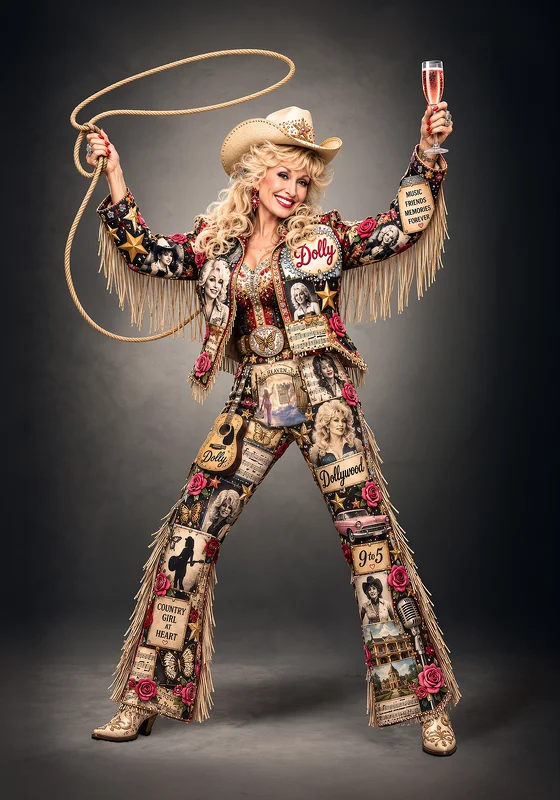
Jörgen Thornberg
9 to 5 - English version, 2026
Digital
50 x 70 cm
2 900 kr
9 to 5
INTRODUCTION — Three Little Words
Few songs announce themselves as quickly as 9 to 5. Before Dolly Parton has sung a word, the rhythm is already there: sharp, impatient and unmistakably mechanical. It sounds like a typewriter racing through another morning at the office. Except it is not a typewriter. It is Dolly Parton playing her acrylic fingernails.
It is hard to imagine a more fitting beginning.
Almost everything about 9 to 5 blends seriousness and playfulness, anger and optimism, hard reality and show-business sparkle. The song makes exploitation sound cheerful. The film turns sexism and workplace inequality into comedy. And at the centre of both stands a woman with enormous blonde hair, impossible heels, and a talent for letting people underestimate her to their own cost.
Yet 9 to 5 did not originate with Dolly Parton.
Before it was a song, it was a film. Before it was a film, it was the name of a movement of women demanding fairer treatment in the American workplace. And long before Dolly encountered any of them, the phrase described something much larger: the bargain by which millions of people trade the greater part of their waking lives for a pay cheque.
For Dolly, the phrase carried an added irony. Few people could have been less suited to a nine-to-five existence. She grew up in the mountains of East Tennessee, watching parents whose working days were dictated by necessity rather than office hours. She left home for Nashville straight after high school and built a career in a business where ambition didn't clock out at five. By the time Hollywood came calling, she had already learned a lesson familiar to the women in the film: working hard was one thing; getting the recognition, money, and control her work deserved was quite another.
That is what makes the story of 9 to 5 more interesting than the story of how a hit song was written.
It is the story of three women making a comedy about women who had stopped laughing at how they were treated. It is the story of Jane Fonda bringing workplace politics into mainstream Hollywood, of Lily Tomlin turning frustration into comedy, and of Dolly Parton discovering that her first major film role bore an uncanny resemblance to battles she had already fought in another industry. It is also the story of how a pair of acrylic fingernails transformed the sound of office machinery into one of popular music’s most recognisable rhythms.
Most of all, it is a story about work.
Work as necessity and work as ambition. Work that provides dignity and work that steals it. The invisible work done in homes, the poorly rewarded work done in offices, the physical work that wears out bodies, and the creative work people struggle to own. It is about the peculiar human habit of spending much of our lives dreaming of what we will do when the working day is finally over.
More than four decades after the film and song appeared, much of their physical world has vanished. The typewriters have fallen silent. Secretarial pools have largely disappeared. The office can now live inside a laptop, and the boss no longer needs to be in the same building to reach you. Nine-to-five may have become eight-to-six, six-to-two, midnight-to-eight, two jobs stitched together, or a working day that never quite ends because the telephone in your pocket refuses to let it.
And the song still works.
Perhaps that is because beneath the wigs, jokes, fantasies, typewriters and irresistible chorus lies a question that technology has never rendered obsolete:
How much of your life should work be allowed to take up?
Dolly Parton never set out to write a philosophical answer to that question. She was meant to write a theme song for a comedy.
Then she tapped her two fingernails together.
And heard a typewriter.
“The Ballad of Nine to Five
When morning strikes her brazen bell
And drives the dreamer from his bed,
The streets awake, the chimneys swell,
And weary feet to work are led.
The merchant counts, the mill wheels turn,
The clerk bends low where ledgers thrive;
For bread and shelter all must earn
Between the hours of nine and five.
”O Time, thou master stern and sly,
Who sellest hours that none may buy;
We give thee youth to stay alive,
And call the bargain nine to five.”
The lord sits high in cushioned ease
And signs his name where others toil;
He gathers fruit from unseen trees
And drinks the wine of others’ soil.
Yet every kingdom, proud and tall,
By humble hands is kept alive;
For should those hands forsake the hall,
No throne would last from nine to five.
”O Time, thou master stern and sly,
Who sellest hours that none may buy;
We give thee youth to stay alive,
And call the bargain nine to five.”
A woman sits before the keys,
Her fingers quick, her wages small;
She knows the books, the men, the fees,
Yet bears no name upon the wall.
Another wears the crown she made,
Another takes the praise they give;
Her clever hands remain in shade
Though by their work the great men live.
”O Time, thou master stern and sly,
Who sellest hours that none may buy;
We give thee youth to stay alive,
And call the bargain nine to five.”
But mark how Fortune loves disguise:
The fool may wear the sober crown,
While wisdom hides in laughing eyes
And golden hair that tumbles down.
Mistake not silk for simple mind,
Nor painted lips for wit deprived;
The brightest blade thou yet may find
May flash unseen from nine to five.
Three women meet beneath one roof,
Three roads have brought them to one door;
Each bear within her living proof
That patience need endure no more.
They laugh, and in their laughter grow
More dangerous than swords alive;
For tyrants have good cause to know
What laughter breeds from nine to five.
”O Time, thou master stern and sly,
Who sellest hours that none may buy;
We give thee youth to stay alive,
And call the bargain nine to five.”
Then from two nails a rhythm springs,
A little clack, a little beat;
No minstrel knows what fate it brings
When chance and inspiration meet.
The typewriter begins to sing,
The sleeping words awake and thrive,
And suddenly the rafters ring
With all the world from nine to five.
The factory hears, the waitress knows,
The nurse looks up, the driver smiles;
The mother folds another load,
The miner walks his weary miles.
Though each may serve a different clock,
The self-same hopes in each survive:
A fair day’s wage, a door unlocked,
A life beyond the nine to five.
”O Time, thou master stern and sly,
Who sellest hours that none may buy;
We give thee youth to stay alive,
And call the bargain nine to five.”
The years advance; the machines depart,
The paper yields to screens of light;
The office travels in the heart
Of little glass held day and night.
The ancient clock has changed its face,
Yet still its hungry hands survive;
For work may follow any place
And long outlive the nine-to-five.
So, spend thy hours, but guard thy soul,
For gold restores no vanished day;
Let labour serve a worthy goal,
But give not all thy life away.
No king, no master, clock nor bell
Can make a captive dream survive;
For life begins where we rebel
Against the walls of nine to five.
”O Time, thou master stern and sly,
Thou takest all that gold can’t buy;
So let us work, and love, and strive—
But let us live beyond the five.”
And when at last the clocks are still,
And silent lies the working day,
No ledger tells what heart or will
We gave, or what we dreamed away.
Then judge us not by wealth or fame,
Nor hours from which we did derive,
But whether we remained the same
When we came home from nine to five.
”Clack, clack—the little fingers play;”
”Clack, clack—and years have flown away.”
”The typewriter no more survives—”
”But still the human spirit strives.”
Malmö, September 2026
PROLOGUE — At Her Fingertips
Clack. Clack. Clack.
It was such a small sound that nobody on the set would have paid much attention to it—the clicking of two long acrylic fingernails against each other. But to me, sitting there between takes with a little time to kill and a movie full of secretaries running through my head, it sounded like something else.
A typewriter.
Clack-clack. Clack-clack.
And suddenly there it was: the rhythm of people arriving at work in the morning, coffee in hand, settling at their desks, answering telephones, typing letters, watching the clock and wondering how on earth it could still be only ten fifteen.
That little rhythm would become “9 to 5.”
Funny thing about a song, though. Sometimes you think you’ve just written it, when in fact you’ve been writing it all your life.
Long before I knew Jane Fonda or Lily Tomlin, long before anyone called me an actress, and long before I sat on a Hollywood set, clicking my fingernails together, I knew something about work. I grew up watching my daddy leave before daylight and come home after dark. I watched my mama stretch almost nothing to feed twelve children. And I learned pretty early that dreams don’t amount to much unless you’re prepared to work for them.
My own nine-to-five never really ran from nine to five. It began in the mountains of East Tennessee and followed me all the way to Nashville. It meant songs scribbled whenever they came into my head, long nights, early mornings, closed doors, open doors, and plenty of men who saw the blonde hair and the high heels before they noticed the woman beneath them.
Then, in 1980, three little words took on a new meaning.
”9 to 5” became a movie.
It became Doralee Rhodes, Violet Newstead and Judy Bernly. It became three women trying to survive in an office ruled by a man who underestimated them. We made people laugh, but beneath all the comedy was something millions of women already knew perfectly well: you could work harder than the man above you, know more than he did, keep the whole place running — and still be treated as though you ought to be grateful to have a desk.
And then ”9 to 5” became a song.
That may be the strangest part of all. A few minutes of music, born from the sound of my fingernails, somehow escaped from the movie that created it. It went out into factories and offices, supermarkets and hospitals, cars and kitchens. People who had never met Doralee Rhodes knew exactly what she was singing about.
Which brings us to the third meaning of those words — perhaps the biggest one.
The real nine to five.
Not the movie. Not the record. Not Hollywood.
Millions of people get up every morning because someone has to pay the rent, put food on the table, raise the children, and keep the world turning. Some love what they do. Some hate every minute of it. Most probably live somewhere in between. But almost everybody knows what it feels like to look at a clock and wish it would move a little faster—or to have a dream that has to wait until the working day is over.
So, when I look back now, I don’t really see one ”9 to 5”.
I see the life I lived, the film we made, the song I wrote, and the working lives of all the people who made that song their own.
And the funny thing is that all of it seems to fit into that one little sound.
Clack.
Clack.
Clack.
So, pour yourself a cup of ambition, honey.
We’ve got some work to do.
My Own Kind of “9 to 5” - From the Mountains to the Spotlight
Long before I ever sang about working nine-to-five, I knew what work looked like. I watched it throughout my childhood in the mountains of East Tennessee, though nobody around us would have thought to measure a workday by the hands of a clock. My father, Robert Lee Parton, was one of the smartest men I ever knew, even though he never had the opportunity to learn to read or write. He worked the land, took on construction jobs and did whatever else was necessary to keep a family of fourteen going. His working day began before daylight and often ended long after the sun had disappeared behind the mountains. There was no five o’clock whistle to tell him he was finished. Work was finished when the work was done.
My mother, Avie Lee, worked just as hard, though much of her labour took place within the walls of our home. Raising twelve children in a little cabin meant there was always somebody hungry, somebody needing clothes washed or mended, somebody crying, somebody sick, and somebody getting into the sort of trouble that twelve children can manufacture with remarkable efficiency. If Daddy went out into the world to earn what money he could, Mama somehow managed to contain an entire world inside that house. Looking back, I suppose those were my first lessons in something I would understand much better years later: some of the hardest work in the world is also the work most easily taken for granted.
We were poor, and there is no point in putting rhinestones on that fact, but poverty looks very different when you are a child living inside it. You do not wake every morning and assess your circumstances economically. You think about breakfast, your brothers and sisters, whether it is cold outside, what game you are going to play, and what kind of trouble you might get into before supper. We had very little money, but we had stories, faith, laughter, mountains and music, and the music seemed to find its way into almost everything. Church gave me a stage before I really understood what one was, and gospel songs, mountain songs and the voices of my family taught me that a song could make a hard life seem lighter, if only for a few minutes.
Before long, I began writing songs of my own. At first, I had no grand plan for them; I knew words and melodies kept appearing in my head, and I wanted somewhere to put them. Gradually, however, the dream acquired a name and a destination. The name was Nashville, and by the time I finished high school, I had little doubt I would go there. The day after I graduated in 1964, I left East Tennessee for Music City, eighteen years old and carrying far more ambition than experience. I knew I wanted to write songs and sing them. What I did not yet understand was how much work it would take to persuade other people that I had the right to do either.
Nashville was crowded with talented singers and songwriters, but it was also a place where a young woman was likely to receive a great deal of advice about what she ought to sing, how she ought to dress, and what sort of career she ought to pursue. I soon discovered that, for a woman in the music business, doing the work was only part of the job. The other part was convincing people that you understood the business as well as they did. My appearance did not always make that easier. I liked blonde hair, high heels, tight clothes, and enough rhinestones to signal passing aircraft, and I never saw any reason why the way I wanted to look should keep me from being taken seriously.
Quite often, of course, people did not take me seriously, and I eventually learned that being underestimated could have its advantages. While somebody was looking at the hair, I could be listening to the contract. While somebody was looking at the dress, I could be thinking about publishing rights. The image became part of the act, but the business behind it was never an act to me. I wanted to know who owned the songs, who controlled the recordings, where the money went, and what would still belong to me when the applause had stopped. That instinct did not arrive fully formed when I stepped off the bus in Nashville, but it grew stronger with each year I spent there.
My career did not happen overnight. I wrote songs, knocked on doors, made records that didn’t always turn out as I hoped, and learned that rejection was simply another part of the working day. Then came “The Porter Wagoner Show”, and with it an opportunity that changed my life. Porter introduced me to an enormous country audience, and together we made music I remain proud of. I owe an important part of my career to those years, and I have never had any difficulty saying so. But at some point, gratitude and independence began pulling me in different directions.
I wanted to make records on my own, write the songs I wanted to write, and discover what kind of artist I could become outside the partnership that had made me famous. Leaving Porter was therefore far more complicated than resigning from a job. Affection, loyalty, success, money, and ambition had become tangled together, and I needed to find a way to say that loving and respecting somebody did not mean surrendering the right to choose my own future. Since songs had always helped me say what ordinary conversation could not, I wrote one. “I Will Always Love You” became my farewell to Porter. Although the world would eventually know it primarily as a love song, for me it also carried something important about work, independence, and the difficult business of walking away from something good because I knew my own road lay somewhere else.
Years later, when I first encountered Doralee Rhodes, I recognised more of her than might have seemed possible. I had never been a secretary, never spent my days behind a typewriter, and never watched an office clock crawl towards five. Still, I knew what it was like to enter a room and have people make assumptions about you before you had opened your mouth. Her figure, her blonde hair, and her clothes were judged, and people mistook appearance for intelligence and friendliness for weakness. I had spent much of my career watching people make the same mistake about me. The details were different, but the underlying experience was familiar.
By then I had also learned that success did not free you from work; it merely changed the nature of the work you had to do. Singing and songwriting remained at the centre of my life, but around them had grown contracts, publishing, recording, touring, and the beginnings of businesses that required decisions very different from choosing a rhyme or finding a melody. The little girl from the mountains had become not only an entertainer but also a businesswoman, and I had come to understand that creative independence depended, to a surprising degree, on knowing who controlled the money and who owned the work.
Yet for all the distance I had travelled from East Tennessee, I never stopped thinking about the people I came from. My father never became famous, my mother never saw her name in lights, and most of the people I had known growing up would never stand on a Hollywood soundstage or receive an award. They worked because children had to be fed, houses had to be kept, crops had to be tended, and bills had to be paid. Their reward was not applause but the knowledge that tomorrow the family could get up and do it all again. Perhaps that was why the world behind “9 to 5” never seemed foreign to me, even though I had never worked in an office. I understood the dignity of work, but I also knew how easily hard work could be overlooked, particularly when the person doing it was a woman.
So, when Jane Fonda entered my life with a story about women who worked hard, were underestimated, and had finally had enough of being treated as less valuable than the man in the bigger office, she didn’t have to explain the basic idea to me. I already knew something about that world, even if I had reached it by a very different road. What I didn’t know was that Jane’s phone call would bring together my childhood, my career, my experience as a woman in business, and a little rhythm still waiting, quite literally, at the ends of my fingers.
Behind the Scenes of ”9 to 5” - Jane, Lily, and a Revolution in High Heels
By the time Jane Fonda called me, I had spent years learning that a woman could be successful yet still have to prove, over and over again, that she deserved to be taken seriously. What I did not know was that Jane had been thinking about much the same thing from an entirely different angle. She was interested in the lives of women who did not have stages, record contracts or their names in lights, but who went to work every morning in offices across America and discovered that being indispensable did not necessarily make them important.
The idea that eventually became “9 to 5” had roots in the real working world. During the 1970s, women office workers had begun organising around problems long treated as simply part of the job: low pay, limited opportunities for advancement, sexual harassment, and the assumption that secretaries existed not only to type letters and answer telephones but also to fetch coffee, run personal errands, and tolerate whatever behaviour came from the men above them. An organisation called 9to5 had emerged from that movement, and Jane became interested in making a film that could bring those experiences to cinemas without turning the story into a lecture. That was important, because Jane understood something I have always believed about songs: if you want people to hear what you are saying, sometimes it helps to make them laugh first.
When she approached me, however, I was hardly the obvious choice for the job. I had never acted in a film. I knew how to stand in front of an audience, find a camera, and deliver a song, but acting was another world entirely, and I was nervous enough to wonder whether I had any business being there. Jane evidently thought otherwise. She wanted me to play Doralee Rhodes alongside her and Lily Tomlin, and the more I learned about Doralee, the more I began to understand why Jane had thought of me.
Doralee was a secretary whose appearance entered every room before the rest of her did. She was blonde, shapely, cheerful, and feminine, and because of that, people assumed things about her that weren’t true. Her boss, Franklin Hart Jr., boasted of an affair with her that existed only in his imagination, while the other women in the office believed him and treated Doralee accordingly. She was being punished for a reputation she had never earned, and the source of that reputation was a man who regarded her attractiveness as something he was entitled to possess. Beneath the comedy, there was something painfully recognisable about that, because women had been living with variations of the same story for generations.
I immediately understood another part of Doralee. People looked at her and thought they knew how clever she was. I knew a little about that myself. By then I had spent years turning the exaggerated blonde image into part of my public personality, and I enjoyed it far too much to apologise for it. But I had also watched people confuse femininity with foolishness and glamour with a lack of seriousness. Doralee and I did not have the same life, but we shared the useful experience of being underestimated. Once I saw that, playing her began to feel less like pretending to be somebody else and more like finding a different version of something I already knew.
Jane and Lily brought entirely different energies to the picture. Jane had already won Academy Awards and carried a political seriousness impossible to miss. At the same time, Lily possessed one of the quickest and most inventive comic minds I had ever encountered. I arrived as the newcomer, the country singer who had never made a feature film, and at first I was frightened enough to learn not only my own lines but everybody else’s. I treated the script rather like a song I had to know perfectly before walking onto the stage. What might have been an intimidating experience became easier because the three of us were so different. We did not have to compete for the same space. Jane was Jane, Lily was Lily, and there was certainly no shortage of Dolly.
Those differences also suited the story. Jane’s Judy Bernly enters the office world after her marriage collapses and must learn to support herself. Lily’s Violet Newstead already knows the company inside out and has spent years watching less capable men move ahead of her. Doralee faces another form of humiliation, caused by Hart’s lies and unwanted attention. Three women arrive at the same rebellion by three different roads, and that was one reason the comedy could carry more weight than its outrageous plot might suggest. The audience could laugh at fantasies of poisoning, shooting or roasting Hart, and later at the wonderfully ridiculous business of keeping him prisoner in his own house, while recognising the very ordinary frustrations underneath it all.
Dabney Coleman understood balance beautifully. Hart had to be awful enough for the audience to enjoy everything that happened to him, yet recognisable enough not to become a cartoon villain from another universe. He was vain, dishonest, sexist and convinced of his own importance, yet the real joke was that the office functioned perfectly well without him. In fact, once the women took control, it functioned even better. They introduced changes that treated employees as human beings rather than interchangeable pieces of office machinery, and the comedy's fantasy became wonderfully simple: what if the people who actually understood the workplace were allowed to run it?
That question was more radical in 1980 than the film’s cheerful surface sometimes suggests today. The office in “9 to 5” belonged to a world in which men generally occupied the executive floors while women filled the secretarial pools beneath them. The women knew the files, schedules, customers and the daily machinery of the business, but knowledge and authority were not the same thing. Violet could be capable of a higher job and still watch a man receive the promotion. Doralee could perform her work perfectly and still have her body become the subject of office gossip. Judy could discover that entering the workforce meant learning an entire system whose rules had largely been written without women like her in mind.
That’s what made the picture more than a revenge fantasy, and it’s also what made the laughter so useful. We could do on screen what would have been horrifying in real life and ridiculous in a serious drama. We could kidnap the boss, strap him into a contraption in his bedroom, and watch three women temporarily remake corporate America while he dangled helplessly at home. Nobody needed to believe this was a practical programme for workplace reform. The exaggeration gave the audience permission to enjoy the fantasy while the ordinary injustices that inspired it remained entirely real.
For me, making the film was also an education. I had spent my professional life in recording studios, on television stages and in concert halls, places where everyone understood that I was there because of music. On a film set, I was the beginner, and being one again was both frightening and refreshing. I watched Jane and Lily, listened, learned, and discovered that acting was not as far removed from songwriting as I had imagined. Both depended on understanding why someone said something, not just knowing the words they were supposed to say.
There was another difference, though. When I wrote a song, the music told me when something was working. A rhythm could carry an idea before the words had quite caught up with it. While making “9 to 5”, I began to think about what kind of song could contain everything the movie was trying to say without merely explaining the plot. It needed to belong to Violet, Judy and Doralee, but it also had to belong to people who would never see themselves as characters in a Hollywood movie. It needed frustration without becoming miserable, anger without losing humour, and enough energy to get somebody out of bed on a Monday morning.
I carried my guitar with me whenever I could and kept turning the problem over in my mind between scenes. The answer did not arrive as a grand melody or a perfect opening line. It came almost by accident while I sat there, waiting for the cameras to roll, looking down at the long acrylic fingernails that had become as much a part of the Dolly Parton kit as wigs and rhinestones.
I tapped them together.
The sound was sharp, mechanical and strangely familiar. I did it again, listening more carefully.
There, in the middle of a Hollywood film set, was the office we had been trying to capture.
It sounded like a typewriter.
Acrylic Nails and a Cup of Ambition - How the Anthem Was Born
That little clicking sound stayed with me. Once I had heard a typewriter in my fingernails, I could not unhear it. The more I tapped them together, the more the rhythm seemed to belong to the film's world. It had the nervous energy of an office waking in the morning: machines beginning to chatter, telephones ringing, drawers opening, heels crossing polished floors, and people settling into another day that already seemed to be moving faster than they were. I had been looking for a way into the song, and suddenly the office itself seemed to be keeping time for me.
Songwriting has always been a mysterious business. Sometimes a song has to be chased for days or weeks, and sometimes it seems to have been waiting patiently for you to notice it. This one came quickly because the rhythm gave me the song’s character before I had all the words. It could not be slow or mournful, even though much of what the film was saying was serious. Violet, Judy, and Doralee were frustrated, underpaid, underestimated, and pushed around, but they were not defeated. They had humour, resilience, and a tremendous amount of life. The music had to carry that spirit, so I let the clicking of my nails push the melody forward as I built the words around the daily ritual of going to work.
That was how the morning entered the song: getting out of bed, stumbling towards the kitchen, trying to wake yourself up and preparing to face another day. The “cup of ambition” was coffee, of course, but I liked the idea because it was more than coffee. Everyone who gets up to go to work needs a little ambition, even if that ambition is to make it through the day. For some, it means building a career; for others, it means paying the mortgage, keeping food on the table, or saving enough to give their children opportunities they never had. The phrase was playful, but beneath it lay something I had understood since childhood. Work is rarely only about work. It is about everything the work makes possible.
As the song developed, however, I did not want to pretend that hard work was always rewarded fairly. That would have contradicted both the movie and much of what I had seen in life. My father had worked harder than many wealthy men I later met, yet hard work alone had never made him rich. The women whose experiences inspired “9 to 5” knew the same thing from another angle. They knew an office better than the executives who ran it, carried responsibilities far beyond their job descriptions, and still found that the promotion, the better salary and the authority went to somebody else. The American promise that determination inevitably carries a person upward is beautiful, but many hardworking people know the lift doesn’t stop at every floor.
That tension became the song's heart. I wanted the music to make you want to move, while the words told you why you might want to move right out of the office. I found something delicious in packaging frustration so cheerfully. A gloomy song about an unfair workplace might make people nod in agreement once and never play it again. A bright, irresistible song could slip past the front desk. People could sing it in the car on the way to the very job they were complaining about, dance to it at a party, and suddenly realise that beneath all that bounce was a fairly sharp description of power, money and disappointment.
That mixture of anger and pleasure is probably one reason the song travelled beyond the movie. It never required the listener to have worked in the particular office we showed on screen. You did not have to be a secretary, or even work from nine to five, to recognise the feeling of giving more than you seemed to get back. A nurse finishing a night shift, a factory worker watching a production line, a waitress carrying another tray, or a mother rushing from one job to another could hear something familiar. The hours might be different, and the workplace might look nothing like Consolidated Companies, but the feeling of somebody else owning a large part of your day was easy to recognise.
There was another reason I understood that feeling. By 1980, I was successful enough that nobody would have mistaken my life for that of an office secretary. Still, success had not erased my memories of watching people work to survive, nor had it erased my own battles over control of my career. I knew what it meant to be told that somebody else understood your future better than you did, and I knew the importance of owning the work you created. The circumstances were very different, but the question underlying them was the same: how much control does a person have over the labour of her own hands, the value it creates and the life she is trying to build with it?
Perhaps that is why I never thought of “9 to 5” as an angry song, even though anger is certainly present. Anger by itself would have been too small for what I wanted. I wanted recognition. I wanted somebody sitting in traffic at eight in the morning to hear the radio and think, “Yes, that is exactly how it feels”, and then turn the volume up. There is a peculiar comfort in discovering that millions of strangers share your private frustration. The job may not change because of a three-minute song, but for those three minutes you are no longer alone in it.
When the record was released alongside the film, the song began a life I could never have planned for it. It reached number one, crossed beyond the country audience, and brought me Grammy Awards, but charts and trophies tell only part of what happened. More important to me was how people began treating the song as though it belonged to them. Working women embraced it, labour organisations used it, and audiences who had never seen the film recognised the opening rhythm almost immediately. What began with three actresses making a comedy about an office became part of a much larger conversation about work and the people whose labour is too often noticed only when they stop doing it.
The sound people recognised wasn't actually a typewriter. No machine had produced that rhythm. Those percussive clicks on the recording came from the same unlikely instruments that had started the song in the first place: my acrylic fingernails. The symbol of the office worker had been recreated by something unmistakably associated with the exaggerated feminine image I had spent years turning to my advantage. I liked that little joke enormously. The nails that might have encouraged somebody to dismiss me as decorative had become part of the machinery behind one of the biggest records of my career.
Over the years, the typewriters themselves began to disappear. Offices filled with computers, secretarial pools changed, working patterns shifted, and even the expression “nine to five” became less literal for millions of people. Yet the song did not disappear with the machines whose rhythm had inspired it. If anything, that taught me we had stumbled onto something broader than a particular moment in office life. Technology can change the desk, the factory, the store, and the way the boss reaches you. Still, it does not automatically change the old questions about who does the work, who receives the rewards, and how much of ourselves we are willing to give away to earn a living.
Whenever I perform the song and hear an audience recognise those opening notes, I sometimes think back to that film set and the absurd simplicity of the moment it began. No orchestra was waiting, no grand declaration that a song was about to be born, and certainly no reason to imagine people would still be singing it decades later. There was only a woman between takes, thinking about a film, tapping her fingernails together and listening.
Clack-clack. Clack-clack.
A typewriter that was never a typewriter, keeping time for a working day that turned out to last far longer than any of us expected.
After Five O’Clock - What “9 to 5” became
When we made “9 to 5”, none of us could have known how long those three little words would follow us. We were making a comedy about a particular workplace at a particular moment in American life. The world we put on screen was unmistakably that of 1980: typewriters rattling across rows of desks, telephones with cords, paper files stacked in cabinets, and secretaries sitting outside the offices of men whose names were painted on the doors. Much of that world has disappeared, but the curious thing is that the feeling behind it has not. The machines changed faster than the relationship people have with work.
That is probably why the song survived the office that inspired it. The literal nine-to-five day was never as universal as the phrase suggested, even then. My daddy certainly never worked nine-to-five, and neither did my mama. Nurses, servers, factory workers, farmers, police officers, truck drivers and countless others have always lived by different clocks, while raising children and keeping a home never came with a time card. Today the boundaries are even less certain. Some people work from home, some work nights, some hold two jobs, and some carry an office in a telephone that lets work find them at almost any hour. The old typewriter may have vanished from the desk, but five o’clock has not necessarily become any easier to find.
Over the years, I have met thousands of people who have told me what “9 to 5” means to them, and their stories have rarely been about the exact hours in the title. They have been about getting up when you would rather stay in bed, going back to the same factory, hospital, or store for another shift, putting up with a boss who never seems to notice what you do, or working for years in the hope that your children might have choices you never had. I have met women raising families while holding down jobs, men who have spent decades doing physical work that eventually showed in their hands and backs, and people who reached retirement and could hardly believe how much of their lives had been measured in working days. Their jobs were different, but the emotions were often remarkably similar.
Perhaps that is the real reason people made the song their own. I wrote it for a film, but audiences didn’t need the film to understand it. Once a song leaves the person who wrote it, you lose control over what it means, and that is one of the loveliest things about music. Someone can take a line you wrote about one experience and attach it to an entirely different life. Before long, “9 to 5” no longer belonged only to Doralee, Violet and Judy, and it certainly did not belong only to me. It belonged to anyone who had ever felt that the work they did was worth more than the respect they received for doing it.
That does not mean I have ever believed work itself is the enemy. I was raised by people who took enormous pride in hard work, and I inherited that pride. Work gave my father dignity even when it didn’t bring him much money, and music gave me a way to build the life I imagined as a little girl in Tennessee. I love working and have probably always worked far more hours than any sensible definition of nine-to-five would recommend. The problem begins when work takes everything and gives too little back, when people are treated as expenses rather than human beings, or when somebody spends a lifetime helping to create prosperity that never seems to reach them.
Success also forced me to consider the other side of that relationship. Eventually, I was no longer simply the girl hoping someone would record one of her songs. I became an employer and a business owner, and that changed my perspective considerably. It is easy to sing about a bad boss when you have never had employees of your own; it becomes a more interesting question when people depend on decisions bearing your name. Dollywood, in particular, brought that lesson home to me because it connected business with the place I came from. I wanted to build something in East Tennessee that would entertain visitors, certainly. Still, I also understood what steady employment could mean in a region where families like mine had always known how hard money could be to earn.
The same connection between opportunity and dignity underpins the Imagination Library, even if books may seem a long way from a song about office workers. My father could not read or write, and that stayed with me long after I had enough money to buy all the books I wanted. Creating a programme that puts books in children’s hands was therefore not simply a matter of charity. It grew out of the same world that shaped my understanding of work: the belief that where you begin in life should not decide everything about where you can go. Education cannot remove every obstacle, but it can give a child more doors to knock on.
In that sense, my life has always contained a contradiction I rather like. I have spent decades singing a song about the frustrations of working while being somebody who seems constitutionally incapable of stopping work. I have written songs on buses, in hotel rooms, backstage, at home, and anywhere else an idea found me. There has never been a whistle at five o’clock telling me to put down the pencil. The difference, and it is an important one, is that much of my work has been mine. I have been fortunate enough to build a life in which ambition and labour could become freedom, and I know perfectly well that not everybody gets that bargain.
Maybe that is also why I have never wanted “9 to 5” to sound bitter. There is anger in it, and there should be, but there is also humour, stubbornness and hope. Violet, Judy and Doralee do not simply complain about the office; when the opportunity arises, they imagine how it could be better. That part of the film mattered. Their fantasy is not a world without work but a workplace with more dignity, flexibility, fairness and common sense. The joke is that once the terrible boss is removed, the people he failed to respect turn out to be remarkably good at running things.
More than four decades later, audiences still respond almost as soon as they hear that familiar rhythm. Some of those singing along were not born when the film was released. They have never used the kind of typewriter those fingernails were imitating, and many have never worked anything resembling a traditional nine-to-five schedule. Yet they know the words because the bargain at the centre of the song remains familiar: we give work a great deal of our lives, and in return we hope for more than a pay cheque. We hope for independence, respect, security, opportunity and enough life left over at the end of the working day to remember who we are when we are not working.
That, I think, is what “9 to 5” became. It began as the title of a movement among working women, became the name of a film, turned into a song at the ends of my fingernails, and then escaped from all of us. Somewhere along the way, it stopped describing a schedule and became shorthand for something much larger: the strange bargain most of us strike between our time and our dreams.
And perhaps that is why, after all these years, people are still singing it long after five o’clock. Clack-clack. Clack-clack.
EPILOGUE — The Typewriter Is Silent
The typewriters are mostly gone now. Those great clattering machines that once filled offices with their own peculiar music have disappeared from desks, along with carbon paper, correction fluid, and many of the other little rituals that belonged to the working world we were making fun of in ”9 to 5”. The secretarial pools have changed; the telephones no longer have cords, and an office can now follow you home in something small enough to fit into your pocket. Sometimes I wonder whether we really escaped the old nine-to-five at all, or taught it how to find us after five.
More than four decades have passed since Jane, Lily and I walked onto that film set together. We could not have imagined then that people who had not even been born would one day know those characters, or that a song I worked out by tapping my fingernails together would still send a crowd to its feet before I had sung more than a few words. That is one of the mysteries of music. You write a song for one moment, and if you are very lucky, the moment lets go of it.
Whenever I hear that rhythm now, I sometimes travel much farther back than Hollywood. I think about East Tennessee and the people who taught me what work meant long before I had a word for ambition. I see my daddy heading out to take whatever job would put food on the table, though nobody was waiting to applaud him when he came home. I see my mama facing another day with twelve children and enough work to exhaust an army, though nobody handed her a pay cheque for it. They belonged to that enormous company of people who keep the world running without ever seeing their names in lights.
Perhaps that is why “9 to 5” has always meant more to me than a film or a hit record. Somewhere within all the jokes, the high heels, the office politics and that cheerful little melody, I learned as a child: work takes up an enormous part of a human life, and the person doing it deserves to be seen. It does not matter whether the work happens in a field, a factory, an office, a hospital, a kitchen, a shop or at home with children. There is dignity in doing something well, but dignity should never be an excuse for expecting people to accept being ignored, underpaid or treated as though their time matters less than somebody else’s.
I have been luckier than I ever knew how to ask for. The little girl who left the mountains with songs in her head was allowed to make a living from them, own much of what she created, and eventually use some of that success to build other things. Yet the older I get, the more clearly I understand that the greatest luxury was never the wigs, the rhinestones or the money. It was having enough control over my own life to decide what my work would be and what I wanted it to mean.
Maybe that is what everybody is really chasing when the alarm clock rings in the morning. Not simply a pay cheque, although heaven knows we all need one, but a little independence, a little respect, and enough room left in the day for a life of our own. The world of work will keep changing, just as it changed from my daddy’s fields to those rows of typewriters in our movie, and from those typewriters to the glowing screens people work on today. But I doubt that particular hope will ever become old-fashioned.
Sometimes, just before I sing “9 to 5”, there is a brief moment when the stage holds its breath and the audience already knows what is coming. Then I make that familiar sound, and thousands of people recognise it instantly. For a second, an instrument that never really existed comes back to life. Somewhere in that rhythm, I can still hear the office, the movie set, Jane and Lily, Doralee, my mama and daddy, Nashville, the mountains, and that eighteen-year-old girl who had no intention of letting anyone else decide how big she was allowed to dream.
The typewriters may have gone quiet, love.
But the working day never did.
”Clack. Clack. Clack.”
2 900 kr

Jörgen Thornberg
Malmö
Lite om bilder och mig. Translation in English at the end.
Jag är en nyfiken person som ser allt i bilder, även det jag fäster i ord, gärna tillsammans för bakom alla mina bilder finns en berättelse. Till vissa bilder hör en kortare eller längre novell som följer med bilden.
Bilder berättar historier. Jag omges av naturlig skönhet, intressanta människor och historia var jag än går. Jag använder min kamera för att dokumentera världen och blanda det jag ser med vad jag känner för att fånga den dolda magin.
Mina bilder berättar mina historier. Genom mina bilder, tryck och berättelser. Jag bjuder in dig att ta del av dessa berättelser, in i ditt liv och hem och dela min mycket personliga syn på vår värld. Mer än vad ögat ser. Jag tänker i bilder, drömmer och skriver och pratar om dem; följaktligen måste jag också skapa bilder. De blir vad jag ser, inte nödvändigtvis begränsade till verkligheten. Det finns en bild runt varje hörn. Jag hoppas att du kommer att se vad jag såg och gilla det.
Jag är också en skrivande person och till många bilder hör en kortare eller längre essay. Den följer med tavlan, tryckt på fint papper och med en personlig hälsning från mig.
Flertalet bilder startar sin resa i min kamera. Enkelt förklarat beskriver jag bilden jag ser i mitt inre, upplevd eller fantiserad. Bilden uppstår inom mig redan innan jag fått okularet till ögat. På bråkdelen av ett ögonblick ser jag vad jag vill ha och vad som kan göras med bilden. Här skall jag stoppa in en giraff, stålmannen, Titanic eller vad det är min fantasi finner ut. Ännu märkligare är att jag kommer ihåg minnesbilden långt efteråt när det blir tid att skapa verket. Om jag lyckas eller inte, är upp till betraktaren, oftast präglat av en stråk av svart humor – meningen är att man skall bli underhållen. Mina bilder blir ofta en snackis där de hänger.
Jag föredrar bilder som förmedlar ett budskap i flera lager. Vid första anblicken fylld av feel-good, en vacker utsikt, fint väder, solen skiner, blommor på ängen eller vattnet som ligger förrädiskt spegelblankt. I en sådan bild kan jag gömma min egentliga berättelse, mitt förakt för förtryckare och våldsverkare, rasister och fördomsfulla människor - ett gärna återkommande motiv mer eller mindre dolt i det vackra motivet. Jag försöker förena dem i ett gemensamt narrativ.
Bild och formgivning har löpt som en röd tråd genom livet. Fotokonst känns som en värdig final som jag gärna delar med mig.
Min genre är vid som framgår av mina bilder, temat en blandning av pop- och gatukonst i kollage som kan bestå av hundratals lager. Vissa bilder kan ta veckor, andra någon dag innan det är dags att överlämna resultatet till printverkstaden. Fine Art Prints är digitala fotocollage. I dessa kollage sker rivandet, klippandet, pusslandet, målandet, ritandet och sprayningen digitalt. Det jag monterar in kan vara hundratals år gamla bilder som jag omsorgsfullt frilägger så att de ser ut att vara en del av tavlan men också bilder skapade av mig själv efter min egen fantasi. Därefter besöks printstudion och för vissa bilder numrera en limiterad upplaga (oftast 7 exemplar) och signera för hand. Vissa bilder kan köpas i olika format. Det är bara att fråga efter vilka. Gillar man en bild som är 70x100 men inte har plats på väggen, går den kanske att få i 50x70 cm istället. Frågan är fri.
Metoden Giclée eller Fine Art Print som det också kallas är det moderna sättet för framställning av grafisk konst. Villkoret för denna typ av utskrifter är att en högkvalitativ storformatskrivare används med åldersbeständigt färgpigment och konstnärspapper eller i förekommande fall på duk. Pappret som används möter de krav på livslängd som ställs av museer och gallerier. Normalt säljer jag mina bilder oinramade så att den nya ägaren själv kan bestämma hur de skall se ut, med eller utan passepartout färg på ram, med eller utan glas etc..
Under många år ställde jag bara ut på nätet, i valda grupper och på min egen Facebooksida - https://www.facebook.com/jorgen.thornberg.9
Jag finns också på en egen hemsida som tyvärr inte alltid är uppdaterad – https://www.jth.life/ Där kan du också läsa en del av de berättelser som följer med bilden.
UTSTÄLLNINGAR
Luftkastellet, oktober 2022
Konst i Lund, november 2022
Luftkastellet, mars 2023
Engleson Galleri Caroli, april 2023
Hydra, Greece June 2023
Engleson Galleri Caroli, oktober 2023
Toppen, Höllviken december 2023
Luftkastellet, mars 2024
Torups Galleri, mars 2024
Venice, May 2024
Luftkastellet, oktober 2024
Konst i Advent, December 2024
Galleri Engleson, Caroli December 2024
Jäger & Jansson Galleri, april 2025
A bit about pictures and me.
I'm a curious person who sees everything in pictures, even what I express in words, often combining them, for behind all my pictures lies a story. These narratives, some as short as a single image and others as long as a novel, are the heart and soul of my work.
Pictures tell stories. Wherever I go, I'm surrounded by natural beauty, exciting people, and history. I use my camera to document the world and blend what I see with what I feel to capture the hidden magic.
My images tell my stories. Through my pictures, prints, and narratives, I invite you to partake in these stories in your life and home and share my deeply personal perspective of our world. More than meets the eye. I think in pictures, dream, write, and talk about them; consequently, I must create images too. They become what I see, not necessarily confined to reality. There's a picture around every corner. I hope you'll see what I saw and enjoy it.
I'm also a writer, and many images come with a shorter or longer essay. It accompanies the painting, printed on fine paper with my personal greeting.
Many pictures start their journey on my camera. Simply put, I describe the image I see in my mind, experienced or imagined. The image arises within me even before I bring the eyepiece to my eye. In a fraction of a moment, I see what I want and what can be done with the picture. Here, I'll insert a giraffe, Superman, the Titanic, or whatever my imagination conjures up. Even stranger is that I remember the mental image long after it's time to create the work. Whether I succeed is up to the observer, often imbued with a streak of black humour – the aim is to entertain. My pictures usually become a talking point wherever they hang.
I prefer pictures that convey a message in multiple layers. At first glance, they're filled with feel-good vibes, a beautiful view, lovely weather, the sun shining, flowers in the meadow, or the water lying deceptively calm. But beneath this surface beauty, I often conceal a deeper story, a narrative that challenges societal norms or explores the human condition. I invite you to delve into these hidden narratives and discover the layers of meaning within my work.
Picture and design have been a thread running through my life. Photographic art feels like a fitting finale, and I'm happy to share it.
My genre is varied, as seen in my pictures; the theme is a blend of pop and street art in collages that can consist of hundreds of layers. Some images can take weeks, others just a day before it's time to hand over the result to the print workshop. Fine Art Prints are digital photo collages. In these collages, tearing, cutting, puzzling, painting, drawing, and spraying happen digitally. What I insert can be images hundreds of years old that I carefully extract so they appear to be part of the painting, but also images created by myself, now also generated from my imagination. Next, visit the print studio and, for certain images, number a limited edition (usually 7 copies) and sign them by hand. Some images may be available in other formats. Just ask which ones. If you like an image that's 70x100 but doesn't have space on the wall, you might be able to get it in 50x70 cm instead. The question is open.
The Giclée method, or Fine Art Print as it's also called, is the modern way of producing graphic art. This method ensures the highest quality and longevity of the artwork, using a high-quality large-format printer with archival pigment inks and artist paper or, in some cases, canvas. The paper used meets the longevity requirements set by museums and galleries. I sell my pictures unframed, allowing the new owner to personalise their artwork, confident in the lasting value and quality of the piece.
For many years, I only exhibited online, in selected groups, and on my Facebook page - https://www.facebook.com/jorgen.thornberg.9. I also have my website, which unfortunately is not constantly updated - https://www.jth.life/. You can also read some of the stories accompanying the pictures there.
EXHIBITIONS
Luftkastellet, October 2022
Art in Lund, November 2022
Luftkastellet, March 2023
Engleson Gallery Caroli, April 2023
Hydra, Greece June 2023
Engleson Gallery Caroli, October 2023
Toppen, Höllviken December 2023
Luftkastellet, March 2024
Torup Gallery, March 2024
Venice, May 2024
UTSTÄLLNINGAR
Luftkastellet, oktober 2022
Konst i Lund, november 2022
Luftkastellet, mars 2023
Engleson Galleri Caroli, april 2023
Hydra, Greece June 2023
Engleson Galleri Caroli, oktober 2023
Toppen, Höllviken december 2023
Luftkastellet, mars 2024
Torups Galleri, mars 2024
Venice, May 2024
Luftkastellet, October 2024
Konst i Advent, December 2024
Galleri Engleson, Caroli December 2024
Jäger & Jansson Galleri, April 2025
Utbildning
Autodidakt
Medlem i konstnärsförening
Öppna Sinnen
Med i konstrunda
Konstrundan i Skåne
Utställningar
Luftkastellet, October 2022
Art in Lund, November 2022
Luftkastellet, March 2023
Engleson Gallery Caroli, April 2023
Hydra, Greece June 2023
Engleson Gallery Caroli, October 2023
Toppen, Höllviken December 2023
Luftkastellet, March 2024
Torup Gallery, March 2024
Venice, May 2024