Vi använder cookies för att ge dig bästa möjliga upplevelse. Välj vilka cookies du tillåter.
Läs mer i vår integritetspolicy
Jörgen Thornberg
The Goddess of the Streaming Age - Streamingålderns gudinna, 2026
Digital
50 x 70 cm
3 200 kr
The Goddess of the Streaming Age - Streamingålderns gudinna
Svensk text på slutet
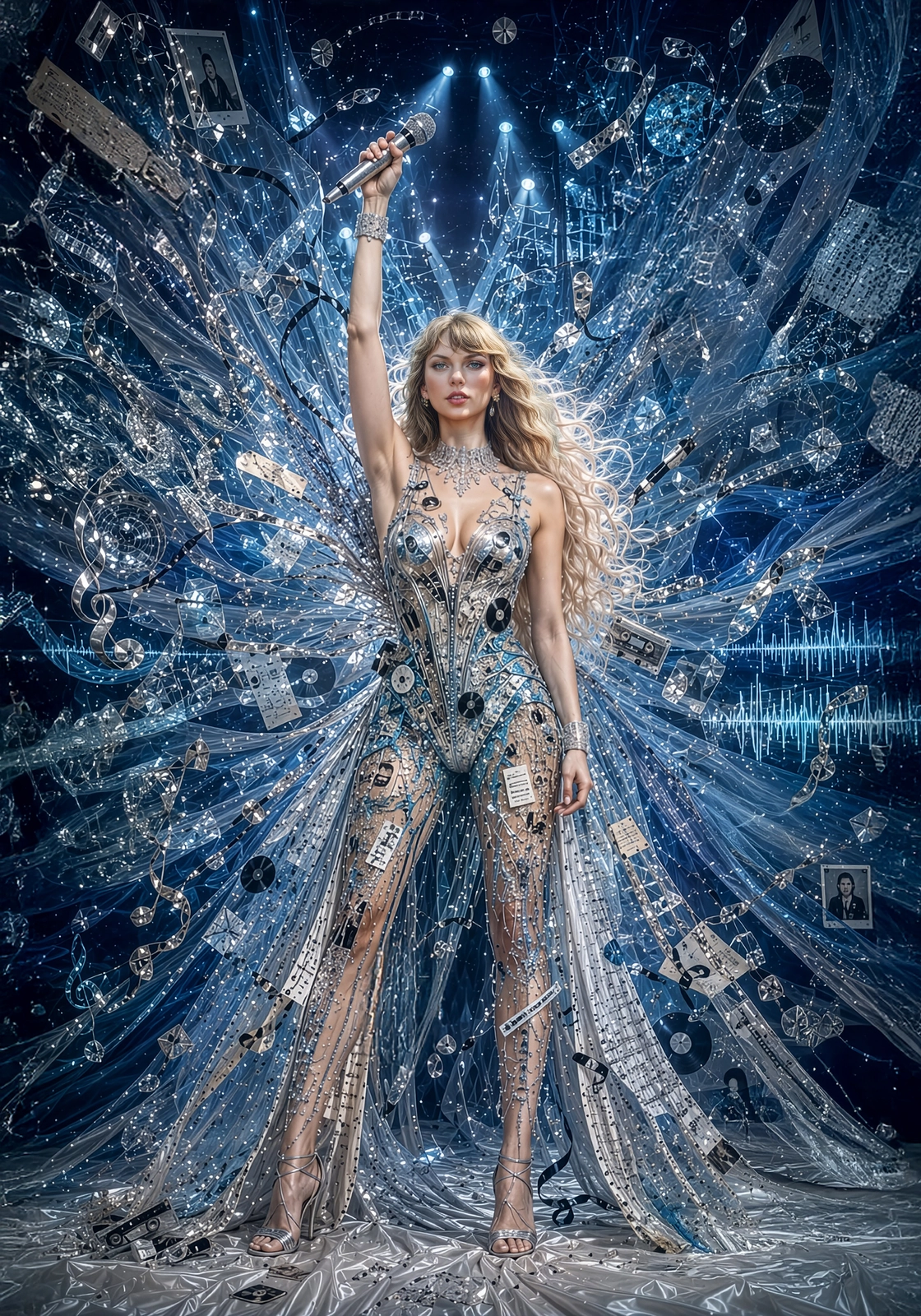
It begins with an image of a woman composed of music. Is she a pop star or a goddess?
Not standing on an ordinary stage, but suspended within a silver storm of soundwaves, photographs, vinyl fragments, cassette tapes, memories, and light. Around her swirl the ruins and relics of modern popular culture, as though the entire streaming age had briefly taken human form. She holds a microphone, yet she also seems to be constructed from the very songs she sings.
And somewhere within that luminous chaos, a larger question begins to emerge.
What exactly is a modern icon?
A singer? A corporation? A mythology collectively written by millions of strangers online? Or something much older, disguised beneath stadium lights and digital technology the latest version of humanitys eternal need to create symbolic figures larger than ordinary life?
This essay is therefore not merely about Taylor Swift.
It is about transformation. About the evolution of celebrity into modern mythology. About music as ritual, streaming culture as collective memory, and fandom as a new form of emotional architecture. It explores how contemporary superstardom increasingly resembles ancient systems of worship, projection, storytelling, and symbolic longing once reserved for gods, saints, queens, and legendary heroes.
Perhaps the modern pop icon no longer belongs entirely to the world of entertainment. Maybe she has begun drifting back towards something older.
Towards the ancient lineage of powerful female figures, stretching from mythological goddesses to superhero legends, from Inanna to Wonder Woman women onto whom civilisations project fantasies of strength, beauty, vulnerability, transformation, sexuality, power, grief, and transcendence.
And somewhere within the silver constellation surrounding Taylor Swift, beneath the algorithms and stadium lights, one can almost glimpse the return of those older myths in digital form.
A goddess woven not of marble or scripture.
But from songs.
Silver Light
Taylor walks through silver light at night
Where stadium stars and skylines meet,
With Wonder Womans fearless stride
And high-heeled thunder in her feet.
The crowds below become a sea,
A living pulse of hands and sound,
While somewhere deep in streaming skies
A million glowing worlds spin round.
She changes skin like northern rain,
Like neon shifting on the tide,
One era fading into mist,
Another waiting just backstage behind.
Sometimes she seems a mortal girl
Who laughs too loud and sings too late,
And sometimes like a silver queen
Stepping calmly through the gates of fate.
The old gods whisper through the wires,
Through vinyl dust and satellites,
While algorithms learn her name
And carry it through endless nights.
Wonder Woman wore a crown
Forged from battle, truth, and flame,
But Taylor rules another world
Built from memory, light, and fame.
Yet both still fly above the dark,
Above the noise, the fear, the fall,
Teaching lonely hearts below
That reinvention saves us all.
And somewhere in the silver glow
Where myth and music intertwine,
A girl next door becomes a star,
A superstar becomes divine.
Malmö, May 2026
The Goddess of the Streaming Age
It begins not with a city but with a constellation.
A woman stands suspended within an explosion of silver light, soundwaves, photographs, vinyl fragments, cassette tapes, handwritten lyrics, and streaming-age debris swirling around her like a digital galaxy. Her dress seems less sewn than assembled from music itself. Every line of fabric resembles an audio signal. Every glittering thread feels connected to memory, media, technology, and emotion. Above her, the cold brilliance of stage lighting no longer resembles theatre illumination so much as artificial starlight.
She is holding a microphone, yet she also seems to be part of it. This is no longer simply a portrait of a singer. It is an image of a modern icon dissolving into her own mythology.
Somewhere between pop culture, algorithmic visibility, emotional storytelling, and collective obsession, the contemporary superstar has evolved into something previous generations might barely recognise. The old boundaries separating performer, corporation, fantasy, confession, and myth have begun to blur. A modern artist exists simultaneously as a human being, a brand, an emotional archive, a digital presence, and a projection screen for millions of private dreams.
And perhaps no contemporary figure embodies that transformation more fully than Taylor Swift.
This essay is therefore not merely about celebrity. It is about metamorphosis. About what happens when a performer becomes so globally omnipresent that she begins to resemble less a person than an atmosphere. It is about music in the age of permanent connectivity, where songs no longer belong to a single moment but circulate endlessly through headphones, livestreams, fan edits, algorithms, memories, and emotional rituals repeated across continents.
It is also about mythology.
Earlier civilisations projected their longings onto gods, saints, queens, warriors, and celestial figures painted across the night sky. Modern culture increasingly performs the same act through celebrities and digital icons. Stadiums replace temples. Screens replace stained glass. Streaming platforms replace oral tradition. Yet the emotional mechanisms remain strangely familiar. Humanity still seeks figures capable of embodying desire, transformation, resilience, heartbreak, reinvention, and transcendence.
Taylor Swift did not invent that machinery, but she may understand it better than most people.
Because somewhere between music and memory, between spectacle and vulnerability, between the internet and intimacy, she has become something more than ordinary fame. Not simply a pop star. Not merely a business empire. But a constantly evolving mythology, collectively woven by millions of people in real time.
And in the image before us, she no longer seems grounded in any specific place on earth. No city surrounds her. No architecture confines her. She stands instead within a floating universe of songs, symbols, fragments, recordings, lights, and echoes as though the entire streaming age had briefly crystallised into human form.
A woman woven from music.
A digital valkyrie for the twenty-first century.
A goddess constructed not of marble or scripture, but of sound.
I. A Body Woven from Sound
At first glance, the image appears almost impossible to decode. The eye instinctively seeks ordinary structure fabric, jewellery, stage design, background but the composition refuses to settle for long. Everything seems to dissolve into something else. Sound becomes light. Light becomes memory. Memory becomes ornament. The woman at the centre appears simultaneously dressed and digitally constructed, human and artificial, physical and spectral.
Her body no longer seems to be covered by clothing alone. It appears to be woven from music itself.
Vinyl records drift through the composition like shattered moons orbiting her. Fragments of cassette tapes unravel into silver ribbons. Musical notation, photographs, sound waves, sequins, and strips of media technology spiral outward in every direction until the entire image resembles an exploding archive of twentieth- and twenty-first-century popular culture. It is as though decades of recorded sound had detached themselves from physical media and gathered around a single human figure.
That may be one of the defining visual ideas of the streaming age: music has become atmospheric.
Earlier generations experienced music through tangible objects. Vinyl records had weight. Cassette tapes degraded over time. CDs reflected light like futuristic artefacts. Shelves, collections, record shops, posters, ticket stubs, and scratched plastic objects formed a physical geography around musical identity. People carried albums in bags, stacked them beside beds, lent them to friends, and slowly wore them down through repeated listening.
Streaming transformed all that.
Music became invisible, immediate, omnipresent, and almost weightless. Songs no longer live primarily in objects but in circulation itself drifting through servers, headphones, playlists, algorithms, memories, edits, and endless digital repetition. Modern listeners rarely own music in the traditional sense. They move through it like weather.
This image captures that transformation with uncanny accuracy.
The woman stands not in a concert hall but in a storm of media fragments. She appears less like a performer before an audience than like the physical embodiment of the machinery through which modern music now travels. Her dress resembles an audio architecture composed of streaming data, emotional residue, and technological debris, woven into something strangely beautiful.
Yet the image never feels cold, which is important.
Despite all the digital symbolism, the figure at the centre remains emotionally accessible. Her raised microphone still suggests performance, vulnerability, and direct human communication. Her expression is neither robotic nor distant. Instead, she appears almost serenely aware of the chaos around her, as though she has accepted that modern fame requires being simultaneously a woman, a projection, and an information flow.
The image's visual language continually reinforces this tension. The silver-blue palette evokes an atmosphere that feels both futuristic and dreamlike. The swirling forms surrounding her evoke galaxies, nervous systems, frozen explosions, or celestial wings. At times, the composition resembles Art Nouveau ornamentation; at others, it feels closer to science fiction or a digital hallucination. Beauty and overload coexist within the same frame.
Perhaps that is precisely what contemporary stardom feels like from the inside.
The modern superstar no longer exists only on stage. She exists across millions of screens at once. Every photograph multiplies instantly. Every gesture fragments into reaction videos, memes, gifs, livestreams, edits, analyses, rankings, reposts, fan theories, and algorithmic circulation. Identity itself becomes distributed across networks too vast for any individual to fully control.
And still the audience searches for the human being hidden somewhere within the constellation.
That search may explain why artists like Taylor Swift elicit such intense emotional attachment. People no longer relate only to songs. They relate to the sense that somewhere beneath the digital storm, a real person remains, capable of transforming private emotions into collective experience.
The woman in the image, therefore, becomes more than a celebrity portrait. She resembles a symbolic figure at the centre of a civilisation built on media, memory, technology, and longing. Not entirely human anymore, but not entirely artificial either.
A body woven from sound. A nervous system composed of songs. A modern icon suspended between flesh and data as the entire streaming age spins endlessly around her.
II. From Flesh to Myth
Every era creates its own mythology.
Ancient societies filled the heavens with constellations representing hunters, queens, monsters, lovers, and gods. Medieval Europe cast saints as luminous figures whose lives straddled documented history and miraculous legend. Later centuries elevated monarchs, generals, film stars, and revolutionaries into symbolic figures larger than ordinary humanity. The names changed, but the mechanism remained remarkably consistent: people continually search for figures onto whom they can project collective longing.
Modern celebrity culture did not destroy mythology. It industrialised it.
The difference is scale. Earlier myths spread slowly through oral storytelling, paintings, churches, literature, theatre, or newspapers. Today, myths travel instantly through digital networks that can transmit images, songs, rumours, emotional reactions, and symbolic narratives across the planet in seconds. A contemporary icon, therefore, evolves faster than any mythological figure in human history.
Taylor Swift exists precisely within that accelerated machinery.
At some point, every globally recognised artist crosses an invisible threshold at which the public no longer relates to the person primarily. Instead, the figure begins to accumulate symbolic meaning. Elvis Presley ceased to be merely a singer and became a cultural earthquake. Marilyn Monroe transformed from an actress into an eternal projection of beauty, vulnerability, sexuality, loneliness, and doomed glamour. David Bowie repeatedly dissolved into his own invented identities until the boundary between performer and mythology became almost impossible to locate. Madonna turned reinvention itself into a form of artistic domination.
Taylor Swift unmistakably belongs within that lineage. Yet her mythology differs in one crucial way: it evolved entirely within the age of permanent visibility.
Earlier icons still disappeared at times. Mystery persisted between interviews, performances, films, photographs, and media appearances. Entire months or years could pass out of public view. In the streaming era, however, absence itself becomes visible. Silence generates speculation. Every movement is documented. Every performance immediately fragments into thousands of circulating digital versions.
This fundamentally changes the nature of myth.
The modern icon no longer exists above the audience in distant perfection. She exists within a constant feedback loop of visibility and interpretation. Millions of people actively participate in constructing the mythology while simultaneously consuming it. Fans analyse interviews, decode lyrics, compare visual motifs, track emotional shifts, catalogue costumes, archive livestreams, and debate symbolic meaning with almost religious intensity.
The result is a strange hybrid of intimacy and unreality.
Taylor Swift often seems strikingly accessible. Her songs are confessional. Her storytelling feels personal. Her emotional vocabulary remains recognisably human. Yet the scale of projection around her has become almost mythological. She exists simultaneously as singer, narrator, fantasy figure, business empire, emotional companion, feminist symbol, internet phenomenon, and collective memory archive.
No ordinary human being can fully contain that much meaning. Perhaps that is why transformation becomes necessary.
The myth must continually evolve to withstand the pressure placed upon it. One identity eventually hardens into a limitation. Another must emerge. The country songwriter becomes a global pop empress. The glittering celebrity dissolves into an introspective folk poet. The wounded romantic transforms into a strategic mastermind. Each reinvention preserves fragments of earlier selves while escaping them.
This process resembles mythology more than marketing does.
Ancient gods frequently changed form depending on who was telling the story. Heroes existed in contradictory versions simultaneously. Legends survived precisely because they remained fluid enough to absorb new generations and interpretations. Modern icons operate similarly. Their meanings multiply rather than stabilise.
Perhaps that is why the image of Taylor Swift surrounded by floating musical fragments feels so powerful. She no longer appears entirely anchored in physical reality. Instead, she resembles a figure emerging from the collective subconscious of the digital age assembled from recordings, memories, projections, narratives, emotions, and endless repetition.
A myth no longer carved in marble, but streamed endlessly through light.
III. The Streaming Goddess
Taylor Swift may be one of the first fully formed deities of the streaming age, not merely because she rose to fame during the rise of digital platforms, but because her entire artistic existence seems uniquely adapted to a world built on constant connectivity, algorithmic circulation, emotional immediacy, and permanent visibility. Earlier generations of stars belonged to specific media environments. Elvis belonged to radio and television. Madonna belonged to MTV. The Beatles belonged to vinyl and mass broadcasting. Their images travelled through physical systems with clear limitations.
Taylor Swift belongs everywhere at once.
Her music flows continuously through phones, headphones, laptops, playlists, social media edits, gym speakers, cafés, airports, bedrooms, TikTok clips, wedding videos, heartbreak compilations, livestreams, and algorithmic recommendations, moving invisibly across continents every second of the day. She is no longer merely a performer. She exists as an atmosphere.
That transformation fundamentally alters the relationship between artist and audience.
Streaming culture has erased many of the older rituals surrounding music consumption. People once waited outside record shops. Albums arrived as events contained within physical objects. Limited access created scarcity, which in turn intensified mythology. The modern listener instead inhabits a permanent ocean of availability, where virtually every song ever recorded is instantly accessible through a touchscreen.
Under those conditions, survival requires more than talent. It demands presence.
Taylor Swift mastered that reality with extraordinary precision. She understood early on that modern fame depends not only on creating music but also on constructing an evolving emotional ecosystem that remains continuously alive between releases. Songs become clues. Lyrics become narratives. Social media becomes an extension of performance. Every public appearance enters an ongoing mythology that never fully pauses.
The artist no longer disappears between albums. She circulates endlessly.
That endless circulation creates something resembling digital immortality. Older performers faded temporarily whenever cameras stopped rolling. Modern icons remain permanently active within online memory systems. Concert clips resurface years later. Interviews become memes. Lyrics mutate into emotional shorthand used by millions of strangers. Entire eras continue to exist simultaneously because the internet preserves all versions at once.
In earlier centuries, immortality belonged to statues and religious texts. Today, it increasingly belongs to data.
The streaming goddess, therefore, inhabits a strange state between presence and abstraction. Taylor Swift can feel emotionally intimate to someone listening alone at night through headphones, while simultaneously existing as one of the largest commercial entertainment structures on earth. She becomes both intimate and industrial.
That paradox defines modern-day superstardom.
The image of her standing within a storm of floating music fragments captures this condition almost perfectly. She appears less like a woman in fashion than like a living interface through which songs, emotions, technologies, memories, and audiences pass continuously. Vinyl records, cassette tapes, digital signals, photographs, and light all orbit her, as though the entire history of recorded music has collapsed into a single body.
And perhaps that is exactly what streaming culture does: it collapses time.
A teenager discovering Taylor Swift today can instantly move between eras that originally unfolded years apart. Country ballads coexist with synth-pop revenge anthems and indie folk confessionals, unbound by chronological distance. The artists entire career becomes simultaneously present, endlessly replayable, and permanently re-editableidentity fragments into overlapping emotional timelines, available on demand.
No previous generation of performers had existed under those conditions.
That may explain why contemporary fandom often resembles a blend of theology and archaeology. Fans excavate hidden references across years of material, seeking continuity amid transformation. Nothing disappears completely. Every lyric may return later, carrying an altered meaning. Every costume, gesture, hairstyle, photograph, interview, or visual motif remains archived somewhere within the internet's digital subconscious.
The streaming goddess, therefore, cannot fully escape her former selves. Instead, she absorbs them.
And still the audience continues searching for authenticity somewhere within the machinery. That desire may seem contradictory in an age dominated by branding and algorithms, yet perhaps it grows even stronger precisely because reality feels increasingly mediated. The more artificial the system becomes, the more emotionally valuable moments of perceived sincerity become.
Taylor Swift understands this instinct with unusual insight. She allows vulnerability to coexist with spectacle. Emotional confession survives within billion-dollar production systems. The human voice remains audible beneath the machinery.
That is why she continues to feel larger-than-life as a celebrity, not because she escaped the digital age, but because she became one of its most complete mythological creations.
IV. Music as Architecture
Modern pop music is no longer only about sound. It is space.
A Taylor Swift concert is not merely a sequence of songs performed before an audience. It is a carefully constructed emotional environment through which thousands of people move together as participants in a temporary civilisation built from light, colour, memory, narrative, and rhythm. The stage becomes architecture in the deepest symbolic sense: a structure designed not simply to contain bodies but to organise feeling.
That may explain why contemporary stadium tours increasingly resemble cathedrals rather than traditional concerts.
Earlier sacred architecture sought to overwhelm visitors emotionally through scale, light, symbolism, ritual, and collective experience. Gigantic ceilings directed the gaze upwards. Stained glass transformed ordinary sunlight into something otherworldly. Music echoed through stone chambers until listeners felt suspended between earthly and divine realms.
Modern arena spectacles often pursue remarkably similar effects.
The Eras Tour functions almost as an enormous emotional cathedral dedicated to memory and transformation. Each section of the performance operates like a distinct chamber within a larger mythological structure. Colours shift. Costumes transform. Lighting alters the emotional temperature. Screens reshape reality itself. One moment, the audience inhabits a glittering romantic fantasy; moments later, they stand within an industrial revenge mythology or autumnal folk melancholy.
The songs become rooms that people enter emotionally.
This is why stage design now matters as much as the music itself. The modern audience does not merely consume melodies; it experiences immersive worlds. Costumes, typography, choreography, symbolic objects, recurring visual motifs, camera movements, transitions, and colour palettes all form a unified emotional language. Contemporary superstardom, therefore, requires architectural thinking as much as musical talent.
Taylor Swift seems unusually aware of this.
Her different eras function almost like entire aesthetic nations, each with its own internal laws. One era glows with pastel optimism. Another pulses with black snakes, sharp shadows, and media warfare. Another wraps itself in candlelight, forests, handwritten poetry, and melancholic intimacy. Fans recognise these visual environments instantly because they operate more like fully developed symbolic ecosystems than like marketing campaigns.
And the audience learns to inhabit them.
That participation matters enormously. Fans dress in era-specific styles. Friendship bracelets serve as ritual objects. Online communities memorise visual codes with astonishing precision. Entire stadiums become synchronised emotional landscapes where strangers instantly recognise each other through costumes, references, colours, and lyrics.
In another century, pilgrims travelled towards sacred cities, bearing religious symbols. Today, fans cross continents, wearing sequined boots and exchanging bracelets beneath giant LED constellations.
The comparison may seem excessive until one witnesses the scale firsthand. Tens of thousands singing together beneath artificial stars, while a giant illuminated figure towers above them, creates an atmosphere far closer to ritual than to casual entertainment. The audience does not simply watch. It participates collectively in meaning-making. As with all successful architecture, the structure disappears, leaving the experience behind.
Most spectators leave a concert remembering emotions rather than technical details. They remember moments when entire stadiums sang together. They remember light exploding across the darkness during particular lyrics. They remember tears welling up unexpectedly during songs they thought they already knew. The architecture succeeds precisely because it becomes emotionally invisible.
Taylor Swifts greatest performances, therefore, resemble acts of emotional engineering.
Not unlike revivalist churches, Pentecostal gatherings, or modern megachurch movements, her concerts often build carefully orchestrated waves of collective emotion through repetition, rhythm, anticipation, light, confession, and communal participation. Tens of thousands of strangers sing and cry together, raise illuminated phones like candles, and temporarily surrender to something larger than ordinary daily life. The atmosphere can resemble secular transcendence a technologically amplified form of collective ecstasy shaped as much by emotional release as by entertainment.
The comparison is not meant to mock. Human beings have always gathered in large groups, seeking transformation through music, ritual, storytelling, rhythm, and shared emotional experience. Stadium concerts represent a modern, largely secular version of impulses far older than popular culture. In earlier centuries, people travelled to cathedrals, revival meetings, sacred festivals, or religious awakenings. Today, they cross continents, wearing sequined costumes and friendship bracelets beneath giant LED constellations, searching for many of the same feelings: belonging, catharsis, elevation, emotional recognition, and the temporary dissolution of loneliness within something collective.
She constructs pathways through nostalgia, heartbreak, empowerment, revenge, longing, joy, vulnerability, irony, memory, and catharsis with almost frightening precision. The audience moves through those emotional chambers together, each attaching private meanings. No two people experience the same concert, even when sharing the same physical space. That may be why modern pop spectacles feel increasingly mythological.
Ancient myths once provided symbolic structures through which societies processed fear, desire, love, mortality, ambition, betrayal, and transformation. Stadium concerts now perform surprisingly similar cultural functions within secular digital societies. They create temporary collective meaning within increasingly fragmented lives.
And somewhere within the silver storm surrounding Taylor Swift in the image before us, one can almost see that architecture taking shape. The floating records, photographs, soundwaves, and fragments of light no longer resemble decoration. They resemble structural components of a vast, invisible cathedral built entirely from music, memory, and emotional connection.
A cathedral without walls. Without altar, spire, incense, or stained glass. A ritual space built from sound, light, memory, and collective emotion rather than stone and scripture. Yet the emotional impulse beneath it may not be so different from the one that once drew pilgrims towards sacred places beneath older skies.
V. The Fragmented Woman
One of the strangest consequences of modern fame is its fragmentation.
Earlier generations often imagined celebrity as a process of elevation. A performer rose above ordinary life and gradually transformed into something larger, more glamorous, more untouchable. The modern superstar, however, experiences the opposite pressure. She becomes larger-than-life even as she is broken apart into endless, consumable fragments distributed across digital space.
Taylor Swift exists everywhere at once.
A song lyric circulates on TikTok, attached to someone elses heartbreak. A slowed-down concert clip becomes a source of comfort for strangers who have never attended a live performance. A facial expression from an interview becomes a meme. A grainy backstage photograph generates thousands of interpretations online within minutes. Entire emotional narratives emerge from fragments that originally lasted only seconds.
The person dissolves into the circulation.
This fragmentation alters the psychological structure of celebrity itself. No audience member encounters the same Taylor Swift. One person knows her primarily as a country songwriter. Another sees her as the architect of stadium spectacle. Someone else relates almost exclusively to the vulnerable, confessional voice carried through headphones in moments of loneliness or grief. To some, she appears as a feminist icon; to others, a corporate mastermind, a romantic narrator, a manipulative strategist, an internet phenomenon, a fashion figure, a poet, a capitalist empire, an emotional companion, or a modern mythological heroine.
All of these versions coexist, and none of them is entirely false.
That may be what makes contemporary fame so psychologically unstable. The public figure gradually loses ownership of a single identity. Millions of people carry competing emotional versions of the same person in their minds. The artist becomes not a single coherent figure, but an ecosystem of interpretations that continually multiply across platforms, generations, and emotional experiences.
The internet accelerates this process relentlessly.
Social media rewards immediacy over wholeness. Short clips detach from the broader context. Emotional reactions spread faster than nuance. Algorithms privilege fragments that generate engagement, outrage, identification, desire, envy, admiration, or conflict. Under such conditions, identity itself begins to behave almost like shattered glass, reflecting different images depending on the angle and distance.
Taylor Swift seems unusually aware of this phenomenon.
Rather than resisting fragmentation entirely, she often incorporates it into her mythology. Her different eras function as both artistic reinventions and controlled reorganisations of public perception. One identity absorbs pressure until another emerges to redistribute emotional meaning. The fragmented woman continuously rebuilds herself before the fragments fully harden into imprisonment.
Yet the process remains deeply human beneath the machinery.
Because behind every projection still lies an individual consciousness forced to navigate impossible contradictions, the modern superstar must appear authentic while recognising that authenticity itself has become a performance. She must remain emotionally accessible while safeguarding enough privacy to survive psychologically. She must embody confidence while living under relentless observation. She must inspire intimacy among millions of strangers without granting those strangers complete access to the self beneath the mythology.
That balancing act can become existentially draining.
Perhaps this is why so many contemporary icons speak openly about anxiety, isolation, surveillance, emotional burnout, and the fear of disappearing into public expectation. The fragmented self risks becoming more visible than the private human being beneath it. Identity begins to feel externally managed by audiences, media systems, algorithms, commercial structures, and collective fantasy.
The image before us captures that tension so beautifully.
Taylor Swift stands at the centre of the composition, yet she also seems to dissolve into the media storm around her. The floating records, photographs, signals, and silver fragments suggest both ornament and disintegration. At times, she seems gloriously powerful, almost divine. At others, she appears on the verge of vanishing completely into her own mythology.
That ambiguity may be the most truthful element of the image.
Modern celebrity no longer produces stable icons carved in marble certainty. It produces fluctuating figures suspended between human vulnerability and digital immortality. Women, especially, are often required to perform contradictory roles simultaneously: powerful yet approachable, ambitious yet graceful, vulnerable yet controlled, beautiful yet authentic, endlessly visible yet somehow emotionally pure beneath the machinery.
The fragmented woman survives by transforming faster than the projections around her. And somewhere within the silver constellation of music, memory, and light, Taylor Swift continues to attempt the impossible task of staying human while millions collectively reinvent her in real time.
VI. The Audience Creates the Star
No modern superstar is created in isolation. The old fantasy of the isolated genius towering above the masses has become increasingly difficult to sustain in the age of digital participation. Contemporary fame functions less like a monarchy and more like an enormous collaborative ecosystem in which audiences actively shape, reinterpret, amplify, archive, and inhabit the artists mythology in real time.
Taylor Swift may control the architecture, but the audience supplies much of the electricity. This relationship differs radically from earlier eras of celebrity culture. Fans once consumed music relatively passively through records, radio broadcasts, magazines, posters, and television appearances, all controlled by traditional gatekeepers. The emotional connection could be intense, but interaction remained largely one-way. Today, however, fandom behaves more like a living organism, constantly producing new layers of meaning around the artist.
Swifties do not merely listen. They decode.
Lyrics become evidence. Colours become signals. Hairstyles, emojis, costume choices, hand gestures, interview phrasing, social media timing, and even punctuation marks can spark extensive interpretive debates online. Entire communities dedicate themselves to analysing hidden references and symbolic continuity across years of material, with an intensity once associated with theology, literary scholarship, or conspiracy culture.
The remarkable aspect is not that these interpretations exist, but that Taylor Swift often appears to encourage them deliberately.
Modern fandom, therefore, becomes a collaborative act of mythmaking. The artist leaves fragments, clues, emotional openings, and recurring symbols; the audience constructs narrative constellations around them. Meaning no longer flows only from performer to listener. It circulates continuously between them.
That circulation fosters extraordinary emotional intimacy.
A teenager alone in Argentina may feel deeply connected to a woman performing onstage in Los Angeles. Someone recovering from a divorce in Stockholm may attach intensely personal meaning to lyrics written years earlier for entirely different circumstances. Fans who have never met exchange friendship bracelets, inside jokes, emotional testimonies, and symbolic references as though participating in a shared mythology larger than geography itself.
The internet transforms private emotion into collective architecture.
This may explain why modern fandom increasingly resembles both community and ritual. Large concert crowds no longer behave simply as audiences observing entertainment. They behave more like temporary emotional societies organised around shared symbolism, memory, vulnerability, and catharsis. People arrive already carrying emotional histories attached to particular songs. During the performance, those individual histories merge into a communal whole.
The experience becomes strangely tribal. Like all tribes, fandom develops its own language.
Specific lyrics function almost like sacred quotations. Certain songs become emotionally untouchable within the community. Entire eras acquire symbolic, emotional identities instantly recognisable to insiders. Fans speak in references that only those deeply immersed in the mythology can understand. Online, millions of strangers continuously reinforce shared narratives through repetition, humour, emotional confessions, and collective memory-building.
No previous generation possessed tools capable of constructing mythology so quickly.
A single concert moment can now become globally legendary within hours. A surprise song performed once in Tokyo may emotionally devastate listeners who have never left Brazil or Sweden. A glance during a livestream may generate essays, edits, and symbolic interpretations that spread endlessly across digital space. Meaning multiplies almost faster than the artist herself can control it.
Yet perhaps that loss of control is part of the phenomenons power. Mythology has always, in part, belonged to the people telling it. Ancient legends survived because communities continually reshaped them through retelling. Gods evolved through interpretation, and heroes absorbed contradictions across generations. Modern digital fandom performs remarkably similar functions through algorithms, social media, livestreams, and collective emotional participation.
Taylor Swift, therefore, becomes more than an individual performer. She becomes a meeting point, a symbolic centre around which millions organise their emotions, memories, fantasies, heartbreak, longing, empowerment, humour, nostalgia, and identity. The audience does not simply consume the mythology surrounding her. It actively manufactures it together.
And perhaps that is why the image of her suspended within a galaxy of floating musical fragments feels so strangely accurate. She appears less like a solitary celebrity than like the luminous centre of an enormous emotional constellation, continuously created by millions of invisible hands.
The star exists because the audience keeps connecting the lights with lines.
VII. Constellations of Memory
The image no longer feels entirely earthly. By this point in the essay, Taylor Swift has already transformed from performer into mythology, from celebrity into emotional architecture, and from woman into a fragmented digital constellation. Now, surrounded by floating records, photographs, soundwaves, silver ribbons, and luminous debris, she appears suspended within something even stranger: collective memory itself.
The fragments in my picture orbiting her resemble stars. It is reminiscent of Taylor Swift's concerts. Lighting also creates a star canopy outdoors. Not random decoration, but emotional astronomy.
Human beings have always projected meaning onto the heavens. Ancient civilisations ascribed the scattered lights to hunters, queens, monsters, lovers, and gods because the human mind instinctively seeks patterns that turn chaos into narrative. Constellations were never merely astronomical. They were emotional maps through which societies organised fear, longing, mortality, heroism, and identity.
Modern culture performs a remarkably similar act through celebrity culture.
The difference is that our constellations are now built not from stars but from media fragments. Songs, photographs, interviews, livestreams, rumours, lyrics, memes, magazine covers, concert footage, fan edits, archived tweets, emotional confessions, and algorithmic circulation drift through digital space like luminous particles, waiting to be connected into meaning.
Taylor Swift sings at the centre of one of the largest of these constellations. Every fan carries different stars within it.
For one person, the constellation begins with an old country ballad heard in adolescence. For another, it starts with a heartbreak anthem played repeatedly through headphones after midnight. Someone else enters through glittering stadium pop, autumnal folk melancholy, or revenge mythology wrapped in black sequins and snakes. Different emotional memories coalesce into distinct symbolic shapes, depending on who is looking.
And yet people somehow recognise the same figure in the sky.
That may be the true power of modern mythology: not uniformity, but emotional adaptability. A successful icon absorbs countless private meanings without collapsing into incoherence. Millions of listeners attach their own griefs, desires, triumphs, romances, insecurities, fantasies, and memories to the same songs, yet still believe the artist speaks directly to them.
The constellation remains both collective and intimate.
Streaming culture intensifies this phenomenon dramatically because memory itself now circulates continuously. Older generations lost moments permanently. Concerts disappeared when the lights went out. Magazine interviews faded into forgotten paper archives. Television appearances dissolved into the past.
Nothing disappears anymore.
A performance endures endlessly through uploads, reposts, edits, reaction videos, compilations, restorations, and algorithmic resurfacing. The internet behaves almost like a giant memory machine incapable of forgetting. Every era remains accessible simultaneously, allowing audiences to travel emotionally backwards and forwards through time at will.
Taylor Swifts mythology, therefore, exists not in a linear but in a cosmic order. All versions remain visible at once.
The teenage songwriter still exists alongside the global stadium empress. The vulnerable diarist coexists with the calculating strategist. The glittering pop goddess overlaps with the woman alone at a piano, singing softly about isolation and loss. Different emotional galaxies intersect continuously within the same public figure.
Perhaps this is why the image feels so celestial.
She no longer appears grounded in gravity or geography. Instead, she resembles a figure suspended in a digital night sky composed of collective memory. The silver fragments surrounding her could equally be read as media debris, stars, emotional signals, or shattered pieces of identity endlessly recombining into new forms.
And somewhere within that constellation lies another uncomfortable truth. Constellations endure only because human beings continue to look upwards. Even if they are there, they disappear if no one is looking.
The modern icon depends on attention in the same way ancient myths depended on storytelling. If people stop connecting with the lights, the symbolic figure dissolves into scattered fragments. Celebrity, therefore, requires constant renewal, continuous circulation, and endless reinterpretation. The mythology must remain emotionally active or risk vanishing into silence.
That pressure may explain the restless energy surrounding modern fame. Reinvention becomes necessary not only artistically but also cosmically. The star must continue to generate light.
And still, despite all the machinery, all the algorithms, all the corporate structures and digital systems surrounding her, something strangely human endures within the constellation. Because at the centre of this enormous galaxy of projection and memory, a woman still stands holding a microphone somehow attempting to transform private feeling into shared emotional gravity for millions of strangers beneath the same invisible sky.
VIII. The Price of Immortality
Every mythology demands sacrifice. Ancient gods required offerings. Kings demanded loyalty. Saints surrendered ordinary life for symbolic permanence. Even fictional superheroes are traditionally portrayed as paying for extraordinary power with loneliness, secrecy, exile, or emotional isolation. Modern celebrity culture preserves that structure more faithfully than it often admits.
Digital immortality has a cost.
Taylor Swift lives within a system that never fully powers down. Cameras wait constantly. Algorithms keep calculating relevance while she sleeps. Old interviews reappear without warning. Relationships become public property before they have emotionally ended in private. Every silence invites speculation. Every appearance invites interpretation. Even absence becomes content.
The streaming goddess is never entirely allowed to disappear. That condition creates a peculiar form of psychological pressure unique to the modern era. Earlier generations of artists could temporarily retreat into obscurity between albums, tours, or films. Time itself created distance. Today, the machinery continues to run regardless of exhaustion, grief, confusion, or emotional need. The public figure remains permanently alive in circulation.
In some ways, the internet has abolished the need to forget. Forgetting once-protected human beings.
Embarrassments fadedmistakes gradually dissolved into memory. Reinvention required moving through time. Now every version survives simultaneously. The teenage songwriter remains searchable alongside the global billionaire. Awkward interviews coexist alongside carefully controlled mythology. Emotional vulnerability can replay endlessly for years after the original feeling has faded.
Nothing fully dies.
That permanence may partly explain why modern fame often leads to visible exhaustion. The superstar no longer battles only critics, tabloids, or public expectations. She battles accumulation itself the endless weight of preserved identity fragments orbiting permanently in digital memory.
Taylor Swift has largely responded to this pressure through transformation.
Reinvention becomes a survival strategy. One era sheds its emotional weight onto another. New aesthetics reorganise public attention before earlier identities harden into confinement. Yet even a successful transformation cannot entirely erase earlier selves. The internet preserves all selves simultaneously, like geological layers visible beneath transparent skin.
The result is a strange form of divided immortality.
Millions of people continue to engage emotionally with different historical versions of the same person simultaneously. One fan remains attached to the vulnerable teenager writing country songs. Another worships the architect of the billion-dollar stadium spectacle. Another seeks comfort in the introspective poet found in quieter albums. The public figure becomes haunted by her own preserved incarnations.
And perhaps nowhere is that tension more evident than in the image before us.
Taylor Swift stands radiant at the centre of the silver storm, yet the composition holds subtle traces of danger beneath its beauty. The swirling media fragments around her resemble both wings and debris. The luminous explosion appears at once triumphant and unstable, as though the mythology might collapse under its own brightness at any moment.
The streaming goddess shines magnificently. But stars also burn themselves out, becoming black holes.
That is the paradox that modern culture rarely acknowledges openly. Society demands constant visibility from its icons while consuming the psychological stability that visibility erodes. Audiences seek authenticity while helping to construct systems that make ordinary authenticity nearly impossible. The public wants emotional openness without fully tolerating ordinary human inconsistency.
Women experience this contradiction especially intensely.
Modern female icons are expected to remain perpetually visible yet somehow untouched by exposure. Powerful yet approachable. Ambitious yet emotionally available. Beautiful without appearing vain. Vulnerable without seeming weak. Reinvented without losing recognisability. Human without disappointing fantasy.
No mythology ever demanded simplicity from its goddesses. That's what makes them exciting.
And perhaps that is why Taylor Swift continues to resonate so powerfully across generations. Beneath the spectacle, algorithms, corporate structures, and digital mythology, many people still recognise something profoundly human in the struggle itself: the attempt to preserve identity while constantly transforming under collective observation.
The price of immortality has always been fragmentation.
Yet somewhere within the endless constellation of songs, memories, projections, and light, the woman at the centre continues to sing even as the machinery around her keeps turning her gradually into something larger, stranger, and less entirely mortal than she may ever have intended to become.
Epilogue She Was Made of Songs
In the end, the image no longer feels like a portrait. It feels like an afterimage left by the streaming age itself a shimmering figure suspended between woman, mythology, technology, memory, and collective longing. The silver fragments surrounding Taylor Swift no longer seem separate from her body. The records, photographs, sound waves, lights, lyrics, digital echoes, and emotional projections have fused into a single constellation that is impossible to disentangle fully.
Where does the performer end and the mythology begin? Perhaps modern culture no longer knows.
That uncertainty may be the defining emotional condition of the twenty-first century. Earlier civilisations drew clearer distinctions between ordinary people and symbolic figures. Gods lived in temples. Heroes belonged to epics. Celebrities appeared on distant screens. Today, those boundaries blur constantly. The modern icon moves through private emotion, algorithmic circulation, commercial systems, livestream intimacy, and collective fantasy until identity itself begins to behave like fluid light.
Taylor Swift did not create that transformation alone, but she became one of its clearest embodiments.
She stands at the intersection of nearly every force shaping contemporary culture: digital memory, emotional branding, streaming technology, fan participation, celebrity mythology, female visibility, reinvention, vulnerability, and mass psychological projection. She is both artist and architect the singer and the vast emotional system surrounding her.
Perhaps that is why the image resonates so strongly.
It captures not merely fame but transcendence through fragmentation. The woman at the centre appears both empowered and dissolving, glorified and consumed, human and mythological. She shines because millions continue to feed emotional energy into the constellation around her. Yet the constellation also threatens to absorb her completely.
Still, she keeps singing. That may be the most extraordinary part of all.
Because beneath the machinery, beneath the corporate structures, beneath the endless circulation of images and interpretations, there remains a recognisably human impulse at the heart of the spectacle: the desire to transform private feeling into shared experience. To stand beneath overwhelming light and somehow make strangers scattered across the planet feel less alone for a few minutes.
Perhaps that is what modern myths are ultimately built on. Not perfection. Not immortality. But emotional recognition.
And somewhere within the endless silver galaxy of music, memory, data, longing, heartbreak, reinvention, and light, Taylor Swift continues to hover between woman and symbol a digital-age goddess built from songs, yet still carrying a microphone like the girl next door who somehow wandered into mythology and never quite found her way back out.
Perhaps that is why Taylor Swift increasingly feels less like a mere pop star and more like the continuation of something far older.
Modern culture may surround her with algorithms, streaming platforms, stadium lights, and digital mythology, yet beneath the machinery echoes an ancient pattern humanity has repeated for thousands of years: the creation of powerful female figures onto whom societies project longing, fear, transformation, desire, grief, beauty, ambition, vulnerability, and collective imagination.
In that sense, she begins to drift strangely close to the old goddesses.
Not only to Wonder Woman and modern superhero mythology, but also to figures such as Inanna, the most powerful and revered goddess in ancient Sumerian mythology. Goddess of love, fertility, sexuality, power, and war, Inanna features prominently in some of humanitys oldest surviving literature and continues to influence feminist thought today. She embodied contradiction itself: tenderness and destruction, seduction and authority, vulnerability and terrifying strength.
Perhaps modern audiences still instinctively search for such figures.
Only now do they no longer descend from temples or ancient skies.
They instead emerge beneath stadium lights, within streaming algorithms, wrapped in sequins and songs, while millions raise illuminated phones towards them like digital candles in the dark.
Streamingålderns gudinna
Det börjar med en bild av en kvinna uppbyggd av musik. Är hon en popstjärna? Eller en gudinna?
Hon står inte på en vanlig scen, utan svävar inne i en silverglänsande storm av ljudvågor, fotografier, vinylfragment, kassettband, minnen och ljus. Runt henne virvlar ruinerna och relikerna från den moderna populärkulturen, som om hela streamingåldern för ett ögonblick tagit mänsklig form. Hon håller en mikrofon, men hon tycks samtidigt vara skapad av själva sångerna hon sjunger.
Och någonstans inne i detta lysande kaos börjar en större fråga ta form.
Vad är egentligen en modern ikon?
En sångerska? Ett företag? En mytologikollektivt skriven av miljontals främlingar online? Eller något mycket äldre, förklätt bakom stadionljus och digital teknologi den senaste versionen av mänsklighetens eviga behov av att skapa symboliska gestalter större än det vanliga livet?
Den här essän handlar därför inte bara om Taylor Swift.
Den handlar om förvandling. Om hur kändisskap utvecklas till modern mytologi. Om musik som ritual, streamingkultur som kollektivt minne och fandom som en ny form av emotionell arkitektur. Den undersöker hur dagens superstjärnor alltmer börjar likna äldre system av dyrkan, projektion, berättande och symbolisk längtan sådant som en gång var reserverat för gudar, helgon, drottningar och legendariska hjältar.
Kanske tillhör den moderna popikonen inte längre helt och hållet underhållningens värld. Kanske har hon börjat driva tillbaka mot något äldre.
Mot den uråldriga linjen av mäktiga kvinnliga gestalter som sträcker sig från mytologiska gudinnor till superhjältelegender, från Inanna till Wonder Woman kvinnor på vilka civilisationer har projicerat fantasier om styrka, skönhet, sårbarhet, förvandling, sexualitet, makt, sorg och transcendens.
Och någonstans inne i den silverglänsande konstellation som omger Taylor Swift, under algoritmerna och stadionljusen, kan man nästan ana hur dessa äldre myter återvänder i digital form.
En gudinna vävd inte av marmor eller heliga skrifter utan av sånger.
The Goddess of the Streaming Age
Det börjar inte med en scen, utan med en konstellation.
En kvinna står svävande inne i en explosion av silverljus, ljudvågor, fotografier, vinylfragment, kassettband, handskrivna textrader och streamingålderns bråte som virvlar runt henne som en digital galax. Hennes klänning verkar mindre sydd än sammansatt av själva musiken. Varje tyglinje liknar en ljudsignal. Varje glittrande tråd känns förbunden med minne, medier, teknologi och känslor. Ovanför henne liknar scenljusens kalla briljans inte längre teaterbelysning så mycket som artificiellt stjärnljus.
Hon håller i en mikrofon men tycks samtidigt vara en del av den. Detta är inte längre bara ett porträtt av en sångerska. Det är en bild av en modern ikon som upplöses i sin egen mytologi.
Någonstans mellan populärkultur, algoritmisk synlighet, emotionellt berättande och kollektiv besatthet har den moderna superstjärnan utvecklats till något som tidigare generationer knappt skulle känna igen. De gamla gränserna mellan artist, företag, fantasi, bekännelse och myt har börjat suddas ut. En modern artist existerar samtidigt som människa, varumärke, emotionellt arkiv, digital närvaro och projektionsyta för miljontals privata drömmar.
Och kanske är det ingen samtida gestalt som förkroppsligar denna förvandling mer komplett än Taylor Swift.
Den här essän handlar därför inte bara om kändisskap. Den handlar om metamorfos, om vad som händer när en artist blir så globalt allestädes närvarande att hon börjar likna mindre en människa än en atmosfär. Den handlar om musik i den permanenta uppkopplingens tidsålder, där sånger inte längre tillhör ett enskilt ögonblick utan cirkulerar oändligt genom hörlurar, livestreams, fanredigeringar, algoritmer, minnen och emotionella ritualer som upprepas över kontinenter.
Den handlar också om mytologi.
Tidigare civilisationer projicerade sin längtan på gudar, helgon, drottningar, krigare och himmelska gestalter målade över natthimlen och tolkade av astrologer. Den moderna kulturen utför allt oftare samma handling genom kändisar och digitala ikoner. Stadion ersätter tempel. Skärmar ersätter glasmålningar. Streamingplattformar ersätter muntlig tradition. Ändå förblir de emotionella mekanismerna märkligt bekanta. Mänskligheten söker fortfarande gestalter som kan förkroppsliga begär, förvandling, motståndskraft, hjärtesorg, återuppfinnelse och transcendens.
Taylor Swift uppfann inte den maskinen, men hon förstår den kanske bättre än de flesta.
För någonstans mellan musik och minne, mellan spektakel och sårbarhet, mellan internet och intimitet, har hon blivit något mer än vanlig berömmelse. Inte bara en popstjärna. Inte bara ett affärsimperium. Utan en ständigt föränderlig mytologi kollektivt vävd av miljontals människor i realtid.
Och i bilden framför oss verkar hon inte längre förankrad på någon särskild plats på jorden. Ingen stad omger henne. Ingen arkitektur begränsar henne. I stället står hon inne i ett svävande universum av sånger, symboler, fragment, inspelningar, ljus och ekon som om hela streamingåldern för ett ögonblick kristalliserats till mänsklig form.
En kvinna vävd av musik.
En digital valkyria för det tjugoförsta århundradet.
En gudinna skapad inte av marmor eller heliga skrifter utan av ljud.
I. En kropp vävd av ljud
Vid första anblicken verkar bilden nästan omöjlig att avkoda. Ögat söker instinktivt efter vanliga strukturer tyg, smycken, scenografi, bakgrund men kompositionen vägrar att stanna upp särskilt länge. Allt tycks upplösas i något annat. Ljud blir ljus. Ljus blir minne. Minne blir ornament. Kvinnan i centrum framstår samtidigt som klädd och digitalt konstruerad, mänsklig och artificiell, fysisk och spöklik.
Hennes kropp verkar inte längre bara vara täckt av kläder. Den tycks vara vävd av själva musiken.
Vinylskivor driver genom kompositionen som krossade månar i omloppsbana runt henne. Fragment av kassettband vecklar ut sig till silverband. Noter, fotografier, ljudvågor, paljetter och remsor av medieteknologi spiralerar utåt i alla riktningar tills hela bilden liknar ett exploderande arkiv över nittonhundratalets och tjugohundratalets populärkultur. Det är som om årtionden av inspelat ljud lossnat från sina fysiska medier och samlats runt en enda mänsklig gestalt.
Det kan vara en av streamingålderns mest definierande visuella idéer: musiken har blivit atmosfärisk.
Tidigare generationer upplevde musik genom konkreta föremål. Vinylskivor hade tyngd. Kassettband försämrades med tiden. CD-skivor reflekterade ljus som futuristiska artefakter. Hyllor, samlingar, skivbutiker, affischer, biljettstumpar och repade plastföremål skapade en fysisk geografi kring musikalisk identitet. Människor bar album i väskor, staplade dem bredvid sängen, lånade ut dem till vänner och slet långsamt ut dem genom upprepad lyssning.
Streaming förändrade allt detta.
Musiken blev osynlig, omedelbar, allestädes närvarande och nästan viktlös. Sånger lever inte längre främst i föremål utan i själva cirkulationen drivande genom servrar, hörlurar, spellistor, algoritmer, minnen, redigeringar och oändlig digital upprepning. Moderna lyssnare äger sällan musik i traditionell mening. De rör sig genom den som genom väder.
Min bild försöker fånga den förvandlingen.
Kvinnan står inte i en konserthall utan i en storm av mediefragment. Hon framstår mindre som en artist framför en publik än som det fysiska förkroppsligandet av maskineriet genom vilket modern musik nu färdas. Hennes klänning liknar en ljudarkitektur, sammansatt av streamingdata, emotionella rester och teknologiskt bråte vävt till något märkligt vackert.
Ändå känns bilden aldrig kall, vilket är viktigt.
Trots all digital symbolik förblir gestalten i centrum emotionellt tillgänglig. Hennes upphöjda mikrofon antyder fortfarande framträdande, sårbarhet och direkt mänsklig kommunikation. Hennes uttryck är varken robotlikt eller avlägset. I stället verkar hon nästan lugnt medveten om kaoset omkring sig, som om hon har accepterat att modern berömmelse kräver att vara samtidigt kvinna, projektion och informationsflöde.
Bildens visuella språk förstärker ständigt denna spänning. Den silverblå paletten framkallar en atmosfär som känns både futuristisk och drömlik. De virvlande formerna runt henne påminner om galaxer, nervsystem, frusna explosioner eller himmelska vingar. Ibland liknar kompositionen jugendornamentik; vid andra tillfällen känns den närmare science fiction eller en digital hallucination. Skönhet och överbelastning samexisterar inom samma ram.
Kanske är det så som dagens stjärnstatus känns inifrån.
Den moderna superstjärnan existerar inte längre bara på scenen. Hon existerar samtidigt över miljontals skärmar. Varje fotografi multipliceras omedelbart. Varje gest fragmenteras till reaktionsvideor, memes, GIF:er, livestreams, redigeringar, analyser, rankningar, återpubliceringar, fan-teorier och algoritmisk cirkulation. Själva identiteten distribueras över nätverk som är alltför stora för att någon individ helt ska kunna kontrollera dem.
Och ändå fortsätter publiken att söka efter människan som gömmer sig någonstans inne i konstellationen.
Det sökandet kan förklara varför artister som Taylor Swift väcker så intensiva emotionella band. Människor relaterar inte längre bara till sånger. Det har att göra med känslan av att det någonstans under den digitala stormen fortfarande finns en riktig person kapabel att förvandla privata känslor till kollektiv erfarenhet.
Kvinnan i bilden blir därför mer än ett kändisporträtt. Hon liknar en symbolisk gestalt i centrum av en civilisation byggd på medier, minnen, teknologi och längtan. Inte helt mänsklig längre, men inte heller helt artificiell.
En kropp vävd av ljud. Ett nervsystem sammansatt av sånger. En modern ikon svävande mellan kött och data medan hela streamingåldern snurrar oändligt runt henne.
II. Från kött till myt
Varje era skapar sin egen mytologi.
Antika samhällen fyllde himlen med konstellationer som föreställde jägare, drottningar, monster, älskare och gudar. Medeltidens Europa gjorde helgon till lysande gestalter, vars liv balanserade mellan dokumenterad historia och mirakulös legend. Senare århundraden upphöjde monarker, generaler, filmstjärnor och revolutionärer till symboliska figurer större än vanliga människor. Namnen förändrades, men mekanismen förblev anmärkningsvärt densamma: människor söker ständigt efter gestalter som de kan projicera kollektiv längtan på.
Den moderna kändiskulturen förstörde inte mytologin. Den industrialiserade den.
Skillnaden ligger i skalan. Tidigare myter spreds långsamt genom muntligt berättande, målningar, kyrkor, litteratur, teater eller tidningar. I dag färdas myter omedelbart genom digitala nätverk som kan sprida bilder, sånger, rykten, emotionella reaktioner och symboliska berättelser över hela planeten på några sekunder. En samtida ikon utvecklas därför snabbare än någon mytologisk gestalt i mänsklighetens historia.
Taylor Swift existerar exakt inne i det accelererade maskineriet.
Vid någon punkt passerar varje globalt erkänd artist en osynlig gräns där publiken inte längre känner igen personen. Istället börjar gestalten samla en symbolisk betydelse. Elvis Presley upphörde att bara vara sångare och blev en kulturell jordbävning. Marilyn Monroe förvandlades från skådespelerska till en evig projektion av skönhet, sårbarhet, sexualitet, ensamhet och glamour som är dömd att förbli oföränderlig. David Bowie upplöste sig gång på gång i sina egna uppfunna identiteter tills gränsen mellan artist o
Jörgen Thornberg
The Goddess of the Streaming Age - Streamingålderns gudinna, 2026
Digital
50 x 70 cm
3 200 kr
The Goddess of the Streaming Age - Streamingålderns gudinna
Svensk text på slutet
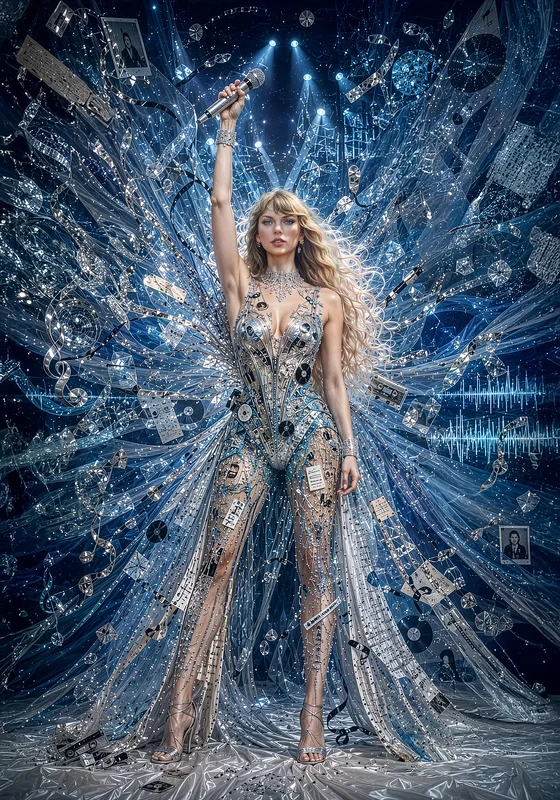
It begins with an image of a woman composed of music. Is she a pop star or a goddess?
Not standing on an ordinary stage, but suspended within a silver storm of soundwaves, photographs, vinyl fragments, cassette tapes, memories, and light. Around her swirl the ruins and relics of modern popular culture, as though the entire streaming age had briefly taken human form. She holds a microphone, yet she also seems to be constructed from the very songs she sings.
And somewhere within that luminous chaos, a larger question begins to emerge.
What exactly is a modern icon?
A singer? A corporation? A mythology collectively written by millions of strangers online? Or something much older, disguised beneath stadium lights and digital technology the latest version of humanitys eternal need to create symbolic figures larger than ordinary life?
This essay is therefore not merely about Taylor Swift.
It is about transformation. About the evolution of celebrity into modern mythology. About music as ritual, streaming culture as collective memory, and fandom as a new form of emotional architecture. It explores how contemporary superstardom increasingly resembles ancient systems of worship, projection, storytelling, and symbolic longing once reserved for gods, saints, queens, and legendary heroes.
Perhaps the modern pop icon no longer belongs entirely to the world of entertainment. Maybe she has begun drifting back towards something older.
Towards the ancient lineage of powerful female figures, stretching from mythological goddesses to superhero legends, from Inanna to Wonder Woman women onto whom civilisations project fantasies of strength, beauty, vulnerability, transformation, sexuality, power, grief, and transcendence.
And somewhere within the silver constellation surrounding Taylor Swift, beneath the algorithms and stadium lights, one can almost glimpse the return of those older myths in digital form.
A goddess woven not of marble or scripture.
But from songs.
Silver Light
Taylor walks through silver light at night
Where stadium stars and skylines meet,
With Wonder Womans fearless stride
And high-heeled thunder in her feet.
The crowds below become a sea,
A living pulse of hands and sound,
While somewhere deep in streaming skies
A million glowing worlds spin round.
She changes skin like northern rain,
Like neon shifting on the tide,
One era fading into mist,
Another waiting just backstage behind.
Sometimes she seems a mortal girl
Who laughs too loud and sings too late,
And sometimes like a silver queen
Stepping calmly through the gates of fate.
The old gods whisper through the wires,
Through vinyl dust and satellites,
While algorithms learn her name
And carry it through endless nights.
Wonder Woman wore a crown
Forged from battle, truth, and flame,
But Taylor rules another world
Built from memory, light, and fame.
Yet both still fly above the dark,
Above the noise, the fear, the fall,
Teaching lonely hearts below
That reinvention saves us all.
And somewhere in the silver glow
Where myth and music intertwine,
A girl next door becomes a star,
A superstar becomes divine.
Malmö, May 2026
The Goddess of the Streaming Age
It begins not with a city but with a constellation.
A woman stands suspended within an explosion of silver light, soundwaves, photographs, vinyl fragments, cassette tapes, handwritten lyrics, and streaming-age debris swirling around her like a digital galaxy. Her dress seems less sewn than assembled from music itself. Every line of fabric resembles an audio signal. Every glittering thread feels connected to memory, media, technology, and emotion. Above her, the cold brilliance of stage lighting no longer resembles theatre illumination so much as artificial starlight.
She is holding a microphone, yet she also seems to be part of it. This is no longer simply a portrait of a singer. It is an image of a modern icon dissolving into her own mythology.
Somewhere between pop culture, algorithmic visibility, emotional storytelling, and collective obsession, the contemporary superstar has evolved into something previous generations might barely recognise. The old boundaries separating performer, corporation, fantasy, confession, and myth have begun to blur. A modern artist exists simultaneously as a human being, a brand, an emotional archive, a digital presence, and a projection screen for millions of private dreams.
And perhaps no contemporary figure embodies that transformation more fully than Taylor Swift.
This essay is therefore not merely about celebrity. It is about metamorphosis. About what happens when a performer becomes so globally omnipresent that she begins to resemble less a person than an atmosphere. It is about music in the age of permanent connectivity, where songs no longer belong to a single moment but circulate endlessly through headphones, livestreams, fan edits, algorithms, memories, and emotional rituals repeated across continents.
It is also about mythology.
Earlier civilisations projected their longings onto gods, saints, queens, warriors, and celestial figures painted across the night sky. Modern culture increasingly performs the same act through celebrities and digital icons. Stadiums replace temples. Screens replace stained glass. Streaming platforms replace oral tradition. Yet the emotional mechanisms remain strangely familiar. Humanity still seeks figures capable of embodying desire, transformation, resilience, heartbreak, reinvention, and transcendence.
Taylor Swift did not invent that machinery, but she may understand it better than most people.
Because somewhere between music and memory, between spectacle and vulnerability, between the internet and intimacy, she has become something more than ordinary fame. Not simply a pop star. Not merely a business empire. But a constantly evolving mythology, collectively woven by millions of people in real time.
And in the image before us, she no longer seems grounded in any specific place on earth. No city surrounds her. No architecture confines her. She stands instead within a floating universe of songs, symbols, fragments, recordings, lights, and echoes as though the entire streaming age had briefly crystallised into human form.
A woman woven from music.
A digital valkyrie for the twenty-first century.
A goddess constructed not of marble or scripture, but of sound.
I. A Body Woven from Sound
At first glance, the image appears almost impossible to decode. The eye instinctively seeks ordinary structure fabric, jewellery, stage design, background but the composition refuses to settle for long. Everything seems to dissolve into something else. Sound becomes light. Light becomes memory. Memory becomes ornament. The woman at the centre appears simultaneously dressed and digitally constructed, human and artificial, physical and spectral.
Her body no longer seems to be covered by clothing alone. It appears to be woven from music itself.
Vinyl records drift through the composition like shattered moons orbiting her. Fragments of cassette tapes unravel into silver ribbons. Musical notation, photographs, sound waves, sequins, and strips of media technology spiral outward in every direction until the entire image resembles an exploding archive of twentieth- and twenty-first-century popular culture. It is as though decades of recorded sound had detached themselves from physical media and gathered around a single human figure.
That may be one of the defining visual ideas of the streaming age: music has become atmospheric.
Earlier generations experienced music through tangible objects. Vinyl records had weight. Cassette tapes degraded over time. CDs reflected light like futuristic artefacts. Shelves, collections, record shops, posters, ticket stubs, and scratched plastic objects formed a physical geography around musical identity. People carried albums in bags, stacked them beside beds, lent them to friends, and slowly wore them down through repeated listening.
Streaming transformed all that.
Music became invisible, immediate, omnipresent, and almost weightless. Songs no longer live primarily in objects but in circulation itself drifting through servers, headphones, playlists, algorithms, memories, edits, and endless digital repetition. Modern listeners rarely own music in the traditional sense. They move through it like weather.
This image captures that transformation with uncanny accuracy.
The woman stands not in a concert hall but in a storm of media fragments. She appears less like a performer before an audience than like the physical embodiment of the machinery through which modern music now travels. Her dress resembles an audio architecture composed of streaming data, emotional residue, and technological debris, woven into something strangely beautiful.
Yet the image never feels cold, which is important.
Despite all the digital symbolism, the figure at the centre remains emotionally accessible. Her raised microphone still suggests performance, vulnerability, and direct human communication. Her expression is neither robotic nor distant. Instead, she appears almost serenely aware of the chaos around her, as though she has accepted that modern fame requires being simultaneously a woman, a projection, and an information flow.
The image's visual language continually reinforces this tension. The silver-blue palette evokes an atmosphere that feels both futuristic and dreamlike. The swirling forms surrounding her evoke galaxies, nervous systems, frozen explosions, or celestial wings. At times, the composition resembles Art Nouveau ornamentation; at others, it feels closer to science fiction or a digital hallucination. Beauty and overload coexist within the same frame.
Perhaps that is precisely what contemporary stardom feels like from the inside.
The modern superstar no longer exists only on stage. She exists across millions of screens at once. Every photograph multiplies instantly. Every gesture fragments into reaction videos, memes, gifs, livestreams, edits, analyses, rankings, reposts, fan theories, and algorithmic circulation. Identity itself becomes distributed across networks too vast for any individual to fully control.
And still the audience searches for the human being hidden somewhere within the constellation.
That search may explain why artists like Taylor Swift elicit such intense emotional attachment. People no longer relate only to songs. They relate to the sense that somewhere beneath the digital storm, a real person remains, capable of transforming private emotions into collective experience.
The woman in the image, therefore, becomes more than a celebrity portrait. She resembles a symbolic figure at the centre of a civilisation built on media, memory, technology, and longing. Not entirely human anymore, but not entirely artificial either.
A body woven from sound. A nervous system composed of songs. A modern icon suspended between flesh and data as the entire streaming age spins endlessly around her.
II. From Flesh to Myth
Every era creates its own mythology.
Ancient societies filled the heavens with constellations representing hunters, queens, monsters, lovers, and gods. Medieval Europe cast saints as luminous figures whose lives straddled documented history and miraculous legend. Later centuries elevated monarchs, generals, film stars, and revolutionaries into symbolic figures larger than ordinary humanity. The names changed, but the mechanism remained remarkably consistent: people continually search for figures onto whom they can project collective longing.
Modern celebrity culture did not destroy mythology. It industrialised it.
The difference is scale. Earlier myths spread slowly through oral storytelling, paintings, churches, literature, theatre, or newspapers. Today, myths travel instantly through digital networks that can transmit images, songs, rumours, emotional reactions, and symbolic narratives across the planet in seconds. A contemporary icon, therefore, evolves faster than any mythological figure in human history.
Taylor Swift exists precisely within that accelerated machinery.
At some point, every globally recognised artist crosses an invisible threshold at which the public no longer relates to the person primarily. Instead, the figure begins to accumulate symbolic meaning. Elvis Presley ceased to be merely a singer and became a cultural earthquake. Marilyn Monroe transformed from an actress into an eternal projection of beauty, vulnerability, sexuality, loneliness, and doomed glamour. David Bowie repeatedly dissolved into his own invented identities until the boundary between performer and mythology became almost impossible to locate. Madonna turned reinvention itself into a form of artistic domination.
Taylor Swift unmistakably belongs within that lineage. Yet her mythology differs in one crucial way: it evolved entirely within the age of permanent visibility.
Earlier icons still disappeared at times. Mystery persisted between interviews, performances, films, photographs, and media appearances. Entire months or years could pass out of public view. In the streaming era, however, absence itself becomes visible. Silence generates speculation. Every movement is documented. Every performance immediately fragments into thousands of circulating digital versions.
This fundamentally changes the nature of myth.
The modern icon no longer exists above the audience in distant perfection. She exists within a constant feedback loop of visibility and interpretation. Millions of people actively participate in constructing the mythology while simultaneously consuming it. Fans analyse interviews, decode lyrics, compare visual motifs, track emotional shifts, catalogue costumes, archive livestreams, and debate symbolic meaning with almost religious intensity.
The result is a strange hybrid of intimacy and unreality.
Taylor Swift often seems strikingly accessible. Her songs are confessional. Her storytelling feels personal. Her emotional vocabulary remains recognisably human. Yet the scale of projection around her has become almost mythological. She exists simultaneously as singer, narrator, fantasy figure, business empire, emotional companion, feminist symbol, internet phenomenon, and collective memory archive.
No ordinary human being can fully contain that much meaning. Perhaps that is why transformation becomes necessary.
The myth must continually evolve to withstand the pressure placed upon it. One identity eventually hardens into a limitation. Another must emerge. The country songwriter becomes a global pop empress. The glittering celebrity dissolves into an introspective folk poet. The wounded romantic transforms into a strategic mastermind. Each reinvention preserves fragments of earlier selves while escaping them.
This process resembles mythology more than marketing does.
Ancient gods frequently changed form depending on who was telling the story. Heroes existed in contradictory versions simultaneously. Legends survived precisely because they remained fluid enough to absorb new generations and interpretations. Modern icons operate similarly. Their meanings multiply rather than stabilise.
Perhaps that is why the image of Taylor Swift surrounded by floating musical fragments feels so powerful. She no longer appears entirely anchored in physical reality. Instead, she resembles a figure emerging from the collective subconscious of the digital age assembled from recordings, memories, projections, narratives, emotions, and endless repetition.
A myth no longer carved in marble, but streamed endlessly through light.
III. The Streaming Goddess
Taylor Swift may be one of the first fully formed deities of the streaming age, not merely because she rose to fame during the rise of digital platforms, but because her entire artistic existence seems uniquely adapted to a world built on constant connectivity, algorithmic circulation, emotional immediacy, and permanent visibility. Earlier generations of stars belonged to specific media environments. Elvis belonged to radio and television. Madonna belonged to MTV. The Beatles belonged to vinyl and mass broadcasting. Their images travelled through physical systems with clear limitations.
Taylor Swift belongs everywhere at once.
Her music flows continuously through phones, headphones, laptops, playlists, social media edits, gym speakers, cafés, airports, bedrooms, TikTok clips, wedding videos, heartbreak compilations, livestreams, and algorithmic recommendations, moving invisibly across continents every second of the day. She is no longer merely a performer. She exists as an atmosphere.
That transformation fundamentally alters the relationship between artist and audience.
Streaming culture has erased many of the older rituals surrounding music consumption. People once waited outside record shops. Albums arrived as events contained within physical objects. Limited access created scarcity, which in turn intensified mythology. The modern listener instead inhabits a permanent ocean of availability, where virtually every song ever recorded is instantly accessible through a touchscreen.
Under those conditions, survival requires more than talent. It demands presence.
Taylor Swift mastered that reality with extraordinary precision. She understood early on that modern fame depends not only on creating music but also on constructing an evolving emotional ecosystem that remains continuously alive between releases. Songs become clues. Lyrics become narratives. Social media becomes an extension of performance. Every public appearance enters an ongoing mythology that never fully pauses.
The artist no longer disappears between albums. She circulates endlessly.
That endless circulation creates something resembling digital immortality. Older performers faded temporarily whenever cameras stopped rolling. Modern icons remain permanently active within online memory systems. Concert clips resurface years later. Interviews become memes. Lyrics mutate into emotional shorthand used by millions of strangers. Entire eras continue to exist simultaneously because the internet preserves all versions at once.
In earlier centuries, immortality belonged to statues and religious texts. Today, it increasingly belongs to data.
The streaming goddess, therefore, inhabits a strange state between presence and abstraction. Taylor Swift can feel emotionally intimate to someone listening alone at night through headphones, while simultaneously existing as one of the largest commercial entertainment structures on earth. She becomes both intimate and industrial.
That paradox defines modern-day superstardom.
The image of her standing within a storm of floating music fragments captures this condition almost perfectly. She appears less like a woman in fashion than like a living interface through which songs, emotions, technologies, memories, and audiences pass continuously. Vinyl records, cassette tapes, digital signals, photographs, and light all orbit her, as though the entire history of recorded music has collapsed into a single body.
And perhaps that is exactly what streaming culture does: it collapses time.
A teenager discovering Taylor Swift today can instantly move between eras that originally unfolded years apart. Country ballads coexist with synth-pop revenge anthems and indie folk confessionals, unbound by chronological distance. The artists entire career becomes simultaneously present, endlessly replayable, and permanently re-editableidentity fragments into overlapping emotional timelines, available on demand.
No previous generation of performers had existed under those conditions.
That may explain why contemporary fandom often resembles a blend of theology and archaeology. Fans excavate hidden references across years of material, seeking continuity amid transformation. Nothing disappears completely. Every lyric may return later, carrying an altered meaning. Every costume, gesture, hairstyle, photograph, interview, or visual motif remains archived somewhere within the internet's digital subconscious.
The streaming goddess, therefore, cannot fully escape her former selves. Instead, she absorbs them.
And still the audience continues searching for authenticity somewhere within the machinery. That desire may seem contradictory in an age dominated by branding and algorithms, yet perhaps it grows even stronger precisely because reality feels increasingly mediated. The more artificial the system becomes, the more emotionally valuable moments of perceived sincerity become.
Taylor Swift understands this instinct with unusual insight. She allows vulnerability to coexist with spectacle. Emotional confession survives within billion-dollar production systems. The human voice remains audible beneath the machinery.
That is why she continues to feel larger-than-life as a celebrity, not because she escaped the digital age, but because she became one of its most complete mythological creations.
IV. Music as Architecture
Modern pop music is no longer only about sound. It is space.
A Taylor Swift concert is not merely a sequence of songs performed before an audience. It is a carefully constructed emotional environment through which thousands of people move together as participants in a temporary civilisation built from light, colour, memory, narrative, and rhythm. The stage becomes architecture in the deepest symbolic sense: a structure designed not simply to contain bodies but to organise feeling.
That may explain why contemporary stadium tours increasingly resemble cathedrals rather than traditional concerts.
Earlier sacred architecture sought to overwhelm visitors emotionally through scale, light, symbolism, ritual, and collective experience. Gigantic ceilings directed the gaze upwards. Stained glass transformed ordinary sunlight into something otherworldly. Music echoed through stone chambers until listeners felt suspended between earthly and divine realms.
Modern arena spectacles often pursue remarkably similar effects.
The Eras Tour functions almost as an enormous emotional cathedral dedicated to memory and transformation. Each section of the performance operates like a distinct chamber within a larger mythological structure. Colours shift. Costumes transform. Lighting alters the emotional temperature. Screens reshape reality itself. One moment, the audience inhabits a glittering romantic fantasy; moments later, they stand within an industrial revenge mythology or autumnal folk melancholy.
The songs become rooms that people enter emotionally.
This is why stage design now matters as much as the music itself. The modern audience does not merely consume melodies; it experiences immersive worlds. Costumes, typography, choreography, symbolic objects, recurring visual motifs, camera movements, transitions, and colour palettes all form a unified emotional language. Contemporary superstardom, therefore, requires architectural thinking as much as musical talent.
Taylor Swift seems unusually aware of this.
Her different eras function almost like entire aesthetic nations, each with its own internal laws. One era glows with pastel optimism. Another pulses with black snakes, sharp shadows, and media warfare. Another wraps itself in candlelight, forests, handwritten poetry, and melancholic intimacy. Fans recognise these visual environments instantly because they operate more like fully developed symbolic ecosystems than like marketing campaigns.
And the audience learns to inhabit them.
That participation matters enormously. Fans dress in era-specific styles. Friendship bracelets serve as ritual objects. Online communities memorise visual codes with astonishing precision. Entire stadiums become synchronised emotional landscapes where strangers instantly recognise each other through costumes, references, colours, and lyrics.
In another century, pilgrims travelled towards sacred cities, bearing religious symbols. Today, fans cross continents, wearing sequined boots and exchanging bracelets beneath giant LED constellations.
The comparison may seem excessive until one witnesses the scale firsthand. Tens of thousands singing together beneath artificial stars, while a giant illuminated figure towers above them, creates an atmosphere far closer to ritual than to casual entertainment. The audience does not simply watch. It participates collectively in meaning-making. As with all successful architecture, the structure disappears, leaving the experience behind.
Most spectators leave a concert remembering emotions rather than technical details. They remember moments when entire stadiums sang together. They remember light exploding across the darkness during particular lyrics. They remember tears welling up unexpectedly during songs they thought they already knew. The architecture succeeds precisely because it becomes emotionally invisible.
Taylor Swifts greatest performances, therefore, resemble acts of emotional engineering.
Not unlike revivalist churches, Pentecostal gatherings, or modern megachurch movements, her concerts often build carefully orchestrated waves of collective emotion through repetition, rhythm, anticipation, light, confession, and communal participation. Tens of thousands of strangers sing and cry together, raise illuminated phones like candles, and temporarily surrender to something larger than ordinary daily life. The atmosphere can resemble secular transcendence a technologically amplified form of collective ecstasy shaped as much by emotional release as by entertainment.
The comparison is not meant to mock. Human beings have always gathered in large groups, seeking transformation through music, ritual, storytelling, rhythm, and shared emotional experience. Stadium concerts represent a modern, largely secular version of impulses far older than popular culture. In earlier centuries, people travelled to cathedrals, revival meetings, sacred festivals, or religious awakenings. Today, they cross continents, wearing sequined costumes and friendship bracelets beneath giant LED constellations, searching for many of the same feelings: belonging, catharsis, elevation, emotional recognition, and the temporary dissolution of loneliness within something collective.
She constructs pathways through nostalgia, heartbreak, empowerment, revenge, longing, joy, vulnerability, irony, memory, and catharsis with almost frightening precision. The audience moves through those emotional chambers together, each attaching private meanings. No two people experience the same concert, even when sharing the same physical space. That may be why modern pop spectacles feel increasingly mythological.
Ancient myths once provided symbolic structures through which societies processed fear, desire, love, mortality, ambition, betrayal, and transformation. Stadium concerts now perform surprisingly similar cultural functions within secular digital societies. They create temporary collective meaning within increasingly fragmented lives.
And somewhere within the silver storm surrounding Taylor Swift in the image before us, one can almost see that architecture taking shape. The floating records, photographs, soundwaves, and fragments of light no longer resemble decoration. They resemble structural components of a vast, invisible cathedral built entirely from music, memory, and emotional connection.
A cathedral without walls. Without altar, spire, incense, or stained glass. A ritual space built from sound, light, memory, and collective emotion rather than stone and scripture. Yet the emotional impulse beneath it may not be so different from the one that once drew pilgrims towards sacred places beneath older skies.
V. The Fragmented Woman
One of the strangest consequences of modern fame is its fragmentation.
Earlier generations often imagined celebrity as a process of elevation. A performer rose above ordinary life and gradually transformed into something larger, more glamorous, more untouchable. The modern superstar, however, experiences the opposite pressure. She becomes larger-than-life even as she is broken apart into endless, consumable fragments distributed across digital space.
Taylor Swift exists everywhere at once.
A song lyric circulates on TikTok, attached to someone elses heartbreak. A slowed-down concert clip becomes a source of comfort for strangers who have never attended a live performance. A facial expression from an interview becomes a meme. A grainy backstage photograph generates thousands of interpretations online within minutes. Entire emotional narratives emerge from fragments that originally lasted only seconds.
The person dissolves into the circulation.
This fragmentation alters the psychological structure of celebrity itself. No audience member encounters the same Taylor Swift. One person knows her primarily as a country songwriter. Another sees her as the architect of stadium spectacle. Someone else relates almost exclusively to the vulnerable, confessional voice carried through headphones in moments of loneliness or grief. To some, she appears as a feminist icon; to others, a corporate mastermind, a romantic narrator, a manipulative strategist, an internet phenomenon, a fashion figure, a poet, a capitalist empire, an emotional companion, or a modern mythological heroine.
All of these versions coexist, and none of them is entirely false.
That may be what makes contemporary fame so psychologically unstable. The public figure gradually loses ownership of a single identity. Millions of people carry competing emotional versions of the same person in their minds. The artist becomes not a single coherent figure, but an ecosystem of interpretations that continually multiply across platforms, generations, and emotional experiences.
The internet accelerates this process relentlessly.
Social media rewards immediacy over wholeness. Short clips detach from the broader context. Emotional reactions spread faster than nuance. Algorithms privilege fragments that generate engagement, outrage, identification, desire, envy, admiration, or conflict. Under such conditions, identity itself begins to behave almost like shattered glass, reflecting different images depending on the angle and distance.
Taylor Swift seems unusually aware of this phenomenon.
Rather than resisting fragmentation entirely, she often incorporates it into her mythology. Her different eras function as both artistic reinventions and controlled reorganisations of public perception. One identity absorbs pressure until another emerges to redistribute emotional meaning. The fragmented woman continuously rebuilds herself before the fragments fully harden into imprisonment.
Yet the process remains deeply human beneath the machinery.
Because behind every projection still lies an individual consciousness forced to navigate impossible contradictions, the modern superstar must appear authentic while recognising that authenticity itself has become a performance. She must remain emotionally accessible while safeguarding enough privacy to survive psychologically. She must embody confidence while living under relentless observation. She must inspire intimacy among millions of strangers without granting those strangers complete access to the self beneath the mythology.
That balancing act can become existentially draining.
Perhaps this is why so many contemporary icons speak openly about anxiety, isolation, surveillance, emotional burnout, and the fear of disappearing into public expectation. The fragmented self risks becoming more visible than the private human being beneath it. Identity begins to feel externally managed by audiences, media systems, algorithms, commercial structures, and collective fantasy.
The image before us captures that tension so beautifully.
Taylor Swift stands at the centre of the composition, yet she also seems to dissolve into the media storm around her. The floating records, photographs, signals, and silver fragments suggest both ornament and disintegration. At times, she seems gloriously powerful, almost divine. At others, she appears on the verge of vanishing completely into her own mythology.
That ambiguity may be the most truthful element of the image.
Modern celebrity no longer produces stable icons carved in marble certainty. It produces fluctuating figures suspended between human vulnerability and digital immortality. Women, especially, are often required to perform contradictory roles simultaneously: powerful yet approachable, ambitious yet graceful, vulnerable yet controlled, beautiful yet authentic, endlessly visible yet somehow emotionally pure beneath the machinery.
The fragmented woman survives by transforming faster than the projections around her. And somewhere within the silver constellation of music, memory, and light, Taylor Swift continues to attempt the impossible task of staying human while millions collectively reinvent her in real time.
VI. The Audience Creates the Star
No modern superstar is created in isolation. The old fantasy of the isolated genius towering above the masses has become increasingly difficult to sustain in the age of digital participation. Contemporary fame functions less like a monarchy and more like an enormous collaborative ecosystem in which audiences actively shape, reinterpret, amplify, archive, and inhabit the artists mythology in real time.
Taylor Swift may control the architecture, but the audience supplies much of the electricity. This relationship differs radically from earlier eras of celebrity culture. Fans once consumed music relatively passively through records, radio broadcasts, magazines, posters, and television appearances, all controlled by traditional gatekeepers. The emotional connection could be intense, but interaction remained largely one-way. Today, however, fandom behaves more like a living organism, constantly producing new layers of meaning around the artist.
Swifties do not merely listen. They decode.
Lyrics become evidence. Colours become signals. Hairstyles, emojis, costume choices, hand gestures, interview phrasing, social media timing, and even punctuation marks can spark extensive interpretive debates online. Entire communities dedicate themselves to analysing hidden references and symbolic continuity across years of material, with an intensity once associated with theology, literary scholarship, or conspiracy culture.
The remarkable aspect is not that these interpretations exist, but that Taylor Swift often appears to encourage them deliberately.
Modern fandom, therefore, becomes a collaborative act of mythmaking. The artist leaves fragments, clues, emotional openings, and recurring symbols; the audience constructs narrative constellations around them. Meaning no longer flows only from performer to listener. It circulates continuously between them.
That circulation fosters extraordinary emotional intimacy.
A teenager alone in Argentina may feel deeply connected to a woman performing onstage in Los Angeles. Someone recovering from a divorce in Stockholm may attach intensely personal meaning to lyrics written years earlier for entirely different circumstances. Fans who have never met exchange friendship bracelets, inside jokes, emotional testimonies, and symbolic references as though participating in a shared mythology larger than geography itself.
The internet transforms private emotion into collective architecture.
This may explain why modern fandom increasingly resembles both community and ritual. Large concert crowds no longer behave simply as audiences observing entertainment. They behave more like temporary emotional societies organised around shared symbolism, memory, vulnerability, and catharsis. People arrive already carrying emotional histories attached to particular songs. During the performance, those individual histories merge into a communal whole.
The experience becomes strangely tribal. Like all tribes, fandom develops its own language.
Specific lyrics function almost like sacred quotations. Certain songs become emotionally untouchable within the community. Entire eras acquire symbolic, emotional identities instantly recognisable to insiders. Fans speak in references that only those deeply immersed in the mythology can understand. Online, millions of strangers continuously reinforce shared narratives through repetition, humour, emotional confessions, and collective memory-building.
No previous generation possessed tools capable of constructing mythology so quickly.
A single concert moment can now become globally legendary within hours. A surprise song performed once in Tokyo may emotionally devastate listeners who have never left Brazil or Sweden. A glance during a livestream may generate essays, edits, and symbolic interpretations that spread endlessly across digital space. Meaning multiplies almost faster than the artist herself can control it.
Yet perhaps that loss of control is part of the phenomenons power. Mythology has always, in part, belonged to the people telling it. Ancient legends survived because communities continually reshaped them through retelling. Gods evolved through interpretation, and heroes absorbed contradictions across generations. Modern digital fandom performs remarkably similar functions through algorithms, social media, livestreams, and collective emotional participation.
Taylor Swift, therefore, becomes more than an individual performer. She becomes a meeting point, a symbolic centre around which millions organise their emotions, memories, fantasies, heartbreak, longing, empowerment, humour, nostalgia, and identity. The audience does not simply consume the mythology surrounding her. It actively manufactures it together.
And perhaps that is why the image of her suspended within a galaxy of floating musical fragments feels so strangely accurate. She appears less like a solitary celebrity than like the luminous centre of an enormous emotional constellation, continuously created by millions of invisible hands.
The star exists because the audience keeps connecting the lights with lines.
VII. Constellations of Memory
The image no longer feels entirely earthly. By this point in the essay, Taylor Swift has already transformed from performer into mythology, from celebrity into emotional architecture, and from woman into a fragmented digital constellation. Now, surrounded by floating records, photographs, soundwaves, silver ribbons, and luminous debris, she appears suspended within something even stranger: collective memory itself.
The fragments in my picture orbiting her resemble stars. It is reminiscent of Taylor Swift's concerts. Lighting also creates a star canopy outdoors. Not random decoration, but emotional astronomy.
Human beings have always projected meaning onto the heavens. Ancient civilisations ascribed the scattered lights to hunters, queens, monsters, lovers, and gods because the human mind instinctively seeks patterns that turn chaos into narrative. Constellations were never merely astronomical. They were emotional maps through which societies organised fear, longing, mortality, heroism, and identity.
Modern culture performs a remarkably similar act through celebrity culture.
The difference is that our constellations are now built not from stars but from media fragments. Songs, photographs, interviews, livestreams, rumours, lyrics, memes, magazine covers, concert footage, fan edits, archived tweets, emotional confessions, and algorithmic circulation drift through digital space like luminous particles, waiting to be connected into meaning.
Taylor Swift sings at the centre of one of the largest of these constellations. Every fan carries different stars within it.
For one person, the constellation begins with an old country ballad heard in adolescence. For another, it starts with a heartbreak anthem played repeatedly through headphones after midnight. Someone else enters through glittering stadium pop, autumnal folk melancholy, or revenge mythology wrapped in black sequins and snakes. Different emotional memories coalesce into distinct symbolic shapes, depending on who is looking.
And yet people somehow recognise the same figure in the sky.
That may be the true power of modern mythology: not uniformity, but emotional adaptability. A successful icon absorbs countless private meanings without collapsing into incoherence. Millions of listeners attach their own griefs, desires, triumphs, romances, insecurities, fantasies, and memories to the same songs, yet still believe the artist speaks directly to them.
The constellation remains both collective and intimate.
Streaming culture intensifies this phenomenon dramatically because memory itself now circulates continuously. Older generations lost moments permanently. Concerts disappeared when the lights went out. Magazine interviews faded into forgotten paper archives. Television appearances dissolved into the past.
Nothing disappears anymore.
A performance endures endlessly through uploads, reposts, edits, reaction videos, compilations, restorations, and algorithmic resurfacing. The internet behaves almost like a giant memory machine incapable of forgetting. Every era remains accessible simultaneously, allowing audiences to travel emotionally backwards and forwards through time at will.
Taylor Swifts mythology, therefore, exists not in a linear but in a cosmic order. All versions remain visible at once.
The teenage songwriter still exists alongside the global stadium empress. The vulnerable diarist coexists with the calculating strategist. The glittering pop goddess overlaps with the woman alone at a piano, singing softly about isolation and loss. Different emotional galaxies intersect continuously within the same public figure.
Perhaps this is why the image feels so celestial.
She no longer appears grounded in gravity or geography. Instead, she resembles a figure suspended in a digital night sky composed of collective memory. The silver fragments surrounding her could equally be read as media debris, stars, emotional signals, or shattered pieces of identity endlessly recombining into new forms.
And somewhere within that constellation lies another uncomfortable truth. Constellations endure only because human beings continue to look upwards. Even if they are there, they disappear if no one is looking.
The modern icon depends on attention in the same way ancient myths depended on storytelling. If people stop connecting with the lights, the symbolic figure dissolves into scattered fragments. Celebrity, therefore, requires constant renewal, continuous circulation, and endless reinterpretation. The mythology must remain emotionally active or risk vanishing into silence.
That pressure may explain the restless energy surrounding modern fame. Reinvention becomes necessary not only artistically but also cosmically. The star must continue to generate light.
And still, despite all the machinery, all the algorithms, all the corporate structures and digital systems surrounding her, something strangely human endures within the constellation. Because at the centre of this enormous galaxy of projection and memory, a woman still stands holding a microphone somehow attempting to transform private feeling into shared emotional gravity for millions of strangers beneath the same invisible sky.
VIII. The Price of Immortality
Every mythology demands sacrifice. Ancient gods required offerings. Kings demanded loyalty. Saints surrendered ordinary life for symbolic permanence. Even fictional superheroes are traditionally portrayed as paying for extraordinary power with loneliness, secrecy, exile, or emotional isolation. Modern celebrity culture preserves that structure more faithfully than it often admits.
Digital immortality has a cost.
Taylor Swift lives within a system that never fully powers down. Cameras wait constantly. Algorithms keep calculating relevance while she sleeps. Old interviews reappear without warning. Relationships become public property before they have emotionally ended in private. Every silence invites speculation. Every appearance invites interpretation. Even absence becomes content.
The streaming goddess is never entirely allowed to disappear. That condition creates a peculiar form of psychological pressure unique to the modern era. Earlier generations of artists could temporarily retreat into obscurity between albums, tours, or films. Time itself created distance. Today, the machinery continues to run regardless of exhaustion, grief, confusion, or emotional need. The public figure remains permanently alive in circulation.
In some ways, the internet has abolished the need to forget. Forgetting once-protected human beings.
Embarrassments fadedmistakes gradually dissolved into memory. Reinvention required moving through time. Now every version survives simultaneously. The teenage songwriter remains searchable alongside the global billionaire. Awkward interviews coexist alongside carefully controlled mythology. Emotional vulnerability can replay endlessly for years after the original feeling has faded.
Nothing fully dies.
That permanence may partly explain why modern fame often leads to visible exhaustion. The superstar no longer battles only critics, tabloids, or public expectations. She battles accumulation itself the endless weight of preserved identity fragments orbiting permanently in digital memory.
Taylor Swift has largely responded to this pressure through transformation.
Reinvention becomes a survival strategy. One era sheds its emotional weight onto another. New aesthetics reorganise public attention before earlier identities harden into confinement. Yet even a successful transformation cannot entirely erase earlier selves. The internet preserves all selves simultaneously, like geological layers visible beneath transparent skin.
The result is a strange form of divided immortality.
Millions of people continue to engage emotionally with different historical versions of the same person simultaneously. One fan remains attached to the vulnerable teenager writing country songs. Another worships the architect of the billion-dollar stadium spectacle. Another seeks comfort in the introspective poet found in quieter albums. The public figure becomes haunted by her own preserved incarnations.
And perhaps nowhere is that tension more evident than in the image before us.
Taylor Swift stands radiant at the centre of the silver storm, yet the composition holds subtle traces of danger beneath its beauty. The swirling media fragments around her resemble both wings and debris. The luminous explosion appears at once triumphant and unstable, as though the mythology might collapse under its own brightness at any moment.
The streaming goddess shines magnificently. But stars also burn themselves out, becoming black holes.
That is the paradox that modern culture rarely acknowledges openly. Society demands constant visibility from its icons while consuming the psychological stability that visibility erodes. Audiences seek authenticity while helping to construct systems that make ordinary authenticity nearly impossible. The public wants emotional openness without fully tolerating ordinary human inconsistency.
Women experience this contradiction especially intensely.
Modern female icons are expected to remain perpetually visible yet somehow untouched by exposure. Powerful yet approachable. Ambitious yet emotionally available. Beautiful without appearing vain. Vulnerable without seeming weak. Reinvented without losing recognisability. Human without disappointing fantasy.
No mythology ever demanded simplicity from its goddesses. That's what makes them exciting.
And perhaps that is why Taylor Swift continues to resonate so powerfully across generations. Beneath the spectacle, algorithms, corporate structures, and digital mythology, many people still recognise something profoundly human in the struggle itself: the attempt to preserve identity while constantly transforming under collective observation.
The price of immortality has always been fragmentation.
Yet somewhere within the endless constellation of songs, memories, projections, and light, the woman at the centre continues to sing even as the machinery around her keeps turning her gradually into something larger, stranger, and less entirely mortal than she may ever have intended to become.
Epilogue She Was Made of Songs
In the end, the image no longer feels like a portrait. It feels like an afterimage left by the streaming age itself a shimmering figure suspended between woman, mythology, technology, memory, and collective longing. The silver fragments surrounding Taylor Swift no longer seem separate from her body. The records, photographs, sound waves, lights, lyrics, digital echoes, and emotional projections have fused into a single constellation that is impossible to disentangle fully.
Where does the performer end and the mythology begin? Perhaps modern culture no longer knows.
That uncertainty may be the defining emotional condition of the twenty-first century. Earlier civilisations drew clearer distinctions between ordinary people and symbolic figures. Gods lived in temples. Heroes belonged to epics. Celebrities appeared on distant screens. Today, those boundaries blur constantly. The modern icon moves through private emotion, algorithmic circulation, commercial systems, livestream intimacy, and collective fantasy until identity itself begins to behave like fluid light.
Taylor Swift did not create that transformation alone, but she became one of its clearest embodiments.
She stands at the intersection of nearly every force shaping contemporary culture: digital memory, emotional branding, streaming technology, fan participation, celebrity mythology, female visibility, reinvention, vulnerability, and mass psychological projection. She is both artist and architect the singer and the vast emotional system surrounding her.
Perhaps that is why the image resonates so strongly.
It captures not merely fame but transcendence through fragmentation. The woman at the centre appears both empowered and dissolving, glorified and consumed, human and mythological. She shines because millions continue to feed emotional energy into the constellation around her. Yet the constellation also threatens to absorb her completely.
Still, she keeps singing. That may be the most extraordinary part of all.
Because beneath the machinery, beneath the corporate structures, beneath the endless circulation of images and interpretations, there remains a recognisably human impulse at the heart of the spectacle: the desire to transform private feeling into shared experience. To stand beneath overwhelming light and somehow make strangers scattered across the planet feel less alone for a few minutes.
Perhaps that is what modern myths are ultimately built on. Not perfection. Not immortality. But emotional recognition.
And somewhere within the endless silver galaxy of music, memory, data, longing, heartbreak, reinvention, and light, Taylor Swift continues to hover between woman and symbol a digital-age goddess built from songs, yet still carrying a microphone like the girl next door who somehow wandered into mythology and never quite found her way back out.
Perhaps that is why Taylor Swift increasingly feels less like a mere pop star and more like the continuation of something far older.
Modern culture may surround her with algorithms, streaming platforms, stadium lights, and digital mythology, yet beneath the machinery echoes an ancient pattern humanity has repeated for thousands of years: the creation of powerful female figures onto whom societies project longing, fear, transformation, desire, grief, beauty, ambition, vulnerability, and collective imagination.
In that sense, she begins to drift strangely close to the old goddesses.
Not only to Wonder Woman and modern superhero mythology, but also to figures such as Inanna, the most powerful and revered goddess in ancient Sumerian mythology. Goddess of love, fertility, sexuality, power, and war, Inanna features prominently in some of humanitys oldest surviving literature and continues to influence feminist thought today. She embodied contradiction itself: tenderness and destruction, seduction and authority, vulnerability and terrifying strength.
Perhaps modern audiences still instinctively search for such figures.
Only now do they no longer descend from temples or ancient skies.
They instead emerge beneath stadium lights, within streaming algorithms, wrapped in sequins and songs, while millions raise illuminated phones towards them like digital candles in the dark.
Streamingålderns gudinna
Det börjar med en bild av en kvinna uppbyggd av musik. Är hon en popstjärna? Eller en gudinna?
Hon står inte på en vanlig scen, utan svävar inne i en silverglänsande storm av ljudvågor, fotografier, vinylfragment, kassettband, minnen och ljus. Runt henne virvlar ruinerna och relikerna från den moderna populärkulturen, som om hela streamingåldern för ett ögonblick tagit mänsklig form. Hon håller en mikrofon, men hon tycks samtidigt vara skapad av själva sångerna hon sjunger.
Och någonstans inne i detta lysande kaos börjar en större fråga ta form.
Vad är egentligen en modern ikon?
En sångerska? Ett företag? En mytologikollektivt skriven av miljontals främlingar online? Eller något mycket äldre, förklätt bakom stadionljus och digital teknologi den senaste versionen av mänsklighetens eviga behov av att skapa symboliska gestalter större än det vanliga livet?
Den här essän handlar därför inte bara om Taylor Swift.
Den handlar om förvandling. Om hur kändisskap utvecklas till modern mytologi. Om musik som ritual, streamingkultur som kollektivt minne och fandom som en ny form av emotionell arkitektur. Den undersöker hur dagens superstjärnor alltmer börjar likna äldre system av dyrkan, projektion, berättande och symbolisk längtan sådant som en gång var reserverat för gudar, helgon, drottningar och legendariska hjältar.
Kanske tillhör den moderna popikonen inte längre helt och hållet underhållningens värld. Kanske har hon börjat driva tillbaka mot något äldre.
Mot den uråldriga linjen av mäktiga kvinnliga gestalter som sträcker sig från mytologiska gudinnor till superhjältelegender, från Inanna till Wonder Woman kvinnor på vilka civilisationer har projicerat fantasier om styrka, skönhet, sårbarhet, förvandling, sexualitet, makt, sorg och transcendens.
Och någonstans inne i den silverglänsande konstellation som omger Taylor Swift, under algoritmerna och stadionljusen, kan man nästan ana hur dessa äldre myter återvänder i digital form.
En gudinna vävd inte av marmor eller heliga skrifter utan av sånger.
The Goddess of the Streaming Age
Det börjar inte med en scen, utan med en konstellation.
En kvinna står svävande inne i en explosion av silverljus, ljudvågor, fotografier, vinylfragment, kassettband, handskrivna textrader och streamingålderns bråte som virvlar runt henne som en digital galax. Hennes klänning verkar mindre sydd än sammansatt av själva musiken. Varje tyglinje liknar en ljudsignal. Varje glittrande tråd känns förbunden med minne, medier, teknologi och känslor. Ovanför henne liknar scenljusens kalla briljans inte längre teaterbelysning så mycket som artificiellt stjärnljus.
Hon håller i en mikrofon men tycks samtidigt vara en del av den. Detta är inte längre bara ett porträtt av en sångerska. Det är en bild av en modern ikon som upplöses i sin egen mytologi.
Någonstans mellan populärkultur, algoritmisk synlighet, emotionellt berättande och kollektiv besatthet har den moderna superstjärnan utvecklats till något som tidigare generationer knappt skulle känna igen. De gamla gränserna mellan artist, företag, fantasi, bekännelse och myt har börjat suddas ut. En modern artist existerar samtidigt som människa, varumärke, emotionellt arkiv, digital närvaro och projektionsyta för miljontals privata drömmar.
Och kanske är det ingen samtida gestalt som förkroppsligar denna förvandling mer komplett än Taylor Swift.
Den här essän handlar därför inte bara om kändisskap. Den handlar om metamorfos, om vad som händer när en artist blir så globalt allestädes närvarande att hon börjar likna mindre en människa än en atmosfär. Den handlar om musik i den permanenta uppkopplingens tidsålder, där sånger inte längre tillhör ett enskilt ögonblick utan cirkulerar oändligt genom hörlurar, livestreams, fanredigeringar, algoritmer, minnen och emotionella ritualer som upprepas över kontinenter.
Den handlar också om mytologi.
Tidigare civilisationer projicerade sin längtan på gudar, helgon, drottningar, krigare och himmelska gestalter målade över natthimlen och tolkade av astrologer. Den moderna kulturen utför allt oftare samma handling genom kändisar och digitala ikoner. Stadion ersätter tempel. Skärmar ersätter glasmålningar. Streamingplattformar ersätter muntlig tradition. Ändå förblir de emotionella mekanismerna märkligt bekanta. Mänskligheten söker fortfarande gestalter som kan förkroppsliga begär, förvandling, motståndskraft, hjärtesorg, återuppfinnelse och transcendens.
Taylor Swift uppfann inte den maskinen, men hon förstår den kanske bättre än de flesta.
För någonstans mellan musik och minne, mellan spektakel och sårbarhet, mellan internet och intimitet, har hon blivit något mer än vanlig berömmelse. Inte bara en popstjärna. Inte bara ett affärsimperium. Utan en ständigt föränderlig mytologi kollektivt vävd av miljontals människor i realtid.
Och i bilden framför oss verkar hon inte längre förankrad på någon särskild plats på jorden. Ingen stad omger henne. Ingen arkitektur begränsar henne. I stället står hon inne i ett svävande universum av sånger, symboler, fragment, inspelningar, ljus och ekon som om hela streamingåldern för ett ögonblick kristalliserats till mänsklig form.
En kvinna vävd av musik.
En digital valkyria för det tjugoförsta århundradet.
En gudinna skapad inte av marmor eller heliga skrifter utan av ljud.
I. En kropp vävd av ljud
Vid första anblicken verkar bilden nästan omöjlig att avkoda. Ögat söker instinktivt efter vanliga strukturer tyg, smycken, scenografi, bakgrund men kompositionen vägrar att stanna upp särskilt länge. Allt tycks upplösas i något annat. Ljud blir ljus. Ljus blir minne. Minne blir ornament. Kvinnan i centrum framstår samtidigt som klädd och digitalt konstruerad, mänsklig och artificiell, fysisk och spöklik.
Hennes kropp verkar inte längre bara vara täckt av kläder. Den tycks vara vävd av själva musiken.
Vinylskivor driver genom kompositionen som krossade månar i omloppsbana runt henne. Fragment av kassettband vecklar ut sig till silverband. Noter, fotografier, ljudvågor, paljetter och remsor av medieteknologi spiralerar utåt i alla riktningar tills hela bilden liknar ett exploderande arkiv över nittonhundratalets och tjugohundratalets populärkultur. Det är som om årtionden av inspelat ljud lossnat från sina fysiska medier och samlats runt en enda mänsklig gestalt.
Det kan vara en av streamingålderns mest definierande visuella idéer: musiken har blivit atmosfärisk.
Tidigare generationer upplevde musik genom konkreta föremål. Vinylskivor hade tyngd. Kassettband försämrades med tiden. CD-skivor reflekterade ljus som futuristiska artefakter. Hyllor, samlingar, skivbutiker, affischer, biljettstumpar och repade plastföremål skapade en fysisk geografi kring musikalisk identitet. Människor bar album i väskor, staplade dem bredvid sängen, lånade ut dem till vänner och slet långsamt ut dem genom upprepad lyssning.
Streaming förändrade allt detta.
Musiken blev osynlig, omedelbar, allestädes närvarande och nästan viktlös. Sånger lever inte längre främst i föremål utan i själva cirkulationen drivande genom servrar, hörlurar, spellistor, algoritmer, minnen, redigeringar och oändlig digital upprepning. Moderna lyssnare äger sällan musik i traditionell mening. De rör sig genom den som genom väder.
Min bild försöker fånga den förvandlingen.
Kvinnan står inte i en konserthall utan i en storm av mediefragment. Hon framstår mindre som en artist framför en publik än som det fysiska förkroppsligandet av maskineriet genom vilket modern musik nu färdas. Hennes klänning liknar en ljudarkitektur, sammansatt av streamingdata, emotionella rester och teknologiskt bråte vävt till något märkligt vackert.
Ändå känns bilden aldrig kall, vilket är viktigt.
Trots all digital symbolik förblir gestalten i centrum emotionellt tillgänglig. Hennes upphöjda mikrofon antyder fortfarande framträdande, sårbarhet och direkt mänsklig kommunikation. Hennes uttryck är varken robotlikt eller avlägset. I stället verkar hon nästan lugnt medveten om kaoset omkring sig, som om hon har accepterat att modern berömmelse kräver att vara samtidigt kvinna, projektion och informationsflöde.
Bildens visuella språk förstärker ständigt denna spänning. Den silverblå paletten framkallar en atmosfär som känns både futuristisk och drömlik. De virvlande formerna runt henne påminner om galaxer, nervsystem, frusna explosioner eller himmelska vingar. Ibland liknar kompositionen jugendornamentik; vid andra tillfällen känns den närmare science fiction eller en digital hallucination. Skönhet och överbelastning samexisterar inom samma ram.
Kanske är det så som dagens stjärnstatus känns inifrån.
Den moderna superstjärnan existerar inte längre bara på scenen. Hon existerar samtidigt över miljontals skärmar. Varje fotografi multipliceras omedelbart. Varje gest fragmenteras till reaktionsvideor, memes, GIF:er, livestreams, redigeringar, analyser, rankningar, återpubliceringar, fan-teorier och algoritmisk cirkulation. Själva identiteten distribueras över nätverk som är alltför stora för att någon individ helt ska kunna kontrollera dem.
Och ändå fortsätter publiken att söka efter människan som gömmer sig någonstans inne i konstellationen.
Det sökandet kan förklara varför artister som Taylor Swift väcker så intensiva emotionella band. Människor relaterar inte längre bara till sånger. Det har att göra med känslan av att det någonstans under den digitala stormen fortfarande finns en riktig person kapabel att förvandla privata känslor till kollektiv erfarenhet.
Kvinnan i bilden blir därför mer än ett kändisporträtt. Hon liknar en symbolisk gestalt i centrum av en civilisation byggd på medier, minnen, teknologi och längtan. Inte helt mänsklig längre, men inte heller helt artificiell.
En kropp vävd av ljud. Ett nervsystem sammansatt av sånger. En modern ikon svävande mellan kött och data medan hela streamingåldern snurrar oändligt runt henne.
II. Från kött till myt
Varje era skapar sin egen mytologi.
Antika samhällen fyllde himlen med konstellationer som föreställde jägare, drottningar, monster, älskare och gudar. Medeltidens Europa gjorde helgon till lysande gestalter, vars liv balanserade mellan dokumenterad historia och mirakulös legend. Senare århundraden upphöjde monarker, generaler, filmstjärnor och revolutionärer till symboliska figurer större än vanliga människor. Namnen förändrades, men mekanismen förblev anmärkningsvärt densamma: människor söker ständigt efter gestalter som de kan projicera kollektiv längtan på.
Den moderna kändiskulturen förstörde inte mytologin. Den industrialiserade den.
Skillnaden ligger i skalan. Tidigare myter spreds långsamt genom muntligt berättande, målningar, kyrkor, litteratur, teater eller tidningar. I dag färdas myter omedelbart genom digitala nätverk som kan sprida bilder, sånger, rykten, emotionella reaktioner och symboliska berättelser över hela planeten på några sekunder. En samtida ikon utvecklas därför snabbare än någon mytologisk gestalt i mänsklighetens historia.
Taylor Swift existerar exakt inne i det accelererade maskineriet.
Vid någon punkt passerar varje globalt erkänd artist en osynlig gräns där publiken inte längre känner igen personen. Istället börjar gestalten samla en symbolisk betydelse. Elvis Presley upphörde att bara vara sångare och blev en kulturell jordbävning. Marilyn Monroe förvandlades från skådespelerska till en evig projektion av skönhet, sårbarhet, sexualitet, ensamhet och glamour som är dömd att förbli oföränderlig. David Bowie upplöste sig gång på gång i sina egna uppfunna identiteter tills gränsen mellan artist o
3 200 kr

Jörgen Thornberg
Malmö
Lite om bilder och mig. Translation in English at the end.
Jag är en nyfiken person som ser allt i bilder, även det jag fäster i ord, gärna tillsammans för bakom alla mina bilder finns en berättelse. Till vissa bilder hör en kortare eller längre novell som följer med bilden.
Bilder berättar historier. Jag omges av naturlig skönhet, intressanta människor och historia var jag än går. Jag använder min kamera för att dokumentera världen och blanda det jag ser med vad jag känner för att fånga den dolda magin.
Mina bilder berättar mina historier. Genom mina bilder, tryck och berättelser. Jag bjuder in dig att ta del av dessa berättelser, in i ditt liv och hem och dela min mycket personliga syn på vår värld. Mer än vad ögat ser. Jag tänker i bilder, drömmer och skriver och pratar om dem; följaktligen måste jag också skapa bilder. De blir vad jag ser, inte nödvändigtvis begränsade till verkligheten. Det finns en bild runt varje hörn. Jag hoppas att du kommer att se vad jag såg och gilla det.
Jag är också en skrivande person och till många bilder hör en kortare eller längre essay. Den följer med tavlan, tryckt på fint papper och med en personlig hälsning från mig.
Flertalet bilder startar sin resa i min kamera. Enkelt förklarat beskriver jag bilden jag ser i mitt inre, upplevd eller fantiserad. Bilden uppstår inom mig redan innan jag fått okularet till ögat. På bråkdelen av ett ögonblick ser jag vad jag vill ha och vad som kan göras med bilden. Här skall jag stoppa in en giraff, stålmannen, Titanic eller vad det är min fantasi finner ut. Ännu märkligare är att jag kommer ihåg minnesbilden långt efteråt när det blir tid att skapa verket. Om jag lyckas eller inte, är upp till betraktaren, oftast präglat av en stråk av svart humor – meningen är att man skall bli underhållen. Mina bilder blir ofta en snackis där de hänger.
Jag föredrar bilder som förmedlar ett budskap i flera lager. Vid första anblicken fylld av feel-good, en vacker utsikt, fint väder, solen skiner, blommor på ängen eller vattnet som ligger förrädiskt spegelblankt. I en sådan bild kan jag gömma min egentliga berättelse, mitt förakt för förtryckare och våldsverkare, rasister och fördomsfulla människor - ett gärna återkommande motiv mer eller mindre dolt i det vackra motivet. Jag försöker förena dem i ett gemensamt narrativ.
Bild och formgivning har löpt som en röd tråd genom livet. Fotokonst känns som en värdig final som jag gärna delar med mig.
Min genre är vid som framgår av mina bilder, temat en blandning av pop- och gatukonst i kollage som kan bestå av hundratals lager. Vissa bilder kan ta veckor, andra någon dag innan det är dags att överlämna resultatet till printverkstaden. Fine Art Prints är digitala fotocollage. I dessa kollage sker rivandet, klippandet, pusslandet, målandet, ritandet och sprayningen digitalt. Det jag monterar in kan vara hundratals år gamla bilder som jag omsorgsfullt frilägger så att de ser ut att vara en del av tavlan men också bilder skapade av mig själv efter min egen fantasi. Därefter besöks printstudion och för vissa bilder numrera en limiterad upplaga (oftast 7 exemplar) och signera för hand. Vissa bilder kan köpas i olika format. Det är bara att fråga efter vilka. Gillar man en bild som är 70x100 men inte har plats på väggen, går den kanske att få i 50x70 cm istället. Frågan är fri.
Metoden Giclée eller Fine Art Print som det också kallas är det moderna sättet för framställning av grafisk konst. Villkoret för denna typ av utskrifter är att en högkvalitativ storformatskrivare används med åldersbeständigt färgpigment och konstnärspapper eller i förekommande fall på duk. Pappret som används möter de krav på livslängd som ställs av museer och gallerier. Normalt säljer jag mina bilder oinramade så att den nya ägaren själv kan bestämma hur de skall se ut, med eller utan passepartout färg på ram, med eller utan glas etc..
Under många år ställde jag bara ut på nätet, i valda grupper och på min egen Facebooksida - https://www.facebook.com/jorgen.thornberg.9
Jag finns också på en egen hemsida som tyvärr inte alltid är uppdaterad – https://www.jth.life/ Där kan du också läsa en del av de berättelser som följer med bilden.
UTSTÄLLNINGAR
Luftkastellet, oktober 2022
Konst i Lund, november 2022
Luftkastellet, mars 2023
Engleson Galleri Caroli, april 2023
Hydra, Greece June 2023
Engleson Galleri Caroli, oktober 2023
Toppen, Höllviken december 2023
Luftkastellet, mars 2024
Torups Galleri, mars 2024
Venice, May 2024
Luftkastellet, oktober 2024
Konst i Advent, December 2024
Galleri Engleson, Caroli December 2024
Jäger & Jansson Galleri, april 2025
A bit about pictures and me.
I'm a curious person who sees everything in pictures, even what I express in words, often combining them, for behind all my pictures lies a story. These narratives, some as short as a single image and others as long as a novel, are the heart and soul of my work.
Pictures tell stories. Wherever I go, I'm surrounded by natural beauty, exciting people, and history. I use my camera to document the world and blend what I see with what I feel to capture the hidden magic.
My images tell my stories. Through my pictures, prints, and narratives, I invite you to partake in these stories in your life and home and share my deeply personal perspective of our world. More than meets the eye. I think in pictures, dream, write, and talk about them; consequently, I must create images too. They become what I see, not necessarily confined to reality. There's a picture around every corner. I hope you'll see what I saw and enjoy it.
I'm also a writer, and many images come with a shorter or longer essay. It accompanies the painting, printed on fine paper with my personal greeting.
Many pictures start their journey on my camera. Simply put, I describe the image I see in my mind, experienced or imagined. The image arises within me even before I bring the eyepiece to my eye. In a fraction of a moment, I see what I want and what can be done with the picture. Here, I'll insert a giraffe, Superman, the Titanic, or whatever my imagination conjures up. Even stranger is that I remember the mental image long after it's time to create the work. Whether I succeed is up to the observer, often imbued with a streak of black humour – the aim is to entertain. My pictures usually become a talking point wherever they hang.
I prefer pictures that convey a message in multiple layers. At first glance, they're filled with feel-good vibes, a beautiful view, lovely weather, the sun shining, flowers in the meadow, or the water lying deceptively calm. But beneath this surface beauty, I often conceal a deeper story, a narrative that challenges societal norms or explores the human condition. I invite you to delve into these hidden narratives and discover the layers of meaning within my work.
Picture and design have been a thread running through my life. Photographic art feels like a fitting finale, and I'm happy to share it.
My genre is varied, as seen in my pictures; the theme is a blend of pop and street art in collages that can consist of hundreds of layers. Some images can take weeks, others just a day before it's time to hand over the result to the print workshop. Fine Art Prints are digital photo collages. In these collages, tearing, cutting, puzzling, painting, drawing, and spraying happen digitally. What I insert can be images hundreds of years old that I carefully extract so they appear to be part of the painting, but also images created by myself, now also generated from my imagination. Next, visit the print studio and, for certain images, number a limited edition (usually 7 copies) and sign them by hand. Some images may be available in other formats. Just ask which ones. If you like an image that's 70x100 but doesn't have space on the wall, you might be able to get it in 50x70 cm instead. The question is open.
The Giclée method, or Fine Art Print as it's also called, is the modern way of producing graphic art. This method ensures the highest quality and longevity of the artwork, using a high-quality large-format printer with archival pigment inks and artist paper or, in some cases, canvas. The paper used meets the longevity requirements set by museums and galleries. I sell my pictures unframed, allowing the new owner to personalise their artwork, confident in the lasting value and quality of the piece.
For many years, I only exhibited online, in selected groups, and on my Facebook page - https://www.facebook.com/jorgen.thornberg.9. I also have my website, which unfortunately is not constantly updated - https://www.jth.life/. You can also read some of the stories accompanying the pictures there.
EXHIBITIONS
Luftkastellet, October 2022
Art in Lund, November 2022
Luftkastellet, March 2023
Engleson Gallery Caroli, April 2023
Hydra, Greece June 2023
Engleson Gallery Caroli, October 2023
Toppen, Höllviken December 2023
Luftkastellet, March 2024
Torup Gallery, March 2024
Venice, May 2024
UTSTÄLLNINGAR
Luftkastellet, oktober 2022
Konst i Lund, november 2022
Luftkastellet, mars 2023
Engleson Galleri Caroli, april 2023
Hydra, Greece June 2023
Engleson Galleri Caroli, oktober 2023
Toppen, Höllviken december 2023
Luftkastellet, mars 2024
Torups Galleri, mars 2024
Venice, May 2024
Luftkastellet, October 2024
Konst i Advent, December 2024
Galleri Engleson, Caroli December 2024
Jäger & Jansson Galleri, April 2025
Utbildning
Autodidakt
Medlem i konstnärsförening
Öppna Sinnen
Med i konstrunda
Konstrundan i Skåne
Utställningar
Luftkastellet, October 2022
Art in Lund, November 2022
Luftkastellet, March 2023
Engleson Gallery Caroli, April 2023
Hydra, Greece June 2023
Engleson Gallery Caroli, October 2023
Toppen, Höllviken December 2023
Luftkastellet, March 2024
Torup Gallery, March 2024
Venice, May 2024