Vi använder cookies för att ge dig bästa möjliga upplevelse. Välj vilka cookies du tillåter.
Läs mer i vår integritetspolicy
Jörgen Thornberg
The Angel Choir - English version, 2026
Digital
70 x 50 cm
3 200 kr
The Angel Choir Änglakören
Svensk text på slutet
To deepen your understanding of these themes, explore my reflections on traditions and societal critique through this link, which complements the essay's exploration of pink skies.
https://www.konst.se/jorgen-thornberg
Introduction
There are places where heaven seems nearer to earth.
When the evening sun sinks over Hammars Backar, and the poppy fields glow like burning embers, something extraordinary happens. The wind from the Baltic Sea carries a stillness that, for a fleeting moment, makes people forget the ordinary world and begin to listen not only with their ears but with their entire being.
Imagine that, right there, between the rose-coloured sky and the solitary hawthorn tree, a choir gathered, unlike any humanity has ever heard before.
Not a choir belonging to a single people or a single religion, but one in which thousands of years of human history sing with one voice. Where Christian Seraphim stand side by side with Islam's Malaika, the celestial beings of Buddhism, the Devas of Hinduism, and spiritual figures from cultures throughout the world. Where languages, traditions, and beliefs no longer divide humanity but instead unite to form a boundless harmony.
At the heart of this choir stands Anita Ekberg.
Not as a film star, beauty queen, or Hollywood icon, but as the conductor of eternity's greatest choir. She leads a concert in which every musical work tells a new story about humanityabout love and betrayal, hope and despair, faith and doubt, joy and sorrow. From Handel's majestic Hallelujah Chorus to John Lennon's Imagine, from ABBA and Robbie Williams to Elvis Presley, Eva Dahlgren, Dolly Parton, and Willie Nelson, music, philosophy, history, and mythology are woven into a single story about what it truly means to be human.
This is therefore not an ordinary concert.
It is a musical journey through humanity's shared dreams, where each song opens a new door to our oldest stories and deepest questions. What is an angel, really? Why do these celestial beings appear in almost every civilisation? And why, across time and culture, do human beings continue to long for something that watches over them when darkness falls?
Perhaps there are no definitive answers.
But when the first note rises above the poppy fields of Hammars Backar, the questions no longer matter.
Then only the music remains.
"The Angel Choir" is not a story about how different religions describe angels it is a depiction of how humanity, through music, has sought to express the same longing for light over thousands of years.
The Angel Choir
I. Celestial Devotion
When evening paints the western sky with rose,
And poppies burn like embers in the breeze,
A silent choir from timeless starlight rose
To sing among the hills and ancient trees.
No tongue alone could shape the sacred air;
Each soul became a note beyond all prayer.
II. Imagine
Imagine every border washed away,
No walls of fear, no crowns, no throne, no chain.
The stars have never learned the names we say;
They shine alike on sunlight and on rain.
The song begins where all divisions cease,
A single breath becoming endless peace.
III. I Have a Dream
The children lift their crystal voices high,
Like morning birds before the birth of dawn.
They teach the weary heart once more to fly,
Though every earthly certainty is gone.
Where innocence and hope together gleam,
The universe remembers how to dream.
IV. Honky Tonk Angels
Not every hymn is born beneath a dome;
Some rise where laughing souls refuse despair.
Even dusty roads can lead us home,
And justice wears a country singer's air.
The strongest wings are often stitched with grace,
Not forged by power, rank, or noble place.
V. Hallelujah
Then thunder rolled beyond the reach of time,
The stars themselves stood still to hear the sound.
Each mighty chord became a mountain climb,
Where truth and harmony were finally found.
No empire built by mortal hands could stay;
Only the light would never fade away.
VI. Seven Spanish Angels
Across the valleys echoed grief and flame,
Yet love refused to yield its final breath.
Seven unseen guardians gently came
To lead two faithful hearts beyond their death.
For even where the darkest shadows start,
An angel still remembers every heart.
VII. Angels
When lonely footsteps vanish in the night,
And every distant window loses its glow,
A gentle hand appears without a sight,
To lift the soul too tired to rise below.
We call them angels simply because
Love never asks the reason or the cause.
VIII. Devil in Disguise
Not every wing reflects the morning sun;
Some hide a smile no honest heart can read.
The fairest face may wound the trusting one,
Where beauty masks ambition, pride, and greed.
Yet every broken heart, though torn apart,
Learns truth can never wear a borrowed heart.
IX. Angel in the Room
Then someone quietly entered the hall,
Without a crown, a halo, or a name.
No miracle announced her at all,
Yet every frightened soul was not the same.
For heaven sometimes chooses, strange but true,
To wear the ordinary face of you.
X. There Must Be an Angel
Joy burst alive like sunlight after rain;
The choir laughed where music learned to fly.
Each voice became another golden flame,
A dancing bridge between the earth and sky.
If bliss could ever find a mortal heart,
It surely sings where grateful spirits start.
XI. Wisdom Beyond the Stars
The oldest songs were never born of men;
They waited in the silence long before.
Each generation found their voice again,
Adding another echo to the score.
The wisest soul is not the one who knows,
But one whose heart forever sings and grows.
XII. The Eternal Choir
At last the final harmony was heard;
The sea grew still beneath the evening's glow.
No faith, no nation, needed one more word,
For every heart already seemed to know.
The concert endsbut not the song above;
The universe itself is written Love.
Malmö, August 2026
PROLOGUE
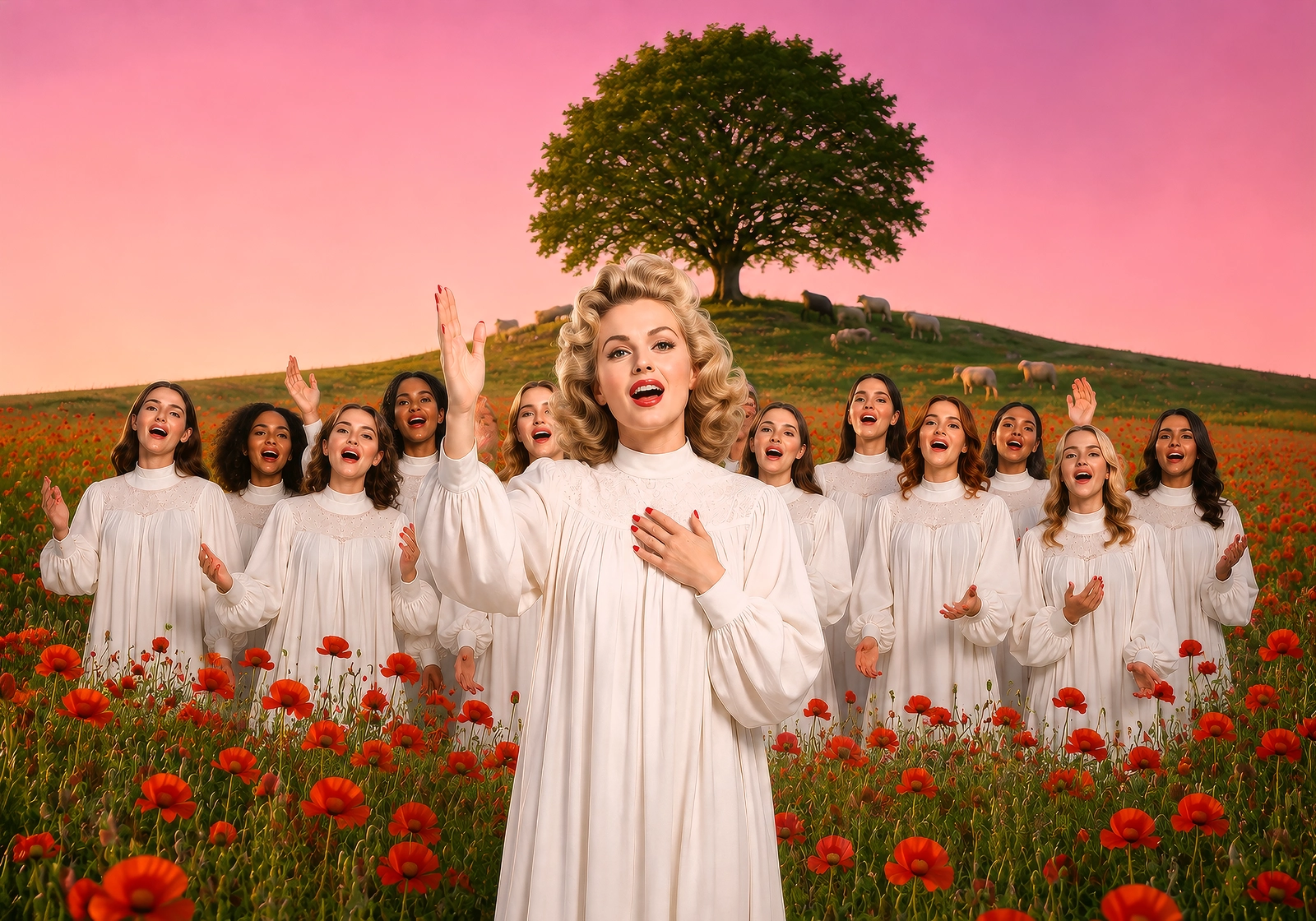
The image tells a story before the reader has even turned the first page.
The eye is drawn to the central angel, for they are all angels. She does not stand before the choir with her back to the audience, like a traditional conductor, but in the midst of it, with one hand raised and the other resting against her breast. The gesture can be interpreted as either her leading the song or being carried away by it. This makes Anita Ekberg the natural centre of the story without dominating the others.
The multicultural choir is one in which no single angel draws attention away from the whole. Their faces reinforce the impression that this is a choir gathered across the boundaries of nations and time. They are her companions from different eras; the oldest is several thousand years old and hails from Mesopotamia.
The poppy field at Hammars Backar, the solitary hawthorn tree on the hill, the grazing sheep, and the rose-coloured evening sky lend the image the atmosphere of a Nordic fairy tale rather than traditional iconography. This means that the title "The Angel Choir" need not be taken literally. The choir may just as well consist of people whose "angelic" quality lies in music and fellowship.
The poppy carries its own symbolism. Throughout history, the flower has symbolised sleep, dreams, memory, and, at times, the passage between worlds. If Anita travels through time, the poppy field becomes a borderland between realities.
The image conveys a sense of hope rather than nostalgia. Anita does not look back on her own life but gazes ahead. For a Time-traveller, this is a strength, since one's focus so easily turns towards the past.
Anita Ekberg conducts a choir of twelve angels, each representing a group of thousands, with each musical work illustrating their unique character. From the celestial devotion of the highest Seraphim to the angelic figures of popular culture, the selections reflect the role of angels in both art and spirituality.
At the outset, Anita explains how the multi-ethnic choir is composed and introduces its multicultural and inter-religious message.
Throughout the concert, the choir performs twelve musical works that represent not only the characteristics of different kinds of angels but also the types of people they resemble. The audience sees how the light falls with equal gentleness upon every angel and realises that humanity's longing for something that watches over us knows neither national borders nor cultural barriers. The idea of angels, or beings who serve as bridges between the divine and the human, exists in every major religion and culture throughout history. Humanity has always needed to believe it is not alone in the darkness.
If we open our minds, we find these heavenly messengers everywhere, even though they bear different names and take different forms.
In the three great Abrahamic religionsChristianity, Judaism, and Islamwe essentially share the same angelic world. In Judaism, they are called "malachim", meaning "messengers". They are Jehovah's instruments and act without a will of their own. In Islam, belief in the angels, the "malaika", is one of the faith's fundamental pillars. There we encounter the same mighty archangels we already know, such as "Jibril" (Gabriel), who dictated the Qur'an to Muhammad, and "Mikael" (Michael). They are described as beings created from pure light, tireless in their service.
Looking even farther afield, we encounter similar beings. Hinduism and Buddhism speak of "devas" and "apsaras". Devas are radiant celestial beings dwelling in higher dimensions, while apsaras are beautiful, flying spirits often depicted in flowing garments, not unlike our Western paintings of singing angels. When apsaras reached China, they became known as "Fēitiān", literally meaning "Flying Celestial Beings". In Japan, these beings became known as "Tennin" ("heavenly beings"), while their female counterparts are called "Tennyo" ("heavenly maidens"). Like Western angels, they are described as beings of extraordinary supernatural beauty dwelling in the Buddhist paradise.
Buddhism also speaks of the "bodhisattvas"beings who have attained complete enlightenment but, out of compassion, choose to remain close to the earthly world to help and protect those who suffer. They are the ultimate symbol of a guardian angel.
Even in the ancient Persian religion of Zoroastrianism, which is far older than Christianity, there existed the "fravashi"personal guardian spirits believed to watch over every human soul from birth until death.
It is fascinating to think that it makes no difference whether one grew up in a religious home. Whether, like Anita, one spent one's childhood on Östra Fäladsgatan in Malmö, in a monastery in Tibet, or in ancient Persia, people throughout history have looked up at the evening sky and thought the very same thought. We long to believe that there is an unseen hand protecting us and a heavenly voice singing for us whenever our own can no longer do so. In eternity, Time-travellers form one universal choir in which everyone sings the same song, though in different languages.
In eternity, humanity finally lives up to its nameHomo sapiens, the wise human beingfor through music these angels become universal, and Time-travellers sing together with people from every age and every culture.
When eternity's "Angel Choir" visits Hammars Backar in Scania, Anita is never far from what was once her childhood home in Malmö. There, on the hillside, memories return to herbut so do the questions.
Chapter 1. The Woman Who Could Sing Without Being a Singer
"How can I conduct a choir when I hardly sang at all on earth? I have asked myself that question many times. I am not a trained singer, nor do I claim to be a blonde Maria Callas. I usually console myself with the thought that I never attended the Royal Dramatic Theatre's acting school either. Yet I still became one of the greatest stars of my era on the silver screen," Anita said unabashedly.
"I was not like Marilyn Monroe, who was never afraid of the microphone and made singing part of her image. Marilyn seized the opportunityor perhaps it was given to herto play the singing temptress. For me, it was never a question of whether I could sing. I was cast early on in roles where singing was not important."
That does not mean I never sang, because I did. Even though the film studios could have dubbed my voice, they allowed me to sing, which proves that my voice was perfectly suitable for the camera.
I possessed neither virtuoso technique nor an extraordinary vocal range. My strength lay elsewhere. My voice was warm, dark, and pleasant, with a natural contralto or mezzo-soprano register that suited my personality. Above all, I sang with the same effortless calm I brought to the camera. There was no strain, no desire to impress with vocal acrobatics; I sang as I acted, like a child of nature. I was meant to fill the stage with my mere presence.
My producers said they did not need another Marilyn Monroe, and when it came to singing, they already had names like Judy Garland, Doris Day, and Julie Andrews. My task was something else. When I sang, it was not the notes themselves that took centre stage, but me. Fellini once described my presence as a force of nature. He believed I did not have to play a role to dominate a room; I simply had to be there. Anita looked towards the star-filled sky, still hidden beyond the rose-coloured twilight.
"At the time, I thought he was talking about cinema. Only afterwards did I realise what he had truly taught me. He never taught me to play a goddess. He taught me to dare to be present. That proved far more important."
That very quality is the same tool I use as a choir conductor in eternity. I realised very early on up here that a good conductor need not be a trained prima donna. My task is not to teach them to sing a high C, but to help them own their expression and sing with absolute honesty. I do not lead them with rigid instructions, but with my ability to bring a room together. When I stand before them, they do not simply respond to a baton; they respond to the weight and security I radiate. That is why they sing so purely. They sound exactly as angels should.
On earth, my voice could easily have carried folk songs, romantic ballads, jazz-inspired numbers, or the popular songs of the 1950s, had I been given the chance. I might never have become a great singer in the traditional sense. Still, here in eternity, together with my own Angel Choir, I have finally been given the opportunity I never had on earth. Only now have I truly grown into my own voice.
On my star, I understood why music always followed me, even though it never became my profession. On earth, I believed a choir conductor's primary skills were reading music, beating time, and hearing when someone sang out of tune. I discovered that these were only a small part of the job. Anita looked at her choir. Unlike the audience, she saw not only twelve angels but also the thousands standing behind them.
"A conductor does not lead voices. She leads people," she continued her monologue.
"When a choir comprises thousands of souls from every culture, language, and millennium on earth, no two voices are alike. Some were professional opera singers in their earthly lives, such as Jenny Lind, the greatest of them all. She sings in my choir. Others sang in churches, temples, or synagogues, or were professional singers like Aretha Franklin, Whitney Houston, Janis Joplin, Amy Winehouse, and Tina Turner. They all left immortal voices on earth, and now they are part of my Angel Choir."
Yet none of that matters anymore. A choir is built on strong personalities who dare to stand by their own voices and know when to listen. Only then does the harmony arise that no human being can create alone.
I was not chosen to lead the Angel Choir because I sang better than anyone else. There are voices in this choir that make the stars themselves pulse with their power. I was chosen because my earthly life taught me something no conservatory can teach. I lived a life in which people constantly saw only my exterior, and because of that I was forced to search for what lay within. I know what it feels like to be admired without being understood, to be looked at without truly being seen. Perhaps that is why I learned to see others.
I believe Fellini was right, though not for the reason he imagined. People did not fall silent because I was more beautiful than anyone else. They fell silent because, for one brief moment, they stopped thinking about themselves.
That is precisely what a choir conductor must accomplish.
When I raise my hands towards the centre of the galaxy, no one begins to sing because I command them. They begin because they feel there is a place for every voice. No one needs to sing louder than anyone else. No one needs to drown out their neighbour. No one needs to sing more beautifully than anyone else. What matters is that every voice finds its place within the harmony, and that the Angel Choir sings as one.
On earth, I believed the world needed more great voices. In eternity, I have learned that the universe needs voices that blend like angels. Perhaps that is why I, who never became a great singer on earth, was finally entrusted with leading the greatest choir of them all.
She had to end her reflections, for the concert was about to begin. Anita slowly raised one hand in a gentle, uplifting gesture, her open palm facing forward in an Abhaya Mudrathe ancient Buddhist symbol of reassurance, fearlessness, and profound comfort. At the same time, her other hand rested upon her breast, anchoring the emotional life of the entire universe within her heart. This twofold gesture conveyed absolute peace to the assembled souls, and at the very moment her fingers settled into position, it was as though an invisible, sacred current flowed through the poppies. The gesture required no words; it was a universal signal that prompted the multicultural Angel Choir to draw a single breath and begin to sing. White wings trembled in the evening air as the first sacred voices of the concert's opening number merged into a cosmic harmony.
Celestial Devotion
The concert's opening number was precisely the kind of music with which the universe is filledharmony. Anita unleashed the choir in a composition by the Japanese composer Toru Takemitsu, a pioneer of modern classical music who fused traditional Western orchestral music with Japanese aesthetics and philosophy.
He called his work "Celestial Devotion" and dedicated it to heavenly devotion. The choir performed the piece from an omnistic perspective, in which every belief system contains part of a common truth. The singers' different languages merged into a synthesis of Gregorian chant, Japanese Shomyo chanting, Sufi dhikr, and Indian raga. The result was magical as the wind from the Baltic Sea played through the leaves of the weather-beaten hawthorn trees on the hillside behind them.
All the angels of the choir sang with heartfelt joy in a soaring upper register, where the Seraph, Israfil, and Agni were permitted to unleash the sacred fire, while the voice of the Tibetan Dakini danced like a being of light through boundless space.
The applause rose as high as the music itself. The audience had travelled from every corner of the universe. It mingled with residents and tourists who happened to be in the right place at the right time, for the concert had not been advertised on Earth, only in eternity. Everyone is welcome when the angels sing.
Imagine What Might Have Been
John Lennon's "Imagine" was the next number. Almost prophetically, his dream portrayed eternity. Everything John wished the people of Earth would imagine is everyday life in eternity. There is neither heaven nor hell, no easily offended gods, no narrow-minded religions, and no nations worth killingor dyingfor. Of course, people still have different opinions; personality remains part of who we are. But since no one can die a second time, there is nothing left to fear, and violence loses all meaning.
"Imagine" appears in many choral arrangements. Still, tonight's four-part arrangement for women's voices is unusual, blending sopranos, mezzo-sopranos, altos, and contraltos in a way that moved Lennon to tears the first time he heard the Angel Choir at a concert on my star, Centaurus.
On that occasion, I took the opportunity to interview John for "The Universal Musical Times." It is remarkable how certain moments become permanently etched in one's memory. I could replay that brief interview in my mind as though I were watching it on YouTube. That is exactly what happened now, and suddenly I could both see and hear John in fast-forward. A conversation that had lasted ten minutes several years ago was over before the audience in front of me even had time to grow impatient.
"I was a little nervous. It was my first interview, and John was one of my musical heroes. A genius who never had the chance to complete his artistic journey on earth, something he has certainly made up for among the stars. 'Imagine' has been followed by many other songs, yet it is still the one audiences always ask to hear."
I began by asking John why his star is called 'Imagine.' Hardly the most original question, given the song's immense popularity and the fact that hordes of people born in the 1930s and 1940s have since passed into eternity.
'The name was obvious. Just as obvious as "The Beatles" when "The Crickets" had already been taken,' he replied, a twinkle in his eye.
'But why "Imagine"?'
He ran a hand through the same unruly hair he had worn at the height of Beatlemania.
'I thought I was writing a protest song. All my life, I had watched people kill one another over flags, borders, religions, and ideologies. I never understood why humanity found it so hard to share the same planet.'
John's eyes searched for the tiny blue dot that was Earth, on the outer edge of the Milky Way.
'It is a perfectly reasonable questionone that everyone asks upon arriving in eternity.'
'I therefore began with an experiment.'
'An experiment?'
'Yes. I asked people I knew to imagine a world in which something they disliked did not exist.'
He smiled.
'Not because I was certain of the answer.'
'Then why?'
'Because perhaps someone else knew.'
John fell silent for a moment.
'Did they?' I asked innocently.
'Sure. I received plenty of suggestions, though not the kind I had hoped for. Everything from bad beer to an impossible mother-in-law. Now and then, a crazy neighbour appeared among the things people wished would disappear forever.' John sighed.
'So the question itself was incorrect.'
'To say the least, that would be the understatement of the year. I greatly overestimated people's sense of proportion. If I asked the same question today, I suspect the answers would be much the same, despite climate change and wars fought in the name of religion.'
'But I assume you found a better question, didn't you?'
'Yep. I realised it was better to present people with a complete picture. First, I asked them to imagine that heaven and hell no longer governed human behaviour. Not because I wanted to take away anyone's faith, but because I wondered how people would behave if they did good simply because it benefited someone else, rather than because they hoped for a reward in heaven or feared being cast into hell.'
John continued slowly.
'Then I asked them to imagine a world without borders. I had travelled across the globe and discovered that the earth itself had no idea where England ended, and France began. Only people drew those linesand then spent their lives defending them.'
He smiled at my puzzled look.
'And then the religions.'
'Naturally, many people misunderstood that.'
'Of course they did, although most of my friends could hardly be described as religious. I never wanted to take God away from anyone. I wanted to ask how people would treat one another if they saw the person before they saw the religion.'
He looked at me.
'Do you understand the difference?'
I nodded.
'You wanted to remove all the walls.'
'Exactly.'
He pointed towards the choir gathered on the hillside, waiting for its conductor.
'When I arrived in eternity, I realised I had sensed something I could not yet see. Among the stars, there are no borders, and nobody truly owns anything except in a virtual sense. There are no nations, because no one is born in any particular place. In the cosmos, there are no religions, because words are no longer needed to understand what prophets and preachers once tried to describeideas that often existed merely to make one person seem more important than another.'
John laughed.
'The funny thing is that I was wrong too.'
'Wrong?'
'Yes.'
'I believed humanity had to change the world before it could realise the dream I described.'
John let his gaze sweep across the thousands of singers gathered to perform his "Imagine."
'Now I know people must first change themselves.'
John closed his eyes.
'On Earth, people still sing my song as a way to escape reality.'
He smiled quietly.
'Among the stars, no one needs to sing it to escape. There, we sing it even though everything I tried to describe already exists.'
The interview faded away, and Anita gently raised her hands.
No conductor's baton was needed. No one gave the starting note. Yet every angel knew the precise moment when the music should begin.
It emerged slowly from the silence, at first almost inaudible, as though the wind itself remembered the melody. One voice became two. Two became a hundred. A hundred became a thousand. Soon, what sounded like tens of thousands of voices filled Hammars Backar.
Because the song is a timeless appeal for peace and has a simple yet beautiful melody, it leaves no listener untouched. Anita had borrowed the arrangement from Lennon's original, with its iconic piano line carrying the song forwarda gentle, rolling theme in C major that feels both comforting and wistful. The choir's singing is soft, intimate, and almost whispered, creating the impression that they are sharing a secret or a dream. The arrangement gradually envelops the audience. It begins with nothing but piano and voices. Slowly, a restrained bass, simple drums, and sweeping cinematic strings are added, lifting the song's hopeful message without overwhelming it.
The audience applauded, deeply moved.
The Dream of Dreams
The next song brought forth the angels of virtue and power within Christianity, those who embodied miracles, grace, and hope on earththings that happen only in the Bible, fairy tales, and films. More and more ABBA admirers have now joined eternity. Their music is always appreciated at our concerts. And now the choir was about to perform their "I Have a Dream."
The words, "I believe in angels, something good in everything I see," offer the ultimate description of the angels of virtue, whose mission was to bring hope, miracles, and divine comfort to humanity amid everyday life. The song is a tribute to optimists and to those who dream themselves away from realityfrom riots in the news, natural disasters, climate change, wars, and every other form of misery. The arrangement is distinguished by the magical entrance of a children's choir, shifting the focus from personal reflection to a collective message of hope and angels.
Anita raised her arms once again, and the next concert piece began in an atmosphere of deep, warm serenity. The spotlights focused on a smaller group within the Angel Choir. The music opened gently with folk-inspired tonesa delicate, rolling bouzouki and a soft acoustic guitar that gave the concert hall a comforting, almost sacred atmosphere. Here, the lyrics opening message was established as a quiet, personal reflection. It spoke of carrying an inner vision, "a dream", and of having a goal to strive towards, "a fantasy", that helped humanity endure when reality felt heavy.
As the song entered its next phase, the arrangement began to breathe. More voices from the adult choir joined in quietly, and the music gained a clearer direction. The lyrics guided the listener through the darkness, speaking of finding the courage to make one's way "through the stream" and daring to cross the threshold when confronted with adversity. The musical mood shifted from a vulnerable narrative to a proclamation of hope. Here, the driving force awakenedthe conviction that there was "something good" and beautiful hidden within everything we encounter.
Then came the concert's most moving and goosebump-inducing momentthe magical entrance. A group of child angels stepped onto the stage, but in this number they were more than just another choir. They became a symbol of eternity's "putti"the eternal child angels. They represented the pure souls who, for one reason or another, were never allowed to remain on earth, those who never had the opportunity to grow up, grow old, or experience adulthood because they arrived in eternity far too soon.
This instantly transformed the performance's emotional power, striking every heart with overwhelming force. The focus shifted from the prayer of an individual adult to a timeless, universal cry from those who watch over us. The clear, innocent voices of the child angels carried the central message: to dare to believe in miracles and in a hand stretched out through the darkness. "I believe in angels" took on an entirely different meaning.
When these putti, symbols of heavenly child angels, met the adult choir in a musical dialogue, sorrow, longing, and consolation were interwoven. The song became a collective hymn of healing that reached across every religion on earth and embraced every living creaturea reminder of eternal hope and of those who left us too early, yet still sing beside us.
The arrangement reached its powerful, hopeful crescendo. The discreet folk instruments were joined by sweeping cinematic strings and a steady, pulsating drum accompaniment that filled Hammars Backar with musical power. It was no longer a quiet dreamit had become a triumphant proclamation. The entire choir sang in perfect harmony, looking towards the future with hope and lifting their song in triumph. The performance ended in a magnificent, shimmering resonance that left the audience with the feeling that miracles truly were possible, both in the Bible and here in Skåne.
When the final notes of ABBA's gentle hymn faded and, as always, the applause seemed endless, a profound reverence lingered over the fields. The delicate voices of the child angels and the earthly dream of hope and outstretched hands had softened the evening air. Yet within the architecture of eternity, this was only a foretaste. The music now shifted its focus from humanity's longing and searching in the darkness to the absolute, cosmic truth. Quiet guitar melodies and earthly concerns gave way to something infinitely greatera transition from comforting fantasy to divine reality. It was time to encounter the final order of the first heavenly sphere.
But first, Anita wished to tell the audience about the choir angels.
In Eternity Everyone Is Equal, Yet Everyone Is Different
Anita let her gaze sweep across the audience gathered in the poppy field. The red blossoms had darkened in the twilight, appearing almost black against the deepening sky. She stood in silence for a moment before she began to speak.
"Since I arrived in eternity, I have come to understand that 'Agni,' 'Israfil,' 'Dakinis,' and 'Seraphim' are not the same beings. They are different languages for the same human experiencethe realisation that there exists a light so powerful, so warm, and so beautiful that human beings instinctively begin to sing."
I did not know them while I lived on earth. I barely knew they existed. Now they stand here in the choir with the rest of us. Each one represents generations of people, different cultures, and different ways of trying to describe that which has never truly allowed itself to be described.
As for what is right and what is wrong, I gladly leave that to the billions upon billions of Time-travellers. We all carry our experiences from Earth with us, but we have also discovered one thing that unites us.
In eternity, all are equal.
There are neither kings nor subjects. No one stands above or below anyone else. No one is a believer or an unbeliever. There are no gods or devils, no heaven and no hell. All such divisions belong to life on earth, just as the physical bodies we once carried belonged there.
Among the stars, we are simply consciousness.
Since we come from thousands of languages and cultures, ordinary words would never be enough. That is why we do not speak with words. We communicate telepathically. What we transmit is not language itself, but the meaning behind it.
Think of an apple.
An apple is an apple whether you grew up in Sweden, China, Egypt, or Peru, or two thousand years ago. On Earth, every people has its own word for the fruit. Here, no word is needed at all. The very moment someone thinks of an apple, everyone else knows exactly what is meant.
It is somewhat reminiscent of ancient Chinese characters. Everyone understands the meaning of the character, even though its pronunciation differs from one region to another. The meaning is shared.
That is why people sometimes ask themselves whether angels can exist.
Call them whatever you wish. They are communicators. Their task is not to rule or to be worshipped. They help souls understand one another. They build bridges between experiences that once seemed impossible to reconcile.
The most beautiful way to do that is through song and music.
Music is older than humanity. Long before Homo sapiens existed, there were rhythm, vibration, and harmony. Life was already singing before anyone could put it into words.
Here, where we normally communicate through thought, we do not really need voices. But when we visit worlds with air and oxygen, like here at Hammars Backar, we once again use our vocal cords and breathe.
Then we sing, not in one language but in all of them.
Each person uses their own tongue, yet no one tries to sing louder than the others. The words blend until they can no longer be distinguished. All that remains is the melody, the harmony, and the emotion.
If someone were standing far away from here, they would not hear Swedish, Arabic, Hebrew, Sanskrit, Latin, or Tibetan spoken.
They would hear only a single song. Perhaps that is why people throughout history have sensed the existence of an Angel Choir. They never heard the wordsonly the harmonies.
"You sometimes ask me why the choir looks so different," she said quietly. "Why some wear crosses, others crescents, others lotus flowers, while some wear no symbols at all."
Anita smiled.
"Because they did so while they were alive."
She looked up at the star-filled sky.
"But out there, among the stars, there are no religions. Only people who once tried to understand the same mystery remain."
Anita pointed towards the innermost circle of the choir.
"In the Christian tradition, they are called Seraphimthe Burning Ones. They stand so close to God that their only task is to love and to sing."
She slowly swept her hand forward.
"Muslims speak of those nearest to God's throne, those completely absorbed in the light. Among them is Israfil, who will one day sound his trumpet, but until then waits in reverence."
Then she pointed towards the blazing poppies.
"In India, fire itself became an image of the very same longing. Agni is not merely fire. He is humanity's love rising towards the divine."
Anita turned and smiled at a young woman standing further back in the choir.
"And in Tibet, you speak of the Dakinis, beings of light who dance through boundless space until every trace of fear and ego is burned away."
She paused.
"I do not know who is right."
The warm wind swept through the poppies.
"Perhaps no one."
She looked up towards the Milky Way.
"Or perhaps everyone."
"For whenever human beings try to describe the greatest mystery of all, they almost always resort to the same images."
"Light."
"Fire."
"Song."
"Love."
She turned toward the choir.
"The words differ, but not the melodyand the melody is all our voices."
Anita turned with a sweeping gesture towards the Angel Choir, as though it were they who had spoken through her.
Angels in the Honky-Tonk
We wanted to provide a down-to-earth contrast to a spirited country number. We now moved into the second sphere, from the Virtues to the Dominionsthe order concerned with leadership, organisation, and establishing order among the lower ranks. To portray this in an earthly and unexpected setting, we chose the timeless country classic "Honky Tonk Angels" by Dolly Parton, Loretta Lynn, and Tammy Wynette. The lyrics bring male double standards to an abrupt halt and confidently take command of the order of things.
The idea of female figures establishing boundaries and creating order in the universe reaches far back into history. In ancient Egyptian mythology, we encounter "Ma'at," the goddess of justice and cosmic order, who carried the feather of truth and ensured that the stars, the seasons, and human actions did not descend into chaos. Likewise, in Norse tradition, we find the "Valkyries," the winged shieldmaidens who, by Odin's command, governed the order of the battlefield and determined which souls were worthy of entering Valhalla, the Vikings' heavenly hall where mead flowed freely.
Doing justice to this bold yet harmonically rich country ballad required a vocal arrangement with unmistakable character. Our arrangement brought together three of the choir's finest altos as a united front, their deep voices woven into the song's iconic country harmonies. When the chorus burst forth, the rest of the choir joined behind them. The contraltos provided a solid, swinging rhythmic foundation, while the sopranos' soaring lines cut through the evening air. The result was a magnificent musical proclamation, demonstrating that order and justice need not be rigid or dull, but can be carried forward with pride, conviction, and unmistakable determination.
A Hymn Beyond Dogma
Silhouetted against the deepening pink sky above the sea, Anita nodded slowly. Her gaze wandered beyond the solitary tree on the hill, far into the vast, star-filled universe. As she introduced the next piece, her voice carried a special gravitythe voice of someone who had left the limits of time behind and stepped across the threshold into eternity.
That was exactly how it was. Homo sapiensthe wise human being. Here on earth, whether on Östra Fäladsgatan or beneath the bright lights of Hollywood, we had so often been divided. We searched, we doubted, we made mistakes, and we concealed our uncertainty behind masks of success or everyday concerns. But in eternity, when every distraction had fallen silent, and everything unimportant had been stripped away, the pieces finally came together. It was then that humanity at last became what it had always been meant to be.
Wise.
Remarkably, this brought both choir and audience directly to the Thrones, the very foundation of the angelic orders. The immense power of the music, the thunder of the kettledrums, and the majesty of royal splendour reflected these beings, whose foremost task is to preserve the balance of the universe.
If the Seraphim were fire and the Cherubim insight, then the Thrones were the foundation itself. They symbolise justice, stability, and cosmic balancethe solid ground upon which the universe rests. Here at Hammars Backar, before the majestic voices of the Thrones, the wise human being found his true place. It was no longer a matter of unquestioning belief or hoping in the darkness; in eternity, the earthly dream was transformed into absolute knowledge and perfect clarity. At last, the audience understood.
To convey the immense, unwavering power of the Thrones in music, Anita asked her choir to lay aside their fragile whispers and instead raise their voices in Georg Friedrich Handel's monumental "Hallelujah Chorus" from "Messiah."
It was a choral work that never faltered. It was architectural, solid, and carried forward by an unfailing sense of judgement and triumph. As the pure voices thundered across the fields, accompanied by the invisible kettledrums and trumpets of heaven, they sang of the final order in which everything that had been crooked and unjust on earth was at last set right. The great words of the Latin and English traditions rang through the evening"Omnipotent" and "Reign forever." Anyone who has taken their place among the countless Time-travellers know that the Almighty is none other than eternity itselfa collective state of being, not a deity.
Listening to that overwhelming power, one realises that humanity is not diminished before the divine in eternity. Quite the contrary. By taking its place near the Thrones and understanding the true order of creation, humanity is elevated. There, in the perfect harmony of music, justice, and light, Homo sapiens finally lives up to its name. The wise human being no longer has to search for truth along the dark streets of Earthhe stands in the very midst of it, within the cosmos.
When the final monumental chord faded across the hills, the audience sat breathless for a moment.
Then it erupted.
A roar of jubilation, equal to the elemental force of the music itself, swept across Hammars Backar, and the applause rolled over the hills like thunder.
The Commanders of Heaven
After the monumental architectural thunder of the Thrones, the audience needed to return to a profoundly human story. The spiritual warfare of the Powers provided the perfect transition in Willie Nelson's dramatic ballad. We now turned our attention to the "Powers," the spiritual warriors whose mission is to battle the forces of darkness and protect humanity in its vulnerability. To portray this epic struggle, we chose Willie Nelson and Ray Charles' dramatic masterpiece, "Seven Spanish Angels." The song's cinematic story of a final battle against overwhelming odds, in which seven angels ultimately descend to carry the souls home from the smoke of battle, perfectly reflects the role of the Powers as heavenly warriors standing on the boundary between light and darkness.
This archetype of the warrior angel who intervenes when human strength has reached its limit is deeply rooted in our cultures. In the Christian and Jewish traditions, we encounter "the Archangel Michael", commander of heaven's armies, who casts out the dragon and personifies the struggle against evil. Yet we find the same motif in the ancient Persian religion of Zoroastrianism, where the "Amesha Spentas" are described as the six divine sparks, or warriors of light, who eternally fight for goodness against the chaos of darkness. It is a timeless story that humanity is never entirely abandoned in its darkest hour.
The choral arrangement was built on stark emotional contrasts. Our soloist opened the verses with a heavy, almost mournful narrative tempo that captured the tragic destiny of the fleeing couple in the lyrics. At first, the choir remained completely silent in the background, like a threatening storm cloud gathering on the horizon. But the moment the gunshots rang out in the story, and the chorus burst forth, the entire choir erupted into a powerful, grieving crescendo. The deep, vibrating foundation of the contraltos carried the weight of the drama, while the sopranos cut through the air like seven brilliant shafts of light as they sang of the seven Spanish angels carrying the rider and his beloved home. It became a performance filled with epic contrasts that left the audience breathlessa reminder that even in the deepest darkness, powers are watching over us.
Angels of Comfort
After the monumental triumph, the applause gradually subsided, and the atmosphere changed once again. From the cosmic authority, royal majesty, and unreachable heights of the Thrones, the choir and I turned our gaze back towards the earth. The music shifted its focus from the firm architecture of the universe to the vulnerability of the individual. Although the order of creation is perfect, humanity is never left alone on its earthly journey. We now arrived at the order closest to us allthe Guardian Angels, the personal protectors whose task is to carry us whenever our own strength fails.
I lowered my hands to my chest and let the silence speak. The sea beneath Scanias darkening skies grew calm in sympathy with the piece about to begin. When I spoke again, it was with a gentle, almost embracing warmtha voice filled with the unconditional love only a guardian angel can offer.
These are the moments when life strikes with full force. When everyday existence becomes overwhelming, or loneliness grows so dense and heavy that a person feels buried alive in the midst of the world's noise. It is in those moments, when every mask has fallen away, and hope is about to fade, that the guardian angel steps forward from the shadows. This intimate, deeply personal relationship with an unseen protector is not unique to any one faithit is a universal source of comfort that, for thousands of years, has taken shape in humanity's culture, art, and spirituality through three timeless guardian figures from art and popular culture.
First, I remembered the Roman guardian spirits, the "Genius," who watched over my home in Genzano outside Rome for so many years. Long before Christian guardian angels were depicted with wings in art, people in the ancient world believed in this personal, invisible, divine companion, born with every human being, who shaped one's character and offered protection from cradle to grave.
Then I thought of the cinematic guardians in "Wings of Desire" ("Der Himmel über Berlin"). In film and popular culture, the idea of the protector has evolved into magnificent symbols. Before my eyes, I saw Wim Wenders' unforgettable angels, silently standing on the rooftops of the city, listening to humanity's secret sorrows and offering an invisible hand of comfort on the shoulders of those who suffer.
Finally, there are the Spirit Guides of modern spirituality and esoteric traditions. Here we encounter the same reassuring image of spiritual guidesbeings who, like guardian angels, are described as personal protectors from the other side, whose sole purpose is to guide human intuition and to bring unexpected light into moments of complete darkness.
To express this deeply personal, unconditional love beneath the pink evening sky, I invited the choir to perform one of the 1990s' greatest and most iconic pop balladsRobbie Williams' "Angels."
The performance opened reverently. A solitary, expressive piano and a single quiet voice from the choir emphasised the song's vulnerability. The lyrics guided the listener through human suffering, speaking of seeking "healing" and finding refuge when one feels most fragile. Gradually, the atmosphere shifted from painful loneliness to a magnificent proclamation of reassurance. Certain words struck directly at the hearts of my audiencethe certainty that wherever life might lead us, and however deeply we might fall, these beings offer absolute "protection" and a "love" that never judges.
When the chorus finally burst forth, the arrangement swelled into a magnificent emotional crescendo. The entire adult choir joined the clear voices of the child angels in a powerful harmony that carried the song's central promisethat they "won't forsake me." To me, it is no longer merely a pop song but a living, breathing hymn to the unseen powers that watch over humanity.
As the final vibrating note faded into the evening breeze, the audience fell silent. Their eyes were filled with tears, deeply moved.
Then the applause erupted.
It was heartfelt, profoundly grateful applause that rolled across Hammars Backar like a warm wave, carrying the same comfort the song had just bestowed upon us.
An Angel in Disguise
Now it was time for the evening's surprise, even though the piece the audience was about to hear was more than seventy years oldElvis Presley's "Devil in Disguise," his song about a fallen angel. My thoughts drifted back to the recent occasion when I heard Elvis perform that very song on his own star, the glowing Vega. It made me reflect on how deeply rooted the idea of the fallen angel is in human consciousness; it appears across countless cultures throughout history. We encounter it in the Babylonian myths of the "Apkallu," who were cast down into the underworld, and in the Book of Enoch's stories of the "Watchers," who fell because of earthly temptations. Most striking of all, however, is the Christian tradition, in which these beings literally fall from the light of heaven into the darkness of hell beneath the earth.
The best known is the angel Lucifer, described as the most beautiful and brilliantly shining of all the archangelscalled the "Light Bringer" or the "Morning Star." Consumed by boundless pride, he desired to become the equal of the Most High. When Lucifer was cast into the abyss, he lost his heavenly radiance and was transformed into Satan himselfthe Adversary, the Tempter, and the Prince of Darkness. Angels of that kind do not belong in my choir, so someone must instead dress as a black-winged angel. To do justice to the role required a very special soloist, someone capable of embodying a fallen angel and serving as a female Elvisa rich, deep contralto. In my introduction, I emphasised that fallen angels exist in both genders. In this case, the fallen angel was a woman, though it could just as easily have been a man.
The performance bore the dramatic title "The Fallen Angel, or Satmara," the angel of betrayal and temptation, and the musical work was Elvis Presley's "Devil in Disguise." It is a perfect portrait of a being who has betrayed anotherin this case, a woman. She possesses the appearance, the graceful walk, and the voice of a heavenly being, yet in the end she rejects the man and reveals herself as a deceiver hiding behind an angelic mask. Although the song is, in reality, about the opposite, Elvis uses the image of the angel as a powerful dramatic contrast while singing about a girl who appears flawless and angelic on the surface. The song is timeless in its brilliant portrayal of bitter betrayal, in which a young man has been deceived by her beauty and false sincerity.
Supported by the choir, the soloist, wearing black wings, sings of how the woman looks, walks, and speaks like an angel. The song and its rhythm portray the man's complete helplessness as she perfectly plays the role of a biblical angel. She possesses the three supreme angelic attributes: beauty, graceful dignity in her movements, and a gentle, comforting voice.
There is absolutely no reason for him to suspect anything is wrong. Then comes the shock: betrayal without explanation, as the lyrics suddenly shift to "you cheated, and you lied." There is no logical reason for her to turn her back on him, and it is precisely this deception that transforms her into a "Satmara" in his eyes. She rejects him without explanation and destroys his illusions by proving unfaithful as well. The choral arrangement reinforces this emotional divide through a clever contrast. While the Elvis angel sings of her angelic qualities, the music remains calm, gentle, and harmonious, like a lullaby. But the very instant her true nature is revealed and the black-winged angel sings, "but you're the devil in disguise," the song explodes into a fast, furious, swinging rock-and-roll tempo. It is the ultimate example in popular music of how quickly a heavenly being becomes a fallen angel when a heart is broken.
An Angelic Human Being
After the dramatic rock-and-roll explosion, calm gradually settled over the hillside, the solitary tree, and the stage. Anita let her gaze wander over her singers before continuing her reflective essay. Now it was time for the angel in disguisenot a fallen being from the underworld, but a human being of flesh and blood who walks among us and is perceived as divine through kindness and compassion. The piece we were about to hear was Eva Dahlgren's "Ängeln i rummet" ("The Angel in the Room"), in the choir's own arrangement.
The idea that heavenly beings appear in human form is ancient. In Islam, we encounter "Khidr," the mysterious man dressed in green who appears as an ordinary human being to guide and grant wisdom to those who have lost their way. In ancient Greece, the idea of "theoxenia" was deeply rootedthe belief that the gods disguised themselves as poor strangers to test human hospitality, so that welcoming a traveller might in fact be an encounter with the sacred itself. Christianity likewise reminds us, in the Epistle to the Hebrews, that many people have unknowingly entertained angels as their guests. Before the Council of Nicaea in 325, many regarded Christ as a human being whose goodness was so extraordinary that he was considered divine. At the Council, he was proclaimed the Son of God, giving rise to an internal struggle within Christianitya dark chapter that has nothing to do with the angels of light.
Unlike the previous performance, the soloist in this piece required neither a dark costume nor sinister attributes. Another of the choir's remarkable contraltos stepped forward, with the same deep, warm vocal colour as Eva Dahlgren herself, and she proudly retained her white wings.
"Ängeln i rummet" does not describe a winged being from heaven, but rather a specific human being who enters a room and radiates such peace and reassurance that, to someone in need, she seems like a living angel.
The soloist lowered her eyes for a moment, touched the necklace at her neck, and smiled with quiet melancholy before singing the opening notes, gently supported by the choir's soft, wordless voices, which formed a protective musical backdrop behind her. This evening's international version preserved the same fragile intimacy as Eva Dahlgren's original recording. The soloist's rich contralto carried the English refrain with extraordinary presence:
"And here I am so full of reason.
I have the things I need to make me whole.
And I hope, I hope you know it's true.
That the woman you see,
is the angel inside of me..."
The choir floated beneath the soloist like a feather-light carpet of sound, carrying the message of humanity's inner divinity. Beautiful though the English version is, it lacks the incomparable intimacy of the Swedish originalits whispered delivery and those small, audible breaths that make it one of the greatest songs ever recorded in Scandinavia. It is precisely in that quiet intimacy that the true human angel reveals herself.
For that version, Anita would have to wait until Eva Dahlgren herself passed into eternity.
Musical Angels
When the applause following Eva Dahlgren's "Angel in Disguise" had finally faded, we needed to awaken the audience with something that challenged the choir's musical craftsmanshipa piece rich in vocal harmonies, playfulness, and breathtaking exhilaration. It was time for the eleventh number, titled "The Ecstatic Angel, or Inspiration", which celebrates those moments when love or creativity strikes us with such overwhelming force that it feels as though an entire choir of angels has taken up residence within our hearts. Our choice fell on Eurythmics' 1985 masterpiece, "There Must Be an Angel". It is a song with remarkable dramatic potential for choral singing, built around its unforgettable line about a heavenly being taking possession of one's heart and playing it like a musical instrument: "No one on earth could feel like this, I'm thrown and overblown with bliss..."
This connection between angels, music, and a state of pure ecstasy is deeply rooted in history. Within the Islamic tradition, we encounter "Israfil," the archangel of music and the Last Judgment, whose voice and trumpet are said to possess such indescribable beauty that they can awaken the dead and fill all living beings with sacred ecstasy. In the Christian Middle Ages, we encounter the musical angels of religious artpainted on church walls with lutes, trumpets, and harps, whose eternal songs of praise were believed to keep the universe itself in harmonious balance. To experience such overwhelming joy within a human relationship is to glimpse paradise itself.
My Angel Choir had created an absolutely brilliant arrangement that truly allowed the voices to display their artistry. The soloist opened with a wonderful rhythmic drive, supported by two altos and one contralto, who gradually built a rich, swinging carpet of harmony beneath her. But it was in the transition into the chorus that the real magic occurred. The voices intertwined in layers, filled with subtle melodic turns that make choral singing so vibrantly alive.
Then came the great operatic lift. The instant the chorus burst forth, the entire choir exploded into a rich, jubilant, multi-part crescendo: "There must be an angel, playing with my heart!" The sopranos soared to breathtaking heights while the rest of the choir answered with a tightly woven, swinging pop arrangement. Yet the most astonishing moment arrived with the famous harmonica solo. Instead of using an instrument, we had the entire choir perform the passage as a complex, playful explosion of wordless "ba-da-da" vocal harmonies. It was anything but monotonous; it became a colourful, pulsating hymn in which the choir's white wings seemed to vibrate with pure joy. It demonstrated that when music reaches its highest level, the boundary between earth and heaven disappears.
The Living Light
After the jubilant pop fireworks, I allowed silence to reclaim the space slowly, a moment of reflection that made the audience listen even more intently before an extraordinary shift in time and place. It was time for the thirteenth number, under the profound title "The Cherubimthe Order of Wisdom, Profound Knowledge, and the Guardians of the Cosmos." Today, many people associate cherubim with the chubby little child angels of the Baroque periodthe so-called putti, but that image is a late and rather superficial distortion. To return to the Cherubim's original, monumental power, we chose the deeply mystical twelfth-century composition "O gloriosissimi lux vivens" by the abbess Hildegard of Bingen. It is a work of music that does not merely seek to please but honours the angels as intelligent guardians of the Living Light and of the unfathomable mysteries of the cosmos.
The idea of the Cherubim as fiery guardians and keepers of divine wisdom extends far beyond the medieval monastery. In the ancient civilisations of Mesopotamia, we encounter the "Lamassu"majestic winged bulls with human heads that guarded royal palaces and temple gates, direct mythological ancestors of the biblical Cherubim. Within Jewish Kabbalah and mysticism, the Cherubim are described as the beings closest to the act of cosmic creation, creatures of pure intellect who bear God's chariot through the heavenly spheres and whose wings vibrate with the hidden knowledge of the universe. To enter their realm is to leave behind the noise of earthly existence and encounter pure, eternal truth.
My Angel Choir approached this medieval masterpiece with a reverence that demanded a vocal technique unlike anything heard earlier in the concert. Hildegard's music is built on monophonic Gregorian chanta free, flowing melodic line without a fixed rhythmic pulse. The soloist began entirely alone, with a vulnerable voice that echoed as though it were bouncing off the cold stone walls of a medieval monastery. Yet here, the unique composition of our choir made all the difference.
Instead of allowing the melody to unfold in a single line, we introduced a subtle, sustained drone beneath it. This was where our two altos and the rare contralto created pure magic. They laid down a deep, dark, unwavering tonal foundation that vibrated throughout the space like the great pipe of a human organ. Above this cosmic wall of sound, the sopranos floated freely, ornamenting the Latin words of the Living Light, "lux vivens." When the entire choir finally united on the last long, sustained vowels, it seemed as though time and space themselves ceased to exist. It was anything but a monotonous liturgical chant; it became a deeply moving sacred revelation in which the choir's white wings remained perfectly still, frozen in an eternal vigil around the holy light.
Lucia Beyond Christmas
After Hildegard of Bingen's deeply moving and sacred revelation of the Cherubim, in which time and space seemed to cease for a brief moment, I let my gaze drift out across the sea. It was time to enter the third spherethe messengers closest to humanity. We began with the "Principalities," the beings whose task is to protect cities, nations, and cultures. As their musical symbol, we chose the traditional hymn "Santa Lucia," composed by Teodoro Cottrau. Lucia serves here as both a patron saint and a bearer of light for an entire culture. This song originally celebrated a lively district of Naples but, through the remarkable paths of history, was transformed into one of Sweden's most cherished Christmas traditions, surrounded by attendants who serve as protective, singing angels in the darkness.
The idea that individual cities and peoples have divine protectors is among humanity's oldest traditions. In ancient Rome, people honoured the "Genius Loci"the spirit of a place that guarded everything from individual squares to entire city-states. In the Jewish tradition, the Book of Daniel describes nations having their own heavenly princes who fight on their behalf in the unseen realms. That an Italian melody can shine like a comforting northern light across the night skies of Skåne is simply another reminder that music knows no borders.
The Angel Choir approached this number with shimmering, touching simplicity. The soloist began entirely unaccompanied, and her voice carried the melody with a purity that resembled the first candle being lit in a room of complete darkness. Gradually, two altos entered, weaving a warm, close third beneath her, before the entire choir joined in. Our arrangement played with the song's geographical transformation; the choir began in Italian, soft and flowing, before shifting to the familiar Swedish lyrics in the following verse. While the contraltos hummed gently beneath them, the sopranos allowed their voices to float in magnificent, feather-light waves of sound. As the choir's white wings slowly swayed with the melody, it seemed as though Hammars Backar had become a timeless sanctuary where no darkness in the world could ever overcome the singing light.
Grand Finale
We allowed Mendelssohn's magnificent choral masterpiece to unite the concert's transreligious and deeply human message in a secure, architecturally perfect final chord.
As the story of the concert approached its final chapter, I felt a profound gratitude for the journey we had made together through the stars, myths, and ages, guided by music. It was now time for the final orderthe "Archangels", the Christian God's greatest messengers, entrusted with the highest and most official missions. Yet this universal promise of mighty heavenly messengers standing between the highest divinity and our earthly existence is far from unique to the Western world. The idea of cosmic guardians entrusted with great responsibilities appears in almost every culture throughout history.
Within Zoroastrianism, we encounter the "Amesha Spentas," the six primordial immortal beings who serve as the Supreme Spirit's direct messengers and preserve order throughout the cosmos. In the Buddhist traditions of China and Japan, we find the Four Heavenly Kings, the "Lokapalas," whose mission is to guard the four corners of the world and protect the sacred "Dharma" from the forces of evil. Whether we speak of the Christian Archangels or the winged guardians of Asia, they all symbolise the enduring protective framework of the universea reminder that humanity is never completely abandoned in its greatest hour of need.
To conclude this cosmic evening, there could be no more fitting choice than Felix Mendelssohn's magnificent yet reassuring choral work "He Shall Give His Angels Charge Over Thee" from the oratorio "Elijah." It is a composition that never hesitates, but with Romantic perfection describes the official mission entrusted to these heavenly messengers: to protect humanity by higher command, so that they do not dash their feet against the stones.
This universal promise of absolute, structured protection is found throughout the great Abrahamic religions, where archangels such as "Gabriel" and "Michael" serve
Jörgen Thornberg
The Angel Choir - English version, 2026
Digital
70 x 50 cm
3 200 kr
The Angel Choir Änglakören
Svensk text på slutet
To deepen your understanding of these themes, explore my reflections on traditions and societal critique through this link, which complements the essay's exploration of pink skies.
https://www.konst.se/jorgen-thornberg
Introduction
There are places where heaven seems nearer to earth.
When the evening sun sinks over Hammars Backar, and the poppy fields glow like burning embers, something extraordinary happens. The wind from the Baltic Sea carries a stillness that, for a fleeting moment, makes people forget the ordinary world and begin to listen not only with their ears but with their entire being.
Imagine that, right there, between the rose-coloured sky and the solitary hawthorn tree, a choir gathered, unlike any humanity has ever heard before.
Not a choir belonging to a single people or a single religion, but one in which thousands of years of human history sing with one voice. Where Christian Seraphim stand side by side with Islam's Malaika, the celestial beings of Buddhism, the Devas of Hinduism, and spiritual figures from cultures throughout the world. Where languages, traditions, and beliefs no longer divide humanity but instead unite to form a boundless harmony.
At the heart of this choir stands Anita Ekberg.
Not as a film star, beauty queen, or Hollywood icon, but as the conductor of eternity's greatest choir. She leads a concert in which every musical work tells a new story about humanityabout love and betrayal, hope and despair, faith and doubt, joy and sorrow. From Handel's majestic Hallelujah Chorus to John Lennon's Imagine, from ABBA and Robbie Williams to Elvis Presley, Eva Dahlgren, Dolly Parton, and Willie Nelson, music, philosophy, history, and mythology are woven into a single story about what it truly means to be human.
This is therefore not an ordinary concert.
It is a musical journey through humanity's shared dreams, where each song opens a new door to our oldest stories and deepest questions. What is an angel, really? Why do these celestial beings appear in almost every civilisation? And why, across time and culture, do human beings continue to long for something that watches over them when darkness falls?
Perhaps there are no definitive answers.
But when the first note rises above the poppy fields of Hammars Backar, the questions no longer matter.
Then only the music remains.
"The Angel Choir" is not a story about how different religions describe angels it is a depiction of how humanity, through music, has sought to express the same longing for light over thousands of years.
The Angel Choir
I. Celestial Devotion
When evening paints the western sky with rose,
And poppies burn like embers in the breeze,
A silent choir from timeless starlight rose
To sing among the hills and ancient trees.
No tongue alone could shape the sacred air;
Each soul became a note beyond all prayer.
II. Imagine
Imagine every border washed away,
No walls of fear, no crowns, no throne, no chain.
The stars have never learned the names we say;
They shine alike on sunlight and on rain.
The song begins where all divisions cease,
A single breath becoming endless peace.
III. I Have a Dream
The children lift their crystal voices high,
Like morning birds before the birth of dawn.
They teach the weary heart once more to fly,
Though every earthly certainty is gone.
Where innocence and hope together gleam,
The universe remembers how to dream.
IV. Honky Tonk Angels
Not every hymn is born beneath a dome;
Some rise where laughing souls refuse despair.
Even dusty roads can lead us home,
And justice wears a country singer's air.
The strongest wings are often stitched with grace,
Not forged by power, rank, or noble place.
V. Hallelujah
Then thunder rolled beyond the reach of time,
The stars themselves stood still to hear the sound.
Each mighty chord became a mountain climb,
Where truth and harmony were finally found.
No empire built by mortal hands could stay;
Only the light would never fade away.
VI. Seven Spanish Angels
Across the valleys echoed grief and flame,
Yet love refused to yield its final breath.
Seven unseen guardians gently came
To lead two faithful hearts beyond their death.
For even where the darkest shadows start,
An angel still remembers every heart.
VII. Angels
When lonely footsteps vanish in the night,
And every distant window loses its glow,
A gentle hand appears without a sight,
To lift the soul too tired to rise below.
We call them angels simply because
Love never asks the reason or the cause.
VIII. Devil in Disguise
Not every wing reflects the morning sun;
Some hide a smile no honest heart can read.
The fairest face may wound the trusting one,
Where beauty masks ambition, pride, and greed.
Yet every broken heart, though torn apart,
Learns truth can never wear a borrowed heart.
IX. Angel in the Room
Then someone quietly entered the hall,
Without a crown, a halo, or a name.
No miracle announced her at all,
Yet every frightened soul was not the same.
For heaven sometimes chooses, strange but true,
To wear the ordinary face of you.
X. There Must Be an Angel
Joy burst alive like sunlight after rain;
The choir laughed where music learned to fly.
Each voice became another golden flame,
A dancing bridge between the earth and sky.
If bliss could ever find a mortal heart,
It surely sings where grateful spirits start.
XI. Wisdom Beyond the Stars
The oldest songs were never born of men;
They waited in the silence long before.
Each generation found their voice again,
Adding another echo to the score.
The wisest soul is not the one who knows,
But one whose heart forever sings and grows.
XII. The Eternal Choir
At last the final harmony was heard;
The sea grew still beneath the evening's glow.
No faith, no nation, needed one more word,
For every heart already seemed to know.
The concert endsbut not the song above;
The universe itself is written Love.
Malmö, August 2026
PROLOGUE
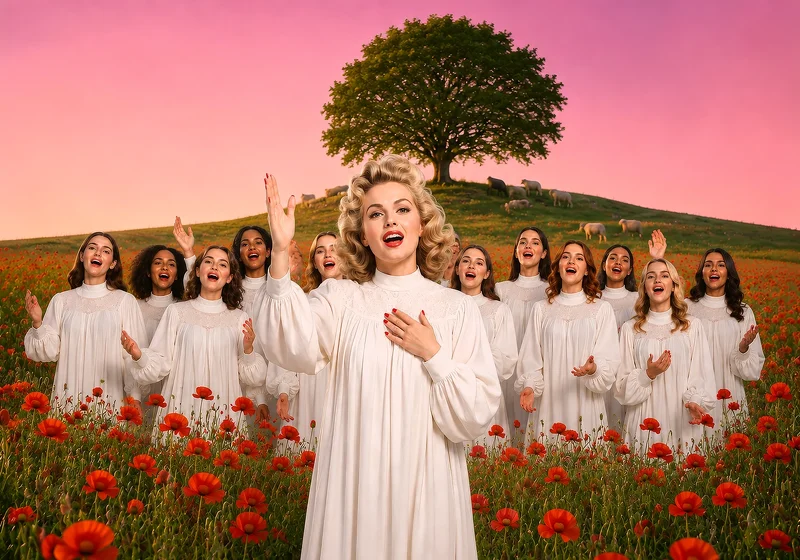
The image tells a story before the reader has even turned the first page.
The eye is drawn to the central angel, for they are all angels. She does not stand before the choir with her back to the audience, like a traditional conductor, but in the midst of it, with one hand raised and the other resting against her breast. The gesture can be interpreted as either her leading the song or being carried away by it. This makes Anita Ekberg the natural centre of the story without dominating the others.
The multicultural choir is one in which no single angel draws attention away from the whole. Their faces reinforce the impression that this is a choir gathered across the boundaries of nations and time. They are her companions from different eras; the oldest is several thousand years old and hails from Mesopotamia.
The poppy field at Hammars Backar, the solitary hawthorn tree on the hill, the grazing sheep, and the rose-coloured evening sky lend the image the atmosphere of a Nordic fairy tale rather than traditional iconography. This means that the title "The Angel Choir" need not be taken literally. The choir may just as well consist of people whose "angelic" quality lies in music and fellowship.
The poppy carries its own symbolism. Throughout history, the flower has symbolised sleep, dreams, memory, and, at times, the passage between worlds. If Anita travels through time, the poppy field becomes a borderland between realities.
The image conveys a sense of hope rather than nostalgia. Anita does not look back on her own life but gazes ahead. For a Time-traveller, this is a strength, since one's focus so easily turns towards the past.
Anita Ekberg conducts a choir of twelve angels, each representing a group of thousands, with each musical work illustrating their unique character. From the celestial devotion of the highest Seraphim to the angelic figures of popular culture, the selections reflect the role of angels in both art and spirituality.
At the outset, Anita explains how the multi-ethnic choir is composed and introduces its multicultural and inter-religious message.
Throughout the concert, the choir performs twelve musical works that represent not only the characteristics of different kinds of angels but also the types of people they resemble. The audience sees how the light falls with equal gentleness upon every angel and realises that humanity's longing for something that watches over us knows neither national borders nor cultural barriers. The idea of angels, or beings who serve as bridges between the divine and the human, exists in every major religion and culture throughout history. Humanity has always needed to believe it is not alone in the darkness.
If we open our minds, we find these heavenly messengers everywhere, even though they bear different names and take different forms.
In the three great Abrahamic religionsChristianity, Judaism, and Islamwe essentially share the same angelic world. In Judaism, they are called "malachim", meaning "messengers". They are Jehovah's instruments and act without a will of their own. In Islam, belief in the angels, the "malaika", is one of the faith's fundamental pillars. There we encounter the same mighty archangels we already know, such as "Jibril" (Gabriel), who dictated the Qur'an to Muhammad, and "Mikael" (Michael). They are described as beings created from pure light, tireless in their service.
Looking even farther afield, we encounter similar beings. Hinduism and Buddhism speak of "devas" and "apsaras". Devas are radiant celestial beings dwelling in higher dimensions, while apsaras are beautiful, flying spirits often depicted in flowing garments, not unlike our Western paintings of singing angels. When apsaras reached China, they became known as "Fēitiān", literally meaning "Flying Celestial Beings". In Japan, these beings became known as "Tennin" ("heavenly beings"), while their female counterparts are called "Tennyo" ("heavenly maidens"). Like Western angels, they are described as beings of extraordinary supernatural beauty dwelling in the Buddhist paradise.
Buddhism also speaks of the "bodhisattvas"beings who have attained complete enlightenment but, out of compassion, choose to remain close to the earthly world to help and protect those who suffer. They are the ultimate symbol of a guardian angel.
Even in the ancient Persian religion of Zoroastrianism, which is far older than Christianity, there existed the "fravashi"personal guardian spirits believed to watch over every human soul from birth until death.
It is fascinating to think that it makes no difference whether one grew up in a religious home. Whether, like Anita, one spent one's childhood on Östra Fäladsgatan in Malmö, in a monastery in Tibet, or in ancient Persia, people throughout history have looked up at the evening sky and thought the very same thought. We long to believe that there is an unseen hand protecting us and a heavenly voice singing for us whenever our own can no longer do so. In eternity, Time-travellers form one universal choir in which everyone sings the same song, though in different languages.
In eternity, humanity finally lives up to its nameHomo sapiens, the wise human beingfor through music these angels become universal, and Time-travellers sing together with people from every age and every culture.
When eternity's "Angel Choir" visits Hammars Backar in Scania, Anita is never far from what was once her childhood home in Malmö. There, on the hillside, memories return to herbut so do the questions.
Chapter 1. The Woman Who Could Sing Without Being a Singer
"How can I conduct a choir when I hardly sang at all on earth? I have asked myself that question many times. I am not a trained singer, nor do I claim to be a blonde Maria Callas. I usually console myself with the thought that I never attended the Royal Dramatic Theatre's acting school either. Yet I still became one of the greatest stars of my era on the silver screen," Anita said unabashedly.
"I was not like Marilyn Monroe, who was never afraid of the microphone and made singing part of her image. Marilyn seized the opportunityor perhaps it was given to herto play the singing temptress. For me, it was never a question of whether I could sing. I was cast early on in roles where singing was not important."
That does not mean I never sang, because I did. Even though the film studios could have dubbed my voice, they allowed me to sing, which proves that my voice was perfectly suitable for the camera.
I possessed neither virtuoso technique nor an extraordinary vocal range. My strength lay elsewhere. My voice was warm, dark, and pleasant, with a natural contralto or mezzo-soprano register that suited my personality. Above all, I sang with the same effortless calm I brought to the camera. There was no strain, no desire to impress with vocal acrobatics; I sang as I acted, like a child of nature. I was meant to fill the stage with my mere presence.
My producers said they did not need another Marilyn Monroe, and when it came to singing, they already had names like Judy Garland, Doris Day, and Julie Andrews. My task was something else. When I sang, it was not the notes themselves that took centre stage, but me. Fellini once described my presence as a force of nature. He believed I did not have to play a role to dominate a room; I simply had to be there. Anita looked towards the star-filled sky, still hidden beyond the rose-coloured twilight.
"At the time, I thought he was talking about cinema. Only afterwards did I realise what he had truly taught me. He never taught me to play a goddess. He taught me to dare to be present. That proved far more important."
That very quality is the same tool I use as a choir conductor in eternity. I realised very early on up here that a good conductor need not be a trained prima donna. My task is not to teach them to sing a high C, but to help them own their expression and sing with absolute honesty. I do not lead them with rigid instructions, but with my ability to bring a room together. When I stand before them, they do not simply respond to a baton; they respond to the weight and security I radiate. That is why they sing so purely. They sound exactly as angels should.
On earth, my voice could easily have carried folk songs, romantic ballads, jazz-inspired numbers, or the popular songs of the 1950s, had I been given the chance. I might never have become a great singer in the traditional sense. Still, here in eternity, together with my own Angel Choir, I have finally been given the opportunity I never had on earth. Only now have I truly grown into my own voice.
On my star, I understood why music always followed me, even though it never became my profession. On earth, I believed a choir conductor's primary skills were reading music, beating time, and hearing when someone sang out of tune. I discovered that these were only a small part of the job. Anita looked at her choir. Unlike the audience, she saw not only twelve angels but also the thousands standing behind them.
"A conductor does not lead voices. She leads people," she continued her monologue.
"When a choir comprises thousands of souls from every culture, language, and millennium on earth, no two voices are alike. Some were professional opera singers in their earthly lives, such as Jenny Lind, the greatest of them all. She sings in my choir. Others sang in churches, temples, or synagogues, or were professional singers like Aretha Franklin, Whitney Houston, Janis Joplin, Amy Winehouse, and Tina Turner. They all left immortal voices on earth, and now they are part of my Angel Choir."
Yet none of that matters anymore. A choir is built on strong personalities who dare to stand by their own voices and know when to listen. Only then does the harmony arise that no human being can create alone.
I was not chosen to lead the Angel Choir because I sang better than anyone else. There are voices in this choir that make the stars themselves pulse with their power. I was chosen because my earthly life taught me something no conservatory can teach. I lived a life in which people constantly saw only my exterior, and because of that I was forced to search for what lay within. I know what it feels like to be admired without being understood, to be looked at without truly being seen. Perhaps that is why I learned to see others.
I believe Fellini was right, though not for the reason he imagined. People did not fall silent because I was more beautiful than anyone else. They fell silent because, for one brief moment, they stopped thinking about themselves.
That is precisely what a choir conductor must accomplish.
When I raise my hands towards the centre of the galaxy, no one begins to sing because I command them. They begin because they feel there is a place for every voice. No one needs to sing louder than anyone else. No one needs to drown out their neighbour. No one needs to sing more beautifully than anyone else. What matters is that every voice finds its place within the harmony, and that the Angel Choir sings as one.
On earth, I believed the world needed more great voices. In eternity, I have learned that the universe needs voices that blend like angels. Perhaps that is why I, who never became a great singer on earth, was finally entrusted with leading the greatest choir of them all.
She had to end her reflections, for the concert was about to begin. Anita slowly raised one hand in a gentle, uplifting gesture, her open palm facing forward in an Abhaya Mudrathe ancient Buddhist symbol of reassurance, fearlessness, and profound comfort. At the same time, her other hand rested upon her breast, anchoring the emotional life of the entire universe within her heart. This twofold gesture conveyed absolute peace to the assembled souls, and at the very moment her fingers settled into position, it was as though an invisible, sacred current flowed through the poppies. The gesture required no words; it was a universal signal that prompted the multicultural Angel Choir to draw a single breath and begin to sing. White wings trembled in the evening air as the first sacred voices of the concert's opening number merged into a cosmic harmony.
Celestial Devotion
The concert's opening number was precisely the kind of music with which the universe is filledharmony. Anita unleashed the choir in a composition by the Japanese composer Toru Takemitsu, a pioneer of modern classical music who fused traditional Western orchestral music with Japanese aesthetics and philosophy.
He called his work "Celestial Devotion" and dedicated it to heavenly devotion. The choir performed the piece from an omnistic perspective, in which every belief system contains part of a common truth. The singers' different languages merged into a synthesis of Gregorian chant, Japanese Shomyo chanting, Sufi dhikr, and Indian raga. The result was magical as the wind from the Baltic Sea played through the leaves of the weather-beaten hawthorn trees on the hillside behind them.
All the angels of the choir sang with heartfelt joy in a soaring upper register, where the Seraph, Israfil, and Agni were permitted to unleash the sacred fire, while the voice of the Tibetan Dakini danced like a being of light through boundless space.
The applause rose as high as the music itself. The audience had travelled from every corner of the universe. It mingled with residents and tourists who happened to be in the right place at the right time, for the concert had not been advertised on Earth, only in eternity. Everyone is welcome when the angels sing.
Imagine What Might Have Been
John Lennon's "Imagine" was the next number. Almost prophetically, his dream portrayed eternity. Everything John wished the people of Earth would imagine is everyday life in eternity. There is neither heaven nor hell, no easily offended gods, no narrow-minded religions, and no nations worth killingor dyingfor. Of course, people still have different opinions; personality remains part of who we are. But since no one can die a second time, there is nothing left to fear, and violence loses all meaning.
"Imagine" appears in many choral arrangements. Still, tonight's four-part arrangement for women's voices is unusual, blending sopranos, mezzo-sopranos, altos, and contraltos in a way that moved Lennon to tears the first time he heard the Angel Choir at a concert on my star, Centaurus.
On that occasion, I took the opportunity to interview John for "The Universal Musical Times." It is remarkable how certain moments become permanently etched in one's memory. I could replay that brief interview in my mind as though I were watching it on YouTube. That is exactly what happened now, and suddenly I could both see and hear John in fast-forward. A conversation that had lasted ten minutes several years ago was over before the audience in front of me even had time to grow impatient.
"I was a little nervous. It was my first interview, and John was one of my musical heroes. A genius who never had the chance to complete his artistic journey on earth, something he has certainly made up for among the stars. 'Imagine' has been followed by many other songs, yet it is still the one audiences always ask to hear."
I began by asking John why his star is called 'Imagine.' Hardly the most original question, given the song's immense popularity and the fact that hordes of people born in the 1930s and 1940s have since passed into eternity.
'The name was obvious. Just as obvious as "The Beatles" when "The Crickets" had already been taken,' he replied, a twinkle in his eye.
'But why "Imagine"?'
He ran a hand through the same unruly hair he had worn at the height of Beatlemania.
'I thought I was writing a protest song. All my life, I had watched people kill one another over flags, borders, religions, and ideologies. I never understood why humanity found it so hard to share the same planet.'
John's eyes searched for the tiny blue dot that was Earth, on the outer edge of the Milky Way.
'It is a perfectly reasonable questionone that everyone asks upon arriving in eternity.'
'I therefore began with an experiment.'
'An experiment?'
'Yes. I asked people I knew to imagine a world in which something they disliked did not exist.'
He smiled.
'Not because I was certain of the answer.'
'Then why?'
'Because perhaps someone else knew.'
John fell silent for a moment.
'Did they?' I asked innocently.
'Sure. I received plenty of suggestions, though not the kind I had hoped for. Everything from bad beer to an impossible mother-in-law. Now and then, a crazy neighbour appeared among the things people wished would disappear forever.' John sighed.
'So the question itself was incorrect.'
'To say the least, that would be the understatement of the year. I greatly overestimated people's sense of proportion. If I asked the same question today, I suspect the answers would be much the same, despite climate change and wars fought in the name of religion.'
'But I assume you found a better question, didn't you?'
'Yep. I realised it was better to present people with a complete picture. First, I asked them to imagine that heaven and hell no longer governed human behaviour. Not because I wanted to take away anyone's faith, but because I wondered how people would behave if they did good simply because it benefited someone else, rather than because they hoped for a reward in heaven or feared being cast into hell.'
John continued slowly.
'Then I asked them to imagine a world without borders. I had travelled across the globe and discovered that the earth itself had no idea where England ended, and France began. Only people drew those linesand then spent their lives defending them.'
He smiled at my puzzled look.
'And then the religions.'
'Naturally, many people misunderstood that.'
'Of course they did, although most of my friends could hardly be described as religious. I never wanted to take God away from anyone. I wanted to ask how people would treat one another if they saw the person before they saw the religion.'
He looked at me.
'Do you understand the difference?'
I nodded.
'You wanted to remove all the walls.'
'Exactly.'
He pointed towards the choir gathered on the hillside, waiting for its conductor.
'When I arrived in eternity, I realised I had sensed something I could not yet see. Among the stars, there are no borders, and nobody truly owns anything except in a virtual sense. There are no nations, because no one is born in any particular place. In the cosmos, there are no religions, because words are no longer needed to understand what prophets and preachers once tried to describeideas that often existed merely to make one person seem more important than another.'
John laughed.
'The funny thing is that I was wrong too.'
'Wrong?'
'Yes.'
'I believed humanity had to change the world before it could realise the dream I described.'
John let his gaze sweep across the thousands of singers gathered to perform his "Imagine."
'Now I know people must first change themselves.'
John closed his eyes.
'On Earth, people still sing my song as a way to escape reality.'
He smiled quietly.
'Among the stars, no one needs to sing it to escape. There, we sing it even though everything I tried to describe already exists.'
The interview faded away, and Anita gently raised her hands.
No conductor's baton was needed. No one gave the starting note. Yet every angel knew the precise moment when the music should begin.
It emerged slowly from the silence, at first almost inaudible, as though the wind itself remembered the melody. One voice became two. Two became a hundred. A hundred became a thousand. Soon, what sounded like tens of thousands of voices filled Hammars Backar.
Because the song is a timeless appeal for peace and has a simple yet beautiful melody, it leaves no listener untouched. Anita had borrowed the arrangement from Lennon's original, with its iconic piano line carrying the song forwarda gentle, rolling theme in C major that feels both comforting and wistful. The choir's singing is soft, intimate, and almost whispered, creating the impression that they are sharing a secret or a dream. The arrangement gradually envelops the audience. It begins with nothing but piano and voices. Slowly, a restrained bass, simple drums, and sweeping cinematic strings are added, lifting the song's hopeful message without overwhelming it.
The audience applauded, deeply moved.
The Dream of Dreams
The next song brought forth the angels of virtue and power within Christianity, those who embodied miracles, grace, and hope on earththings that happen only in the Bible, fairy tales, and films. More and more ABBA admirers have now joined eternity. Their music is always appreciated at our concerts. And now the choir was about to perform their "I Have a Dream."
The words, "I believe in angels, something good in everything I see," offer the ultimate description of the angels of virtue, whose mission was to bring hope, miracles, and divine comfort to humanity amid everyday life. The song is a tribute to optimists and to those who dream themselves away from realityfrom riots in the news, natural disasters, climate change, wars, and every other form of misery. The arrangement is distinguished by the magical entrance of a children's choir, shifting the focus from personal reflection to a collective message of hope and angels.
Anita raised her arms once again, and the next concert piece began in an atmosphere of deep, warm serenity. The spotlights focused on a smaller group within the Angel Choir. The music opened gently with folk-inspired tonesa delicate, rolling bouzouki and a soft acoustic guitar that gave the concert hall a comforting, almost sacred atmosphere. Here, the lyrics opening message was established as a quiet, personal reflection. It spoke of carrying an inner vision, "a dream", and of having a goal to strive towards, "a fantasy", that helped humanity endure when reality felt heavy.
As the song entered its next phase, the arrangement began to breathe. More voices from the adult choir joined in quietly, and the music gained a clearer direction. The lyrics guided the listener through the darkness, speaking of finding the courage to make one's way "through the stream" and daring to cross the threshold when confronted with adversity. The musical mood shifted from a vulnerable narrative to a proclamation of hope. Here, the driving force awakenedthe conviction that there was "something good" and beautiful hidden within everything we encounter.
Then came the concert's most moving and goosebump-inducing momentthe magical entrance. A group of child angels stepped onto the stage, but in this number they were more than just another choir. They became a symbol of eternity's "putti"the eternal child angels. They represented the pure souls who, for one reason or another, were never allowed to remain on earth, those who never had the opportunity to grow up, grow old, or experience adulthood because they arrived in eternity far too soon.
This instantly transformed the performance's emotional power, striking every heart with overwhelming force. The focus shifted from the prayer of an individual adult to a timeless, universal cry from those who watch over us. The clear, innocent voices of the child angels carried the central message: to dare to believe in miracles and in a hand stretched out through the darkness. "I believe in angels" took on an entirely different meaning.
When these putti, symbols of heavenly child angels, met the adult choir in a musical dialogue, sorrow, longing, and consolation were interwoven. The song became a collective hymn of healing that reached across every religion on earth and embraced every living creaturea reminder of eternal hope and of those who left us too early, yet still sing beside us.
The arrangement reached its powerful, hopeful crescendo. The discreet folk instruments were joined by sweeping cinematic strings and a steady, pulsating drum accompaniment that filled Hammars Backar with musical power. It was no longer a quiet dreamit had become a triumphant proclamation. The entire choir sang in perfect harmony, looking towards the future with hope and lifting their song in triumph. The performance ended in a magnificent, shimmering resonance that left the audience with the feeling that miracles truly were possible, both in the Bible and here in Skåne.
When the final notes of ABBA's gentle hymn faded and, as always, the applause seemed endless, a profound reverence lingered over the fields. The delicate voices of the child angels and the earthly dream of hope and outstretched hands had softened the evening air. Yet within the architecture of eternity, this was only a foretaste. The music now shifted its focus from humanity's longing and searching in the darkness to the absolute, cosmic truth. Quiet guitar melodies and earthly concerns gave way to something infinitely greatera transition from comforting fantasy to divine reality. It was time to encounter the final order of the first heavenly sphere.
But first, Anita wished to tell the audience about the choir angels.
In Eternity Everyone Is Equal, Yet Everyone Is Different
Anita let her gaze sweep across the audience gathered in the poppy field. The red blossoms had darkened in the twilight, appearing almost black against the deepening sky. She stood in silence for a moment before she began to speak.
"Since I arrived in eternity, I have come to understand that 'Agni,' 'Israfil,' 'Dakinis,' and 'Seraphim' are not the same beings. They are different languages for the same human experiencethe realisation that there exists a light so powerful, so warm, and so beautiful that human beings instinctively begin to sing."
I did not know them while I lived on earth. I barely knew they existed. Now they stand here in the choir with the rest of us. Each one represents generations of people, different cultures, and different ways of trying to describe that which has never truly allowed itself to be described.
As for what is right and what is wrong, I gladly leave that to the billions upon billions of Time-travellers. We all carry our experiences from Earth with us, but we have also discovered one thing that unites us.
In eternity, all are equal.
There are neither kings nor subjects. No one stands above or below anyone else. No one is a believer or an unbeliever. There are no gods or devils, no heaven and no hell. All such divisions belong to life on earth, just as the physical bodies we once carried belonged there.
Among the stars, we are simply consciousness.
Since we come from thousands of languages and cultures, ordinary words would never be enough. That is why we do not speak with words. We communicate telepathically. What we transmit is not language itself, but the meaning behind it.
Think of an apple.
An apple is an apple whether you grew up in Sweden, China, Egypt, or Peru, or two thousand years ago. On Earth, every people has its own word for the fruit. Here, no word is needed at all. The very moment someone thinks of an apple, everyone else knows exactly what is meant.
It is somewhat reminiscent of ancient Chinese characters. Everyone understands the meaning of the character, even though its pronunciation differs from one region to another. The meaning is shared.
That is why people sometimes ask themselves whether angels can exist.
Call them whatever you wish. They are communicators. Their task is not to rule or to be worshipped. They help souls understand one another. They build bridges between experiences that once seemed impossible to reconcile.
The most beautiful way to do that is through song and music.
Music is older than humanity. Long before Homo sapiens existed, there were rhythm, vibration, and harmony. Life was already singing before anyone could put it into words.
Here, where we normally communicate through thought, we do not really need voices. But when we visit worlds with air and oxygen, like here at Hammars Backar, we once again use our vocal cords and breathe.
Then we sing, not in one language but in all of them.
Each person uses their own tongue, yet no one tries to sing louder than the others. The words blend until they can no longer be distinguished. All that remains is the melody, the harmony, and the emotion.
If someone were standing far away from here, they would not hear Swedish, Arabic, Hebrew, Sanskrit, Latin, or Tibetan spoken.
They would hear only a single song. Perhaps that is why people throughout history have sensed the existence of an Angel Choir. They never heard the wordsonly the harmonies.
"You sometimes ask me why the choir looks so different," she said quietly. "Why some wear crosses, others crescents, others lotus flowers, while some wear no symbols at all."
Anita smiled.
"Because they did so while they were alive."
She looked up at the star-filled sky.
"But out there, among the stars, there are no religions. Only people who once tried to understand the same mystery remain."
Anita pointed towards the innermost circle of the choir.
"In the Christian tradition, they are called Seraphimthe Burning Ones. They stand so close to God that their only task is to love and to sing."
She slowly swept her hand forward.
"Muslims speak of those nearest to God's throne, those completely absorbed in the light. Among them is Israfil, who will one day sound his trumpet, but until then waits in reverence."
Then she pointed towards the blazing poppies.
"In India, fire itself became an image of the very same longing. Agni is not merely fire. He is humanity's love rising towards the divine."
Anita turned and smiled at a young woman standing further back in the choir.
"And in Tibet, you speak of the Dakinis, beings of light who dance through boundless space until every trace of fear and ego is burned away."
She paused.
"I do not know who is right."
The warm wind swept through the poppies.
"Perhaps no one."
She looked up towards the Milky Way.
"Or perhaps everyone."
"For whenever human beings try to describe the greatest mystery of all, they almost always resort to the same images."
"Light."
"Fire."
"Song."
"Love."
She turned toward the choir.
"The words differ, but not the melodyand the melody is all our voices."
Anita turned with a sweeping gesture towards the Angel Choir, as though it were they who had spoken through her.
Angels in the Honky-Tonk
We wanted to provide a down-to-earth contrast to a spirited country number. We now moved into the second sphere, from the Virtues to the Dominionsthe order concerned with leadership, organisation, and establishing order among the lower ranks. To portray this in an earthly and unexpected setting, we chose the timeless country classic "Honky Tonk Angels" by Dolly Parton, Loretta Lynn, and Tammy Wynette. The lyrics bring male double standards to an abrupt halt and confidently take command of the order of things.
The idea of female figures establishing boundaries and creating order in the universe reaches far back into history. In ancient Egyptian mythology, we encounter "Ma'at," the goddess of justice and cosmic order, who carried the feather of truth and ensured that the stars, the seasons, and human actions did not descend into chaos. Likewise, in Norse tradition, we find the "Valkyries," the winged shieldmaidens who, by Odin's command, governed the order of the battlefield and determined which souls were worthy of entering Valhalla, the Vikings' heavenly hall where mead flowed freely.
Doing justice to this bold yet harmonically rich country ballad required a vocal arrangement with unmistakable character. Our arrangement brought together three of the choir's finest altos as a united front, their deep voices woven into the song's iconic country harmonies. When the chorus burst forth, the rest of the choir joined behind them. The contraltos provided a solid, swinging rhythmic foundation, while the sopranos' soaring lines cut through the evening air. The result was a magnificent musical proclamation, demonstrating that order and justice need not be rigid or dull, but can be carried forward with pride, conviction, and unmistakable determination.
A Hymn Beyond Dogma
Silhouetted against the deepening pink sky above the sea, Anita nodded slowly. Her gaze wandered beyond the solitary tree on the hill, far into the vast, star-filled universe. As she introduced the next piece, her voice carried a special gravitythe voice of someone who had left the limits of time behind and stepped across the threshold into eternity.
That was exactly how it was. Homo sapiensthe wise human being. Here on earth, whether on Östra Fäladsgatan or beneath the bright lights of Hollywood, we had so often been divided. We searched, we doubted, we made mistakes, and we concealed our uncertainty behind masks of success or everyday concerns. But in eternity, when every distraction had fallen silent, and everything unimportant had been stripped away, the pieces finally came together. It was then that humanity at last became what it had always been meant to be.
Wise.
Remarkably, this brought both choir and audience directly to the Thrones, the very foundation of the angelic orders. The immense power of the music, the thunder of the kettledrums, and the majesty of royal splendour reflected these beings, whose foremost task is to preserve the balance of the universe.
If the Seraphim were fire and the Cherubim insight, then the Thrones were the foundation itself. They symbolise justice, stability, and cosmic balancethe solid ground upon which the universe rests. Here at Hammars Backar, before the majestic voices of the Thrones, the wise human being found his true place. It was no longer a matter of unquestioning belief or hoping in the darkness; in eternity, the earthly dream was transformed into absolute knowledge and perfect clarity. At last, the audience understood.
To convey the immense, unwavering power of the Thrones in music, Anita asked her choir to lay aside their fragile whispers and instead raise their voices in Georg Friedrich Handel's monumental "Hallelujah Chorus" from "Messiah."
It was a choral work that never faltered. It was architectural, solid, and carried forward by an unfailing sense of judgement and triumph. As the pure voices thundered across the fields, accompanied by the invisible kettledrums and trumpets of heaven, they sang of the final order in which everything that had been crooked and unjust on earth was at last set right. The great words of the Latin and English traditions rang through the evening"Omnipotent" and "Reign forever." Anyone who has taken their place among the countless Time-travellers know that the Almighty is none other than eternity itselfa collective state of being, not a deity.
Listening to that overwhelming power, one realises that humanity is not diminished before the divine in eternity. Quite the contrary. By taking its place near the Thrones and understanding the true order of creation, humanity is elevated. There, in the perfect harmony of music, justice, and light, Homo sapiens finally lives up to its name. The wise human being no longer has to search for truth along the dark streets of Earthhe stands in the very midst of it, within the cosmos.
When the final monumental chord faded across the hills, the audience sat breathless for a moment.
Then it erupted.
A roar of jubilation, equal to the elemental force of the music itself, swept across Hammars Backar, and the applause rolled over the hills like thunder.
The Commanders of Heaven
After the monumental architectural thunder of the Thrones, the audience needed to return to a profoundly human story. The spiritual warfare of the Powers provided the perfect transition in Willie Nelson's dramatic ballad. We now turned our attention to the "Powers," the spiritual warriors whose mission is to battle the forces of darkness and protect humanity in its vulnerability. To portray this epic struggle, we chose Willie Nelson and Ray Charles' dramatic masterpiece, "Seven Spanish Angels." The song's cinematic story of a final battle against overwhelming odds, in which seven angels ultimately descend to carry the souls home from the smoke of battle, perfectly reflects the role of the Powers as heavenly warriors standing on the boundary between light and darkness.
This archetype of the warrior angel who intervenes when human strength has reached its limit is deeply rooted in our cultures. In the Christian and Jewish traditions, we encounter "the Archangel Michael", commander of heaven's armies, who casts out the dragon and personifies the struggle against evil. Yet we find the same motif in the ancient Persian religion of Zoroastrianism, where the "Amesha Spentas" are described as the six divine sparks, or warriors of light, who eternally fight for goodness against the chaos of darkness. It is a timeless story that humanity is never entirely abandoned in its darkest hour.
The choral arrangement was built on stark emotional contrasts. Our soloist opened the verses with a heavy, almost mournful narrative tempo that captured the tragic destiny of the fleeing couple in the lyrics. At first, the choir remained completely silent in the background, like a threatening storm cloud gathering on the horizon. But the moment the gunshots rang out in the story, and the chorus burst forth, the entire choir erupted into a powerful, grieving crescendo. The deep, vibrating foundation of the contraltos carried the weight of the drama, while the sopranos cut through the air like seven brilliant shafts of light as they sang of the seven Spanish angels carrying the rider and his beloved home. It became a performance filled with epic contrasts that left the audience breathlessa reminder that even in the deepest darkness, powers are watching over us.
Angels of Comfort
After the monumental triumph, the applause gradually subsided, and the atmosphere changed once again. From the cosmic authority, royal majesty, and unreachable heights of the Thrones, the choir and I turned our gaze back towards the earth. The music shifted its focus from the firm architecture of the universe to the vulnerability of the individual. Although the order of creation is perfect, humanity is never left alone on its earthly journey. We now arrived at the order closest to us allthe Guardian Angels, the personal protectors whose task is to carry us whenever our own strength fails.
I lowered my hands to my chest and let the silence speak. The sea beneath Scanias darkening skies grew calm in sympathy with the piece about to begin. When I spoke again, it was with a gentle, almost embracing warmtha voice filled with the unconditional love only a guardian angel can offer.
These are the moments when life strikes with full force. When everyday existence becomes overwhelming, or loneliness grows so dense and heavy that a person feels buried alive in the midst of the world's noise. It is in those moments, when every mask has fallen away, and hope is about to fade, that the guardian angel steps forward from the shadows. This intimate, deeply personal relationship with an unseen protector is not unique to any one faithit is a universal source of comfort that, for thousands of years, has taken shape in humanity's culture, art, and spirituality through three timeless guardian figures from art and popular culture.
First, I remembered the Roman guardian spirits, the "Genius," who watched over my home in Genzano outside Rome for so many years. Long before Christian guardian angels were depicted with wings in art, people in the ancient world believed in this personal, invisible, divine companion, born with every human being, who shaped one's character and offered protection from cradle to grave.
Then I thought of the cinematic guardians in "Wings of Desire" ("Der Himmel über Berlin"). In film and popular culture, the idea of the protector has evolved into magnificent symbols. Before my eyes, I saw Wim Wenders' unforgettable angels, silently standing on the rooftops of the city, listening to humanity's secret sorrows and offering an invisible hand of comfort on the shoulders of those who suffer.
Finally, there are the Spirit Guides of modern spirituality and esoteric traditions. Here we encounter the same reassuring image of spiritual guidesbeings who, like guardian angels, are described as personal protectors from the other side, whose sole purpose is to guide human intuition and to bring unexpected light into moments of complete darkness.
To express this deeply personal, unconditional love beneath the pink evening sky, I invited the choir to perform one of the 1990s' greatest and most iconic pop balladsRobbie Williams' "Angels."
The performance opened reverently. A solitary, expressive piano and a single quiet voice from the choir emphasised the song's vulnerability. The lyrics guided the listener through human suffering, speaking of seeking "healing" and finding refuge when one feels most fragile. Gradually, the atmosphere shifted from painful loneliness to a magnificent proclamation of reassurance. Certain words struck directly at the hearts of my audiencethe certainty that wherever life might lead us, and however deeply we might fall, these beings offer absolute "protection" and a "love" that never judges.
When the chorus finally burst forth, the arrangement swelled into a magnificent emotional crescendo. The entire adult choir joined the clear voices of the child angels in a powerful harmony that carried the song's central promisethat they "won't forsake me." To me, it is no longer merely a pop song but a living, breathing hymn to the unseen powers that watch over humanity.
As the final vibrating note faded into the evening breeze, the audience fell silent. Their eyes were filled with tears, deeply moved.
Then the applause erupted.
It was heartfelt, profoundly grateful applause that rolled across Hammars Backar like a warm wave, carrying the same comfort the song had just bestowed upon us.
An Angel in Disguise
Now it was time for the evening's surprise, even though the piece the audience was about to hear was more than seventy years oldElvis Presley's "Devil in Disguise," his song about a fallen angel. My thoughts drifted back to the recent occasion when I heard Elvis perform that very song on his own star, the glowing Vega. It made me reflect on how deeply rooted the idea of the fallen angel is in human consciousness; it appears across countless cultures throughout history. We encounter it in the Babylonian myths of the "Apkallu," who were cast down into the underworld, and in the Book of Enoch's stories of the "Watchers," who fell because of earthly temptations. Most striking of all, however, is the Christian tradition, in which these beings literally fall from the light of heaven into the darkness of hell beneath the earth.
The best known is the angel Lucifer, described as the most beautiful and brilliantly shining of all the archangelscalled the "Light Bringer" or the "Morning Star." Consumed by boundless pride, he desired to become the equal of the Most High. When Lucifer was cast into the abyss, he lost his heavenly radiance and was transformed into Satan himselfthe Adversary, the Tempter, and the Prince of Darkness. Angels of that kind do not belong in my choir, so someone must instead dress as a black-winged angel. To do justice to the role required a very special soloist, someone capable of embodying a fallen angel and serving as a female Elvisa rich, deep contralto. In my introduction, I emphasised that fallen angels exist in both genders. In this case, the fallen angel was a woman, though it could just as easily have been a man.
The performance bore the dramatic title "The Fallen Angel, or Satmara," the angel of betrayal and temptation, and the musical work was Elvis Presley's "Devil in Disguise." It is a perfect portrait of a being who has betrayed anotherin this case, a woman. She possesses the appearance, the graceful walk, and the voice of a heavenly being, yet in the end she rejects the man and reveals herself as a deceiver hiding behind an angelic mask. Although the song is, in reality, about the opposite, Elvis uses the image of the angel as a powerful dramatic contrast while singing about a girl who appears flawless and angelic on the surface. The song is timeless in its brilliant portrayal of bitter betrayal, in which a young man has been deceived by her beauty and false sincerity.
Supported by the choir, the soloist, wearing black wings, sings of how the woman looks, walks, and speaks like an angel. The song and its rhythm portray the man's complete helplessness as she perfectly plays the role of a biblical angel. She possesses the three supreme angelic attributes: beauty, graceful dignity in her movements, and a gentle, comforting voice.
There is absolutely no reason for him to suspect anything is wrong. Then comes the shock: betrayal without explanation, as the lyrics suddenly shift to "you cheated, and you lied." There is no logical reason for her to turn her back on him, and it is precisely this deception that transforms her into a "Satmara" in his eyes. She rejects him without explanation and destroys his illusions by proving unfaithful as well. The choral arrangement reinforces this emotional divide through a clever contrast. While the Elvis angel sings of her angelic qualities, the music remains calm, gentle, and harmonious, like a lullaby. But the very instant her true nature is revealed and the black-winged angel sings, "but you're the devil in disguise," the song explodes into a fast, furious, swinging rock-and-roll tempo. It is the ultimate example in popular music of how quickly a heavenly being becomes a fallen angel when a heart is broken.
An Angelic Human Being
After the dramatic rock-and-roll explosion, calm gradually settled over the hillside, the solitary tree, and the stage. Anita let her gaze wander over her singers before continuing her reflective essay. Now it was time for the angel in disguisenot a fallen being from the underworld, but a human being of flesh and blood who walks among us and is perceived as divine through kindness and compassion. The piece we were about to hear was Eva Dahlgren's "Ängeln i rummet" ("The Angel in the Room"), in the choir's own arrangement.
The idea that heavenly beings appear in human form is ancient. In Islam, we encounter "Khidr," the mysterious man dressed in green who appears as an ordinary human being to guide and grant wisdom to those who have lost their way. In ancient Greece, the idea of "theoxenia" was deeply rootedthe belief that the gods disguised themselves as poor strangers to test human hospitality, so that welcoming a traveller might in fact be an encounter with the sacred itself. Christianity likewise reminds us, in the Epistle to the Hebrews, that many people have unknowingly entertained angels as their guests. Before the Council of Nicaea in 325, many regarded Christ as a human being whose goodness was so extraordinary that he was considered divine. At the Council, he was proclaimed the Son of God, giving rise to an internal struggle within Christianitya dark chapter that has nothing to do with the angels of light.
Unlike the previous performance, the soloist in this piece required neither a dark costume nor sinister attributes. Another of the choir's remarkable contraltos stepped forward, with the same deep, warm vocal colour as Eva Dahlgren herself, and she proudly retained her white wings.
"Ängeln i rummet" does not describe a winged being from heaven, but rather a specific human being who enters a room and radiates such peace and reassurance that, to someone in need, she seems like a living angel.
The soloist lowered her eyes for a moment, touched the necklace at her neck, and smiled with quiet melancholy before singing the opening notes, gently supported by the choir's soft, wordless voices, which formed a protective musical backdrop behind her. This evening's international version preserved the same fragile intimacy as Eva Dahlgren's original recording. The soloist's rich contralto carried the English refrain with extraordinary presence:
"And here I am so full of reason.
I have the things I need to make me whole.
And I hope, I hope you know it's true.
That the woman you see,
is the angel inside of me..."
The choir floated beneath the soloist like a feather-light carpet of sound, carrying the message of humanity's inner divinity. Beautiful though the English version is, it lacks the incomparable intimacy of the Swedish originalits whispered delivery and those small, audible breaths that make it one of the greatest songs ever recorded in Scandinavia. It is precisely in that quiet intimacy that the true human angel reveals herself.
For that version, Anita would have to wait until Eva Dahlgren herself passed into eternity.
Musical Angels
When the applause following Eva Dahlgren's "Angel in Disguise" had finally faded, we needed to awaken the audience with something that challenged the choir's musical craftsmanshipa piece rich in vocal harmonies, playfulness, and breathtaking exhilaration. It was time for the eleventh number, titled "The Ecstatic Angel, or Inspiration", which celebrates those moments when love or creativity strikes us with such overwhelming force that it feels as though an entire choir of angels has taken up residence within our hearts. Our choice fell on Eurythmics' 1985 masterpiece, "There Must Be an Angel". It is a song with remarkable dramatic potential for choral singing, built around its unforgettable line about a heavenly being taking possession of one's heart and playing it like a musical instrument: "No one on earth could feel like this, I'm thrown and overblown with bliss..."
This connection between angels, music, and a state of pure ecstasy is deeply rooted in history. Within the Islamic tradition, we encounter "Israfil," the archangel of music and the Last Judgment, whose voice and trumpet are said to possess such indescribable beauty that they can awaken the dead and fill all living beings with sacred ecstasy. In the Christian Middle Ages, we encounter the musical angels of religious artpainted on church walls with lutes, trumpets, and harps, whose eternal songs of praise were believed to keep the universe itself in harmonious balance. To experience such overwhelming joy within a human relationship is to glimpse paradise itself.
My Angel Choir had created an absolutely brilliant arrangement that truly allowed the voices to display their artistry. The soloist opened with a wonderful rhythmic drive, supported by two altos and one contralto, who gradually built a rich, swinging carpet of harmony beneath her. But it was in the transition into the chorus that the real magic occurred. The voices intertwined in layers, filled with subtle melodic turns that make choral singing so vibrantly alive.
Then came the great operatic lift. The instant the chorus burst forth, the entire choir exploded into a rich, jubilant, multi-part crescendo: "There must be an angel, playing with my heart!" The sopranos soared to breathtaking heights while the rest of the choir answered with a tightly woven, swinging pop arrangement. Yet the most astonishing moment arrived with the famous harmonica solo. Instead of using an instrument, we had the entire choir perform the passage as a complex, playful explosion of wordless "ba-da-da" vocal harmonies. It was anything but monotonous; it became a colourful, pulsating hymn in which the choir's white wings seemed to vibrate with pure joy. It demonstrated that when music reaches its highest level, the boundary between earth and heaven disappears.
The Living Light
After the jubilant pop fireworks, I allowed silence to reclaim the space slowly, a moment of reflection that made the audience listen even more intently before an extraordinary shift in time and place. It was time for the thirteenth number, under the profound title "The Cherubimthe Order of Wisdom, Profound Knowledge, and the Guardians of the Cosmos." Today, many people associate cherubim with the chubby little child angels of the Baroque periodthe so-called putti, but that image is a late and rather superficial distortion. To return to the Cherubim's original, monumental power, we chose the deeply mystical twelfth-century composition "O gloriosissimi lux vivens" by the abbess Hildegard of Bingen. It is a work of music that does not merely seek to please but honours the angels as intelligent guardians of the Living Light and of the unfathomable mysteries of the cosmos.
The idea of the Cherubim as fiery guardians and keepers of divine wisdom extends far beyond the medieval monastery. In the ancient civilisations of Mesopotamia, we encounter the "Lamassu"majestic winged bulls with human heads that guarded royal palaces and temple gates, direct mythological ancestors of the biblical Cherubim. Within Jewish Kabbalah and mysticism, the Cherubim are described as the beings closest to the act of cosmic creation, creatures of pure intellect who bear God's chariot through the heavenly spheres and whose wings vibrate with the hidden knowledge of the universe. To enter their realm is to leave behind the noise of earthly existence and encounter pure, eternal truth.
My Angel Choir approached this medieval masterpiece with a reverence that demanded a vocal technique unlike anything heard earlier in the concert. Hildegard's music is built on monophonic Gregorian chanta free, flowing melodic line without a fixed rhythmic pulse. The soloist began entirely alone, with a vulnerable voice that echoed as though it were bouncing off the cold stone walls of a medieval monastery. Yet here, the unique composition of our choir made all the difference.
Instead of allowing the melody to unfold in a single line, we introduced a subtle, sustained drone beneath it. This was where our two altos and the rare contralto created pure magic. They laid down a deep, dark, unwavering tonal foundation that vibrated throughout the space like the great pipe of a human organ. Above this cosmic wall of sound, the sopranos floated freely, ornamenting the Latin words of the Living Light, "lux vivens." When the entire choir finally united on the last long, sustained vowels, it seemed as though time and space themselves ceased to exist. It was anything but a monotonous liturgical chant; it became a deeply moving sacred revelation in which the choir's white wings remained perfectly still, frozen in an eternal vigil around the holy light.
Lucia Beyond Christmas
After Hildegard of Bingen's deeply moving and sacred revelation of the Cherubim, in which time and space seemed to cease for a brief moment, I let my gaze drift out across the sea. It was time to enter the third spherethe messengers closest to humanity. We began with the "Principalities," the beings whose task is to protect cities, nations, and cultures. As their musical symbol, we chose the traditional hymn "Santa Lucia," composed by Teodoro Cottrau. Lucia serves here as both a patron saint and a bearer of light for an entire culture. This song originally celebrated a lively district of Naples but, through the remarkable paths of history, was transformed into one of Sweden's most cherished Christmas traditions, surrounded by attendants who serve as protective, singing angels in the darkness.
The idea that individual cities and peoples have divine protectors is among humanity's oldest traditions. In ancient Rome, people honoured the "Genius Loci"the spirit of a place that guarded everything from individual squares to entire city-states. In the Jewish tradition, the Book of Daniel describes nations having their own heavenly princes who fight on their behalf in the unseen realms. That an Italian melody can shine like a comforting northern light across the night skies of Skåne is simply another reminder that music knows no borders.
The Angel Choir approached this number with shimmering, touching simplicity. The soloist began entirely unaccompanied, and her voice carried the melody with a purity that resembled the first candle being lit in a room of complete darkness. Gradually, two altos entered, weaving a warm, close third beneath her, before the entire choir joined in. Our arrangement played with the song's geographical transformation; the choir began in Italian, soft and flowing, before shifting to the familiar Swedish lyrics in the following verse. While the contraltos hummed gently beneath them, the sopranos allowed their voices to float in magnificent, feather-light waves of sound. As the choir's white wings slowly swayed with the melody, it seemed as though Hammars Backar had become a timeless sanctuary where no darkness in the world could ever overcome the singing light.
Grand Finale
We allowed Mendelssohn's magnificent choral masterpiece to unite the concert's transreligious and deeply human message in a secure, architecturally perfect final chord.
As the story of the concert approached its final chapter, I felt a profound gratitude for the journey we had made together through the stars, myths, and ages, guided by music. It was now time for the final orderthe "Archangels", the Christian God's greatest messengers, entrusted with the highest and most official missions. Yet this universal promise of mighty heavenly messengers standing between the highest divinity and our earthly existence is far from unique to the Western world. The idea of cosmic guardians entrusted with great responsibilities appears in almost every culture throughout history.
Within Zoroastrianism, we encounter the "Amesha Spentas," the six primordial immortal beings who serve as the Supreme Spirit's direct messengers and preserve order throughout the cosmos. In the Buddhist traditions of China and Japan, we find the Four Heavenly Kings, the "Lokapalas," whose mission is to guard the four corners of the world and protect the sacred "Dharma" from the forces of evil. Whether we speak of the Christian Archangels or the winged guardians of Asia, they all symbolise the enduring protective framework of the universea reminder that humanity is never completely abandoned in its greatest hour of need.
To conclude this cosmic evening, there could be no more fitting choice than Felix Mendelssohn's magnificent yet reassuring choral work "He Shall Give His Angels Charge Over Thee" from the oratorio "Elijah." It is a composition that never hesitates, but with Romantic perfection describes the official mission entrusted to these heavenly messengers: to protect humanity by higher command, so that they do not dash their feet against the stones.
This universal promise of absolute, structured protection is found throughout the great Abrahamic religions, where archangels such as "Gabriel" and "Michael" serve
3 200 kr

Jörgen Thornberg
Malmö
Lite om bilder och mig. Translation in English at the end.
Jag är en nyfiken person som ser allt i bilder, även det jag fäster i ord, gärna tillsammans för bakom alla mina bilder finns en berättelse. Till vissa bilder hör en kortare eller längre novell som följer med bilden.
Bilder berättar historier. Jag omges av naturlig skönhet, intressanta människor och historia var jag än går. Jag använder min kamera för att dokumentera världen och blanda det jag ser med vad jag känner för att fånga den dolda magin.
Mina bilder berättar mina historier. Genom mina bilder, tryck och berättelser. Jag bjuder in dig att ta del av dessa berättelser, in i ditt liv och hem och dela min mycket personliga syn på vår värld. Mer än vad ögat ser. Jag tänker i bilder, drömmer och skriver och pratar om dem; följaktligen måste jag också skapa bilder. De blir vad jag ser, inte nödvändigtvis begränsade till verkligheten. Det finns en bild runt varje hörn. Jag hoppas att du kommer att se vad jag såg och gilla det.
Jag är också en skrivande person och till många bilder hör en kortare eller längre essay. Den följer med tavlan, tryckt på fint papper och med en personlig hälsning från mig.
Flertalet bilder startar sin resa i min kamera. Enkelt förklarat beskriver jag bilden jag ser i mitt inre, upplevd eller fantiserad. Bilden uppstår inom mig redan innan jag fått okularet till ögat. På bråkdelen av ett ögonblick ser jag vad jag vill ha och vad som kan göras med bilden. Här skall jag stoppa in en giraff, stålmannen, Titanic eller vad det är min fantasi finner ut. Ännu märkligare är att jag kommer ihåg minnesbilden långt efteråt när det blir tid att skapa verket. Om jag lyckas eller inte, är upp till betraktaren, oftast präglat av en stråk av svart humor – meningen är att man skall bli underhållen. Mina bilder blir ofta en snackis där de hänger.
Jag föredrar bilder som förmedlar ett budskap i flera lager. Vid första anblicken fylld av feel-good, en vacker utsikt, fint väder, solen skiner, blommor på ängen eller vattnet som ligger förrädiskt spegelblankt. I en sådan bild kan jag gömma min egentliga berättelse, mitt förakt för förtryckare och våldsverkare, rasister och fördomsfulla människor - ett gärna återkommande motiv mer eller mindre dolt i det vackra motivet. Jag försöker förena dem i ett gemensamt narrativ.
Bild och formgivning har löpt som en röd tråd genom livet. Fotokonst känns som en värdig final som jag gärna delar med mig.
Min genre är vid som framgår av mina bilder, temat en blandning av pop- och gatukonst i kollage som kan bestå av hundratals lager. Vissa bilder kan ta veckor, andra någon dag innan det är dags att överlämna resultatet till printverkstaden. Fine Art Prints är digitala fotocollage. I dessa kollage sker rivandet, klippandet, pusslandet, målandet, ritandet och sprayningen digitalt. Det jag monterar in kan vara hundratals år gamla bilder som jag omsorgsfullt frilägger så att de ser ut att vara en del av tavlan men också bilder skapade av mig själv efter min egen fantasi. Därefter besöks printstudion och för vissa bilder numrera en limiterad upplaga (oftast 7 exemplar) och signera för hand. Vissa bilder kan köpas i olika format. Det är bara att fråga efter vilka. Gillar man en bild som är 70x100 men inte har plats på väggen, går den kanske att få i 50x70 cm istället. Frågan är fri.
Metoden Giclée eller Fine Art Print som det också kallas är det moderna sättet för framställning av grafisk konst. Villkoret för denna typ av utskrifter är att en högkvalitativ storformatskrivare används med åldersbeständigt färgpigment och konstnärspapper eller i förekommande fall på duk. Pappret som används möter de krav på livslängd som ställs av museer och gallerier. Normalt säljer jag mina bilder oinramade så att den nya ägaren själv kan bestämma hur de skall se ut, med eller utan passepartout färg på ram, med eller utan glas etc..
Under många år ställde jag bara ut på nätet, i valda grupper och på min egen Facebooksida - https://www.facebook.com/jorgen.thornberg.9
Jag finns också på en egen hemsida som tyvärr inte alltid är uppdaterad – https://www.jth.life/ Där kan du också läsa en del av de berättelser som följer med bilden.
UTSTÄLLNINGAR
Luftkastellet, oktober 2022
Konst i Lund, november 2022
Luftkastellet, mars 2023
Engleson Galleri Caroli, april 2023
Hydra, Greece June 2023
Engleson Galleri Caroli, oktober 2023
Toppen, Höllviken december 2023
Luftkastellet, mars 2024
Torups Galleri, mars 2024
Venice, May 2024
Luftkastellet, oktober 2024
Konst i Advent, December 2024
Galleri Engleson, Caroli December 2024
Jäger & Jansson Galleri, april 2025
A bit about pictures and me.
I'm a curious person who sees everything in pictures, even what I express in words, often combining them, for behind all my pictures lies a story. These narratives, some as short as a single image and others as long as a novel, are the heart and soul of my work.
Pictures tell stories. Wherever I go, I'm surrounded by natural beauty, exciting people, and history. I use my camera to document the world and blend what I see with what I feel to capture the hidden magic.
My images tell my stories. Through my pictures, prints, and narratives, I invite you to partake in these stories in your life and home and share my deeply personal perspective of our world. More than meets the eye. I think in pictures, dream, write, and talk about them; consequently, I must create images too. They become what I see, not necessarily confined to reality. There's a picture around every corner. I hope you'll see what I saw and enjoy it.
I'm also a writer, and many images come with a shorter or longer essay. It accompanies the painting, printed on fine paper with my personal greeting.
Many pictures start their journey on my camera. Simply put, I describe the image I see in my mind, experienced or imagined. The image arises within me even before I bring the eyepiece to my eye. In a fraction of a moment, I see what I want and what can be done with the picture. Here, I'll insert a giraffe, Superman, the Titanic, or whatever my imagination conjures up. Even stranger is that I remember the mental image long after it's time to create the work. Whether I succeed is up to the observer, often imbued with a streak of black humour – the aim is to entertain. My pictures usually become a talking point wherever they hang.
I prefer pictures that convey a message in multiple layers. At first glance, they're filled with feel-good vibes, a beautiful view, lovely weather, the sun shining, flowers in the meadow, or the water lying deceptively calm. But beneath this surface beauty, I often conceal a deeper story, a narrative that challenges societal norms or explores the human condition. I invite you to delve into these hidden narratives and discover the layers of meaning within my work.
Picture and design have been a thread running through my life. Photographic art feels like a fitting finale, and I'm happy to share it.
My genre is varied, as seen in my pictures; the theme is a blend of pop and street art in collages that can consist of hundreds of layers. Some images can take weeks, others just a day before it's time to hand over the result to the print workshop. Fine Art Prints are digital photo collages. In these collages, tearing, cutting, puzzling, painting, drawing, and spraying happen digitally. What I insert can be images hundreds of years old that I carefully extract so they appear to be part of the painting, but also images created by myself, now also generated from my imagination. Next, visit the print studio and, for certain images, number a limited edition (usually 7 copies) and sign them by hand. Some images may be available in other formats. Just ask which ones. If you like an image that's 70x100 but doesn't have space on the wall, you might be able to get it in 50x70 cm instead. The question is open.
The Giclée method, or Fine Art Print as it's also called, is the modern way of producing graphic art. This method ensures the highest quality and longevity of the artwork, using a high-quality large-format printer with archival pigment inks and artist paper or, in some cases, canvas. The paper used meets the longevity requirements set by museums and galleries. I sell my pictures unframed, allowing the new owner to personalise their artwork, confident in the lasting value and quality of the piece.
For many years, I only exhibited online, in selected groups, and on my Facebook page - https://www.facebook.com/jorgen.thornberg.9. I also have my website, which unfortunately is not constantly updated - https://www.jth.life/. You can also read some of the stories accompanying the pictures there.
EXHIBITIONS
Luftkastellet, October 2022
Art in Lund, November 2022
Luftkastellet, March 2023
Engleson Gallery Caroli, April 2023
Hydra, Greece June 2023
Engleson Gallery Caroli, October 2023
Toppen, Höllviken December 2023
Luftkastellet, March 2024
Torup Gallery, March 2024
Venice, May 2024
UTSTÄLLNINGAR
Luftkastellet, oktober 2022
Konst i Lund, november 2022
Luftkastellet, mars 2023
Engleson Galleri Caroli, april 2023
Hydra, Greece June 2023
Engleson Galleri Caroli, oktober 2023
Toppen, Höllviken december 2023
Luftkastellet, mars 2024
Torups Galleri, mars 2024
Venice, May 2024
Luftkastellet, October 2024
Konst i Advent, December 2024
Galleri Engleson, Caroli December 2024
Jäger & Jansson Galleri, April 2025
Utbildning
Autodidakt
Medlem i konstnärsförening
Öppna Sinnen
Med i konstrunda
Konstrundan i Skåne
Utställningar
Luftkastellet, October 2022
Art in Lund, November 2022
Luftkastellet, March 2023
Engleson Gallery Caroli, April 2023
Hydra, Greece June 2023
Engleson Gallery Caroli, October 2023
Toppen, Höllviken December 2023
Luftkastellet, March 2024
Torup Gallery, March 2024
Venice, May 2024