Vi använder cookies för att ge dig bästa möjliga upplevelse. Välj vilka cookies du tillåter.
Läs mer i vår integritetspolicy
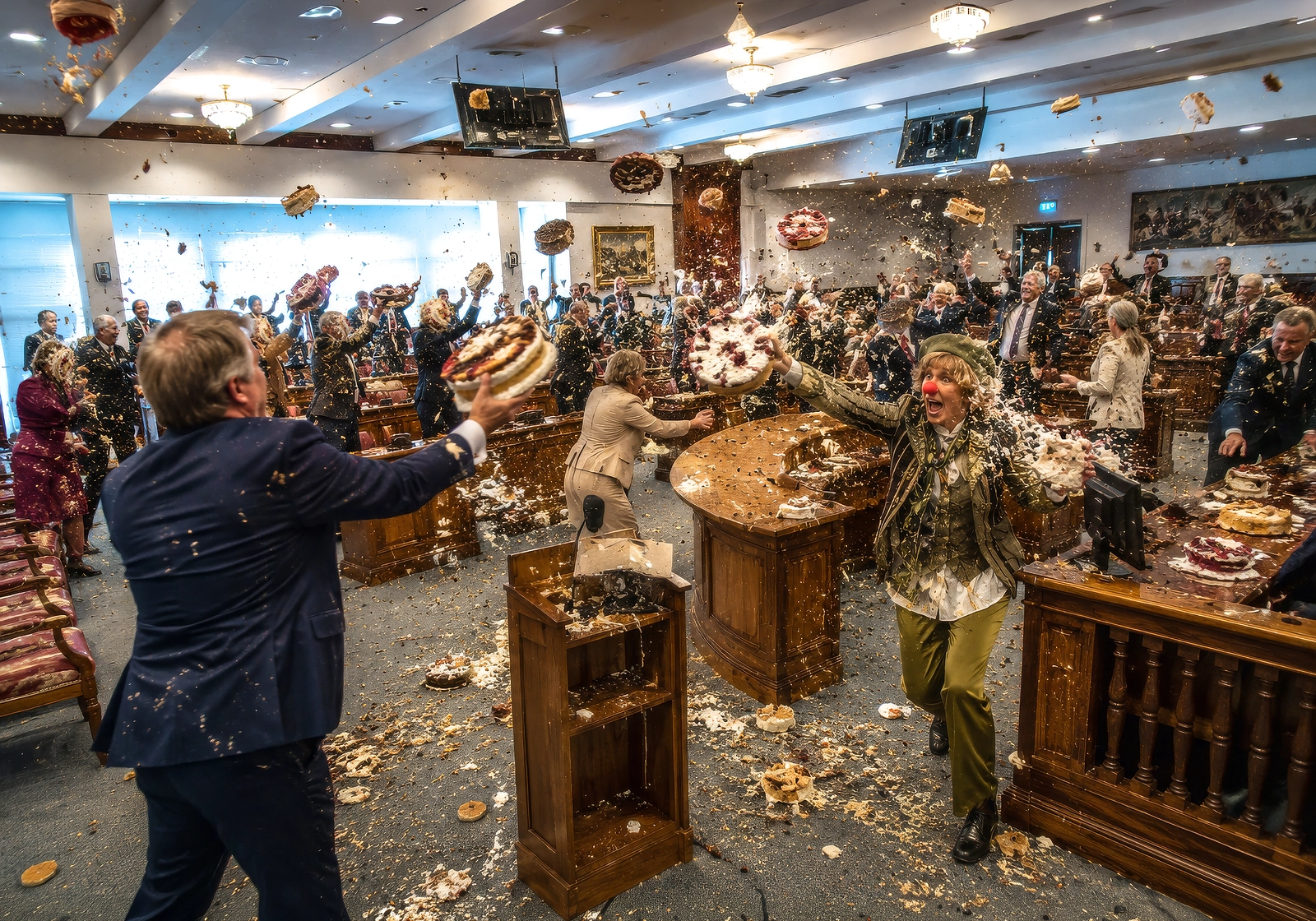
Jörgen Thornberg
Bedlam at the City Hall a political farce - Kalabalik i Rådhuset en politisk fars, 2026
Digital
70 x 50 cm
3 200 kr
Bedlam at the City Hall a political farce - Kalabalik i Rådhuset en politisk fars
Svensk text på slutet
Introduction
What happens when a thirty-five-year-old secret turns out to be sitting in the middle of the political assembly at Malmö City Hall?
In this fast-paced political farce, we enter a city where everyone seems to know something about everyone elseyet no one knows the whole truth. Over the course of a single council meeting, the corridors of power descend into a labyrinth of misunderstandings, slamming doors, hidden documents, secret love affairs and panic-stricken politicians willing to do almost anything to protect their carefully polished façades.
When a woman begins searching for her origins, she awakens a past that, according to many, should have remained buried forever. Long-forgotten romances, misplaced letters and an adoption dating back to the early 1990s suddenly force today's political leaders to question everything they thought they had under control. At the same time, a Green Party councillor frantically searches for his missing car keys, a Sweden Democrat sees conspiracies around every corner, a Social Democrat struggles to keep multiple identities from colliding, and an entire city council edges towards a spectacular collapse no one could have foreseen.
With warmth, satire and a keen eye for humanity's remarkable talent for complicating its own existence, this story reminds us that the greatest enemy is rarely a political opponent but the fear that the truth might finally come to light.
Behind every political party stands a human being.
And human beings are seldom as well organised as their party manifestos.
"Calabalik at City Hall
Once there was a Town Hall so grand,
Where no one quite followed the plan.
The Mayor said, "Order!"
They fled through each corridor,
While truth disappeared under the stand.
A councillor preached, with great pride,
"Let bicycles always be our guide!"
Yet hidden from sight,
On each moonless night,
His Cadillac waited outside.
A Liberal hid in a broom,
Convinced he was facing his doom.
A Moderate crawled,
Beneath tables appalled,
While curtains concealed all the gloom.
A Socialist whispered with grace,
Then vanished without leaving a trace.
A lover arrived,
The old guard dived,
Each hiding in somebody's place.
One teacher, composed to the core,
Knew less than the rest of the floor.
The rumours took flight,
From morning till night,
Though none knew what started the war.
A firebrand searched for a key,
A racist saw plots by decree.
One lost baby girl,
Set all heads in a whirl,
Without saying a word, naturally.
The Chairman kept pounding away,
"Proceed with the business today!"
But speeches grew thin,
As chaos rushed in,
And reason packed up for the day.
For politics, so we've been told,
Is noble, courageous and bold.
Yet scratch through the paint,
And every proud saint
Has secrets they pray won't unfold.
So here's to the grand masquerade,
Where reputations are made.
The parties may fight,
From morning till night,
But humans still wrote every grade.
And if, in some Town Hall one day,
You hear an old politician say,
"There must be some damn order in a party at war!"
Don't argue. Don't make a fuss.
Just check who's hiding behind the door...
It may be all of us.
Malmö, July 2026
Prologue There Must Be Some Damn Order...
On a cold winter's day in early 1992, a baby girl was born at Malmö General Hospital. To the staff, she was simply one of many newborns that day. She weighed just over three kilograms, had ten fingers and ten toes, and a remarkably powerful cry. Her mother held her for only a brief moment before, with a decision that would shape the rest of both their lives, signing the papers that made the child someone else's.
None of the people who, many years later, would gather in the council chamber of Malmö City Hall could have imagined that her birth would one day send shockwaves far beyond the maternity ward. During the previous summer, a young woman in the Möllevången district had lived a life in which politics, love, and dreams of the future blended in a way that seemed perfectly natural at the time but would later seem almost impossible to believe. When she disappeared from Malmö, she took the secret of the child's father with her. Perhaps she did not even know it herself.
The years passed. The little girl grew up unaware of her origins, while the men who had once been close to her mother carried on with their lives. They built political careers, won and lost elections, changed positions, and, like professional politicians everywhere, learned that the past is rarely something one speaks of voluntarily. The summer of 1991 slowly faded into a blurred memory that no one wanted to recall.
Thirty-five years later, those men have reached positions where they believe they are firmly in control of their lives. Their concerns are budgets, planning applications, climate zones, opinion polls and troublesome political opponents. Not one of them gives a single thought to the little girl who once left the hospital, with none of the possible fathers even knowing she existed.
Politics is said to be about vision, responsibility and wise decisions for the public good. It is, of course, a beautiful idea. But anyone who has spent time inside the walls of a city hall knows that reality is usually far more human. Ideals coexist with ambition, conviction with vanity, and great principles with small secrets. No one wants to be caught with the wrong person at the wrong moment, and no one wants old mistakes suddenly emerging from the archives, demanding answers. And no Green Party politician wants to be exposed as the owner of a gas-guzzling Chevrolet.
Above all, politics is about timing.
Because if a single door opens two seconds too early, if an envelope lands on the wrong desk, if a mobile phone chimes at the exact wrong moment, or if someone happens to witness something they were never meant to see, decades of carefully constructed façades can collapse faster than a municipal IT system after a software bug.
That is why an old letter can sometimes be more dangerous than a hundred political opponents combined.
This story unfolds over a single day at Malmö City Hall. No one arrives intending to lie any more than necessary. No one plans a scandal. No one plans a conspiracy. No one imagines that an ordinary council meeting will turn into a farce in which doors open and close faster than arguments can be made.
Yet that is precisely what happens.
As the curtain rises on this sunny day in May, each of the main characters believes their greatest concerns are the budget negotiations, climate zones, planning applications and the votes that lie ahead.
They are wrong. Very wrong. But they are not alone. The entire council is wrong, and the most spectacularly wrong among them is a thoroughbred racist.
Behind tailored suits, polished party manifestos and solemn speeches stand ordinary human beings with the same weaknesses as everyone else: love, jealousy, vanity, fear, and an almost superhuman determination never to be found out.
When everyone is trying to protect their own secrets at the same time, misunderstandings arise that no playwright would ever have dared to invent. And when the little girl born in 1992, without the slightest idea herself, suddenly becomes part of their lives again, a carefully balanced political house of cards begins to tremble in a way that leaves even the most seasoned politicians shaken.
Calabalik.
"There must be some damn order in a political party," declared the Swedish Communist leader C-H. Hermansson.
But no one had ever said there had to be order inside a City Hall until one of his own party comrades did so at Malmö City Hall in 2026.
PART ONE: THE EDUCATED SURFACE
Chapter 1: The Sun over Bellevue and the Western Harbour
The sun rising above Stortorget on that May morning in 2026 paid no heed to political manifestos. It cast the same soft pink, democratic light over the architect-designed passive houses of the Western Harbour and the mature, leafy gardens of old Bellevue. Dawn treated everyone equally. It was a perfect morning for a multicultural city.
In the villa on Krageholmsgatan in old Bellevue, Georg Lagercreutz stood before the bathroom mirror, tying his silk tie. He turned his head slightly to examine the result in profile. His straight, classical nosean inheritance from his family's Greek ancestrygave him the statesmanlike authority that Malmö's Moderate opposition would need for the afternoon's council meeting.
"Georg? You do remember we're having dinner with the consultant couple on Friday, my colleagues?"
Astrid's voice came from the hallway. She stood in the doorway, ready to leave for the hospital. She had always been careful to keep a professional distance between her career and her husband's political life. To Astrid, politics was background noise; medicine dealt with reality.
"Of course, darling. It's in my diary," Georg lied, smiling at his reflection.
Everything in his life was perfectly in order. He was a respected politician and leader of the Moderate opposition, with a successful wife. His twenty-six-year-old son Nicolas had not only secured a seat on Malmö City Council. He was already being tipped for a brilliant national career as chairman of the Young Moderates. The Lagercreutz family had become something of a conservative institution in Malmö.
A few kilometres away, in a climate-smart three-room apartment in the Western Harbour, Jan Pettersson stood on his balcony, gazing towards Turning Torso. He drew a deep breath of sea air and felt quietly satisfied to represent the Green Party's unquestioned moral compass at City Hall. Jan did not own a regular car. His morning routine was a carefully choreographed sequence of environmentally conscious choices: breakfast consisted of locally produced oats and biodynamically grown salad. Outside in the courtyard, his custom-built electric cargo bike stood, secured to the cycle rack with two heavy-duty locks.
As Jan wheeled the bike through the property's wrought-iron gate, he felt the respectful glances from his neighbours. He was the architect who had designed their climate-smart way of life. That afternoon he would step up to the lectern in City Hall and demand a complete ban on cars in the city centre. The fact that a key attached to a large enamel American flag was tucked away in his trouser pocket did not disturb the tranquillity of the morning. The key belonged to a barn in Lockarpto his dream, but also to his guilty conscience. Lockarp lay thirteen kilometres away, and at this moment Jan Pettersson was simply an environmentally conscious cyclist.
At the very moment Jan rolled onto the cycle path in the Western Harbour, a mobile phone chimed inside the Social Democratic offices on Kalendegatan. That was where Jan was heading, though the call had nothing to do with himeven if he would eventually become entangled in its consequences.
Sara Ekdahl, the city's thirty-four-year-old Deputy Mayor for Environment and Climate, picked up the phone from her desk. She was the brightest rising star of the red-green administrationcharismatic, quick-witted, and armed with a debating style that could make even the most seasoned Moderate politicians shrink in their seats. A message from an anonymous sender lit up the screen.
"Knut Hall. Ten minutes before the coffee break. I've brought the documents you requested."
Sara smiled, then quickly deleted the message.
She and Nicolas Lagercreutz were playing a dangerous game. A leading Social Democrat and the son of the opposition leader. If her colleagues discovered that she shared more than committee tables with the Moderates' golden boy during difficult budget negotiations, the debate over loyalty would tear the party offices apart. There were already whispers in the coffee room about security risks and information leaks.
But Sara Ekdahl had always navigated by her own compass. She absent-mindedly touched her nosethe same strikingly straight, classical profile that gave her an almost regal appearance at the lecternand slipped the phone into her handbag, on top of an official document she had printed that morning.
The world was rife with political conflicts, but on this May morning in Malmö, everything still seemed calm. The clock in the tower of St. Peter's Church had just struck eight as the city's civil servants and elected councillors arrived at the municipal offices on Kalendegatan.
Chapter 2: Masks and Tailored Suits
Sami Al-Hamra adjusted his glasses and ran his fingers over the neatly stacked piles of marked civics papers on his desk. It was approaching lunchtime at the upper secondary school, and City Hall awaited him that afternoon. For Sami, every day was an exercise in absolute self-control. Whether talking to his students or joking with colleagues in the staff room, he was exactly the man Malmö's Social Democrats needed: well educated, secular, and speaking flawless Scanian Swedish like a native. Sami was deeply rooted in the city's immigrant neighbourhoods.
Sami was born in Damascus, Syria, into a secular family with deep Jewish roots. The family name, Al-Hamra"the Red"was common among both Jews and Arabs in the region and helped them keep a low profile under the strict control of the Syrian regime. No religious holidays were celebrated at home, yet an awareness of their Jewish heritage remained, quietly hidden beneath the surface. When the civil war broke out, Sami was forced to flee. As an academic, he was particularly vulnerable. His journey eventually brought him to Sweden and to Malmö, mainly because it was the first major city on the other side of the bridge. Sami's asylum claim was based on his Jewish background, although the Swedish Migration Agency officially registered him as having no religious affiliation. That suited him perfectly, since he believed in no god, regardless of which holy book claimed otherwise.
Sami learned Swedish remarkably quickly and qualified for teacher training at Malmö University. The standard programme lasted five and a half years and included extensive academic study to qualify as a civics teacher.
Because he already held an academic degree from Syria, he needed only a supplementary teacher-training programme to obtain his Swedish teaching licence. He completed it in a single yearan impressive feat given his background. That was when the Social Democrats first noticed him. Sami had never been particularly political, but one does not turn down Sweden's largest political party casually.
After settling in Malmö, Sami quickly came to understand the city's complex social and political dynamics. To avoid the widespread antisemitism he encounteredbut above all to maximise his opportunities to integrate and build a careerhe made a purely pragmatic decision. As in Syria, he allowed those around him to assume he was Muslim. His first name, Sami, was the perfect bridge. To Swedes and secular Muslims, it sounded unmistakably Arabic, while to him it remained a shortened form of the Jewish name Samuel. He joined in the social life surrounding the major Muslim festivals, occasionally fasted during Ramadan simply for social reasons, and had learnt every cultural code and familiar expression by heart. His homosexuality, meanwhile, remained locked deep in the closet. Anything else would have been political suicide.
For Sami, religion had nothing to do with faith. It was about survival and influence. Having seen Assad and his executioners murder his family, he felt no remaining attachment to Jewish tradition. To Sami, there was no fundamental difference between Arabs and Jews; both were, by definition, Semitic peoples who had lived side by side for thousands of years. The differences were cultural, and although Islam had borrowed extensively from Judaism, both traditions belonged to the Abrahamic tradition and shared prophets and much else.
Joining the Social Democrats was therefore not merely an ideological choice; it was strategic. In Malmö, the Social Democrats remained the dominant political force, and active involvement in the party was the quickest route to genuine influence. Within its ranks, Sami had become a rising star. He embodied the ideal party member: highly educated, fluent in Swedish, with roots in a war-torn country and strong credibility across Malmö's immigrant neighbourhoods. His colleagues regarded him as a moderate, secular voice with deep ties to the city's Muslim communities. He used his platform to focus on education, integration and employmentissues that allowed him to avoid the political minefield of religious debate.
Sami lived in a permanent state of readiness. His life was both a political and a personal game of chess, in which a single mistake could destroy everything he had built. His greatest threat was Tobias "Tobbe" Bergqvist of the Sweden Democrats, who regarded Sami as his principal political rival. Through obsessive digging, Tobbe had uncovered hidden details of Sami's family history in Damascus. He knew Sami was concealing his Jewish background and was waiting for the right moment to bring his opponent down. Tobbe also suspected that Sami was gay, though he had no proof.
If Sami's Jewish background were exposed, it would not be his religion that destroyed him but the deception itself. He would be accused of political opportunism and misleading the electorate. Tobbe intended to use that revelation at the council meeting to prove that the Social Democrats' rising immigrant star was nothing more than a carefully staged performance. During the afternoon session, however, Tobbe's investigation would collide head-on with several other politicians' desperate attempts to hide a very different secret involving a woman they had all shared in the early 1990s, dragging an entirely innocent Sami into the very centre of the storm.
Whenever conflicts in the Middle East or questions of local antisemitism arose in Malmö City Council, Sami was forced to walk an impossibly fine line. The same was true of debates over LGBTQ issues. He had to speak in a way that satisfied both his party and his voters while privately wrestling with his own identity. Sami had erased his past to build a future. But the higher he climbed through the corridors of power, the closer the scrutiny from both the media and political opponents like Tobbe became of the past he had struggled so hard to escape. Tobbe was hardly a pleasant man, but every political party had its share of bastards, just as it also contained decent people. It was up to the voters to separate the wheat from the chaff. That, after all, is how democracy works.
Chapter 3: The Rumour from the Kockums Years
It was one o'clock in the afternoon when Torsten Värnebalk stepped into Georg Lagercreutz's office on Kalendegatan. The room exuded bourgeois security, with heavy mahogany bookshelves and Venetian blinds shutting out the harsh May sunlight. Georg sat behind his large desk, skimming the opposition's budget proposal, but looked up as soon as the door opened.
Torsten quietly closed the door behind him. As the Liberal Party's senior adviser, he always moved with understated, socially polished elegance, but today his movements carried tension. He placed a yellowed bundle of papers on Georg's deskan old, forgotten set of minutes from the Kockums Recreation Committee.
"Georg, do you remember the election campaign in the summer of 1991?" Torsten asked, taking a seat opposite him without waiting to be invited. His voice was low, almost a whisper.
Georg leaned back and frowned.
"Of course. That was the year we came to power. What's this about?"
"I heard a rumour last night," Torsten said, straightening as though trying to hide how hard his heart was beating. "She's dead. The woman from the commune in Möllevången. But the rumour is that she gave birth to a daughter in 1992, just before giving the child up for adoption and disappearing from Malmö forever."
Georg froze. The memory of his passionate, secret summer affair with the young woman from the political left cut through his usual statesmanlike composure. He had met her on neutral ground at Zoltan's Hungariathe Hungarian restaurant on Davidshallsgatanwhere they drank Tokaji and hid from their party colleagues. Georg had assumed she had grown tired of politics when she suddenly disappeared in August 1991. He had never heard that she might have been pregnant.
"It's probably just a rumour," Georg replied coolly, but his lawyer's mind was already calculating the months at furious speed. "She had plenty of friends back then, Torsten. Why are you telling me this?"
Torsten turned his gaze towards the window. Behind the façade of the pragmatic humanist lay sheer panic. He remembered the late nights when he had slipped into Möllevången after finishing work at the Kockums offices, deeply in love with the very same woman. He was already engaged to the woman who later became his wifea member of one of Malmö's most influential families. If the truth about his indiscretion ever emerged, his stable bourgeois marriage would be in danger. On top of that, he was one of the architects of the city's current political administration. If he harboured a biological secret involving one of the red-green politicians, Tobias Bergqvist and the Sweden Democrats would tear apart his life's work.
"I'm telling you because I'm doing the same calculation you're doing right now," Torsten said quietly, looking Georg straight in the eye. "Neither of us knew anything in August 1991. But if the child was born in early 1992... either of us could be the father. And I doubt you're any more interested than I am in becoming a father retroactively."
Chapter 4: The Profile on the Floor
Before Georg could respond to Torsten's words, a firm knock came at the door. Torsten straightened at once, and Georg lowered his eyes to his budget papers again. When the door opened, Sara Ekdahl stepped into the office. Her stride was light yet purposeful, and she carried a thick folder under her arm.
"Sorry to interrupt the opposition at work, Georg," Sara said with the confident smile that had made her the Social Democrats' brightest rising star. "I just need to check one detail about the environmental budget and the climate zones before this afternoon's council meeting."
She stepped into the room and turned slightly to point to a line in her document. At that very moment, the May sun streamed through the window, and in the backlight, Sara's face became a razor-sharp silhouette against the dark bookshelves.
Georg Lagercreutz stopped breathing. It was as if all the oxygen in the room had suddenly disappeared. In the brilliant light, Sara's profile stood out. It was a perfect, regal profile, dominated by a straight, classical nose. It was the same nose that Georg himself had examined in the bathroom mirror in Bellevue only a few hours earlierthe same distinctive feature inherited from his own Greek ancestry. He turned his gaze towards Torsten, whose eyes had widened and whose face had turned ashen. Torsten, too, was staring at Sara's profile, though his attention was more on her forehead.
Sara noticed nothing. She pulled a document from the folder, but as she moved, her handbag slipped off her shoulder. It fell to the floor, and a folded sheet of paper slid out.
"Oh, I'm sorry," Sara said, quickly picking up her handbag without noticing the paper that had slipped under the bookcase. "I'll bring the environmental briefing to the council chamber instead, and we can go through it at the break. See you there at five." She nodded briefly, turned on her heel and left the office.
Georg picked up the paper from the floor. He had expected to see a table of carbon emissions or a printout on the environmental budget. But the official crest at the top of the page told a very different story. It bore the emblem of the Social Welfare Committee.
"Application for Access to Records: File Concerning Biological Maternity, Malmö 1992," he read aloud so Torsten could follow. Georg's legal mind raced. The dates matched exactly. Sara had requested access to the confidential child welfare file to trace the woman from the commune in Möllevångenthe very woman with whom he had had an intense, secret affair during the 1991 election campaign. Sara was only an administrative decision away from destroying his entire existence, assuming, of course, that he was her father.
He looked up at Torsten.
"Torsten," Georg whispered, his voice suddenly sounding old and fragile. "My son Nicolas... he's dating Sara. They're in love."
Torsten stepped back and covered his mouth. If Georg was the father, Nicolas and Sara were, in fact, biological half-siblings. It was a moral catastrophe, a biological taboo that would trigger a monumental public scandal and destroy the Lagercreutz family forever.
"We have to stop this," Georg said, his eyes suddenly hard with sheer desperation. "We have to stop the truth from coming out and keep Nicolas away from her before it's too late."
PART TWO: THE INTERNAL LOGISTICS
Chapter 5: Planning Permission and Biological Mothers
Before Georg and Torsten had even managed to devise a concrete strategy to conceal the adoption records, the office door flew open with a bang. Both men flinched. In sheer panic, Georg shoved the City Archives papers beneath a heavy pile of budget documents on his desk.
Standing in the doorway was a young woman with dark hair, wearing a fitted dark red blazer. She was breathing heavily, her eyes flashing with frustration, and under her arm she carried a thick roll of architectural drawings. She introduced herself as Elena Popescu. She stepped firmly into the room, slammed the door behind her, and fixed Georg with an accusing stare.
Georg and Torsten exchanged a look of utter panic. By then, their adoption crisis had robbed them of all sense of reason and logic. Before them stood a young foreign woman, angry and demanding. At that moment, only one explanation seemed remotely possible: the dark secret from the summer of 1991 had suddenly materialised and sent an emissary to confrontor blackmailthem before the evening's meeting.
"Enough is enough!" Elena burst out in fluent Swedish with a slight accent. "I've been sent from one office to another in this building for over an hour. Nobody takes responsibility; everyone points me towards the next corridor, and time is running out for my business. We have to sort this out right now!"
Georg rose from behind his desk. Beads of sweat appeared on his forehead as he raised both hands in a calming, deeply defensive gesture.
"Please... lower your voice," Georg hissed desperately, stepping quickly around the desk to block the door so no one in the corridor could overhear them. "We can settle this discreetly, I promise. There is absolutely no need to make a public scene about what happened. Just tell me what you want. How much financial compensation are you asking for to keep quiet about what took place in Möllevången in the summer of 1991?"
Elena stepped back and stared at the leader of the opposition as though he had completely lost his mind. She frowned in utter bewilderment and raised the roll of drawings in front of her like a weapon.
"What on earth are you talking about?" Elena snapped. "1991?! I was minus eleven years old! My parents hadn't even met yet, let alone moved here! I don't want your money! I want my planning permission for the restaurant on Bergsgatan! Tobias Bergqvist from the Sweden Democrats told me to go to the door just before the coffee room to get the final signature, but instead I found two crazy old men sitting here, sweating!"
Torsten, pressed against the mahogany bookcase and holding his breath, suddenly let it out in a long, shaky sigh. He looked at Elena's angry young face and realised the monumental misunderstanding. She was a twenty-four-year-old entrepreneur with an administrative problem, not a ghost from the past.
But before Georg could apologise or explain the absurd misunderstanding, heavy footsteps echoed down the corridor from Kalendegatan. Tobias Bergqvist was coming in search of his planning-permission client, and the farce inside the new City Hall complex had just stepped up a gear.
PART TWO: THE INTERNAL LOGISTICS
Chapter 5: Planning Permission and Biological Mothers
Before Georg and Torsten had even managed to devise a concrete strategy to conceal the adoption records, the office door flew open with a bang. Both men flinched. In sheer panic, Georg shoved the City Archives papers beneath a heavy pile of budget documents on his desk.
Standing in the doorway was a young woman with dark hair, wearing a fitted dark red blazer. She was breathing heavily, her eyes flashing with frustration, and under her arm she carried a thick roll of architectural drawings. She introduced herself as Elena Popescu. She stepped firmly into the room, slammed the door behind her, and fixed Georg with an accusing stare.
Georg and Torsten exchanged a look of utter panic. By then, their adoption crisis had robbed them of all sense of reason and logic. Before them stood a young foreign woman, angry and demanding. At that moment, only one explanation seemed remotely possible: the dark secret from the summer of 1991 had suddenly materialised and sent an emissary to confrontor blackmailthem before the evening's meeting.
"Enough is enough!" Elena burst out in fluent Swedish with a slight accent. "I've been sent from one office to another in this building for over an hour. Nobody takes responsibility; everyone points me towards the next corridor, and time is running out for my business. We have to sort this out right now!"
Georg rose from behind his desk. Beads of sweat appeared on his forehead as he raised both hands in a calming, deeply defensive gesture.
"Please... lower your voice," Georg hissed desperately, stepping quickly around the desk to block the door so no one in the corridor could overhear them. "We can settle this discreetly, I promise. There is absolutely no need to make a public scene about what happened. Just tell me what you want. How much financial compensation are you asking for to keep quiet about what took place in Möllevången in the summer of 1991?"
Elena stepped back and stared at the leader of the opposition as though he had completely lost his mind. She frowned in utter bewilderment and raised the roll of drawings in front of her like a weapon.
"What on earth are you talking about?" Elena snapped. "1991?! I was minus eleven years old! My parents hadn't even met yet, let alone moved here! I don't want your money! I want my planning permission for the restaurant on Bergsgatan! Tobias Bergqvist from the Sweden Democrats told me to go to the door just before the coffee room to get the final signature, but instead I found two crazy old men sitting here, sweating!"
Torsten, pressed against the mahogany bookcase and holding his breath, suddenly let it out in a long, shaky sigh. He looked at Elena's angry young face and realised the monumental misunderstanding. She was a twenty-four-year-old entrepreneur with an administrative problem, not a ghost from the past.
But before Georg could apologise or explain the absurd misunderstanding, heavy footsteps echoed down the corridor from Kalendegatan. Tobias Bergqvist was coming in search of his planning-permission client, and the farce inside the new City Hall complex had just stepped up a gear.
Chapter 6: Sabotage on Three Fronts
The doors along the corridor flew open and shut in a pattern that would have impressed any stage manager. Torsten grabbed Georg firmly by the arm and pulled him into the smaller adjoining meeting room before Elena could leave the office. Torsten closed the door, leaned back against the frame, took a deep breath, and let out a long sigh.
"Georg, did you see Sara's forehead?" Torsten whispered, his voice trembling. "What if those aren't your Greek genes? What if I'm the father?" Torsten instinctively touched his forehead.
Georg stared in astonishment at his Liberal colleague. Before he could reply, voices echoed through the corridor, accompanied by hurried footsteps and the sound of doors opening and closing. The machinery of the farce had begun, and within moments the corridors of City Hall had become a logistical puzzle of closed doors and hidden intentions.
Nicolas had just slipped away from the Moderate Party offices, a red rose hidden beneath his dark blue jacket. He was anxiously searching for Sara, determined to steal a kiss before the formal meeting began. He reached for the handle of the photocopy room door, unaware that Sara had locked herself inside. She was pressed against the large laser printer to avoid her suspicious party colleagues, who were whispering in the coffee room about conflicts of loyalty and the risk of information leaking to the opposition during the ongoing budget negotiations.
"Nothing can be kept secret in this building," Sara thought.
Georg, having recognised his son's voice in the corridor, was seized by sudden panic. He opened the meeting-room door a crack, grabbed Torsten and shoved him into the small cleaning cupboard opposite the desk, so the Liberal would not be seen if Nicolas or Sara appeared.
"Stay there and don't move," Georg hissed, slamming the cupboard door shut just as Sami Al-Hamra stepped out of the coffee room, carrying a steaming cup of coffee.
Sami stopped and looked at Georg with a polite, questioning smile. As the conscientious schoolteacher he was, he tried to get through the day without drawing attention to his hidden past. But at that exact moment, the worn lock on the cleaning cupboard gave way. The door burst open, and Torsten Värnebalk, holding a mop, tumbled backwards into the corridor and landed flat on the floor at Sami's feet.
Farther down the corridor, hidden behind a pillar, stood Tobias Bergqvist. His mobile phone camera was already raised. Tobbe, who had been shadowing Sami in search of political dirt linked to his Syrian background, zoomed in on the scene in utter amazement. Tobbe, who always played the role of the tolerant, nuanced reformer from the council lectern, felt his deeply suppressed hatred surge through him with renewed energy.
He saw the Liberal adviser lying on the floor, the panic in the opposition leader's eyes, and the Social Democratic immigrant Sami standing in the very middle of it all. Tobbe smiled a broad, triumphant smile. He understood nothing, but his tactical chess-player's mind immediately concluded that he had just filmed proof of a secret cross-party conspiracy.
In the midst of this carefully controlled chaos, the lift doors by the reception opened. Simon Andersson stepped onto the floor, walking heavily, a dusty moving box clutched tightly against his stomach. The old shipyard welder had just come from school, carrying the commune's old letters and notes from the 1990s. Irritated, he was looking for an empty committee room. He headed towards the first open door he saw, completely unaware that he was about to set down the ticking time bomb that would plunge the confusion into chaos.
Chapter 7: The Moving Box in the Wrong Room
Simon Andersson muttered to himself as he balanced the heavy moving box in the corridor. His back ached after a long day at the upper secondary school, and the thought of spending the evening in the council chamber, listening to bourgeois platitudes, did nothing to improve his mood. He was looking for the Left Party's temporary committee room, but the identical doors and anonymous signs in the courthouse complex left him confused.
He pushed open a door with his elbow, stepped into an empty, cool meeting room, and placed the box on the polished oak table with a heavy thud. Simon let out a sigh of relief, wiped his forehead, and turned on his heel to fetch a much-needed cup of black coffee from the coffee room. It never occurred to him that he had just left his most private documents from the 1990s in the Moderates' committee room.
A minute after Simon had left the room, Georg and Torsten slipped through the same door to escape Tobias Bergqvist's watchful gaze in the corridor. Georg locked the door behind him and drew a deep breath.
"Saved by the bell," he joked.
"What's that? Are you moving?" Torsten asked, pointing at the box.
Georg took a few cautious steps forward and examined the worn cardboard box. It had not been there a moment earlier. Of that, he was certain.
Written along the side in large black letters were the words: The Möllevången Commune 19911993. Georg's heart somersaulted in his chest. He stretched out a trembling hand and lifted the lid. On top lay old political leaflets, worn notebooks, and several handwritten letters addressed to Simon Andersson.
"My God, it's Simon's box," Georg whispered, leafing frantically through the papers. "Is that old devil involved in this as well? If he's kept all this for thirty-five years, he must be trying to work out the truth too!"
Torsten moved up beside Georg, driven by his own fear that his respectable family life and stable marriage might be wiped away. His eyes fell on a yellowed envelope, stamped and postmarked October 1991. He snatched it up and began reading the elegant handwriting on the back. It was addressed to Simon Andersson. He had the strange feeling he had seen the handwriting before, but he could not place it. His first impulse was to tear open the envelope to see whether its contents had anything to do with the nightmare they were facing. But he could not open Simon's private letter. No well-brought-up Liberal would do such a thing. Or could he make just this one exception? Before he had finished arguing with his conscience, he heard the sound of metal-tipped heels approaching.
Sixty metres farther down the long corridor towards the underground passage, Simon Andersson was walking back with his cup of coffee. He stopped when he heard a familiar voice from the Social Democratic offices. It was Sara Ekdahl, delivering a passionate, impromptu speech to her colleagues on the importance of never compromising the rights of the working class in environmental policy. She was rehearsing for the evening.
Simon froze, his coffee cup halfway to his mouth. The words she used, the rhythm of her voice, and her intense, uncompromising tone struck him like a blow to the stomach. It was like hearing an echo of his own speeches on the shop floor at the Kockums shipyard in the early 1990s: a woman's voice, yet his words.
The penny dropped, and Simon began counting backwards in his head. Could it really be?... The thought slowly took shape.
"She disappeared in August 1991... The girl was born in early 1992... Sara is thirty-four now..."
A wave of ideological and social shame swept over the old shipyard welder. If it were ever revealed that hethe Left Party's uncompromising proletarianwas the biological father of the Social Democrats' highest-paid deputy mayor, his life's work and credibility would vanish in an instant. His party comrades would brand him a hypocrite who had fathered a champagne socialist. Simon slammed his coffee cup down on a windowsill so hard that coffee splashed over the edge. He turned on his heel, determined to empty his moving box and destroy every trace of the 1990s before anyone else could put the pieces together.
Chapter 8: Car Keys and Hidden V8 Engines
Jan Pettersson stood in front of the coffee machine, nervously drumming his fingers on the plastic cup. The budget negotiations within the red-green coalition were intense, but it was not the political compromises that made the Green Party's foremost moral compass break into a sweat. It was something far heavier in his pocket. He pulled out his handkerchief to wipe his forehead, and in the same movement, his car key slipped from his trouser pocket and landed on a discarded paper towel on the linoleum floor of the coffee room.
Jan noticed nothing. Fuelled by caffeine and stress, he hurried out of the room, coffee in hand, determined to finish preparing his speech on car-free city centres before the clock struck five.
A moment later, Sami Al-Hamra entered the coffee room and spotted the key. He bent down and picked it up. It was decorated with a large enamel American flag and a badge reading Cadillac Eldorado V8. Sami frowned. He sensed that one of his colleagues at City Hall was keeping a secret. He slipped the key into his jacket pocket, intending to find its owner at the next break.
Jan Pettersson, who had just realised his mistake in the corridor, turned back to retrieve the key. He stopped dead in the doorway of the coffee room, all the blood draining from his face. Through the glass panel in the door, he watched Sami Al-Hamra weigh the bright red Cadillac key in his hand before slipping it into his jacket pocket.
Jan's ecological world collapsed. If Samihis closest political allydiscovered that the Green Party's loudest cycling enthusiast secretly chaired Malmö's most fuel-hungry classic car club and kept a luxury car hidden in a barn in Lockarp, Jan's career would be over. Instinctively, Jan pulled his cap lower over his face, backed into the corridor and took cover behind a large pillar. His heart pounding, he began to spy on Sami's every move, waiting for an opportunity to sneak up behind him and steal the key back from his jacket pocket.
Jan did not realise he was being watched. Three metres farther down the corridor, Tobias Bergqvist stood concealed behind a photocopier. Tobbe zoomed in on Jan with his mobile phone camera, fascinated by the Green politician's bizarre behaviour. Through his contacts in the construction industry, Tobbe had already heard rumours about the anonymous barn in Lockarp, and he was merely waiting for the perfect moment to thrust a photograph of the V8 monster into Jan's face during a council debate.
By now, the mechanics of the farce had become so intricate that no one in the corridor saw reality for what it was. Jan was spying on Sami to save his car; Tobbe was spying on Jan to bring down the Green Party; around the corner, Georg and Torsten were still running about in a panic over the adoption; Sara was hiding from Nicolas, who was looking for his father to tell him a secret; and Simon was doing everything he could to stop a cross-party conspiracy.
All it would take was for Sami to step out into the corridor for the whole carousel to come crashing down.
Chapter 9: The Corridor Junction
Sami Al-Hamra took a deep breath, smoothed his navy-blue jacket, and stepped out of the coffee room, completely unaware that he was walking straight into the logistical hub of total corridor chaos. With the heavy Cadillac key resting in his right-hand pocket, he made his way towards the point where the corridors met on Kalendegatan.
At that very moment, the door to the locked meeting room burst open. Georg Lagercreutz and Torsten Värnebalk came flying out like two jack-in-the-boxes, pale-faced and carrying Simon's letters from the 1990s, hidden in two thick folders. They came to an abrupt halt when they collided with Sami.
"Sami," Georg exclaimed, trying to mask his panic with a sharp, statesmanlike voice. "Have you seen my son Nicolas? He must report to the Moderate Party office immediately. There's an urgent assignment for him elsewhere in the city!"
Before Sami could answer, Jan Pettersson emerged from behind a pillar. Moving stealthily, he kept his eyes fixed on Sami's jacket pocket. He took two quick steps forward, but suddenly lost his nerve when he met the gaze of the two elderly bourgeois gentlemen. Instead, Jan instinctively dived through the nearest open doorwhich happened to be the narrow cleaning cupboardand slammed it shut behind him.
"What on earth is the Green Party up to?" Torsten whispered, staring at the closed cupboard door as his thoughts swung wildly between the terror of fatherhood and the fear that his respectable bourgeois wife might discover the girl from the Möllevången commune.
From the opposite end of the corridor came Simon Andersson, striding forward with quick, heavy steps. He was looking for his moving box when he saw Georg and Torsten standing close together, whispering about Sami. He immediately concluded that the class enemy was conspiring against his secret past. Simon walked straight into the circle, slapped his fist into his open palm, and fixed Georg with a dark stare.
"You keep your bloody hands off what doesn't belong to you, you damned bourgeois bastards!" Simon thundered, his thoughts consumed by the unbearable idea that his own flesh and blood was wearing the Social Democrats' party badge.
Sami Al-Hamra stood at the junction of the corridor, looking like one enormous question mark. He looked at Simon shouting, at Georg and Torsten sweating over their folders, and heard a faint, desperate scratching from inside the cleaning cupboard, where Jan Pettersson was trapped. Sami instinctively stepped back, utterly confused.
Farther down the corridor, completely hidden behind the same photocopier as before, Tobias Bergqvist filmed everything. Tobbe, whose racial prejudice was barely concealed beneath his public role as a tolerant campaigner for integration, zoomed in on Sami's bewildered face, surrounded by leading politicians from the Moderates, Liberals and the Left Party. Tobbe's hateful mind had now assembled the pieces into a truth entirely of its own: Sami Al-Hamra was leading a secret cross-party conspiracy to sell out Malmö's security. A conspiracy that had to be reported to the Swedish Security Service immediately.
The clock on the wall read 4:45 p.m.
Fifteen minutes were remaining before the meeting began.
"We have to break this off," Georg said abruptly, glancing at the clock and recoiling at the thought of Nicolas and Sara's incestuous relationship. "The council meeting starts in fifteen minutes. We'll have to move to the old City Hall."
The group moved in suspicious silence towards the heavy door leading to the underground passage linking the new complex to the historic City Hall's council chamber. The farce on Kalendegatan was over, but beneath the crystal chandeliers on Stortorget, complete pandemonium was poised to erupt before a live audience.
PART THREE: PANDEMONIUM IN THE COUNCIL CHAMBER
Chapter 10: Beneath the Council Table
The underground passage led the politicians straight into the historic vaulted basement of the old City Hall. They climbed the worn stone staircase and entered the great council chamber overlooking Stortorget, where heavy oak doors and oil portraits of long-dead politicians lined one wall. At the same time, sparkling crystal chandeliers cast a newly restored glow against the worn corridors of the old courthouse complex. The clock struck exactly 5:00 p.m. as the Chair of the Council, Carina Nilsson, brought down her gavel and declared the May meeting open.
During the first hour, the group remained pinned to their seats, but not one of them heard a single word of the formal reports. Georg stared anxiously across the chamber towards the Social Democratic benches, where Sara Ekdahl sat in profile, displaying that unmistakably straight Greek nose. Torsten Värnebalk nervously twisted his wedding ring and avoided looking towards the public gallery. At the same time, Simon Andersson sat with his arms tightly folded across his chest, staring at his recovered moving box, which he had managed to place beneath the empty bench beside him. In the middle of the chamber sat Sami Al-Hamra, still carrying the Cadillac key in his jacket pocket. Tobias Bergqvist of the Sweden Democrats leafed through the photographs on his mobile phone, a calculating smile on his face.
When the Chair announced a short adjournment for coffee, the pent-up energy in the chamber erupted.
Nicolas Lagercreutz glanced towards his father and seized the chance to slip out through the side door towards Knut Hall. The red rose was still hidden beneath his jacket. He caught sight of Sara heading towards the coffee table and gently took hold of her arm.
"Sara," Nicolas whispered, drawing her into the dark, empty County Council Chamber next door. "We have to talk. My father is behaving completely irrationally today. He tried to send me on a made-up assignment to Oxie. I got the impression he wanted to keep me away, though I have no idea from what. Come on, let's sneak down to the City Hall Cellar instead. None of our political brothers and sisters will see us there."
Sara laughed quietly, though she, too, was tense.
Only a few seconds after the young lovers had closed the door behind them, Georg and Torsten slipped into the same room, half-crazed with panic about the adoption. They could hear Nicolas and Sara whispering from deeper within the darkened chamber. Driven by the absolute terror that his son might unknowingly commit incest, Georg completely lost his statesmanlike dignity.
"They'll see us!" Torsten hissed, panicked.
"Quickover here!" Georg whispered.
Without thinking, the two elderly bourgeois gentlementhe Moderate Party's leader of the opposition and the Liberal Party's most respected senior adviserdropped to their knees. They crawled at full speed beneath the magnificent long oak council table and drew the heavy red velvet curtains that hung to the floor around them. There they lay, pressed tightly together beneath the table, panting in desperation, Georg horrified that he had been reduced to spying on his own son to prevent a biological taboo.
"Nicolas, we can't be seen together during the budget debate. My Social Democratic colleagues believe I'm leaking information to you. People are already whispering about us in the corridors."
They parted company. Sara returned to the coffee break, while Nicolas went back to the council chamber. The red rose remained tucked in his jacket as he closed the door behind him.
Torsten and Georg heard the whispered conversation end and prepared to step out of their uncomfortable hiding place.
At that very moment, the door opened once more.
It was Jan Pettersson of the Green Party, slipping quietly into the room, desperately searching for Sami Al-Hamra to steal back his car keys. Jan, who publicly cultivated the image of an ecological role model, was so obsessed with the secret of the bright red Cadillac that he failed to notice the curtains beneath the table moving. Instead, he hid behind one of the grand window drapes, ready to pounce the moment Sami appeared.
The chaos within the historic rooms of City Hall was now complete. No one knew who was hiding from whomor why. The doors to Knut Hall and the staircases opened and closed in rapid succession. Beneath the heavy oak table, Georg suddenly realised he had dropped the City Archives' adoption papers onto the floor just outside the curtaindirectly in front of the feet of someone who had just entered the room with brisk, purposeful steps.
Tobias Bergqvist.
The Sweden Democrat was easy to recognise even from such a low angle. His black-and-white spectator shoes were unmistakable. In gangster and mafia films, they often signalled elegance, wealth and swagger. Quite what they had to do with his nationalist political convictions, nobody had ever dared ask. He nudged the envelope with one shoe, bent down to pick it up, and quietly left the room.
Georg, thoroughly shaken, did the same, with Torsten close behind. Recovering the missing envelope would have to wait. It was time to return to the council meeting.
PART THREE: PANDEMONIUM IN THE COUNCIL CHAMBER
Chapter 11: The Performance Begins to Crack
The Chair of the Council, Carina Nilsson, struck her gavel with a sharp crack that made the crystal chandeliers in the council chamber tremble. The recess was over. The councillors streamed back to their seats, wiping the sweat from their foreheads after the chaotic quarter of an hour behind the scenes at City Hall. Georg Lagercreutz sat bolt upright, but there was a hunted look in his eyes; the City Archives' adoption papers had vanished without a trace beneath the council table in the County Council Chamber. Sami did what he always did: he secretly marked his pupils' exams. It was his way of making the long, tedious speeches from politicians of every colour pass more quickly.
"Next, we have the question submitted by Jan Pettersson of the Green Party to Andréas Schönström, Chair of the Technical Committee and a Social Democrat, concerning a total ban on cars in the city centre," Carina Nilsson began. She looked as though she already knew what was coming, for Green Party politicians were predictable; whatever they were about to say could already be found in their party manifesto, regardless of what had happened. "Andréas is already at the lectern, so that we may begin," she continued. "The rules are that the person answering has two minutes, the questioner has one minute for a reply, followed by one minute each. The floor is yours, Andréas Schönström."
"Thank you. As you heard, I have received a question from Jan Pettersson of the Green Party about whether the governing coalition intends to introduce a total ban on motor traffic in the city centre. Making it more difficult to get around and removing unnecessary traffic in Malmö are priorities we are continuously pursuing. This applies to the municipality's own activities and to everyone else who comes into contact with road traffic in Malmö. In the 2026 budget, this work has been given special priority. At present, a cross-departmental programme is underway to reduce access to Malmö's streets and make it slower and more difficult to enter the municipality by car. We have already ensured that extensive road closures and diversions are in place around the city's outskirts. At the latest meeting of the Executive Committee, we allocated another 2.5 million kronor to continue this important work."
"We have already made it more difficult for cars to enter from neighbouring municipalities. For example, a carefully designed diversion from Svedala ensures that motorists end up driving back there instead. I would also like to point out that we have the full support of businesses in the surrounding municipalities for these measures."
"Our slogan, *'Stay where you arewe don't want you here,'* has been a remarkable success. We have also tried to introduce new obstacles to replace the old ones, ensuring we remain focused. You proposed the donkey initiative, and the Executive Committee unanimously referred it for further consideration, so the donkey issue remains under review. Personally, however, I am very positive about adopting the model used on the Greek island of Hydra, where donkeys handle all transport. It would also have the beneficial side effect of reducing the need to import artificial fertiliser into Skåne's agriculture."
"What I want to demonstrate is that substantial work is already underway. Together, we need to intensify our efforts to make life even harder for motorists."
"Jan Pettersson, the Green Party's spokesperson on transport."
"Thank you, Madam Chair. Distinguished councillors, members of the publicand above allthe people of Malmö. Earlier in this debate, we were presented with statistics showing that car traffic in our city centre is decreasing while bicycle traffic is increasing. That is a wonderful development. But we in the Green Party refuse to stop there. We must dare to look ahead, lift our gaze beyond Malmö's horizon, and draw inspiration from places that have truly taken the final step."
"Let us turn our eyes to the Greek island of Hydra, with a permanent population of only a few thousand that swells in summer. The island's politicians made a courageous decision. All cars, motorcycles and mopeds are completely prohibited. There are no exhaust fumes poisoning children's lungs, no constant traffic noise stressing residents, and no rows of parked metal monsters stealing valuable public space. Hydra has shown that a society can function, flourish and prosper without a single fossil-fuelled vehicle on its streets. They travel by healthy walks, boatsand Albanians. The imported labour force carries everything the donkeys cannot, such as a grand piano. Carrying their own groceries has left the island's elderly in far better physical condition than their counterparts in Malmö. Even local businesses benefit. Cobblers and shoe shops are thriving."
"Now I imagine the Chair of the Technical Committee, Andréas Schönström, is thinking: *'Come now, Jan Pettersson, surely we can't replace the city buses on Amiralsgatan with donkeys and horses?'*"
'No, of course not. Malmö is not a Greek island, and we are not trying to drag history all the way back to the Stone Ageonly halfway. The lesson from Hydra is not about four-legged animals, but the principle that the city belongs to people, not to cars. There are compromises. The people of Malmö need to learn to be patient, as the early environmentalist Edvard Persson sang in the 1930s. Then Tram Line 3 could regain its former glory, circling the city centre once again on newly laid rails pulled by donkeys. The difference in journey time would be negligible, and there are so many beautiful buildings to admire along the way. Malmö is a beautiful city and well worth visiting. If you're in a hurry, take a bicycle. In a car-free city centre, the journey from Västra Hamnen to Triangeln takes only twelve minutes at a leisurely pace. Sprinting takes less than ten minutes, which is still considerably faster than today's buses.'
"If an entire island can reorganise its logistics, transport building materials and move its inhabitants without a single private vehicle, then Malmö can certainly do far more than we do today. We already have an ever-growing number of cyclists, and we continue to expand the Malmö Express bus network."
"What we lack is the political courage to put our foot down. We need Malmö's Technical Committee to dare to make decisions that genuinely challenge our dependence on cars. Let us remove cars from the city centre once and for all. Let us return the streets to cafés, playgrounds and trees, creating a paradise for dogs seeking a convenient place to relieve themselves. Let us make Malmö the Hydra of Northern Europea modern, green and vibrant city where people always come first."
"Thank you."
"We have added a great many policy documents governing traffic in the city centre to ensure that the laws and regulations already in force are not too easy to understand. We have produced municipal guidelines based on the existing conditions. Long-term deterioration of accessibility often requires a continuous stream of political decisions and careful balancing, all intended to achieve an even greater reduction in accessibility for motorists in the city centre. Naturally, whenever unnecessary bureaucracy is expanded, it must be continuously reviewed. Drivers who experience frustration must become even more frustrated."
"Not a single concrete example of an increase in the number of donkeysapart from those already sitting on the Executive Committee. That was about what one expected. During your time as Chair of the Technical Committee, Malmö has dropped 133 places in the Swedish Enterprise business rankingthe worst results concern bureaucracy and public service. Malmö ranks dead last. But it ought to be even worse if the Green Party had its way. A growing business sector harms the environment and increases demand for cars. The conclusion is obvious: keep Malmö clean and send dirty industries across the bridge."
"You mentioned that the Executive Committee unanimously referred our proposal for further consideration, but you omitted that the Social Democrats on the Executive Committee rejected it as recently as Monday and have no interest in reviewing the burden. Sometimes regulations discourage rather than encourage. They force people to waste time and money instead of hiring more staff."
"Andréas Schönström has the final reply."
"Thank you. I wish to note that work is already underway to further restrict access. Over the past few years, we have launched extensive roadworks, widened pavements at the expense of traffic lanes, expanded traffic islands, converted driving lanes into bus lanes, and ensured that ongoing road closures affecting motorists have been given the highest priority."
"Requests from developers for temporary lane closures are processed as a priority, and decisions are made well in advance. The coordinator position for the city's ongoing construction projects was abolished at the start of this council term. The resulting building chaos is entirely my own achievement."
"We continue to make policy documents even less transparent by constantly increasing their level of detail and ensuring that new ones are introduced as older ones expire. What you forgetand something we have often discussedis that during my time as Chair, traffic volumes in Malmö's central districts have shown a clear downward trend."
"Our reduction is considerably greater than in Stockholm or Gothenburg, for example. We have successfully turned this issue into a problem for our neighbouring municipalities, thereby creating many new jobs for them. Listening to you, one would think the municipality never does anything right. My own view is that we still have much work ahead of us. Efforts are ongoing to provide poorer service and even worse customer treatment. We are working systematically to exclude even more land from car use, convert car parks into community activity centres, and make room for more bicycle racks and wider pedestrian crossings. But reality must be described as it isnot simply by demanding more prohibitions. We are already doing everything we can to make traffic more difficult. Rest assured! The day will come when your donkeys are truly needed. The donkey stables already form part of the municipality's long-term planning."
"Can we consider the question answered? Yes, the answer is yes."
"We now move to the next speaker, Tobias Bergqvist of the Left Party, speaking under 'Any Other Business' at his own request. Please come to the lectern," Carina Nilsson said, without sounding particularly welcoming. Carina tried to conceal her lack of affection for Left Party politicians who pretended they no longer belonged to the party once known as the Communists, even though, in her own mind, they were still Stalinists by definition. She wrestled with much the same inner conflict when it came to the Sweden Democrats, many of whom she believed still harboured brown opinions while doing everything possible to hide them.
Tobbe knew perfectly well where he stood with Carina, but he did not care. He had more pressing matters to attend to. He would deal with her as soon as he had wiped out her party. Tobias Bergqvist stepped up to the lectern. He smoothed his grey suit and offered the public gallery and the television cameras his most balanced and tolerant smile. At the lectern, he was renowned for his impeccable anti-racist façade, but at that moment he concealed what he regarded as a racial triumph in his chest. He was convinced he possessed the ultimate weapon with which to destroy the Social Democrats in Malmö.
"Honourable colleagues," Tobbe began, his carefully affected voice striking the perfect balance of gravity and compassion. "Today we are debating integration and the use of taxpayers' money. But how can we build a safe Malmö when the city's red-green leadership uses the corridors of power for secret pacts and hidden agendas, all behind the voters' backs?"
A murmur swept through the chamber. Sami Al-Hamra looked up from the pile of unmarked exams on his desk and held his breath. Instinctively, he slipped his hand into his jacket pocket, where Jan Pettersson's Cadillac key still lay.
Tobbe Bergqvist pulled out his mobile phone and raised it before the assembly as if it were a sword.
"Here is the proof," he growled, sounding remarkably like Jan Pettersson's Cadillac under hard acceleration.
Tobbe's frustration at having to shake hands with people he privately despised every day finally boiled over. He remembered the photographs he had taken in the corridor by Kalendegatanthe photographs showing Sami Al-Hamra standing in a whispering circle with Georg Lagercreutz and Torsten Värnebalk. At the same time, Jan Pettersson was hiding inside a cleaning cupboard.
"I saw it with my own eyes," Tobbe continued, glaring at Sami, "how the Social Democrats' rising star is engaged in a secret cross-party collaboration in the corridors of City Hall. But it doesn't end there! I hereby accuse Sami Al-Hamra of being responsible for an internal security leakand of maintaining a highly inappropriate private relationship with the deputy mayor, Sara Ekdahl, to secure the red-green coalition's budget negotiations!"
The counc
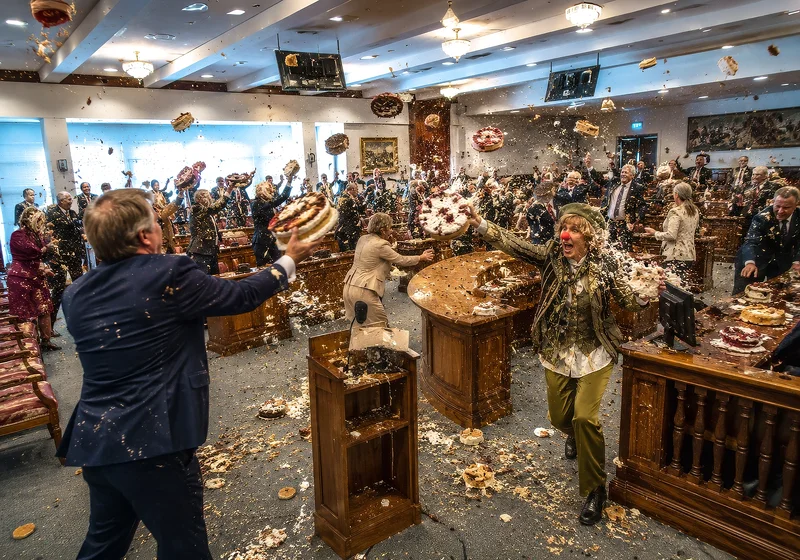
Jörgen Thornberg
Bedlam at the City Hall a political farce - Kalabalik i Rådhuset en politisk fars, 2026
Digital
70 x 50 cm
3 200 kr
Bedlam at the City Hall a political farce - Kalabalik i Rådhuset en politisk fars
Svensk text på slutet
Introduction
What happens when a thirty-five-year-old secret turns out to be sitting in the middle of the political assembly at Malmö City Hall?
In this fast-paced political farce, we enter a city where everyone seems to know something about everyone elseyet no one knows the whole truth. Over the course of a single council meeting, the corridors of power descend into a labyrinth of misunderstandings, slamming doors, hidden documents, secret love affairs and panic-stricken politicians willing to do almost anything to protect their carefully polished façades.
When a woman begins searching for her origins, she awakens a past that, according to many, should have remained buried forever. Long-forgotten romances, misplaced letters and an adoption dating back to the early 1990s suddenly force today's political leaders to question everything they thought they had under control. At the same time, a Green Party councillor frantically searches for his missing car keys, a Sweden Democrat sees conspiracies around every corner, a Social Democrat struggles to keep multiple identities from colliding, and an entire city council edges towards a spectacular collapse no one could have foreseen.
With warmth, satire and a keen eye for humanity's remarkable talent for complicating its own existence, this story reminds us that the greatest enemy is rarely a political opponent but the fear that the truth might finally come to light.
Behind every political party stands a human being.
And human beings are seldom as well organised as their party manifestos.
"Calabalik at City Hall
Once there was a Town Hall so grand,
Where no one quite followed the plan.
The Mayor said, "Order!"
They fled through each corridor,
While truth disappeared under the stand.
A councillor preached, with great pride,
"Let bicycles always be our guide!"
Yet hidden from sight,
On each moonless night,
His Cadillac waited outside.
A Liberal hid in a broom,
Convinced he was facing his doom.
A Moderate crawled,
Beneath tables appalled,
While curtains concealed all the gloom.
A Socialist whispered with grace,
Then vanished without leaving a trace.
A lover arrived,
The old guard dived,
Each hiding in somebody's place.
One teacher, composed to the core,
Knew less than the rest of the floor.
The rumours took flight,
From morning till night,
Though none knew what started the war.
A firebrand searched for a key,
A racist saw plots by decree.
One lost baby girl,
Set all heads in a whirl,
Without saying a word, naturally.
The Chairman kept pounding away,
"Proceed with the business today!"
But speeches grew thin,
As chaos rushed in,
And reason packed up for the day.
For politics, so we've been told,
Is noble, courageous and bold.
Yet scratch through the paint,
And every proud saint
Has secrets they pray won't unfold.
So here's to the grand masquerade,
Where reputations are made.
The parties may fight,
From morning till night,
But humans still wrote every grade.
And if, in some Town Hall one day,
You hear an old politician say,
"There must be some damn order in a party at war!"
Don't argue. Don't make a fuss.
Just check who's hiding behind the door...
It may be all of us.
Malmö, July 2026
Prologue There Must Be Some Damn Order...
On a cold winter's day in early 1992, a baby girl was born at Malmö General Hospital. To the staff, she was simply one of many newborns that day. She weighed just over three kilograms, had ten fingers and ten toes, and a remarkably powerful cry. Her mother held her for only a brief moment before, with a decision that would shape the rest of both their lives, signing the papers that made the child someone else's.
None of the people who, many years later, would gather in the council chamber of Malmö City Hall could have imagined that her birth would one day send shockwaves far beyond the maternity ward. During the previous summer, a young woman in the Möllevången district had lived a life in which politics, love, and dreams of the future blended in a way that seemed perfectly natural at the time but would later seem almost impossible to believe. When she disappeared from Malmö, she took the secret of the child's father with her. Perhaps she did not even know it herself.
The years passed. The little girl grew up unaware of her origins, while the men who had once been close to her mother carried on with their lives. They built political careers, won and lost elections, changed positions, and, like professional politicians everywhere, learned that the past is rarely something one speaks of voluntarily. The summer of 1991 slowly faded into a blurred memory that no one wanted to recall.
Thirty-five years later, those men have reached positions where they believe they are firmly in control of their lives. Their concerns are budgets, planning applications, climate zones, opinion polls and troublesome political opponents. Not one of them gives a single thought to the little girl who once left the hospital, with none of the possible fathers even knowing she existed.
Politics is said to be about vision, responsibility and wise decisions for the public good. It is, of course, a beautiful idea. But anyone who has spent time inside the walls of a city hall knows that reality is usually far more human. Ideals coexist with ambition, conviction with vanity, and great principles with small secrets. No one wants to be caught with the wrong person at the wrong moment, and no one wants old mistakes suddenly emerging from the archives, demanding answers. And no Green Party politician wants to be exposed as the owner of a gas-guzzling Chevrolet.
Above all, politics is about timing.
Because if a single door opens two seconds too early, if an envelope lands on the wrong desk, if a mobile phone chimes at the exact wrong moment, or if someone happens to witness something they were never meant to see, decades of carefully constructed façades can collapse faster than a municipal IT system after a software bug.
That is why an old letter can sometimes be more dangerous than a hundred political opponents combined.
This story unfolds over a single day at Malmö City Hall. No one arrives intending to lie any more than necessary. No one plans a scandal. No one plans a conspiracy. No one imagines that an ordinary council meeting will turn into a farce in which doors open and close faster than arguments can be made.
Yet that is precisely what happens.
As the curtain rises on this sunny day in May, each of the main characters believes their greatest concerns are the budget negotiations, climate zones, planning applications and the votes that lie ahead.
They are wrong. Very wrong. But they are not alone. The entire council is wrong, and the most spectacularly wrong among them is a thoroughbred racist.
Behind tailored suits, polished party manifestos and solemn speeches stand ordinary human beings with the same weaknesses as everyone else: love, jealousy, vanity, fear, and an almost superhuman determination never to be found out.
When everyone is trying to protect their own secrets at the same time, misunderstandings arise that no playwright would ever have dared to invent. And when the little girl born in 1992, without the slightest idea herself, suddenly becomes part of their lives again, a carefully balanced political house of cards begins to tremble in a way that leaves even the most seasoned politicians shaken.
Calabalik.
"There must be some damn order in a political party," declared the Swedish Communist leader C-H. Hermansson.
But no one had ever said there had to be order inside a City Hall until one of his own party comrades did so at Malmö City Hall in 2026.
PART ONE: THE EDUCATED SURFACE
Chapter 1: The Sun over Bellevue and the Western Harbour
The sun rising above Stortorget on that May morning in 2026 paid no heed to political manifestos. It cast the same soft pink, democratic light over the architect-designed passive houses of the Western Harbour and the mature, leafy gardens of old Bellevue. Dawn treated everyone equally. It was a perfect morning for a multicultural city.
In the villa on Krageholmsgatan in old Bellevue, Georg Lagercreutz stood before the bathroom mirror, tying his silk tie. He turned his head slightly to examine the result in profile. His straight, classical nosean inheritance from his family's Greek ancestrygave him the statesmanlike authority that Malmö's Moderate opposition would need for the afternoon's council meeting.
"Georg? You do remember we're having dinner with the consultant couple on Friday, my colleagues?"
Astrid's voice came from the hallway. She stood in the doorway, ready to leave for the hospital. She had always been careful to keep a professional distance between her career and her husband's political life. To Astrid, politics was background noise; medicine dealt with reality.
"Of course, darling. It's in my diary," Georg lied, smiling at his reflection.
Everything in his life was perfectly in order. He was a respected politician and leader of the Moderate opposition, with a successful wife. His twenty-six-year-old son Nicolas had not only secured a seat on Malmö City Council. He was already being tipped for a brilliant national career as chairman of the Young Moderates. The Lagercreutz family had become something of a conservative institution in Malmö.
A few kilometres away, in a climate-smart three-room apartment in the Western Harbour, Jan Pettersson stood on his balcony, gazing towards Turning Torso. He drew a deep breath of sea air and felt quietly satisfied to represent the Green Party's unquestioned moral compass at City Hall. Jan did not own a regular car. His morning routine was a carefully choreographed sequence of environmentally conscious choices: breakfast consisted of locally produced oats and biodynamically grown salad. Outside in the courtyard, his custom-built electric cargo bike stood, secured to the cycle rack with two heavy-duty locks.
As Jan wheeled the bike through the property's wrought-iron gate, he felt the respectful glances from his neighbours. He was the architect who had designed their climate-smart way of life. That afternoon he would step up to the lectern in City Hall and demand a complete ban on cars in the city centre. The fact that a key attached to a large enamel American flag was tucked away in his trouser pocket did not disturb the tranquillity of the morning. The key belonged to a barn in Lockarpto his dream, but also to his guilty conscience. Lockarp lay thirteen kilometres away, and at this moment Jan Pettersson was simply an environmentally conscious cyclist.
At the very moment Jan rolled onto the cycle path in the Western Harbour, a mobile phone chimed inside the Social Democratic offices on Kalendegatan. That was where Jan was heading, though the call had nothing to do with himeven if he would eventually become entangled in its consequences.
Sara Ekdahl, the city's thirty-four-year-old Deputy Mayor for Environment and Climate, picked up the phone from her desk. She was the brightest rising star of the red-green administrationcharismatic, quick-witted, and armed with a debating style that could make even the most seasoned Moderate politicians shrink in their seats. A message from an anonymous sender lit up the screen.
"Knut Hall. Ten minutes before the coffee break. I've brought the documents you requested."
Sara smiled, then quickly deleted the message.
She and Nicolas Lagercreutz were playing a dangerous game. A leading Social Democrat and the son of the opposition leader. If her colleagues discovered that she shared more than committee tables with the Moderates' golden boy during difficult budget negotiations, the debate over loyalty would tear the party offices apart. There were already whispers in the coffee room about security risks and information leaks.
But Sara Ekdahl had always navigated by her own compass. She absent-mindedly touched her nosethe same strikingly straight, classical profile that gave her an almost regal appearance at the lecternand slipped the phone into her handbag, on top of an official document she had printed that morning.
The world was rife with political conflicts, but on this May morning in Malmö, everything still seemed calm. The clock in the tower of St. Peter's Church had just struck eight as the city's civil servants and elected councillors arrived at the municipal offices on Kalendegatan.
Chapter 2: Masks and Tailored Suits
Sami Al-Hamra adjusted his glasses and ran his fingers over the neatly stacked piles of marked civics papers on his desk. It was approaching lunchtime at the upper secondary school, and City Hall awaited him that afternoon. For Sami, every day was an exercise in absolute self-control. Whether talking to his students or joking with colleagues in the staff room, he was exactly the man Malmö's Social Democrats needed: well educated, secular, and speaking flawless Scanian Swedish like a native. Sami was deeply rooted in the city's immigrant neighbourhoods.
Sami was born in Damascus, Syria, into a secular family with deep Jewish roots. The family name, Al-Hamra"the Red"was common among both Jews and Arabs in the region and helped them keep a low profile under the strict control of the Syrian regime. No religious holidays were celebrated at home, yet an awareness of their Jewish heritage remained, quietly hidden beneath the surface. When the civil war broke out, Sami was forced to flee. As an academic, he was particularly vulnerable. His journey eventually brought him to Sweden and to Malmö, mainly because it was the first major city on the other side of the bridge. Sami's asylum claim was based on his Jewish background, although the Swedish Migration Agency officially registered him as having no religious affiliation. That suited him perfectly, since he believed in no god, regardless of which holy book claimed otherwise.
Sami learned Swedish remarkably quickly and qualified for teacher training at Malmö University. The standard programme lasted five and a half years and included extensive academic study to qualify as a civics teacher.
Because he already held an academic degree from Syria, he needed only a supplementary teacher-training programme to obtain his Swedish teaching licence. He completed it in a single yearan impressive feat given his background. That was when the Social Democrats first noticed him. Sami had never been particularly political, but one does not turn down Sweden's largest political party casually.
After settling in Malmö, Sami quickly came to understand the city's complex social and political dynamics. To avoid the widespread antisemitism he encounteredbut above all to maximise his opportunities to integrate and build a careerhe made a purely pragmatic decision. As in Syria, he allowed those around him to assume he was Muslim. His first name, Sami, was the perfect bridge. To Swedes and secular Muslims, it sounded unmistakably Arabic, while to him it remained a shortened form of the Jewish name Samuel. He joined in the social life surrounding the major Muslim festivals, occasionally fasted during Ramadan simply for social reasons, and had learnt every cultural code and familiar expression by heart. His homosexuality, meanwhile, remained locked deep in the closet. Anything else would have been political suicide.
For Sami, religion had nothing to do with faith. It was about survival and influence. Having seen Assad and his executioners murder his family, he felt no remaining attachment to Jewish tradition. To Sami, there was no fundamental difference between Arabs and Jews; both were, by definition, Semitic peoples who had lived side by side for thousands of years. The differences were cultural, and although Islam had borrowed extensively from Judaism, both traditions belonged to the Abrahamic tradition and shared prophets and much else.
Joining the Social Democrats was therefore not merely an ideological choice; it was strategic. In Malmö, the Social Democrats remained the dominant political force, and active involvement in the party was the quickest route to genuine influence. Within its ranks, Sami had become a rising star. He embodied the ideal party member: highly educated, fluent in Swedish, with roots in a war-torn country and strong credibility across Malmö's immigrant neighbourhoods. His colleagues regarded him as a moderate, secular voice with deep ties to the city's Muslim communities. He used his platform to focus on education, integration and employmentissues that allowed him to avoid the political minefield of religious debate.
Sami lived in a permanent state of readiness. His life was both a political and a personal game of chess, in which a single mistake could destroy everything he had built. His greatest threat was Tobias "Tobbe" Bergqvist of the Sweden Democrats, who regarded Sami as his principal political rival. Through obsessive digging, Tobbe had uncovered hidden details of Sami's family history in Damascus. He knew Sami was concealing his Jewish background and was waiting for the right moment to bring his opponent down. Tobbe also suspected that Sami was gay, though he had no proof.
If Sami's Jewish background were exposed, it would not be his religion that destroyed him but the deception itself. He would be accused of political opportunism and misleading the electorate. Tobbe intended to use that revelation at the council meeting to prove that the Social Democrats' rising immigrant star was nothing more than a carefully staged performance. During the afternoon session, however, Tobbe's investigation would collide head-on with several other politicians' desperate attempts to hide a very different secret involving a woman they had all shared in the early 1990s, dragging an entirely innocent Sami into the very centre of the storm.
Whenever conflicts in the Middle East or questions of local antisemitism arose in Malmö City Council, Sami was forced to walk an impossibly fine line. The same was true of debates over LGBTQ issues. He had to speak in a way that satisfied both his party and his voters while privately wrestling with his own identity. Sami had erased his past to build a future. But the higher he climbed through the corridors of power, the closer the scrutiny from both the media and political opponents like Tobbe became of the past he had struggled so hard to escape. Tobbe was hardly a pleasant man, but every political party had its share of bastards, just as it also contained decent people. It was up to the voters to separate the wheat from the chaff. That, after all, is how democracy works.
Chapter 3: The Rumour from the Kockums Years
It was one o'clock in the afternoon when Torsten Värnebalk stepped into Georg Lagercreutz's office on Kalendegatan. The room exuded bourgeois security, with heavy mahogany bookshelves and Venetian blinds shutting out the harsh May sunlight. Georg sat behind his large desk, skimming the opposition's budget proposal, but looked up as soon as the door opened.
Torsten quietly closed the door behind him. As the Liberal Party's senior adviser, he always moved with understated, socially polished elegance, but today his movements carried tension. He placed a yellowed bundle of papers on Georg's deskan old, forgotten set of minutes from the Kockums Recreation Committee.
"Georg, do you remember the election campaign in the summer of 1991?" Torsten asked, taking a seat opposite him without waiting to be invited. His voice was low, almost a whisper.
Georg leaned back and frowned.
"Of course. That was the year we came to power. What's this about?"
"I heard a rumour last night," Torsten said, straightening as though trying to hide how hard his heart was beating. "She's dead. The woman from the commune in Möllevången. But the rumour is that she gave birth to a daughter in 1992, just before giving the child up for adoption and disappearing from Malmö forever."
Georg froze. The memory of his passionate, secret summer affair with the young woman from the political left cut through his usual statesmanlike composure. He had met her on neutral ground at Zoltan's Hungariathe Hungarian restaurant on Davidshallsgatanwhere they drank Tokaji and hid from their party colleagues. Georg had assumed she had grown tired of politics when she suddenly disappeared in August 1991. He had never heard that she might have been pregnant.
"It's probably just a rumour," Georg replied coolly, but his lawyer's mind was already calculating the months at furious speed. "She had plenty of friends back then, Torsten. Why are you telling me this?"
Torsten turned his gaze towards the window. Behind the façade of the pragmatic humanist lay sheer panic. He remembered the late nights when he had slipped into Möllevången after finishing work at the Kockums offices, deeply in love with the very same woman. He was already engaged to the woman who later became his wifea member of one of Malmö's most influential families. If the truth about his indiscretion ever emerged, his stable bourgeois marriage would be in danger. On top of that, he was one of the architects of the city's current political administration. If he harboured a biological secret involving one of the red-green politicians, Tobias Bergqvist and the Sweden Democrats would tear apart his life's work.
"I'm telling you because I'm doing the same calculation you're doing right now," Torsten said quietly, looking Georg straight in the eye. "Neither of us knew anything in August 1991. But if the child was born in early 1992... either of us could be the father. And I doubt you're any more interested than I am in becoming a father retroactively."
Chapter 4: The Profile on the Floor
Before Georg could respond to Torsten's words, a firm knock came at the door. Torsten straightened at once, and Georg lowered his eyes to his budget papers again. When the door opened, Sara Ekdahl stepped into the office. Her stride was light yet purposeful, and she carried a thick folder under her arm.
"Sorry to interrupt the opposition at work, Georg," Sara said with the confident smile that had made her the Social Democrats' brightest rising star. "I just need to check one detail about the environmental budget and the climate zones before this afternoon's council meeting."
She stepped into the room and turned slightly to point to a line in her document. At that very moment, the May sun streamed through the window, and in the backlight, Sara's face became a razor-sharp silhouette against the dark bookshelves.
Georg Lagercreutz stopped breathing. It was as if all the oxygen in the room had suddenly disappeared. In the brilliant light, Sara's profile stood out. It was a perfect, regal profile, dominated by a straight, classical nose. It was the same nose that Georg himself had examined in the bathroom mirror in Bellevue only a few hours earlierthe same distinctive feature inherited from his own Greek ancestry. He turned his gaze towards Torsten, whose eyes had widened and whose face had turned ashen. Torsten, too, was staring at Sara's profile, though his attention was more on her forehead.
Sara noticed nothing. She pulled a document from the folder, but as she moved, her handbag slipped off her shoulder. It fell to the floor, and a folded sheet of paper slid out.
"Oh, I'm sorry," Sara said, quickly picking up her handbag without noticing the paper that had slipped under the bookcase. "I'll bring the environmental briefing to the council chamber instead, and we can go through it at the break. See you there at five." She nodded briefly, turned on her heel and left the office.
Georg picked up the paper from the floor. He had expected to see a table of carbon emissions or a printout on the environmental budget. But the official crest at the top of the page told a very different story. It bore the emblem of the Social Welfare Committee.
"Application for Access to Records: File Concerning Biological Maternity, Malmö 1992," he read aloud so Torsten could follow. Georg's legal mind raced. The dates matched exactly. Sara had requested access to the confidential child welfare file to trace the woman from the commune in Möllevångenthe very woman with whom he had had an intense, secret affair during the 1991 election campaign. Sara was only an administrative decision away from destroying his entire existence, assuming, of course, that he was her father.
He looked up at Torsten.
"Torsten," Georg whispered, his voice suddenly sounding old and fragile. "My son Nicolas... he's dating Sara. They're in love."
Torsten stepped back and covered his mouth. If Georg was the father, Nicolas and Sara were, in fact, biological half-siblings. It was a moral catastrophe, a biological taboo that would trigger a monumental public scandal and destroy the Lagercreutz family forever.
"We have to stop this," Georg said, his eyes suddenly hard with sheer desperation. "We have to stop the truth from coming out and keep Nicolas away from her before it's too late."
PART TWO: THE INTERNAL LOGISTICS
Chapter 5: Planning Permission and Biological Mothers
Before Georg and Torsten had even managed to devise a concrete strategy to conceal the adoption records, the office door flew open with a bang. Both men flinched. In sheer panic, Georg shoved the City Archives papers beneath a heavy pile of budget documents on his desk.
Standing in the doorway was a young woman with dark hair, wearing a fitted dark red blazer. She was breathing heavily, her eyes flashing with frustration, and under her arm she carried a thick roll of architectural drawings. She introduced herself as Elena Popescu. She stepped firmly into the room, slammed the door behind her, and fixed Georg with an accusing stare.
Georg and Torsten exchanged a look of utter panic. By then, their adoption crisis had robbed them of all sense of reason and logic. Before them stood a young foreign woman, angry and demanding. At that moment, only one explanation seemed remotely possible: the dark secret from the summer of 1991 had suddenly materialised and sent an emissary to confrontor blackmailthem before the evening's meeting.
"Enough is enough!" Elena burst out in fluent Swedish with a slight accent. "I've been sent from one office to another in this building for over an hour. Nobody takes responsibility; everyone points me towards the next corridor, and time is running out for my business. We have to sort this out right now!"
Georg rose from behind his desk. Beads of sweat appeared on his forehead as he raised both hands in a calming, deeply defensive gesture.
"Please... lower your voice," Georg hissed desperately, stepping quickly around the desk to block the door so no one in the corridor could overhear them. "We can settle this discreetly, I promise. There is absolutely no need to make a public scene about what happened. Just tell me what you want. How much financial compensation are you asking for to keep quiet about what took place in Möllevången in the summer of 1991?"
Elena stepped back and stared at the leader of the opposition as though he had completely lost his mind. She frowned in utter bewilderment and raised the roll of drawings in front of her like a weapon.
"What on earth are you talking about?" Elena snapped. "1991?! I was minus eleven years old! My parents hadn't even met yet, let alone moved here! I don't want your money! I want my planning permission for the restaurant on Bergsgatan! Tobias Bergqvist from the Sweden Democrats told me to go to the door just before the coffee room to get the final signature, but instead I found two crazy old men sitting here, sweating!"
Torsten, pressed against the mahogany bookcase and holding his breath, suddenly let it out in a long, shaky sigh. He looked at Elena's angry young face and realised the monumental misunderstanding. She was a twenty-four-year-old entrepreneur with an administrative problem, not a ghost from the past.
But before Georg could apologise or explain the absurd misunderstanding, heavy footsteps echoed down the corridor from Kalendegatan. Tobias Bergqvist was coming in search of his planning-permission client, and the farce inside the new City Hall complex had just stepped up a gear.
PART TWO: THE INTERNAL LOGISTICS
Chapter 5: Planning Permission and Biological Mothers
Before Georg and Torsten had even managed to devise a concrete strategy to conceal the adoption records, the office door flew open with a bang. Both men flinched. In sheer panic, Georg shoved the City Archives papers beneath a heavy pile of budget documents on his desk.
Standing in the doorway was a young woman with dark hair, wearing a fitted dark red blazer. She was breathing heavily, her eyes flashing with frustration, and under her arm she carried a thick roll of architectural drawings. She introduced herself as Elena Popescu. She stepped firmly into the room, slammed the door behind her, and fixed Georg with an accusing stare.
Georg and Torsten exchanged a look of utter panic. By then, their adoption crisis had robbed them of all sense of reason and logic. Before them stood a young foreign woman, angry and demanding. At that moment, only one explanation seemed remotely possible: the dark secret from the summer of 1991 had suddenly materialised and sent an emissary to confrontor blackmailthem before the evening's meeting.
"Enough is enough!" Elena burst out in fluent Swedish with a slight accent. "I've been sent from one office to another in this building for over an hour. Nobody takes responsibility; everyone points me towards the next corridor, and time is running out for my business. We have to sort this out right now!"
Georg rose from behind his desk. Beads of sweat appeared on his forehead as he raised both hands in a calming, deeply defensive gesture.
"Please... lower your voice," Georg hissed desperately, stepping quickly around the desk to block the door so no one in the corridor could overhear them. "We can settle this discreetly, I promise. There is absolutely no need to make a public scene about what happened. Just tell me what you want. How much financial compensation are you asking for to keep quiet about what took place in Möllevången in the summer of 1991?"
Elena stepped back and stared at the leader of the opposition as though he had completely lost his mind. She frowned in utter bewilderment and raised the roll of drawings in front of her like a weapon.
"What on earth are you talking about?" Elena snapped. "1991?! I was minus eleven years old! My parents hadn't even met yet, let alone moved here! I don't want your money! I want my planning permission for the restaurant on Bergsgatan! Tobias Bergqvist from the Sweden Democrats told me to go to the door just before the coffee room to get the final signature, but instead I found two crazy old men sitting here, sweating!"
Torsten, pressed against the mahogany bookcase and holding his breath, suddenly let it out in a long, shaky sigh. He looked at Elena's angry young face and realised the monumental misunderstanding. She was a twenty-four-year-old entrepreneur with an administrative problem, not a ghost from the past.
But before Georg could apologise or explain the absurd misunderstanding, heavy footsteps echoed down the corridor from Kalendegatan. Tobias Bergqvist was coming in search of his planning-permission client, and the farce inside the new City Hall complex had just stepped up a gear.
Chapter 6: Sabotage on Three Fronts
The doors along the corridor flew open and shut in a pattern that would have impressed any stage manager. Torsten grabbed Georg firmly by the arm and pulled him into the smaller adjoining meeting room before Elena could leave the office. Torsten closed the door, leaned back against the frame, took a deep breath, and let out a long sigh.
"Georg, did you see Sara's forehead?" Torsten whispered, his voice trembling. "What if those aren't your Greek genes? What if I'm the father?" Torsten instinctively touched his forehead.
Georg stared in astonishment at his Liberal colleague. Before he could reply, voices echoed through the corridor, accompanied by hurried footsteps and the sound of doors opening and closing. The machinery of the farce had begun, and within moments the corridors of City Hall had become a logistical puzzle of closed doors and hidden intentions.
Nicolas had just slipped away from the Moderate Party offices, a red rose hidden beneath his dark blue jacket. He was anxiously searching for Sara, determined to steal a kiss before the formal meeting began. He reached for the handle of the photocopy room door, unaware that Sara had locked herself inside. She was pressed against the large laser printer to avoid her suspicious party colleagues, who were whispering in the coffee room about conflicts of loyalty and the risk of information leaking to the opposition during the ongoing budget negotiations.
"Nothing can be kept secret in this building," Sara thought.
Georg, having recognised his son's voice in the corridor, was seized by sudden panic. He opened the meeting-room door a crack, grabbed Torsten and shoved him into the small cleaning cupboard opposite the desk, so the Liberal would not be seen if Nicolas or Sara appeared.
"Stay there and don't move," Georg hissed, slamming the cupboard door shut just as Sami Al-Hamra stepped out of the coffee room, carrying a steaming cup of coffee.
Sami stopped and looked at Georg with a polite, questioning smile. As the conscientious schoolteacher he was, he tried to get through the day without drawing attention to his hidden past. But at that exact moment, the worn lock on the cleaning cupboard gave way. The door burst open, and Torsten Värnebalk, holding a mop, tumbled backwards into the corridor and landed flat on the floor at Sami's feet.
Farther down the corridor, hidden behind a pillar, stood Tobias Bergqvist. His mobile phone camera was already raised. Tobbe, who had been shadowing Sami in search of political dirt linked to his Syrian background, zoomed in on the scene in utter amazement. Tobbe, who always played the role of the tolerant, nuanced reformer from the council lectern, felt his deeply suppressed hatred surge through him with renewed energy.
He saw the Liberal adviser lying on the floor, the panic in the opposition leader's eyes, and the Social Democratic immigrant Sami standing in the very middle of it all. Tobbe smiled a broad, triumphant smile. He understood nothing, but his tactical chess-player's mind immediately concluded that he had just filmed proof of a secret cross-party conspiracy.
In the midst of this carefully controlled chaos, the lift doors by the reception opened. Simon Andersson stepped onto the floor, walking heavily, a dusty moving box clutched tightly against his stomach. The old shipyard welder had just come from school, carrying the commune's old letters and notes from the 1990s. Irritated, he was looking for an empty committee room. He headed towards the first open door he saw, completely unaware that he was about to set down the ticking time bomb that would plunge the confusion into chaos.
Chapter 7: The Moving Box in the Wrong Room
Simon Andersson muttered to himself as he balanced the heavy moving box in the corridor. His back ached after a long day at the upper secondary school, and the thought of spending the evening in the council chamber, listening to bourgeois platitudes, did nothing to improve his mood. He was looking for the Left Party's temporary committee room, but the identical doors and anonymous signs in the courthouse complex left him confused.
He pushed open a door with his elbow, stepped into an empty, cool meeting room, and placed the box on the polished oak table with a heavy thud. Simon let out a sigh of relief, wiped his forehead, and turned on his heel to fetch a much-needed cup of black coffee from the coffee room. It never occurred to him that he had just left his most private documents from the 1990s in the Moderates' committee room.
A minute after Simon had left the room, Georg and Torsten slipped through the same door to escape Tobias Bergqvist's watchful gaze in the corridor. Georg locked the door behind him and drew a deep breath.
"Saved by the bell," he joked.
"What's that? Are you moving?" Torsten asked, pointing at the box.
Georg took a few cautious steps forward and examined the worn cardboard box. It had not been there a moment earlier. Of that, he was certain.
Written along the side in large black letters were the words: The Möllevången Commune 19911993. Georg's heart somersaulted in his chest. He stretched out a trembling hand and lifted the lid. On top lay old political leaflets, worn notebooks, and several handwritten letters addressed to Simon Andersson.
"My God, it's Simon's box," Georg whispered, leafing frantically through the papers. "Is that old devil involved in this as well? If he's kept all this for thirty-five years, he must be trying to work out the truth too!"
Torsten moved up beside Georg, driven by his own fear that his respectable family life and stable marriage might be wiped away. His eyes fell on a yellowed envelope, stamped and postmarked October 1991. He snatched it up and began reading the elegant handwriting on the back. It was addressed to Simon Andersson. He had the strange feeling he had seen the handwriting before, but he could not place it. His first impulse was to tear open the envelope to see whether its contents had anything to do with the nightmare they were facing. But he could not open Simon's private letter. No well-brought-up Liberal would do such a thing. Or could he make just this one exception? Before he had finished arguing with his conscience, he heard the sound of metal-tipped heels approaching.
Sixty metres farther down the long corridor towards the underground passage, Simon Andersson was walking back with his cup of coffee. He stopped when he heard a familiar voice from the Social Democratic offices. It was Sara Ekdahl, delivering a passionate, impromptu speech to her colleagues on the importance of never compromising the rights of the working class in environmental policy. She was rehearsing for the evening.
Simon froze, his coffee cup halfway to his mouth. The words she used, the rhythm of her voice, and her intense, uncompromising tone struck him like a blow to the stomach. It was like hearing an echo of his own speeches on the shop floor at the Kockums shipyard in the early 1990s: a woman's voice, yet his words.
The penny dropped, and Simon began counting backwards in his head. Could it really be?... The thought slowly took shape.
"She disappeared in August 1991... The girl was born in early 1992... Sara is thirty-four now..."
A wave of ideological and social shame swept over the old shipyard welder. If it were ever revealed that hethe Left Party's uncompromising proletarianwas the biological father of the Social Democrats' highest-paid deputy mayor, his life's work and credibility would vanish in an instant. His party comrades would brand him a hypocrite who had fathered a champagne socialist. Simon slammed his coffee cup down on a windowsill so hard that coffee splashed over the edge. He turned on his heel, determined to empty his moving box and destroy every trace of the 1990s before anyone else could put the pieces together.
Chapter 8: Car Keys and Hidden V8 Engines
Jan Pettersson stood in front of the coffee machine, nervously drumming his fingers on the plastic cup. The budget negotiations within the red-green coalition were intense, but it was not the political compromises that made the Green Party's foremost moral compass break into a sweat. It was something far heavier in his pocket. He pulled out his handkerchief to wipe his forehead, and in the same movement, his car key slipped from his trouser pocket and landed on a discarded paper towel on the linoleum floor of the coffee room.
Jan noticed nothing. Fuelled by caffeine and stress, he hurried out of the room, coffee in hand, determined to finish preparing his speech on car-free city centres before the clock struck five.
A moment later, Sami Al-Hamra entered the coffee room and spotted the key. He bent down and picked it up. It was decorated with a large enamel American flag and a badge reading Cadillac Eldorado V8. Sami frowned. He sensed that one of his colleagues at City Hall was keeping a secret. He slipped the key into his jacket pocket, intending to find its owner at the next break.
Jan Pettersson, who had just realised his mistake in the corridor, turned back to retrieve the key. He stopped dead in the doorway of the coffee room, all the blood draining from his face. Through the glass panel in the door, he watched Sami Al-Hamra weigh the bright red Cadillac key in his hand before slipping it into his jacket pocket.
Jan's ecological world collapsed. If Samihis closest political allydiscovered that the Green Party's loudest cycling enthusiast secretly chaired Malmö's most fuel-hungry classic car club and kept a luxury car hidden in a barn in Lockarp, Jan's career would be over. Instinctively, Jan pulled his cap lower over his face, backed into the corridor and took cover behind a large pillar. His heart pounding, he began to spy on Sami's every move, waiting for an opportunity to sneak up behind him and steal the key back from his jacket pocket.
Jan did not realise he was being watched. Three metres farther down the corridor, Tobias Bergqvist stood concealed behind a photocopier. Tobbe zoomed in on Jan with his mobile phone camera, fascinated by the Green politician's bizarre behaviour. Through his contacts in the construction industry, Tobbe had already heard rumours about the anonymous barn in Lockarp, and he was merely waiting for the perfect moment to thrust a photograph of the V8 monster into Jan's face during a council debate.
By now, the mechanics of the farce had become so intricate that no one in the corridor saw reality for what it was. Jan was spying on Sami to save his car; Tobbe was spying on Jan to bring down the Green Party; around the corner, Georg and Torsten were still running about in a panic over the adoption; Sara was hiding from Nicolas, who was looking for his father to tell him a secret; and Simon was doing everything he could to stop a cross-party conspiracy.
All it would take was for Sami to step out into the corridor for the whole carousel to come crashing down.
Chapter 9: The Corridor Junction
Sami Al-Hamra took a deep breath, smoothed his navy-blue jacket, and stepped out of the coffee room, completely unaware that he was walking straight into the logistical hub of total corridor chaos. With the heavy Cadillac key resting in his right-hand pocket, he made his way towards the point where the corridors met on Kalendegatan.
At that very moment, the door to the locked meeting room burst open. Georg Lagercreutz and Torsten Värnebalk came flying out like two jack-in-the-boxes, pale-faced and carrying Simon's letters from the 1990s, hidden in two thick folders. They came to an abrupt halt when they collided with Sami.
"Sami," Georg exclaimed, trying to mask his panic with a sharp, statesmanlike voice. "Have you seen my son Nicolas? He must report to the Moderate Party office immediately. There's an urgent assignment for him elsewhere in the city!"
Before Sami could answer, Jan Pettersson emerged from behind a pillar. Moving stealthily, he kept his eyes fixed on Sami's jacket pocket. He took two quick steps forward, but suddenly lost his nerve when he met the gaze of the two elderly bourgeois gentlemen. Instead, Jan instinctively dived through the nearest open doorwhich happened to be the narrow cleaning cupboardand slammed it shut behind him.
"What on earth is the Green Party up to?" Torsten whispered, staring at the closed cupboard door as his thoughts swung wildly between the terror of fatherhood and the fear that his respectable bourgeois wife might discover the girl from the Möllevången commune.
From the opposite end of the corridor came Simon Andersson, striding forward with quick, heavy steps. He was looking for his moving box when he saw Georg and Torsten standing close together, whispering about Sami. He immediately concluded that the class enemy was conspiring against his secret past. Simon walked straight into the circle, slapped his fist into his open palm, and fixed Georg with a dark stare.
"You keep your bloody hands off what doesn't belong to you, you damned bourgeois bastards!" Simon thundered, his thoughts consumed by the unbearable idea that his own flesh and blood was wearing the Social Democrats' party badge.
Sami Al-Hamra stood at the junction of the corridor, looking like one enormous question mark. He looked at Simon shouting, at Georg and Torsten sweating over their folders, and heard a faint, desperate scratching from inside the cleaning cupboard, where Jan Pettersson was trapped. Sami instinctively stepped back, utterly confused.
Farther down the corridor, completely hidden behind the same photocopier as before, Tobias Bergqvist filmed everything. Tobbe, whose racial prejudice was barely concealed beneath his public role as a tolerant campaigner for integration, zoomed in on Sami's bewildered face, surrounded by leading politicians from the Moderates, Liberals and the Left Party. Tobbe's hateful mind had now assembled the pieces into a truth entirely of its own: Sami Al-Hamra was leading a secret cross-party conspiracy to sell out Malmö's security. A conspiracy that had to be reported to the Swedish Security Service immediately.
The clock on the wall read 4:45 p.m.
Fifteen minutes were remaining before the meeting began.
"We have to break this off," Georg said abruptly, glancing at the clock and recoiling at the thought of Nicolas and Sara's incestuous relationship. "The council meeting starts in fifteen minutes. We'll have to move to the old City Hall."
The group moved in suspicious silence towards the heavy door leading to the underground passage linking the new complex to the historic City Hall's council chamber. The farce on Kalendegatan was over, but beneath the crystal chandeliers on Stortorget, complete pandemonium was poised to erupt before a live audience.
PART THREE: PANDEMONIUM IN THE COUNCIL CHAMBER
Chapter 10: Beneath the Council Table
The underground passage led the politicians straight into the historic vaulted basement of the old City Hall. They climbed the worn stone staircase and entered the great council chamber overlooking Stortorget, where heavy oak doors and oil portraits of long-dead politicians lined one wall. At the same time, sparkling crystal chandeliers cast a newly restored glow against the worn corridors of the old courthouse complex. The clock struck exactly 5:00 p.m. as the Chair of the Council, Carina Nilsson, brought down her gavel and declared the May meeting open.
During the first hour, the group remained pinned to their seats, but not one of them heard a single word of the formal reports. Georg stared anxiously across the chamber towards the Social Democratic benches, where Sara Ekdahl sat in profile, displaying that unmistakably straight Greek nose. Torsten Värnebalk nervously twisted his wedding ring and avoided looking towards the public gallery. At the same time, Simon Andersson sat with his arms tightly folded across his chest, staring at his recovered moving box, which he had managed to place beneath the empty bench beside him. In the middle of the chamber sat Sami Al-Hamra, still carrying the Cadillac key in his jacket pocket. Tobias Bergqvist of the Sweden Democrats leafed through the photographs on his mobile phone, a calculating smile on his face.
When the Chair announced a short adjournment for coffee, the pent-up energy in the chamber erupted.
Nicolas Lagercreutz glanced towards his father and seized the chance to slip out through the side door towards Knut Hall. The red rose was still hidden beneath his jacket. He caught sight of Sara heading towards the coffee table and gently took hold of her arm.
"Sara," Nicolas whispered, drawing her into the dark, empty County Council Chamber next door. "We have to talk. My father is behaving completely irrationally today. He tried to send me on a made-up assignment to Oxie. I got the impression he wanted to keep me away, though I have no idea from what. Come on, let's sneak down to the City Hall Cellar instead. None of our political brothers and sisters will see us there."
Sara laughed quietly, though she, too, was tense.
Only a few seconds after the young lovers had closed the door behind them, Georg and Torsten slipped into the same room, half-crazed with panic about the adoption. They could hear Nicolas and Sara whispering from deeper within the darkened chamber. Driven by the absolute terror that his son might unknowingly commit incest, Georg completely lost his statesmanlike dignity.
"They'll see us!" Torsten hissed, panicked.
"Quickover here!" Georg whispered.
Without thinking, the two elderly bourgeois gentlementhe Moderate Party's leader of the opposition and the Liberal Party's most respected senior adviserdropped to their knees. They crawled at full speed beneath the magnificent long oak council table and drew the heavy red velvet curtains that hung to the floor around them. There they lay, pressed tightly together beneath the table, panting in desperation, Georg horrified that he had been reduced to spying on his own son to prevent a biological taboo.
"Nicolas, we can't be seen together during the budget debate. My Social Democratic colleagues believe I'm leaking information to you. People are already whispering about us in the corridors."
They parted company. Sara returned to the coffee break, while Nicolas went back to the council chamber. The red rose remained tucked in his jacket as he closed the door behind him.
Torsten and Georg heard the whispered conversation end and prepared to step out of their uncomfortable hiding place.
At that very moment, the door opened once more.
It was Jan Pettersson of the Green Party, slipping quietly into the room, desperately searching for Sami Al-Hamra to steal back his car keys. Jan, who publicly cultivated the image of an ecological role model, was so obsessed with the secret of the bright red Cadillac that he failed to notice the curtains beneath the table moving. Instead, he hid behind one of the grand window drapes, ready to pounce the moment Sami appeared.
The chaos within the historic rooms of City Hall was now complete. No one knew who was hiding from whomor why. The doors to Knut Hall and the staircases opened and closed in rapid succession. Beneath the heavy oak table, Georg suddenly realised he had dropped the City Archives' adoption papers onto the floor just outside the curtaindirectly in front of the feet of someone who had just entered the room with brisk, purposeful steps.
Tobias Bergqvist.
The Sweden Democrat was easy to recognise even from such a low angle. His black-and-white spectator shoes were unmistakable. In gangster and mafia films, they often signalled elegance, wealth and swagger. Quite what they had to do with his nationalist political convictions, nobody had ever dared ask. He nudged the envelope with one shoe, bent down to pick it up, and quietly left the room.
Georg, thoroughly shaken, did the same, with Torsten close behind. Recovering the missing envelope would have to wait. It was time to return to the council meeting.
PART THREE: PANDEMONIUM IN THE COUNCIL CHAMBER
Chapter 11: The Performance Begins to Crack
The Chair of the Council, Carina Nilsson, struck her gavel with a sharp crack that made the crystal chandeliers in the council chamber tremble. The recess was over. The councillors streamed back to their seats, wiping the sweat from their foreheads after the chaotic quarter of an hour behind the scenes at City Hall. Georg Lagercreutz sat bolt upright, but there was a hunted look in his eyes; the City Archives' adoption papers had vanished without a trace beneath the council table in the County Council Chamber. Sami did what he always did: he secretly marked his pupils' exams. It was his way of making the long, tedious speeches from politicians of every colour pass more quickly.
"Next, we have the question submitted by Jan Pettersson of the Green Party to Andréas Schönström, Chair of the Technical Committee and a Social Democrat, concerning a total ban on cars in the city centre," Carina Nilsson began. She looked as though she already knew what was coming, for Green Party politicians were predictable; whatever they were about to say could already be found in their party manifesto, regardless of what had happened. "Andréas is already at the lectern, so that we may begin," she continued. "The rules are that the person answering has two minutes, the questioner has one minute for a reply, followed by one minute each. The floor is yours, Andréas Schönström."
"Thank you. As you heard, I have received a question from Jan Pettersson of the Green Party about whether the governing coalition intends to introduce a total ban on motor traffic in the city centre. Making it more difficult to get around and removing unnecessary traffic in Malmö are priorities we are continuously pursuing. This applies to the municipality's own activities and to everyone else who comes into contact with road traffic in Malmö. In the 2026 budget, this work has been given special priority. At present, a cross-departmental programme is underway to reduce access to Malmö's streets and make it slower and more difficult to enter the municipality by car. We have already ensured that extensive road closures and diversions are in place around the city's outskirts. At the latest meeting of the Executive Committee, we allocated another 2.5 million kronor to continue this important work."
"We have already made it more difficult for cars to enter from neighbouring municipalities. For example, a carefully designed diversion from Svedala ensures that motorists end up driving back there instead. I would also like to point out that we have the full support of businesses in the surrounding municipalities for these measures."
"Our slogan, *'Stay where you arewe don't want you here,'* has been a remarkable success. We have also tried to introduce new obstacles to replace the old ones, ensuring we remain focused. You proposed the donkey initiative, and the Executive Committee unanimously referred it for further consideration, so the donkey issue remains under review. Personally, however, I am very positive about adopting the model used on the Greek island of Hydra, where donkeys handle all transport. It would also have the beneficial side effect of reducing the need to import artificial fertiliser into Skåne's agriculture."
"What I want to demonstrate is that substantial work is already underway. Together, we need to intensify our efforts to make life even harder for motorists."
"Jan Pettersson, the Green Party's spokesperson on transport."
"Thank you, Madam Chair. Distinguished councillors, members of the publicand above allthe people of Malmö. Earlier in this debate, we were presented with statistics showing that car traffic in our city centre is decreasing while bicycle traffic is increasing. That is a wonderful development. But we in the Green Party refuse to stop there. We must dare to look ahead, lift our gaze beyond Malmö's horizon, and draw inspiration from places that have truly taken the final step."
"Let us turn our eyes to the Greek island of Hydra, with a permanent population of only a few thousand that swells in summer. The island's politicians made a courageous decision. All cars, motorcycles and mopeds are completely prohibited. There are no exhaust fumes poisoning children's lungs, no constant traffic noise stressing residents, and no rows of parked metal monsters stealing valuable public space. Hydra has shown that a society can function, flourish and prosper without a single fossil-fuelled vehicle on its streets. They travel by healthy walks, boatsand Albanians. The imported labour force carries everything the donkeys cannot, such as a grand piano. Carrying their own groceries has left the island's elderly in far better physical condition than their counterparts in Malmö. Even local businesses benefit. Cobblers and shoe shops are thriving."
"Now I imagine the Chair of the Technical Committee, Andréas Schönström, is thinking: *'Come now, Jan Pettersson, surely we can't replace the city buses on Amiralsgatan with donkeys and horses?'*"
'No, of course not. Malmö is not a Greek island, and we are not trying to drag history all the way back to the Stone Ageonly halfway. The lesson from Hydra is not about four-legged animals, but the principle that the city belongs to people, not to cars. There are compromises. The people of Malmö need to learn to be patient, as the early environmentalist Edvard Persson sang in the 1930s. Then Tram Line 3 could regain its former glory, circling the city centre once again on newly laid rails pulled by donkeys. The difference in journey time would be negligible, and there are so many beautiful buildings to admire along the way. Malmö is a beautiful city and well worth visiting. If you're in a hurry, take a bicycle. In a car-free city centre, the journey from Västra Hamnen to Triangeln takes only twelve minutes at a leisurely pace. Sprinting takes less than ten minutes, which is still considerably faster than today's buses.'
"If an entire island can reorganise its logistics, transport building materials and move its inhabitants without a single private vehicle, then Malmö can certainly do far more than we do today. We already have an ever-growing number of cyclists, and we continue to expand the Malmö Express bus network."
"What we lack is the political courage to put our foot down. We need Malmö's Technical Committee to dare to make decisions that genuinely challenge our dependence on cars. Let us remove cars from the city centre once and for all. Let us return the streets to cafés, playgrounds and trees, creating a paradise for dogs seeking a convenient place to relieve themselves. Let us make Malmö the Hydra of Northern Europea modern, green and vibrant city where people always come first."
"Thank you."
"We have added a great many policy documents governing traffic in the city centre to ensure that the laws and regulations already in force are not too easy to understand. We have produced municipal guidelines based on the existing conditions. Long-term deterioration of accessibility often requires a continuous stream of political decisions and careful balancing, all intended to achieve an even greater reduction in accessibility for motorists in the city centre. Naturally, whenever unnecessary bureaucracy is expanded, it must be continuously reviewed. Drivers who experience frustration must become even more frustrated."
"Not a single concrete example of an increase in the number of donkeysapart from those already sitting on the Executive Committee. That was about what one expected. During your time as Chair of the Technical Committee, Malmö has dropped 133 places in the Swedish Enterprise business rankingthe worst results concern bureaucracy and public service. Malmö ranks dead last. But it ought to be even worse if the Green Party had its way. A growing business sector harms the environment and increases demand for cars. The conclusion is obvious: keep Malmö clean and send dirty industries across the bridge."
"You mentioned that the Executive Committee unanimously referred our proposal for further consideration, but you omitted that the Social Democrats on the Executive Committee rejected it as recently as Monday and have no interest in reviewing the burden. Sometimes regulations discourage rather than encourage. They force people to waste time and money instead of hiring more staff."
"Andréas Schönström has the final reply."
"Thank you. I wish to note that work is already underway to further restrict access. Over the past few years, we have launched extensive roadworks, widened pavements at the expense of traffic lanes, expanded traffic islands, converted driving lanes into bus lanes, and ensured that ongoing road closures affecting motorists have been given the highest priority."
"Requests from developers for temporary lane closures are processed as a priority, and decisions are made well in advance. The coordinator position for the city's ongoing construction projects was abolished at the start of this council term. The resulting building chaos is entirely my own achievement."
"We continue to make policy documents even less transparent by constantly increasing their level of detail and ensuring that new ones are introduced as older ones expire. What you forgetand something we have often discussedis that during my time as Chair, traffic volumes in Malmö's central districts have shown a clear downward trend."
"Our reduction is considerably greater than in Stockholm or Gothenburg, for example. We have successfully turned this issue into a problem for our neighbouring municipalities, thereby creating many new jobs for them. Listening to you, one would think the municipality never does anything right. My own view is that we still have much work ahead of us. Efforts are ongoing to provide poorer service and even worse customer treatment. We are working systematically to exclude even more land from car use, convert car parks into community activity centres, and make room for more bicycle racks and wider pedestrian crossings. But reality must be described as it isnot simply by demanding more prohibitions. We are already doing everything we can to make traffic more difficult. Rest assured! The day will come when your donkeys are truly needed. The donkey stables already form part of the municipality's long-term planning."
"Can we consider the question answered? Yes, the answer is yes."
"We now move to the next speaker, Tobias Bergqvist of the Left Party, speaking under 'Any Other Business' at his own request. Please come to the lectern," Carina Nilsson said, without sounding particularly welcoming. Carina tried to conceal her lack of affection for Left Party politicians who pretended they no longer belonged to the party once known as the Communists, even though, in her own mind, they were still Stalinists by definition. She wrestled with much the same inner conflict when it came to the Sweden Democrats, many of whom she believed still harboured brown opinions while doing everything possible to hide them.
Tobbe knew perfectly well where he stood with Carina, but he did not care. He had more pressing matters to attend to. He would deal with her as soon as he had wiped out her party. Tobias Bergqvist stepped up to the lectern. He smoothed his grey suit and offered the public gallery and the television cameras his most balanced and tolerant smile. At the lectern, he was renowned for his impeccable anti-racist façade, but at that moment he concealed what he regarded as a racial triumph in his chest. He was convinced he possessed the ultimate weapon with which to destroy the Social Democrats in Malmö.
"Honourable colleagues," Tobbe began, his carefully affected voice striking the perfect balance of gravity and compassion. "Today we are debating integration and the use of taxpayers' money. But how can we build a safe Malmö when the city's red-green leadership uses the corridors of power for secret pacts and hidden agendas, all behind the voters' backs?"
A murmur swept through the chamber. Sami Al-Hamra looked up from the pile of unmarked exams on his desk and held his breath. Instinctively, he slipped his hand into his jacket pocket, where Jan Pettersson's Cadillac key still lay.
Tobbe Bergqvist pulled out his mobile phone and raised it before the assembly as if it were a sword.
"Here is the proof," he growled, sounding remarkably like Jan Pettersson's Cadillac under hard acceleration.
Tobbe's frustration at having to shake hands with people he privately despised every day finally boiled over. He remembered the photographs he had taken in the corridor by Kalendegatanthe photographs showing Sami Al-Hamra standing in a whispering circle with Georg Lagercreutz and Torsten Värnebalk. At the same time, Jan Pettersson was hiding inside a cleaning cupboard.
"I saw it with my own eyes," Tobbe continued, glaring at Sami, "how the Social Democrats' rising star is engaged in a secret cross-party collaboration in the corridors of City Hall. But it doesn't end there! I hereby accuse Sami Al-Hamra of being responsible for an internal security leakand of maintaining a highly inappropriate private relationship with the deputy mayor, Sara Ekdahl, to secure the red-green coalition's budget negotiations!"
The counc
3 200 kr

Jörgen Thornberg
Malmö
Lite om bilder och mig. Translation in English at the end.
Jag är en nyfiken person som ser allt i bilder, även det jag fäster i ord, gärna tillsammans för bakom alla mina bilder finns en berättelse. Till vissa bilder hör en kortare eller längre novell som följer med bilden.
Bilder berättar historier. Jag omges av naturlig skönhet, intressanta människor och historia var jag än går. Jag använder min kamera för att dokumentera världen och blanda det jag ser med vad jag känner för att fånga den dolda magin.
Mina bilder berättar mina historier. Genom mina bilder, tryck och berättelser. Jag bjuder in dig att ta del av dessa berättelser, in i ditt liv och hem och dela min mycket personliga syn på vår värld. Mer än vad ögat ser. Jag tänker i bilder, drömmer och skriver och pratar om dem; följaktligen måste jag också skapa bilder. De blir vad jag ser, inte nödvändigtvis begränsade till verkligheten. Det finns en bild runt varje hörn. Jag hoppas att du kommer att se vad jag såg och gilla det.
Jag är också en skrivande person och till många bilder hör en kortare eller längre essay. Den följer med tavlan, tryckt på fint papper och med en personlig hälsning från mig.
Flertalet bilder startar sin resa i min kamera. Enkelt förklarat beskriver jag bilden jag ser i mitt inre, upplevd eller fantiserad. Bilden uppstår inom mig redan innan jag fått okularet till ögat. På bråkdelen av ett ögonblick ser jag vad jag vill ha och vad som kan göras med bilden. Här skall jag stoppa in en giraff, stålmannen, Titanic eller vad det är min fantasi finner ut. Ännu märkligare är att jag kommer ihåg minnesbilden långt efteråt när det blir tid att skapa verket. Om jag lyckas eller inte, är upp till betraktaren, oftast präglat av en stråk av svart humor – meningen är att man skall bli underhållen. Mina bilder blir ofta en snackis där de hänger.
Jag föredrar bilder som förmedlar ett budskap i flera lager. Vid första anblicken fylld av feel-good, en vacker utsikt, fint väder, solen skiner, blommor på ängen eller vattnet som ligger förrädiskt spegelblankt. I en sådan bild kan jag gömma min egentliga berättelse, mitt förakt för förtryckare och våldsverkare, rasister och fördomsfulla människor - ett gärna återkommande motiv mer eller mindre dolt i det vackra motivet. Jag försöker förena dem i ett gemensamt narrativ.
Bild och formgivning har löpt som en röd tråd genom livet. Fotokonst känns som en värdig final som jag gärna delar med mig.
Min genre är vid som framgår av mina bilder, temat en blandning av pop- och gatukonst i kollage som kan bestå av hundratals lager. Vissa bilder kan ta veckor, andra någon dag innan det är dags att överlämna resultatet till printverkstaden. Fine Art Prints är digitala fotocollage. I dessa kollage sker rivandet, klippandet, pusslandet, målandet, ritandet och sprayningen digitalt. Det jag monterar in kan vara hundratals år gamla bilder som jag omsorgsfullt frilägger så att de ser ut att vara en del av tavlan men också bilder skapade av mig själv efter min egen fantasi. Därefter besöks printstudion och för vissa bilder numrera en limiterad upplaga (oftast 7 exemplar) och signera för hand. Vissa bilder kan köpas i olika format. Det är bara att fråga efter vilka. Gillar man en bild som är 70x100 men inte har plats på väggen, går den kanske att få i 50x70 cm istället. Frågan är fri.
Metoden Giclée eller Fine Art Print som det också kallas är det moderna sättet för framställning av grafisk konst. Villkoret för denna typ av utskrifter är att en högkvalitativ storformatskrivare används med åldersbeständigt färgpigment och konstnärspapper eller i förekommande fall på duk. Pappret som används möter de krav på livslängd som ställs av museer och gallerier. Normalt säljer jag mina bilder oinramade så att den nya ägaren själv kan bestämma hur de skall se ut, med eller utan passepartout färg på ram, med eller utan glas etc..
Under många år ställde jag bara ut på nätet, i valda grupper och på min egen Facebooksida - https://www.facebook.com/jorgen.thornberg.9
Jag finns också på en egen hemsida som tyvärr inte alltid är uppdaterad – https://www.jth.life/ Där kan du också läsa en del av de berättelser som följer med bilden.
UTSTÄLLNINGAR
Luftkastellet, oktober 2022
Konst i Lund, november 2022
Luftkastellet, mars 2023
Engleson Galleri Caroli, april 2023
Hydra, Greece June 2023
Engleson Galleri Caroli, oktober 2023
Toppen, Höllviken december 2023
Luftkastellet, mars 2024
Torups Galleri, mars 2024
Venice, May 2024
Luftkastellet, oktober 2024
Konst i Advent, December 2024
Galleri Engleson, Caroli December 2024
Jäger & Jansson Galleri, april 2025
A bit about pictures and me.
I'm a curious person who sees everything in pictures, even what I express in words, often combining them, for behind all my pictures lies a story. These narratives, some as short as a single image and others as long as a novel, are the heart and soul of my work.
Pictures tell stories. Wherever I go, I'm surrounded by natural beauty, exciting people, and history. I use my camera to document the world and blend what I see with what I feel to capture the hidden magic.
My images tell my stories. Through my pictures, prints, and narratives, I invite you to partake in these stories in your life and home and share my deeply personal perspective of our world. More than meets the eye. I think in pictures, dream, write, and talk about them; consequently, I must create images too. They become what I see, not necessarily confined to reality. There's a picture around every corner. I hope you'll see what I saw and enjoy it.
I'm also a writer, and many images come with a shorter or longer essay. It accompanies the painting, printed on fine paper with my personal greeting.
Many pictures start their journey on my camera. Simply put, I describe the image I see in my mind, experienced or imagined. The image arises within me even before I bring the eyepiece to my eye. In a fraction of a moment, I see what I want and what can be done with the picture. Here, I'll insert a giraffe, Superman, the Titanic, or whatever my imagination conjures up. Even stranger is that I remember the mental image long after it's time to create the work. Whether I succeed is up to the observer, often imbued with a streak of black humour – the aim is to entertain. My pictures usually become a talking point wherever they hang.
I prefer pictures that convey a message in multiple layers. At first glance, they're filled with feel-good vibes, a beautiful view, lovely weather, the sun shining, flowers in the meadow, or the water lying deceptively calm. But beneath this surface beauty, I often conceal a deeper story, a narrative that challenges societal norms or explores the human condition. I invite you to delve into these hidden narratives and discover the layers of meaning within my work.
Picture and design have been a thread running through my life. Photographic art feels like a fitting finale, and I'm happy to share it.
My genre is varied, as seen in my pictures; the theme is a blend of pop and street art in collages that can consist of hundreds of layers. Some images can take weeks, others just a day before it's time to hand over the result to the print workshop. Fine Art Prints are digital photo collages. In these collages, tearing, cutting, puzzling, painting, drawing, and spraying happen digitally. What I insert can be images hundreds of years old that I carefully extract so they appear to be part of the painting, but also images created by myself, now also generated from my imagination. Next, visit the print studio and, for certain images, number a limited edition (usually 7 copies) and sign them by hand. Some images may be available in other formats. Just ask which ones. If you like an image that's 70x100 but doesn't have space on the wall, you might be able to get it in 50x70 cm instead. The question is open.
The Giclée method, or Fine Art Print as it's also called, is the modern way of producing graphic art. This method ensures the highest quality and longevity of the artwork, using a high-quality large-format printer with archival pigment inks and artist paper or, in some cases, canvas. The paper used meets the longevity requirements set by museums and galleries. I sell my pictures unframed, allowing the new owner to personalise their artwork, confident in the lasting value and quality of the piece.
For many years, I only exhibited online, in selected groups, and on my Facebook page - https://www.facebook.com/jorgen.thornberg.9. I also have my website, which unfortunately is not constantly updated - https://www.jth.life/. You can also read some of the stories accompanying the pictures there.
EXHIBITIONS
Luftkastellet, October 2022
Art in Lund, November 2022
Luftkastellet, March 2023
Engleson Gallery Caroli, April 2023
Hydra, Greece June 2023
Engleson Gallery Caroli, October 2023
Toppen, Höllviken December 2023
Luftkastellet, March 2024
Torup Gallery, March 2024
Venice, May 2024
UTSTÄLLNINGAR
Luftkastellet, oktober 2022
Konst i Lund, november 2022
Luftkastellet, mars 2023
Engleson Galleri Caroli, april 2023
Hydra, Greece June 2023
Engleson Galleri Caroli, oktober 2023
Toppen, Höllviken december 2023
Luftkastellet, mars 2024
Torups Galleri, mars 2024
Venice, May 2024
Luftkastellet, October 2024
Konst i Advent, December 2024
Galleri Engleson, Caroli December 2024
Jäger & Jansson Galleri, April 2025
Utbildning
Autodidakt
Medlem i konstnärsförening
Öppna Sinnen
Med i konstrunda
Konstrundan i Skåne
Utställningar
Luftkastellet, October 2022
Art in Lund, November 2022
Luftkastellet, March 2023
Engleson Gallery Caroli, April 2023
Hydra, Greece June 2023
Engleson Gallery Caroli, October 2023
Toppen, Höllviken December 2023
Luftkastellet, March 2024
Torup Gallery, March 2024
Venice, May 2024