Vi använder cookies för att ge dig bästa möjliga upplevelse. Välj vilka cookies du tillåter.
Läs mer i vår integritetspolicy
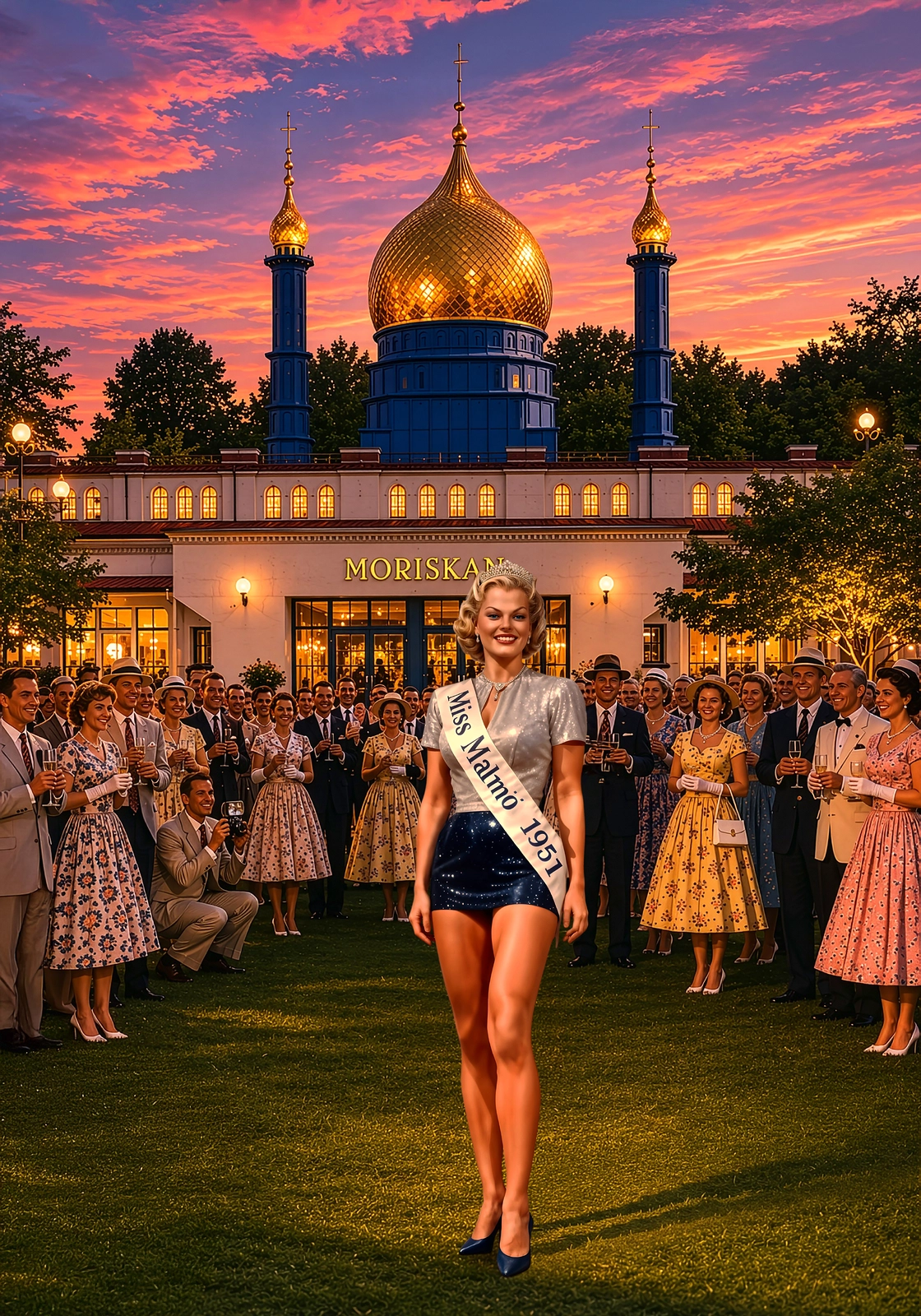
Jörgen Thornberg
Miss Sweden and Svartbäckens reddest rose - Fröken Sverige och Svartbäckens ros, 2026
Digital
50 x 70 cm
3 200 kr
Miss Sweden and Svartbäckens reddest rose - Fröken Sverige och Svartbäckens ros
Svensk text på slutet
Introduction
What does it take to become the world's most beautiful woman?
A beautiful face? A perfect figure? A dazzling smile? Or is it something far harder to definepresence, courage, charisma, and that extraordinary ability to make an entire room fall silent the moment you walk in?
The question is older than most civilisations. The ancient Greeks were already telling stories of gods and mortals competing to be the fairest of them all, and ever since, each age has created its own ideals of beauty. Queens, goddesses, movie stars, fashion models, and beauty queens have succeeded one another as the world has continued to try to answer the same impossible question: Can beauty really be measured?
No other competition has stirred as many emotions as a beauty pageant. It has been celebrated as a gateway to a better life and condemned as a symbol of superficiality and outdated ideals. It has opened doors to Hollywood, politics, and international careers, while also fuelling some of the loudest cultural debates of our time. Yet the fascination endures. Crowns are still awarded, dreams continue to flourish, and every year a new generation of young women steps onto the stage, hoping their lives will be changed forever.
This is the story of that narrative.
Of how beauty pageants were born, how they conquered the world, why they became both loved and hated at the same timeand how they came to change not only my life but also the lives of countless other women.
Behind every crown stands a person.
And behind every person is a story worth telling.
"Svartbäckens reddest rose
They crowned us queens with borrowed grace,
A sash, a smile, a polished face.
We waved like duchesses, poised and bright
Till one high heel declared goodnight.
The judges frowned with solemn pride,
As egos marched four girls abreast.
Each swore that Fate was on her side
And every mother knew the rest.
One measured ankles, one measured hair,
One whispered, "Charm is rather rare."
Another claimed, with learned prose,
"It's posture that outshines the rose."
Yet all their charts and careful scores
Could never settle beauty's wars.
For every crown that's proudly won
Is tarnished by tomorrow's sun.
Except, perhapsso old folks say
For one who danced the northern way;
No jewelled crown upon her brow,
Yet legends still remember how
She laughed as if the world were new,
Turned every raindrop into dew,
And stole each heart before it knew
What hopeless hearts are destined to do.
She was Svartbäcken's Reddest Rose,
A vintage bottled without corks.
No judge could cage, no rule impose,
No trophy fit the way she glowed.
So here's to queens who missed the prize,
Who never conquered headlines' skies.
For ribbons fade and tiaras rust
But roses bloom in memory's trust.
And somewhere, when the lights all close,
The crowd forgets the winner's pose...
Yet softly still, the old tune flows:
"There goes Svartbäcken's Reddest Rose."
Malmö, July 2026
Prologue The Contest Number That Changed Everything
When people hear the name Anita Ekberg, they probably think of a fountain.
They picture the black dress, the icy water, and Federico Fellini's camera. Others think of Hollywood, movie stars, red carpetsor perhaps the scandals. Some may recall the headlines proclaiming me "the most beautiful woman in the world."
But almost no one thinks of a contest number pinned to the dress of a nineteen-year-old girl in Folkets Park, Malmö.
Yet that is where it all began.
Had I not entered the Miss Malmö competition, I would never have become Miss Sweden. Had I not become Miss Sweden, I would never have travelled to America. Had I not travelled to America, I would probably never have signed my contract with Universal Studios, never have made films in Hollywood, and perhaps never have stood shivering in the Trevi Fountain on that unforgettable night when the whole world suddenly knew who Anita Ekberg was.
It is remarkable how an entire life can sometimes be decided in a few minutes on stage.
Beauty pageants have often been dismissed as superficial, vain, or even ridiculous. At times, the criticism has been justified. Yet these competitions have also transformed the lives of thousands of women. They have opened doors to education, careers, and opportunities in film and television that might otherwise never have existed.
My life is a perfect example.
This is not merely the story of crowns, tiaras, and glittering evening gowns.
It is the story of how a curious ideathe notion of asking people to choose the most beautiful woman in the worldcame to change the world in ways most people never imagined.
And it is also the story of how it changed my life.
Miss Malmö
In fact, my journey to Hollywood began long before I became Miss Malmö.
I had already left school and was working as a travelling fashion model for Fougstedts, while earning extra money as a showgirl at the Hippodrome Theatreor simply the Hipp, as everyone called iton Kalendegatan in Malmö. It had a rather mixed reputation. Some called it a den of sin; others thought it was simply the city's most entertaining venue. A few years later, the Pentecostal Church bought the entire building and converted it into a church. Life has a curious sense of humour.
As early as 1949, when I was seventeen, I was elected Miss Hipp. It was hardly a major national competition, but it meant far more to me than I realised at the time. I had already begun working as a model, including assignments for Malmö Mekaniska Trikåfabrik, and the photo shoots grew increasingly frequent. I was no novice in front of a camera. I had learned how to stand, how to tilt my head, how to arch my upper body, where to find the light, and how a single smile could transform an entire photograph.
One of the people who influenced me most was the Malmö photographer Georg Oddner. He had an extraordinary eye and taught me not only how to pose but also how to apply make-up. It was with him that the foundation was laid for the style that would follow me throughout my career. Strong eyebrows sweeping outward like birds' wings, eyeliner, eye shadow, and a generous hand with cosmetics. I never understood why anyone thought make-up should be used sparingly. When applied properly, it hides nothingit simply enhances what nature has already given you. In time, other women began doing the same. What had once been Georg's advice to a young model from Malmö eventually became known as "the Anita look."
Of course, I knew I was tall and attractive, but I wasn't particularly interested in entering a beauty contest. I was happy working as a model. Besides, I was afraid of making a fool of myself.
Then, on a rainy day in 1951, I was walking across Gustav Adolfs Square, my raincoat pulled over my head. There stood Rune Ernestad, a journalist for Vecko-Revyn and the man responsible for the Miss Malmö competition. He was desperately searching for one more contestant for the final at Folkets Park. Apparently, he saw something in me despite my raincoat. He came over and tried to persuade me to enter.
I said no.
I went home and told my mother, who was absolutely thrilled.
"Of course, you're going to enter!"
Once Mother had made up her mind, I didn't have much to say about it. Naturally, I felt flattered, but I was also terrifiednot of losing, but of not winning. After all, nobody wanted to be laughed at.
My father, Gustaf, wasn't particularly pleased that his eldest daughter had already left school to become a fashion model. The idea that I would now parade myself in a beauty contest hardly improved matters. In those days, it was considered rather daring for a respectable middle-class girl to stand on a stage in tight black shorts and a fitted jumper, hoping to be crowned "Miss." Even so, Father drove me to Folkets Park, without fully understanding what he had agreed to.
Mother, on the other hand, had been far-sighted. She made sure that several of my brothers and sisters, along with one of my cousins, were there to cheer me on.
As it turned out, they were hardly needed at all.
When I stepped onto the stage wearing contestant number eight on June 29, 1951, I was greeted by a roar of applause unlike anything I had ever heard. The audience welcomed me as though they had already made up their minds. The judges seemed to feel the same way. I won the Miss Malmö title, and the beloved entertainer Lasse Dahlquist placed the crown on my head.
Suddenly, Malmö felt too small.
A few months later, I was standing in Stockholm, being crowned Miss Sweden. First prize was a ticket to Americaand to the Miss Universe pageant.
I had no idea the ticket would take me far beyond the United States. It would carry me out into the world and, eventually, to Genzano, just outside Rome. The reason was summarised on a single page torn from a notebook. "A Half Sheet of Paper," as the playwright August Strindberg called one of his most famous short stories. In my case, it was not a sheet filled with melancholy memories, but one that quietly mapped out my future.
"I still have the note."
Anita takes out Rune's handwritten notes from their meeting before the Miss Sweden final in Stockholm. He had taken her measurements with the same kind of cloth measuring tape her mother kept in her sewing basket.
"It felt a little strange to have a man I'd never met running his hands over my body, but he seemed completely matter-of-fact about it. I suppose he was used to it. Once he had taken my measurements, he asked a few general questions. Then everything was finished, and he tore the page from his notebook before leaving for another appointment. I was curious about what he had written, so I did something my mother had taught me. Using a pencil from my handbag, I gently shaded the page beneath. The graphite caught in the impressions left by his ballpoint pen, and suddenly I could read every word."
Anita kept the page. Although it had become worn and badly creased over the decades, it was still legible, allowing what he had written seventy-five years earlier to be read.
"Almost 20 years old.
Tall!! An otherworldly beautiful figure.
174 cm. Weight: 59 kg.
Bust: 92 cm. Waist: 62 cm. Hips: 96 cm.
Blue eyes and light blonde poodle-cut hair.
Heart-shaped face, exquisitely sculpted and classically pure.
Peach-like complexion and slender hands with long, graceful fingers. Thoroughbred bones.
An exceptionally captivating smile and dazzlingly white teeth.
Open, friendly and companionable temperament.
Overall impression: A beauty who makes people turn around in the streetwomen as often as men.
"After reading Rune's notes, I thought this would probably work out after all. His comments were very personal, and I found it hard to believe he wrote like that about every contestant. I'd already met all the other girls, and none of them had peach-like skin or my curvesor what Vecko-Revyn's editor-in-chief, Mischa Katz, had described to Rune as 'solidly and wholesomely Scanian.'"
Successes and Misses
You already know how things turned out for me. But perhaps you're wondering what happened to the other young women who were crowned Miss Sweden during the competition's sixty-year history.
There is no simple answer. The same crown, the same title, an enormous bouquet, and a warm embrace from the hostwho, in those days, was always a man. That was how every pageant ended. After that, however, our lives took completely different paths.
Some had probably always dreamed of standing in the spotlight. For them, winning marked the start of a career in show business. One became a television presenter with Sweden's national broadcaster, and another a weather presenter on the same network. One auditioned for a television series and eventually settled in Germany, where she built a successful acting career. Another founded a thriving fashion brand and became an entrepreneur, while yet another trained as a beauty therapist to help women who had not been born beautiful enough to win this particular competition.
Some saw themselves primarily as ambassadors for Sweden. One devoted herself to campaigning for a smoke-free generation and helped reshape Miss Sweden's public image. Several married abroad and built entirely new lives far from home.
But the crown did not always weigh as lightly as it seemed.
One winner later admitted that all the attention had made her afraid of people. She could hardly leave the house without being recognised and judged by strangers who believed they already knew her. In the end, she withdrew from public life and still says that the experience of that single year shaped the rest of her life.
Another observed that, nineteen years after her victory, no one escapes time. The first grey hairs and wrinkles may not be especially welcome, but they come to all of us. A third said something I completely agree with: that appearance becomes less important as the years go by. A few extra pounds either way no longer matter very much. What matters is feeling comfortable in your own skin. "I'm much bigger than I used to beand so what? It's not really fat; it's personal growth," as I once put it.
By the 1990s, long after my own victory, Miss Sweden had become a media phenomenon. The final was broadcast live on national television, and public interest rivalled that of the Eurovision Song Contest. When the winner returned home, entire neighbourhoods lined the streets with banners and flowers. There were celebrations, photographers, and crowds everywhere.
How different it had been in my day. When I landed at Bulltofta Airport after the final in Stockholm, there was no welcoming committee, no fanfare, not even a photographer from the local newspaperonly a taxi booked in advance. I went straight home with the bouquet the singer Lasse Dahlquist had presented to me when he crowned me Miss Malmö. Mother received the flowers, and I received plenty of hugs. I certainly wasn't complaining. After all the excitement in Stockholm, it was rather pleasant to come home in peace. As the old saying goes, "Things were better in the old daysand the older, the better." Compared with what the competition later became, my own experience was almost idyllic. In my view, the pageant gradually lost its way. It became increasingly commercialised, and in the end I felt increasingly sorry for the girls who took part.
Not every fairy tale ended happily. Stalkers harassed some former winners, and some even received death threats. One woman admitted, many years later, that despite all her success, life had never been the bed of roses people imagined. Another went on to win the Miss Universe title and enjoyed an international film career, only for her life to end tragically in a plane crash.
Then there are the little stories that have grown into legends. One Miss Sweden is said to have inspired one of Sweden's most beloved singer-songwriters to write The Red Rose of Svartbäcken. Another remembers less about where she placed in the Miss Universe pageant than about being voted the friendliest contestantand she still laughs about it today.
Perhaps that is the real truth about Miss Sweden. Winning the crown never guaranteed a ready-made life. It merely opened a door. What lay beyond was different for each of us. For some, it led to fame; for others, to a quiet life far from the cameras. And for most of us, as it was for me, it was simply the beginning of a much longer story.
Some women have won both the Miss Sweden and Miss Universe crowns. I finished only sixth in Miss Universe, yet in many ways I had won the real competition. Today, several former Miss Sweden winners are famous for entirely different achievements, and many people have no idea they were once crowned beauty queens. Who cares?
As for me, I paid a high price for my extraordinary journey from a modest working-class home in Malmö to becoming an internationally celebrated star. It is never easy to be a prophet in your own hometown. Perhaps I would have felt more at home in today's multicultural Malmöthe city's last unforgettable diva, if I may say so. Modern society is no longer as easily dazzled as it once was. I sometimes think the divas have become extinct.
A Ticket to Heaven and Hell
"For me, Miss Sweden was never the destination. It was the ticket."
When I competed in Miss Universe in 1951, no one knew how quickly everything was about to change. The pageant I entered was the inaugural unofficial predecessor to the official Miss Universe competition, which launched the following year. When Miss Universe officially began in 1952, I was therefore no longer a contestant but a guestone of the young women who had already attracted international attention.
Even so, it proved to be a decisive autumn. I finished among the six finalists in the unofficial competition and received something far more meaningful than a crown or a sash. I received a contract with Universal Studios in Hollywood.
Suddenly, the world wanted to know who that tall blonde from Malmö really was. Newspapers wrote about my face, my height, and my figure, but they could not see that I was still the same girl from Scania who, only a few months earlier, had been walking through the streets of Malmö, occasionally making people turn for a second look.
Miss Sweden had opened the door, but I still had to find the courage to step through it.
I did so in autumn 1951.
I boarded the plane at Bromma Airport, bound for New York, without knowing a single word of English. Not one. It sounds almost unbelievable today, but it was true. I could smile, nod, and hope people understood what I meanteverything else I had to improvise. But I learned quickly. One word after another became part of everyday life. If I wanted to order a hamburger, looking hungry was usually enough.
After the competition, I worked as a fashion model. Cameras seemed to understand me better than words did, and photo shoots quickly became more frequent. The publicity surrounding the international beauty pageants meant that my name began circulating in Hollywood long before I had even taken my first screen test.
Two years later, I found myself standing in front of a movie camera.
What had begun with a contest number pinned to my sweater in Folkets Park in Malmö had led me all the way to Universal Studios and my Hollywood film debut in 1953.
Sometimes an entire life can change in just a few months. You don't realise it until you look back.
Up Like the Sun, Down Like a Pancake
It has been strange to watch Miss Sweden from a distance since leaving the competition behind. The twists and turns have been many. When I stood on that stage in 1951, no one could have imagined it would become one of Sweden's biggest television events. It was only the third time the competition had been held. After that, everything happened quickly. For many years, the final attracted almost as many viewers as the Eurovision Song Contest does today. The entire country had an opinion on who deserved to win, and overnight the winner became a familiar face. For some, the crown opened the door to an international career. For others, it remained little more than a beautiful memory. Like me, many of my successors have now left this world.
Miss Sweden was born in 1949, only a few years after the war ended. Sweden looked towards the future, and the competition reflected the era's optimism. In the decades that followed, it became a national institution, with young women from across the country competing for the chance to represent Sweden around the world. But society changed, and so did the pageant.
When I competed, everything was much simpler than many people imagine today. We did not arrive with wardrobes full of designer clothesquite the opposite. The judges wanted to assess us as fairly as possible, so we all looked almost identical. We wore white T-shirts and dark shorts. The idea was that no one should be able to impress with expensive clothes or exclusive accessories. We were judged on our posture, physique, presence, and what people then called healthy vitality. For photo shoots and official appearances, we were also given a shared travel wardrobe designed by a Swedish fashion designer. Today that may sound modest, but back then it felt elegant and modern. The truth, however, is that every woman fills out her clothes differentlysomething no pair of shorts or thin T-shirt can ever conceal.
During the 1960s, fashion began to change. Shorts disappeared, replaced by figure-hugging swimsuits made from new stretch fabrics. At the same time, clothes worn outside the competition became brighter, shorter, and more influenced by contemporary fashion. Suddenly, it was no longer only about who you were, but also about how you presented yourself. The miniskirt revolution of the 1960s demanded that one wear the proper undergarments. That would have caused problems for me, because I never liked wearing knickers. I wasn't wearing any beneath my dress in the La Dolce Vita fountain scene either. The dress's daringly high slit could have become a problem, but I found a solution.
During the 1970s and 1980s, the competitions evolved into lavish gala events. Glittering evening gowns, sequins, towering hairstyles, and dramatic silhouettes dominated the stage. Everything became bigger, shinier, and more spectacular. When television turned the pageant into prime-time entertainment in the 1990s, the glamour became even more pronounced. Evening gowns grew more elegant, bikinis often replaced swimsuits, and everything was tailored for the international finals, where television cameras loved glitter almost as much as the audience did.
But the world changed faster than the competition did.
By the beginning of the twenty-first century, it was no longer taken for granted that women should be judged publicly by their appearance. Criticism grew year on year. Feminists and women's organisations described Miss Sweden as an outdated cattle market in which women were reduced to their bodies. They argued that the competition promoted unrealistic beauty ideals and sent the wrong message to young girls.
The conflict became unmistakable at the 2001 final, when activists stormed the stage carrying a banner reading "Dirty Old Men." The protest became a symbol of how profoundly society had changed since my own time. Sponsors began to withdraw, television networks grew increasingly hesitant, and the competition gradually lost its unquestioned place in Swedish popular culture.
The following year, the organisers tried to attract attention by having the contestants wear flesh-coloured underwear covered in body paint instead of traditional swimsuits. The result was not the fresh start they had hoped for, but an even fiercer debate about nudity, the treatment of women, and exploitation. Personally, I thought the whole idea was utterly ridiculousand I've never been shy. Now that was exploitation.
Then came one final attempt to save the pageant. Swimwear entrepreneur Panos Papadopoulos took over Miss Sweden in 2005 and sought to create a modern version in which personality, intelligence, ambition, and eloquence would matter more than body measurements. He even abolished the swimsuit competition, believing that a modern woman should not have to appear in swimwear to be judged.
It was a beautiful idea, but reality proved more complex.
International rules stood in the way. The Miss Universe Organisation, then partly owned by Donald Trump, still required national winners to compete in the swimsuit competition. Sweden wanted change; the world wanted to continue as before. That conflict could not be resolved. A few years later, Miss Sweden disappeared. Whether it is gone forever, only the future can tell.
I have often been asked whether I think it was right for the competition to have disappeared.
My answer has always been that every era has its own ideals. When I competed, I never saw myself as a victimquite the opposite. Miss Sweden allowed me to leave Malmö, discover the world, and build a life I had never dared to dream of. The crown did not define mebut it opened the door. Everything that followed was up to me.
No title in the world can create a career. It can only give you the chance to start. What you do with that opportunity is entirely up to you.
1. When Beauty Became a Competition
If someone asks me what a beauty pageant really is, most people immediately think of the four major international competitionsMiss Universe, Miss World, Miss International, and nowadays Miss Earth. I think first of something far more human: young women trying to look perfectly calm while their hearts are pounding beneath elegant clothes. Behind every tiara is a story, behind every smile are expectations, and behind every crown are far more losers than winners. I know what it feels like because I once stood there myself, a contest number pinned to my chest, with no idea that a few minutes on stage would change my life forever.
The remarkable thing is that beauty pageants have never been only about beauty. They have always reflected their own time, revealing what people admired, which ideals they celebrated, and how they viewed women's role in society. That is why the history of beauty pageants is also the history of how our ideas about beauty, femininity, and power have changed over the centuries.
The ancient Greeks were already fascinated by the idea of choosing the most beautiful woman. Their mythology is filled with stories in which goddesses beauty determines humanitys fate, and the most famous of them all is the Judgment of Paris, in which the prince was asked to choose between Hera, Athena, and Aphrodite. He gave the golden apple to Aphrodite, the goddess of love, and his reward was the most beautiful woman in the world, Helen. The rest is history. Troy fell because someone decided that one goddess was more beautiful than the others. Perhaps that tells us more about human beings than about the gods, for we have hardly changed. And why should we? After all, it is humanity that created the gods in its own imagenot the other way around.
The beauty pageants we know today, however, were born much later. It was not until the nineteenth century that competitions began to be organised in which ordinary young women were judged by a panel and a winner chosen. The first known modern beauty contest was held in 1825 at the Hungarian spa resort of Balatonfüred during the traditional Anna Ball, when the title Belle of the Anna Ball was awarded. A few years later, in 1839, a similar competition was held during the Eglinton Tournament in Scotland. There, Georgiana Seymour, Duchess of Somerset, was proclaimed "Queen of Beauty"a title that sounds as though it belongs in a medieval fairy tale but, in reality, pointed towards something entirely new.
During the second half of the nineteenth century, beauty competitions began to appear in more and more places across Europe. In the Belgian spa town of Spa, an eighteen-year-old woman was crowned "Beauty Queen" in 1888, but the path to the title looked rather different from today. Contestants submitted photographs and a brief description of themselves, after which a panel selected twenty-one finalists to compete for the crown. Even then, it was about more than a beautiful face. The judges also wanted to tell the story of the woman behind the photographsomething that is not so different from today's competitions.
America also began to take an interest in the phenomenon. One of the earliest documented American beauty contests was held in Rehoboth Beach, Delaware, where the organisers sought "the most beautiful unmarried woman in the nation" and awarded her the title of Miss United States. Even so, many people still regarded such competitions as highly questionable. Critics argued that respectable young women should not stand on a stage to be judged on their appearance. In their view, only the vainest women would ever consider entering.
It is almost amusing to think about today. The very competitions once regarded as immoral would, only a few decades later, become family entertainment, be televised live around the world, and transform unknown young women into international stars. But that was still some way off. First, America would turn the beauty pageant into a national pastime and give the world an entirely new kind of queena beauty queen.
2. America Invents the Beauty Queen
It was typical of Americans to turn what Europeans had largely regarded as a pleasant social diversion into a business. During the nineteenth century, several beauty contests were held in both Europe and the United States, but they remained isolated events that drew as much criticism as admiration. It was not until the 1920s that things truly gathered momentum, and, oddly enough, it did not begin with a desire to find the world's most beautiful woman but with a far more down-to-earth problemhow could tourists be persuaded to stay after the summer season had ended?
The answer was Atlantic City, New Jersey. The town relied on its seaside visitors, but as autumn approached, they packed their suitcases and went home. In 1921, the city's business community therefore decided to organise a competition to encourage people to stay a little longer. It was called Miss America, and what had begun as little more than a publicity stunt would soon become the world's most famous national beauty pageant.
The first competition was modest. Only eight young women took part, and the most talked-about event was a swimsuit parade along the boardwalk. Even so, the pageant quickly captured the public imagination. Newspapers covered the contestants, photographers flocked to the event, and crowds grew larger each year. The first winner, Margaret Gorman, became more than simply Miss Americashe became the symbol of a new generation of young women: confident, modern, and ready to take their place in a rapidly changing society.
It is easy to smile at the photographs from those days. The swimsuits covered far more than they do today, the hairstyles seem charmingly modest, and the whole event appears almost intimate compared with today's gigantic television productions. But every era has its own ideals. What one generation considers daring is regarded by the next as perfectly harmless, and beauty pageants have always reflected the times in which they were held.
At the same time, they also began to reshape the public's idea of what a beauty queen could be. Naturally, she was expected not only to be beautiful but also to conduct herself with dignity, represent her hometown or country, and serve as a role model. The crown therefore became more than a reward for a beautiful face. It became a kind of public office.
By the time I began entering beauty contests many years later, that development was already well underway. Of course, we were judged on our appearance. It would be foolish to pretend otherwise. But one quickly learned that kindness, a sense of humour, and the ability to talk to people often mattered just as much. A crown could open doors, but it was your personality that determined whether they stayed open.
During the interwar years, Miss America continued to grow and became a recurring national event. At the same time, similar competitions began to appear elsewhere around the world, although no one had yet conceived of having different countries compete against one another. That idea would not emerge until after the Second World War, when the world longed for peace, optimism, and international encounters rather than conflict. And pretty girls rather than uniforms.
It is difficult to imagine the optimism that characterised the first post-war years. After years of war, people wanted to dance, travel, and go to the cinema again, and, above all, to believe in the future. Film stars, fashion, music, and beauty became symbols of a new era, and it was then that the door opened for the international beauty pageants that would soon transform unknown young women into world-famous celebrities.
I would soon become one of them, though I had no idea at the time, as a young girl from Malmö walking in fashion shows and posing for local advertisements. Hollywood seemed as distant as the moon, and I would never have dared to dream that a beauty pageant would become my ticket there.
3. When the World Wanted to Dream Again
The Second World War had left deep scars, but once peace finally came, people wanted to look forward rather than backward. After years of rationing, uniforms, and blackouts, an almost insatiable hunger arose for everything that symbolised joy and optimism. Movie theatres filled up, fashion flourished, music became livelier, and film stars were transformed into dream figures for an entire generation. It was also in that world that international beauty pageants were born.
In 1951, the first Miss World pageant was held in London, originally as part of the Festival of Britain. The competition was intended as a one-off event, but public enthusiasm was so great that it soon became an annual tradition. That same year also saw the first international competition that would later evolve into Miss Universe. It was not yet the official pageant the world knows today. Still, it became the prelude to the competition, which, the following year, in 1952, was officially launched in its present form by its American organisers. The world now had two international beauty pageants that would soon become as famous as the greatest sporting championships.
It was in the midst of this remarkable development that I found myself, though at the time I mostly felt everything was unfolding unbelievably fast. Two years earlier, I had been chosen Miss Hipp. Then came Miss Malmö, and shortly afterwards Miss Sweden. Suddenly I found myself facing a world I had previously known only from the cinema screen and the glossy pages of weekly magazines.
When I competed in the international pageant in 1951, none of us could have imagined the significance it would eventually have. The following year, it became the official Miss Universe competition, but those of us who had been there from the beginning became part of its history. I finished among the six finalists, and although I did not receive a crown, something entirely different changed my life.
American photographers discovered the tall blonde girl from Malmö. Newspapers began writing about me, cameras turned towards me, and before long came the offer that meant far more than any titlea contract with Universal Studios in Hollywood.
Life has a curious way of working. Many people believe the greatest victory is always winning the competition itself, but sometimes the opposite is true. I never won Miss Universe, and, in truth, it never mattered very much. Had I won, an entire year would have been devoted to official appearances, ribbon-cuttings, charity events, and ceremonial engagements. Instead, I was free to accept well-paid fashion assignments and begin building the career that eventually took me to Hollywood. Looking back, I have sometimes thought it may well have been the best "defeat" I ever experienced.
During the 1950s and 1960s, international pageants grew at an extraordinary pace. More and more countries began organising national competitions to select their representatives for Miss World and Miss Universe, and winning a national title suddenly became a matter of national pride. A beauty queen was no longer expected merely to be beautiful; she was also expected to represent her country with dignity, meet the press, travel the world, and serve as a goodwill ambassador. The crown became a platform for reaching the international stage, where politics, culture, and entertainment often intersected.
I noticed how quickly the world seemed to shrink. One day I was standing on a stage in Sweden; the next I was sitting on an aeroplane bound for America, without knowing a single word of English. It was both frightening and wonderful. I did not always understand what people around me were saying, but the camera did not care about language. It simply saw what it saw, and sometimes that was enough to open doors that would otherwise have remained closed.
For many young women, international beauty pageants became exactly thatan opportunity to leave their small hometowns and discover the world. Some became movie stars, others models, television personalities, or businesswomen. Some returned home wearing a crown; others returned with experiences that proved far more valuable than gold and jewels. Beauty pageants had become a springboard, and no one could longer claim they were only about a beautiful face.
But even as crowns began to sparkle across the world, the image of who was allowed to wear them also began to change. New countries entered the competitions, new ideals emerged, and beauty took on ever more faces. It would soon transform the pageants into a truly global phenomenon.
4. When the Crowns Conquered the World
Once the international beauty pageants had taken root, their growth was almost explosive. One country after another began organising national competitions to select representatives for Miss World and Miss Universe, and within a few decades a global network of pageants had emerged. A crown was no longer merely a personal achievement. For many nations, it became a matter of national pride, much like an Olympic gold medal or a world championship.
I noticed this myself as I began travelling. I soon discovered that people held different ideas about beauty, yet almost everywhere they shared the same dreamthat someone from their own country would succeed. When a contestant won, it was not only her family or hometown that celebrated. Often, an entire nation rejoiced with her.
Nowhere was this more evident than in Latin America, where beauty pageants evolved into something akin to a national sport. Venezuela, in particular, built an almost unbeatable reputation in the second half of the twentieth century. The country produced winners so consistently that the rest of the world began speaking of a genuine "beauty industry." Specialised academies trained young women in everything from posture and interview technique to public speaking, catwalk walking, and confident on-camera performance. When a Venezuelan contestant won Miss Universe or Miss World, she was celebrated as a national heroine, and many went on to successful careers in television, politics, business, or philanthropy.
Beauty pageants also took on unique significance in Asia. When India's Reita Faria won Miss World in 1966, she made history as the first Asian woman to claim the title. Her victory inspired countless young women and showed that international crowns were no longer automatically reserved for Europe or America. A few decades later, Sushmita Sen's win at Miss Universe and Aishwarya Rai's Miss World title sparked near euphoria throughout India. They became symbols of a nation increasingly taking its place on the world stage, and their success sparked a wave of interest in beauty pageants that remains evident today.
Similar enthusiasm can be found in the Philippines, where beauty pageants are followed with a passion usually reserved for major sporting events. When a Filipina contestant reaches the finals, people stay up through the night to watch the live broadcasts, and a victory is celebrated with the same joy as an Olympic medal. There, the crown represents far more than beauty. It becomes proof that even a small nation can stand proudly before the entire world.
At the same time, the winners also began to shift perceptions of what an international beauty queen could look like. When Nigeria's Agbani Darego won Miss World in 2001, she became the first Black African woman to claim the titlea historic victory whose significance extended far beyond the pageant stage. Each new winner from a country or region previously outside the spotlight helped broaden the world's image of beauty and made the international competitions more representative of the world they claimed to represent.
One part of the competitions I particularly enjoyed was the national costume segment. It allowed each country to showcase its history, traditions, and culture. Some of the costumes were undeniably imaginative and wonderfully extravagant, but that was precisely what made them such a colourful part of the international exhibition. In just a few minutes, the audience could travel from Japanese kimonos and Indian saris to South American feathered creations and Nordic folk costumes. Behind all the glamour, there was also a genuine meeting of cultures, and I think many people forget that when they see only the glittering surface.
At the same time, the world was changing in another way. In the 1960s, new ideas about women's role in society emerged, and more and more people began to question whether beauty pageants truly belonged in the modern age. While some countries celebrated their beauty queens as national heroines, demonstrators outside pageant venues in other parts of the world demanded that the entire tradition be abolished. The crowns continued to be awarded, but the debate surrounding them had only just begun.
5. When Beauty Became Politics
Beauty pageants have always reflected the times in which they existed, and perhaps it was inevitable that they would eventually find themselves at the centre of the great social debates of the 1960s and 1970s. The women's movement challenged traditional gender roles, while the sexual revolution transformed attitudes towards women's freedom. More and more people began to ask whether it was reasonable for women to continue to stand on a stage and be judged primarily by their appearance.
The most famous protest took place outside the Miss America pageant in Atlantic City in 1968. While the competition was underway, feminists gathered outside the venue. They threw bras, girdles, high heels, make-up, and other items they described as "instruments of female torture" into a large rubbish bin they called the Freedom Trash Can. The story has often been retold as though the demonstrators burned their bras, but that never actually happened. The myth survived because it made for more dramatic headlines than the truth, yet the message itself was impossible to misunderstand. Women no longer wanted to be judged solely by their appearance.
I have often reflected on that criticism, and the truth is that it was not entirely unfounded. There certainly were competitions in which appearance counted for almost everything, and there were ideals that now seem both narrow and unfair. No one benefits from being constantly compared with others, and no woman should ever be led to believe that her worth depends on the size of her waist or the shape of her face.
But there is another side to the story that is rarely told.
For me, a beauty pageant was not a prisonit was a doorway. Without Miss Malmö, there would never have been a Miss Sweden. Without Miss Sweden, I would never have travelled to America. Without that journey, I would almost certainly never have secured a contract with Universal Studios or made films in Hollywood and Italy. That little contest number I pinned to my dress in Folkets Park changed my entire life.
Of course, I was far from alone. For many young women around the world, beauty pageants became a means of obtaining an education, building a career, or escaping a life with limited prospects. The crown opened doors to television, film, fashion, business, and sometimes even politics. To claim that the pageants were only about appearances would therefore be as misleading as claiming that appearance played no part at all.
Even so, the criticism prompted the organisers to rethink their competitions. Over time, interviews, general knowledge, and personal presentation carried greater weight. Talent competitions gained prominence, and several organisations emphasised that their winners should serve as ambassadors for education, charitable causes, and international understanding, rather than merely be beautiful faces on camera. Miss America, for example, evolved into one of the world's largest scholarship programmes, with education becoming a central part of the competition's identity.
At the same time, perceptions of who could win also began to shift. In 1984, Vanessa Williams made history as the first Black woman to be crowned Miss America. Although her reign was controversial, her victory marked an important step towards a more inclusive ideal and demonstrated that old barriers were beginning to disappear.
Looking back, I am struck by how much beauty pageants have changed. The competitions I took part in would look completely different if they were held today, and that is probably exactly as it should be. Society changes, women change, and therefore the competitions must also change if they wish to remain relevant.
Despite all the criticism, they never disappeared. On the contrary, they continued to attract millions of television viewers worldwide, but entirely new expectations were now placed on them. A beauty queen was no longer expected merely to wear her crown with elegance. She was also expected to have something meaningful to say and to use her position for something that mattered beyond glamour alone. That would shape beauty pageants well into the twenty-first century.
6. A Crown for a New Era
When I look at today's beauty pageants, I sometimes feel as though I am looking at an entirely different world from the one I entered as a young woman. The crowns are still there, as are the glittering evening gowns and the nervous smiles as the envelope is opened, but much else has changed. Society has changed, women's opportunities have changed, and, for that reason, beauty pageants have also been forced to evolve if they are to remain relevant.
Perhaps the greatest difference is that today's contestants are expected to be far more than simply beautiful faces. They use social media to reach millions of people and are given the opportunity to speak about issues that matter to them. Many devote themselves to education, mental health, women's rights, children's welfare, or environmental causes, using the attention that comes with a title to create genuine change. In recent years, Miss Universe has encapsulated that philosophy in the phrase Confidently Beautiful, emphasising self-confidence, personality, and the ability to inspire others just as much as outward appearance.
At the same time, the competitions have become far more inclusive of people from diverse backgrounds. What was once dominated by a narrow ideal of beauty now reflects a much broader share of the world's diversity. One symbolic moment came in 2019, when all of the major American titlesMiss America, Miss USA, Miss Teen USA, Miss Universe, and Miss Worldwere held by Black women. For many, it became powerful proof of how profoundly perceptions of beauty had changed since the first pageants were held.
New competitions have also emerged with entirely different priorities. When Miss Earth was founded in 2001, the emphasis was placed not only on contestants' stage performances but also on their knowledge of environmental and climate issues. Commitment to protecting nature became as important a part of the judging as the traditional stage presentation. Perhaps nothing illustrates more clearly how beauty pageants have continually adapted to the times in which they exist.
People sometimes ask me whether beauty pageants still have a place in todays world. I believe they dobut only if they continue to evolve. The world no longer accepts that women should be judged solely on their appearance, nor should it. At the same time, there is nothing wrong with appreciating beauty, just as there is nothing wrong with appreciating music, art, or dance. The problem arises only when appearance becomes the sole criterion.
For me, a beauty pageant marked the start of a life I could never have planned. It took me from Malmö to Hollywood, then to Rome, and out into a world I had only dreamed of as a teenager. I never won Miss Universe, but I won something far more valuablethe opportunity to shape my own life. That is why I find it so difficult to see beauty pageants as nothing more than superficial. For some women, perhaps they are. For others, they become a springboard to education, careers, friendships, and experiences they might otherwise never have had.
Perhaps that is why beauty pageants continue to exist despite all the criticism and the profound changes the world has undergone since the first contestants walked along the boardwalk in Atlantic City more than a hundred years ago. They are still about dreams that possess a remarkable ability to endure, even when the rules change.
As for the future, of course, no one knows anything. Perhaps the competitions will look entirely different fifty years from now. Perhaps they will move to digital platforms. Perhaps social engagement will carry more weight than ever before. And perhaps the very word beauty will come to mean something broader than it does today.
One thing, however, I am fairly certain of. As long as there are young people who dare to believe in their dreams, there will also be stages to step onto, crowns to be awarded, and new life journeys that begin with a tentative smile before an audience.
My own journey began with a contest number in Malmö.
The rest, you already know.
Epilogue: The Girl Who Was Svartbäcken's Reddest Rose
History is full of people who achieved everything they ever dreamed of, yet were forgotten. It is also full of people who never received what they longed for, yet still left a lasting mark on the world.
Perhaps that is why I have always loved stories where paths cross in unexpected ways.
A few years after I had become Miss Sweden and travelled to America, another young woman stood on the same stage. Her name was Hillevi Rombin. She won Miss Sweden, went on to Miss Universe, and became the first Swedish woman to wear the crown. Afterwards, her journey led her to Hollywood as well. In many ways, she followed the same path I had begun a few years earlier, although our lives eventually took different directions.
Back in Sweden, she left behind a young troubadour named Owe Thörnqvist, who had fallen in love with Hillevi. He never won the woman he dreamed of. Her future carried her farther and farther away. Their love story did not have a happy ending, but it did not truly end either. It simply changed its form.
Owe did what troubadours have always done when life refuses to unfold as they had hoped.
He wrote a song.
There is something beautiful in that thought. A beauty pageant may award a crown that shines for an evening or even a year. A film may make someone famous for life. But a melody can live on long after the competitions have faded into memory and the headlines have disappeared. With a handful of verses, he immortalised the woman he never won, in a way no jury in the world ever could.
I have often thought it says something important about life.
We human beings like to believe that success is about winning. Winning the crown, the prize, the role, or the great love. But sometimes the opposite is true. Sometimes it is precisely what we never receive that becomes something greater. I never won Hillevi, but the world was given Svartbäcken's Reddest Rose. I never won Miss Universe, yet I was given a life that carried me from Malmö to Hollywood, then to Rome, and finally into people's memories in a way no beauty pageant ever could.
That is why I believe the world is far smaller than it appears. A young woman from Malmö and another from Uppsala followed almost the same path across the Atlantic without ever truly knowing one another. One became Sweden's first Miss Universe. The other became the girl in the Trevi Fountain, forever. And somewhere, for all eternity, a young man stands with his guitar, singing a song that outlasts us all.
Perhaps that is the most beautiful lesson of all.
Beauty fades. Fame grows dim. Even the greatest film stars eventually become forgotten photographs in an archive. But a story, a painting, or a song can endure as long as someone is willing to listen.
Perhaps that is precisely why we tell stories.
Inledning
Vad krävs för att bli världens vackraste kvinna?
Ett vackert ansikte? En perfekt figur? Ett bländande leende? Eller handlar det om något betydligt svårare att sätta ord på utstrålning, mod, karisma och den där märkliga förmågan att få ett helt rum att stanna upp när man kliver in?
Frågan är äldre än de flesta civilisationer. Redan de gamla grekerna lät gudar och människor tvista om vem som var den skönaste av dem alla, och sedan dess har varje tid skapat sina egna ideal. Drottningar, gudinnor, filmstjärnor, fotomodeller och skönhetsdrottningar har avlöst varandra, medan världen ständigt har försökt besvara samma omöjliga fråga: Går skönhet verkligen att mäta?
Ingen annan tävling har väckt så många känslor som en skönhetstävling. Den har hyllats som en språngbräda till ett bättre liv och fördömts som ett uttryck för ytlighet och förlegade ideal. Den har öppnat dörrar till Hollywood, politik och internationella karriärer, men också gett upphov till några av vår tids mest högljudda kulturdebatter. Ändå fortsätter människor att fascineras. Kronorna delas fortfarande ut, drömmarna lever vidare och varje år ställer sig nya unga kvinnor på en scen i hopp om att just deras liv ska förändras.
Det här är berättelsen om den historien.
Om hur skönhetstävlingarna föddes, hur de erövrade världen, varför de blev älskade och hatade på samma gång och hur de kom att förändra inte bara mitt liv, utan också livet för otaliga andra kvinnor.
För bakom varje krona finns en människa.
Och bakom varje människa finns en historia värd att berätta.
Prolog Nummerlappen som förändrade allt
När människor hör Anita Ekbergs namn tänker de förmodligen på en fontän.
De ser den svarta klänningen, det kalla vattnet och Federico Fellinis kamera framför sig. Andra tänker på Hollywood, filmstjärnor och röda mattor eller på skandaler. Några minns kanske rubrikerna om "världens vackraste kvinna".
Men nästan ingen tänker på en nummerlapp fastnålad på en nittonårig flicka i Folkets Park i Malmö.
Ändå var det där allt började.
Hade jag inte ställt upp i Fröken Malmö, hade jag aldrig blivit Fröken Sverige. Hade jag inte blivit Fröken Sverige hade jag aldrig rest till Amerika. Hade jag aldrig rest till Amerika hade jag förmodligen aldrig fått mitt kontrakt med Universal Studios, aldrig spelat in filmer i Hollywood och kanske aldrig stått och frusit i Fontana di Trevi den där natten innan hela världen plötsligt visste vem Anita Ekberg var.
Det är märkligt hur ett människoliv ibland avgörs av några minuter på en scen.
Skönhetstävlingar har ofta avfärdats som ytliga, fåfänga eller rent av löjliga. Ibland har kritiken varit berättigad. Men samtidigt har dessa tävlingar förändrat tusentals kvinnors liv. De har öppnat dörrar till utbildning, arbete, film, tv och ett liv som annars kanske aldrig hade blivit möjligt.
Mitt eget liv är ett bra exempel.
Det här är inte bara historien om kronorna, tiarorna och de glittrande galaklänningarna.
Det är berättelsen om hur en märklig idé att låta människor utse världens vackraste kvinna kom att förändra världen på ett sätt som de flesta inte anar.
Och det är också historien om hur den förändrade mitt liv.
Fröken Malmö
Egentligen började min resa mot Hollywood långt innan jag blev Fröken Malmö.
Jag hade redan hunnit lämna skolan och arbetade som resemannekäng för Fougstedts, samtidigt som jag extrajobbade som nummerflicka på Hippodromen eller Hipp, som alla sa på Kalendegatan i Malmö. Det var ett ställe med ett blandat rykte. En del kallade det ett syndens näste, andra tyckte bara att det var stadens roligaste nöjeslokal. Några år senare skulle pingstvännerna köpa hela byggnaden och göra om den till en kyrka. Livet kan ta märkliga svängar.
Redan 1949, när jag var sjutton år, blev jag vald till Miss Hipp. Det var ingen stor nationell tävling, men för mig betydde den mer än jag förstod då. Jag hade redan börjat arbeta som modell, bland annat för Malmö Mekaniska Trikåfabrik, och fotograferingarna blev allt fler. Jag var ingen nybörjare framför kameran. Jag hade lärt mig hur jag skulle stå, hur jag skulle vrida huvudet, puta med överkroppen, var ljuset fanns och hur ett leende kunde förändra en hel bild.
En av dem som betydde mest för mig var Malmöfotografen Georg Oddner. Han hade ett fantastiskt öga och lärde mig inte bara att posera utan också att sminka mig. Det var hos honom grunden lades till den stil som sedan följde mig genom hela karriären. Markerade ögonbryn som svepte ut som fågelvingar, eyeliner, ögonskugga och ett generöst handlag med kosmetikan. Jag har aldrig förstått varför man skulle vara snål med smink. Rätt använt döljer det ingenting det framhäver bara det som naturen redan har gett dig. Med tiden började andra kvinnor göra likadant. Det som en gång hade varit Georgs råd till en ung modell från Malmö blev så småningom det som många kallade "Anita-looken".
Jag visste förstås att jag var lång och såg bra ut, men jag var inte särskilt intresserad av att ställa upp i någon skönhetstävling. Jag arbetade som modell och trivdes med det. Dessutom var jag rädd för att göra bort mig.
Så en regnig dag 1951 kom jag gående över Gustav Adolfs torg med regnkappan uppdragen över huvudet. Där stod Rune Ernestad, journalist på Vecko-Revyn och mannen som ansvarade för Fröken Malmö-tävlingen. Han var på desperat jakt efter ytterligare en deltagare till finalen i Folkets Park. Trots regnkappan såg han tydligen något hos mig. Han kom fram och försökte övertala mig att vara med.
Jag tackade nej.
Jag gick hem och berättade för mamma. Hon blev eld och lågor.
"Det är klart att du ska vara med!"
När mamma väl hade bestämt sig hade jag egentligen inte så mycket att säga till om. Jag kände mig förstås smickrad, men jag var också livrädd. Inte för att förlora utan för att inte vinna. Man ville ju inte bli utskrattad.
Pappa Gustaf var inte särskilt förtjust i att hans äldsta dotter redan hade lämnat skolan för att bli mannekäng. Att jag dessutom nu skulle visa upp mig i en skönhetstävling gjorde knappast saken bättre. På den tiden ansågs det ganska vågat att en ordentlig medelklassflicka stod på en scen i trånga svarta shorts och en åtsittande tröja för att bli utsedd till "Fröken". Men pappa körde mig ändå till Folkets Park, utan att egentligen förstå vad han hade gett sig in på.
Mamma hade däremot varit betydligt mer förutseende. Hon såg till att några av mina syskon och en kusin fanns på plats som hejarklack.
Det hade egentligen inte behövts.
När jag kom ut på scenen med nummer åtta över bröstet den 29 juni 1951 möttes jag av ett jubel som jag aldrig tidigare hade upplevt. Publiken tog emot mig som om de redan hade bestämt sig. Juryn verkade tänka likadant. Jag vann Fröken Malmö och den folkkäre Lasse Dahlquist satte kronan på mitt huvud.
Plötsligt var Malmö för litet.
Några månader senare stod jag i Stockholm och blev Fröken Sverige. Första pris var en biljett till Amerika och Miss Universum.
Jag hade ingen aning om att den biljetten inte bara skulle ta mig till USA. Den skulle ta mig ut i världen och så småningom till Genzano utanför Rom. Anledningen fanns sammanfattad på en sida, riven ur en anteckningsbok. Ett halvt ark papper, som dramatikern Strindberg skrev. I mitt fall inte ett papper med dystra minnen utan ett som stakade ut framtiden.
Jag har lappen kvar." Anita tar upp talangscouten Runes anteckningar efter deras möte inför Fröken Sverigefinalen i Stockholm. Han hade tagit hennes mått med hjälp av samma sorts tygmåttband som hennes mamma hade i sitt syskrin. "Det kändes lite konstigt när en okänd man fingrade över min kropp, men han verkade helt nollställd. Han var väl van, antar jag. När han hade tagit måtten ställde han några allmänna frågor. Sedan var allt klart och han rev ut sidan i anteckningsboken och gick till ett annat möte. Jag var lite nyfiken på vad han skrivit och strök, som jag lärt mig av mamma, med en blyertspenna jag hade i handväskan över pappret. I fördjupningarna som hans kulspetspenna lämnat efter sig i pappret fastnade blyertsens grafit, och jag kunde tydligt läsa hans anteckningar. Anita hade kvar sidan ur anteckningsboken. Även om den var både sliten och skrynklig gick det fortfarande att läsa vad han hade skrivit sjuttiofem år tidigare.
Snart 20 år.
Lång!! Överjordisk skön figur.
174 cm. Vikt: 59 kg.
Byst: 92 cm. Midja: 62 cm. Höfter: 96 cm.
Blå ögon och pudelklippt ljusblont hår.
Hjärtformat ansikte, utsökt skulpterat och klassiskt rent.
Persikohy och smala händer med långa, smidiga fingrar. Rasben.
Mycket intagande leende och blixtrande tänder.
Bussigt, vänligt och kamratligt temperament.
Helhetsintryck: En skönhet som får människor att vända sig om på gatan kvinnor lika ofta som män.
När jag hade läst Runes anteckningar tänkte jag att det här nog skulle gå vägen. Hans noteringar var väldigt personliga och jag hade svårt att tänka mig att han skrev så om alla. Jag hade dessutom träffat alla flickorna, och där fanns varken persikohy eller mina kurvor, eller var skånskt präktig, som jag hört VeckoRevyns chefredaktör Mischa Katz säga till Rune.
Framgångar och missar
Hur det gick för mig vet ni ju redan. Men kanske undrar någon hur det gick för de andra flickorna som en gång kröntes till Fröken Sverige under de 60 år tävlingen varade.
Det finns inget enkelt svar. Samma krona och samma titel, en rejäl blomsterkvast och en jättekram från programledaren, som alltid var en man. Så slutade varje tävling, men sedan gick vi åt helt olika håll.
En del hade nog alltid drömt om att stå i strålkastarljuset. För dem blev segern början på ett liv i nöjesbranschen. Någon blev programledare i den statliga televisionen, en annan väderpresentatör på samma ställe. En fick provspela för en tv-serie och hamnade så småningom i Tyskland där hon gjorde skådespelarkarriär. En byggde upp ett framgångsrikt klädmärke och blev entreprenör, medan en annan valde att utbilda sig till skönhetsterapeut för att hjälpa kvinnor som inte har råkat födas vackra nog för att vinna den här tävlingen.
Några såg sig framför allt som ambassadörer för Sverige. En arbetade engagerat för en rökfri generation och var med och förändrade bilden av Fröken Sverige. Flera gifte sig utomlands och skapade helt nya liv långt från Sverige.
Men kronan vägde inte alltid lika lätt som den såg ut.
En av vinnarna berättade efteråt att hon blev folkskygg av all uppmärksamhet. Hon kunde knappt gå ut utan att bli igenkänd och analyserad av människor som trodde att de redan visste vem hon var. Till slut drog hon sig undan och säger än i dag att det där året kom att prägla resten av livet.
En annan konstaterade, nitton år efter sin seger, att ingen kommer undan tiden. De första grå hårstråna och de första rynkorna är kanske inte så roliga, men de kommer till oss alla. En tredje sa något som jag faktiskt håller med om: att utseendet med åren blir mindre viktigt. Om vågen visar några kilo mer eller mindre spelar det inte så stor roll längre. Det viktiga är att man trivs med sig själv. "Jag är mycket större än jag var, och vadå då? Det är egentligen inte fetma, det är utveckling", uttryckte jag det själv.
Långt efter att jag vann på 1990-talet hade Fröken Sverige blivit ett mediefenomen. Finalen direktsändes i tv och intresset var nästan i klass med Melodifestivalen. När vinnaren kom hem kunde hela kvarteret stå ute på gatan med plakat och blommor. Det var fest, fotografer och folk överallt.
Hur annorlunda det är jämfört med förr. När jag landade på Bulltofta efter finalen i Stockholm väntade ingen mottagningskommitté, inga pukor och trumpeter eller ens en fotograf från någon lokaltidning, utan bara en förbeställd taxi. Jag åkte raka vägen hem i en taxi med blombuketten jag fått av sångaren Lasse Dahlquist när han krönte mig. Blommorna fick mor och jag en massa kramar. Jag beklagar mig verkligen inte, för det var skönt att slippa all uppståndelse som varit i Stockholm. Ibland är det som man säger: bättre förr och ju förr, dess bättre. När jag vann var det jäm
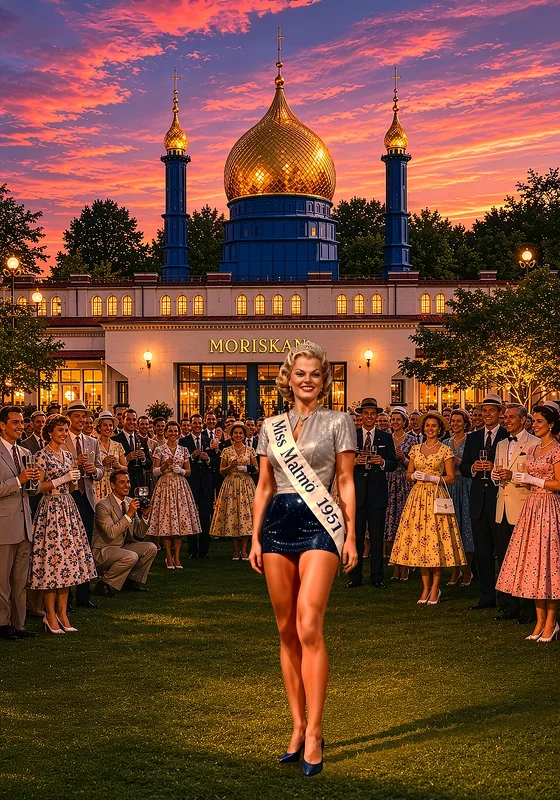
Jörgen Thornberg
Miss Sweden and Svartbäckens reddest rose - Fröken Sverige och Svartbäckens ros, 2026
Digital
50 x 70 cm
3 200 kr
Miss Sweden and Svartbäckens reddest rose - Fröken Sverige och Svartbäckens ros
Svensk text på slutet
Introduction
What does it take to become the world's most beautiful woman?
A beautiful face? A perfect figure? A dazzling smile? Or is it something far harder to definepresence, courage, charisma, and that extraordinary ability to make an entire room fall silent the moment you walk in?
The question is older than most civilisations. The ancient Greeks were already telling stories of gods and mortals competing to be the fairest of them all, and ever since, each age has created its own ideals of beauty. Queens, goddesses, movie stars, fashion models, and beauty queens have succeeded one another as the world has continued to try to answer the same impossible question: Can beauty really be measured?
No other competition has stirred as many emotions as a beauty pageant. It has been celebrated as a gateway to a better life and condemned as a symbol of superficiality and outdated ideals. It has opened doors to Hollywood, politics, and international careers, while also fuelling some of the loudest cultural debates of our time. Yet the fascination endures. Crowns are still awarded, dreams continue to flourish, and every year a new generation of young women steps onto the stage, hoping their lives will be changed forever.
This is the story of that narrative.
Of how beauty pageants were born, how they conquered the world, why they became both loved and hated at the same timeand how they came to change not only my life but also the lives of countless other women.
Behind every crown stands a person.
And behind every person is a story worth telling.
"Svartbäckens reddest rose
They crowned us queens with borrowed grace,
A sash, a smile, a polished face.
We waved like duchesses, poised and bright
Till one high heel declared goodnight.
The judges frowned with solemn pride,
As egos marched four girls abreast.
Each swore that Fate was on her side
And every mother knew the rest.
One measured ankles, one measured hair,
One whispered, "Charm is rather rare."
Another claimed, with learned prose,
"It's posture that outshines the rose."
Yet all their charts and careful scores
Could never settle beauty's wars.
For every crown that's proudly won
Is tarnished by tomorrow's sun.
Except, perhapsso old folks say
For one who danced the northern way;
No jewelled crown upon her brow,
Yet legends still remember how
She laughed as if the world were new,
Turned every raindrop into dew,
And stole each heart before it knew
What hopeless hearts are destined to do.
She was Svartbäcken's Reddest Rose,
A vintage bottled without corks.
No judge could cage, no rule impose,
No trophy fit the way she glowed.
So here's to queens who missed the prize,
Who never conquered headlines' skies.
For ribbons fade and tiaras rust
But roses bloom in memory's trust.
And somewhere, when the lights all close,
The crowd forgets the winner's pose...
Yet softly still, the old tune flows:
"There goes Svartbäcken's Reddest Rose."
Malmö, July 2026
Prologue The Contest Number That Changed Everything
When people hear the name Anita Ekberg, they probably think of a fountain.
They picture the black dress, the icy water, and Federico Fellini's camera. Others think of Hollywood, movie stars, red carpetsor perhaps the scandals. Some may recall the headlines proclaiming me "the most beautiful woman in the world."
But almost no one thinks of a contest number pinned to the dress of a nineteen-year-old girl in Folkets Park, Malmö.
Yet that is where it all began.
Had I not entered the Miss Malmö competition, I would never have become Miss Sweden. Had I not become Miss Sweden, I would never have travelled to America. Had I not travelled to America, I would probably never have signed my contract with Universal Studios, never have made films in Hollywood, and perhaps never have stood shivering in the Trevi Fountain on that unforgettable night when the whole world suddenly knew who Anita Ekberg was.
It is remarkable how an entire life can sometimes be decided in a few minutes on stage.
Beauty pageants have often been dismissed as superficial, vain, or even ridiculous. At times, the criticism has been justified. Yet these competitions have also transformed the lives of thousands of women. They have opened doors to education, careers, and opportunities in film and television that might otherwise never have existed.
My life is a perfect example.
This is not merely the story of crowns, tiaras, and glittering evening gowns.
It is the story of how a curious ideathe notion of asking people to choose the most beautiful woman in the worldcame to change the world in ways most people never imagined.
And it is also the story of how it changed my life.
Miss Malmö
In fact, my journey to Hollywood began long before I became Miss Malmö.
I had already left school and was working as a travelling fashion model for Fougstedts, while earning extra money as a showgirl at the Hippodrome Theatreor simply the Hipp, as everyone called iton Kalendegatan in Malmö. It had a rather mixed reputation. Some called it a den of sin; others thought it was simply the city's most entertaining venue. A few years later, the Pentecostal Church bought the entire building and converted it into a church. Life has a curious sense of humour.
As early as 1949, when I was seventeen, I was elected Miss Hipp. It was hardly a major national competition, but it meant far more to me than I realised at the time. I had already begun working as a model, including assignments for Malmö Mekaniska Trikåfabrik, and the photo shoots grew increasingly frequent. I was no novice in front of a camera. I had learned how to stand, how to tilt my head, how to arch my upper body, where to find the light, and how a single smile could transform an entire photograph.
One of the people who influenced me most was the Malmö photographer Georg Oddner. He had an extraordinary eye and taught me not only how to pose but also how to apply make-up. It was with him that the foundation was laid for the style that would follow me throughout my career. Strong eyebrows sweeping outward like birds' wings, eyeliner, eye shadow, and a generous hand with cosmetics. I never understood why anyone thought make-up should be used sparingly. When applied properly, it hides nothingit simply enhances what nature has already given you. In time, other women began doing the same. What had once been Georg's advice to a young model from Malmö eventually became known as "the Anita look."
Of course, I knew I was tall and attractive, but I wasn't particularly interested in entering a beauty contest. I was happy working as a model. Besides, I was afraid of making a fool of myself.
Then, on a rainy day in 1951, I was walking across Gustav Adolfs Square, my raincoat pulled over my head. There stood Rune Ernestad, a journalist for Vecko-Revyn and the man responsible for the Miss Malmö competition. He was desperately searching for one more contestant for the final at Folkets Park. Apparently, he saw something in me despite my raincoat. He came over and tried to persuade me to enter.
I said no.
I went home and told my mother, who was absolutely thrilled.
"Of course, you're going to enter!"
Once Mother had made up her mind, I didn't have much to say about it. Naturally, I felt flattered, but I was also terrifiednot of losing, but of not winning. After all, nobody wanted to be laughed at.
My father, Gustaf, wasn't particularly pleased that his eldest daughter had already left school to become a fashion model. The idea that I would now parade myself in a beauty contest hardly improved matters. In those days, it was considered rather daring for a respectable middle-class girl to stand on a stage in tight black shorts and a fitted jumper, hoping to be crowned "Miss." Even so, Father drove me to Folkets Park, without fully understanding what he had agreed to.
Mother, on the other hand, had been far-sighted. She made sure that several of my brothers and sisters, along with one of my cousins, were there to cheer me on.
As it turned out, they were hardly needed at all.
When I stepped onto the stage wearing contestant number eight on June 29, 1951, I was greeted by a roar of applause unlike anything I had ever heard. The audience welcomed me as though they had already made up their minds. The judges seemed to feel the same way. I won the Miss Malmö title, and the beloved entertainer Lasse Dahlquist placed the crown on my head.
Suddenly, Malmö felt too small.
A few months later, I was standing in Stockholm, being crowned Miss Sweden. First prize was a ticket to Americaand to the Miss Universe pageant.
I had no idea the ticket would take me far beyond the United States. It would carry me out into the world and, eventually, to Genzano, just outside Rome. The reason was summarised on a single page torn from a notebook. "A Half Sheet of Paper," as the playwright August Strindberg called one of his most famous short stories. In my case, it was not a sheet filled with melancholy memories, but one that quietly mapped out my future.
"I still have the note."
Anita takes out Rune's handwritten notes from their meeting before the Miss Sweden final in Stockholm. He had taken her measurements with the same kind of cloth measuring tape her mother kept in her sewing basket.
"It felt a little strange to have a man I'd never met running his hands over my body, but he seemed completely matter-of-fact about it. I suppose he was used to it. Once he had taken my measurements, he asked a few general questions. Then everything was finished, and he tore the page from his notebook before leaving for another appointment. I was curious about what he had written, so I did something my mother had taught me. Using a pencil from my handbag, I gently shaded the page beneath. The graphite caught in the impressions left by his ballpoint pen, and suddenly I could read every word."
Anita kept the page. Although it had become worn and badly creased over the decades, it was still legible, allowing what he had written seventy-five years earlier to be read.
"Almost 20 years old.
Tall!! An otherworldly beautiful figure.
174 cm. Weight: 59 kg.
Bust: 92 cm. Waist: 62 cm. Hips: 96 cm.
Blue eyes and light blonde poodle-cut hair.
Heart-shaped face, exquisitely sculpted and classically pure.
Peach-like complexion and slender hands with long, graceful fingers. Thoroughbred bones.
An exceptionally captivating smile and dazzlingly white teeth.
Open, friendly and companionable temperament.
Overall impression: A beauty who makes people turn around in the streetwomen as often as men.
"After reading Rune's notes, I thought this would probably work out after all. His comments were very personal, and I found it hard to believe he wrote like that about every contestant. I'd already met all the other girls, and none of them had peach-like skin or my curvesor what Vecko-Revyn's editor-in-chief, Mischa Katz, had described to Rune as 'solidly and wholesomely Scanian.'"
Successes and Misses
You already know how things turned out for me. But perhaps you're wondering what happened to the other young women who were crowned Miss Sweden during the competition's sixty-year history.
There is no simple answer. The same crown, the same title, an enormous bouquet, and a warm embrace from the hostwho, in those days, was always a man. That was how every pageant ended. After that, however, our lives took completely different paths.
Some had probably always dreamed of standing in the spotlight. For them, winning marked the start of a career in show business. One became a television presenter with Sweden's national broadcaster, and another a weather presenter on the same network. One auditioned for a television series and eventually settled in Germany, where she built a successful acting career. Another founded a thriving fashion brand and became an entrepreneur, while yet another trained as a beauty therapist to help women who had not been born beautiful enough to win this particular competition.
Some saw themselves primarily as ambassadors for Sweden. One devoted herself to campaigning for a smoke-free generation and helped reshape Miss Sweden's public image. Several married abroad and built entirely new lives far from home.
But the crown did not always weigh as lightly as it seemed.
One winner later admitted that all the attention had made her afraid of people. She could hardly leave the house without being recognised and judged by strangers who believed they already knew her. In the end, she withdrew from public life and still says that the experience of that single year shaped the rest of her life.
Another observed that, nineteen years after her victory, no one escapes time. The first grey hairs and wrinkles may not be especially welcome, but they come to all of us. A third said something I completely agree with: that appearance becomes less important as the years go by. A few extra pounds either way no longer matter very much. What matters is feeling comfortable in your own skin. "I'm much bigger than I used to beand so what? It's not really fat; it's personal growth," as I once put it.
By the 1990s, long after my own victory, Miss Sweden had become a media phenomenon. The final was broadcast live on national television, and public interest rivalled that of the Eurovision Song Contest. When the winner returned home, entire neighbourhoods lined the streets with banners and flowers. There were celebrations, photographers, and crowds everywhere.
How different it had been in my day. When I landed at Bulltofta Airport after the final in Stockholm, there was no welcoming committee, no fanfare, not even a photographer from the local newspaperonly a taxi booked in advance. I went straight home with the bouquet the singer Lasse Dahlquist had presented to me when he crowned me Miss Malmö. Mother received the flowers, and I received plenty of hugs. I certainly wasn't complaining. After all the excitement in Stockholm, it was rather pleasant to come home in peace. As the old saying goes, "Things were better in the old daysand the older, the better." Compared with what the competition later became, my own experience was almost idyllic. In my view, the pageant gradually lost its way. It became increasingly commercialised, and in the end I felt increasingly sorry for the girls who took part.
Not every fairy tale ended happily. Stalkers harassed some former winners, and some even received death threats. One woman admitted, many years later, that despite all her success, life had never been the bed of roses people imagined. Another went on to win the Miss Universe title and enjoyed an international film career, only for her life to end tragically in a plane crash.
Then there are the little stories that have grown into legends. One Miss Sweden is said to have inspired one of Sweden's most beloved singer-songwriters to write The Red Rose of Svartbäcken. Another remembers less about where she placed in the Miss Universe pageant than about being voted the friendliest contestantand she still laughs about it today.
Perhaps that is the real truth about Miss Sweden. Winning the crown never guaranteed a ready-made life. It merely opened a door. What lay beyond was different for each of us. For some, it led to fame; for others, to a quiet life far from the cameras. And for most of us, as it was for me, it was simply the beginning of a much longer story.
Some women have won both the Miss Sweden and Miss Universe crowns. I finished only sixth in Miss Universe, yet in many ways I had won the real competition. Today, several former Miss Sweden winners are famous for entirely different achievements, and many people have no idea they were once crowned beauty queens. Who cares?
As for me, I paid a high price for my extraordinary journey from a modest working-class home in Malmö to becoming an internationally celebrated star. It is never easy to be a prophet in your own hometown. Perhaps I would have felt more at home in today's multicultural Malmöthe city's last unforgettable diva, if I may say so. Modern society is no longer as easily dazzled as it once was. I sometimes think the divas have become extinct.
A Ticket to Heaven and Hell
"For me, Miss Sweden was never the destination. It was the ticket."
When I competed in Miss Universe in 1951, no one knew how quickly everything was about to change. The pageant I entered was the inaugural unofficial predecessor to the official Miss Universe competition, which launched the following year. When Miss Universe officially began in 1952, I was therefore no longer a contestant but a guestone of the young women who had already attracted international attention.
Even so, it proved to be a decisive autumn. I finished among the six finalists in the unofficial competition and received something far more meaningful than a crown or a sash. I received a contract with Universal Studios in Hollywood.
Suddenly, the world wanted to know who that tall blonde from Malmö really was. Newspapers wrote about my face, my height, and my figure, but they could not see that I was still the same girl from Scania who, only a few months earlier, had been walking through the streets of Malmö, occasionally making people turn for a second look.
Miss Sweden had opened the door, but I still had to find the courage to step through it.
I did so in autumn 1951.
I boarded the plane at Bromma Airport, bound for New York, without knowing a single word of English. Not one. It sounds almost unbelievable today, but it was true. I could smile, nod, and hope people understood what I meanteverything else I had to improvise. But I learned quickly. One word after another became part of everyday life. If I wanted to order a hamburger, looking hungry was usually enough.
After the competition, I worked as a fashion model. Cameras seemed to understand me better than words did, and photo shoots quickly became more frequent. The publicity surrounding the international beauty pageants meant that my name began circulating in Hollywood long before I had even taken my first screen test.
Two years later, I found myself standing in front of a movie camera.
What had begun with a contest number pinned to my sweater in Folkets Park in Malmö had led me all the way to Universal Studios and my Hollywood film debut in 1953.
Sometimes an entire life can change in just a few months. You don't realise it until you look back.
Up Like the Sun, Down Like a Pancake
It has been strange to watch Miss Sweden from a distance since leaving the competition behind. The twists and turns have been many. When I stood on that stage in 1951, no one could have imagined it would become one of Sweden's biggest television events. It was only the third time the competition had been held. After that, everything happened quickly. For many years, the final attracted almost as many viewers as the Eurovision Song Contest does today. The entire country had an opinion on who deserved to win, and overnight the winner became a familiar face. For some, the crown opened the door to an international career. For others, it remained little more than a beautiful memory. Like me, many of my successors have now left this world.
Miss Sweden was born in 1949, only a few years after the war ended. Sweden looked towards the future, and the competition reflected the era's optimism. In the decades that followed, it became a national institution, with young women from across the country competing for the chance to represent Sweden around the world. But society changed, and so did the pageant.
When I competed, everything was much simpler than many people imagine today. We did not arrive with wardrobes full of designer clothesquite the opposite. The judges wanted to assess us as fairly as possible, so we all looked almost identical. We wore white T-shirts and dark shorts. The idea was that no one should be able to impress with expensive clothes or exclusive accessories. We were judged on our posture, physique, presence, and what people then called healthy vitality. For photo shoots and official appearances, we were also given a shared travel wardrobe designed by a Swedish fashion designer. Today that may sound modest, but back then it felt elegant and modern. The truth, however, is that every woman fills out her clothes differentlysomething no pair of shorts or thin T-shirt can ever conceal.
During the 1960s, fashion began to change. Shorts disappeared, replaced by figure-hugging swimsuits made from new stretch fabrics. At the same time, clothes worn outside the competition became brighter, shorter, and more influenced by contemporary fashion. Suddenly, it was no longer only about who you were, but also about how you presented yourself. The miniskirt revolution of the 1960s demanded that one wear the proper undergarments. That would have caused problems for me, because I never liked wearing knickers. I wasn't wearing any beneath my dress in the La Dolce Vita fountain scene either. The dress's daringly high slit could have become a problem, but I found a solution.
During the 1970s and 1980s, the competitions evolved into lavish gala events. Glittering evening gowns, sequins, towering hairstyles, and dramatic silhouettes dominated the stage. Everything became bigger, shinier, and more spectacular. When television turned the pageant into prime-time entertainment in the 1990s, the glamour became even more pronounced. Evening gowns grew more elegant, bikinis often replaced swimsuits, and everything was tailored for the international finals, where television cameras loved glitter almost as much as the audience did.
But the world changed faster than the competition did.
By the beginning of the twenty-first century, it was no longer taken for granted that women should be judged publicly by their appearance. Criticism grew year on year. Feminists and women's organisations described Miss Sweden as an outdated cattle market in which women were reduced to their bodies. They argued that the competition promoted unrealistic beauty ideals and sent the wrong message to young girls.
The conflict became unmistakable at the 2001 final, when activists stormed the stage carrying a banner reading "Dirty Old Men." The protest became a symbol of how profoundly society had changed since my own time. Sponsors began to withdraw, television networks grew increasingly hesitant, and the competition gradually lost its unquestioned place in Swedish popular culture.
The following year, the organisers tried to attract attention by having the contestants wear flesh-coloured underwear covered in body paint instead of traditional swimsuits. The result was not the fresh start they had hoped for, but an even fiercer debate about nudity, the treatment of women, and exploitation. Personally, I thought the whole idea was utterly ridiculousand I've never been shy. Now that was exploitation.
Then came one final attempt to save the pageant. Swimwear entrepreneur Panos Papadopoulos took over Miss Sweden in 2005 and sought to create a modern version in which personality, intelligence, ambition, and eloquence would matter more than body measurements. He even abolished the swimsuit competition, believing that a modern woman should not have to appear in swimwear to be judged.
It was a beautiful idea, but reality proved more complex.
International rules stood in the way. The Miss Universe Organisation, then partly owned by Donald Trump, still required national winners to compete in the swimsuit competition. Sweden wanted change; the world wanted to continue as before. That conflict could not be resolved. A few years later, Miss Sweden disappeared. Whether it is gone forever, only the future can tell.
I have often been asked whether I think it was right for the competition to have disappeared.
My answer has always been that every era has its own ideals. When I competed, I never saw myself as a victimquite the opposite. Miss Sweden allowed me to leave Malmö, discover the world, and build a life I had never dared to dream of. The crown did not define mebut it opened the door. Everything that followed was up to me.
No title in the world can create a career. It can only give you the chance to start. What you do with that opportunity is entirely up to you.
1. When Beauty Became a Competition
If someone asks me what a beauty pageant really is, most people immediately think of the four major international competitionsMiss Universe, Miss World, Miss International, and nowadays Miss Earth. I think first of something far more human: young women trying to look perfectly calm while their hearts are pounding beneath elegant clothes. Behind every tiara is a story, behind every smile are expectations, and behind every crown are far more losers than winners. I know what it feels like because I once stood there myself, a contest number pinned to my chest, with no idea that a few minutes on stage would change my life forever.
The remarkable thing is that beauty pageants have never been only about beauty. They have always reflected their own time, revealing what people admired, which ideals they celebrated, and how they viewed women's role in society. That is why the history of beauty pageants is also the history of how our ideas about beauty, femininity, and power have changed over the centuries.
The ancient Greeks were already fascinated by the idea of choosing the most beautiful woman. Their mythology is filled with stories in which goddesses beauty determines humanitys fate, and the most famous of them all is the Judgment of Paris, in which the prince was asked to choose between Hera, Athena, and Aphrodite. He gave the golden apple to Aphrodite, the goddess of love, and his reward was the most beautiful woman in the world, Helen. The rest is history. Troy fell because someone decided that one goddess was more beautiful than the others. Perhaps that tells us more about human beings than about the gods, for we have hardly changed. And why should we? After all, it is humanity that created the gods in its own imagenot the other way around.
The beauty pageants we know today, however, were born much later. It was not until the nineteenth century that competitions began to be organised in which ordinary young women were judged by a panel and a winner chosen. The first known modern beauty contest was held in 1825 at the Hungarian spa resort of Balatonfüred during the traditional Anna Ball, when the title Belle of the Anna Ball was awarded. A few years later, in 1839, a similar competition was held during the Eglinton Tournament in Scotland. There, Georgiana Seymour, Duchess of Somerset, was proclaimed "Queen of Beauty"a title that sounds as though it belongs in a medieval fairy tale but, in reality, pointed towards something entirely new.
During the second half of the nineteenth century, beauty competitions began to appear in more and more places across Europe. In the Belgian spa town of Spa, an eighteen-year-old woman was crowned "Beauty Queen" in 1888, but the path to the title looked rather different from today. Contestants submitted photographs and a brief description of themselves, after which a panel selected twenty-one finalists to compete for the crown. Even then, it was about more than a beautiful face. The judges also wanted to tell the story of the woman behind the photographsomething that is not so different from today's competitions.
America also began to take an interest in the phenomenon. One of the earliest documented American beauty contests was held in Rehoboth Beach, Delaware, where the organisers sought "the most beautiful unmarried woman in the nation" and awarded her the title of Miss United States. Even so, many people still regarded such competitions as highly questionable. Critics argued that respectable young women should not stand on a stage to be judged on their appearance. In their view, only the vainest women would ever consider entering.
It is almost amusing to think about today. The very competitions once regarded as immoral would, only a few decades later, become family entertainment, be televised live around the world, and transform unknown young women into international stars. But that was still some way off. First, America would turn the beauty pageant into a national pastime and give the world an entirely new kind of queena beauty queen.
2. America Invents the Beauty Queen
It was typical of Americans to turn what Europeans had largely regarded as a pleasant social diversion into a business. During the nineteenth century, several beauty contests were held in both Europe and the United States, but they remained isolated events that drew as much criticism as admiration. It was not until the 1920s that things truly gathered momentum, and, oddly enough, it did not begin with a desire to find the world's most beautiful woman but with a far more down-to-earth problemhow could tourists be persuaded to stay after the summer season had ended?
The answer was Atlantic City, New Jersey. The town relied on its seaside visitors, but as autumn approached, they packed their suitcases and went home. In 1921, the city's business community therefore decided to organise a competition to encourage people to stay a little longer. It was called Miss America, and what had begun as little more than a publicity stunt would soon become the world's most famous national beauty pageant.
The first competition was modest. Only eight young women took part, and the most talked-about event was a swimsuit parade along the boardwalk. Even so, the pageant quickly captured the public imagination. Newspapers covered the contestants, photographers flocked to the event, and crowds grew larger each year. The first winner, Margaret Gorman, became more than simply Miss Americashe became the symbol of a new generation of young women: confident, modern, and ready to take their place in a rapidly changing society.
It is easy to smile at the photographs from those days. The swimsuits covered far more than they do today, the hairstyles seem charmingly modest, and the whole event appears almost intimate compared with today's gigantic television productions. But every era has its own ideals. What one generation considers daring is regarded by the next as perfectly harmless, and beauty pageants have always reflected the times in which they were held.
At the same time, they also began to reshape the public's idea of what a beauty queen could be. Naturally, she was expected not only to be beautiful but also to conduct herself with dignity, represent her hometown or country, and serve as a role model. The crown therefore became more than a reward for a beautiful face. It became a kind of public office.
By the time I began entering beauty contests many years later, that development was already well underway. Of course, we were judged on our appearance. It would be foolish to pretend otherwise. But one quickly learned that kindness, a sense of humour, and the ability to talk to people often mattered just as much. A crown could open doors, but it was your personality that determined whether they stayed open.
During the interwar years, Miss America continued to grow and became a recurring national event. At the same time, similar competitions began to appear elsewhere around the world, although no one had yet conceived of having different countries compete against one another. That idea would not emerge until after the Second World War, when the world longed for peace, optimism, and international encounters rather than conflict. And pretty girls rather than uniforms.
It is difficult to imagine the optimism that characterised the first post-war years. After years of war, people wanted to dance, travel, and go to the cinema again, and, above all, to believe in the future. Film stars, fashion, music, and beauty became symbols of a new era, and it was then that the door opened for the international beauty pageants that would soon transform unknown young women into world-famous celebrities.
I would soon become one of them, though I had no idea at the time, as a young girl from Malmö walking in fashion shows and posing for local advertisements. Hollywood seemed as distant as the moon, and I would never have dared to dream that a beauty pageant would become my ticket there.
3. When the World Wanted to Dream Again
The Second World War had left deep scars, but once peace finally came, people wanted to look forward rather than backward. After years of rationing, uniforms, and blackouts, an almost insatiable hunger arose for everything that symbolised joy and optimism. Movie theatres filled up, fashion flourished, music became livelier, and film stars were transformed into dream figures for an entire generation. It was also in that world that international beauty pageants were born.
In 1951, the first Miss World pageant was held in London, originally as part of the Festival of Britain. The competition was intended as a one-off event, but public enthusiasm was so great that it soon became an annual tradition. That same year also saw the first international competition that would later evolve into Miss Universe. It was not yet the official pageant the world knows today. Still, it became the prelude to the competition, which, the following year, in 1952, was officially launched in its present form by its American organisers. The world now had two international beauty pageants that would soon become as famous as the greatest sporting championships.
It was in the midst of this remarkable development that I found myself, though at the time I mostly felt everything was unfolding unbelievably fast. Two years earlier, I had been chosen Miss Hipp. Then came Miss Malmö, and shortly afterwards Miss Sweden. Suddenly I found myself facing a world I had previously known only from the cinema screen and the glossy pages of weekly magazines.
When I competed in the international pageant in 1951, none of us could have imagined the significance it would eventually have. The following year, it became the official Miss Universe competition, but those of us who had been there from the beginning became part of its history. I finished among the six finalists, and although I did not receive a crown, something entirely different changed my life.
American photographers discovered the tall blonde girl from Malmö. Newspapers began writing about me, cameras turned towards me, and before long came the offer that meant far more than any titlea contract with Universal Studios in Hollywood.
Life has a curious way of working. Many people believe the greatest victory is always winning the competition itself, but sometimes the opposite is true. I never won Miss Universe, and, in truth, it never mattered very much. Had I won, an entire year would have been devoted to official appearances, ribbon-cuttings, charity events, and ceremonial engagements. Instead, I was free to accept well-paid fashion assignments and begin building the career that eventually took me to Hollywood. Looking back, I have sometimes thought it may well have been the best "defeat" I ever experienced.
During the 1950s and 1960s, international pageants grew at an extraordinary pace. More and more countries began organising national competitions to select their representatives for Miss World and Miss Universe, and winning a national title suddenly became a matter of national pride. A beauty queen was no longer expected merely to be beautiful; she was also expected to represent her country with dignity, meet the press, travel the world, and serve as a goodwill ambassador. The crown became a platform for reaching the international stage, where politics, culture, and entertainment often intersected.
I noticed how quickly the world seemed to shrink. One day I was standing on a stage in Sweden; the next I was sitting on an aeroplane bound for America, without knowing a single word of English. It was both frightening and wonderful. I did not always understand what people around me were saying, but the camera did not care about language. It simply saw what it saw, and sometimes that was enough to open doors that would otherwise have remained closed.
For many young women, international beauty pageants became exactly thatan opportunity to leave their small hometowns and discover the world. Some became movie stars, others models, television personalities, or businesswomen. Some returned home wearing a crown; others returned with experiences that proved far more valuable than gold and jewels. Beauty pageants had become a springboard, and no one could longer claim they were only about a beautiful face.
But even as crowns began to sparkle across the world, the image of who was allowed to wear them also began to change. New countries entered the competitions, new ideals emerged, and beauty took on ever more faces. It would soon transform the pageants into a truly global phenomenon.
4. When the Crowns Conquered the World
Once the international beauty pageants had taken root, their growth was almost explosive. One country after another began organising national competitions to select representatives for Miss World and Miss Universe, and within a few decades a global network of pageants had emerged. A crown was no longer merely a personal achievement. For many nations, it became a matter of national pride, much like an Olympic gold medal or a world championship.
I noticed this myself as I began travelling. I soon discovered that people held different ideas about beauty, yet almost everywhere they shared the same dreamthat someone from their own country would succeed. When a contestant won, it was not only her family or hometown that celebrated. Often, an entire nation rejoiced with her.
Nowhere was this more evident than in Latin America, where beauty pageants evolved into something akin to a national sport. Venezuela, in particular, built an almost unbeatable reputation in the second half of the twentieth century. The country produced winners so consistently that the rest of the world began speaking of a genuine "beauty industry." Specialised academies trained young women in everything from posture and interview technique to public speaking, catwalk walking, and confident on-camera performance. When a Venezuelan contestant won Miss Universe or Miss World, she was celebrated as a national heroine, and many went on to successful careers in television, politics, business, or philanthropy.
Beauty pageants also took on unique significance in Asia. When India's Reita Faria won Miss World in 1966, she made history as the first Asian woman to claim the title. Her victory inspired countless young women and showed that international crowns were no longer automatically reserved for Europe or America. A few decades later, Sushmita Sen's win at Miss Universe and Aishwarya Rai's Miss World title sparked near euphoria throughout India. They became symbols of a nation increasingly taking its place on the world stage, and their success sparked a wave of interest in beauty pageants that remains evident today.
Similar enthusiasm can be found in the Philippines, where beauty pageants are followed with a passion usually reserved for major sporting events. When a Filipina contestant reaches the finals, people stay up through the night to watch the live broadcasts, and a victory is celebrated with the same joy as an Olympic medal. There, the crown represents far more than beauty. It becomes proof that even a small nation can stand proudly before the entire world.
At the same time, the winners also began to shift perceptions of what an international beauty queen could look like. When Nigeria's Agbani Darego won Miss World in 2001, she became the first Black African woman to claim the titlea historic victory whose significance extended far beyond the pageant stage. Each new winner from a country or region previously outside the spotlight helped broaden the world's image of beauty and made the international competitions more representative of the world they claimed to represent.
One part of the competitions I particularly enjoyed was the national costume segment. It allowed each country to showcase its history, traditions, and culture. Some of the costumes were undeniably imaginative and wonderfully extravagant, but that was precisely what made them such a colourful part of the international exhibition. In just a few minutes, the audience could travel from Japanese kimonos and Indian saris to South American feathered creations and Nordic folk costumes. Behind all the glamour, there was also a genuine meeting of cultures, and I think many people forget that when they see only the glittering surface.
At the same time, the world was changing in another way. In the 1960s, new ideas about women's role in society emerged, and more and more people began to question whether beauty pageants truly belonged in the modern age. While some countries celebrated their beauty queens as national heroines, demonstrators outside pageant venues in other parts of the world demanded that the entire tradition be abolished. The crowns continued to be awarded, but the debate surrounding them had only just begun.
5. When Beauty Became Politics
Beauty pageants have always reflected the times in which they existed, and perhaps it was inevitable that they would eventually find themselves at the centre of the great social debates of the 1960s and 1970s. The women's movement challenged traditional gender roles, while the sexual revolution transformed attitudes towards women's freedom. More and more people began to ask whether it was reasonable for women to continue to stand on a stage and be judged primarily by their appearance.
The most famous protest took place outside the Miss America pageant in Atlantic City in 1968. While the competition was underway, feminists gathered outside the venue. They threw bras, girdles, high heels, make-up, and other items they described as "instruments of female torture" into a large rubbish bin they called the Freedom Trash Can. The story has often been retold as though the demonstrators burned their bras, but that never actually happened. The myth survived because it made for more dramatic headlines than the truth, yet the message itself was impossible to misunderstand. Women no longer wanted to be judged solely by their appearance.
I have often reflected on that criticism, and the truth is that it was not entirely unfounded. There certainly were competitions in which appearance counted for almost everything, and there were ideals that now seem both narrow and unfair. No one benefits from being constantly compared with others, and no woman should ever be led to believe that her worth depends on the size of her waist or the shape of her face.
But there is another side to the story that is rarely told.
For me, a beauty pageant was not a prisonit was a doorway. Without Miss Malmö, there would never have been a Miss Sweden. Without Miss Sweden, I would never have travelled to America. Without that journey, I would almost certainly never have secured a contract with Universal Studios or made films in Hollywood and Italy. That little contest number I pinned to my dress in Folkets Park changed my entire life.
Of course, I was far from alone. For many young women around the world, beauty pageants became a means of obtaining an education, building a career, or escaping a life with limited prospects. The crown opened doors to television, film, fashion, business, and sometimes even politics. To claim that the pageants were only about appearances would therefore be as misleading as claiming that appearance played no part at all.
Even so, the criticism prompted the organisers to rethink their competitions. Over time, interviews, general knowledge, and personal presentation carried greater weight. Talent competitions gained prominence, and several organisations emphasised that their winners should serve as ambassadors for education, charitable causes, and international understanding, rather than merely be beautiful faces on camera. Miss America, for example, evolved into one of the world's largest scholarship programmes, with education becoming a central part of the competition's identity.
At the same time, perceptions of who could win also began to shift. In 1984, Vanessa Williams made history as the first Black woman to be crowned Miss America. Although her reign was controversial, her victory marked an important step towards a more inclusive ideal and demonstrated that old barriers were beginning to disappear.
Looking back, I am struck by how much beauty pageants have changed. The competitions I took part in would look completely different if they were held today, and that is probably exactly as it should be. Society changes, women change, and therefore the competitions must also change if they wish to remain relevant.
Despite all the criticism, they never disappeared. On the contrary, they continued to attract millions of television viewers worldwide, but entirely new expectations were now placed on them. A beauty queen was no longer expected merely to wear her crown with elegance. She was also expected to have something meaningful to say and to use her position for something that mattered beyond glamour alone. That would shape beauty pageants well into the twenty-first century.
6. A Crown for a New Era
When I look at today's beauty pageants, I sometimes feel as though I am looking at an entirely different world from the one I entered as a young woman. The crowns are still there, as are the glittering evening gowns and the nervous smiles as the envelope is opened, but much else has changed. Society has changed, women's opportunities have changed, and, for that reason, beauty pageants have also been forced to evolve if they are to remain relevant.
Perhaps the greatest difference is that today's contestants are expected to be far more than simply beautiful faces. They use social media to reach millions of people and are given the opportunity to speak about issues that matter to them. Many devote themselves to education, mental health, women's rights, children's welfare, or environmental causes, using the attention that comes with a title to create genuine change. In recent years, Miss Universe has encapsulated that philosophy in the phrase Confidently Beautiful, emphasising self-confidence, personality, and the ability to inspire others just as much as outward appearance.
At the same time, the competitions have become far more inclusive of people from diverse backgrounds. What was once dominated by a narrow ideal of beauty now reflects a much broader share of the world's diversity. One symbolic moment came in 2019, when all of the major American titlesMiss America, Miss USA, Miss Teen USA, Miss Universe, and Miss Worldwere held by Black women. For many, it became powerful proof of how profoundly perceptions of beauty had changed since the first pageants were held.
New competitions have also emerged with entirely different priorities. When Miss Earth was founded in 2001, the emphasis was placed not only on contestants' stage performances but also on their knowledge of environmental and climate issues. Commitment to protecting nature became as important a part of the judging as the traditional stage presentation. Perhaps nothing illustrates more clearly how beauty pageants have continually adapted to the times in which they exist.
People sometimes ask me whether beauty pageants still have a place in todays world. I believe they dobut only if they continue to evolve. The world no longer accepts that women should be judged solely on their appearance, nor should it. At the same time, there is nothing wrong with appreciating beauty, just as there is nothing wrong with appreciating music, art, or dance. The problem arises only when appearance becomes the sole criterion.
For me, a beauty pageant marked the start of a life I could never have planned. It took me from Malmö to Hollywood, then to Rome, and out into a world I had only dreamed of as a teenager. I never won Miss Universe, but I won something far more valuablethe opportunity to shape my own life. That is why I find it so difficult to see beauty pageants as nothing more than superficial. For some women, perhaps they are. For others, they become a springboard to education, careers, friendships, and experiences they might otherwise never have had.
Perhaps that is why beauty pageants continue to exist despite all the criticism and the profound changes the world has undergone since the first contestants walked along the boardwalk in Atlantic City more than a hundred years ago. They are still about dreams that possess a remarkable ability to endure, even when the rules change.
As for the future, of course, no one knows anything. Perhaps the competitions will look entirely different fifty years from now. Perhaps they will move to digital platforms. Perhaps social engagement will carry more weight than ever before. And perhaps the very word beauty will come to mean something broader than it does today.
One thing, however, I am fairly certain of. As long as there are young people who dare to believe in their dreams, there will also be stages to step onto, crowns to be awarded, and new life journeys that begin with a tentative smile before an audience.
My own journey began with a contest number in Malmö.
The rest, you already know.
Epilogue: The Girl Who Was Svartbäcken's Reddest Rose
History is full of people who achieved everything they ever dreamed of, yet were forgotten. It is also full of people who never received what they longed for, yet still left a lasting mark on the world.
Perhaps that is why I have always loved stories where paths cross in unexpected ways.
A few years after I had become Miss Sweden and travelled to America, another young woman stood on the same stage. Her name was Hillevi Rombin. She won Miss Sweden, went on to Miss Universe, and became the first Swedish woman to wear the crown. Afterwards, her journey led her to Hollywood as well. In many ways, she followed the same path I had begun a few years earlier, although our lives eventually took different directions.
Back in Sweden, she left behind a young troubadour named Owe Thörnqvist, who had fallen in love with Hillevi. He never won the woman he dreamed of. Her future carried her farther and farther away. Their love story did not have a happy ending, but it did not truly end either. It simply changed its form.
Owe did what troubadours have always done when life refuses to unfold as they had hoped.
He wrote a song.
There is something beautiful in that thought. A beauty pageant may award a crown that shines for an evening or even a year. A film may make someone famous for life. But a melody can live on long after the competitions have faded into memory and the headlines have disappeared. With a handful of verses, he immortalised the woman he never won, in a way no jury in the world ever could.
I have often thought it says something important about life.
We human beings like to believe that success is about winning. Winning the crown, the prize, the role, or the great love. But sometimes the opposite is true. Sometimes it is precisely what we never receive that becomes something greater. I never won Hillevi, but the world was given Svartbäcken's Reddest Rose. I never won Miss Universe, yet I was given a life that carried me from Malmö to Hollywood, then to Rome, and finally into people's memories in a way no beauty pageant ever could.
That is why I believe the world is far smaller than it appears. A young woman from Malmö and another from Uppsala followed almost the same path across the Atlantic without ever truly knowing one another. One became Sweden's first Miss Universe. The other became the girl in the Trevi Fountain, forever. And somewhere, for all eternity, a young man stands with his guitar, singing a song that outlasts us all.
Perhaps that is the most beautiful lesson of all.
Beauty fades. Fame grows dim. Even the greatest film stars eventually become forgotten photographs in an archive. But a story, a painting, or a song can endure as long as someone is willing to listen.
Perhaps that is precisely why we tell stories.
Inledning
Vad krävs för att bli världens vackraste kvinna?
Ett vackert ansikte? En perfekt figur? Ett bländande leende? Eller handlar det om något betydligt svårare att sätta ord på utstrålning, mod, karisma och den där märkliga förmågan att få ett helt rum att stanna upp när man kliver in?
Frågan är äldre än de flesta civilisationer. Redan de gamla grekerna lät gudar och människor tvista om vem som var den skönaste av dem alla, och sedan dess har varje tid skapat sina egna ideal. Drottningar, gudinnor, filmstjärnor, fotomodeller och skönhetsdrottningar har avlöst varandra, medan världen ständigt har försökt besvara samma omöjliga fråga: Går skönhet verkligen att mäta?
Ingen annan tävling har väckt så många känslor som en skönhetstävling. Den har hyllats som en språngbräda till ett bättre liv och fördömts som ett uttryck för ytlighet och förlegade ideal. Den har öppnat dörrar till Hollywood, politik och internationella karriärer, men också gett upphov till några av vår tids mest högljudda kulturdebatter. Ändå fortsätter människor att fascineras. Kronorna delas fortfarande ut, drömmarna lever vidare och varje år ställer sig nya unga kvinnor på en scen i hopp om att just deras liv ska förändras.
Det här är berättelsen om den historien.
Om hur skönhetstävlingarna föddes, hur de erövrade världen, varför de blev älskade och hatade på samma gång och hur de kom att förändra inte bara mitt liv, utan också livet för otaliga andra kvinnor.
För bakom varje krona finns en människa.
Och bakom varje människa finns en historia värd att berätta.
Prolog Nummerlappen som förändrade allt
När människor hör Anita Ekbergs namn tänker de förmodligen på en fontän.
De ser den svarta klänningen, det kalla vattnet och Federico Fellinis kamera framför sig. Andra tänker på Hollywood, filmstjärnor och röda mattor eller på skandaler. Några minns kanske rubrikerna om "världens vackraste kvinna".
Men nästan ingen tänker på en nummerlapp fastnålad på en nittonårig flicka i Folkets Park i Malmö.
Ändå var det där allt började.
Hade jag inte ställt upp i Fröken Malmö, hade jag aldrig blivit Fröken Sverige. Hade jag inte blivit Fröken Sverige hade jag aldrig rest till Amerika. Hade jag aldrig rest till Amerika hade jag förmodligen aldrig fått mitt kontrakt med Universal Studios, aldrig spelat in filmer i Hollywood och kanske aldrig stått och frusit i Fontana di Trevi den där natten innan hela världen plötsligt visste vem Anita Ekberg var.
Det är märkligt hur ett människoliv ibland avgörs av några minuter på en scen.
Skönhetstävlingar har ofta avfärdats som ytliga, fåfänga eller rent av löjliga. Ibland har kritiken varit berättigad. Men samtidigt har dessa tävlingar förändrat tusentals kvinnors liv. De har öppnat dörrar till utbildning, arbete, film, tv och ett liv som annars kanske aldrig hade blivit möjligt.
Mitt eget liv är ett bra exempel.
Det här är inte bara historien om kronorna, tiarorna och de glittrande galaklänningarna.
Det är berättelsen om hur en märklig idé att låta människor utse världens vackraste kvinna kom att förändra världen på ett sätt som de flesta inte anar.
Och det är också historien om hur den förändrade mitt liv.
Fröken Malmö
Egentligen började min resa mot Hollywood långt innan jag blev Fröken Malmö.
Jag hade redan hunnit lämna skolan och arbetade som resemannekäng för Fougstedts, samtidigt som jag extrajobbade som nummerflicka på Hippodromen eller Hipp, som alla sa på Kalendegatan i Malmö. Det var ett ställe med ett blandat rykte. En del kallade det ett syndens näste, andra tyckte bara att det var stadens roligaste nöjeslokal. Några år senare skulle pingstvännerna köpa hela byggnaden och göra om den till en kyrka. Livet kan ta märkliga svängar.
Redan 1949, när jag var sjutton år, blev jag vald till Miss Hipp. Det var ingen stor nationell tävling, men för mig betydde den mer än jag förstod då. Jag hade redan börjat arbeta som modell, bland annat för Malmö Mekaniska Trikåfabrik, och fotograferingarna blev allt fler. Jag var ingen nybörjare framför kameran. Jag hade lärt mig hur jag skulle stå, hur jag skulle vrida huvudet, puta med överkroppen, var ljuset fanns och hur ett leende kunde förändra en hel bild.
En av dem som betydde mest för mig var Malmöfotografen Georg Oddner. Han hade ett fantastiskt öga och lärde mig inte bara att posera utan också att sminka mig. Det var hos honom grunden lades till den stil som sedan följde mig genom hela karriären. Markerade ögonbryn som svepte ut som fågelvingar, eyeliner, ögonskugga och ett generöst handlag med kosmetikan. Jag har aldrig förstått varför man skulle vara snål med smink. Rätt använt döljer det ingenting det framhäver bara det som naturen redan har gett dig. Med tiden började andra kvinnor göra likadant. Det som en gång hade varit Georgs råd till en ung modell från Malmö blev så småningom det som många kallade "Anita-looken".
Jag visste förstås att jag var lång och såg bra ut, men jag var inte särskilt intresserad av att ställa upp i någon skönhetstävling. Jag arbetade som modell och trivdes med det. Dessutom var jag rädd för att göra bort mig.
Så en regnig dag 1951 kom jag gående över Gustav Adolfs torg med regnkappan uppdragen över huvudet. Där stod Rune Ernestad, journalist på Vecko-Revyn och mannen som ansvarade för Fröken Malmö-tävlingen. Han var på desperat jakt efter ytterligare en deltagare till finalen i Folkets Park. Trots regnkappan såg han tydligen något hos mig. Han kom fram och försökte övertala mig att vara med.
Jag tackade nej.
Jag gick hem och berättade för mamma. Hon blev eld och lågor.
"Det är klart att du ska vara med!"
När mamma väl hade bestämt sig hade jag egentligen inte så mycket att säga till om. Jag kände mig förstås smickrad, men jag var också livrädd. Inte för att förlora utan för att inte vinna. Man ville ju inte bli utskrattad.
Pappa Gustaf var inte särskilt förtjust i att hans äldsta dotter redan hade lämnat skolan för att bli mannekäng. Att jag dessutom nu skulle visa upp mig i en skönhetstävling gjorde knappast saken bättre. På den tiden ansågs det ganska vågat att en ordentlig medelklassflicka stod på en scen i trånga svarta shorts och en åtsittande tröja för att bli utsedd till "Fröken". Men pappa körde mig ändå till Folkets Park, utan att egentligen förstå vad han hade gett sig in på.
Mamma hade däremot varit betydligt mer förutseende. Hon såg till att några av mina syskon och en kusin fanns på plats som hejarklack.
Det hade egentligen inte behövts.
När jag kom ut på scenen med nummer åtta över bröstet den 29 juni 1951 möttes jag av ett jubel som jag aldrig tidigare hade upplevt. Publiken tog emot mig som om de redan hade bestämt sig. Juryn verkade tänka likadant. Jag vann Fröken Malmö och den folkkäre Lasse Dahlquist satte kronan på mitt huvud.
Plötsligt var Malmö för litet.
Några månader senare stod jag i Stockholm och blev Fröken Sverige. Första pris var en biljett till Amerika och Miss Universum.
Jag hade ingen aning om att den biljetten inte bara skulle ta mig till USA. Den skulle ta mig ut i världen och så småningom till Genzano utanför Rom. Anledningen fanns sammanfattad på en sida, riven ur en anteckningsbok. Ett halvt ark papper, som dramatikern Strindberg skrev. I mitt fall inte ett papper med dystra minnen utan ett som stakade ut framtiden.
Jag har lappen kvar." Anita tar upp talangscouten Runes anteckningar efter deras möte inför Fröken Sverigefinalen i Stockholm. Han hade tagit hennes mått med hjälp av samma sorts tygmåttband som hennes mamma hade i sitt syskrin. "Det kändes lite konstigt när en okänd man fingrade över min kropp, men han verkade helt nollställd. Han var väl van, antar jag. När han hade tagit måtten ställde han några allmänna frågor. Sedan var allt klart och han rev ut sidan i anteckningsboken och gick till ett annat möte. Jag var lite nyfiken på vad han skrivit och strök, som jag lärt mig av mamma, med en blyertspenna jag hade i handväskan över pappret. I fördjupningarna som hans kulspetspenna lämnat efter sig i pappret fastnade blyertsens grafit, och jag kunde tydligt läsa hans anteckningar. Anita hade kvar sidan ur anteckningsboken. Även om den var både sliten och skrynklig gick det fortfarande att läsa vad han hade skrivit sjuttiofem år tidigare.
Snart 20 år.
Lång!! Överjordisk skön figur.
174 cm. Vikt: 59 kg.
Byst: 92 cm. Midja: 62 cm. Höfter: 96 cm.
Blå ögon och pudelklippt ljusblont hår.
Hjärtformat ansikte, utsökt skulpterat och klassiskt rent.
Persikohy och smala händer med långa, smidiga fingrar. Rasben.
Mycket intagande leende och blixtrande tänder.
Bussigt, vänligt och kamratligt temperament.
Helhetsintryck: En skönhet som får människor att vända sig om på gatan kvinnor lika ofta som män.
När jag hade läst Runes anteckningar tänkte jag att det här nog skulle gå vägen. Hans noteringar var väldigt personliga och jag hade svårt att tänka mig att han skrev så om alla. Jag hade dessutom träffat alla flickorna, och där fanns varken persikohy eller mina kurvor, eller var skånskt präktig, som jag hört VeckoRevyns chefredaktör Mischa Katz säga till Rune.
Framgångar och missar
Hur det gick för mig vet ni ju redan. Men kanske undrar någon hur det gick för de andra flickorna som en gång kröntes till Fröken Sverige under de 60 år tävlingen varade.
Det finns inget enkelt svar. Samma krona och samma titel, en rejäl blomsterkvast och en jättekram från programledaren, som alltid var en man. Så slutade varje tävling, men sedan gick vi åt helt olika håll.
En del hade nog alltid drömt om att stå i strålkastarljuset. För dem blev segern början på ett liv i nöjesbranschen. Någon blev programledare i den statliga televisionen, en annan väderpresentatör på samma ställe. En fick provspela för en tv-serie och hamnade så småningom i Tyskland där hon gjorde skådespelarkarriär. En byggde upp ett framgångsrikt klädmärke och blev entreprenör, medan en annan valde att utbilda sig till skönhetsterapeut för att hjälpa kvinnor som inte har råkat födas vackra nog för att vinna den här tävlingen.
Några såg sig framför allt som ambassadörer för Sverige. En arbetade engagerat för en rökfri generation och var med och förändrade bilden av Fröken Sverige. Flera gifte sig utomlands och skapade helt nya liv långt från Sverige.
Men kronan vägde inte alltid lika lätt som den såg ut.
En av vinnarna berättade efteråt att hon blev folkskygg av all uppmärksamhet. Hon kunde knappt gå ut utan att bli igenkänd och analyserad av människor som trodde att de redan visste vem hon var. Till slut drog hon sig undan och säger än i dag att det där året kom att prägla resten av livet.
En annan konstaterade, nitton år efter sin seger, att ingen kommer undan tiden. De första grå hårstråna och de första rynkorna är kanske inte så roliga, men de kommer till oss alla. En tredje sa något som jag faktiskt håller med om: att utseendet med åren blir mindre viktigt. Om vågen visar några kilo mer eller mindre spelar det inte så stor roll längre. Det viktiga är att man trivs med sig själv. "Jag är mycket större än jag var, och vadå då? Det är egentligen inte fetma, det är utveckling", uttryckte jag det själv.
Långt efter att jag vann på 1990-talet hade Fröken Sverige blivit ett mediefenomen. Finalen direktsändes i tv och intresset var nästan i klass med Melodifestivalen. När vinnaren kom hem kunde hela kvarteret stå ute på gatan med plakat och blommor. Det var fest, fotografer och folk överallt.
Hur annorlunda det är jämfört med förr. När jag landade på Bulltofta efter finalen i Stockholm väntade ingen mottagningskommitté, inga pukor och trumpeter eller ens en fotograf från någon lokaltidning, utan bara en förbeställd taxi. Jag åkte raka vägen hem i en taxi med blombuketten jag fått av sångaren Lasse Dahlquist när han krönte mig. Blommorna fick mor och jag en massa kramar. Jag beklagar mig verkligen inte, för det var skönt att slippa all uppståndelse som varit i Stockholm. Ibland är det som man säger: bättre förr och ju förr, dess bättre. När jag vann var det jäm
3 200 kr

Jörgen Thornberg
Malmö
Lite om bilder och mig. Translation in English at the end.
Jag är en nyfiken person som ser allt i bilder, även det jag fäster i ord, gärna tillsammans för bakom alla mina bilder finns en berättelse. Till vissa bilder hör en kortare eller längre novell som följer med bilden.
Bilder berättar historier. Jag omges av naturlig skönhet, intressanta människor och historia var jag än går. Jag använder min kamera för att dokumentera världen och blanda det jag ser med vad jag känner för att fånga den dolda magin.
Mina bilder berättar mina historier. Genom mina bilder, tryck och berättelser. Jag bjuder in dig att ta del av dessa berättelser, in i ditt liv och hem och dela min mycket personliga syn på vår värld. Mer än vad ögat ser. Jag tänker i bilder, drömmer och skriver och pratar om dem; följaktligen måste jag också skapa bilder. De blir vad jag ser, inte nödvändigtvis begränsade till verkligheten. Det finns en bild runt varje hörn. Jag hoppas att du kommer att se vad jag såg och gilla det.
Jag är också en skrivande person och till många bilder hör en kortare eller längre essay. Den följer med tavlan, tryckt på fint papper och med en personlig hälsning från mig.
Flertalet bilder startar sin resa i min kamera. Enkelt förklarat beskriver jag bilden jag ser i mitt inre, upplevd eller fantiserad. Bilden uppstår inom mig redan innan jag fått okularet till ögat. På bråkdelen av ett ögonblick ser jag vad jag vill ha och vad som kan göras med bilden. Här skall jag stoppa in en giraff, stålmannen, Titanic eller vad det är min fantasi finner ut. Ännu märkligare är att jag kommer ihåg minnesbilden långt efteråt när det blir tid att skapa verket. Om jag lyckas eller inte, är upp till betraktaren, oftast präglat av en stråk av svart humor – meningen är att man skall bli underhållen. Mina bilder blir ofta en snackis där de hänger.
Jag föredrar bilder som förmedlar ett budskap i flera lager. Vid första anblicken fylld av feel-good, en vacker utsikt, fint väder, solen skiner, blommor på ängen eller vattnet som ligger förrädiskt spegelblankt. I en sådan bild kan jag gömma min egentliga berättelse, mitt förakt för förtryckare och våldsverkare, rasister och fördomsfulla människor - ett gärna återkommande motiv mer eller mindre dolt i det vackra motivet. Jag försöker förena dem i ett gemensamt narrativ.
Bild och formgivning har löpt som en röd tråd genom livet. Fotokonst känns som en värdig final som jag gärna delar med mig.
Min genre är vid som framgår av mina bilder, temat en blandning av pop- och gatukonst i kollage som kan bestå av hundratals lager. Vissa bilder kan ta veckor, andra någon dag innan det är dags att överlämna resultatet till printverkstaden. Fine Art Prints är digitala fotocollage. I dessa kollage sker rivandet, klippandet, pusslandet, målandet, ritandet och sprayningen digitalt. Det jag monterar in kan vara hundratals år gamla bilder som jag omsorgsfullt frilägger så att de ser ut att vara en del av tavlan men också bilder skapade av mig själv efter min egen fantasi. Därefter besöks printstudion och för vissa bilder numrera en limiterad upplaga (oftast 7 exemplar) och signera för hand. Vissa bilder kan köpas i olika format. Det är bara att fråga efter vilka. Gillar man en bild som är 70x100 men inte har plats på väggen, går den kanske att få i 50x70 cm istället. Frågan är fri.
Metoden Giclée eller Fine Art Print som det också kallas är det moderna sättet för framställning av grafisk konst. Villkoret för denna typ av utskrifter är att en högkvalitativ storformatskrivare används med åldersbeständigt färgpigment och konstnärspapper eller i förekommande fall på duk. Pappret som används möter de krav på livslängd som ställs av museer och gallerier. Normalt säljer jag mina bilder oinramade så att den nya ägaren själv kan bestämma hur de skall se ut, med eller utan passepartout färg på ram, med eller utan glas etc..
Under många år ställde jag bara ut på nätet, i valda grupper och på min egen Facebooksida - https://www.facebook.com/jorgen.thornberg.9
Jag finns också på en egen hemsida som tyvärr inte alltid är uppdaterad – https://www.jth.life/ Där kan du också läsa en del av de berättelser som följer med bilden.
UTSTÄLLNINGAR
Luftkastellet, oktober 2022
Konst i Lund, november 2022
Luftkastellet, mars 2023
Engleson Galleri Caroli, april 2023
Hydra, Greece June 2023
Engleson Galleri Caroli, oktober 2023
Toppen, Höllviken december 2023
Luftkastellet, mars 2024
Torups Galleri, mars 2024
Venice, May 2024
Luftkastellet, oktober 2024
Konst i Advent, December 2024
Galleri Engleson, Caroli December 2024
Jäger & Jansson Galleri, april 2025
A bit about pictures and me.
I'm a curious person who sees everything in pictures, even what I express in words, often combining them, for behind all my pictures lies a story. These narratives, some as short as a single image and others as long as a novel, are the heart and soul of my work.
Pictures tell stories. Wherever I go, I'm surrounded by natural beauty, exciting people, and history. I use my camera to document the world and blend what I see with what I feel to capture the hidden magic.
My images tell my stories. Through my pictures, prints, and narratives, I invite you to partake in these stories in your life and home and share my deeply personal perspective of our world. More than meets the eye. I think in pictures, dream, write, and talk about them; consequently, I must create images too. They become what I see, not necessarily confined to reality. There's a picture around every corner. I hope you'll see what I saw and enjoy it.
I'm also a writer, and many images come with a shorter or longer essay. It accompanies the painting, printed on fine paper with my personal greeting.
Many pictures start their journey on my camera. Simply put, I describe the image I see in my mind, experienced or imagined. The image arises within me even before I bring the eyepiece to my eye. In a fraction of a moment, I see what I want and what can be done with the picture. Here, I'll insert a giraffe, Superman, the Titanic, or whatever my imagination conjures up. Even stranger is that I remember the mental image long after it's time to create the work. Whether I succeed is up to the observer, often imbued with a streak of black humour – the aim is to entertain. My pictures usually become a talking point wherever they hang.
I prefer pictures that convey a message in multiple layers. At first glance, they're filled with feel-good vibes, a beautiful view, lovely weather, the sun shining, flowers in the meadow, or the water lying deceptively calm. But beneath this surface beauty, I often conceal a deeper story, a narrative that challenges societal norms or explores the human condition. I invite you to delve into these hidden narratives and discover the layers of meaning within my work.
Picture and design have been a thread running through my life. Photographic art feels like a fitting finale, and I'm happy to share it.
My genre is varied, as seen in my pictures; the theme is a blend of pop and street art in collages that can consist of hundreds of layers. Some images can take weeks, others just a day before it's time to hand over the result to the print workshop. Fine Art Prints are digital photo collages. In these collages, tearing, cutting, puzzling, painting, drawing, and spraying happen digitally. What I insert can be images hundreds of years old that I carefully extract so they appear to be part of the painting, but also images created by myself, now also generated from my imagination. Next, visit the print studio and, for certain images, number a limited edition (usually 7 copies) and sign them by hand. Some images may be available in other formats. Just ask which ones. If you like an image that's 70x100 but doesn't have space on the wall, you might be able to get it in 50x70 cm instead. The question is open.
The Giclée method, or Fine Art Print as it's also called, is the modern way of producing graphic art. This method ensures the highest quality and longevity of the artwork, using a high-quality large-format printer with archival pigment inks and artist paper or, in some cases, canvas. The paper used meets the longevity requirements set by museums and galleries. I sell my pictures unframed, allowing the new owner to personalise their artwork, confident in the lasting value and quality of the piece.
For many years, I only exhibited online, in selected groups, and on my Facebook page - https://www.facebook.com/jorgen.thornberg.9. I also have my website, which unfortunately is not constantly updated - https://www.jth.life/. You can also read some of the stories accompanying the pictures there.
EXHIBITIONS
Luftkastellet, October 2022
Art in Lund, November 2022
Luftkastellet, March 2023
Engleson Gallery Caroli, April 2023
Hydra, Greece June 2023
Engleson Gallery Caroli, October 2023
Toppen, Höllviken December 2023
Luftkastellet, March 2024
Torup Gallery, March 2024
Venice, May 2024
UTSTÄLLNINGAR
Luftkastellet, oktober 2022
Konst i Lund, november 2022
Luftkastellet, mars 2023
Engleson Galleri Caroli, april 2023
Hydra, Greece June 2023
Engleson Galleri Caroli, oktober 2023
Toppen, Höllviken december 2023
Luftkastellet, mars 2024
Torups Galleri, mars 2024
Venice, May 2024
Luftkastellet, October 2024
Konst i Advent, December 2024
Galleri Engleson, Caroli December 2024
Jäger & Jansson Galleri, April 2025
Utbildning
Autodidakt
Medlem i konstnärsförening
Öppna Sinnen
Med i konstrunda
Konstrundan i Skåne
Utställningar
Luftkastellet, October 2022
Art in Lund, November 2022
Luftkastellet, March 2023
Engleson Gallery Caroli, April 2023
Hydra, Greece June 2023
Engleson Gallery Caroli, October 2023
Toppen, Höllviken December 2023
Luftkastellet, March 2024
Torup Gallery, March 2024
Venice, May 2024