Vi använder cookies för att ge dig bästa möjliga upplevelse. Välj vilka cookies du tillåter.
Läs mer i vår integritetspolicy
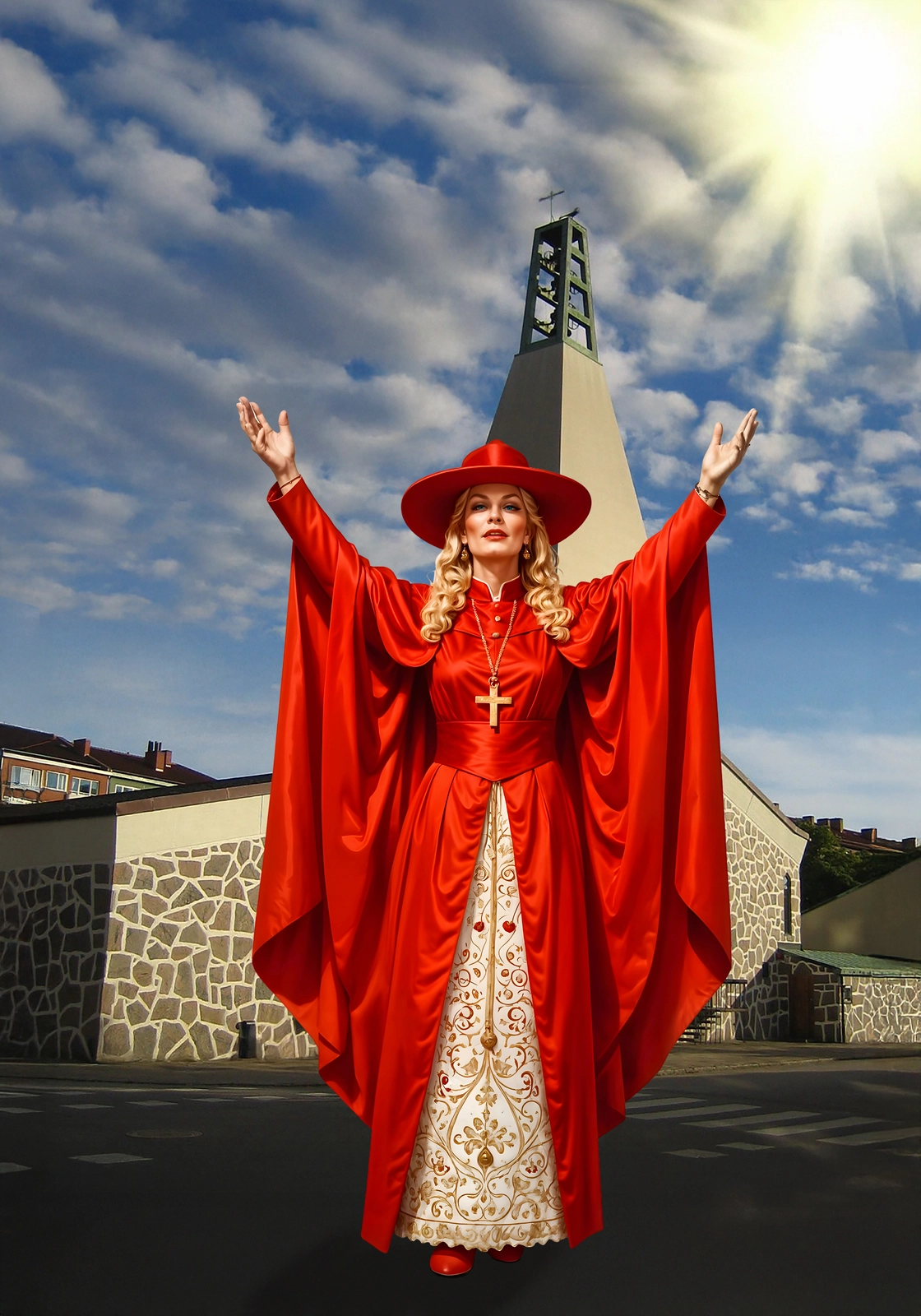
Jörgen Thornberg
Blessed are the empty-headed, for they are naturally buoyant when the waters rise - Saliga äro de korkade, ty de flyter , 2026
Digital
50 x 70 cm
3 200 kr
Blessed are the empty-headed, for they are naturally buoyant when the waters rise - Saliga äro de korkade, ty de flyter när floden kommer.
Svensk text på slutet
Introduction
What happens when the world's most famous blonde turns up in front of a Catholic church, dressed as a cardinal?
Not to pray. Not to repent. But to laugh.
Standing in front of the Catholic church in Malmö, Anita Ekberg looks back on a lifetime spent provoking popes and priests, scandalising moralists, and becoming an unwilling symbol in the eternal struggle between desire and dogma. With her characteristic wit, she finds that religion has produced some of history's greatest works of artand some of its greatest absurdities.
Together with her friend Lena, she embarks on a hilarious, irreverent and surprisingly thoughtful journey through two thousand years of saints, sinners, miracles, myths and magnificent nonsense. From Pope Joan and Martin Luther to indulgences, snake-handling pastors, witch trials, baby-throwing rituals and the Vatican's evolving view of La Dolce Vita, no sacred cow is spared.
Yet beneath the laughter lies a more serious question: why have so many religions feared women who refused to apologise for their beauty, intelligence and freedom, or just to be?
With the sparkle of Fellini, the elegance of Rome and the unmistakable humour of Anita Ekberg, this is not an attack on faith but on hypocrisy. It is a celebration of curiosity, independent thought and the simple conviction that life is far too precious to be lived in accordance with someone else's fear.
After all, as Anita likes to remind us, God may forgivebut humour is often the better salvation.
"The Scarlet Cardinal
A blonde put on a cardinal's hat,
And Rome cried, "Heaven! Imagine that!"
She smiled at a priest with dazzling grace:
"Relax, Your Eminence... enjoy the place."
The church bells trembled, the bishops frowned,
One startled monk sat flat on the ground.
A quiet nun whispered, hiding a grin,
"Perhaps even God enjoys a little sin."
A snake-handling preacher declared with pride,
"The faithful have nothing at all to hide!"
The serpent replied with a flick of its tongue,
"Your theology's brave... but your timing is wrong."
A witch was tested in holy dread:
"If she floats, she's guilty!" the judges said.
If she sank, she diedbut her soul was clean.
Justice, apparently, worked in between.
The Pope searched heaven's register twice.
"I'm certain my name must be written quite nice!"
Saint Peter shrugged with a puzzled stare:
"I've never seen management listed up here."
Old Martin Luther looked rather amused.
"They sold God's mercy?" he gently accused.
Tetzel replied, with a merchant's delight:
"Forgiveness is half-price... today only. Right?"
Then Anita laugheda glorious sound
So loudly the cathedrals echoed around.
"You built mighty churches of marble and stone,
Yet forgot that no heaven is built on fear alone."
So raise your hot chocolate, your coffee, your wine;
To women who sparkle and refuse to fall in line.
To questions, to freedom, to wit and good cheer,
For laughter has always been holier than fear.
Perhaps when our final curtain is drawn,
We'll find no halos waiting at dawn.
Just old friends smiling beneath endless skies,
Still laughing at humanity's magnificent lies.
And if God is watching, I rather suspect
He'll smile before passing His final verdict.
Malmö, July 2026
PROLOGUE A Scarlet Vision in Malmö
Anita Ekberg and her friend Lena stand on the pavement along Erik Dahlbergsgatan in Malmö; before them rises Our Saviour's Catholic Church, a distinctive modern building from the 1960s. Its exterior resembles a rugged medieval limestone wall, while its angular, conical bell tower points skyward like a finger against a dramatic Scandinavian sky. The building is low, austere and rough, radiating a quiet, distinctly Scanian Catholic severity. From the expression on Anita's face, it is immediately clear that she has not come to admire the architecture.
The contrast between the bleak grey church wall and Anita's appearance could hardly be greater. Suddenly, she throws open her coat, steps back dramatically, and reveals a vision worthy of a surreal haute couture show in Rome. The old black priest's cassock from La Dolce Vita is long behind her. She has upgraded to something altogether more magnificent, fashionably extravagant and unmistakably feminine: a cardinal's vestments reimagined for a diva.
The outfit is a visual masterpiece. The upper part consists of a deep scarlet gown, tightly cinched at the waist like a corset, accentuating her legendary curves in a way that would make any conclave lose its composure. From her shoulders falls a sweeping cape. As she raises her arms, the crimson fabric spreads like wings, shimmering in a sudden burst of sunlight. The lower part contrasts beautifully in ivory whitea heavy, flowing fabric entirely covered with an intricate golden brocade pattern of vines, flowers and tiny heart-shaped motifs. Draped across her bosom hangs an enormous golden cross, suspended from a heavy chain. On her head she wears the traditional cardinal's hatbut redesigned into an elegant, broad-brimmed creation that sits perfectly above her eternally blonde curls.
With her face turned towards the heavens, Anita makes a grand, theatrical gesture. Her arms are raised high above her head, her palms open towards the drifting clouds and rays of sunlight, as though she were conducting the spectacle. Her gaze is intense, her lips a deep crimson, and her expression radiates absolute confidence and effortless authority.
This extravagant costume and pose are no accident. They are Anita's humorous revenge and a satirical salute to the Catholic Church. By taking one of the ultimate symbols of male ecclesiastical power, transforming it into an ultra-feminine work of fashion, and wearing it with unapologetic glamour, she exposes the Church's hypocrisy. It is a visual assault on two thousand years of patriarchal control, enforced celibacy and fear of women. With a single pose, she demonstrates that everything deeply humanbeauty, sensuality and joycan never be banished by Latin prayers or exclusionary liturgy. Faced with Anita's scarlet apparition, Our Saviour's Church fades into the background, and there, on a Malmö pavement, the satire is complete.
Lena widens her eyes, slowly looks her friend up and down, but she is not surprised.
Chapter 1: The Sexiest Priest in Catholic History
LENA: (looking up at the bell tower) What struck me when I saw this grim, austere façade? That you've secured your place as the sexiest priest in the entire history of the Catholic Church. At least the sexiest female version.
ANITA: (laughs, a rich, full-bodied laugh) Oh, good Lord. It only happened onceand even then, only in a film!
LENA: True enough. But you have to admit the competition on the women's side has been rather limited. As we all know, that profession has maintained a very strict hiring freeze for women.
ANITA: That's certainly true. But the Vatican was definitely unprepared for a curvaceous Swedish blonde in a tailor-made cassock when Federico Fellini started filming La Dolce Vita in 1960. They must have felt I'd marched straight onto their home turf and stirred up trouble.
LENA: Absolutely. Watching you race up that narrow staircase inside St. Peter's Basilica in Rome, wearing a skin-tight cassock while breathless Marcello Mastroianni chases after youthat has to be the most brilliant satire in cinema history of the Church's elderly fascination with femininity, while pretending to be scandalised by it. Fellini knew exactly which buttons to press to provoke the Catholic establishment.
ANITA: Oh, it was tremendous fun, even though those stairs were unbelievably steep. I lost count of how many times I had to run up and down them. But do you know what's most ironic about that dress we called Il Pretino"The Little Priest"?
LENA: No, tell me!
ANITA: The fashion house Sorelle Fontana actually received the Vatican's official blessing for its "Cardinal Collection" in the 1950s! The Church fathers thought it was magnificent fashion. What they hadn't counted on was our copying the designoriginally created for Ava Gardnerand letting my character, Sylvia, run around in it, flirting with journalists. Ava, by the way, was furious with Fellini for stealing her image and making it mine. That woman always lacked perspective.
Chapter 2: Pope Joan The Myth That Refuses to Die
LENA: The Church has always had something of a panic attack whenever women get too close to the altar. There are even stories claiming that there was once a female popePope Joan. Whether she was particularly attractive while disguised as a man... well, history remains strangely silent on that point.
ANITA: (shaking her head) Ah yes, that old medieval legend! The story of a woman in the ninth century who fooled the entire College of Cardinals by disguising herself as a monk, studying in Athens, and eventually being elected Pope?
LENA: Exactly! The ultimate disguise. And imagine the climax of that satire: the truth is revealed only when she suddenly goes into labour during a papal procession through the streets of Rome! Even Fellini would have struggled to invent a scene more outrageously dramatic than that.
ANITA: (grinning broadly) It sounds like a rejected film script. But the best part of the legend comes next. According to the story, the Vatican responded by introducing a special chair with a hole in the seatthe Sella Stercorariain which a young deacon had to reach underneath and physically verify that the newly elected pope possessed the proper... anatomy.
LENA: Yes! Once the inspection was complete, he was supposed to proclaim: "Duos habet et bene pendentes!""He has two, and they hang well!" It's so absurd that one almost wishes it were true. Whether Pope Joan ever existed or not, she did it for power and knowledge. You did it for art.
ANITA: (laughing) They've actually made two films about Pope Joan. In the first, Liv Ullmann played the Pope.
LENA: Seriously?
ANITA: Seriously! Although the result was rather disappointing. Joan's calling may have been to serve God, but in the film her greatest temptation is to satisfy men. She ends up pregnant and, if I remember correctly, dies in childbirth. They tried again about forty years later, this time adapting a bestselling novel. I haven't seen that version, but people say it's an excellent historical drama. Naturally, the Vatican was furious on both occasions, but by then time was beginning to overtake the Papal State. Personally, I received far more abuse simply for taking a fully clothed bath in a fountain.
LENA: Really?
Chapter 3: Spittle, Holy Fury and Unexpected Jesuits
ANITA: The difference was that Joan managed to stay hidden for years. Federico and I barely had time to screen the film before all hell broke loose. When La Dolce Vita premiered in Milan, an enraged man stepped forward and spat in Federico's face. "In the name of the Fatherland!" he shouted, branding Federico a traitor.
LENA: It really became a full-blown cultural storm, didn't it? The Vatican newspaper published furious editorials demanding the film be banned outright. At the same time, conservative politicians in the Italian Parliament shouted themselves hoarse, accusing you of dragging Rome's reputation through the mud by exposing the decadence and moral decay of the upper classes. Fellini stripped them of their dignity metaphorically, while you quite literally dressed up.
ANITA: Yes, they took it very personally. But amid all that outrage, there was one thing most people have forgottenand it happens to be the finest part of Fellini's satire. A group of progressive Jesuit priests at San Fedele in Milan actually came out publicly in our defence!
LENA: The Jesuits? That's wonderful. So they understood the irony?
ANITA: They understood everything. They realised the film wasn't celebrating sin or mocking faith. It showed how empty, tragic and ultimately meaningless that so-called "sweet life" of superficial fame was. While the cardinals in the Vatican were raging over my tight-fitting cassock, the Jesuits were quietly nodding in appreciation of the film's profound moral message.
LENA: (laughing as she turns to continue walking along Erik Dahlbergsgatan) History eventually proved you right. You ended up with admirers among the Jesuits, a Palme d'Or at Cannes, and an Academy Award for Best Costume Design.
ANITA: (pulling her cape a little tighter around herself and smiling) Exactly. Whatever those old gentlemen in Rome thought, every single step up that staircase was worth it.
Chapter 4: When the Vatican Finally Granted Absolution
LENA: (stopping at the corner of Erik Dahlbergsgatan and glancing back at the austere church building) But Anita... speaking of history proving you right, the funniest part of this entire story is surely what happened fifty years later. It's almost the greatest satire of all.
ANITA: (raising her perfectly arched eyebrows) Ah... you mean when the gentlemen in Rome suddenly developed collective amnesia and decided to forgive us?
LENA: Exactly! It was around 2010, for the film's fiftieth anniversary. The Vatican's official newspaperthe very same stern L'Osservatore Romano that had denounced the film as "disgusting" in the 1960s and had demanded it be banned outrightsuddenly published an article praising La Dolce Vita as "an unsurpassed masterpiece."
ANITA: (laughing so heartily that the golden brocade silk of her skirt rustles) Oh yes, I remember! Didn't they even call it a deeply moral film that captured the spiritual crisis of an entire era? Imagineit took them half a century to grasp what the Jesuits in Milan had understood during the very week of the premiere!
LENA: It's extraordinary. From wanting to burn the film reels to practically canonising Federico. One wonders whether the Pope himself approved that miraculous change of heart over his morning espresso. "Gentlemen, perhaps that Swedish girl's cassock wasn't such a terrible idea after all... and I must admit the costume design was impeccable."
ANITA: (smiling as she adjusts the large golden cross resting on her chest) I suppose they eventually realised the film had become far greater than their condemnation. Timeless glamour cannot be defeated by outdated censorship. And I must admit, it feels rather satisfying to have the Vatican's official approval in my old age. Technically, that makes me a respectable sinner now.
LENA: (laughing as she playfully nudges the scarlet silk sleeve) Respectable? I'm not entirely convincedeven dressed in red and gold. But now that you've promoted yourself to cardinal here in Malmö, you could always walk into the church and tell them you're already carrying the Pope's blessing in your pocket.
ANITA: (casting one last mischievous glance at the bell tower) Oh, why settle for a blessing? If we wait another fifty years, perhaps they'll declare this cardinal outfit the official liturgical fashion. Come along, darlinglet's have a coffee. The sweet life in Scania is far too cold to stand still.
LENA: Let's go to Hollandia at Södra Förstadsgatan. That café has been there since long before you left Malmö for Hollywood!
ANITA: (linking her arm through Lena's) Ah, Hollandia! Yes, let's. It's far too cold in Scania to stand around in this outfit. Lead the way, darling!
Chapter 5: The Walk to Hollandia and the Vatican's Fear of Women
They set off at a brisk pace, crossing Fersens väg before turning towards Davidshallstorg. Anita draws more than a few curious glances in her dramatic scarlet cardinal's attire, but she meets every stare and returns it with the effortless smile of a true movie star. As they approach the pedestrian street, Lena grows thoughtful and looks at her friend.
LENA: Anita, as we're walking, I have to ask you something. Do you really understand the Vatican's profound fear of women? I mean, you were never particularly religious yourself. You didn't exactly attend Mass every Sunday... did you? Let's say you lived a rather open, freeand by their standardsdecidedly sinful life.
ANITA: (laughs softly) Go to Mass? No, darling, I can't say it was ever one of my favourite pastimes. I was far too busy living!
LENA: Exactly. But at the same time, you spent most of your adult life in Catholic Italy. For decades, you lived surrounded by priests, nuns and their sacred morality breathing down your neck. Surely that gave you a fairly clear idea of why they're so terrified of women.
ANITA: (laughing as she adjusts her cardinal's hat in the Malmö breeze) Darling, you don't need to spend fifty years in Italy to understand that. You only need to go back to page one. The whole game was rigged in the Book of Genesis!
LENA: (smiling) You mean Adam and Eve?
ANITA: Exactly! Just think about it. Created from a man's rib. What could be a more effective humiliation or power play? Right there, the men who wrote the story decided that man came first, while woman was merely a spare-parts project who happened to get everyone into trouble with an apple.
LENA: Yes, the roles were assigned remarkably quickly. The Fall became the perfect excuse to keep women in their place for the next two thousand years. That's when we were reduced to little more than men's playthings.
ANITA: That's exactly how it worked. By the time the Torahthe Jewish Biblewas written, gender roles had been carved in stone. Women were considered impure and dangerous, and excluded from the holiest places of worship. Men claimed God for themselves and locked the door behind them. When Catholicism inherited the baton, nothing changed. They built larger sanctuaries, wore more expensive robes, and kept us outside.
LENA: So you're saying their fear isn't really about religion at all, but about something more worldly?
ANITA: (falls silent for a moment, staring ahead before taking a deep breath) It's about control. The Catholic Church is like an exclusive gentlemen's club where men write all the rules, hand out impressive titles to one another, and bolt the doors from the inside.
LENA: And then a woman comes along and upsets the whole arrangement?
ANITA: Exactly. A womanand especially one who embraces her beauty and sexuality without apologyis the greatest threat imaginable to that system. The moment a cardinal looks at a woman and feels desire, or realises she's cleverer than he is, he loses the illusion that he's somehow above ordinary humanity. That's why generations have been taught that the woman herself is the source of sin. It's much easier to forbid us than to confront their own desires.
LENA: So all that fear is really an admission of women's power?
ANITA: (stopping outside the entrance to Hollandia, where warm crystal chandeliers glow invitingly through the windows) Exactly, darling. They're terrified we'll expose the illusion. Just look at me now. I took their finest ceremonial robes and made them even more beautifuland now I'm the one everyone is looking at.
They step into the cosy warmth of Hollandia Confectionery and sit at one of its classic little tables. A few moments later, their order arrives: two steaming mugs of hot chocolate, each crowned with generous mounds of whipped cream to thaw them after the blustery walk. Beside them sits a plate piled high with irresistible coconut macaroons.
LENA: (taking a sip of hot chocolate, wiping a little whipped cream from her upper lip before biting into a macaroon) Oh, heavens, I needed that! But Anita... now that we're sitting here, and speaking of what we were discussing outside the church... who on earth was it who actually slept with Pope Joan and got her pregnant?
ANITA: (laughing so hard she nearly chokes on her chocolate, eyes sparkling beneath the scarlet hat) Ha! Good Lord, you really can't let that one go, can you? Well... who rolled around with the Supreme Pontiff? Ninth-century gossip is rather short on details, but if we're free to speculate, I'd put my money on her private secretaryor perhaps an overenthusiastic cardinal. Someone with keys to the innermost chambers.
LENA: (grinning broadly as she chews her macaroon) Exactly! It had to be someone who could sneak into the sacristy. But the real question is: when did they manage it? Before Mass? During Mass? Afterwards? Imagine it happening right in the middle of the serviceduring one of those endless Alleluias, while the choir sang at full volume to drown out the heavy breathing behind the altar!
ANITA: (flashing Lena a mischievous grin as she scoops up another spoonful of whipped cream) You're incorrigible, darling! Whether it was a quick encounter before Mass or a sinful rendezvous afterwards, it proves exactly what we were talking about on the way here. Men can build church towers as high as they please and pretend to live solely on the Holy Spirit, but in the end they're still only human. No cassock in the worldnot even a papal tiaracan conceal biological reality. What is truly horrifying, however, is the countless sexual abuses committed by priests against boys and girls alike. That isn't some dubious medieval legend. It's a modern reality.
LENA: (shaking her head sadly, lowering her eyes to the table) It really is horrific. Worst of all, it was hidden for decades beneath holy vestments and hypocritical silence. Men claiming to speak for God abusing the most defenceless among us... There aren't words to describe how sick it is. It strips every magnificent cathedral of its splendour.
ANITA: (her expression growing serious as she nods firmly) Exactly. It's a tragedy unfolding in plain sight while the Church has been busy condemning contraception and hunting sinners.
LENA: But Anita... we can't resolve all the Church's darkest sins today, no matter how convincing your cardinal's costume may be. Shall we leave that sorrowful subject behind and restore the cheerful atmosphere here at Hollandia?
ANITA: (her face softening into a warm smile once again) Yes, darling. Let's do exactly that. Spend too long wandering the Church's crypts, and you end up bitter.
LENA: (raising her mug of hot chocolate in a toast) Exactly. Here's to that, Your Eminence. And here's to the sweet life, made even sweeter by whipped cream and coconut macaroons!
ANITA: (raising her mug until the porcelain gently clinks) Cheers to that, darling. Now this is a Mass entirely to my liking.
They sit in silence for a moment, savouring the warmth. Lena glances at the empty cups, waves to the waitress, then turns to Anita with a mischievous smile. It is clearly time to change the subject and continue their tour of the world's religious absurdities.
LENA: You know what? Let's order another hot chocolate each. If we're going to sin today, we may as well do it properly!
ANITA: (laughing her deep, infectious laugh) That certainly won't send anyone to Hell!
LENA: Speaking of lightening the mood... have you ever heard the story about the priest and the taxi driver?
ANITA: I don't think so, but give it a try. I'm so forgetful these days that everything sounds new to me.
LENA: A Catholic priest and a taxi driver die on the same day and arrive together before Saint Peter.
The taxi driver is given a magnificent silk robe, a golden staff, and the keys to an enormous villa.
The priest receives a simple cotton robe, a wooden staff and a modest little shack.
Naturally, the priest protests.
"I devoted my entire life to God. All he ever did was drive a taxi in Rome!"
Saint Peter calmly replies,
"Up here, we judge by results."
"Results? What do you mean by results? I celebrated Mass every day of my life!"
"When you preached," says Saint Peter, "people fell asleep in the pews. When he drove his taxi, his passengers prayed to God."
ANITA: (laughing until tears gather in her eyes) I'd never heard that one! And it's wonderfully accurate. I was never much of a churchgoer. My parents weren't religious, though school forced a few church services on me as a child. After that... only the occasional funeral, and every single one left me with the same memory: a solemn, unbearably dull priest droning from the pulpit.
LENA: (after the laughter subsides) Let's keep it light. What other ridiculous things have people done in the name of God? Surely it isn't only the Vatican that excels at that?
ANITA: Oh, there are plenty. Protestant preachers who claim that true faith protects them from snake venomand then die from snake bitesMuslim martyrs who supposedly receive a harem of virgins in the afterlife.
LENA: (with amused contempt) Blessed are the simple-minded, for they shall float when the flood comes. Quite useful these days, with climate change.
ANITA: (laughing) God probably had greater plans for him, perhaps becoming worm food. But if you ask me, Catholic confession can be just as peculiarpriests granting murderers absolution as long as they claim to be sorry.
LENA: "Everyone is blessed in his own faith," they always say. That's perfectly fineuntil faith becomes fanaticism and fundamentalism, and people start killing anyone who believes differently.
ANITA: Exactly. The problem begins the moment people imagine that God has appointed them as His personal executioners.
LENA: Or promises them seventy-two virgins if they die while murdering unbelievers.
ANITA: (smiling) That reminds me of one of my favourite sayings:
"Only dead fish go with the flow."
LENA: I've never heard that one.
ANITA: It's a metaphor. It means that only something without life drifts wherever the current carries it. Swimming against the current requires strength, conviction and a mind of your own. It isn't necessarily about religion. The first person I heard use the expression was Richard Burton, the legendary Welsh actor. He loved quoting it in interviews to explain why he refused to conform to what everyone else expected. I told him it suited me perfectly as well.
LENA: (grinning) Were you involved with him as well?
ANITA: (laughing) No, not the Welshmanbut with one of his colleagues, Sean Connery.
LENA: What? Sean Connery, the handsome one?
ANITA: Yes, handsome, certainly. Unfortunately, he didn't always behave as handsomely.
LENA: That's disappointing.
ANITA: That's putting it mildly. When it comes to men, I'm afraid I fell into the same category as that snake-handling preacher.
LENA: (carefully) Believing the last fool hasn't yet been born?
ANITA: Precisely. And it's a rather sad story. By then, I'd finally recovered from my divorce from the alcoholic Steel. I was thirty-one, convinced I was getting old. All my sisters and childhood friends were married, and there I was, sitting alone at the top of the glass mountain. I genuinely dreamed of having a husband, children and an ordinary family.
LENA: I suppose that's part of our biology, isn't it?
ANITA: I think so. I convinced myself that Sean Connery was exactly the sort of man who could be my husbandand the father of our children.
LENA: So how did you meet?
ANITA: Very formally at first. We were introduced during discussions about the very first Bond film, Dr No. I was considered for the role of Honey Ryder, but in the end it went to Ursula Andress.
LENA: What a disappointment! Why did she get the part? You were more beautifuland already world-famous.
ANITA: Thank you, darling. That's sweet of you. But that was precisely the problem. Producer Cubby Broccoli thought I was already too well establishedand too expensivefor a brand-new film series. He wanted a completely fresh, unknown, and less costly face, someone audiences wouldn't associate with other major roles. Ursula was still an unknown Swiss actress. I, on the other hand, had become forever associated with that damned fountain.
LENA: Money always makes the decisions. Still, it must have been some consolation to know you lost the role because you were too good for it.
ANITA: It was, in a waya small comfort for a tiger's heart. I did, however, make a brief appearance in the sequel, From Russia with Love (1963), as a giant advertising billboard. They paid me rather handsomely to hang there, so it made up for the role's financial loss. Emotionally, though... it certainly didn't make up for losing Sean. I truly believed he was going to become my second husband.
LENA: Did you actually discuss marriage, or was it just another Hollywood romance?
ANITA: Oh, it was far more than wishful thinking. We weren't exactly hiding from the cameras either; photographs of us together appeared in the newspapers. Sean hadn't merely hinted that we had a future togetherhe told me outright that we were going to marry. He never literally dropped to one knee, but it wasn't far off. I even called my agency in Rome and happily announced, "Sean has told me we're getting married." That's how certain I was.
LENA: How romantic.
ANITA: The romance itself remained discreet. As Sean liked to say, "I've got several cards in my hand." He was on the verge of becoming James Bondthe sexiest man in the worldand he knew it.
LENA: So what happened? It sounds as though everything was going wonderfully well.
ANITA: That's exactly how I experienced it for months. I was completely defenceless, so it came as a total shock when, on 6 December in Gibraltar, Sean married another girlfriendthe actress Diane Cilento. The new Mrs Bond was heavily pregnant, and barely a month later, on 11 January, their son Jason was born.
LENA: So he was forced into marrying her?
ANITA: That's certainly one way of looking at it. But throughout the autumn, he'd behaved as though there were only the two of us. Meanwhile, that clever little lady was quietly walking around with a baby bump.
LENA: How did you find out? I assume he didn't phone you himself.
ANITA: Like lightning from a clear blue sky. My agency in Rome called to say Sean had married another woman. I nearly dropped the phone and shouted, "That can't be true! He proposed to me!"
LENA: Men can be such cowards. As you said beforethe last fool hasn't yet been born. Sadly, when love is involved, it's often a woman who ends up playing the fool.
ANITA: Looking back, you could say Diane was the smarter one. By then, I'd already been taking the contraceptive pill for about a year. It had been approved in Britain, where I bought it. In Catholic Italy, it wouldn't officially become available until 1967and even then only as a treatment for menstrual disorders.
LENA: So you think she deliberately made sure she became pregnant?
ANITA: What do you think?
LENA: It's an old trick, unfortunately. Women have used it for centuries. So yes... I suspect that's exactly what happened.
ANITA: Or, as I usually joke whenever my love life comes up: "Blessed are the bow-legged, for they shall pee in parentheses."
LENA: (laughing) That's wonderful! Honestly, where do you find these things?
ANITA: From the same source as another of my favourites: "God helps the woman who helps herself."
In other words, I managed perfectly well without divine assistance.
LENA: I couldn't agree more. Speaking of helping oneself... that snake salvation movement you mentioned earlier. I remember reading about an American preacher who appeared in a television series about handling poisonous snakes during church services. Didn't he actually die from a snakebite? Was that the man you meant?
ANITA: YesJamie Coots. He died after refusing medical treatment. In the television series Snake Salvation, he explained that he literally believed a verse in the Bible promised that venomous snakes could not harm true believers whom God had anointed. As unbelievable as it sounds, those ceremonies still take place, especially in parts of the rural American South, even though they're illegal in most states.
LENA: Incredible. So he never understood the danger?
ANITA: He understood it perfectly. That's what made the whole thing so extraordinary. He was a third-generation snake handler who dreamed of handing the church over to his grown-up son, Little Cody. The National Geographic series showed them handling copperheads, rattlesnakes and cottonmouthssome of the most venomous snakes in North America. On the channel's website, there was even a photograph of Jamie wearing his beard and fedora. It explained that he'd already lost half a finger to an earlier snakebite and had personally witnessed people dying during services. Yet he still refused to abandon his beliefs.
LENA: And eventually, the inevitable happened?
ANITA: Exactly. The series came to an abrupt end in 2014 when a deadly rattlesnake bit him. He refused antivenom, remained steadfast in his faith, and died at home, surrounded by his family and fellow believers.
LENA: At least that must have put an end to the practice.
ANITA: Oh no, darling. Not at all. After Jamie's death, even the BBC reported that his son, Cody, took over the congregationand was later seriously bitten. The entire movement has been heavily scrutinised since. There have been court cases over the ownership of venomous snakes, and some congregations have begun to reconsider whether refusing medical treatment is such a wise idea. But in a few places, the traditions stubbornly persist. As one journalist memorably wrote:
"A pastor who handles venomous snakes and dies from a snakebite isn't religion. It's natural selection."
LENA: (taking another generous sip of hot chocolate and shivering slightly) Well, challenging fate with rattlesnakes is one thing. But if we're talking about history's greatest religious absurdities, poisonous snakes aren't even necessary. Human beings have always been perfectly capable of torturing themselves with their bare hands in the name of God.
ANITA: (nodding) You're thinking of the flagellants?
LENA: Exactly. During the Middle Ages, they spread across Europe like a plague of their own, especially during the Black Death. The logic seemed simple enough: God had sent the plague to punish humanity, so perhaps if people whipped themselves bloody enough, He might calm down. The truly insane part is that if the plague didn't kill you, your own whip sometimes did.
ANITA: (smiling wryly) Humanity in a nutshell. But it's hardly confined to the Middle Ages. Variations persist today in certain strict Catholic traditionsfor example, in the Philippines during Holy Week, where penitents slash their backs to ribbons before crowds of tourists. Similar rituals occur among some Shia Muslim communities, where believers beat themselves with chains and blades until blood flows freely, all in mourning for long-dead martyrs or in the hope of atoning for their sins.
LENA: (shaking her head) I simply can't understand how people confuse self-inflicted torture with spiritual salvation. But speaking of religious absurditiesand dressing updid the Church's moral police ever bother you while you were filming those epic Hollywood productions in Italy? I don't mean Fellini. I mean those gloriously pagan adventures in which you ran around with swords.
ANITA: (laughing so hard that her cardinal's hat almost slips sideways) Oh, good heavens! You mean when I played Queen Zenobia in Nel segno di Romareleased in English as Sign of the Gladiator? That was in 1959, just before we filmed the fountain scenes. The story is set during Rome's war against Palmyra in the third century. It was one of those classic Italian sword-and-sandal epics from the period when Italy dominated the market for ancient adventure filmsjust before spaghetti westerns took over. The studios kept the same sets, swapped the swords for revolvers, dressed everyone in jeans, and suddenly the Roman Empire had become the Wild West.
The costume designer certainly wasn't wasteful with fabric. My golden armour covered... well... the absolute essentials. Everything else was left almost entirely to God's fresh air. We were filming in an ancient Catholic mountain village at the height of the Italian summer.
LENA: (leaning forward with a grin) Let me guessthe local parish priest had a heart attack?
ANITA: (bursting into laughter) Almost! The poor man suffered a complete religious breakdown. It was nearly forty degrees Celsius, so during breaks, hundreds of extrasplaying Roman soldiers and pagan rebelsthrew down their spears and swam, practically naked, in the river running through the village. And right in the middle of this supposed den of sin, there I was, strolling around in my golden bikini, wearing a breastplate designed less to conceal than to ensure every male extra promptly forgot his lines.
The village priest suddenly appeared on set, red as a tomato, shouting that Hollywood had brought Sodom and Gomorrah to his sacred mountain. He warned the villagers that God Himself would punish them with drought and destroy every olive tree unless they drove that "Swedish temptress" away with shovels and pitchforks. His language was hardly suitable for Sunday sermons. There was no mistaking the message.
LENA: (already laughing) No! Surely not! He actually blamed your costume for threatening the olive harvest?
ANITA: (grinning broadly) Every single olive tree was apparently doomed because of my sins. But the funniest part was that the villagers couldn't have cared less about divine wrath or dying olive trees. They were making far too much money renting their donkeys to the film crew, while their wives earned a tidy living cooking for us. So one morning, when the desperate priest marched onto the set wearing full vestments, furiously sprinkling holy water in every direction and brandishing a crucifix to cast Satan out of the village, do you know what happened?
LENA: (covering her mouth) No! Tell me!
ANITA: They carried him away!
His own church wardens, terrified that the productionand the daily income it generatedmight disappear, grabbed him by the arms and carried him off as he kicked his legs wildly and shouted in Latin. Paganism defeated the Church that daynot through philosophy, but through a blend of Scanian glamour and Italian capitalism.
LENA: (laughing so hard she nearly chokes on her macaroon, wiping away tears) That's magnificent! Imagine being carried away by your own congregation because a movie star was better for business than divine wrath! Blessed are those who rent out donkeys, for theirs shall be the profits, drought or no drought!
ANITA: (finishing the last spoonful of whipped cream) Exactly. Which only proves how astonishingly little it takes for reason to fly out of the window the moment people convince themselves they're defending God.
LENA: (after finally catching her breath) Human beings never cease to amaze me. But if you really want to see madness, you don't have to look to whips or film sets. Sometimes religion reserves its cruellest ideas for the most defenceless. Have you ever heard of baby tossing in India?
ANITA: (frowning) Baby... what? You're joking, right?
LENA: I wish I were. In parts of Maharashtra and Karnataka, there's an old tradition in which babies are dropped from a temple roof, roughly 15 metres above the ground, into a blanket held by men below. The ritual is believed to bring the child health and good fortune.
ANITA: (shaking her head in disbelief) Health? The poor child must suffer a heart attack before reaching the blanket! It's extraordinary how far superstition can drive perfectly ordinary people.
LENA: It really is. But speaking of the Church's own history, what about the witch trials? There was a system in which you supposedly died no matter what.
ANITA: You're referring to the famous water ordeal, aren't you? Women suspected of witchcraft were tied up and thrown into rivers or lakes.
LENA: Exactly. If they floated, they were declared guilty and burned alive. If they sank, they were innocentbut by then they'd already drowned. At least the innocent were supposedly buried in consecrated ground.
ANITA: (smiling knowingly) That's actually one of history's greatest myths. I looked into it recently, and the reality turns out to be a little different.
LENA: Wait... what? They didn't drown?
ANITA: The logic behind the ordeal was genuine. Water was considered holy and pure, so if it rejected a person by allowing her to float, she was deemed to be in league with the Devil. If she sank, she was deemed innocent.
LENA: So why didn't she drown?
ANITA: That wasn't usually the intention. In many places, the accused woman was tied to a rope before being lowered into the water. If she sankand therefore proved her innocencethe executioners pulled her back out.
LENA: Really? That sounds... marginally more humane than the version most people know.
ANITA: Only marginally. It remained a barbaric practice. Some women certainly drowned because people were careless or the currents were too strong. But the purpose wasn't normally to execute them by drowning. In Sweden, the water ordeal was relatively uncommon anyway. Women convicted of witchcraft were more often beheaded before their bodies were burned. Jealous neighbours, frightened children and forced confessions under torture proved far deadlier than rivers ever did.
LENA: Bloody hell.
ANITA: Lena, if you think today's influencers and cryptocurrency scams are outrageous, let me tell you what the Catholic Church was up to in the sixteenth century. In sheer scale, it was probably the greatest and most ingenious scam in history. The Church first convinced people to live in terror of Hell and Purgatoryand then began selling something called indulgences.
LENA: Hold on. Indulgences? What exactly were they?
ANITA: Forgiveness of sins on paper. Quite literally. The Church desperately needed money to build the enormous St Peter's Basilica in Rome, so they sent out their finest salesmenthe most fanatical friars you could imagineto travel across Europe. The most famous of them was Johann Tetzel, a true superstar salesman. His pitch was essentially this: "Been unfaithful? Stolen something? No problem. Buy this certificate, and God will erase your punishment."
LENA: You're kidding! Did people actually believe that?
ANITA: They lined up to buy them. It wasn't limited to your own sins. Tetzel stood in market squares, telling poor farmers that their dead parents were suffering in Purgatory, crying out to be rescued. His famous sales slogan was: "As soon as the coin in the coffer rings, the soul from Purgatory springs."
People handed over their last few coins to free their grandmother from torment in the afterlife. It was an astonishingly lucrative business.
LENA: That's completely insane. So how did it finally end?
ANITA: That particular absurdity proved to be the final straw. An angry German monk, Martin Luther, finally lost patience with the corruption. He thought the idea of buying your way into Heaven was outrageous. In 1517, he nailed his Ninety-five Theses to the door of a church. That act became the spark that ignited the Protestant Reformation. In other words, much of Protestant Christianity was born because the Catholic Church had turned God's forgiveness into a highly successful commercial enterprise.
LENA: But wait a minute... isn't confession almost the same thing? You step into a dark wooden booth, admit you've behaved badly, the priest tells you you're forgiven, and you walk out with a clean slate.
ANITA: Psychologically, yes. It's rather like a medieval reset buttona free therapy session for a guilty conscience. But there was one enormous difference that set indulgences apart.
LENA: Which was?
ANITA: The price tag. Confession wasand still isfree. You can't simply pay a priest to buy forgiveness. Indulgences became a business in which the wealthy could buy relief from punishment, while the poor, unable to pay, were left to burn in Purgatory. That's what outraged so many people.
LENA: Fair enough, but confession still allows people to escape punishment, doesn't it?
ANITA: Not exactly. According to Catholic theology, saying "I'm sorry" isn't enough. Genuine repentance is essential, along with a sincere intention to change. The priest also assigns penance. Today it may be a few prayers. In the Middle Ages, it might have meant fasting for six months or making a barefoot pilgrimage to another town.
LENA: So people still had to suffer a bit?
ANITA: Exactly. Indulgences were essentially a shortcut around that inconvenience. Instead of examining your conscience or changing your behaviour, you simply reached for your purse. That's why Martin Luther exploded with indignation. He had no objection to confession itself. What horrified him was the idea of selling God's forgiveness as a market commodity.
LENA: That's when the priest says "Ego te absolvo," isn't it? I've heard it in films.
ANITA: Exactly. "Ego te absolvo""I absolve you." That's the heart of the ritual, the moment your slate is wiped clean. The absurdity was that indulgences were, in effect, the same promiseonly printed on a piece of paper and priced.
LENA: When you think about it, that really is the definition of absurdity.
ANITA: It certainly is.
LENA: But do you know what's the most ironic of all?
ANITA: Go on.
LENA: Martin Luther wasn't protesting against confession itself. He continued to go to confession throughout his life. He believed it was a valuable practice. What he opposed was turning God's mercy into a profitable business.
ANITA: Exactly right. When you look at what happened in Protestant countries after confession largely disappeared, you almost wonder whether we threw the baby out with the bathwater.
LENA: What do you mean?
ANITA: Think about it. Many people today would probably find confession comforting. We Protestants carry our mistakes around like invisible suitcases for the rest of our lives. We rarely experience that concrete moment when another human being looks us in the eye and says, "Your burden has been lifted."
LENA: That's true. We keep replaying everything in our heads.
ANITA: Exactly. According to traditional Protestant teaching, we carry all our failures until the Last Judgment, when everything is finally sorted out, and we're either admitted to Heavenor sent somewhere considerably warmer. That's quite a psychological burden to carry throughout an entire lifetime without ever being allowed to press the reset button.
LENA: We Time-travellers, who spend our lives among the stars, know perfectly well that it is all nonsense. No gods or goddesses are waiting in eternityonly retired prophets and thoroughly disillusioned priests, shamans, monks, rabbis, imams and popes, all wondering how they managed to get it so spectacularly wrong. For many of them, the greatest shock was realising that neither Heaven nor Hell existed. For everyone else, it was a tremendous relief. Shall I tell you one of my favourite stories about a pope arriving at Heaven's gate?
ANITA: (taking another sip of hot chocolate) Please do.
LENA: (laughing) It's one of my favourites.
"I'm the Pope," he announces proudly.
Saint Peter leafs through his enormous register, listing the names of every soul admitted to Heaven.
"The Pope... the Pope..." he mutters. "No, I'm afraid I can't find anyone by that name."
"But I'm God's representative on Earth!" the Pope exclaims, disbelieving.
"Really? One moment. I'd better ask the Boss."
Saint Peter disappears inside and returns with Jesus, who studies the Pope for a few moments before bursting into uncontrollable laughter.
"Peter," he says, "Do you remember the little fishing club I started on the Sea of Galilee two thousand years ago? Apparently, it's still going!"
ANITA: (smiling thoughtfully) Here we aretwo time travellers who have seen eternity and looked behind every religion and every sect... and what are we talking about?
Religion.
When you stop and think about it... that's rather mad, isn't it?
Här är översättningen med samma disposition, samma dialogformat och samma styckeindelning som originalet.
Chapter 6: The Final Wish Between Rome and the Soil of Scania
LENA: (takes one last bite of her coconut macaroon and looks at Anita with a gentler smile) But you know, Anita, amid all this talk about the old men of the Vatican, scandals and a sinful life... we shouldn't forget that when it really mattered, you were very particular about your roots. You knew exactly how you wanted your own farewell to be. I mean, your choice of church and everything.
ANITA: (looks down into her cup of hot chocolate and nods slowly) Yes... You can live in Italy for an entire lifetime, but you never forget where you came from. When that day came, I absolutely did not want a Catholic ceremony. I remained faithful to the Church of Sweden all the way. Not because I believed, but because I didn't know.
LENA: (nods) Same here. I paid my church tax all my life without ever setting foot in a church. In my last will, I specifically stated that I wanted a memorial service without hymns or biblical mumbo-jumbo. And that's exactly how it turned out.
ANITA: I suppose it was a way of hedging my bets. After all, the Catholic Church had declared that, given the life I'd lived, I belonged to Satan's camp. Perhaps the rumour had never reached the Protestants. Just as Voltaire, whom we both met at the Enlightened Society's gathering aboard the Pole Star, I thought it was wiser to be careful. Voltaire was one of the Catholic Church's fiercest critics, and the feeling was very much mutual. When a priest asked Voltaire, on his deathbed, to renounce Satan, the great philosopher replied, "This is no time to make new enemies."
LENA: It turned out exactly as you wished. A large funeral service in Rome, held at the German Evangelical Church, because the Swedish congregation had cooperated with them and their church was large enough to accommodate everyone who wanted to say goodbye.
ANITA: (smiles nostalgically) Yes, that was important to me. It became an open serviceonly a stone's throw from Via Veneto, where we filmed La Dolce Vita. The circle closed in the very heart of the city, but on my own terms. Hymns, film music and jazz in Rome, beneath a Protestant roof. Yet I was equally determined not to remain on Italian soil forever. I wanted to come home.
LENA: There was a quiet, beautiful memorial service, followed by a second funeral at Skanör Church for your closest family and friends, myself included. Your ashes now rest in the old churchyard at Skanör, in the family grave beside your brother.
ANITA: (adjusts her fiery red cardinal's hat one last time and gazes out through Hollandia's window) Exactly where I belong. That's the part of me that stayed on Earth. It's rather comforting to know, darling. You can conquer the world, bathe in fountains, and dress up as both priest and cardinal. But in the end, all you really want is to come to rest in the fertile soil of Scania, where the wind blows freely, and no pope in the world can interfere with how you lie.
LENA: (raising the last of her hot chocolate in a toast) A perfect final act for a true icon.
ANITA: (raises her cup in return, smiling her warmest Hollywood smile) The very best, darling. The very best.
EPILOGUE The Last Mass on Södra Förstadsgatan
The light outside Hollandia Confectionery slowly begins to change. The warm glow of the crystal chandeliers still keeps the darkness at bay, but outside the windows the Malmö twilight settles over Södra Förstadsgatan. The clink of porcelain and the murmur of conversation gradually fade, while in the background the soft, haunting notes of an organ dissolve into a swinging jazz melody, like a Fellini film transplanted to Scania. Perhaps the music comes from within, for that is how Time-travellers work. Anita and Lena remain seated at their table. The empty mugs of hot chocolate, their rims still marked with dried whipped cream, are still there, but the mood has shifted from playful mockery to something gentler, almost cinematic in its restraint. Anita slowly rises to her feet. Her scarlet cardinal's robes cast a long shadow across the carpet. She straightens the large golden cross at her breast and gazes out of the window.
LENA: (looks up at her friend) We've certainly covered a lot of ground today, Anita. From rattlesnakes and medieval popesses to witch trials and village priests carried away because of a golden bra. It's enough to make your head spin at humanity's sheer madness.
ANITA: (smiles nostalgically beneath the broad brim of her hat) Yes, darling. The world is full of fools who believe they can lock lifeand Godinside their austere stone walls. But in the end, reality always slips through their rigid fingers, like the water in the Trevi Fountain.
LENA: And now here you are, standing on a red carpet, dressed as a cardinal in the middle of Malmö, having stripped all the Church Fathers down to their bare brass. What do you think the old gentlemen in Rome would say if they could see you now?
ANITA: (lets out a deep, rich laugh) They'd probably have called the church wardens to carry me away as well! But you know what? It doesn't matter anymore. In the end, they granted my film absolution.
LENA: (stands up and throws her coat over her shoulder) Yes, the circle really did close on your own terms. Just imagine ityour farewell in Rome beneath a Protestant roof, with both jazz and hymns, only a stone's throw from Via Veneto. You never let them have the last word.
ANITA: (nods slowly, her gaze fixed on the horizon) Never, Lena. You can conquer the world, shake the Vatican to its foundations, and live as freelyand as sinfullyas you please. But when the curtain finally falls, all you really want is to come home. Home to Scania, where the wind stubbornly blows straight through every robe and every dogma. Where the earth is free, and no one in the world can tell you how to liveor how to die.
LENA: (slipping her arm through Anita's) Then shall we step back out into that Scanian wind, Your Eminence?
ANITA: (turns towards the door and straightens her back with regal dignity) Yes, darling. Let's go. We've finished our chocolate, exposed their illusions, and now we'll leave the old gentlemen to their fate. This Mass is officially over!
Anita makes one final, subtle yet magnificent sweep of her scarlet cape, then turns gracefully and walks out through Hollandia's door. Lena follows close behind, smiling. Outside, the light slowly fades as the organ and the jazz merge into a final triumphant chord.
THE END
Inledning
Vad händer när världens mest berömda blondin dyker upp utanför en katolsk kyrka, klädd som en kardinal?
Inte för att be. Inte för att ångra sig. Utan för att skratta.
Utanför den katolska kyrkan i Malmö ser Anita Ekberg tillbaka på ett liv fyllt av påvar och präster, moralpredikanter och skandaler, där hon mot sin vilja kom att bli en symbol i den eviga kampen mellan begär och dogmer. Med sin karakteristiska humor konstaterar hon att religionen har gett världen några av historiens största konstverk och några av dess mest magnifika absurditeter.
Tillsammans med sin vän Lena ger hon sig ut på en halsbrytande, respektlös och oväntat tankeväckande resa genom tvåtusen år av helgon, syndare, mirakler, myter och mänskliga dårskaper. Från påvinnan Johanna och Martin Luther till avlatsbrev, ormpräster, häxprocesser, spädbarnskast och Vatikanens gradvis förändrade syn på La Dolce Vita lämnas ingen helig ko ifred.
Men bakom skratten döljer sig en allvarligare fråga: Varför har så många religioner fruktat kvinnor som vägrar be om ursäkt för sin skönhet, sin intelligens och sin frihet eller bara att vara?
Med Fellinis glittrande fantasi, Roms tidlösa elegans och Anita Ekbergs omisskännliga humor är detta ingen uppgörelse med tron, utan med hyckleriet. Det är en hyllning till nyfikenheten, det fria tänkandet och övertygelsen om att livet är alldeles för värdefullt för att levas efter någon annans rädslor.
Som Anita gärna påminner oss om: Gud må förlåta men humor är ofta den bästa frälsningen.
PROLOG En scharlakansröd vision i Malmö
Anita Ekberg och hennes väninna Lena står på trottoaren vid Erik Dahlbergsgatan i Malmö. Framför dem reser sig Vår Frälsares katolska kyrka, en ganska särpräglad och modern byggnad från 1960-talet. Exteriören påminner om en robust, rå medeltida kalkstensmur, och det kantiga koniska klocktornet sträcker sig som ett finger mot en dramatisk himmel. Byggnaden är låg, sträv och utstrålar en tyst, skånsk-katolsk stramhet. Av Anitas min framgår tydligt att hon inte är där för att beundra arkitekturen.
Kontrasten mellan den gråskånska, sträva kyrkväggen och Anitas uppenbarelse kunde inte vara mer total. Plötsligt öppnar hon sin kappa, tar ett dramatiskt steg bakåt och blottar en syn som hämtad ur en surrealistisk haute couture-visning i Rom. Anita har lämnat den gamla svarta prästkappan från La Dolce Vita-filmen långt bakom sig. Hon har uppgraderat till en fullkomligt magnifik, moderiktig och djupt feminiserad kardinalsmundering.
Klädseln är ett visuellt mästerverk. Överdelen består av en djupt scharlakansröd klänning som är hårt insvängd i midjan som en korsett, vilket framhäver hennes berömda former på ett sätt som skulle få vilken konklav som helst att tappa fattningen. Från axlarna faller en stor böljande cape. När hon lyfter armarna breder det röda tyget ut sig som vingar, glänsande i det plötsliga solskenet. Understycket kontrasterar vackert i brutet vitt ett tungt fallande tyg helt täckt av ett intrikat, guldgult brokadmönster med rankor, blommor och små hjärtformade detaljer. Över bysten hänger ett maffigt, guldigt kors i en kraftig kedja. På huvudet bär hon den traditionella kardinalshatten men i en omarbetad, elegant variant med brett brätte som sitter perfekt över hennes evigt blonda lockar.
Med ansiktet vänt uppåt gör Anita en storslagen, teatralisk gest mot himlen. Armarna är sträckta rakt upp, handflatorna öppna mot de drivande molnen och solstrålarna, som om hon personligen dirigerar skådespelet. Hennes blick är intensiv, läpparna mörkröda och uttrycket utstrålar en total, suverän självsäkerhet.
Denna extravaganta utstyrsel och pose är ingen slump. Det är Anitas humoristiska hämnd och satir riktad mot den katolska kyrkan. Genom att ta ett av männens exklusiva maktkläder, sy om det till en ultrafeminin modedröm och bära det med uttalad glamour, blottar hon kyrkans hyckleri. Det är en visuell attack mot två årtusenden av gubbigt kontrollbehov, celibatkrav och kvinnofobi. Hon visar med en enda pose att det djupt mänskliga, det sensuella och det vackra inte går att stänga ute med latinska böner och exkluderande liturgi. Inför Anitas scharlakansröda gestalt bleknar Vår Frälsares kyrka och på trottoaren i Malmö är satiren fulländad.
Lena spärrar ut ögonen, tittar upp och ner på sin väninna, men är inte förvånad.
Kapitel 1: Den sexigaste prästen i den katolska historien
LENA: (tittar upp mot klocktornet) Vet du vad jag kom att tänka på när jag ser den här strama karga fasaden? Att du har skrivit in dig som den katolska historiens absolut sexigaste präst. I varje fall den sexigaste kvinnliga varianten.
ANITA: (skrattar till, ett djupt och fylligt skratt) Åh, herregud. Det var ju bara en enda gång, dessutom på film!
LENA: Jo, men du måste erkänna att konkurrensen på kvinnosidan är ganska svag. Det finns ju som bekant ett ganska strikt anställningsstopp för kvinnor i den branschen.
ANITA: Visst är det så. Men Vatikanen var absolut inte beredd på en kurvig, svensk blondin i en skräddarsydd prästrock när Federico Fellini rullade igång kamerorna för La Dolce Vita 1960. De tyckte väl att jag klev rakt in på deras hemmaplan och rörde om.
LENA: Verkligen. Att kasta dig uppför en trång torntrappa i Peterskyrkan i Rom, utklädd i en åtsmitande kassock, med en flåsande Marcello Mastroianni efter dig det är ju filmhistoriens mest geniala satir över kyrkans gubbiga fascination för det feminina, samtidigt som de låtsas förfäras av det. Fellini visste precis vilka knappar han skulle trycka på för att driva med det katolska etablissemanget.
ANITA: Ja, det var kul även om trappan var brant. Jag vet inte hur många gånger jag fick springa upp och ner. Men vet du vad som är det mest ironiska med den där klänningen som vi kallade Il Pretino "den lilla prästen"?
LENA: Nej, berätta!
ANITA: Modehuset Sorelle Fontana hade faktiskt fått Vatikanens formella välsignelse för sin "Kardinals-kollektion" på 50-talet! Kyrkofäderna tyckte att det var ett storartat mode. Men kyrkan hade nog inte räknat med att vi skulle kopiera designen som de egentligen hade sytt upp till Ava Gardner och låta min karaktär Sylvia kuta runt i den och flirta med journalister. Ava blev förresten rasande på Fellini för att han snodde hennes image och gjorde den till min. Den kvinnan har alltid saknat perspektiv.
Kapitel 2: Påvinnan Johanna Myten som vägrar dö
LENA: Kyrkan har ju historiskt sett haft panik över kvinnor i närheten av altaret. Det påstås ju faktiskt ha funnits en kvinnlig påve en gång i tiden Påvinnan Johanna. Men huruvida hon, utklädd till man, var särskilt sexig eller inte ja, det förtäljer ju inte historien.
ANITA: (skakar på huvudet) Den där gamla medeltida skrönan! Att en kvinna på 800-talet skulle ha lurat hela kardinalkollegiet genom att klä ut sig till munk, studera i Aten och till slut bli vald till påve?
LENA: Precis den! Den ultimata utklädnaden. Och tänk dig upplösningen på den satiren: Sanningen uppdagas först när hon plötsligt tvingas föda barn mitt under en påvlig procession på Roms gator! Det är ju en scen som till och med Fellini hade haft svårt att toppa rent dramatiskt.
ANITA: (ler brett) Det låter som ett refuserat filmmanus. Men det bästa med den myten är ju efterspelet. Att historien påstår att Vatikanen efter det införde en särskild stol med hål i sitsen Sella Stercoraria där en ung diakon var tvungen att sticka upp handen och rent fysiskt känna efter, så att den nya påven faktiskt hade rätt anatomi.
LENA: Ja! Och när kontrollen var klar utropade han: "Duos habet et bene pendentes!" "Han har två, och de hänger väl!" Det är så absurt att man nästan hoppas att det är sant. Men oavsett om Johanna funnits eller inte, gjorde hon det för maktens och bildningens skull. Du gjorde det för konsten.
ANITA: (skrattande) Det är faktiskt gjort film om Johanna två gånger. Första gången spelade Liv Ullmann påven.
LENA: Seriöst!!!
ANITA: Faktiskt! Men resultatet blev så där. Johannas kallelse må ha varit att tjäna Gud, men i filmen blir hennes frestelse att tillfredsställa män. Hon blev med barn på kuppen och dog i barnsäng, vill jag minnas. Det gjordes ännu ett försök 40 år senare baserat på en bästsäljande roman. Den har jag inte sett, men den påstås vara ett mycket välgjort historiskt drama. Vatikanen blev naturligtvis rasande båda gångerna, men tiden började rinna förbi Kyrkostaten. Jag fick mycket mer skit för att ha fullt påklädd ha badat i en fontänt.
LENA: Är det så?
Kapitel 3: Spottloskor, heligt raseri och oväntade jesuiter
ANITA: Skillnaden var väl att Johanna lyckades hålla sig gömd i flera år. Jag och Federico hann knappt visa filmen förrän det blev ett herrans liv. När La Dolce Vita hade premiär i Milano klev en uppretad man fram och spottade Federico rakt i ansiktet. "I fäderneslandets namn", skrek han och kallade honom för en landsförrädare.
LENA: Visst blev det något av en kulturstorm? Vatikanens tidning skrev indignerade artiklar och krävde att filmen skulle totalförbjudas, och i det italienska parlamentet skrek konservativa politiker sig hesa om att ni drog Roms rykte i smutsen genom att visa upp överklassens dekadens och moraliska förfall. Fellini klädde av dem metaforiskt och du klädde bokstavligen ut dig .
ANITA: Ja, de tog det väldigt personligt. Men mitt i allt det där raseriet fanns det en sak som de flesta glömmer bort och som är den bästa delen av Fellinis satir. En grupp progressiva jesuitpräster vid San Fedele i Milano gick faktiskt ut och försvarade oss offentligt!
LENA: Jesuiterna? Det är ju fantastiskt. De såg alltså ironin?
ANITA: De såg allt. De förstod att filmen inte handlade om att hylla synden eller att driva med tron. Den visade ju hur tomt, tragiskt och meningslöst det där "ljuva livet" med all sin ytliga kändisskap egentligen var. Så medan kardinalerna i Vatikanen rasade över min tajta prästkappa, satt jesuiterna och nickade åt filmens djupa moraliska budskap.
LENA: (skrattar och vänder sig om för att gå vidare längs Erik Dahlbergsgatan) Så man kan säga att historien gav er rätt till slut. Ni fick jesuiter som fans, en guldpalm i Cannes och en Oscar f
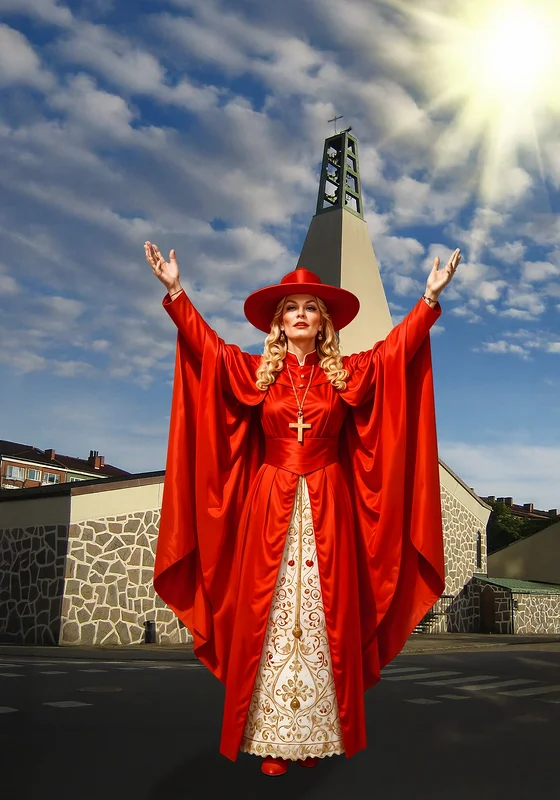
Jörgen Thornberg
Blessed are the empty-headed, for they are naturally buoyant when the waters rise - Saliga äro de korkade, ty de flyter , 2026
Digital
50 x 70 cm
3 200 kr
Blessed are the empty-headed, for they are naturally buoyant when the waters rise - Saliga äro de korkade, ty de flyter när floden kommer.
Svensk text på slutet
Introduction
What happens when the world's most famous blonde turns up in front of a Catholic church, dressed as a cardinal?
Not to pray. Not to repent. But to laugh.
Standing in front of the Catholic church in Malmö, Anita Ekberg looks back on a lifetime spent provoking popes and priests, scandalising moralists, and becoming an unwilling symbol in the eternal struggle between desire and dogma. With her characteristic wit, she finds that religion has produced some of history's greatest works of artand some of its greatest absurdities.
Together with her friend Lena, she embarks on a hilarious, irreverent and surprisingly thoughtful journey through two thousand years of saints, sinners, miracles, myths and magnificent nonsense. From Pope Joan and Martin Luther to indulgences, snake-handling pastors, witch trials, baby-throwing rituals and the Vatican's evolving view of La Dolce Vita, no sacred cow is spared.
Yet beneath the laughter lies a more serious question: why have so many religions feared women who refused to apologise for their beauty, intelligence and freedom, or just to be?
With the sparkle of Fellini, the elegance of Rome and the unmistakable humour of Anita Ekberg, this is not an attack on faith but on hypocrisy. It is a celebration of curiosity, independent thought and the simple conviction that life is far too precious to be lived in accordance with someone else's fear.
After all, as Anita likes to remind us, God may forgivebut humour is often the better salvation.
"The Scarlet Cardinal
A blonde put on a cardinal's hat,
And Rome cried, "Heaven! Imagine that!"
She smiled at a priest with dazzling grace:
"Relax, Your Eminence... enjoy the place."
The church bells trembled, the bishops frowned,
One startled monk sat flat on the ground.
A quiet nun whispered, hiding a grin,
"Perhaps even God enjoys a little sin."
A snake-handling preacher declared with pride,
"The faithful have nothing at all to hide!"
The serpent replied with a flick of its tongue,
"Your theology's brave... but your timing is wrong."
A witch was tested in holy dread:
"If she floats, she's guilty!" the judges said.
If she sank, she diedbut her soul was clean.
Justice, apparently, worked in between.
The Pope searched heaven's register twice.
"I'm certain my name must be written quite nice!"
Saint Peter shrugged with a puzzled stare:
"I've never seen management listed up here."
Old Martin Luther looked rather amused.
"They sold God's mercy?" he gently accused.
Tetzel replied, with a merchant's delight:
"Forgiveness is half-price... today only. Right?"
Then Anita laugheda glorious sound
So loudly the cathedrals echoed around.
"You built mighty churches of marble and stone,
Yet forgot that no heaven is built on fear alone."
So raise your hot chocolate, your coffee, your wine;
To women who sparkle and refuse to fall in line.
To questions, to freedom, to wit and good cheer,
For laughter has always been holier than fear.
Perhaps when our final curtain is drawn,
We'll find no halos waiting at dawn.
Just old friends smiling beneath endless skies,
Still laughing at humanity's magnificent lies.
And if God is watching, I rather suspect
He'll smile before passing His final verdict.
Malmö, July 2026
PROLOGUE A Scarlet Vision in Malmö
Anita Ekberg and her friend Lena stand on the pavement along Erik Dahlbergsgatan in Malmö; before them rises Our Saviour's Catholic Church, a distinctive modern building from the 1960s. Its exterior resembles a rugged medieval limestone wall, while its angular, conical bell tower points skyward like a finger against a dramatic Scandinavian sky. The building is low, austere and rough, radiating a quiet, distinctly Scanian Catholic severity. From the expression on Anita's face, it is immediately clear that she has not come to admire the architecture.
The contrast between the bleak grey church wall and Anita's appearance could hardly be greater. Suddenly, she throws open her coat, steps back dramatically, and reveals a vision worthy of a surreal haute couture show in Rome. The old black priest's cassock from La Dolce Vita is long behind her. She has upgraded to something altogether more magnificent, fashionably extravagant and unmistakably feminine: a cardinal's vestments reimagined for a diva.
The outfit is a visual masterpiece. The upper part consists of a deep scarlet gown, tightly cinched at the waist like a corset, accentuating her legendary curves in a way that would make any conclave lose its composure. From her shoulders falls a sweeping cape. As she raises her arms, the crimson fabric spreads like wings, shimmering in a sudden burst of sunlight. The lower part contrasts beautifully in ivory whitea heavy, flowing fabric entirely covered with an intricate golden brocade pattern of vines, flowers and tiny heart-shaped motifs. Draped across her bosom hangs an enormous golden cross, suspended from a heavy chain. On her head she wears the traditional cardinal's hatbut redesigned into an elegant, broad-brimmed creation that sits perfectly above her eternally blonde curls.
With her face turned towards the heavens, Anita makes a grand, theatrical gesture. Her arms are raised high above her head, her palms open towards the drifting clouds and rays of sunlight, as though she were conducting the spectacle. Her gaze is intense, her lips a deep crimson, and her expression radiates absolute confidence and effortless authority.
This extravagant costume and pose are no accident. They are Anita's humorous revenge and a satirical salute to the Catholic Church. By taking one of the ultimate symbols of male ecclesiastical power, transforming it into an ultra-feminine work of fashion, and wearing it with unapologetic glamour, she exposes the Church's hypocrisy. It is a visual assault on two thousand years of patriarchal control, enforced celibacy and fear of women. With a single pose, she demonstrates that everything deeply humanbeauty, sensuality and joycan never be banished by Latin prayers or exclusionary liturgy. Faced with Anita's scarlet apparition, Our Saviour's Church fades into the background, and there, on a Malmö pavement, the satire is complete.
Lena widens her eyes, slowly looks her friend up and down, but she is not surprised.
Chapter 1: The Sexiest Priest in Catholic History
LENA: (looking up at the bell tower) What struck me when I saw this grim, austere façade? That you've secured your place as the sexiest priest in the entire history of the Catholic Church. At least the sexiest female version.
ANITA: (laughs, a rich, full-bodied laugh) Oh, good Lord. It only happened onceand even then, only in a film!
LENA: True enough. But you have to admit the competition on the women's side has been rather limited. As we all know, that profession has maintained a very strict hiring freeze for women.
ANITA: That's certainly true. But the Vatican was definitely unprepared for a curvaceous Swedish blonde in a tailor-made cassock when Federico Fellini started filming La Dolce Vita in 1960. They must have felt I'd marched straight onto their home turf and stirred up trouble.
LENA: Absolutely. Watching you race up that narrow staircase inside St. Peter's Basilica in Rome, wearing a skin-tight cassock while breathless Marcello Mastroianni chases after youthat has to be the most brilliant satire in cinema history of the Church's elderly fascination with femininity, while pretending to be scandalised by it. Fellini knew exactly which buttons to press to provoke the Catholic establishment.
ANITA: Oh, it was tremendous fun, even though those stairs were unbelievably steep. I lost count of how many times I had to run up and down them. But do you know what's most ironic about that dress we called Il Pretino"The Little Priest"?
LENA: No, tell me!
ANITA: The fashion house Sorelle Fontana actually received the Vatican's official blessing for its "Cardinal Collection" in the 1950s! The Church fathers thought it was magnificent fashion. What they hadn't counted on was our copying the designoriginally created for Ava Gardnerand letting my character, Sylvia, run around in it, flirting with journalists. Ava, by the way, was furious with Fellini for stealing her image and making it mine. That woman always lacked perspective.
Chapter 2: Pope Joan The Myth That Refuses to Die
LENA: The Church has always had something of a panic attack whenever women get too close to the altar. There are even stories claiming that there was once a female popePope Joan. Whether she was particularly attractive while disguised as a man... well, history remains strangely silent on that point.
ANITA: (shaking her head) Ah yes, that old medieval legend! The story of a woman in the ninth century who fooled the entire College of Cardinals by disguising herself as a monk, studying in Athens, and eventually being elected Pope?
LENA: Exactly! The ultimate disguise. And imagine the climax of that satire: the truth is revealed only when she suddenly goes into labour during a papal procession through the streets of Rome! Even Fellini would have struggled to invent a scene more outrageously dramatic than that.
ANITA: (grinning broadly) It sounds like a rejected film script. But the best part of the legend comes next. According to the story, the Vatican responded by introducing a special chair with a hole in the seatthe Sella Stercorariain which a young deacon had to reach underneath and physically verify that the newly elected pope possessed the proper... anatomy.
LENA: Yes! Once the inspection was complete, he was supposed to proclaim: "Duos habet et bene pendentes!""He has two, and they hang well!" It's so absurd that one almost wishes it were true. Whether Pope Joan ever existed or not, she did it for power and knowledge. You did it for art.
ANITA: (laughing) They've actually made two films about Pope Joan. In the first, Liv Ullmann played the Pope.
LENA: Seriously?
ANITA: Seriously! Although the result was rather disappointing. Joan's calling may have been to serve God, but in the film her greatest temptation is to satisfy men. She ends up pregnant and, if I remember correctly, dies in childbirth. They tried again about forty years later, this time adapting a bestselling novel. I haven't seen that version, but people say it's an excellent historical drama. Naturally, the Vatican was furious on both occasions, but by then time was beginning to overtake the Papal State. Personally, I received far more abuse simply for taking a fully clothed bath in a fountain.
LENA: Really?
Chapter 3: Spittle, Holy Fury and Unexpected Jesuits
ANITA: The difference was that Joan managed to stay hidden for years. Federico and I barely had time to screen the film before all hell broke loose. When La Dolce Vita premiered in Milan, an enraged man stepped forward and spat in Federico's face. "In the name of the Fatherland!" he shouted, branding Federico a traitor.
LENA: It really became a full-blown cultural storm, didn't it? The Vatican newspaper published furious editorials demanding the film be banned outright. At the same time, conservative politicians in the Italian Parliament shouted themselves hoarse, accusing you of dragging Rome's reputation through the mud by exposing the decadence and moral decay of the upper classes. Fellini stripped them of their dignity metaphorically, while you quite literally dressed up.
ANITA: Yes, they took it very personally. But amid all that outrage, there was one thing most people have forgottenand it happens to be the finest part of Fellini's satire. A group of progressive Jesuit priests at San Fedele in Milan actually came out publicly in our defence!
LENA: The Jesuits? That's wonderful. So they understood the irony?
ANITA: They understood everything. They realised the film wasn't celebrating sin or mocking faith. It showed how empty, tragic and ultimately meaningless that so-called "sweet life" of superficial fame was. While the cardinals in the Vatican were raging over my tight-fitting cassock, the Jesuits were quietly nodding in appreciation of the film's profound moral message.
LENA: (laughing as she turns to continue walking along Erik Dahlbergsgatan) History eventually proved you right. You ended up with admirers among the Jesuits, a Palme d'Or at Cannes, and an Academy Award for Best Costume Design.
ANITA: (pulling her cape a little tighter around herself and smiling) Exactly. Whatever those old gentlemen in Rome thought, every single step up that staircase was worth it.
Chapter 4: When the Vatican Finally Granted Absolution
LENA: (stopping at the corner of Erik Dahlbergsgatan and glancing back at the austere church building) But Anita... speaking of history proving you right, the funniest part of this entire story is surely what happened fifty years later. It's almost the greatest satire of all.
ANITA: (raising her perfectly arched eyebrows) Ah... you mean when the gentlemen in Rome suddenly developed collective amnesia and decided to forgive us?
LENA: Exactly! It was around 2010, for the film's fiftieth anniversary. The Vatican's official newspaperthe very same stern L'Osservatore Romano that had denounced the film as "disgusting" in the 1960s and had demanded it be banned outrightsuddenly published an article praising La Dolce Vita as "an unsurpassed masterpiece."
ANITA: (laughing so heartily that the golden brocade silk of her skirt rustles) Oh yes, I remember! Didn't they even call it a deeply moral film that captured the spiritual crisis of an entire era? Imagineit took them half a century to grasp what the Jesuits in Milan had understood during the very week of the premiere!
LENA: It's extraordinary. From wanting to burn the film reels to practically canonising Federico. One wonders whether the Pope himself approved that miraculous change of heart over his morning espresso. "Gentlemen, perhaps that Swedish girl's cassock wasn't such a terrible idea after all... and I must admit the costume design was impeccable."
ANITA: (smiling as she adjusts the large golden cross resting on her chest) I suppose they eventually realised the film had become far greater than their condemnation. Timeless glamour cannot be defeated by outdated censorship. And I must admit, it feels rather satisfying to have the Vatican's official approval in my old age. Technically, that makes me a respectable sinner now.
LENA: (laughing as she playfully nudges the scarlet silk sleeve) Respectable? I'm not entirely convincedeven dressed in red and gold. But now that you've promoted yourself to cardinal here in Malmö, you could always walk into the church and tell them you're already carrying the Pope's blessing in your pocket.
ANITA: (casting one last mischievous glance at the bell tower) Oh, why settle for a blessing? If we wait another fifty years, perhaps they'll declare this cardinal outfit the official liturgical fashion. Come along, darlinglet's have a coffee. The sweet life in Scania is far too cold to stand still.
LENA: Let's go to Hollandia at Södra Förstadsgatan. That café has been there since long before you left Malmö for Hollywood!
ANITA: (linking her arm through Lena's) Ah, Hollandia! Yes, let's. It's far too cold in Scania to stand around in this outfit. Lead the way, darling!
Chapter 5: The Walk to Hollandia and the Vatican's Fear of Women
They set off at a brisk pace, crossing Fersens väg before turning towards Davidshallstorg. Anita draws more than a few curious glances in her dramatic scarlet cardinal's attire, but she meets every stare and returns it with the effortless smile of a true movie star. As they approach the pedestrian street, Lena grows thoughtful and looks at her friend.
LENA: Anita, as we're walking, I have to ask you something. Do you really understand the Vatican's profound fear of women? I mean, you were never particularly religious yourself. You didn't exactly attend Mass every Sunday... did you? Let's say you lived a rather open, freeand by their standardsdecidedly sinful life.
ANITA: (laughs softly) Go to Mass? No, darling, I can't say it was ever one of my favourite pastimes. I was far too busy living!
LENA: Exactly. But at the same time, you spent most of your adult life in Catholic Italy. For decades, you lived surrounded by priests, nuns and their sacred morality breathing down your neck. Surely that gave you a fairly clear idea of why they're so terrified of women.
ANITA: (laughing as she adjusts her cardinal's hat in the Malmö breeze) Darling, you don't need to spend fifty years in Italy to understand that. You only need to go back to page one. The whole game was rigged in the Book of Genesis!
LENA: (smiling) You mean Adam and Eve?
ANITA: Exactly! Just think about it. Created from a man's rib. What could be a more effective humiliation or power play? Right there, the men who wrote the story decided that man came first, while woman was merely a spare-parts project who happened to get everyone into trouble with an apple.
LENA: Yes, the roles were assigned remarkably quickly. The Fall became the perfect excuse to keep women in their place for the next two thousand years. That's when we were reduced to little more than men's playthings.
ANITA: That's exactly how it worked. By the time the Torahthe Jewish Biblewas written, gender roles had been carved in stone. Women were considered impure and dangerous, and excluded from the holiest places of worship. Men claimed God for themselves and locked the door behind them. When Catholicism inherited the baton, nothing changed. They built larger sanctuaries, wore more expensive robes, and kept us outside.
LENA: So you're saying their fear isn't really about religion at all, but about something more worldly?
ANITA: (falls silent for a moment, staring ahead before taking a deep breath) It's about control. The Catholic Church is like an exclusive gentlemen's club where men write all the rules, hand out impressive titles to one another, and bolt the doors from the inside.
LENA: And then a woman comes along and upsets the whole arrangement?
ANITA: Exactly. A womanand especially one who embraces her beauty and sexuality without apologyis the greatest threat imaginable to that system. The moment a cardinal looks at a woman and feels desire, or realises she's cleverer than he is, he loses the illusion that he's somehow above ordinary humanity. That's why generations have been taught that the woman herself is the source of sin. It's much easier to forbid us than to confront their own desires.
LENA: So all that fear is really an admission of women's power?
ANITA: (stopping outside the entrance to Hollandia, where warm crystal chandeliers glow invitingly through the windows) Exactly, darling. They're terrified we'll expose the illusion. Just look at me now. I took their finest ceremonial robes and made them even more beautifuland now I'm the one everyone is looking at.
They step into the cosy warmth of Hollandia Confectionery and sit at one of its classic little tables. A few moments later, their order arrives: two steaming mugs of hot chocolate, each crowned with generous mounds of whipped cream to thaw them after the blustery walk. Beside them sits a plate piled high with irresistible coconut macaroons.
LENA: (taking a sip of hot chocolate, wiping a little whipped cream from her upper lip before biting into a macaroon) Oh, heavens, I needed that! But Anita... now that we're sitting here, and speaking of what we were discussing outside the church... who on earth was it who actually slept with Pope Joan and got her pregnant?
ANITA: (laughing so hard she nearly chokes on her chocolate, eyes sparkling beneath the scarlet hat) Ha! Good Lord, you really can't let that one go, can you? Well... who rolled around with the Supreme Pontiff? Ninth-century gossip is rather short on details, but if we're free to speculate, I'd put my money on her private secretaryor perhaps an overenthusiastic cardinal. Someone with keys to the innermost chambers.
LENA: (grinning broadly as she chews her macaroon) Exactly! It had to be someone who could sneak into the sacristy. But the real question is: when did they manage it? Before Mass? During Mass? Afterwards? Imagine it happening right in the middle of the serviceduring one of those endless Alleluias, while the choir sang at full volume to drown out the heavy breathing behind the altar!
ANITA: (flashing Lena a mischievous grin as she scoops up another spoonful of whipped cream) You're incorrigible, darling! Whether it was a quick encounter before Mass or a sinful rendezvous afterwards, it proves exactly what we were talking about on the way here. Men can build church towers as high as they please and pretend to live solely on the Holy Spirit, but in the end they're still only human. No cassock in the worldnot even a papal tiaracan conceal biological reality. What is truly horrifying, however, is the countless sexual abuses committed by priests against boys and girls alike. That isn't some dubious medieval legend. It's a modern reality.
LENA: (shaking her head sadly, lowering her eyes to the table) It really is horrific. Worst of all, it was hidden for decades beneath holy vestments and hypocritical silence. Men claiming to speak for God abusing the most defenceless among us... There aren't words to describe how sick it is. It strips every magnificent cathedral of its splendour.
ANITA: (her expression growing serious as she nods firmly) Exactly. It's a tragedy unfolding in plain sight while the Church has been busy condemning contraception and hunting sinners.
LENA: But Anita... we can't resolve all the Church's darkest sins today, no matter how convincing your cardinal's costume may be. Shall we leave that sorrowful subject behind and restore the cheerful atmosphere here at Hollandia?
ANITA: (her face softening into a warm smile once again) Yes, darling. Let's do exactly that. Spend too long wandering the Church's crypts, and you end up bitter.
LENA: (raising her mug of hot chocolate in a toast) Exactly. Here's to that, Your Eminence. And here's to the sweet life, made even sweeter by whipped cream and coconut macaroons!
ANITA: (raising her mug until the porcelain gently clinks) Cheers to that, darling. Now this is a Mass entirely to my liking.
They sit in silence for a moment, savouring the warmth. Lena glances at the empty cups, waves to the waitress, then turns to Anita with a mischievous smile. It is clearly time to change the subject and continue their tour of the world's religious absurdities.
LENA: You know what? Let's order another hot chocolate each. If we're going to sin today, we may as well do it properly!
ANITA: (laughing her deep, infectious laugh) That certainly won't send anyone to Hell!
LENA: Speaking of lightening the mood... have you ever heard the story about the priest and the taxi driver?
ANITA: I don't think so, but give it a try. I'm so forgetful these days that everything sounds new to me.
LENA: A Catholic priest and a taxi driver die on the same day and arrive together before Saint Peter.
The taxi driver is given a magnificent silk robe, a golden staff, and the keys to an enormous villa.
The priest receives a simple cotton robe, a wooden staff and a modest little shack.
Naturally, the priest protests.
"I devoted my entire life to God. All he ever did was drive a taxi in Rome!"
Saint Peter calmly replies,
"Up here, we judge by results."
"Results? What do you mean by results? I celebrated Mass every day of my life!"
"When you preached," says Saint Peter, "people fell asleep in the pews. When he drove his taxi, his passengers prayed to God."
ANITA: (laughing until tears gather in her eyes) I'd never heard that one! And it's wonderfully accurate. I was never much of a churchgoer. My parents weren't religious, though school forced a few church services on me as a child. After that... only the occasional funeral, and every single one left me with the same memory: a solemn, unbearably dull priest droning from the pulpit.
LENA: (after the laughter subsides) Let's keep it light. What other ridiculous things have people done in the name of God? Surely it isn't only the Vatican that excels at that?
ANITA: Oh, there are plenty. Protestant preachers who claim that true faith protects them from snake venomand then die from snake bitesMuslim martyrs who supposedly receive a harem of virgins in the afterlife.
LENA: (with amused contempt) Blessed are the simple-minded, for they shall float when the flood comes. Quite useful these days, with climate change.
ANITA: (laughing) God probably had greater plans for him, perhaps becoming worm food. But if you ask me, Catholic confession can be just as peculiarpriests granting murderers absolution as long as they claim to be sorry.
LENA: "Everyone is blessed in his own faith," they always say. That's perfectly fineuntil faith becomes fanaticism and fundamentalism, and people start killing anyone who believes differently.
ANITA: Exactly. The problem begins the moment people imagine that God has appointed them as His personal executioners.
LENA: Or promises them seventy-two virgins if they die while murdering unbelievers.
ANITA: (smiling) That reminds me of one of my favourite sayings:
"Only dead fish go with the flow."
LENA: I've never heard that one.
ANITA: It's a metaphor. It means that only something without life drifts wherever the current carries it. Swimming against the current requires strength, conviction and a mind of your own. It isn't necessarily about religion. The first person I heard use the expression was Richard Burton, the legendary Welsh actor. He loved quoting it in interviews to explain why he refused to conform to what everyone else expected. I told him it suited me perfectly as well.
LENA: (grinning) Were you involved with him as well?
ANITA: (laughing) No, not the Welshmanbut with one of his colleagues, Sean Connery.
LENA: What? Sean Connery, the handsome one?
ANITA: Yes, handsome, certainly. Unfortunately, he didn't always behave as handsomely.
LENA: That's disappointing.
ANITA: That's putting it mildly. When it comes to men, I'm afraid I fell into the same category as that snake-handling preacher.
LENA: (carefully) Believing the last fool hasn't yet been born?
ANITA: Precisely. And it's a rather sad story. By then, I'd finally recovered from my divorce from the alcoholic Steel. I was thirty-one, convinced I was getting old. All my sisters and childhood friends were married, and there I was, sitting alone at the top of the glass mountain. I genuinely dreamed of having a husband, children and an ordinary family.
LENA: I suppose that's part of our biology, isn't it?
ANITA: I think so. I convinced myself that Sean Connery was exactly the sort of man who could be my husbandand the father of our children.
LENA: So how did you meet?
ANITA: Very formally at first. We were introduced during discussions about the very first Bond film, Dr No. I was considered for the role of Honey Ryder, but in the end it went to Ursula Andress.
LENA: What a disappointment! Why did she get the part? You were more beautifuland already world-famous.
ANITA: Thank you, darling. That's sweet of you. But that was precisely the problem. Producer Cubby Broccoli thought I was already too well establishedand too expensivefor a brand-new film series. He wanted a completely fresh, unknown, and less costly face, someone audiences wouldn't associate with other major roles. Ursula was still an unknown Swiss actress. I, on the other hand, had become forever associated with that damned fountain.
LENA: Money always makes the decisions. Still, it must have been some consolation to know you lost the role because you were too good for it.
ANITA: It was, in a waya small comfort for a tiger's heart. I did, however, make a brief appearance in the sequel, From Russia with Love (1963), as a giant advertising billboard. They paid me rather handsomely to hang there, so it made up for the role's financial loss. Emotionally, though... it certainly didn't make up for losing Sean. I truly believed he was going to become my second husband.
LENA: Did you actually discuss marriage, or was it just another Hollywood romance?
ANITA: Oh, it was far more than wishful thinking. We weren't exactly hiding from the cameras either; photographs of us together appeared in the newspapers. Sean hadn't merely hinted that we had a future togetherhe told me outright that we were going to marry. He never literally dropped to one knee, but it wasn't far off. I even called my agency in Rome and happily announced, "Sean has told me we're getting married." That's how certain I was.
LENA: How romantic.
ANITA: The romance itself remained discreet. As Sean liked to say, "I've got several cards in my hand." He was on the verge of becoming James Bondthe sexiest man in the worldand he knew it.
LENA: So what happened? It sounds as though everything was going wonderfully well.
ANITA: That's exactly how I experienced it for months. I was completely defenceless, so it came as a total shock when, on 6 December in Gibraltar, Sean married another girlfriendthe actress Diane Cilento. The new Mrs Bond was heavily pregnant, and barely a month later, on 11 January, their son Jason was born.
LENA: So he was forced into marrying her?
ANITA: That's certainly one way of looking at it. But throughout the autumn, he'd behaved as though there were only the two of us. Meanwhile, that clever little lady was quietly walking around with a baby bump.
LENA: How did you find out? I assume he didn't phone you himself.
ANITA: Like lightning from a clear blue sky. My agency in Rome called to say Sean had married another woman. I nearly dropped the phone and shouted, "That can't be true! He proposed to me!"
LENA: Men can be such cowards. As you said beforethe last fool hasn't yet been born. Sadly, when love is involved, it's often a woman who ends up playing the fool.
ANITA: Looking back, you could say Diane was the smarter one. By then, I'd already been taking the contraceptive pill for about a year. It had been approved in Britain, where I bought it. In Catholic Italy, it wouldn't officially become available until 1967and even then only as a treatment for menstrual disorders.
LENA: So you think she deliberately made sure she became pregnant?
ANITA: What do you think?
LENA: It's an old trick, unfortunately. Women have used it for centuries. So yes... I suspect that's exactly what happened.
ANITA: Or, as I usually joke whenever my love life comes up: "Blessed are the bow-legged, for they shall pee in parentheses."
LENA: (laughing) That's wonderful! Honestly, where do you find these things?
ANITA: From the same source as another of my favourites: "God helps the woman who helps herself."
In other words, I managed perfectly well without divine assistance.
LENA: I couldn't agree more. Speaking of helping oneself... that snake salvation movement you mentioned earlier. I remember reading about an American preacher who appeared in a television series about handling poisonous snakes during church services. Didn't he actually die from a snakebite? Was that the man you meant?
ANITA: YesJamie Coots. He died after refusing medical treatment. In the television series Snake Salvation, he explained that he literally believed a verse in the Bible promised that venomous snakes could not harm true believers whom God had anointed. As unbelievable as it sounds, those ceremonies still take place, especially in parts of the rural American South, even though they're illegal in most states.
LENA: Incredible. So he never understood the danger?
ANITA: He understood it perfectly. That's what made the whole thing so extraordinary. He was a third-generation snake handler who dreamed of handing the church over to his grown-up son, Little Cody. The National Geographic series showed them handling copperheads, rattlesnakes and cottonmouthssome of the most venomous snakes in North America. On the channel's website, there was even a photograph of Jamie wearing his beard and fedora. It explained that he'd already lost half a finger to an earlier snakebite and had personally witnessed people dying during services. Yet he still refused to abandon his beliefs.
LENA: And eventually, the inevitable happened?
ANITA: Exactly. The series came to an abrupt end in 2014 when a deadly rattlesnake bit him. He refused antivenom, remained steadfast in his faith, and died at home, surrounded by his family and fellow believers.
LENA: At least that must have put an end to the practice.
ANITA: Oh no, darling. Not at all. After Jamie's death, even the BBC reported that his son, Cody, took over the congregationand was later seriously bitten. The entire movement has been heavily scrutinised since. There have been court cases over the ownership of venomous snakes, and some congregations have begun to reconsider whether refusing medical treatment is such a wise idea. But in a few places, the traditions stubbornly persist. As one journalist memorably wrote:
"A pastor who handles venomous snakes and dies from a snakebite isn't religion. It's natural selection."
LENA: (taking another generous sip of hot chocolate and shivering slightly) Well, challenging fate with rattlesnakes is one thing. But if we're talking about history's greatest religious absurdities, poisonous snakes aren't even necessary. Human beings have always been perfectly capable of torturing themselves with their bare hands in the name of God.
ANITA: (nodding) You're thinking of the flagellants?
LENA: Exactly. During the Middle Ages, they spread across Europe like a plague of their own, especially during the Black Death. The logic seemed simple enough: God had sent the plague to punish humanity, so perhaps if people whipped themselves bloody enough, He might calm down. The truly insane part is that if the plague didn't kill you, your own whip sometimes did.
ANITA: (smiling wryly) Humanity in a nutshell. But it's hardly confined to the Middle Ages. Variations persist today in certain strict Catholic traditionsfor example, in the Philippines during Holy Week, where penitents slash their backs to ribbons before crowds of tourists. Similar rituals occur among some Shia Muslim communities, where believers beat themselves with chains and blades until blood flows freely, all in mourning for long-dead martyrs or in the hope of atoning for their sins.
LENA: (shaking her head) I simply can't understand how people confuse self-inflicted torture with spiritual salvation. But speaking of religious absurditiesand dressing updid the Church's moral police ever bother you while you were filming those epic Hollywood productions in Italy? I don't mean Fellini. I mean those gloriously pagan adventures in which you ran around with swords.
ANITA: (laughing so hard that her cardinal's hat almost slips sideways) Oh, good heavens! You mean when I played Queen Zenobia in Nel segno di Romareleased in English as Sign of the Gladiator? That was in 1959, just before we filmed the fountain scenes. The story is set during Rome's war against Palmyra in the third century. It was one of those classic Italian sword-and-sandal epics from the period when Italy dominated the market for ancient adventure filmsjust before spaghetti westerns took over. The studios kept the same sets, swapped the swords for revolvers, dressed everyone in jeans, and suddenly the Roman Empire had become the Wild West.
The costume designer certainly wasn't wasteful with fabric. My golden armour covered... well... the absolute essentials. Everything else was left almost entirely to God's fresh air. We were filming in an ancient Catholic mountain village at the height of the Italian summer.
LENA: (leaning forward with a grin) Let me guessthe local parish priest had a heart attack?
ANITA: (bursting into laughter) Almost! The poor man suffered a complete religious breakdown. It was nearly forty degrees Celsius, so during breaks, hundreds of extrasplaying Roman soldiers and pagan rebelsthrew down their spears and swam, practically naked, in the river running through the village. And right in the middle of this supposed den of sin, there I was, strolling around in my golden bikini, wearing a breastplate designed less to conceal than to ensure every male extra promptly forgot his lines.
The village priest suddenly appeared on set, red as a tomato, shouting that Hollywood had brought Sodom and Gomorrah to his sacred mountain. He warned the villagers that God Himself would punish them with drought and destroy every olive tree unless they drove that "Swedish temptress" away with shovels and pitchforks. His language was hardly suitable for Sunday sermons. There was no mistaking the message.
LENA: (already laughing) No! Surely not! He actually blamed your costume for threatening the olive harvest?
ANITA: (grinning broadly) Every single olive tree was apparently doomed because of my sins. But the funniest part was that the villagers couldn't have cared less about divine wrath or dying olive trees. They were making far too much money renting their donkeys to the film crew, while their wives earned a tidy living cooking for us. So one morning, when the desperate priest marched onto the set wearing full vestments, furiously sprinkling holy water in every direction and brandishing a crucifix to cast Satan out of the village, do you know what happened?
LENA: (covering her mouth) No! Tell me!
ANITA: They carried him away!
His own church wardens, terrified that the productionand the daily income it generatedmight disappear, grabbed him by the arms and carried him off as he kicked his legs wildly and shouted in Latin. Paganism defeated the Church that daynot through philosophy, but through a blend of Scanian glamour and Italian capitalism.
LENA: (laughing so hard she nearly chokes on her macaroon, wiping away tears) That's magnificent! Imagine being carried away by your own congregation because a movie star was better for business than divine wrath! Blessed are those who rent out donkeys, for theirs shall be the profits, drought or no drought!
ANITA: (finishing the last spoonful of whipped cream) Exactly. Which only proves how astonishingly little it takes for reason to fly out of the window the moment people convince themselves they're defending God.
LENA: (after finally catching her breath) Human beings never cease to amaze me. But if you really want to see madness, you don't have to look to whips or film sets. Sometimes religion reserves its cruellest ideas for the most defenceless. Have you ever heard of baby tossing in India?
ANITA: (frowning) Baby... what? You're joking, right?
LENA: I wish I were. In parts of Maharashtra and Karnataka, there's an old tradition in which babies are dropped from a temple roof, roughly 15 metres above the ground, into a blanket held by men below. The ritual is believed to bring the child health and good fortune.
ANITA: (shaking her head in disbelief) Health? The poor child must suffer a heart attack before reaching the blanket! It's extraordinary how far superstition can drive perfectly ordinary people.
LENA: It really is. But speaking of the Church's own history, what about the witch trials? There was a system in which you supposedly died no matter what.
ANITA: You're referring to the famous water ordeal, aren't you? Women suspected of witchcraft were tied up and thrown into rivers or lakes.
LENA: Exactly. If they floated, they were declared guilty and burned alive. If they sank, they were innocentbut by then they'd already drowned. At least the innocent were supposedly buried in consecrated ground.
ANITA: (smiling knowingly) That's actually one of history's greatest myths. I looked into it recently, and the reality turns out to be a little different.
LENA: Wait... what? They didn't drown?
ANITA: The logic behind the ordeal was genuine. Water was considered holy and pure, so if it rejected a person by allowing her to float, she was deemed to be in league with the Devil. If she sank, she was deemed innocent.
LENA: So why didn't she drown?
ANITA: That wasn't usually the intention. In many places, the accused woman was tied to a rope before being lowered into the water. If she sankand therefore proved her innocencethe executioners pulled her back out.
LENA: Really? That sounds... marginally more humane than the version most people know.
ANITA: Only marginally. It remained a barbaric practice. Some women certainly drowned because people were careless or the currents were too strong. But the purpose wasn't normally to execute them by drowning. In Sweden, the water ordeal was relatively uncommon anyway. Women convicted of witchcraft were more often beheaded before their bodies were burned. Jealous neighbours, frightened children and forced confessions under torture proved far deadlier than rivers ever did.
LENA: Bloody hell.
ANITA: Lena, if you think today's influencers and cryptocurrency scams are outrageous, let me tell you what the Catholic Church was up to in the sixteenth century. In sheer scale, it was probably the greatest and most ingenious scam in history. The Church first convinced people to live in terror of Hell and Purgatoryand then began selling something called indulgences.
LENA: Hold on. Indulgences? What exactly were they?
ANITA: Forgiveness of sins on paper. Quite literally. The Church desperately needed money to build the enormous St Peter's Basilica in Rome, so they sent out their finest salesmenthe most fanatical friars you could imagineto travel across Europe. The most famous of them was Johann Tetzel, a true superstar salesman. His pitch was essentially this: "Been unfaithful? Stolen something? No problem. Buy this certificate, and God will erase your punishment."
LENA: You're kidding! Did people actually believe that?
ANITA: They lined up to buy them. It wasn't limited to your own sins. Tetzel stood in market squares, telling poor farmers that their dead parents were suffering in Purgatory, crying out to be rescued. His famous sales slogan was: "As soon as the coin in the coffer rings, the soul from Purgatory springs."
People handed over their last few coins to free their grandmother from torment in the afterlife. It was an astonishingly lucrative business.
LENA: That's completely insane. So how did it finally end?
ANITA: That particular absurdity proved to be the final straw. An angry German monk, Martin Luther, finally lost patience with the corruption. He thought the idea of buying your way into Heaven was outrageous. In 1517, he nailed his Ninety-five Theses to the door of a church. That act became the spark that ignited the Protestant Reformation. In other words, much of Protestant Christianity was born because the Catholic Church had turned God's forgiveness into a highly successful commercial enterprise.
LENA: But wait a minute... isn't confession almost the same thing? You step into a dark wooden booth, admit you've behaved badly, the priest tells you you're forgiven, and you walk out with a clean slate.
ANITA: Psychologically, yes. It's rather like a medieval reset buttona free therapy session for a guilty conscience. But there was one enormous difference that set indulgences apart.
LENA: Which was?
ANITA: The price tag. Confession wasand still isfree. You can't simply pay a priest to buy forgiveness. Indulgences became a business in which the wealthy could buy relief from punishment, while the poor, unable to pay, were left to burn in Purgatory. That's what outraged so many people.
LENA: Fair enough, but confession still allows people to escape punishment, doesn't it?
ANITA: Not exactly. According to Catholic theology, saying "I'm sorry" isn't enough. Genuine repentance is essential, along with a sincere intention to change. The priest also assigns penance. Today it may be a few prayers. In the Middle Ages, it might have meant fasting for six months or making a barefoot pilgrimage to another town.
LENA: So people still had to suffer a bit?
ANITA: Exactly. Indulgences were essentially a shortcut around that inconvenience. Instead of examining your conscience or changing your behaviour, you simply reached for your purse. That's why Martin Luther exploded with indignation. He had no objection to confession itself. What horrified him was the idea of selling God's forgiveness as a market commodity.
LENA: That's when the priest says "Ego te absolvo," isn't it? I've heard it in films.
ANITA: Exactly. "Ego te absolvo""I absolve you." That's the heart of the ritual, the moment your slate is wiped clean. The absurdity was that indulgences were, in effect, the same promiseonly printed on a piece of paper and priced.
LENA: When you think about it, that really is the definition of absurdity.
ANITA: It certainly is.
LENA: But do you know what's the most ironic of all?
ANITA: Go on.
LENA: Martin Luther wasn't protesting against confession itself. He continued to go to confession throughout his life. He believed it was a valuable practice. What he opposed was turning God's mercy into a profitable business.
ANITA: Exactly right. When you look at what happened in Protestant countries after confession largely disappeared, you almost wonder whether we threw the baby out with the bathwater.
LENA: What do you mean?
ANITA: Think about it. Many people today would probably find confession comforting. We Protestants carry our mistakes around like invisible suitcases for the rest of our lives. We rarely experience that concrete moment when another human being looks us in the eye and says, "Your burden has been lifted."
LENA: That's true. We keep replaying everything in our heads.
ANITA: Exactly. According to traditional Protestant teaching, we carry all our failures until the Last Judgment, when everything is finally sorted out, and we're either admitted to Heavenor sent somewhere considerably warmer. That's quite a psychological burden to carry throughout an entire lifetime without ever being allowed to press the reset button.
LENA: We Time-travellers, who spend our lives among the stars, know perfectly well that it is all nonsense. No gods or goddesses are waiting in eternityonly retired prophets and thoroughly disillusioned priests, shamans, monks, rabbis, imams and popes, all wondering how they managed to get it so spectacularly wrong. For many of them, the greatest shock was realising that neither Heaven nor Hell existed. For everyone else, it was a tremendous relief. Shall I tell you one of my favourite stories about a pope arriving at Heaven's gate?
ANITA: (taking another sip of hot chocolate) Please do.
LENA: (laughing) It's one of my favourites.
"I'm the Pope," he announces proudly.
Saint Peter leafs through his enormous register, listing the names of every soul admitted to Heaven.
"The Pope... the Pope..." he mutters. "No, I'm afraid I can't find anyone by that name."
"But I'm God's representative on Earth!" the Pope exclaims, disbelieving.
"Really? One moment. I'd better ask the Boss."
Saint Peter disappears inside and returns with Jesus, who studies the Pope for a few moments before bursting into uncontrollable laughter.
"Peter," he says, "Do you remember the little fishing club I started on the Sea of Galilee two thousand years ago? Apparently, it's still going!"
ANITA: (smiling thoughtfully) Here we aretwo time travellers who have seen eternity and looked behind every religion and every sect... and what are we talking about?
Religion.
When you stop and think about it... that's rather mad, isn't it?
Här är översättningen med samma disposition, samma dialogformat och samma styckeindelning som originalet.
Chapter 6: The Final Wish Between Rome and the Soil of Scania
LENA: (takes one last bite of her coconut macaroon and looks at Anita with a gentler smile) But you know, Anita, amid all this talk about the old men of the Vatican, scandals and a sinful life... we shouldn't forget that when it really mattered, you were very particular about your roots. You knew exactly how you wanted your own farewell to be. I mean, your choice of church and everything.
ANITA: (looks down into her cup of hot chocolate and nods slowly) Yes... You can live in Italy for an entire lifetime, but you never forget where you came from. When that day came, I absolutely did not want a Catholic ceremony. I remained faithful to the Church of Sweden all the way. Not because I believed, but because I didn't know.
LENA: (nods) Same here. I paid my church tax all my life without ever setting foot in a church. In my last will, I specifically stated that I wanted a memorial service without hymns or biblical mumbo-jumbo. And that's exactly how it turned out.
ANITA: I suppose it was a way of hedging my bets. After all, the Catholic Church had declared that, given the life I'd lived, I belonged to Satan's camp. Perhaps the rumour had never reached the Protestants. Just as Voltaire, whom we both met at the Enlightened Society's gathering aboard the Pole Star, I thought it was wiser to be careful. Voltaire was one of the Catholic Church's fiercest critics, and the feeling was very much mutual. When a priest asked Voltaire, on his deathbed, to renounce Satan, the great philosopher replied, "This is no time to make new enemies."
LENA: It turned out exactly as you wished. A large funeral service in Rome, held at the German Evangelical Church, because the Swedish congregation had cooperated with them and their church was large enough to accommodate everyone who wanted to say goodbye.
ANITA: (smiles nostalgically) Yes, that was important to me. It became an open serviceonly a stone's throw from Via Veneto, where we filmed La Dolce Vita. The circle closed in the very heart of the city, but on my own terms. Hymns, film music and jazz in Rome, beneath a Protestant roof. Yet I was equally determined not to remain on Italian soil forever. I wanted to come home.
LENA: There was a quiet, beautiful memorial service, followed by a second funeral at Skanör Church for your closest family and friends, myself included. Your ashes now rest in the old churchyard at Skanör, in the family grave beside your brother.
ANITA: (adjusts her fiery red cardinal's hat one last time and gazes out through Hollandia's window) Exactly where I belong. That's the part of me that stayed on Earth. It's rather comforting to know, darling. You can conquer the world, bathe in fountains, and dress up as both priest and cardinal. But in the end, all you really want is to come to rest in the fertile soil of Scania, where the wind blows freely, and no pope in the world can interfere with how you lie.
LENA: (raising the last of her hot chocolate in a toast) A perfect final act for a true icon.
ANITA: (raises her cup in return, smiling her warmest Hollywood smile) The very best, darling. The very best.
EPILOGUE The Last Mass on Södra Förstadsgatan
The light outside Hollandia Confectionery slowly begins to change. The warm glow of the crystal chandeliers still keeps the darkness at bay, but outside the windows the Malmö twilight settles over Södra Förstadsgatan. The clink of porcelain and the murmur of conversation gradually fade, while in the background the soft, haunting notes of an organ dissolve into a swinging jazz melody, like a Fellini film transplanted to Scania. Perhaps the music comes from within, for that is how Time-travellers work. Anita and Lena remain seated at their table. The empty mugs of hot chocolate, their rims still marked with dried whipped cream, are still there, but the mood has shifted from playful mockery to something gentler, almost cinematic in its restraint. Anita slowly rises to her feet. Her scarlet cardinal's robes cast a long shadow across the carpet. She straightens the large golden cross at her breast and gazes out of the window.
LENA: (looks up at her friend) We've certainly covered a lot of ground today, Anita. From rattlesnakes and medieval popesses to witch trials and village priests carried away because of a golden bra. It's enough to make your head spin at humanity's sheer madness.
ANITA: (smiles nostalgically beneath the broad brim of her hat) Yes, darling. The world is full of fools who believe they can lock lifeand Godinside their austere stone walls. But in the end, reality always slips through their rigid fingers, like the water in the Trevi Fountain.
LENA: And now here you are, standing on a red carpet, dressed as a cardinal in the middle of Malmö, having stripped all the Church Fathers down to their bare brass. What do you think the old gentlemen in Rome would say if they could see you now?
ANITA: (lets out a deep, rich laugh) They'd probably have called the church wardens to carry me away as well! But you know what? It doesn't matter anymore. In the end, they granted my film absolution.
LENA: (stands up and throws her coat over her shoulder) Yes, the circle really did close on your own terms. Just imagine ityour farewell in Rome beneath a Protestant roof, with both jazz and hymns, only a stone's throw from Via Veneto. You never let them have the last word.
ANITA: (nods slowly, her gaze fixed on the horizon) Never, Lena. You can conquer the world, shake the Vatican to its foundations, and live as freelyand as sinfullyas you please. But when the curtain finally falls, all you really want is to come home. Home to Scania, where the wind stubbornly blows straight through every robe and every dogma. Where the earth is free, and no one in the world can tell you how to liveor how to die.
LENA: (slipping her arm through Anita's) Then shall we step back out into that Scanian wind, Your Eminence?
ANITA: (turns towards the door and straightens her back with regal dignity) Yes, darling. Let's go. We've finished our chocolate, exposed their illusions, and now we'll leave the old gentlemen to their fate. This Mass is officially over!
Anita makes one final, subtle yet magnificent sweep of her scarlet cape, then turns gracefully and walks out through Hollandia's door. Lena follows close behind, smiling. Outside, the light slowly fades as the organ and the jazz merge into a final triumphant chord.
THE END
Inledning
Vad händer när världens mest berömda blondin dyker upp utanför en katolsk kyrka, klädd som en kardinal?
Inte för att be. Inte för att ångra sig. Utan för att skratta.
Utanför den katolska kyrkan i Malmö ser Anita Ekberg tillbaka på ett liv fyllt av påvar och präster, moralpredikanter och skandaler, där hon mot sin vilja kom att bli en symbol i den eviga kampen mellan begär och dogmer. Med sin karakteristiska humor konstaterar hon att religionen har gett världen några av historiens största konstverk och några av dess mest magnifika absurditeter.
Tillsammans med sin vän Lena ger hon sig ut på en halsbrytande, respektlös och oväntat tankeväckande resa genom tvåtusen år av helgon, syndare, mirakler, myter och mänskliga dårskaper. Från påvinnan Johanna och Martin Luther till avlatsbrev, ormpräster, häxprocesser, spädbarnskast och Vatikanens gradvis förändrade syn på La Dolce Vita lämnas ingen helig ko ifred.
Men bakom skratten döljer sig en allvarligare fråga: Varför har så många religioner fruktat kvinnor som vägrar be om ursäkt för sin skönhet, sin intelligens och sin frihet eller bara att vara?
Med Fellinis glittrande fantasi, Roms tidlösa elegans och Anita Ekbergs omisskännliga humor är detta ingen uppgörelse med tron, utan med hyckleriet. Det är en hyllning till nyfikenheten, det fria tänkandet och övertygelsen om att livet är alldeles för värdefullt för att levas efter någon annans rädslor.
Som Anita gärna påminner oss om: Gud må förlåta men humor är ofta den bästa frälsningen.
PROLOG En scharlakansröd vision i Malmö
Anita Ekberg och hennes väninna Lena står på trottoaren vid Erik Dahlbergsgatan i Malmö. Framför dem reser sig Vår Frälsares katolska kyrka, en ganska särpräglad och modern byggnad från 1960-talet. Exteriören påminner om en robust, rå medeltida kalkstensmur, och det kantiga koniska klocktornet sträcker sig som ett finger mot en dramatisk himmel. Byggnaden är låg, sträv och utstrålar en tyst, skånsk-katolsk stramhet. Av Anitas min framgår tydligt att hon inte är där för att beundra arkitekturen.
Kontrasten mellan den gråskånska, sträva kyrkväggen och Anitas uppenbarelse kunde inte vara mer total. Plötsligt öppnar hon sin kappa, tar ett dramatiskt steg bakåt och blottar en syn som hämtad ur en surrealistisk haute couture-visning i Rom. Anita har lämnat den gamla svarta prästkappan från La Dolce Vita-filmen långt bakom sig. Hon har uppgraderat till en fullkomligt magnifik, moderiktig och djupt feminiserad kardinalsmundering.
Klädseln är ett visuellt mästerverk. Överdelen består av en djupt scharlakansröd klänning som är hårt insvängd i midjan som en korsett, vilket framhäver hennes berömda former på ett sätt som skulle få vilken konklav som helst att tappa fattningen. Från axlarna faller en stor böljande cape. När hon lyfter armarna breder det röda tyget ut sig som vingar, glänsande i det plötsliga solskenet. Understycket kontrasterar vackert i brutet vitt ett tungt fallande tyg helt täckt av ett intrikat, guldgult brokadmönster med rankor, blommor och små hjärtformade detaljer. Över bysten hänger ett maffigt, guldigt kors i en kraftig kedja. På huvudet bär hon den traditionella kardinalshatten men i en omarbetad, elegant variant med brett brätte som sitter perfekt över hennes evigt blonda lockar.
Med ansiktet vänt uppåt gör Anita en storslagen, teatralisk gest mot himlen. Armarna är sträckta rakt upp, handflatorna öppna mot de drivande molnen och solstrålarna, som om hon personligen dirigerar skådespelet. Hennes blick är intensiv, läpparna mörkröda och uttrycket utstrålar en total, suverän självsäkerhet.
Denna extravaganta utstyrsel och pose är ingen slump. Det är Anitas humoristiska hämnd och satir riktad mot den katolska kyrkan. Genom att ta ett av männens exklusiva maktkläder, sy om det till en ultrafeminin modedröm och bära det med uttalad glamour, blottar hon kyrkans hyckleri. Det är en visuell attack mot två årtusenden av gubbigt kontrollbehov, celibatkrav och kvinnofobi. Hon visar med en enda pose att det djupt mänskliga, det sensuella och det vackra inte går att stänga ute med latinska böner och exkluderande liturgi. Inför Anitas scharlakansröda gestalt bleknar Vår Frälsares kyrka och på trottoaren i Malmö är satiren fulländad.
Lena spärrar ut ögonen, tittar upp och ner på sin väninna, men är inte förvånad.
Kapitel 1: Den sexigaste prästen i den katolska historien
LENA: (tittar upp mot klocktornet) Vet du vad jag kom att tänka på när jag ser den här strama karga fasaden? Att du har skrivit in dig som den katolska historiens absolut sexigaste präst. I varje fall den sexigaste kvinnliga varianten.
ANITA: (skrattar till, ett djupt och fylligt skratt) Åh, herregud. Det var ju bara en enda gång, dessutom på film!
LENA: Jo, men du måste erkänna att konkurrensen på kvinnosidan är ganska svag. Det finns ju som bekant ett ganska strikt anställningsstopp för kvinnor i den branschen.
ANITA: Visst är det så. Men Vatikanen var absolut inte beredd på en kurvig, svensk blondin i en skräddarsydd prästrock när Federico Fellini rullade igång kamerorna för La Dolce Vita 1960. De tyckte väl att jag klev rakt in på deras hemmaplan och rörde om.
LENA: Verkligen. Att kasta dig uppför en trång torntrappa i Peterskyrkan i Rom, utklädd i en åtsmitande kassock, med en flåsande Marcello Mastroianni efter dig det är ju filmhistoriens mest geniala satir över kyrkans gubbiga fascination för det feminina, samtidigt som de låtsas förfäras av det. Fellini visste precis vilka knappar han skulle trycka på för att driva med det katolska etablissemanget.
ANITA: Ja, det var kul även om trappan var brant. Jag vet inte hur många gånger jag fick springa upp och ner. Men vet du vad som är det mest ironiska med den där klänningen som vi kallade Il Pretino "den lilla prästen"?
LENA: Nej, berätta!
ANITA: Modehuset Sorelle Fontana hade faktiskt fått Vatikanens formella välsignelse för sin "Kardinals-kollektion" på 50-talet! Kyrkofäderna tyckte att det var ett storartat mode. Men kyrkan hade nog inte räknat med att vi skulle kopiera designen som de egentligen hade sytt upp till Ava Gardner och låta min karaktär Sylvia kuta runt i den och flirta med journalister. Ava blev förresten rasande på Fellini för att han snodde hennes image och gjorde den till min. Den kvinnan har alltid saknat perspektiv.
Kapitel 2: Påvinnan Johanna Myten som vägrar dö
LENA: Kyrkan har ju historiskt sett haft panik över kvinnor i närheten av altaret. Det påstås ju faktiskt ha funnits en kvinnlig påve en gång i tiden Påvinnan Johanna. Men huruvida hon, utklädd till man, var särskilt sexig eller inte ja, det förtäljer ju inte historien.
ANITA: (skakar på huvudet) Den där gamla medeltida skrönan! Att en kvinna på 800-talet skulle ha lurat hela kardinalkollegiet genom att klä ut sig till munk, studera i Aten och till slut bli vald till påve?
LENA: Precis den! Den ultimata utklädnaden. Och tänk dig upplösningen på den satiren: Sanningen uppdagas först när hon plötsligt tvingas föda barn mitt under en påvlig procession på Roms gator! Det är ju en scen som till och med Fellini hade haft svårt att toppa rent dramatiskt.
ANITA: (ler brett) Det låter som ett refuserat filmmanus. Men det bästa med den myten är ju efterspelet. Att historien påstår att Vatikanen efter det införde en särskild stol med hål i sitsen Sella Stercoraria där en ung diakon var tvungen att sticka upp handen och rent fysiskt känna efter, så att den nya påven faktiskt hade rätt anatomi.
LENA: Ja! Och när kontrollen var klar utropade han: "Duos habet et bene pendentes!" "Han har två, och de hänger väl!" Det är så absurt att man nästan hoppas att det är sant. Men oavsett om Johanna funnits eller inte, gjorde hon det för maktens och bildningens skull. Du gjorde det för konsten.
ANITA: (skrattande) Det är faktiskt gjort film om Johanna två gånger. Första gången spelade Liv Ullmann påven.
LENA: Seriöst!!!
ANITA: Faktiskt! Men resultatet blev så där. Johannas kallelse må ha varit att tjäna Gud, men i filmen blir hennes frestelse att tillfredsställa män. Hon blev med barn på kuppen och dog i barnsäng, vill jag minnas. Det gjordes ännu ett försök 40 år senare baserat på en bästsäljande roman. Den har jag inte sett, men den påstås vara ett mycket välgjort historiskt drama. Vatikanen blev naturligtvis rasande båda gångerna, men tiden började rinna förbi Kyrkostaten. Jag fick mycket mer skit för att ha fullt påklädd ha badat i en fontänt.
LENA: Är det så?
Kapitel 3: Spottloskor, heligt raseri och oväntade jesuiter
ANITA: Skillnaden var väl att Johanna lyckades hålla sig gömd i flera år. Jag och Federico hann knappt visa filmen förrän det blev ett herrans liv. När La Dolce Vita hade premiär i Milano klev en uppretad man fram och spottade Federico rakt i ansiktet. "I fäderneslandets namn", skrek han och kallade honom för en landsförrädare.
LENA: Visst blev det något av en kulturstorm? Vatikanens tidning skrev indignerade artiklar och krävde att filmen skulle totalförbjudas, och i det italienska parlamentet skrek konservativa politiker sig hesa om att ni drog Roms rykte i smutsen genom att visa upp överklassens dekadens och moraliska förfall. Fellini klädde av dem metaforiskt och du klädde bokstavligen ut dig .
ANITA: Ja, de tog det väldigt personligt. Men mitt i allt det där raseriet fanns det en sak som de flesta glömmer bort och som är den bästa delen av Fellinis satir. En grupp progressiva jesuitpräster vid San Fedele i Milano gick faktiskt ut och försvarade oss offentligt!
LENA: Jesuiterna? Det är ju fantastiskt. De såg alltså ironin?
ANITA: De såg allt. De förstod att filmen inte handlade om att hylla synden eller att driva med tron. Den visade ju hur tomt, tragiskt och meningslöst det där "ljuva livet" med all sin ytliga kändisskap egentligen var. Så medan kardinalerna i Vatikanen rasade över min tajta prästkappa, satt jesuiterna och nickade åt filmens djupa moraliska budskap.
LENA: (skrattar och vänder sig om för att gå vidare längs Erik Dahlbergsgatan) Så man kan säga att historien gav er rätt till slut. Ni fick jesuiter som fans, en guldpalm i Cannes och en Oscar f
3 200 kr

Jörgen Thornberg
Malmö
Lite om bilder och mig. Translation in English at the end.
Jag är en nyfiken person som ser allt i bilder, även det jag fäster i ord, gärna tillsammans för bakom alla mina bilder finns en berättelse. Till vissa bilder hör en kortare eller längre novell som följer med bilden.
Bilder berättar historier. Jag omges av naturlig skönhet, intressanta människor och historia var jag än går. Jag använder min kamera för att dokumentera världen och blanda det jag ser med vad jag känner för att fånga den dolda magin.
Mina bilder berättar mina historier. Genom mina bilder, tryck och berättelser. Jag bjuder in dig att ta del av dessa berättelser, in i ditt liv och hem och dela min mycket personliga syn på vår värld. Mer än vad ögat ser. Jag tänker i bilder, drömmer och skriver och pratar om dem; följaktligen måste jag också skapa bilder. De blir vad jag ser, inte nödvändigtvis begränsade till verkligheten. Det finns en bild runt varje hörn. Jag hoppas att du kommer att se vad jag såg och gilla det.
Jag är också en skrivande person och till många bilder hör en kortare eller längre essay. Den följer med tavlan, tryckt på fint papper och med en personlig hälsning från mig.
Flertalet bilder startar sin resa i min kamera. Enkelt förklarat beskriver jag bilden jag ser i mitt inre, upplevd eller fantiserad. Bilden uppstår inom mig redan innan jag fått okularet till ögat. På bråkdelen av ett ögonblick ser jag vad jag vill ha och vad som kan göras med bilden. Här skall jag stoppa in en giraff, stålmannen, Titanic eller vad det är min fantasi finner ut. Ännu märkligare är att jag kommer ihåg minnesbilden långt efteråt när det blir tid att skapa verket. Om jag lyckas eller inte, är upp till betraktaren, oftast präglat av en stråk av svart humor – meningen är att man skall bli underhållen. Mina bilder blir ofta en snackis där de hänger.
Jag föredrar bilder som förmedlar ett budskap i flera lager. Vid första anblicken fylld av feel-good, en vacker utsikt, fint väder, solen skiner, blommor på ängen eller vattnet som ligger förrädiskt spegelblankt. I en sådan bild kan jag gömma min egentliga berättelse, mitt förakt för förtryckare och våldsverkare, rasister och fördomsfulla människor - ett gärna återkommande motiv mer eller mindre dolt i det vackra motivet. Jag försöker förena dem i ett gemensamt narrativ.
Bild och formgivning har löpt som en röd tråd genom livet. Fotokonst känns som en värdig final som jag gärna delar med mig.
Min genre är vid som framgår av mina bilder, temat en blandning av pop- och gatukonst i kollage som kan bestå av hundratals lager. Vissa bilder kan ta veckor, andra någon dag innan det är dags att överlämna resultatet till printverkstaden. Fine Art Prints är digitala fotocollage. I dessa kollage sker rivandet, klippandet, pusslandet, målandet, ritandet och sprayningen digitalt. Det jag monterar in kan vara hundratals år gamla bilder som jag omsorgsfullt frilägger så att de ser ut att vara en del av tavlan men också bilder skapade av mig själv efter min egen fantasi. Därefter besöks printstudion och för vissa bilder numrera en limiterad upplaga (oftast 7 exemplar) och signera för hand. Vissa bilder kan köpas i olika format. Det är bara att fråga efter vilka. Gillar man en bild som är 70x100 men inte har plats på väggen, går den kanske att få i 50x70 cm istället. Frågan är fri.
Metoden Giclée eller Fine Art Print som det också kallas är det moderna sättet för framställning av grafisk konst. Villkoret för denna typ av utskrifter är att en högkvalitativ storformatskrivare används med åldersbeständigt färgpigment och konstnärspapper eller i förekommande fall på duk. Pappret som används möter de krav på livslängd som ställs av museer och gallerier. Normalt säljer jag mina bilder oinramade så att den nya ägaren själv kan bestämma hur de skall se ut, med eller utan passepartout färg på ram, med eller utan glas etc..
Under många år ställde jag bara ut på nätet, i valda grupper och på min egen Facebooksida - https://www.facebook.com/jorgen.thornberg.9
Jag finns också på en egen hemsida som tyvärr inte alltid är uppdaterad – https://www.jth.life/ Där kan du också läsa en del av de berättelser som följer med bilden.
UTSTÄLLNINGAR
Luftkastellet, oktober 2022
Konst i Lund, november 2022
Luftkastellet, mars 2023
Engleson Galleri Caroli, april 2023
Hydra, Greece June 2023
Engleson Galleri Caroli, oktober 2023
Toppen, Höllviken december 2023
Luftkastellet, mars 2024
Torups Galleri, mars 2024
Venice, May 2024
Luftkastellet, oktober 2024
Konst i Advent, December 2024
Galleri Engleson, Caroli December 2024
Jäger & Jansson Galleri, april 2025
A bit about pictures and me.
I'm a curious person who sees everything in pictures, even what I express in words, often combining them, for behind all my pictures lies a story. These narratives, some as short as a single image and others as long as a novel, are the heart and soul of my work.
Pictures tell stories. Wherever I go, I'm surrounded by natural beauty, exciting people, and history. I use my camera to document the world and blend what I see with what I feel to capture the hidden magic.
My images tell my stories. Through my pictures, prints, and narratives, I invite you to partake in these stories in your life and home and share my deeply personal perspective of our world. More than meets the eye. I think in pictures, dream, write, and talk about them; consequently, I must create images too. They become what I see, not necessarily confined to reality. There's a picture around every corner. I hope you'll see what I saw and enjoy it.
I'm also a writer, and many images come with a shorter or longer essay. It accompanies the painting, printed on fine paper with my personal greeting.
Many pictures start their journey on my camera. Simply put, I describe the image I see in my mind, experienced or imagined. The image arises within me even before I bring the eyepiece to my eye. In a fraction of a moment, I see what I want and what can be done with the picture. Here, I'll insert a giraffe, Superman, the Titanic, or whatever my imagination conjures up. Even stranger is that I remember the mental image long after it's time to create the work. Whether I succeed is up to the observer, often imbued with a streak of black humour – the aim is to entertain. My pictures usually become a talking point wherever they hang.
I prefer pictures that convey a message in multiple layers. At first glance, they're filled with feel-good vibes, a beautiful view, lovely weather, the sun shining, flowers in the meadow, or the water lying deceptively calm. But beneath this surface beauty, I often conceal a deeper story, a narrative that challenges societal norms or explores the human condition. I invite you to delve into these hidden narratives and discover the layers of meaning within my work.
Picture and design have been a thread running through my life. Photographic art feels like a fitting finale, and I'm happy to share it.
My genre is varied, as seen in my pictures; the theme is a blend of pop and street art in collages that can consist of hundreds of layers. Some images can take weeks, others just a day before it's time to hand over the result to the print workshop. Fine Art Prints are digital photo collages. In these collages, tearing, cutting, puzzling, painting, drawing, and spraying happen digitally. What I insert can be images hundreds of years old that I carefully extract so they appear to be part of the painting, but also images created by myself, now also generated from my imagination. Next, visit the print studio and, for certain images, number a limited edition (usually 7 copies) and sign them by hand. Some images may be available in other formats. Just ask which ones. If you like an image that's 70x100 but doesn't have space on the wall, you might be able to get it in 50x70 cm instead. The question is open.
The Giclée method, or Fine Art Print as it's also called, is the modern way of producing graphic art. This method ensures the highest quality and longevity of the artwork, using a high-quality large-format printer with archival pigment inks and artist paper or, in some cases, canvas. The paper used meets the longevity requirements set by museums and galleries. I sell my pictures unframed, allowing the new owner to personalise their artwork, confident in the lasting value and quality of the piece.
For many years, I only exhibited online, in selected groups, and on my Facebook page - https://www.facebook.com/jorgen.thornberg.9. I also have my website, which unfortunately is not constantly updated - https://www.jth.life/. You can also read some of the stories accompanying the pictures there.
EXHIBITIONS
Luftkastellet, October 2022
Art in Lund, November 2022
Luftkastellet, March 2023
Engleson Gallery Caroli, April 2023
Hydra, Greece June 2023
Engleson Gallery Caroli, October 2023
Toppen, Höllviken December 2023
Luftkastellet, March 2024
Torup Gallery, March 2024
Venice, May 2024
UTSTÄLLNINGAR
Luftkastellet, oktober 2022
Konst i Lund, november 2022
Luftkastellet, mars 2023
Engleson Galleri Caroli, april 2023
Hydra, Greece June 2023
Engleson Galleri Caroli, oktober 2023
Toppen, Höllviken december 2023
Luftkastellet, mars 2024
Torups Galleri, mars 2024
Venice, May 2024
Luftkastellet, October 2024
Konst i Advent, December 2024
Galleri Engleson, Caroli December 2024
Jäger & Jansson Galleri, April 2025
Utbildning
Autodidakt
Medlem i konstnärsförening
Öppna Sinnen
Med i konstrunda
Konstrundan i Skåne
Utställningar
Luftkastellet, October 2022
Art in Lund, November 2022
Luftkastellet, March 2023
Engleson Gallery Caroli, April 2023
Hydra, Greece June 2023
Engleson Gallery Caroli, October 2023
Toppen, Höllviken December 2023
Luftkastellet, March 2024
Torup Gallery, March 2024
Venice, May 2024