Vi använder cookies för att ge dig bästa möjliga upplevelse. Välj vilka cookies du tillåter.
Läs mer i vår integritetspolicy

Jörgen Thornberg
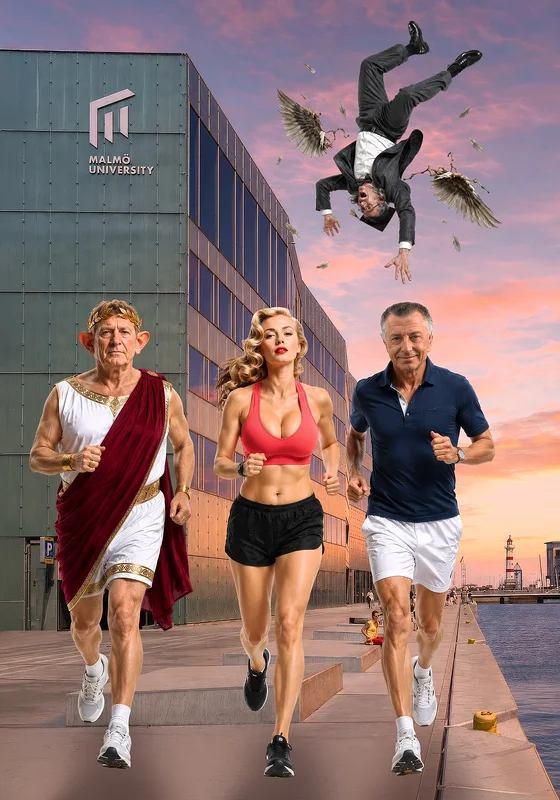
The Professor Who Tried to Fly - Professorn som försökte flyga, 2026
Digital
50 x 70 cm
3 200 kr
The Professor Who Tried to Fly - Professorn som försökte flyga
Svensk text på slutet
The Head in the River
History is filled with lost masterpieces. Some vanish in wars. Others disappear into private collections, shipwrecks, fires, or the silent chaos of time itselfa few become obsessions. The more elusive they are, the more desperately scholars search for them.
For generations, historians, archaeologists, and art experts had wondered what had become of the lost head of Emperor Nero. Somewhere between the collapse of an empire and the rise of modern Rome, it had disappeared. Theories multiplied. Books were written. Careers were built on speculation. Yet history remained silent.
Then, in the summer of 1966, an extraordinary discovery seemed to solve the mystery. Behind it was the movie star Anita Ekberg and the love of her life, Gianni Agnelli, the Fiat boss.
A weathered marble head emerged from the mud of the Tiber. Ancient pigments survived in its cracks. Its stone seemed to bear the exhaustion of nineteen centuries. The evidence appeared overwhelming. Laboratories confirmed what everyone wanted to believe. Newspapers celebrated, museums rejoiced, and scholars hailed a discovery that would rewrite Roman history.
Only one thing was wrong. The head was a fake.
What followed was not merely an archaeological hoax but one of the most elaborate practical jokes ever conceiveda conspiracy involving a billionaire industrialist and his lover, a world-famous, sexy movie star, a brilliant young sculptor, a river full of secrets, and a professor whose certainty proved stronger than his judgement.
This is the story of how Emperor Nero was given a new face, how the nose led an entire academic establishment, and how a trap set beneath the waters of the Tiber slowly closed around the man who believed himself the cleverest scholar in Italy.
The deeper the mystery grew, the more impossible it became to resist. That was precisely the point.
"Professor Bizzaros Flight
Professor Bizzaro spread his wings,
And dreamt of joining academic kings.
He found a head below the stream
And called it historys greatest dream.
I alone, the scholar cried,
Can see what lesser minds can't find!
His colleagues frowned; he laughed with pride
And left all caution far behind.
Each lecture hall became his throne,
Each newspaper his stepping stone.
He quoted Latin by the yard
And made complexity look hard.
The higher flew Professor Bizz,
The greater grew the Bizzaro buzz.
The students cheered, the cardinals smiled,
The man himself grew rather wild.
Like Icarus in Roman skies,
He soared on praise and grand replies.
His wax was made of egos heat,
His wings of footnotes incomplete.
X-ray the head! a rival said.
Bizzaro grinned and shook his head.
Please do! Let all the world behold
How envy strikes at truth and gold!
The cameras rolled.
The crowd grew still.
The room grew colder than a hill.
A shadow lurked within the stone
A secret chamber all its own.
A plug was pulled.
A gasp arose.
The professor trembled to his toes.
No ancient scroll.
No Caesars seal.
A newspaper.
Very real.
The date was clear.
The year was new.
Nineteen sixty-six stared through.
Gemini Ten had docked in space,
While horror drained Bizzaros face.
His wings dissolved.
His glory fled.
His masterpiece proved dead.
His empire cracked.
His triumph died.
And all of Rome laughed far and wide.
While Gianni raised a glass of wine,
And Anita thought the joke divine,
The scholar learned, though rather late:
The higher the ego,
The harder the date with fate.
And somewhere down the Tibers shore,
The river whispered evermore:
Before you claim you know it all,
Be certain first you cannot fall.
Malmö, June 2026
PROLOGUE A Cosmic Flashback
The glittering dust clouds surrounding Alpha Centauri spread like an endless field of crushed diamonds against the black velvet of space. Gianni, whose centaur form moved with a weightless yet majestic rhythm through the wormhole, slowed. His gleaming equine body reflected the light of the twin stars, and his human facewith those unmistakable features of Italian industrial nobility and timeless eleganceturned back towards Anita, who rode on his back.
It's fascinating, said Gianni, letting his gaze wander across the galactic horizon, how the laws of the universe are absolute, while human laws on Earth have always been so... flexible, especially among those who consider themselves the intellectual guardians of the world.
Anita laughed, a sound that could not be heard in the vacuum but existed as telepathic communication within him. Youre thinking of academics, Gianni? The ones who believe a diploma from the University of Bologna entitles them to look down on people like you, who actually build and finance the world?
Precisely them, Gianni nodded, his hooves skimming an invisible gravitational wave. The so-called experts. There is nothing more devious than a man whose ego exceeds his knowledge. If you want to hide reality from such an expert, you do not need to conceal it. You merely have to wrap it in a package that flatters his sense of superiority. Then he will defend the lie with an honour he does not possess.
Anita smiled and straightened. I know exactly what you're thinking. Rome, 1966.
Yes, indeed, said Gianni, his voice taking on a darker, telepathic tone. We are talking about Professor Emilio Bizzaro, that arrogant art historian who sat on his academic throne in the Vatican and believed he could treat me like an ignorant car salesman from the north. He swindled me with a fake Baroque painting, Saint John the Baptist, and a rediscovered Caravaggio, Bizzaro claimed. It was historically documented as one of the artists final works. The painting disappeared upon the death of its owner, Cardinal Borghese. It had been considered lost for more than four hundred years before being rediscovered in poor condition in the attic of a villa on the outskirts of the Borghese Gardens. This happened a year or so before we first met at the Stork Club nightclub, either 1951 or 1952.
1951, said Anita. It was during the Miss Universe competition, and I was in New York for several weeks. But go onI dont think Ive heard the full story yet.
I bought the painting, believing it was about to be acquired by Pierre Dreyfus, head of Renault. Faced with the prospect of an Italian master ending up in France, I purchased it and had it cleaned and restored. Bizzaro, regarded as Italys foremost authority on Caravaggio, guaranteed that the painting was the lost 1595 Caravaggio. A sensation! as he put it.
Word of my purchase spread through certain art circles; fortunately, nothing leaked to the press. Once the painting had been cleaned and restored, an anonymous letter appeared, claiming it was one of two paintings the legendary forger Han van Meegeren had sold to the Nazi criminal Hermann Göring. While the second forgery, attributed to VermeerChrist and the Woman Taken in Adulteryhangs in a museum in the Netherlands, the Caravaggio vanished from the salt mine where Göring had hidden his art collection. How it ended up in the Borghese Gardens has never been fully explained, but the house was once occupied by Professor Bizzaros predecessor at the faculty, Professor Truffatori. He belonged to the group that hunted down missing paintings after the war and apparently felt that a Caravaggio, genuine or not, belonged in Italy.
In the letter, the anonymous expertmost likely a jealous colleague of Bizzarosdescribed how Van Meegeren deceived specialists by mixing historical pigments, such as lapis lazuli, with synthetic Bakelite and lilac oil rather than ordinary linseed oil. Once the work was complete, he baked the canvas in an oven at 100120°C, fully hardening the paint so it could withstand the chemical, alcohol, and needle tests of the time. To imitate age cracks, he rolled the rigid canvas around a cylinder and washed it with black India ink, which settled into the cracks like centuries of dirt. He used inexpensive but genuine sixteenth-century paintings as a foundation, scraping away the original image while retaining the old canvas and wooden frame so the work would survive material analysis. He also advised me where to turn to verify his claims.
Geneva Fine Art Analysis (GFAA), the worlds most renowned private laboratory for the physical and chemical analysis of art, exposed the fraud. The method is complex but simple in principle. They search for anachronisms and substances that did not exist when the painting was supposedly created. They employed X-rays, infrared reflectography, and pigment analysis. Their research team ultimately uncovered the deception through three decisive scientific discoveries. First, microchemical testing isolated traces of synthetic Bakelite in the paint layersa plastic invented only in 1907. Second, X-ray images showed that the superficial cracks produced by the cylinder did not align with the deeper, genuine cracks in the underlying seventeenth-century ground layer. Finally, chemical analysis of the dirt lodged within the cracks proved it consisted of modern, uniform ink rather than naturally accumulated, multi-layered historical dust.
Bizzaro had described the purchase as a bargain because the artist was supposedly known as a companion of Caravaggio. That part was true. I paid thirty-five million Italian lire, less than the investigation would later cost. In total, I may have spent one hundred million lire, which in todays money is roughly 2.14 million eurosnot an enormous sum. It was not the money that bothered me, but the fact that a dubious professor had deceived me. Reaching him was difficult because it was his word against mine. I received no paperwork, only his informal assessment. Because of his position, I placed far too much trust in his expertise.
I understand exactly how you felt. Much as I did when my second husband robbed me of everything I owned. Despite all the years that have passed, Rik van Nutter is one person I avoid for eternity. Formally, he is still my husband on Earth, since we were never divorced. Rik disappeared from Earth eight years before I did, and I exhaled, thinking the bastard was gone forever. Of course not, but I couldn't have known then how small the universe is. Anyway, we ran into each other in eternity shortly after we had found each other again and I had moved to your star. When he realised who I shared the sun with, he did as he did on Earth and disappeared. I have heard rumours that he traded for a star as far away as you can get, Earendel, the most distant star in the universe, 28 billion light-years from Centaurus. Even with wormholes, the journey takes almost a year, and you have to change several times. The risk of us bumping into each other is therefore small. He knows I'm going to claw his eyes out next time. It doesn't matter that it doesn't hurt him, because it's the eternal dishonour that counts.
"Too bad you can't take revenge as elegantly as I could. It was actually you who gave me the idea. We were talking about our shared practical jokesthe shark that chased you and your prank of setting my watch back. We began fantasising about ways to fool other people. For example, you wanted to embarrass the star photographer Felice Quinto, the paparazzo who pursued you more relentlessly than anyone else. The arrow in his backside had not been enough. We joked about smuggling a roll of explicit pornographic photographs into his film reels and reporting him to the police. A search of his camera bag would have caused him enormous trouble.
Yes, that was certainly true under the laws of the time. My photographs were examined under a magnifying glass. I had problems with the Vatican, the morality police, and the Italian states strict censorship authorities. On one occasion, my mere appearance sparked a moral panic. Newspapers joked that Romes seven hills had become nine. It went so far that Pope Pius XII publicly described me as a danger to traffic whenever I moved through the streets.
Pornography was illegal in Italy under the category of obscene publications and objects, if I remember correctly. It could have resulted in heavy fines or imprisonment ranging from three months to three years. We laughed heartily at the image of the paparazzo being dragged along Via Nazionale by two policemen. The idea failed only because neither of us knew anyone willing to be photographed in such a manner. But the thought itself was wonderfully liberating.
Before you came up with the idea for the pornographic film role, you were considering luring him to the Galleria Borghese and arranging for Quinto to stumble beside Berninis statue, 'Apollo and Daphne.' The Baroque master carved the marble so thin that it looked like real leaves and branches. You planned to trip the paparazzo so he would hit the high pedestal hard enough to send the priceless marble leaves raining onto the floor. The idea was genuinely funny, but neither of us wanted to play a part in destroying an irreplaceable statue.
Afterwards, it occurred to me that instead of removing something from a statue, one could do the opposite. Add something. That was when I came up with the idea for one of Romes many headless statues. The Eternal City is full of them, a legacy of ancient practicality and historical drama. The Romans mass-produced marble bodies with a neck socket so that the head of whichever emperor happened to be in favour could be quickly inserted.
The joint was a weak point, and over centuries of earthquakes, angry mobs beheading hated rulersa practice known as damnatio memoriae'and early Christians deliberately smashing pagan statues, heads rolled more freely than in the French Revolution. One of those mutilated monuments could be perfect for getting at the art professor. But which statue, and how?
Do you remember the brainstorming session we held?
Yes, it involved vast quantities of champagne and laughter.
But we soon agreed that Nero was the obvious choice. He was the mad emperor, the subject of Professor Bizzaros doctoral dissertation. That should lure him straight into the trap.
Part 1: The Heist in Rome and the Roman "Necklace Beard"
The summer heat of Rome in 1966 hung heavy and shimmering over Piazza del Campidoglio. But inside the thick stone walls of Palazzo Nuovo, one of the two buildings that make up the Capitoline Museums, the air was cool, almost crypt-like. It smelt of damp marble, polished floors, and the unmistakable sharp tang of Italian Nazionali cigarettes.
In the museum director's office, Il Direttore, a stern Roman man in his fifties, sat, wearing a perfectly tailored suit, pomade in his greying hair, and with a facial expression that radiated the sort of academic superiority only a lifetime in the service of the Roman state can produce. To him, the world was divided into two categories: those who understood the greatness of antiquity and the tourists who merely got in the way.
But this morning, his stone-hard routine had been interrupted by a rare, intellectually stimulating visit.
You had appeared on a Monday, a day when the museum was closed. She had called that very morning to ask whether it would be convenient. Saying no to Anita Ekberg, Rome's most famous woman, was out of the question. The fact that she came during the afternoon break was also excellent, since he would have her entirely to himself; the rest of the staff had gone home to escape the hottest hours of the day, eat lunch, and perhaps take a nap. He would have done the same if Anita Ekberg had not called.
The fact that she brought an art student with her came as a surprise. However, his disappointment faded when the young man explained that he should not disturb them and that he would instead take a tour of the museum on his own if that were permitted.
"Of course," said Il Direttore, relieved.
Anita sat back in the heavy leather armchair opposite his desk. She was dressed in an elegant period ensemblea linen blazer fastened with a single button over a V-neck jumper, beneath which more was revealed than concealed. Her large sunglasses had been pushed up into her hair. On an antique silver tray before them stood two empty espresso cups and a smoking ashtray. Both were smoking. Everyone did in those days.
"But Professor," said Anita, tilting her head slightly with an expression of perfectly balanced, provocative admiration, "you surely cannot mean that Carlo Rainaldi's late-Baroque façades on Piazza del Popolo were mere plagiarism of Bernini. That would reduce his entire understanding of space to a meaningless imitation."
The museum director straightened in his chair, drew deeply on his cigarette, and slowly exhaled smoke between his lips, wearing a self-satisfied smile. This was exactly what he lived for: a young, obviously intelligent woman seeking his guidance while daring to challenge him just enough to tickle his academic ego.
"My dear signorina," he began, gesturing theatrically with the cigarette in his hand, "architecture is not merely lines carved in stone; it is power politics. Rainaldi was certainly talented, but he lacked Bernini's direct connection to papal authority. He was forced to compromise. If you study the 1662 drawings, you will see that..."
Anita nodded thoughtfully, brought her fingers to her chin, and let his monologue roll on like an unstoppable steamroller. She knew exactly which buttons to press. Every time he showed signs of winding down, she slipped in another profound, faintly provocative questiononce about Borromini's geometric neuroses, another about how much of Borromini's flowing Baroque style had actually found its way into Palazzo Nuovo's façade in the seventeenth century. She had spent several hours the previous evening studying the relevant chapters of a book on Rome's artistic treasures.
Il Direttore walked straight into the trap every time. He lit up, sat up straighter in his chair, and interrupted her, his voice triumphant.
"But my dear signorina, you are completely mistaken! The façade of Palazzo Nuovo follows Michelangelo's pure, austere Renaissance lines from the sixteenth century, designed long before the Baroque was conceived. However, the building itself was not completed until later! Allow me to explain the differences in symmetry..."
The museum director was completely ensnared in Anita's haze of Marlboros and academic flirtation. He forgot the time, the place, and, above all, he forgot to look at the clock. He was utterly convinced that he was educating Rome's number one sex symbol, entirely unaware that every second he spoke was giving the young man precious time one floor above.
One floor above, the young sculptor moved quietly around the famous bust of Nero. The silence felt deafening, broken only by his own breathing.
Part 2: The Emperors Hall and the Silent Impressions
The faint echo of the museum directors voice drifted up the stairwell from the office one floor below, like a distant mass. The conversation was Vittorios lifeline. As long as the monologue continued, he was safe. Methodically, with practised movements, he kept his focus, but the silence in the Emperors Hall was deafening, broken only by his own nervous breathing.
Vittorio took a small glass jar from his inside pocket and unscrewed the lid. He produced a soft, fine-haired brush, dipped it into the jar, touched the tip to the olive oil, and with feather-light strokes spread a leaf-thin layer over the intricate, circular necklace beard on Neros bust. The brush hairs followed the deep, carved curls perfectly. The stone greedily absorbed the moisture, darkening slightly and now protected from the aggressive plaster mixture.
Now he had to be quick. He could not use pre-prepared plaster; fast-setting plaster hardens in only a few minutes and must be mixed on the spot.
Vittorio took out a small plastic Tupperware container already filled with the exact amount of dry, finely ground alabaster plaster. From the other pocket, he pulled out a small glass bottle with a screw cap, filled with a prepared mixture of lukewarm water and a pinch of salt to speed up the chemical process. He quickly poured in the liquid. Instead of shaking the container, which would trap air bubbles in the mixture, he took out a narrow spatula made of soft horn. With quick circular movements, he stirred methodically until the plaster was completely smooth and free of lumps, achieving a thick-cream consistency.
With the spatula, he quickly spread the mixture over the emperors chin. Before it had time to set, he pressed a strip of thin, loosely woven medical gauze onto it, which he had cut beforehand. With the back of the spatula, he gently pressed the mesh into the wet mixture and spread a final layer of plaster over it to secure it. The reinforcement was in place; the impression would now hold together without cracking when it was pried loose.
Then came the worst part. Waiting. The seconds ticked by as if the clock were filled with syrup.
Vittorio held the spatula against the edge and counted the seconds in his head. Through the chemical process, the plaster began to emit a faint, feverish warmtha strange contrast to the ice-cold marble. It almost felt as if the dead emperor had suddenly acquired a pulse. The plaster grew hot, hardened in an instant, and transformed from cream to a hard, chalk-like crust.
Suddenly, a doorframe creaked somewhere further down the corridor.
Vittorios heart leaped into his chest. He froze, his gaze locked on Neros cold, empty marble eyes. Sweat broke out on the back of his neck in an instant, and the linen jacket suddenly felt like a straitjacket. He held his breath, listening so intently that his ears roared. Was it a guard? Had Il Direttore finished speaking? The seconds stretched into an eternity before he realised it was only the woodwork in the old windows shifting in the summer heat outside.
He exhaled. It echoed like a shaky lisp.
With gentle pressure along the edge, he pried the hardened plaster impression free. Thanks to the gauze, the thin, fragile mould held together perfectly and came away from the stone with a dry, dull snap. The impression of the beard was razor-sharp; the olive oil had done its job. He quickly wrapped the section in a soft cloth and placed it in his worn leather bag.
He then repeated the procedure twice, once for each side, so that the halves of the face met at the centre of the skull. These impressions also went into the bag.
Before closing the bag, he took out a grey, twisted piece of waste cloth he had kept in his pocket. Methodically, he removed every last trace of excess olive oil and plaster dust from Neros chin. Afterwards, he wiped it clean with pure alcohol to dissolve any remaining traces of olive oil, until the stone was once again completely dry and matte. No traces. No evidence.
As he pulled the bags zip shut, he heard the museum directors voice from one floor below suddenly change tone, as if he were about to finish a tirade and bid his guest goodbye. Time was up. Vittorio looked around once more and walked down the stairs. The timing was perfect.
Forgive me for not taking care of you, said Il Direttore. We were having such a pleasant time that the hours simply slipped by. I promise to be more sociable next time and to tell you a little about our museum. He winked at Anita, who smiled. From Vittorios satisfied expression, she understood that everything had gone well.
Part 3: The Bribe in Carrara
The dust was not grey up here; it was chalk-white. It settled like a fine powder over the hood of the heavy Fiat truck as it slowly made its way along the winding roads of the Apuan Alps, all the way to Fantiscritti. It was two oclock in the afternoon, and the afternoon siesta had laid a blanket of silence over the mountains. The heavy echo of pneumatic drills and wire saws had fallen silent; everything stood still in the shimmering summer heat. The sun reflected off the sheer white stone walls with such intensity that Vittorio had to squint despite his sunglasses as he stepped out of the truck cab.
The osteria at Fantiscritti lay secluded, little more than a shack of rough planks and corrugated sheet metal, wedged between two enormous blocks of marble. In the shade, it smelt of sour red wine, salted lardo ham, and the bitter, sharp scent of coarse-cut tobacco. This was no tourist establishment, but one could be left in peace here.
At the innermost wooden table sat Pasquale. He looked as if he had been carved from the mountain; his hands were as rough as rasps, his face furrowed by a long life beneath the open sky, and his eyes watchful beneath bushy eyebrows dusted with stone powder.
Vittorio sat opposite the old stonecutter, opened his worn leather bag, and discreetly slid an envelope of banknotes across the stained table. It was a considerable sum in Italian lire, taken from one of Gianni Agnellis hidden funds, For predictably unpredictable expenses.
Pasquale did not even glance at the envelope. He took a sip of the dark wine, spat it demonstratively onto the dirt floor, and slowly shook his head.
Paper, muttered the old man in a broad Tuscan dialect. It buys me nothing up here. The states rubbish money only brings me trouble with the tax authorities in Rome, young man. Do you think I would sell my secret stockpile for that? Forget it.
Vittorio refused to be discouraged. This was exactly what Gianni had anticipated. Cash carried no weight with Carraras old guard in the late sixties. He pulled back the envelope and reached into the inside pocket of his linen jacket.
I understand you, Pasquale, said Vittorio quietly, laying a heavy, high-quality, folded document on the table instead. But what about this?
Pasquale frowned and pulled the document towards him. At the top of the elegant paper gleamed the familiar silver logo: FIAT. It was an official, personally signed document from the office of the newly appointed chief executive in Turin. It guaranteed the bearer immediate delivery of a factory-new, bright green Fiat 850straight from the Mirafiori assembly line. No waiting, no forms, no two-year waiting list ordinary mortals were forced to endure. A brand-new car, the very same day, in the most sought-after colour scheme.
Part 4: The Sculptors Time Travel
The old stonecutters eyes widened. The elegant little car was the very embodiment of the Italian economic miracle, a currency harder than gold in a country where everyone wanted wheels. Pasquales fingers trembled as he touched Agnellis hidden signature. He looked up at Vittorio, and for the first time, a crooked, toothless smile broke through the grey moustache.
LAvvocato, whispered Pasquale, carefully folding the document and slipping it into his worn vest. That man knows how to speak to a stonemason.
Pasquale rose and led Vittorio deep into an abandoned, shaded section of the quarry, far from the modern machinery. In the sharp afternoon light, he showed the way to a niche in the mountainside, half-hidden beneath fallen rubble.
There it lay. A block of genuine Luna marblethe finest, most fine-grained available, with an almost magical, waxy lustre. It had been quarried during the reign of Emperor Claudius nearly nineteen hundred years earlier, but it was rejected because of a deep surface crack along one edge. To the ancient Roman sculptor, the block was worthless, but to Vittorio, the crack mattered not at all. He intended to chisel away the defective section before beginning his work. Moreover, the block was large enough for three full-sized heads. It gave him enormous reassurance; he could afford to fail.
The stone had aged for centuries. Because the block had been left outdoors, completely exposed beneath the open sky, centuries of Alpine rainwater, biting winter frost, and the burning Tuscan summer sun had penetrated deep into the porous marble. Chemical weathering and moisture had altered the stone at its core; the sharp calcite crystals had softened, and calcium carbonate had slowly broken down in the outer layers. The process had given the marble a subtle, sponge-like microporosity and a matte, earthy undertone. This was crucial to Giannis plan. The head Vittorio was about to carve was intended to be presented as a sensational archaeological discovery that had lain buried in the corrosive, oxygen-poor mud of the Tiber for nineteen hundred years. Had the stone been freshly quarried, an expert would immediately have exposed the fraud by its hardness, but this weathered, deeply aged stone already possessed exactly the right historical weariness. It was entirely free of internal stresses, perfectly cured, and in precisely the same shade as Neros bust in Palazzo Nuovo. It was a theft from history carried out in broad daylight.
The driver backed the rumbling Fiat truck down towards the hidden niche. Working with Pasquales old blocks and tackle, they rolled the ancient stone onto the flatbed, where it landed with a heavy metallic thud.
Vittorio climbed back into the passenger seat and pulled the door shut. The driver set course for the studio in Turin, and the truck rolled out of the siesta-silent Carrara, heavily laden with nineteen hundred years of history on its flatbed.
The conditions for Vittorios time travel had been set at the absolute centre of power in Rome. Borrowing an ancient, decapitated, armoured statuea loricatus of imperial sizefrom the Vatican Museums heavily guarded collections was a logistical impossibility for ordinary mortals. But for LAvvocato, it required only a private telephone call, a discreet handshake at dinner, and the promise of an astronomical donation to the Vaticans restoration funds. Officially, the heavy marble body was shipped to Turin for an exclusive, closed exhibition of experts in the citys cathedral, Il Duomo, generously sponsored by the Agnelli family, who regularly financed the cultural life of both church and city. Unofficially, however, the heavy transport rolled directly into Vittorios hidden studio in the old artisans quarter.
Vittorio was a young man. He would turn thirty the following year, yet he already carried a great professional pride. He had been among the very best students of his year at the Accademia Albertina di Belle Arti in Turin, a rare talent who mastered stone as if it were wax. He already had several public works behind him, but like all young artists, he had irregular commissions, and finances were a constant rollercoaster. Gianni Agnelli had discovered his talent early and had become his patron. It was through LAvvocatos hidden network that Vittorio had secured the commissions that kept him afloat, and now the patron demanded the riskiest masterpiece of his life.
Instead of beginning with the facial features, Vittorio started with the body. He began with the neck and the statues attachment point. The heavy marble body stood in the middle of the room, and Vittorio studied the broken neck socket beneath a powerful halogen lamp. Over the centuries, as the statue changed identity and received new heads whenever emperors succeeded one another, the attachment had been altered and recut several times. However, I have made a careful estimate of what the original attachment looked like in the first century, before the soldiers beheaded it during the damnatio memoriae.
The work was carried out entirely without modern machinery. Electric angle grinders and pneumatic chisels were forbidden; they would leave microscopic traces of modernity that an expert would detect. Vittorio used only hand-forged iron chisels and a hand-operated bow drilla trapano a volanoto reproduce exactly the techniques of his ancient colleague. Every tool mark in the stone had to speak the same language as the Roman original.
The rough carving took four days. With a heavy wooden mallet and coarse-point chisels, he methodically removed the cracked outer edge of the Carrara block until a rough, egg-shaped volume emerged from the aged marble. Then followed more than a week of geometric torture. Using a classical pointing machine, he measured hundreds of fixed points on his plaster casts from the Emperors Hall and carefully drilled millimetre-deep holes into the new stone to establish Neros proportions. Piece by piece, Nero emerged in broad outline. He paid particular attention to the peculiar beard and Neros asymmetrical, protruding ears.
During the final ten days, the finished emperor emerged from the dust. Vittorio worked by the light of a pair of antique oil lamps, watching how the shadows fell across the cruel facial features and the intricate, circular necklace beard. Since the head would be presented as an ancient river find, the marble was left unpolished. Once the stone had reached the correct texture, he stopped. Taking a small brass brush, he deliberately knocked off microscopic flakes from the lower edge of the neck so that the fracture surface matched the statues decapitated necknot across the entire surface, since the opening had been modified to fit several previous heads, but at a few vital points it didjust as West Africa fits into eastern South America, where they once belonged together before continental drift separated them. It was a mutilated puzzle in which the heavy marble head was lowered into place and locked itself into the deep socket of the torso.
The final phase was pure alchemy. Ancient statues were polychrome, and Vittorio recreated the worn traces of Neros notorious reddish-blonde hair, his freckled complexion, and his cold grey-blue eyes. He used microscopic remnants of genuine ancient pigmentslight yellow ochre for the hair, Egyptian blue and burnt umber for the eyes, and deep red cinnabar scraped from worthless fragments of Roman brick. He even rubbed tiny flakes of gold leaf into the beards grooves before bathing the marble in a diluted mixture of sulphuric acid and coarse sand. The acid etched away the freshly carved sharpness of the chisel marks, making the stone bleed until the pigments and dried river mud were mechanically burned into the marble's pores.
One final, most important task remained: proof that this was a modern replica, not Neros original head, the little time capsule. A tightly rolled front page from Giannis own newspaper, La Stampa, was inserted into a round aluminium container. Without this time-capsule evidence, there was a significant risk that, after various tests in 1966, the head would have been considered the original, once discarded. Vittorio had been that skilful. In that case, the entire carefully planned practical joke would have been wasted, and Gianni would never have had his revenge on the professor. The time capsule was fundamental and, at the right moment, would become the bomb that exploded beneath the professors feet. He would certainly be one of those capable of going to his death, insisting that this was genuine.
Vittorio had prepared this important detail as well. When he initially cut the stone to size, he saved the leftover section where the neck ended. He then drilled a hole in the underside of the neck and used a core drill to cut a slightly tapered plug from the leftover piece of marble.
The time capsule, wrapped in greased paper, was inserted into the hole, and a grease plug was pressed in above it before the slightly tapered stone plug was driven into place. Both sides were then brushed with sulphuric acid to bond the marble. Finally, Vittorio sanded the underside until the edges disappeared, and, with the aid of acid, the surface was given the proper rough texture.
When Vittorio finally wiped the face clean with an alcohol-soaked cloth, he was met with Neros cold gaze. The head was finished. It did not look like a copy; it carried the weight, the grime, and the genuine, weary erosion of nineteen hundred years of oblivion at the bottom of a river.
Last of all, he placed the completed head in a barrel filled with genuine foul-smelling river water transported from central Rome, together with several barrels of bottom sludge collected from two metres beneath the present riverbed. There, the head remained undisturbed for an entire week, allowing the stone to absorb the correct amount of contaminated water deep within its structure. Vittorio knew that if a suspicious laboratory technician later took a deep sample from the head, they would not find sterile spring water from Turin. Instead, they would discover traces of industrial lead, diesel residues, deposits of tannic acid from vegetation along the riverbanks, and microbiological evidence of a modern, densely populated Romeincluding thriving cultures of coliform bacteria deeply absorbed into the marbles ancient capillaries. It was the marbles final biological false alibi.
When the week had passed, and the stone had become saturated with Romes modern DNA, it was time to determine exactly where in the river the head would be buried. The lawyer and Vittorio studied Romes river maps with obsessive precision. The chosen location was ingenious in its simplicity: the bend of the river below the Aventine Hill, beside the ruins of the ancient river port known as the Emporium.
Vittorio had been adamant about that point. Under no circumstances could the head be dumped in the northern or central sections of the river, near Tiber Island or Romes oldest intact bridge, Pons Fabricius. Along those central stretches, Italian engineers had turned over every stone in the river when the monumental Muraglioni embankment walls were built in the late nineteenth century. Up there, the riverbed had been cleared, blasted, dredged, and secured with modern concrete foundations. Every accumulation of sediment had been disturbed.
But here, just south of the ruined ancient arch known as Ponte Rotto, where the Tiber made a broad curve past the Aventine Hill, the riverbed widened. The current naturally slowed, turning the bend into a geological sediment trap. Here, over the centuries, the river had been allowed to deposit the citys debris in undisturbed, oxygen-free layers of clay and silt, untouched by modern bridge construction or dredging operations since antiquity. If the head were buried in the mud here, below the old logistics centre of the Roman Empire and the amphora hill Monte Testaccio, the riverbed would never have been disturbed by machinery. It would lie sealed within a deep layer of clay, untouched since the days of Emperor Claudiusready to be discovered by the right person.
Part 5: The Ambiguously Written Bait and the Trap in Rome
In his studio in Turin, Vittorio swept the last traces of marble dust from the workbench. Neros head rested in its barrel of water, but Vittorio was not finished. From the floor, he lifted the rectangular slab of marble he had saved from the cracked short end of the Carrara block. It was a rough, battered slab, rugged at the edges and worn by centuries of exposure to the open sky. To an outsider, it looked like a worthless piece of stone, but in Vittorios hands it would become the intellectual bomb that would trigger LAvvocatos revenge.
With a worn point chisel and light hammer blows, Vittorio began carving an inscription on the front of the slab. He used a careless, period-appropriate Roman cursive script, precisely the style a military cartographer or a state surveyora gromaticuswould have used in the field in the first century.
Vittorio did not carve only coordinates. At the top of the stone, in the centre, he placed the official initials NC for Nero Caesar, followed by CACAT. Directly before NC, he carved an erect phallus, its glans pointing towards Nero Caesar. The inscription literally means: Shits on Nero Caesar, with the penis serving as a visual insult to the emperors masculinity and dignity. That an admirer of Nero had not carved it was obvious; rather, it had been carved by someone who wished to retrieve the head and destroy it completely.
Immediately after the letters were in place, he took his coarsest chisel and struck a hard, careless blow straight across the inscription, chipping a piece of the stone away. It looked like a classic hasty attempt at damnatio memoriaeas though a Roman soldier, in panic, had tried to erase the hated emperors name before the stone was buried. Yet the letters remained fully legible to a trained eye.
Just below the damaged name, he carved the official coordinate system of ancient Rome, based on the exact position of the river bend relative to the citys point of origin:
SD XII VK VII
AD FLVM EMPORIVM
The formula was a readable cypher for the initiated, for example, archaeologists and professors of history.
Sinistra Decumani XII, Ultra Kardinem VIItwelve units to the left of the east-west axis, seven units beyond the north-south axis. The line beneath indicated the location: on the river at the Emporium. If one understood nothing, it did not matter, because Vittorio did not either. Yet he was still able to carve every symbol.
To complete the forgery, Vittorio took a small amount of red iron-oxide paste and rubbed it into the letters, exactly as the Romans had done to make inscriptions visible in sunlight. He then brushed the stone with sulphuric acid to make the newly carved grooves look as weathered and eroded as the rest of the slab.
When the professor sees this in the photograph, he will be beside himself with academic joy, thought Vittorio. To Bizzaro, the badly battered piece of marble is the ultimate proof. It shows that the stone is not merely a boring official boundary marker, but that an angry Roman soldier or rebel dishonoured Nero during the year of the revolt, AD 68, when Neros regime collapsed, and his statue was decapitated.
The fact that the soldier carved a contemptuous phallus and wrote CACAT also explains why the stone is so battered and why it was discarded. It gives the forgery a perfect dramatic narrative that Bizzaro will swallow hook, line, and sinker.
Part 6: Operation Fiumaroli and the Deep Memory of the Tiber
It was Monday, July 25, 1966, and a heatwave gripped the city. The oppressive siesta silence hung heavily over the bend of the river below the Aventine Hill. The murky, opaque waters of the Tiber moved lazily, carrying summer debris and the scent of mud and sun-baked wood. In 1966, the river was still a living part of Roman popular life. Here, the Fiumarolithe river peoplespent their afternoons fishing for mullet and eels from their characteristic flat-bottomed wooden boats. On this particular afternoon, two such barconi lay anchored in the gentle current, a few dozen metres apart. The boats had been purchased well in advance through intermediaries, complete with permanent moorings along the riverbank.
To outsiders, they appeared to be two groups of local Romans escaping the city heat to fish for barbel in the shade of the Aventine Hill. But aboard the first boat sat Vittorio with Gianni. LAvvocato was in his element; he was an avid and experienced sport diver who loved a challenge. To prevent the boat from capsizing as they lowered Nero, they had lashed the thirty-kilogram Nero head to the stern. The head hung submerged just below the waters surface, invisible to people on shore but safely supported by the boats buoyancy.
The second boat served as a diving platform for three of Vittorios closest friends, all experienced sport divers whom Gianni had outfitted with modern diving gear.
The location had been chosen with great care. Anita had read the story of Paolo Bianchini, a fiumarolo who, in the nineteenth century, discovered a headless consular statue at precisely this location. It made the plan perfect. They were positioned on a stretch where the depth measured just over two to three metres, exactly the depth at which a severed imperial head might reasonably have landed if angry soldiers or an enraged mob had thrown it over the parapet of the old bridge during a damnatio memoriae nineteen hundred years earlier.
Now, Vittorio, said Gianni quietly, adjusting his sunglasses and taking one final look at the riverbank before preparing himself. Check the coordinates, he called.
While the friends in both boats theatrically tended their fishing rods and shouted comments to one another across the water to maintain appearances, Vittorio took out a small notebook and checked Giannis notes from the previous week, in which he had marked the future position of the head. Vittorio now verified whether they were anchored in the correct position. He pointed towards the four fixed ancient landmarks that Gianni had indicated: the distinctive corner of the stonework at the Emporium, the steep monastic cliff of the Aventine Hill, the solitary column on the hilltop, and the remaining arch of the ruined Ponte Rotto. By crossing these four lines in his sketch, he created a crosshair that would allow them to locate the site with millimetre precision in future. They were within a metre of the mark, directly above the point Gianni had selected.
Gianni slipped on his mask, placed the breathing mouthpiece between his lips, and silently slipped into the warm brown water with the other three divers. They disappeared beneath the surface at once. Vittorio untied the ropes at the stern and allowed the heavy Nero head to be lowered to Gianni and the others waiting on the riverbed.
Down in the oxygen-poor darkness of the riverbed, the four divers worked quickly. Using short shovels, they dug deep into the nineteen-hundred-year-old sludge. They excavated a cavity in the sticky clay. They positioned the head naturallyslightly tilted on its side, half-buried, exactly as the current would have left it if it had once rolled along the riverbed. Afterwards, they methodically shovelled the mud back over the marble. They carefully concealed the site beneath the natural river debris scattered across the bottom: several heavy Roman brick fragments, branches, and a couple of old, rusty iron pieces.
When the divers finally broke the surface and climbed back over the gunwale, Gianni let out a relieved sigh, pushed his mask up onto his forehead, and accepted a towel from Vittorio. The operation was over. They knew the Tiber's currents and sediment flow would do the rest. After a week in the river, no one in the world would be able to distinguish that patch from the surrounding ancient riverbed. The trap was set.
The planting of the coordinate stone, which Vittorio had carved with deliberate carelessness, was a masterpiece of media and psychological manipulation, conceived by Gianni. He knew that Professor Bizzaro had spent decades searching for Neros head and had developed an academic obsession with the search. If the stone were simply sent to him, he would suspect a trick. Bizzaro had to believe he had almost stolen the clue from under his rivals noses.
Through an intermediary, Gianni arranged for the marble fragment to be discovered by a well-known, disreputable private investigator and antiquities smuggler during an illegal excavation outside Rome. Desperate for money, the smuggler photographed the coordinate stone and tried to sell the image, with its seemingly meaningless text, to newspapers. No one was interested, despite the phallic symbol. Even in the 1960s, such graffiti could be found on every other wall, so it caused no excitement.
Copies of the photograph also reached the offices of La Stampa, Giannis own newspaper in Turin. An editor on the culture desk, in on the scheme, officially declined to purchase the image from the smuggler, arguing that it was an obvious forgery. Secretly, however, he stole an official correspondence card from the editor-in-chiefs office. He ensured that a copy of the photograph ended up on Professor Bizzaros desk in Rome, together with the elegant card and a handwritten note: What does this mean? Politely signed by Giulio De Benedetti, the legendary editor-in-chief of La Stampa.
When the professor saw the photograph of the battered marble fragment, the hidden initials of Nero Caesar, and the adjacent primitive phallic symbol bearing the word CACAT, he was seized by academic hubris. His ego silenced every warning bell.
He immediately understood what the letters NC, SD, and VK meantan official survey marker from imperial times, dishonoured by an angry soldier during the revolt of AD 68! Feverishly, Bizzaro pulled out several ancient maps and plotted the coordinates using the Decumanus and the Cardo. When his compass pointed precisely to the bend of the river below the Aventine Hill, beneath the Emporium, he trembled with excitement. Near the old bridge, Ponte Rotto. That was where he should have searched long ago. Of course, they had thrown the head exactly where the current slowed after the bridge support.
The professor was convinced he was the only person in all of Italy clever enough to decipher the ancient cartographers' system. Terrified that another scholar might steal his lifetime's discovery, he did not even mention it to a single colleague. In absolute secrecy, Bizzaro hired a couple of local divers to search the site, completely unaware that they were about to swim straight into the hidden net Gianni had cast beneath the waters of the Tiber. And he himself would become trapped in it.
But greed made the divers careless. They assumed that no one would throw a heavy stone, but would drop it straight down. Despite the exact coordinates on the stone, they chose to search first directly beside the ruined bridge, where the solitary arch stood in the sluggish current. Strong currents never entered their thoughts, nor the professors. A head can roll even along the bottom of a river.
There, the divers spent several days and found little more than an ancient, rusty Bianchi bicycle, half-buried in foul-smelling river mud. However, how it had ended up in the middle of the riverbed, thirty metres from shore, remained a mystery. From the riverbank, Bizzaro tore at his hair in the summer heat, while the divers cursed the poor underwater visibility.
After so many years, the coordinates were no longer accurate enough to pinpoint the location to within a few metres. Consequently, the search area had to be expanded farther from the bridge. After a week, when Bizzaro began to lose hope, it occurred to him that one of the coordinate reference pointsthe distinctive corner of the stoneworks at the Emporiummight refer to either of two corners. If he switched corners, the cross on the map fell into the water directly beneath the bridge arch, in the middle of the old main channel, close enough that the head might have travelled several metres in the strong current before becoming lodged in the mud. At that moment, Bizzaro realised that the head had to be buried beneath the sludge. He was a professor of history rather than an archaeologist, and his unwillingness to share the discovery meant he lacked others' expertise.
The divers anchored their boat precisely above the point where the cross had fallen, according to the recalculated coordinates. This time, they brought proper shovels and spades and began moving mud from place to place. No one noticed that the sludge was unusually easy to excavate; the divers were not archaeologists either. They found occasional bronze objects, so heavily corroded that it was impossible to determine what they had once been. On the second day, one of the divers struck something hard with his shovela stone, or perhaps the remains of an old wallstone, in any case. After half an hour of digging, they uncovered a head, perhaps the very one the professor had been seeking.
The moment the head reached the shore, Bizzaro realised he had achieved his lifelong dream. But generosity does not reign in the academic world. Instead, a strict, often jealous meritocracy rules, and there are always those who oppose it. It did not matter that Bizzaro presented a masterpiece; his colleagues demanded proof, ready to tear his discovery to pieces. It is difficult to do that with a stone, but smashing a dream with a sledgehammer works just as well.
When Bizzaro confronted his critics during the first stormy debates at the university, he responded with an arrogant sigh. He reminded his opponents that scientific inertia was nothing new. The fact that the Earth is now considered round was not fully accepted until the first satellite photographs finally silenced the doubters. It did not matter that the Greek astronomer and cartographer Eratosthenes in Egypt had calculated that the Earth was round more than two thousand years earlier, simply by observing how the angle of a shadow varied between two locations at the summer solstice. The academic world had always demanded to see the obvious before believing it.
Bizzaro was one hundred per cent certain this was Neros lost head. The ancient coordinate stone spoke with perfect clarity, and to silence his critics once and for all, he had no choice but to grant his opponents full access to Nero for their independent analyses.
Several weeks passed. Laboratories in Rome and Milan tested the stone and found aged Luna marble, ancient pigments, and biological river contaminants that Vittorio had so brilliantly prepared. No one, no matter how much they wanted to, could disprove Bizzaro. The professor secured one success after another while his opponents kept striking stonea metaphor that certainly fit the circumstances.
With each failed counterattack, Bizzaros arrogance grew. He was celebrated internationally, wrote opinion pieces, and addressed packed halls. Higher and higher Bizzaro flew on his own waxen wings, and the risk of crashing into a wall increased. He remained completely unaware that the higher he flew, the harder the fall would be when LAvvocatos hidden time capsule was opened. The final straw came when Bizzaro began to develop political ambitions and to speak openly about sweeping the corridors clean of academic nobodies if he ever gained power.
Like Icarus, Bizzaro hovered perilously close to the sun, and Gianni wondered when he should let the wax melt; the professor could not fall any farther. The opportunity arose when the Vatican Museums, in cooperation with the Italian Ministry of Culture, announced a live international gala dinner and academic ceremony to be held in Rome. The purpose was grand: to officially celebrate the reunification of the ancient armoured statuewhich had now been hastily transported back from the expert exhibition at Turin Cathedralwith its newly discovered imperial head.
The entire European cultural elite was in attendance. Television cameras rolled, flashbulbs popped, and at the head table sat Professor Bizzaro, flanked by cardinals and ministers, radiant as a newly crowned king. It was the pinnacle of his career.
On Giannis orders, one of the young sculptor friends who had taken part in the diving operation sent an anonymous yet highly technical tip to one of Bizzaros most bitter academic rivals. The tip alleged that Bizzaro had secretly used a modern synthetic resin deep within the neck socket to secure the attachment to the torsoa serious breach of international restoration regulations.
The rival, who had been boiling with envy for weeks, swallowed the bait immediately. In the middle of the televised programme, just before the head was ceremonially lowered into the statues neck socket before a worldwide audience, the rival stepped forward to the microphones and demanded an immediate public examination of the underside of the neck using a portable X-ray device already present in the building, loaned by one of Giannis many companies. How convenient.
Bizzaro laughed mockingly at the suggestion. He was so certain of the stone that he himself waved the technicians forward.
Let them X-ray it! Let the whole world see how pathetic their jealousy is!
Photographs were taken and developed one after another because X-ray imaging was still a complicated process. At last, however, they had a developed X-ray image taken from below at an angle. When the screen lit up, the plate revealed not a solid marble headdeep within the centre of the marble neck, a perfectly circular shadow appeared. The head contained an internal cavity that had been sealed.
The silence that settled over the gala hall was absolute. For as long as possible, Bizzaro hoped it was an ancient relic cache or a forgotten imperial seal. Meanwhile, in the trembling silence, a technician took a fine chisel and carefully tapped along the invisible acid-bonded seam. Eventually, the slightly tapered marble plug loosened and slid outward. Using pliers, the technician pulled the plug free. Inside lay a round capsule wrapped in paper. Neither paper nor aluminium existed in Roman times, and things were beginning to look bleak for Bizzaro. A roll was removed from the capsule. It was not parchment but a modern newspaper.
Before the worlds television cameras, the trembling museum director unfolded the front page of La Stampa, dated Tuesday, July 19, 1966. At the top of the page, giant black headlines blazed, announcing that astronauts John Young and Michael Collins had just completed historys first successful space docking during Gemini 10.
Bizzaro turned deathly pale. His waxen wings had not merely melted; the professor had collided with the sun live on television. In the VIP section, Gianni and Anita sat in the shade, raising glasses of champagne and smiling coolly.
The revenge was complete.
Epilogue What Goes Around Comes Around
Professor Bizzaros art scholarship was a fraud, disguised as elegant Latin terminology and forged provenance papers, but he made one fatal mistakehe believed my lire notes were blind."
And you hate losing, Anita reminded him.
I do not hate losing money, Anita. I hate being underestimated, Gianni corrected her with a crooked smile. But it was precisely there, in the bitter aftertaste of the fake Caravaggio in the spring of 1966, that our best project was born. The ultimate delayed practical joke. A trap that would not only cost him his reputation but also make Bizzaros name synonymous with academic blindness. Think of that the next time you hear someone say something is bizarre.
I shall think of it. But 1966 was a wonderful year, Anita said, looking back as they continued gliding towards the next star system. You had the money, I had the story, and our sculptor had the chisel. It is time for us to document how we actually gave Emperor Nero his face backand how we gave Bizzaro the flight he so richly deserved.
Professorn som försökte flyga
Huvudet i floden
Historien är full av förlorade mästerverk. Vissa försvinner i krig. Andra går upp i rök i privata samlingar, skeppsbrott, bränder eller i tidens tysta kaos några få blir besattheter. Ju omöjligare de är att hitta, desto desperatare söker forskarna efter dem.
I generationer hade historiker, arkeologer och konstexperter funderat över vad som hänt med kejsar Neros försvunna huvud. Någonstans mellan ett imperiums fall och det moderna Roms framväxt hade det förlorats. Teorierna blev fler. Böcker skrevs. Karriärer byggdes på spekulationer. Ändå förblev historien tyst.
Sommaren 1966 tycktes en sensationell upptäckt lösa gåtan. Bakom låg filmstjärnan Anita Ekberg och hennes livs kärlek, Gianni Agnelli, Fiatchefen.
Ett vittrat marmorhuvud dök upp ur Tiberns dy. Antika pigment levde kvar i dess sprickor. Stenen tycktes bära på nitton sekler av hemligheter. Bevisen verkade överväldigande. Laboratorier bekräftade det som alla ville tro. Tidningarna jublade. Museerna firade. Forskare talade om en upptäckt som skulle skriva om den romerska historien.
Bara en sak var fel.
Huvudet var falskt.
Det som följde var inte bara en arkeologisk bluff, utan ett av de mest genomarbetade praktiska skämt som någonsin iscensatts en konspiration som involverade en miljardär och industrimagnat samt hans älskarinna, en världsberömd sexsymbol och filmstjärna, en briljant ung bildhuggare, en flod full av hemligheter och en professor vars övertygelse visade sig vara starkare än hans omdöme.
Det här är berättelsen om hur kejsar Nero fick sitt ansikte tillbaka, hur en hel akademisk värld leddes vid näsan och hur en fälla, utlagd under Tiberns vatten, långsamt slöts kring mannen som ansåg sig vara Italiens skarpaste forskare.
Ju djupare mysteriet blev, desto omöjligare blev det att värja sig mot det.
Och det var precis meningen.
PROLOGUE - Kosmisk tillbakablick
De glittrande stoftmolnen runt Alpha Centauri bredde ut sig som ett oändligt fält av krossad diamant mot rymdens svarta sammet. Gianni, vars kentaurskepnad rörde sig med en tyngdlös men ändå majestätisk rytm genom maskhålet, saktade in. Hans glänsande hästkropp reflekterade ljuset från tvillingstjärnorna, och hans mänskliga ansikte med de där omisskännliga dragen av italiensk industriadel och tidlös elegans vändes bakåt mot Anita, som red på hans rygg.
"Det är fascinerande", sade Gianni och lät blicken vandra över den galaktiska horisonten, "hur universums lagar är absoluta, medan de mänskliga lagarna på jorden alltid har varit så töjbara. Särskilt bland dem som anser sig vara jordens intellektuella väktare."
Anita skrattade, ett ljud som inte hördes i vakuumet men som var en telepatisk kommunikation inuti honom. "Du tänker på akademiker, Gianni? De som tror att ett diplom från universitetet i Bologna ger dem rätt att se ner på er som faktiskt bygger och finansierar världen?"
"Precis de", nickade Gianni och hans hovar hoppade över en osynlig gravitationsvåg. "De så kallade 'experterna'. Det finns inget lömskare än en man vars ego är större än hans faktiska kunskaper. Om man vill dölja verkligheten för en sådan expert behöver man inte gömma den. Du behöver bara slå in den i ett paket som smickrar hans egen förträfflighet. Då kommer han att försvara lögnen med en heder han inte har."
Anita log och sträckte på sig. "Jag vet exakt vad du tänker på. Rom 1966."
"Ja", sade Gianni, och hans röst fick en mörkare, telepatisk ton. "Vi talar om professor Emilio Bizzaro. Den där arrogante konsthistorikern som satt på sin akademiska tron i Vatikanen och trodde att han kunde behandla mig som en okunnig bilnasare från norr. Han blåste mig med en falsk barockmålning. Johannes Döparen och en 'återfunnen' Caravaggio, påstod Bizarro. Den är historiskt dokumenterad som ett av konstnärens sista verk. Målningen försvann i samband med kardinal Borghese' död. Den har ansetts förlorad i över 400 år, men återfanns i dåligt skick på vinden i en villa i Borgheseparkens utkanter. Det här skedde något år innan vi träffades första gången på nattklubben Stork Club. 1951 eller 1952.
1951, sa Anita. Det var i samband med Miss Universe-tävlingen och jag var i New York i flera veckor. Men berätta, för jag har nog inte hört allt.
Jag köpte målningen i tron att verket var på väg att köpas av Pierre Dreyfus, chef för Renault. Inför risken att en italiensk stormästare skulle hamna i Frankrike köpte jag verket och lät det rengöras och restaureras. Bizzaro, som ansågs vara Italiens främste kännare av Caravaggio, garanterade att målningen faktiskt var den försvunna Caravaggio-målningen från 1595. En sensation! som han uttryckte det.
Ryktet om mitt inköp spred sig i trängre konstkretsar; dessbättre läckte inget ut till media. När målningen var rengjord och klar dök ett anonymt brev upp som påstod att den var en av två målningar som den legendariske förfalskaren Han van Meegeren hade sålt till naziförbrytaren Hermann Göring. Medan den andra förfalskningen, tillskriven Vermeer, Kristus och äktenskapsbryterskan, hänger på ett museum i Holland, stals Caravaggio från saltgruvan där Göring gömde sin konstsamling. Hur den hamnade i Borgheseparken är inte helt utrett, men i huset bodde professor Bizzaros företrädare på fakulteten, professor Truffatori. Han ingick i den grupp som jagade försvunna målningar efter kriget och tyckte väl att en Caravaggio hörde hemma i Italien, falsk eller inte.
I brevet beskrev den anonyme experten, sannolikt en avundsjuk kollega till Bizzaro, hur Van Meegeren lurade experter genom att blanda historiska pigment (som lapis lazuli) med syntetisk bakelit och syrenolja, istället för vanlig linolja. Efter avslutat arbete ugnsbakade han duken i 100120 °C, vilket härdade färgen helt och gjorde att den motstod dåtidens kemiska alkohol- och nåltester. För att efterlikna ålderssprickor rullade han den stela duken runt en cylinder och tvättade den med svart tusch som fastnade i sprickorna som gammal smuts. Som grund använde han billiga, äkta 1500-talsmålningar där han skrapade bort motivet men behöll den gamla duken och träramen för att klara materialanalyser. Han rekommenderade mig också var jag skulle vända mig för att bekräfta hans uppgifter.
Geneva Fine Art Analysis (GFAA), det mest kända privata laboratoriet i världen för fysisk och kemisk analys av konst, avslöjade bluffen. Metoden är komplicerad men
Jörgen Thornberg
The Professor Who Tried to Fly - Professorn som försökte flyga, 2026
Digital
50 x 70 cm
3 200 kr
The Professor Who Tried to Fly - Professorn som försökte flyga
Svensk text på slutet
The Head in the River
History is filled with lost masterpieces. Some vanish in wars. Others disappear into private collections, shipwrecks, fires, or the silent chaos of time itselfa few become obsessions. The more elusive they are, the more desperately scholars search for them.
For generations, historians, archaeologists, and art experts had wondered what had become of the lost head of Emperor Nero. Somewhere between the collapse of an empire and the rise of modern Rome, it had disappeared. Theories multiplied. Books were written. Careers were built on speculation. Yet history remained silent.
Then, in the summer of 1966, an extraordinary discovery seemed to solve the mystery. Behind it was the movie star Anita Ekberg and the love of her life, Gianni Agnelli, the Fiat boss.
A weathered marble head emerged from the mud of the Tiber. Ancient pigments survived in its cracks. Its stone seemed to bear the exhaustion of nineteen centuries. The evidence appeared overwhelming. Laboratories confirmed what everyone wanted to believe. Newspapers celebrated, museums rejoiced, and scholars hailed a discovery that would rewrite Roman history.
Only one thing was wrong. The head was a fake.
What followed was not merely an archaeological hoax but one of the most elaborate practical jokes ever conceiveda conspiracy involving a billionaire industrialist and his lover, a world-famous, sexy movie star, a brilliant young sculptor, a river full of secrets, and a professor whose certainty proved stronger than his judgement.
This is the story of how Emperor Nero was given a new face, how the nose led an entire academic establishment, and how a trap set beneath the waters of the Tiber slowly closed around the man who believed himself the cleverest scholar in Italy.
The deeper the mystery grew, the more impossible it became to resist. That was precisely the point.
"Professor Bizzaros Flight
Professor Bizzaro spread his wings,
And dreamt of joining academic kings.
He found a head below the stream
And called it historys greatest dream.
I alone, the scholar cried,
Can see what lesser minds can't find!
His colleagues frowned; he laughed with pride
And left all caution far behind.
Each lecture hall became his throne,
Each newspaper his stepping stone.
He quoted Latin by the yard
And made complexity look hard.
The higher flew Professor Bizz,
The greater grew the Bizzaro buzz.
The students cheered, the cardinals smiled,
The man himself grew rather wild.
Like Icarus in Roman skies,
He soared on praise and grand replies.
His wax was made of egos heat,
His wings of footnotes incomplete.
X-ray the head! a rival said.
Bizzaro grinned and shook his head.
Please do! Let all the world behold
How envy strikes at truth and gold!
The cameras rolled.
The crowd grew still.
The room grew colder than a hill.
A shadow lurked within the stone
A secret chamber all its own.
A plug was pulled.
A gasp arose.
The professor trembled to his toes.
No ancient scroll.
No Caesars seal.
A newspaper.
Very real.
The date was clear.
The year was new.
Nineteen sixty-six stared through.
Gemini Ten had docked in space,
While horror drained Bizzaros face.
His wings dissolved.
His glory fled.
His masterpiece proved dead.
His empire cracked.
His triumph died.
And all of Rome laughed far and wide.
While Gianni raised a glass of wine,
And Anita thought the joke divine,
The scholar learned, though rather late:
The higher the ego,
The harder the date with fate.
And somewhere down the Tibers shore,
The river whispered evermore:
Before you claim you know it all,
Be certain first you cannot fall.
Malmö, June 2026
PROLOGUE A Cosmic Flashback
The glittering dust clouds surrounding Alpha Centauri spread like an endless field of crushed diamonds against the black velvet of space. Gianni, whose centaur form moved with a weightless yet majestic rhythm through the wormhole, slowed. His gleaming equine body reflected the light of the twin stars, and his human facewith those unmistakable features of Italian industrial nobility and timeless eleganceturned back towards Anita, who rode on his back.
It's fascinating, said Gianni, letting his gaze wander across the galactic horizon, how the laws of the universe are absolute, while human laws on Earth have always been so... flexible, especially among those who consider themselves the intellectual guardians of the world.
Anita laughed, a sound that could not be heard in the vacuum but existed as telepathic communication within him. Youre thinking of academics, Gianni? The ones who believe a diploma from the University of Bologna entitles them to look down on people like you, who actually build and finance the world?
Precisely them, Gianni nodded, his hooves skimming an invisible gravitational wave. The so-called experts. There is nothing more devious than a man whose ego exceeds his knowledge. If you want to hide reality from such an expert, you do not need to conceal it. You merely have to wrap it in a package that flatters his sense of superiority. Then he will defend the lie with an honour he does not possess.
Anita smiled and straightened. I know exactly what you're thinking. Rome, 1966.
Yes, indeed, said Gianni, his voice taking on a darker, telepathic tone. We are talking about Professor Emilio Bizzaro, that arrogant art historian who sat on his academic throne in the Vatican and believed he could treat me like an ignorant car salesman from the north. He swindled me with a fake Baroque painting, Saint John the Baptist, and a rediscovered Caravaggio, Bizzaro claimed. It was historically documented as one of the artists final works. The painting disappeared upon the death of its owner, Cardinal Borghese. It had been considered lost for more than four hundred years before being rediscovered in poor condition in the attic of a villa on the outskirts of the Borghese Gardens. This happened a year or so before we first met at the Stork Club nightclub, either 1951 or 1952.
1951, said Anita. It was during the Miss Universe competition, and I was in New York for several weeks. But go onI dont think Ive heard the full story yet.
I bought the painting, believing it was about to be acquired by Pierre Dreyfus, head of Renault. Faced with the prospect of an Italian master ending up in France, I purchased it and had it cleaned and restored. Bizzaro, regarded as Italys foremost authority on Caravaggio, guaranteed that the painting was the lost 1595 Caravaggio. A sensation! as he put it.
Word of my purchase spread through certain art circles; fortunately, nothing leaked to the press. Once the painting had been cleaned and restored, an anonymous letter appeared, claiming it was one of two paintings the legendary forger Han van Meegeren had sold to the Nazi criminal Hermann Göring. While the second forgery, attributed to VermeerChrist and the Woman Taken in Adulteryhangs in a museum in the Netherlands, the Caravaggio vanished from the salt mine where Göring had hidden his art collection. How it ended up in the Borghese Gardens has never been fully explained, but the house was once occupied by Professor Bizzaros predecessor at the faculty, Professor Truffatori. He belonged to the group that hunted down missing paintings after the war and apparently felt that a Caravaggio, genuine or not, belonged in Italy.
In the letter, the anonymous expertmost likely a jealous colleague of Bizzarosdescribed how Van Meegeren deceived specialists by mixing historical pigments, such as lapis lazuli, with synthetic Bakelite and lilac oil rather than ordinary linseed oil. Once the work was complete, he baked the canvas in an oven at 100120°C, fully hardening the paint so it could withstand the chemical, alcohol, and needle tests of the time. To imitate age cracks, he rolled the rigid canvas around a cylinder and washed it with black India ink, which settled into the cracks like centuries of dirt. He used inexpensive but genuine sixteenth-century paintings as a foundation, scraping away the original image while retaining the old canvas and wooden frame so the work would survive material analysis. He also advised me where to turn to verify his claims.
Geneva Fine Art Analysis (GFAA), the worlds most renowned private laboratory for the physical and chemical analysis of art, exposed the fraud. The method is complex but simple in principle. They search for anachronisms and substances that did not exist when the painting was supposedly created. They employed X-rays, infrared reflectography, and pigment analysis. Their research team ultimately uncovered the deception through three decisive scientific discoveries. First, microchemical testing isolated traces of synthetic Bakelite in the paint layersa plastic invented only in 1907. Second, X-ray images showed that the superficial cracks produced by the cylinder did not align with the deeper, genuine cracks in the underlying seventeenth-century ground layer. Finally, chemical analysis of the dirt lodged within the cracks proved it consisted of modern, uniform ink rather than naturally accumulated, multi-layered historical dust.
Bizzaro had described the purchase as a bargain because the artist was supposedly known as a companion of Caravaggio. That part was true. I paid thirty-five million Italian lire, less than the investigation would later cost. In total, I may have spent one hundred million lire, which in todays money is roughly 2.14 million eurosnot an enormous sum. It was not the money that bothered me, but the fact that a dubious professor had deceived me. Reaching him was difficult because it was his word against mine. I received no paperwork, only his informal assessment. Because of his position, I placed far too much trust in his expertise.
I understand exactly how you felt. Much as I did when my second husband robbed me of everything I owned. Despite all the years that have passed, Rik van Nutter is one person I avoid for eternity. Formally, he is still my husband on Earth, since we were never divorced. Rik disappeared from Earth eight years before I did, and I exhaled, thinking the bastard was gone forever. Of course not, but I couldn't have known then how small the universe is. Anyway, we ran into each other in eternity shortly after we had found each other again and I had moved to your star. When he realised who I shared the sun with, he did as he did on Earth and disappeared. I have heard rumours that he traded for a star as far away as you can get, Earendel, the most distant star in the universe, 28 billion light-years from Centaurus. Even with wormholes, the journey takes almost a year, and you have to change several times. The risk of us bumping into each other is therefore small. He knows I'm going to claw his eyes out next time. It doesn't matter that it doesn't hurt him, because it's the eternal dishonour that counts.
"Too bad you can't take revenge as elegantly as I could. It was actually you who gave me the idea. We were talking about our shared practical jokesthe shark that chased you and your prank of setting my watch back. We began fantasising about ways to fool other people. For example, you wanted to embarrass the star photographer Felice Quinto, the paparazzo who pursued you more relentlessly than anyone else. The arrow in his backside had not been enough. We joked about smuggling a roll of explicit pornographic photographs into his film reels and reporting him to the police. A search of his camera bag would have caused him enormous trouble.
Yes, that was certainly true under the laws of the time. My photographs were examined under a magnifying glass. I had problems with the Vatican, the morality police, and the Italian states strict censorship authorities. On one occasion, my mere appearance sparked a moral panic. Newspapers joked that Romes seven hills had become nine. It went so far that Pope Pius XII publicly described me as a danger to traffic whenever I moved through the streets.
Pornography was illegal in Italy under the category of obscene publications and objects, if I remember correctly. It could have resulted in heavy fines or imprisonment ranging from three months to three years. We laughed heartily at the image of the paparazzo being dragged along Via Nazionale by two policemen. The idea failed only because neither of us knew anyone willing to be photographed in such a manner. But the thought itself was wonderfully liberating.
Before you came up with the idea for the pornographic film role, you were considering luring him to the Galleria Borghese and arranging for Quinto to stumble beside Berninis statue, 'Apollo and Daphne.' The Baroque master carved the marble so thin that it looked like real leaves and branches. You planned to trip the paparazzo so he would hit the high pedestal hard enough to send the priceless marble leaves raining onto the floor. The idea was genuinely funny, but neither of us wanted to play a part in destroying an irreplaceable statue.
Afterwards, it occurred to me that instead of removing something from a statue, one could do the opposite. Add something. That was when I came up with the idea for one of Romes many headless statues. The Eternal City is full of them, a legacy of ancient practicality and historical drama. The Romans mass-produced marble bodies with a neck socket so that the head of whichever emperor happened to be in favour could be quickly inserted.
The joint was a weak point, and over centuries of earthquakes, angry mobs beheading hated rulersa practice known as damnatio memoriae'and early Christians deliberately smashing pagan statues, heads rolled more freely than in the French Revolution. One of those mutilated monuments could be perfect for getting at the art professor. But which statue, and how?
Do you remember the brainstorming session we held?
Yes, it involved vast quantities of champagne and laughter.
But we soon agreed that Nero was the obvious choice. He was the mad emperor, the subject of Professor Bizzaros doctoral dissertation. That should lure him straight into the trap.
Part 1: The Heist in Rome and the Roman "Necklace Beard"
The summer heat of Rome in 1966 hung heavy and shimmering over Piazza del Campidoglio. But inside the thick stone walls of Palazzo Nuovo, one of the two buildings that make up the Capitoline Museums, the air was cool, almost crypt-like. It smelt of damp marble, polished floors, and the unmistakable sharp tang of Italian Nazionali cigarettes.
In the museum director's office, Il Direttore, a stern Roman man in his fifties, sat, wearing a perfectly tailored suit, pomade in his greying hair, and with a facial expression that radiated the sort of academic superiority only a lifetime in the service of the Roman state can produce. To him, the world was divided into two categories: those who understood the greatness of antiquity and the tourists who merely got in the way.
But this morning, his stone-hard routine had been interrupted by a rare, intellectually stimulating visit.
You had appeared on a Monday, a day when the museum was closed. She had called that very morning to ask whether it would be convenient. Saying no to Anita Ekberg, Rome's most famous woman, was out of the question. The fact that she came during the afternoon break was also excellent, since he would have her entirely to himself; the rest of the staff had gone home to escape the hottest hours of the day, eat lunch, and perhaps take a nap. He would have done the same if Anita Ekberg had not called.
The fact that she brought an art student with her came as a surprise. However, his disappointment faded when the young man explained that he should not disturb them and that he would instead take a tour of the museum on his own if that were permitted.
"Of course," said Il Direttore, relieved.
Anita sat back in the heavy leather armchair opposite his desk. She was dressed in an elegant period ensemblea linen blazer fastened with a single button over a V-neck jumper, beneath which more was revealed than concealed. Her large sunglasses had been pushed up into her hair. On an antique silver tray before them stood two empty espresso cups and a smoking ashtray. Both were smoking. Everyone did in those days.
"But Professor," said Anita, tilting her head slightly with an expression of perfectly balanced, provocative admiration, "you surely cannot mean that Carlo Rainaldi's late-Baroque façades on Piazza del Popolo were mere plagiarism of Bernini. That would reduce his entire understanding of space to a meaningless imitation."
The museum director straightened in his chair, drew deeply on his cigarette, and slowly exhaled smoke between his lips, wearing a self-satisfied smile. This was exactly what he lived for: a young, obviously intelligent woman seeking his guidance while daring to challenge him just enough to tickle his academic ego.
"My dear signorina," he began, gesturing theatrically with the cigarette in his hand, "architecture is not merely lines carved in stone; it is power politics. Rainaldi was certainly talented, but he lacked Bernini's direct connection to papal authority. He was forced to compromise. If you study the 1662 drawings, you will see that..."
Anita nodded thoughtfully, brought her fingers to her chin, and let his monologue roll on like an unstoppable steamroller. She knew exactly which buttons to press. Every time he showed signs of winding down, she slipped in another profound, faintly provocative questiononce about Borromini's geometric neuroses, another about how much of Borromini's flowing Baroque style had actually found its way into Palazzo Nuovo's façade in the seventeenth century. She had spent several hours the previous evening studying the relevant chapters of a book on Rome's artistic treasures.
Il Direttore walked straight into the trap every time. He lit up, sat up straighter in his chair, and interrupted her, his voice triumphant.
"But my dear signorina, you are completely mistaken! The façade of Palazzo Nuovo follows Michelangelo's pure, austere Renaissance lines from the sixteenth century, designed long before the Baroque was conceived. However, the building itself was not completed until later! Allow me to explain the differences in symmetry..."
The museum director was completely ensnared in Anita's haze of Marlboros and academic flirtation. He forgot the time, the place, and, above all, he forgot to look at the clock. He was utterly convinced that he was educating Rome's number one sex symbol, entirely unaware that every second he spoke was giving the young man precious time one floor above.
One floor above, the young sculptor moved quietly around the famous bust of Nero. The silence felt deafening, broken only by his own breathing.
Part 2: The Emperors Hall and the Silent Impressions
The faint echo of the museum directors voice drifted up the stairwell from the office one floor below, like a distant mass. The conversation was Vittorios lifeline. As long as the monologue continued, he was safe. Methodically, with practised movements, he kept his focus, but the silence in the Emperors Hall was deafening, broken only by his own nervous breathing.
Vittorio took a small glass jar from his inside pocket and unscrewed the lid. He produced a soft, fine-haired brush, dipped it into the jar, touched the tip to the olive oil, and with feather-light strokes spread a leaf-thin layer over the intricate, circular necklace beard on Neros bust. The brush hairs followed the deep, carved curls perfectly. The stone greedily absorbed the moisture, darkening slightly and now protected from the aggressive plaster mixture.
Now he had to be quick. He could not use pre-prepared plaster; fast-setting plaster hardens in only a few minutes and must be mixed on the spot.
Vittorio took out a small plastic Tupperware container already filled with the exact amount of dry, finely ground alabaster plaster. From the other pocket, he pulled out a small glass bottle with a screw cap, filled with a prepared mixture of lukewarm water and a pinch of salt to speed up the chemical process. He quickly poured in the liquid. Instead of shaking the container, which would trap air bubbles in the mixture, he took out a narrow spatula made of soft horn. With quick circular movements, he stirred methodically until the plaster was completely smooth and free of lumps, achieving a thick-cream consistency.
With the spatula, he quickly spread the mixture over the emperors chin. Before it had time to set, he pressed a strip of thin, loosely woven medical gauze onto it, which he had cut beforehand. With the back of the spatula, he gently pressed the mesh into the wet mixture and spread a final layer of plaster over it to secure it. The reinforcement was in place; the impression would now hold together without cracking when it was pried loose.
Then came the worst part. Waiting. The seconds ticked by as if the clock were filled with syrup.
Vittorio held the spatula against the edge and counted the seconds in his head. Through the chemical process, the plaster began to emit a faint, feverish warmtha strange contrast to the ice-cold marble. It almost felt as if the dead emperor had suddenly acquired a pulse. The plaster grew hot, hardened in an instant, and transformed from cream to a hard, chalk-like crust.
Suddenly, a doorframe creaked somewhere further down the corridor.
Vittorios heart leaped into his chest. He froze, his gaze locked on Neros cold, empty marble eyes. Sweat broke out on the back of his neck in an instant, and the linen jacket suddenly felt like a straitjacket. He held his breath, listening so intently that his ears roared. Was it a guard? Had Il Direttore finished speaking? The seconds stretched into an eternity before he realised it was only the woodwork in the old windows shifting in the summer heat outside.
He exhaled. It echoed like a shaky lisp.
With gentle pressure along the edge, he pried the hardened plaster impression free. Thanks to the gauze, the thin, fragile mould held together perfectly and came away from the stone with a dry, dull snap. The impression of the beard was razor-sharp; the olive oil had done its job. He quickly wrapped the section in a soft cloth and placed it in his worn leather bag.
He then repeated the procedure twice, once for each side, so that the halves of the face met at the centre of the skull. These impressions also went into the bag.
Before closing the bag, he took out a grey, twisted piece of waste cloth he had kept in his pocket. Methodically, he removed every last trace of excess olive oil and plaster dust from Neros chin. Afterwards, he wiped it clean with pure alcohol to dissolve any remaining traces of olive oil, until the stone was once again completely dry and matte. No traces. No evidence.
As he pulled the bags zip shut, he heard the museum directors voice from one floor below suddenly change tone, as if he were about to finish a tirade and bid his guest goodbye. Time was up. Vittorio looked around once more and walked down the stairs. The timing was perfect.
Forgive me for not taking care of you, said Il Direttore. We were having such a pleasant time that the hours simply slipped by. I promise to be more sociable next time and to tell you a little about our museum. He winked at Anita, who smiled. From Vittorios satisfied expression, she understood that everything had gone well.
Part 3: The Bribe in Carrara
The dust was not grey up here; it was chalk-white. It settled like a fine powder over the hood of the heavy Fiat truck as it slowly made its way along the winding roads of the Apuan Alps, all the way to Fantiscritti. It was two oclock in the afternoon, and the afternoon siesta had laid a blanket of silence over the mountains. The heavy echo of pneumatic drills and wire saws had fallen silent; everything stood still in the shimmering summer heat. The sun reflected off the sheer white stone walls with such intensity that Vittorio had to squint despite his sunglasses as he stepped out of the truck cab.
The osteria at Fantiscritti lay secluded, little more than a shack of rough planks and corrugated sheet metal, wedged between two enormous blocks of marble. In the shade, it smelt of sour red wine, salted lardo ham, and the bitter, sharp scent of coarse-cut tobacco. This was no tourist establishment, but one could be left in peace here.
At the innermost wooden table sat Pasquale. He looked as if he had been carved from the mountain; his hands were as rough as rasps, his face furrowed by a long life beneath the open sky, and his eyes watchful beneath bushy eyebrows dusted with stone powder.
Vittorio sat opposite the old stonecutter, opened his worn leather bag, and discreetly slid an envelope of banknotes across the stained table. It was a considerable sum in Italian lire, taken from one of Gianni Agnellis hidden funds, For predictably unpredictable expenses.
Pasquale did not even glance at the envelope. He took a sip of the dark wine, spat it demonstratively onto the dirt floor, and slowly shook his head.
Paper, muttered the old man in a broad Tuscan dialect. It buys me nothing up here. The states rubbish money only brings me trouble with the tax authorities in Rome, young man. Do you think I would sell my secret stockpile for that? Forget it.
Vittorio refused to be discouraged. This was exactly what Gianni had anticipated. Cash carried no weight with Carraras old guard in the late sixties. He pulled back the envelope and reached into the inside pocket of his linen jacket.
I understand you, Pasquale, said Vittorio quietly, laying a heavy, high-quality, folded document on the table instead. But what about this?
Pasquale frowned and pulled the document towards him. At the top of the elegant paper gleamed the familiar silver logo: FIAT. It was an official, personally signed document from the office of the newly appointed chief executive in Turin. It guaranteed the bearer immediate delivery of a factory-new, bright green Fiat 850straight from the Mirafiori assembly line. No waiting, no forms, no two-year waiting list ordinary mortals were forced to endure. A brand-new car, the very same day, in the most sought-after colour scheme.
Part 4: The Sculptors Time Travel
The old stonecutters eyes widened. The elegant little car was the very embodiment of the Italian economic miracle, a currency harder than gold in a country where everyone wanted wheels. Pasquales fingers trembled as he touched Agnellis hidden signature. He looked up at Vittorio, and for the first time, a crooked, toothless smile broke through the grey moustache.
LAvvocato, whispered Pasquale, carefully folding the document and slipping it into his worn vest. That man knows how to speak to a stonemason.
Pasquale rose and led Vittorio deep into an abandoned, shaded section of the quarry, far from the modern machinery. In the sharp afternoon light, he showed the way to a niche in the mountainside, half-hidden beneath fallen rubble.
There it lay. A block of genuine Luna marblethe finest, most fine-grained available, with an almost magical, waxy lustre. It had been quarried during the reign of Emperor Claudius nearly nineteen hundred years earlier, but it was rejected because of a deep surface crack along one edge. To the ancient Roman sculptor, the block was worthless, but to Vittorio, the crack mattered not at all. He intended to chisel away the defective section before beginning his work. Moreover, the block was large enough for three full-sized heads. It gave him enormous reassurance; he could afford to fail.
The stone had aged for centuries. Because the block had been left outdoors, completely exposed beneath the open sky, centuries of Alpine rainwater, biting winter frost, and the burning Tuscan summer sun had penetrated deep into the porous marble. Chemical weathering and moisture had altered the stone at its core; the sharp calcite crystals had softened, and calcium carbonate had slowly broken down in the outer layers. The process had given the marble a subtle, sponge-like microporosity and a matte, earthy undertone. This was crucial to Giannis plan. The head Vittorio was about to carve was intended to be presented as a sensational archaeological discovery that had lain buried in the corrosive, oxygen-poor mud of the Tiber for nineteen hundred years. Had the stone been freshly quarried, an expert would immediately have exposed the fraud by its hardness, but this weathered, deeply aged stone already possessed exactly the right historical weariness. It was entirely free of internal stresses, perfectly cured, and in precisely the same shade as Neros bust in Palazzo Nuovo. It was a theft from history carried out in broad daylight.
The driver backed the rumbling Fiat truck down towards the hidden niche. Working with Pasquales old blocks and tackle, they rolled the ancient stone onto the flatbed, where it landed with a heavy metallic thud.
Vittorio climbed back into the passenger seat and pulled the door shut. The driver set course for the studio in Turin, and the truck rolled out of the siesta-silent Carrara, heavily laden with nineteen hundred years of history on its flatbed.
The conditions for Vittorios time travel had been set at the absolute centre of power in Rome. Borrowing an ancient, decapitated, armoured statuea loricatus of imperial sizefrom the Vatican Museums heavily guarded collections was a logistical impossibility for ordinary mortals. But for LAvvocato, it required only a private telephone call, a discreet handshake at dinner, and the promise of an astronomical donation to the Vaticans restoration funds. Officially, the heavy marble body was shipped to Turin for an exclusive, closed exhibition of experts in the citys cathedral, Il Duomo, generously sponsored by the Agnelli family, who regularly financed the cultural life of both church and city. Unofficially, however, the heavy transport rolled directly into Vittorios hidden studio in the old artisans quarter.
Vittorio was a young man. He would turn thirty the following year, yet he already carried a great professional pride. He had been among the very best students of his year at the Accademia Albertina di Belle Arti in Turin, a rare talent who mastered stone as if it were wax. He already had several public works behind him, but like all young artists, he had irregular commissions, and finances were a constant rollercoaster. Gianni Agnelli had discovered his talent early and had become his patron. It was through LAvvocatos hidden network that Vittorio had secured the commissions that kept him afloat, and now the patron demanded the riskiest masterpiece of his life.
Instead of beginning with the facial features, Vittorio started with the body. He began with the neck and the statues attachment point. The heavy marble body stood in the middle of the room, and Vittorio studied the broken neck socket beneath a powerful halogen lamp. Over the centuries, as the statue changed identity and received new heads whenever emperors succeeded one another, the attachment had been altered and recut several times. However, I have made a careful estimate of what the original attachment looked like in the first century, before the soldiers beheaded it during the damnatio memoriae.
The work was carried out entirely without modern machinery. Electric angle grinders and pneumatic chisels were forbidden; they would leave microscopic traces of modernity that an expert would detect. Vittorio used only hand-forged iron chisels and a hand-operated bow drilla trapano a volanoto reproduce exactly the techniques of his ancient colleague. Every tool mark in the stone had to speak the same language as the Roman original.
The rough carving took four days. With a heavy wooden mallet and coarse-point chisels, he methodically removed the cracked outer edge of the Carrara block until a rough, egg-shaped volume emerged from the aged marble. Then followed more than a week of geometric torture. Using a classical pointing machine, he measured hundreds of fixed points on his plaster casts from the Emperors Hall and carefully drilled millimetre-deep holes into the new stone to establish Neros proportions. Piece by piece, Nero emerged in broad outline. He paid particular attention to the peculiar beard and Neros asymmetrical, protruding ears.
During the final ten days, the finished emperor emerged from the dust. Vittorio worked by the light of a pair of antique oil lamps, watching how the shadows fell across the cruel facial features and the intricate, circular necklace beard. Since the head would be presented as an ancient river find, the marble was left unpolished. Once the stone had reached the correct texture, he stopped. Taking a small brass brush, he deliberately knocked off microscopic flakes from the lower edge of the neck so that the fracture surface matched the statues decapitated necknot across the entire surface, since the opening had been modified to fit several previous heads, but at a few vital points it didjust as West Africa fits into eastern South America, where they once belonged together before continental drift separated them. It was a mutilated puzzle in which the heavy marble head was lowered into place and locked itself into the deep socket of the torso.
The final phase was pure alchemy. Ancient statues were polychrome, and Vittorio recreated the worn traces of Neros notorious reddish-blonde hair, his freckled complexion, and his cold grey-blue eyes. He used microscopic remnants of genuine ancient pigmentslight yellow ochre for the hair, Egyptian blue and burnt umber for the eyes, and deep red cinnabar scraped from worthless fragments of Roman brick. He even rubbed tiny flakes of gold leaf into the beards grooves before bathing the marble in a diluted mixture of sulphuric acid and coarse sand. The acid etched away the freshly carved sharpness of the chisel marks, making the stone bleed until the pigments and dried river mud were mechanically burned into the marble's pores.
One final, most important task remained: proof that this was a modern replica, not Neros original head, the little time capsule. A tightly rolled front page from Giannis own newspaper, La Stampa, was inserted into a round aluminium container. Without this time-capsule evidence, there was a significant risk that, after various tests in 1966, the head would have been considered the original, once discarded. Vittorio had been that skilful. In that case, the entire carefully planned practical joke would have been wasted, and Gianni would never have had his revenge on the professor. The time capsule was fundamental and, at the right moment, would become the bomb that exploded beneath the professors feet. He would certainly be one of those capable of going to his death, insisting that this was genuine.
Vittorio had prepared this important detail as well. When he initially cut the stone to size, he saved the leftover section where the neck ended. He then drilled a hole in the underside of the neck and used a core drill to cut a slightly tapered plug from the leftover piece of marble.
The time capsule, wrapped in greased paper, was inserted into the hole, and a grease plug was pressed in above it before the slightly tapered stone plug was driven into place. Both sides were then brushed with sulphuric acid to bond the marble. Finally, Vittorio sanded the underside until the edges disappeared, and, with the aid of acid, the surface was given the proper rough texture.
When Vittorio finally wiped the face clean with an alcohol-soaked cloth, he was met with Neros cold gaze. The head was finished. It did not look like a copy; it carried the weight, the grime, and the genuine, weary erosion of nineteen hundred years of oblivion at the bottom of a river.
Last of all, he placed the completed head in a barrel filled with genuine foul-smelling river water transported from central Rome, together with several barrels of bottom sludge collected from two metres beneath the present riverbed. There, the head remained undisturbed for an entire week, allowing the stone to absorb the correct amount of contaminated water deep within its structure. Vittorio knew that if a suspicious laboratory technician later took a deep sample from the head, they would not find sterile spring water from Turin. Instead, they would discover traces of industrial lead, diesel residues, deposits of tannic acid from vegetation along the riverbanks, and microbiological evidence of a modern, densely populated Romeincluding thriving cultures of coliform bacteria deeply absorbed into the marbles ancient capillaries. It was the marbles final biological false alibi.
When the week had passed, and the stone had become saturated with Romes modern DNA, it was time to determine exactly where in the river the head would be buried. The lawyer and Vittorio studied Romes river maps with obsessive precision. The chosen location was ingenious in its simplicity: the bend of the river below the Aventine Hill, beside the ruins of the ancient river port known as the Emporium.
Vittorio had been adamant about that point. Under no circumstances could the head be dumped in the northern or central sections of the river, near Tiber Island or Romes oldest intact bridge, Pons Fabricius. Along those central stretches, Italian engineers had turned over every stone in the river when the monumental Muraglioni embankment walls were built in the late nineteenth century. Up there, the riverbed had been cleared, blasted, dredged, and secured with modern concrete foundations. Every accumulation of sediment had been disturbed.
But here, just south of the ruined ancient arch known as Ponte Rotto, where the Tiber made a broad curve past the Aventine Hill, the riverbed widened. The current naturally slowed, turning the bend into a geological sediment trap. Here, over the centuries, the river had been allowed to deposit the citys debris in undisturbed, oxygen-free layers of clay and silt, untouched by modern bridge construction or dredging operations since antiquity. If the head were buried in the mud here, below the old logistics centre of the Roman Empire and the amphora hill Monte Testaccio, the riverbed would never have been disturbed by machinery. It would lie sealed within a deep layer of clay, untouched since the days of Emperor Claudiusready to be discovered by the right person.
Part 5: The Ambiguously Written Bait and the Trap in Rome
In his studio in Turin, Vittorio swept the last traces of marble dust from the workbench. Neros head rested in its barrel of water, but Vittorio was not finished. From the floor, he lifted the rectangular slab of marble he had saved from the cracked short end of the Carrara block. It was a rough, battered slab, rugged at the edges and worn by centuries of exposure to the open sky. To an outsider, it looked like a worthless piece of stone, but in Vittorios hands it would become the intellectual bomb that would trigger LAvvocatos revenge.
With a worn point chisel and light hammer blows, Vittorio began carving an inscription on the front of the slab. He used a careless, period-appropriate Roman cursive script, precisely the style a military cartographer or a state surveyora gromaticuswould have used in the field in the first century.
Vittorio did not carve only coordinates. At the top of the stone, in the centre, he placed the official initials NC for Nero Caesar, followed by CACAT. Directly before NC, he carved an erect phallus, its glans pointing towards Nero Caesar. The inscription literally means: Shits on Nero Caesar, with the penis serving as a visual insult to the emperors masculinity and dignity. That an admirer of Nero had not carved it was obvious; rather, it had been carved by someone who wished to retrieve the head and destroy it completely.
Immediately after the letters were in place, he took his coarsest chisel and struck a hard, careless blow straight across the inscription, chipping a piece of the stone away. It looked like a classic hasty attempt at damnatio memoriaeas though a Roman soldier, in panic, had tried to erase the hated emperors name before the stone was buried. Yet the letters remained fully legible to a trained eye.
Just below the damaged name, he carved the official coordinate system of ancient Rome, based on the exact position of the river bend relative to the citys point of origin:
SD XII VK VII
AD FLVM EMPORIVM
The formula was a readable cypher for the initiated, for example, archaeologists and professors of history.
Sinistra Decumani XII, Ultra Kardinem VIItwelve units to the left of the east-west axis, seven units beyond the north-south axis. The line beneath indicated the location: on the river at the Emporium. If one understood nothing, it did not matter, because Vittorio did not either. Yet he was still able to carve every symbol.
To complete the forgery, Vittorio took a small amount of red iron-oxide paste and rubbed it into the letters, exactly as the Romans had done to make inscriptions visible in sunlight. He then brushed the stone with sulphuric acid to make the newly carved grooves look as weathered and eroded as the rest of the slab.
When the professor sees this in the photograph, he will be beside himself with academic joy, thought Vittorio. To Bizzaro, the badly battered piece of marble is the ultimate proof. It shows that the stone is not merely a boring official boundary marker, but that an angry Roman soldier or rebel dishonoured Nero during the year of the revolt, AD 68, when Neros regime collapsed, and his statue was decapitated.
The fact that the soldier carved a contemptuous phallus and wrote CACAT also explains why the stone is so battered and why it was discarded. It gives the forgery a perfect dramatic narrative that Bizzaro will swallow hook, line, and sinker.
Part 6: Operation Fiumaroli and the Deep Memory of the Tiber
It was Monday, July 25, 1966, and a heatwave gripped the city. The oppressive siesta silence hung heavily over the bend of the river below the Aventine Hill. The murky, opaque waters of the Tiber moved lazily, carrying summer debris and the scent of mud and sun-baked wood. In 1966, the river was still a living part of Roman popular life. Here, the Fiumarolithe river peoplespent their afternoons fishing for mullet and eels from their characteristic flat-bottomed wooden boats. On this particular afternoon, two such barconi lay anchored in the gentle current, a few dozen metres apart. The boats had been purchased well in advance through intermediaries, complete with permanent moorings along the riverbank.
To outsiders, they appeared to be two groups of local Romans escaping the city heat to fish for barbel in the shade of the Aventine Hill. But aboard the first boat sat Vittorio with Gianni. LAvvocato was in his element; he was an avid and experienced sport diver who loved a challenge. To prevent the boat from capsizing as they lowered Nero, they had lashed the thirty-kilogram Nero head to the stern. The head hung submerged just below the waters surface, invisible to people on shore but safely supported by the boats buoyancy.
The second boat served as a diving platform for three of Vittorios closest friends, all experienced sport divers whom Gianni had outfitted with modern diving gear.
The location had been chosen with great care. Anita had read the story of Paolo Bianchini, a fiumarolo who, in the nineteenth century, discovered a headless consular statue at precisely this location. It made the plan perfect. They were positioned on a stretch where the depth measured just over two to three metres, exactly the depth at which a severed imperial head might reasonably have landed if angry soldiers or an enraged mob had thrown it over the parapet of the old bridge during a damnatio memoriae nineteen hundred years earlier.
Now, Vittorio, said Gianni quietly, adjusting his sunglasses and taking one final look at the riverbank before preparing himself. Check the coordinates, he called.
While the friends in both boats theatrically tended their fishing rods and shouted comments to one another across the water to maintain appearances, Vittorio took out a small notebook and checked Giannis notes from the previous week, in which he had marked the future position of the head. Vittorio now verified whether they were anchored in the correct position. He pointed towards the four fixed ancient landmarks that Gianni had indicated: the distinctive corner of the stonework at the Emporium, the steep monastic cliff of the Aventine Hill, the solitary column on the hilltop, and the remaining arch of the ruined Ponte Rotto. By crossing these four lines in his sketch, he created a crosshair that would allow them to locate the site with millimetre precision in future. They were within a metre of the mark, directly above the point Gianni had selected.
Gianni slipped on his mask, placed the breathing mouthpiece between his lips, and silently slipped into the warm brown water with the other three divers. They disappeared beneath the surface at once. Vittorio untied the ropes at the stern and allowed the heavy Nero head to be lowered to Gianni and the others waiting on the riverbed.
Down in the oxygen-poor darkness of the riverbed, the four divers worked quickly. Using short shovels, they dug deep into the nineteen-hundred-year-old sludge. They excavated a cavity in the sticky clay. They positioned the head naturallyslightly tilted on its side, half-buried, exactly as the current would have left it if it had once rolled along the riverbed. Afterwards, they methodically shovelled the mud back over the marble. They carefully concealed the site beneath the natural river debris scattered across the bottom: several heavy Roman brick fragments, branches, and a couple of old, rusty iron pieces.
When the divers finally broke the surface and climbed back over the gunwale, Gianni let out a relieved sigh, pushed his mask up onto his forehead, and accepted a towel from Vittorio. The operation was over. They knew the Tiber's currents and sediment flow would do the rest. After a week in the river, no one in the world would be able to distinguish that patch from the surrounding ancient riverbed. The trap was set.
The planting of the coordinate stone, which Vittorio had carved with deliberate carelessness, was a masterpiece of media and psychological manipulation, conceived by Gianni. He knew that Professor Bizzaro had spent decades searching for Neros head and had developed an academic obsession with the search. If the stone were simply sent to him, he would suspect a trick. Bizzaro had to believe he had almost stolen the clue from under his rivals noses.
Through an intermediary, Gianni arranged for the marble fragment to be discovered by a well-known, disreputable private investigator and antiquities smuggler during an illegal excavation outside Rome. Desperate for money, the smuggler photographed the coordinate stone and tried to sell the image, with its seemingly meaningless text, to newspapers. No one was interested, despite the phallic symbol. Even in the 1960s, such graffiti could be found on every other wall, so it caused no excitement.
Copies of the photograph also reached the offices of La Stampa, Giannis own newspaper in Turin. An editor on the culture desk, in on the scheme, officially declined to purchase the image from the smuggler, arguing that it was an obvious forgery. Secretly, however, he stole an official correspondence card from the editor-in-chiefs office. He ensured that a copy of the photograph ended up on Professor Bizzaros desk in Rome, together with the elegant card and a handwritten note: What does this mean? Politely signed by Giulio De Benedetti, the legendary editor-in-chief of La Stampa.
When the professor saw the photograph of the battered marble fragment, the hidden initials of Nero Caesar, and the adjacent primitive phallic symbol bearing the word CACAT, he was seized by academic hubris. His ego silenced every warning bell.
He immediately understood what the letters NC, SD, and VK meantan official survey marker from imperial times, dishonoured by an angry soldier during the revolt of AD 68! Feverishly, Bizzaro pulled out several ancient maps and plotted the coordinates using the Decumanus and the Cardo. When his compass pointed precisely to the bend of the river below the Aventine Hill, beneath the Emporium, he trembled with excitement. Near the old bridge, Ponte Rotto. That was where he should have searched long ago. Of course, they had thrown the head exactly where the current slowed after the bridge support.
The professor was convinced he was the only person in all of Italy clever enough to decipher the ancient cartographers' system. Terrified that another scholar might steal his lifetime's discovery, he did not even mention it to a single colleague. In absolute secrecy, Bizzaro hired a couple of local divers to search the site, completely unaware that they were about to swim straight into the hidden net Gianni had cast beneath the waters of the Tiber. And he himself would become trapped in it.
But greed made the divers careless. They assumed that no one would throw a heavy stone, but would drop it straight down. Despite the exact coordinates on the stone, they chose to search first directly beside the ruined bridge, where the solitary arch stood in the sluggish current. Strong currents never entered their thoughts, nor the professors. A head can roll even along the bottom of a river.
There, the divers spent several days and found little more than an ancient, rusty Bianchi bicycle, half-buried in foul-smelling river mud. However, how it had ended up in the middle of the riverbed, thirty metres from shore, remained a mystery. From the riverbank, Bizzaro tore at his hair in the summer heat, while the divers cursed the poor underwater visibility.
After so many years, the coordinates were no longer accurate enough to pinpoint the location to within a few metres. Consequently, the search area had to be expanded farther from the bridge. After a week, when Bizzaro began to lose hope, it occurred to him that one of the coordinate reference pointsthe distinctive corner of the stoneworks at the Emporiummight refer to either of two corners. If he switched corners, the cross on the map fell into the water directly beneath the bridge arch, in the middle of the old main channel, close enough that the head might have travelled several metres in the strong current before becoming lodged in the mud. At that moment, Bizzaro realised that the head had to be buried beneath the sludge. He was a professor of history rather than an archaeologist, and his unwillingness to share the discovery meant he lacked others' expertise.
The divers anchored their boat precisely above the point where the cross had fallen, according to the recalculated coordinates. This time, they brought proper shovels and spades and began moving mud from place to place. No one noticed that the sludge was unusually easy to excavate; the divers were not archaeologists either. They found occasional bronze objects, so heavily corroded that it was impossible to determine what they had once been. On the second day, one of the divers struck something hard with his shovela stone, or perhaps the remains of an old wallstone, in any case. After half an hour of digging, they uncovered a head, perhaps the very one the professor had been seeking.
The moment the head reached the shore, Bizzaro realised he had achieved his lifelong dream. But generosity does not reign in the academic world. Instead, a strict, often jealous meritocracy rules, and there are always those who oppose it. It did not matter that Bizzaro presented a masterpiece; his colleagues demanded proof, ready to tear his discovery to pieces. It is difficult to do that with a stone, but smashing a dream with a sledgehammer works just as well.
When Bizzaro confronted his critics during the first stormy debates at the university, he responded with an arrogant sigh. He reminded his opponents that scientific inertia was nothing new. The fact that the Earth is now considered round was not fully accepted until the first satellite photographs finally silenced the doubters. It did not matter that the Greek astronomer and cartographer Eratosthenes in Egypt had calculated that the Earth was round more than two thousand years earlier, simply by observing how the angle of a shadow varied between two locations at the summer solstice. The academic world had always demanded to see the obvious before believing it.
Bizzaro was one hundred per cent certain this was Neros lost head. The ancient coordinate stone spoke with perfect clarity, and to silence his critics once and for all, he had no choice but to grant his opponents full access to Nero for their independent analyses.
Several weeks passed. Laboratories in Rome and Milan tested the stone and found aged Luna marble, ancient pigments, and biological river contaminants that Vittorio had so brilliantly prepared. No one, no matter how much they wanted to, could disprove Bizzaro. The professor secured one success after another while his opponents kept striking stonea metaphor that certainly fit the circumstances.
With each failed counterattack, Bizzaros arrogance grew. He was celebrated internationally, wrote opinion pieces, and addressed packed halls. Higher and higher Bizzaro flew on his own waxen wings, and the risk of crashing into a wall increased. He remained completely unaware that the higher he flew, the harder the fall would be when LAvvocatos hidden time capsule was opened. The final straw came when Bizzaro began to develop political ambitions and to speak openly about sweeping the corridors clean of academic nobodies if he ever gained power.
Like Icarus, Bizzaro hovered perilously close to the sun, and Gianni wondered when he should let the wax melt; the professor could not fall any farther. The opportunity arose when the Vatican Museums, in cooperation with the Italian Ministry of Culture, announced a live international gala dinner and academic ceremony to be held in Rome. The purpose was grand: to officially celebrate the reunification of the ancient armoured statuewhich had now been hastily transported back from the expert exhibition at Turin Cathedralwith its newly discovered imperial head.
The entire European cultural elite was in attendance. Television cameras rolled, flashbulbs popped, and at the head table sat Professor Bizzaro, flanked by cardinals and ministers, radiant as a newly crowned king. It was the pinnacle of his career.
On Giannis orders, one of the young sculptor friends who had taken part in the diving operation sent an anonymous yet highly technical tip to one of Bizzaros most bitter academic rivals. The tip alleged that Bizzaro had secretly used a modern synthetic resin deep within the neck socket to secure the attachment to the torsoa serious breach of international restoration regulations.
The rival, who had been boiling with envy for weeks, swallowed the bait immediately. In the middle of the televised programme, just before the head was ceremonially lowered into the statues neck socket before a worldwide audience, the rival stepped forward to the microphones and demanded an immediate public examination of the underside of the neck using a portable X-ray device already present in the building, loaned by one of Giannis many companies. How convenient.
Bizzaro laughed mockingly at the suggestion. He was so certain of the stone that he himself waved the technicians forward.
Let them X-ray it! Let the whole world see how pathetic their jealousy is!
Photographs were taken and developed one after another because X-ray imaging was still a complicated process. At last, however, they had a developed X-ray image taken from below at an angle. When the screen lit up, the plate revealed not a solid marble headdeep within the centre of the marble neck, a perfectly circular shadow appeared. The head contained an internal cavity that had been sealed.
The silence that settled over the gala hall was absolute. For as long as possible, Bizzaro hoped it was an ancient relic cache or a forgotten imperial seal. Meanwhile, in the trembling silence, a technician took a fine chisel and carefully tapped along the invisible acid-bonded seam. Eventually, the slightly tapered marble plug loosened and slid outward. Using pliers, the technician pulled the plug free. Inside lay a round capsule wrapped in paper. Neither paper nor aluminium existed in Roman times, and things were beginning to look bleak for Bizzaro. A roll was removed from the capsule. It was not parchment but a modern newspaper.
Before the worlds television cameras, the trembling museum director unfolded the front page of La Stampa, dated Tuesday, July 19, 1966. At the top of the page, giant black headlines blazed, announcing that astronauts John Young and Michael Collins had just completed historys first successful space docking during Gemini 10.
Bizzaro turned deathly pale. His waxen wings had not merely melted; the professor had collided with the sun live on television. In the VIP section, Gianni and Anita sat in the shade, raising glasses of champagne and smiling coolly.
The revenge was complete.
Epilogue What Goes Around Comes Around
Professor Bizzaros art scholarship was a fraud, disguised as elegant Latin terminology and forged provenance papers, but he made one fatal mistakehe believed my lire notes were blind."
And you hate losing, Anita reminded him.
I do not hate losing money, Anita. I hate being underestimated, Gianni corrected her with a crooked smile. But it was precisely there, in the bitter aftertaste of the fake Caravaggio in the spring of 1966, that our best project was born. The ultimate delayed practical joke. A trap that would not only cost him his reputation but also make Bizzaros name synonymous with academic blindness. Think of that the next time you hear someone say something is bizarre.
I shall think of it. But 1966 was a wonderful year, Anita said, looking back as they continued gliding towards the next star system. You had the money, I had the story, and our sculptor had the chisel. It is time for us to document how we actually gave Emperor Nero his face backand how we gave Bizzaro the flight he so richly deserved.
Professorn som försökte flyga
Huvudet i floden
Historien är full av förlorade mästerverk. Vissa försvinner i krig. Andra går upp i rök i privata samlingar, skeppsbrott, bränder eller i tidens tysta kaos några få blir besattheter. Ju omöjligare de är att hitta, desto desperatare söker forskarna efter dem.
I generationer hade historiker, arkeologer och konstexperter funderat över vad som hänt med kejsar Neros försvunna huvud. Någonstans mellan ett imperiums fall och det moderna Roms framväxt hade det förlorats. Teorierna blev fler. Böcker skrevs. Karriärer byggdes på spekulationer. Ändå förblev historien tyst.
Sommaren 1966 tycktes en sensationell upptäckt lösa gåtan. Bakom låg filmstjärnan Anita Ekberg och hennes livs kärlek, Gianni Agnelli, Fiatchefen.
Ett vittrat marmorhuvud dök upp ur Tiberns dy. Antika pigment levde kvar i dess sprickor. Stenen tycktes bära på nitton sekler av hemligheter. Bevisen verkade överväldigande. Laboratorier bekräftade det som alla ville tro. Tidningarna jublade. Museerna firade. Forskare talade om en upptäckt som skulle skriva om den romerska historien.
Bara en sak var fel.
Huvudet var falskt.
Det som följde var inte bara en arkeologisk bluff, utan ett av de mest genomarbetade praktiska skämt som någonsin iscensatts en konspiration som involverade en miljardär och industrimagnat samt hans älskarinna, en världsberömd sexsymbol och filmstjärna, en briljant ung bildhuggare, en flod full av hemligheter och en professor vars övertygelse visade sig vara starkare än hans omdöme.
Det här är berättelsen om hur kejsar Nero fick sitt ansikte tillbaka, hur en hel akademisk värld leddes vid näsan och hur en fälla, utlagd under Tiberns vatten, långsamt slöts kring mannen som ansåg sig vara Italiens skarpaste forskare.
Ju djupare mysteriet blev, desto omöjligare blev det att värja sig mot det.
Och det var precis meningen.
PROLOGUE - Kosmisk tillbakablick
De glittrande stoftmolnen runt Alpha Centauri bredde ut sig som ett oändligt fält av krossad diamant mot rymdens svarta sammet. Gianni, vars kentaurskepnad rörde sig med en tyngdlös men ändå majestätisk rytm genom maskhålet, saktade in. Hans glänsande hästkropp reflekterade ljuset från tvillingstjärnorna, och hans mänskliga ansikte med de där omisskännliga dragen av italiensk industriadel och tidlös elegans vändes bakåt mot Anita, som red på hans rygg.
"Det är fascinerande", sade Gianni och lät blicken vandra över den galaktiska horisonten, "hur universums lagar är absoluta, medan de mänskliga lagarna på jorden alltid har varit så töjbara. Särskilt bland dem som anser sig vara jordens intellektuella väktare."
Anita skrattade, ett ljud som inte hördes i vakuumet men som var en telepatisk kommunikation inuti honom. "Du tänker på akademiker, Gianni? De som tror att ett diplom från universitetet i Bologna ger dem rätt att se ner på er som faktiskt bygger och finansierar världen?"
"Precis de", nickade Gianni och hans hovar hoppade över en osynlig gravitationsvåg. "De så kallade 'experterna'. Det finns inget lömskare än en man vars ego är större än hans faktiska kunskaper. Om man vill dölja verkligheten för en sådan expert behöver man inte gömma den. Du behöver bara slå in den i ett paket som smickrar hans egen förträfflighet. Då kommer han att försvara lögnen med en heder han inte har."
Anita log och sträckte på sig. "Jag vet exakt vad du tänker på. Rom 1966."
"Ja", sade Gianni, och hans röst fick en mörkare, telepatisk ton. "Vi talar om professor Emilio Bizzaro. Den där arrogante konsthistorikern som satt på sin akademiska tron i Vatikanen och trodde att han kunde behandla mig som en okunnig bilnasare från norr. Han blåste mig med en falsk barockmålning. Johannes Döparen och en 'återfunnen' Caravaggio, påstod Bizarro. Den är historiskt dokumenterad som ett av konstnärens sista verk. Målningen försvann i samband med kardinal Borghese' död. Den har ansetts förlorad i över 400 år, men återfanns i dåligt skick på vinden i en villa i Borgheseparkens utkanter. Det här skedde något år innan vi träffades första gången på nattklubben Stork Club. 1951 eller 1952.
1951, sa Anita. Det var i samband med Miss Universe-tävlingen och jag var i New York i flera veckor. Men berätta, för jag har nog inte hört allt.
Jag köpte målningen i tron att verket var på väg att köpas av Pierre Dreyfus, chef för Renault. Inför risken att en italiensk stormästare skulle hamna i Frankrike köpte jag verket och lät det rengöras och restaureras. Bizzaro, som ansågs vara Italiens främste kännare av Caravaggio, garanterade att målningen faktiskt var den försvunna Caravaggio-målningen från 1595. En sensation! som han uttryckte det.
Ryktet om mitt inköp spred sig i trängre konstkretsar; dessbättre läckte inget ut till media. När målningen var rengjord och klar dök ett anonymt brev upp som påstod att den var en av två målningar som den legendariske förfalskaren Han van Meegeren hade sålt till naziförbrytaren Hermann Göring. Medan den andra förfalskningen, tillskriven Vermeer, Kristus och äktenskapsbryterskan, hänger på ett museum i Holland, stals Caravaggio från saltgruvan där Göring gömde sin konstsamling. Hur den hamnade i Borgheseparken är inte helt utrett, men i huset bodde professor Bizzaros företrädare på fakulteten, professor Truffatori. Han ingick i den grupp som jagade försvunna målningar efter kriget och tyckte väl att en Caravaggio hörde hemma i Italien, falsk eller inte.
I brevet beskrev den anonyme experten, sannolikt en avundsjuk kollega till Bizzaro, hur Van Meegeren lurade experter genom att blanda historiska pigment (som lapis lazuli) med syntetisk bakelit och syrenolja, istället för vanlig linolja. Efter avslutat arbete ugnsbakade han duken i 100120 °C, vilket härdade färgen helt och gjorde att den motstod dåtidens kemiska alkohol- och nåltester. För att efterlikna ålderssprickor rullade han den stela duken runt en cylinder och tvättade den med svart tusch som fastnade i sprickorna som gammal smuts. Som grund använde han billiga, äkta 1500-talsmålningar där han skrapade bort motivet men behöll den gamla duken och träramen för att klara materialanalyser. Han rekommenderade mig också var jag skulle vända mig för att bekräfta hans uppgifter.
Geneva Fine Art Analysis (GFAA), det mest kända privata laboratoriet i världen för fysisk och kemisk analys av konst, avslöjade bluffen. Metoden är komplicerad men
3 200 kr

Jörgen Thornberg
Malmö
Lite om bilder och mig. Translation in English at the end.
Jag är en nyfiken person som ser allt i bilder, även det jag fäster i ord, gärna tillsammans för bakom alla mina bilder finns en berättelse. Till vissa bilder hör en kortare eller längre novell som följer med bilden.
Bilder berättar historier. Jag omges av naturlig skönhet, intressanta människor och historia var jag än går. Jag använder min kamera för att dokumentera världen och blanda det jag ser med vad jag känner för att fånga den dolda magin.
Mina bilder berättar mina historier. Genom mina bilder, tryck och berättelser. Jag bjuder in dig att ta del av dessa berättelser, in i ditt liv och hem och dela min mycket personliga syn på vår värld. Mer än vad ögat ser. Jag tänker i bilder, drömmer och skriver och pratar om dem; följaktligen måste jag också skapa bilder. De blir vad jag ser, inte nödvändigtvis begränsade till verkligheten. Det finns en bild runt varje hörn. Jag hoppas att du kommer att se vad jag såg och gilla det.
Jag är också en skrivande person och till många bilder hör en kortare eller längre essay. Den följer med tavlan, tryckt på fint papper och med en personlig hälsning från mig.
Flertalet bilder startar sin resa i min kamera. Enkelt förklarat beskriver jag bilden jag ser i mitt inre, upplevd eller fantiserad. Bilden uppstår inom mig redan innan jag fått okularet till ögat. På bråkdelen av ett ögonblick ser jag vad jag vill ha och vad som kan göras med bilden. Här skall jag stoppa in en giraff, stålmannen, Titanic eller vad det är min fantasi finner ut. Ännu märkligare är att jag kommer ihåg minnesbilden långt efteråt när det blir tid att skapa verket. Om jag lyckas eller inte, är upp till betraktaren, oftast präglat av en stråk av svart humor – meningen är att man skall bli underhållen. Mina bilder blir ofta en snackis där de hänger.
Jag föredrar bilder som förmedlar ett budskap i flera lager. Vid första anblicken fylld av feel-good, en vacker utsikt, fint väder, solen skiner, blommor på ängen eller vattnet som ligger förrädiskt spegelblankt. I en sådan bild kan jag gömma min egentliga berättelse, mitt förakt för förtryckare och våldsverkare, rasister och fördomsfulla människor - ett gärna återkommande motiv mer eller mindre dolt i det vackra motivet. Jag försöker förena dem i ett gemensamt narrativ.
Bild och formgivning har löpt som en röd tråd genom livet. Fotokonst känns som en värdig final som jag gärna delar med mig.
Min genre är vid som framgår av mina bilder, temat en blandning av pop- och gatukonst i kollage som kan bestå av hundratals lager. Vissa bilder kan ta veckor, andra någon dag innan det är dags att överlämna resultatet till printverkstaden. Fine Art Prints är digitala fotocollage. I dessa kollage sker rivandet, klippandet, pusslandet, målandet, ritandet och sprayningen digitalt. Det jag monterar in kan vara hundratals år gamla bilder som jag omsorgsfullt frilägger så att de ser ut att vara en del av tavlan men också bilder skapade av mig själv efter min egen fantasi. Därefter besöks printstudion och för vissa bilder numrera en limiterad upplaga (oftast 7 exemplar) och signera för hand. Vissa bilder kan köpas i olika format. Det är bara att fråga efter vilka. Gillar man en bild som är 70x100 men inte har plats på väggen, går den kanske att få i 50x70 cm istället. Frågan är fri.
Metoden Giclée eller Fine Art Print som det också kallas är det moderna sättet för framställning av grafisk konst. Villkoret för denna typ av utskrifter är att en högkvalitativ storformatskrivare används med åldersbeständigt färgpigment och konstnärspapper eller i förekommande fall på duk. Pappret som används möter de krav på livslängd som ställs av museer och gallerier. Normalt säljer jag mina bilder oinramade så att den nya ägaren själv kan bestämma hur de skall se ut, med eller utan passepartout färg på ram, med eller utan glas etc..
Under många år ställde jag bara ut på nätet, i valda grupper och på min egen Facebooksida - https://www.facebook.com/jorgen.thornberg.9
Jag finns också på en egen hemsida som tyvärr inte alltid är uppdaterad – https://www.jth.life/ Där kan du också läsa en del av de berättelser som följer med bilden.
UTSTÄLLNINGAR
Luftkastellet, oktober 2022
Konst i Lund, november 2022
Luftkastellet, mars 2023
Engleson Galleri Caroli, april 2023
Hydra, Greece June 2023
Engleson Galleri Caroli, oktober 2023
Toppen, Höllviken december 2023
Luftkastellet, mars 2024
Torups Galleri, mars 2024
Venice, May 2024
Luftkastellet, oktober 2024
Konst i Advent, December 2024
Galleri Engleson, Caroli December 2024
Jäger & Jansson Galleri, april 2025
A bit about pictures and me.
I'm a curious person who sees everything in pictures, even what I express in words, often combining them, for behind all my pictures lies a story. These narratives, some as short as a single image and others as long as a novel, are the heart and soul of my work.
Pictures tell stories. Wherever I go, I'm surrounded by natural beauty, exciting people, and history. I use my camera to document the world and blend what I see with what I feel to capture the hidden magic.
My images tell my stories. Through my pictures, prints, and narratives, I invite you to partake in these stories in your life and home and share my deeply personal perspective of our world. More than meets the eye. I think in pictures, dream, write, and talk about them; consequently, I must create images too. They become what I see, not necessarily confined to reality. There's a picture around every corner. I hope you'll see what I saw and enjoy it.
I'm also a writer, and many images come with a shorter or longer essay. It accompanies the painting, printed on fine paper with my personal greeting.
Many pictures start their journey on my camera. Simply put, I describe the image I see in my mind, experienced or imagined. The image arises within me even before I bring the eyepiece to my eye. In a fraction of a moment, I see what I want and what can be done with the picture. Here, I'll insert a giraffe, Superman, the Titanic, or whatever my imagination conjures up. Even stranger is that I remember the mental image long after it's time to create the work. Whether I succeed is up to the observer, often imbued with a streak of black humour – the aim is to entertain. My pictures usually become a talking point wherever they hang.
I prefer pictures that convey a message in multiple layers. At first glance, they're filled with feel-good vibes, a beautiful view, lovely weather, the sun shining, flowers in the meadow, or the water lying deceptively calm. But beneath this surface beauty, I often conceal a deeper story, a narrative that challenges societal norms or explores the human condition. I invite you to delve into these hidden narratives and discover the layers of meaning within my work.
Picture and design have been a thread running through my life. Photographic art feels like a fitting finale, and I'm happy to share it.
My genre is varied, as seen in my pictures; the theme is a blend of pop and street art in collages that can consist of hundreds of layers. Some images can take weeks, others just a day before it's time to hand over the result to the print workshop. Fine Art Prints are digital photo collages. In these collages, tearing, cutting, puzzling, painting, drawing, and spraying happen digitally. What I insert can be images hundreds of years old that I carefully extract so they appear to be part of the painting, but also images created by myself, now also generated from my imagination. Next, visit the print studio and, for certain images, number a limited edition (usually 7 copies) and sign them by hand. Some images may be available in other formats. Just ask which ones. If you like an image that's 70x100 but doesn't have space on the wall, you might be able to get it in 50x70 cm instead. The question is open.
The Giclée method, or Fine Art Print as it's also called, is the modern way of producing graphic art. This method ensures the highest quality and longevity of the artwork, using a high-quality large-format printer with archival pigment inks and artist paper or, in some cases, canvas. The paper used meets the longevity requirements set by museums and galleries. I sell my pictures unframed, allowing the new owner to personalise their artwork, confident in the lasting value and quality of the piece.
For many years, I only exhibited online, in selected groups, and on my Facebook page - https://www.facebook.com/jorgen.thornberg.9. I also have my website, which unfortunately is not constantly updated - https://www.jth.life/. You can also read some of the stories accompanying the pictures there.
EXHIBITIONS
Luftkastellet, October 2022
Art in Lund, November 2022
Luftkastellet, March 2023
Engleson Gallery Caroli, April 2023
Hydra, Greece June 2023
Engleson Gallery Caroli, October 2023
Toppen, Höllviken December 2023
Luftkastellet, March 2024
Torup Gallery, March 2024
Venice, May 2024
UTSTÄLLNINGAR
Luftkastellet, oktober 2022
Konst i Lund, november 2022
Luftkastellet, mars 2023
Engleson Galleri Caroli, april 2023
Hydra, Greece June 2023
Engleson Galleri Caroli, oktober 2023
Toppen, Höllviken december 2023
Luftkastellet, mars 2024
Torups Galleri, mars 2024
Venice, May 2024
Luftkastellet, October 2024
Konst i Advent, December 2024
Galleri Engleson, Caroli December 2024
Jäger & Jansson Galleri, April 2025
Utbildning
Autodidakt
Medlem i konstnärsförening
Öppna Sinnen
Med i konstrunda
Konstrundan i Skåne
Utställningar
Luftkastellet, October 2022
Art in Lund, November 2022
Luftkastellet, March 2023
Engleson Gallery Caroli, April 2023
Hydra, Greece June 2023
Engleson Gallery Caroli, October 2023
Toppen, Höllviken December 2023
Luftkastellet, March 2024
Torup Gallery, March 2024
Venice, May 2024