Vi använder cookies för att ge dig bästa möjliga upplevelse. Välj vilka cookies du tillåter.
Läs mer i vår integritetspolicy
Jörgen Thornberg
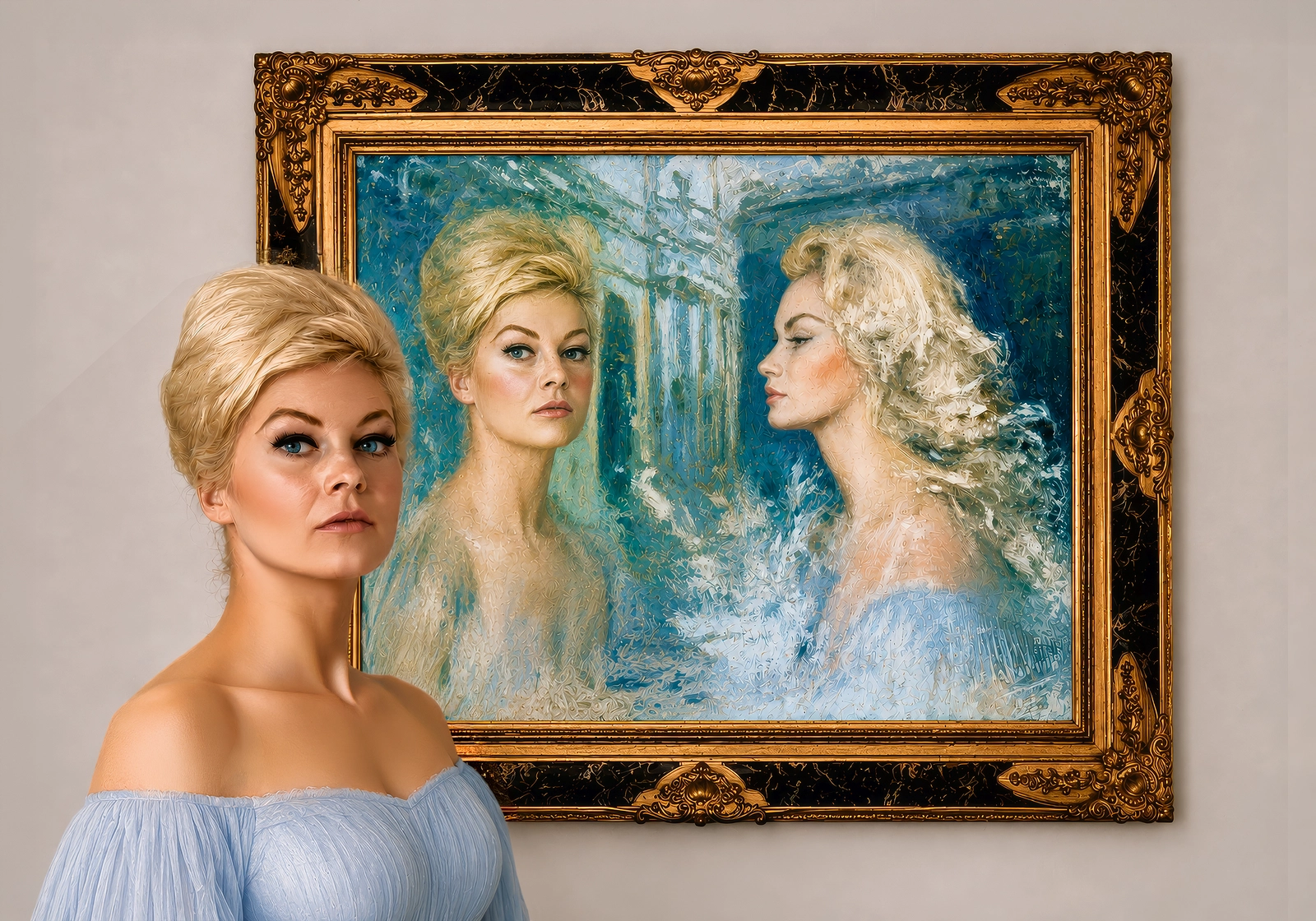
The Three Muses - De tre Musorna, 2026
Digital
50 x 70 cm
3 200 kr
The Three Muses - De tre Musorna
Svensk text på slutet
Introduction
What remains when the applause has faded, the cameras have fallen silent, and even the greatest treasures have vanished? In this moving story, Anita Ekberg reflects on a life that stretched from the streets of Malmö to the glittering heights of Hollywood and Rome.
Anita Ekberg returns to the Three Muses and to the extraordinary painting Gianni gave her in 1960a work of art that would one day vanish, yet leave something far more enduring than paint and canvas. Through memories of love, friendship, fame, and loss, she discovers that the most precious things in life can never be stolen.
This is not a farewell to a legend, but an intimate conversation with the woman behind the legend. A quiet reflection on memory, inspiration, and the invisible threads that bind our lives together long after we are gone. Some journeys end with an answerthe most beautiful end with a memory.
More than anything, it is a reminder that legends are created by the worldbut remembered through the humanity of those behind them.
At the end of the journey, the diva steps aside, and the woman remains.
Simply Anita.
"The Thirteenth Labour
Malmö, July 2026
PROLOGUE
Den sista divans dolda mästerverk: Varför Anita Ekberg bara satt modell en enda gång
The Last Divas Hidden Masterpiece: Why Anita Ekberg Sat for a Painter Just Once
People almost always think of the Trevi Fountain when they hear my name.
They picture the black dress, the moonlit water, the flashbulbs, the headlines and the impossible glamour. To many, that single scene became my entire lifeas if I had stepped out of the fountain on a magical night and stayed there forever, young, beautiful and untouchable.
But there IS another image of me. Not a film still. Not a publicity photograph. Not a magazine cover retouched for desire and distancea painting.
It was the only painted portrait I ever approved, the only one for which I knowingly sat as a model. Gianni gave it to me in 1960, and for more than fifty years it hung in my home like a secret no one quite understood. Three Muses on a canvas. Three versions of the same woman: three masks, three destinies, three ways of becoming Anita.
Then it vanished.
While I lay in hospital, thieves broke into my house, stole what they wanted, and set fire to what remained. The painting disappeared with them. Today, the last divas hidden masterpiece survives only in memory and in photographs.
This is in part a story of that lost painting, but also of the woman inside it. People have spent decades telling my story. Now, at last, allow me to step out of the frame and tell it myself.
Chapter 1: Control Over the Image
In the spring of 1960, I agreed, for the first and only time in my life, to sit for an artist. As a fashion model, I had been photographed thousands of times, and as a film star I had appeared in more than sixty filmsyet I had consistently refused to let myself be painted on canvas.
My ironclad principle was rooted in a fear of losing control over how I was portrayed. A photograph is what it isa fleeting reflection of my true self, captured through a lens and fixed on film. In the photographic process, I always had a say in which negatives would be printed, and the process was completed quickly. A painting, however, becomes whatever the artist wishes to express. An artist can add or remove details long after the sitting is over, and I can't do much about it. That was the source of my scepticism.
A perfect example of this artistic freedom is Leonardo da Vinci's portrait of the Mona Lisa. Not only was the painting never delivered to its patron, Mona Lisa's husband, but it also remained with Leonardo throughout his travels, including a trip to France, where he spent the final three years of his life. Leonardo never let go of the painting, returning to it repeatedly over many years. Between 1503 and 1519a span of sixteen yearshe continued adding layer upon layer of paint and never considered the work finished.
Thanks to modern technology, it is now possible to see numerous significant alterationsthe so-called pentimenti, or changes of mindthat Leonardo da Vinci made during the painting process. By analysing the paint layers, researchers have discovered at least three major, previously hidden versions of the Mona Lisa beneath the surface we see today. Leonardo altered her gaze; in the earliest version, her face was turned differently, and she looked more towards the left. The position of her hands was changed, and her fingers were repositioned several times. Her head covering, hair, and the lines of her veil were all adjusted as the work progressed. Many scholars believe that Leonardo initially painted an entirely different portrait, probably of another model, and then gradually transformed it, painting over it to create the masterpiece we know today.
I had long suspected this was often the case with older paintings in the 1950s, and I could easily imagine what an artist might do as the work evolved. That uncertainty held no appeal for me. I refused to risk sitting for my own portrait only to see it gradually become a completely different woman on canvas.
Chapter 2: The Ekberg Brand
During my heyday in Hollywood and Europe, I was fiercely protective of my public image as a glamorous sex symbol and film diva. I was the foremost champion and guardian of my own brand. Nothing was left to chance; everything had to be perfect. And it was.
As early as the 1950s, when I was being promoted by studios such as Universal Pictures, I worked closely with the film companies' highly disciplined publicity departments. I ensured that my curvaceous figure and flowing blonde hair were always presented in the most flattering light and in the right context. I knew exactly which angles worked and which did not, carefully controlled how I was portrayed, and maintained uncompromising control.
I cherished the aura of stardom. I was an icon of the classic Hollywood era. I wore my diva status with pride and expected to be treated accordingly, even though my closest friends have always emphasisedand still rememberthat, in private, I was remarkably down-to-earth. Lars Hector's major biography of me, not without reason, is titled The Last Diva. I suppose I shall live with that forever.
I defended my privacy and the image I had built with my teeth and nails. I did everything in my power to keep photographers at bay. One famous example came in 1960, when I drove away intrusive paparazzi in the Roman night, armed with nothing more than a bow and arrow.
The Exception and the Count by the Trevi Fountain
The reason I finally made a single exception to my rule was entirely due to my great love for the Fiat billionaire Gianni Agnelli. I did so only because he asked me to. The artist was one of his close friends, the very same man who had painted a fine portrait of the barely twenty-year-old Agnelli in his cavalry officer's uniform as he was on his way to the Eastern Front back in 1941.
The artist was a count, though wealthy in little besides his namewhich, admittedly, was impressive enough: Uberto Cipollone Pallastrelli di Celleri. Agnelli recommended him to as many people as he could within the highest circles of society, encouraging them to have their portraits painted by this friend from Piacenza.
Chapter 3: The Studio by the Trevi Fountain
Uberto's apartment and studio occupied the first floor of a building at Piazza di Trevi 100. It stood right beside the Trevi Fountain, where I had just finished filming La Dolce Vita. Only because Gianni personally vouched for Uberto did I agree to sit for a double portrait. Despite my initial scepticism, I must admit I found these sittings at the count's studio surprisingly enjoyable, though I never compromised my status. I was molto famosissima and very conscious of the image I projected. That is why I never arrived alone. I always brought my own hairdresser, make-up artist, and stylist. Their job was to ensure I looked flawless and consistent from one sitting to the next.
Outside the studio, on the little square, a crowd of admirers quickly gathered, waiting for me to emerge and sign autographs. And of course I did. Now and then I would leave the uncomfortable stool reserved for Uberto's models to wave to my fans and soak up their applause. Moments like those are wonderfulto feel genuinely popular while giving my backside a well-earned break from Uberto's miserable seat.
Our sessions were often interrupted by visitors dropping by. Uberto's studio was one of those places where people from industry, the film world, and the cultural elite loved to meet. I was right in the middle of it all, so I did not mind in the least. Before I came along, he had already painted many women from Roman high society. Several unfinished canvases hung around the studio, one of which immediately caught my attention. It portrayed a beautiful blonde with a poodle haircut, a magnificent diamond necklace, matching earrings, and a spectacular bright red strapless gown. She reminded me of myself at the time of the Miss Sweden competition ten years earlier, although she had brown eyes.
"She drops in whenever it suits her," Uberto said when he noticed my interest. He explained that she was the American socialite and philanthropist Betsy Bloomingdale. She came to Rome a couple of times a year and stopped by so he could make a little more progress on her portrait. He hoped to finish it when she returned in the autumn.
I knew her very well. I had attended a couple of Betsy's legendary parties, each time accompanied by a hopelessly infatuated Frank Sinatra. Betsy's husband had even been Frank's agent for a while. She was an absolutely delightful woman. She and her husband lived in a magnificent house in the fashionable Holmby Hills neighbourhood of Los Angeles, not far from Hollywood. Betsy was the true queen of Hollywood society. Receiving an invitation to her court was a great honour for a working-class girl from the little town of Malmö. In those circles, I was still something of an unknown quantity, but arriving on Frank's arm certainly didn't hurt.
It was autumn 1955, when Frank and I were practically inseparable. He wanted to marry me, but I resisted, having no desire to become Mrs Sinatra and spend my life in his shadow. The same would have applied to any other man, for that matter. I wanted to remain Anita Ekberg and continue building my own brand. But I certainly cared deeply for him. He was sixteen years older than I was and far more established, yet he was wonderful in bed. Gradually, I persuaded him to see things differently, and we remained lifelong friends.
At Betsy's party, we danced a wild boogie-woogie to Bill Haley's Rock Around the Clock. Rock music had only just broken through, and Betsy had made it the theme of the evening. Some guests had fully embraced the faster rock-and-roll style of dancing, but that was hardly Frank's scene, as he approached fifty. I had no trouble keeping up, though I must admit it was far cosier to melt into his arms during a foxtrot. Instead, we enjoyed watching a troupe of professional dancers hired for the occasion, performing breathtaking acrobatics across the dance floor. Now that was an air show.
Chapter 4: The Queen of Parties and Villa Anita
Betsy hosted parties constantly, most of them charity events, earning her the affectionate nickname Good Queen Betts. As a hostess, she was the consummate professional, keeping meticulous records of every dinner she gave, including a photograph of the table setting, a seating chart showing who sat beside whom, the menu, and even what she herself wore. She did all this to ensure that her guests would never eat the same meal twice or see her wearing the same dress twicewhat people in her circles called the hideous faux pas. She could afford to be so selective, since she owned enough clothes to fill eleven wardrobes.
In time, I could match her in that department. My house in Genzano di Roma contained several overflowing dressing rooms because I kept everything. My glamorous wardrobe suited my status as an international diva, and I owned endless rows of figure-hugging dresses in bold colours and magnificent fabrics, together with countless custom-made creations by the world's leading fashion designers. My shoe collection was equally impressive and filled an entire room.
There was only one area where I could not compete with Betsy, and I want to emphasise that there truly was a difference. It concerned her parties. Even in my finest years in the 1950s and 1960s, when I was living la dolce vita and hosting lavish dinners, pool parties, and gatherings for film stars, directors, and other celebrities at my home, my parties were simple by her standards. It was not because I couldn't have matched herI can accomplish anything I set my mind to. I lacked the ambition because I had more important things to do. My brand was me, not elaborate gala dinners with formally seated guests around extravagantly decorated tables.
Betsy's parties were usually charity dinners at which guests paid for their seats, with the proceeds benefiting worthy causes. The second time I visited her, Frank paid $100 per person for us, which, in today's money, would probably be about 10 times as much. Good heavens. Charging your guests the equivalent of more than a thousand dollars to dine on Royal Copenhagen porcelain worth a hundred thousand dollars was never my style. At my house, it made absolutely no difference if someone accidentally dropped a plate on the floor. I never charged admission, and at Villa Anita, the champagne was always plentiful, well-chilled, and free.
Villa Anita was naturally not as exclusive as Betsy's palace, but my home certainly had nothing to be ashamed of. It offered spacious interiors, a magnificent garden surrounded by its own olive grove, an enormous lawn, and a completely secluded oasis. People genuinely loved coming to my house. There, they could kick off their shoes and dance barefoot whenever the mood struck themand it often did.
At Betsy's, Frank's dollars, along with everyone else's, went to disadvantaged children and unmarried mothers, so the cause was admirable, even if there could hardly have been many of them in fashionable Holmby Hills. The dinner itself was as stiff as such society occasions often are, with everyone trying to make the perfect impression and desperately hoping not to spill anything on their distinguished table companions. But once dinner was over, the evening truly came alive, and we certainly got our money's worth.
It was at that very party that I learned to dance the Twist, the latest dance craze. It was incredibly easy to learn. You followed the rhythm, twisting your feet back and forth as though you were grinding out a cigarette with your toes, while drying your back with an imaginary towel. Frank and I both gave it our all on the dance floor. In a way, the party resembled the film we made together a few years later, 4 for Texas. On paper, it promised non-stop excitement, but in reality the pace was uneven. In that respect, my parties outshone hers by light-years, because at my house the tempo was always at full speed.
Chapter 5: The Painting of the Two Anitas and the Magic of the Muses
Once I had brought my new painting home, I hung it so that its two Anitas had a perfect view of my large living room. Nothing that happened on the dance floor could escape our watchful eyes.
It was Gianni who first suggested that I embodied all the classical Muses at onceor so he believed. Naturally, I was flattered by the comparison. The Muses are goddesses of creativity and knowledge, and, from a modern woman's perspective, they are all women gathered into a single figure. And who wouldn't love a metaphor like that?
We sometimes playfully argued over which Muses were actually depicted in the painting, because choosing the most important qualities is a delicate matter. It is like standing in a sweet shop with a hundred bins of sweets. Which one do you choose when you like them all? I would say it depends on the time and the occasion. Whenever people were dancing on the floor beneath the painting, one Anita should surely be Terpsichore, the Muse of dance, and the other Euterpe, the goddess of music.
Gianni was far more classically educated than I was, and from him I learned everything about the Muses. He knew an astonishing amount and loved sharing it. I was a much better listener than my reputation suggested, at least when I was with him.
With the clarity of hindsight and the perspective of eternity, one can afford to call things by their proper names. What happened on Earth cannot be undone, and a person's character resides in the souland the soul accompanies you to your star. Of course, eternity gives you all the time you could ever need to smooth away the rough edges, should that be necessary. But among the stars, the guiding principle is that one is as good as another, and stars rarely collide. It does happen from time to time, and when it does, the result is a tremendous explosion. A supernova blazes brilliantly one final time before collapsing into a black hole. It is not an outcome anyone strives for because, beyond eternity, there is nothing. Some stars shine more brightly than others, but they all shine, and each has its own planetary system. Even the greatest egos who ever lived on Earth eventually find that enough. After all, what is the alternative?
Even three Swedish divas can happily inhabit the same star. Birgit Nilsson, Zarah Leander, and I have all spent time together on Birgit's star, Casta Diva. I may be something of an outsider among the great opera divas. Still, if Birgit could share a planet with the supreme diva of opera, the Greek soprano Maria Callas, then surely everyone can get along. Such is the magic of space.
Casta Diva was a red giant, shining with exceptional brilliance, a trait that suited Birgit perfectly. Because the constellation Norma lies within one of the Milky Way's richest star fields, its individual stars are difficult to distinguish without binoculars. Even so, the human eye can make out forty-four stars there, among them Birgit's Casta Diva. Whether that is merely coincidence or something more, no one knows, since the universe has no ruler or guiding force that we know of. In any case, it has somehow become customary for those who devoted their lives to music on Earth to seek out one of Norma's star clusters upon arriving in eternity.
Chapter 6: The Cosmos and the Time Travellers of the Norma Arm
One of the Milky Way's great spiral arms, the so-called Norma Arm, passes directly through the constellation. With a powerful telescope, astronomers can count millions, perhaps even billions, of incredibly faint and distant stars within Norma's official boundaries. In other words, there is plenty of room for both old and new musical time travellers.
At this very moment, roughly twelve million people on Earth work in music as singers or musicians across every imaginable genre. Most are freelancers or pursue music alongside another profession. They may earn money from concerts and streaming services, but many still rely on other jobs to pay the rent. Truly global superstars, however, number no more than about three hundred singers and musicians who can fill concert halls and entire stadiums while shaping the musical culture of their age. Over the course of a century, perhaps fifty of them leave Earth and find their place in Norma.
Close to Birgit lives Wagner, whose music she interpreted countless times as the greatest dramatic soprano of her era. They are all there, so anyone with an interest need only turn the pages of music history.
Enheduanna of Mesopotamia arrived here some four hundred years ago and still quietly hums her mysterious hymns. By the time she arrived, the Egyptian flautist and court musician Khufu-Ankh had already been there for two hundred years. Much later, around 675 BC, the father of Greek music, Terpander, came from the island of Lesbos. He had added three extra strings to the lyre, bringing the total to seven, and had already won several musical competitions in Sparta.
The giant Orpheus resides on the star Olympos. This supreme musician played so beautifully on Earth that, with his voice and lyre, he could tame wild beasts, make stones weep, and even open the gates of the Underworld. A formidable achievement indeedbut among Norma's millions of stars, the competition is fierce.
Because space is a vacuum in which ordinary sound waves cannot travel, music is performed telepathically. Just as the deaf Beethoven could both hear and compose music in his own mind while he lived on Earth, these time travellers can do the same. Naturally, they also wish to hear themselves and one another under more earthly conditions, so they gather at music festivals on one of the billions of planets throughout the Milky Way that have atmospheres similar to our own.
Such an immense amount of music ought to leave a cosmic imprintand it does. From Earth, we can listen to the cosmic microwave background, the echo of the Big Bang itself, and convert electromagnetic waves into sound. Because Norma's music is a collective resonance, it emerges as a deep, rumbling bass note, a dark hum reminiscent of a gigantic jet enginehardly pleasant listening, which is why you are much better off opening YouTube or Spotify instead.
Chapter 7: The Iceberg and the Seducer Who Listened
Historically, I was never described as a particularly good listenerquite the opposite. I was known as a woman who took up plenty of space, spoke her mind without hesitation, and loved being the centre of attention. In social settings, my personality and behaviour were defined above all by my independence and outspoken nature. I was famous for having a sharp tongue and for keeping very little hidden. If I had an opinion, I expressed it directly rather than quietly listening and adapting to everyone else. I still do, so in that respect I have learned absolutely nothing.
I was every inch the diva, often described as the classic film goddess who demanded attention. My role at any gathering was to entertain and dominate the room with my presence, not to sit quietly in the background and listen attentively to others. The international press occasionally nicknamed me The Iceberg. That had as much to do with my surname as with the impression that I could be cool, reserved, and difficult to approach on a deeper level. In short, I was a woman with a commanding personality who occupied space entirely on her own termsa woman people listened to rather than one who listened to them. Don't worryI haven't changed.
Except when I was with Gianni.
It was not that I suddenly changed my feathers; there was no need. Gianni was almost my complete opposite in communication. He was renowned for being an exceptionally skilled, intensely curious listener. Gianni was the seducer who listened. While I dominated a room with my speech and demands for attention, Agnelli charmed people by giving them his undivided attention. In one famous interview, he remarked that he did not enjoy talking about women; he preferred talking with them.
Gianni let people speak while he asked short, incisive questions, absorbing information like a sponge to keep himself informed about everything in the universe. He embodied the Italian ideal of sprezzaturathe art of making the difficult appear effortless and elegant. While I generated dramatic headlines, Agnelli was a master of discretion in social situations. He listened, observed, and quietly acted behind the scenes. That approach served him well in eternity, among the countless billions upon billions of stars. In the company of everyone who has ever lived on Earth, it is rather difficult to present yourself as the diva of all divasand certainly not as the last one.
Chapter 8: Life on Centaur and Meeting Lucy
As time went on, I discovered just how fascinating Gianni was. He knew an astonishing number of things I had never imagined, yet found them deeply interesting. We shared many passions, but above all we despised boredom. On Earth, we lived by the principle that life should never be dull, constantly seeking excitement and stimulation. Our intense, secret meetings became the perfect escape from everyday life.
That became even truer in eternity, when we met again and eventually moved in together on the star Centaur, which Gianni had managed to acquire in one of his characteristic exchanges. Just imagine an endless succession of days waiting to be filled. Gianni and I manage that quite effortlessly. We travel all over the universe, meeting remarkable people from every era imaginable. The most fascinating so far is probably the prehistoric woman Lucythe one who, according to legend, sat in a tree playing a flute before falling to the ground nearly 3.18 million years ago. Today she is the principal flautist in an all-star philharmonic orchestra. Talk about personal development. And imagine what someone who has spent so long in eternity has to say.
One thing you should know is that people never stop growing and learning in the afterlife. Lucy, for example, has become absolutely obsessed with the internetboth the earthly version and its cosmic predecessor, telepathy. In eternity, we no longer need to digitise our thoughts and package them as electronic signals. We think and, in doing so, connect directly with one another. If you happen to be on the same wavelength, all you have to do is join in.
Lucy wore a diamond necklace that Gianni had given her, and she adored it so much that she wore it at every concert. It was a family heirloom that had mysteriously disappeared. Gianni had retrieved it from a secret safe-deposit box in Turin to ensure his heirs would not quarrel over it.
Things like that often happen when someone leaves the Earth, only to return a short while later as a time traveller, bringing something that deserves a place in eternity.
Chapter 9: Returning to the House and the Memories in the Cellar
I did the same thing myself. There was a hiding place in my house that the thieves had never found, where I had kept several love gifts from Gianni. It was a full jewellery box, probably valuable enough to buy a house. But some things are not for sale.
Only a week after my soul had left the Earth, I returned, now free from every ache and pain and filled with renewed strength. I had not set foot in my house for several years, so I was naturally shocked by the devastation the burglars had left behind. I only made a quick tour of the rooms, but the right feeling refused to come. No memories stirred within me, and the wall where the double portrait had once hung stood empty.
Since the disaster was no longer my concern, I walked down to the very last place any thief would ever think to look: the food cellar, with all my preserves and all my memories from the years when I still had the strength to make them.
My footsteps fell heavily and silently on the massive stone staircase. The steps were clad in travertine, the warm, honey-coloured Roman limestone, whose cool surface felt soothing beneath my feet. I passed through several rooms before finally reaching the food cellar, dug into the ground beside my house.
I switched on the single light bulb and let my eyes slowly wander across the shelves. I moved an empty wooden crate into place and climbed onto it to reach the highest shelf. I pushed aside the outermost jars of cucumbers preserved the Swedish way, in vinegar and sugar. Carefully, I reached my hand in behind them. Before touching the innermost corner, I paused to savour the memories.
I noticed the jars of crisp giardiniera and immediately remembered the sharp, clean tang of vinegar on my tonguea perfect contrast to a rich slice of porchetta enjoyed on the terrace. Beside them stood spring artichokes submerged in olive oil. I could almost feel their tender leaves melting on my tongue, mingling with garlic and the wild mint I had gathered by the roadside. My hand and eyes drifted on across rows of sweeter treasures. I remembered the intense tropical fragrance that had filled the entire kitchen as I simmered mangoes from my garden with a sprig of rosemary, and the bright, tart burst of kiwi jam sharpened with a splash of grappa. Every jar carried its own unmistakable flavour, a little fragment of preserved sunshine from a time when my hands were still strong enough to do the work.
Chapter 10: The Treasure Hidden Behind the Cockscombs
At last, my fingers reached the very back of the top shelf, tucked away in the darkest corner where the dust lay thickest. There stood the rarest row of preserving jars, filled with something few outside the older generation in the region would ever think to put on a shopping list: Cresta di gallo sott'oliocockscombs preserved in olive oil. These wrinkled combs, once a vivid coral red, were first blanched, then gently simmered in white wine vinegar, and finally tightly packed in the finest local olive oil. A rubber seal was placed around each jar, a glass lid secured with a metal clamp, and the jars were then lowered into a large aluminium pot for preservation. They were boiled for two full hours. Cockscombs are naturally rich in collagen. The prolonged immersion in the boiling water bath gradually breaks down the collagen until the combs become wonderfully tender. At the same time, the heat penetrates to the very centre of the jars, sterilising the meat. Delicious.
In my mind, I can still taste their unique, delicate, almost gelatinous texturean intensely local delicacy that carries the true rustic flavours of Lazio. There is no dramatic thud. I do what I came to do. I reach even farther in, pushing aside the last jars of cockscombs until I spot the narrow crack in the wall. It is not large and looks perfectly natural in an old houseunless, like me, you know what lies hidden behind it.
I slipped in the screwdriver I had fetched from the kitchen and gently pried. The stone came loose with what sounded almost like a sigh, and flakes of plaster drifted to the floor. Once I had eased the stone out, I reached into the cavity behind itmy secret hiding place. After a moment, my fingers closed around a small olive-wood box. Gianni had given it to me years earlier, and he believed it dated back to the eighteenth century. Inside, the diamond necklace that had once belonged to his grandmother still lay.
"This should be yours, cara mia. Grandma was almost as cheeky as you," Gianni had said as he embraced me.
Anita's lifeor rather, my earthly lifehad changed. When la dolce vita finally came to an end and the glittering parties were over, I no longer had any use for my treasures. I decided they were safer hidden in the cellar than in my underwear, the first place any burglar searches for jewellery. Over the years, I gradually filled the box with more keepsakes: necklaces, bracelets, brooches, and a few rings, all gifts from Gianni.
"For rainy days," he used to say.
There had certainly been plenty of rain during my final years, but not even a tsunami could have persuaded me to sell Gianni's gifts. Now they were about to make their longest journey yetto our star in Centaur.
I carefully placed the olive-wood box inside my handbag, itself another gift from Gianni. Alongside the jewellery, I packed a couple of jars of preserved cockscombs. Then I slipped quietly out of the house and walked to an olive grove a few hundred metres away. By one of those fortunate coincidences that occasionally occur in the universe, the wormhole emerged therethe very one that had carried me back and forth between my star and Genzano. Wormholes are wisely designed so that nothing on Earth can accidentally fall into them unless a time traveller is holding your hand. I could have brought one of my dogs or cats with me, but there was no sign of them. I was sure Anna Maria had taken care of them, and they were probably better off in Genzano.
Chapter 11: The Analogue Internet and the Knots of the Inca
As I made my way back through the wormhole, I had time to think. Perhaps it was the cosmic cold surrounding the passage that made my thoughts drift towards sheer nonsense. There, the nonsense appeared as the exact opposite of the determination that created both the ancient world's and our own version of the internet.
Even back on Earth, Gianni often spoke about his fascination with how the ancient Romans maintained what he liked to call an analogue internet. He also loved discussing how information spread across empires long before the modern age. Then he would jump continents and tell the story of the Inca, who did not even possess a written language as we understand it today. Instead, they relied on knotted cords known as quipus. At Fiat board meetings, Gianni liked to joke that the Inca had proved that, given fast enough runners and enough knots, you really did not need a telephone network to govern a vast empire. What he meant was that we may have replaced running shoes with pulses of light and knots with ones and zeros, but the underlying principle remains the same. Long before the first computer had even been imagined, the Inca demonstrated that all it takes to shrink the world is a talent for logistics.
There were moments when Rome was more than a mere backdrop to our late evenings together. It became a living organism, breathing through the centuries. I remember one particular evening at Hostaria dell'Orso in early October 2001. Beyond the windows, the Tiber flowed dark and unhurried, while husky voices drifted through the restaurant around us. Gianni sat opposite me, impeccably dressed as always in one of his tailored suits, his wristwatch strapped over the cuff of his shirt. He wore that unmistakable expression of relentless curiosity, the one that allowed him to captivate an entire room simply by listening, only to dismantle the world a moment later with a handful of elegant observations. But when the mood suited him, he was also a gifted storyteller.
Even from a distance, Gianni continued to look after me. He helped me financially, arranged repairs to my house, and quietly made everyday life easier. I knew about his prostate cancer, though he insisted he had everything under control. He had undergone surgery in an attempt to halt the disease. The diagnosis had come in 1997, around the same time that his nephew and chosen Fiat heir, Giovanni Alberto Agnelli, died of stomach cancer. Whenever I asked about his health, he would wave his hand dismissively and say, It's all right, cara.
Gianni briefly explained the difficulties facing the Fiat Group and said he was about to attend a top-secret crisis meeting with Italy's Prime Minister, Silvio Berlusconi. He would personally negotiate with the government over a state rescue package to save tens of thousands of Italian manufacturing jobs. I knew perfectly well how strained the relationship between Gianni and Berlusconi had always been. In many ways, it was old aristocracy confronting new money. Gianni embodied inherited industrial power, royal elegance, and discretion built over a century. Berlusconi embodied the new, rather gaudy capitalism of television monopolies, glittering populism, AC Milan, and an unapologetically flashy lifestyle. Agnelli looked down on Berlusconi's lack of refinement and mockingly referred to him as a pizzaioloa pizza maker who had happened to become rich. Naturally, I agreed. Yet although Gianni's pride prevented him from admitting it openly, the balance of power had shifted. My Gianni, who had once dictated terms to Italian governments, now had to meet Berlusconi with hat in hand. Fiat stood on the brink of bankruptcy and desperately needed state assistance.
Once we had spoken long enough about matters beyond either of our control, Gianni wanted to know how I was doing. His unspoken message was that worrying was pointless if there was nothing I could do about it anyway. We did not meet often anymore, but we were careful never to lose touch, speaking on the telephone perhaps once a week. The physical affair gradually faded after more than twenty years, yet the emotional bond never weakened. It became something very much like a long-distance marriagetwo souls living apart but sharing the same life. We remained each other's closest confidants. Gianni regularly called me for my honest, completely unfiltered opinions about the world. I was one of the very few people who had never trembled in the presence of his power.
Chapter 12: Hollywood Babble-On, Political Nonsense, and Jackie Kennedy
I am certainly no expert in either economics or politics, though that has never stopped me from having opinions. Since my years in the film industry, I have become an expert in Hollywood Babble-Onthe jargon-filled language of agents, producers, and actors who manage to sound immensely important, artistic, and successful without saying anything of substance or delivering much. I soon discovered that much the same phenomenon existed in the corporate world, especially among large companies, where it went by the name of Company Bullshit. Simply skimming the business pages of the newspapers was enough for me to recognise the familiar style. Gianni eventually realised that, despite my lack of technical expertise, I often reached conclusions he found remarkably useful.
"Mundus vult decipi, ergo decipiatur""The world wants to be deceived, therefore let it be deceived"has traditionally been attributed to the Roman writer Petronius, who lived during the reign of Emperor Nero. Oddly enough, it was the prosperous farmer I spent time with before leaving for America who first taught me that saying. In his view, everyone was trying to deceive everyone else. He explained how things worked when timber was sold and an official surveyor arrived to measure the wood. The survey determined how much the farmer would be paid. "You should be able to throw your hat straight through the pile," he used to say, meaning that a clever stacker could pack plenty of invisible air into a pile of logs. The trick was to arrange crooked branches just right and hide the occasional large stone inside. It worked even better if you made sure your pile was measured late in the afternoon, after the surveyorlike all the other farmershad been offered a generous schnapps.
The same principle applied to politics, and I had already seen through that world during my Hollywood years. The cultural sector is particularly vulnerable to political waffle because no one wins elections over such issues. As we say in Sweden, a beloved child has many names, and political nonsense has plenty of synonyms waffling, gobbledegook, political mumbo-jumbo, to mention only a few. They all amount to the same thing: hiding reality behind words. Over time, I became astonishingly good at recognising nonsense from nothing more than a headline and the opening lines of an article. Not because I could always explain precisely what it was about, but because Gianni could. My intuition saved him time by pointing him in the right direction. At least, that is what he always claimed, and it made me feel important.
As the years passed, I developed deep respect for his wife, Marella, and for Gianni's family, and I never demanded that he leave them for me. Our silent agreement rested on absolute freedom and discretion. He had never objected to either of my marriages, and we continued to see one another as before. The only time things became truly heated was when he decided to avenge one of my practical jokes by inviting First Lady Jackie Kennedy aboard his yacht for an entire week. I would rather not think about what happened there. The affair came to an abrupt end after her husband, the President, reportedly sent a now-legendary telegram from the White House:
"More Caroline, less Gianni."
"More Caroline, less Gianni" could hardly be misunderstood, given that Caroline was their daughter. Jackie promptly returned home, and Gianni and I resumed seeing one another as usual. Later, when Jackie married Onassis, she certainly revealed what kind of woman she truly was.
I have always been proud that I never married for money. Gianni's wealth was, of course, convenient for both of us, but I had no idea who he was when we first met at the Stork Club in New York. At the time, I was as poor as a church mouse. By the time we met again a few years later, I had no difficulty supporting myself. In fact, I was about to marry a man considerably less successful than I was.
I still laugh when I think about it because the telegram had leaked to the press. Eventually, the storm subsided, and the two families continued to socialise. In September of that year, President Kennedy and Jackie welcomed Gianni and Marella aboard the presidential yacht during the America's Cup races in Newport.
There I go again, losing the thread.
Back to Hostaria dell'Orso.
Chapter 13: Rome's Stone Fibre Network
After discussing Fiat's problems at length, I complained about how long it took my letters to reach Sweden, especially since the newspapers always seemed to know everything before we did. Gianni smiled his sardonic smile, took a sip of his drink, and leaned across the table.
"Anita, my dear," he said in his husky, captivating voice. "You think our age invented speed. But the editors in Milan and New York are simply doing what the emperors of this city perfected two thousand years ago. The Romans built an internet, Anita. A sophisticated analogue network. They used stone instead of cables, straight roads instead of fibre optics, and muscle instead of electricity. What we are witnessing today is not a paradigm shift but a technological evolution that shortens time and thereby expands the territory that can be managed."
I laughed, accustomed to his theatrical comparisons, but he continued, painting a picture I would never forget. How right he was became even clearer after I arrived in eternity, where people from vastly different cultures and eras tell remarkably similar stories. The surface changes; time changes. The Roman Empire stretched across much of the known world, whereas today's internet spans the globe, and its cosmic predecessor reaches across the universe.
Gianni explained that the Roman road systemthe viaewas, in fact, the empire's hardware, a vast fibre-optic network of stone spanning nearly fifty thousand miles. He gestured with his elegant hands to show how the roads sliced arrow-straight through the landscape. They were built that way, he said, for one ruthlessly practical reason: to minimise latencythe waiting time. The aim was to reduce delays for data packets, which, in those days, were sweaty horsemen and rattling wagons. The straighter the line, the faster the flow.
"But a cable is useless without routers to direct traffic," Gianni continued, his eyes sparkling with that uniquely industrial passion. "That is why Augustus created the Cursus Publicus. Think of it as a network of servers lining the roads. There were the mutationessmall relay stations every fifteen kilometres, about as far as a horse can gallop at full speed. A courier would stop there for only a breath or two before leaping onto a fresh horse and continuing his journey. One day's ride farther on stood the mansionesthe great server farms of antiquity, although the Romans called them inns. There you found food, beds, veterinarians, and guards. It was a logistical relay system that allowed urgent military dispatches to travel nearly 150 miles per day. Even today, most of the people we communicate with are no farther away than that. You sent a message on Tuesday morning and received the reply on Thursday morning. That may not sound impressive today, especially now that artificial intelligence often supplies answers before people have even asked the question. Machines are beginning to predict what you are likely to askor perhaps what you should have asked in the first place."
When I asked how anyone could find their way through such a bewildering web of roads, Gianni brightened even more. He began describing the Tabula Peutingeriana, the surviving seven-metre-long parchment map he liked to call the Romans' own web browseror their version of Google Maps. It was not a geographically accurate representation of mountains and seas but a schematic diagram, much like a modern subway map. It showed only how hubs and cities were connected, where the relay stations were, and how long it took to travel between them. That was all a traveller needed to know.
"Think about the Inca Empire, Anita," he said, leaning back in his chair. "Their system was fascinating yet entirely centralised. Everything flowed to the emperor in Cuzco through a closed code of knotted cords. The Romans were different. Their network, like today's internet, was open and based on written communicationpapyrus scrolls and wax tablets rather than digital text. True, Cursus Publicus was state-owned, but if you had moneyif you were a wealthy merchant or a patricianyou could purchase a diploma, an official permit granting access to the network. In many ways, that is how the internet began as well: an official network available only to a privileged few."
Gianni fell silent and studied me over the rim of his glass. That was so typical of him. He had taken my superficial frustration with the postal service and turned it into a lesson in historical elegance. Gianni loved the combination of power, structure, and speed, which he regarded as beauty itself.
Many years later, when I watched young people gazing down at their glowing little screens as they spoke of the global network, I could not help but smile. I never thought of Silicon Valley or satellites. I thought of Gianni, the cigarette smoke drifting through that Roman restaurant, and of his voice explaining that everything we do today is merely an echo of the horses that once thundered along the Via Appia to keep an empire alive.
Chapter 14: The Last Prayer to the Muse
How we ended up talking about the Muses again, I no longer remember. Still, it probably had something to do with the Muses being the messengers of the ancient gods, carrying messages between Mount Olympus and the people of the earth. In any case, Gianni asked whether I still had the painting he gave me in 1960, the one beside which we had danced so many times when my house was still filled with joyful parties. These days, my social life had been reduced to little more than a cup of coffee with the gardener and with Annamaria Attanasio, my indispensable companion, housekeeper and maid. After Gianni left this world in 2003, she was the person closest to me.
Of course, I still had the painting. It hung in the same place until it was stolen while I was in hospital. Naturally, I could not have known that that evening at Hostaria dell'Orso, but I noticed how relieved Gianni seemed when I answered. As everyone knows, none of us can see the future. He knew I was struggling financially and perhaps feared I had sold the painting rather than ask him for money. A portrait of me by that artist would certainly have fetched a handsome sum, but I would rather have starved than sell a gift born of love.
So we picked up where we had left off many years earlier, discussing which Muses were portrayed on the canvas. I remembered that, in the end, we had agreed it depended on the occasion and the circumstances. Gianni had forgotten that conclusion, so we started all over again. Softly, I hummed the opening words of the Symphony of the Three Muses: Sing, O Goddess...
The painting became a masterpiece: a profound and enchanting double portrait. Yet its composition ultimately embraces a far greater mythological dimension. Greek mythology required nine Muses, but I needed only threethe ones in the painting and myself standing in the foreground. The three Muses borrow a familiar motif from antiquity and give it an entirely new meaning. There are not nine distinct goddesses here, but three manifestations of the same woman. The Muses in the painting present three versions of me, each complementing the others, and that is precisely why I became so successful. The viewer expects to see three separate Muses, only to discover that each is me. The background becomes a perfect fusion of the Trevi Fountain and the lush gardens of my home, Villa Anita in Genzano.
Throughout my life, I changed my clothes, but never my personality. That connects me to both classical mythology and to my role as a model, an artistic inspiration and a cinematic legend. One might ask why Thalia, the Muse of comedythe one with the smiling theatrical maskdoes not take the foreground. The answer is simple enough: I never acted on stage; I spent my entire life playing myself. I did so successfully until one of the Muses grew old, because without the beauty of youth and the radiance of the goddess of love, even the finest varnish on a painting eventually cracks.
Each of the three figures tells a different story. The figure on the left gazes directly at the viewer as Clio, the Muse of history. As Clio, she embodies the woman whose life has become historyfrom Miss Malmö to Hollywood, Rome and the Trevi Fountain. She carries the memory of a century that was cinema's true golden age. The figure on the right is Erato, the classical beauty and Muse of love and lyrical poetry, through whom I inspired photographers, fashion designers and filmmakers alike. Her profile is timeless, almost like an ancient medallion or a Renaissance painting. Here I become the very symbol of elegance and seduction.
Calliopethe Muse of epic poetry, the woman standing before the paintingis the living Anita, a human being of flesh and blood. I stand before my own images and become the protagonist of my own story. Calliope was the greatest of the Muses and the patroness of epic tales, making her the perfect companion for the journey that carried me from Malmö to immortality on the silver screen. My life became an epicnot because I wrote it myself, but because countless others wrote about me, portrayed me in films, and filled newspaper pages with my story for decades.
In Greek mythology, the nine Muses were goddesses of art, science and creative inspiration. They were the daughters of Zeus and Mnemosyne, the goddess of memory. The symbolism is profound: creativity is born of the union of divine inspiration and memory. According to the myth, Zeus spent nine nights with Mnemosyne, and the result was the nine Muses. They first dwelt on Mount Helicon and later on Mount Parnassus, where they sang, danced and inspired poets, artists and philosophers. My three personalities in the foreground each tell their own story, yet the composition also carries fragments of each of the nine sisters.
Calliope, the Muse of epic poetry, is traditionally depicted holding a writing tablet or a scroll. Standing before the painting, I was hardly an intellectual in the strict sense of the word. I wrote no books, plays or poems. Yet thousands of others did so in my name. Endless newspaper columns and books were devoted to me. That inspiration forms the core of my personality: the desire to be seen and to become part of a story. Some people call it showing off, but I always seemed to appear wherever something mischievous was about to happen. Clio, the Muse of history, on the left side of the painting, reminds us that history itself is simply another form of storytelling. Erato, the Muse of love poetry, is usually shown with her lyre. My love affair with Gianni Agnelli could have filled an entire library with poems. On the right side of the painting, she turns her profile away, because with Gianni, discretion was essential if we were to avoid ending up in the paparazzi's film.
Euterpe, the Muse of music, is recognised by her flute. Music has always been an important part of my life, especially the jazz I carried with me from Malmö. Melpomene, the Muse of tragedy, bears the tragic theatrical mask. She eventually replaced Erato and Thalia through the many ups and downs of my life's roller coaster. Thalia, the Muse of comedy, with her smiling theatrical mask, dominated much of my life for many years. She forms the very foundation of La Dolce Vita and keeps Calliope constantly occupied. Terpsichore, the Muse of dance, embodies rhythm and movement. I loved dancing, and that music first entered my life at Amiralen dance hall in Malmö in the 1940s, when it was called jitterbug. Polyhymnia, the Muse of sacred hymns and devotional poetry, is often portrayed deep in thought. She was present throughout my collaboration with Fellini, who was endlessly fascinated by mythology, symbolism and female archetypes. In films such as La Dolce Vita and Boccaccio '70, he portrayed me as the ultimate, almost otherworldly feminine apparitionan incarnation of the mysterious Muse herself. Urania, the Muse of astronomy, carries a celestial globe and a pair of compasses. Even while I was on earth, I lived with my head among the stars, but from my own star in Centaurus I now have a perfect view of the universeand of eternity.
In every sense, I was the embodiment of a Muse. In the classical world, the Muses were not artists themselves but the inspiration behind all art. That is why so many ancient authors began their works with a prayer to a Muse. Homer opens both the Iliad and the Odyssey with the immortal words, Sing, O Goddess..."a plea for creative inspiration. The word museum derives from the Greek mouseion, which originally meant the sanctuary of the Muses. A museum was therefore not merely a place where objects were kept, but a place dedicated to inspiration, learning and creativity. Throughout the history of art, the word muse gradually acquired a broader meaning: a woman whose appearance, personality or charisma awakens the artist's creative spirit.
I, Anita Ekberg, was undoubtedly a Musea Muse among Muses. I inspired painters, photographers, fashion designers and film directors. Most famously, through my collaboration with Federico Fellini, in which, in La Dolce Vita, I became more than an actress. By simply being myself, I became the very image of the modern goddess.
The Muses remained faithfully on the same wall for more than fifty years. Sadly, the painting met a tragic fate. In the autumn of 2011, I fell again, was injured, and ended up in hospital. While I lay helpless in my hospital bed, thieves emptied my home of priceless treasures and, afterwards, set the house on fire. The painting of the Muses disappeared with them. Where it is today, only the thieves know, for the only painted portrait I ever approved and personally sat for now survives only in photographs.
Damn those thieves.
But as you can see, I have had a new one painted. It now hangs in the finest room on Gianni's and my own star. If you do not wish to wait until you arrive there yourselves, you might as well take a look at it now.
Epilogue
If you have reached these final pages, we have travelled a long road together.
From the streets of Malmö to the studios of Hollywood. From the fashion runways to the Trevi Fountain. From applause and champagne to solitude and silence. Along the way, we met dreamers, kings, artists, lovers, journalists, friends, and a fair number of fools. Some stayed for a season. Others remained in my heart forever.
People often ask what fame is like.
The truth is that fame is only a spotlight. It can illuminate you, but it can never warm you. Love does that. Friendship does that. Kindness does that. The people who truly mattered in my life never admired the legend. They cared about the woman behind the legend.
Time eventually takes everything from usour youth, our beauty, our possessions, and, in the end, even our homes. It stole my beloved painting of the Three Muses, but it could not steal what it represented. Inspiration cannot be burned. Memory cannot be robbed. Love cannot be catalogued and locked away.
Perhaps that is why the ancient Greeks gave the Muses a mother named MnemosyneMemory itself. As long as someone remembers, nothing of real importance is ever entirely lost.
So, if one day you find yourself standing before the Trevi Fountain, or hear the opening notes of an old jazz record, or catch yourself smiling at a black-and-white photograph from another age, think not of the myth but of the woman.
I was never a goddess.
I was simply Anita.
And that was more than enough.
De Tre Musorna
Inledning
Vad återstår när applåderna har tystnat, kamerorna har slutat blixtra och till och med de största skatterna har försvunnit? I denna gripande berättelse ser Anita Ekberg tillbaka på ett liv som sträckte sig från Malmös gator till Hollywoods och Roms glittrande världar.
Hon återvänder till De tre muserna och den märkliga målning som Gianni gav henne 1960 ett konstverk som en dag skulle försvinna, men samtidigt lämna efter sig något långt mer bestående än färg och duk. Genom minnen av kärlek, vänskap, berömmelse och förlust upptäcker hon att det mest värdefulla i livet aldrig kan stjälas.
Det här är inte ett avsked till en legend, utan ett nära och personligt möte med kvinnan bakom legenden. En stillsam berättelse om minnet, inspirationen och de osynliga trådar som binder oss samman långt efter att vi själva har lämnat världen. Vissa resor slutar med ett svar. De vackraste slutar med ett minne.
Framför allt är det en påminnelse om att legender skapas av världen men bevaras av människan bakom dem.
När resan når sitt slut kliver divan åt sidan och kvinnan blir kvar.
Helt enkelt Anita.
PROLOG - Den sista divans dolda mästerverk: Varför Anita Ekberg bara satt modell för en målare en enda gång
När människor hör mitt namn tänker de nästan alltid på Fontana di Trevi.
De ser den svarta klänningen, det månbelysta vattnet, kamerablixtarna, tidningsrubrikerna och den osannolika glamouren. För många blev just den scenen hela mitt liv som om jag en magisk natt steg upp ur fontänen och sedan förblev där för evigt, ung, vacker och ouppnåelig.
Men det finns faktiskt en annan bild av mig. Inte en filmscen. Inte ett reklamfotografi. Inte ett tidningsomslag retuscherat för att väcka längtan och beundran utan en målning.
Det var det enda målade porträtt jag någonsin godkände, det enda där jag medvetet satt modell för en konstnär. Gianni gav mig tavlan 1960, och i mer än femtio år hängde den i mitt hem som en hemlighet ingen riktigt förstod. Tre muser på en duk. Tre versioner av samma kvinna: tre masker, tre öden, tre sätt att bli Anita.
Sedan försvann den.
Medan jag låg på sjukhus bröt sig tjuvar in i mitt hus, stal det de ville ha och satte eld på det som återstod. Målningen försvann tillsammans med dem. I dag lever den sista divans dolda mästerverk vidare endast i minnet och på några få fotografier.
Det här är delvis berättelsen om den förlorade målningen, men också om kvinnan som levde inuti den. Människor har ägnat årtionden åt att berätta min historia. Nu är det äntligen min tur att kliva ut ur ramen och berätta den själv.
Kapitel 1: Kontrollen över bilden
Våren 1960 accepterade jag för första och enda gången i mitt liv att sitta modell för en konstnär. Som fotomodell hade jag avbildats tusentals gånger och som filmstjärna medverkat i över sextio filmer ändå vägrade jag konsekvent att låta mig målas på duk.
Min stenhårda princip handlade i grunden om en rädsla för att förlora kontrollen över hur jag gestaltades. Ett foto blir vad det blir en snabb spegling av mitt verkliga jag som, genom en lins, fastnar på film. I den fotografiska processen var jag alltid med och bestämde vilka negativ som fick kopieras och hela processen gick snabbt. Men ett konstverk blir det som konstnären vill gestalta. En konstnär kan i efterhand både lägga till och dra ifrån, utan att jag kan göra mycket åt det. Därav min skepsis.
Ett bra exempel på denna konstnärliga frihet är Leonardo da Vincis porträtt av Mona Lisa. Dels levererades målningen aldrig till beställaren, Mona Lisas make, utan följde med Leonardo under hans resor, till och med till Frankrike, där konstnären bodde i tre år fram till sin död. Leonardo släppte aldrig taget om tavlan, utan arbetade på den i olika omgångar under flera år. Mellan 1503 och 1519, alltså under sexton år, fortsatte han att addera lager av färg och ansåg aldrig att målningen var färdig.
Tack vare modern teknik kan man idag se flertalet väsentliga ändringar så kallade pentimenti, eller ånger som Leonardo da Vinci gjorde under arbetsprocessen. Genom att analysera färglagren har forskare upptäckt minst tre stora, tidigare dolda versioner av Mona Lisa i dagens målning. Leonardo ändrade hennes blick; den första versionen hade en annan ansiktsriktning och hon tittade ursprungligen mer åt vänster. Händernas position har förändrats och fingrarna har flyttats flera gånger. Huvudbonaden, håret och slöjans linjer har justerats under processens gång. Många forskare menar att Leonardo började med att måla ett helt annat porträtt, troligen av en annan modell, och sedan gradvis byggde om och målade över det för att skapa det verk vi ser idag.
Att så var fallet med äldre konst kunde jag ana redan på 1950-talet, och jag kunde själv räkna ut vad en konstnär kunde tänkas göra under arbetets gång. Den osäkerheten var jag inte intresserad av. Jag vägrade riskera att sitta modell för mitt porträtt om det sedan successivt blev en helt annan kvinna på duken.
Kapitel 2: Varumärket Ekberg
Under min storhetstid i Hollywood och Europa var jag mycket mån om min offentliga image som glamorös sexsymbol och filmdiva. Jag var mitt eget varumärkes främsta tillskyndare och beskyddare. Inget fick ske av en slump; allt skulle vara perfekt. Och det blev det.
Redan under 1950-talet, då jag lanserades av bland annat Universal Pictures, samarbetade jag med filmbolagens strikta PR-avdelningar. Jag såg till att min kurviga figur och mitt blonda svall alltid exponerades smickrande och i rätt sammanhang. Jag visste precis vilka vinklar som var bra och vilka som var dåliga, styrde noggrant hur jag framställdes och höll en stenhård kontroll.
Jag värnade om stjärnglansen. Jag var en ikon som förkroppsligade den klassiska Hollywooderan. Jag bar stolt min diva-status och krävde att bli behandlad därefter, även om mina nära vänner betonade och minns att jag privat var väldigt jordnära. Titeln på Lars Hectors stora biografi om mig bär, inte utan anledning, namnet Den Sista Divan. Jag får leva med det för evigt.
Jag värnade om min integritet och den image jag byggt upp med näbbar och klor. Jag gjorde allt efter bästa förmåga för att hålla fotografer på avstånd. Det märktes till exempel den berömda gången 1960 när jag resolut avvisade närgångna paparazzis i den romerska natten med pil och båge.
Undantaget och greven vid Fontana di Trevi
Att jag till slut gjorde ett enda undantag från min princip berodde helt och hållet på min stora kärlek till Fiat-miljardären Gianni Agnelli. Och det gjorde jag bara för att han bad mig om det. Konstnären var nämligen hans gode vän, som redan 1941 hade gjort ett fint porträtt av den knappt tjugoårige Agnelli i kavalleriofficersuniform på väg till östfronten.
Konstnären var greve men inte rik på annat än sitt namn, som i och för sig var imponerande: Uberto Cipollone Pallastrelli di Celleri. Agnelli rekommenderade så många han kunde i den högsta societeten att få sina porträtt målade av just den här vännen från Piacenza.
Kapitel 3: Ateljén vid Fontana di Trevi
Ubertos bostad och ateljé låg på första våningen i ett hus på Piazza di Trevi 100. Det var precis vid Fontana di Trevi, där jag precis hade spelat in La dolce vita. Bara genom att Gianni gick i god för Uberto accepterade jag att sitta modell för ett dubbelporträtt. Trots min initiala skepsis måste jag erkänna att jag fann mycket nöje i dessa sittningar hos greven, men jag tummade aldrig på min status. Jag var molto famosissima och mån om hur jag visade upp mig. Därför kom jag aldrig ensam utan hade med mig min egen frisör, en sminkös och en stylist. Dessa tre skulle se till att jag var på topp och såg likadan ut från sittning till sittning.
Utanför ateljén vid piazzettan samlades snabbt en hord av mina beundrare som väntade på att jag skulle komma ut och skriva autografer. Och visst fick de det. Då och då lämnade jag den obekväma pallen som var avsedd för Ubertos modeller för att vinka till mina fans och ta emot applåder. Sådana tillfällen är underbara: att känna sig populär på ett äkta sätt och samtidigt låta stjärten vila från Ubertos miserabla sittplats.
Vi blev ofta avbrutna eftersom det ständigt droppade in besökare. Ubertos ateljé var en plats där folk f
Jörgen Thornberg
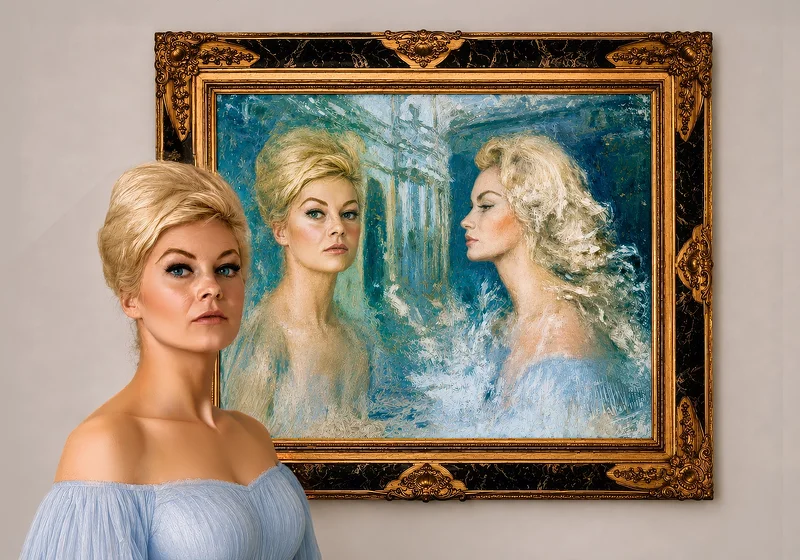
The Three Muses - De tre Musorna, 2026
Digital
50 x 70 cm
3 200 kr
The Three Muses - De tre Musorna
Svensk text på slutet
Introduction
What remains when the applause has faded, the cameras have fallen silent, and even the greatest treasures have vanished? In this moving story, Anita Ekberg reflects on a life that stretched from the streets of Malmö to the glittering heights of Hollywood and Rome.
Anita Ekberg returns to the Three Muses and to the extraordinary painting Gianni gave her in 1960a work of art that would one day vanish, yet leave something far more enduring than paint and canvas. Through memories of love, friendship, fame, and loss, she discovers that the most precious things in life can never be stolen.
This is not a farewell to a legend, but an intimate conversation with the woman behind the legend. A quiet reflection on memory, inspiration, and the invisible threads that bind our lives together long after we are gone. Some journeys end with an answerthe most beautiful end with a memory.
More than anything, it is a reminder that legends are created by the worldbut remembered through the humanity of those behind them.
At the end of the journey, the diva steps aside, and the woman remains.
Simply Anita.
"The Thirteenth Labour
Malmö, July 2026
PROLOGUE
Den sista divans dolda mästerverk: Varför Anita Ekberg bara satt modell en enda gång
The Last Divas Hidden Masterpiece: Why Anita Ekberg Sat for a Painter Just Once
People almost always think of the Trevi Fountain when they hear my name.
They picture the black dress, the moonlit water, the flashbulbs, the headlines and the impossible glamour. To many, that single scene became my entire lifeas if I had stepped out of the fountain on a magical night and stayed there forever, young, beautiful and untouchable.
But there IS another image of me. Not a film still. Not a publicity photograph. Not a magazine cover retouched for desire and distancea painting.
It was the only painted portrait I ever approved, the only one for which I knowingly sat as a model. Gianni gave it to me in 1960, and for more than fifty years it hung in my home like a secret no one quite understood. Three Muses on a canvas. Three versions of the same woman: three masks, three destinies, three ways of becoming Anita.
Then it vanished.
While I lay in hospital, thieves broke into my house, stole what they wanted, and set fire to what remained. The painting disappeared with them. Today, the last divas hidden masterpiece survives only in memory and in photographs.
This is in part a story of that lost painting, but also of the woman inside it. People have spent decades telling my story. Now, at last, allow me to step out of the frame and tell it myself.
Chapter 1: Control Over the Image
In the spring of 1960, I agreed, for the first and only time in my life, to sit for an artist. As a fashion model, I had been photographed thousands of times, and as a film star I had appeared in more than sixty filmsyet I had consistently refused to let myself be painted on canvas.
My ironclad principle was rooted in a fear of losing control over how I was portrayed. A photograph is what it isa fleeting reflection of my true self, captured through a lens and fixed on film. In the photographic process, I always had a say in which negatives would be printed, and the process was completed quickly. A painting, however, becomes whatever the artist wishes to express. An artist can add or remove details long after the sitting is over, and I can't do much about it. That was the source of my scepticism.
A perfect example of this artistic freedom is Leonardo da Vinci's portrait of the Mona Lisa. Not only was the painting never delivered to its patron, Mona Lisa's husband, but it also remained with Leonardo throughout his travels, including a trip to France, where he spent the final three years of his life. Leonardo never let go of the painting, returning to it repeatedly over many years. Between 1503 and 1519a span of sixteen yearshe continued adding layer upon layer of paint and never considered the work finished.
Thanks to modern technology, it is now possible to see numerous significant alterationsthe so-called pentimenti, or changes of mindthat Leonardo da Vinci made during the painting process. By analysing the paint layers, researchers have discovered at least three major, previously hidden versions of the Mona Lisa beneath the surface we see today. Leonardo altered her gaze; in the earliest version, her face was turned differently, and she looked more towards the left. The position of her hands was changed, and her fingers were repositioned several times. Her head covering, hair, and the lines of her veil were all adjusted as the work progressed. Many scholars believe that Leonardo initially painted an entirely different portrait, probably of another model, and then gradually transformed it, painting over it to create the masterpiece we know today.
I had long suspected this was often the case with older paintings in the 1950s, and I could easily imagine what an artist might do as the work evolved. That uncertainty held no appeal for me. I refused to risk sitting for my own portrait only to see it gradually become a completely different woman on canvas.
Chapter 2: The Ekberg Brand
During my heyday in Hollywood and Europe, I was fiercely protective of my public image as a glamorous sex symbol and film diva. I was the foremost champion and guardian of my own brand. Nothing was left to chance; everything had to be perfect. And it was.
As early as the 1950s, when I was being promoted by studios such as Universal Pictures, I worked closely with the film companies' highly disciplined publicity departments. I ensured that my curvaceous figure and flowing blonde hair were always presented in the most flattering light and in the right context. I knew exactly which angles worked and which did not, carefully controlled how I was portrayed, and maintained uncompromising control.
I cherished the aura of stardom. I was an icon of the classic Hollywood era. I wore my diva status with pride and expected to be treated accordingly, even though my closest friends have always emphasisedand still rememberthat, in private, I was remarkably down-to-earth. Lars Hector's major biography of me, not without reason, is titled The Last Diva. I suppose I shall live with that forever.
I defended my privacy and the image I had built with my teeth and nails. I did everything in my power to keep photographers at bay. One famous example came in 1960, when I drove away intrusive paparazzi in the Roman night, armed with nothing more than a bow and arrow.
The Exception and the Count by the Trevi Fountain
The reason I finally made a single exception to my rule was entirely due to my great love for the Fiat billionaire Gianni Agnelli. I did so only because he asked me to. The artist was one of his close friends, the very same man who had painted a fine portrait of the barely twenty-year-old Agnelli in his cavalry officer's uniform as he was on his way to the Eastern Front back in 1941.
The artist was a count, though wealthy in little besides his namewhich, admittedly, was impressive enough: Uberto Cipollone Pallastrelli di Celleri. Agnelli recommended him to as many people as he could within the highest circles of society, encouraging them to have their portraits painted by this friend from Piacenza.
Chapter 3: The Studio by the Trevi Fountain
Uberto's apartment and studio occupied the first floor of a building at Piazza di Trevi 100. It stood right beside the Trevi Fountain, where I had just finished filming La Dolce Vita. Only because Gianni personally vouched for Uberto did I agree to sit for a double portrait. Despite my initial scepticism, I must admit I found these sittings at the count's studio surprisingly enjoyable, though I never compromised my status. I was molto famosissima and very conscious of the image I projected. That is why I never arrived alone. I always brought my own hairdresser, make-up artist, and stylist. Their job was to ensure I looked flawless and consistent from one sitting to the next.
Outside the studio, on the little square, a crowd of admirers quickly gathered, waiting for me to emerge and sign autographs. And of course I did. Now and then I would leave the uncomfortable stool reserved for Uberto's models to wave to my fans and soak up their applause. Moments like those are wonderfulto feel genuinely popular while giving my backside a well-earned break from Uberto's miserable seat.
Our sessions were often interrupted by visitors dropping by. Uberto's studio was one of those places where people from industry, the film world, and the cultural elite loved to meet. I was right in the middle of it all, so I did not mind in the least. Before I came along, he had already painted many women from Roman high society. Several unfinished canvases hung around the studio, one of which immediately caught my attention. It portrayed a beautiful blonde with a poodle haircut, a magnificent diamond necklace, matching earrings, and a spectacular bright red strapless gown. She reminded me of myself at the time of the Miss Sweden competition ten years earlier, although she had brown eyes.
"She drops in whenever it suits her," Uberto said when he noticed my interest. He explained that she was the American socialite and philanthropist Betsy Bloomingdale. She came to Rome a couple of times a year and stopped by so he could make a little more progress on her portrait. He hoped to finish it when she returned in the autumn.
I knew her very well. I had attended a couple of Betsy's legendary parties, each time accompanied by a hopelessly infatuated Frank Sinatra. Betsy's husband had even been Frank's agent for a while. She was an absolutely delightful woman. She and her husband lived in a magnificent house in the fashionable Holmby Hills neighbourhood of Los Angeles, not far from Hollywood. Betsy was the true queen of Hollywood society. Receiving an invitation to her court was a great honour for a working-class girl from the little town of Malmö. In those circles, I was still something of an unknown quantity, but arriving on Frank's arm certainly didn't hurt.
It was autumn 1955, when Frank and I were practically inseparable. He wanted to marry me, but I resisted, having no desire to become Mrs Sinatra and spend my life in his shadow. The same would have applied to any other man, for that matter. I wanted to remain Anita Ekberg and continue building my own brand. But I certainly cared deeply for him. He was sixteen years older than I was and far more established, yet he was wonderful in bed. Gradually, I persuaded him to see things differently, and we remained lifelong friends.
At Betsy's party, we danced a wild boogie-woogie to Bill Haley's Rock Around the Clock. Rock music had only just broken through, and Betsy had made it the theme of the evening. Some guests had fully embraced the faster rock-and-roll style of dancing, but that was hardly Frank's scene, as he approached fifty. I had no trouble keeping up, though I must admit it was far cosier to melt into his arms during a foxtrot. Instead, we enjoyed watching a troupe of professional dancers hired for the occasion, performing breathtaking acrobatics across the dance floor. Now that was an air show.
Chapter 4: The Queen of Parties and Villa Anita
Betsy hosted parties constantly, most of them charity events, earning her the affectionate nickname Good Queen Betts. As a hostess, she was the consummate professional, keeping meticulous records of every dinner she gave, including a photograph of the table setting, a seating chart showing who sat beside whom, the menu, and even what she herself wore. She did all this to ensure that her guests would never eat the same meal twice or see her wearing the same dress twicewhat people in her circles called the hideous faux pas. She could afford to be so selective, since she owned enough clothes to fill eleven wardrobes.
In time, I could match her in that department. My house in Genzano di Roma contained several overflowing dressing rooms because I kept everything. My glamorous wardrobe suited my status as an international diva, and I owned endless rows of figure-hugging dresses in bold colours and magnificent fabrics, together with countless custom-made creations by the world's leading fashion designers. My shoe collection was equally impressive and filled an entire room.
There was only one area where I could not compete with Betsy, and I want to emphasise that there truly was a difference. It concerned her parties. Even in my finest years in the 1950s and 1960s, when I was living la dolce vita and hosting lavish dinners, pool parties, and gatherings for film stars, directors, and other celebrities at my home, my parties were simple by her standards. It was not because I couldn't have matched herI can accomplish anything I set my mind to. I lacked the ambition because I had more important things to do. My brand was me, not elaborate gala dinners with formally seated guests around extravagantly decorated tables.
Betsy's parties were usually charity dinners at which guests paid for their seats, with the proceeds benefiting worthy causes. The second time I visited her, Frank paid $100 per person for us, which, in today's money, would probably be about 10 times as much. Good heavens. Charging your guests the equivalent of more than a thousand dollars to dine on Royal Copenhagen porcelain worth a hundred thousand dollars was never my style. At my house, it made absolutely no difference if someone accidentally dropped a plate on the floor. I never charged admission, and at Villa Anita, the champagne was always plentiful, well-chilled, and free.
Villa Anita was naturally not as exclusive as Betsy's palace, but my home certainly had nothing to be ashamed of. It offered spacious interiors, a magnificent garden surrounded by its own olive grove, an enormous lawn, and a completely secluded oasis. People genuinely loved coming to my house. There, they could kick off their shoes and dance barefoot whenever the mood struck themand it often did.
At Betsy's, Frank's dollars, along with everyone else's, went to disadvantaged children and unmarried mothers, so the cause was admirable, even if there could hardly have been many of them in fashionable Holmby Hills. The dinner itself was as stiff as such society occasions often are, with everyone trying to make the perfect impression and desperately hoping not to spill anything on their distinguished table companions. But once dinner was over, the evening truly came alive, and we certainly got our money's worth.
It was at that very party that I learned to dance the Twist, the latest dance craze. It was incredibly easy to learn. You followed the rhythm, twisting your feet back and forth as though you were grinding out a cigarette with your toes, while drying your back with an imaginary towel. Frank and I both gave it our all on the dance floor. In a way, the party resembled the film we made together a few years later, 4 for Texas. On paper, it promised non-stop excitement, but in reality the pace was uneven. In that respect, my parties outshone hers by light-years, because at my house the tempo was always at full speed.
Chapter 5: The Painting of the Two Anitas and the Magic of the Muses
Once I had brought my new painting home, I hung it so that its two Anitas had a perfect view of my large living room. Nothing that happened on the dance floor could escape our watchful eyes.
It was Gianni who first suggested that I embodied all the classical Muses at onceor so he believed. Naturally, I was flattered by the comparison. The Muses are goddesses of creativity and knowledge, and, from a modern woman's perspective, they are all women gathered into a single figure. And who wouldn't love a metaphor like that?
We sometimes playfully argued over which Muses were actually depicted in the painting, because choosing the most important qualities is a delicate matter. It is like standing in a sweet shop with a hundred bins of sweets. Which one do you choose when you like them all? I would say it depends on the time and the occasion. Whenever people were dancing on the floor beneath the painting, one Anita should surely be Terpsichore, the Muse of dance, and the other Euterpe, the goddess of music.
Gianni was far more classically educated than I was, and from him I learned everything about the Muses. He knew an astonishing amount and loved sharing it. I was a much better listener than my reputation suggested, at least when I was with him.
With the clarity of hindsight and the perspective of eternity, one can afford to call things by their proper names. What happened on Earth cannot be undone, and a person's character resides in the souland the soul accompanies you to your star. Of course, eternity gives you all the time you could ever need to smooth away the rough edges, should that be necessary. But among the stars, the guiding principle is that one is as good as another, and stars rarely collide. It does happen from time to time, and when it does, the result is a tremendous explosion. A supernova blazes brilliantly one final time before collapsing into a black hole. It is not an outcome anyone strives for because, beyond eternity, there is nothing. Some stars shine more brightly than others, but they all shine, and each has its own planetary system. Even the greatest egos who ever lived on Earth eventually find that enough. After all, what is the alternative?
Even three Swedish divas can happily inhabit the same star. Birgit Nilsson, Zarah Leander, and I have all spent time together on Birgit's star, Casta Diva. I may be something of an outsider among the great opera divas. Still, if Birgit could share a planet with the supreme diva of opera, the Greek soprano Maria Callas, then surely everyone can get along. Such is the magic of space.
Casta Diva was a red giant, shining with exceptional brilliance, a trait that suited Birgit perfectly. Because the constellation Norma lies within one of the Milky Way's richest star fields, its individual stars are difficult to distinguish without binoculars. Even so, the human eye can make out forty-four stars there, among them Birgit's Casta Diva. Whether that is merely coincidence or something more, no one knows, since the universe has no ruler or guiding force that we know of. In any case, it has somehow become customary for those who devoted their lives to music on Earth to seek out one of Norma's star clusters upon arriving in eternity.
Chapter 6: The Cosmos and the Time Travellers of the Norma Arm
One of the Milky Way's great spiral arms, the so-called Norma Arm, passes directly through the constellation. With a powerful telescope, astronomers can count millions, perhaps even billions, of incredibly faint and distant stars within Norma's official boundaries. In other words, there is plenty of room for both old and new musical time travellers.
At this very moment, roughly twelve million people on Earth work in music as singers or musicians across every imaginable genre. Most are freelancers or pursue music alongside another profession. They may earn money from concerts and streaming services, but many still rely on other jobs to pay the rent. Truly global superstars, however, number no more than about three hundred singers and musicians who can fill concert halls and entire stadiums while shaping the musical culture of their age. Over the course of a century, perhaps fifty of them leave Earth and find their place in Norma.
Close to Birgit lives Wagner, whose music she interpreted countless times as the greatest dramatic soprano of her era. They are all there, so anyone with an interest need only turn the pages of music history.
Enheduanna of Mesopotamia arrived here some four hundred years ago and still quietly hums her mysterious hymns. By the time she arrived, the Egyptian flautist and court musician Khufu-Ankh had already been there for two hundred years. Much later, around 675 BC, the father of Greek music, Terpander, came from the island of Lesbos. He had added three extra strings to the lyre, bringing the total to seven, and had already won several musical competitions in Sparta.
The giant Orpheus resides on the star Olympos. This supreme musician played so beautifully on Earth that, with his voice and lyre, he could tame wild beasts, make stones weep, and even open the gates of the Underworld. A formidable achievement indeedbut among Norma's millions of stars, the competition is fierce.
Because space is a vacuum in which ordinary sound waves cannot travel, music is performed telepathically. Just as the deaf Beethoven could both hear and compose music in his own mind while he lived on Earth, these time travellers can do the same. Naturally, they also wish to hear themselves and one another under more earthly conditions, so they gather at music festivals on one of the billions of planets throughout the Milky Way that have atmospheres similar to our own.
Such an immense amount of music ought to leave a cosmic imprintand it does. From Earth, we can listen to the cosmic microwave background, the echo of the Big Bang itself, and convert electromagnetic waves into sound. Because Norma's music is a collective resonance, it emerges as a deep, rumbling bass note, a dark hum reminiscent of a gigantic jet enginehardly pleasant listening, which is why you are much better off opening YouTube or Spotify instead.
Chapter 7: The Iceberg and the Seducer Who Listened
Historically, I was never described as a particularly good listenerquite the opposite. I was known as a woman who took up plenty of space, spoke her mind without hesitation, and loved being the centre of attention. In social settings, my personality and behaviour were defined above all by my independence and outspoken nature. I was famous for having a sharp tongue and for keeping very little hidden. If I had an opinion, I expressed it directly rather than quietly listening and adapting to everyone else. I still do, so in that respect I have learned absolutely nothing.
I was every inch the diva, often described as the classic film goddess who demanded attention. My role at any gathering was to entertain and dominate the room with my presence, not to sit quietly in the background and listen attentively to others. The international press occasionally nicknamed me The Iceberg. That had as much to do with my surname as with the impression that I could be cool, reserved, and difficult to approach on a deeper level. In short, I was a woman with a commanding personality who occupied space entirely on her own termsa woman people listened to rather than one who listened to them. Don't worryI haven't changed.
Except when I was with Gianni.
It was not that I suddenly changed my feathers; there was no need. Gianni was almost my complete opposite in communication. He was renowned for being an exceptionally skilled, intensely curious listener. Gianni was the seducer who listened. While I dominated a room with my speech and demands for attention, Agnelli charmed people by giving them his undivided attention. In one famous interview, he remarked that he did not enjoy talking about women; he preferred talking with them.
Gianni let people speak while he asked short, incisive questions, absorbing information like a sponge to keep himself informed about everything in the universe. He embodied the Italian ideal of sprezzaturathe art of making the difficult appear effortless and elegant. While I generated dramatic headlines, Agnelli was a master of discretion in social situations. He listened, observed, and quietly acted behind the scenes. That approach served him well in eternity, among the countless billions upon billions of stars. In the company of everyone who has ever lived on Earth, it is rather difficult to present yourself as the diva of all divasand certainly not as the last one.
Chapter 8: Life on Centaur and Meeting Lucy
As time went on, I discovered just how fascinating Gianni was. He knew an astonishing number of things I had never imagined, yet found them deeply interesting. We shared many passions, but above all we despised boredom. On Earth, we lived by the principle that life should never be dull, constantly seeking excitement and stimulation. Our intense, secret meetings became the perfect escape from everyday life.
That became even truer in eternity, when we met again and eventually moved in together on the star Centaur, which Gianni had managed to acquire in one of his characteristic exchanges. Just imagine an endless succession of days waiting to be filled. Gianni and I manage that quite effortlessly. We travel all over the universe, meeting remarkable people from every era imaginable. The most fascinating so far is probably the prehistoric woman Lucythe one who, according to legend, sat in a tree playing a flute before falling to the ground nearly 3.18 million years ago. Today she is the principal flautist in an all-star philharmonic orchestra. Talk about personal development. And imagine what someone who has spent so long in eternity has to say.
One thing you should know is that people never stop growing and learning in the afterlife. Lucy, for example, has become absolutely obsessed with the internetboth the earthly version and its cosmic predecessor, telepathy. In eternity, we no longer need to digitise our thoughts and package them as electronic signals. We think and, in doing so, connect directly with one another. If you happen to be on the same wavelength, all you have to do is join in.
Lucy wore a diamond necklace that Gianni had given her, and she adored it so much that she wore it at every concert. It was a family heirloom that had mysteriously disappeared. Gianni had retrieved it from a secret safe-deposit box in Turin to ensure his heirs would not quarrel over it.
Things like that often happen when someone leaves the Earth, only to return a short while later as a time traveller, bringing something that deserves a place in eternity.
Chapter 9: Returning to the House and the Memories in the Cellar
I did the same thing myself. There was a hiding place in my house that the thieves had never found, where I had kept several love gifts from Gianni. It was a full jewellery box, probably valuable enough to buy a house. But some things are not for sale.
Only a week after my soul had left the Earth, I returned, now free from every ache and pain and filled with renewed strength. I had not set foot in my house for several years, so I was naturally shocked by the devastation the burglars had left behind. I only made a quick tour of the rooms, but the right feeling refused to come. No memories stirred within me, and the wall where the double portrait had once hung stood empty.
Since the disaster was no longer my concern, I walked down to the very last place any thief would ever think to look: the food cellar, with all my preserves and all my memories from the years when I still had the strength to make them.
My footsteps fell heavily and silently on the massive stone staircase. The steps were clad in travertine, the warm, honey-coloured Roman limestone, whose cool surface felt soothing beneath my feet. I passed through several rooms before finally reaching the food cellar, dug into the ground beside my house.
I switched on the single light bulb and let my eyes slowly wander across the shelves. I moved an empty wooden crate into place and climbed onto it to reach the highest shelf. I pushed aside the outermost jars of cucumbers preserved the Swedish way, in vinegar and sugar. Carefully, I reached my hand in behind them. Before touching the innermost corner, I paused to savour the memories.
I noticed the jars of crisp giardiniera and immediately remembered the sharp, clean tang of vinegar on my tonguea perfect contrast to a rich slice of porchetta enjoyed on the terrace. Beside them stood spring artichokes submerged in olive oil. I could almost feel their tender leaves melting on my tongue, mingling with garlic and the wild mint I had gathered by the roadside. My hand and eyes drifted on across rows of sweeter treasures. I remembered the intense tropical fragrance that had filled the entire kitchen as I simmered mangoes from my garden with a sprig of rosemary, and the bright, tart burst of kiwi jam sharpened with a splash of grappa. Every jar carried its own unmistakable flavour, a little fragment of preserved sunshine from a time when my hands were still strong enough to do the work.
Chapter 10: The Treasure Hidden Behind the Cockscombs
At last, my fingers reached the very back of the top shelf, tucked away in the darkest corner where the dust lay thickest. There stood the rarest row of preserving jars, filled with something few outside the older generation in the region would ever think to put on a shopping list: Cresta di gallo sott'oliocockscombs preserved in olive oil. These wrinkled combs, once a vivid coral red, were first blanched, then gently simmered in white wine vinegar, and finally tightly packed in the finest local olive oil. A rubber seal was placed around each jar, a glass lid secured with a metal clamp, and the jars were then lowered into a large aluminium pot for preservation. They were boiled for two full hours. Cockscombs are naturally rich in collagen. The prolonged immersion in the boiling water bath gradually breaks down the collagen until the combs become wonderfully tender. At the same time, the heat penetrates to the very centre of the jars, sterilising the meat. Delicious.
In my mind, I can still taste their unique, delicate, almost gelatinous texturean intensely local delicacy that carries the true rustic flavours of Lazio. There is no dramatic thud. I do what I came to do. I reach even farther in, pushing aside the last jars of cockscombs until I spot the narrow crack in the wall. It is not large and looks perfectly natural in an old houseunless, like me, you know what lies hidden behind it.
I slipped in the screwdriver I had fetched from the kitchen and gently pried. The stone came loose with what sounded almost like a sigh, and flakes of plaster drifted to the floor. Once I had eased the stone out, I reached into the cavity behind itmy secret hiding place. After a moment, my fingers closed around a small olive-wood box. Gianni had given it to me years earlier, and he believed it dated back to the eighteenth century. Inside, the diamond necklace that had once belonged to his grandmother still lay.
"This should be yours, cara mia. Grandma was almost as cheeky as you," Gianni had said as he embraced me.
Anita's lifeor rather, my earthly lifehad changed. When la dolce vita finally came to an end and the glittering parties were over, I no longer had any use for my treasures. I decided they were safer hidden in the cellar than in my underwear, the first place any burglar searches for jewellery. Over the years, I gradually filled the box with more keepsakes: necklaces, bracelets, brooches, and a few rings, all gifts from Gianni.
"For rainy days," he used to say.
There had certainly been plenty of rain during my final years, but not even a tsunami could have persuaded me to sell Gianni's gifts. Now they were about to make their longest journey yetto our star in Centaur.
I carefully placed the olive-wood box inside my handbag, itself another gift from Gianni. Alongside the jewellery, I packed a couple of jars of preserved cockscombs. Then I slipped quietly out of the house and walked to an olive grove a few hundred metres away. By one of those fortunate coincidences that occasionally occur in the universe, the wormhole emerged therethe very one that had carried me back and forth between my star and Genzano. Wormholes are wisely designed so that nothing on Earth can accidentally fall into them unless a time traveller is holding your hand. I could have brought one of my dogs or cats with me, but there was no sign of them. I was sure Anna Maria had taken care of them, and they were probably better off in Genzano.
Chapter 11: The Analogue Internet and the Knots of the Inca
As I made my way back through the wormhole, I had time to think. Perhaps it was the cosmic cold surrounding the passage that made my thoughts drift towards sheer nonsense. There, the nonsense appeared as the exact opposite of the determination that created both the ancient world's and our own version of the internet.
Even back on Earth, Gianni often spoke about his fascination with how the ancient Romans maintained what he liked to call an analogue internet. He also loved discussing how information spread across empires long before the modern age. Then he would jump continents and tell the story of the Inca, who did not even possess a written language as we understand it today. Instead, they relied on knotted cords known as quipus. At Fiat board meetings, Gianni liked to joke that the Inca had proved that, given fast enough runners and enough knots, you really did not need a telephone network to govern a vast empire. What he meant was that we may have replaced running shoes with pulses of light and knots with ones and zeros, but the underlying principle remains the same. Long before the first computer had even been imagined, the Inca demonstrated that all it takes to shrink the world is a talent for logistics.
There were moments when Rome was more than a mere backdrop to our late evenings together. It became a living organism, breathing through the centuries. I remember one particular evening at Hostaria dell'Orso in early October 2001. Beyond the windows, the Tiber flowed dark and unhurried, while husky voices drifted through the restaurant around us. Gianni sat opposite me, impeccably dressed as always in one of his tailored suits, his wristwatch strapped over the cuff of his shirt. He wore that unmistakable expression of relentless curiosity, the one that allowed him to captivate an entire room simply by listening, only to dismantle the world a moment later with a handful of elegant observations. But when the mood suited him, he was also a gifted storyteller.
Even from a distance, Gianni continued to look after me. He helped me financially, arranged repairs to my house, and quietly made everyday life easier. I knew about his prostate cancer, though he insisted he had everything under control. He had undergone surgery in an attempt to halt the disease. The diagnosis had come in 1997, around the same time that his nephew and chosen Fiat heir, Giovanni Alberto Agnelli, died of stomach cancer. Whenever I asked about his health, he would wave his hand dismissively and say, It's all right, cara.
Gianni briefly explained the difficulties facing the Fiat Group and said he was about to attend a top-secret crisis meeting with Italy's Prime Minister, Silvio Berlusconi. He would personally negotiate with the government over a state rescue package to save tens of thousands of Italian manufacturing jobs. I knew perfectly well how strained the relationship between Gianni and Berlusconi had always been. In many ways, it was old aristocracy confronting new money. Gianni embodied inherited industrial power, royal elegance, and discretion built over a century. Berlusconi embodied the new, rather gaudy capitalism of television monopolies, glittering populism, AC Milan, and an unapologetically flashy lifestyle. Agnelli looked down on Berlusconi's lack of refinement and mockingly referred to him as a pizzaioloa pizza maker who had happened to become rich. Naturally, I agreed. Yet although Gianni's pride prevented him from admitting it openly, the balance of power had shifted. My Gianni, who had once dictated terms to Italian governments, now had to meet Berlusconi with hat in hand. Fiat stood on the brink of bankruptcy and desperately needed state assistance.
Once we had spoken long enough about matters beyond either of our control, Gianni wanted to know how I was doing. His unspoken message was that worrying was pointless if there was nothing I could do about it anyway. We did not meet often anymore, but we were careful never to lose touch, speaking on the telephone perhaps once a week. The physical affair gradually faded after more than twenty years, yet the emotional bond never weakened. It became something very much like a long-distance marriagetwo souls living apart but sharing the same life. We remained each other's closest confidants. Gianni regularly called me for my honest, completely unfiltered opinions about the world. I was one of the very few people who had never trembled in the presence of his power.
Chapter 12: Hollywood Babble-On, Political Nonsense, and Jackie Kennedy
I am certainly no expert in either economics or politics, though that has never stopped me from having opinions. Since my years in the film industry, I have become an expert in Hollywood Babble-Onthe jargon-filled language of agents, producers, and actors who manage to sound immensely important, artistic, and successful without saying anything of substance or delivering much. I soon discovered that much the same phenomenon existed in the corporate world, especially among large companies, where it went by the name of Company Bullshit. Simply skimming the business pages of the newspapers was enough for me to recognise the familiar style. Gianni eventually realised that, despite my lack of technical expertise, I often reached conclusions he found remarkably useful.
"Mundus vult decipi, ergo decipiatur""The world wants to be deceived, therefore let it be deceived"has traditionally been attributed to the Roman writer Petronius, who lived during the reign of Emperor Nero. Oddly enough, it was the prosperous farmer I spent time with before leaving for America who first taught me that saying. In his view, everyone was trying to deceive everyone else. He explained how things worked when timber was sold and an official surveyor arrived to measure the wood. The survey determined how much the farmer would be paid. "You should be able to throw your hat straight through the pile," he used to say, meaning that a clever stacker could pack plenty of invisible air into a pile of logs. The trick was to arrange crooked branches just right and hide the occasional large stone inside. It worked even better if you made sure your pile was measured late in the afternoon, after the surveyorlike all the other farmershad been offered a generous schnapps.
The same principle applied to politics, and I had already seen through that world during my Hollywood years. The cultural sector is particularly vulnerable to political waffle because no one wins elections over such issues. As we say in Sweden, a beloved child has many names, and political nonsense has plenty of synonyms waffling, gobbledegook, political mumbo-jumbo, to mention only a few. They all amount to the same thing: hiding reality behind words. Over time, I became astonishingly good at recognising nonsense from nothing more than a headline and the opening lines of an article. Not because I could always explain precisely what it was about, but because Gianni could. My intuition saved him time by pointing him in the right direction. At least, that is what he always claimed, and it made me feel important.
As the years passed, I developed deep respect for his wife, Marella, and for Gianni's family, and I never demanded that he leave them for me. Our silent agreement rested on absolute freedom and discretion. He had never objected to either of my marriages, and we continued to see one another as before. The only time things became truly heated was when he decided to avenge one of my practical jokes by inviting First Lady Jackie Kennedy aboard his yacht for an entire week. I would rather not think about what happened there. The affair came to an abrupt end after her husband, the President, reportedly sent a now-legendary telegram from the White House:
"More Caroline, less Gianni."
"More Caroline, less Gianni" could hardly be misunderstood, given that Caroline was their daughter. Jackie promptly returned home, and Gianni and I resumed seeing one another as usual. Later, when Jackie married Onassis, she certainly revealed what kind of woman she truly was.
I have always been proud that I never married for money. Gianni's wealth was, of course, convenient for both of us, but I had no idea who he was when we first met at the Stork Club in New York. At the time, I was as poor as a church mouse. By the time we met again a few years later, I had no difficulty supporting myself. In fact, I was about to marry a man considerably less successful than I was.
I still laugh when I think about it because the telegram had leaked to the press. Eventually, the storm subsided, and the two families continued to socialise. In September of that year, President Kennedy and Jackie welcomed Gianni and Marella aboard the presidential yacht during the America's Cup races in Newport.
There I go again, losing the thread.
Back to Hostaria dell'Orso.
Chapter 13: Rome's Stone Fibre Network
After discussing Fiat's problems at length, I complained about how long it took my letters to reach Sweden, especially since the newspapers always seemed to know everything before we did. Gianni smiled his sardonic smile, took a sip of his drink, and leaned across the table.
"Anita, my dear," he said in his husky, captivating voice. "You think our age invented speed. But the editors in Milan and New York are simply doing what the emperors of this city perfected two thousand years ago. The Romans built an internet, Anita. A sophisticated analogue network. They used stone instead of cables, straight roads instead of fibre optics, and muscle instead of electricity. What we are witnessing today is not a paradigm shift but a technological evolution that shortens time and thereby expands the territory that can be managed."
I laughed, accustomed to his theatrical comparisons, but he continued, painting a picture I would never forget. How right he was became even clearer after I arrived in eternity, where people from vastly different cultures and eras tell remarkably similar stories. The surface changes; time changes. The Roman Empire stretched across much of the known world, whereas today's internet spans the globe, and its cosmic predecessor reaches across the universe.
Gianni explained that the Roman road systemthe viaewas, in fact, the empire's hardware, a vast fibre-optic network of stone spanning nearly fifty thousand miles. He gestured with his elegant hands to show how the roads sliced arrow-straight through the landscape. They were built that way, he said, for one ruthlessly practical reason: to minimise latencythe waiting time. The aim was to reduce delays for data packets, which, in those days, were sweaty horsemen and rattling wagons. The straighter the line, the faster the flow.
"But a cable is useless without routers to direct traffic," Gianni continued, his eyes sparkling with that uniquely industrial passion. "That is why Augustus created the Cursus Publicus. Think of it as a network of servers lining the roads. There were the mutationessmall relay stations every fifteen kilometres, about as far as a horse can gallop at full speed. A courier would stop there for only a breath or two before leaping onto a fresh horse and continuing his journey. One day's ride farther on stood the mansionesthe great server farms of antiquity, although the Romans called them inns. There you found food, beds, veterinarians, and guards. It was a logistical relay system that allowed urgent military dispatches to travel nearly 150 miles per day. Even today, most of the people we communicate with are no farther away than that. You sent a message on Tuesday morning and received the reply on Thursday morning. That may not sound impressive today, especially now that artificial intelligence often supplies answers before people have even asked the question. Machines are beginning to predict what you are likely to askor perhaps what you should have asked in the first place."
When I asked how anyone could find their way through such a bewildering web of roads, Gianni brightened even more. He began describing the Tabula Peutingeriana, the surviving seven-metre-long parchment map he liked to call the Romans' own web browseror their version of Google Maps. It was not a geographically accurate representation of mountains and seas but a schematic diagram, much like a modern subway map. It showed only how hubs and cities were connected, where the relay stations were, and how long it took to travel between them. That was all a traveller needed to know.
"Think about the Inca Empire, Anita," he said, leaning back in his chair. "Their system was fascinating yet entirely centralised. Everything flowed to the emperor in Cuzco through a closed code of knotted cords. The Romans were different. Their network, like today's internet, was open and based on written communicationpapyrus scrolls and wax tablets rather than digital text. True, Cursus Publicus was state-owned, but if you had moneyif you were a wealthy merchant or a patricianyou could purchase a diploma, an official permit granting access to the network. In many ways, that is how the internet began as well: an official network available only to a privileged few."
Gianni fell silent and studied me over the rim of his glass. That was so typical of him. He had taken my superficial frustration with the postal service and turned it into a lesson in historical elegance. Gianni loved the combination of power, structure, and speed, which he regarded as beauty itself.
Many years later, when I watched young people gazing down at their glowing little screens as they spoke of the global network, I could not help but smile. I never thought of Silicon Valley or satellites. I thought of Gianni, the cigarette smoke drifting through that Roman restaurant, and of his voice explaining that everything we do today is merely an echo of the horses that once thundered along the Via Appia to keep an empire alive.
Chapter 14: The Last Prayer to the Muse
How we ended up talking about the Muses again, I no longer remember. Still, it probably had something to do with the Muses being the messengers of the ancient gods, carrying messages between Mount Olympus and the people of the earth. In any case, Gianni asked whether I still had the painting he gave me in 1960, the one beside which we had danced so many times when my house was still filled with joyful parties. These days, my social life had been reduced to little more than a cup of coffee with the gardener and with Annamaria Attanasio, my indispensable companion, housekeeper and maid. After Gianni left this world in 2003, she was the person closest to me.
Of course, I still had the painting. It hung in the same place until it was stolen while I was in hospital. Naturally, I could not have known that that evening at Hostaria dell'Orso, but I noticed how relieved Gianni seemed when I answered. As everyone knows, none of us can see the future. He knew I was struggling financially and perhaps feared I had sold the painting rather than ask him for money. A portrait of me by that artist would certainly have fetched a handsome sum, but I would rather have starved than sell a gift born of love.
So we picked up where we had left off many years earlier, discussing which Muses were portrayed on the canvas. I remembered that, in the end, we had agreed it depended on the occasion and the circumstances. Gianni had forgotten that conclusion, so we started all over again. Softly, I hummed the opening words of the Symphony of the Three Muses: Sing, O Goddess...
The painting became a masterpiece: a profound and enchanting double portrait. Yet its composition ultimately embraces a far greater mythological dimension. Greek mythology required nine Muses, but I needed only threethe ones in the painting and myself standing in the foreground. The three Muses borrow a familiar motif from antiquity and give it an entirely new meaning. There are not nine distinct goddesses here, but three manifestations of the same woman. The Muses in the painting present three versions of me, each complementing the others, and that is precisely why I became so successful. The viewer expects to see three separate Muses, only to discover that each is me. The background becomes a perfect fusion of the Trevi Fountain and the lush gardens of my home, Villa Anita in Genzano.
Throughout my life, I changed my clothes, but never my personality. That connects me to both classical mythology and to my role as a model, an artistic inspiration and a cinematic legend. One might ask why Thalia, the Muse of comedythe one with the smiling theatrical maskdoes not take the foreground. The answer is simple enough: I never acted on stage; I spent my entire life playing myself. I did so successfully until one of the Muses grew old, because without the beauty of youth and the radiance of the goddess of love, even the finest varnish on a painting eventually cracks.
Each of the three figures tells a different story. The figure on the left gazes directly at the viewer as Clio, the Muse of history. As Clio, she embodies the woman whose life has become historyfrom Miss Malmö to Hollywood, Rome and the Trevi Fountain. She carries the memory of a century that was cinema's true golden age. The figure on the right is Erato, the classical beauty and Muse of love and lyrical poetry, through whom I inspired photographers, fashion designers and filmmakers alike. Her profile is timeless, almost like an ancient medallion or a Renaissance painting. Here I become the very symbol of elegance and seduction.
Calliopethe Muse of epic poetry, the woman standing before the paintingis the living Anita, a human being of flesh and blood. I stand before my own images and become the protagonist of my own story. Calliope was the greatest of the Muses and the patroness of epic tales, making her the perfect companion for the journey that carried me from Malmö to immortality on the silver screen. My life became an epicnot because I wrote it myself, but because countless others wrote about me, portrayed me in films, and filled newspaper pages with my story for decades.
In Greek mythology, the nine Muses were goddesses of art, science and creative inspiration. They were the daughters of Zeus and Mnemosyne, the goddess of memory. The symbolism is profound: creativity is born of the union of divine inspiration and memory. According to the myth, Zeus spent nine nights with Mnemosyne, and the result was the nine Muses. They first dwelt on Mount Helicon and later on Mount Parnassus, where they sang, danced and inspired poets, artists and philosophers. My three personalities in the foreground each tell their own story, yet the composition also carries fragments of each of the nine sisters.
Calliope, the Muse of epic poetry, is traditionally depicted holding a writing tablet or a scroll. Standing before the painting, I was hardly an intellectual in the strict sense of the word. I wrote no books, plays or poems. Yet thousands of others did so in my name. Endless newspaper columns and books were devoted to me. That inspiration forms the core of my personality: the desire to be seen and to become part of a story. Some people call it showing off, but I always seemed to appear wherever something mischievous was about to happen. Clio, the Muse of history, on the left side of the painting, reminds us that history itself is simply another form of storytelling. Erato, the Muse of love poetry, is usually shown with her lyre. My love affair with Gianni Agnelli could have filled an entire library with poems. On the right side of the painting, she turns her profile away, because with Gianni, discretion was essential if we were to avoid ending up in the paparazzi's film.
Euterpe, the Muse of music, is recognised by her flute. Music has always been an important part of my life, especially the jazz I carried with me from Malmö. Melpomene, the Muse of tragedy, bears the tragic theatrical mask. She eventually replaced Erato and Thalia through the many ups and downs of my life's roller coaster. Thalia, the Muse of comedy, with her smiling theatrical mask, dominated much of my life for many years. She forms the very foundation of La Dolce Vita and keeps Calliope constantly occupied. Terpsichore, the Muse of dance, embodies rhythm and movement. I loved dancing, and that music first entered my life at Amiralen dance hall in Malmö in the 1940s, when it was called jitterbug. Polyhymnia, the Muse of sacred hymns and devotional poetry, is often portrayed deep in thought. She was present throughout my collaboration with Fellini, who was endlessly fascinated by mythology, symbolism and female archetypes. In films such as La Dolce Vita and Boccaccio '70, he portrayed me as the ultimate, almost otherworldly feminine apparitionan incarnation of the mysterious Muse herself. Urania, the Muse of astronomy, carries a celestial globe and a pair of compasses. Even while I was on earth, I lived with my head among the stars, but from my own star in Centaurus I now have a perfect view of the universeand of eternity.
In every sense, I was the embodiment of a Muse. In the classical world, the Muses were not artists themselves but the inspiration behind all art. That is why so many ancient authors began their works with a prayer to a Muse. Homer opens both the Iliad and the Odyssey with the immortal words, Sing, O Goddess..."a plea for creative inspiration. The word museum derives from the Greek mouseion, which originally meant the sanctuary of the Muses. A museum was therefore not merely a place where objects were kept, but a place dedicated to inspiration, learning and creativity. Throughout the history of art, the word muse gradually acquired a broader meaning: a woman whose appearance, personality or charisma awakens the artist's creative spirit.
I, Anita Ekberg, was undoubtedly a Musea Muse among Muses. I inspired painters, photographers, fashion designers and film directors. Most famously, through my collaboration with Federico Fellini, in which, in La Dolce Vita, I became more than an actress. By simply being myself, I became the very image of the modern goddess.
The Muses remained faithfully on the same wall for more than fifty years. Sadly, the painting met a tragic fate. In the autumn of 2011, I fell again, was injured, and ended up in hospital. While I lay helpless in my hospital bed, thieves emptied my home of priceless treasures and, afterwards, set the house on fire. The painting of the Muses disappeared with them. Where it is today, only the thieves know, for the only painted portrait I ever approved and personally sat for now survives only in photographs.
Damn those thieves.
But as you can see, I have had a new one painted. It now hangs in the finest room on Gianni's and my own star. If you do not wish to wait until you arrive there yourselves, you might as well take a look at it now.
Epilogue
If you have reached these final pages, we have travelled a long road together.
From the streets of Malmö to the studios of Hollywood. From the fashion runways to the Trevi Fountain. From applause and champagne to solitude and silence. Along the way, we met dreamers, kings, artists, lovers, journalists, friends, and a fair number of fools. Some stayed for a season. Others remained in my heart forever.
People often ask what fame is like.
The truth is that fame is only a spotlight. It can illuminate you, but it can never warm you. Love does that. Friendship does that. Kindness does that. The people who truly mattered in my life never admired the legend. They cared about the woman behind the legend.
Time eventually takes everything from usour youth, our beauty, our possessions, and, in the end, even our homes. It stole my beloved painting of the Three Muses, but it could not steal what it represented. Inspiration cannot be burned. Memory cannot be robbed. Love cannot be catalogued and locked away.
Perhaps that is why the ancient Greeks gave the Muses a mother named MnemosyneMemory itself. As long as someone remembers, nothing of real importance is ever entirely lost.
So, if one day you find yourself standing before the Trevi Fountain, or hear the opening notes of an old jazz record, or catch yourself smiling at a black-and-white photograph from another age, think not of the myth but of the woman.
I was never a goddess.
I was simply Anita.
And that was more than enough.
De Tre Musorna
Inledning
Vad återstår när applåderna har tystnat, kamerorna har slutat blixtra och till och med de största skatterna har försvunnit? I denna gripande berättelse ser Anita Ekberg tillbaka på ett liv som sträckte sig från Malmös gator till Hollywoods och Roms glittrande världar.
Hon återvänder till De tre muserna och den märkliga målning som Gianni gav henne 1960 ett konstverk som en dag skulle försvinna, men samtidigt lämna efter sig något långt mer bestående än färg och duk. Genom minnen av kärlek, vänskap, berömmelse och förlust upptäcker hon att det mest värdefulla i livet aldrig kan stjälas.
Det här är inte ett avsked till en legend, utan ett nära och personligt möte med kvinnan bakom legenden. En stillsam berättelse om minnet, inspirationen och de osynliga trådar som binder oss samman långt efter att vi själva har lämnat världen. Vissa resor slutar med ett svar. De vackraste slutar med ett minne.
Framför allt är det en påminnelse om att legender skapas av världen men bevaras av människan bakom dem.
När resan når sitt slut kliver divan åt sidan och kvinnan blir kvar.
Helt enkelt Anita.
PROLOG - Den sista divans dolda mästerverk: Varför Anita Ekberg bara satt modell för en målare en enda gång
När människor hör mitt namn tänker de nästan alltid på Fontana di Trevi.
De ser den svarta klänningen, det månbelysta vattnet, kamerablixtarna, tidningsrubrikerna och den osannolika glamouren. För många blev just den scenen hela mitt liv som om jag en magisk natt steg upp ur fontänen och sedan förblev där för evigt, ung, vacker och ouppnåelig.
Men det finns faktiskt en annan bild av mig. Inte en filmscen. Inte ett reklamfotografi. Inte ett tidningsomslag retuscherat för att väcka längtan och beundran utan en målning.
Det var det enda målade porträtt jag någonsin godkände, det enda där jag medvetet satt modell för en konstnär. Gianni gav mig tavlan 1960, och i mer än femtio år hängde den i mitt hem som en hemlighet ingen riktigt förstod. Tre muser på en duk. Tre versioner av samma kvinna: tre masker, tre öden, tre sätt att bli Anita.
Sedan försvann den.
Medan jag låg på sjukhus bröt sig tjuvar in i mitt hus, stal det de ville ha och satte eld på det som återstod. Målningen försvann tillsammans med dem. I dag lever den sista divans dolda mästerverk vidare endast i minnet och på några få fotografier.
Det här är delvis berättelsen om den förlorade målningen, men också om kvinnan som levde inuti den. Människor har ägnat årtionden åt att berätta min historia. Nu är det äntligen min tur att kliva ut ur ramen och berätta den själv.
Kapitel 1: Kontrollen över bilden
Våren 1960 accepterade jag för första och enda gången i mitt liv att sitta modell för en konstnär. Som fotomodell hade jag avbildats tusentals gånger och som filmstjärna medverkat i över sextio filmer ändå vägrade jag konsekvent att låta mig målas på duk.
Min stenhårda princip handlade i grunden om en rädsla för att förlora kontrollen över hur jag gestaltades. Ett foto blir vad det blir en snabb spegling av mitt verkliga jag som, genom en lins, fastnar på film. I den fotografiska processen var jag alltid med och bestämde vilka negativ som fick kopieras och hela processen gick snabbt. Men ett konstverk blir det som konstnären vill gestalta. En konstnär kan i efterhand både lägga till och dra ifrån, utan att jag kan göra mycket åt det. Därav min skepsis.
Ett bra exempel på denna konstnärliga frihet är Leonardo da Vincis porträtt av Mona Lisa. Dels levererades målningen aldrig till beställaren, Mona Lisas make, utan följde med Leonardo under hans resor, till och med till Frankrike, där konstnären bodde i tre år fram till sin död. Leonardo släppte aldrig taget om tavlan, utan arbetade på den i olika omgångar under flera år. Mellan 1503 och 1519, alltså under sexton år, fortsatte han att addera lager av färg och ansåg aldrig att målningen var färdig.
Tack vare modern teknik kan man idag se flertalet väsentliga ändringar så kallade pentimenti, eller ånger som Leonardo da Vinci gjorde under arbetsprocessen. Genom att analysera färglagren har forskare upptäckt minst tre stora, tidigare dolda versioner av Mona Lisa i dagens målning. Leonardo ändrade hennes blick; den första versionen hade en annan ansiktsriktning och hon tittade ursprungligen mer åt vänster. Händernas position har förändrats och fingrarna har flyttats flera gånger. Huvudbonaden, håret och slöjans linjer har justerats under processens gång. Många forskare menar att Leonardo började med att måla ett helt annat porträtt, troligen av en annan modell, och sedan gradvis byggde om och målade över det för att skapa det verk vi ser idag.
Att så var fallet med äldre konst kunde jag ana redan på 1950-talet, och jag kunde själv räkna ut vad en konstnär kunde tänkas göra under arbetets gång. Den osäkerheten var jag inte intresserad av. Jag vägrade riskera att sitta modell för mitt porträtt om det sedan successivt blev en helt annan kvinna på duken.
Kapitel 2: Varumärket Ekberg
Under min storhetstid i Hollywood och Europa var jag mycket mån om min offentliga image som glamorös sexsymbol och filmdiva. Jag var mitt eget varumärkes främsta tillskyndare och beskyddare. Inget fick ske av en slump; allt skulle vara perfekt. Och det blev det.
Redan under 1950-talet, då jag lanserades av bland annat Universal Pictures, samarbetade jag med filmbolagens strikta PR-avdelningar. Jag såg till att min kurviga figur och mitt blonda svall alltid exponerades smickrande och i rätt sammanhang. Jag visste precis vilka vinklar som var bra och vilka som var dåliga, styrde noggrant hur jag framställdes och höll en stenhård kontroll.
Jag värnade om stjärnglansen. Jag var en ikon som förkroppsligade den klassiska Hollywooderan. Jag bar stolt min diva-status och krävde att bli behandlad därefter, även om mina nära vänner betonade och minns att jag privat var väldigt jordnära. Titeln på Lars Hectors stora biografi om mig bär, inte utan anledning, namnet Den Sista Divan. Jag får leva med det för evigt.
Jag värnade om min integritet och den image jag byggt upp med näbbar och klor. Jag gjorde allt efter bästa förmåga för att hålla fotografer på avstånd. Det märktes till exempel den berömda gången 1960 när jag resolut avvisade närgångna paparazzis i den romerska natten med pil och båge.
Undantaget och greven vid Fontana di Trevi
Att jag till slut gjorde ett enda undantag från min princip berodde helt och hållet på min stora kärlek till Fiat-miljardären Gianni Agnelli. Och det gjorde jag bara för att han bad mig om det. Konstnären var nämligen hans gode vän, som redan 1941 hade gjort ett fint porträtt av den knappt tjugoårige Agnelli i kavalleriofficersuniform på väg till östfronten.
Konstnären var greve men inte rik på annat än sitt namn, som i och för sig var imponerande: Uberto Cipollone Pallastrelli di Celleri. Agnelli rekommenderade så många han kunde i den högsta societeten att få sina porträtt målade av just den här vännen från Piacenza.
Kapitel 3: Ateljén vid Fontana di Trevi
Ubertos bostad och ateljé låg på första våningen i ett hus på Piazza di Trevi 100. Det var precis vid Fontana di Trevi, där jag precis hade spelat in La dolce vita. Bara genom att Gianni gick i god för Uberto accepterade jag att sitta modell för ett dubbelporträtt. Trots min initiala skepsis måste jag erkänna att jag fann mycket nöje i dessa sittningar hos greven, men jag tummade aldrig på min status. Jag var molto famosissima och mån om hur jag visade upp mig. Därför kom jag aldrig ensam utan hade med mig min egen frisör, en sminkös och en stylist. Dessa tre skulle se till att jag var på topp och såg likadan ut från sittning till sittning.
Utanför ateljén vid piazzettan samlades snabbt en hord av mina beundrare som väntade på att jag skulle komma ut och skriva autografer. Och visst fick de det. Då och då lämnade jag den obekväma pallen som var avsedd för Ubertos modeller för att vinka till mina fans och ta emot applåder. Sådana tillfällen är underbara: att känna sig populär på ett äkta sätt och samtidigt låta stjärten vila från Ubertos miserabla sittplats.
Vi blev ofta avbrutna eftersom det ständigt droppade in besökare. Ubertos ateljé var en plats där folk f
3 200 kr

Jörgen Thornberg
Malmö
Lite om bilder och mig. Translation in English at the end.
Jag är en nyfiken person som ser allt i bilder, även det jag fäster i ord, gärna tillsammans för bakom alla mina bilder finns en berättelse. Till vissa bilder hör en kortare eller längre novell som följer med bilden.
Bilder berättar historier. Jag omges av naturlig skönhet, intressanta människor och historia var jag än går. Jag använder min kamera för att dokumentera världen och blanda det jag ser med vad jag känner för att fånga den dolda magin.
Mina bilder berättar mina historier. Genom mina bilder, tryck och berättelser. Jag bjuder in dig att ta del av dessa berättelser, in i ditt liv och hem och dela min mycket personliga syn på vår värld. Mer än vad ögat ser. Jag tänker i bilder, drömmer och skriver och pratar om dem; följaktligen måste jag också skapa bilder. De blir vad jag ser, inte nödvändigtvis begränsade till verkligheten. Det finns en bild runt varje hörn. Jag hoppas att du kommer att se vad jag såg och gilla det.
Jag är också en skrivande person och till många bilder hör en kortare eller längre essay. Den följer med tavlan, tryckt på fint papper och med en personlig hälsning från mig.
Flertalet bilder startar sin resa i min kamera. Enkelt förklarat beskriver jag bilden jag ser i mitt inre, upplevd eller fantiserad. Bilden uppstår inom mig redan innan jag fått okularet till ögat. På bråkdelen av ett ögonblick ser jag vad jag vill ha och vad som kan göras med bilden. Här skall jag stoppa in en giraff, stålmannen, Titanic eller vad det är min fantasi finner ut. Ännu märkligare är att jag kommer ihåg minnesbilden långt efteråt när det blir tid att skapa verket. Om jag lyckas eller inte, är upp till betraktaren, oftast präglat av en stråk av svart humor – meningen är att man skall bli underhållen. Mina bilder blir ofta en snackis där de hänger.
Jag föredrar bilder som förmedlar ett budskap i flera lager. Vid första anblicken fylld av feel-good, en vacker utsikt, fint väder, solen skiner, blommor på ängen eller vattnet som ligger förrädiskt spegelblankt. I en sådan bild kan jag gömma min egentliga berättelse, mitt förakt för förtryckare och våldsverkare, rasister och fördomsfulla människor - ett gärna återkommande motiv mer eller mindre dolt i det vackra motivet. Jag försöker förena dem i ett gemensamt narrativ.
Bild och formgivning har löpt som en röd tråd genom livet. Fotokonst känns som en värdig final som jag gärna delar med mig.
Min genre är vid som framgår av mina bilder, temat en blandning av pop- och gatukonst i kollage som kan bestå av hundratals lager. Vissa bilder kan ta veckor, andra någon dag innan det är dags att överlämna resultatet till printverkstaden. Fine Art Prints är digitala fotocollage. I dessa kollage sker rivandet, klippandet, pusslandet, målandet, ritandet och sprayningen digitalt. Det jag monterar in kan vara hundratals år gamla bilder som jag omsorgsfullt frilägger så att de ser ut att vara en del av tavlan men också bilder skapade av mig själv efter min egen fantasi. Därefter besöks printstudion och för vissa bilder numrera en limiterad upplaga (oftast 7 exemplar) och signera för hand. Vissa bilder kan köpas i olika format. Det är bara att fråga efter vilka. Gillar man en bild som är 70x100 men inte har plats på väggen, går den kanske att få i 50x70 cm istället. Frågan är fri.
Metoden Giclée eller Fine Art Print som det också kallas är det moderna sättet för framställning av grafisk konst. Villkoret för denna typ av utskrifter är att en högkvalitativ storformatskrivare används med åldersbeständigt färgpigment och konstnärspapper eller i förekommande fall på duk. Pappret som används möter de krav på livslängd som ställs av museer och gallerier. Normalt säljer jag mina bilder oinramade så att den nya ägaren själv kan bestämma hur de skall se ut, med eller utan passepartout färg på ram, med eller utan glas etc..
Under många år ställde jag bara ut på nätet, i valda grupper och på min egen Facebooksida - https://www.facebook.com/jorgen.thornberg.9
Jag finns också på en egen hemsida som tyvärr inte alltid är uppdaterad – https://www.jth.life/ Där kan du också läsa en del av de berättelser som följer med bilden.
UTSTÄLLNINGAR
Luftkastellet, oktober 2022
Konst i Lund, november 2022
Luftkastellet, mars 2023
Engleson Galleri Caroli, april 2023
Hydra, Greece June 2023
Engleson Galleri Caroli, oktober 2023
Toppen, Höllviken december 2023
Luftkastellet, mars 2024
Torups Galleri, mars 2024
Venice, May 2024
Luftkastellet, oktober 2024
Konst i Advent, December 2024
Galleri Engleson, Caroli December 2024
Jäger & Jansson Galleri, april 2025
A bit about pictures and me.
I'm a curious person who sees everything in pictures, even what I express in words, often combining them, for behind all my pictures lies a story. These narratives, some as short as a single image and others as long as a novel, are the heart and soul of my work.
Pictures tell stories. Wherever I go, I'm surrounded by natural beauty, exciting people, and history. I use my camera to document the world and blend what I see with what I feel to capture the hidden magic.
My images tell my stories. Through my pictures, prints, and narratives, I invite you to partake in these stories in your life and home and share my deeply personal perspective of our world. More than meets the eye. I think in pictures, dream, write, and talk about them; consequently, I must create images too. They become what I see, not necessarily confined to reality. There's a picture around every corner. I hope you'll see what I saw and enjoy it.
I'm also a writer, and many images come with a shorter or longer essay. It accompanies the painting, printed on fine paper with my personal greeting.
Many pictures start their journey on my camera. Simply put, I describe the image I see in my mind, experienced or imagined. The image arises within me even before I bring the eyepiece to my eye. In a fraction of a moment, I see what I want and what can be done with the picture. Here, I'll insert a giraffe, Superman, the Titanic, or whatever my imagination conjures up. Even stranger is that I remember the mental image long after it's time to create the work. Whether I succeed is up to the observer, often imbued with a streak of black humour – the aim is to entertain. My pictures usually become a talking point wherever they hang.
I prefer pictures that convey a message in multiple layers. At first glance, they're filled with feel-good vibes, a beautiful view, lovely weather, the sun shining, flowers in the meadow, or the water lying deceptively calm. But beneath this surface beauty, I often conceal a deeper story, a narrative that challenges societal norms or explores the human condition. I invite you to delve into these hidden narratives and discover the layers of meaning within my work.
Picture and design have been a thread running through my life. Photographic art feels like a fitting finale, and I'm happy to share it.
My genre is varied, as seen in my pictures; the theme is a blend of pop and street art in collages that can consist of hundreds of layers. Some images can take weeks, others just a day before it's time to hand over the result to the print workshop. Fine Art Prints are digital photo collages. In these collages, tearing, cutting, puzzling, painting, drawing, and spraying happen digitally. What I insert can be images hundreds of years old that I carefully extract so they appear to be part of the painting, but also images created by myself, now also generated from my imagination. Next, visit the print studio and, for certain images, number a limited edition (usually 7 copies) and sign them by hand. Some images may be available in other formats. Just ask which ones. If you like an image that's 70x100 but doesn't have space on the wall, you might be able to get it in 50x70 cm instead. The question is open.
The Giclée method, or Fine Art Print as it's also called, is the modern way of producing graphic art. This method ensures the highest quality and longevity of the artwork, using a high-quality large-format printer with archival pigment inks and artist paper or, in some cases, canvas. The paper used meets the longevity requirements set by museums and galleries. I sell my pictures unframed, allowing the new owner to personalise their artwork, confident in the lasting value and quality of the piece.
For many years, I only exhibited online, in selected groups, and on my Facebook page - https://www.facebook.com/jorgen.thornberg.9. I also have my website, which unfortunately is not constantly updated - https://www.jth.life/. You can also read some of the stories accompanying the pictures there.
EXHIBITIONS
Luftkastellet, October 2022
Art in Lund, November 2022
Luftkastellet, March 2023
Engleson Gallery Caroli, April 2023
Hydra, Greece June 2023
Engleson Gallery Caroli, October 2023
Toppen, Höllviken December 2023
Luftkastellet, March 2024
Torup Gallery, March 2024
Venice, May 2024
UTSTÄLLNINGAR
Luftkastellet, oktober 2022
Konst i Lund, november 2022
Luftkastellet, mars 2023
Engleson Galleri Caroli, april 2023
Hydra, Greece June 2023
Engleson Galleri Caroli, oktober 2023
Toppen, Höllviken december 2023
Luftkastellet, mars 2024
Torups Galleri, mars 2024
Venice, May 2024
Luftkastellet, October 2024
Konst i Advent, December 2024
Galleri Engleson, Caroli December 2024
Jäger & Jansson Galleri, April 2025
Utbildning
Autodidakt
Medlem i konstnärsförening
Öppna Sinnen
Med i konstrunda
Konstrundan i Skåne
Utställningar
Luftkastellet, October 2022
Art in Lund, November 2022
Luftkastellet, March 2023
Engleson Gallery Caroli, April 2023
Hydra, Greece June 2023
Engleson Gallery Caroli, October 2023
Toppen, Höllviken December 2023
Luftkastellet, March 2024
Torup Gallery, March 2024
Venice, May 2024