Vi använder cookies för att ge dig bästa möjliga upplevelse. Välj vilka cookies du tillåter.
Läs mer i vår integritetspolicy
Jörgen Thornberg
The Lookout on Titanic - Utkiken på Titanic, 2026
Digital
50 x 70 cm
3 200 kr
The Lookout on Titanic - Utkiken på Titanic
Svensk text på slutet
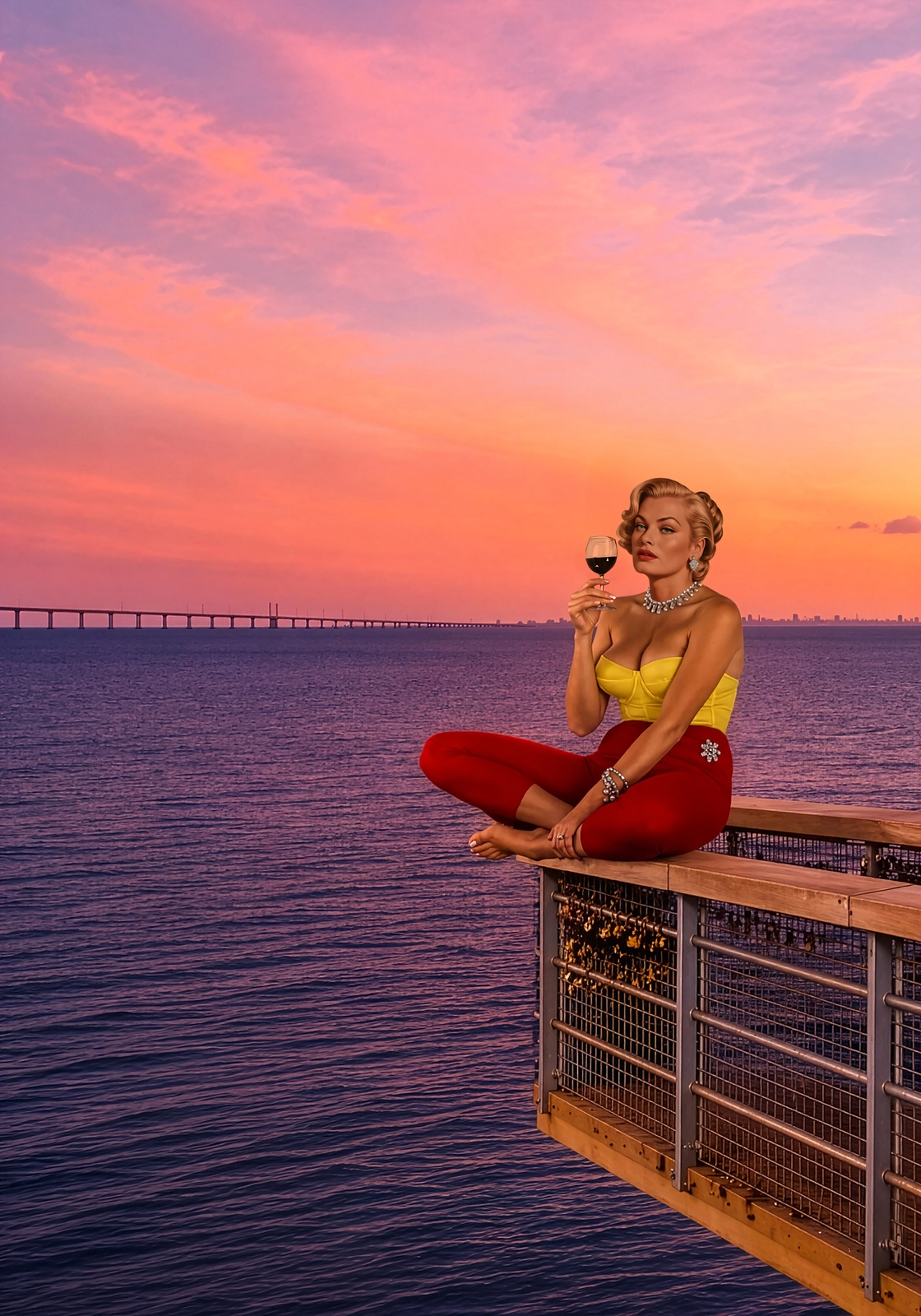
It begins with an image of Anita Ekberg sitting on the Titanic in Malmö.
There are stories so improbable that they become believable for exactly that reason. This is one of them.
It begins on a summer night in Malmö, at the very edge of the viewing platform in Västra Hamnen that locals call Titanic because it stretches out over the sea like the bow of a doomed ocean liner. The Øresund glitters beneath the twilight, Copenhagen flickers faintly in the distance, and the Turning Torso rises behind them like a white sail against the Nordic evening sky.
There sit Anita Ekberg and Marcello. Not as ghosts. Not as memories. And certainly not as old people. Time-travellers dislike words like dead. In eternity, consciousness merely changes horizon.
Between them stands a Tuscan picnic basket filled with Brunello wine, Parmesan, and olives while the warm Scandinavian night drifts slowly toward darkness. Around Anitas neck glitter diamonds once owned by Marilyn Monroe. Real diamonds. Dangerous diamonds. The sort of jewels capable of creating scandals even decades after the women themselves have supposedly vanished from Earth.
And perhaps that is what this story really is about. Not scandals themselves, but the strange machinery behind them.
The photographers hiding in Roman bushes like hunters waiting for prey. The carefully rehearsed accidents. The dresses that slipped almost but not quite far enough. The rumours that became more famous than the truth. The impossible burden of being desired by millions of strangers while still trying to remain human beneath the myth.
For years, the world saw Anita Ekberg as a fantasy: the blonde goddess in the Trevi Fountain, the voluptuous Swede who conquered Rome, the scandalous woman forever pursued by paparazzi flashes and male fantasies. But myths rarely tell the whole story.
Because behind the headlines stood a woman sharp enough to understand the game long before most men around her did. A woman who realised that fame was not merely something one suffered under it was something one could manipulate, redirect and weaponise.
Tonight, sitting above the black waters of the Øresund with wine in her hand and eternity behind her, Anita finally tells the stories about the five scandals herself.
The bow and arrow. The dress. The taxes. The fountain. Marilyns diamonds.
And somewhere between Malmö and Rome, between scandal and truth, between memory and myth, another portrait slowly emerges: Not merely Anita Ekberg the sex symbol. But Anita Ekberg is the survivor.
"Anitas Scandals
They said she drank too much champagne,
that Rome itself had lost its brain,
that blondes from Sweden brought disgrace
each time she smiled with a tilted face.
They said her dresses slipped too low,
that sinful things began to grow
whenever Anita crossed the square
with midnight perfume in her hair.
The priests declared the end was near,
the papers sold desire and fear,
while cameras flashed through Roman nights
like hungry wolves in neon lights.
One evening, tired of being chased,
she raised a bow with perfect taste.
The arrows flew, the men all ran
and thus the legend first began.
They called her wild. They called her vain.
They blamed her body, wine and fame.
But underneath the diamond glow
stood someone sharper than theyd know.
Anita learned what few men knew:
The myth was something one could use.
If all the world became a stage,
then scandal too could be a cage.
And yet the years moved silently,
as all bright storms must cross the sea.
The gowns grew still. The flashbulbs died.
Old Rome forgot the tears she cried.
But somewhere past the final shore,
where Time-travellers age no more,
she lifts her glass beneath the stars
while Malmö flickers from afar.
And out beyond the bridge at night,
where sea and heaven blur from sight,
the old scandals lose their sting
mere echoes now of glittering.
For history keeps what will survive:
not who was good, nor who contrived,
but those who briefly made the earth
feel larger than its daily worth.
Malmö, May 2026
The Lookout on Titanic - Utkiken på Titanic
PROLOGUE The Lookout on Titanic
It was one of those evenings when the sky above the Øresund looked as if someone had mixed strawberry ice cream, rosé wine and lavender into the thin, drifting clouds. At the furthest point on the viewing platform in Västra Hamnen the place Malmö residents call Titanic because it juts out over the sea like the bow of a doomed ocean liner sat Anita Ekberg, her bare feet resting on the warm wooden planks, a glass of wine in her hand. At the same time, the wind from the sound moved softly through her hair.
Marcello leaned against the railing and looked at her with an expression of half tenderness and half resignation.
This does not feel safe, he said. Historically, things tend to end badly whenever Anita Ekberg is placed at the very front of the Titanic.
I laughed and raised my glass in his direction.
Too late, I said. The iceberg usually arrives after the scandal. Besides, its summer.
He shook his head and gazed out over the water, where the Øresund Bridge stretched like a thin, glowing ribbon between Sweden and Denmark. Far away, Copenhagen blinked faintly in the evening haze, and behind us, Turning Torso rose like a white sculpture against the pink sky.
Between us stood an Italian picnic basket on the wooden planks. Not some touristy plastic container, but a real old-fashioned basket from Tuscany, with leather straps and a checked fabric lining. Marcello had insisted on carrying it all the way through Västra Hamnen, despite complaining like an Italian widower for most of the walk.
However, the contents justified the effort.
Thin slices of prosciutto di Parma lay rolled like silk ribbons beside pistachio mortadella, pecorino, olives, marinated artichokes and a dark, rustic bread that still smelt faintly of olive oil. There were small tomatoes, figs and a wedge of Parmesan so aged it almost crackled between your teeth.
And the wine. Two bottles of Brunello di Montalcino, Val di Suga 2018our favourite wine from Tuscany. For me, it was my first visit to Systembolaget. When I left Sweden for my modelling career, I was only eighteen, and back then, you had to be twenty-one to buy wine. On the occasions I returned to Sweden, someone else had always insisted on paying for the wine and therefore handling the purchase.
There had been a slightly embarrassing little scene at the liquor store when Marcello tried to pay. Being the gentleman he is, he insisted on buying the bottles himself. It no longer mattered financially, because we both used the same credit card anyway a VISA linked to a bottomless account at the Bank of England. All Time-travellers use the same arrangement, although the card numbers differ. I have absolutely no idea how it works, only that it does and that nobody above has ever received an invoice. A former French central bank governor apparently designed the entire system, and the money supposedly comes from something called The Slush Fund, where all of Earths fiscal accounting errors eventually end up, which means unimaginable sums.
In any case, the purchase fell to Marcello, though I appreciated the gesture. Unfortunately, it nearly collapsed into disaster. The cashier asked for identification. The legal age is eighteen, so she misjudged Marcello by seventy-four years. Since we can read thoughts, I immediately understood that the confused cashier believed he looked like a drug addict. Apparently, there is an internal blacklist for alcoholics.
No problem.
Marcellos Italian passport is absurdly fake, though just as untouchable as everything else produced above. One should remember that among the stars are also historys greatest forgers and swindlers.
On his passport, his name is Mario Rossi, which in Italy is the equivalent of Average Svensson in Sweden (in English, John Doe). No matter how thoroughly the cashier searched, he did not appear on any blacklists, and Marcello was allowed to pay for the bottles. Good for his masculinity. We laughed all the way back to the car.
It is perhaps worth commenting on the issue of alcohol and driving. Since a Time-traveller does not possess ordinary blood, we cannot become intoxicated, no matter how much we drink. Besides, we only breathe for appearances sake when visiting Earth. If the police stop us, a breathalyser always reads zero, no matter how hard we blow into it.
Do you know why I love Brunello? I asked while slowly swirling the glass so the evening light passed through the dark red wine.
Because its expensive?
No, I said. It tastes like history.
I looked down into the glass.
Imagine it, Marcello. Vineyards in Tuscany date back to 800 BC. Etruscans, Romans, monks, wars, plague, lovers, murderers, poets and people still cultivate the same hills.
He smiled.
You romanticise alcohol.
Of course. That is why Italians drink better wine than Americans do.
The wine carried notes of red flowers, strawberries and dark cherries, with that dry, almost dusty Sangiovese character that always made me think of hot Tuscan roads and late dinners that never quite wanted to end.
I still sat perched on the railing with my legs crossed, as if I did not care about the several metres down to the sea. And perhaps I did not. In eternity, certain fears disappear while others grow stronger.
My clothing had drawn several passers-by to cast discreet glances in our direction. I wore tight red capri trousers and a butter-yellow top that left my shoulders bare in the evening air. The colours were a tribute to Scania red and yellow, like the regional flag. The diamonds still glittered softly in the sunset: large earrings, a necklace catching the final golden rays, and a bracelet whose stones chimed lightly whenever I moved my hand around the glass.
The entire collection had come from Marilyn. After singing Diamonds Are a Girls Best Friend for much of her earthly life, she received one precious jewel after another from men hoping to buy their way beneath her sheets. The jewels ended up in a bank vault that her heirs knew nothing about. The first time Marilyn returned to Earth was at President Kennedys funeral, the year after she herself had left the world behind. She then retrieved the jewels, which filled an entire bag. One set she later bestowed upon me: necklace, earrings, a magnificent ring, a brooch and an additional ruby ring.
You still look like the start of an international incident, Marcello observed.
That is better than looking like the end of one.
A few young people farther away photographed the sunset without realising they were barely twenty metres from two film stars. Then again, in their eyes, we had long since passed our sell-by date. That was the beautiful thing about eternity. People almost always saw exactly what they expected. A beautiful, mature woman drinking wine on the Titanic in Västra Hamnen was entirely believable, but nothing that supposedly belonged in anyones bed any more. Anita Ekberg, together with Marcello, in the twilight between Sweden and Italy, was far harder to believe.
Idiots!
My breasts are just as firm today as they were when they filled cinema screens. And the rest has never posed any problems either. The thirty-five-year-old Avatar I chose for this visit was the same one that tempted men across Europe in the sixties.
What fools.
The wind strengthened slightly from almost nothing to something.
Further along Sundspromenaden, laughter from the restaurants and the sound of glasses clinking in the evening air came.
You know what is strange? I said after a while. People still believe my greatest scandals were about sex.
Werent they?
No, I answered calmly. They were about control.
I took a small piece of Parmesan and looked out over the sea again.
The bow and arrow were about control. The dress was about control. Even the tax scandal was about control. About who had the right to own Anita Ekberg.
Marcello picked up the bottle and refilled our glasses.
This, he said, nodding towards the sky, the sea and the wine, is approximately the most dangerous combination imaginable. Anita Ekberg, Brunello and Titanic.
You forgot the sunset.
That only makes the catastrophe more costly.
CHAPTER I The Bow and Arrow
You know what was strangest about the paparazzi in Rome? I said as the evening air from the Øresund drifted over Titanic Pier. It was not that they chased us. It was that, eventually, they began to live more dramatically than the people they photographed.
Marcello laughed quietly, then tore off a piece of bread.
That is true. I remember a photographer who divorced twice to improve his romantic reputation in the press.
Exactly. In the end, all of Via Veneto became like a travelling circus, with everybody performing roles for one another.
I still sat balanced on the railing, one foot tucked beneath me and the wine glass resting against my knee. The sky above the Øresund had darkened slightly. The pink slowly faded to blue-violet dusk, and down by the water, the lights along the promenade began to come on one by one.
But the bow and arrow, Marcello said. That was not theatre. You were genuinely furious that night.
Yes, I answered. I truly was.
He looked at me over the rim of his glass.
I have heard ten different versions.
Then I shall give you the eleventh. The true one.
The wind caught my hair again, and I looked out over the sound before continuing.
It had really begun long before the bow itself. People always imagine explosions happening suddenly, but they rarely do. They build slowly. Day after day. Flash after flash. Comment after comment.
Back then, photographers could stand outside Cinecittà from morning until night. They followed us on Vespas, hid behind café menus, crouched behind flower pots, and appeared outside restaurants before one had even ordered antipasti.
And the larger a star you became, the less human they considered you.
I looked down into the wine.
That is the price of myths, I said quietly. Eventually, people begin to believe they own part of you.
Marcello nodded slowly but said nothing.
He knew.
He, too, had been chased through Rome. Perhaps not as brutally, but enough to understand the mechanics. Cameras were hardly discreet in those days, with absurd half-metre telephoto lenses mounted on the front.
Penis extensions, I used to call them.
And in the fifties, there were still no ethical rules, no respectful distance, no security zonesonly hunger.
That evening they had followed me the entire day, I continued. First at the film set. Then outside the hairdresser. Then at the restaurant. Finally, all the way home.
I laughed briefly.
One of them even managed to photograph me as I dropped an orange.
An international catastrophe. And big headlines.
Exactly. ANITA LOSES CONTROL OF FRUIT.
Marcello laughed so hard he had to wipe tears from his eyes.
That genuinely could have become a headline.
Of course, Italians could turn even citrus fruits into opera.
But when I arrived home that night, I was finished. Completely finished.
Outside the villa, the photographers were already waiting among the trees. Cigarettes glowed in the darkness. The tyres were still hot from the chase through Rome. The instant the car stopped, flashes exploded against the windows.
Anita! Over here!
Anita! Smile!
Anita! One more!
One more.
Always one more.
I walked through the gates without answering, but inside the house, I boiled with rage. Not elegant, movie-star anger. Real Malmö anger. The kind of anger that smells of poison after somebody has finally had enough.
And there, conveniently enough, stood the bow and arrow.
A decorative prop from a film production. I believe the producer intended it to look Greek, though in reality it resembled something from a cheap Robin Hood performance in Folkets Park.
This, Marcello said, pointing at me with a piece of cheese, is the moment civilisation should have intervened.
Too late. The iceberg had already struck the hull.
I rose lightly onto the railing and balanced without thinking about the drop to the sea below.
I picked up the bow and went outside again.
You never thought: Anita, perhaps this is not legally optimal?
Marcello, I said dryly, no human being thinks legally when she is furious.
Now we both laughed.
But beneath the laughter, the memory remained.
I could still see the flashes before me, hear the shouting, and feel the Roman night itself tremble with heat and aggression.
They began laughing when they saw me, I said. At first, they thought it was a joke.
I made a small gesture with my hand as though still holding the bow.
Then I fired.
You never hit anyone.
Of course not. I was angry, not insane.
The first arrow buried itself in a wooden fence near the photographers. The second arrow flew over a car bonnet so closely that the men threw themselves aside as if war had suddenly returned to Italy.
And in the middle of it all stood me in an evening gown, blonde as a furious Nordic valkyrie as Rome screamed around me.
You know what was strangest? I asked.
No.
Afterwards, they respected me more.
Marcello smiled slowly.
Yes, he said. Rome worked that way.
CHAPTER II The Dress
Now we come to that story, Marcello said as he refilled our glasses, which half of Europe still believes was an accident.
Which one of them? I asked.
The fashionable dress.
I began laughing before he had finished the sentence.
Not that small, elegant laugh women learn at dinners in Beverly Hills. The real one. The kind that comes from the stomach when you remember something so absurd you can hardly believe it yourself any more.
The evening had grown darker. The final traces of pink still lingered far out above the Øresund, but around Västra Hamnen the restaurants had begun to glow in warm yellow and orange light. Turning Torso looked almost luminous against the sky, and down along the promenade, people wandered slowly past with ice creams, dogs and prams, entirely unaware that Anita Ekberg was currently confessing to international publicity fraud at the very edge of Titanic.
Marcello, I said, leaning back against the railing, nothing in Hollywood ever slipped by accident.
He nodded slowly.
That was what I suspected.
People still believe the glamorous world of the fifties operated spontaneously. That women woke up looking perfect and happened to lose their dresses in front of photographers.
You mean civilisation was actually built on safety pins and lies?
Exactly.
I picked an olive from the basket and carried on.
The whole thing really began when the studio wanted me to become more visible. Truly visible. Not merely present on cinema posters, but transformed into a conversation. A phenomenon. Something men discussed in bars and women gossiped about in front of mirrors, without fully admitting why.
And there I was, useful.
Because I had already understood something many actresses still had not: the camera did not love perfection. It loved disasters that still looked beautiful.
That, Marcello said, is almost a definition of the whole film industry.
Yes. Fellini understood it too.
The wind had calmed slightly. The sea beneath the Titanic lay darker and quieter, almost black-blue, while the lights of Copenhagen blinked faintly through the haze like another world.
A photographer I knew, I continued, approached me before a premiere and said something like: Do you know what would sell more newspapers than your film?
I think I can guess where this is going.
He said: If something goes wrong.
Marcello started laughing before I could continue.
It was actually rather innocent at first. A shoulder strap. A seam. Pulled just a little too tight. Enough to cause panic, but not catastrophe.
Controlled catastrophe.
Exactly.
I looked down toward the water and smiled faintly.
We even rehearsed my reaction.
You rehearsed it?
Of course. One cannot simply look shocked. One must look shocked properly.
He leaned back and shook his head.
This is the most Italian thing I have ever heard about Hollywood.
The most Italian aspect was the photographers. They understood perfectly well what was happening but pretended not to because they also earned money from the performance.
And then it happened.
Flashes. Shouting. People dropping drinks. Men stared as if civilisation itself had just collapsed before their eyes.
Armageddon, more or less.
The dress slipped.
Not much.
Exactly enough.
It is almost comical today, I said. Nowadays, people must undress completely online merely to make someone glance up for three seconds. In the fifties, it was enough for the world to believe a seam had burst. Though, admittedly, the neckline between my breasts slipped down a few centimetres enough to give one elderly photographer what appeared to be a mild heart attack.
You lived in more innocent times.
No, I answered calmly. We simply lived in better lighting.
Marcello laughed again and raised his glass toward me.
So there it is. The truth behind the great scandal.
Parts of it.
There is more?
I looked at him with a slight crooked smile.
Yes. There was something I did not understand at the time.
What?
I slowly let my finger follow the edge of the wine glass.
People were never truly upset about skin. They were upset because I appeared to be in control of the situation.
A moment of silence settled between us.
Along the quay, laughter came from a group of young people photographing one another at the edge of the Titanic. Someone played quiet music from a mobile phone, and farther away, a cyclist glided past like a dark shadow beside the sea.
That, Marcello said thoughtfully, is still true.
Yes, I replied. Men are often willing to forgive scandals, but they rarely forgive women who personally direct them.
By the way, he added. Did the photographer survive?
Fortunately, I never wanted my breasts to cause fatalities. None that I know of, anyway.
Marcello laughed.
So, technically, there may still be a few lives on your conscience.
He looked out over the sound.
So the dress was never really the main story.
No, I said with a faint smile. The real story was that a blonde girl from Malmö had understood how the whole machinery worked.
CHAPTER III Taxes
Now we arrive at the least erotic scandal in film history, Marcello said, slicing more pecorino with a small pocketknife he, for some reason, always seemed to carry. The tax authorities.
Never underestimate tax authorities, I replied. The Roman Empire was built by rulers who loved taxes and crucifixions.
By now, evening had become night at least as dark as Sweden ever gets in the first half of July. The Øresund lay still and heavy beneath Titanic Pier, and only the reflections from Copenhagen and the boats on the water moved slowly across the surface. Behind us, we could hear the restaurants filling with people. Laughter, clinking glasses and low music drifted on the weak wind from Västra Hamnen.
I drew my legs closer beneath me atop the railing and looked out towards the horizon.
Do you know what really provoked people most about me? I asked.
Marcello thought for a moment.
That you were beautiful?
No. There are always beautiful women.
That you were blonde?
That helped.
That you laughed too loudly?
Definitely.
He smiled.
So what was it then?
That looked expensive.
He began laughing immediately.
You mean like a sports car?
Exactly. People love looking at luxury as long as they believe they control it. But the moment they suspect the woman behind the jewels also earns money and makes her own decisions, the atmosphere becomes much less romantic.
I took a sip of Brunello.
Suddenly, newspapers began writing about me as though I were some Nordic barbarian invading Italy with furs, champagne and sports cars.
Which, Marcello added dryly, was not entirely untrue.
No, but still exaggerated.
In reality, the scandal was almost comically boring. Missing paperwork, misplaced tax declarations, clever lawyers, and money moved between countries and film companies until nobody could longer truly tell what had been taxed and what had not. Yet the press wrote about it as if I personally intended to plunder Italy of its final lire.
But the press never loved reality. It loved symbols.
And the symbol Anita Ekberg functioned perfectly.
The tall blonde from the North, living like a queen in Rome. The woman who ate late dinners on Via Veneto, drove sports cars through the night, and kissed men as though tomorrow might never arrive.
So when the tax scandal broke, I continued, the world had already written the role for me.
The dangerous woman.
Yes. Once people decide a woman is dangerous, even a wrongly completed form can be presented as a sign of international decadence.
Marcello shook his head as he refilled our glasses.
It is actually strange.
What?
Men in the film industry could gamble away fortunes, cheat in five countries at once, and occasionally smash hotel rooms to pieces. But if a woman had problems with her taxes, it was treated as a moral collapse.
Of course, I said. Men were allowed to be sinners. Women were expected to be half-witted sex symbols. A blonde fit the bill perfectly.
A weak breeze drifted in from the sea again, making the napkin over the picnic basket ripple softly. A few young people passed behind us, casting discreet glances in our direction. I saw one of the girls whisper something to her friend while staring at my jewellery.
She thinks Im some rich older woman from Limhamn, I said quietly. I can read her thoughts. If you werent here, Id probably be in trouble, my bodyguard.
You sound almost disappointed.
A little.
Marcello smiled.
You miss the scandals.
I considered that before answering.
No. I miss the intensity.
Silence settled between us for a while.
Somewhere in the darkness, a boat's horn echoed across the sound.
You see, I continued slowly, when you are young and famous, you live as if the world were permanently on fire. Every evening feels important. Every glance feels decisive. Every scandal feels like the end of something.
I looked down into the dark red wine.
And then one day you realise almost everything has passed. The headlines. The men. The photographs. The anger. All that remains are the stories.
Marcello looked at me for a long time without speaking.
Then he smiled faintly.
Yes, he said. But some stories survive longer than others.
I tilted my head into the evening wind and looked out over the Øresund, where the bridge's lights still glittered between Sweden and Denmark like a narrow band between two worlds. It looked like a diamond necklace.
Do you know what is ironic? I asked.
No.
That I was never particularly scandalous.
He raised an eyebrow.
Anita
No, listen. I drank wine, loved men, bought dresses, and screamed at photographers. If a man had done the same, he would have been called a bon vivant.
Marcello began laughing again.
So you mean your entire career was essentially one huge misunderstanding?
Exactly.
I raised my glass to him.
A toast to that.
He clinked his glass against mine.
A toast. And a toast to Titanic.
Why Titanic?
He looked out over the darkness beneath the pier, smiling his usual tired smile.
Because people keep dancing even when they suspect the iceberg is there.
CHAPTER IV The Fountain
The strange thing, Marcello said, leaning back against the wooden bench on Titanic and looking out over the dark water, is that the world still believes you and I spent the entire night in the Trevi Fountain.
Didnt we?
Anita, the water was freezing. No human being stays in there longer than necessary.
I laughed.
You see? There is another lie that became more beautiful than the truth.
The wind from the Øresund had turned cooler now. Somewhere behind us, music drifted from a restaurant near Dockan, and farther away, bicycle lights blinked along the promenade like fireflies. The Titanic was almost empty by now. Only an elderly couple stood farther out by the edge, looking toward the bridge, while the womans scarf fluttered in the wind.
But do you know what actually created the scandal around the Trevi Fountain scene? I continued. Not the dress. Not the water. Not even Fellini.
What was it then?
That the scene looked like freedom.
Marcello fell silent for a moment.
Yes, he said quietly. It really did.
I looked down into my wine glass, where the city lights moved dark red through the Brunello.
Today, people think La Dolce Vita was glamorous. But when the film appeared, many Italians experienced it almost as an attack on respectable Italy itself. Priests raged. Politicians raged. Newspapers raged. There was talk of moral collapse, decadence, and sin, as though Rome once again stood on the verge of a barbarian invasion.
And in the middle of it all stood I.
Wet. Blonde. And wearing a black dress that concealed very little above the waist.
Entirely unconcerned with what the men around me thought.
You must understand what Italy looked like back then, I said. It was still a country where many women were expected to move directly from the control of their family into the control of their husband. And then Fellini placed me in the middle of Rome like some erotic Nordic sea goddess who did not appear to obey anyone at all.
Marcello smiled crookedly.
You made Italians nervous.
Terrified.
I took another piece of Parmesan and continued.
The ironic part is that people still remember the scene as far more scandalous than it really was. Even today, many believe the dress slipped off in the fountain and that I stood there half naked before all of Rome.
Which never happened, Marcello said.
Never.
I pointed toward him with my glass.
The dress stayed exactly where it belonged throughout the entire filming. Federico would have gone insane if something like that had actually happened in the middle of a take. He was not interested in cheap scandals. He wanted to create dreams.
But the rumour survived.
Of course. And the rumour was almost as good as reality.
I smiled faintly.
The amusing part was that an actual wardrobe malfunction occurred much later, during an entirely different magazine photoshoot. But because people had already transformed the Trevi Fountain scene into some collective erotic fantasy, memories began blending. Eventually, people became completely convinced they had seen things that never existed.
That, Marcello said, is really film history in its purest form.
Yes. People do not remember what they saw. They remember what they felt when they saw it.
Below us, waves struck softly against the quay beneath the Titanic. Somewhere out in the darkness, a motorboat passed through the sound.
Do you know what happened the week after the premiere? I asked.
Chaos?
Chaos. Journalists everywhere. Priests preaching about sin. Men suddenly want to travel to Rome. Women are beginning to buy black evening gowns.
I laughed quietly.
And the photographers dear God, the photographers. After that film, they followed me as if I personally carried responsibility for the moral collapse of the Western world.
Didnt you?
Only partially.
He raised his glass toward me.
A toast to the downfall of civilisation.
A toast.
We drank.
For a while, we sat there silently looking out over the Øresund, where the bridge still glowed faintly between the countries like an illuminated line through the darkness.
The strange thing, I finally said, is that people still think the scene is about sex.
What is it about then?
I thought for a moment before answering.
Longing.
For what?
For the chance to step down into the water and become someone else for a while.
Marcello looked at me for a long time.
You know, he finally said, sometimes you sound almost like Fellini himself.
No, I answered with a smile toward the night lights over the sound. Federico still believed he was directing the film.
Behind us, several young people laughed loudly as they tried to photograph one another at the edge of the Titanic, their arms outstretched as if standing aboard a real ship.
I watched them and slowly shook my head.
People never learn.
What do you mean?
They still believe the dangerous thing is the iceberg.
Marcello smiled tiredly.
What is dangerous then?
I raised my glass toward the dark horizon.
The belief that there is no iceberg at all.
CHAPTER V Marilyns Diamonds
By the way, Marcello said, glancing down at the jewels around my neck as the wind made the diamonds flash in the restaurant lights behind us, that is still completely insane.
What is?
Marilyn Monroe gave some of her jewels to Anita Ekberg of Malmö. It happened in 1963, after Kennedys funeral, and it would have become an international scandal if anyone had discovered it. I would probably have been accused of drugging her and of participating in the alleged murder with the Kennedy brothers. The diamonds would have been presented as my payment, unknown to everyone else.
How did it happen? She had already left Earth the previous year, hadnt she? Marcello asked sceptically.
Yes. What do you think I thought when a strange messenger appeared, dressed in a green uniform with gold details everywhere and wearing a peaked cap so elaborate it looked almost theatrical? Nowadays, I know it was Eternal Delivery or simply Eternal, as it says on their badge. Back then, I was one enormous question mark. The courier had such a smooth face and so little personality that it would have been impossible to describe him afterwards. He merely informed me that this was a posthumous gift from Marilyn Monroe.
She has admired you for a long time, the personality-less man had said.
I signed for the package, and as I curiously opened the box, he somehow vanished almost dissolving into thin air. Naturally, I was shocked when I unpacked the contents. I am hardly an expert, but even I knew these were not pieces of glass mounted in gold. There was a handkerchief embroidered with Marilyns initials, still carrying the scent of Chanel No. 5, her favourite perfume. And mine. We had both publicly said we usually slept in only two drops of French perfume. We were somehow sisters, even though we weren't close friends at the time. We met for the first time during a so-called line-up at Queen Elizabeth's at Buckingham Palace. Two scandalous blondes who got to kiss the Queen's hand. But back to the jewellery. What was I supposed to do? Jewellery, obviously worth a fortune, from a dead film star. I hid them as quickly as possible.
I smiled, letting my fingers brush the necklace.
It sounds like the beginning of a terrible crime novel.
Or a very expensive lawsuit. In the worst case, a murder trial. Anything is possible in America, and a blonde woman from Sweden has absolutely no credibility, especially one making films in Italy. If the jewels really belonged to Marilyn, how could I possibly explain how they ended up in my possession?
That would indeed have been difficult.
Besides, I was hardly drowning in money. Not even after our films success.
I understand that perfectly.
It was not especially smart of Marilyn. Very sweet, but not very bright. So the jewels ended up hidden in another bank vault. It was only after I met Giovanni that I could finally wear them, because everyone assumed he had given them to me.
Brilliant, Marcello said, impressed.
Actually, it greatly improved my standing with Giovanni. A woman who had received jewels like those from another man was clearly someone to be feared, or so he probably thought. He never asked, and I never explained. Later, the three of us Marilyn, Giovanni and I laughed about the whole thing on his star, which he called Fiat Nova.
Titanic now lay almost completely dark, except for a few scattered people at the edge. The sea beneath us had turned black and glossy as oil, and the Øresund Bridge glowed in the distance like a ribbon of light linking worlds.
You know what was strange about Marilyn? I continued. She was much funnier than people imagined.
Everyone who truly knew her says that.
Because it is true. People always remember the tragedy first, the person second.
I took another sip of wine.
Marilyn could imitate people better than any comedian I ever met. Producers, presidents, actors, journalists. She could stand in the middle of a dinner party and suddenly begin imitating how a senator ate asparagus.
Marcello laughed.
I would have paid to see that.
Everyone wanted to see her. That was the problem.
A gust of wind ruffled my hair again, and I looked out over the sound before continuing.
When Marilyn left Earth for eternity, her jewels remained down here among people who did not even know exactly what she owned. Bank vaults, lawyers, relatives and missing inventory lists. Chaos, essentially. The ordinary human chaos that occurs whenever somebody becomes larger in memory than in life itself.
The first time she returned from eternity, I said quietly, was at Kennedys funeral.
Marcello nodded slowly.
That sounds like her.
Yes. She said she wanted to see whether the men still looked guilty.
He burst out laughing again.
Did they?
Absolutely.
I looked down at the bracelet, glittering around my wrist.
After the funeral, she retrieved part of the jewellery. Not to sell it. Not even to wear it, really. She wanted it to belong to her again, not to a bank vault.
I understand that.
Then she brought the whole collection back to her star, except for the pieces she gave me.
Marcello looked up.
Like a queen?
No, I said. Like someone who understood that one can wear only a few jewels at a time. And something I did not yet know then: it is impossible to outshine a star.
We in eternity dislike speaking about death, Marcello reminded me. The word feels almost indecent up there, as if people on Earth still use it because they have not yet understood that consciousness merely changes horizons.
When I had only just arrived in eternity and missed my dog more than anything, I was almost inconsolable. Then Marilyn appeared on my stage, carrying a diamond ring with an enormous ruby, to make me laugh again. She also confessed she had admired me from afar for decades and that was why she had given me the other jewels. I told her how terrified I had been to wear them until Giovanni entered my life. We laughed together. She apologised for her thoughtlessness, but I told her it was the intention that mattered. As you know, we are very close friends now, and she was here in Malmö with me not long ago.
A few young people passed behind us, and one of the girls discreetly glanced again at the jewels around my neck. I smiled to myself.
Do you know what Marilyn said when she gave me this set?
No.
I laughed quietly.
She said: Anita, diamonds are absolutely not a girls best friend. But they make excellent revenge on gloomy people.
Marcello laughed so hard he nearly spilt wine over the picnic basket.
That sounds exactly like her.
Yes.
For a while, we sat in silence as the sea moved rhythmically against the quay beneath Titanic.
People misunderstood her, too, I said eventually. Just as they misunderstood me.
In what way?
They believed sexuality and intelligence contradicted one another.
I looked out over the dark water.
If a woman was beautiful, people automatically assumed she must also be stupid, tragic or manipulated. Marilyn was trapped in that idea almost her entire life.
Marcello nodded thoughtfully.
She played the blonde so convincingly that the world eventually believed the role was real.
Exactly.
I smiled faintly.
The irony is that truly intelligent women sometimes use mens underestimation as camouflage. Marilyn knew that. I knew that. But men rarely notice such things until much later, if ever.
Or never.
Or never.
Far out over the Øresund, a ship moved slowly through the darkness, its lanterns glowing against the night.
Marcello followed it with his eyes.
You know, he said, this entire evening feels like the start of yet another scandal.
Why?
He gestured towards me, the wine, the diamonds and the Titanic itself.
Anita Ekberg in red Capri trousers on Titanic Pier, wearing Marilyn Monroes jewels while drinking Brunello, with access to a bottomless Bank of England account. If the media heard this, they would faint with joy.
Too late, I said, raising my glass to him. We already belong to eternity.
He smiled tiredly.
That has never stopped journalists.
EPILOGUE Titanic at Night
Marcello looked out over the Øresund, where the lights of Copenhagen shivered far away in the night haze.
Do you know what I think? he said in a quiet voice.
No.
I think people never really cared about the scandals.
What did they love then?
He looked at me for a long moment before replying.
That you made the world feel larger than their everyday lives.
Silence settled between us again.
Behind us, the sounds of restaurants closing for the night drifted in. Waiters stacked chairs. Glasses were cleared away. Someone laughed too loudly in the darkness, but the sound then vanished with the wind.
At the very edge of the Titanic, a few people still stood, photographing the darkness where the sea and sky merged.
I rested my head against Marcellos shoulder.
The strange thing, I said, is that it all once felt like life or death.
Yes, he answered. And now?
I looked out over Malmö.
Turning Torso shimmered like a solitary sail in the night, while the Øresund Bridge lay motionless across the darkness like a pier between worlds.
Now it mostly feels like stories.
Marcello smiled.
Good stories.
I raised my glass one final time towards the sea, and we stepped into the car.
A toast to Titanic.
A toast.
And out towards the horizon, the Øresund continued to glitter as though icebergs had never existed at all.
PROLOG - Utkiken på Titanic
Det var en sådan kväll då himlen över Öresund såg ut som om någon hade blandat jordgubbsglass, rosévin och lavendel med slöjmolnen. Längst ute på utsiktsplattformen i Västra Hamnen platsen Malmöborna kallar Titanic därför att den sticker ut över havet som fören på ett öderdigert fartyg satt Anita Ekberg med bara fötter på det varma träet och ett vinglas i handen medan vinden från sundet drog genom hennes hår.
Marcello stod lutad mot räcket och såg på henne med ett uttryck som var hälften ömhet och hälften uppgivenhet.
Det här känns inte tryggt, sa han. Historiskt sett brukar det gå illa när man placerar Anita Ekberg längst fram på Titanic.
Jag skrattade och höjde glaset mot honom.
För sent, sa jag. Isberget brukar alltid komma efter skandalen. Och dessutom är det sommar.
Han skakade på huvudet och såg ut över vattnet där Öresundsbron låg som ett tunt band mellan Sverige och Danmark. Långt borta blinkade Köpenhamn svagt i kvällsdiset, och bakom oss reste sig Turning Torso som en vit skulptur mot den rosa himlen.
Mellan oss stod en italiensk picknickkorg uppställd på träplankorna. Inte någon turistisk plastlåda utan en riktig gammaldags korg från Toscana med läderremmar och rutigt tyg invändigt. Marcello hade envisats med att bära hela vägen genom Västra Hamnen trots att han hade klagat som en italiensk änkling under större delen av promenaden.
Innehållet var däremot värt besväret.
Tunna skivor prosciutto di Parma, låg hoprullade som sidenband, bredvid mortadella med pistage, pecorino, oliver, marinerade kronärtskockor och ett mörkt lantbröd som fortfarande doftade av olivolja. Där fanns också små tomater, fikon och ett stycke parmesan som var så lagrad att den nästan knastrade mellan tänderna.
Och vinet. Två flaskor Brunello di Montalcino, Val di Suga 2018. Vårt favoritvin från Toscana. För mig var det första besöket på Systembolaget någonsin. När jag lämnade Sverige för min modellkarriär var jag bara arton och på den tiden måste man vara 21 för att få köpa vin. Vid de tillfällen jag har varit tillbaka i Sverige har alltid någon annan insisterat på att få bjuda på vinet och därmed stå för inköpet. Det hände ett lite pisamt intermezzo på Systemet när Marcello skulle betala. Som den gentleman han är insisterade han på att få stå för inköpet. Nu spelar det ingen roll eftersom vi använder samma betalkort, ett VISA kopplat till ett bottenlöst konto på Bank of England. Alla Time-travellers använder samma, även om kortnumren skiljer sig åt. Jag har ingen aning om hur det fungerar, bara att det fungerar och att ingen ovan någonsin har fått någon avräkning. Konstruktionen står en före detta fransk riksbankschef för, och tydligen kommer pengarna från något som kallas Slasken. Där hamnar all jordens felräkningspengar på fiskal nivå, gigantiska summor med andra ord.
I vilket fall drabbade alltså inköpet Marcello, men gesten uppskattade jag. Nu höll det på att gå åt skogen. Kassörskan frågade efter legitimation. Åldergränsen är 18, så personen i kassan missade med 74 år. Eftersom vi praktiskt nog kan läsa tankar förstod jag att den förvirrade kassörskan tyckte att Marcello liknade en pundare. Tydligen finns det en spärrlista för alkisar. Inga problem! Marcellos italienska pass är hur falskt som helst, men lika oantastligt som allt annat vi producerar ovan. Betänk att bland stjärnorna finns historiens samlade förfalskare och skojare.
Han heter Mario Rossi i passet, vilket i Italien är detsamma som Medelsvensson i Sverige. Hur kassörskan än letade fanns han inte på någon spärrlista, så Marcello kunde betala för flaskorna. Bra för hans manlighet. Vi skrattade gott hela vägen till bilen.
Det är kanske värt att kommentera det där med alkohol och bilkörning. Eftersom en Time-traveller inte har vanligt blod i ådrorna kan vi inte bli berusade, oavsett hur mycket vi häller i oss. Dessutom andas vi bara för syns skull när vi är på jorden. Skulle vi bli stoppade av polisen visar en alkometer alltid noll hur vi än blåser.
Vet du varför jag älskar Brunello? frågade jag medan jag långsamt snurrade glaset så att kvällsljuset gick genom det mörkröda vinet.
Därför att det är dyrt?
Nej, sa jag. Därför att det smakar historia.
Jag såg ner i glaset.
Tänk dig det, Marcello. Vinodlingar i Toscana redan åttahundra år före Kristus. Etrusker, romare, munkar, krig, pest, älskare, mördare, poeter och ändå fortsätter människor att odla samma kullar.
Han log.
Du romantiserar alkohol.
Naturligtvis. Det är därför italienarna dricker bättre vin än amerikanerna.
Vinet doftade röda blommor, jordgubbar och mörka körsbär, med den där torra nästan dammiga tonen av Sangiovese som alltid fick mig att tänka på heta vägar genom Toscana och sena middagar som aldrig riktigt ville ta slut.
Jag satt fortfarande uppe på räcket, med benen korsade, som om jag inte alls brydde mig om att det var flera meter ner till havet. Och kanske gjorde jag inte det heller. I evigheten försvinner en del rädslor medan andra blir starkare.
Min klädsel hade fått flera förbipasserande att kasta diskreta blickar åt vårt håll. Jag bar åtsittande röda capribyxor och en smörgul topp som lämnade axlarna bara mot kvällsluften. Färgerna var en hyllning till Skåne, rött och gult som i flaggan. Diamantsmyckena glittrade fortfarande lätt i solnedgången stora örhängen, ett halsband som fångade de sista gyllene strålarna och ett armband där diamanterna klirrade härligt när jag rörde handen kring glaset.
Hela konkarongen hade jag fått av Marilyn, som efter att ha sjungit in Diamonds are a girls best friend så länge hon levde fick ta emot det ena dyrbara smycket efter det andra av män som ville köpa sig in under täcket hos henne. Smyckena låg i ett bankfack som arvingarna inte hade koll på. Första gången Marilyn kom tillbaka till jorden var vid president Kennedys begravning året efter att hon själv lämnat jorden. Då fiskade hon upp smyckena, som fyllde en bag. Ett set har hon förärat mig: halsband, örhängen, en saftig ring, en brosch och en extra rubinring.
Du ser fortfarande ut som början på en internationell incident, konstaterade Marcello.
Det är bättre än att se ut som slutet på en.
Några ungdomar längre bort fotograferade solnedgången utan att förstå att de bara satt tjugo meter från två filmstjärnor. Nåja, i deras ögon hade vi sedan länge passerat vårt bäst-före-datum. Det var det fina med evigheten. Folk såg nästan alltid det de förväntade sig att se. En vacker mogen kvinna med vin på Titanic i Västra Hamnen var fullt rimlig, men inget som längre dög i sängen. Anita Ekberg tillsammans med Marcello i skymningen mellan Sverige och Italien var betydligt svårare att tro på. Vilka idioter! Mina bröst är lika fasta idag som någonsin när de fyllde filmdukarna. Och med resten har det aldrig varit några problem. Den trettiofemåriga gestalten jag har valt att resa som den här gången var den som jagade karlarna på 60-talet. Vilka torskar!
Vinden tilltog något. Från nästan ingenting till någonting.
Borta vid Sundspromenaden hördes skratt från restaurangerna och ljudet av glas som möttes i kvällsluften.
Du vet vad som är märkligt? sa jag efter en stund. Människor tror fortfarande att mina största skandaler handlade om sex.
Gjorde de inte det?
Nej, svarade jag lugnt. Det handlade om kontroll.
Jag tog en liten bit parmesan och såg ut över havet igen.
Pilbågen handlade om kontroll. Klänningen handlade om kontroll. Till och med handlade skattehistorien egentligen om kontroll. Om vem som hade rätt att äga Anita Ekberg.
Marcello tog upp flaskan och fyllde våra glas igen.
Det här, sa han och nickade mot himlen, havet och vinet, är ungefär den farligaste möjliga kombinationen. Anita Ekberg, Brunello och Titanic.
Du glömde solnedgången.
Den gör bara katastrofen dyrare.
KAPITEL I - Pilbågen
Du vet vad som var det märkligaste med paparazzifotograferna i Rom? sa jag medan kvällsluften från Öresund drog in över Titanicbryggan. Det var inte att de förföljde oss. Det var att de till slut började leva mer dramatiskt än människorna de fotograferade.
Marcello skrattade lågt och bröt av en bit bröd.
Det där är sant. Jag minns en fotograf som skilde sig två gånger bara för att få bättre kontaktannonser i pressen.
Exakt. Till slut blev hela Via Veneto som ett kringresande cirkussällskap där alla spelade roller för varandra.
Jag satt fortfarande uppe på räcket med ena foten under mig och vinglaset vilande mot knät. Himlen över Öresund hade mörknat något nu. Det rosa höll långsamt på att glida över i blåviolett skymning och nere vid havet började lamporna längs promenaden tändas en efter en.
Men pilbågen, sa Marcello. Det där var inte teater. Du var verkligen rasande den kvällen.
Ja, svarade jag. Det var jag faktiskt.
Han såg på mig över glasets kant.
Jag har hört tio olika versioner.
Då skall du få den elfte. Den sanna.
Vinden tog tag i håret igen och jag såg ut över sundet innan jag fortsatte.
Det började egentligen långt tidigare än själva pilbågen. Folk tror alltid att explosioner uppstår plötsligt, men det är nästan aldrig så. De byggs upp långsamt. Dag efter dag. Blixt efter blixt. Kommentar efter kommentar.
På den tiden kunde fotograferna stå utanför Cinecittà från morgon till kväll. De följde efter oss på Vespor, gömde sig bakom cafémenyer, låg på huk bakom blomkrukor och dök upp utanför restauranger innan man ens hunnit beställa antipasti.
Och ju större stjärna du blev, desto mindre människa ansåg de att du var.
Jag såg ner i vinet.
Det där är priset för myter, sa jag tyst. Till slut tror folk att de äger en del av dig.
Marcello nickade långsamt men sa inget.
Han visste.
Han hade också blivit jagad genom Rom. Inte lika brutalt kanske, men tillräckligt för att förstå mekanismen. Kamerorna var inte särskilt diskreta på den tiden, med ett halvmeters teleobjektiv framtill. Penisförlängare, kallade jag dem. Och på femtiotalet fanns det ännu inga etiska regler. Ingen respektfull distans. Ingen säkerhetszon. Bara hunger.
Den kvällen hade de följt efter mig hela dagen, fortsatte jag. Först vid inspelningen. Sedan utanför frisören. Sedan vid restaurangen. Till sist hela vägen hem.
Jag skrattade kort.
En av dem lyckades till och med fotografera mig när jag tappade en apelsin.
En internationell katastrof.
Precis. ANITA LOSES CONTROL OF FRUIT.
Marcello började skratta så hårt att han fick torka bort tårarna.
Det där hade faktiskt blivit en rubrik.
Naturligtvis. Italienarna kunde göra opera även av citrusfrukter.
Men när jag kom hem den kvällen var jag färdig. Helt färdig.
Utanför villan stod fotograferna redan och väntade bland träden. Cigaretter glödde i mörkret. Däcken var fortfarande glödheta efter jakten genom Rom. Så fort bilen stannade började blixtarna smattra mot rutorna.
Anita! Over here!
Anita! Smile!
Anita! One more!
En gång till.
Alltid en gång till.
Jag gick in genom grindarna utan att svara, men inne i huset kokade jag. Inte elegant filmstjärneilska heller. Riktig Malmöilska. Den sorts ilska som luktar etter efter någon som fått nog.
Där inne stod påpassligt pilbågen.
En dekorativ sak från en filmproduktion. Jag tror att producenten hade tänkt att den skulle se grekisk ut, men egentligen såg den mest ut som något från en billig Robin Hood-föreställning i Folkets Park.
Det här, sa Marcello och pekade med ostbiten mot mig, är ögonblicket då civilisationen borde ha ingripit.
För sent. Isberget hade redan träffat skrovet.
Jag reste mig lätt på räcket och balanserade utan att tänka på höjden ner mot havet.
Jag tog pilbågen och gick ut igen.
Du tänkte aldrig: Anita, det här är kanske inte juridiskt optimalt?
Marcello, sa jag torrt, ingen människa tänker juridiskt när hon är förbannad.
Nu skrattade vi båda.
Men under skrattet låg minnet fortfarande kvar.
Jag kunde fortfarande se blixtarna framför mig. Höra ropen. Känna hur natten i Rom nästan darrade av hetta och aggression.
De började skratta när de såg mig, sa jag. Först trodde de att det var ett skämt.
Jag gjorde en liten rörelse med handen som om jag fortfarande höll bågen.
Sedan sköt jag.
Du träffade aldrig någon.
Naturligtvis inte. Jag var arg, inte galen.
Den första pilen slog in i ett trästaket nära fotograferna. Den andra ven över en bilmotorhuv så nära att männen kastade sig åt sidan som om kriget plötsligt kommit tillbaka till Italien.
Och mitt i allt stod jag i aftonklänning, blond som en förbannad nordisk valkyria, medan Rom skrek omkring mig.
Vet du vad det märkligaste var? frågade jag.
Nej.
Efteråt respekterade de mig mer.
Marcello log långsamt.
Ja, sa han. Rom fungerade så.
Borta vid Sundspromenaden började någon spela musik från en liten högtalare. Ett ungt par längre bort tog bilder ute vid kanten av Titanic och försökte fånga solnedgångens sista ljus innan det försvann helt.
Jag såg på dem en stund.
Det ironiska, sa jag, är att folk fortfarande tror att pilbågen var skandalen.
Vad var skandalen då?
Jag tog upp glaset igen.
Att en kvinna plötsligt slutade vara rädd.
KAPITEL II - Klänningen
Nu kommer vi till den där historien, sa Marcello och fyllde våra glas igen, som halva Europa fortfarande tror var en olycka.
Vilken av dem? frågade jag.
Klänningen.
Jag började skratta redan innan han hann säga ordet färdigt.
Inte det där lilla eleganta skrattet som kvinnor lär sig på middagar i Beverly Hills. Utan det riktiga skrattet. Det som kommer från magen när man tänker tillbaka på något så absurt att man nästan inte längre tror på det själv.
Kvällen hade blivit mörkare nu. Det sista rosa ljuset låg fortfarande kvar långt ute över Öresund, men runt Västra Hamnen började restaurangerna glöda i varmt gult och orange. Turning Torso såg nästan självlysande ut mot himlen och nere vid strandpromenaden gick människor långsamt förbi med glassar, hundar och barnvagnar utan att ana att Anita Ekberg just satt och erkände internationella publicitetsbedrägerier längst ute på Titanic.
Marcello, sa jag och lutade mig tillbaka mot räcket, ingenting i Hollywood råkade spricka.
Han nickade långsamt.
Det var ungefär vad jag misstänkte.
Folk tror fortfarande att femtiotalets glamourvärld fungerade spontant. Att kvinnor bara råkade vakna upp med perfekt hår och råkade tappa klänningar framför fotografer.
Du menar att civilisationen i själva verket byggdes av säkerhetsnålar och lögner?
Exakt.
Jag tog en oliv från korgen och fortsatte.
Det hela började egentligen med att studion ville att jag skulle synas mer. På riktigt menar jag. Inte bara finnas på bioaffischer utan bli ett samtalsämne. Ett fenomen. Något som män diskuterade på barer och kvinnor sladdrade om framför spegeln utan att riktigt vilja erkänna varför.
Och där var jag användbar.
För jag hade redan förstått något som många andra skådespelerskor ännu inte hade förstått: kameran älskade inte perfektion. Den älskar katastrofer som fortfarande såg vackra ut.
Det där, sa Marcello, är nästan en definition av hela filmindustrin.
Ja. Fellini förstod det också.
Vinden hade mojnat något nu. Havet nedanför Titanic låg mörkare och lugnare, nästan svartblått, medan ljusen från Köpenhamn blinkade långt ute i diset som en annan värld.
En fotograf jag kände, fortsatte jag, kom fram till mig innan en premiär och sa ungefär: Vet du vad som skulle sälja fler tidningar än din film?
Jag börjar ana vart detta leder.
Han sa: Om något går fel.
Marcello började skratta redan innan jag hann fortsätta.
Det var faktiskt ganska oskyldigt från början. Ett axelband. En söm. Lite för hårt dragen. Precis tillräckligt för att skapa panik, men inte en katastrof.
Kontrollerad katastrof.
Precis.
Jag såg ner mot vattnet och log svagt.
Vi repeterade till och med hur jag skulle reagera.
Ni repeterade?
Naturligtvis. Man kan inte bara se chockad ut. Man måste se chockad ut på rätt sätt.
Han lutade sig bakåt och skakade på huvudet.
Det här är det mest italienska jag någonsin hört om Hollywood.
Det mest italienska var faktiskt fotograferna. De förstod exakt vad som pågick, men låtsades inte göra det eftersom de också tjänade pengar på föreställningen.
Och så hände det.
Blixtar. Rop. Folk som tappade drinkar. Män som stirrade som om civilisationen just kollapsat framför deras ögon. Armageddon typ.
Klänningen gled.
Inte mycket.
Precis lagom.
Det är nästan komiskt idag, sa jag. Numera måste människor klä av sig fullständigt på internet bara för att någon ska lyfta blicken i tre sekunder. På femtiotalet räckte det att världen trodde att en söm spruckit. Men ok, glipan mellan brösten halkade ner några centimeter, nog för att en äldre fotograf fick hjärtstillestånd.
Ni levde i mer oskyldiga tider.
Nej, svarade jag lugnt. Vi levde bara i bättre ljussättning.
Marcello skrattade igen och höjde glaset mot mig.
Så där är den alltså. Sanningen bakom den stora skandalen.
Delar av den.
Det finns mer?
Jag såg på honom med ett litet snett leende.
Ja. Det fanns något jag inte förstod då.
Vad?
Jag lät fingret långsamt följa kanten på vinglaset.
Att människor egentligen inte blev upprörda över huden. De blev upprörda över att jag verkade ha kontroll över situationen.
Det blev tyst mellan oss en stund.
Nere på kajen hördes skratt från några ungdomar som fotograferade varandra ute vid kanten av Titanic. Någon spelade låg musik från en mobiltelefon och längre bort gled en cyklist förbi som en mörk skugga mot havet.
Det där, sa Marcello eftertänksamt, är fortfarande sant.
Ja, svarade jag. Män förlåter gärna skandaler. Men de förlåter sällan kvinnor som regisserar dem själva.
Förresten. Överlevde fotografen?
Som tur var. Jag ville inte att min byst skulle orsaka olyckor. Inte som jag fick kännedom om i vart fall.
Marcello skrattade. Så tekniskt sett kan du ha några liv på ditt samvete. Han såg ut över sundet.
Så egentligen var klänningen aldrig huvudhistorien.
Nej, sa jag och log svagt. Huvudhistorien var att en blond flicka från Malmö hade förstått hur hela maskineriet fungerade.
KAPITEL III
Skatten
Nu kommer vi till den minst erotiska skandalen i filmhistorien, sa Marcello medan han skar upp mer pecorino med en liten fickkniv som han av någon anledning alltid verkade bära med sig. Skatteverket.
Underskatta aldrig skattemyndigheter, svarade jag. Romarriket byggdes av härskare som älskade skatter och korsfästelser.
Kvällen hade nu blivit natt, så mörkt det blir i Sverige under den första hälften av juli. Öresund låg stilla och tungt nedanför Titanicbryggan och bara ljusreflexerna från Köpenhamn och båtarna ute på vattnet rörde sig långsamt över ytan. Bakom oss hörde vi att restaurangerna fylldes av människor. Skratt, glas och låg musik drev med den svaga vinden från Västra Hamnen.
Jag drog benen tätare under mig uppe på räcket och såg ut över horisonten.
Vet du vad som egentligen provocerade människor mest med mig? frågade jag.
Marcello tänkte efter.
Att du var vacker?
Nej. Det finns alltid vackra kvinnor.
Att du var blond?
Det hjälpte.
Att du skrattade för högt?
Definitivt.
Han log.
Så vad var det då?
Att jag såg dyr ut.
Han började skratta direkt.
Du menar som en sportbil?
Precis. Och människor älskar att titta på lyx så länge de själva tror att de har kontroll över den. Men så fort de misstänker att kvinnan bakom juvelerna faktiskt också tjänar pengar och bestämmer själv, blir stämningen snabbt mindre romantisk.
Jag tog en klunk Brunello.
Plötsligt började tidningarna skriva om mig som om jag vore någon sorts nordisk barbar som invaderat Italien med pälsar, champagne och sportbilar.
Vilket, inflikade Marcello torrt, inte var helt osant.
Nej, men ändå överdrivet.
I verkligheten var skandalen nästan komiskt tråkig. Missade papper, förkomna deklarationer, smarta advokater och pengar som flyttats mellan olika länder och filmbolag tills ingen längre riktigt visste vad som beskattats var. Men pressen skrev om det som om jag personligen försökte plundra Italien på dess sista lire.
Men pressen älskade inte verkligheten. Pressen älskade symboler.
Och symbolen Anita Ekberg fungerade perfekt.
Den stora blondinen från Norden som levde som en drottning i Rom. Kvinnan som åt sena middagar på Via Veneto, körde sportbil genom natten och kysste män som om morgondagen kanske inte existerade.
Så när skattehistorien kom, fortsatte jag, hade världen redan skrivit rollen åt mig.
Den farliga kvinnan.
Ja. Och när människor väl bestämt sig för att en kvinna är farlig kan till och med en felifylld blankett framställas som internationell dekadens.
Marcello skakade på huvudet medan han fyllde våra glas igen.
Det är egentligen märkligt.
Vad?
Män i filmvärlden kunde spela bort förmögenheter, vara otrogna i fem länder samtidigt och ibland bokstavligen slå sönder hotellrum. Men om en kvinna hade problem med deklarationen blev det moralisk undergång.
Naturligtvis, sa jag. Män fick vara syndare. Kvinnor förväntades vara halvkorkade sexsymboler. En blondin passar perfekt.
En svag vind drog in från havet igen och fick servetten över picknickkorgen att röra sig lätt. Några ungdomar passerade bakom oss och kastade diskreta blickar åt vårt håll. Jag såg hur en av flickorna viskade något till sin väninna och sneglade på mina smycken.
Hon tror att jag är någon rik tant från Limhamn, sa jag lågt. Jag läser hennes tankar. Hade du inte varit med, hade jag legat pyrt till, min bodyguard.
Du låter nästan besviken.
Lite.
Marcello log.
Du saknar skandalerna.
Jag tänkte efter innan jag svarade.
Ne
Jörgen Thornberg
The Lookout on Titanic - Utkiken på Titanic, 2026
Digital
50 x 70 cm
3 200 kr
The Lookout on Titanic - Utkiken på Titanic
Svensk text på slutet
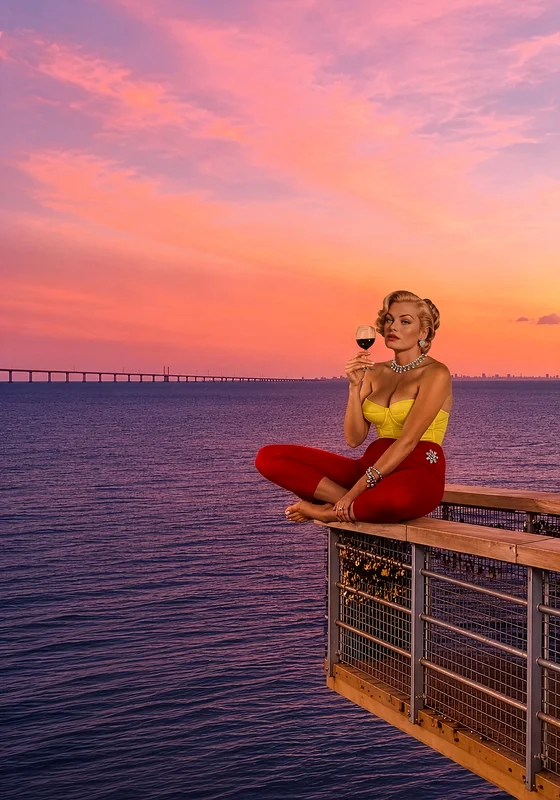
It begins with an image of Anita Ekberg sitting on the Titanic in Malmö.
There are stories so improbable that they become believable for exactly that reason. This is one of them.
It begins on a summer night in Malmö, at the very edge of the viewing platform in Västra Hamnen that locals call Titanic because it stretches out over the sea like the bow of a doomed ocean liner. The Øresund glitters beneath the twilight, Copenhagen flickers faintly in the distance, and the Turning Torso rises behind them like a white sail against the Nordic evening sky.
There sit Anita Ekberg and Marcello. Not as ghosts. Not as memories. And certainly not as old people. Time-travellers dislike words like dead. In eternity, consciousness merely changes horizon.
Between them stands a Tuscan picnic basket filled with Brunello wine, Parmesan, and olives while the warm Scandinavian night drifts slowly toward darkness. Around Anitas neck glitter diamonds once owned by Marilyn Monroe. Real diamonds. Dangerous diamonds. The sort of jewels capable of creating scandals even decades after the women themselves have supposedly vanished from Earth.
And perhaps that is what this story really is about. Not scandals themselves, but the strange machinery behind them.
The photographers hiding in Roman bushes like hunters waiting for prey. The carefully rehearsed accidents. The dresses that slipped almost but not quite far enough. The rumours that became more famous than the truth. The impossible burden of being desired by millions of strangers while still trying to remain human beneath the myth.
For years, the world saw Anita Ekberg as a fantasy: the blonde goddess in the Trevi Fountain, the voluptuous Swede who conquered Rome, the scandalous woman forever pursued by paparazzi flashes and male fantasies. But myths rarely tell the whole story.
Because behind the headlines stood a woman sharp enough to understand the game long before most men around her did. A woman who realised that fame was not merely something one suffered under it was something one could manipulate, redirect and weaponise.
Tonight, sitting above the black waters of the Øresund with wine in her hand and eternity behind her, Anita finally tells the stories about the five scandals herself.
The bow and arrow. The dress. The taxes. The fountain. Marilyns diamonds.
And somewhere between Malmö and Rome, between scandal and truth, between memory and myth, another portrait slowly emerges: Not merely Anita Ekberg the sex symbol. But Anita Ekberg is the survivor.
"Anitas Scandals
They said she drank too much champagne,
that Rome itself had lost its brain,
that blondes from Sweden brought disgrace
each time she smiled with a tilted face.
They said her dresses slipped too low,
that sinful things began to grow
whenever Anita crossed the square
with midnight perfume in her hair.
The priests declared the end was near,
the papers sold desire and fear,
while cameras flashed through Roman nights
like hungry wolves in neon lights.
One evening, tired of being chased,
she raised a bow with perfect taste.
The arrows flew, the men all ran
and thus the legend first began.
They called her wild. They called her vain.
They blamed her body, wine and fame.
But underneath the diamond glow
stood someone sharper than theyd know.
Anita learned what few men knew:
The myth was something one could use.
If all the world became a stage,
then scandal too could be a cage.
And yet the years moved silently,
as all bright storms must cross the sea.
The gowns grew still. The flashbulbs died.
Old Rome forgot the tears she cried.
But somewhere past the final shore,
where Time-travellers age no more,
she lifts her glass beneath the stars
while Malmö flickers from afar.
And out beyond the bridge at night,
where sea and heaven blur from sight,
the old scandals lose their sting
mere echoes now of glittering.
For history keeps what will survive:
not who was good, nor who contrived,
but those who briefly made the earth
feel larger than its daily worth.
Malmö, May 2026
The Lookout on Titanic - Utkiken på Titanic
PROLOGUE The Lookout on Titanic
It was one of those evenings when the sky above the Øresund looked as if someone had mixed strawberry ice cream, rosé wine and lavender into the thin, drifting clouds. At the furthest point on the viewing platform in Västra Hamnen the place Malmö residents call Titanic because it juts out over the sea like the bow of a doomed ocean liner sat Anita Ekberg, her bare feet resting on the warm wooden planks, a glass of wine in her hand. At the same time, the wind from the sound moved softly through her hair.
Marcello leaned against the railing and looked at her with an expression of half tenderness and half resignation.
This does not feel safe, he said. Historically, things tend to end badly whenever Anita Ekberg is placed at the very front of the Titanic.
I laughed and raised my glass in his direction.
Too late, I said. The iceberg usually arrives after the scandal. Besides, its summer.
He shook his head and gazed out over the water, where the Øresund Bridge stretched like a thin, glowing ribbon between Sweden and Denmark. Far away, Copenhagen blinked faintly in the evening haze, and behind us, Turning Torso rose like a white sculpture against the pink sky.
Between us stood an Italian picnic basket on the wooden planks. Not some touristy plastic container, but a real old-fashioned basket from Tuscany, with leather straps and a checked fabric lining. Marcello had insisted on carrying it all the way through Västra Hamnen, despite complaining like an Italian widower for most of the walk.
However, the contents justified the effort.
Thin slices of prosciutto di Parma lay rolled like silk ribbons beside pistachio mortadella, pecorino, olives, marinated artichokes and a dark, rustic bread that still smelt faintly of olive oil. There were small tomatoes, figs and a wedge of Parmesan so aged it almost crackled between your teeth.
And the wine. Two bottles of Brunello di Montalcino, Val di Suga 2018our favourite wine from Tuscany. For me, it was my first visit to Systembolaget. When I left Sweden for my modelling career, I was only eighteen, and back then, you had to be twenty-one to buy wine. On the occasions I returned to Sweden, someone else had always insisted on paying for the wine and therefore handling the purchase.
There had been a slightly embarrassing little scene at the liquor store when Marcello tried to pay. Being the gentleman he is, he insisted on buying the bottles himself. It no longer mattered financially, because we both used the same credit card anyway a VISA linked to a bottomless account at the Bank of England. All Time-travellers use the same arrangement, although the card numbers differ. I have absolutely no idea how it works, only that it does and that nobody above has ever received an invoice. A former French central bank governor apparently designed the entire system, and the money supposedly comes from something called The Slush Fund, where all of Earths fiscal accounting errors eventually end up, which means unimaginable sums.
In any case, the purchase fell to Marcello, though I appreciated the gesture. Unfortunately, it nearly collapsed into disaster. The cashier asked for identification. The legal age is eighteen, so she misjudged Marcello by seventy-four years. Since we can read thoughts, I immediately understood that the confused cashier believed he looked like a drug addict. Apparently, there is an internal blacklist for alcoholics.
No problem.
Marcellos Italian passport is absurdly fake, though just as untouchable as everything else produced above. One should remember that among the stars are also historys greatest forgers and swindlers.
On his passport, his name is Mario Rossi, which in Italy is the equivalent of Average Svensson in Sweden (in English, John Doe). No matter how thoroughly the cashier searched, he did not appear on any blacklists, and Marcello was allowed to pay for the bottles. Good for his masculinity. We laughed all the way back to the car.
It is perhaps worth commenting on the issue of alcohol and driving. Since a Time-traveller does not possess ordinary blood, we cannot become intoxicated, no matter how much we drink. Besides, we only breathe for appearances sake when visiting Earth. If the police stop us, a breathalyser always reads zero, no matter how hard we blow into it.
Do you know why I love Brunello? I asked while slowly swirling the glass so the evening light passed through the dark red wine.
Because its expensive?
No, I said. It tastes like history.
I looked down into the glass.
Imagine it, Marcello. Vineyards in Tuscany date back to 800 BC. Etruscans, Romans, monks, wars, plague, lovers, murderers, poets and people still cultivate the same hills.
He smiled.
You romanticise alcohol.
Of course. That is why Italians drink better wine than Americans do.
The wine carried notes of red flowers, strawberries and dark cherries, with that dry, almost dusty Sangiovese character that always made me think of hot Tuscan roads and late dinners that never quite wanted to end.
I still sat perched on the railing with my legs crossed, as if I did not care about the several metres down to the sea. And perhaps I did not. In eternity, certain fears disappear while others grow stronger.
My clothing had drawn several passers-by to cast discreet glances in our direction. I wore tight red capri trousers and a butter-yellow top that left my shoulders bare in the evening air. The colours were a tribute to Scania red and yellow, like the regional flag. The diamonds still glittered softly in the sunset: large earrings, a necklace catching the final golden rays, and a bracelet whose stones chimed lightly whenever I moved my hand around the glass.
The entire collection had come from Marilyn. After singing Diamonds Are a Girls Best Friend for much of her earthly life, she received one precious jewel after another from men hoping to buy their way beneath her sheets. The jewels ended up in a bank vault that her heirs knew nothing about. The first time Marilyn returned to Earth was at President Kennedys funeral, the year after she herself had left the world behind. She then retrieved the jewels, which filled an entire bag. One set she later bestowed upon me: necklace, earrings, a magnificent ring, a brooch and an additional ruby ring.
You still look like the start of an international incident, Marcello observed.
That is better than looking like the end of one.
A few young people farther away photographed the sunset without realising they were barely twenty metres from two film stars. Then again, in their eyes, we had long since passed our sell-by date. That was the beautiful thing about eternity. People almost always saw exactly what they expected. A beautiful, mature woman drinking wine on the Titanic in Västra Hamnen was entirely believable, but nothing that supposedly belonged in anyones bed any more. Anita Ekberg, together with Marcello, in the twilight between Sweden and Italy, was far harder to believe.
Idiots!
My breasts are just as firm today as they were when they filled cinema screens. And the rest has never posed any problems either. The thirty-five-year-old Avatar I chose for this visit was the same one that tempted men across Europe in the sixties.
What fools.
The wind strengthened slightly from almost nothing to something.
Further along Sundspromenaden, laughter from the restaurants and the sound of glasses clinking in the evening air came.
You know what is strange? I said after a while. People still believe my greatest scandals were about sex.
Werent they?
No, I answered calmly. They were about control.
I took a small piece of Parmesan and looked out over the sea again.
The bow and arrow were about control. The dress was about control. Even the tax scandal was about control. About who had the right to own Anita Ekberg.
Marcello picked up the bottle and refilled our glasses.
This, he said, nodding towards the sky, the sea and the wine, is approximately the most dangerous combination imaginable. Anita Ekberg, Brunello and Titanic.
You forgot the sunset.
That only makes the catastrophe more costly.
CHAPTER I The Bow and Arrow
You know what was strangest about the paparazzi in Rome? I said as the evening air from the Øresund drifted over Titanic Pier. It was not that they chased us. It was that, eventually, they began to live more dramatically than the people they photographed.
Marcello laughed quietly, then tore off a piece of bread.
That is true. I remember a photographer who divorced twice to improve his romantic reputation in the press.
Exactly. In the end, all of Via Veneto became like a travelling circus, with everybody performing roles for one another.
I still sat balanced on the railing, one foot tucked beneath me and the wine glass resting against my knee. The sky above the Øresund had darkened slightly. The pink slowly faded to blue-violet dusk, and down by the water, the lights along the promenade began to come on one by one.
But the bow and arrow, Marcello said. That was not theatre. You were genuinely furious that night.
Yes, I answered. I truly was.
He looked at me over the rim of his glass.
I have heard ten different versions.
Then I shall give you the eleventh. The true one.
The wind caught my hair again, and I looked out over the sound before continuing.
It had really begun long before the bow itself. People always imagine explosions happening suddenly, but they rarely do. They build slowly. Day after day. Flash after flash. Comment after comment.
Back then, photographers could stand outside Cinecittà from morning until night. They followed us on Vespas, hid behind café menus, crouched behind flower pots, and appeared outside restaurants before one had even ordered antipasti.
And the larger a star you became, the less human they considered you.
I looked down into the wine.
That is the price of myths, I said quietly. Eventually, people begin to believe they own part of you.
Marcello nodded slowly but said nothing.
He knew.
He, too, had been chased through Rome. Perhaps not as brutally, but enough to understand the mechanics. Cameras were hardly discreet in those days, with absurd half-metre telephoto lenses mounted on the front.
Penis extensions, I used to call them.
And in the fifties, there were still no ethical rules, no respectful distance, no security zonesonly hunger.
That evening they had followed me the entire day, I continued. First at the film set. Then outside the hairdresser. Then at the restaurant. Finally, all the way home.
I laughed briefly.
One of them even managed to photograph me as I dropped an orange.
An international catastrophe. And big headlines.
Exactly. ANITA LOSES CONTROL OF FRUIT.
Marcello laughed so hard he had to wipe tears from his eyes.
That genuinely could have become a headline.
Of course, Italians could turn even citrus fruits into opera.
But when I arrived home that night, I was finished. Completely finished.
Outside the villa, the photographers were already waiting among the trees. Cigarettes glowed in the darkness. The tyres were still hot from the chase through Rome. The instant the car stopped, flashes exploded against the windows.
Anita! Over here!
Anita! Smile!
Anita! One more!
One more.
Always one more.
I walked through the gates without answering, but inside the house, I boiled with rage. Not elegant, movie-star anger. Real Malmö anger. The kind of anger that smells of poison after somebody has finally had enough.
And there, conveniently enough, stood the bow and arrow.
A decorative prop from a film production. I believe the producer intended it to look Greek, though in reality it resembled something from a cheap Robin Hood performance in Folkets Park.
This, Marcello said, pointing at me with a piece of cheese, is the moment civilisation should have intervened.
Too late. The iceberg had already struck the hull.
I rose lightly onto the railing and balanced without thinking about the drop to the sea below.
I picked up the bow and went outside again.
You never thought: Anita, perhaps this is not legally optimal?
Marcello, I said dryly, no human being thinks legally when she is furious.
Now we both laughed.
But beneath the laughter, the memory remained.
I could still see the flashes before me, hear the shouting, and feel the Roman night itself tremble with heat and aggression.
They began laughing when they saw me, I said. At first, they thought it was a joke.
I made a small gesture with my hand as though still holding the bow.
Then I fired.
You never hit anyone.
Of course not. I was angry, not insane.
The first arrow buried itself in a wooden fence near the photographers. The second arrow flew over a car bonnet so closely that the men threw themselves aside as if war had suddenly returned to Italy.
And in the middle of it all stood me in an evening gown, blonde as a furious Nordic valkyrie as Rome screamed around me.
You know what was strangest? I asked.
No.
Afterwards, they respected me more.
Marcello smiled slowly.
Yes, he said. Rome worked that way.
CHAPTER II The Dress
Now we come to that story, Marcello said as he refilled our glasses, which half of Europe still believes was an accident.
Which one of them? I asked.
The fashionable dress.
I began laughing before he had finished the sentence.
Not that small, elegant laugh women learn at dinners in Beverly Hills. The real one. The kind that comes from the stomach when you remember something so absurd you can hardly believe it yourself any more.
The evening had grown darker. The final traces of pink still lingered far out above the Øresund, but around Västra Hamnen the restaurants had begun to glow in warm yellow and orange light. Turning Torso looked almost luminous against the sky, and down along the promenade, people wandered slowly past with ice creams, dogs and prams, entirely unaware that Anita Ekberg was currently confessing to international publicity fraud at the very edge of Titanic.
Marcello, I said, leaning back against the railing, nothing in Hollywood ever slipped by accident.
He nodded slowly.
That was what I suspected.
People still believe the glamorous world of the fifties operated spontaneously. That women woke up looking perfect and happened to lose their dresses in front of photographers.
You mean civilisation was actually built on safety pins and lies?
Exactly.
I picked an olive from the basket and carried on.
The whole thing really began when the studio wanted me to become more visible. Truly visible. Not merely present on cinema posters, but transformed into a conversation. A phenomenon. Something men discussed in bars and women gossiped about in front of mirrors, without fully admitting why.
And there I was, useful.
Because I had already understood something many actresses still had not: the camera did not love perfection. It loved disasters that still looked beautiful.
That, Marcello said, is almost a definition of the whole film industry.
Yes. Fellini understood it too.
The wind had calmed slightly. The sea beneath the Titanic lay darker and quieter, almost black-blue, while the lights of Copenhagen blinked faintly through the haze like another world.
A photographer I knew, I continued, approached me before a premiere and said something like: Do you know what would sell more newspapers than your film?
I think I can guess where this is going.
He said: If something goes wrong.
Marcello started laughing before I could continue.
It was actually rather innocent at first. A shoulder strap. A seam. Pulled just a little too tight. Enough to cause panic, but not catastrophe.
Controlled catastrophe.
Exactly.
I looked down toward the water and smiled faintly.
We even rehearsed my reaction.
You rehearsed it?
Of course. One cannot simply look shocked. One must look shocked properly.
He leaned back and shook his head.
This is the most Italian thing I have ever heard about Hollywood.
The most Italian aspect was the photographers. They understood perfectly well what was happening but pretended not to because they also earned money from the performance.
And then it happened.
Flashes. Shouting. People dropping drinks. Men stared as if civilisation itself had just collapsed before their eyes.
Armageddon, more or less.
The dress slipped.
Not much.
Exactly enough.
It is almost comical today, I said. Nowadays, people must undress completely online merely to make someone glance up for three seconds. In the fifties, it was enough for the world to believe a seam had burst. Though, admittedly, the neckline between my breasts slipped down a few centimetres enough to give one elderly photographer what appeared to be a mild heart attack.
You lived in more innocent times.
No, I answered calmly. We simply lived in better lighting.
Marcello laughed again and raised his glass toward me.
So there it is. The truth behind the great scandal.
Parts of it.
There is more?
I looked at him with a slight crooked smile.
Yes. There was something I did not understand at the time.
What?
I slowly let my finger follow the edge of the wine glass.
People were never truly upset about skin. They were upset because I appeared to be in control of the situation.
A moment of silence settled between us.
Along the quay, laughter came from a group of young people photographing one another at the edge of the Titanic. Someone played quiet music from a mobile phone, and farther away, a cyclist glided past like a dark shadow beside the sea.
That, Marcello said thoughtfully, is still true.
Yes, I replied. Men are often willing to forgive scandals, but they rarely forgive women who personally direct them.
By the way, he added. Did the photographer survive?
Fortunately, I never wanted my breasts to cause fatalities. None that I know of, anyway.
Marcello laughed.
So, technically, there may still be a few lives on your conscience.
He looked out over the sound.
So the dress was never really the main story.
No, I said with a faint smile. The real story was that a blonde girl from Malmö had understood how the whole machinery worked.
CHAPTER III Taxes
Now we arrive at the least erotic scandal in film history, Marcello said, slicing more pecorino with a small pocketknife he, for some reason, always seemed to carry. The tax authorities.
Never underestimate tax authorities, I replied. The Roman Empire was built by rulers who loved taxes and crucifixions.
By now, evening had become night at least as dark as Sweden ever gets in the first half of July. The Øresund lay still and heavy beneath Titanic Pier, and only the reflections from Copenhagen and the boats on the water moved slowly across the surface. Behind us, we could hear the restaurants filling with people. Laughter, clinking glasses and low music drifted on the weak wind from Västra Hamnen.
I drew my legs closer beneath me atop the railing and looked out towards the horizon.
Do you know what really provoked people most about me? I asked.
Marcello thought for a moment.
That you were beautiful?
No. There are always beautiful women.
That you were blonde?
That helped.
That you laughed too loudly?
Definitely.
He smiled.
So what was it then?
That looked expensive.
He began laughing immediately.
You mean like a sports car?
Exactly. People love looking at luxury as long as they believe they control it. But the moment they suspect the woman behind the jewels also earns money and makes her own decisions, the atmosphere becomes much less romantic.
I took a sip of Brunello.
Suddenly, newspapers began writing about me as though I were some Nordic barbarian invading Italy with furs, champagne and sports cars.
Which, Marcello added dryly, was not entirely untrue.
No, but still exaggerated.
In reality, the scandal was almost comically boring. Missing paperwork, misplaced tax declarations, clever lawyers, and money moved between countries and film companies until nobody could longer truly tell what had been taxed and what had not. Yet the press wrote about it as if I personally intended to plunder Italy of its final lire.
But the press never loved reality. It loved symbols.
And the symbol Anita Ekberg functioned perfectly.
The tall blonde from the North, living like a queen in Rome. The woman who ate late dinners on Via Veneto, drove sports cars through the night, and kissed men as though tomorrow might never arrive.
So when the tax scandal broke, I continued, the world had already written the role for me.
The dangerous woman.
Yes. Once people decide a woman is dangerous, even a wrongly completed form can be presented as a sign of international decadence.
Marcello shook his head as he refilled our glasses.
It is actually strange.
What?
Men in the film industry could gamble away fortunes, cheat in five countries at once, and occasionally smash hotel rooms to pieces. But if a woman had problems with her taxes, it was treated as a moral collapse.
Of course, I said. Men were allowed to be sinners. Women were expected to be half-witted sex symbols. A blonde fit the bill perfectly.
A weak breeze drifted in from the sea again, making the napkin over the picnic basket ripple softly. A few young people passed behind us, casting discreet glances in our direction. I saw one of the girls whisper something to her friend while staring at my jewellery.
She thinks Im some rich older woman from Limhamn, I said quietly. I can read her thoughts. If you werent here, Id probably be in trouble, my bodyguard.
You sound almost disappointed.
A little.
Marcello smiled.
You miss the scandals.
I considered that before answering.
No. I miss the intensity.
Silence settled between us for a while.
Somewhere in the darkness, a boat's horn echoed across the sound.
You see, I continued slowly, when you are young and famous, you live as if the world were permanently on fire. Every evening feels important. Every glance feels decisive. Every scandal feels like the end of something.
I looked down into the dark red wine.
And then one day you realise almost everything has passed. The headlines. The men. The photographs. The anger. All that remains are the stories.
Marcello looked at me for a long time without speaking.
Then he smiled faintly.
Yes, he said. But some stories survive longer than others.
I tilted my head into the evening wind and looked out over the Øresund, where the bridge's lights still glittered between Sweden and Denmark like a narrow band between two worlds. It looked like a diamond necklace.
Do you know what is ironic? I asked.
No.
That I was never particularly scandalous.
He raised an eyebrow.
Anita
No, listen. I drank wine, loved men, bought dresses, and screamed at photographers. If a man had done the same, he would have been called a bon vivant.
Marcello began laughing again.
So you mean your entire career was essentially one huge misunderstanding?
Exactly.
I raised my glass to him.
A toast to that.
He clinked his glass against mine.
A toast. And a toast to Titanic.
Why Titanic?
He looked out over the darkness beneath the pier, smiling his usual tired smile.
Because people keep dancing even when they suspect the iceberg is there.
CHAPTER IV The Fountain
The strange thing, Marcello said, leaning back against the wooden bench on Titanic and looking out over the dark water, is that the world still believes you and I spent the entire night in the Trevi Fountain.
Didnt we?
Anita, the water was freezing. No human being stays in there longer than necessary.
I laughed.
You see? There is another lie that became more beautiful than the truth.
The wind from the Øresund had turned cooler now. Somewhere behind us, music drifted from a restaurant near Dockan, and farther away, bicycle lights blinked along the promenade like fireflies. The Titanic was almost empty by now. Only an elderly couple stood farther out by the edge, looking toward the bridge, while the womans scarf fluttered in the wind.
But do you know what actually created the scandal around the Trevi Fountain scene? I continued. Not the dress. Not the water. Not even Fellini.
What was it then?
That the scene looked like freedom.
Marcello fell silent for a moment.
Yes, he said quietly. It really did.
I looked down into my wine glass, where the city lights moved dark red through the Brunello.
Today, people think La Dolce Vita was glamorous. But when the film appeared, many Italians experienced it almost as an attack on respectable Italy itself. Priests raged. Politicians raged. Newspapers raged. There was talk of moral collapse, decadence, and sin, as though Rome once again stood on the verge of a barbarian invasion.
And in the middle of it all stood I.
Wet. Blonde. And wearing a black dress that concealed very little above the waist.
Entirely unconcerned with what the men around me thought.
You must understand what Italy looked like back then, I said. It was still a country where many women were expected to move directly from the control of their family into the control of their husband. And then Fellini placed me in the middle of Rome like some erotic Nordic sea goddess who did not appear to obey anyone at all.
Marcello smiled crookedly.
You made Italians nervous.
Terrified.
I took another piece of Parmesan and continued.
The ironic part is that people still remember the scene as far more scandalous than it really was. Even today, many believe the dress slipped off in the fountain and that I stood there half naked before all of Rome.
Which never happened, Marcello said.
Never.
I pointed toward him with my glass.
The dress stayed exactly where it belonged throughout the entire filming. Federico would have gone insane if something like that had actually happened in the middle of a take. He was not interested in cheap scandals. He wanted to create dreams.
But the rumour survived.
Of course. And the rumour was almost as good as reality.
I smiled faintly.
The amusing part was that an actual wardrobe malfunction occurred much later, during an entirely different magazine photoshoot. But because people had already transformed the Trevi Fountain scene into some collective erotic fantasy, memories began blending. Eventually, people became completely convinced they had seen things that never existed.
That, Marcello said, is really film history in its purest form.
Yes. People do not remember what they saw. They remember what they felt when they saw it.
Below us, waves struck softly against the quay beneath the Titanic. Somewhere out in the darkness, a motorboat passed through the sound.
Do you know what happened the week after the premiere? I asked.
Chaos?
Chaos. Journalists everywhere. Priests preaching about sin. Men suddenly want to travel to Rome. Women are beginning to buy black evening gowns.
I laughed quietly.
And the photographers dear God, the photographers. After that film, they followed me as if I personally carried responsibility for the moral collapse of the Western world.
Didnt you?
Only partially.
He raised his glass toward me.
A toast to the downfall of civilisation.
A toast.
We drank.
For a while, we sat there silently looking out over the Øresund, where the bridge still glowed faintly between the countries like an illuminated line through the darkness.
The strange thing, I finally said, is that people still think the scene is about sex.
What is it about then?
I thought for a moment before answering.
Longing.
For what?
For the chance to step down into the water and become someone else for a while.
Marcello looked at me for a long time.
You know, he finally said, sometimes you sound almost like Fellini himself.
No, I answered with a smile toward the night lights over the sound. Federico still believed he was directing the film.
Behind us, several young people laughed loudly as they tried to photograph one another at the edge of the Titanic, their arms outstretched as if standing aboard a real ship.
I watched them and slowly shook my head.
People never learn.
What do you mean?
They still believe the dangerous thing is the iceberg.
Marcello smiled tiredly.
What is dangerous then?
I raised my glass toward the dark horizon.
The belief that there is no iceberg at all.
CHAPTER V Marilyns Diamonds
By the way, Marcello said, glancing down at the jewels around my neck as the wind made the diamonds flash in the restaurant lights behind us, that is still completely insane.
What is?
Marilyn Monroe gave some of her jewels to Anita Ekberg of Malmö. It happened in 1963, after Kennedys funeral, and it would have become an international scandal if anyone had discovered it. I would probably have been accused of drugging her and of participating in the alleged murder with the Kennedy brothers. The diamonds would have been presented as my payment, unknown to everyone else.
How did it happen? She had already left Earth the previous year, hadnt she? Marcello asked sceptically.
Yes. What do you think I thought when a strange messenger appeared, dressed in a green uniform with gold details everywhere and wearing a peaked cap so elaborate it looked almost theatrical? Nowadays, I know it was Eternal Delivery or simply Eternal, as it says on their badge. Back then, I was one enormous question mark. The courier had such a smooth face and so little personality that it would have been impossible to describe him afterwards. He merely informed me that this was a posthumous gift from Marilyn Monroe.
She has admired you for a long time, the personality-less man had said.
I signed for the package, and as I curiously opened the box, he somehow vanished almost dissolving into thin air. Naturally, I was shocked when I unpacked the contents. I am hardly an expert, but even I knew these were not pieces of glass mounted in gold. There was a handkerchief embroidered with Marilyns initials, still carrying the scent of Chanel No. 5, her favourite perfume. And mine. We had both publicly said we usually slept in only two drops of French perfume. We were somehow sisters, even though we weren't close friends at the time. We met for the first time during a so-called line-up at Queen Elizabeth's at Buckingham Palace. Two scandalous blondes who got to kiss the Queen's hand. But back to the jewellery. What was I supposed to do? Jewellery, obviously worth a fortune, from a dead film star. I hid them as quickly as possible.
I smiled, letting my fingers brush the necklace.
It sounds like the beginning of a terrible crime novel.
Or a very expensive lawsuit. In the worst case, a murder trial. Anything is possible in America, and a blonde woman from Sweden has absolutely no credibility, especially one making films in Italy. If the jewels really belonged to Marilyn, how could I possibly explain how they ended up in my possession?
That would indeed have been difficult.
Besides, I was hardly drowning in money. Not even after our films success.
I understand that perfectly.
It was not especially smart of Marilyn. Very sweet, but not very bright. So the jewels ended up hidden in another bank vault. It was only after I met Giovanni that I could finally wear them, because everyone assumed he had given them to me.
Brilliant, Marcello said, impressed.
Actually, it greatly improved my standing with Giovanni. A woman who had received jewels like those from another man was clearly someone to be feared, or so he probably thought. He never asked, and I never explained. Later, the three of us Marilyn, Giovanni and I laughed about the whole thing on his star, which he called Fiat Nova.
Titanic now lay almost completely dark, except for a few scattered people at the edge. The sea beneath us had turned black and glossy as oil, and the Øresund Bridge glowed in the distance like a ribbon of light linking worlds.
You know what was strange about Marilyn? I continued. She was much funnier than people imagined.
Everyone who truly knew her says that.
Because it is true. People always remember the tragedy first, the person second.
I took another sip of wine.
Marilyn could imitate people better than any comedian I ever met. Producers, presidents, actors, journalists. She could stand in the middle of a dinner party and suddenly begin imitating how a senator ate asparagus.
Marcello laughed.
I would have paid to see that.
Everyone wanted to see her. That was the problem.
A gust of wind ruffled my hair again, and I looked out over the sound before continuing.
When Marilyn left Earth for eternity, her jewels remained down here among people who did not even know exactly what she owned. Bank vaults, lawyers, relatives and missing inventory lists. Chaos, essentially. The ordinary human chaos that occurs whenever somebody becomes larger in memory than in life itself.
The first time she returned from eternity, I said quietly, was at Kennedys funeral.
Marcello nodded slowly.
That sounds like her.
Yes. She said she wanted to see whether the men still looked guilty.
He burst out laughing again.
Did they?
Absolutely.
I looked down at the bracelet, glittering around my wrist.
After the funeral, she retrieved part of the jewellery. Not to sell it. Not even to wear it, really. She wanted it to belong to her again, not to a bank vault.
I understand that.
Then she brought the whole collection back to her star, except for the pieces she gave me.
Marcello looked up.
Like a queen?
No, I said. Like someone who understood that one can wear only a few jewels at a time. And something I did not yet know then: it is impossible to outshine a star.
We in eternity dislike speaking about death, Marcello reminded me. The word feels almost indecent up there, as if people on Earth still use it because they have not yet understood that consciousness merely changes horizons.
When I had only just arrived in eternity and missed my dog more than anything, I was almost inconsolable. Then Marilyn appeared on my stage, carrying a diamond ring with an enormous ruby, to make me laugh again. She also confessed she had admired me from afar for decades and that was why she had given me the other jewels. I told her how terrified I had been to wear them until Giovanni entered my life. We laughed together. She apologised for her thoughtlessness, but I told her it was the intention that mattered. As you know, we are very close friends now, and she was here in Malmö with me not long ago.
A few young people passed behind us, and one of the girls discreetly glanced again at the jewels around my neck. I smiled to myself.
Do you know what Marilyn said when she gave me this set?
No.
I laughed quietly.
She said: Anita, diamonds are absolutely not a girls best friend. But they make excellent revenge on gloomy people.
Marcello laughed so hard he nearly spilt wine over the picnic basket.
That sounds exactly like her.
Yes.
For a while, we sat in silence as the sea moved rhythmically against the quay beneath Titanic.
People misunderstood her, too, I said eventually. Just as they misunderstood me.
In what way?
They believed sexuality and intelligence contradicted one another.
I looked out over the dark water.
If a woman was beautiful, people automatically assumed she must also be stupid, tragic or manipulated. Marilyn was trapped in that idea almost her entire life.
Marcello nodded thoughtfully.
She played the blonde so convincingly that the world eventually believed the role was real.
Exactly.
I smiled faintly.
The irony is that truly intelligent women sometimes use mens underestimation as camouflage. Marilyn knew that. I knew that. But men rarely notice such things until much later, if ever.
Or never.
Or never.
Far out over the Øresund, a ship moved slowly through the darkness, its lanterns glowing against the night.
Marcello followed it with his eyes.
You know, he said, this entire evening feels like the start of yet another scandal.
Why?
He gestured towards me, the wine, the diamonds and the Titanic itself.
Anita Ekberg in red Capri trousers on Titanic Pier, wearing Marilyn Monroes jewels while drinking Brunello, with access to a bottomless Bank of England account. If the media heard this, they would faint with joy.
Too late, I said, raising my glass to him. We already belong to eternity.
He smiled tiredly.
That has never stopped journalists.
EPILOGUE Titanic at Night
Marcello looked out over the Øresund, where the lights of Copenhagen shivered far away in the night haze.
Do you know what I think? he said in a quiet voice.
No.
I think people never really cared about the scandals.
What did they love then?
He looked at me for a long moment before replying.
That you made the world feel larger than their everyday lives.
Silence settled between us again.
Behind us, the sounds of restaurants closing for the night drifted in. Waiters stacked chairs. Glasses were cleared away. Someone laughed too loudly in the darkness, but the sound then vanished with the wind.
At the very edge of the Titanic, a few people still stood, photographing the darkness where the sea and sky merged.
I rested my head against Marcellos shoulder.
The strange thing, I said, is that it all once felt like life or death.
Yes, he answered. And now?
I looked out over Malmö.
Turning Torso shimmered like a solitary sail in the night, while the Øresund Bridge lay motionless across the darkness like a pier between worlds.
Now it mostly feels like stories.
Marcello smiled.
Good stories.
I raised my glass one final time towards the sea, and we stepped into the car.
A toast to Titanic.
A toast.
And out towards the horizon, the Øresund continued to glitter as though icebergs had never existed at all.
PROLOG - Utkiken på Titanic
Det var en sådan kväll då himlen över Öresund såg ut som om någon hade blandat jordgubbsglass, rosévin och lavendel med slöjmolnen. Längst ute på utsiktsplattformen i Västra Hamnen platsen Malmöborna kallar Titanic därför att den sticker ut över havet som fören på ett öderdigert fartyg satt Anita Ekberg med bara fötter på det varma träet och ett vinglas i handen medan vinden från sundet drog genom hennes hår.
Marcello stod lutad mot räcket och såg på henne med ett uttryck som var hälften ömhet och hälften uppgivenhet.
Det här känns inte tryggt, sa han. Historiskt sett brukar det gå illa när man placerar Anita Ekberg längst fram på Titanic.
Jag skrattade och höjde glaset mot honom.
För sent, sa jag. Isberget brukar alltid komma efter skandalen. Och dessutom är det sommar.
Han skakade på huvudet och såg ut över vattnet där Öresundsbron låg som ett tunt band mellan Sverige och Danmark. Långt borta blinkade Köpenhamn svagt i kvällsdiset, och bakom oss reste sig Turning Torso som en vit skulptur mot den rosa himlen.
Mellan oss stod en italiensk picknickkorg uppställd på träplankorna. Inte någon turistisk plastlåda utan en riktig gammaldags korg från Toscana med läderremmar och rutigt tyg invändigt. Marcello hade envisats med att bära hela vägen genom Västra Hamnen trots att han hade klagat som en italiensk änkling under större delen av promenaden.
Innehållet var däremot värt besväret.
Tunna skivor prosciutto di Parma, låg hoprullade som sidenband, bredvid mortadella med pistage, pecorino, oliver, marinerade kronärtskockor och ett mörkt lantbröd som fortfarande doftade av olivolja. Där fanns också små tomater, fikon och ett stycke parmesan som var så lagrad att den nästan knastrade mellan tänderna.
Och vinet. Två flaskor Brunello di Montalcino, Val di Suga 2018. Vårt favoritvin från Toscana. För mig var det första besöket på Systembolaget någonsin. När jag lämnade Sverige för min modellkarriär var jag bara arton och på den tiden måste man vara 21 för att få köpa vin. Vid de tillfällen jag har varit tillbaka i Sverige har alltid någon annan insisterat på att få bjuda på vinet och därmed stå för inköpet. Det hände ett lite pisamt intermezzo på Systemet när Marcello skulle betala. Som den gentleman han är insisterade han på att få stå för inköpet. Nu spelar det ingen roll eftersom vi använder samma betalkort, ett VISA kopplat till ett bottenlöst konto på Bank of England. Alla Time-travellers använder samma, även om kortnumren skiljer sig åt. Jag har ingen aning om hur det fungerar, bara att det fungerar och att ingen ovan någonsin har fått någon avräkning. Konstruktionen står en före detta fransk riksbankschef för, och tydligen kommer pengarna från något som kallas Slasken. Där hamnar all jordens felräkningspengar på fiskal nivå, gigantiska summor med andra ord.
I vilket fall drabbade alltså inköpet Marcello, men gesten uppskattade jag. Nu höll det på att gå åt skogen. Kassörskan frågade efter legitimation. Åldergränsen är 18, så personen i kassan missade med 74 år. Eftersom vi praktiskt nog kan läsa tankar förstod jag att den förvirrade kassörskan tyckte att Marcello liknade en pundare. Tydligen finns det en spärrlista för alkisar. Inga problem! Marcellos italienska pass är hur falskt som helst, men lika oantastligt som allt annat vi producerar ovan. Betänk att bland stjärnorna finns historiens samlade förfalskare och skojare.
Han heter Mario Rossi i passet, vilket i Italien är detsamma som Medelsvensson i Sverige. Hur kassörskan än letade fanns han inte på någon spärrlista, så Marcello kunde betala för flaskorna. Bra för hans manlighet. Vi skrattade gott hela vägen till bilen.
Det är kanske värt att kommentera det där med alkohol och bilkörning. Eftersom en Time-traveller inte har vanligt blod i ådrorna kan vi inte bli berusade, oavsett hur mycket vi häller i oss. Dessutom andas vi bara för syns skull när vi är på jorden. Skulle vi bli stoppade av polisen visar en alkometer alltid noll hur vi än blåser.
Vet du varför jag älskar Brunello? frågade jag medan jag långsamt snurrade glaset så att kvällsljuset gick genom det mörkröda vinet.
Därför att det är dyrt?
Nej, sa jag. Därför att det smakar historia.
Jag såg ner i glaset.
Tänk dig det, Marcello. Vinodlingar i Toscana redan åttahundra år före Kristus. Etrusker, romare, munkar, krig, pest, älskare, mördare, poeter och ändå fortsätter människor att odla samma kullar.
Han log.
Du romantiserar alkohol.
Naturligtvis. Det är därför italienarna dricker bättre vin än amerikanerna.
Vinet doftade röda blommor, jordgubbar och mörka körsbär, med den där torra nästan dammiga tonen av Sangiovese som alltid fick mig att tänka på heta vägar genom Toscana och sena middagar som aldrig riktigt ville ta slut.
Jag satt fortfarande uppe på räcket, med benen korsade, som om jag inte alls brydde mig om att det var flera meter ner till havet. Och kanske gjorde jag inte det heller. I evigheten försvinner en del rädslor medan andra blir starkare.
Min klädsel hade fått flera förbipasserande att kasta diskreta blickar åt vårt håll. Jag bar åtsittande röda capribyxor och en smörgul topp som lämnade axlarna bara mot kvällsluften. Färgerna var en hyllning till Skåne, rött och gult som i flaggan. Diamantsmyckena glittrade fortfarande lätt i solnedgången stora örhängen, ett halsband som fångade de sista gyllene strålarna och ett armband där diamanterna klirrade härligt när jag rörde handen kring glaset.
Hela konkarongen hade jag fått av Marilyn, som efter att ha sjungit in Diamonds are a girls best friend så länge hon levde fick ta emot det ena dyrbara smycket efter det andra av män som ville köpa sig in under täcket hos henne. Smyckena låg i ett bankfack som arvingarna inte hade koll på. Första gången Marilyn kom tillbaka till jorden var vid president Kennedys begravning året efter att hon själv lämnat jorden. Då fiskade hon upp smyckena, som fyllde en bag. Ett set har hon förärat mig: halsband, örhängen, en saftig ring, en brosch och en extra rubinring.
Du ser fortfarande ut som början på en internationell incident, konstaterade Marcello.
Det är bättre än att se ut som slutet på en.
Några ungdomar längre bort fotograferade solnedgången utan att förstå att de bara satt tjugo meter från två filmstjärnor. Nåja, i deras ögon hade vi sedan länge passerat vårt bäst-före-datum. Det var det fina med evigheten. Folk såg nästan alltid det de förväntade sig att se. En vacker mogen kvinna med vin på Titanic i Västra Hamnen var fullt rimlig, men inget som längre dög i sängen. Anita Ekberg tillsammans med Marcello i skymningen mellan Sverige och Italien var betydligt svårare att tro på. Vilka idioter! Mina bröst är lika fasta idag som någonsin när de fyllde filmdukarna. Och med resten har det aldrig varit några problem. Den trettiofemåriga gestalten jag har valt att resa som den här gången var den som jagade karlarna på 60-talet. Vilka torskar!
Vinden tilltog något. Från nästan ingenting till någonting.
Borta vid Sundspromenaden hördes skratt från restaurangerna och ljudet av glas som möttes i kvällsluften.
Du vet vad som är märkligt? sa jag efter en stund. Människor tror fortfarande att mina största skandaler handlade om sex.
Gjorde de inte det?
Nej, svarade jag lugnt. Det handlade om kontroll.
Jag tog en liten bit parmesan och såg ut över havet igen.
Pilbågen handlade om kontroll. Klänningen handlade om kontroll. Till och med handlade skattehistorien egentligen om kontroll. Om vem som hade rätt att äga Anita Ekberg.
Marcello tog upp flaskan och fyllde våra glas igen.
Det här, sa han och nickade mot himlen, havet och vinet, är ungefär den farligaste möjliga kombinationen. Anita Ekberg, Brunello och Titanic.
Du glömde solnedgången.
Den gör bara katastrofen dyrare.
KAPITEL I - Pilbågen
Du vet vad som var det märkligaste med paparazzifotograferna i Rom? sa jag medan kvällsluften från Öresund drog in över Titanicbryggan. Det var inte att de förföljde oss. Det var att de till slut började leva mer dramatiskt än människorna de fotograferade.
Marcello skrattade lågt och bröt av en bit bröd.
Det där är sant. Jag minns en fotograf som skilde sig två gånger bara för att få bättre kontaktannonser i pressen.
Exakt. Till slut blev hela Via Veneto som ett kringresande cirkussällskap där alla spelade roller för varandra.
Jag satt fortfarande uppe på räcket med ena foten under mig och vinglaset vilande mot knät. Himlen över Öresund hade mörknat något nu. Det rosa höll långsamt på att glida över i blåviolett skymning och nere vid havet började lamporna längs promenaden tändas en efter en.
Men pilbågen, sa Marcello. Det där var inte teater. Du var verkligen rasande den kvällen.
Ja, svarade jag. Det var jag faktiskt.
Han såg på mig över glasets kant.
Jag har hört tio olika versioner.
Då skall du få den elfte. Den sanna.
Vinden tog tag i håret igen och jag såg ut över sundet innan jag fortsatte.
Det började egentligen långt tidigare än själva pilbågen. Folk tror alltid att explosioner uppstår plötsligt, men det är nästan aldrig så. De byggs upp långsamt. Dag efter dag. Blixt efter blixt. Kommentar efter kommentar.
På den tiden kunde fotograferna stå utanför Cinecittà från morgon till kväll. De följde efter oss på Vespor, gömde sig bakom cafémenyer, låg på huk bakom blomkrukor och dök upp utanför restauranger innan man ens hunnit beställa antipasti.
Och ju större stjärna du blev, desto mindre människa ansåg de att du var.
Jag såg ner i vinet.
Det där är priset för myter, sa jag tyst. Till slut tror folk att de äger en del av dig.
Marcello nickade långsamt men sa inget.
Han visste.
Han hade också blivit jagad genom Rom. Inte lika brutalt kanske, men tillräckligt för att förstå mekanismen. Kamerorna var inte särskilt diskreta på den tiden, med ett halvmeters teleobjektiv framtill. Penisförlängare, kallade jag dem. Och på femtiotalet fanns det ännu inga etiska regler. Ingen respektfull distans. Ingen säkerhetszon. Bara hunger.
Den kvällen hade de följt efter mig hela dagen, fortsatte jag. Först vid inspelningen. Sedan utanför frisören. Sedan vid restaurangen. Till sist hela vägen hem.
Jag skrattade kort.
En av dem lyckades till och med fotografera mig när jag tappade en apelsin.
En internationell katastrof.
Precis. ANITA LOSES CONTROL OF FRUIT.
Marcello började skratta så hårt att han fick torka bort tårarna.
Det där hade faktiskt blivit en rubrik.
Naturligtvis. Italienarna kunde göra opera även av citrusfrukter.
Men när jag kom hem den kvällen var jag färdig. Helt färdig.
Utanför villan stod fotograferna redan och väntade bland träden. Cigaretter glödde i mörkret. Däcken var fortfarande glödheta efter jakten genom Rom. Så fort bilen stannade började blixtarna smattra mot rutorna.
Anita! Over here!
Anita! Smile!
Anita! One more!
En gång till.
Alltid en gång till.
Jag gick in genom grindarna utan att svara, men inne i huset kokade jag. Inte elegant filmstjärneilska heller. Riktig Malmöilska. Den sorts ilska som luktar etter efter någon som fått nog.
Där inne stod påpassligt pilbågen.
En dekorativ sak från en filmproduktion. Jag tror att producenten hade tänkt att den skulle se grekisk ut, men egentligen såg den mest ut som något från en billig Robin Hood-föreställning i Folkets Park.
Det här, sa Marcello och pekade med ostbiten mot mig, är ögonblicket då civilisationen borde ha ingripit.
För sent. Isberget hade redan träffat skrovet.
Jag reste mig lätt på räcket och balanserade utan att tänka på höjden ner mot havet.
Jag tog pilbågen och gick ut igen.
Du tänkte aldrig: Anita, det här är kanske inte juridiskt optimalt?
Marcello, sa jag torrt, ingen människa tänker juridiskt när hon är förbannad.
Nu skrattade vi båda.
Men under skrattet låg minnet fortfarande kvar.
Jag kunde fortfarande se blixtarna framför mig. Höra ropen. Känna hur natten i Rom nästan darrade av hetta och aggression.
De började skratta när de såg mig, sa jag. Först trodde de att det var ett skämt.
Jag gjorde en liten rörelse med handen som om jag fortfarande höll bågen.
Sedan sköt jag.
Du träffade aldrig någon.
Naturligtvis inte. Jag var arg, inte galen.
Den första pilen slog in i ett trästaket nära fotograferna. Den andra ven över en bilmotorhuv så nära att männen kastade sig åt sidan som om kriget plötsligt kommit tillbaka till Italien.
Och mitt i allt stod jag i aftonklänning, blond som en förbannad nordisk valkyria, medan Rom skrek omkring mig.
Vet du vad det märkligaste var? frågade jag.
Nej.
Efteråt respekterade de mig mer.
Marcello log långsamt.
Ja, sa han. Rom fungerade så.
Borta vid Sundspromenaden började någon spela musik från en liten högtalare. Ett ungt par längre bort tog bilder ute vid kanten av Titanic och försökte fånga solnedgångens sista ljus innan det försvann helt.
Jag såg på dem en stund.
Det ironiska, sa jag, är att folk fortfarande tror att pilbågen var skandalen.
Vad var skandalen då?
Jag tog upp glaset igen.
Att en kvinna plötsligt slutade vara rädd.
KAPITEL II - Klänningen
Nu kommer vi till den där historien, sa Marcello och fyllde våra glas igen, som halva Europa fortfarande tror var en olycka.
Vilken av dem? frågade jag.
Klänningen.
Jag började skratta redan innan han hann säga ordet färdigt.
Inte det där lilla eleganta skrattet som kvinnor lär sig på middagar i Beverly Hills. Utan det riktiga skrattet. Det som kommer från magen när man tänker tillbaka på något så absurt att man nästan inte längre tror på det själv.
Kvällen hade blivit mörkare nu. Det sista rosa ljuset låg fortfarande kvar långt ute över Öresund, men runt Västra Hamnen började restaurangerna glöda i varmt gult och orange. Turning Torso såg nästan självlysande ut mot himlen och nere vid strandpromenaden gick människor långsamt förbi med glassar, hundar och barnvagnar utan att ana att Anita Ekberg just satt och erkände internationella publicitetsbedrägerier längst ute på Titanic.
Marcello, sa jag och lutade mig tillbaka mot räcket, ingenting i Hollywood råkade spricka.
Han nickade långsamt.
Det var ungefär vad jag misstänkte.
Folk tror fortfarande att femtiotalets glamourvärld fungerade spontant. Att kvinnor bara råkade vakna upp med perfekt hår och råkade tappa klänningar framför fotografer.
Du menar att civilisationen i själva verket byggdes av säkerhetsnålar och lögner?
Exakt.
Jag tog en oliv från korgen och fortsatte.
Det hela började egentligen med att studion ville att jag skulle synas mer. På riktigt menar jag. Inte bara finnas på bioaffischer utan bli ett samtalsämne. Ett fenomen. Något som män diskuterade på barer och kvinnor sladdrade om framför spegeln utan att riktigt vilja erkänna varför.
Och där var jag användbar.
För jag hade redan förstått något som många andra skådespelerskor ännu inte hade förstått: kameran älskade inte perfektion. Den älskar katastrofer som fortfarande såg vackra ut.
Det där, sa Marcello, är nästan en definition av hela filmindustrin.
Ja. Fellini förstod det också.
Vinden hade mojnat något nu. Havet nedanför Titanic låg mörkare och lugnare, nästan svartblått, medan ljusen från Köpenhamn blinkade långt ute i diset som en annan värld.
En fotograf jag kände, fortsatte jag, kom fram till mig innan en premiär och sa ungefär: Vet du vad som skulle sälja fler tidningar än din film?
Jag börjar ana vart detta leder.
Han sa: Om något går fel.
Marcello började skratta redan innan jag hann fortsätta.
Det var faktiskt ganska oskyldigt från början. Ett axelband. En söm. Lite för hårt dragen. Precis tillräckligt för att skapa panik, men inte en katastrof.
Kontrollerad katastrof.
Precis.
Jag såg ner mot vattnet och log svagt.
Vi repeterade till och med hur jag skulle reagera.
Ni repeterade?
Naturligtvis. Man kan inte bara se chockad ut. Man måste se chockad ut på rätt sätt.
Han lutade sig bakåt och skakade på huvudet.
Det här är det mest italienska jag någonsin hört om Hollywood.
Det mest italienska var faktiskt fotograferna. De förstod exakt vad som pågick, men låtsades inte göra det eftersom de också tjänade pengar på föreställningen.
Och så hände det.
Blixtar. Rop. Folk som tappade drinkar. Män som stirrade som om civilisationen just kollapsat framför deras ögon. Armageddon typ.
Klänningen gled.
Inte mycket.
Precis lagom.
Det är nästan komiskt idag, sa jag. Numera måste människor klä av sig fullständigt på internet bara för att någon ska lyfta blicken i tre sekunder. På femtiotalet räckte det att världen trodde att en söm spruckit. Men ok, glipan mellan brösten halkade ner några centimeter, nog för att en äldre fotograf fick hjärtstillestånd.
Ni levde i mer oskyldiga tider.
Nej, svarade jag lugnt. Vi levde bara i bättre ljussättning.
Marcello skrattade igen och höjde glaset mot mig.
Så där är den alltså. Sanningen bakom den stora skandalen.
Delar av den.
Det finns mer?
Jag såg på honom med ett litet snett leende.
Ja. Det fanns något jag inte förstod då.
Vad?
Jag lät fingret långsamt följa kanten på vinglaset.
Att människor egentligen inte blev upprörda över huden. De blev upprörda över att jag verkade ha kontroll över situationen.
Det blev tyst mellan oss en stund.
Nere på kajen hördes skratt från några ungdomar som fotograferade varandra ute vid kanten av Titanic. Någon spelade låg musik från en mobiltelefon och längre bort gled en cyklist förbi som en mörk skugga mot havet.
Det där, sa Marcello eftertänksamt, är fortfarande sant.
Ja, svarade jag. Män förlåter gärna skandaler. Men de förlåter sällan kvinnor som regisserar dem själva.
Förresten. Överlevde fotografen?
Som tur var. Jag ville inte att min byst skulle orsaka olyckor. Inte som jag fick kännedom om i vart fall.
Marcello skrattade. Så tekniskt sett kan du ha några liv på ditt samvete. Han såg ut över sundet.
Så egentligen var klänningen aldrig huvudhistorien.
Nej, sa jag och log svagt. Huvudhistorien var att en blond flicka från Malmö hade förstått hur hela maskineriet fungerade.
KAPITEL III
Skatten
Nu kommer vi till den minst erotiska skandalen i filmhistorien, sa Marcello medan han skar upp mer pecorino med en liten fickkniv som han av någon anledning alltid verkade bära med sig. Skatteverket.
Underskatta aldrig skattemyndigheter, svarade jag. Romarriket byggdes av härskare som älskade skatter och korsfästelser.
Kvällen hade nu blivit natt, så mörkt det blir i Sverige under den första hälften av juli. Öresund låg stilla och tungt nedanför Titanicbryggan och bara ljusreflexerna från Köpenhamn och båtarna ute på vattnet rörde sig långsamt över ytan. Bakom oss hörde vi att restaurangerna fylldes av människor. Skratt, glas och låg musik drev med den svaga vinden från Västra Hamnen.
Jag drog benen tätare under mig uppe på räcket och såg ut över horisonten.
Vet du vad som egentligen provocerade människor mest med mig? frågade jag.
Marcello tänkte efter.
Att du var vacker?
Nej. Det finns alltid vackra kvinnor.
Att du var blond?
Det hjälpte.
Att du skrattade för högt?
Definitivt.
Han log.
Så vad var det då?
Att jag såg dyr ut.
Han började skratta direkt.
Du menar som en sportbil?
Precis. Och människor älskar att titta på lyx så länge de själva tror att de har kontroll över den. Men så fort de misstänker att kvinnan bakom juvelerna faktiskt också tjänar pengar och bestämmer själv, blir stämningen snabbt mindre romantisk.
Jag tog en klunk Brunello.
Plötsligt började tidningarna skriva om mig som om jag vore någon sorts nordisk barbar som invaderat Italien med pälsar, champagne och sportbilar.
Vilket, inflikade Marcello torrt, inte var helt osant.
Nej, men ändå överdrivet.
I verkligheten var skandalen nästan komiskt tråkig. Missade papper, förkomna deklarationer, smarta advokater och pengar som flyttats mellan olika länder och filmbolag tills ingen längre riktigt visste vad som beskattats var. Men pressen skrev om det som om jag personligen försökte plundra Italien på dess sista lire.
Men pressen älskade inte verkligheten. Pressen älskade symboler.
Och symbolen Anita Ekberg fungerade perfekt.
Den stora blondinen från Norden som levde som en drottning i Rom. Kvinnan som åt sena middagar på Via Veneto, körde sportbil genom natten och kysste män som om morgondagen kanske inte existerade.
Så när skattehistorien kom, fortsatte jag, hade världen redan skrivit rollen åt mig.
Den farliga kvinnan.
Ja. Och när människor väl bestämt sig för att en kvinna är farlig kan till och med en felifylld blankett framställas som internationell dekadens.
Marcello skakade på huvudet medan han fyllde våra glas igen.
Det är egentligen märkligt.
Vad?
Män i filmvärlden kunde spela bort förmögenheter, vara otrogna i fem länder samtidigt och ibland bokstavligen slå sönder hotellrum. Men om en kvinna hade problem med deklarationen blev det moralisk undergång.
Naturligtvis, sa jag. Män fick vara syndare. Kvinnor förväntades vara halvkorkade sexsymboler. En blondin passar perfekt.
En svag vind drog in från havet igen och fick servetten över picknickkorgen att röra sig lätt. Några ungdomar passerade bakom oss och kastade diskreta blickar åt vårt håll. Jag såg hur en av flickorna viskade något till sin väninna och sneglade på mina smycken.
Hon tror att jag är någon rik tant från Limhamn, sa jag lågt. Jag läser hennes tankar. Hade du inte varit med, hade jag legat pyrt till, min bodyguard.
Du låter nästan besviken.
Lite.
Marcello log.
Du saknar skandalerna.
Jag tänkte efter innan jag svarade.
Ne
3 200 kr

Jörgen Thornberg
Malmö
Lite om bilder och mig. Translation in English at the end.
Jag är en nyfiken person som ser allt i bilder, även det jag fäster i ord, gärna tillsammans för bakom alla mina bilder finns en berättelse. Till vissa bilder hör en kortare eller längre novell som följer med bilden.
Bilder berättar historier. Jag omges av naturlig skönhet, intressanta människor och historia var jag än går. Jag använder min kamera för att dokumentera världen och blanda det jag ser med vad jag känner för att fånga den dolda magin.
Mina bilder berättar mina historier. Genom mina bilder, tryck och berättelser. Jag bjuder in dig att ta del av dessa berättelser, in i ditt liv och hem och dela min mycket personliga syn på vår värld. Mer än vad ögat ser. Jag tänker i bilder, drömmer och skriver och pratar om dem; följaktligen måste jag också skapa bilder. De blir vad jag ser, inte nödvändigtvis begränsade till verkligheten. Det finns en bild runt varje hörn. Jag hoppas att du kommer att se vad jag såg och gilla det.
Jag är också en skrivande person och till många bilder hör en kortare eller längre essay. Den följer med tavlan, tryckt på fint papper och med en personlig hälsning från mig.
Flertalet bilder startar sin resa i min kamera. Enkelt förklarat beskriver jag bilden jag ser i mitt inre, upplevd eller fantiserad. Bilden uppstår inom mig redan innan jag fått okularet till ögat. På bråkdelen av ett ögonblick ser jag vad jag vill ha och vad som kan göras med bilden. Här skall jag stoppa in en giraff, stålmannen, Titanic eller vad det är min fantasi finner ut. Ännu märkligare är att jag kommer ihåg minnesbilden långt efteråt när det blir tid att skapa verket. Om jag lyckas eller inte, är upp till betraktaren, oftast präglat av en stråk av svart humor – meningen är att man skall bli underhållen. Mina bilder blir ofta en snackis där de hänger.
Jag föredrar bilder som förmedlar ett budskap i flera lager. Vid första anblicken fylld av feel-good, en vacker utsikt, fint väder, solen skiner, blommor på ängen eller vattnet som ligger förrädiskt spegelblankt. I en sådan bild kan jag gömma min egentliga berättelse, mitt förakt för förtryckare och våldsverkare, rasister och fördomsfulla människor - ett gärna återkommande motiv mer eller mindre dolt i det vackra motivet. Jag försöker förena dem i ett gemensamt narrativ.
Bild och formgivning har löpt som en röd tråd genom livet. Fotokonst känns som en värdig final som jag gärna delar med mig.
Min genre är vid som framgår av mina bilder, temat en blandning av pop- och gatukonst i kollage som kan bestå av hundratals lager. Vissa bilder kan ta veckor, andra någon dag innan det är dags att överlämna resultatet till printverkstaden. Fine Art Prints är digitala fotocollage. I dessa kollage sker rivandet, klippandet, pusslandet, målandet, ritandet och sprayningen digitalt. Det jag monterar in kan vara hundratals år gamla bilder som jag omsorgsfullt frilägger så att de ser ut att vara en del av tavlan men också bilder skapade av mig själv efter min egen fantasi. Därefter besöks printstudion och för vissa bilder numrera en limiterad upplaga (oftast 7 exemplar) och signera för hand. Vissa bilder kan köpas i olika format. Det är bara att fråga efter vilka. Gillar man en bild som är 70x100 men inte har plats på väggen, går den kanske att få i 50x70 cm istället. Frågan är fri.
Metoden Giclée eller Fine Art Print som det också kallas är det moderna sättet för framställning av grafisk konst. Villkoret för denna typ av utskrifter är att en högkvalitativ storformatskrivare används med åldersbeständigt färgpigment och konstnärspapper eller i förekommande fall på duk. Pappret som används möter de krav på livslängd som ställs av museer och gallerier. Normalt säljer jag mina bilder oinramade så att den nya ägaren själv kan bestämma hur de skall se ut, med eller utan passepartout färg på ram, med eller utan glas etc..
Under många år ställde jag bara ut på nätet, i valda grupper och på min egen Facebooksida - https://www.facebook.com/jorgen.thornberg.9
Jag finns också på en egen hemsida som tyvärr inte alltid är uppdaterad – https://www.jth.life/ Där kan du också läsa en del av de berättelser som följer med bilden.
UTSTÄLLNINGAR
Luftkastellet, oktober 2022
Konst i Lund, november 2022
Luftkastellet, mars 2023
Engleson Galleri Caroli, april 2023
Hydra, Greece June 2023
Engleson Galleri Caroli, oktober 2023
Toppen, Höllviken december 2023
Luftkastellet, mars 2024
Torups Galleri, mars 2024
Venice, May 2024
Luftkastellet, oktober 2024
Konst i Advent, December 2024
Galleri Engleson, Caroli December 2024
Jäger & Jansson Galleri, april 2025
A bit about pictures and me.
I'm a curious person who sees everything in pictures, even what I express in words, often combining them, for behind all my pictures lies a story. These narratives, some as short as a single image and others as long as a novel, are the heart and soul of my work.
Pictures tell stories. Wherever I go, I'm surrounded by natural beauty, exciting people, and history. I use my camera to document the world and blend what I see with what I feel to capture the hidden magic.
My images tell my stories. Through my pictures, prints, and narratives, I invite you to partake in these stories in your life and home and share my deeply personal perspective of our world. More than meets the eye. I think in pictures, dream, write, and talk about them; consequently, I must create images too. They become what I see, not necessarily confined to reality. There's a picture around every corner. I hope you'll see what I saw and enjoy it.
I'm also a writer, and many images come with a shorter or longer essay. It accompanies the painting, printed on fine paper with my personal greeting.
Many pictures start their journey on my camera. Simply put, I describe the image I see in my mind, experienced or imagined. The image arises within me even before I bring the eyepiece to my eye. In a fraction of a moment, I see what I want and what can be done with the picture. Here, I'll insert a giraffe, Superman, the Titanic, or whatever my imagination conjures up. Even stranger is that I remember the mental image long after it's time to create the work. Whether I succeed is up to the observer, often imbued with a streak of black humour – the aim is to entertain. My pictures usually become a talking point wherever they hang.
I prefer pictures that convey a message in multiple layers. At first glance, they're filled with feel-good vibes, a beautiful view, lovely weather, the sun shining, flowers in the meadow, or the water lying deceptively calm. But beneath this surface beauty, I often conceal a deeper story, a narrative that challenges societal norms or explores the human condition. I invite you to delve into these hidden narratives and discover the layers of meaning within my work.
Picture and design have been a thread running through my life. Photographic art feels like a fitting finale, and I'm happy to share it.
My genre is varied, as seen in my pictures; the theme is a blend of pop and street art in collages that can consist of hundreds of layers. Some images can take weeks, others just a day before it's time to hand over the result to the print workshop. Fine Art Prints are digital photo collages. In these collages, tearing, cutting, puzzling, painting, drawing, and spraying happen digitally. What I insert can be images hundreds of years old that I carefully extract so they appear to be part of the painting, but also images created by myself, now also generated from my imagination. Next, visit the print studio and, for certain images, number a limited edition (usually 7 copies) and sign them by hand. Some images may be available in other formats. Just ask which ones. If you like an image that's 70x100 but doesn't have space on the wall, you might be able to get it in 50x70 cm instead. The question is open.
The Giclée method, or Fine Art Print as it's also called, is the modern way of producing graphic art. This method ensures the highest quality and longevity of the artwork, using a high-quality large-format printer with archival pigment inks and artist paper or, in some cases, canvas. The paper used meets the longevity requirements set by museums and galleries. I sell my pictures unframed, allowing the new owner to personalise their artwork, confident in the lasting value and quality of the piece.
For many years, I only exhibited online, in selected groups, and on my Facebook page - https://www.facebook.com/jorgen.thornberg.9. I also have my website, which unfortunately is not constantly updated - https://www.jth.life/. You can also read some of the stories accompanying the pictures there.
EXHIBITIONS
Luftkastellet, October 2022
Art in Lund, November 2022
Luftkastellet, March 2023
Engleson Gallery Caroli, April 2023
Hydra, Greece June 2023
Engleson Gallery Caroli, October 2023
Toppen, Höllviken December 2023
Luftkastellet, March 2024
Torup Gallery, March 2024
Venice, May 2024
UTSTÄLLNINGAR
Luftkastellet, oktober 2022
Konst i Lund, november 2022
Luftkastellet, mars 2023
Engleson Galleri Caroli, april 2023
Hydra, Greece June 2023
Engleson Galleri Caroli, oktober 2023
Toppen, Höllviken december 2023
Luftkastellet, mars 2024
Torups Galleri, mars 2024
Venice, May 2024
Luftkastellet, October 2024
Konst i Advent, December 2024
Galleri Engleson, Caroli December 2024
Jäger & Jansson Galleri, April 2025
Utbildning
Autodidakt
Medlem i konstnärsförening
Öppna Sinnen
Med i konstrunda
Konstrundan i Skåne
Utställningar
Luftkastellet, October 2022
Art in Lund, November 2022
Luftkastellet, March 2023
Engleson Gallery Caroli, April 2023
Hydra, Greece June 2023
Engleson Gallery Caroli, October 2023
Toppen, Höllviken December 2023
Luftkastellet, March 2024
Torup Gallery, March 2024
Venice, May 2024