Vi använder cookies för att ge dig bästa möjliga upplevelse. Välj vilka cookies du tillåter.
Läs mer i vår integritetspolicy
Jörgen Thornberg
Memories Moriskan 1951, 2026
Digital
50 x 70 cm
3 200 kr
Memories Moriskan 1951
Svensk text på slutet
It begins with an image.
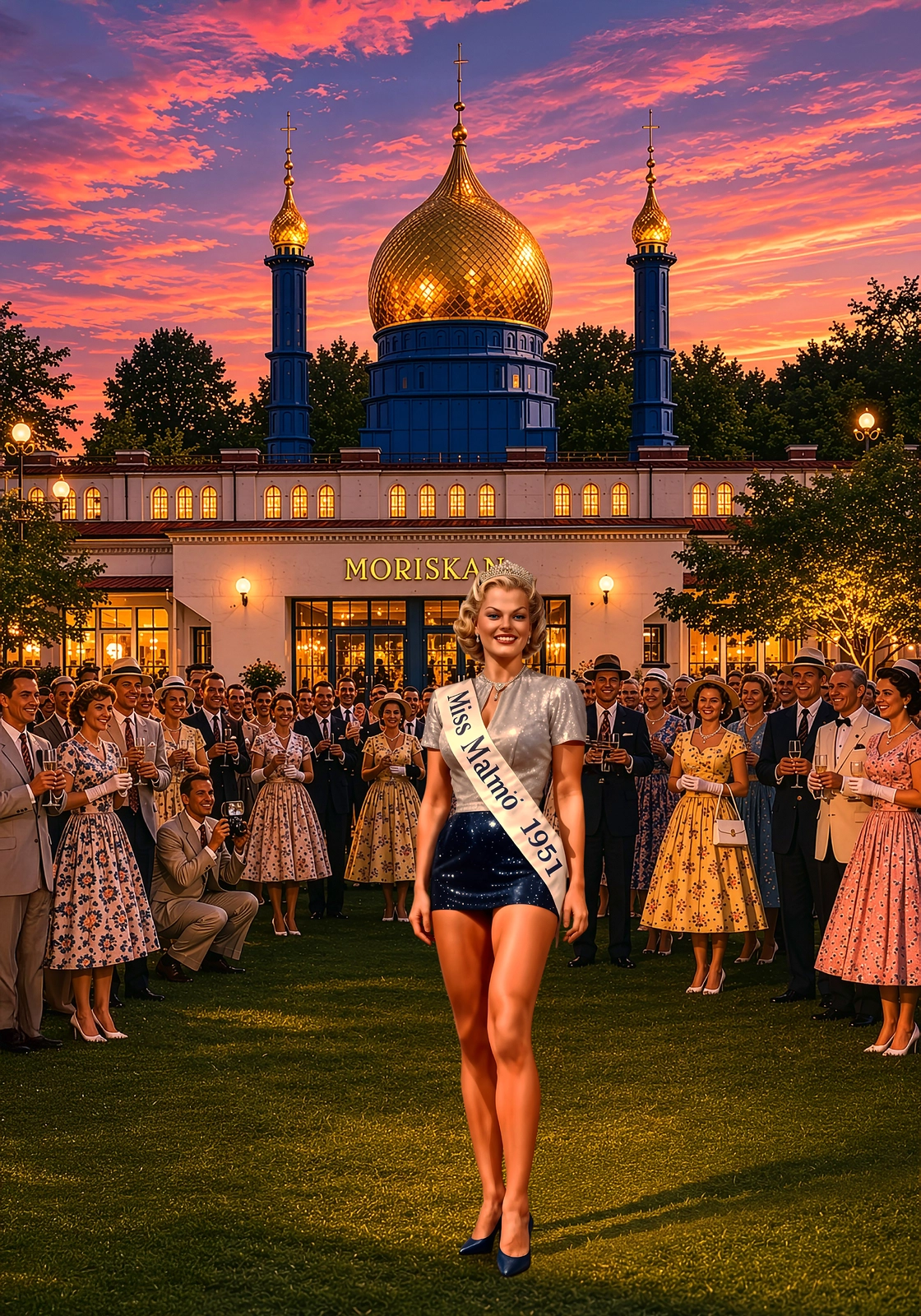
A young blonde woman walks slowly across the grass outside Moriska Paviljongen on a warm summer evening in 1951, while Malmö watches her with collective fascination.
Behind her rise the fantastical golden domes of the Moorish pavilion, glowing beneath a pink Scandinavian sunset like something transported north from an oriental fairy tale. Around her stands a crowd of smiling spectators dressed in post-war elegance floral dresses, white gloves, champagne glasses, cigarettes, summer hats, carefully pressed suits. Sweden has survived the war untouched; optimism hangs in the air, and somewhere beyond the lights of Folkets Park, the future still seems manageable.
Across the young womans chest runs a sash that reads "Miss Malmö 1951".
At the time, she is merely Anita Ekberg from Rostorp, one contestant among several in a local beauty competition held in Malmös great democratic pleasure park. Nobody present can fully grasp that the smiling girl walking towards the photographers will eventually become one of the most recognisable women in world cinema.
Not even Anita herself.
More than seventy years later, she returns to the city as a Time-Traveller, together with Marcello Mastroianni, wandering through Malmö in search of places where memory still clings stubbornly to streets, theatres and old façades. They revisit her childhood home, the Riviera near Gustav Adolf's Torg, where a journalist first noticed her crossing the square, Hippodromen, and finally Folkets Park itself, where the first small crack appeared in the ordinary life of a young Swedish girl who dreamed more of modelling than of acting.
Along the way, they discuss beauty competitions, Hollywood, ageing, glamour, Instagram, mythology, and the strange machinery by which human beings slowly transform one another into symbols.
Perhaps that is what beauty contests really sell in the end.
Not merely beauty. A possibility, but at a price.
"Time Travel in Malmö
We wandered through Malmö beneath the northern summer sky,
Where twilight never fully fades and old dreams never die.
The trams were gone from Gustavs square, the years had drifted on,
Yet somewhere in the evening light, the vanished world lived on.
Past Moriskans golden domes, where laughter filled the air,
Where young girls once wore satin sashes and learned that crowds could stare.
A blonde girl walked through Folkets Park in nineteen fifty-one,
Unaware that the road ahead would lead beyond the sun.
We walked through streets of memory where shadows softly stayed,
Past Hippodromens faded walls and cafés half in shade.
And every stone in Malmö seemed to whisper as we passed
That cities, much like human hearts, are built from layers of the past.
The bars around Lilla Torg still shimmered late at night,
With restless youth beneath the glow of neon, wine and light.
The music changed, the fashions changed, the glowing screens arrived,
Yet hope remained the same old hope that keeps the young alive.
For beauty was not merely crowns nor judges in a row,
But longing for a larger life beyond the life you know.
A wish to leave the narrow streets where destiny feels small,
And hear some distant future softly whispering your call.
We spoke of Rome and Hollywood, of fames relentless flame,
How photographs outlive the flesh yet never quite the name.
How symbols slowly swallow those the world once claimed to love,
Until the stars seem more authentic than the souls thereof.
Yet still the city held her there beside the Baltic sea,
The girl from Rostorp wandering through immortality.
And somewhere through the Malmö night, another girl walked on,
Crossing Gustav Adolfs square beneath the fragile dawn.
Perhaps she, too, was dreaming of a life not yet begun,
Of distant worlds and brighter skies and becoming someone.
And Time itself stood listening while summer shadows curled
For every little city hides a doorway to the world."
Malmö, May 2026
Memories Moriskan 1951
Prologue A travel in time
They had remained by the shore at Skälderviken until dawn.
Not because they were tired. Time-Travellers did not really sleep unless they happened to enjoy the theatre of sleep the softness of sheets, the intimacy of lying beside another body, the illusion of rest. In eternity, there was no biological need for unconsciousness. One could remain awake for centuries if one wished.
But there was something pleasant in pretending to be human for a little longer.
The sea had lain silver-blue beneath the paling sky as fishing boats slipped like shadows beyond the shallows. Anita Ekberg had stood barefoot in the cold sand, her shoes dangling from one hand, her blonde hair stirred by the weak morning wind from the Kattegat. Beside her, Marcello Mastroianni had smoked thoughtfully, watching the horizon emerge from darkness.
For quite some time, neither of them spoke.
Yesterday at Jägersro, the horses, the impossible centaur visions, the champagne, the laughter, and the strange sense that memory itself had briefly seemed more real than history still lingered between them. Afterwards, they had driven north along the coast through sleeping villages until they reached Skäldervikens quiet beauty, where the Scandinavian summer night never truly turned black.
It is strange, Marcello finally said, watching the dawn spread across the water, how Malmö keeps following you everywhere.
Anita smiled faintly.
Because I never escaped it.
Then, as the first gulls began circling above the shore, they turned the car south again and drove back towards the city where everything had once begun.
Chapter 1 Östra Fäladsgatan 29
The first stop had to be the house. There was never any discussion about that.
Before theatres, before photographers, before Rome, before Hollywood, Fellini, fountains, gossip columnists, mink coats, and flashbulbs there had been a modest little family house in Rostorp.
Here, Anita announced with surprising solemnity as the car pulled to a halt. Östra Fäladsgatan 29.
Marcello looked out through the windscreen.
The building stood quietly beneath the slightly pinkish Malmö morning, like thousands of other modest middle-class family homes built in the Swedish interwar years: sturdy brickwork, practical windows, sensible balconies, nothing remotely cinematic about it.
He tilted his head.
One expected something a little more dramatic.
Anita gave him a sharp look.
What did you expect? Versailles?
Marcello shrugged.
You became Anita Ekberg. One imagines at least a marble staircase.
You Italians always need ruins and marble columns before you can take history seriously.
Marcello pointed toward the building.
It does look solid.
People built properly back then.
Like the Colosseum, he said dryly.
Anita turned toward him instantly.
Marcello. The Colosseum is falling apart. My childhood home is not.
He burst out laughing.
The truth was that very little had changed.
That surprised him.
The Malmö Anita described from the late 1940s often sounded impossibly distant from the modern world: trams rattling through the city, dance halls crowded with sailors and factory workers, and strict Lutheran respectability mingling with growing postwar optimism. Yet the small house itself remained stubbornly ordinary, as though history had happened elsewhere.
Anita stepped out of the car slowly, then stood, looking up at the windows.
For years, she said quietly, I thought this was the centre of the universe.
And now?
She smiled faintly.
Now I know the universe is much larger. But strangely enough this place still matters.
A cyclist passed them without recognising either of them.
The two Time-Travellers enjoyed moments like this.
No paparazzi.
No headlines.
No mythology.
Only two immortals stood outside a small house in Malmö while the city continued with its morning routines.
Anita walked a few steps along the pavement.
When I was a child, she said, I did not dream about becoming an actress.
No?
As a teenager, I wanted to become a model. That seemed glamorous enough.
And less dangerous than cinema?
Far less dangerous, she said. Film turns people into ghosts.
Marcello considered it. She was probably right.
The modelling world first opened to her through local photographers, fashion shows, number-girl appearances, and small beauty competitions. Even before the famous Fröken Malmö contest, Anita already understood something essential about cameras: they rewarded confidence long before they rewarded perfection.
She could already pose, Anita said. That surprised people later. But by then I had practised for years.
Ah, yes, Marcello smiled. The terrible burden of being naturally photogenic.
She ignored him.
My mother understood before anyone else.
Her voice softened slightly at the mention of Alvah.
Most respectable middle-class Swedish mothers of the period would have considered beauty contests scandalous or vulgar. Nice girls did not parade in tight sweaters and black shorts before strangers.
But Alvah Ekberg had been unusually modern.
She supported me completely, Anita said. Not because she wanted fame herself. She thought my life should be bigger than Malmö.
Marcello lounged against the car.
A dangerous idea.
Yes, Anita replied. She was absolutely right.
For a moment, they stood in silence as sunlight crept slowly across the façades.
Then Marcello glanced toward the street ahead.
So, he asked, where does the grand nostalgic pilgrimage go now?
Anita smiled.
To the Riviera.
Chapter 2 The Riviera
Riviera!? exclaimed Marcello Mastroianni as Anita steered the old car deeper into Malmö. Are you taking me back to my native country? That is quite a long drive in this ancient car. I thought you wanted a nostalgic day in Malmö.
Anita laughed loudly.
You silly man! Obviously, we are not driving 2,500 kilometres across Europe. In Malmö, we also have a Riviera.
Marcello looked deeply suspicious.
You Scandinavians are always stealing southern names. Riviera, Bellevue, California. Soon you will claim Naples belongs to Sweden.
Only the attractive parts, Anita replied calmly.
The car rolled slowly towards Gustav Adolf's Torg beneath a morning sky turning increasingly blue. Malmö had changed enormously since Anitas youth, yet certain things remained strangely untouched by time. The squares geometry still felt familiar to her. The wide open space. The movement of people crossing diagonally in all directions. The department stores. The impatient cyclists. Even the light itself seemed unchanged that particular cool Nordic brightness that Italian cinematographers always struggled to imitate.
There, Anita said, pointing towards the southern side of the square. That stretch used to be called Rivieran.
Marcello stared ahead through the windshield.
That?
Yes.
It looks less like Monte Carlo and more like a place where accountants buy shoelaces.
That, Anita replied proudly, is because Italians confuse glamour with geography.
Marcello smiled.
And Swedes confuse geography with optimism.
They parked near the square and continued on foot.
In Anitas youth, the place had been one of Malmös fashionable meeting places cafés, elegant shop windows, people strolling simply to see and be seen. In the years immediately after the war, Sweden had escaped the physical destruction that had engulfed much of Europe, and a strange mixture of restraint and optimism hung in the air. Malmö was still a working city of shipyards, factories, trams, sailors, office clerks and dance halls, but modernity was beginning to arrive.
And somewhere in the middle of that transformation, a tall blonde girl from Rostorp had suddenly appeared.
It happened almost exactly here, Anita said quietly.
Marcello looked around theatrically.
A miracle?
A journalist.
Ah, yes. Often more dangerous.
She nodded toward the square.
Rune Ernestad.
Marcello vaguely recognised the name from Anitas stories. A journalist, talent scout and enthusiastic hunter of beautiful women, working in the magazine world surrounding the Fröken Sverige competitions.
He was here, trying to recruit more contestants for the Malmö final at Folkets Park, Anita explained. Apparently, too many girls had become nervous and withdrawn.
A wise instinct.
I was walking across the square when he spotted me.
Marcello folded his arms.
And naturally, he immediately recognised future international stardom.
Something like that.
What exactly were you wearing?
Anita smiled faintly.
I honestly do not remember.
That means it must have been effective.
She ignored the comment. She understood that he was thinking of a tight-fitting pullover.
The funny thing is that I was not interested at all. I thought the whole thing sounded ridiculous.
And yet you became Anita Ekberg.
Yes. But first I went home.
Marcello laughed.
You rejected destiny?
For several hours.
She explained that Ernestad had approached her with the polished confidence of a man who had spent half his life persuading uncertain young women to enter beauty competitions. Anita had listened politely, remained deeply sceptical, and walked away.
Then, later, she reconsidered.
Not because she dreamed about Hollywood.
She didnt. Not yet.
At that point, the dream was much smaller and much more Swedish.
Modelling.
Fashion photography.
Perhaps travelling abroad.
Perhaps escaping Malmö for a little while.
When people later wrote about me, Anita said, they often pretended I had always dreamed of becoming a movie star. That is nonsense.
What did you dream about?
She looked across the square.
Freedom.
That answer silenced even Marcello for a moment.
Buses moved around the square while modern Malmö carried on, unaware of the two Time-Travellers standing quietly near the spot where an accidental encounter had altered an entire life.
Anita resumed walking.
By then, I already knew how to pose, she said. That surprised many people later.
You practised?
Of course, I had already worked with photographers, including Georg Oddner. He became internationally well known before me. I understood cameras long before Hollywood.
Marcello nodded approvingly.
That is true. Most actors never understand cameras at all.
Anita smiled.
There is a difference between being looked at and understanding how people look at you.
That, Marcello admitted, is a very dangerous form of intelligence.
As they crossed the square, Anita continued to describe the atmosphere of the early 1950s. Sweden liked to remember itself as modern and progressive, yet beauty competitions still left many respectable people deeply uncomfortable.
Nice middle-class girls were not expected to appear in public wearing tight sweaters and black shorts while strangers evaluated their appearance from a stage.
At the time, Anita said, many people considered beauty contests almost scandalous.
Marcello raised an eyebrow.
And today?
Today, the same middle class posts identical photos of their daughters on Instagram.
Marcello burst out laughing.
Yes, he admitted. Human hypocrisy endures every generation.
Anita slowed as they approached the old commercial buildings near Kalendegatan.
My mother never thought it was shameful, she said quietly. That mattered a great deal.
Alvah Ekberg had supported her daughter from the start, unlike many parents of the era who feared scandal or gossip. During the Fröken Malmö competition, she had even joined the crowd cheering for Anita.
She wanted life to become bigger, Anita said. Bigger than fear. Bigger than gossip. Bigger than Malmö.
Marcello glanced at her.
And did it?
Anita looked ahead towards the old streets of the city centre.
Oh yes, she said softly. Far larger than anyone had expected.
Chapter 3 Kalendegatan and Hippodromen
They continued westward through the older parts of the city as the morning slowly ripened towards noon.
Kalendegatan still bore traces of another Malmö beneath the modern storefronts and renovated façades. Here and there, older brickwork survived like fragments of memory pushing through the decades. Anita walked more slowly now, occasionally stopping without explanation, as though certain corners still held invisible echoes audible only to her.
Marcello followed, his hands in the pockets of his light summer coat.
You become quieter here, he observed.
This part of the city remembers things.
That sounds ominous.
Italian cities are full of ghosts. Malmö merely hides them more effectively.
They reached Hippodromen, and Anita stopped.
There, she said softly.
Marcello looked upward.
The old building still bore traces of faded grandeur: ornate details, theatrical proportions, and the slightly melancholic dignity common to theatres that had survived several eras without entirely belonging to any of them.
It was a variety theatre then, Anita explained. Now it belongs to Malmö City Theatre. For a while, the Pentecostal movement owned the house, and it was a church. I think it was a mark of the Pentecostal friends to transform a den of sin where young girls danced in almost nothing. I suppose that, as a theatre, it is almost as bad in the eyes of many religious people."
Marcello studied the façade thoughtfully.
All theatres eventually become nostalgic.
Anita smiled faintly.
That is because theatre disappears the second it happens.
And cinema?
Cinema survives, she said. Unfortunately.
Marcello laughed quietly.
Ah, yes. Eternal youth projected twenty metres high.
Exactly. Theatre allows people to age naturally, whereas film preserves them like insects trapped in amber.
For a moment, both of them fell silent.
No one understood that better than Anita Ekberg.
All over the world, she still existed eternally within La Dolce Vita blonde, magnificent, laughing in the waters of the Trevi Fountain as Rome shimmered around her like a dream. Millions remembered that woman. Very few remembered the human being who had continued to live afterwards.
Marcello glanced sideways at her.
You know, he said gently, most actresses would kill for immortality.
Yes, Anita replied. Until they realise immortality means staying thirty forever while your soul continues to age.
A tram no longer rattled past Hippodromen as it once had. The silence felt strange to Anita.
In those days, she continued, this part of Malmö was alive with theatres, revues, dance halls, musicians, travelling performers People wanted glamour after the war. They wanted a distraction.
And beautiful women.
Especially beautiful women.
Marcello nodded approvingly.
At last, Sweden enters civilisation.
She rolled her eyes.
At Hipp, people sang, danced, performed comedy, flirted, drank too much, fell in love for one evening, and regretted it all the next morning. Entire lives passed through places like this.
And you?
I was still standing at the edge of everything, Anita said. Not yet famous, just another girl trying to become visible.
She described the strange world surrounding the entertainment industry of the late 1940s and early 1950s: number girls, travelling fashion models, dance orchestras, local photographers, beauty competitions and revue culture, all blending into a half-glamorous, half-improvised universe.
For ambitious young women, it could feel intoxicating.
And dangerous.
You must understand, Anita said. Sweden was still very respectable then. Officially respectable, at least.
Marcello smiled knowingly.
Which usually means privately hypocritical.
Exactly.
A girl could appear on stage in a swimsuit before hundreds of strangers and still be expected to remain pure, modest and respectable afterwards. Society admired glamour while simultaneously distrusting the women associated with it.
The contradiction never disappeared, Anita continued. People wanted beautiful women but they also wanted those women punished for being beautiful.
Marcello looked impressed.
That is a remarkably Catholic observation for a Lutheran country.
She laughed.
Beauty always makes societies nervous.
As they resumed walking, Marcello glanced at the younger people passing them on the street in fashionable clothes, wearing expensive trainers, with phones constantly glowing in their hands.
And now? he asked. Has the world become wiser?
Anita snorted.
Now everyone carries a permanent beauty competition in their pocket.
She pointed toward a young influencer posing outside a café while her friend adjusted the camera angle.
There. Same performance. Same anxiety. Same desire to be admired.
But democratised.
Yes, Anita replied. That is the difference. In my day, perhaps twenty women stood on a stage in Folkets Park while a jury judged them. Now, millions judge each other constantly.
Marcello watched the girls photographing themselves.
And the judges are algorithms.
Much crueller than any beauty pageant jury.
They reached the corner near Hippodromen once again and paused beneath the old theatre façade.
You know what is funny? Anita suddenly said.
What?
Today, people pretend that beauty contests were uniquely degrading.
Marcello raised an eyebrow.
You disagree?
I think modern culture simply found more efficient ways to do the same thing.
That answer lingered between them for several moments.
Then Marcello smiled slowly.
You are becoming philosophical in your old age.
My dear Marcello, Anita replied. Time-Travellers do not have ages.
He bowed slightly.
Forgive me. I forgot.
Chapter 4 Folkets Park
They eventually returned to the car parked near the older streets in the city centre.
The vehicle itself looked almost absurd as it moved through modern Malmö long, elegant, slightly excessive, like a survivor from another civilisation. People occasionally turned their heads as it passed. Not because they recognised its occupants, but because the automobile carried an unmistakable aura of another era.
Marcello leaned back comfortably in the passenger seat.
So now we finally arrive at the sacred birthplace of Swedish glamour?
Anita smiled as she steered towards Folkets Park.
Do not exaggerate. It was essentially a beauty contest beside beer stands and dance pavilions.
That, Marcello replied solemnly, is how most civilisations begin.
The park looked greener than Anita remembered.
Or perhaps quieter.
In the decades after the war, Folkets Park was one of Malmös great social worlds: concerts, lotteries, political speeches, dances, rides, and summer evenings filled with cigarette smoke and accordion music. Workers, sailors, office girls, factory boys, pensioners, children the entire city had passed through the park at one time or another.
And somewhere in the midst of ordinary life, a young woman in black shorts had unexpectedly become the future, Anita Ekberg.
They walked slowly along the paths.
It happened over there, Anita said, pointing towards an open area near one of the old gathering spaces. The Fröken Malmö final.
Beyond the trees rose the fantastical silhouette of Moriska Paviljongen, with its oriental domes, towers, and strange, dreamlike architecture, standing in Folkets Park since the beginning of the twentieth century. Built as a pleasure palace for Malmös workers, the old Moorish pavilion looked less like Scandinavia than something transported north from an operetta set in Cairo or Damascus. Even in Anitas youth, the building already carried an atmosphere of faded exotic glamour part dance hall, part fantasy, part political folk-park romanticism.
Marcello looked around theatrically.
I expected something grander.
It looked grand when you were twenty.
That applies to many things.
Anita laughed quietly.
For a moment, she seemed genuinely transported back in time.
The audience.
The lights.
The orchestra music.
The nervous contestants pretend not to be nervous.
The smell of perfume mixed with beer and summer dust.
And somewhere in the crowd sat her mother, Alvah, cheering louder than anyone.
My mother was absolutely impossible, Anita said affectionately.
Marcello smiled.
Stage mothers usually are.
No, not like Hollywood mothers. She was not ambitious for herself. She enjoyed life immensely.
That is rarer.
Anita nodded.
She thought the whole thing was exciting, glamorous, and slightly outrageous.
And your father?
She burst out laughing.
My father barely understood what was going on.
Marcello could immediately picture it: respectable Swedish fathers in the early 1950s driving their daughters to beauty contests, remaining politely confused about the whole concept.
He drove me here, Anita continued. Completely unaware that his daughter was about to become a national sex symbol.
Marcello applauded softly.
A magnificent piece of Scandinavian innocence.
They sat briefly on a bench beneath the trees.
Anita became quieter now.
At the time, she said, many people considered beauty competitions improper.
Marcello looked surprised.
Even in Sweden?
Especially in Sweden. Respectability was very important then.
A respectable girl was expected to behave modestly, speak carefully, avoid attracting undue attention, and certainly not display herself publicly before male judges.
Yet at the same time, newspapers, magazines, and advertisers were becoming increasingly obsessed with glamour, modern femininity, and idealised beauty.
It was contradictory from the beginning, Anita said. Society wanted attractive women, but became nervous whenever women recognised the power of attractiveness.
Marcello nodded slowly.
Yes. Men prefer beauty, slightly unconscious of itself.
Exactly.
A few younger visitors passed them without recognising either of them.
That still amused Anita sometimes.
Once, photographers had followed her through airports, restaurants and film premieres across Europe and America. Now she could sit quietly in the very park where her public life had begun, while students walked past, carrying takeaway coffee, without the faintest idea who she was.
Time eventually defeated all fame except mythology.
And yet, Marcello said carefully, you do not regret it.
Anita looked toward the trees moving gently in the wind.
No, she admitted after a while. Because the contest changed everything.
That was the uncomfortable truth beneath all later political arguments.
Without Miss Malmö, there would likely have been no Miss Sverige.
Without Miss Sweden, no America.
Without America, no Hollywood.
Without Hollywood, perhaps no Fellini.
Without Fellini, no Trevi Fountain.
Without the fountain, no Anita Ekberg as the world remembered her.
And without Anita Ekberg, just one fountain among many.
An entire international myth had emerged from a summer evening in Folkets Park.
It opened the door, Anita said quietly. That is what people forget.
Marcello leaned back slightly.
And what did the door lead to?
Anita smiled faintly.
Everything.
For a moment, neither of them spoke.
Then Marcello suddenly asked:
Tell me honestly. Did you enjoy winning?
Anita looked at him as though the answer were obvious.
Of course I did.
Ah, he said triumphantly. At last some honesty.
She laughed again.
Why should I pretend otherwise? I was young, ambitious and beautiful. Winning felt wonderful.
And terrifying?
Yes, she admitted. Suddenly, people looked at me differently.
How? The boys must have been watching you all the time," Marcello said, eyeing her from head to toe. "We boys still do," he added, grinning.
She considered the question carefully, but did not comment on his remark.
As if I had ceased to be entirely human and become symbolic.
Marcello understood immediately.
Cinema did the same thing.
Once audiences transformed a person into an image, the image slowly began to devour the person beneath it.
A breeze moved through the park.
Not far away, children were laughing.
And above the ordinary sounds of modern Malmö floated the invisible ghost of another evening long ago, when a young woman first discovered that beauty could be both a liberation and a cage.
Chapter 5 From Folkets Park to the Trevi Fountain
When they finally left Folkets Park, the afternoon light had begun to soften above the city.
Malmö drifted past outside the car windows: bicycles, buses, cafés, construction cranes, students with backpacks, office workers already thinking about dinner. The city looked younger now than it had in Anitas youth, strangely enough. Modern cities often did. They underwent cosmetic surgery every decade, while older generations quietly disappeared beneath the renovations.
Marcello rested one arm against the open window.
So, he said, after Folkets Park came America.
Anita smiled faintly.
You say that as if it were the most natural thing in the world.
For you, it eventually became natural.
No, she replied. It never felt natural. That was part of the problem.
Traffic slowed near a crossing. For a few moments, neither of them spoke.
Then Anita continued quietly:
Winning Fröken Sverige changed everything almost immediately. Suddenly, people who had ignored you your entire life began to behave as though you were important.
Marcello nodded knowingly.
Beauty is perhaps the only passport recognised by every country in the world.
Yes, Anita said dryly. Unfortunately, it expires.
He laughed softly.
After the national competition came America, with photographers, magazine interviews, modelling contracts, and finally the machinery of Hollywood itself, but unlike the myths later invented by journalists, the transformation had not happened overnight.
There had been auditions.
Embarrassing screen tests.
Minor film roles.
Awkward parties.
Producers are attempting to redesign her personality.
Acting lessons delivered by men who barely understood acting themselves.
And a lot of people drooling over her body.
They wanted Scandinavian ice, Anita said. But preferably with large breasts.
Marcello looked thoughtful.
A difficult artistic balance.
Oh, they managed heroically.
She described 1950s Hollywood as a strange blend of industrial efficiency and organised fantasy. Young actresses were discovered, reshaped, photographed, renamed, publicised and discarded with alarming speed.
Sometimes, Anita admitted, the beauty contests felt almost more honest.
Marcello looked genuinely surprised.
Really?
At least everyone understood the transaction.
That sentence hung heavily in the car.
Outside, Malmö continued sliding past in fragments of old and new architecture.
When did you first realise you had become famous? Marcello asked.
Anita thought for several moments.
Not in America, she finally said. Americans are obsessed with fame. That atmosphere becomes unreal very quickly.
True.
It happened later, in Europe, after Fellini. And you, of course.
Marcello smiled in silence at the mention of Federico Fellini.
Ah, yes, he murmured. The magician.
They both fell silent again.
Everything changed after La Dolce Vita.
Not merely success.
Transformation.
Before the film, Anita Ekberg was a glamorous actress known mainly for her beauty, publicity, and Hollywood spectacle. Afterwards, she became something else entirely an international symbola cinematic apparition, suspended forever in black water beneath Roman moonlight.
And beside her stood Marcello himself.
You know, he said after a while, people still talk about that fountain scene as if it were real history.
It is real history.
No, Marcello replied softly. It is mythology.
Anita smiled.
Perhaps he was right.
The strange thing about cinema was that fictional moments sometimes endured longer than real human experiences. Millions of people remembered Anita Ekberg stepping into the Trevi Fountain. Very few remembered elections, treaties or governments from the same year.
That fountain changed Rome, Marcello continued.
It changed tourism.
It changed fantasy.
She laughed softly.
Before the film, it was merely one magnificent fountain among many in Italy.
And afterwards?
Afterwards, every tourist in the world suddenly wanted to stand exactly where you and I stood.
Marcello smiled.
That is power.
No, Anita corrected him quietly. That is imagery.
"I hope they don't freeze as I did. In addition, they risk ending up in prison. It is now forbidden to bathe in the fountain." Marcello shuddered at the memory.
"Well, you got drunk as a jack of all trades when you tried to warm yourself with whiskey."
"Also, a cheap one that a cameraman had brought along."
The car stopped briefly at a red light.
Outside, two teenage girls passed by, taking selfies together with practised precision, adjusting angles instinctively before photographing themselves again.
Anita watched them carefully.
You see? she said.
Marcello glanced outside.
The modern beauty contest.
Exactly.
No jury.
No stage.
No Folkets Park.
Only millions of invisible spectators are permanently connected via screens.
At least in my day, Anita said, you could leave the stage when the evening was over.
Marcello nodded slowly.
Now the performance never stops.
The light changed.
They continued driving through Malmö as the late-afternoon sunlight fell softly across the city's windows.
Then Marcello suddenly smiled to himself.
What?
I was just recalling something you once told journalists.
Anita groaned immediately.
That sounds dangerous.
You said I was slightly afraid of you.
Marcello laughed.
You were.
Rubbish.
You were taller than half the men in Italy and stronger than most of them.
Anita burst into laughter.
That part may actually be true.
Marcello turned toward her with theatrical seriousness.
You arrived in Rome like a Viking invasion, wrapped in Dior.
She laughed so hard she briefly had to slow the car.
And for a moment just a brief moment they no longer seemed like immortals wandering through memory. They were simply two old friends sharing laughter inside an ageing car as Malmö drifted quietly around them.
Chapter 6 Why Beauty Contests Died
They eventually left the city centre behind and drove slowly along the canals as evening settled over Malmö.
The light had begun to take on that peculiar Scandinavian softness, which seemed to dissolve hard edges rather than sharpen them. Water reflected pale gold beneath the bridges. Restaurant terraces gradually filled with people drinking wine beneath blankets, despite the mild summer temperature. Somewhere distant, a gull cried above the harbour.
Marcello lit another cigarette.
So, he said, when exactly did the world decide that beauty contests were immoral?
Anita smiled faintly.
The world never decides anything all at once. It simply becomes embarrassed slowly.
That sounds very Swedish.
It probably is.
The car rolled quietly onward.
For a while, Anita watched the city pass by outside before continuing.
When I was young, beauty contests embodied modernity. Glamour. Internationalism. Escape. Girls from ordinary towns suddenly imagined bigger lives.
And now?
Now, people mostly hear the word objectification.
Marcello nodded thoughtfully.
He understood the transformation perfectly. During the second half of the twentieth century, beauty itself had become politically complex in a way previous generations barely understood.
Or perhaps beauty had always been complicated. Only now were people discussing it openly.
The criticism was not entirely wrong, Anita admitted. Many competitions were shallow. Some organisers treated girls terribly, and some contestants were cynically exploited.
Marcello looked amused.
That description also applies to most film studios.
Yes, Anita laughed. Exactly.
They passed older industrial areas, now transformed into modern apartments and glass offices.
Cities reinvented themselves the same way ageing actresses did: carefully, expensively, and never entirely convincingly.
The strange thing, Anita continued, is that the competitions themselves tried desperately to survive. Every decade, they reinvented themselves a little more. Suddenly, married women were allowed to compete. Then mothers. The organisers began speaking less about measurements and more about personality, education, charity work, social engagement, environmental causes everything except the one thing the audience still secretly came to look at.
Marcello smiled faintly.
And still people lost interest, Marcello observed.
Yes.
Why?
Anita considered the question carefully.
Because modern audiences no longer trust simplicity.
He turned toward her.
What does that mean?
In the 1950s, a beauty contest openly acknowledged what it was doing. A jury assessed attractive women and selected a winner. Crude, perhaps but honest.
And now?
Now, society performs the same rituals while pretending they are about empowerment.
Marcello burst out laughing.
That may be the most ruthless thing you have said all day.
She shrugged.
Instagram is essentially an endless global beauty contest, judged by invisible drooling strangers.
And unlike Folkets Park, Marcello added, the contestants never leave the stage.
Exactly.
Anita believed that explained much of modern anxiety.
In earlier decades, beauty at least remained partly local and temporary. A contest lasted one evening. A magazine photograph faded within a week. A model aged out of fashion and disappeared quietly.
But digital culture transformed appearance into a permanent public performance.
Young people now live under constant surveillance.
You know what would terrify me if I were young today? Anita asked.
What?
The fact that nobody is allowed to return to ordinary again.
Marcello became unusually serious.
Yes, he admitted softly. That is true.
The car slowed near the water.
Lights from restaurants shimmered across the canal as bicycles crossed nearby bridges like shadows.
Anita suddenly smiled to herself.
What?
I was thinking about those old competitions in the 1920s.
The ones measuring women like racehorses?
Yes, she laughed. Imagine introducing that today.
In the early twentieth century, many Scandinavian beauty contests blended glamour with bizarre pseudoscientific ideas about racial purity, ideal Nordic measurements, and healthy national beauty. Newspapers published body measurements alongside photographs, as though female attractiveness could be calculated mathematically.
Human beings become very dangerous whenever they try to turn beauty into science, Anita said quietly.
Marcello nodded.
Yet beauty itself survives every ideology.
Yes.
That may have been the real reason beauty contests became unfashionable: not because human beings stopped worshipping beauty, but because modern society no longer liked admitting how much it still did.
The car finally stopped near the water.
For a moment, neither moved.
Then Marcello smiled faintly.
So after all these philosophical discussions, tell me honestly
Anita sighed theatrically.
That sentence is always dangerous.
If a beautiful eighteen-year-old girl asked for your advice today, would you tell her to enter a beauty contest?
Anita looked out across the darkening canal for a very long time before answering.
Finally, she smiled.
I would tell her to understand the difference between using beauty
She turned slightly toward him.
and allowing beauty to use her.
Chapter 7 Malmö by Night
Night had fully settled over Malmö by the time they left the canal. They drove to Västra Hamnen to park the car near Sundspromenaden.
This part of the city no longer resembled the Malmö Anita remembered from the early 1950s. Kockums shipyard cranes had all gone. The old industrial smoke had vanished. New glass buildings reflected the harbour lights, while expensive apartments rose where dockworkers and factory labourers once stood, drinking coffee from thermoses at dawn. Nor could you go by boat to Copenhagen any more, "tura" as the people of Malmö called it when you went back and forth to buy groceries cheaply, which you could in Denmark at that time. Anita loved to take the trip with her mother because she got fish fillet and Citronvann (lemon water), a Danish soft drink.
Yet the city still carried the same strange mixture of modesty and ambition. Malmö had always wanted to become something slightly larger than itself, rather like Anita.
Marcello lowered the car window as they drove slowly toward the waterfront.
The air smelled faintly of saltwater and summer asphalt still warm from the days heat.
You know, he said quietly, something is amusing about all this.
What?
You spent an entire day explaining why beauty contests disappeared
Anita smiled faintly.
while still looking like the woman who won them.
She laughed softly.
My dear Marcello, eternity is extremely flattering to former actresses.
No, he replied. It is flattering to mythologies.
That word returned.
Mythology.
Perhaps that was what remained after enough decades had passed. Not ordinary fame, nor even celebrity, but something stranger a symbolic afterlife in which human beings slowly ceased to be entirely human and instead became stories the world continued to retell long after reality itself had faded. Anita Ekberg had gradually become an image suspended between cinema and mythology: the blonde woman standing in the Trevi Fountain beneath Roman nightfall, the impossible Scandinavian beauty who arrived in Italy like a giant northern apparition and conquered Rome simply by being there. Over time, the symbol had almost devoured the person behind it.
Very few people still remembered the uncertain young woman crossing Gustav Adolf's Torg, wondering whether entering a local beauty competition might lead to something slightly more interesting than ordinary life in Malmö.
Anita drove in silence for a while before speaking again.
You know what people misunderstand about beauty?
Marcello turned slightly toward her.
What?
They think beautiful women spend their entire lives feeling admired.
And they do not?
She shook her head slowly.
No. Most spend their lives feeling observed.
That sentence remained suspended inside the car.
Outside, the harbour lights shimmered against the dark water.
Observation becomes exhausting eventually, Anita continued quietly. Especially when people begin confusing appearance with identity.
Marcello nodded.
Yes. Audiences rarely forgive symbols for becoming human.
Exactly.
For a moment, both of them drifted backwards through memory again.
Rome, Marcello said quietly.
The photographers, Anita added.
The premieres.
The journalists.
The damned flashbulbs exploding every five seconds like artillery fire.
Marcello laughed softly.
Men staring at you as though civilisation itself might collapse if you disappeared.
And women examining every wrinkle, every kilogram, every dress.
The producers are calculating profits while pretending to discuss art.
The fans, Anita said more quietly now, falling in love with fantasies they projected onto strangers.
Silence settled briefly inside the car.
The machinery of glamour has always demanded sacrifices, said Anita, but she did not sound bitter.
Only thoughtful.
Still, Marcello said carefully, you never entirely rejected that world.
No, Anita admitted. Because it gave me my life.
That was the contradiction she could never honestly deny. Beauty contests had been superficial, sometimes exploitative, and occasionally absurd.
But they had also opened doors that otherwise would have remained permanently closed to a girl from Malmö. Without them, she might never have seen America, never have worked with Fellini, and Kerstin might never have become Anita Ekberg.
And besides, she added with sudden amusement, human beings have always organised ridiculous competitions.
Marcello smiled.
True.
People compare horses, dogs, flowers, wine, tomatoes, opera singers, and bodybuilders
She shrugged lightly.
So why not girls?
Marcello burst out laughing.
There it is again. Your famed Scandinavian pragmatism.
No, Anita replied. Merely honesty.
The car finally pulled up near the dark water.
Far away across the Öresund, faint lights from Denmark flickered beneath the night sky.
For minutes, neither of them moved.
Then Marcello spoke softly:
So after everything do you think the world has changed?
Anita looked out towards the water before answering.
Yes, she said eventually. Women have changed.
And men?
She smiled faintly.
Men mostly changed their vocabulary.
Marcello laughed so hard he nearly dropped his cigarette.
Then silence returned once more. A peaceful silence this time.
Two aged immortals sitting in an ageing car at the edge of Malmö after a long, nostalgic pilgrimage through memory, beauty, fame and time itself.
Finally, Anita leaned back comfortably and closed her eyes for a moment.
Not because Time-Travellers needed sleep.
But sometimes even immortals enjoyed resting in old memories before returning to eternity once more.
Epilogue The Girls Still Crossing the Square
Later that evening, they left the car behind and continued on foot through the older parts of central Malmö known as Old West.
Around Lilla Torg, the restaurants and bars were packed. Summer evenings always transformed the square into something strangely continental by Scandinavian standards. Outdoor tables crowded the cobblestones beneath strings of lights. At the same time, music drifted between the façades, accompanied by bursts of laughter, clinking wine glasses, and the low, endless murmur of young people talking about futures that still seemed limitless.
Marcello slowed slightly and looked around with visible approval.
At last, he announced, your city is beginning to behave like Europe.
Anita laughed.
Malmö has always wanted to be continental, sometimes rather desperately.
Young women passed them in elegant summer dresses, oversized jackets, super-high heels, trainers, black leather, glittering jewellery, vintage fashion, expensive make-up and carefully careless hair. Young men tried to project confidence with varying success, pretending not to stare too obviously.
The entire square vibrated with performance, and strangely enough, Anita felt unexpectedly at ease there.
Strolling around Lilla Torg, among the cafés, bars and restless young people, Anita was faintly reminded of the old Malmö she remembered from dance halls, folk parks and summer evenings long before Hollywood had entered her life. Not literally, of course. The music was different. The clothes were different. The rituals of courtship had migrated to smartphones and glowing screens. But the underlying energy remained recognisable.
Half the world seems to be there. The advantage of being a Time-traveller is that you understand all languages because you listen to the thoughts that guide speech.
"Yes, it's quite practical, but I've got the impression you meet a lot more people among the stars," Marcello said, though he didn't sound jealous. He preferred Italians because they had been capturing the day for thousands of years. That habit was deeply ingrained."
"We women tend to do that." After a while, Anita stopped counting.
"I don't understand that you have the patience."
I reached thirty-two languages before giving up, she said, amused.
Marcello looked around the crowded square.
You can actually distinguish them all?
My dear Marcello, its no news to you that we Time-Travellers do not really hear language the way ordinary humans do.
He smiled.
Ah, yes. One of eternitys unfair advantages.
Anita nodded.
In eternity, everyone who has ever lived eventually encounters everyone else. After enough centuries, you begin recognising patterns beneath language itself.
Marcello lit another cigarette while they continued slowly through the crowd.
I know, but it sounds suspiciously philosophical.
It is actually very practical, Anita replied. Human beings think before they speak. The words merely translate thought into sound.
And therefore?
And therefore meaning survives even when language changes completely.
She searched briefly for an example.
It is a little like Chinese writing. A person in Beijing and a person in Hong Kong may pronounce a character differently, but both understand the underlying idea. In eternity, it functions similarly. When someone wishes to say the word chair, they think of a chair first. Speech becomes the visible surface of thought.
Marcello laughed softly.
So theoretically you could speak with anyone who ever existed?
More or less.
A Roman centurion?
Yes.
A Viking?
Several. Most of them drank too much.
A Neanderthal?
Anita smiled.
Yes, although that requires patience. They had no word for chair sixty thousand years ago. So if you need to sit down, they assume you sit with your legs crossed on the floor. A bit hard on my old joints, Anita laughed.
Marcello burst out laughing.
A tragic limitation.
But after enough time in eternity, Anita continued, people learn from one another. You must have noticed. Cultures mix, and knowledge accumulates. Even very ancient humans gradually come to understand concepts that never existed in their earthly lives.
I havent thought much about it, but Ive only been in eternity for thirty years." Marcello looked genuinely fascinated.
You should, because it makes life run more quickly in eternity.
You know, he admitted, this may be the first truly convincing argument for immortality.
Anita smiled mysteriously.
Oh, it becomes stranger than that.
They slowed near one of the outdoor restaurants as younger people laughed around glowing candles and wine glasses.
A few months ago, Anita continued, I experienced something extraordinary.
Marcello immediately looked suspicious.
With you, that sentence usually involves mythology, astronomy or excessive amounts of champagne.
All three occasionally.
She glanced upward toward the dark Scandinavian sky.
I attended a chamber concert on a small sun in the central solar system.
Marcello blinked once.
A sentence impossible to hear as ordinary conversation.
A mixed ensemble spanning different historical periods performed several of Antonio Vivaldis flute concertos. He was there, by the way.
Marcello looked delighted already.
Now this sounds promising. I love Vivaldi.
There were musicians from many centuries sitting together. Baroque violinists sat beside a twentieth-century viola player and a cellist born during the Abbasid Caliphate. A harpsichord player from eighteenth-century Venice complained endlessly about modern tuning systems.
And Vivaldi himself?
Playing first violin.
Marcello stopped walking.
Of course he was.
Anita smiled faintly.
They performed La Tempesta di Mare, La Notte and Il Gardellino.
The storm, the night and the goldfinch, Marcello translated softly.
She nodded.
The remarkable thing about music in eternity is that distinctions begin to dissolve. Nationality, time periods, religion, culture and language. Everything dissolves into the music itself.
Marcello listened quietly now.
The orchestra accompanied the flute soloist almost conversationally, Anita continued. The strings answered her phrases, the harpsichord filling the harmony beneath them. And suddenly I realised nobody present cared whether the musicians came from ancient Rome, Renaissance Venice, or twentieth-century Buenos Aires. They listened.
And the soloist? Marcello asked.
Anita smiled strangely to herself.
She was extraordinary.
Famous?
In a manner of speaking.
They continued walking slowly past crowded terraces and glowing restaurant windows.
Her name was Lucy.
Marcello frowned slightly.
Lucy who? The Blind Lucy? But she's still alive on Earth, so she can't be. I've seen her on CableVision, one of our thousands of cable networks."
"The Lucy!" Anita said emphatically.
The Lucy?
Yes.
For perhaps the first time that evening, Marcello looked genuinely speechless.
You are telling me, he said carefully, that one of humanitys earliest ancestors performed Vivaldi on the flute at a chamber concert on a star?
A rather small sun, Anita corrected him mildly.
Marcello stared at her.
She played the flute?
She died falling from a tree while playing one.
He laughed in disbelief.
That is either magnificent or completely insane.
Both, Anita replied calmly.
Lucy or rather, Dinkinesh, her true name had lived on Earth more than three million years earlier as an early Australopithecus afarensis. The nickname Lucy emerged much later, after the Beatles song "Lucy in the Sky with Diamonds", which was repeatedly played in the researchers camp on the evening her skeleton was discovered.
Dinkinesh, Anita continued softly, means something like you are wonderful in her own language.
Marcello shook his head slowly.
And now she performs Vivaldi.
Yes.
That may be the most beautiful thing I have ever heard.
Around them, the nightlife of Malmö continued to glow beneath the summer darkness as young people laughed, flirted, took selfies and moved endlessly from table to table, bar to bar, and possibility to possibility.
And suddenly, the centuries separating ancient humanity from modern civilisation no longer seemed long at all.
Back to the present and this evening at Lilla Torg. Youth itself had not changed very muchonly the technology surrounding it.
It feels almost familiar, Anita admitted quietly.
Marcello smiled.
You enjoy this.
A little.
You miss being young.
Anita considered it carefully before shaking her head.
No. But sometimes I miss the feeling that everything might still happen.
For a moment, they stood watching the crowd.
At a nearby table, several girls were taking photographs of one another, adjusting poses, angles and lighting with almost professional concentration. One of them immediately rejected the image and demanded another attempt.
Marcello smiled knowingly.
There is your modern beauty contest.
Yes, Anita replied softly. Only now the whole world is the jury.
But she no longer sounded entirely cynical about it. Perhaps because, watching the young women laughing beneath the lights of Lilla Torg, adjusting their dresses, retaking photographs and pretending not to care how they looked to others, she recognised something familiar there not merely vanity or narcissism, as older generations often liked to claim.
What she recognised was hope.
Most girls who once entered competitions like Miss Malmö had never truly been chasing crowns or satin ribbons. What they wanted was possibility. A doorway into another version of life. An opportunity to become visible in a world where ordinary young women so often felt invisible. What they wanted was possibility. Escape. Reinvention. A chance that life might suddenly feel bigger than the streets they already knew by heart.
And perhaps young people still wanted the same thing. Only now they searched for it on screens rather than on stages. They kept crossing the square as night deepened around them. No one recognised them.
Or perhaps a few people vaguely thought the elegant older blonde woman looked strangely familiar, though they could not quite explain why. Time softened even legendary faces. That anonymity pleased Anita more than she expected.
After a while, they began walking back towards Gustav Adolf's Torg again.
The square was quieter now than earlier in the day. Streetlights cast a soft glow on the pavement as late-night buses moved through the city, carrying tired workers, students, lonely souls, and couples heading home together after too much wine.
Then Anita noticed a young blonde girl crossing the square alone. She could not have been older than eighteen, and at least from a distance, she was good-looking.
The girl moved quickly and purposefully, carrying the faint nervous energy of someone heading towards something important perhaps a date, perhaps a party, perhaps merely another ordinary evening that might unexpectedly alter the course of an entire life.
Marcello watched her disappear toward the southern side of the square.
Then he glanced at Anita. She smiled very softly to herself.
Because somewhere in each generation, another young woman was still crossing Gustav Adolf's Torg, still dreaming of becoming someone slightly larger than the life she had been given.
And perhaps that dream itself would never grow old.
PS Beauty Contests, Sweden and the Long History of Being Judged
Beauty contests are far older than people imagine.
Their roots stretch back to ancient mythology and the Judgement of Paris, in which the Trojan prince Paris was asked by Eris, the goddess of discord, to decide which goddess was the most beautiful a decision that ultimately helped ignite the Trojan War. In other words, Western civilisation linked beauty competitions to vanity, politics, desire and catastrophe almost from the very beginning.
By the late nineteenth century, beauty competitions had spread across Europe. The first truly international contest is usually said to have taken place in the fashionable Belgian spa town of Spa in 1888, though participation remained largely confined to upper-class society. Sweden enthusiastically embraced the phenomenon in the same era. As early as 1883, competitions were held in cities including Gävle, Göteborg, Helsingborg, Hudiksvall, Stockholm and Trelleborg, often alongside carnivals, musical events and popular entertainments. Newspapers described them as crowded, noisy and occasionally chaotic.
During the interwar period, the competitions took on a darker tone. Swedish magazines such as Charme combined glamour with pseudoscientific ideas about racial purity, ideal Nordic body measurements and national beauty. Contestants submitted not only photographs but also extensive body measurements, supposedly to help define the perfect proportions of the Swedish race. Healthy skin, athletic bodies and racially pure features became part of a broader nationalist obsession spreading across much of Europe at the time.
The first national Miss Sweden competition emerged in the early 1930s and later evolved into Fröken Sverige, organised in collaboration with Swedens Folk Parks movement from 1949 onwards. That was the world Anita Ekberg entered a curious mixture of postwar optimism, folk-park democracy, commercial glamour and old-fashioned morality.
For decades, beauty contests held a strangely contradictory place in Swedish culture. Society admired beautiful women while distrusting those who understood beautys social power. Respectable middle-class girls were expected to remain modest, yet magazines, advertisers, and photographers constantly sought new female faces to showcase.
By the early twenty-first century, the old format had begun to collapse. Fröken Sverige lost popularity and finally disappeared in its traditional form in 2009. Malmö itself no longer hosts major recurring beauty pageants. Instead, the city now offers fashion expos, beauty fairs, modelling agencies, and social media culture. In this decentralised world, everyone performs continuously rather than briefly stepping onto a stage for one evening.
Perhaps that is the strangest transformation of all.
Beauty contests never truly vanished.
They dissolved into everyday life.
Memories Moriskan 1951
Det börjar med en bild.
En ung blond kvinna promenerar långsamt över gräset utanför Moriska Paviljongen en varm sommarkväll 1951 medan Malmö betraktar henne med kollektiv fascination.
Bakom henne reser sig Moriskans fantasifulla gyllene kupoler, glödande under en rosa skandinavisk solnedgång som något transporterat norrut ur en orientalisk saga. Runt henne står en publik av leende åskådare klädda i efterkrigstidens elegans blommiga klänningar, vita handskar, champagneglas, cigaretter, sommarhattar och noggrant pressade kostymer. Sverige har klarat sig oskadat undan kriget; optimismen ligger i luften och någonstans bortom Folkets Parks ljus tycks framtiden fortfarande vara hanterbar.
Över den unga kvinnans välvuxna behag löper ett band med texten Miss Malmö 1951.
Vid denna tidpunkt är hon bara Anita Ekberg från Rostorp, en tävlande bland flera i en lokal skönhetstävling i Malmös stora demokratiska nöjespark. Ingen av de närvarande kan fullt ut förstå att den leende flickan som går mot fotograferna en dag ska bli en av världens mest igenkända kvinnor.
Inte ens Anita själv.
Mer än sjuttio år senare återvänder hon till staden som Time-Traveller tillsammans med Marcello Mastroianni och vandrar genom Malmö på jakt efter platser där minnet fortfarande klamrar sig fast vid gator, teatrar och gamla fasader. De återser hennes barndomshem, Rivieran vid Gustav Adolfs torg, där en journalist först fick syn på henne när hon korsade torget, Hippodromen och slutligen själva Folkets Park, där den första lilla sprickan uppstod i en vanlig svensk flickas ordinära liv en flicka som drömde mer om modellvärlden än om skådespeleri.
Längs vägen talar de om skönhetstävlingar, Hollywood, åldrande, glamour, Instagram, mytologi och den märkliga mekanismen genom vilken människor långsamt förvandlar varandra till symboler.
Kanske är det egentligen det som skönhetstävlingar säljer i slutänden.
Inte bara skönhet. En möjlighet men till ett pris.
Prolog En resa i tiden
De hade stannat kvar vid stranden i Skälderviken ända till gryningen.
Inte därför att de var trötta. Time-Travellers sov egentligen inte om de inte råkade uppskatta själva teatern kring sömnen mjuka lakan, intimiteten i att ligga bredvid en annan kropp, illusionen av vila. I evigheten fanns inget biologiskt behov av medvetslöshet. Man kunde hålla sig vaken i århundraden om man ville.
Men det fanns något behagligt i att låtsas vara människa lite längre.
Havet låg silverblått medan fiskebåtar gled fram som skuggor. Anita Ekberg stod barfota i den kalla sanden med skorna dinglande i den ena handen och det blonda håret rufsat av den svaga morgonvinden från Kattegatt. Bredvid henne stod Marcello Mastroianni och rökte eftertänksamt medan han såg horisonten växa fram ur mörkret.
Under en lång stund sade ingen av dem någonting.
Gårdagen på Jägersro hästarna, det omöjliga kentaurloppet, champagnen, skratten och den märkliga känslan av att minnet för ett ögonblick känts verkligare än historien dröjde fortfarande kvar. Efteråt hade de kört norrut längs kusten genom sovande byar till de nådde Skäldervikens stilla skönhet, där den skandinaviska sommarnatten aldrig riktigt blir svart.
Det är märkligt, sade Marcello till sist medan gryningen bredde ut sig över vattnet, hur Malmö fortsätter att följa dig överallt.
Anita log svagt.
Därför att jag aldrig lyckades fly från staden.
Och när morgonens första måsar började cirkla över stranden vände de bilen söderut igen och körde tillbaka mot staden där allt en gång hade börjat.
Kapitel 1 Östra Fäladsgatan 29
Första stoppet måste bli det gamla huset. Det var inte lönt att diskutera.
Före teatrarna, före fotograferna, före Rom, Hollywood, Fellini, fontänerna, skvallerjournalisterna, minkpälsarna och blixtlamporna hade det funnits ett litet anspråkslöst familjehus i Rostorp.
Här, sade Anita med oväntad högtidlighet när bilen stannade. Östra Fäladsgatan 29.
Marcello såg ut genom vindrutan.
Huset tedde sig anspråkslöst under den lätt rosafärgade Malmöhimlen, likt tusentals andra blygsamma medelklassvillor byggda under mellankrigstidens Sverige: stabilt tegel, praktiska fönster, förnuftiga balkonger, ingenting det minsta filmiskt över det.
Han lutade huvudet lätt åt sidan.
Man hade väntat sig något lite mer dramatiskt.
Anita gav honom en skarp blick.
Vad hade du väntat dig? Versailles?
Marcello ryckte på axlarna.
Du är Anita Ekberg. Man föreställer sig åtminstone en marmortrappa.
Ni italienare behöver alltid ruiner och marmorkolonner innan ni tar historien på allvar.
Marcello pekade mot huset.
Det ser stabilt ut.
Man byggde ordentligt på den tiden.
Som Colosseum, sad
Jörgen Thornberg
Memories Moriskan 1951, 2026
Digital
50 x 70 cm
3 200 kr
Memories Moriskan 1951
Svensk text på slutet
It begins with an image.
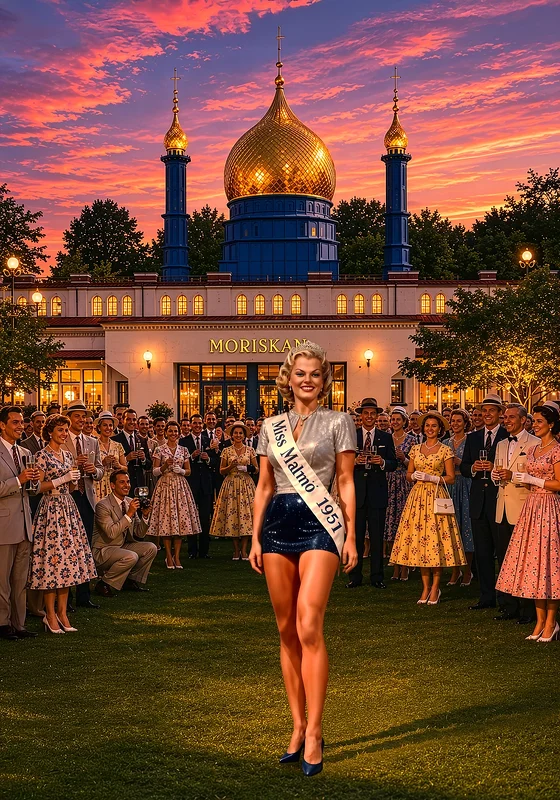
A young blonde woman walks slowly across the grass outside Moriska Paviljongen on a warm summer evening in 1951, while Malmö watches her with collective fascination.
Behind her rise the fantastical golden domes of the Moorish pavilion, glowing beneath a pink Scandinavian sunset like something transported north from an oriental fairy tale. Around her stands a crowd of smiling spectators dressed in post-war elegance floral dresses, white gloves, champagne glasses, cigarettes, summer hats, carefully pressed suits. Sweden has survived the war untouched; optimism hangs in the air, and somewhere beyond the lights of Folkets Park, the future still seems manageable.
Across the young womans chest runs a sash that reads "Miss Malmö 1951".
At the time, she is merely Anita Ekberg from Rostorp, one contestant among several in a local beauty competition held in Malmös great democratic pleasure park. Nobody present can fully grasp that the smiling girl walking towards the photographers will eventually become one of the most recognisable women in world cinema.
Not even Anita herself.
More than seventy years later, she returns to the city as a Time-Traveller, together with Marcello Mastroianni, wandering through Malmö in search of places where memory still clings stubbornly to streets, theatres and old façades. They revisit her childhood home, the Riviera near Gustav Adolf's Torg, where a journalist first noticed her crossing the square, Hippodromen, and finally Folkets Park itself, where the first small crack appeared in the ordinary life of a young Swedish girl who dreamed more of modelling than of acting.
Along the way, they discuss beauty competitions, Hollywood, ageing, glamour, Instagram, mythology, and the strange machinery by which human beings slowly transform one another into symbols.
Perhaps that is what beauty contests really sell in the end.
Not merely beauty. A possibility, but at a price.
"Time Travel in Malmö
We wandered through Malmö beneath the northern summer sky,
Where twilight never fully fades and old dreams never die.
The trams were gone from Gustavs square, the years had drifted on,
Yet somewhere in the evening light, the vanished world lived on.
Past Moriskans golden domes, where laughter filled the air,
Where young girls once wore satin sashes and learned that crowds could stare.
A blonde girl walked through Folkets Park in nineteen fifty-one,
Unaware that the road ahead would lead beyond the sun.
We walked through streets of memory where shadows softly stayed,
Past Hippodromens faded walls and cafés half in shade.
And every stone in Malmö seemed to whisper as we passed
That cities, much like human hearts, are built from layers of the past.
The bars around Lilla Torg still shimmered late at night,
With restless youth beneath the glow of neon, wine and light.
The music changed, the fashions changed, the glowing screens arrived,
Yet hope remained the same old hope that keeps the young alive.
For beauty was not merely crowns nor judges in a row,
But longing for a larger life beyond the life you know.
A wish to leave the narrow streets where destiny feels small,
And hear some distant future softly whispering your call.
We spoke of Rome and Hollywood, of fames relentless flame,
How photographs outlive the flesh yet never quite the name.
How symbols slowly swallow those the world once claimed to love,
Until the stars seem more authentic than the souls thereof.
Yet still the city held her there beside the Baltic sea,
The girl from Rostorp wandering through immortality.
And somewhere through the Malmö night, another girl walked on,
Crossing Gustav Adolfs square beneath the fragile dawn.
Perhaps she, too, was dreaming of a life not yet begun,
Of distant worlds and brighter skies and becoming someone.
And Time itself stood listening while summer shadows curled
For every little city hides a doorway to the world."
Malmö, May 2026
Memories Moriskan 1951
Prologue A travel in time
They had remained by the shore at Skälderviken until dawn.
Not because they were tired. Time-Travellers did not really sleep unless they happened to enjoy the theatre of sleep the softness of sheets, the intimacy of lying beside another body, the illusion of rest. In eternity, there was no biological need for unconsciousness. One could remain awake for centuries if one wished.
But there was something pleasant in pretending to be human for a little longer.
The sea had lain silver-blue beneath the paling sky as fishing boats slipped like shadows beyond the shallows. Anita Ekberg had stood barefoot in the cold sand, her shoes dangling from one hand, her blonde hair stirred by the weak morning wind from the Kattegat. Beside her, Marcello Mastroianni had smoked thoughtfully, watching the horizon emerge from darkness.
For quite some time, neither of them spoke.
Yesterday at Jägersro, the horses, the impossible centaur visions, the champagne, the laughter, and the strange sense that memory itself had briefly seemed more real than history still lingered between them. Afterwards, they had driven north along the coast through sleeping villages until they reached Skäldervikens quiet beauty, where the Scandinavian summer night never truly turned black.
It is strange, Marcello finally said, watching the dawn spread across the water, how Malmö keeps following you everywhere.
Anita smiled faintly.
Because I never escaped it.
Then, as the first gulls began circling above the shore, they turned the car south again and drove back towards the city where everything had once begun.
Chapter 1 Östra Fäladsgatan 29
The first stop had to be the house. There was never any discussion about that.
Before theatres, before photographers, before Rome, before Hollywood, Fellini, fountains, gossip columnists, mink coats, and flashbulbs there had been a modest little family house in Rostorp.
Here, Anita announced with surprising solemnity as the car pulled to a halt. Östra Fäladsgatan 29.
Marcello looked out through the windscreen.
The building stood quietly beneath the slightly pinkish Malmö morning, like thousands of other modest middle-class family homes built in the Swedish interwar years: sturdy brickwork, practical windows, sensible balconies, nothing remotely cinematic about it.
He tilted his head.
One expected something a little more dramatic.
Anita gave him a sharp look.
What did you expect? Versailles?
Marcello shrugged.
You became Anita Ekberg. One imagines at least a marble staircase.
You Italians always need ruins and marble columns before you can take history seriously.
Marcello pointed toward the building.
It does look solid.
People built properly back then.
Like the Colosseum, he said dryly.
Anita turned toward him instantly.
Marcello. The Colosseum is falling apart. My childhood home is not.
He burst out laughing.
The truth was that very little had changed.
That surprised him.
The Malmö Anita described from the late 1940s often sounded impossibly distant from the modern world: trams rattling through the city, dance halls crowded with sailors and factory workers, and strict Lutheran respectability mingling with growing postwar optimism. Yet the small house itself remained stubbornly ordinary, as though history had happened elsewhere.
Anita stepped out of the car slowly, then stood, looking up at the windows.
For years, she said quietly, I thought this was the centre of the universe.
And now?
She smiled faintly.
Now I know the universe is much larger. But strangely enough this place still matters.
A cyclist passed them without recognising either of them.
The two Time-Travellers enjoyed moments like this.
No paparazzi.
No headlines.
No mythology.
Only two immortals stood outside a small house in Malmö while the city continued with its morning routines.
Anita walked a few steps along the pavement.
When I was a child, she said, I did not dream about becoming an actress.
No?
As a teenager, I wanted to become a model. That seemed glamorous enough.
And less dangerous than cinema?
Far less dangerous, she said. Film turns people into ghosts.
Marcello considered it. She was probably right.
The modelling world first opened to her through local photographers, fashion shows, number-girl appearances, and small beauty competitions. Even before the famous Fröken Malmö contest, Anita already understood something essential about cameras: they rewarded confidence long before they rewarded perfection.
She could already pose, Anita said. That surprised people later. But by then I had practised for years.
Ah, yes, Marcello smiled. The terrible burden of being naturally photogenic.
She ignored him.
My mother understood before anyone else.
Her voice softened slightly at the mention of Alvah.
Most respectable middle-class Swedish mothers of the period would have considered beauty contests scandalous or vulgar. Nice girls did not parade in tight sweaters and black shorts before strangers.
But Alvah Ekberg had been unusually modern.
She supported me completely, Anita said. Not because she wanted fame herself. She thought my life should be bigger than Malmö.
Marcello lounged against the car.
A dangerous idea.
Yes, Anita replied. She was absolutely right.
For a moment, they stood in silence as sunlight crept slowly across the façades.
Then Marcello glanced toward the street ahead.
So, he asked, where does the grand nostalgic pilgrimage go now?
Anita smiled.
To the Riviera.
Chapter 2 The Riviera
Riviera!? exclaimed Marcello Mastroianni as Anita steered the old car deeper into Malmö. Are you taking me back to my native country? That is quite a long drive in this ancient car. I thought you wanted a nostalgic day in Malmö.
Anita laughed loudly.
You silly man! Obviously, we are not driving 2,500 kilometres across Europe. In Malmö, we also have a Riviera.
Marcello looked deeply suspicious.
You Scandinavians are always stealing southern names. Riviera, Bellevue, California. Soon you will claim Naples belongs to Sweden.
Only the attractive parts, Anita replied calmly.
The car rolled slowly towards Gustav Adolf's Torg beneath a morning sky turning increasingly blue. Malmö had changed enormously since Anitas youth, yet certain things remained strangely untouched by time. The squares geometry still felt familiar to her. The wide open space. The movement of people crossing diagonally in all directions. The department stores. The impatient cyclists. Even the light itself seemed unchanged that particular cool Nordic brightness that Italian cinematographers always struggled to imitate.
There, Anita said, pointing towards the southern side of the square. That stretch used to be called Rivieran.
Marcello stared ahead through the windshield.
That?
Yes.
It looks less like Monte Carlo and more like a place where accountants buy shoelaces.
That, Anita replied proudly, is because Italians confuse glamour with geography.
Marcello smiled.
And Swedes confuse geography with optimism.
They parked near the square and continued on foot.
In Anitas youth, the place had been one of Malmös fashionable meeting places cafés, elegant shop windows, people strolling simply to see and be seen. In the years immediately after the war, Sweden had escaped the physical destruction that had engulfed much of Europe, and a strange mixture of restraint and optimism hung in the air. Malmö was still a working city of shipyards, factories, trams, sailors, office clerks and dance halls, but modernity was beginning to arrive.
And somewhere in the middle of that transformation, a tall blonde girl from Rostorp had suddenly appeared.
It happened almost exactly here, Anita said quietly.
Marcello looked around theatrically.
A miracle?
A journalist.
Ah, yes. Often more dangerous.
She nodded toward the square.
Rune Ernestad.
Marcello vaguely recognised the name from Anitas stories. A journalist, talent scout and enthusiastic hunter of beautiful women, working in the magazine world surrounding the Fröken Sverige competitions.
He was here, trying to recruit more contestants for the Malmö final at Folkets Park, Anita explained. Apparently, too many girls had become nervous and withdrawn.
A wise instinct.
I was walking across the square when he spotted me.
Marcello folded his arms.
And naturally, he immediately recognised future international stardom.
Something like that.
What exactly were you wearing?
Anita smiled faintly.
I honestly do not remember.
That means it must have been effective.
She ignored the comment. She understood that he was thinking of a tight-fitting pullover.
The funny thing is that I was not interested at all. I thought the whole thing sounded ridiculous.
And yet you became Anita Ekberg.
Yes. But first I went home.
Marcello laughed.
You rejected destiny?
For several hours.
She explained that Ernestad had approached her with the polished confidence of a man who had spent half his life persuading uncertain young women to enter beauty competitions. Anita had listened politely, remained deeply sceptical, and walked away.
Then, later, she reconsidered.
Not because she dreamed about Hollywood.
She didnt. Not yet.
At that point, the dream was much smaller and much more Swedish.
Modelling.
Fashion photography.
Perhaps travelling abroad.
Perhaps escaping Malmö for a little while.
When people later wrote about me, Anita said, they often pretended I had always dreamed of becoming a movie star. That is nonsense.
What did you dream about?
She looked across the square.
Freedom.
That answer silenced even Marcello for a moment.
Buses moved around the square while modern Malmö carried on, unaware of the two Time-Travellers standing quietly near the spot where an accidental encounter had altered an entire life.
Anita resumed walking.
By then, I already knew how to pose, she said. That surprised many people later.
You practised?
Of course, I had already worked with photographers, including Georg Oddner. He became internationally well known before me. I understood cameras long before Hollywood.
Marcello nodded approvingly.
That is true. Most actors never understand cameras at all.
Anita smiled.
There is a difference between being looked at and understanding how people look at you.
That, Marcello admitted, is a very dangerous form of intelligence.
As they crossed the square, Anita continued to describe the atmosphere of the early 1950s. Sweden liked to remember itself as modern and progressive, yet beauty competitions still left many respectable people deeply uncomfortable.
Nice middle-class girls were not expected to appear in public wearing tight sweaters and black shorts while strangers evaluated their appearance from a stage.
At the time, Anita said, many people considered beauty contests almost scandalous.
Marcello raised an eyebrow.
And today?
Today, the same middle class posts identical photos of their daughters on Instagram.
Marcello burst out laughing.
Yes, he admitted. Human hypocrisy endures every generation.
Anita slowed as they approached the old commercial buildings near Kalendegatan.
My mother never thought it was shameful, she said quietly. That mattered a great deal.
Alvah Ekberg had supported her daughter from the start, unlike many parents of the era who feared scandal or gossip. During the Fröken Malmö competition, she had even joined the crowd cheering for Anita.
She wanted life to become bigger, Anita said. Bigger than fear. Bigger than gossip. Bigger than Malmö.
Marcello glanced at her.
And did it?
Anita looked ahead towards the old streets of the city centre.
Oh yes, she said softly. Far larger than anyone had expected.
Chapter 3 Kalendegatan and Hippodromen
They continued westward through the older parts of the city as the morning slowly ripened towards noon.
Kalendegatan still bore traces of another Malmö beneath the modern storefronts and renovated façades. Here and there, older brickwork survived like fragments of memory pushing through the decades. Anita walked more slowly now, occasionally stopping without explanation, as though certain corners still held invisible echoes audible only to her.
Marcello followed, his hands in the pockets of his light summer coat.
You become quieter here, he observed.
This part of the city remembers things.
That sounds ominous.
Italian cities are full of ghosts. Malmö merely hides them more effectively.
They reached Hippodromen, and Anita stopped.
There, she said softly.
Marcello looked upward.
The old building still bore traces of faded grandeur: ornate details, theatrical proportions, and the slightly melancholic dignity common to theatres that had survived several eras without entirely belonging to any of them.
It was a variety theatre then, Anita explained. Now it belongs to Malmö City Theatre. For a while, the Pentecostal movement owned the house, and it was a church. I think it was a mark of the Pentecostal friends to transform a den of sin where young girls danced in almost nothing. I suppose that, as a theatre, it is almost as bad in the eyes of many religious people."
Marcello studied the façade thoughtfully.
All theatres eventually become nostalgic.
Anita smiled faintly.
That is because theatre disappears the second it happens.
And cinema?
Cinema survives, she said. Unfortunately.
Marcello laughed quietly.
Ah, yes. Eternal youth projected twenty metres high.
Exactly. Theatre allows people to age naturally, whereas film preserves them like insects trapped in amber.
For a moment, both of them fell silent.
No one understood that better than Anita Ekberg.
All over the world, she still existed eternally within La Dolce Vita blonde, magnificent, laughing in the waters of the Trevi Fountain as Rome shimmered around her like a dream. Millions remembered that woman. Very few remembered the human being who had continued to live afterwards.
Marcello glanced sideways at her.
You know, he said gently, most actresses would kill for immortality.
Yes, Anita replied. Until they realise immortality means staying thirty forever while your soul continues to age.
A tram no longer rattled past Hippodromen as it once had. The silence felt strange to Anita.
In those days, she continued, this part of Malmö was alive with theatres, revues, dance halls, musicians, travelling performers People wanted glamour after the war. They wanted a distraction.
And beautiful women.
Especially beautiful women.
Marcello nodded approvingly.
At last, Sweden enters civilisation.
She rolled her eyes.
At Hipp, people sang, danced, performed comedy, flirted, drank too much, fell in love for one evening, and regretted it all the next morning. Entire lives passed through places like this.
And you?
I was still standing at the edge of everything, Anita said. Not yet famous, just another girl trying to become visible.
She described the strange world surrounding the entertainment industry of the late 1940s and early 1950s: number girls, travelling fashion models, dance orchestras, local photographers, beauty competitions and revue culture, all blending into a half-glamorous, half-improvised universe.
For ambitious young women, it could feel intoxicating.
And dangerous.
You must understand, Anita said. Sweden was still very respectable then. Officially respectable, at least.
Marcello smiled knowingly.
Which usually means privately hypocritical.
Exactly.
A girl could appear on stage in a swimsuit before hundreds of strangers and still be expected to remain pure, modest and respectable afterwards. Society admired glamour while simultaneously distrusting the women associated with it.
The contradiction never disappeared, Anita continued. People wanted beautiful women but they also wanted those women punished for being beautiful.
Marcello looked impressed.
That is a remarkably Catholic observation for a Lutheran country.
She laughed.
Beauty always makes societies nervous.
As they resumed walking, Marcello glanced at the younger people passing them on the street in fashionable clothes, wearing expensive trainers, with phones constantly glowing in their hands.
And now? he asked. Has the world become wiser?
Anita snorted.
Now everyone carries a permanent beauty competition in their pocket.
She pointed toward a young influencer posing outside a café while her friend adjusted the camera angle.
There. Same performance. Same anxiety. Same desire to be admired.
But democratised.
Yes, Anita replied. That is the difference. In my day, perhaps twenty women stood on a stage in Folkets Park while a jury judged them. Now, millions judge each other constantly.
Marcello watched the girls photographing themselves.
And the judges are algorithms.
Much crueller than any beauty pageant jury.
They reached the corner near Hippodromen once again and paused beneath the old theatre façade.
You know what is funny? Anita suddenly said.
What?
Today, people pretend that beauty contests were uniquely degrading.
Marcello raised an eyebrow.
You disagree?
I think modern culture simply found more efficient ways to do the same thing.
That answer lingered between them for several moments.
Then Marcello smiled slowly.
You are becoming philosophical in your old age.
My dear Marcello, Anita replied. Time-Travellers do not have ages.
He bowed slightly.
Forgive me. I forgot.
Chapter 4 Folkets Park
They eventually returned to the car parked near the older streets in the city centre.
The vehicle itself looked almost absurd as it moved through modern Malmö long, elegant, slightly excessive, like a survivor from another civilisation. People occasionally turned their heads as it passed. Not because they recognised its occupants, but because the automobile carried an unmistakable aura of another era.
Marcello leaned back comfortably in the passenger seat.
So now we finally arrive at the sacred birthplace of Swedish glamour?
Anita smiled as she steered towards Folkets Park.
Do not exaggerate. It was essentially a beauty contest beside beer stands and dance pavilions.
That, Marcello replied solemnly, is how most civilisations begin.
The park looked greener than Anita remembered.
Or perhaps quieter.
In the decades after the war, Folkets Park was one of Malmös great social worlds: concerts, lotteries, political speeches, dances, rides, and summer evenings filled with cigarette smoke and accordion music. Workers, sailors, office girls, factory boys, pensioners, children the entire city had passed through the park at one time or another.
And somewhere in the midst of ordinary life, a young woman in black shorts had unexpectedly become the future, Anita Ekberg.
They walked slowly along the paths.
It happened over there, Anita said, pointing towards an open area near one of the old gathering spaces. The Fröken Malmö final.
Beyond the trees rose the fantastical silhouette of Moriska Paviljongen, with its oriental domes, towers, and strange, dreamlike architecture, standing in Folkets Park since the beginning of the twentieth century. Built as a pleasure palace for Malmös workers, the old Moorish pavilion looked less like Scandinavia than something transported north from an operetta set in Cairo or Damascus. Even in Anitas youth, the building already carried an atmosphere of faded exotic glamour part dance hall, part fantasy, part political folk-park romanticism.
Marcello looked around theatrically.
I expected something grander.
It looked grand when you were twenty.
That applies to many things.
Anita laughed quietly.
For a moment, she seemed genuinely transported back in time.
The audience.
The lights.
The orchestra music.
The nervous contestants pretend not to be nervous.
The smell of perfume mixed with beer and summer dust.
And somewhere in the crowd sat her mother, Alvah, cheering louder than anyone.
My mother was absolutely impossible, Anita said affectionately.
Marcello smiled.
Stage mothers usually are.
No, not like Hollywood mothers. She was not ambitious for herself. She enjoyed life immensely.
That is rarer.
Anita nodded.
She thought the whole thing was exciting, glamorous, and slightly outrageous.
And your father?
She burst out laughing.
My father barely understood what was going on.
Marcello could immediately picture it: respectable Swedish fathers in the early 1950s driving their daughters to beauty contests, remaining politely confused about the whole concept.
He drove me here, Anita continued. Completely unaware that his daughter was about to become a national sex symbol.
Marcello applauded softly.
A magnificent piece of Scandinavian innocence.
They sat briefly on a bench beneath the trees.
Anita became quieter now.
At the time, she said, many people considered beauty competitions improper.
Marcello looked surprised.
Even in Sweden?
Especially in Sweden. Respectability was very important then.
A respectable girl was expected to behave modestly, speak carefully, avoid attracting undue attention, and certainly not display herself publicly before male judges.
Yet at the same time, newspapers, magazines, and advertisers were becoming increasingly obsessed with glamour, modern femininity, and idealised beauty.
It was contradictory from the beginning, Anita said. Society wanted attractive women, but became nervous whenever women recognised the power of attractiveness.
Marcello nodded slowly.
Yes. Men prefer beauty, slightly unconscious of itself.
Exactly.
A few younger visitors passed them without recognising either of them.
That still amused Anita sometimes.
Once, photographers had followed her through airports, restaurants and film premieres across Europe and America. Now she could sit quietly in the very park where her public life had begun, while students walked past, carrying takeaway coffee, without the faintest idea who she was.
Time eventually defeated all fame except mythology.
And yet, Marcello said carefully, you do not regret it.
Anita looked toward the trees moving gently in the wind.
No, she admitted after a while. Because the contest changed everything.
That was the uncomfortable truth beneath all later political arguments.
Without Miss Malmö, there would likely have been no Miss Sverige.
Without Miss Sweden, no America.
Without America, no Hollywood.
Without Hollywood, perhaps no Fellini.
Without Fellini, no Trevi Fountain.
Without the fountain, no Anita Ekberg as the world remembered her.
And without Anita Ekberg, just one fountain among many.
An entire international myth had emerged from a summer evening in Folkets Park.
It opened the door, Anita said quietly. That is what people forget.
Marcello leaned back slightly.
And what did the door lead to?
Anita smiled faintly.
Everything.
For a moment, neither of them spoke.
Then Marcello suddenly asked:
Tell me honestly. Did you enjoy winning?
Anita looked at him as though the answer were obvious.
Of course I did.
Ah, he said triumphantly. At last some honesty.
She laughed again.
Why should I pretend otherwise? I was young, ambitious and beautiful. Winning felt wonderful.
And terrifying?
Yes, she admitted. Suddenly, people looked at me differently.
How? The boys must have been watching you all the time," Marcello said, eyeing her from head to toe. "We boys still do," he added, grinning.
She considered the question carefully, but did not comment on his remark.
As if I had ceased to be entirely human and become symbolic.
Marcello understood immediately.
Cinema did the same thing.
Once audiences transformed a person into an image, the image slowly began to devour the person beneath it.
A breeze moved through the park.
Not far away, children were laughing.
And above the ordinary sounds of modern Malmö floated the invisible ghost of another evening long ago, when a young woman first discovered that beauty could be both a liberation and a cage.
Chapter 5 From Folkets Park to the Trevi Fountain
When they finally left Folkets Park, the afternoon light had begun to soften above the city.
Malmö drifted past outside the car windows: bicycles, buses, cafés, construction cranes, students with backpacks, office workers already thinking about dinner. The city looked younger now than it had in Anitas youth, strangely enough. Modern cities often did. They underwent cosmetic surgery every decade, while older generations quietly disappeared beneath the renovations.
Marcello rested one arm against the open window.
So, he said, after Folkets Park came America.
Anita smiled faintly.
You say that as if it were the most natural thing in the world.
For you, it eventually became natural.
No, she replied. It never felt natural. That was part of the problem.
Traffic slowed near a crossing. For a few moments, neither of them spoke.
Then Anita continued quietly:
Winning Fröken Sverige changed everything almost immediately. Suddenly, people who had ignored you your entire life began to behave as though you were important.
Marcello nodded knowingly.
Beauty is perhaps the only passport recognised by every country in the world.
Yes, Anita said dryly. Unfortunately, it expires.
He laughed softly.
After the national competition came America, with photographers, magazine interviews, modelling contracts, and finally the machinery of Hollywood itself, but unlike the myths later invented by journalists, the transformation had not happened overnight.
There had been auditions.
Embarrassing screen tests.
Minor film roles.
Awkward parties.
Producers are attempting to redesign her personality.
Acting lessons delivered by men who barely understood acting themselves.
And a lot of people drooling over her body.
They wanted Scandinavian ice, Anita said. But preferably with large breasts.
Marcello looked thoughtful.
A difficult artistic balance.
Oh, they managed heroically.
She described 1950s Hollywood as a strange blend of industrial efficiency and organised fantasy. Young actresses were discovered, reshaped, photographed, renamed, publicised and discarded with alarming speed.
Sometimes, Anita admitted, the beauty contests felt almost more honest.
Marcello looked genuinely surprised.
Really?
At least everyone understood the transaction.
That sentence hung heavily in the car.
Outside, Malmö continued sliding past in fragments of old and new architecture.
When did you first realise you had become famous? Marcello asked.
Anita thought for several moments.
Not in America, she finally said. Americans are obsessed with fame. That atmosphere becomes unreal very quickly.
True.
It happened later, in Europe, after Fellini. And you, of course.
Marcello smiled in silence at the mention of Federico Fellini.
Ah, yes, he murmured. The magician.
They both fell silent again.
Everything changed after La Dolce Vita.
Not merely success.
Transformation.
Before the film, Anita Ekberg was a glamorous actress known mainly for her beauty, publicity, and Hollywood spectacle. Afterwards, she became something else entirely an international symbola cinematic apparition, suspended forever in black water beneath Roman moonlight.
And beside her stood Marcello himself.
You know, he said after a while, people still talk about that fountain scene as if it were real history.
It is real history.
No, Marcello replied softly. It is mythology.
Anita smiled.
Perhaps he was right.
The strange thing about cinema was that fictional moments sometimes endured longer than real human experiences. Millions of people remembered Anita Ekberg stepping into the Trevi Fountain. Very few remembered elections, treaties or governments from the same year.
That fountain changed Rome, Marcello continued.
It changed tourism.
It changed fantasy.
She laughed softly.
Before the film, it was merely one magnificent fountain among many in Italy.
And afterwards?
Afterwards, every tourist in the world suddenly wanted to stand exactly where you and I stood.
Marcello smiled.
That is power.
No, Anita corrected him quietly. That is imagery.
"I hope they don't freeze as I did. In addition, they risk ending up in prison. It is now forbidden to bathe in the fountain." Marcello shuddered at the memory.
"Well, you got drunk as a jack of all trades when you tried to warm yourself with whiskey."
"Also, a cheap one that a cameraman had brought along."
The car stopped briefly at a red light.
Outside, two teenage girls passed by, taking selfies together with practised precision, adjusting angles instinctively before photographing themselves again.
Anita watched them carefully.
You see? she said.
Marcello glanced outside.
The modern beauty contest.
Exactly.
No jury.
No stage.
No Folkets Park.
Only millions of invisible spectators are permanently connected via screens.
At least in my day, Anita said, you could leave the stage when the evening was over.
Marcello nodded slowly.
Now the performance never stops.
The light changed.
They continued driving through Malmö as the late-afternoon sunlight fell softly across the city's windows.
Then Marcello suddenly smiled to himself.
What?
I was just recalling something you once told journalists.
Anita groaned immediately.
That sounds dangerous.
You said I was slightly afraid of you.
Marcello laughed.
You were.
Rubbish.
You were taller than half the men in Italy and stronger than most of them.
Anita burst into laughter.
That part may actually be true.
Marcello turned toward her with theatrical seriousness.
You arrived in Rome like a Viking invasion, wrapped in Dior.
She laughed so hard she briefly had to slow the car.
And for a moment just a brief moment they no longer seemed like immortals wandering through memory. They were simply two old friends sharing laughter inside an ageing car as Malmö drifted quietly around them.
Chapter 6 Why Beauty Contests Died
They eventually left the city centre behind and drove slowly along the canals as evening settled over Malmö.
The light had begun to take on that peculiar Scandinavian softness, which seemed to dissolve hard edges rather than sharpen them. Water reflected pale gold beneath the bridges. Restaurant terraces gradually filled with people drinking wine beneath blankets, despite the mild summer temperature. Somewhere distant, a gull cried above the harbour.
Marcello lit another cigarette.
So, he said, when exactly did the world decide that beauty contests were immoral?
Anita smiled faintly.
The world never decides anything all at once. It simply becomes embarrassed slowly.
That sounds very Swedish.
It probably is.
The car rolled quietly onward.
For a while, Anita watched the city pass by outside before continuing.
When I was young, beauty contests embodied modernity. Glamour. Internationalism. Escape. Girls from ordinary towns suddenly imagined bigger lives.
And now?
Now, people mostly hear the word objectification.
Marcello nodded thoughtfully.
He understood the transformation perfectly. During the second half of the twentieth century, beauty itself had become politically complex in a way previous generations barely understood.
Or perhaps beauty had always been complicated. Only now were people discussing it openly.
The criticism was not entirely wrong, Anita admitted. Many competitions were shallow. Some organisers treated girls terribly, and some contestants were cynically exploited.
Marcello looked amused.
That description also applies to most film studios.
Yes, Anita laughed. Exactly.
They passed older industrial areas, now transformed into modern apartments and glass offices.
Cities reinvented themselves the same way ageing actresses did: carefully, expensively, and never entirely convincingly.
The strange thing, Anita continued, is that the competitions themselves tried desperately to survive. Every decade, they reinvented themselves a little more. Suddenly, married women were allowed to compete. Then mothers. The organisers began speaking less about measurements and more about personality, education, charity work, social engagement, environmental causes everything except the one thing the audience still secretly came to look at.
Marcello smiled faintly.
And still people lost interest, Marcello observed.
Yes.
Why?
Anita considered the question carefully.
Because modern audiences no longer trust simplicity.
He turned toward her.
What does that mean?
In the 1950s, a beauty contest openly acknowledged what it was doing. A jury assessed attractive women and selected a winner. Crude, perhaps but honest.
And now?
Now, society performs the same rituals while pretending they are about empowerment.
Marcello burst out laughing.
That may be the most ruthless thing you have said all day.
She shrugged.
Instagram is essentially an endless global beauty contest, judged by invisible drooling strangers.
And unlike Folkets Park, Marcello added, the contestants never leave the stage.
Exactly.
Anita believed that explained much of modern anxiety.
In earlier decades, beauty at least remained partly local and temporary. A contest lasted one evening. A magazine photograph faded within a week. A model aged out of fashion and disappeared quietly.
But digital culture transformed appearance into a permanent public performance.
Young people now live under constant surveillance.
You know what would terrify me if I were young today? Anita asked.
What?
The fact that nobody is allowed to return to ordinary again.
Marcello became unusually serious.
Yes, he admitted softly. That is true.
The car slowed near the water.
Lights from restaurants shimmered across the canal as bicycles crossed nearby bridges like shadows.
Anita suddenly smiled to herself.
What?
I was thinking about those old competitions in the 1920s.
The ones measuring women like racehorses?
Yes, she laughed. Imagine introducing that today.
In the early twentieth century, many Scandinavian beauty contests blended glamour with bizarre pseudoscientific ideas about racial purity, ideal Nordic measurements, and healthy national beauty. Newspapers published body measurements alongside photographs, as though female attractiveness could be calculated mathematically.
Human beings become very dangerous whenever they try to turn beauty into science, Anita said quietly.
Marcello nodded.
Yet beauty itself survives every ideology.
Yes.
That may have been the real reason beauty contests became unfashionable: not because human beings stopped worshipping beauty, but because modern society no longer liked admitting how much it still did.
The car finally stopped near the water.
For a moment, neither moved.
Then Marcello smiled faintly.
So after all these philosophical discussions, tell me honestly
Anita sighed theatrically.
That sentence is always dangerous.
If a beautiful eighteen-year-old girl asked for your advice today, would you tell her to enter a beauty contest?
Anita looked out across the darkening canal for a very long time before answering.
Finally, she smiled.
I would tell her to understand the difference between using beauty
She turned slightly toward him.
and allowing beauty to use her.
Chapter 7 Malmö by Night
Night had fully settled over Malmö by the time they left the canal. They drove to Västra Hamnen to park the car near Sundspromenaden.
This part of the city no longer resembled the Malmö Anita remembered from the early 1950s. Kockums shipyard cranes had all gone. The old industrial smoke had vanished. New glass buildings reflected the harbour lights, while expensive apartments rose where dockworkers and factory labourers once stood, drinking coffee from thermoses at dawn. Nor could you go by boat to Copenhagen any more, "tura" as the people of Malmö called it when you went back and forth to buy groceries cheaply, which you could in Denmark at that time. Anita loved to take the trip with her mother because she got fish fillet and Citronvann (lemon water), a Danish soft drink.
Yet the city still carried the same strange mixture of modesty and ambition. Malmö had always wanted to become something slightly larger than itself, rather like Anita.
Marcello lowered the car window as they drove slowly toward the waterfront.
The air smelled faintly of saltwater and summer asphalt still warm from the days heat.
You know, he said quietly, something is amusing about all this.
What?
You spent an entire day explaining why beauty contests disappeared
Anita smiled faintly.
while still looking like the woman who won them.
She laughed softly.
My dear Marcello, eternity is extremely flattering to former actresses.
No, he replied. It is flattering to mythologies.
That word returned.
Mythology.
Perhaps that was what remained after enough decades had passed. Not ordinary fame, nor even celebrity, but something stranger a symbolic afterlife in which human beings slowly ceased to be entirely human and instead became stories the world continued to retell long after reality itself had faded. Anita Ekberg had gradually become an image suspended between cinema and mythology: the blonde woman standing in the Trevi Fountain beneath Roman nightfall, the impossible Scandinavian beauty who arrived in Italy like a giant northern apparition and conquered Rome simply by being there. Over time, the symbol had almost devoured the person behind it.
Very few people still remembered the uncertain young woman crossing Gustav Adolf's Torg, wondering whether entering a local beauty competition might lead to something slightly more interesting than ordinary life in Malmö.
Anita drove in silence for a while before speaking again.
You know what people misunderstand about beauty?
Marcello turned slightly toward her.
What?
They think beautiful women spend their entire lives feeling admired.
And they do not?
She shook her head slowly.
No. Most spend their lives feeling observed.
That sentence remained suspended inside the car.
Outside, the harbour lights shimmered against the dark water.
Observation becomes exhausting eventually, Anita continued quietly. Especially when people begin confusing appearance with identity.
Marcello nodded.
Yes. Audiences rarely forgive symbols for becoming human.
Exactly.
For a moment, both of them drifted backwards through memory again.
Rome, Marcello said quietly.
The photographers, Anita added.
The premieres.
The journalists.
The damned flashbulbs exploding every five seconds like artillery fire.
Marcello laughed softly.
Men staring at you as though civilisation itself might collapse if you disappeared.
And women examining every wrinkle, every kilogram, every dress.
The producers are calculating profits while pretending to discuss art.
The fans, Anita said more quietly now, falling in love with fantasies they projected onto strangers.
Silence settled briefly inside the car.
The machinery of glamour has always demanded sacrifices, said Anita, but she did not sound bitter.
Only thoughtful.
Still, Marcello said carefully, you never entirely rejected that world.
No, Anita admitted. Because it gave me my life.
That was the contradiction she could never honestly deny. Beauty contests had been superficial, sometimes exploitative, and occasionally absurd.
But they had also opened doors that otherwise would have remained permanently closed to a girl from Malmö. Without them, she might never have seen America, never have worked with Fellini, and Kerstin might never have become Anita Ekberg.
And besides, she added with sudden amusement, human beings have always organised ridiculous competitions.
Marcello smiled.
True.
People compare horses, dogs, flowers, wine, tomatoes, opera singers, and bodybuilders
She shrugged lightly.
So why not girls?
Marcello burst out laughing.
There it is again. Your famed Scandinavian pragmatism.
No, Anita replied. Merely honesty.
The car finally pulled up near the dark water.
Far away across the Öresund, faint lights from Denmark flickered beneath the night sky.
For minutes, neither of them moved.
Then Marcello spoke softly:
So after everything do you think the world has changed?
Anita looked out towards the water before answering.
Yes, she said eventually. Women have changed.
And men?
She smiled faintly.
Men mostly changed their vocabulary.
Marcello laughed so hard he nearly dropped his cigarette.
Then silence returned once more. A peaceful silence this time.
Two aged immortals sitting in an ageing car at the edge of Malmö after a long, nostalgic pilgrimage through memory, beauty, fame and time itself.
Finally, Anita leaned back comfortably and closed her eyes for a moment.
Not because Time-Travellers needed sleep.
But sometimes even immortals enjoyed resting in old memories before returning to eternity once more.
Epilogue The Girls Still Crossing the Square
Later that evening, they left the car behind and continued on foot through the older parts of central Malmö known as Old West.
Around Lilla Torg, the restaurants and bars were packed. Summer evenings always transformed the square into something strangely continental by Scandinavian standards. Outdoor tables crowded the cobblestones beneath strings of lights. At the same time, music drifted between the façades, accompanied by bursts of laughter, clinking wine glasses, and the low, endless murmur of young people talking about futures that still seemed limitless.
Marcello slowed slightly and looked around with visible approval.
At last, he announced, your city is beginning to behave like Europe.
Anita laughed.
Malmö has always wanted to be continental, sometimes rather desperately.
Young women passed them in elegant summer dresses, oversized jackets, super-high heels, trainers, black leather, glittering jewellery, vintage fashion, expensive make-up and carefully careless hair. Young men tried to project confidence with varying success, pretending not to stare too obviously.
The entire square vibrated with performance, and strangely enough, Anita felt unexpectedly at ease there.
Strolling around Lilla Torg, among the cafés, bars and restless young people, Anita was faintly reminded of the old Malmö she remembered from dance halls, folk parks and summer evenings long before Hollywood had entered her life. Not literally, of course. The music was different. The clothes were different. The rituals of courtship had migrated to smartphones and glowing screens. But the underlying energy remained recognisable.
Half the world seems to be there. The advantage of being a Time-traveller is that you understand all languages because you listen to the thoughts that guide speech.
"Yes, it's quite practical, but I've got the impression you meet a lot more people among the stars," Marcello said, though he didn't sound jealous. He preferred Italians because they had been capturing the day for thousands of years. That habit was deeply ingrained."
"We women tend to do that." After a while, Anita stopped counting.
"I don't understand that you have the patience."
I reached thirty-two languages before giving up, she said, amused.
Marcello looked around the crowded square.
You can actually distinguish them all?
My dear Marcello, its no news to you that we Time-Travellers do not really hear language the way ordinary humans do.
He smiled.
Ah, yes. One of eternitys unfair advantages.
Anita nodded.
In eternity, everyone who has ever lived eventually encounters everyone else. After enough centuries, you begin recognising patterns beneath language itself.
Marcello lit another cigarette while they continued slowly through the crowd.
I know, but it sounds suspiciously philosophical.
It is actually very practical, Anita replied. Human beings think before they speak. The words merely translate thought into sound.
And therefore?
And therefore meaning survives even when language changes completely.
She searched briefly for an example.
It is a little like Chinese writing. A person in Beijing and a person in Hong Kong may pronounce a character differently, but both understand the underlying idea. In eternity, it functions similarly. When someone wishes to say the word chair, they think of a chair first. Speech becomes the visible surface of thought.
Marcello laughed softly.
So theoretically you could speak with anyone who ever existed?
More or less.
A Roman centurion?
Yes.
A Viking?
Several. Most of them drank too much.
A Neanderthal?
Anita smiled.
Yes, although that requires patience. They had no word for chair sixty thousand years ago. So if you need to sit down, they assume you sit with your legs crossed on the floor. A bit hard on my old joints, Anita laughed.
Marcello burst out laughing.
A tragic limitation.
But after enough time in eternity, Anita continued, people learn from one another. You must have noticed. Cultures mix, and knowledge accumulates. Even very ancient humans gradually come to understand concepts that never existed in their earthly lives.
I havent thought much about it, but Ive only been in eternity for thirty years." Marcello looked genuinely fascinated.
You should, because it makes life run more quickly in eternity.
You know, he admitted, this may be the first truly convincing argument for immortality.
Anita smiled mysteriously.
Oh, it becomes stranger than that.
They slowed near one of the outdoor restaurants as younger people laughed around glowing candles and wine glasses.
A few months ago, Anita continued, I experienced something extraordinary.
Marcello immediately looked suspicious.
With you, that sentence usually involves mythology, astronomy or excessive amounts of champagne.
All three occasionally.
She glanced upward toward the dark Scandinavian sky.
I attended a chamber concert on a small sun in the central solar system.
Marcello blinked once.
A sentence impossible to hear as ordinary conversation.
A mixed ensemble spanning different historical periods performed several of Antonio Vivaldis flute concertos. He was there, by the way.
Marcello looked delighted already.
Now this sounds promising. I love Vivaldi.
There were musicians from many centuries sitting together. Baroque violinists sat beside a twentieth-century viola player and a cellist born during the Abbasid Caliphate. A harpsichord player from eighteenth-century Venice complained endlessly about modern tuning systems.
And Vivaldi himself?
Playing first violin.
Marcello stopped walking.
Of course he was.
Anita smiled faintly.
They performed La Tempesta di Mare, La Notte and Il Gardellino.
The storm, the night and the goldfinch, Marcello translated softly.
She nodded.
The remarkable thing about music in eternity is that distinctions begin to dissolve. Nationality, time periods, religion, culture and language. Everything dissolves into the music itself.
Marcello listened quietly now.
The orchestra accompanied the flute soloist almost conversationally, Anita continued. The strings answered her phrases, the harpsichord filling the harmony beneath them. And suddenly I realised nobody present cared whether the musicians came from ancient Rome, Renaissance Venice, or twentieth-century Buenos Aires. They listened.
And the soloist? Marcello asked.
Anita smiled strangely to herself.
She was extraordinary.
Famous?
In a manner of speaking.
They continued walking slowly past crowded terraces and glowing restaurant windows.
Her name was Lucy.
Marcello frowned slightly.
Lucy who? The Blind Lucy? But she's still alive on Earth, so she can't be. I've seen her on CableVision, one of our thousands of cable networks."
"The Lucy!" Anita said emphatically.
The Lucy?
Yes.
For perhaps the first time that evening, Marcello looked genuinely speechless.
You are telling me, he said carefully, that one of humanitys earliest ancestors performed Vivaldi on the flute at a chamber concert on a star?
A rather small sun, Anita corrected him mildly.
Marcello stared at her.
She played the flute?
She died falling from a tree while playing one.
He laughed in disbelief.
That is either magnificent or completely insane.
Both, Anita replied calmly.
Lucy or rather, Dinkinesh, her true name had lived on Earth more than three million years earlier as an early Australopithecus afarensis. The nickname Lucy emerged much later, after the Beatles song "Lucy in the Sky with Diamonds", which was repeatedly played in the researchers camp on the evening her skeleton was discovered.
Dinkinesh, Anita continued softly, means something like you are wonderful in her own language.
Marcello shook his head slowly.
And now she performs Vivaldi.
Yes.
That may be the most beautiful thing I have ever heard.
Around them, the nightlife of Malmö continued to glow beneath the summer darkness as young people laughed, flirted, took selfies and moved endlessly from table to table, bar to bar, and possibility to possibility.
And suddenly, the centuries separating ancient humanity from modern civilisation no longer seemed long at all.
Back to the present and this evening at Lilla Torg. Youth itself had not changed very muchonly the technology surrounding it.
It feels almost familiar, Anita admitted quietly.
Marcello smiled.
You enjoy this.
A little.
You miss being young.
Anita considered it carefully before shaking her head.
No. But sometimes I miss the feeling that everything might still happen.
For a moment, they stood watching the crowd.
At a nearby table, several girls were taking photographs of one another, adjusting poses, angles and lighting with almost professional concentration. One of them immediately rejected the image and demanded another attempt.
Marcello smiled knowingly.
There is your modern beauty contest.
Yes, Anita replied softly. Only now the whole world is the jury.
But she no longer sounded entirely cynical about it. Perhaps because, watching the young women laughing beneath the lights of Lilla Torg, adjusting their dresses, retaking photographs and pretending not to care how they looked to others, she recognised something familiar there not merely vanity or narcissism, as older generations often liked to claim.
What she recognised was hope.
Most girls who once entered competitions like Miss Malmö had never truly been chasing crowns or satin ribbons. What they wanted was possibility. A doorway into another version of life. An opportunity to become visible in a world where ordinary young women so often felt invisible. What they wanted was possibility. Escape. Reinvention. A chance that life might suddenly feel bigger than the streets they already knew by heart.
And perhaps young people still wanted the same thing. Only now they searched for it on screens rather than on stages. They kept crossing the square as night deepened around them. No one recognised them.
Or perhaps a few people vaguely thought the elegant older blonde woman looked strangely familiar, though they could not quite explain why. Time softened even legendary faces. That anonymity pleased Anita more than she expected.
After a while, they began walking back towards Gustav Adolf's Torg again.
The square was quieter now than earlier in the day. Streetlights cast a soft glow on the pavement as late-night buses moved through the city, carrying tired workers, students, lonely souls, and couples heading home together after too much wine.
Then Anita noticed a young blonde girl crossing the square alone. She could not have been older than eighteen, and at least from a distance, she was good-looking.
The girl moved quickly and purposefully, carrying the faint nervous energy of someone heading towards something important perhaps a date, perhaps a party, perhaps merely another ordinary evening that might unexpectedly alter the course of an entire life.
Marcello watched her disappear toward the southern side of the square.
Then he glanced at Anita. She smiled very softly to herself.
Because somewhere in each generation, another young woman was still crossing Gustav Adolf's Torg, still dreaming of becoming someone slightly larger than the life she had been given.
And perhaps that dream itself would never grow old.
PS Beauty Contests, Sweden and the Long History of Being Judged
Beauty contests are far older than people imagine.
Their roots stretch back to ancient mythology and the Judgement of Paris, in which the Trojan prince Paris was asked by Eris, the goddess of discord, to decide which goddess was the most beautiful a decision that ultimately helped ignite the Trojan War. In other words, Western civilisation linked beauty competitions to vanity, politics, desire and catastrophe almost from the very beginning.
By the late nineteenth century, beauty competitions had spread across Europe. The first truly international contest is usually said to have taken place in the fashionable Belgian spa town of Spa in 1888, though participation remained largely confined to upper-class society. Sweden enthusiastically embraced the phenomenon in the same era. As early as 1883, competitions were held in cities including Gävle, Göteborg, Helsingborg, Hudiksvall, Stockholm and Trelleborg, often alongside carnivals, musical events and popular entertainments. Newspapers described them as crowded, noisy and occasionally chaotic.
During the interwar period, the competitions took on a darker tone. Swedish magazines such as Charme combined glamour with pseudoscientific ideas about racial purity, ideal Nordic body measurements and national beauty. Contestants submitted not only photographs but also extensive body measurements, supposedly to help define the perfect proportions of the Swedish race. Healthy skin, athletic bodies and racially pure features became part of a broader nationalist obsession spreading across much of Europe at the time.
The first national Miss Sweden competition emerged in the early 1930s and later evolved into Fröken Sverige, organised in collaboration with Swedens Folk Parks movement from 1949 onwards. That was the world Anita Ekberg entered a curious mixture of postwar optimism, folk-park democracy, commercial glamour and old-fashioned morality.
For decades, beauty contests held a strangely contradictory place in Swedish culture. Society admired beautiful women while distrusting those who understood beautys social power. Respectable middle-class girls were expected to remain modest, yet magazines, advertisers, and photographers constantly sought new female faces to showcase.
By the early twenty-first century, the old format had begun to collapse. Fröken Sverige lost popularity and finally disappeared in its traditional form in 2009. Malmö itself no longer hosts major recurring beauty pageants. Instead, the city now offers fashion expos, beauty fairs, modelling agencies, and social media culture. In this decentralised world, everyone performs continuously rather than briefly stepping onto a stage for one evening.
Perhaps that is the strangest transformation of all.
Beauty contests never truly vanished.
They dissolved into everyday life.
Memories Moriskan 1951
Det börjar med en bild.
En ung blond kvinna promenerar långsamt över gräset utanför Moriska Paviljongen en varm sommarkväll 1951 medan Malmö betraktar henne med kollektiv fascination.
Bakom henne reser sig Moriskans fantasifulla gyllene kupoler, glödande under en rosa skandinavisk solnedgång som något transporterat norrut ur en orientalisk saga. Runt henne står en publik av leende åskådare klädda i efterkrigstidens elegans blommiga klänningar, vita handskar, champagneglas, cigaretter, sommarhattar och noggrant pressade kostymer. Sverige har klarat sig oskadat undan kriget; optimismen ligger i luften och någonstans bortom Folkets Parks ljus tycks framtiden fortfarande vara hanterbar.
Över den unga kvinnans välvuxna behag löper ett band med texten Miss Malmö 1951.
Vid denna tidpunkt är hon bara Anita Ekberg från Rostorp, en tävlande bland flera i en lokal skönhetstävling i Malmös stora demokratiska nöjespark. Ingen av de närvarande kan fullt ut förstå att den leende flickan som går mot fotograferna en dag ska bli en av världens mest igenkända kvinnor.
Inte ens Anita själv.
Mer än sjuttio år senare återvänder hon till staden som Time-Traveller tillsammans med Marcello Mastroianni och vandrar genom Malmö på jakt efter platser där minnet fortfarande klamrar sig fast vid gator, teatrar och gamla fasader. De återser hennes barndomshem, Rivieran vid Gustav Adolfs torg, där en journalist först fick syn på henne när hon korsade torget, Hippodromen och slutligen själva Folkets Park, där den första lilla sprickan uppstod i en vanlig svensk flickas ordinära liv en flicka som drömde mer om modellvärlden än om skådespeleri.
Längs vägen talar de om skönhetstävlingar, Hollywood, åldrande, glamour, Instagram, mytologi och den märkliga mekanismen genom vilken människor långsamt förvandlar varandra till symboler.
Kanske är det egentligen det som skönhetstävlingar säljer i slutänden.
Inte bara skönhet. En möjlighet men till ett pris.
Prolog En resa i tiden
De hade stannat kvar vid stranden i Skälderviken ända till gryningen.
Inte därför att de var trötta. Time-Travellers sov egentligen inte om de inte råkade uppskatta själva teatern kring sömnen mjuka lakan, intimiteten i att ligga bredvid en annan kropp, illusionen av vila. I evigheten fanns inget biologiskt behov av medvetslöshet. Man kunde hålla sig vaken i århundraden om man ville.
Men det fanns något behagligt i att låtsas vara människa lite längre.
Havet låg silverblått medan fiskebåtar gled fram som skuggor. Anita Ekberg stod barfota i den kalla sanden med skorna dinglande i den ena handen och det blonda håret rufsat av den svaga morgonvinden från Kattegatt. Bredvid henne stod Marcello Mastroianni och rökte eftertänksamt medan han såg horisonten växa fram ur mörkret.
Under en lång stund sade ingen av dem någonting.
Gårdagen på Jägersro hästarna, det omöjliga kentaurloppet, champagnen, skratten och den märkliga känslan av att minnet för ett ögonblick känts verkligare än historien dröjde fortfarande kvar. Efteråt hade de kört norrut längs kusten genom sovande byar till de nådde Skäldervikens stilla skönhet, där den skandinaviska sommarnatten aldrig riktigt blir svart.
Det är märkligt, sade Marcello till sist medan gryningen bredde ut sig över vattnet, hur Malmö fortsätter att följa dig överallt.
Anita log svagt.
Därför att jag aldrig lyckades fly från staden.
Och när morgonens första måsar började cirkla över stranden vände de bilen söderut igen och körde tillbaka mot staden där allt en gång hade börjat.
Kapitel 1 Östra Fäladsgatan 29
Första stoppet måste bli det gamla huset. Det var inte lönt att diskutera.
Före teatrarna, före fotograferna, före Rom, Hollywood, Fellini, fontänerna, skvallerjournalisterna, minkpälsarna och blixtlamporna hade det funnits ett litet anspråkslöst familjehus i Rostorp.
Här, sade Anita med oväntad högtidlighet när bilen stannade. Östra Fäladsgatan 29.
Marcello såg ut genom vindrutan.
Huset tedde sig anspråkslöst under den lätt rosafärgade Malmöhimlen, likt tusentals andra blygsamma medelklassvillor byggda under mellankrigstidens Sverige: stabilt tegel, praktiska fönster, förnuftiga balkonger, ingenting det minsta filmiskt över det.
Han lutade huvudet lätt åt sidan.
Man hade väntat sig något lite mer dramatiskt.
Anita gav honom en skarp blick.
Vad hade du väntat dig? Versailles?
Marcello ryckte på axlarna.
Du är Anita Ekberg. Man föreställer sig åtminstone en marmortrappa.
Ni italienare behöver alltid ruiner och marmorkolonner innan ni tar historien på allvar.
Marcello pekade mot huset.
Det ser stabilt ut.
Man byggde ordentligt på den tiden.
Som Colosseum, sad
3 200 kr

Jörgen Thornberg
Malmö
Lite om bilder och mig. Translation in English at the end.
Jag är en nyfiken person som ser allt i bilder, även det jag fäster i ord, gärna tillsammans för bakom alla mina bilder finns en berättelse. Till vissa bilder hör en kortare eller längre novell som följer med bilden.
Bilder berättar historier. Jag omges av naturlig skönhet, intressanta människor och historia var jag än går. Jag använder min kamera för att dokumentera världen och blanda det jag ser med vad jag känner för att fånga den dolda magin.
Mina bilder berättar mina historier. Genom mina bilder, tryck och berättelser. Jag bjuder in dig att ta del av dessa berättelser, in i ditt liv och hem och dela min mycket personliga syn på vår värld. Mer än vad ögat ser. Jag tänker i bilder, drömmer och skriver och pratar om dem; följaktligen måste jag också skapa bilder. De blir vad jag ser, inte nödvändigtvis begränsade till verkligheten. Det finns en bild runt varje hörn. Jag hoppas att du kommer att se vad jag såg och gilla det.
Jag är också en skrivande person och till många bilder hör en kortare eller längre essay. Den följer med tavlan, tryckt på fint papper och med en personlig hälsning från mig.
Flertalet bilder startar sin resa i min kamera. Enkelt förklarat beskriver jag bilden jag ser i mitt inre, upplevd eller fantiserad. Bilden uppstår inom mig redan innan jag fått okularet till ögat. På bråkdelen av ett ögonblick ser jag vad jag vill ha och vad som kan göras med bilden. Här skall jag stoppa in en giraff, stålmannen, Titanic eller vad det är min fantasi finner ut. Ännu märkligare är att jag kommer ihåg minnesbilden långt efteråt när det blir tid att skapa verket. Om jag lyckas eller inte, är upp till betraktaren, oftast präglat av en stråk av svart humor – meningen är att man skall bli underhållen. Mina bilder blir ofta en snackis där de hänger.
Jag föredrar bilder som förmedlar ett budskap i flera lager. Vid första anblicken fylld av feel-good, en vacker utsikt, fint väder, solen skiner, blommor på ängen eller vattnet som ligger förrädiskt spegelblankt. I en sådan bild kan jag gömma min egentliga berättelse, mitt förakt för förtryckare och våldsverkare, rasister och fördomsfulla människor - ett gärna återkommande motiv mer eller mindre dolt i det vackra motivet. Jag försöker förena dem i ett gemensamt narrativ.
Bild och formgivning har löpt som en röd tråd genom livet. Fotokonst känns som en värdig final som jag gärna delar med mig.
Min genre är vid som framgår av mina bilder, temat en blandning av pop- och gatukonst i kollage som kan bestå av hundratals lager. Vissa bilder kan ta veckor, andra någon dag innan det är dags att överlämna resultatet till printverkstaden. Fine Art Prints är digitala fotocollage. I dessa kollage sker rivandet, klippandet, pusslandet, målandet, ritandet och sprayningen digitalt. Det jag monterar in kan vara hundratals år gamla bilder som jag omsorgsfullt frilägger så att de ser ut att vara en del av tavlan men också bilder skapade av mig själv efter min egen fantasi. Därefter besöks printstudion och för vissa bilder numrera en limiterad upplaga (oftast 7 exemplar) och signera för hand. Vissa bilder kan köpas i olika format. Det är bara att fråga efter vilka. Gillar man en bild som är 70x100 men inte har plats på väggen, går den kanske att få i 50x70 cm istället. Frågan är fri.
Metoden Giclée eller Fine Art Print som det också kallas är det moderna sättet för framställning av grafisk konst. Villkoret för denna typ av utskrifter är att en högkvalitativ storformatskrivare används med åldersbeständigt färgpigment och konstnärspapper eller i förekommande fall på duk. Pappret som används möter de krav på livslängd som ställs av museer och gallerier. Normalt säljer jag mina bilder oinramade så att den nya ägaren själv kan bestämma hur de skall se ut, med eller utan passepartout färg på ram, med eller utan glas etc..
Under många år ställde jag bara ut på nätet, i valda grupper och på min egen Facebooksida - https://www.facebook.com/jorgen.thornberg.9
Jag finns också på en egen hemsida som tyvärr inte alltid är uppdaterad – https://www.jth.life/ Där kan du också läsa en del av de berättelser som följer med bilden.
UTSTÄLLNINGAR
Luftkastellet, oktober 2022
Konst i Lund, november 2022
Luftkastellet, mars 2023
Engleson Galleri Caroli, april 2023
Hydra, Greece June 2023
Engleson Galleri Caroli, oktober 2023
Toppen, Höllviken december 2023
Luftkastellet, mars 2024
Torups Galleri, mars 2024
Venice, May 2024
Luftkastellet, oktober 2024
Konst i Advent, December 2024
Galleri Engleson, Caroli December 2024
Jäger & Jansson Galleri, april 2025
A bit about pictures and me.
I'm a curious person who sees everything in pictures, even what I express in words, often combining them, for behind all my pictures lies a story. These narratives, some as short as a single image and others as long as a novel, are the heart and soul of my work.
Pictures tell stories. Wherever I go, I'm surrounded by natural beauty, exciting people, and history. I use my camera to document the world and blend what I see with what I feel to capture the hidden magic.
My images tell my stories. Through my pictures, prints, and narratives, I invite you to partake in these stories in your life and home and share my deeply personal perspective of our world. More than meets the eye. I think in pictures, dream, write, and talk about them; consequently, I must create images too. They become what I see, not necessarily confined to reality. There's a picture around every corner. I hope you'll see what I saw and enjoy it.
I'm also a writer, and many images come with a shorter or longer essay. It accompanies the painting, printed on fine paper with my personal greeting.
Many pictures start their journey on my camera. Simply put, I describe the image I see in my mind, experienced or imagined. The image arises within me even before I bring the eyepiece to my eye. In a fraction of a moment, I see what I want and what can be done with the picture. Here, I'll insert a giraffe, Superman, the Titanic, or whatever my imagination conjures up. Even stranger is that I remember the mental image long after it's time to create the work. Whether I succeed is up to the observer, often imbued with a streak of black humour – the aim is to entertain. My pictures usually become a talking point wherever they hang.
I prefer pictures that convey a message in multiple layers. At first glance, they're filled with feel-good vibes, a beautiful view, lovely weather, the sun shining, flowers in the meadow, or the water lying deceptively calm. But beneath this surface beauty, I often conceal a deeper story, a narrative that challenges societal norms or explores the human condition. I invite you to delve into these hidden narratives and discover the layers of meaning within my work.
Picture and design have been a thread running through my life. Photographic art feels like a fitting finale, and I'm happy to share it.
My genre is varied, as seen in my pictures; the theme is a blend of pop and street art in collages that can consist of hundreds of layers. Some images can take weeks, others just a day before it's time to hand over the result to the print workshop. Fine Art Prints are digital photo collages. In these collages, tearing, cutting, puzzling, painting, drawing, and spraying happen digitally. What I insert can be images hundreds of years old that I carefully extract so they appear to be part of the painting, but also images created by myself, now also generated from my imagination. Next, visit the print studio and, for certain images, number a limited edition (usually 7 copies) and sign them by hand. Some images may be available in other formats. Just ask which ones. If you like an image that's 70x100 but doesn't have space on the wall, you might be able to get it in 50x70 cm instead. The question is open.
The Giclée method, or Fine Art Print as it's also called, is the modern way of producing graphic art. This method ensures the highest quality and longevity of the artwork, using a high-quality large-format printer with archival pigment inks and artist paper or, in some cases, canvas. The paper used meets the longevity requirements set by museums and galleries. I sell my pictures unframed, allowing the new owner to personalise their artwork, confident in the lasting value and quality of the piece.
For many years, I only exhibited online, in selected groups, and on my Facebook page - https://www.facebook.com/jorgen.thornberg.9. I also have my website, which unfortunately is not constantly updated - https://www.jth.life/. You can also read some of the stories accompanying the pictures there.
EXHIBITIONS
Luftkastellet, October 2022
Art in Lund, November 2022
Luftkastellet, March 2023
Engleson Gallery Caroli, April 2023
Hydra, Greece June 2023
Engleson Gallery Caroli, October 2023
Toppen, Höllviken December 2023
Luftkastellet, March 2024
Torup Gallery, March 2024
Venice, May 2024
UTSTÄLLNINGAR
Luftkastellet, oktober 2022
Konst i Lund, november 2022
Luftkastellet, mars 2023
Engleson Galleri Caroli, april 2023
Hydra, Greece June 2023
Engleson Galleri Caroli, oktober 2023
Toppen, Höllviken december 2023
Luftkastellet, mars 2024
Torups Galleri, mars 2024
Venice, May 2024
Luftkastellet, October 2024
Konst i Advent, December 2024
Galleri Engleson, Caroli December 2024
Jäger & Jansson Galleri, April 2025
Utbildning
Autodidakt
Medlem i konstnärsförening
Öppna Sinnen
Med i konstrunda
Konstrundan i Skåne
Utställningar
Luftkastellet, October 2022
Art in Lund, November 2022
Luftkastellet, March 2023
Engleson Gallery Caroli, April 2023
Hydra, Greece June 2023
Engleson Gallery Caroli, October 2023
Toppen, Höllviken December 2023
Luftkastellet, March 2024
Torup Gallery, March 2024
Venice, May 2024