Vi använder cookies för att ge dig bästa möjliga upplevelse. Välj vilka cookies du tillåter.
Läs mer i vår integritetspolicy
Jörgen Thornberg
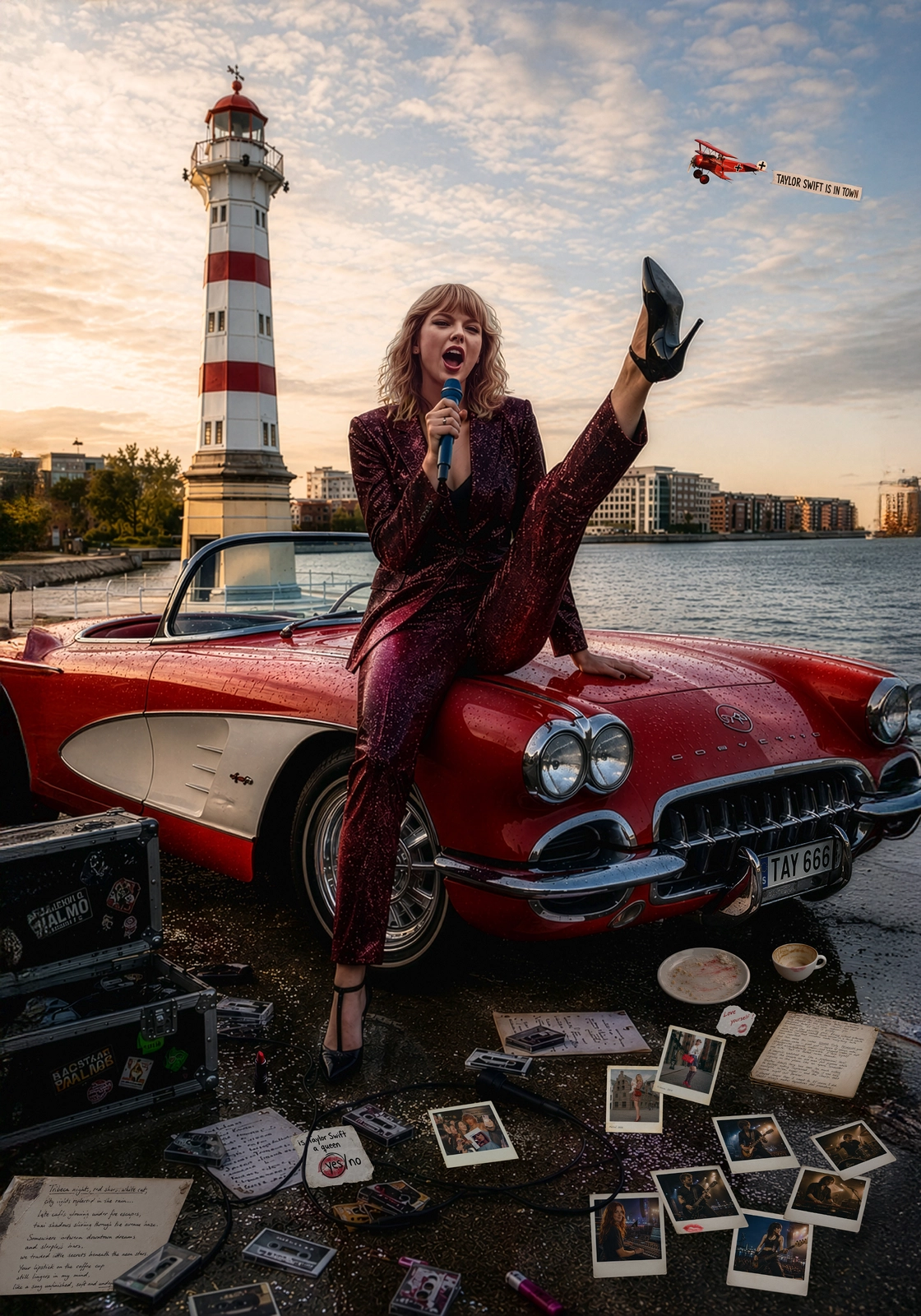
Classy Ride, 2026
Digital
50 x 70 cm
3 200 kr
Classy Ride
Svensk text på slutet
A Photograph That Should Not Exist
At first glance, it looks like nothing more than an old Polaroid from another night of music, noise, and youthful excitement. A blonde singer balances dramatically on the hood of a red 1950s Corvette while fans crowd around her under the evening lights. Someone is laughing. Someone is trying to keep a camera steady. A little girl raises a doll towards the lens as though she wants to step into the story as well.
Yet something about the image feels strangely impossible.
Not because the photograph looks artificial. Quite the opposite. Its blurred edges, worn surface, harsh flash, faded colours, and accidental imperfections make it seem uncannily real — almost too real. It resembles the kind of photograph people rediscover years later in forgotten drawers and immediately start building memories around, even when they are no longer entirely certain what truly happened that night.
Perhaps that uncertainty is exactly where this story begins.
This is not only a story about Taylor Swift, Polaroid photography, nostalgia, fame, or modern pop culture. It is also a story about memory itself — about why human beings continue to try to preserve fleeting moments long after technology has made memory almost infinite.
Why do old photographs still move us more deeply than millions of flawless digital images endlessly stored in invisible clouds? Why do blurred snapshots sometimes feel more truthful than perfect portraits? And why did an instant camera become one of the most powerful visual symbols associated with one of the world’s largest pop stars?
Somewhere between analogue imperfection and digital mythology, between superstardom and intimacy, and between stadium lights and private bedrooms, Taylor Swift and the Polaroid somehow found one another.
This is the story of how it happened.
“Swift Ballet
Beneath the flash of stadium light,
She danced across the summer night,
With red high heels and golden hair,
And Polaroids thrown through the air.
A Corvette gleamed in scarlet shine,
Like something stolen out of time,
While fans with trembling hands held tight
To little squares of fading white.
Some snapshots blurred, some overexposed,
Some caught the moments no one posed,
A laughing face, a tilted grin,
A doorway left half-opened in.
For fame may glow and records spin,
But memory keeps the scratches in,
And every crease and silver stain
Becomes a way to feel again.
So years from now, when songs still play
Though trends and screens have slipped away,
A dusty Polaroid may prove
How quickly youth dissolves in love.
And somewhere in a drawer unseen,
Between old tickets, worn and green,
A faded photograph may stay —
Still kicking like a Swift ballet.”
Malmö, May 2026
Selfie of the Year
Few singers can kick as high as Taylor Swift, even if, in this particular image, she seems to be gaining momentum with the help of a gleaming 1950s Corvette. She may not accelerate from zero to one hundred quite as quickly as the famous sports car beneath her, but once she steps onto a stage, she maintains an impressive speed of her own. Scattered below the beautiful red convertible are memorabilia that tell her story: vinyl records, backstage passes, handwritten signs, photographs, dolls, concert bracelets, and fragments of a modern mythology built around one of the world’s most recognisable pop stars. Yet one question remains: who exactly are the people who worship this pop queen today, and who could seriously challenge her throne at the moment?
In Sweden, Taylor Swift’s core fan base is largely composed of women and millennials aged 18 to 35. At the same time, her audience extends far beyond that demographic, including Gen Z teenagers, young children, and older listeners who have followed her career for years, demonstrating the remarkable breadth of her cultural influence. Dedicated fans — often known as Swifties — are highly active in local online communities such as the Taylor Swift Sweden Facebook Group, where discussions range from lyrics and hidden references to concert outfits, friendships, and emotional memories tied to her music. Many of these admirers first connected with her through her intensely personal songwriting and narrative style, while others were drawn into her orbit by the emotional spectacle of her stadium tours, such as her recent [specific tour or event].
Her crossover hits, such as “Cruel Summer” and “Fortnight”, are constantly heard in Swedish shopping malls, cafés, on radio stations, and across streaming playlists, reflecting how firmly embedded she has become in contemporary Swedish pop culture. Swift’s close collaborations with legendary Swedish producers such as Max Martin and Shellback have also given her a special status within Sweden’s music industry, where producers, songwriters, and insiders often regard her catalogue as a masterclass in modern pop craftsmanship. During “The Eras Tour” in Sweden, she sold out multiple nights at Stockholm’s Friends Arena, drawing more than 60,000 fans each evening and setting new attendance records.
Many assume printed photography is obsolete, but Polaroids uniquely symbolise authenticity and memory, deepening their cultural significance and resonating with fans like Taylor Swift who share candid images. Highlighting this connection keeps readers engaged with the theme of imperfection and nostalgia.
Prologue — The Picture in the Drawer
Nobody remembered who had taken the photograph. That was part of its mystery.
The Polaroid had lain for years in an old wooden drawer, alongside concert wristbands, faded motel receipts, dry perfume samples, and handwritten notes whose ink had slowly bled into the paper. The white border had yellowed with age, one corner bent gently inward, and along the lower edge someone had once written in hurried silver marker:
“The night everything changed.”
And there she was. Young. Laughing. Half-turned away from the camera, as though the moment had been captured spontaneously rather than staged. Her lipstick was slightly smudged, her blonde hair glowing under the harsh flash, while a chaotic crowd of girls surrounded her, holding phones, records, and posters, their hands trembling. The image was imperfect in every way — too bright in one corner, slightly blurred at the edges, marked by a fingerprint across the glossy surface and a faint scratch behind her shoulder — yet somehow more alive than thousands of flawless digital images stored invisibly in phones and clouds.
That was the strange thing about Polaroids. They did not merely capture people. They aged with them.
Even now, in the era of smartphones and infinite digital storage, instant film has seen a remarkable revival. People still carry Polaroid and instant cameras to parties, concerts, weddings, birthdays, and late-night gatherings because the small physical prints feel nostalgic, imperfect, and strangely intimate. Friends hand photographs directly to one another while the images are still developing, passing around tangible memories rather than endlessly scrolling through screens. A Polaroid becomes an object that can be held, taped to a bedroom mirror, slipped into a diary, forgotten in a drawer, or rediscovered years later as a surviving fragment of another life.
Many young photographers and visual artists have embraced the analogue imperfections of instant photography almost as a quiet rebellion against the polished sterility of digital culture. The blurred edges, chemical stains, faded colours, and unpredictable lighting are no longer seen as flaws but as evidence that a real moment once existed before the lens.
The photograph felt less like publicity and more like memory itself: fragile, fading, and vulnerable to light, dust, and time.
Chapter 1 — The Camera That Never Waited
Long before Taylor Swift became one of the most photographed women in the world, she was captivated by the fragile mechanics of memory. She cherished the small, unexpected moments that vanish in an instant: a half-finished milkshake, headlights in the rain, a friend laughing before a photograph is taken, a mother singing alone in the kitchen.
Even as a young girl, she seemed drawn to things that felt temporary. Old family photographs, faded postcards, disposable cameras, snapshots with overexposed skies and imperfect framing — these interested her far more than immaculate studio portraits. The mistakes themselves fascinated her. A blurred hand, a crooked focus, washed-out colours, someone accidentally walking into the frame: all those imperfections made the image feel alive rather than manufactured. A perfect photograph could impress people, but an imperfect one could remind them of their own lives.
This instinct would later become deeply entwined with her songwriting. Many Taylor Swift songs function almost as instant photographs set to music. They rarely describe entire lifetimes. Instead, they capture brief emotional flashes: someone standing in a doorway, a scarf left behind in autumn, headlights on a midnight drive, the sound of shoes on wooden floors, lipstick stains on coffee cups, and silence in a crowded room.
In many ways, the Polaroid camera embodied that philosophy. Unlike digital photography, instant film never waits politely for perfection. There is no endless correcting, filtering, deleting, or retouching. The photograph appears almost immediately, often before the people in it have had time to prepare emotionally. The image arrives carrying the moment's chaos: strange lighting, accidental expressions, nervous movement, grain, chemical shifts, fingerprints, scratches.
That may explain why the Polaroid aesthetic eventually suited Taylor Swift so perfectly. Her public image often hovered in the strange territory between glamour and intimacy, between superstardom and diary confessions. Even at the height of her fame, she cultivated the sense that she was still documenting her life from the inside rather than observing it from above, like a distant celebrity. Fans did not simply listen to her songs; they felt invited into a continuously unfolding scrapbook filled with emotions, clues, memories, heartbreaks, inside jokes, handwritten notes, and private moments that somehow became collective experiences.
As social media rose, with millions of images endlessly editable and disposable, the appeal of instant photography paradoxically grew. Young people increasingly longed for photographs that felt physical, vulnerable, and real. Modern Polaroid cameras began to reappear at parties, backstage gatherings, fashion shoots, birthdays, and in late-night hotel rooms. The small square photographs could be handed to friends on the spot, pinned to mirrors, taped inside notebooks, or scattered across dressing tables as the night unfolded.
A digital image can be copied infinitely without change, but a Polaroid ages alongside its owner. The colours fade, the corners bend, and tiny scratches appear. Over time, the photograph begins to resemble memory itself — delicate, incomplete, yet somehow more truthful for its flaws.
And perhaps that is why so many people eventually associated Taylor Swift not only with songs, tours, and stadiums, but also with Polaroids. She belonged to an era obsessed with documenting everything, yet she somehow reminded people that the most meaningful memories are rarely flawless.
Chapter 2 — The Photographs Left Behind
Chapter 2 — The Photographs Left Behind
At some point, the fascination became more than an aesthetic. It became a way of seeing the world.
Among collectors, musicians, and young photographers, there has always been a particular affection for abandoned photographs — pictures found in flea markets, second-hand shops, forgotten boxes, and dusty family drawers after the people inside them have disappeared. Old Polaroids have an especially haunting quality because they were never meant to travel far from the moment they were taken. Unlike newspaper photographs or official portraits, they were private objects from the start: birthday parties, road trips, motel rooms, drunken evenings, awkward romances, family holidays, somebody’s first flat, somebody’s last summer before everything changed.
One can imagine a young Taylor Swift browsing antique shops or leafing through old photo albums, captivated not only by the images themselves but also by the invisible stories behind them. A faded Polaroid of a teenage couple standing beside a cheap car outside a diner in 1987. A blurry Christmas party where nobody remembers the joke. A girl sitting alone on a hotel bed as neon light filters through the curtains. The photographs endure even when names, voices, and relationships have vanished.
That strange tension between permanence and disappearance would later become one of the defining emotional currents in Taylor Swift’s artistic universe. Her songs often centre on moments already slipping away, even as they happen. Her lyrics rarely serve as stable historical records. Instead, they resemble emotional snapshots rescued from time: fragments of conversations, clothing details, streetlights, weather, perfume, dances, glances, and unfinished sentences. Listeners are not given complete biographies; they are handed flashes of memory.
This may also explain why so many fans developed unusually personal relationships with her music. People did not merely admire her from a distance as a glamorous celebrity. They inserted their own lives into the spaces within her songs. A listener in Stockholm, Melbourne, Nashville, or Malmö could hear one of her lyrics and suddenly remember a specific room, a particular winter, a particular heartbreak, or someone they had not thought about for years. Her songs behaved almost exactly like rediscovered photographs.
The rise of instant photography during the smartphone era deepened this emotional connection. In a culture flooded with billions of polished digital images, young people increasingly began searching for objects that felt tangible and emotionally grounded. A Polaroid could not disappear into an endless stream of scrolling. It existed physically in the world. It could be damaged, lost, kissed, folded, written on, hidden inside books, or rediscovered decades later by someone who had never met the people in the image.
Many artists and photographers deliberately embraced these imperfections as a rebellion against digital sterility. Fashion shoots began to use instant film again. Musicians taped Polaroids to studio walls while recording albums. Behind-the-scenes photographs became almost as emotionally valuable as official publicity campaigns. Even major celebrities began cultivating a more intimate visual language centred on spontaneity rather than on unreachable perfection.
Taylor Swift understood this instinctively. Long before audiences fully recognised what she was doing, she had begun to craft an artistic mythology grounded not in distance but in emotional proximity. Her audience was not simply watching a star. They were collecting moments. And like old Polaroids found years later in forgotten drawers, those moments felt precious precisely because they seemed so vulnerable to time.
Chapter 3 — America Through the Car Window
As Taylor Swift grew older, the world beyond the window began to move faster. Highways replaced school corridors, and tour buses replaced bedrooms. Airports, motel rooms, dressing rooms, diners, petrol stations, backstage corridors, and sleepless drives through unfamiliar cities gradually became part of the emotional geography from which her music emerged. Yet even as her career accelerated towards global superstardom, her artistic gaze remained fixed on small details.
Again and again, her songs returned to fleeting visual fragments: streetlights reflected on wet asphalt, lipstick on coffee cups, old cardigans, traffic at midnight, shoes abandoned beside a bed, perfume lingering in lifts, and someone smoking outside a party as snow begins to fall.
The American road has long held a mythical place in popular culture. Writers, musicians, photographers, and filmmakers have associated highways with freedom, reinvention, loneliness, and youth. Taylor Swift entered that tradition almost instinctively. Her artistic universe is filled with convertibles, motels, windows, rainstorms, radios playing late at night, and lovers disappearing into headlights. Even as her productions grew massive and technologically sophisticated, her storytelling retained the intimacy of someone scribbling thoughts into a notebook while staring out of a moving car window.
At the same time, she was evolving visually. The country aesthetic of cowboy boots and Nashville innocence gradually gave way to something more urban, cinematic, and nostalgic. Vintage jackets, red lipstick, cassette tapes, vinyl records, handwritten notes, motel signs, old sports cars, faded motel pools, and analogue photography began to recur throughout the imagery surrounding her music.
This transformation reached its clearest form in the years leading up to 1989. By then, Taylor Swift no longer presented herself simply as a country songwriter venturing into pop. She had become something more elusive: a curator of modern nostalgia. She drew on visual languages from the late twentieth century — especially the 1980s — but filtered them through contemporary emotional vulnerability. The result felt both glamorous and intimate, polished yet accidental.
Polaroid photography fitted perfectly into this evolving aesthetic universe. The instant photograph carried many of the same emotional associations her songs already explored: transience, youth, movement, romance, loneliness, and the fear that happiness might vanish before one fully understands it. Unlike glossy celebrity portraiture, Polaroids suggested that the moment itself mattered more than perfection. They looked like memories already beginning to fade.
Meanwhile, social media culture was moving in the opposite direction. Platforms became increasingly dominated by carefully curated identities, edited faces, manipulated lighting, and algorithmic perfection. Young people constantly photographed everything, yet many began to feel strangely detached from their own images. In response to this digital saturation, analogue aesthetics experienced a powerful revival. Vinyl records returned. Cassette tapes reappeared. Film photography regained popularity. Instant cameras once again became fashionable, not despite their flaws but because of them.
At parties, concerts, fashion shoots, and backstage gatherings, modern Polaroid cameras began circulating almost like emotional machines. Friends handed out physical prints to one another as evenings unfolded. Artists taped photographs to mirrors and dressing-room walls. The images looked fragile and temporary, yet somehow more emotionally trustworthy than thousands of flawless digital files buried in phones.
Taylor Swift perhaps understood the emotional symbolism embedded in that revival better than almost anyone else in mainstream pop culture. Her music already functioned like a scrapbook of emotional snapshots. The Polaroid gave that feeling a physical form.
Chapter 4 — When an Album Found Its Visual Language
By the time Taylor Swift began working on “1989”, she stood at a crossroads that would permanently redefine her career and public image. The transition from country music to full-scale pop had already begun, but the deeper transformation was emotional and visual rather than merely musical. She was no longer simply writing songs about youth and heartbreak; she was constructing an entire atmosphere around the act of remembering.
That atmosphere demanded its own visual language.
For decades, album covers often aimed for perfection: carefully lit portraits, dramatic poses, immaculate styling, and highly controlled photography designed to create distance between stars and audiences. But Taylor moved in the opposite direction. The imagery surrounding “1989” felt deliberately incomplete. Faces were partially cropped. Colours appeared faded, as if washed by time. The framing resembled casual snapshots rather than official publicity stills. Handwritten lyrics appeared across images like fragments torn from personal notebooks. Instead of presenting herself as untouchable, she cultivated the illusion that listeners had stumbled upon an intimate archive of private memories.
The Polaroid became central to this reinvention.
The album cover echoed the square proportions and visual mood of instant photography. Taylor’s eyes were entirely cropped from the image, an unusual choice in celebrity culture, where eye contact often functions as a branding tool and a means of emotional control. Instead, the photograph felt candid, as if discovered among old belongings rather than staged by the industry. The white border resembled an instant-print frame, and the handwritten title added a personal touch.
Taylor Swift’s songs rarely unfold as grand epic narratives. Instead, they function more like recovered fragments of emotional experience: a scarf, a dance, a kitchen light, a late-night phone call, a dress on the floor, a car disappearing into the rain. The visual language surrounding “1989” transformed those lyrical fragments into a coherent mythology.
During the early 2010s, social media platforms were rapidly transforming everyday life into an endless performance of perfection. Photographs became increasingly filtered, curated, and polished, prompting audiences to crave images that felt more immediate and emotionally believable, even when carefully crafted.
Taylor understood that paradox instinctively. The “1989” imagery did not reject glamour outright; instead, it softened it with vulnerability. The photographs suggested movement, intimacy, friendship, loneliness, youth, and impermanence. They resembled fragments of emotional life rather than products of a global industry machine.
Few artists have managed to merge music, memory, and visual identity so completely. “1989” was not simply an album accompanied by photographs. It was an album that understood how modern audiences emotionally consume photographs — not as objective documentation, but as vessels for longing, nostalgia, identity, and the fear of losing moments that can never fully return.
Chapter 5 — The Sixty-Five Polaroids
One of the most brilliant aspects of the “1989” era was that Taylor Swift did not merely borrow the visual language of Polaroid photography. She made the physical object itself part of the experience.
Different editions of the album included sets of collectable Polaroid photographs — 65 in total — and what might have initially seemed a simple marketing idea quickly became something far more emotionally powerful. Fans did not treat the photographs as ordinary promotional inserts. They collected, traded, and framed them, analysed them online, and obsessively searched for hidden meanings in tiny visual details. The images became artefacts within a growing mythology.
This reaction revealed something important about modern pop culture. In an era increasingly dominated by streaming and invisible digital files, audiences still longed for physical objects that could anchor emotions in the material world. A streamed song dissolves into algorithms and playlists. A Polaroid can be held in the hand. It acquires fingerprints. Corners bend. Light slowly shifts its colours. It becomes personal through time and use.
The photographs themselves were carefully balanced between spontaneity and construction. Some showed Taylor lying on hotel beds, sitting by windows, walking through cities, or laughing with friends. Others resembled fragments from road trips, rehearsals, dressing rooms, kitchens, rooftops, and sleepless nights. The compositions often looked accidental, even when they were clearly carefully constructed. Fans felt they were gaining access not simply to an artist’s image, but to moments existing somewhere between performance and private life.
Many of the Polaroids also contained handwritten lyric fragments beneath the photographs. The handwritten notes evoked letters, diaries, folded messages, and thoughts scribbled late at night before sleep. Combined with the instant-photo aesthetic, the images no longer felt like corporate packaging but like fragments of someone’s emotional archive.
Entire online communities formed around these photographs. Fans exchanged duplicates, debated chronology, interpreted symbolism, and tried to reconstruct emotional narratives that linked specific images to specific songs. Some searched for hidden references to relationships or future projects. Others became emotionally attached to the atmosphere surrounding the images: youth suspended in motion, glamorous yet lonely, confident yet vulnerable.
In many ways, the “1989” Polaroids anticipated later developments in fan culture and social media aesthetics. They encouraged audiences not merely to consume music but to curate emotional worlds around it. The fan was no longer simply a listener or spectator. The fan became an archivist, collector, interpreter, and participant within an unfolding mythology.
At the same time, the photographs reinforced one of the deepest themes running through Taylor Swift’s artistic universe: the tension between permanence and disappearance. A Polaroid develops almost instantly, yet begins to age immediately afterwards. The image appears before one’s eyes even as it slowly moves towards the past. That emotional contradiction mirrors the structure of many Taylor Swift songs. Happiness is already becoming a memory even as it is being experienced.
Perhaps that is why the Polaroids resonated so deeply. They did not merely illustrate the music. They brought their emotional logic into physical reality. Fans were no longer merely hearing about memory, longing, youth, and the passage of time. They could literally hold those themes in their hands.
Chapter 6 — Instagram Before Instagram
One of the great ironies of the ’1989 era is that Taylor Swift helped popularise an aesthetic of analogue intimacy precisely as the world was becoming overwhelmingly digital. Social media platforms rapidly transformed everyday life into a continuous stream of photographs. Yet the more images people produced, the more many of them longed for pictures that felt tangible, accidental, and emotionally believable.
The timing could hardly have been more perfect.
Instagram was growing explosively. Filters tried to mimic vintage film stocks. Young people edited photographs to resemble faded snapshots from decades they had never lived through. Tumblr aesthetics celebrated blurred lights, motel signs, handwritten notes, cigarette smoke, vinyl records, scratched cassette tapes, old convertibles, and melancholic fragments of American nostalgia. Entire online cultures revolved around making the digital world look analogue again.
Yet most of those images remained trapped on screens.
That was the crucial difference with Polaroids. An instant photograph existed physically from the start. It emerged slowly in the hand as people gathered around it, making the object itself part of the emotional experience. Friends passed the image among themselves at parties before it had even fully developed. Lovers hid Polaroids in drawers and wallets. Artists taped them to studio walls and dressing-room mirrors. The photograph occupied real space, aged in real light, and bore the marks of physical existence.
In many ways, Taylor Swift understood the longing for material reality. Her visual world during this period felt deeply connected to internet culture while resisting its polished artificiality.
She also anticipated broader cultural developments that would become even more visible later. Vinyl records returned. Film cameras regained popularity. Handwritten journals, analogue synthesisers, thrift-store fashion, and objects bearing visible signs of age and use suddenly acquired new emotional value. Digital perfection had become so dominant that imperfections themselves began to feel emotionally trustworthy.
Professional photographers noticed the same phenomenon. Fashion shoots often paired instant film with expensive digital equipment because Polaroids created a markedly different atmosphere. Models relaxed more easily around the cameras. Celebrities appeared less guarded. Behind-the-scenes moments suddenly looked spontaneous rather than staged. Many photographers built physical scrapbooks on the spot during shoots, covering studio walls with fresh instant prints as the session unfolded.
The object itself carried history: fingerprints, sunlight, scratches, folds, and chemical fading. Over time, a Polaroid became less like data and more like an artefact rescued from lived experience.
This emotional logic aligned perfectly with Taylor Swift’s songwriting persona. Her audience often experienced her music not as distant entertainment but as emotional companionship in their own lives. Fans listened to her songs during breakups, road trips, first loves, lonely nights, friendships, and transitions into adulthood. The Polaroid aesthetic gave that intimacy physical form. It suggested that these were not merely pop songs produced by a giant industry machine, but fragments of life temporarily preserved before time carried them away.
In retrospect, the “1989” era now feels strangely prophetic. It arrived at the precise moment when digital culture reached saturation and nostalgia itself became one of the defining emotional currencies of the twenty-first century. Taylor Swift did not create that longing, but she understood how to translate it into a visual and emotional language that millions immediately recognised as their own.
Chapter 7 — The Fans and the Moments
For many artists, fame creates distance. The larger the stadiums grow, the smaller and more unreachable the person at the centre often appears. Yet one of the unusual aspects of Taylor Swift was that her enormous success frequently seemed to deepen the emotional connection her audience felt with her. Fans did not simply admire her career from afar. They linked her songs to the architecture of their own lives.
A Taylor Swift concert, therefore, became more than mere entertainment. It functioned almost as a collective memory machine.
Inside enormous stadiums, thousands of people simultaneously revisited earlier versions of themselves through the songs. Someone remembered a first heartbreak. Someone thought about a friendship that had long since ended. Someone relived late-night drives, school dances, university apartments, unanswered text messages, summers by the sea, winters that felt endless, or relationships that had already begun to feel like memories even as they were happening. Entire sections of the audience cried not because they were sad in the present moment, but because the music reopened emotional rooms they believed had long since been sealed.
This emotional relationship between the audience and the artist helps explain why Polaroid imagery became so culturally powerful. Fans were not merely collecting photographs of Taylor Swift; they were gathering emotional evidence of moments in their own lives.
In that sense, the photographs functioned less as celebrity memorabilia and more as portable time capsules.
The phenomenon became especially visible during ”The Eras Tour”, where nostalgia itself formed the structural foundation of the entire production. The concerts unfolded almost like journeys through accumulated memory, allowing audiences to move chronologically through different emotional stages of Taylor’s career while simultaneously revisiting their own histories alongside it.
And the cameras were everywhere.
Smartphones lit up entire stadiums like artificial constellations, yet amid the digital avalanche, instant cameras still circulated through crowds and backstage gatherings. Young fans handed out physical photographs to friends before the concerts had even ended. Others taped fresh Polaroids into journals alongside ticket stubs and handwritten reflections. The need for tangible memory remained surprisingly strong despite the infinite convenience of digital storage.
Part of the appeal may lie in the fact that physical photographs acknowledge the passage of time more honestly than screens do. A digital image looks almost identical ten years later, whereas a Polaroid visibly ages alongside its owner. Colours slowly fade. Corners bend. Tiny scratches appear across the surface. Over time, the object begins to resemble memory itself.
Taylor Swift’s artistic universe repeatedly returns to the fleeting nature of moments: how quickly they vanish, how selectively people remember them, and how youth feels endless while one is living through it, yet afterwards seems astonishingly brief.
Perhaps that is why so many listeners formed such deep attachments not only to the songs themselves but also to the visual culture surrounding them. The Polaroids, lyric fragments, handwritten notes, backstage photographs, and memorabilia all reinforced the same emotional truth: life is experienced in fragments, and those fragments become precious precisely because they disappear.
The fans understood this. They were not merely documenting concerts. They were trying to rescue moments before they disappeared.
Chapter 8 — Why Polaroid Suited Taylor Swift
Some artists could never have embodied the Polaroid aesthetic convincingly. For Taylor Swift, however, the connection felt almost inevitable, as the emotional structure of her artistic identity already mirrored the logic of instant photography long before the visual concept fully emerged.
At the heart of Taylor Swift’s songwriting lies an obsession with memory. Not memory as objective history, but as emotional reconstruction — selective, fragmented, intensely sensory, and permanently unstable. Her songs rarely attempt to tell complete stories from start to finish. Instead, they preserve flashes of emotional experience: someone dancing barefoot in a kitchen, autumn leaves drifting across a scarf left behind, headlights crossing a face at midnight, lipstick stains on glass, rain against windows, names spoken softly in the dark.
A Polaroid works in much the same way.
Instant photographs often appear incomplete or uncontrolled. They capture an emotional atmosphere rather than technical perfection. Awkward framing, unpredictable colours, blurred movement, fingerprints, scratches, and overexposure frequently make the image feel more alive rather than less convincing. The photograph seems to contain lived time rather than merely recording appearances.
Taylor’s public persona also occupied a delicate balance between glamour and intimacy. She became one of the world’s biggest stars while still maintaining the impression of being emotionally accessible. Audiences did not simply observe her from a distance; they continually searched for fragments of themselves in her songs.
That emotional accessibility distinguished her from many earlier pop stars, whose images relied more heavily on distance, mystery, or unattainable perfection. Taylor Swift instead cultivated the sense of an ongoing conversation. Through handwritten lyrics, diary-like confessions, hidden references, social media interactions, backstage glimpses, and autobiographical storytelling, she transformed celebrity culture into something unusually participatory. Fans did not merely consume finished performances; they constantly searched for emotional clues linking songs, photographs, memories, relationships, and different eras.
The Polaroid aesthetic perfectly reinforced that sense of intimacy because instant photographs feel inherently personal. They belong in bedrooms, at parties, on road trips, on dressing tables, in lockers, on refrigerators, and in private drawers, rather than in museums or corporate archives. A Polaroid suggests friendship, youth, romance, vulnerability, and the passing of time. It feels less like publicity and more like evidence that a moment once genuinely existed.
There was also something emotionally comforting in the analogue qualities of the imagery in an increasingly digital age. Social media culture encouraged relentless self-curation, endless comparison, and the illusion that life should look permanently optimised. Taylor’s Polaroid-inspired visual world softened that pressure by romanticising imperfection rather than erasing it. The blurred edges, faded colours, handwritten notes, and casual snapshots suggested that emotional truth mattered more than flawless presentation.
This may explain why so many fans experienced the ”1989” era not merely as an album cycle but as a complete emotional environment. The music, photographs, typography, fashion, memorabilia, and visual storytelling reinforced one another with unusual coherence. Together, they constructed a world in which memory itself became beautiful precisely because it was temporary and imperfect.
In retrospect, the connection between Taylor Swift and Polaroids now feels almost inevitable. She emerged at a moment when audiences were drowning in digital images yet starved for emotional authenticity. Her genius was not merely recognising that longing but translating it into a form people could hold in their hands — fragile little photographs already beginning to fade the moment they appeared.
Chapter 9 — The Eras Tour and the Machinery of Memory
By the time Taylor Swift launched ”The Eras Tour”, she had evolved from a pop star into something closer to a cultural timekeeper. Few artists in modern history have managed to construct such a clearly defined emotional chronology across their careers.
”The Eras Tour” transformed that accumulated mythology into a physical space.
The concerts unfolded less like ordinary performances and more like rituals of remembrance. Audiences did not simply attend to hear songs they already loved. They came to revisit earlier versions of themselves through the music.
Inside enormous stadiums, thousands of people simultaneously returned to different emotional periods of their lives. Someone remembered a first heartbreak. Someone thought about a friendship that had quietly disappeared years earlier. Someone relived school dances, late-night drives, university apartments, unanswered text messages, summers by the sea, winters that once felt endless, or relationships that had already begun to turn into memories even as they were unfolding.
The scale itself was staggering. Giant screens, synchronised lights, elaborate stage constructions, moving platforms, pyrotechnics, and massive visual effects combined to create one of the most technologically sophisticated touring productions ever assembled. Yet despite this overwhelming machinery, the emotional core of the experience remained surprisingly intimate. Fans still searched constantly for fleeting human moments within the spectacle: a spontaneous smile, a glance towards the crowd, an unscripted gesture, or a brief change in tone or expression.
That instinct revealed something essential about contemporary celebrity culture. In an age saturated with infinite digital content, audiences increasingly value moments that seem accidental or emotionally unfiltered. Perfection impresses people, but vulnerability lingers.
Once again, the Polaroid metaphor quietly reappeared.
Throughout the tour, fans obsessively documented their experiences on smartphones, creating millions of digital images and videos that circulated instantly across the internet. Yet many attendees also carried analogue cameras, journals, printed photographs, friendship bracelets, ticket stubs, handwritten notes, and other physical objects associated with memory and preservation. Entire sections of social media became devoted not merely to documenting the concerts but to transforming them into emotional scrapbooks.
The friendship bracelets exchanged during the tour shared many of the same symbolic qualities as Polaroids. They were handmade, imperfect, tangible, and deeply personal. These small objects transformed giant stadiums into temporary communities centred on memory and participation.
Against that backdrop, Taylor Swift’s artistic universe offered something emotionally distinct. Her work repeatedly returned to the textures of memory itself: handwriting, old clothes, faded photographs, scents, seasons, objects, places, fragments of conversation, and songs tied to specific emotional moments. ”The Eras Tour” therefore functioned not merely as entertainment but as a vast collective attempt to hold on to time before it disappeared.
And perhaps that explains why the Polaroid remained such a powerful symbol throughout her mythology. An instant photograph develops while one is still standing within the moment it captures, yet the image already belongs to the past almost immediately afterwards. It is both presence and disappearance.
Much of Taylor Swift’s music operates on the same emotional logic. The songs recognise that people often recognise the importance of moments only when they are already beginning to vanish.
Chapter 10 — The Girl Next Door
One reason Taylor Swift became more than merely a successful pop artist may lie in something far less obvious than stadium tours, streaming records, or carefully orchestrated publicity campaigns. Behind the spectacle, the glamour, the choreography, and the vast machinery of modern celebrity culture, she somehow managed to preserve the emotional illusion of being “the girl next door”.
The phrase is deeply rooted in American culture. It does not literally mean an ordinary girl living nearby, nor does it imply a lack of beauty, charisma, or ambition—quite the opposite. The “girl next door” archetype traditionally describes someone who appears emotionally approachable despite fame or attractiveness—someone audiences feel they might genuinely know, speak to, fall in love with, or recognise from their own lives. She remains human-sized even after becoming larger-than-life.
Many major stars throughout modern entertainment history have cultivated a sense of distance as part of their mythology. Some become untouchable icons wrapped in luxury, mystery, sexuality, avant-garde aesthetics, or aristocratic perfection. Their power partly depends on remaining unreachable. Taylor Swift’s public image evolved differently. Even as her fame expanded into something almost impossible to comprehend, her emotional language remained grounded in ordinary details and recognisable experiences.
Her songs rarely address abstract concepts. Instead, they centre on bedrooms, kitchens, telephones, scarves, school corridors, late-night drives, autumn leaves, awkward conversations, friendships, misunderstandings, heartbreak, and memories attached to small physical objects. The emotional scale remains intimate even as the career surrounding it becomes enormous. Audiences do not simply observe her life from a distance; they continually find fragments of themselves within it.
That emotional accessibility may explain why her audience often behaves less like a traditional fandom and more like a vast collective memory community. People attach Taylor Swift songs to highly specific moments in their own lives: first loves, breakups, school years, road trips, university apartments, friendships that faded, lonely winters, weddings, growing up, and moving away from home. Her music frequently becomes intertwined with listeners’ personal emotional timelines.
The Polaroid aesthetic reinforced this connection perfectly. A Polaroid does not resemble luxury advertising or unreachable glamour. It resembles somebody’s bedroom wall, somebody’s diary, somebody’s road trip, somebody’s forgotten summer. The instant photograph carries traces of touch and time: fingerprints, bent corners, fading colours, scratches, and handwritten notes. It feels personal before it feels iconic.
That is precisely the emotional territory in which the “girl next door” archetype lives.
Taylor Swift’s cultural achievement may therefore rest not only on musical craftsmanship or business acumen, but on her ability to preserve the illusion of emotional proximity within a level of fame that would normally destroy it. Audiences feel that beneath the immense celebrity apparatus, there still exists a person who notices the same small details they do: the sound of shoes on wooden floors, headlights through rain-covered windows, lipstick on coffee cups, silence after arguments, old photographs hidden in drawers.
Of course, this intimacy is partly constructed. No global superstar remains entirely spontaneous under the permanent spotlight of twenty-first-century fame. Yet the emotional impact remains powerful because the illusion itself satisfies a modern cultural hunger. In an age increasingly dominated by algorithms, branding, filters, and digital performance, people still long for personalities who seem emotionally real, vulnerable, and recognisable.
Perhaps that is why Taylor Swift’s relationship with her audience often feels unusually enduring. Fans do not merely admire her success. They feel as though they have grown up alongside her.
Epilogue — The Last Polaroid
Years from now, long after streaming platforms have changed names, social media trends have vanished, and today’s phones lie forgotten in drawers beside obsolete chargers and silent hard drives, somebody will probably still find an old Polaroid of Taylor Swift somewhere in the physical world.
Perhaps inside a second-hand book. Perhaps tucked into the sleeve of an old vinyl record. Perhaps hidden in a box of concert memorabilia in an attic, where dust drifts slowly through summer light.
The photograph will already be surrendering to time. The colours will have faded slightly. The corners will be bent. Tiny scratches will mark the surface. The image may no longer appear entirely sharp. Yet, because of those imperfections, the photograph may feel strangely more alive than thousands of flawless digital images stored invisibly in the clouds and on servers.
That has always been the Polaroid paradox.
An instant photograph appears fragile from the outset. It can be damaged, lost, stained, creased, or destroyed almost by accident. Unlike digital files endlessly duplicated across invisible servers, the Polaroid is a unique physical object, moving vulnerably through time alongside the person who keeps it.
Taylor Swift understood this. Throughout her career, she transformed fleeting emotional moments into something audiences could preserve and revisit long after the original experiences had passed. Her songs became attached to first loves, breakups, friendships, cities, school years, marriages, lonely nights, road trips, and transitions into adulthood for millions of people around the world. Listeners did not merely hear the music. They inserted their own lives into it.
The Polaroid aesthetic captured that emotional relationship perfectly by mirroring the instability of memory. Human beings do not remember life as a polished chronology. They remember fragments: light through windows, perfume in hallways, summer heat rising from asphalt, songs from passing cars, the colour of somebody’s jacket, a final glance before goodbye. Memories blur. Certain details fade while others remain painfully sharp. Over time, emotion reshapes the image itself.
That is why the old Polaroid in the drawer feels more powerful than a thousand flawless publicity photographs. It does not merely document celebrity. It preserves atmosphere, vulnerability, and the fleeting sense that the moment captured in the image once briefly existed before slipping away forever.
In the end, Taylor Swift’s connection to Polaroids was never just about retro fashion or nostalgia. It reflected something deeper about the fragility of memory in modern life. In an era obsessed with endless documentation, the Polaroid reminded people that memories gain emotional weight not through perfection but through impermanence.
And perhaps that is why people continue to seek physical traces of their lives, even in a digital age promising infinite storage. Deep inside us, we still want memories to feel touchable. We want them to age alongside us.
A Polaroid does exactly that.
PS:
Something about the image that opens this story may disturb a certain kind of orderly mind. No matter how high Taylor Swift kicks, something about it does not quite add up.
That is perfectly true.
The image is, at least in part, about dreams and fantasies — wishful thinking, some people in Stockholm would probably call it. That opinion may remain theirs.
Taylor Swift has not performed a concert in Malmö to date. But who can say with certainty that she did not quietly slip through the city on her way to Stockholm in May 2024? She had been off tour since early March, after performing in Singapore. Perhaps she wanted to experience Malmö for herself — a city many still consider Sweden’s true music capital. Perhaps the opportunity will come when Malmö’s new major stadium is inaugurated in 2029.
So no, Taylor Swift has not played in Malmö. But the local Swiftie community is very much alive. Fans in the city regularly gather for club nights and festivals celebrating her music. Keep an eye on the Facebook groups. If Taylor ever appears incognito in Malmö, they will almost certainly be the first to know. One should also remember that Copenhageners have always enjoyed crossing over to Malmö — particularly if Taylor Swift happens to be in town.
Ett fotografi som inte borde existera
Vid första anblicken ser det inte ut som något annat än en gammal Polaroid från ännu en kväll fylld av musik, oväsen och ungdomlig upphetsning. En blond sångerska balanserar dramatiskt på motorhuven till en röd Corvette från 1950-talet medan fans tränger sig omkring henne under kvällsljuset. Någon skrattar. Någon försöker hålla kameran stilla. En liten flicka sträcker en docka mot linsen som om hon också vill kliva in i berättelsen.
Ändå finns det något med bilden som känns märkligt och omöjligt.
Inte därför att fotografiet ser konstgjort ut. Tvärtom. Dess suddiga kanter, slitna yta, hårda blixtljus, blekta färger och tillfälliga brister får det att framstå som kusligt verkligt — nästan alltför verkligt. Det liknar den sortens fotografi som människor återupptäcker många år senare i bortglömda lådor och omedelbart börjar bygga minnen kring, även när de inte längre är helt säkra på vad som egentligen hände den där kvällen.
Kanske är det just där denna berättelse börjar.
Det här är inte bara en berättelse om Taylor Swift, Polaroidfotografi, nostalgi, berömmelse eller modern popkultur. Det är också en berättelse om själva minnet — om varför människor fortsätter att försöka bevara flyktiga ögonblick långt efter att tekniken gjort minnet nästan oändligt.
Varför berör gamla fotografier oss fortfarande djupare än miljontals perfekta digitala bilder som oändligt lagras i osynliga moln? Varför känns suddiga snapshots ibland sannare än perfekta porträtt? Och varför blev en instantkamera en av de starkaste visuella symbolerna kring en av världens största popstjärnor?
Någonstans mellan analog ofullkomlighet och digital mytologi, mellan superstjärnestatus och intimitet, mellan stadionljus och privata sovrum fann Taylor Swift och Polaroiden på något sätt varandra.
Det här är berättelsen om hur det gick till.
Årets Selfie
Det är inte många sångartister som kan sparka lika högt som Taylor Swift, även om hon på just den här bilden tycks ta sats med hjälp av en glänsande Corvette från 1950-talet. Hon accelererar kanske inte från noll till hundra riktigt lika snabbt som den berömda sportbilen under henne, men så snart hon kliver upp på en scen håller hon en imponerande fart på sitt eget sätt. Nedanför den vackra röda cabrioleten ligger memorabilia utspridda som berättar hennes historia: vinylskivor, backstagepass, handskrivna skyltar, fotografier, dockor, konsertarmband och fragment av en modern mytologi uppbyggd kring en av världens mest igenkännliga popstjärnor. Men en fråga kvarstår: vilka är egentligen människorna som dyrkar denna popdrottning i dag, och vem skulle på allvar kunna utmana hennes tron just nu?
I Sverige består Taylor Swifts kärnpublik till stor del av kvinnor och millennials mellan 18 och 35 år. Samtidigt sträcker sig hennes publik långt utanför den gruppen och omfattar både Gen Z-tonåringar, yngre barn och äldre lyssnare som följt hennes karriär i många år, vilket visar hur omfattande hennes kulturella genomslag har blivit. Hängivna fans — ofta kallade Swifties — är mycket aktiva i lokala nätgemenskaper som Taylor Swift Sweden Facebook Group, där diskussionerna rör allt från textrader och dolda referenser till konsertkläder, vänskaper och känslomässiga minnen kopplade till hennes musik. Många av dessa beundrare drogs först till henne genom hennes personliga låtskrivande och berättarstil, medan andra fångades av den emotionella kraften i hennes stadionturnéer.
Hennes crossover-hits, som ”Cruel Summer” och ”Fortnight”, hörs ständigt i svenska köpcentrum, på caféer, radiostationer och streaminglistor, vilket visar hur djupt förankrad hon blivit i samtida svensk popkultur. Swifts nära samarbeten med legendariska svenska producenter som Max Martin och Shellback har också gett henne en särskild status inom den svenska musikindustrin, där producenter, låtskrivare och branschfolk ofta betraktar hennes katalog som en mästarklass i modern popmusik. Under ”The Eras Tour” i Sverige sålde hon ut flera kvällar på Friends Arena i Stockholm och drog mer än 60 000 besökare varje kväll, samtidigt som nya publikrekord sattes.
Många utgår från att pappersfotografi är föråldrat, men Polaroidbilder har kommit att symbolisera autenticitet och minne på ett sätt som gett dem ett nytt kulturellt liv.
Prologue — Bilden i lådan
Ingen kom ihåg vem som hade tagit fotografiet. Det var en del av dess mysterium.
Polaroidbilden hade legat i åratal i en gammal trälåda tillsammans med konsertarmband, blekta motellkvitton, torra parfymprover och handskrivna lappar vars bläck långsamt hade sugits ut i papperet. Den vita ramen hade gulnat av ålder, ett hörn böjde sig lätt inåt och längst ned hade någon en gång skrivit med hastig silverpenna.
”Natten då allting förändrades.”
Och där var hon. Ung, skrattande, halvt vänd bort från kameran, som om ögonblicket hade fångats spontant snarare än arrangerat. Läppstiftet var något utsmetat; hennes blonda hår lyste under den hårda blixten medan en kaotisk grupp flickor omgav henne med telefoner, skivor och affischer i händerna. Bilden var på alla sätt ofullkomlig — för ljus i ena hörnet, lätt oskarp i kanterna, märkt av ett fingeravtryck över den blanka ytan och en svag repa bakom hennes axel — men ändå på något märkligt sätt mer levande än tusentals perfekta digitala bilder, osynligt lagrade i telefoner och molntjänster.
Det var det märkliga med Polaroider. De fångade inte bara människor. De åldrades tillsammans med dem.
Även nu, i smarttelefonernas och det oändliga digitala lagringsutrymmets tid, har instantfilm fått ett remarkabelt uppsving. Människor tar fortfarande med sig Polaroid- och instantkameror till fester, konserter, bröllop, födelsedagar och sena kvällssammankomster därför att de små fysiska bilderna känns nostalgiska, ofullkomliga och märkligt intima. Vänner skickar fotografier direkt till varandra medan bilderna fortfarande framkallas och skickar runt konkreta minnen istället för att oändligt scrolla genom skärmar. En Polaroid blir ett föremål som kan hållas i handen, tejpas fast på en sovrumsspegel, stoppas in i en dagbok, glömmas i en låda eller återupptäckas många år senare som ett överlevande fragment av ett annat liv.
Många unga fotografer och bildkonstnärer har omfamnat instantfotografins analoga ofullkomlighet, nästan som ett stillsamt uppror mot den digitala kulturens polerade sterilitet. De suddiga kanterna, kemiska fläckarna, de blekta färgerna och det oförutsägbara ljuset betraktas inte längre som fel utan som bevis på att ett verkligt ögonblick en gång existerade framför linsen.
Fotografiet kändes mindre som reklam och mer som själva minnet: skört, bleknande och sårbart för ljus, damm och tid.
Kapitel 1 — Kameran som aldrig väntade
Långt innan Taylor Swift blev en av världens mest fotograferade kvinnor var hon fascinerad av minnets sköra mekanik. Hon drogs till de små oväntade ögonblicken som försvinner på ett ögonblick: en halvuppdrucken milkshake, strålkastare i regnet, en vän som skrattar innan bilden tas, en mamma som sjunger ensam i köket.
Redan som ung verkade hon dras till sådant som kändes tillfälligt. Gamla familjefotografier, blekta vykort, engångskameror och snapshots med överexponerade himlar och ojämn bildkomposition intresserade henne långt mer än perfekta studioporträtt. Själva misstagen fascinerade henne. En suddig hand, ett skevt fokus, utvättade färger, någon som råkar gå in i bild — allt detta fick fotografiet att kännas levande snarare än tillverkat. Ett perfekt fotografi kunde imponera på människor, men ett ofullkomligt kunde påminna dem om deras egna liv.
Detta skulle senare bli djupt sammanvävt med hennes låtskrivande. Många Taylor Swift-låtar fungerar nästan som instantfotografier satta till musik. De beskriver sällan hela livet. Istället fångar de korta emotionella blixtar: någon som står i en dörröppning, en halsduk som lämnats kvar under hösten, strålkastare under en nattlig bilfärd, ljudet av skor mot trägolv, läppstiftsmärken på kaffekoppar och tystnad i ett överfullt rum.
På många sätt förkroppsligade Polaroidkameran just den filosofin. Till skillnad från digital fotografering väntar instantfilm aldrig artigt på perfektion. Det finns inget ändlöst korrigerande, filtrerande, raderande eller retuscherande. Fotografiet uppstår nästan omedelbart, ofta innan människorna på bilden hunnit förbereda sig känslomässigt. Bilden anländer med hela ögonblickets kaos: märkligt ljus, tillfälliga ansiktsuttryck, nervösa rörelser, kornighet, kemiska skiftningar, fingeravtryck och repor.
Det kan förklara varför Polaroidestetiken till slut passade Taylor Swift så perfekt. Hennes offentliga image svävade ofta i det märkliga gränslandet mellan glamour och intimitet, mellan superstjärnestatus och dagboksbekännelser. Även på höjden av sin berömmelse lyckades hon skapa en känsla av att fortfarande dokumentera sitt liv inifrån snarare än att betrakta det utifrån som en avlägsen celebritet. Fansen lyssnade inte bara på hennes låtar; de kände sig inbjudna till ett ständigt växande scrapbook fyllt av känslor, ledtrådar, minnen, hjärtesorg, interna skämt, handskrivna lappar och privata ögonblick som på något sätt blev kollektiva upplevelser.
När sociala medier växte fram och miljontals bilder blev oändligt redigerbara och utbytbara, ökade paradoxalt nog instantfotografins attraktionskraft. Unga människor började längta efter fotografier som kändes fysiska, sårbara och verkliga. Moderna Polaroidkameror började åter dyka upp på fester, backstageområden, modefotograferingar, födelsedagar och sena hotellkvällar. De små fyrkantiga bilderna kunde ges direkt till vänner, sättas upp på speglar, tejpas in i anteckningsböcker eller spridas över sminkbord medan natten fortfarande pågick.
En digital bild kan kopieras oändligt utan att förändras, men en Polaroid åldras tillsammans med sin ägare. Färgerna bleknar, hörnen böjs och små repor uppstår. Med tiden börjar fotografiet likna själva minnet — skört, ofullständigt men på något sätt sannare genom sina brister.
Och kanske är det därför så många till slut kom att förknippa Taylor Swift inte bara med låtar, turnéer och stadionkonserter utan också med Polaroider. Hon tillhörde en tid besatt av att dokumentera allting, men hon påminde samtidigt människor om att de mest betydelsefulla minnena sällan är felfria.
Kapitel 2 — Fotografierna som blev kvar
Vid någon punkt blev fascinationen mer än bara en estetik. Den blev ett sätt att se på världen.
Bland samlare, musiker och unga fotografer har det alltid funnits en särskild dragning till övergivna fotografier — bilder som hittats på loppmarknader, i secondhandbutiker, i bortglömda kartonger och dammiga familjelådor efter att människorna på bilderna försvunnit. Gamla Polaroider bär på en särskilt hemsökande kvalitet eftersom de aldrig var avsedda att färdas långt bort från ögonblicket då de togs. Till skillnad från tidningsfotografier eller officiella porträtt var de privata föremål redan från början: födelsedagsfester, bilresor, motellrum, berusade kvällar, tafatta romanser, familjesemestrar, någons första lägenhet, någons sista sommar innan allting förändrades.
Man kan föreställa sig en ung Taylor Swift bläddrande i gamla fotoalbum eller vandrande genom antikaffärer, fascinerad inte bara av bilderna i sig utan också av de osynliga historierna bakom dem. En blekt Polaroid av ett tonårspar som står bredvid en billig bil utanför en diner år 1987. En suddig julfest där ingen längre minns skämtet. En flicka som sitter ensam på en hotellsäng medan neonljuset silas genom gardinerna. Fotografierna överlever även när namn, röster och relationer har försvunnit.
Den märkliga spänningen mellan beständighet och försvinnande skulle senare bli en av de starkaste känsloströmmarna i Taylor Swifts konstnärliga universum. Hennes låtar kretsar ofta kring ögonblick som redan håller på att glida undan medan de fortfarande pågår. Hennes texter fungerar sällan som stabila historiska dokument. Istället liknar de emotionella snapshots räddade ur tiden: fragment av samtal, detaljer i kläder, gatlyktor, väder, parfym, danser, blickar och ofullbordade meningar. Lyssnaren får inga kompletta biografier; man får glimtar av minne.
Det kan också förklara varför så många fans utvecklade ovanligt personliga relationer till hennes musik. Människor beundrade henne inte bara på avstånd som en glamorös celebritet. De placerade sina egna liv i tomrummen mellan hennes textrader. En lyssnare i Stockholm, Melbourne, Nashville eller Malmö kunde höra en av hennes låtar och plötsligt minnas ett särskilt rum, en särskild vinter, en särskild hjärtesorg eller någon de inte tänkt på på många år. Hennes låtar fungerade nästan exakt som återupptäckta fotografier.
Instantfotografins återkomst under smarttelefonernas era fördjupade denna känslomässiga koppling. I en kultur översvämmad av miljarder polerade digitala bilder började unga människor söka efter föremål som kändes konkreta och emotionellt förankrade. En Polaroid kunde inte försvinna in i ett oändligt flöde av scrollande. Den existerade fysiskt i världen. Den kunde skadas, tappas bort, klistras, vikas, skrivas på, gömmas i böcker eller återupptäckas flera decennier senare av någon som aldrig hade träffat människorna på bilden.
Många konstnärer och fotografer började medvetet omfamna dessa brister som ett slags uppror mot den digitala steriliteten. Modefotograferingar började åter använda instantfilm. Musiker tejpade upp Polaroider på studioväggar medan album spelades in. Bilder bakom kulisserna blev nästan lika känslomässigt värdefulla som officiella reklamkampanjer. Till och med stora celebriteter började odla ett mer intimt bildspråk byggt på spontanitet snarare än ouppnåelig perfektion.
Taylor Swift förstod detta. Långt innan publiken fullt ut insåg vad hon gjorde hade hon redan börjat bygga en konstnärlig mytologi, grundad inte på distans utan på känslomässig närhet. Hennes publik betraktade inte bara en stjärna. De samlade ögonblick. Och likt gamla Polaroider som återfinns många år senare i bortglömda lådor, kändes dessa ögonblick värdefulla just därför att de verkade så sårbara för tidens gång.
Kapitel 3 — Amerika genom bilrutan
När Taylor Swift blev äldre började världen utanför bilrutan röra sig allt snabbare. Motorvägar ersatte skolkorridorer och turnébussar ersatte sovrum. Flygplatser, motellrum, loger, diners, bensinstationer, backstagekorridorer och sömnlösa bilfärder genom främmande städer blev gradvis en del av det emotionella landskap ur vilket hennes musik växte fram. Me
Jörgen Thornberg
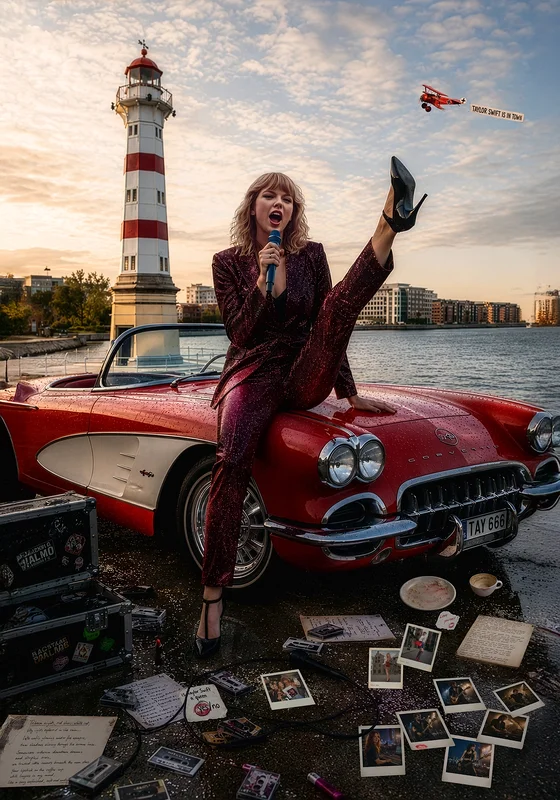
Classy Ride, 2026
Digital
50 x 70 cm
3 200 kr
Classy Ride
Svensk text på slutet
A Photograph That Should Not Exist
At first glance, it looks like nothing more than an old Polaroid from another night of music, noise, and youthful excitement. A blonde singer balances dramatically on the hood of a red 1950s Corvette while fans crowd around her under the evening lights. Someone is laughing. Someone is trying to keep a camera steady. A little girl raises a doll towards the lens as though she wants to step into the story as well.
Yet something about the image feels strangely impossible.
Not because the photograph looks artificial. Quite the opposite. Its blurred edges, worn surface, harsh flash, faded colours, and accidental imperfections make it seem uncannily real — almost too real. It resembles the kind of photograph people rediscover years later in forgotten drawers and immediately start building memories around, even when they are no longer entirely certain what truly happened that night.
Perhaps that uncertainty is exactly where this story begins.
This is not only a story about Taylor Swift, Polaroid photography, nostalgia, fame, or modern pop culture. It is also a story about memory itself — about why human beings continue to try to preserve fleeting moments long after technology has made memory almost infinite.
Why do old photographs still move us more deeply than millions of flawless digital images endlessly stored in invisible clouds? Why do blurred snapshots sometimes feel more truthful than perfect portraits? And why did an instant camera become one of the most powerful visual symbols associated with one of the world’s largest pop stars?
Somewhere between analogue imperfection and digital mythology, between superstardom and intimacy, and between stadium lights and private bedrooms, Taylor Swift and the Polaroid somehow found one another.
This is the story of how it happened.
“Swift Ballet
Beneath the flash of stadium light,
She danced across the summer night,
With red high heels and golden hair,
And Polaroids thrown through the air.
A Corvette gleamed in scarlet shine,
Like something stolen out of time,
While fans with trembling hands held tight
To little squares of fading white.
Some snapshots blurred, some overexposed,
Some caught the moments no one posed,
A laughing face, a tilted grin,
A doorway left half-opened in.
For fame may glow and records spin,
But memory keeps the scratches in,
And every crease and silver stain
Becomes a way to feel again.
So years from now, when songs still play
Though trends and screens have slipped away,
A dusty Polaroid may prove
How quickly youth dissolves in love.
And somewhere in a drawer unseen,
Between old tickets, worn and green,
A faded photograph may stay —
Still kicking like a Swift ballet.”
Malmö, May 2026
Selfie of the Year
Few singers can kick as high as Taylor Swift, even if, in this particular image, she seems to be gaining momentum with the help of a gleaming 1950s Corvette. She may not accelerate from zero to one hundred quite as quickly as the famous sports car beneath her, but once she steps onto a stage, she maintains an impressive speed of her own. Scattered below the beautiful red convertible are memorabilia that tell her story: vinyl records, backstage passes, handwritten signs, photographs, dolls, concert bracelets, and fragments of a modern mythology built around one of the world’s most recognisable pop stars. Yet one question remains: who exactly are the people who worship this pop queen today, and who could seriously challenge her throne at the moment?
In Sweden, Taylor Swift’s core fan base is largely composed of women and millennials aged 18 to 35. At the same time, her audience extends far beyond that demographic, including Gen Z teenagers, young children, and older listeners who have followed her career for years, demonstrating the remarkable breadth of her cultural influence. Dedicated fans — often known as Swifties — are highly active in local online communities such as the Taylor Swift Sweden Facebook Group, where discussions range from lyrics and hidden references to concert outfits, friendships, and emotional memories tied to her music. Many of these admirers first connected with her through her intensely personal songwriting and narrative style, while others were drawn into her orbit by the emotional spectacle of her stadium tours, such as her recent [specific tour or event].
Her crossover hits, such as “Cruel Summer” and “Fortnight”, are constantly heard in Swedish shopping malls, cafés, on radio stations, and across streaming playlists, reflecting how firmly embedded she has become in contemporary Swedish pop culture. Swift’s close collaborations with legendary Swedish producers such as Max Martin and Shellback have also given her a special status within Sweden’s music industry, where producers, songwriters, and insiders often regard her catalogue as a masterclass in modern pop craftsmanship. During “The Eras Tour” in Sweden, she sold out multiple nights at Stockholm’s Friends Arena, drawing more than 60,000 fans each evening and setting new attendance records.
Many assume printed photography is obsolete, but Polaroids uniquely symbolise authenticity and memory, deepening their cultural significance and resonating with fans like Taylor Swift who share candid images. Highlighting this connection keeps readers engaged with the theme of imperfection and nostalgia.
Prologue — The Picture in the Drawer
Nobody remembered who had taken the photograph. That was part of its mystery.
The Polaroid had lain for years in an old wooden drawer, alongside concert wristbands, faded motel receipts, dry perfume samples, and handwritten notes whose ink had slowly bled into the paper. The white border had yellowed with age, one corner bent gently inward, and along the lower edge someone had once written in hurried silver marker:
“The night everything changed.”
And there she was. Young. Laughing. Half-turned away from the camera, as though the moment had been captured spontaneously rather than staged. Her lipstick was slightly smudged, her blonde hair glowing under the harsh flash, while a chaotic crowd of girls surrounded her, holding phones, records, and posters, their hands trembling. The image was imperfect in every way — too bright in one corner, slightly blurred at the edges, marked by a fingerprint across the glossy surface and a faint scratch behind her shoulder — yet somehow more alive than thousands of flawless digital images stored invisibly in phones and clouds.
That was the strange thing about Polaroids. They did not merely capture people. They aged with them.
Even now, in the era of smartphones and infinite digital storage, instant film has seen a remarkable revival. People still carry Polaroid and instant cameras to parties, concerts, weddings, birthdays, and late-night gatherings because the small physical prints feel nostalgic, imperfect, and strangely intimate. Friends hand photographs directly to one another while the images are still developing, passing around tangible memories rather than endlessly scrolling through screens. A Polaroid becomes an object that can be held, taped to a bedroom mirror, slipped into a diary, forgotten in a drawer, or rediscovered years later as a surviving fragment of another life.
Many young photographers and visual artists have embraced the analogue imperfections of instant photography almost as a quiet rebellion against the polished sterility of digital culture. The blurred edges, chemical stains, faded colours, and unpredictable lighting are no longer seen as flaws but as evidence that a real moment once existed before the lens.
The photograph felt less like publicity and more like memory itself: fragile, fading, and vulnerable to light, dust, and time.
Chapter 1 — The Camera That Never Waited
Long before Taylor Swift became one of the most photographed women in the world, she was captivated by the fragile mechanics of memory. She cherished the small, unexpected moments that vanish in an instant: a half-finished milkshake, headlights in the rain, a friend laughing before a photograph is taken, a mother singing alone in the kitchen.
Even as a young girl, she seemed drawn to things that felt temporary. Old family photographs, faded postcards, disposable cameras, snapshots with overexposed skies and imperfect framing — these interested her far more than immaculate studio portraits. The mistakes themselves fascinated her. A blurred hand, a crooked focus, washed-out colours, someone accidentally walking into the frame: all those imperfections made the image feel alive rather than manufactured. A perfect photograph could impress people, but an imperfect one could remind them of their own lives.
This instinct would later become deeply entwined with her songwriting. Many Taylor Swift songs function almost as instant photographs set to music. They rarely describe entire lifetimes. Instead, they capture brief emotional flashes: someone standing in a doorway, a scarf left behind in autumn, headlights on a midnight drive, the sound of shoes on wooden floors, lipstick stains on coffee cups, and silence in a crowded room.
In many ways, the Polaroid camera embodied that philosophy. Unlike digital photography, instant film never waits politely for perfection. There is no endless correcting, filtering, deleting, or retouching. The photograph appears almost immediately, often before the people in it have had time to prepare emotionally. The image arrives carrying the moment's chaos: strange lighting, accidental expressions, nervous movement, grain, chemical shifts, fingerprints, scratches.
That may explain why the Polaroid aesthetic eventually suited Taylor Swift so perfectly. Her public image often hovered in the strange territory between glamour and intimacy, between superstardom and diary confessions. Even at the height of her fame, she cultivated the sense that she was still documenting her life from the inside rather than observing it from above, like a distant celebrity. Fans did not simply listen to her songs; they felt invited into a continuously unfolding scrapbook filled with emotions, clues, memories, heartbreaks, inside jokes, handwritten notes, and private moments that somehow became collective experiences.
As social media rose, with millions of images endlessly editable and disposable, the appeal of instant photography paradoxically grew. Young people increasingly longed for photographs that felt physical, vulnerable, and real. Modern Polaroid cameras began to reappear at parties, backstage gatherings, fashion shoots, birthdays, and in late-night hotel rooms. The small square photographs could be handed to friends on the spot, pinned to mirrors, taped inside notebooks, or scattered across dressing tables as the night unfolded.
A digital image can be copied infinitely without change, but a Polaroid ages alongside its owner. The colours fade, the corners bend, and tiny scratches appear. Over time, the photograph begins to resemble memory itself — delicate, incomplete, yet somehow more truthful for its flaws.
And perhaps that is why so many people eventually associated Taylor Swift not only with songs, tours, and stadiums, but also with Polaroids. She belonged to an era obsessed with documenting everything, yet she somehow reminded people that the most meaningful memories are rarely flawless.
Chapter 2 — The Photographs Left Behind
Chapter 2 — The Photographs Left Behind
At some point, the fascination became more than an aesthetic. It became a way of seeing the world.
Among collectors, musicians, and young photographers, there has always been a particular affection for abandoned photographs — pictures found in flea markets, second-hand shops, forgotten boxes, and dusty family drawers after the people inside them have disappeared. Old Polaroids have an especially haunting quality because they were never meant to travel far from the moment they were taken. Unlike newspaper photographs or official portraits, they were private objects from the start: birthday parties, road trips, motel rooms, drunken evenings, awkward romances, family holidays, somebody’s first flat, somebody’s last summer before everything changed.
One can imagine a young Taylor Swift browsing antique shops or leafing through old photo albums, captivated not only by the images themselves but also by the invisible stories behind them. A faded Polaroid of a teenage couple standing beside a cheap car outside a diner in 1987. A blurry Christmas party where nobody remembers the joke. A girl sitting alone on a hotel bed as neon light filters through the curtains. The photographs endure even when names, voices, and relationships have vanished.
That strange tension between permanence and disappearance would later become one of the defining emotional currents in Taylor Swift’s artistic universe. Her songs often centre on moments already slipping away, even as they happen. Her lyrics rarely serve as stable historical records. Instead, they resemble emotional snapshots rescued from time: fragments of conversations, clothing details, streetlights, weather, perfume, dances, glances, and unfinished sentences. Listeners are not given complete biographies; they are handed flashes of memory.
This may also explain why so many fans developed unusually personal relationships with her music. People did not merely admire her from a distance as a glamorous celebrity. They inserted their own lives into the spaces within her songs. A listener in Stockholm, Melbourne, Nashville, or Malmö could hear one of her lyrics and suddenly remember a specific room, a particular winter, a particular heartbreak, or someone they had not thought about for years. Her songs behaved almost exactly like rediscovered photographs.
The rise of instant photography during the smartphone era deepened this emotional connection. In a culture flooded with billions of polished digital images, young people increasingly began searching for objects that felt tangible and emotionally grounded. A Polaroid could not disappear into an endless stream of scrolling. It existed physically in the world. It could be damaged, lost, kissed, folded, written on, hidden inside books, or rediscovered decades later by someone who had never met the people in the image.
Many artists and photographers deliberately embraced these imperfections as a rebellion against digital sterility. Fashion shoots began to use instant film again. Musicians taped Polaroids to studio walls while recording albums. Behind-the-scenes photographs became almost as emotionally valuable as official publicity campaigns. Even major celebrities began cultivating a more intimate visual language centred on spontaneity rather than on unreachable perfection.
Taylor Swift understood this instinctively. Long before audiences fully recognised what she was doing, she had begun to craft an artistic mythology grounded not in distance but in emotional proximity. Her audience was not simply watching a star. They were collecting moments. And like old Polaroids found years later in forgotten drawers, those moments felt precious precisely because they seemed so vulnerable to time.
Chapter 3 — America Through the Car Window
As Taylor Swift grew older, the world beyond the window began to move faster. Highways replaced school corridors, and tour buses replaced bedrooms. Airports, motel rooms, dressing rooms, diners, petrol stations, backstage corridors, and sleepless drives through unfamiliar cities gradually became part of the emotional geography from which her music emerged. Yet even as her career accelerated towards global superstardom, her artistic gaze remained fixed on small details.
Again and again, her songs returned to fleeting visual fragments: streetlights reflected on wet asphalt, lipstick on coffee cups, old cardigans, traffic at midnight, shoes abandoned beside a bed, perfume lingering in lifts, and someone smoking outside a party as snow begins to fall.
The American road has long held a mythical place in popular culture. Writers, musicians, photographers, and filmmakers have associated highways with freedom, reinvention, loneliness, and youth. Taylor Swift entered that tradition almost instinctively. Her artistic universe is filled with convertibles, motels, windows, rainstorms, radios playing late at night, and lovers disappearing into headlights. Even as her productions grew massive and technologically sophisticated, her storytelling retained the intimacy of someone scribbling thoughts into a notebook while staring out of a moving car window.
At the same time, she was evolving visually. The country aesthetic of cowboy boots and Nashville innocence gradually gave way to something more urban, cinematic, and nostalgic. Vintage jackets, red lipstick, cassette tapes, vinyl records, handwritten notes, motel signs, old sports cars, faded motel pools, and analogue photography began to recur throughout the imagery surrounding her music.
This transformation reached its clearest form in the years leading up to 1989. By then, Taylor Swift no longer presented herself simply as a country songwriter venturing into pop. She had become something more elusive: a curator of modern nostalgia. She drew on visual languages from the late twentieth century — especially the 1980s — but filtered them through contemporary emotional vulnerability. The result felt both glamorous and intimate, polished yet accidental.
Polaroid photography fitted perfectly into this evolving aesthetic universe. The instant photograph carried many of the same emotional associations her songs already explored: transience, youth, movement, romance, loneliness, and the fear that happiness might vanish before one fully understands it. Unlike glossy celebrity portraiture, Polaroids suggested that the moment itself mattered more than perfection. They looked like memories already beginning to fade.
Meanwhile, social media culture was moving in the opposite direction. Platforms became increasingly dominated by carefully curated identities, edited faces, manipulated lighting, and algorithmic perfection. Young people constantly photographed everything, yet many began to feel strangely detached from their own images. In response to this digital saturation, analogue aesthetics experienced a powerful revival. Vinyl records returned. Cassette tapes reappeared. Film photography regained popularity. Instant cameras once again became fashionable, not despite their flaws but because of them.
At parties, concerts, fashion shoots, and backstage gatherings, modern Polaroid cameras began circulating almost like emotional machines. Friends handed out physical prints to one another as evenings unfolded. Artists taped photographs to mirrors and dressing-room walls. The images looked fragile and temporary, yet somehow more emotionally trustworthy than thousands of flawless digital files buried in phones.
Taylor Swift perhaps understood the emotional symbolism embedded in that revival better than almost anyone else in mainstream pop culture. Her music already functioned like a scrapbook of emotional snapshots. The Polaroid gave that feeling a physical form.
Chapter 4 — When an Album Found Its Visual Language
By the time Taylor Swift began working on “1989”, she stood at a crossroads that would permanently redefine her career and public image. The transition from country music to full-scale pop had already begun, but the deeper transformation was emotional and visual rather than merely musical. She was no longer simply writing songs about youth and heartbreak; she was constructing an entire atmosphere around the act of remembering.
That atmosphere demanded its own visual language.
For decades, album covers often aimed for perfection: carefully lit portraits, dramatic poses, immaculate styling, and highly controlled photography designed to create distance between stars and audiences. But Taylor moved in the opposite direction. The imagery surrounding “1989” felt deliberately incomplete. Faces were partially cropped. Colours appeared faded, as if washed by time. The framing resembled casual snapshots rather than official publicity stills. Handwritten lyrics appeared across images like fragments torn from personal notebooks. Instead of presenting herself as untouchable, she cultivated the illusion that listeners had stumbled upon an intimate archive of private memories.
The Polaroid became central to this reinvention.
The album cover echoed the square proportions and visual mood of instant photography. Taylor’s eyes were entirely cropped from the image, an unusual choice in celebrity culture, where eye contact often functions as a branding tool and a means of emotional control. Instead, the photograph felt candid, as if discovered among old belongings rather than staged by the industry. The white border resembled an instant-print frame, and the handwritten title added a personal touch.
Taylor Swift’s songs rarely unfold as grand epic narratives. Instead, they function more like recovered fragments of emotional experience: a scarf, a dance, a kitchen light, a late-night phone call, a dress on the floor, a car disappearing into the rain. The visual language surrounding “1989” transformed those lyrical fragments into a coherent mythology.
During the early 2010s, social media platforms were rapidly transforming everyday life into an endless performance of perfection. Photographs became increasingly filtered, curated, and polished, prompting audiences to crave images that felt more immediate and emotionally believable, even when carefully crafted.
Taylor understood that paradox instinctively. The “1989” imagery did not reject glamour outright; instead, it softened it with vulnerability. The photographs suggested movement, intimacy, friendship, loneliness, youth, and impermanence. They resembled fragments of emotional life rather than products of a global industry machine.
Few artists have managed to merge music, memory, and visual identity so completely. “1989” was not simply an album accompanied by photographs. It was an album that understood how modern audiences emotionally consume photographs — not as objective documentation, but as vessels for longing, nostalgia, identity, and the fear of losing moments that can never fully return.
Chapter 5 — The Sixty-Five Polaroids
One of the most brilliant aspects of the “1989” era was that Taylor Swift did not merely borrow the visual language of Polaroid photography. She made the physical object itself part of the experience.
Different editions of the album included sets of collectable Polaroid photographs — 65 in total — and what might have initially seemed a simple marketing idea quickly became something far more emotionally powerful. Fans did not treat the photographs as ordinary promotional inserts. They collected, traded, and framed them, analysed them online, and obsessively searched for hidden meanings in tiny visual details. The images became artefacts within a growing mythology.
This reaction revealed something important about modern pop culture. In an era increasingly dominated by streaming and invisible digital files, audiences still longed for physical objects that could anchor emotions in the material world. A streamed song dissolves into algorithms and playlists. A Polaroid can be held in the hand. It acquires fingerprints. Corners bend. Light slowly shifts its colours. It becomes personal through time and use.
The photographs themselves were carefully balanced between spontaneity and construction. Some showed Taylor lying on hotel beds, sitting by windows, walking through cities, or laughing with friends. Others resembled fragments from road trips, rehearsals, dressing rooms, kitchens, rooftops, and sleepless nights. The compositions often looked accidental, even when they were clearly carefully constructed. Fans felt they were gaining access not simply to an artist’s image, but to moments existing somewhere between performance and private life.
Many of the Polaroids also contained handwritten lyric fragments beneath the photographs. The handwritten notes evoked letters, diaries, folded messages, and thoughts scribbled late at night before sleep. Combined with the instant-photo aesthetic, the images no longer felt like corporate packaging but like fragments of someone’s emotional archive.
Entire online communities formed around these photographs. Fans exchanged duplicates, debated chronology, interpreted symbolism, and tried to reconstruct emotional narratives that linked specific images to specific songs. Some searched for hidden references to relationships or future projects. Others became emotionally attached to the atmosphere surrounding the images: youth suspended in motion, glamorous yet lonely, confident yet vulnerable.
In many ways, the “1989” Polaroids anticipated later developments in fan culture and social media aesthetics. They encouraged audiences not merely to consume music but to curate emotional worlds around it. The fan was no longer simply a listener or spectator. The fan became an archivist, collector, interpreter, and participant within an unfolding mythology.
At the same time, the photographs reinforced one of the deepest themes running through Taylor Swift’s artistic universe: the tension between permanence and disappearance. A Polaroid develops almost instantly, yet begins to age immediately afterwards. The image appears before one’s eyes even as it slowly moves towards the past. That emotional contradiction mirrors the structure of many Taylor Swift songs. Happiness is already becoming a memory even as it is being experienced.
Perhaps that is why the Polaroids resonated so deeply. They did not merely illustrate the music. They brought their emotional logic into physical reality. Fans were no longer merely hearing about memory, longing, youth, and the passage of time. They could literally hold those themes in their hands.
Chapter 6 — Instagram Before Instagram
One of the great ironies of the ’1989 era is that Taylor Swift helped popularise an aesthetic of analogue intimacy precisely as the world was becoming overwhelmingly digital. Social media platforms rapidly transformed everyday life into a continuous stream of photographs. Yet the more images people produced, the more many of them longed for pictures that felt tangible, accidental, and emotionally believable.
The timing could hardly have been more perfect.
Instagram was growing explosively. Filters tried to mimic vintage film stocks. Young people edited photographs to resemble faded snapshots from decades they had never lived through. Tumblr aesthetics celebrated blurred lights, motel signs, handwritten notes, cigarette smoke, vinyl records, scratched cassette tapes, old convertibles, and melancholic fragments of American nostalgia. Entire online cultures revolved around making the digital world look analogue again.
Yet most of those images remained trapped on screens.
That was the crucial difference with Polaroids. An instant photograph existed physically from the start. It emerged slowly in the hand as people gathered around it, making the object itself part of the emotional experience. Friends passed the image among themselves at parties before it had even fully developed. Lovers hid Polaroids in drawers and wallets. Artists taped them to studio walls and dressing-room mirrors. The photograph occupied real space, aged in real light, and bore the marks of physical existence.
In many ways, Taylor Swift understood the longing for material reality. Her visual world during this period felt deeply connected to internet culture while resisting its polished artificiality.
She also anticipated broader cultural developments that would become even more visible later. Vinyl records returned. Film cameras regained popularity. Handwritten journals, analogue synthesisers, thrift-store fashion, and objects bearing visible signs of age and use suddenly acquired new emotional value. Digital perfection had become so dominant that imperfections themselves began to feel emotionally trustworthy.
Professional photographers noticed the same phenomenon. Fashion shoots often paired instant film with expensive digital equipment because Polaroids created a markedly different atmosphere. Models relaxed more easily around the cameras. Celebrities appeared less guarded. Behind-the-scenes moments suddenly looked spontaneous rather than staged. Many photographers built physical scrapbooks on the spot during shoots, covering studio walls with fresh instant prints as the session unfolded.
The object itself carried history: fingerprints, sunlight, scratches, folds, and chemical fading. Over time, a Polaroid became less like data and more like an artefact rescued from lived experience.
This emotional logic aligned perfectly with Taylor Swift’s songwriting persona. Her audience often experienced her music not as distant entertainment but as emotional companionship in their own lives. Fans listened to her songs during breakups, road trips, first loves, lonely nights, friendships, and transitions into adulthood. The Polaroid aesthetic gave that intimacy physical form. It suggested that these were not merely pop songs produced by a giant industry machine, but fragments of life temporarily preserved before time carried them away.
In retrospect, the “1989” era now feels strangely prophetic. It arrived at the precise moment when digital culture reached saturation and nostalgia itself became one of the defining emotional currencies of the twenty-first century. Taylor Swift did not create that longing, but she understood how to translate it into a visual and emotional language that millions immediately recognised as their own.
Chapter 7 — The Fans and the Moments
For many artists, fame creates distance. The larger the stadiums grow, the smaller and more unreachable the person at the centre often appears. Yet one of the unusual aspects of Taylor Swift was that her enormous success frequently seemed to deepen the emotional connection her audience felt with her. Fans did not simply admire her career from afar. They linked her songs to the architecture of their own lives.
A Taylor Swift concert, therefore, became more than mere entertainment. It functioned almost as a collective memory machine.
Inside enormous stadiums, thousands of people simultaneously revisited earlier versions of themselves through the songs. Someone remembered a first heartbreak. Someone thought about a friendship that had long since ended. Someone relived late-night drives, school dances, university apartments, unanswered text messages, summers by the sea, winters that felt endless, or relationships that had already begun to feel like memories even as they were happening. Entire sections of the audience cried not because they were sad in the present moment, but because the music reopened emotional rooms they believed had long since been sealed.
This emotional relationship between the audience and the artist helps explain why Polaroid imagery became so culturally powerful. Fans were not merely collecting photographs of Taylor Swift; they were gathering emotional evidence of moments in their own lives.
In that sense, the photographs functioned less as celebrity memorabilia and more as portable time capsules.
The phenomenon became especially visible during ”The Eras Tour”, where nostalgia itself formed the structural foundation of the entire production. The concerts unfolded almost like journeys through accumulated memory, allowing audiences to move chronologically through different emotional stages of Taylor’s career while simultaneously revisiting their own histories alongside it.
And the cameras were everywhere.
Smartphones lit up entire stadiums like artificial constellations, yet amid the digital avalanche, instant cameras still circulated through crowds and backstage gatherings. Young fans handed out physical photographs to friends before the concerts had even ended. Others taped fresh Polaroids into journals alongside ticket stubs and handwritten reflections. The need for tangible memory remained surprisingly strong despite the infinite convenience of digital storage.
Part of the appeal may lie in the fact that physical photographs acknowledge the passage of time more honestly than screens do. A digital image looks almost identical ten years later, whereas a Polaroid visibly ages alongside its owner. Colours slowly fade. Corners bend. Tiny scratches appear across the surface. Over time, the object begins to resemble memory itself.
Taylor Swift’s artistic universe repeatedly returns to the fleeting nature of moments: how quickly they vanish, how selectively people remember them, and how youth feels endless while one is living through it, yet afterwards seems astonishingly brief.
Perhaps that is why so many listeners formed such deep attachments not only to the songs themselves but also to the visual culture surrounding them. The Polaroids, lyric fragments, handwritten notes, backstage photographs, and memorabilia all reinforced the same emotional truth: life is experienced in fragments, and those fragments become precious precisely because they disappear.
The fans understood this. They were not merely documenting concerts. They were trying to rescue moments before they disappeared.
Chapter 8 — Why Polaroid Suited Taylor Swift
Some artists could never have embodied the Polaroid aesthetic convincingly. For Taylor Swift, however, the connection felt almost inevitable, as the emotional structure of her artistic identity already mirrored the logic of instant photography long before the visual concept fully emerged.
At the heart of Taylor Swift’s songwriting lies an obsession with memory. Not memory as objective history, but as emotional reconstruction — selective, fragmented, intensely sensory, and permanently unstable. Her songs rarely attempt to tell complete stories from start to finish. Instead, they preserve flashes of emotional experience: someone dancing barefoot in a kitchen, autumn leaves drifting across a scarf left behind, headlights crossing a face at midnight, lipstick stains on glass, rain against windows, names spoken softly in the dark.
A Polaroid works in much the same way.
Instant photographs often appear incomplete or uncontrolled. They capture an emotional atmosphere rather than technical perfection. Awkward framing, unpredictable colours, blurred movement, fingerprints, scratches, and overexposure frequently make the image feel more alive rather than less convincing. The photograph seems to contain lived time rather than merely recording appearances.
Taylor’s public persona also occupied a delicate balance between glamour and intimacy. She became one of the world’s biggest stars while still maintaining the impression of being emotionally accessible. Audiences did not simply observe her from a distance; they continually searched for fragments of themselves in her songs.
That emotional accessibility distinguished her from many earlier pop stars, whose images relied more heavily on distance, mystery, or unattainable perfection. Taylor Swift instead cultivated the sense of an ongoing conversation. Through handwritten lyrics, diary-like confessions, hidden references, social media interactions, backstage glimpses, and autobiographical storytelling, she transformed celebrity culture into something unusually participatory. Fans did not merely consume finished performances; they constantly searched for emotional clues linking songs, photographs, memories, relationships, and different eras.
The Polaroid aesthetic perfectly reinforced that sense of intimacy because instant photographs feel inherently personal. They belong in bedrooms, at parties, on road trips, on dressing tables, in lockers, on refrigerators, and in private drawers, rather than in museums or corporate archives. A Polaroid suggests friendship, youth, romance, vulnerability, and the passing of time. It feels less like publicity and more like evidence that a moment once genuinely existed.
There was also something emotionally comforting in the analogue qualities of the imagery in an increasingly digital age. Social media culture encouraged relentless self-curation, endless comparison, and the illusion that life should look permanently optimised. Taylor’s Polaroid-inspired visual world softened that pressure by romanticising imperfection rather than erasing it. The blurred edges, faded colours, handwritten notes, and casual snapshots suggested that emotional truth mattered more than flawless presentation.
This may explain why so many fans experienced the ”1989” era not merely as an album cycle but as a complete emotional environment. The music, photographs, typography, fashion, memorabilia, and visual storytelling reinforced one another with unusual coherence. Together, they constructed a world in which memory itself became beautiful precisely because it was temporary and imperfect.
In retrospect, the connection between Taylor Swift and Polaroids now feels almost inevitable. She emerged at a moment when audiences were drowning in digital images yet starved for emotional authenticity. Her genius was not merely recognising that longing but translating it into a form people could hold in their hands — fragile little photographs already beginning to fade the moment they appeared.
Chapter 9 — The Eras Tour and the Machinery of Memory
By the time Taylor Swift launched ”The Eras Tour”, she had evolved from a pop star into something closer to a cultural timekeeper. Few artists in modern history have managed to construct such a clearly defined emotional chronology across their careers.
”The Eras Tour” transformed that accumulated mythology into a physical space.
The concerts unfolded less like ordinary performances and more like rituals of remembrance. Audiences did not simply attend to hear songs they already loved. They came to revisit earlier versions of themselves through the music.
Inside enormous stadiums, thousands of people simultaneously returned to different emotional periods of their lives. Someone remembered a first heartbreak. Someone thought about a friendship that had quietly disappeared years earlier. Someone relived school dances, late-night drives, university apartments, unanswered text messages, summers by the sea, winters that once felt endless, or relationships that had already begun to turn into memories even as they were unfolding.
The scale itself was staggering. Giant screens, synchronised lights, elaborate stage constructions, moving platforms, pyrotechnics, and massive visual effects combined to create one of the most technologically sophisticated touring productions ever assembled. Yet despite this overwhelming machinery, the emotional core of the experience remained surprisingly intimate. Fans still searched constantly for fleeting human moments within the spectacle: a spontaneous smile, a glance towards the crowd, an unscripted gesture, or a brief change in tone or expression.
That instinct revealed something essential about contemporary celebrity culture. In an age saturated with infinite digital content, audiences increasingly value moments that seem accidental or emotionally unfiltered. Perfection impresses people, but vulnerability lingers.
Once again, the Polaroid metaphor quietly reappeared.
Throughout the tour, fans obsessively documented their experiences on smartphones, creating millions of digital images and videos that circulated instantly across the internet. Yet many attendees also carried analogue cameras, journals, printed photographs, friendship bracelets, ticket stubs, handwritten notes, and other physical objects associated with memory and preservation. Entire sections of social media became devoted not merely to documenting the concerts but to transforming them into emotional scrapbooks.
The friendship bracelets exchanged during the tour shared many of the same symbolic qualities as Polaroids. They were handmade, imperfect, tangible, and deeply personal. These small objects transformed giant stadiums into temporary communities centred on memory and participation.
Against that backdrop, Taylor Swift’s artistic universe offered something emotionally distinct. Her work repeatedly returned to the textures of memory itself: handwriting, old clothes, faded photographs, scents, seasons, objects, places, fragments of conversation, and songs tied to specific emotional moments. ”The Eras Tour” therefore functioned not merely as entertainment but as a vast collective attempt to hold on to time before it disappeared.
And perhaps that explains why the Polaroid remained such a powerful symbol throughout her mythology. An instant photograph develops while one is still standing within the moment it captures, yet the image already belongs to the past almost immediately afterwards. It is both presence and disappearance.
Much of Taylor Swift’s music operates on the same emotional logic. The songs recognise that people often recognise the importance of moments only when they are already beginning to vanish.
Chapter 10 — The Girl Next Door
One reason Taylor Swift became more than merely a successful pop artist may lie in something far less obvious than stadium tours, streaming records, or carefully orchestrated publicity campaigns. Behind the spectacle, the glamour, the choreography, and the vast machinery of modern celebrity culture, she somehow managed to preserve the emotional illusion of being “the girl next door”.
The phrase is deeply rooted in American culture. It does not literally mean an ordinary girl living nearby, nor does it imply a lack of beauty, charisma, or ambition—quite the opposite. The “girl next door” archetype traditionally describes someone who appears emotionally approachable despite fame or attractiveness—someone audiences feel they might genuinely know, speak to, fall in love with, or recognise from their own lives. She remains human-sized even after becoming larger-than-life.
Many major stars throughout modern entertainment history have cultivated a sense of distance as part of their mythology. Some become untouchable icons wrapped in luxury, mystery, sexuality, avant-garde aesthetics, or aristocratic perfection. Their power partly depends on remaining unreachable. Taylor Swift’s public image evolved differently. Even as her fame expanded into something almost impossible to comprehend, her emotional language remained grounded in ordinary details and recognisable experiences.
Her songs rarely address abstract concepts. Instead, they centre on bedrooms, kitchens, telephones, scarves, school corridors, late-night drives, autumn leaves, awkward conversations, friendships, misunderstandings, heartbreak, and memories attached to small physical objects. The emotional scale remains intimate even as the career surrounding it becomes enormous. Audiences do not simply observe her life from a distance; they continually find fragments of themselves within it.
That emotional accessibility may explain why her audience often behaves less like a traditional fandom and more like a vast collective memory community. People attach Taylor Swift songs to highly specific moments in their own lives: first loves, breakups, school years, road trips, university apartments, friendships that faded, lonely winters, weddings, growing up, and moving away from home. Her music frequently becomes intertwined with listeners’ personal emotional timelines.
The Polaroid aesthetic reinforced this connection perfectly. A Polaroid does not resemble luxury advertising or unreachable glamour. It resembles somebody’s bedroom wall, somebody’s diary, somebody’s road trip, somebody’s forgotten summer. The instant photograph carries traces of touch and time: fingerprints, bent corners, fading colours, scratches, and handwritten notes. It feels personal before it feels iconic.
That is precisely the emotional territory in which the “girl next door” archetype lives.
Taylor Swift’s cultural achievement may therefore rest not only on musical craftsmanship or business acumen, but on her ability to preserve the illusion of emotional proximity within a level of fame that would normally destroy it. Audiences feel that beneath the immense celebrity apparatus, there still exists a person who notices the same small details they do: the sound of shoes on wooden floors, headlights through rain-covered windows, lipstick on coffee cups, silence after arguments, old photographs hidden in drawers.
Of course, this intimacy is partly constructed. No global superstar remains entirely spontaneous under the permanent spotlight of twenty-first-century fame. Yet the emotional impact remains powerful because the illusion itself satisfies a modern cultural hunger. In an age increasingly dominated by algorithms, branding, filters, and digital performance, people still long for personalities who seem emotionally real, vulnerable, and recognisable.
Perhaps that is why Taylor Swift’s relationship with her audience often feels unusually enduring. Fans do not merely admire her success. They feel as though they have grown up alongside her.
Epilogue — The Last Polaroid
Years from now, long after streaming platforms have changed names, social media trends have vanished, and today’s phones lie forgotten in drawers beside obsolete chargers and silent hard drives, somebody will probably still find an old Polaroid of Taylor Swift somewhere in the physical world.
Perhaps inside a second-hand book. Perhaps tucked into the sleeve of an old vinyl record. Perhaps hidden in a box of concert memorabilia in an attic, where dust drifts slowly through summer light.
The photograph will already be surrendering to time. The colours will have faded slightly. The corners will be bent. Tiny scratches will mark the surface. The image may no longer appear entirely sharp. Yet, because of those imperfections, the photograph may feel strangely more alive than thousands of flawless digital images stored invisibly in the clouds and on servers.
That has always been the Polaroid paradox.
An instant photograph appears fragile from the outset. It can be damaged, lost, stained, creased, or destroyed almost by accident. Unlike digital files endlessly duplicated across invisible servers, the Polaroid is a unique physical object, moving vulnerably through time alongside the person who keeps it.
Taylor Swift understood this. Throughout her career, she transformed fleeting emotional moments into something audiences could preserve and revisit long after the original experiences had passed. Her songs became attached to first loves, breakups, friendships, cities, school years, marriages, lonely nights, road trips, and transitions into adulthood for millions of people around the world. Listeners did not merely hear the music. They inserted their own lives into it.
The Polaroid aesthetic captured that emotional relationship perfectly by mirroring the instability of memory. Human beings do not remember life as a polished chronology. They remember fragments: light through windows, perfume in hallways, summer heat rising from asphalt, songs from passing cars, the colour of somebody’s jacket, a final glance before goodbye. Memories blur. Certain details fade while others remain painfully sharp. Over time, emotion reshapes the image itself.
That is why the old Polaroid in the drawer feels more powerful than a thousand flawless publicity photographs. It does not merely document celebrity. It preserves atmosphere, vulnerability, and the fleeting sense that the moment captured in the image once briefly existed before slipping away forever.
In the end, Taylor Swift’s connection to Polaroids was never just about retro fashion or nostalgia. It reflected something deeper about the fragility of memory in modern life. In an era obsessed with endless documentation, the Polaroid reminded people that memories gain emotional weight not through perfection but through impermanence.
And perhaps that is why people continue to seek physical traces of their lives, even in a digital age promising infinite storage. Deep inside us, we still want memories to feel touchable. We want them to age alongside us.
A Polaroid does exactly that.
PS:
Something about the image that opens this story may disturb a certain kind of orderly mind. No matter how high Taylor Swift kicks, something about it does not quite add up.
That is perfectly true.
The image is, at least in part, about dreams and fantasies — wishful thinking, some people in Stockholm would probably call it. That opinion may remain theirs.
Taylor Swift has not performed a concert in Malmö to date. But who can say with certainty that she did not quietly slip through the city on her way to Stockholm in May 2024? She had been off tour since early March, after performing in Singapore. Perhaps she wanted to experience Malmö for herself — a city many still consider Sweden’s true music capital. Perhaps the opportunity will come when Malmö’s new major stadium is inaugurated in 2029.
So no, Taylor Swift has not played in Malmö. But the local Swiftie community is very much alive. Fans in the city regularly gather for club nights and festivals celebrating her music. Keep an eye on the Facebook groups. If Taylor ever appears incognito in Malmö, they will almost certainly be the first to know. One should also remember that Copenhageners have always enjoyed crossing over to Malmö — particularly if Taylor Swift happens to be in town.
Ett fotografi som inte borde existera
Vid första anblicken ser det inte ut som något annat än en gammal Polaroid från ännu en kväll fylld av musik, oväsen och ungdomlig upphetsning. En blond sångerska balanserar dramatiskt på motorhuven till en röd Corvette från 1950-talet medan fans tränger sig omkring henne under kvällsljuset. Någon skrattar. Någon försöker hålla kameran stilla. En liten flicka sträcker en docka mot linsen som om hon också vill kliva in i berättelsen.
Ändå finns det något med bilden som känns märkligt och omöjligt.
Inte därför att fotografiet ser konstgjort ut. Tvärtom. Dess suddiga kanter, slitna yta, hårda blixtljus, blekta färger och tillfälliga brister får det att framstå som kusligt verkligt — nästan alltför verkligt. Det liknar den sortens fotografi som människor återupptäcker många år senare i bortglömda lådor och omedelbart börjar bygga minnen kring, även när de inte längre är helt säkra på vad som egentligen hände den där kvällen.
Kanske är det just där denna berättelse börjar.
Det här är inte bara en berättelse om Taylor Swift, Polaroidfotografi, nostalgi, berömmelse eller modern popkultur. Det är också en berättelse om själva minnet — om varför människor fortsätter att försöka bevara flyktiga ögonblick långt efter att tekniken gjort minnet nästan oändligt.
Varför berör gamla fotografier oss fortfarande djupare än miljontals perfekta digitala bilder som oändligt lagras i osynliga moln? Varför känns suddiga snapshots ibland sannare än perfekta porträtt? Och varför blev en instantkamera en av de starkaste visuella symbolerna kring en av världens största popstjärnor?
Någonstans mellan analog ofullkomlighet och digital mytologi, mellan superstjärnestatus och intimitet, mellan stadionljus och privata sovrum fann Taylor Swift och Polaroiden på något sätt varandra.
Det här är berättelsen om hur det gick till.
Årets Selfie
Det är inte många sångartister som kan sparka lika högt som Taylor Swift, även om hon på just den här bilden tycks ta sats med hjälp av en glänsande Corvette från 1950-talet. Hon accelererar kanske inte från noll till hundra riktigt lika snabbt som den berömda sportbilen under henne, men så snart hon kliver upp på en scen håller hon en imponerande fart på sitt eget sätt. Nedanför den vackra röda cabrioleten ligger memorabilia utspridda som berättar hennes historia: vinylskivor, backstagepass, handskrivna skyltar, fotografier, dockor, konsertarmband och fragment av en modern mytologi uppbyggd kring en av världens mest igenkännliga popstjärnor. Men en fråga kvarstår: vilka är egentligen människorna som dyrkar denna popdrottning i dag, och vem skulle på allvar kunna utmana hennes tron just nu?
I Sverige består Taylor Swifts kärnpublik till stor del av kvinnor och millennials mellan 18 och 35 år. Samtidigt sträcker sig hennes publik långt utanför den gruppen och omfattar både Gen Z-tonåringar, yngre barn och äldre lyssnare som följt hennes karriär i många år, vilket visar hur omfattande hennes kulturella genomslag har blivit. Hängivna fans — ofta kallade Swifties — är mycket aktiva i lokala nätgemenskaper som Taylor Swift Sweden Facebook Group, där diskussionerna rör allt från textrader och dolda referenser till konsertkläder, vänskaper och känslomässiga minnen kopplade till hennes musik. Många av dessa beundrare drogs först till henne genom hennes personliga låtskrivande och berättarstil, medan andra fångades av den emotionella kraften i hennes stadionturnéer.
Hennes crossover-hits, som ”Cruel Summer” och ”Fortnight”, hörs ständigt i svenska köpcentrum, på caféer, radiostationer och streaminglistor, vilket visar hur djupt förankrad hon blivit i samtida svensk popkultur. Swifts nära samarbeten med legendariska svenska producenter som Max Martin och Shellback har också gett henne en särskild status inom den svenska musikindustrin, där producenter, låtskrivare och branschfolk ofta betraktar hennes katalog som en mästarklass i modern popmusik. Under ”The Eras Tour” i Sverige sålde hon ut flera kvällar på Friends Arena i Stockholm och drog mer än 60 000 besökare varje kväll, samtidigt som nya publikrekord sattes.
Många utgår från att pappersfotografi är föråldrat, men Polaroidbilder har kommit att symbolisera autenticitet och minne på ett sätt som gett dem ett nytt kulturellt liv.
Prologue — Bilden i lådan
Ingen kom ihåg vem som hade tagit fotografiet. Det var en del av dess mysterium.
Polaroidbilden hade legat i åratal i en gammal trälåda tillsammans med konsertarmband, blekta motellkvitton, torra parfymprover och handskrivna lappar vars bläck långsamt hade sugits ut i papperet. Den vita ramen hade gulnat av ålder, ett hörn böjde sig lätt inåt och längst ned hade någon en gång skrivit med hastig silverpenna.
”Natten då allting förändrades.”
Och där var hon. Ung, skrattande, halvt vänd bort från kameran, som om ögonblicket hade fångats spontant snarare än arrangerat. Läppstiftet var något utsmetat; hennes blonda hår lyste under den hårda blixten medan en kaotisk grupp flickor omgav henne med telefoner, skivor och affischer i händerna. Bilden var på alla sätt ofullkomlig — för ljus i ena hörnet, lätt oskarp i kanterna, märkt av ett fingeravtryck över den blanka ytan och en svag repa bakom hennes axel — men ändå på något märkligt sätt mer levande än tusentals perfekta digitala bilder, osynligt lagrade i telefoner och molntjänster.
Det var det märkliga med Polaroider. De fångade inte bara människor. De åldrades tillsammans med dem.
Även nu, i smarttelefonernas och det oändliga digitala lagringsutrymmets tid, har instantfilm fått ett remarkabelt uppsving. Människor tar fortfarande med sig Polaroid- och instantkameror till fester, konserter, bröllop, födelsedagar och sena kvällssammankomster därför att de små fysiska bilderna känns nostalgiska, ofullkomliga och märkligt intima. Vänner skickar fotografier direkt till varandra medan bilderna fortfarande framkallas och skickar runt konkreta minnen istället för att oändligt scrolla genom skärmar. En Polaroid blir ett föremål som kan hållas i handen, tejpas fast på en sovrumsspegel, stoppas in i en dagbok, glömmas i en låda eller återupptäckas många år senare som ett överlevande fragment av ett annat liv.
Många unga fotografer och bildkonstnärer har omfamnat instantfotografins analoga ofullkomlighet, nästan som ett stillsamt uppror mot den digitala kulturens polerade sterilitet. De suddiga kanterna, kemiska fläckarna, de blekta färgerna och det oförutsägbara ljuset betraktas inte längre som fel utan som bevis på att ett verkligt ögonblick en gång existerade framför linsen.
Fotografiet kändes mindre som reklam och mer som själva minnet: skört, bleknande och sårbart för ljus, damm och tid.
Kapitel 1 — Kameran som aldrig väntade
Långt innan Taylor Swift blev en av världens mest fotograferade kvinnor var hon fascinerad av minnets sköra mekanik. Hon drogs till de små oväntade ögonblicken som försvinner på ett ögonblick: en halvuppdrucken milkshake, strålkastare i regnet, en vän som skrattar innan bilden tas, en mamma som sjunger ensam i köket.
Redan som ung verkade hon dras till sådant som kändes tillfälligt. Gamla familjefotografier, blekta vykort, engångskameror och snapshots med överexponerade himlar och ojämn bildkomposition intresserade henne långt mer än perfekta studioporträtt. Själva misstagen fascinerade henne. En suddig hand, ett skevt fokus, utvättade färger, någon som råkar gå in i bild — allt detta fick fotografiet att kännas levande snarare än tillverkat. Ett perfekt fotografi kunde imponera på människor, men ett ofullkomligt kunde påminna dem om deras egna liv.
Detta skulle senare bli djupt sammanvävt med hennes låtskrivande. Många Taylor Swift-låtar fungerar nästan som instantfotografier satta till musik. De beskriver sällan hela livet. Istället fångar de korta emotionella blixtar: någon som står i en dörröppning, en halsduk som lämnats kvar under hösten, strålkastare under en nattlig bilfärd, ljudet av skor mot trägolv, läppstiftsmärken på kaffekoppar och tystnad i ett överfullt rum.
På många sätt förkroppsligade Polaroidkameran just den filosofin. Till skillnad från digital fotografering väntar instantfilm aldrig artigt på perfektion. Det finns inget ändlöst korrigerande, filtrerande, raderande eller retuscherande. Fotografiet uppstår nästan omedelbart, ofta innan människorna på bilden hunnit förbereda sig känslomässigt. Bilden anländer med hela ögonblickets kaos: märkligt ljus, tillfälliga ansiktsuttryck, nervösa rörelser, kornighet, kemiska skiftningar, fingeravtryck och repor.
Det kan förklara varför Polaroidestetiken till slut passade Taylor Swift så perfekt. Hennes offentliga image svävade ofta i det märkliga gränslandet mellan glamour och intimitet, mellan superstjärnestatus och dagboksbekännelser. Även på höjden av sin berömmelse lyckades hon skapa en känsla av att fortfarande dokumentera sitt liv inifrån snarare än att betrakta det utifrån som en avlägsen celebritet. Fansen lyssnade inte bara på hennes låtar; de kände sig inbjudna till ett ständigt växande scrapbook fyllt av känslor, ledtrådar, minnen, hjärtesorg, interna skämt, handskrivna lappar och privata ögonblick som på något sätt blev kollektiva upplevelser.
När sociala medier växte fram och miljontals bilder blev oändligt redigerbara och utbytbara, ökade paradoxalt nog instantfotografins attraktionskraft. Unga människor började längta efter fotografier som kändes fysiska, sårbara och verkliga. Moderna Polaroidkameror började åter dyka upp på fester, backstageområden, modefotograferingar, födelsedagar och sena hotellkvällar. De små fyrkantiga bilderna kunde ges direkt till vänner, sättas upp på speglar, tejpas in i anteckningsböcker eller spridas över sminkbord medan natten fortfarande pågick.
En digital bild kan kopieras oändligt utan att förändras, men en Polaroid åldras tillsammans med sin ägare. Färgerna bleknar, hörnen böjs och små repor uppstår. Med tiden börjar fotografiet likna själva minnet — skört, ofullständigt men på något sätt sannare genom sina brister.
Och kanske är det därför så många till slut kom att förknippa Taylor Swift inte bara med låtar, turnéer och stadionkonserter utan också med Polaroider. Hon tillhörde en tid besatt av att dokumentera allting, men hon påminde samtidigt människor om att de mest betydelsefulla minnena sällan är felfria.
Kapitel 2 — Fotografierna som blev kvar
Vid någon punkt blev fascinationen mer än bara en estetik. Den blev ett sätt att se på världen.
Bland samlare, musiker och unga fotografer har det alltid funnits en särskild dragning till övergivna fotografier — bilder som hittats på loppmarknader, i secondhandbutiker, i bortglömda kartonger och dammiga familjelådor efter att människorna på bilderna försvunnit. Gamla Polaroider bär på en särskilt hemsökande kvalitet eftersom de aldrig var avsedda att färdas långt bort från ögonblicket då de togs. Till skillnad från tidningsfotografier eller officiella porträtt var de privata föremål redan från början: födelsedagsfester, bilresor, motellrum, berusade kvällar, tafatta romanser, familjesemestrar, någons första lägenhet, någons sista sommar innan allting förändrades.
Man kan föreställa sig en ung Taylor Swift bläddrande i gamla fotoalbum eller vandrande genom antikaffärer, fascinerad inte bara av bilderna i sig utan också av de osynliga historierna bakom dem. En blekt Polaroid av ett tonårspar som står bredvid en billig bil utanför en diner år 1987. En suddig julfest där ingen längre minns skämtet. En flicka som sitter ensam på en hotellsäng medan neonljuset silas genom gardinerna. Fotografierna överlever även när namn, röster och relationer har försvunnit.
Den märkliga spänningen mellan beständighet och försvinnande skulle senare bli en av de starkaste känsloströmmarna i Taylor Swifts konstnärliga universum. Hennes låtar kretsar ofta kring ögonblick som redan håller på att glida undan medan de fortfarande pågår. Hennes texter fungerar sällan som stabila historiska dokument. Istället liknar de emotionella snapshots räddade ur tiden: fragment av samtal, detaljer i kläder, gatlyktor, väder, parfym, danser, blickar och ofullbordade meningar. Lyssnaren får inga kompletta biografier; man får glimtar av minne.
Det kan också förklara varför så många fans utvecklade ovanligt personliga relationer till hennes musik. Människor beundrade henne inte bara på avstånd som en glamorös celebritet. De placerade sina egna liv i tomrummen mellan hennes textrader. En lyssnare i Stockholm, Melbourne, Nashville eller Malmö kunde höra en av hennes låtar och plötsligt minnas ett särskilt rum, en särskild vinter, en särskild hjärtesorg eller någon de inte tänkt på på många år. Hennes låtar fungerade nästan exakt som återupptäckta fotografier.
Instantfotografins återkomst under smarttelefonernas era fördjupade denna känslomässiga koppling. I en kultur översvämmad av miljarder polerade digitala bilder började unga människor söka efter föremål som kändes konkreta och emotionellt förankrade. En Polaroid kunde inte försvinna in i ett oändligt flöde av scrollande. Den existerade fysiskt i världen. Den kunde skadas, tappas bort, klistras, vikas, skrivas på, gömmas i böcker eller återupptäckas flera decennier senare av någon som aldrig hade träffat människorna på bilden.
Många konstnärer och fotografer började medvetet omfamna dessa brister som ett slags uppror mot den digitala steriliteten. Modefotograferingar började åter använda instantfilm. Musiker tejpade upp Polaroider på studioväggar medan album spelades in. Bilder bakom kulisserna blev nästan lika känslomässigt värdefulla som officiella reklamkampanjer. Till och med stora celebriteter började odla ett mer intimt bildspråk byggt på spontanitet snarare än ouppnåelig perfektion.
Taylor Swift förstod detta. Långt innan publiken fullt ut insåg vad hon gjorde hade hon redan börjat bygga en konstnärlig mytologi, grundad inte på distans utan på känslomässig närhet. Hennes publik betraktade inte bara en stjärna. De samlade ögonblick. Och likt gamla Polaroider som återfinns många år senare i bortglömda lådor, kändes dessa ögonblick värdefulla just därför att de verkade så sårbara för tidens gång.
Kapitel 3 — Amerika genom bilrutan
När Taylor Swift blev äldre började världen utanför bilrutan röra sig allt snabbare. Motorvägar ersatte skolkorridorer och turnébussar ersatte sovrum. Flygplatser, motellrum, loger, diners, bensinstationer, backstagekorridorer och sömnlösa bilfärder genom främmande städer blev gradvis en del av det emotionella landskap ur vilket hennes musik växte fram. Me
3 200 kr

Jörgen Thornberg
Malmö
Lite om bilder och mig. Translation in English at the end.
Jag är en nyfiken person som ser allt i bilder, även det jag fäster i ord, gärna tillsammans för bakom alla mina bilder finns en berättelse. Till vissa bilder hör en kortare eller längre novell som följer med bilden.
Bilder berättar historier. Jag omges av naturlig skönhet, intressanta människor och historia var jag än går. Jag använder min kamera för att dokumentera världen och blanda det jag ser med vad jag känner för att fånga den dolda magin.
Mina bilder berättar mina historier. Genom mina bilder, tryck och berättelser. Jag bjuder in dig att ta del av dessa berättelser, in i ditt liv och hem och dela min mycket personliga syn på vår värld. Mer än vad ögat ser. Jag tänker i bilder, drömmer och skriver och pratar om dem; följaktligen måste jag också skapa bilder. De blir vad jag ser, inte nödvändigtvis begränsade till verkligheten. Det finns en bild runt varje hörn. Jag hoppas att du kommer att se vad jag såg och gilla det.
Jag är också en skrivande person och till många bilder hör en kortare eller längre essay. Den följer med tavlan, tryckt på fint papper och med en personlig hälsning från mig.
Flertalet bilder startar sin resa i min kamera. Enkelt förklarat beskriver jag bilden jag ser i mitt inre, upplevd eller fantiserad. Bilden uppstår inom mig redan innan jag fått okularet till ögat. På bråkdelen av ett ögonblick ser jag vad jag vill ha och vad som kan göras med bilden. Här skall jag stoppa in en giraff, stålmannen, Titanic eller vad det är min fantasi finner ut. Ännu märkligare är att jag kommer ihåg minnesbilden långt efteråt när det blir tid att skapa verket. Om jag lyckas eller inte, är upp till betraktaren, oftast präglat av en stråk av svart humor – meningen är att man skall bli underhållen. Mina bilder blir ofta en snackis där de hänger.
Jag föredrar bilder som förmedlar ett budskap i flera lager. Vid första anblicken fylld av feel-good, en vacker utsikt, fint väder, solen skiner, blommor på ängen eller vattnet som ligger förrädiskt spegelblankt. I en sådan bild kan jag gömma min egentliga berättelse, mitt förakt för förtryckare och våldsverkare, rasister och fördomsfulla människor - ett gärna återkommande motiv mer eller mindre dolt i det vackra motivet. Jag försöker förena dem i ett gemensamt narrativ.
Bild och formgivning har löpt som en röd tråd genom livet. Fotokonst känns som en värdig final som jag gärna delar med mig.
Min genre är vid som framgår av mina bilder, temat en blandning av pop- och gatukonst i kollage som kan bestå av hundratals lager. Vissa bilder kan ta veckor, andra någon dag innan det är dags att överlämna resultatet till printverkstaden. Fine Art Prints är digitala fotocollage. I dessa kollage sker rivandet, klippandet, pusslandet, målandet, ritandet och sprayningen digitalt. Det jag monterar in kan vara hundratals år gamla bilder som jag omsorgsfullt frilägger så att de ser ut att vara en del av tavlan men också bilder skapade av mig själv efter min egen fantasi. Därefter besöks printstudion och för vissa bilder numrera en limiterad upplaga (oftast 7 exemplar) och signera för hand. Vissa bilder kan köpas i olika format. Det är bara att fråga efter vilka. Gillar man en bild som är 70x100 men inte har plats på väggen, går den kanske att få i 50x70 cm istället. Frågan är fri.
Metoden Giclée eller Fine Art Print som det också kallas är det moderna sättet för framställning av grafisk konst. Villkoret för denna typ av utskrifter är att en högkvalitativ storformatskrivare används med åldersbeständigt färgpigment och konstnärspapper eller i förekommande fall på duk. Pappret som används möter de krav på livslängd som ställs av museer och gallerier. Normalt säljer jag mina bilder oinramade så att den nya ägaren själv kan bestämma hur de skall se ut, med eller utan passepartout färg på ram, med eller utan glas etc..
Under många år ställde jag bara ut på nätet, i valda grupper och på min egen Facebooksida - https://www.facebook.com/jorgen.thornberg.9
Jag finns också på en egen hemsida som tyvärr inte alltid är uppdaterad – https://www.jth.life/ Där kan du också läsa en del av de berättelser som följer med bilden.
UTSTÄLLNINGAR
Luftkastellet, oktober 2022
Konst i Lund, november 2022
Luftkastellet, mars 2023
Engleson Galleri Caroli, april 2023
Hydra, Greece June 2023
Engleson Galleri Caroli, oktober 2023
Toppen, Höllviken december 2023
Luftkastellet, mars 2024
Torups Galleri, mars 2024
Venice, May 2024
Luftkastellet, oktober 2024
Konst i Advent, December 2024
Galleri Engleson, Caroli December 2024
Jäger & Jansson Galleri, april 2025
A bit about pictures and me.
I'm a curious person who sees everything in pictures, even what I express in words, often combining them, for behind all my pictures lies a story. These narratives, some as short as a single image and others as long as a novel, are the heart and soul of my work.
Pictures tell stories. Wherever I go, I'm surrounded by natural beauty, exciting people, and history. I use my camera to document the world and blend what I see with what I feel to capture the hidden magic.
My images tell my stories. Through my pictures, prints, and narratives, I invite you to partake in these stories in your life and home and share my deeply personal perspective of our world. More than meets the eye. I think in pictures, dream, write, and talk about them; consequently, I must create images too. They become what I see, not necessarily confined to reality. There's a picture around every corner. I hope you'll see what I saw and enjoy it.
I'm also a writer, and many images come with a shorter or longer essay. It accompanies the painting, printed on fine paper with my personal greeting.
Many pictures start their journey on my camera. Simply put, I describe the image I see in my mind, experienced or imagined. The image arises within me even before I bring the eyepiece to my eye. In a fraction of a moment, I see what I want and what can be done with the picture. Here, I'll insert a giraffe, Superman, the Titanic, or whatever my imagination conjures up. Even stranger is that I remember the mental image long after it's time to create the work. Whether I succeed is up to the observer, often imbued with a streak of black humour – the aim is to entertain. My pictures usually become a talking point wherever they hang.
I prefer pictures that convey a message in multiple layers. At first glance, they're filled with feel-good vibes, a beautiful view, lovely weather, the sun shining, flowers in the meadow, or the water lying deceptively calm. But beneath this surface beauty, I often conceal a deeper story, a narrative that challenges societal norms or explores the human condition. I invite you to delve into these hidden narratives and discover the layers of meaning within my work.
Picture and design have been a thread running through my life. Photographic art feels like a fitting finale, and I'm happy to share it.
My genre is varied, as seen in my pictures; the theme is a blend of pop and street art in collages that can consist of hundreds of layers. Some images can take weeks, others just a day before it's time to hand over the result to the print workshop. Fine Art Prints are digital photo collages. In these collages, tearing, cutting, puzzling, painting, drawing, and spraying happen digitally. What I insert can be images hundreds of years old that I carefully extract so they appear to be part of the painting, but also images created by myself, now also generated from my imagination. Next, visit the print studio and, for certain images, number a limited edition (usually 7 copies) and sign them by hand. Some images may be available in other formats. Just ask which ones. If you like an image that's 70x100 but doesn't have space on the wall, you might be able to get it in 50x70 cm instead. The question is open.
The Giclée method, or Fine Art Print as it's also called, is the modern way of producing graphic art. This method ensures the highest quality and longevity of the artwork, using a high-quality large-format printer with archival pigment inks and artist paper or, in some cases, canvas. The paper used meets the longevity requirements set by museums and galleries. I sell my pictures unframed, allowing the new owner to personalise their artwork, confident in the lasting value and quality of the piece.
For many years, I only exhibited online, in selected groups, and on my Facebook page - https://www.facebook.com/jorgen.thornberg.9. I also have my website, which unfortunately is not constantly updated - https://www.jth.life/. You can also read some of the stories accompanying the pictures there.
EXHIBITIONS
Luftkastellet, October 2022
Art in Lund, November 2022
Luftkastellet, March 2023
Engleson Gallery Caroli, April 2023
Hydra, Greece June 2023
Engleson Gallery Caroli, October 2023
Toppen, Höllviken December 2023
Luftkastellet, March 2024
Torup Gallery, March 2024
Venice, May 2024
UTSTÄLLNINGAR
Luftkastellet, oktober 2022
Konst i Lund, november 2022
Luftkastellet, mars 2023
Engleson Galleri Caroli, april 2023
Hydra, Greece June 2023
Engleson Galleri Caroli, oktober 2023
Toppen, Höllviken december 2023
Luftkastellet, mars 2024
Torups Galleri, mars 2024
Venice, May 2024
Luftkastellet, October 2024
Konst i Advent, December 2024
Galleri Engleson, Caroli December 2024
Jäger & Jansson Galleri, April 2025
Utbildning
Autodidakt
Medlem i konstnärsförening
Öppna Sinnen
Med i konstrunda
Konstrundan i Skåne
Utställningar
Luftkastellet, October 2022
Art in Lund, November 2022
Luftkastellet, March 2023
Engleson Gallery Caroli, April 2023
Hydra, Greece June 2023
Engleson Gallery Caroli, October 2023
Toppen, Höllviken December 2023
Luftkastellet, March 2024
Torup Gallery, March 2024
Venice, May 2024