Vi använder cookies för att ge dig bästa möjliga upplevelse. Välj vilka cookies du tillåter.
Läs mer i vår integritetspolicy

Jörgen Thornberg
Woman in Red - En Tjej i Rött, 2026
Digital
50 x 70 cm
3 200 kr
Woman in Red - En Tjej i Rött
Some moments arrive quietly, encouraging readers to feel curiosity and attentiveness, as they subtly alter the way we see and inspire wonder. A bridge at dusk, a city beginning to glow, a figure passing through light as if she carried it with her-each element invites us to look closer. You might think you are only watching a woman in a red dress cross from one place to another. But something in the colour, in the movement, in the way the world seems to pause around her, suggests otherwise.
She is not alone; she never has been. Visual cues such as her presence and subtle shifts in light deepen the sense of connection and mystery, hinting at hidden stories waiting to be uncovered, encouraging reflection on unseen narratives that shape our perception.
And if you follow that colour—tracing it through reflections, stages, and history—you may begin to see what she already knows, inviting reflection on the hidden stories behind everyday moments and encouraging curiosity about the stories concealed within ordinary scenes.
"Women in Red
There are women in red who have never met,
yet know one another in silhouette—
in glass, in water, in glances that stay,
just one heartbeat longer than they should delay.
One crosses a bridge where the evening turns gold,
where the city behind her wakes, timid and bold,
and the sky over water, in blushes outspread,
seems to echo the hue of the dress that she’s led.
Another stands caught in a moment of air,
with the wind as accomplice, unruly yet fair,
a skirt lifting lightly—no scandal, no dread—
just the world held a breath for a woman in red.
Marilyn Monroe still lingers there, poised between chance and design,
between laughter and knowing, between yours and mine;
and the glimpse of red silk, not a secret undone,
but a whisper that speaks before words have begun.
Further back in the corridors woven by time,
a queen dressed in scarlet made power her rhyme,
not adornment, but language—authority worn,
a presence that ruled from the moment she was born.
A woman on stage where the shadows all play,
let each step be a sentence, each pause has its say,
and a queen by the Nile in the ceremony’s thread
turns colour to meaning—her silence, her red.
And here on this bridge, with no crown, no acclaim,
stands a woman who carries the echo the same,
not seeking an audience, not seeking to plead,
but aware of the weight and the will of her deed.
For red is not neutral—it burns, it declares,
it remembers, it risks, it insists that it dares;
It does not ask leave, nor permission to start,
it rises, unbidden, like truth from the heart.
She will not stay long—none of them ever do—
yet they leave something faint in the light that they drew,
not a story concluded, but something instead:
a beginning that lingers—like a woman in red.”
Malmö, May 2026
Woman in Red - En Tjej i Rött
The woman in red walks across Beijerbron, the red gång och cykelbron that has linked Universitetsholmen with the emerging Varvsstaden, once Kockums Shipyard, since 2024. The structure itself still carries a faint memory of industry—steel, intention, direction—but tonight it feels almost weightless. She slows, then stops, resting her hand lightly on the railing and looking out over the old harbour basin and the sound behind, where the sky is being painted pink by the descending sun.
For a moment, she does nothing. Not even thinking, not quite. Just receiving the light as it spreads across the water, thinning, dissolving, reforming into long, trembling reflections that never quite settle. Then, as so often happens in that suspended hour between day and evening, a story begins to take shape inside her—not something she decides, but something that arrives.
If I were in a film…
It is not an original thought, but it is necessary to explore how stepping outside herself allows her to see her identity through the lens of self-expression. She allows herself this indulgence, casting her life as if in a private cinema, where she envisions herself as a woman in red, embodying confidence and intention, symbols of self-presentation that transcend time.
Not the dress alone—though yes, the dress matters, the way it moves, the way it deliberately claims space—yet the sensation of stepping just slightly beyond expectation. A gesture so small it could be mistaken for a coincidence, yet intentional enough to inspire confidence in the viewer. She thinks of Kelly LeBrock as a direction, a permission. Walk like you are already seen, she tells herself, even here, even now. This encourages the audience to consider their own subtle acts of self-assertion.
The water below answers with light that refuses to settle. It stretches and breaks, gathers again, like thoughts that almost become decisions. Somewhere within that imagined film, there is a man. She pauses there, because the choice matters. Not the obvious one, not the man who arrives with certainty and perfectly formed lines. That would collapse the illusion. Instead, she finds herself thinking of Gene Wilder, and the thought makes her smile.
Not a hero in the conventional sense, but a man slightly out of step with his own intentions, whose gentleness shows in the way he hesitates, misjudges, and recovers. Someone who does not command a moment but grows into it, almost by accident, until it becomes real. The kindest man imaginable, she thinks, the kind who would not chase her but notice her. And that, she knows, is the difference that matters.
Around her, the city begins to light itself, one window at a time, as if the evening were being carefully assembled rather than simply falling. She lets the imagined scene settle. She stands exactly here—the bridge, the water, the sky now deepening from pink to a darker hue. He arrives late, of course, slightly out of breath, not from urgency but from life. He says something imperfect, almost right. She answers not with a line, but with a presence that needs no explanation.
There is no chaos in this version, no farce, no unravelling. Only a quiet convergence: a woman who has chosen to step into colour, and a man who has chosen to remain, even amid uncertainty. A meeting that does not erupt but settles, like the last light on water.
She opens her eyes fully again. Nothing has changed, and yet something has. The bridge is still beneath her, the sound still moving, and the sky is slowly losing its colour. No camera, no audience—and yet she adjusts the fall of her dress, almost without thinking. Walk as if you have already seen.
She opens her eyes fully again. Nothing has changed, and yet something has. The bridge is still beneath her, the sound still moving, and the sky is slowly losing its colour. No camera, no audience-and yet she adjusts the fall of her dress, almost without thinking. Walk as if you have already seen.
Queen Elizabeth I of England recognises power—not loud, not declared, but composed—a quiet assertion of agency through visibility. Cleopatra's deliberate use of colour, especially red, exemplifies how self-presentation can serve as both a societal critique and a personal assertion, linking personal identity to historical symbolism across eras.
And then, further back still, beyond theatre, beyond cinema, beyond even the modern idea of self-presentation, she finds herself thinking of Cleopatra VII. Two thousand years earlier, in a world where clothing was not casual but ceremonial, where colour itself carried meaning about identity and power. While historic fashion favoured white linen for purity and climate, Cleopatra moved within a sphere where colour—rare, costly, deliberate—could be chosen for effect. Red, in that world, was not everyday. It was power and vitality, but also danger, a colour that had to be worn with intention, shaping her self-presentation across time. This deepens the audience's understanding of red as a symbol of agency and societal influence.
She thinks of how history has dressed great ladies since. Of Elizabeth Taylor in Cleopatra, entering scenes in red at moments of confrontation, before Caesar, before Antony, when emotion and authority merged into something visible. Not clothing, but armour. Not decoration, but declaration. And earlier still, the image of a woman preparing pigment from crushed carmine beetles, pressing colour to her lips not for vanity but as a sign of status, control, and presence.
The thought lingers. How can red live so close to the skin? How can it be both surface and signal at once, inviting reflection on how colour, especially red, functions as a tool of personal agency and societal power, shaping identity across history and in her own self-presentation?
She looks out again over the water. The bridge remains, the city remains, yet the moment has deepened because she now understands she is not simply a woman in a red dress. She stands, however briefly, in a quiet lineage of women who knew that to be seen is never neutral, that colour can speak before words, that presence can precede action, and that a single chosen gesture can carry further than it seems.
She breathes in, steady, almost amused by the weight of it, then lets it settle into something lighter. Not a burden, but a possibility. She straightens, lets go of the railing, and turns back towards the city, carrying the story with her—not as something that happened, but as something that might. And somehow, for that reason alone, it already has.
En Tjej i Rött
Kvinnan i rött går över Beijerbron, den röda gång- och cykelbron som sedan 2024 förbinder Universitetsholmen med den framväxande Varvsstaden, det som en gång var Kockums varvsområde. Konstruktionen bär fortfarande en svag erinran om industri – stål, intention, riktning – men i kväll känns den nästan viktlös. Hon saktar in, stannar, låter handen vila lätt mot räcket och ser ut över den gamla hamnbassängen och sundet bakom, där himlen färgas rosa av den nedåtgående solen.
En stund gör hon ingenting. Inte ens tänker, inte riktigt. Hon tar bara emot ljuset när det breder ut sig över vattnet, tunnas ut, löses upp och formas på nytt till långa, darrande speglingar som aldrig riktigt finner ro. Och så, som det så ofta sker i den där svävande timmen mellan dag och kväll, börjar en berättelse ta form inom henne – inte något hon bestämmer sig för, utan något som kommer till henne.
Om jag vore med i en film…
Det är ingen originell tanke, men den är nödvändig för att utforska hur ett steg utanför henne själv låter henne se sin identitet genom ett slags självframställning. Hon tillåter sig den lyxen att iscensätta sitt liv som i en privat biograf, där hon föreställer sig själv som en kvinna i rött – en gestalt som bär självförtroende och avsikt, symboler för ett sätt att framträda som sträcker sig bortom tiden.
Det är inte bara klänningen – även om den är viktig – utan hur den rör sig, hur den medvetet tar plats – utan känslan av att stiga en aning utanför det förväntade. En gest så liten att den kan tas som en slump, men tillräckligt avsiktlig för att inge närvaro hos den som ser. Hon tänker på Kelly LeBrock som en riktning, en tillåtelse. Gå som om du redan är sedd, säger hon till sig själv, här och nu. En uppmaning som lika mycket riktar sig inåt som utåt.
Vattnet nedanför skickar tillbaka ett ljus som vägrar stillna. Det sträcker sig, bryts, samlas igen, som tankar som nästan blir till beslut. Någonstans i den där inre filmen finns en man. Hon stannar vid den tanken, för valet spelar roll. Inte den självklara, inte den som träder fram med säkerhet och färdiga repliker. Det skulle rasera allt. I stället tänker hon på Gene Wilder och hon ler.
Inte en hjälte i traditionell mening, utan en man en aning ur takt med sina egna avsikter, vars mildhet visar sig i hur han tvekar, misstar sig, återhämtar sig. Någon som inte behärskar ett ögonblick utan växer in i det, nästan av misstag, tills det blir verkligt. Den vänligaste man man kan tänka sig, tänker hon, den som inte jagar henne utan lägger märke till henne. Och det, vet hon, är skillnaden som betyder något.
Runt henne börjar staden tändas, fönster för fönster, som om kvällen långsamt sattes samman i stället för att bara falla. Hon låter scenen landa. Hon står precis här – bron, vattnet, himlen som fördjupas från rosa till en mörkare ton. Han kommer sent, förstås, lite andfådd, inte av brådska utan av livet självt. Han säger något som inte är perfekt, men nästan. Hon svarar inte med en replik, utan med en närvaro som inte kräver någon förklaring.
Det finns inget kaos i den här versionen, ingen fars, inget som faller sönder. Bara en stilla sammansmältning: en kvinna som har valt att stiga in i färg och en man som har valt att stanna, även i osäkerheten. Ett möte som inte exploderar utan lägger sig som det sista ljuset på vattnet.
Hon öppnar ögonen igen. Ingenting har förändrats, och ändå har något hänt. Bron är fortfarande under henne, sundet rör sig som förut och himlen håller på att förlora sin färg. Ingen kamera, ingen publik – och ändå rättar hon till klänningens fall, nästan omedvetet. Gå som om du redan är sedd.
Tankarna rör sig vidare, bakåt, djupare. Drottning Elizabeth I av England representerar makt – inte högljudd eller utropad, utan samlad, en stilla markering av handlingskraft genom synlighet. Och ännu längre bakåt, bortom teater och film, bortom själva idén om modern självframställning, tänker hon på Cleopatra VII. Tvåtusen år tidigare, i en värld där kläder inte var vardag utan ceremoni, där färg bar betydelser om identitet och makt. Även om historiskt mode föredrog vitt linne för dess renhet och svalka, rörde sig Cleopatra i en sfär där färg – sällsynt, kostsam, avsiktlig – kunde väljas för effekt. Rött var ingen vardagsfärg där. Det var kraft och liv, men också fara, en färg som måste bäras med medvetenhet och som formade hur hon framträdde inför världen.
Hon tänker på hur historien därefter har klätt sina stora kvinnor. Se Elizabeth Taylor i filmen Cleopatra, hur hon träder in i scener klädd i rött i ett ögonblick av konfrontation, inför Caesar, inför Antonius, när känsla och auktoritet måste bli synliga samtidigt. Inte kläder, utan rustning. Inte dekoration, utan ett påstående. Och ännu tidigare, bilden av en kvinna som bereder pigment av krossade karminbaggar, som för färg till sina läppar inte av fåfänga utan som tecken – på status, kontroll, närvaro.
Tanken dröjer kvar. Hur rött kan leva så nära huden. Hur det kan vara både yta och signal samtidigt.
Hon ser ut över vattnet igen. Bron finns kvar, staden finns kvar, men ögonblicket har fördjupats, för hon förstår nu att hon inte bara är en kvinna i en röd klänning. Hon står, om så bara för en stund, i en stilla linje av kvinnor som har vetat att synlighet aldrig är neutral, att färg kan tala före orden, att närvaro kan föregå handling, att en enda medveten gest kan bära längre än den tycks.
Hon andas in, lugnt, nästan med ett leende inför tyngden i tanken, och låter den sedan bli något lättare. Inte en börda, utan en möjlighet. Hon rätar på sig, släpper räcket och vänder tillbaka mot staden och bär berättelsen med sig – inte som något som har hänt, utan som något som skulle kunna hända. Och på något sätt, just därför, har man redan gjort det.
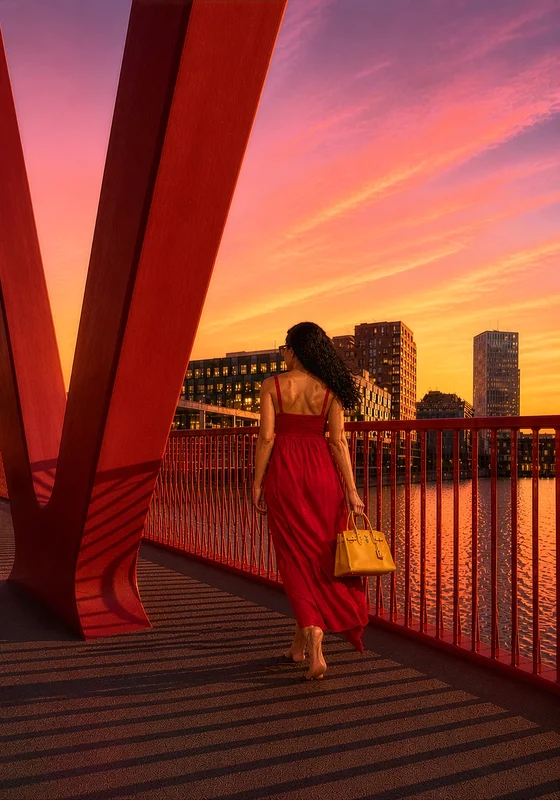
Jörgen Thornberg
Woman in Red - En Tjej i Rött, 2026
Digital
50 x 70 cm
3 200 kr
Woman in Red - En Tjej i Rött
Some moments arrive quietly, encouraging readers to feel curiosity and attentiveness, as they subtly alter the way we see and inspire wonder. A bridge at dusk, a city beginning to glow, a figure passing through light as if she carried it with her-each element invites us to look closer. You might think you are only watching a woman in a red dress cross from one place to another. But something in the colour, in the movement, in the way the world seems to pause around her, suggests otherwise.
She is not alone; she never has been. Visual cues such as her presence and subtle shifts in light deepen the sense of connection and mystery, hinting at hidden stories waiting to be uncovered, encouraging reflection on unseen narratives that shape our perception.
And if you follow that colour—tracing it through reflections, stages, and history—you may begin to see what she already knows, inviting reflection on the hidden stories behind everyday moments and encouraging curiosity about the stories concealed within ordinary scenes.
"Women in Red
There are women in red who have never met,
yet know one another in silhouette—
in glass, in water, in glances that stay,
just one heartbeat longer than they should delay.
One crosses a bridge where the evening turns gold,
where the city behind her wakes, timid and bold,
and the sky over water, in blushes outspread,
seems to echo the hue of the dress that she’s led.
Another stands caught in a moment of air,
with the wind as accomplice, unruly yet fair,
a skirt lifting lightly—no scandal, no dread—
just the world held a breath for a woman in red.
Marilyn Monroe still lingers there, poised between chance and design,
between laughter and knowing, between yours and mine;
and the glimpse of red silk, not a secret undone,
but a whisper that speaks before words have begun.
Further back in the corridors woven by time,
a queen dressed in scarlet made power her rhyme,
not adornment, but language—authority worn,
a presence that ruled from the moment she was born.
A woman on stage where the shadows all play,
let each step be a sentence, each pause has its say,
and a queen by the Nile in the ceremony’s thread
turns colour to meaning—her silence, her red.
And here on this bridge, with no crown, no acclaim,
stands a woman who carries the echo the same,
not seeking an audience, not seeking to plead,
but aware of the weight and the will of her deed.
For red is not neutral—it burns, it declares,
it remembers, it risks, it insists that it dares;
It does not ask leave, nor permission to start,
it rises, unbidden, like truth from the heart.
She will not stay long—none of them ever do—
yet they leave something faint in the light that they drew,
not a story concluded, but something instead:
a beginning that lingers—like a woman in red.”
Malmö, May 2026
Woman in Red - En Tjej i Rött
The woman in red walks across Beijerbron, the red gång och cykelbron that has linked Universitetsholmen with the emerging Varvsstaden, once Kockums Shipyard, since 2024. The structure itself still carries a faint memory of industry—steel, intention, direction—but tonight it feels almost weightless. She slows, then stops, resting her hand lightly on the railing and looking out over the old harbour basin and the sound behind, where the sky is being painted pink by the descending sun.
For a moment, she does nothing. Not even thinking, not quite. Just receiving the light as it spreads across the water, thinning, dissolving, reforming into long, trembling reflections that never quite settle. Then, as so often happens in that suspended hour between day and evening, a story begins to take shape inside her—not something she decides, but something that arrives.
If I were in a film…
It is not an original thought, but it is necessary to explore how stepping outside herself allows her to see her identity through the lens of self-expression. She allows herself this indulgence, casting her life as if in a private cinema, where she envisions herself as a woman in red, embodying confidence and intention, symbols of self-presentation that transcend time.
Not the dress alone—though yes, the dress matters, the way it moves, the way it deliberately claims space—yet the sensation of stepping just slightly beyond expectation. A gesture so small it could be mistaken for a coincidence, yet intentional enough to inspire confidence in the viewer. She thinks of Kelly LeBrock as a direction, a permission. Walk like you are already seen, she tells herself, even here, even now. This encourages the audience to consider their own subtle acts of self-assertion.
The water below answers with light that refuses to settle. It stretches and breaks, gathers again, like thoughts that almost become decisions. Somewhere within that imagined film, there is a man. She pauses there, because the choice matters. Not the obvious one, not the man who arrives with certainty and perfectly formed lines. That would collapse the illusion. Instead, she finds herself thinking of Gene Wilder, and the thought makes her smile.
Not a hero in the conventional sense, but a man slightly out of step with his own intentions, whose gentleness shows in the way he hesitates, misjudges, and recovers. Someone who does not command a moment but grows into it, almost by accident, until it becomes real. The kindest man imaginable, she thinks, the kind who would not chase her but notice her. And that, she knows, is the difference that matters.
Around her, the city begins to light itself, one window at a time, as if the evening were being carefully assembled rather than simply falling. She lets the imagined scene settle. She stands exactly here—the bridge, the water, the sky now deepening from pink to a darker hue. He arrives late, of course, slightly out of breath, not from urgency but from life. He says something imperfect, almost right. She answers not with a line, but with a presence that needs no explanation.
There is no chaos in this version, no farce, no unravelling. Only a quiet convergence: a woman who has chosen to step into colour, and a man who has chosen to remain, even amid uncertainty. A meeting that does not erupt but settles, like the last light on water.
She opens her eyes fully again. Nothing has changed, and yet something has. The bridge is still beneath her, the sound still moving, and the sky is slowly losing its colour. No camera, no audience—and yet she adjusts the fall of her dress, almost without thinking. Walk as if you have already seen.
She opens her eyes fully again. Nothing has changed, and yet something has. The bridge is still beneath her, the sound still moving, and the sky is slowly losing its colour. No camera, no audience-and yet she adjusts the fall of her dress, almost without thinking. Walk as if you have already seen.
Queen Elizabeth I of England recognises power—not loud, not declared, but composed—a quiet assertion of agency through visibility. Cleopatra's deliberate use of colour, especially red, exemplifies how self-presentation can serve as both a societal critique and a personal assertion, linking personal identity to historical symbolism across eras.
And then, further back still, beyond theatre, beyond cinema, beyond even the modern idea of self-presentation, she finds herself thinking of Cleopatra VII. Two thousand years earlier, in a world where clothing was not casual but ceremonial, where colour itself carried meaning about identity and power. While historic fashion favoured white linen for purity and climate, Cleopatra moved within a sphere where colour—rare, costly, deliberate—could be chosen for effect. Red, in that world, was not everyday. It was power and vitality, but also danger, a colour that had to be worn with intention, shaping her self-presentation across time. This deepens the audience's understanding of red as a symbol of agency and societal influence.
She thinks of how history has dressed great ladies since. Of Elizabeth Taylor in Cleopatra, entering scenes in red at moments of confrontation, before Caesar, before Antony, when emotion and authority merged into something visible. Not clothing, but armour. Not decoration, but declaration. And earlier still, the image of a woman preparing pigment from crushed carmine beetles, pressing colour to her lips not for vanity but as a sign of status, control, and presence.
The thought lingers. How can red live so close to the skin? How can it be both surface and signal at once, inviting reflection on how colour, especially red, functions as a tool of personal agency and societal power, shaping identity across history and in her own self-presentation?
She looks out again over the water. The bridge remains, the city remains, yet the moment has deepened because she now understands she is not simply a woman in a red dress. She stands, however briefly, in a quiet lineage of women who knew that to be seen is never neutral, that colour can speak before words, that presence can precede action, and that a single chosen gesture can carry further than it seems.
She breathes in, steady, almost amused by the weight of it, then lets it settle into something lighter. Not a burden, but a possibility. She straightens, lets go of the railing, and turns back towards the city, carrying the story with her—not as something that happened, but as something that might. And somehow, for that reason alone, it already has.
En Tjej i Rött
Kvinnan i rött går över Beijerbron, den röda gång- och cykelbron som sedan 2024 förbinder Universitetsholmen med den framväxande Varvsstaden, det som en gång var Kockums varvsområde. Konstruktionen bär fortfarande en svag erinran om industri – stål, intention, riktning – men i kväll känns den nästan viktlös. Hon saktar in, stannar, låter handen vila lätt mot räcket och ser ut över den gamla hamnbassängen och sundet bakom, där himlen färgas rosa av den nedåtgående solen.
En stund gör hon ingenting. Inte ens tänker, inte riktigt. Hon tar bara emot ljuset när det breder ut sig över vattnet, tunnas ut, löses upp och formas på nytt till långa, darrande speglingar som aldrig riktigt finner ro. Och så, som det så ofta sker i den där svävande timmen mellan dag och kväll, börjar en berättelse ta form inom henne – inte något hon bestämmer sig för, utan något som kommer till henne.
Om jag vore med i en film…
Det är ingen originell tanke, men den är nödvändig för att utforska hur ett steg utanför henne själv låter henne se sin identitet genom ett slags självframställning. Hon tillåter sig den lyxen att iscensätta sitt liv som i en privat biograf, där hon föreställer sig själv som en kvinna i rött – en gestalt som bär självförtroende och avsikt, symboler för ett sätt att framträda som sträcker sig bortom tiden.
Det är inte bara klänningen – även om den är viktig – utan hur den rör sig, hur den medvetet tar plats – utan känslan av att stiga en aning utanför det förväntade. En gest så liten att den kan tas som en slump, men tillräckligt avsiktlig för att inge närvaro hos den som ser. Hon tänker på Kelly LeBrock som en riktning, en tillåtelse. Gå som om du redan är sedd, säger hon till sig själv, här och nu. En uppmaning som lika mycket riktar sig inåt som utåt.
Vattnet nedanför skickar tillbaka ett ljus som vägrar stillna. Det sträcker sig, bryts, samlas igen, som tankar som nästan blir till beslut. Någonstans i den där inre filmen finns en man. Hon stannar vid den tanken, för valet spelar roll. Inte den självklara, inte den som träder fram med säkerhet och färdiga repliker. Det skulle rasera allt. I stället tänker hon på Gene Wilder och hon ler.
Inte en hjälte i traditionell mening, utan en man en aning ur takt med sina egna avsikter, vars mildhet visar sig i hur han tvekar, misstar sig, återhämtar sig. Någon som inte behärskar ett ögonblick utan växer in i det, nästan av misstag, tills det blir verkligt. Den vänligaste man man kan tänka sig, tänker hon, den som inte jagar henne utan lägger märke till henne. Och det, vet hon, är skillnaden som betyder något.
Runt henne börjar staden tändas, fönster för fönster, som om kvällen långsamt sattes samman i stället för att bara falla. Hon låter scenen landa. Hon står precis här – bron, vattnet, himlen som fördjupas från rosa till en mörkare ton. Han kommer sent, förstås, lite andfådd, inte av brådska utan av livet självt. Han säger något som inte är perfekt, men nästan. Hon svarar inte med en replik, utan med en närvaro som inte kräver någon förklaring.
Det finns inget kaos i den här versionen, ingen fars, inget som faller sönder. Bara en stilla sammansmältning: en kvinna som har valt att stiga in i färg och en man som har valt att stanna, även i osäkerheten. Ett möte som inte exploderar utan lägger sig som det sista ljuset på vattnet.
Hon öppnar ögonen igen. Ingenting har förändrats, och ändå har något hänt. Bron är fortfarande under henne, sundet rör sig som förut och himlen håller på att förlora sin färg. Ingen kamera, ingen publik – och ändå rättar hon till klänningens fall, nästan omedvetet. Gå som om du redan är sedd.
Tankarna rör sig vidare, bakåt, djupare. Drottning Elizabeth I av England representerar makt – inte högljudd eller utropad, utan samlad, en stilla markering av handlingskraft genom synlighet. Och ännu längre bakåt, bortom teater och film, bortom själva idén om modern självframställning, tänker hon på Cleopatra VII. Tvåtusen år tidigare, i en värld där kläder inte var vardag utan ceremoni, där färg bar betydelser om identitet och makt. Även om historiskt mode föredrog vitt linne för dess renhet och svalka, rörde sig Cleopatra i en sfär där färg – sällsynt, kostsam, avsiktlig – kunde väljas för effekt. Rött var ingen vardagsfärg där. Det var kraft och liv, men också fara, en färg som måste bäras med medvetenhet och som formade hur hon framträdde inför världen.
Hon tänker på hur historien därefter har klätt sina stora kvinnor. Se Elizabeth Taylor i filmen Cleopatra, hur hon träder in i scener klädd i rött i ett ögonblick av konfrontation, inför Caesar, inför Antonius, när känsla och auktoritet måste bli synliga samtidigt. Inte kläder, utan rustning. Inte dekoration, utan ett påstående. Och ännu tidigare, bilden av en kvinna som bereder pigment av krossade karminbaggar, som för färg till sina läppar inte av fåfänga utan som tecken – på status, kontroll, närvaro.
Tanken dröjer kvar. Hur rött kan leva så nära huden. Hur det kan vara både yta och signal samtidigt.
Hon ser ut över vattnet igen. Bron finns kvar, staden finns kvar, men ögonblicket har fördjupats, för hon förstår nu att hon inte bara är en kvinna i en röd klänning. Hon står, om så bara för en stund, i en stilla linje av kvinnor som har vetat att synlighet aldrig är neutral, att färg kan tala före orden, att närvaro kan föregå handling, att en enda medveten gest kan bära längre än den tycks.
Hon andas in, lugnt, nästan med ett leende inför tyngden i tanken, och låter den sedan bli något lättare. Inte en börda, utan en möjlighet. Hon rätar på sig, släpper räcket och vänder tillbaka mot staden och bär berättelsen med sig – inte som något som har hänt, utan som något som skulle kunna hända. Och på något sätt, just därför, har man redan gjort det.
3 200 kr

Jörgen Thornberg
Malmö
Lite om bilder och mig. Translation in English at the end.
Jag är en nyfiken person som ser allt i bilder, även det jag fäster i ord, gärna tillsammans för bakom alla mina bilder finns en berättelse. Till vissa bilder hör en kortare eller längre novell som följer med bilden.
Bilder berättar historier. Jag omges av naturlig skönhet, intressanta människor och historia var jag än går. Jag använder min kamera för att dokumentera världen och blanda det jag ser med vad jag känner för att fånga den dolda magin.
Mina bilder berättar mina historier. Genom mina bilder, tryck och berättelser. Jag bjuder in dig att ta del av dessa berättelser, in i ditt liv och hem och dela min mycket personliga syn på vår värld. Mer än vad ögat ser. Jag tänker i bilder, drömmer och skriver och pratar om dem; följaktligen måste jag också skapa bilder. De blir vad jag ser, inte nödvändigtvis begränsade till verkligheten. Det finns en bild runt varje hörn. Jag hoppas att du kommer att se vad jag såg och gilla det.
Jag är också en skrivande person och till många bilder hör en kortare eller längre essay. Den följer med tavlan, tryckt på fint papper och med en personlig hälsning från mig.
Flertalet bilder startar sin resa i min kamera. Enkelt förklarat beskriver jag bilden jag ser i mitt inre, upplevd eller fantiserad. Bilden uppstår inom mig redan innan jag fått okularet till ögat. På bråkdelen av ett ögonblick ser jag vad jag vill ha och vad som kan göras med bilden. Här skall jag stoppa in en giraff, stålmannen, Titanic eller vad det är min fantasi finner ut. Ännu märkligare är att jag kommer ihåg minnesbilden långt efteråt när det blir tid att skapa verket. Om jag lyckas eller inte, är upp till betraktaren, oftast präglat av en stråk av svart humor – meningen är att man skall bli underhållen. Mina bilder blir ofta en snackis där de hänger.
Jag föredrar bilder som förmedlar ett budskap i flera lager. Vid första anblicken fylld av feel-good, en vacker utsikt, fint väder, solen skiner, blommor på ängen eller vattnet som ligger förrädiskt spegelblankt. I en sådan bild kan jag gömma min egentliga berättelse, mitt förakt för förtryckare och våldsverkare, rasister och fördomsfulla människor - ett gärna återkommande motiv mer eller mindre dolt i det vackra motivet. Jag försöker förena dem i ett gemensamt narrativ.
Bild och formgivning har löpt som en röd tråd genom livet. Fotokonst känns som en värdig final som jag gärna delar med mig.
Min genre är vid som framgår av mina bilder, temat en blandning av pop- och gatukonst i kollage som kan bestå av hundratals lager. Vissa bilder kan ta veckor, andra någon dag innan det är dags att överlämna resultatet till printverkstaden. Fine Art Prints är digitala fotocollage. I dessa kollage sker rivandet, klippandet, pusslandet, målandet, ritandet och sprayningen digitalt. Det jag monterar in kan vara hundratals år gamla bilder som jag omsorgsfullt frilägger så att de ser ut att vara en del av tavlan men också bilder skapade av mig själv efter min egen fantasi. Därefter besöks printstudion och för vissa bilder numrera en limiterad upplaga (oftast 7 exemplar) och signera för hand. Vissa bilder kan köpas i olika format. Det är bara att fråga efter vilka. Gillar man en bild som är 70x100 men inte har plats på väggen, går den kanske att få i 50x70 cm istället. Frågan är fri.
Metoden Giclée eller Fine Art Print som det också kallas är det moderna sättet för framställning av grafisk konst. Villkoret för denna typ av utskrifter är att en högkvalitativ storformatskrivare används med åldersbeständigt färgpigment och konstnärspapper eller i förekommande fall på duk. Pappret som används möter de krav på livslängd som ställs av museer och gallerier. Normalt säljer jag mina bilder oinramade så att den nya ägaren själv kan bestämma hur de skall se ut, med eller utan passepartout färg på ram, med eller utan glas etc..
Under många år ställde jag bara ut på nätet, i valda grupper och på min egen Facebooksida - https://www.facebook.com/jorgen.thornberg.9
Jag finns också på en egen hemsida som tyvärr inte alltid är uppdaterad – https://www.jth.life/ Där kan du också läsa en del av de berättelser som följer med bilden.
UTSTÄLLNINGAR
Luftkastellet, oktober 2022
Konst i Lund, november 2022
Luftkastellet, mars 2023
Engleson Galleri Caroli, april 2023
Hydra, Greece June 2023
Engleson Galleri Caroli, oktober 2023
Toppen, Höllviken december 2023
Luftkastellet, mars 2024
Torups Galleri, mars 2024
Venice, May 2024
Luftkastellet, oktober 2024
Konst i Advent, December 2024
Galleri Engleson, Caroli December 2024
Jäger & Jansson Galleri, april 2025
A bit about pictures and me.
I'm a curious person who sees everything in pictures, even what I express in words, often combining them, for behind all my pictures lies a story. These narratives, some as short as a single image and others as long as a novel, are the heart and soul of my work.
Pictures tell stories. Wherever I go, I'm surrounded by natural beauty, exciting people, and history. I use my camera to document the world and blend what I see with what I feel to capture the hidden magic.
My images tell my stories. Through my pictures, prints, and narratives, I invite you to partake in these stories in your life and home and share my deeply personal perspective of our world. More than meets the eye. I think in pictures, dream, write, and talk about them; consequently, I must create images too. They become what I see, not necessarily confined to reality. There's a picture around every corner. I hope you'll see what I saw and enjoy it.
I'm also a writer, and many images come with a shorter or longer essay. It accompanies the painting, printed on fine paper with my personal greeting.
Many pictures start their journey on my camera. Simply put, I describe the image I see in my mind, experienced or imagined. The image arises within me even before I bring the eyepiece to my eye. In a fraction of a moment, I see what I want and what can be done with the picture. Here, I'll insert a giraffe, Superman, the Titanic, or whatever my imagination conjures up. Even stranger is that I remember the mental image long after it's time to create the work. Whether I succeed is up to the observer, often imbued with a streak of black humour – the aim is to entertain. My pictures usually become a talking point wherever they hang.
I prefer pictures that convey a message in multiple layers. At first glance, they're filled with feel-good vibes, a beautiful view, lovely weather, the sun shining, flowers in the meadow, or the water lying deceptively calm. But beneath this surface beauty, I often conceal a deeper story, a narrative that challenges societal norms or explores the human condition. I invite you to delve into these hidden narratives and discover the layers of meaning within my work.
Picture and design have been a thread running through my life. Photographic art feels like a fitting finale, and I'm happy to share it.
My genre is varied, as seen in my pictures; the theme is a blend of pop and street art in collages that can consist of hundreds of layers. Some images can take weeks, others just a day before it's time to hand over the result to the print workshop. Fine Art Prints are digital photo collages. In these collages, tearing, cutting, puzzling, painting, drawing, and spraying happen digitally. What I insert can be images hundreds of years old that I carefully extract so they appear to be part of the painting, but also images created by myself, now also generated from my imagination. Next, visit the print studio and, for certain images, number a limited edition (usually 7 copies) and sign them by hand. Some images may be available in other formats. Just ask which ones. If you like an image that's 70x100 but doesn't have space on the wall, you might be able to get it in 50x70 cm instead. The question is open.
The Giclée method, or Fine Art Print as it's also called, is the modern way of producing graphic art. This method ensures the highest quality and longevity of the artwork, using a high-quality large-format printer with archival pigment inks and artist paper or, in some cases, canvas. The paper used meets the longevity requirements set by museums and galleries. I sell my pictures unframed, allowing the new owner to personalise their artwork, confident in the lasting value and quality of the piece.
For many years, I only exhibited online, in selected groups, and on my Facebook page - https://www.facebook.com/jorgen.thornberg.9. I also have my website, which unfortunately is not constantly updated - https://www.jth.life/. You can also read some of the stories accompanying the pictures there.
EXHIBITIONS
Luftkastellet, October 2022
Art in Lund, November 2022
Luftkastellet, March 2023
Engleson Gallery Caroli, April 2023
Hydra, Greece June 2023
Engleson Gallery Caroli, October 2023
Toppen, Höllviken December 2023
Luftkastellet, March 2024
Torup Gallery, March 2024
Venice, May 2024
UTSTÄLLNINGAR
Luftkastellet, oktober 2022
Konst i Lund, november 2022
Luftkastellet, mars 2023
Engleson Galleri Caroli, april 2023
Hydra, Greece June 2023
Engleson Galleri Caroli, oktober 2023
Toppen, Höllviken december 2023
Luftkastellet, mars 2024
Torups Galleri, mars 2024
Venice, May 2024
Luftkastellet, October 2024
Konst i Advent, December 2024
Galleri Engleson, Caroli December 2024
Jäger & Jansson Galleri, April 2025
Utbildning
Autodidakt
Medlem i konstnärsförening
Öppna Sinnen
Med i konstrunda
Konstrundan i Skåne
Utställningar
Luftkastellet, October 2022
Art in Lund, November 2022
Luftkastellet, March 2023
Engleson Gallery Caroli, April 2023
Hydra, Greece June 2023
Engleson Gallery Caroli, October 2023
Toppen, Höllviken December 2023
Luftkastellet, March 2024
Torup Gallery, March 2024
Venice, May 2024