Vi använder cookies för att ge dig bästa möjliga upplevelse. Välj vilka cookies du tillåter.
Läs mer i vår integritetspolicy
Jörgen Thornberg
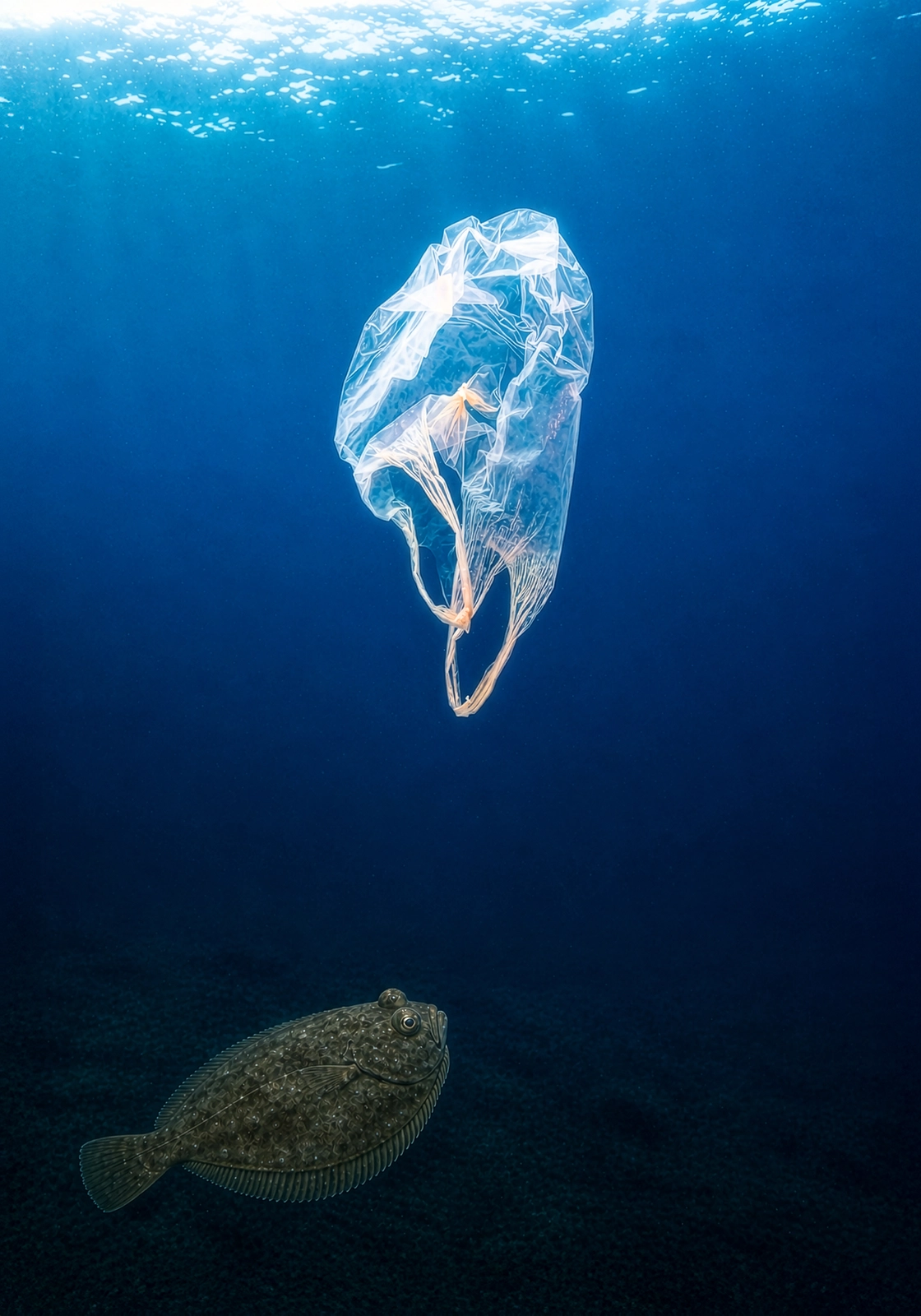
One has to wonder,” said the flounder – Jag undrar sa flundran, 2026
Digital
50 x 70 cm
3 200 kr
One has to wonder,” said the flounder – Jag undrar sa flundran
"One has to wonder,” said the flounder
It drifts as they do—
a pulse without a heart,
a body without hunger,
a gesture of life rehearsed too well.
Above, the Øresund breathes—
a narrow passage
that remembers every ocean,
and forgets nothing we give it.
Once, the sea knew how to end things.
Now it keeps them.
Fragments fall like quiet snow,
too small for the eye,
large enough for the body.
They enter without asking,
and stay without leaving.
One has to wonder…
If what we make outlives what we are,
if what we throw away
is only changing form.
The currents carry everything onward—
north, south, inward, outward—
until direction no longer matters,
only persistence.
…whether that plastic bag is a jellyfish.
Or whether the difference
is something we have already lost.
The flounder settles,
eyes open, unblinking—
watching the soft parade above.
Plastic, drifting like thought.
Like memory.
Like a mistake
that has learned how to float.”
Malmö, May 2026
One has to wonder,” said the flounder, “whether that plastic bag is a jellyfish.”
The currents in the Øresund connect distant waters, reminding the audience that our actions affect the health of global ecosystems and shared waters.
The flounder lay still, its mottled body blending seamlessly with the sand, its two eyes fixed on the drifting form. The bag pulsed faintly in the shifting light, translucent and pale, hinting at life rather than embodying it.
“One has to wonder…”
The Øresund had always been a meeting place. Salt and brackish water met here. Species from different worlds crossed paths, adapted, and endured. In its quiet way, it was a miniature of something larger—a narrow seam holding together vast bodies of water. What passed through here did not stay. What entered here eventually belonged to the sea beyond.
And the sea beyond was the world.
“…whether the plastic bag is a jellyfish.”
The question was not absurd. It was practical. The soft, drifting bodies of jellyfish had long drifted through these waters, carried by the same currents that now bore the bag. The resemblance was imperfect, yet close enough. After all, movement persuades more than form.
Others have mistaken such things before. The water holds more than it once did, affecting marine life and prompting the audience to consider how their choices contribute to this change.
“One has to wonder…”
The water reflects our collective impact: hundreds of plastic bags from each of us enter the water each year, showing how human choices directly affect marine health and our shared environment. The global figure is horrendous.
The Øresund, for all its specificity, reflects the global ocean. Small actions, such as refusing single-use plastics or choosing reusable bags, can help reduce this pollution and inspire us all to take responsibility.
“…whether the plastic bag is a jellyfish.”
The bag drifted closer, folding in on itself, then unfolding again, its edges trembling in the slow flow of water. It neither fed nor fled. It neither aged nor decayed in any meaningful sense. It simply remained.
In time, it would fragment. Not disappear—but shrink. Less visible. More intimate.
The flounder did not know the word microplastic, but it knew that what enters the sea often remains. Tiny particles can accumulate in marine life and enter our food, posing health risks to us all.
And what does not leave circulates.
“One has to wonder…”
Those above measure such things. They calculate not only numbers but also masses. They say that within a few decades—by 2050—the total weight of plastic in the oceans may exceed the combined weight of all fish.
The flounder did not know the year, but it knew the direction. Something was increasing. Not in movement. Not in life. But in persistence.
The currents of the Øresund carried the bag onward, as they carried everything—north, south, inward, outward—linking this narrow strait to something immeasurably larger. A system without edges. A body without a single owner.
A sea that was, in truth, a single one.
“One has to wonder,” said the flounder…
And after a pause, as the drifting form passed slowly overhead: “…what else is no longer as it seems.”
The flounder sighed and settled into the sand below, looking up at the plastic bags drifting past— not unlike jellyfish, only far more dangerous.
Undra, sa flundran, om plastpåsen är en manet.
Strömmarna i Öresund förbinder avlägsna vatten och påminner oss om att våra handlingar påverkar hälsan i globala ekosystem och i gemensamma hav.
Flundran låg stilla, dess fläckiga kropp nästan oskiljbar från sanden, med båda ögonen riktade uppåt mot den drivande formen. Påsen pulserade svagt i det skiftande ljuset, blek och genomskinlig – en antydan till liv snarare än liv självt.
Undra, sa flundran…
Öresund har alltid varit en mötesplats. Här möts salt och bräckt vatten. Arter från olika världar korsar varandras vägar, anpassar sig och består. På sitt stillsamma sätt är sundet en miniatyr av något större – en smal fog som håller samman väldiga vattenmassor. Det som passerar här stannar inte. Det som förs in här tillhör till slut havet bortom.
Och havet bortom är världen.
…om plastpåsen är en manet.
Frågan var inte absurd. Den var praktisk. De mjuka, drivande kropparna av maneter har länge rört sig genom dessa vatten, burna av samma strömmar som nu för påsen. Likheten är ofullständig, men tillräcklig. Rörelsen övertygar mer än formen.
Andra har tagit miste förut. Vattnet rymmer mer än det gjorde en gång – något som påverkar livet i havet och som får oss att inse hur våra val bidrar till förändringen.
Undra, sa flundran…
Vattnet speglar vår samlade påverkan: Hundratals plastpåsar från var och en av oss når varje år haven. Siffrorna är svindlande.
Öresund, oavsett hur specifikt det är, speglar världshaven. Små handlingar – att avstå från engångsplast och att välja återanvändbara alternativ – kan minska detta flöde och påminna oss om vårt ansvar.
…om plastpåsen är en manet.
Påsen drev närmare, vek sig, öppnade sig igen; dess kanter darrade i det långsamma vattnet. Den varken åt eller flydde. Den åldrades inte, förmultnade inte i någon meningsfull bemärkelse. Den blev bara kvar.
Med tiden skulle den fragmenteras. Inte försvinna – utan bli mindre. Mindre synlig. Mer intim.
Flundran kände inte till ordet mikroplast, men den visste att det som kommer in i havet ofta stannar kvar. Små partiklar samlas i livet under ytan och återvänder till oss via det vi äter.
Och det som inte lämnar cirkulerar. Kommer tillbaka.
Undra, sa flundran…
Där ovanför finns de som mäter. Som räknar inte bara antal utan också massa. De säger att inom några decennier – till år 2050 – kan plastens sammanlagda vikt i haven överstiga vikten av all fisk.
Flundran kände inte året, men den kände riktningen. Något ökade. Inte i rörelse. Inte i liv. Utan i varaktighet.
Öresunds strömmar förde påsen vidare, som de för allt – norrut, söderut, inåt, utåt – och band detta smala sund till något oöverskådligt större. Ett system utan kanter. En kropp utan ägare.
Ett hav som i själva verket är ett enda.
Undra, sa flundran…
Och efter en paus, medan formen sakta drev förbi ovanför:
…Vad mer är det som inte längre är vad det ser ut att vara?
Flundran suckade och la sig tillrätta i sanden under sig och såg upp mot plastpåsarna som drev förbi – inte helt olika maneter, bara så mycket farligare.
Jörgen Thornberg
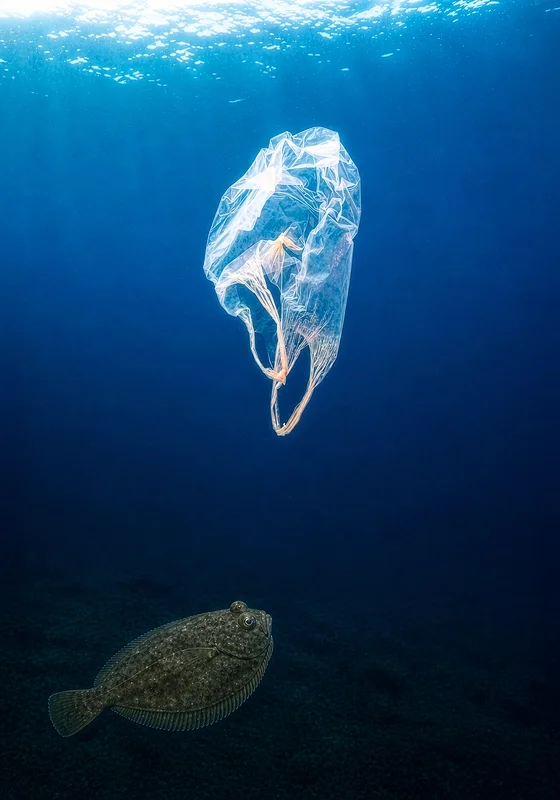
One has to wonder,” said the flounder – Jag undrar sa flundran, 2026
Digital
50 x 70 cm
3 200 kr
One has to wonder,” said the flounder – Jag undrar sa flundran
"One has to wonder,” said the flounder
It drifts as they do—
a pulse without a heart,
a body without hunger,
a gesture of life rehearsed too well.
Above, the Øresund breathes—
a narrow passage
that remembers every ocean,
and forgets nothing we give it.
Once, the sea knew how to end things.
Now it keeps them.
Fragments fall like quiet snow,
too small for the eye,
large enough for the body.
They enter without asking,
and stay without leaving.
One has to wonder…
If what we make outlives what we are,
if what we throw away
is only changing form.
The currents carry everything onward—
north, south, inward, outward—
until direction no longer matters,
only persistence.
…whether that plastic bag is a jellyfish.
Or whether the difference
is something we have already lost.
The flounder settles,
eyes open, unblinking—
watching the soft parade above.
Plastic, drifting like thought.
Like memory.
Like a mistake
that has learned how to float.”
Malmö, May 2026
One has to wonder,” said the flounder, “whether that plastic bag is a jellyfish.”
The currents in the Øresund connect distant waters, reminding the audience that our actions affect the health of global ecosystems and shared waters.
The flounder lay still, its mottled body blending seamlessly with the sand, its two eyes fixed on the drifting form. The bag pulsed faintly in the shifting light, translucent and pale, hinting at life rather than embodying it.
“One has to wonder…”
The Øresund had always been a meeting place. Salt and brackish water met here. Species from different worlds crossed paths, adapted, and endured. In its quiet way, it was a miniature of something larger—a narrow seam holding together vast bodies of water. What passed through here did not stay. What entered here eventually belonged to the sea beyond.
And the sea beyond was the world.
“…whether the plastic bag is a jellyfish.”
The question was not absurd. It was practical. The soft, drifting bodies of jellyfish had long drifted through these waters, carried by the same currents that now bore the bag. The resemblance was imperfect, yet close enough. After all, movement persuades more than form.
Others have mistaken such things before. The water holds more than it once did, affecting marine life and prompting the audience to consider how their choices contribute to this change.
“One has to wonder…”
The water reflects our collective impact: hundreds of plastic bags from each of us enter the water each year, showing how human choices directly affect marine health and our shared environment. The global figure is horrendous.
The Øresund, for all its specificity, reflects the global ocean. Small actions, such as refusing single-use plastics or choosing reusable bags, can help reduce this pollution and inspire us all to take responsibility.
“…whether the plastic bag is a jellyfish.”
The bag drifted closer, folding in on itself, then unfolding again, its edges trembling in the slow flow of water. It neither fed nor fled. It neither aged nor decayed in any meaningful sense. It simply remained.
In time, it would fragment. Not disappear—but shrink. Less visible. More intimate.
The flounder did not know the word microplastic, but it knew that what enters the sea often remains. Tiny particles can accumulate in marine life and enter our food, posing health risks to us all.
And what does not leave circulates.
“One has to wonder…”
Those above measure such things. They calculate not only numbers but also masses. They say that within a few decades—by 2050—the total weight of plastic in the oceans may exceed the combined weight of all fish.
The flounder did not know the year, but it knew the direction. Something was increasing. Not in movement. Not in life. But in persistence.
The currents of the Øresund carried the bag onward, as they carried everything—north, south, inward, outward—linking this narrow strait to something immeasurably larger. A system without edges. A body without a single owner.
A sea that was, in truth, a single one.
“One has to wonder,” said the flounder…
And after a pause, as the drifting form passed slowly overhead: “…what else is no longer as it seems.”
The flounder sighed and settled into the sand below, looking up at the plastic bags drifting past— not unlike jellyfish, only far more dangerous.
Undra, sa flundran, om plastpåsen är en manet.
Strömmarna i Öresund förbinder avlägsna vatten och påminner oss om att våra handlingar påverkar hälsan i globala ekosystem och i gemensamma hav.
Flundran låg stilla, dess fläckiga kropp nästan oskiljbar från sanden, med båda ögonen riktade uppåt mot den drivande formen. Påsen pulserade svagt i det skiftande ljuset, blek och genomskinlig – en antydan till liv snarare än liv självt.
Undra, sa flundran…
Öresund har alltid varit en mötesplats. Här möts salt och bräckt vatten. Arter från olika världar korsar varandras vägar, anpassar sig och består. På sitt stillsamma sätt är sundet en miniatyr av något större – en smal fog som håller samman väldiga vattenmassor. Det som passerar här stannar inte. Det som förs in här tillhör till slut havet bortom.
Och havet bortom är världen.
…om plastpåsen är en manet.
Frågan var inte absurd. Den var praktisk. De mjuka, drivande kropparna av maneter har länge rört sig genom dessa vatten, burna av samma strömmar som nu för påsen. Likheten är ofullständig, men tillräcklig. Rörelsen övertygar mer än formen.
Andra har tagit miste förut. Vattnet rymmer mer än det gjorde en gång – något som påverkar livet i havet och som får oss att inse hur våra val bidrar till förändringen.
Undra, sa flundran…
Vattnet speglar vår samlade påverkan: Hundratals plastpåsar från var och en av oss når varje år haven. Siffrorna är svindlande.
Öresund, oavsett hur specifikt det är, speglar världshaven. Små handlingar – att avstå från engångsplast och att välja återanvändbara alternativ – kan minska detta flöde och påminna oss om vårt ansvar.
…om plastpåsen är en manet.
Påsen drev närmare, vek sig, öppnade sig igen; dess kanter darrade i det långsamma vattnet. Den varken åt eller flydde. Den åldrades inte, förmultnade inte i någon meningsfull bemärkelse. Den blev bara kvar.
Med tiden skulle den fragmenteras. Inte försvinna – utan bli mindre. Mindre synlig. Mer intim.
Flundran kände inte till ordet mikroplast, men den visste att det som kommer in i havet ofta stannar kvar. Små partiklar samlas i livet under ytan och återvänder till oss via det vi äter.
Och det som inte lämnar cirkulerar. Kommer tillbaka.
Undra, sa flundran…
Där ovanför finns de som mäter. Som räknar inte bara antal utan också massa. De säger att inom några decennier – till år 2050 – kan plastens sammanlagda vikt i haven överstiga vikten av all fisk.
Flundran kände inte året, men den kände riktningen. Något ökade. Inte i rörelse. Inte i liv. Utan i varaktighet.
Öresunds strömmar förde påsen vidare, som de för allt – norrut, söderut, inåt, utåt – och band detta smala sund till något oöverskådligt större. Ett system utan kanter. En kropp utan ägare.
Ett hav som i själva verket är ett enda.
Undra, sa flundran…
Och efter en paus, medan formen sakta drev förbi ovanför:
…Vad mer är det som inte längre är vad det ser ut att vara?
Flundran suckade och la sig tillrätta i sanden under sig och såg upp mot plastpåsarna som drev förbi – inte helt olika maneter, bara så mycket farligare.
3 200 kr

Jörgen Thornberg
Malmö
Lite om bilder och mig. Translation in English at the end.
Jag är en nyfiken person som ser allt i bilder, även det jag fäster i ord, gärna tillsammans för bakom alla mina bilder finns en berättelse. Till vissa bilder hör en kortare eller längre novell som följer med bilden.
Bilder berättar historier. Jag omges av naturlig skönhet, intressanta människor och historia var jag än går. Jag använder min kamera för att dokumentera världen och blanda det jag ser med vad jag känner för att fånga den dolda magin.
Mina bilder berättar mina historier. Genom mina bilder, tryck och berättelser. Jag bjuder in dig att ta del av dessa berättelser, in i ditt liv och hem och dela min mycket personliga syn på vår värld. Mer än vad ögat ser. Jag tänker i bilder, drömmer och skriver och pratar om dem; följaktligen måste jag också skapa bilder. De blir vad jag ser, inte nödvändigtvis begränsade till verkligheten. Det finns en bild runt varje hörn. Jag hoppas att du kommer att se vad jag såg och gilla det.
Jag är också en skrivande person och till många bilder hör en kortare eller längre essay. Den följer med tavlan, tryckt på fint papper och med en personlig hälsning från mig.
Flertalet bilder startar sin resa i min kamera. Enkelt förklarat beskriver jag bilden jag ser i mitt inre, upplevd eller fantiserad. Bilden uppstår inom mig redan innan jag fått okularet till ögat. På bråkdelen av ett ögonblick ser jag vad jag vill ha och vad som kan göras med bilden. Här skall jag stoppa in en giraff, stålmannen, Titanic eller vad det är min fantasi finner ut. Ännu märkligare är att jag kommer ihåg minnesbilden långt efteråt när det blir tid att skapa verket. Om jag lyckas eller inte, är upp till betraktaren, oftast präglat av en stråk av svart humor – meningen är att man skall bli underhållen. Mina bilder blir ofta en snackis där de hänger.
Jag föredrar bilder som förmedlar ett budskap i flera lager. Vid första anblicken fylld av feel-good, en vacker utsikt, fint väder, solen skiner, blommor på ängen eller vattnet som ligger förrädiskt spegelblankt. I en sådan bild kan jag gömma min egentliga berättelse, mitt förakt för förtryckare och våldsverkare, rasister och fördomsfulla människor - ett gärna återkommande motiv mer eller mindre dolt i det vackra motivet. Jag försöker förena dem i ett gemensamt narrativ.
Bild och formgivning har löpt som en röd tråd genom livet. Fotokonst känns som en värdig final som jag gärna delar med mig.
Min genre är vid som framgår av mina bilder, temat en blandning av pop- och gatukonst i kollage som kan bestå av hundratals lager. Vissa bilder kan ta veckor, andra någon dag innan det är dags att överlämna resultatet till printverkstaden. Fine Art Prints är digitala fotocollage. I dessa kollage sker rivandet, klippandet, pusslandet, målandet, ritandet och sprayningen digitalt. Det jag monterar in kan vara hundratals år gamla bilder som jag omsorgsfullt frilägger så att de ser ut att vara en del av tavlan men också bilder skapade av mig själv efter min egen fantasi. Därefter besöks printstudion och för vissa bilder numrera en limiterad upplaga (oftast 7 exemplar) och signera för hand. Vissa bilder kan köpas i olika format. Det är bara att fråga efter vilka. Gillar man en bild som är 70x100 men inte har plats på väggen, går den kanske att få i 50x70 cm istället. Frågan är fri.
Metoden Giclée eller Fine Art Print som det också kallas är det moderna sättet för framställning av grafisk konst. Villkoret för denna typ av utskrifter är att en högkvalitativ storformatskrivare används med åldersbeständigt färgpigment och konstnärspapper eller i förekommande fall på duk. Pappret som används möter de krav på livslängd som ställs av museer och gallerier. Normalt säljer jag mina bilder oinramade så att den nya ägaren själv kan bestämma hur de skall se ut, med eller utan passepartout färg på ram, med eller utan glas etc..
Under många år ställde jag bara ut på nätet, i valda grupper och på min egen Facebooksida - https://www.facebook.com/jorgen.thornberg.9
Jag finns också på en egen hemsida som tyvärr inte alltid är uppdaterad – https://www.jth.life/ Där kan du också läsa en del av de berättelser som följer med bilden.
UTSTÄLLNINGAR
Luftkastellet, oktober 2022
Konst i Lund, november 2022
Luftkastellet, mars 2023
Engleson Galleri Caroli, april 2023
Hydra, Greece June 2023
Engleson Galleri Caroli, oktober 2023
Toppen, Höllviken december 2023
Luftkastellet, mars 2024
Torups Galleri, mars 2024
Venice, May 2024
Luftkastellet, oktober 2024
Konst i Advent, December 2024
Galleri Engleson, Caroli December 2024
Jäger & Jansson Galleri, april 2025
A bit about pictures and me.
I'm a curious person who sees everything in pictures, even what I express in words, often combining them, for behind all my pictures lies a story. These narratives, some as short as a single image and others as long as a novel, are the heart and soul of my work.
Pictures tell stories. Wherever I go, I'm surrounded by natural beauty, exciting people, and history. I use my camera to document the world and blend what I see with what I feel to capture the hidden magic.
My images tell my stories. Through my pictures, prints, and narratives, I invite you to partake in these stories in your life and home and share my deeply personal perspective of our world. More than meets the eye. I think in pictures, dream, write, and talk about them; consequently, I must create images too. They become what I see, not necessarily confined to reality. There's a picture around every corner. I hope you'll see what I saw and enjoy it.
I'm also a writer, and many images come with a shorter or longer essay. It accompanies the painting, printed on fine paper with my personal greeting.
Many pictures start their journey on my camera. Simply put, I describe the image I see in my mind, experienced or imagined. The image arises within me even before I bring the eyepiece to my eye. In a fraction of a moment, I see what I want and what can be done with the picture. Here, I'll insert a giraffe, Superman, the Titanic, or whatever my imagination conjures up. Even stranger is that I remember the mental image long after it's time to create the work. Whether I succeed is up to the observer, often imbued with a streak of black humour – the aim is to entertain. My pictures usually become a talking point wherever they hang.
I prefer pictures that convey a message in multiple layers. At first glance, they're filled with feel-good vibes, a beautiful view, lovely weather, the sun shining, flowers in the meadow, or the water lying deceptively calm. But beneath this surface beauty, I often conceal a deeper story, a narrative that challenges societal norms or explores the human condition. I invite you to delve into these hidden narratives and discover the layers of meaning within my work.
Picture and design have been a thread running through my life. Photographic art feels like a fitting finale, and I'm happy to share it.
My genre is varied, as seen in my pictures; the theme is a blend of pop and street art in collages that can consist of hundreds of layers. Some images can take weeks, others just a day before it's time to hand over the result to the print workshop. Fine Art Prints are digital photo collages. In these collages, tearing, cutting, puzzling, painting, drawing, and spraying happen digitally. What I insert can be images hundreds of years old that I carefully extract so they appear to be part of the painting, but also images created by myself, now also generated from my imagination. Next, visit the print studio and, for certain images, number a limited edition (usually 7 copies) and sign them by hand. Some images may be available in other formats. Just ask which ones. If you like an image that's 70x100 but doesn't have space on the wall, you might be able to get it in 50x70 cm instead. The question is open.
The Giclée method, or Fine Art Print as it's also called, is the modern way of producing graphic art. This method ensures the highest quality and longevity of the artwork, using a high-quality large-format printer with archival pigment inks and artist paper or, in some cases, canvas. The paper used meets the longevity requirements set by museums and galleries. I sell my pictures unframed, allowing the new owner to personalise their artwork, confident in the lasting value and quality of the piece.
For many years, I only exhibited online, in selected groups, and on my Facebook page - https://www.facebook.com/jorgen.thornberg.9. I also have my website, which unfortunately is not constantly updated - https://www.jth.life/. You can also read some of the stories accompanying the pictures there.
EXHIBITIONS
Luftkastellet, October 2022
Art in Lund, November 2022
Luftkastellet, March 2023
Engleson Gallery Caroli, April 2023
Hydra, Greece June 2023
Engleson Gallery Caroli, October 2023
Toppen, Höllviken December 2023
Luftkastellet, March 2024
Torup Gallery, March 2024
Venice, May 2024
UTSTÄLLNINGAR
Luftkastellet, oktober 2022
Konst i Lund, november 2022
Luftkastellet, mars 2023
Engleson Galleri Caroli, april 2023
Hydra, Greece June 2023
Engleson Galleri Caroli, oktober 2023
Toppen, Höllviken december 2023
Luftkastellet, mars 2024
Torups Galleri, mars 2024
Venice, May 2024
Luftkastellet, October 2024
Konst i Advent, December 2024
Galleri Engleson, Caroli December 2024
Jäger & Jansson Galleri, April 2025
Utbildning
Autodidakt
Medlem i konstnärsförening
Öppna Sinnen
Med i konstrunda
Konstrundan i Skåne
Utställningar
Luftkastellet, October 2022
Art in Lund, November 2022
Luftkastellet, March 2023
Engleson Gallery Caroli, April 2023
Hydra, Greece June 2023
Engleson Gallery Caroli, October 2023
Toppen, Höllviken December 2023
Luftkastellet, March 2024
Torup Gallery, March 2024
Venice, May 2024