Vi använder cookies för att ge dig bästa möjliga upplevelse. Välj vilka cookies du tillåter.
Läs mer i vår integritetspolicy
Jörgen Thornberg
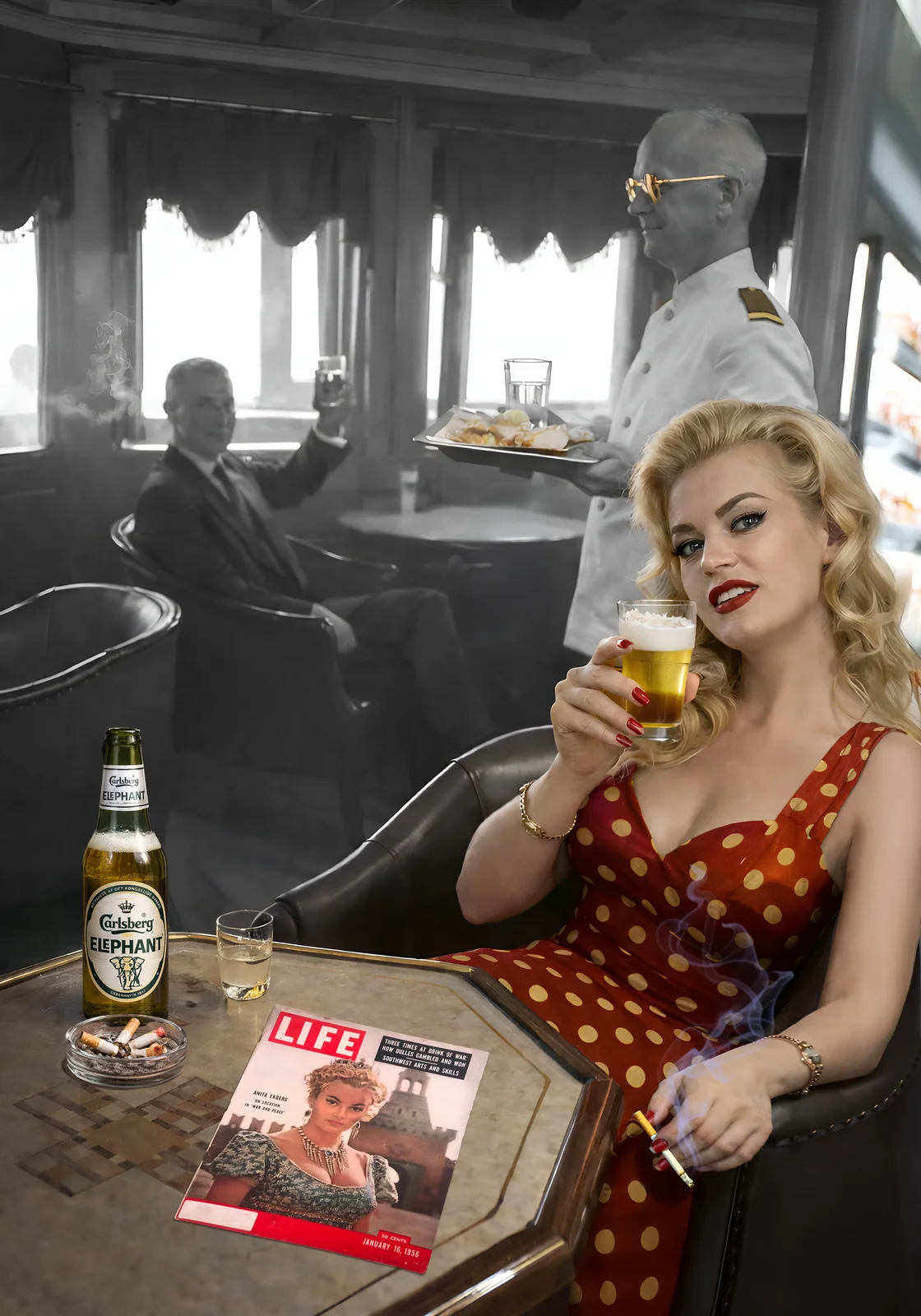
Love, Love and Love – The Interview That Never Froze, 2026
Digital
50 x 70 cm
3 200 kr
Love, Love and Love – The Interview That Never Froze
Svensk text på slutet
It’s autumn 1962. The ferry Malmöhus pulls away from the quay in Malmö and crosses the Öresund. In the lounge, beneath the polished inlaid wall, two old classmates share a beer. One now works as a journalist at Sydsvenskan, while the other has just left the fountain in Rome and stepped into the spotlight.
In Sweden, the press calls her ‘The Iceberg’. Around the world, she’s already an icon. But here, she’s simply Anita.
They only planned to 'tura'—to ride back and forth without disembarking in Denmark, enjoy a quick meal of fish fillets with remoulade, and reminisce about their school days. But instead, their talk turned to the cost of beauty, the strength and vulnerability of women, forgiveness, and why dreams never freeze.
Some interviews make the news.
This one became something different.
“Love, Love and Love
She rose from a harbour city
where wind tasted of salt
and ambition had to speak softly
to be allowed a place at the table.
They saw the surface first—
the curve, the light,
her body translated into headlines.
Beauty opened doors
with the ease of a master key.
But beauty, she knew,
is both invitation and cage.
“When you’re born beautiful,” she said,
“it helps you start.”
And then she smiled—
because she had already seen
the other side of the mirror.
She refused to shrink
into a photograph.
In Rome, she waded in water
and the world stepped into myth.
Yet behind the fountain
stood a woman
who understood the cost of being looked at
and chose to look back.
She spoke of femininity
not as an ornament
but as force—
a current beneath the skin,
a quiet architecture of strength.
“I’ve always found power in it,”
she said,
as if describing something elemental—
fire, tide, breath.
She was unafraid of contradiction:
strong and vulnerable,
provocative and kind,
fierce in opinion
yet tender in truth.
“Don’t be afraid to be vulnerable.”
Because of the fracture
light enters.
In the admission of fear
connection begins.
She did not cling to bitterness.
Life, she reminded us,
is too brief for the heavy luggage of grudges.
Forgive.
Let go.
Move forward.
Dreams, she insisted,
never freeze.
Even when borders close,
and when customs officers search your bags,
or when headlines cool into archives—
dreams cross untouched.
She loved extravagantly—
love, love, and love—
not as decoration
but as oxygen.
She believed character lasts
longer than applause.
That kindness costs nothing
yet alters the shape of a room.
That authenticity may wound
but dishonesty wounds more.
And so she walked through her life
as through a doorway
no longer asking permission.
Beauty faded in photographs.
But courage does not fade.
Neither does warmth.
Neither does the decision
to live without shrinking.
In the end
she was never an iceberg.
She was water—
moving,
reflecting light,
impossible to hold,
and always, always
alive with fire beneath the surface.
Love, love and love—
and the rest
is weather.”
Malmö, February 2026
Love, Love and Love – The Interview That Never Froze
On an autumn day in 1962, a light mist hung over the Öresund as the ferry Malmöhus pulled away from the dock. In the cosy lounge, known for its polished inlaid wood wall, two old classmates sat facing each other, each holding a glass of beer.
It was a fond reunion.
Anita Ekberg was thirty-one and already an international film star. Her big break came with Federico Fellini’s La Dolce Vita in 1960. Earlier that year, she had also appeared in Boccaccio ’70, another film partly directed by Fellini. Its Swedish title, Det ljuva lättsinnet (“The Sweet Frivolity”), suggested bold themes that matched the era. Alongside stars such as Sophia Loren and Romy Schneider, Anita became one of Europe’s most talked-about women.
But that afternoon, she was just Anita.
Jan, who had once sat behind her in the classroom at Malmö Borgarskola, had become a journalist for Sydsvenskan. He remembered the short braids, the laughter, and that effortless presence that even then drew every gaze in the room. Now she sat before him, more beautiful than ever—matured, self-aware, with a calm that had not existed in teenage restlessness.
They reminisced about school days, recalling silly teachers and laughing about field trips that didn’t go as planned. In 1945, the school served as a reserve hospital from April to August, so teachers and students had to leave whenever ambulances arrived in the courtyard. Even though the war had ended, refugees kept arriving, many in terrible condition after surviving concentration camps. They refilled their beers, perhaps to ease the heavy memories of seeing people carried inside.
When the ferry reached Copenhagen, neither of them got up. Like many people from Skåne, they decided to “tura”—to stay on the boat, not disembarking, let it turn around, and order a fried fish fillet with remoulade. It’s a tradition, almost a ceremony.
Jan paused before asking his question.
Anita’s relationship with journalists was well known to be complicated. She often found the Swedish press aggressive, cold, and sometimes even rude. In the media, she was called “The Iceberg”—an image that both fascinated and irritated her. Yet it was a journalist who “discovered” her in 1951, when she was twenty-two and still Anita from Malmö, and introduced her to readers of Vecko-Revyn.
She gave a sideways smile when Jan brought it up.
“Well, of course. You newspaper hacks both create us and freeze us out,” she said.
He laughed.
“May I interview you, Anita?”
She leaned back and looked out the window at the grey-blue water passing by.
“You’re still as stubborn as ever, Jan. So I guess there’s no point in saying no.”
There was a short pause.
“All right. But let’s talk as we used to, not as if we’re in an interrogation room.”
He nodded.
The Öresund was calm. The inlaid wall behind them shimmered in the lounge’s warm light. Their beers gently foamed in their glasses. In the engine room, the motors hummed softly.
Jan took out his notebook.
The interview could begin.
Beauty – Blessing or Trap?
Jan paused and looked at her before speaking. Even with his suit, notebook, and professional manner, there was still a hint of the boy in his eyes.
“You were beautiful even at school, Anita. You know that. Yes, I was interested in you—like all the healthy boys. You may have said that winning Miss Malmö surprised you, but it didn’t surprise me. You were really beautiful.”
She laughed, her voice low and a little rough, sounding more like Rome than Malmö.
“Healthy boys, you say? You stared as if you’d never seen a girl before.”
“Maybe we did. But let me ask you this. Being beautiful has served you well. It has opened doors. Are there downsides? I imagine it can stir envy among other girls—and perhaps a bit too much attention from men. Is beauty, in reality, a blessing or a trap?”
Anita sipped her beer and set the glass down in her hand.
“When you’re born beautiful, it helps you start in the business. But then it becomes a handicap.”
She spoke calmly, almost as if it were a matter of fact, then went on.
“It helps you at the start. People see you. They remember you. Producers call. The photographer puts you at the front. You don’t have to fight as long to be noticed. But then… it becomes a label. A cage.”
She lifted her eyebrows a little.
“They don’t want to know what you think. They want to know how you’ll look in the next dress.”
Jan quickly jotted down some notes.
“Do you feel you’ve been trapped in the role of sex symbol?”
She smiled, but it wasn’t a gentle smile.
“Trapped? Sometimes, yes. But I’ve also held the key.”
“What do you mean?”
“If the world wants to make me a sex symbol, I might as well play the role better than anyone else. But that doesn’t mean that’s all I am.”
She leaned across the table.
“There’s a difference between being used and using your own image.”
Jan watched her.
“So you’re saying you controlled it yourself?”
She shrugged.
“Do you think dresses always split by accident?”
She gave a quick smile. He got the reference—London, the photographer who just happened to be there, and the story that went around the world.
“But isn’t that a risk?” he asked. “That the audience never sees anything else?”
“Yes. That’s the risk. That’s the handicap. When you want to do something more serious, something deeper, they’re still waiting for the fountain in Rome.”
She was quiet for a moment.
“People like to believe Fellini made me famous. That he discovered me. But the truth is that I made Fellini famous too. It wasn’t only him who created the image. I helped shape it.”
Jan glanced up from his notebook.
“That doesn’t sound like an iceberg.”
She laughed again.
“No. Icebergs are cold. I’m just tired of people believing a beautiful woman must be stupid.”
She sipped her drink again.
“A beautiful surface is a ticket in. But if you have nothing more, you’re thrown out again.”
The ferry moved slowly across the Sound. Lounge lights shone through the window. In the glass, Jan saw both the schoolgirl and the film star.
“So what remains when beauty changes?” he asked quietly.
She looked him in the eye.
“Character.”
The Body, the Gaze, and Power
The head waiter brought out the fish fillets himself. He recognised Anita, and his smile stretched nearly from ear to ear. The remoulade was spread thickly over the crisp fish, and the smell of fried fish mixed with malt and the salty sea air. Jan put his notebook down for a moment.
“You know, Anita,” he said, cutting into the first bite, “there’s something else I have to ask. You’ve said things many women would never dare to say out loud.”
He flipped to a note.
“I’m very proud of my breasts, as every woman should be. It’s not cellular obesity. It’s womanliness.”
He looked up.
“What do you really mean by that?”
Anita calmly wiped her mouth with her napkin.
“I mean exactly what I say. I’m proud of my body. It’s not a mistake. It’s not an accident. It’s not something that needs to be corrected.”
She held his gaze.
“In Hollywood, they like women to be thin, like teenage girls. But I am a woman. And I don’t apologise for that.”
Jan smiled slightly.
“But you know that very femininity has made you a poster girl across half the world.”
“Yes, and?” she replied quickly.
“And…” he continued carefully, “isn’t it exhausting to be watched all the time? You’ve also said: ‘Men are never ashamed. I assure you they would stare at me even if I didn’t have a thread on my body.’”
She laughed shortly.
“That wasn’t meant as a compliment to men.”
“No, I understood that.”
She leaned back.
“Men stare. They always have. The question is what you do with it. You can feel offended. You can be afraid. Or you can own the situation.”
“So you see it as power?”
“Of course. If someone is going to look at you anyway, you might as well decide how they see you.”
She made a small, almost theatrical gesture with her hand.
“I know I’m attractive. I know men react. That’s no mystery. But I’m not their fantasy. I am myself.”
Jan nodded slowly.
“And other women? Envy? Rivalry?”
“Of course, there is envy. But do you know what’s worse? Fear. The fear of not being enough. Of comparing yourself. That is the real prison.”
She pushed her half-eaten plate aside.
“When I say I’m proud of my breasts, what I’m really saying is: be proud of your body. The one you have. Not the one someone else thinks you should have.”
“So it’s not just provocation?”
“No, Jan. It’s freedom.”
He studied her for a moment.
“You almost sound like a feminist.”
She raised one eyebrow.
“Almost? I am a feminist.”
A smile spread across her face.
“I’ve always found strength in my femininity. It’s a force. And men know it. That’s why they’re both drawn to it and try to control it.”
“And you refuse to be controlled?”
“Never.”
A brief silence fell between them. The engines hummed beneath the floor, and the quiet voices of other passengers drifted around them.
“So objectification,” Jan said thoughtfully, “is not a prison for you?”
“It can be if you let it become one. But I’ve never been satisfied with being just a pretty face. I’ve always wanted more.”
She met his eyes again.
“And that frightens people far more than my body ever has.”
Jan paused for a moment, the pen resting in his hand.
“When I hear you speak, Anita… it almost sounds political.”
She lifted her gaze.
“Political?”
“Yes. You speak of the body as power. Of owning the gaze. Of not allowing yourself to be defined. It’s not just glamour. It’s something more.”
“I’ve always found strength in my femininity. It’s a powerful and beautiful thing. If that’s political.”
“At the very least, it’s a position.” He looked up. “What does it really mean?”
Anita ran her hand calmly through her hair.
“It means I have never seen my womanhood as a weakness.”
“But that’s often how it’s portrayed.”
“Yes. As something soft. Something decorative. Something that should adapt.”
She leaned forward.
“But femininity is power. It is creative. It is erotic. It is intuitive. It is dangerous.”
“Dangerous?”
“Because it cannot be fully controlled.”
Jan studied her.
“You know, some people would call you a feminist.”
She smiled faintly.
“I call myself free.”
“But you are challenging norms.”
“Am I? I’m simply saying I am proud to be a woman. I don’t want to make myself smaller to fit into a mould men have created.”
She lifted her glass slightly.
“In a world where femininity is sometimes seen as shallow or weak, it’s revolutionary to say: I am strong precisely because I am a woman.”
Jan nodded slowly.
“So when you speak about your breasts, about the body… It’s not exhibitionism?”
“No. It’s self-definition.”
They paused for a moment.
“I make a distinction between being an object and being a subject. If I choose to show myself, it is my choice. That’s the difference.”
“And if someone says you reinforce the stereotype?”
“Then I say the stereotype isn’t the problem. The problem is who owns it.”
She met his gaze without blinking.
“I have always found strength in my femininity. It is powerful and beautiful. It is not something to apologise for.”
“So you want to redefine femininity?”
“No. I want to live it fully.”
They sat in silence.
“Do you think men are afraid of that?” Jan asked.
She smiled crookedly.
“Some are. Others are fascinated. And a few understand.”
“And Sweden?”
“Sweden is cautious. It likes balance. But female strength is not always balanced. It is intense.”
She leaned back again.
“I have never conformed to society’s standards. I have walked my own path.”
“That comes at a cost.”
“Yes. But mediocrity costs more.”
Jan put down his pen.
“So if a young woman is listening to you… What do you say to her?”
Anita thought for a second.
“Don’t be afraid of being too much. That’s often where your strength lies.”
She sipped her beer.
“And never be ashamed of your femininity. It is not an obstacle. It is your source of power.”
Anita sat quietly for a moment after her own words. The murmur around them had softened. The light in the lounge felt warmer.
Jan leaned a little closer.
“But strength isn’t always what shows, Anita. You speak of power. Of being ‘too much.’”
“Don’t be afraid to be vulnerable. It’s through vulnerability that we connect and grow,” she said in English, without thinking.
“That almost sounds contradictory. How do you reconcile strength and vulnerability?”
Anita smiled, this time without irony.
“They are not opposites.”
“No?”
“No. The one who fears being vulnerable is never truly strong.”
She let her fingers rest on the rim of her glass.
“People think vulnerability is weakness, showing emotions, admitting fear, and being hurt. But it’s the opposite. It takes courage to show your inner self.”
Jan nodded slowly.
“You, who have been looked at by the entire world, have you been able to afford vulnerability?”
“That’s precisely why one must.”
She held his gaze steadily.
“If you only play the role of the strong woman, the sex symbol, the icon, you become a statue. And statues feel nothing.”
A brief pause.
“I have been hurt. I have doubted. I have been afraid of not being enough. But if you hide that, you isolate yourself.”
“So vulnerability is…?”
“Connection.”
She continued, more softly:
“It’s when we dare to show our cracks that people recognise themselves in us. That’s when we truly meet.”
Jan wrote slowly, almost thoughtfully.
“It sounds like you’re speaking more about the human being than the star.”
“Because the star is only an image. The human being is what lives behind it.”
She drew a breath, as if weighing her next words.
“Life is a constant journey of self-discovery. It never stands still. You think you know who you are — and then you change.”
“Are you still changing?”
“All the time.”
“Even though the world has already decided who you are?”
She smiled slightly.
“The world decides nothing unless you let it.”
She continued, more serious now:
“I have learned to embrace the unknown. That’s where you grow. If you only stay where it feels safe, you stop developing.”
“But the unknown is frightening.”
“Yes. But it is also where possibility lives.”
She let her hand rest lightly against her chest, not theatrically, just still.
“Every time I’ve dared to do something new — travel, take a role no one believed in, say something that provokes people — I have learned something about myself.”
“And if it goes wrong?”
“Then you learn even more.”
A silence fell between them. It wasn’t uncomfortable, but it felt heavy.
“So femininity, strength, and vulnerability… they’re not separate things?”
“No. It’s the same movement.”
She looked at him with quiet seriousness.
“To be a woman does not mean being flawless. It means carrying both your power and your cracks at the same time.”
Jan put down his pen again.
“You almost sound as if you’re speaking to an entire generation.”
“Perhaps I am.”
She smiled faintly.
“Don’t be afraid to be vulnerable. That’s where you grow. That’s where you transform.”
Outside the window, the harbour lights shimmered closer.
“And you, Jan…” she continued softly, “you’re never finished. You keep evolving as long as you dare.”
Love, Love, and Love
The ferry turned at Copenhagen and headed back to Malmö. The light over the water softened, taking on a silvery hue. Laughter rang out from a distant table. Beer glasses clinked.
Jan leaned forward once more.
“You once said something else I’ve always liked. ‘I like three things — love, love, and love.’”
He smiled.
“That almost sounds like a manifesto.”
Anita smiled slowly.
“It is.”
“Is it hedonism? Or are you, at heart, a romantic?”
She paused before answering.
“I have always been a true romantic at heart. But being romantic doesn’t mean being naïve.”
“What does it mean to you?”
“To feel. Truly. Not to live halfway. Not to settle for lukewarm compromises.”
She gazed out of the window.
“I like passion. I like it when the heart beats fast. When there’s a risk.”
Jan jotted down notes quickly.
“Risk again. You keep coming back to that.”
“Yes. Love without risk is like beer without alcohol. It looks the same, but it does nothing to you.”
He laughed.
“And yet you once said: ‘But I’m a Swede, and Swedes have a reputation for choosing cold sexual partners.’”
She laughed loudly.
“Yes, that one is often quoted. I like teasing people.”
“But is there any truth to it?”
She gave a small shrug.
“We Swedes are reserved. We pretend to be rational. We don’t talk about desire. In Italy… they live inside it. They’re not ashamed of it.”
She looked at him.
“But that doesn’t mean Swedes are cold. It just means we hide the fire better.”
“And you?”
“I don’t hide it at all.”
Jan smiled at her.
“So when you say ‘love, love, and love,’ you mean…”
“All kinds of love. Erotic. Romantic. Tender. Wild. And that quiet kind that comes after the storm. And love for life and for good people.”
Her expression turned serious.
“Love is the only thing that truly matters. Careers fade. Beauty changes. Reputation rises and falls. But love — that’s the only thing that makes life worth living.”
“And yet you’ve lived in a world of glamour, premieres, and photographers.”
“That’s surface, Jan. I’m not interested in merely turning heads. I want to shake hearts.”
He glanced up from his notebook.
“That sounds almost like a line from a film.”
“Maybe. But I mean it.”
She leaned in closer.
“There are people who collect money, titles, and admirers. I collect feelings.”
“And if they hurt?”
“Then you’re alive. I believe in living life fully. You never know when it ends.”
They sat in brief silence.
“Do you believe in eternal love?” he asked.
She gave him a crooked smile.
“I believe in intense love. Eternity may be for God. Passion is ours.
The ferry moved through the darkening water. The lounge grew quieter.
Jan leaned back in his seat.
“So you’re neither a cynic nor a fairy-tale princess?”
“No. I’m a realist with a romantic disposition.”
Adam and the Others
Jan sat quietly for a moment after her last words. Then he smiled the way she remembered from their school days, looking a little pleased with himself and a little provocative.
“May I provoke you a little now?”
“You’ve been waiting for it,” she said dryly.
He flipped through his notes.
“Is it true that you once said: ‘Has there really been any man of significance since Adam?’?”
He looked up before continuing. “It’s either brilliant or completely outrageous.”
Anita laughed.
“It’s meant to be both.”
“So what do you mean? Is man in a downward spiral since creation?”
“No, Jan. It’s a rhetorical question.”
She leaned back, crossing her legs.
“Adam was the first. The unique one. The original. Everyone after him is… a copy.”
“That sounds rather brutal.”
“It’s humour. With a small grain of truth.”
He raised his eyebrows.
“What truth?”
“That men like to see themselves as the engine of history. As inventors, conquerors, geniuses. But they are also childish. Vain. Afraid.”
“And women aren’t?”
“Of course we are. But we don’t pretend to run the world while tripping over our own egos.”
Jan laughed.
“So it’s a comment on power?”
“It’s a comment on illusions. Men build monuments. Women build life.”
He fell silent for a moment.
“Are you disillusioned about men?”
“No. I like men. Very much.”
She smiled.
“Otherwise, I wouldn’t talk so much about love.”
“But sometimes you sound as if you see right through them.”
“I do. And that frightens them.”
She leaned forward, lowering her voice slightly.
“When I say that men stare even if I didn’t have a thread on my body, what I’m really saying is that I understand how the gaze works. I understand how desire works. And I don’t let myself be defined by it.”
“So the Adam quote isn’t hatred towards men?”
“No. It’s a playful jab at their self-image.”
She smiled.
“And perhaps a reminder that the world doesn’t belong only to them.”
Jan wrote a few words, slowly.
“You’re not afraid to say things like that publicly?”
“I have never been afraid of my opinions. Authenticity is more important than being liked.”
“But doesn’t it cost you?”
“Everything costs, Jan. But the greatest mistake is not taking any risks at all.”
A brief pause.
“So if you were to answer your own question… has there been any man of significance since Adam?”
She thought for a second.
“A few,” she said dryly. “But they’re rare.”
He laughed out loud.
“Fellini?”
She gave a crooked smile.
“He was interesting.”
“And love?”
“It is always significant, regardless of gender.”
The ferry neared Malmö. Lights from the harbour shimmered on the darkening water.
Jan put down his pen.
“You’re more dangerous than you look.”
“No, Jan. I’m simply free.”
Sweden – Escape or Liberation?
A gentle breeze touched the window. Malmö appeared on the horizon, its outline scattered with lights.
Jan leaned forward again, less smiling now.
“Free, you say.” A brief pause. “But not entirely free, it seems to me. You have a strained relationship with Sweden. It almost feels as if you ran away. And then one isn’t completely free, or?”
Anita lifted her gaze slowly.
“Ran away?”
“Yes. You broke through abroad. You became bigger in Rome than in Stockholm. And here at home… here they call you The Iceberg. It’s as if there has always been a distance between you and them.”
There was a pause as she let his words sink in.
“I didn’t flee Sweden, Jan. I fled narrow-mindedness.”
“What do you mean?”
“In Sweden, it’s dangerous to stand out. You’re supposed to be just enough. Not too beautiful. Not too loud. Not too confident. Not too gifted. Anything beyond the norm becomes suspect. Especially if you’re a woman.”
Jan stayed quiet, but he understood her. As a journalist, he had sometimes thought about spending a few years abroad because of the language. Leaving for another country was not easy, but he had sometimes thought about spending a few years abroad. Sweden could feel small at times.
“When I came to Italy,” she continued, “I wasn’t made smaller to fit in. I grew larger. They wanted me to be more.”
“So Sweden held you back?”
“Sweden tried to press me into a box. Either I was too much — or I was nothing.”
“And the media?”
She gave a lopsided smile.
“The Swedish press loves to build you up and then freeze you. Hence, The Iceberg.”
“Did it hurt you?”
She replied immediately.
“Yes.”
For the first time in their conversation, her voice fell quiet.
“I was twenty-two when I was discovered. A journalist from Vecko-Revyn brought me to public attention. The same world that opens the door can also slam it shut.”
“So you feel unfairly treated?”
“Not unfairly. Just misread.”
“Misread?”
“They saw the body. They saw the headline. They saw the fountain in Rome. But they didn’t see the work. The discipline. The loneliness. The work. Filming the fountain scene in La Dolce Vita took four days. It was freezing. My co-star drank himself drunk before every take, even though he wore a wetsuit under his costume. So you can imagine how I felt, half-naked.”
“I know many people don’t see what it’s really like,” Jan leaned back. “But what about the loneliness?”
“You’re never alone in a room full of people. But you can be alone in how they see you.”
She glanced out the window once more.
“In Italy, I became exotic. In Sweden, I became a suspect.”
“Suspect of what?”
“Of wanting more than what is considered decent.”
“Is that why you stayed abroad?”
“I stayed where I could breathe.”
A heavier silence settled between them.
“But you’re sitting here now,” Jan said gently.
She turned back to him.
“Sweden is my origin. You don’t flee your origin. You renegotiate it.”
“And today? Are you still angry?”
She gave a faint smile.
“No. I’m not someone who lives in bitterness. Life is too short to cling to old grievances.”
“So you’ve forgiven?”
“I’ve moved on.”
She picked up her glass of beer and watched the last of the foam slide down inside.
“And you, Jan. You journalists. You can’t own me anymore.”
He lifted his hands in mock defence.
“We’re only trying to understand you. At least I am, even though I knew you as a teenager.”
“Then you must stop freezing me.”
They shared a quiet moment of understanding.
“So in fact you didn’t run away?”
“No. I followed my dreams.”
She smiled again, this time more softly.
“And dreams never freeze.”
Jan let the silence linger a little longer. Then he leaned back and looked at her, his gaze less like a journalist’s now.
“You know, Anita… I admire your honesty.”
She raised her eyebrows a little.
“That’s kind of you to say.”
“No, I mean it. You’re direct. Sometimes your formulations are almost harsh. But behind that, there’s something else. Warmth. Kindness.”
She fell silent.
“People don’t always see that part,” she said calmly.
“No. But it’s there.”
“Kindness costs nothing, but its impact can be immeasurable,” she said again in English, which surfaced all too easily these days. Anita knew many were irritated by it; the editor-in-chief of Expressen had written that she ought to take the next flight back to Hollywood, since she no longer fitted here if she couldn’t even speak the language.
“That doesn’t sound like The Iceberg.” Jan looked up.
Anita gave a faint smile.
“Kindness costs nothing. That’s true. But it’s rarer than beauty.”
“Why do you think that is?”
“Because kindness requires presence. You have to see other people. Not just yourself.”
She went on, her voice softer:
“Small acts matter more than grand gestures. A listening ear. A hand on a shoulder. Not judging too quickly.”
“That almost sounds… quiet.”
“Yes. Perhaps that’s why it doesn’t sell as well as a scandal.”
Jan nodded.
“So behind the provocation, there is empathy?”
“Of course. Otherwise, everything would be empty.”
She met his gaze.
“Being strong doesn’t mean you stop caring. Quite the opposite.”
There was a brief pause.
“I have never been afraid to express my opinions. Authenticity matters. But authenticity without kindness becomes brutality.”
“So you see a difference there?”
“Yes. You can be honest without being cruel.”
Jan leaned forward once more.
“So you’re not just chasing attention.”
“No. I’m chasing what sets the soul on fire.”
She smiled, and in that smile was both warmth and calm.
“Passion is contagious. When you dare to live intensely, others dare too. But passion without heart is only noise.”
“And the heart?”
“It’s what keeps you from losing yourself.”
Another silence followed. It wasn’t heavy or tense, just human.
“So beneath all the headlines…” Jan said slowly.
“… a woman is trying to live as truthfully as she can,” she finished.
She raised her glass slightly.
“Kindness. Courage. Passion. They are not opposites. They are the same fire.”
Outside, Malmö was now very close, and the Malmöhus began to turn back into the harbour. Light from the shore came through the lounge window and cast a soft glow on her face.
“And you, Jan,” she said softly. “You can be both strong and gentle.”
He smiled.
“That may be your real strength.”
She didn’t answer. She didn’t have to.
Letting Go
The harbour lights drew nearer. The lounge grew quieter as a few people stood to put on their coats.
Jan looked at her again.
“You speak of moving on. Of not letting Sweden freeze you. But there must have been bitterness somewhere.”
She traced her finger slowly around the rim of her glass, considering the question.
“Bitterness is heavy to carry.”
She paused for a moment.
“Life is too short to hold grudges or dwell on the past…”
She stopped and gave a small smile.
“Sorry, I always slip into English.”
She switched back to Swedish, but the English words still hung in the air.
“Life is too short to carry resentment. To keep turning over what has been. You have to forgive… let go… and move forward.”
Jan leaned closer.
“Is it that simple?”
“No. But it’s necessary.”
She continued, her voice calm.
“If you hold on to injustices, you become stuck in the past. It prevents you from being happy. From growing.”
“So you’ve forgiven Sweden?”
She gave a faint smile.
“It’s not a person you forgive. It’s a feeling you have to release.”
“And how do you do that?”
“You accept that life is bigger than your wounds.”
She looked at him, serious and quiet.
“We often believe our pride is more important than our freedom. But it’s the opposite. Freedom comes when you stop holding on to what hurts.”
Jan had stopped writing. Now he just listened.
“Forgiveness is not weakness,” she continued. “It’s strength. It means you don’t allow the past to govern your future.”
“And if the wounds are deep?”
“Then it takes time. But time only works if you yourself want to move forward.”
She took a slow breath.
“Life is a gift. It’s too precious to waste on bitterness.”
A moment of stillness settled over the table. The low hum of the engines below seemed louder.
Jan thought that behind her sharp formulations, behind the irony and the challenge, lay discipline — a conscious stance towards life. She chose to move forward. Not because she hadn’t been hurt, but because she refused to let the wounds define her.
“So you live in the present?” he asked quietly.
“As much as I can.”
She smiled.
“It’s the only moment we have.”
Age, Dreams, and What Endures
The ferry moved closer to the dock, but neither of them got up. Their conversation had taken on a life of its own, ignoring the schedule.
Jan looked at her, and this time there was no irony in his eyes.
“You’ve also said something that sounds almost… defiant. ‘I never think about age or wrinkles. I’m too busy dreaming.’”
He put his notebook down.
“Is that true? You never think about age?”
Anita smiled, and it wasn’t a dismissive smile.
“No. Or… I don’t think about it in that way.”
“In what way?”
“Age is something that happens to the body. Dreams are something that happen to the soul.”
She let her words linger between them.
“If you begin staring at wrinkles, you’ve already accepted that what matters most is in the skin.”
“And it isn’t?”
“No. What matters most is in the will.”
Jan nodded, taking his time.
“But the film world is cruel. It loves young faces.”
“Yes, it loves what is new. But that isn’t the same as what is true.”
She looked up at him.
“Beauty changes. Character deepens.”
“Doesn’t that sound a little like consolation?”
She gave a quiet laugh.
“Perhaps. But it’s also experience.”
They paused for a moment.
“I have never been satisfied with being only a beautiful face. I have always striven for something greater.”
“Greatness?”
“Yes. Not fame. Greatness is something else.”
“What’s the difference?”
“Fame is about people knowing who you are. Greatness is about knowing who you are.”
Jan went quiet.
“Are you afraid of being forgotten?”
She thought for a moment.
“All human beings want to be remembered. But I’m not afraid of changing.”
“And the wrinkles?”
“They are proof that you have lived.”
She smiled again.
“I believe in living life fully. You never know when it ends. If one day I wake up and see a new line in the mirror, I’ll think: there’s another story.”
Jan looked at her, now with a new respect.
“You almost sound philosophical.”
“Life makes you philosophical, if you survive long enough.”
“So age doesn’t define you?”
“Never. You mustn’t let age decide what you can or dare to do. The greatest mistake is to begin limiting yourself.”
She traced the rim of her beer glass with her finger.
“I’ve learned that life is a constant journey of self-discovery. You have to dare the unknown. Continue to evolve.”
“And if it goes wrong?”
“Then you rise. I have never allowed setbacks to define me. Every time life knocks me down, I rise stronger.”
Jan gave a faint smile.
“You almost sound immortal.” She shook her head gently.
“No. Just alive.”
A final silence hung between them until the loudspeaker announced their arrival in Malmö.
“So what remains, Anita?” he asked quietly. “When beauty changes, when the headlines fade, when the applause falls silent.”
She met his eyes without hesitation.
“Character.”
Then, in a softer voice:
“And love.”
Home Again
The loudspeaker crackled.
“Malmö. Malmö next.”
They stood slowly. Chairs scraped the floor. Someone zipped up a coat, and another person laughed at a last joke about the remoulade sauce.
Jan slipped his notebook into his inside pocket.
“Thank you, Anita.”
“For what?”
“For not freezing me too.”
She smiled.
“You were always stubborn. I respect that.”
They left the lounge together and walked through a corridor that smelt of beer, sea, and diesel. The stairs down to the car deck and gangway were narrow. People crowded the space, carrying bags that looked a little too full.
Outside, the terminal and customs were waiting for them.
Back then, customs were not just a formality. There were real borders. You could not bring unlimited goods from Denmark. Alcohol, butter, margarine, and meat were all restricted. A Danish krone was only sixty öre, and groceries were cheaper across the Sound. Beer, wine, spirits, and tobacco were also much cheaper.
You had to look innocent enough when walking past the sharp-eyed customs officers.
Jan glanced at her.
“Anything to declare?”
She raised one eyebrow.
“Only my dreams.”
“They’re duty-free?”
“Always.”
They got in line. Ahead of them, an older man held a heavy handbag and looked unusually relaxed.
“It’s almost theatre,” Jan muttered.
“Everything is theatre,” she replied. A customs officer checked the passengers. Some had to open their bags. Packages of butter appeared, and bottles clinked inside the luggage.
“You look far too guilty,” she whispered to Jan.
“I only have notes.”
“That’s the most dangerous thing you can bring into a country. At least into certain countries.”
He laughed quietly.
They reached the inspection. The officer glanced at them, nodded, and let them through.
Outside, in the crisp autumn air, she pulled her coat tighter. The harbour lights shone in puddles on the asphalt.
“So,” Jan said. “What do you take with you from this trip?”
She thought for a moment.
“That Malmö still smells of the sea.”
“And?”
“That you can’t carry everything across a border.”
“What do you mean?”
“You can buy butter in Denmark. Cheaper beer. Maybe slightly better wine. But you can’t import self-respect. Or courage. Or dreams.”
She looked at him.
“You have to carry those yourself.”
A taxi pulled up and stopped at the kerb.
“Write kindly about me, Jan.”
“I’ll write truthfully.”
She opened the car door and paused for a moment.
“That’s the only thing that matters.”
She got in, closed the door, and the taxi drove off towards the city centre.
Jan stood for a moment in the cold evening air. His notebook was still in his inside pocket. Her words echoed in his mind: Dreams never freeze.
And they are duty-free as well, he thought.
Epilogue
“It was a long time ago now,” Jan says, leaning back in his chair. His hair is grey at the temples. His voice is calmer and less eager than it was in the 1960s, when we first met as journalists. Now we sit in the restaurant at Luftkastellet, looking out at the Öresund Bridge. These days, this is as close as you get to the Sound since the ferries stopped running twenty-five years ago. The bridge is convenient, but those of us who remember the old days miss the boats, the crossings, and everything that came with them.
“You know, I’ve done hundreds of interviews in my life. Ministers. Executives. Actors. Sports stars. But it’s odd which meetings stay with you.”
He stirs his coffee, though there’s no real need.
“It was autumn 1962. We were on the Malmöhus. The inlaid wall shone with its story of the Birth of Venus.” He smiles, a little wistfully.
“Yes, she was beautiful, that old ferry,” I say.
“She was already a world star. La Dolce Vita. The fountain in Rome. Boccaccio ’70. All that mythology. But when we sat there with our beers and a fish fillet with remoulade sauce, she was just Anita from school.”
He looks up at me.
“You’re speaking about Anita Ekberg, I assume.”
“Yep. She was sharper than I expected. And warmer.”
He pauses.
“People called her ‘The Iceberg’. But that was wrong. Icebergs are cold all the way through. She was simply careful about who got to see the warmth.”
He laughs softly.
“She spoke of beauty as a ticket, not a guarantee. She saw femininity as power and vulnerability as courage. She wasn’t just posing; she had thought it through.”
He leans forward slightly.
“And do you know what struck me most? It wasn’t the lines or the quotes. It was her ability to let go.”
He quotes her almost word for word:
‘Life is too short to hold grudges. Life is too short to carry resentment.’ She said it without bitterness, as if she had truly made up her mind.
He sits quietly for a moment.
“She could have been angry. At Sweden. At the press. At men. At how she was reduced. But she chose to move on. That requires discipline.”
He smiles again, this time softer.
“When we walked through customs, and everyone tried to look innocent with their butter packages and bottles, she said that dreams are duty-free.”
He shakes his head lightly.
“That was so typical of her. Playful and serious at the same time.”
We sit in brief silence—two older men or mature as Anita would have said.
“I think many misunderstood her. They saw only her body. They heard the provocation. But behind it lay a principle: to live fully. Not to shrink to fit in.”
He looks out the window, as if seeing the Sound again that evening sixty years ago.
“She said beauty changes, but character remains. I didn’t understand how true that was then. I do now. But now she’s gone.”
He turns back to me. His eyes are moist.
“It wasn’t an interview I did that day. It was a conversation. And some conversations you carry with you.”
He smiles.
“She followed her dreams. And she was right.”
A small pause.
“Dreams never freeze.”
We sit quietly for a moment before I ask:
“But Jan… what did you learn from her that day?”
He smiles, almost surprised by the question.
“More than I understood at the time.”
He leans back.
“I thought I was interviewing a superficial film star, but I met someone who refused to be reduced. She was still the same classmate I’d known as a child. At that age, you don’t understand everything, but it was all there.”
A pause.
“She taught me that beauty is a language, but not the whole story. Strength isn’t always loud. And vulnerability is not weakness.”
Jan looks down at his hands.
“I was young then. I thought you had to choose—be hard or be soft, rational or passionate. She showed you can be all of it at once.”
“And personally?” I ask.
He laughs quietly.
“She taught me not to carry resentment for so long.”
A brief silence.
“I was rather proud when I was young. Easy to provoke. Easy to feel offended. But when she said life is too short to dwell on the past, that stayed with me.”
He looks up again.
“It’s strange how some sentences keep living and working inside you long after the conversation ends.”
“And the dreams?” I say.
He nods slowly.
“Yes. That thing about dreams being duty-free. It was playful. But it’s true.”
He leans forward.
“You can take many things from a person. Status. Money. Fame. But not the dream, unless she gives it up herself.”
A quiet pause.
“She was bigger than her reputation, yet smaller in a human way. Really, she was just an ordinary girl beneath the glamorous surface.”
“Smaller?”
“Yes. Not the monument or the fountain, but the laughter, the irony, and that glance that saw straight through you.”
He smiles.
“I think that’s what taught me the most: behind every icon is a person simply trying to live as truthfully as she can.”
He sits quietly for a moment.”
“And maybe I learned something about myself, too. To listen more. Not to write the headline before the conversation is over.”
He looks at me.
“Not every interview changes you. But that one did.”
Outside the window, the Öresund lies calm. The water barely moves.
“So, if you ask what I learned?” he says finally.
He smiles.
“That courage, kindness, and passion aren’t opposites. They spring from the same fire.”
A small pause.
“And that dreams… truly never freeze.”
Hösten 1962 lämnar färjan Malmöhus kajen i Malmö och styr ut över Öresund. I salongen med den blanka intarsiaväggen sitter två gamla skolkamrater med varsitt ölglas. Den ena har blivit journalist på Sydsvenskan. Den andra har just klivit ur fontänen i Rom och in i världens blick.
Hon kallas Isberget i svensk press. Internationellt är hon redan en ikon. Här är hon bara Anita.
De skulle bara ”tura”, äta fiskfilé med remouladsås och minnas skoltiden. I stället blev det ett samtal om skönhetens pris, kvinnlig styrka, sårbarhet, förlåtelse och varför drömmar aldrig fryser.
Vissa intervjuer blir rubriker. Den här blev något annat.
Love, Love and Love - Intervjun som aldrig frös
Hösten 1962 låg ett milt dis över Öresund när färjan Malmöhus lämnade kajen. Ombord i den ombonade salongen, med sin berömda intarsiavägg i glänsande träslag, satt två gamla skolkamrater mitt emot varandra med var sitt ölglas.
Det var ett kärt återseende.
Anita Ekberg hade hunnit bli trettioett år. Hon var internationellt etablerad filmstjärna efter sitt stora genombrott i Federico Fellinis La Dolce Vita 1960 – filmen som i Sverige fick heta Det ljuva livet. Tidigare samma år hade hon medverkat i episodfilmen Boccaccio ’70, även den delvis regisserad av Fellini. Den svenska titeln Det ljuva lättsinnet antydde ett vågat innehåll i tidens anda, och tillsammans med namn som Sophia Loren och Romy Schneider befäste hon sin plats bland Europas mest omskrivna kvinnor.
Men här, denna eftermiddag, var hon bara Anita.
Jan, som en gång suttit bakom henne i klassrummet på Malmö Borgarskola, hade blivit journalist på Sydsvenskan. Han mindes de korta flätorna, skrattet, den där självklara närvaron som redan då drog blickarna till sig. Nu satt hon framför honom, vackrare än någonsin – mognare, mer medveten, med ett lugn som inte fanns i tonårens rastlöshet.
De talade om skolminnen. Om lärare de båda fruktat och skrattat åt. Om klassresor som gått snett. Hur skolan 1945 fungerat som reservsjukhus mellan april och augusti 1945, vilket inneburit att lärare och elever fick evakuera när ambulanser rullade in. Kriget var slut men det vällde in flyktingar, många i dåligt skick efter vistelser i koncentrationsläger. Ölen fylldes på för att lätta upp tankarna på stackarna de sett bäras in på skolan.
När färjan lade till i Köpenhamn reste sig ingen av dem. De gjorde som så många skåningar gör när de ”turar” – stannar ombord, låter båten vända och beställer in en fiskfilé med remouladsås. Det hör till. Det är nästan ceremoni.
Jan hade tvekat en stund innan han ställt frågan.
Anitas relation till journalister var välkänd som komplicerad. Hon hade ofta upplevt svensk press aggressiv och kylig, ibland rentav otrevlig. I media kallades hon ”Isberget” – en bild som både fascinerade och störde henne. Ändå var det en journalist som 1951 hade ”upptäckt” henne, den 22-åriga Anita från Malmö, och lyft fram henne i Vecko-Revyn.
Hon log snett när Jan nämnde det.
– Jomenvisst. Ni tidningsmurvlar både skapar och fryser ut oss, sa hon.
Han skrattade.
– Får jag intervjua dig, Anita?
Hon lutade sig tillbaka, såg ut genom fönstret mot det gråblå vattnet som långsamt gled förbi.
– Du är fortfarande lika envis, Jan. Så det är väl lönlöst att säga nej.
En kort paus.
– Okej. Men vi pratar som förr. Inte som i en polisförhörssal.
Han nickade.
Öresund låg stilla. Intarsiaväggen bakom dem glänste i det varma salongsljuset. Ölen skummade lätt i glasen. Någonstans i maskinrummet vibrerade motorerna dovt.
Jan tog fram sitt block. Intervjun kunde börja.
Skönheten – välsignelse eller fälla?
Jan såg på henne en stund innan han började. Det fanns fortfarande något av pojken kvar i hans blick, trots kostymen, blocket och den journalistiska hållningen.
– Du var ju snygg redan i skolan, Anita. Det vet du. Och visst var jag intresserad av dig, som alla andra friska killar. Att du vann Miss Malmö överraskade kanske dig – som jag läst att du sagt – men inte mig. Du var riktigt snygg.
Hon skrattade till, det där mörka, lite hesa skrattet som lät mer Rom än Malmö.
– Friska killar, säger du? Ni stirrade som om ni aldrig sett en flicka förut.
– Ja, kanske gjorde vi det. Men låt mig fråga så här. Att vara vacker har ju tjänat dig väl. Det har öppnat dörrar. Men finns det några baksidor? Jag anar att det både kan väcka avund hos andra tjejer och kanske lite för mycket av det goda från männen. Är skönheten i verkligheten en välsignelse eller en fälla?
Anita tog en klunk öl, lät glaset vila i handen.
– When you’re born beautiful, it helps you start in the business. But then it becomes a handicap.
Hon sa det lugnt, nästan konstaterande, innan hon fortsatte på svenska.
– Det hjälper dig i början. Folk ser dig. De minns dig. Producenterna ringer. Fotografen ställer dig längst fram. Du slipper slåss lika länge för att bli upptäckt. Men sedan… då blir det en etikett. En bur.
Hon höjde ögonbrynen svagt.
– De vill inte veta vad du tänker. De vill veta hur du ser ut i nästa klänning.
Jan antecknade snabbt.
– Känner du att du blivit fångad i rollen som sexsymbol?
Hon log, men det var inte ett mjukt leende.
– Fångad? Ibland, ja. Men jag har också haft nyckeln själv.
– Hur menar du?
– Om världen vill göra mig till en sexsymbol, då kan jag lika gärna spela rollen bättre än någon annan. Men det betyder inte att det är hela jag.
Hon lutade sig fram över bordet.
– Det finns en skillnad mellan att bli använd och att använda sin egen image.
Jan såg på henne.
– Så du menar att du själv styrt det där?
Hon ryckte på axlarna.
– Tror du att klänningar alltid spricker av misstag?
Ett kort leende. Han förstod anspelningen. London. Fotografen som råkade stå där. Historien som spreds världen över.
– Men är det inte en risk? frågade han. Att publiken aldrig ser något annat?
– Jo. Det är risken. Det är handikappet. När du vill göra något allvarligare, något djupare, då sitter de fortfarande och väntar på fontänen i Rom.
Hon tystnade ett ögonblick.
– Folk vill gärna tro att Fellini gjorde mig berömd. Att han upptäckte mig. Men sanningen är att jag gjorde Fellini berömd också. Det var inte bara han som skapade bilden. Jag var med och formade den.
Jan höjde blicken från blocket.
– Det där låter inte som ett isberg.
Hon skrattade igen.
– Nej. Isberg är kalla. Jag är bara trött på att folk tror att en vacker kvinna måste vara dum.
Hon tog en ny klunk.
– En vacker yta är en biljett in. Men om du inte har något mer, då kastas du ut igen.
Färjan svängde mjukt ute på sundet. Ljuset från salongen speglades i fönstret. I glaset såg Jan både den unga flickan från skoltiden och den internationella filmstjärnan.
– Så vad återstår när skönheten förändras? frågade han lågt.
Hon mötte hans blick.
– Karaktär.
Kroppen, blicken och makten
Hovmöstaren i egen hög person kom in med fiskfiléerna. Anita var igenkänd det märktes på hans leende som nästan lika brett som ansiktet. Remouladsåsen vilade generöst över den frasiga ytan, och doften av stekt fisk blandades med malt och salt hav. Jan lade undan blocket för ett ögonblick.
– Du vet, Anita, sa han medan han skar första biten, det finns något annat jag måste fråga om. Du har sagt saker som många kvinnor aldrig skulle våga säga högt.
Han bläddrade fram en anteckning.
– “I’m very proud of my breasts, as every woman should be. It’s not cellular obesity. It’s womanliness.”
Han såg upp.
– Vad menar du egentligen med det?
Anita torkade munnen med servetten, lugnt.
– Jag menar exakt det jag säger. Jag är stolt över min kropp. Den är inte ett misstag. Den är inte en olycka. Den är inte något som ska rättas till.
Hon höll hans blick.
– I Hollywood vill de gärna att kvinnor ska vara smala som tonårsflickor. Men jag är kvinna. Och det är inget jag ber om ursäkt för.
Jan log snett.
– Men du vet ju att det är just den där kvinnligheten som gjort dig till affischflicka på halva jordklotet.
– Ja, och? svarade hon snabbt.
– Och… fortsatte han försiktigt, är det inte tröttsamt att alltid bli betraktad? Du har också sagt: “Karlar skäms aldrig. Jag försäkrar att dom skulle stirra på mig även om jag inte hade en tråd på kroppen.”
Hon skrattade kort.
– Det var inte menat som en komplimang till männen.
– Nej, det förstod jag.
Hon lutade sig tillbaka.
– Män stirrar. Det gör de. De har alltid gjort det. Frågan är bara vad man gör av det. Man kan bli kränkt. Man kan bli rädd. Eller så kan man äga situationen.
– Så du ser det som makt?
– Naturligtvis. Om någon ändå tittar på dig, kan du lika gärna bestämma hur de ska titta.
Hon gjorde en liten gest med handen, nästan teatral.
– Jag vet att jag är attraktiv. Jag vet att män reagerar. Det är inget mysterium. Men jag är inte deras fantasi. Jag är mig själv.
Jan nickade långsamt.
– Men andra kvinnor då? Avund? Rivalitet?
– Självklart finns det avund. Men vet du vad som är värre? Rädsla. Rädslan att inte vara tillräcklig. Att jämföra sig. Det är det verkliga fängelset.
Hon sköt tallriken ifrån sig, halvt uppäten.
– När jag säger att jag är stolt över mina bröst, då säger jag egentligen: var stolt över din kropp. Den du har. Inte den någon annan tycker att du borde ha.
– Så det är inte bara provokation?
– Nej, Jan. Det är frihet.
Han betraktade henne en stund.
– Du låter nästan som en feminist.
Hon höjde ena ögonbrynet.
– Nästan? Jag är feminist.
Ett leende gled över hennes ansikte.
– Jag har alltid funnit styrka i min kvinnlighet. Det är en kraft. Och männen vet det. Det är därför de både dras till den och försöker kontrollera den.
– Och du låter dig inte kontrolleras?
– Aldrig.
En kort tystnad lade sig mellan dem. Motorernas dovhet under golvet, sorlet från andra passagerare som också ”turade”.
– Så objektifieringen, sa Jan eftertänksamt, är inte ett fängelse för dig?
– Den kan vara det. Om du låter den bli det. Men jag har aldrig varit nöjd med att bara vara ett vackert ansikte. Jag har alltid velat mer.
Hon mötte hans blick igen.
– Och det skrämmer folk mer än min kropp någonsin gjort.
xxx
Femininitet som styrka
Jan funderade en stund med pennan i handen.
– När man hör dig tala, Anita… det låter nästan politiskt.
Hon höjde blicken.
– Politiskt?
– Ja. Du talar om kroppen som makt. Om att äga blicken. Om att inte låta dig definieras. Det är inte bara glamour. Det är något mer.
– Jag sagt: “I've always found strength in my femininity. It's a powerful and beautiful thing.” Om det nu är politiskt.
– I vart fall ett ställningstagande.” Han såg upp. ”Vad betyder det egentligen?”
Anita drog handen genom håret, lugnt.
– Det betyder att jag aldrig har sett min kvinnlighet som en svaghet.
– Men det är så den ofta framställs.
– Ja. Som något mjukt. Något dekorativt. Något som ska anpassas.
Hon lutade sig fram.
– Men kvinnlighet är kraft. Den är skapande. Den är erotisk. Den är intuitiv. Den är farlig.
– Farlig?
– För att den inte går att kontrollera fullt ut.
Jan studerade henne.
– Du vet att vissa skulle kalla dig feminist.
Hon log svagt.
– Jag kallar mig själv fri.
– Men du utmanar ju normer.
– Gör jag? Jag säger bara att jag är stolt över att vara kvinna. Att jag inte vill bli mindre för att passa in i en mall som män satt upp.
Hon höjde glaset en aning.
– I en värld där kvinnlighet ibland ses som ytlig eller svag, är det en revolution att säga: jag är stark just därför att jag är kvinna.
Jan nickade långsamt.
– Så när du talar om dina bröst, om kroppen… är det inte exhibitionism?
– Nej. Det är självdefinition.
En kort paus.
– Jag skiljer mellan att vara objekt och att vara subjekt. Om jag väljer att visa mig, då är det mitt val. Det är skillnaden.
– Och om någon säger att du förstärker stereotypen?
– Då säger jag att stereotypen inte är problemet. Problemet är vem som äger den.
Hon mötte hans blick utan att blinka.
– Jag har alltid funnit styrka i min femininitet. Den är kraftfull och vacker. Den är inte något som ska ursäktas.
– Så du vill omdefiniera kvinnlighet?
– Nej. Jag vill bara leva den fullt ut.
En tystnad.
– Tror du att män är rädda för det? frågade Jan.
Hon log snett.
– Vissa är det. Andra fascineras. Och några få förstår.
– Och Sverige?
– Sverige är försiktigt. Det gillar jämnhet. Men kvinnlig styrka är inte alltid jämn. Den är intensiv.
Hon lutade sig tillbaka igen.
– Jag har aldrig anpassat mig efter samhällets standarder. Jag har gått min egen väg.
– Det kostar.
– Ja. Men mediokritet kostar mer.
Jan lade ner pennan.
– Så om någon ung kvinna lyssnar på dig… vad säger du till henne?
Anita tänkte en sekund.
– Var inte rädd för att vara för mycket. Det är ofta där din styrka finns.
Hon läppjade på ölen.
– Och skäms aldrig för din kvinnlighet. Den är inget hinder. Den är din kraftkälla.
Anita satt tyst en stund efter sina egna ord. Sorlet runt omkring dem hade dämpats. Ljuset i salongen kändes varmare.
Jan lutade sig lite närmare.
– Men styrka är inte alltid det som syns, Anita. Du talar om kraft. Om att vara ”för mycket”.
– Don’t be afraid to be vulnerable. It’s through vulnerability that we connect and grow, sa hon på engelska utan att tänka på det.
– Det låter nästan motsägelsefullt. Hur förenar du styrka och sårbarhet?
Anita log, men denna gång utan ironi.
– De är inte varandras motsatser.
– Nej?
– Nej. Den som är rädd för att vara sårbar är aldrig riktigt stark.
Hon lät fingrarna vila mot glasets kant.
– Människor tror att sårbarhet är svaghet. Att visa känslor. Att erkänna rädsla. Att bli sårad. Men det är tvärtom. Det kräver mod att visa sitt inre.
Jan nickade långsamt.
– Du, som blivit betraktad av hela världen, har du haft råd att vara sårbar?
– Just därför måste man vara det.
Hon mötte hans blick stadigt.
– Om man bara spelar rollen av stark kvinna, sexsymbol, ikon – då blir man en staty. Och statyer känner ingenting.
En kort paus.
– Jag har blivit sårad. Jag har tvivlat. Jag har varit rädd att inte räcka till. Men om man gömmer det, då isolerar man sig.
– Så sårbarhet är…?
– Förbindelse.
Hon fortsatte mjukare:
– Det är när vi vågar visa våra sprickor som människor känner igen sig i oss. Det är då vi verkligen möts.
Jan skrev långsamt, nästan eftertänksamt.
– Det låter som om du talar mer om människan än om stjärnan.
– För stjärnan är bara en bild. Människan är det som lever bakom den.
Hon drog in andan, som om hon vägde sina nästa ord.
– Livet är en ständig resa av självupptäckt. Det står aldrig stilla. Man tror att man vet vem man är – och så förändras man.
– Förändras du fortfarande?
– Hela tiden.
– Trots att världen redan har bestämt vem du är?
Hon log snett.
– Världen bestämmer ingenting om man inte låter den.
Hon fortsatte, mer allvarligt:
– Jag har lärt mig att omfamna det okända. Det är där man växer. Om man bara stannar där det känns tryggt, då stannar man också i utvecklingen.
– Men det okända är skrämmande.
– Ja. Men det är också där möjligheten finns.
Hon lät handen vila mot bröstet, inte teatraliskt, bara stilla.
– Varje gång jag vågat göra något nytt – resa, ta en roll som ingen trodde på, säga något som retar upp folk – har jag lärt mig något om mig själv.
– Och om det går fel?
– Då lär man sig ännu mer.
En tystnad föll mellan dem. Inte obekväm, utan tät.
– Så femininitet, styrka, sårbarhet… det är inte olika saker?
– Nej. Det är samma rörelse.
Hon såg på honom med ett nästan stilla allvar.
– Att vara kvinna betyder inte att vara ofelbar. Det betyder att bära sin kraft och sina sprickor samtidigt.
Jan lade ner pennan igen.
– Du låter nästan som om du talar till en hel generation.
– Kanske gör jag det.
Hon log svagt.
– Var inte rädd för att vara sårbar. Det är där du växer. Det är där du förvandlas.
Utanför fönstret glittrade hamnljusen närmare nu.
– Och du, Jan… fortsatte hon lågt, man blir aldrig färdig. Man utvecklas så länge man vågar.
Love, love, and love
Färjan hade vänt vid Köpenhamn och var på väg tillbaka mot Malmö. Ljuset över sundet hade blivit mjukare, nästan silvrigt. Någon skrattade högt vid ett bord längre bort. Ölglas klirrade.
Jan lutade sig fram igen.
– Du har sagt något annat som jag alltid tyckt om. ”I like three things — love, love, and love.”
Han log.
– Det låter nästan som en programförklaring.
Anita log långsamt tillbaka.
– Det är det också.
– Är det hedonism? Eller är du i grunden romantiker?
Hon tog en stund på sig innan hon svarade.
– Jag har alltid varit en sann romantiker i hjärtat. Men romantik betyder inte att man är naiv.
– Vad betyder det då för dig?
– Att känna. På riktigt. Att inte leva halvt. Att inte nöja sig med svala kompromisser.
Hon såg ut genom fönstret.
– Jag tycker om passion. Jag tycker om när hjärtat slår fort. När det finns en risk.
Jan antecknade snabbt.
– Risk igen. Du återkommer till det.
– Ja. Kärlek utan risk är som öl utan alkohol. Det ser likadant ut, men det gör ingenting med dig.
Han skrattade.
– Och ändå har du sagt: ”But I’m a Swede, and Swedes have a reputation for choosing cold sexual partners.”
Hon skrattade högt.
– Ja, det där citeras ofta. Jag tycker om att reta folk.
– Men ligger det något i det?
Hon ryckte på axlarna.
– Vi svenskar är reserverade. Vi låtsas vara rationella. Vi talar in
Jörgen Thornberg
Love, Love and Love – The Interview That Never Froze, 2026
Digital
50 x 70 cm
3 200 kr
Love, Love and Love – The Interview That Never Froze
Svensk text på slutet
It’s autumn 1962. The ferry Malmöhus pulls away from the quay in Malmö and crosses the Öresund. In the lounge, beneath the polished inlaid wall, two old classmates share a beer. One now works as a journalist at Sydsvenskan, while the other has just left the fountain in Rome and stepped into the spotlight.
In Sweden, the press calls her ‘The Iceberg’. Around the world, she’s already an icon. But here, she’s simply Anita.
They only planned to 'tura'—to ride back and forth without disembarking in Denmark, enjoy a quick meal of fish fillets with remoulade, and reminisce about their school days. But instead, their talk turned to the cost of beauty, the strength and vulnerability of women, forgiveness, and why dreams never freeze.
Some interviews make the news.
This one became something different.
“Love, Love and Love
She rose from a harbour city
where wind tasted of salt
and ambition had to speak softly
to be allowed a place at the table.
They saw the surface first—
the curve, the light,
her body translated into headlines.
Beauty opened doors
with the ease of a master key.
But beauty, she knew,
is both invitation and cage.
“When you’re born beautiful,” she said,
“it helps you start.”
And then she smiled—
because she had already seen
the other side of the mirror.
She refused to shrink
into a photograph.
In Rome, she waded in water
and the world stepped into myth.
Yet behind the fountain
stood a woman
who understood the cost of being looked at
and chose to look back.
She spoke of femininity
not as an ornament
but as force—
a current beneath the skin,
a quiet architecture of strength.
“I’ve always found power in it,”
she said,
as if describing something elemental—
fire, tide, breath.
She was unafraid of contradiction:
strong and vulnerable,
provocative and kind,
fierce in opinion
yet tender in truth.
“Don’t be afraid to be vulnerable.”
Because of the fracture
light enters.
In the admission of fear
connection begins.
She did not cling to bitterness.
Life, she reminded us,
is too brief for the heavy luggage of grudges.
Forgive.
Let go.
Move forward.
Dreams, she insisted,
never freeze.
Even when borders close,
and when customs officers search your bags,
or when headlines cool into archives—
dreams cross untouched.
She loved extravagantly—
love, love, and love—
not as decoration
but as oxygen.
She believed character lasts
longer than applause.
That kindness costs nothing
yet alters the shape of a room.
That authenticity may wound
but dishonesty wounds more.
And so she walked through her life
as through a doorway
no longer asking permission.
Beauty faded in photographs.
But courage does not fade.
Neither does warmth.
Neither does the decision
to live without shrinking.
In the end
she was never an iceberg.
She was water—
moving,
reflecting light,
impossible to hold,
and always, always
alive with fire beneath the surface.
Love, love and love—
and the rest
is weather.”
Malmö, February 2026
Love, Love and Love – The Interview That Never Froze
On an autumn day in 1962, a light mist hung over the Öresund as the ferry Malmöhus pulled away from the dock. In the cosy lounge, known for its polished inlaid wood wall, two old classmates sat facing each other, each holding a glass of beer.
It was a fond reunion.
Anita Ekberg was thirty-one and already an international film star. Her big break came with Federico Fellini’s La Dolce Vita in 1960. Earlier that year, she had also appeared in Boccaccio ’70, another film partly directed by Fellini. Its Swedish title, Det ljuva lättsinnet (“The Sweet Frivolity”), suggested bold themes that matched the era. Alongside stars such as Sophia Loren and Romy Schneider, Anita became one of Europe’s most talked-about women.
But that afternoon, she was just Anita.
Jan, who had once sat behind her in the classroom at Malmö Borgarskola, had become a journalist for Sydsvenskan. He remembered the short braids, the laughter, and that effortless presence that even then drew every gaze in the room. Now she sat before him, more beautiful than ever—matured, self-aware, with a calm that had not existed in teenage restlessness.
They reminisced about school days, recalling silly teachers and laughing about field trips that didn’t go as planned. In 1945, the school served as a reserve hospital from April to August, so teachers and students had to leave whenever ambulances arrived in the courtyard. Even though the war had ended, refugees kept arriving, many in terrible condition after surviving concentration camps. They refilled their beers, perhaps to ease the heavy memories of seeing people carried inside.
When the ferry reached Copenhagen, neither of them got up. Like many people from Skåne, they decided to “tura”—to stay on the boat, not disembarking, let it turn around, and order a fried fish fillet with remoulade. It’s a tradition, almost a ceremony.
Jan paused before asking his question.
Anita’s relationship with journalists was well known to be complicated. She often found the Swedish press aggressive, cold, and sometimes even rude. In the media, she was called “The Iceberg”—an image that both fascinated and irritated her. Yet it was a journalist who “discovered” her in 1951, when she was twenty-two and still Anita from Malmö, and introduced her to readers of Vecko-Revyn.
She gave a sideways smile when Jan brought it up.
“Well, of course. You newspaper hacks both create us and freeze us out,” she said.
He laughed.
“May I interview you, Anita?”
She leaned back and looked out the window at the grey-blue water passing by.
“You’re still as stubborn as ever, Jan. So I guess there’s no point in saying no.”
There was a short pause.
“All right. But let’s talk as we used to, not as if we’re in an interrogation room.”
He nodded.
The Öresund was calm. The inlaid wall behind them shimmered in the lounge’s warm light. Their beers gently foamed in their glasses. In the engine room, the motors hummed softly.
Jan took out his notebook.
The interview could begin.
Beauty – Blessing or Trap?
Jan paused and looked at her before speaking. Even with his suit, notebook, and professional manner, there was still a hint of the boy in his eyes.
“You were beautiful even at school, Anita. You know that. Yes, I was interested in you—like all the healthy boys. You may have said that winning Miss Malmö surprised you, but it didn’t surprise me. You were really beautiful.”
She laughed, her voice low and a little rough, sounding more like Rome than Malmö.
“Healthy boys, you say? You stared as if you’d never seen a girl before.”
“Maybe we did. But let me ask you this. Being beautiful has served you well. It has opened doors. Are there downsides? I imagine it can stir envy among other girls—and perhaps a bit too much attention from men. Is beauty, in reality, a blessing or a trap?”
Anita sipped her beer and set the glass down in her hand.
“When you’re born beautiful, it helps you start in the business. But then it becomes a handicap.”
She spoke calmly, almost as if it were a matter of fact, then went on.
“It helps you at the start. People see you. They remember you. Producers call. The photographer puts you at the front. You don’t have to fight as long to be noticed. But then… it becomes a label. A cage.”
She lifted her eyebrows a little.
“They don’t want to know what you think. They want to know how you’ll look in the next dress.”
Jan quickly jotted down some notes.
“Do you feel you’ve been trapped in the role of sex symbol?”
She smiled, but it wasn’t a gentle smile.
“Trapped? Sometimes, yes. But I’ve also held the key.”
“What do you mean?”
“If the world wants to make me a sex symbol, I might as well play the role better than anyone else. But that doesn’t mean that’s all I am.”
She leaned across the table.
“There’s a difference between being used and using your own image.”
Jan watched her.
“So you’re saying you controlled it yourself?”
She shrugged.
“Do you think dresses always split by accident?”
She gave a quick smile. He got the reference—London, the photographer who just happened to be there, and the story that went around the world.
“But isn’t that a risk?” he asked. “That the audience never sees anything else?”
“Yes. That’s the risk. That’s the handicap. When you want to do something more serious, something deeper, they’re still waiting for the fountain in Rome.”
She was quiet for a moment.
“People like to believe Fellini made me famous. That he discovered me. But the truth is that I made Fellini famous too. It wasn’t only him who created the image. I helped shape it.”
Jan glanced up from his notebook.
“That doesn’t sound like an iceberg.”
She laughed again.
“No. Icebergs are cold. I’m just tired of people believing a beautiful woman must be stupid.”
She sipped her drink again.
“A beautiful surface is a ticket in. But if you have nothing more, you’re thrown out again.”
The ferry moved slowly across the Sound. Lounge lights shone through the window. In the glass, Jan saw both the schoolgirl and the film star.
“So what remains when beauty changes?” he asked quietly.
She looked him in the eye.
“Character.”
The Body, the Gaze, and Power
The head waiter brought out the fish fillets himself. He recognised Anita, and his smile stretched nearly from ear to ear. The remoulade was spread thickly over the crisp fish, and the smell of fried fish mixed with malt and the salty sea air. Jan put his notebook down for a moment.
“You know, Anita,” he said, cutting into the first bite, “there’s something else I have to ask. You’ve said things many women would never dare to say out loud.”
He flipped to a note.
“I’m very proud of my breasts, as every woman should be. It’s not cellular obesity. It’s womanliness.”
He looked up.
“What do you really mean by that?”
Anita calmly wiped her mouth with her napkin.
“I mean exactly what I say. I’m proud of my body. It’s not a mistake. It’s not an accident. It’s not something that needs to be corrected.”
She held his gaze.
“In Hollywood, they like women to be thin, like teenage girls. But I am a woman. And I don’t apologise for that.”
Jan smiled slightly.
“But you know that very femininity has made you a poster girl across half the world.”
“Yes, and?” she replied quickly.
“And…” he continued carefully, “isn’t it exhausting to be watched all the time? You’ve also said: ‘Men are never ashamed. I assure you they would stare at me even if I didn’t have a thread on my body.’”
She laughed shortly.
“That wasn’t meant as a compliment to men.”
“No, I understood that.”
She leaned back.
“Men stare. They always have. The question is what you do with it. You can feel offended. You can be afraid. Or you can own the situation.”
“So you see it as power?”
“Of course. If someone is going to look at you anyway, you might as well decide how they see you.”
She made a small, almost theatrical gesture with her hand.
“I know I’m attractive. I know men react. That’s no mystery. But I’m not their fantasy. I am myself.”
Jan nodded slowly.
“And other women? Envy? Rivalry?”
“Of course, there is envy. But do you know what’s worse? Fear. The fear of not being enough. Of comparing yourself. That is the real prison.”
She pushed her half-eaten plate aside.
“When I say I’m proud of my breasts, what I’m really saying is: be proud of your body. The one you have. Not the one someone else thinks you should have.”
“So it’s not just provocation?”
“No, Jan. It’s freedom.”
He studied her for a moment.
“You almost sound like a feminist.”
She raised one eyebrow.
“Almost? I am a feminist.”
A smile spread across her face.
“I’ve always found strength in my femininity. It’s a force. And men know it. That’s why they’re both drawn to it and try to control it.”
“And you refuse to be controlled?”
“Never.”
A brief silence fell between them. The engines hummed beneath the floor, and the quiet voices of other passengers drifted around them.
“So objectification,” Jan said thoughtfully, “is not a prison for you?”
“It can be if you let it become one. But I’ve never been satisfied with being just a pretty face. I’ve always wanted more.”
She met his eyes again.
“And that frightens people far more than my body ever has.”
Jan paused for a moment, the pen resting in his hand.
“When I hear you speak, Anita… it almost sounds political.”
She lifted her gaze.
“Political?”
“Yes. You speak of the body as power. Of owning the gaze. Of not allowing yourself to be defined. It’s not just glamour. It’s something more.”
“I’ve always found strength in my femininity. It’s a powerful and beautiful thing. If that’s political.”
“At the very least, it’s a position.” He looked up. “What does it really mean?”
Anita ran her hand calmly through her hair.
“It means I have never seen my womanhood as a weakness.”
“But that’s often how it’s portrayed.”
“Yes. As something soft. Something decorative. Something that should adapt.”
She leaned forward.
“But femininity is power. It is creative. It is erotic. It is intuitive. It is dangerous.”
“Dangerous?”
“Because it cannot be fully controlled.”
Jan studied her.
“You know, some people would call you a feminist.”
She smiled faintly.
“I call myself free.”
“But you are challenging norms.”
“Am I? I’m simply saying I am proud to be a woman. I don’t want to make myself smaller to fit into a mould men have created.”
She lifted her glass slightly.
“In a world where femininity is sometimes seen as shallow or weak, it’s revolutionary to say: I am strong precisely because I am a woman.”
Jan nodded slowly.
“So when you speak about your breasts, about the body… It’s not exhibitionism?”
“No. It’s self-definition.”
They paused for a moment.
“I make a distinction between being an object and being a subject. If I choose to show myself, it is my choice. That’s the difference.”
“And if someone says you reinforce the stereotype?”
“Then I say the stereotype isn’t the problem. The problem is who owns it.”
She met his gaze without blinking.
“I have always found strength in my femininity. It is powerful and beautiful. It is not something to apologise for.”
“So you want to redefine femininity?”
“No. I want to live it fully.”
They sat in silence.
“Do you think men are afraid of that?” Jan asked.
She smiled crookedly.
“Some are. Others are fascinated. And a few understand.”
“And Sweden?”
“Sweden is cautious. It likes balance. But female strength is not always balanced. It is intense.”
She leaned back again.
“I have never conformed to society’s standards. I have walked my own path.”
“That comes at a cost.”
“Yes. But mediocrity costs more.”
Jan put down his pen.
“So if a young woman is listening to you… What do you say to her?”
Anita thought for a second.
“Don’t be afraid of being too much. That’s often where your strength lies.”
She sipped her beer.
“And never be ashamed of your femininity. It is not an obstacle. It is your source of power.”
Anita sat quietly for a moment after her own words. The murmur around them had softened. The light in the lounge felt warmer.
Jan leaned a little closer.
“But strength isn’t always what shows, Anita. You speak of power. Of being ‘too much.’”
“Don’t be afraid to be vulnerable. It’s through vulnerability that we connect and grow,” she said in English, without thinking.
“That almost sounds contradictory. How do you reconcile strength and vulnerability?”
Anita smiled, this time without irony.
“They are not opposites.”
“No?”
“No. The one who fears being vulnerable is never truly strong.”
She let her fingers rest on the rim of her glass.
“People think vulnerability is weakness, showing emotions, admitting fear, and being hurt. But it’s the opposite. It takes courage to show your inner self.”
Jan nodded slowly.
“You, who have been looked at by the entire world, have you been able to afford vulnerability?”
“That’s precisely why one must.”
She held his gaze steadily.
“If you only play the role of the strong woman, the sex symbol, the icon, you become a statue. And statues feel nothing.”
A brief pause.
“I have been hurt. I have doubted. I have been afraid of not being enough. But if you hide that, you isolate yourself.”
“So vulnerability is…?”
“Connection.”
She continued, more softly:
“It’s when we dare to show our cracks that people recognise themselves in us. That’s when we truly meet.”
Jan wrote slowly, almost thoughtfully.
“It sounds like you’re speaking more about the human being than the star.”
“Because the star is only an image. The human being is what lives behind it.”
She drew a breath, as if weighing her next words.
“Life is a constant journey of self-discovery. It never stands still. You think you know who you are — and then you change.”
“Are you still changing?”
“All the time.”
“Even though the world has already decided who you are?”
She smiled slightly.
“The world decides nothing unless you let it.”
She continued, more serious now:
“I have learned to embrace the unknown. That’s where you grow. If you only stay where it feels safe, you stop developing.”
“But the unknown is frightening.”
“Yes. But it is also where possibility lives.”
She let her hand rest lightly against her chest, not theatrically, just still.
“Every time I’ve dared to do something new — travel, take a role no one believed in, say something that provokes people — I have learned something about myself.”
“And if it goes wrong?”
“Then you learn even more.”
A silence fell between them. It wasn’t uncomfortable, but it felt heavy.
“So femininity, strength, and vulnerability… they’re not separate things?”
“No. It’s the same movement.”
She looked at him with quiet seriousness.
“To be a woman does not mean being flawless. It means carrying both your power and your cracks at the same time.”
Jan put down his pen again.
“You almost sound as if you’re speaking to an entire generation.”
“Perhaps I am.”
She smiled faintly.
“Don’t be afraid to be vulnerable. That’s where you grow. That’s where you transform.”
Outside the window, the harbour lights shimmered closer.
“And you, Jan…” she continued softly, “you’re never finished. You keep evolving as long as you dare.”
Love, Love, and Love
The ferry turned at Copenhagen and headed back to Malmö. The light over the water softened, taking on a silvery hue. Laughter rang out from a distant table. Beer glasses clinked.
Jan leaned forward once more.
“You once said something else I’ve always liked. ‘I like three things — love, love, and love.’”
He smiled.
“That almost sounds like a manifesto.”
Anita smiled slowly.
“It is.”
“Is it hedonism? Or are you, at heart, a romantic?”
She paused before answering.
“I have always been a true romantic at heart. But being romantic doesn’t mean being naïve.”
“What does it mean to you?”
“To feel. Truly. Not to live halfway. Not to settle for lukewarm compromises.”
She gazed out of the window.
“I like passion. I like it when the heart beats fast. When there’s a risk.”
Jan jotted down notes quickly.
“Risk again. You keep coming back to that.”
“Yes. Love without risk is like beer without alcohol. It looks the same, but it does nothing to you.”
He laughed.
“And yet you once said: ‘But I’m a Swede, and Swedes have a reputation for choosing cold sexual partners.’”
She laughed loudly.
“Yes, that one is often quoted. I like teasing people.”
“But is there any truth to it?”
She gave a small shrug.
“We Swedes are reserved. We pretend to be rational. We don’t talk about desire. In Italy… they live inside it. They’re not ashamed of it.”
She looked at him.
“But that doesn’t mean Swedes are cold. It just means we hide the fire better.”
“And you?”
“I don’t hide it at all.”
Jan smiled at her.
“So when you say ‘love, love, and love,’ you mean…”
“All kinds of love. Erotic. Romantic. Tender. Wild. And that quiet kind that comes after the storm. And love for life and for good people.”
Her expression turned serious.
“Love is the only thing that truly matters. Careers fade. Beauty changes. Reputation rises and falls. But love — that’s the only thing that makes life worth living.”
“And yet you’ve lived in a world of glamour, premieres, and photographers.”
“That’s surface, Jan. I’m not interested in merely turning heads. I want to shake hearts.”
He glanced up from his notebook.
“That sounds almost like a line from a film.”
“Maybe. But I mean it.”
She leaned in closer.
“There are people who collect money, titles, and admirers. I collect feelings.”
“And if they hurt?”
“Then you’re alive. I believe in living life fully. You never know when it ends.”
They sat in brief silence.
“Do you believe in eternal love?” he asked.
She gave him a crooked smile.
“I believe in intense love. Eternity may be for God. Passion is ours.
The ferry moved through the darkening water. The lounge grew quieter.
Jan leaned back in his seat.
“So you’re neither a cynic nor a fairy-tale princess?”
“No. I’m a realist with a romantic disposition.”
Adam and the Others
Jan sat quietly for a moment after her last words. Then he smiled the way she remembered from their school days, looking a little pleased with himself and a little provocative.
“May I provoke you a little now?”
“You’ve been waiting for it,” she said dryly.
He flipped through his notes.
“Is it true that you once said: ‘Has there really been any man of significance since Adam?’?”
He looked up before continuing. “It’s either brilliant or completely outrageous.”
Anita laughed.
“It’s meant to be both.”
“So what do you mean? Is man in a downward spiral since creation?”
“No, Jan. It’s a rhetorical question.”
She leaned back, crossing her legs.
“Adam was the first. The unique one. The original. Everyone after him is… a copy.”
“That sounds rather brutal.”
“It’s humour. With a small grain of truth.”
He raised his eyebrows.
“What truth?”
“That men like to see themselves as the engine of history. As inventors, conquerors, geniuses. But they are also childish. Vain. Afraid.”
“And women aren’t?”
“Of course we are. But we don’t pretend to run the world while tripping over our own egos.”
Jan laughed.
“So it’s a comment on power?”
“It’s a comment on illusions. Men build monuments. Women build life.”
He fell silent for a moment.
“Are you disillusioned about men?”
“No. I like men. Very much.”
She smiled.
“Otherwise, I wouldn’t talk so much about love.”
“But sometimes you sound as if you see right through them.”
“I do. And that frightens them.”
She leaned forward, lowering her voice slightly.
“When I say that men stare even if I didn’t have a thread on my body, what I’m really saying is that I understand how the gaze works. I understand how desire works. And I don’t let myself be defined by it.”
“So the Adam quote isn’t hatred towards men?”
“No. It’s a playful jab at their self-image.”
She smiled.
“And perhaps a reminder that the world doesn’t belong only to them.”
Jan wrote a few words, slowly.
“You’re not afraid to say things like that publicly?”
“I have never been afraid of my opinions. Authenticity is more important than being liked.”
“But doesn’t it cost you?”
“Everything costs, Jan. But the greatest mistake is not taking any risks at all.”
A brief pause.
“So if you were to answer your own question… has there been any man of significance since Adam?”
She thought for a second.
“A few,” she said dryly. “But they’re rare.”
He laughed out loud.
“Fellini?”
She gave a crooked smile.
“He was interesting.”
“And love?”
“It is always significant, regardless of gender.”
The ferry neared Malmö. Lights from the harbour shimmered on the darkening water.
Jan put down his pen.
“You’re more dangerous than you look.”
“No, Jan. I’m simply free.”
Sweden – Escape or Liberation?
A gentle breeze touched the window. Malmö appeared on the horizon, its outline scattered with lights.
Jan leaned forward again, less smiling now.
“Free, you say.” A brief pause. “But not entirely free, it seems to me. You have a strained relationship with Sweden. It almost feels as if you ran away. And then one isn’t completely free, or?”
Anita lifted her gaze slowly.
“Ran away?”
“Yes. You broke through abroad. You became bigger in Rome than in Stockholm. And here at home… here they call you The Iceberg. It’s as if there has always been a distance between you and them.”
There was a pause as she let his words sink in.
“I didn’t flee Sweden, Jan. I fled narrow-mindedness.”
“What do you mean?”
“In Sweden, it’s dangerous to stand out. You’re supposed to be just enough. Not too beautiful. Not too loud. Not too confident. Not too gifted. Anything beyond the norm becomes suspect. Especially if you’re a woman.”
Jan stayed quiet, but he understood her. As a journalist, he had sometimes thought about spending a few years abroad because of the language. Leaving for another country was not easy, but he had sometimes thought about spending a few years abroad. Sweden could feel small at times.
“When I came to Italy,” she continued, “I wasn’t made smaller to fit in. I grew larger. They wanted me to be more.”
“So Sweden held you back?”
“Sweden tried to press me into a box. Either I was too much — or I was nothing.”
“And the media?”
She gave a lopsided smile.
“The Swedish press loves to build you up and then freeze you. Hence, The Iceberg.”
“Did it hurt you?”
She replied immediately.
“Yes.”
For the first time in their conversation, her voice fell quiet.
“I was twenty-two when I was discovered. A journalist from Vecko-Revyn brought me to public attention. The same world that opens the door can also slam it shut.”
“So you feel unfairly treated?”
“Not unfairly. Just misread.”
“Misread?”
“They saw the body. They saw the headline. They saw the fountain in Rome. But they didn’t see the work. The discipline. The loneliness. The work. Filming the fountain scene in La Dolce Vita took four days. It was freezing. My co-star drank himself drunk before every take, even though he wore a wetsuit under his costume. So you can imagine how I felt, half-naked.”
“I know many people don’t see what it’s really like,” Jan leaned back. “But what about the loneliness?”
“You’re never alone in a room full of people. But you can be alone in how they see you.”
She glanced out the window once more.
“In Italy, I became exotic. In Sweden, I became a suspect.”
“Suspect of what?”
“Of wanting more than what is considered decent.”
“Is that why you stayed abroad?”
“I stayed where I could breathe.”
A heavier silence settled between them.
“But you’re sitting here now,” Jan said gently.
She turned back to him.
“Sweden is my origin. You don’t flee your origin. You renegotiate it.”
“And today? Are you still angry?”
She gave a faint smile.
“No. I’m not someone who lives in bitterness. Life is too short to cling to old grievances.”
“So you’ve forgiven?”
“I’ve moved on.”
She picked up her glass of beer and watched the last of the foam slide down inside.
“And you, Jan. You journalists. You can’t own me anymore.”
He lifted his hands in mock defence.
“We’re only trying to understand you. At least I am, even though I knew you as a teenager.”
“Then you must stop freezing me.”
They shared a quiet moment of understanding.
“So in fact you didn’t run away?”
“No. I followed my dreams.”
She smiled again, this time more softly.
“And dreams never freeze.”
Jan let the silence linger a little longer. Then he leaned back and looked at her, his gaze less like a journalist’s now.
“You know, Anita… I admire your honesty.”
She raised her eyebrows a little.
“That’s kind of you to say.”
“No, I mean it. You’re direct. Sometimes your formulations are almost harsh. But behind that, there’s something else. Warmth. Kindness.”
She fell silent.
“People don’t always see that part,” she said calmly.
“No. But it’s there.”
“Kindness costs nothing, but its impact can be immeasurable,” she said again in English, which surfaced all too easily these days. Anita knew many were irritated by it; the editor-in-chief of Expressen had written that she ought to take the next flight back to Hollywood, since she no longer fitted here if she couldn’t even speak the language.
“That doesn’t sound like The Iceberg.” Jan looked up.
Anita gave a faint smile.
“Kindness costs nothing. That’s true. But it’s rarer than beauty.”
“Why do you think that is?”
“Because kindness requires presence. You have to see other people. Not just yourself.”
She went on, her voice softer:
“Small acts matter more than grand gestures. A listening ear. A hand on a shoulder. Not judging too quickly.”
“That almost sounds… quiet.”
“Yes. Perhaps that’s why it doesn’t sell as well as a scandal.”
Jan nodded.
“So behind the provocation, there is empathy?”
“Of course. Otherwise, everything would be empty.”
She met his gaze.
“Being strong doesn’t mean you stop caring. Quite the opposite.”
There was a brief pause.
“I have never been afraid to express my opinions. Authenticity matters. But authenticity without kindness becomes brutality.”
“So you see a difference there?”
“Yes. You can be honest without being cruel.”
Jan leaned forward once more.
“So you’re not just chasing attention.”
“No. I’m chasing what sets the soul on fire.”
She smiled, and in that smile was both warmth and calm.
“Passion is contagious. When you dare to live intensely, others dare too. But passion without heart is only noise.”
“And the heart?”
“It’s what keeps you from losing yourself.”
Another silence followed. It wasn’t heavy or tense, just human.
“So beneath all the headlines…” Jan said slowly.
“… a woman is trying to live as truthfully as she can,” she finished.
She raised her glass slightly.
“Kindness. Courage. Passion. They are not opposites. They are the same fire.”
Outside, Malmö was now very close, and the Malmöhus began to turn back into the harbour. Light from the shore came through the lounge window and cast a soft glow on her face.
“And you, Jan,” she said softly. “You can be both strong and gentle.”
He smiled.
“That may be your real strength.”
She didn’t answer. She didn’t have to.
Letting Go
The harbour lights drew nearer. The lounge grew quieter as a few people stood to put on their coats.
Jan looked at her again.
“You speak of moving on. Of not letting Sweden freeze you. But there must have been bitterness somewhere.”
She traced her finger slowly around the rim of her glass, considering the question.
“Bitterness is heavy to carry.”
She paused for a moment.
“Life is too short to hold grudges or dwell on the past…”
She stopped and gave a small smile.
“Sorry, I always slip into English.”
She switched back to Swedish, but the English words still hung in the air.
“Life is too short to carry resentment. To keep turning over what has been. You have to forgive… let go… and move forward.”
Jan leaned closer.
“Is it that simple?”
“No. But it’s necessary.”
She continued, her voice calm.
“If you hold on to injustices, you become stuck in the past. It prevents you from being happy. From growing.”
“So you’ve forgiven Sweden?”
She gave a faint smile.
“It’s not a person you forgive. It’s a feeling you have to release.”
“And how do you do that?”
“You accept that life is bigger than your wounds.”
She looked at him, serious and quiet.
“We often believe our pride is more important than our freedom. But it’s the opposite. Freedom comes when you stop holding on to what hurts.”
Jan had stopped writing. Now he just listened.
“Forgiveness is not weakness,” she continued. “It’s strength. It means you don’t allow the past to govern your future.”
“And if the wounds are deep?”
“Then it takes time. But time only works if you yourself want to move forward.”
She took a slow breath.
“Life is a gift. It’s too precious to waste on bitterness.”
A moment of stillness settled over the table. The low hum of the engines below seemed louder.
Jan thought that behind her sharp formulations, behind the irony and the challenge, lay discipline — a conscious stance towards life. She chose to move forward. Not because she hadn’t been hurt, but because she refused to let the wounds define her.
“So you live in the present?” he asked quietly.
“As much as I can.”
She smiled.
“It’s the only moment we have.”
Age, Dreams, and What Endures
The ferry moved closer to the dock, but neither of them got up. Their conversation had taken on a life of its own, ignoring the schedule.
Jan looked at her, and this time there was no irony in his eyes.
“You’ve also said something that sounds almost… defiant. ‘I never think about age or wrinkles. I’m too busy dreaming.’”
He put his notebook down.
“Is that true? You never think about age?”
Anita smiled, and it wasn’t a dismissive smile.
“No. Or… I don’t think about it in that way.”
“In what way?”
“Age is something that happens to the body. Dreams are something that happen to the soul.”
She let her words linger between them.
“If you begin staring at wrinkles, you’ve already accepted that what matters most is in the skin.”
“And it isn’t?”
“No. What matters most is in the will.”
Jan nodded, taking his time.
“But the film world is cruel. It loves young faces.”
“Yes, it loves what is new. But that isn’t the same as what is true.”
She looked up at him.
“Beauty changes. Character deepens.”
“Doesn’t that sound a little like consolation?”
She gave a quiet laugh.
“Perhaps. But it’s also experience.”
They paused for a moment.
“I have never been satisfied with being only a beautiful face. I have always striven for something greater.”
“Greatness?”
“Yes. Not fame. Greatness is something else.”
“What’s the difference?”
“Fame is about people knowing who you are. Greatness is about knowing who you are.”
Jan went quiet.
“Are you afraid of being forgotten?”
She thought for a moment.
“All human beings want to be remembered. But I’m not afraid of changing.”
“And the wrinkles?”
“They are proof that you have lived.”
She smiled again.
“I believe in living life fully. You never know when it ends. If one day I wake up and see a new line in the mirror, I’ll think: there’s another story.”
Jan looked at her, now with a new respect.
“You almost sound philosophical.”
“Life makes you philosophical, if you survive long enough.”
“So age doesn’t define you?”
“Never. You mustn’t let age decide what you can or dare to do. The greatest mistake is to begin limiting yourself.”
She traced the rim of her beer glass with her finger.
“I’ve learned that life is a constant journey of self-discovery. You have to dare the unknown. Continue to evolve.”
“And if it goes wrong?”
“Then you rise. I have never allowed setbacks to define me. Every time life knocks me down, I rise stronger.”
Jan gave a faint smile.
“You almost sound immortal.” She shook her head gently.
“No. Just alive.”
A final silence hung between them until the loudspeaker announced their arrival in Malmö.
“So what remains, Anita?” he asked quietly. “When beauty changes, when the headlines fade, when the applause falls silent.”
She met his eyes without hesitation.
“Character.”
Then, in a softer voice:
“And love.”
Home Again
The loudspeaker crackled.
“Malmö. Malmö next.”
They stood slowly. Chairs scraped the floor. Someone zipped up a coat, and another person laughed at a last joke about the remoulade sauce.
Jan slipped his notebook into his inside pocket.
“Thank you, Anita.”
“For what?”
“For not freezing me too.”
She smiled.
“You were always stubborn. I respect that.”
They left the lounge together and walked through a corridor that smelt of beer, sea, and diesel. The stairs down to the car deck and gangway were narrow. People crowded the space, carrying bags that looked a little too full.
Outside, the terminal and customs were waiting for them.
Back then, customs were not just a formality. There were real borders. You could not bring unlimited goods from Denmark. Alcohol, butter, margarine, and meat were all restricted. A Danish krone was only sixty öre, and groceries were cheaper across the Sound. Beer, wine, spirits, and tobacco were also much cheaper.
You had to look innocent enough when walking past the sharp-eyed customs officers.
Jan glanced at her.
“Anything to declare?”
She raised one eyebrow.
“Only my dreams.”
“They’re duty-free?”
“Always.”
They got in line. Ahead of them, an older man held a heavy handbag and looked unusually relaxed.
“It’s almost theatre,” Jan muttered.
“Everything is theatre,” she replied. A customs officer checked the passengers. Some had to open their bags. Packages of butter appeared, and bottles clinked inside the luggage.
“You look far too guilty,” she whispered to Jan.
“I only have notes.”
“That’s the most dangerous thing you can bring into a country. At least into certain countries.”
He laughed quietly.
They reached the inspection. The officer glanced at them, nodded, and let them through.
Outside, in the crisp autumn air, she pulled her coat tighter. The harbour lights shone in puddles on the asphalt.
“So,” Jan said. “What do you take with you from this trip?”
She thought for a moment.
“That Malmö still smells of the sea.”
“And?”
“That you can’t carry everything across a border.”
“What do you mean?”
“You can buy butter in Denmark. Cheaper beer. Maybe slightly better wine. But you can’t import self-respect. Or courage. Or dreams.”
She looked at him.
“You have to carry those yourself.”
A taxi pulled up and stopped at the kerb.
“Write kindly about me, Jan.”
“I’ll write truthfully.”
She opened the car door and paused for a moment.
“That’s the only thing that matters.”
She got in, closed the door, and the taxi drove off towards the city centre.
Jan stood for a moment in the cold evening air. His notebook was still in his inside pocket. Her words echoed in his mind: Dreams never freeze.
And they are duty-free as well, he thought.
Epilogue
“It was a long time ago now,” Jan says, leaning back in his chair. His hair is grey at the temples. His voice is calmer and less eager than it was in the 1960s, when we first met as journalists. Now we sit in the restaurant at Luftkastellet, looking out at the Öresund Bridge. These days, this is as close as you get to the Sound since the ferries stopped running twenty-five years ago. The bridge is convenient, but those of us who remember the old days miss the boats, the crossings, and everything that came with them.
“You know, I’ve done hundreds of interviews in my life. Ministers. Executives. Actors. Sports stars. But it’s odd which meetings stay with you.”
He stirs his coffee, though there’s no real need.
“It was autumn 1962. We were on the Malmöhus. The inlaid wall shone with its story of the Birth of Venus.” He smiles, a little wistfully.
“Yes, she was beautiful, that old ferry,” I say.
“She was already a world star. La Dolce Vita. The fountain in Rome. Boccaccio ’70. All that mythology. But when we sat there with our beers and a fish fillet with remoulade sauce, she was just Anita from school.”
He looks up at me.
“You’re speaking about Anita Ekberg, I assume.”
“Yep. She was sharper than I expected. And warmer.”
He pauses.
“People called her ‘The Iceberg’. But that was wrong. Icebergs are cold all the way through. She was simply careful about who got to see the warmth.”
He laughs softly.
“She spoke of beauty as a ticket, not a guarantee. She saw femininity as power and vulnerability as courage. She wasn’t just posing; she had thought it through.”
He leans forward slightly.
“And do you know what struck me most? It wasn’t the lines or the quotes. It was her ability to let go.”
He quotes her almost word for word:
‘Life is too short to hold grudges. Life is too short to carry resentment.’ She said it without bitterness, as if she had truly made up her mind.
He sits quietly for a moment.
“She could have been angry. At Sweden. At the press. At men. At how she was reduced. But she chose to move on. That requires discipline.”
He smiles again, this time softer.
“When we walked through customs, and everyone tried to look innocent with their butter packages and bottles, she said that dreams are duty-free.”
He shakes his head lightly.
“That was so typical of her. Playful and serious at the same time.”
We sit in brief silence—two older men or mature as Anita would have said.
“I think many misunderstood her. They saw only her body. They heard the provocation. But behind it lay a principle: to live fully. Not to shrink to fit in.”
He looks out the window, as if seeing the Sound again that evening sixty years ago.
“She said beauty changes, but character remains. I didn’t understand how true that was then. I do now. But now she’s gone.”
He turns back to me. His eyes are moist.
“It wasn’t an interview I did that day. It was a conversation. And some conversations you carry with you.”
He smiles.
“She followed her dreams. And she was right.”
A small pause.
“Dreams never freeze.”
We sit quietly for a moment before I ask:
“But Jan… what did you learn from her that day?”
He smiles, almost surprised by the question.
“More than I understood at the time.”
He leans back.
“I thought I was interviewing a superficial film star, but I met someone who refused to be reduced. She was still the same classmate I’d known as a child. At that age, you don’t understand everything, but it was all there.”
A pause.
“She taught me that beauty is a language, but not the whole story. Strength isn’t always loud. And vulnerability is not weakness.”
Jan looks down at his hands.
“I was young then. I thought you had to choose—be hard or be soft, rational or passionate. She showed you can be all of it at once.”
“And personally?” I ask.
He laughs quietly.
“She taught me not to carry resentment for so long.”
A brief silence.
“I was rather proud when I was young. Easy to provoke. Easy to feel offended. But when she said life is too short to dwell on the past, that stayed with me.”
He looks up again.
“It’s strange how some sentences keep living and working inside you long after the conversation ends.”
“And the dreams?” I say.
He nods slowly.
“Yes. That thing about dreams being duty-free. It was playful. But it’s true.”
He leans forward.
“You can take many things from a person. Status. Money. Fame. But not the dream, unless she gives it up herself.”
A quiet pause.
“She was bigger than her reputation, yet smaller in a human way. Really, she was just an ordinary girl beneath the glamorous surface.”
“Smaller?”
“Yes. Not the monument or the fountain, but the laughter, the irony, and that glance that saw straight through you.”
He smiles.
“I think that’s what taught me the most: behind every icon is a person simply trying to live as truthfully as she can.”
He sits quietly for a moment.”
“And maybe I learned something about myself, too. To listen more. Not to write the headline before the conversation is over.”
He looks at me.
“Not every interview changes you. But that one did.”
Outside the window, the Öresund lies calm. The water barely moves.
“So, if you ask what I learned?” he says finally.
He smiles.
“That courage, kindness, and passion aren’t opposites. They spring from the same fire.”
A small pause.
“And that dreams… truly never freeze.”
Hösten 1962 lämnar färjan Malmöhus kajen i Malmö och styr ut över Öresund. I salongen med den blanka intarsiaväggen sitter två gamla skolkamrater med varsitt ölglas. Den ena har blivit journalist på Sydsvenskan. Den andra har just klivit ur fontänen i Rom och in i världens blick.
Hon kallas Isberget i svensk press. Internationellt är hon redan en ikon. Här är hon bara Anita.
De skulle bara ”tura”, äta fiskfilé med remouladsås och minnas skoltiden. I stället blev det ett samtal om skönhetens pris, kvinnlig styrka, sårbarhet, förlåtelse och varför drömmar aldrig fryser.
Vissa intervjuer blir rubriker. Den här blev något annat.
Love, Love and Love - Intervjun som aldrig frös
Hösten 1962 låg ett milt dis över Öresund när färjan Malmöhus lämnade kajen. Ombord i den ombonade salongen, med sin berömda intarsiavägg i glänsande träslag, satt två gamla skolkamrater mitt emot varandra med var sitt ölglas.
Det var ett kärt återseende.
Anita Ekberg hade hunnit bli trettioett år. Hon var internationellt etablerad filmstjärna efter sitt stora genombrott i Federico Fellinis La Dolce Vita 1960 – filmen som i Sverige fick heta Det ljuva livet. Tidigare samma år hade hon medverkat i episodfilmen Boccaccio ’70, även den delvis regisserad av Fellini. Den svenska titeln Det ljuva lättsinnet antydde ett vågat innehåll i tidens anda, och tillsammans med namn som Sophia Loren och Romy Schneider befäste hon sin plats bland Europas mest omskrivna kvinnor.
Men här, denna eftermiddag, var hon bara Anita.
Jan, som en gång suttit bakom henne i klassrummet på Malmö Borgarskola, hade blivit journalist på Sydsvenskan. Han mindes de korta flätorna, skrattet, den där självklara närvaron som redan då drog blickarna till sig. Nu satt hon framför honom, vackrare än någonsin – mognare, mer medveten, med ett lugn som inte fanns i tonårens rastlöshet.
De talade om skolminnen. Om lärare de båda fruktat och skrattat åt. Om klassresor som gått snett. Hur skolan 1945 fungerat som reservsjukhus mellan april och augusti 1945, vilket inneburit att lärare och elever fick evakuera när ambulanser rullade in. Kriget var slut men det vällde in flyktingar, många i dåligt skick efter vistelser i koncentrationsläger. Ölen fylldes på för att lätta upp tankarna på stackarna de sett bäras in på skolan.
När färjan lade till i Köpenhamn reste sig ingen av dem. De gjorde som så många skåningar gör när de ”turar” – stannar ombord, låter båten vända och beställer in en fiskfilé med remouladsås. Det hör till. Det är nästan ceremoni.
Jan hade tvekat en stund innan han ställt frågan.
Anitas relation till journalister var välkänd som komplicerad. Hon hade ofta upplevt svensk press aggressiv och kylig, ibland rentav otrevlig. I media kallades hon ”Isberget” – en bild som både fascinerade och störde henne. Ändå var det en journalist som 1951 hade ”upptäckt” henne, den 22-åriga Anita från Malmö, och lyft fram henne i Vecko-Revyn.
Hon log snett när Jan nämnde det.
– Jomenvisst. Ni tidningsmurvlar både skapar och fryser ut oss, sa hon.
Han skrattade.
– Får jag intervjua dig, Anita?
Hon lutade sig tillbaka, såg ut genom fönstret mot det gråblå vattnet som långsamt gled förbi.
– Du är fortfarande lika envis, Jan. Så det är väl lönlöst att säga nej.
En kort paus.
– Okej. Men vi pratar som förr. Inte som i en polisförhörssal.
Han nickade.
Öresund låg stilla. Intarsiaväggen bakom dem glänste i det varma salongsljuset. Ölen skummade lätt i glasen. Någonstans i maskinrummet vibrerade motorerna dovt.
Jan tog fram sitt block. Intervjun kunde börja.
Skönheten – välsignelse eller fälla?
Jan såg på henne en stund innan han började. Det fanns fortfarande något av pojken kvar i hans blick, trots kostymen, blocket och den journalistiska hållningen.
– Du var ju snygg redan i skolan, Anita. Det vet du. Och visst var jag intresserad av dig, som alla andra friska killar. Att du vann Miss Malmö överraskade kanske dig – som jag läst att du sagt – men inte mig. Du var riktigt snygg.
Hon skrattade till, det där mörka, lite hesa skrattet som lät mer Rom än Malmö.
– Friska killar, säger du? Ni stirrade som om ni aldrig sett en flicka förut.
– Ja, kanske gjorde vi det. Men låt mig fråga så här. Att vara vacker har ju tjänat dig väl. Det har öppnat dörrar. Men finns det några baksidor? Jag anar att det både kan väcka avund hos andra tjejer och kanske lite för mycket av det goda från männen. Är skönheten i verkligheten en välsignelse eller en fälla?
Anita tog en klunk öl, lät glaset vila i handen.
– When you’re born beautiful, it helps you start in the business. But then it becomes a handicap.
Hon sa det lugnt, nästan konstaterande, innan hon fortsatte på svenska.
– Det hjälper dig i början. Folk ser dig. De minns dig. Producenterna ringer. Fotografen ställer dig längst fram. Du slipper slåss lika länge för att bli upptäckt. Men sedan… då blir det en etikett. En bur.
Hon höjde ögonbrynen svagt.
– De vill inte veta vad du tänker. De vill veta hur du ser ut i nästa klänning.
Jan antecknade snabbt.
– Känner du att du blivit fångad i rollen som sexsymbol?
Hon log, men det var inte ett mjukt leende.
– Fångad? Ibland, ja. Men jag har också haft nyckeln själv.
– Hur menar du?
– Om världen vill göra mig till en sexsymbol, då kan jag lika gärna spela rollen bättre än någon annan. Men det betyder inte att det är hela jag.
Hon lutade sig fram över bordet.
– Det finns en skillnad mellan att bli använd och att använda sin egen image.
Jan såg på henne.
– Så du menar att du själv styrt det där?
Hon ryckte på axlarna.
– Tror du att klänningar alltid spricker av misstag?
Ett kort leende. Han förstod anspelningen. London. Fotografen som råkade stå där. Historien som spreds världen över.
– Men är det inte en risk? frågade han. Att publiken aldrig ser något annat?
– Jo. Det är risken. Det är handikappet. När du vill göra något allvarligare, något djupare, då sitter de fortfarande och väntar på fontänen i Rom.
Hon tystnade ett ögonblick.
– Folk vill gärna tro att Fellini gjorde mig berömd. Att han upptäckte mig. Men sanningen är att jag gjorde Fellini berömd också. Det var inte bara han som skapade bilden. Jag var med och formade den.
Jan höjde blicken från blocket.
– Det där låter inte som ett isberg.
Hon skrattade igen.
– Nej. Isberg är kalla. Jag är bara trött på att folk tror att en vacker kvinna måste vara dum.
Hon tog en ny klunk.
– En vacker yta är en biljett in. Men om du inte har något mer, då kastas du ut igen.
Färjan svängde mjukt ute på sundet. Ljuset från salongen speglades i fönstret. I glaset såg Jan både den unga flickan från skoltiden och den internationella filmstjärnan.
– Så vad återstår när skönheten förändras? frågade han lågt.
Hon mötte hans blick.
– Karaktär.
Kroppen, blicken och makten
Hovmöstaren i egen hög person kom in med fiskfiléerna. Anita var igenkänd det märktes på hans leende som nästan lika brett som ansiktet. Remouladsåsen vilade generöst över den frasiga ytan, och doften av stekt fisk blandades med malt och salt hav. Jan lade undan blocket för ett ögonblick.
– Du vet, Anita, sa han medan han skar första biten, det finns något annat jag måste fråga om. Du har sagt saker som många kvinnor aldrig skulle våga säga högt.
Han bläddrade fram en anteckning.
– “I’m very proud of my breasts, as every woman should be. It’s not cellular obesity. It’s womanliness.”
Han såg upp.
– Vad menar du egentligen med det?
Anita torkade munnen med servetten, lugnt.
– Jag menar exakt det jag säger. Jag är stolt över min kropp. Den är inte ett misstag. Den är inte en olycka. Den är inte något som ska rättas till.
Hon höll hans blick.
– I Hollywood vill de gärna att kvinnor ska vara smala som tonårsflickor. Men jag är kvinna. Och det är inget jag ber om ursäkt för.
Jan log snett.
– Men du vet ju att det är just den där kvinnligheten som gjort dig till affischflicka på halva jordklotet.
– Ja, och? svarade hon snabbt.
– Och… fortsatte han försiktigt, är det inte tröttsamt att alltid bli betraktad? Du har också sagt: “Karlar skäms aldrig. Jag försäkrar att dom skulle stirra på mig även om jag inte hade en tråd på kroppen.”
Hon skrattade kort.
– Det var inte menat som en komplimang till männen.
– Nej, det förstod jag.
Hon lutade sig tillbaka.
– Män stirrar. Det gör de. De har alltid gjort det. Frågan är bara vad man gör av det. Man kan bli kränkt. Man kan bli rädd. Eller så kan man äga situationen.
– Så du ser det som makt?
– Naturligtvis. Om någon ändå tittar på dig, kan du lika gärna bestämma hur de ska titta.
Hon gjorde en liten gest med handen, nästan teatral.
– Jag vet att jag är attraktiv. Jag vet att män reagerar. Det är inget mysterium. Men jag är inte deras fantasi. Jag är mig själv.
Jan nickade långsamt.
– Men andra kvinnor då? Avund? Rivalitet?
– Självklart finns det avund. Men vet du vad som är värre? Rädsla. Rädslan att inte vara tillräcklig. Att jämföra sig. Det är det verkliga fängelset.
Hon sköt tallriken ifrån sig, halvt uppäten.
– När jag säger att jag är stolt över mina bröst, då säger jag egentligen: var stolt över din kropp. Den du har. Inte den någon annan tycker att du borde ha.
– Så det är inte bara provokation?
– Nej, Jan. Det är frihet.
Han betraktade henne en stund.
– Du låter nästan som en feminist.
Hon höjde ena ögonbrynet.
– Nästan? Jag är feminist.
Ett leende gled över hennes ansikte.
– Jag har alltid funnit styrka i min kvinnlighet. Det är en kraft. Och männen vet det. Det är därför de både dras till den och försöker kontrollera den.
– Och du låter dig inte kontrolleras?
– Aldrig.
En kort tystnad lade sig mellan dem. Motorernas dovhet under golvet, sorlet från andra passagerare som också ”turade”.
– Så objektifieringen, sa Jan eftertänksamt, är inte ett fängelse för dig?
– Den kan vara det. Om du låter den bli det. Men jag har aldrig varit nöjd med att bara vara ett vackert ansikte. Jag har alltid velat mer.
Hon mötte hans blick igen.
– Och det skrämmer folk mer än min kropp någonsin gjort.
xxx
Femininitet som styrka
Jan funderade en stund med pennan i handen.
– När man hör dig tala, Anita… det låter nästan politiskt.
Hon höjde blicken.
– Politiskt?
– Ja. Du talar om kroppen som makt. Om att äga blicken. Om att inte låta dig definieras. Det är inte bara glamour. Det är något mer.
– Jag sagt: “I've always found strength in my femininity. It's a powerful and beautiful thing.” Om det nu är politiskt.
– I vart fall ett ställningstagande.” Han såg upp. ”Vad betyder det egentligen?”
Anita drog handen genom håret, lugnt.
– Det betyder att jag aldrig har sett min kvinnlighet som en svaghet.
– Men det är så den ofta framställs.
– Ja. Som något mjukt. Något dekorativt. Något som ska anpassas.
Hon lutade sig fram.
– Men kvinnlighet är kraft. Den är skapande. Den är erotisk. Den är intuitiv. Den är farlig.
– Farlig?
– För att den inte går att kontrollera fullt ut.
Jan studerade henne.
– Du vet att vissa skulle kalla dig feminist.
Hon log svagt.
– Jag kallar mig själv fri.
– Men du utmanar ju normer.
– Gör jag? Jag säger bara att jag är stolt över att vara kvinna. Att jag inte vill bli mindre för att passa in i en mall som män satt upp.
Hon höjde glaset en aning.
– I en värld där kvinnlighet ibland ses som ytlig eller svag, är det en revolution att säga: jag är stark just därför att jag är kvinna.
Jan nickade långsamt.
– Så när du talar om dina bröst, om kroppen… är det inte exhibitionism?
– Nej. Det är självdefinition.
En kort paus.
– Jag skiljer mellan att vara objekt och att vara subjekt. Om jag väljer att visa mig, då är det mitt val. Det är skillnaden.
– Och om någon säger att du förstärker stereotypen?
– Då säger jag att stereotypen inte är problemet. Problemet är vem som äger den.
Hon mötte hans blick utan att blinka.
– Jag har alltid funnit styrka i min femininitet. Den är kraftfull och vacker. Den är inte något som ska ursäktas.
– Så du vill omdefiniera kvinnlighet?
– Nej. Jag vill bara leva den fullt ut.
En tystnad.
– Tror du att män är rädda för det? frågade Jan.
Hon log snett.
– Vissa är det. Andra fascineras. Och några få förstår.
– Och Sverige?
– Sverige är försiktigt. Det gillar jämnhet. Men kvinnlig styrka är inte alltid jämn. Den är intensiv.
Hon lutade sig tillbaka igen.
– Jag har aldrig anpassat mig efter samhällets standarder. Jag har gått min egen väg.
– Det kostar.
– Ja. Men mediokritet kostar mer.
Jan lade ner pennan.
– Så om någon ung kvinna lyssnar på dig… vad säger du till henne?
Anita tänkte en sekund.
– Var inte rädd för att vara för mycket. Det är ofta där din styrka finns.
Hon läppjade på ölen.
– Och skäms aldrig för din kvinnlighet. Den är inget hinder. Den är din kraftkälla.
Anita satt tyst en stund efter sina egna ord. Sorlet runt omkring dem hade dämpats. Ljuset i salongen kändes varmare.
Jan lutade sig lite närmare.
– Men styrka är inte alltid det som syns, Anita. Du talar om kraft. Om att vara ”för mycket”.
– Don’t be afraid to be vulnerable. It’s through vulnerability that we connect and grow, sa hon på engelska utan att tänka på det.
– Det låter nästan motsägelsefullt. Hur förenar du styrka och sårbarhet?
Anita log, men denna gång utan ironi.
– De är inte varandras motsatser.
– Nej?
– Nej. Den som är rädd för att vara sårbar är aldrig riktigt stark.
Hon lät fingrarna vila mot glasets kant.
– Människor tror att sårbarhet är svaghet. Att visa känslor. Att erkänna rädsla. Att bli sårad. Men det är tvärtom. Det kräver mod att visa sitt inre.
Jan nickade långsamt.
– Du, som blivit betraktad av hela världen, har du haft råd att vara sårbar?
– Just därför måste man vara det.
Hon mötte hans blick stadigt.
– Om man bara spelar rollen av stark kvinna, sexsymbol, ikon – då blir man en staty. Och statyer känner ingenting.
En kort paus.
– Jag har blivit sårad. Jag har tvivlat. Jag har varit rädd att inte räcka till. Men om man gömmer det, då isolerar man sig.
– Så sårbarhet är…?
– Förbindelse.
Hon fortsatte mjukare:
– Det är när vi vågar visa våra sprickor som människor känner igen sig i oss. Det är då vi verkligen möts.
Jan skrev långsamt, nästan eftertänksamt.
– Det låter som om du talar mer om människan än om stjärnan.
– För stjärnan är bara en bild. Människan är det som lever bakom den.
Hon drog in andan, som om hon vägde sina nästa ord.
– Livet är en ständig resa av självupptäckt. Det står aldrig stilla. Man tror att man vet vem man är – och så förändras man.
– Förändras du fortfarande?
– Hela tiden.
– Trots att världen redan har bestämt vem du är?
Hon log snett.
– Världen bestämmer ingenting om man inte låter den.
Hon fortsatte, mer allvarligt:
– Jag har lärt mig att omfamna det okända. Det är där man växer. Om man bara stannar där det känns tryggt, då stannar man också i utvecklingen.
– Men det okända är skrämmande.
– Ja. Men det är också där möjligheten finns.
Hon lät handen vila mot bröstet, inte teatraliskt, bara stilla.
– Varje gång jag vågat göra något nytt – resa, ta en roll som ingen trodde på, säga något som retar upp folk – har jag lärt mig något om mig själv.
– Och om det går fel?
– Då lär man sig ännu mer.
En tystnad föll mellan dem. Inte obekväm, utan tät.
– Så femininitet, styrka, sårbarhet… det är inte olika saker?
– Nej. Det är samma rörelse.
Hon såg på honom med ett nästan stilla allvar.
– Att vara kvinna betyder inte att vara ofelbar. Det betyder att bära sin kraft och sina sprickor samtidigt.
Jan lade ner pennan igen.
– Du låter nästan som om du talar till en hel generation.
– Kanske gör jag det.
Hon log svagt.
– Var inte rädd för att vara sårbar. Det är där du växer. Det är där du förvandlas.
Utanför fönstret glittrade hamnljusen närmare nu.
– Och du, Jan… fortsatte hon lågt, man blir aldrig färdig. Man utvecklas så länge man vågar.
Love, love, and love
Färjan hade vänt vid Köpenhamn och var på väg tillbaka mot Malmö. Ljuset över sundet hade blivit mjukare, nästan silvrigt. Någon skrattade högt vid ett bord längre bort. Ölglas klirrade.
Jan lutade sig fram igen.
– Du har sagt något annat som jag alltid tyckt om. ”I like three things — love, love, and love.”
Han log.
– Det låter nästan som en programförklaring.
Anita log långsamt tillbaka.
– Det är det också.
– Är det hedonism? Eller är du i grunden romantiker?
Hon tog en stund på sig innan hon svarade.
– Jag har alltid varit en sann romantiker i hjärtat. Men romantik betyder inte att man är naiv.
– Vad betyder det då för dig?
– Att känna. På riktigt. Att inte leva halvt. Att inte nöja sig med svala kompromisser.
Hon såg ut genom fönstret.
– Jag tycker om passion. Jag tycker om när hjärtat slår fort. När det finns en risk.
Jan antecknade snabbt.
– Risk igen. Du återkommer till det.
– Ja. Kärlek utan risk är som öl utan alkohol. Det ser likadant ut, men det gör ingenting med dig.
Han skrattade.
– Och ändå har du sagt: ”But I’m a Swede, and Swedes have a reputation for choosing cold sexual partners.”
Hon skrattade högt.
– Ja, det där citeras ofta. Jag tycker om att reta folk.
– Men ligger det något i det?
Hon ryckte på axlarna.
– Vi svenskar är reserverade. Vi låtsas vara rationella. Vi talar in
3 200 kr

Jörgen Thornberg
Malmö
Lite om bilder och mig. Translation in English at the end.
Jag är en nyfiken person som ser allt i bilder, även det jag fäster i ord, gärna tillsammans för bakom alla mina bilder finns en berättelse. Till vissa bilder hör en kortare eller längre novell som följer med bilden.
Bilder berättar historier. Jag omges av naturlig skönhet, intressanta människor och historia var jag än går. Jag använder min kamera för att dokumentera världen och blanda det jag ser med vad jag känner för att fånga den dolda magin.
Mina bilder berättar mina historier. Genom mina bilder, tryck och berättelser. Jag bjuder in dig att ta del av dessa berättelser, in i ditt liv och hem och dela min mycket personliga syn på vår värld. Mer än vad ögat ser. Jag tänker i bilder, drömmer och skriver och pratar om dem; följaktligen måste jag också skapa bilder. De blir vad jag ser, inte nödvändigtvis begränsade till verkligheten. Det finns en bild runt varje hörn. Jag hoppas att du kommer att se vad jag såg och gilla det.
Jag är också en skrivande person och till många bilder hör en kortare eller längre essay. Den följer med tavlan, tryckt på fint papper och med en personlig hälsning från mig.
Flertalet bilder startar sin resa i min kamera. Enkelt förklarat beskriver jag bilden jag ser i mitt inre, upplevd eller fantiserad. Bilden uppstår inom mig redan innan jag fått okularet till ögat. På bråkdelen av ett ögonblick ser jag vad jag vill ha och vad som kan göras med bilden. Här skall jag stoppa in en giraff, stålmannen, Titanic eller vad det är min fantasi finner ut. Ännu märkligare är att jag kommer ihåg minnesbilden långt efteråt när det blir tid att skapa verket. Om jag lyckas eller inte, är upp till betraktaren, oftast präglat av en stråk av svart humor – meningen är att man skall bli underhållen. Mina bilder blir ofta en snackis där de hänger.
Jag föredrar bilder som förmedlar ett budskap i flera lager. Vid första anblicken fylld av feel-good, en vacker utsikt, fint väder, solen skiner, blommor på ängen eller vattnet som ligger förrädiskt spegelblankt. I en sådan bild kan jag gömma min egentliga berättelse, mitt förakt för förtryckare och våldsverkare, rasister och fördomsfulla människor - ett gärna återkommande motiv mer eller mindre dolt i det vackra motivet. Jag försöker förena dem i ett gemensamt narrativ.
Bild och formgivning har löpt som en röd tråd genom livet. Fotokonst känns som en värdig final som jag gärna delar med mig.
Min genre är vid som framgår av mina bilder, temat en blandning av pop- och gatukonst i kollage som kan bestå av hundratals lager. Vissa bilder kan ta veckor, andra någon dag innan det är dags att överlämna resultatet till printverkstaden. Fine Art Prints är digitala fotocollage. I dessa kollage sker rivandet, klippandet, pusslandet, målandet, ritandet och sprayningen digitalt. Det jag monterar in kan vara hundratals år gamla bilder som jag omsorgsfullt frilägger så att de ser ut att vara en del av tavlan men också bilder skapade av mig själv efter min egen fantasi. Därefter besöks printstudion och för vissa bilder numrera en limiterad upplaga (oftast 7 exemplar) och signera för hand. Vissa bilder kan köpas i olika format. Det är bara att fråga efter vilka. Gillar man en bild som är 70x100 men inte har plats på väggen, går den kanske att få i 50x70 cm istället. Frågan är fri.
Metoden Giclée eller Fine Art Print som det också kallas är det moderna sättet för framställning av grafisk konst. Villkoret för denna typ av utskrifter är att en högkvalitativ storformatskrivare används med åldersbeständigt färgpigment och konstnärspapper eller i förekommande fall på duk. Pappret som används möter de krav på livslängd som ställs av museer och gallerier. Normalt säljer jag mina bilder oinramade så att den nya ägaren själv kan bestämma hur de skall se ut, med eller utan passepartout färg på ram, med eller utan glas etc..
Under många år ställde jag bara ut på nätet, i valda grupper och på min egen Facebooksida - https://www.facebook.com/jorgen.thornberg.9
Jag finns också på en egen hemsida som tyvärr inte alltid är uppdaterad – https://www.jth.life/ Där kan du också läsa en del av de berättelser som följer med bilden.
UTSTÄLLNINGAR
Luftkastellet, oktober 2022
Konst i Lund, november 2022
Luftkastellet, mars 2023
Engleson Galleri Caroli, april 2023
Hydra, Greece June 2023
Engleson Galleri Caroli, oktober 2023
Toppen, Höllviken december 2023
Luftkastellet, mars 2024
Torups Galleri, mars 2024
Venice, May 2024
Luftkastellet, oktober 2024
Konst i Advent, December 2024
Galleri Engleson, Caroli December 2024
Jäger & Jansson Galleri, april 2025
A bit about pictures and me.
I'm a curious person who sees everything in pictures, even what I express in words, often combining them, for behind all my pictures lies a story. These narratives, some as short as a single image and others as long as a novel, are the heart and soul of my work.
Pictures tell stories. Wherever I go, I'm surrounded by natural beauty, exciting people, and history. I use my camera to document the world and blend what I see with what I feel to capture the hidden magic.
My images tell my stories. Through my pictures, prints, and narratives, I invite you to partake in these stories in your life and home and share my deeply personal perspective of our world. More than meets the eye. I think in pictures, dream, write, and talk about them; consequently, I must create images too. They become what I see, not necessarily confined to reality. There's a picture around every corner. I hope you'll see what I saw and enjoy it.
I'm also a writer, and many images come with a shorter or longer essay. It accompanies the painting, printed on fine paper with my personal greeting.
Many pictures start their journey on my camera. Simply put, I describe the image I see in my mind, experienced or imagined. The image arises within me even before I bring the eyepiece to my eye. In a fraction of a moment, I see what I want and what can be done with the picture. Here, I'll insert a giraffe, Superman, the Titanic, or whatever my imagination conjures up. Even stranger is that I remember the mental image long after it's time to create the work. Whether I succeed is up to the observer, often imbued with a streak of black humour – the aim is to entertain. My pictures usually become a talking point wherever they hang.
I prefer pictures that convey a message in multiple layers. At first glance, they're filled with feel-good vibes, a beautiful view, lovely weather, the sun shining, flowers in the meadow, or the water lying deceptively calm. But beneath this surface beauty, I often conceal a deeper story, a narrative that challenges societal norms or explores the human condition. I invite you to delve into these hidden narratives and discover the layers of meaning within my work.
Picture and design have been a thread running through my life. Photographic art feels like a fitting finale, and I'm happy to share it.
My genre is varied, as seen in my pictures; the theme is a blend of pop and street art in collages that can consist of hundreds of layers. Some images can take weeks, others just a day before it's time to hand over the result to the print workshop. Fine Art Prints are digital photo collages. In these collages, tearing, cutting, puzzling, painting, drawing, and spraying happen digitally. What I insert can be images hundreds of years old that I carefully extract so they appear to be part of the painting, but also images created by myself, now also generated from my imagination. Next, visit the print studio and, for certain images, number a limited edition (usually 7 copies) and sign them by hand. Some images may be available in other formats. Just ask which ones. If you like an image that's 70x100 but doesn't have space on the wall, you might be able to get it in 50x70 cm instead. The question is open.
The Giclée method, or Fine Art Print as it's also called, is the modern way of producing graphic art. This method ensures the highest quality and longevity of the artwork, using a high-quality large-format printer with archival pigment inks and artist paper or, in some cases, canvas. The paper used meets the longevity requirements set by museums and galleries. I sell my pictures unframed, allowing the new owner to personalise their artwork, confident in the lasting value and quality of the piece.
For many years, I only exhibited online, in selected groups, and on my Facebook page - https://www.facebook.com/jorgen.thornberg.9. I also have my website, which unfortunately is not constantly updated - https://www.jth.life/. You can also read some of the stories accompanying the pictures there.
EXHIBITIONS
Luftkastellet, October 2022
Art in Lund, November 2022
Luftkastellet, March 2023
Engleson Gallery Caroli, April 2023
Hydra, Greece June 2023
Engleson Gallery Caroli, October 2023
Toppen, Höllviken December 2023
Luftkastellet, March 2024
Torup Gallery, March 2024
Venice, May 2024
UTSTÄLLNINGAR
Luftkastellet, oktober 2022
Konst i Lund, november 2022
Luftkastellet, mars 2023
Engleson Galleri Caroli, april 2023
Hydra, Greece June 2023
Engleson Galleri Caroli, oktober 2023
Toppen, Höllviken december 2023
Luftkastellet, mars 2024
Torups Galleri, mars 2024
Venice, May 2024
Luftkastellet, October 2024
Konst i Advent, December 2024
Galleri Engleson, Caroli December 2024
Jäger & Jansson Galleri, April 2025
Utbildning
Autodidakt
Medlem i konstnärsförening
Öppna Sinnen
Med i konstrunda
Konstrundan i Skåne
Utställningar
Luftkastellet, October 2022
Art in Lund, November 2022
Luftkastellet, March 2023
Engleson Gallery Caroli, April 2023
Hydra, Greece June 2023
Engleson Gallery Caroli, October 2023
Toppen, Höllviken December 2023
Luftkastellet, March 2024
Torup Gallery, March 2024
Venice, May 2024