Vi använder cookies för att ge dig bästa möjliga upplevelse. Välj vilka cookies du tillåter.
Läs mer i vår integritetspolicy
Jörgen Thornberg
The Fallen Angel - Den fallne ängeln, 2026
Digital
50 x 70 cm
3 200 kr
The Fallen Angel
Svensk text på slutet
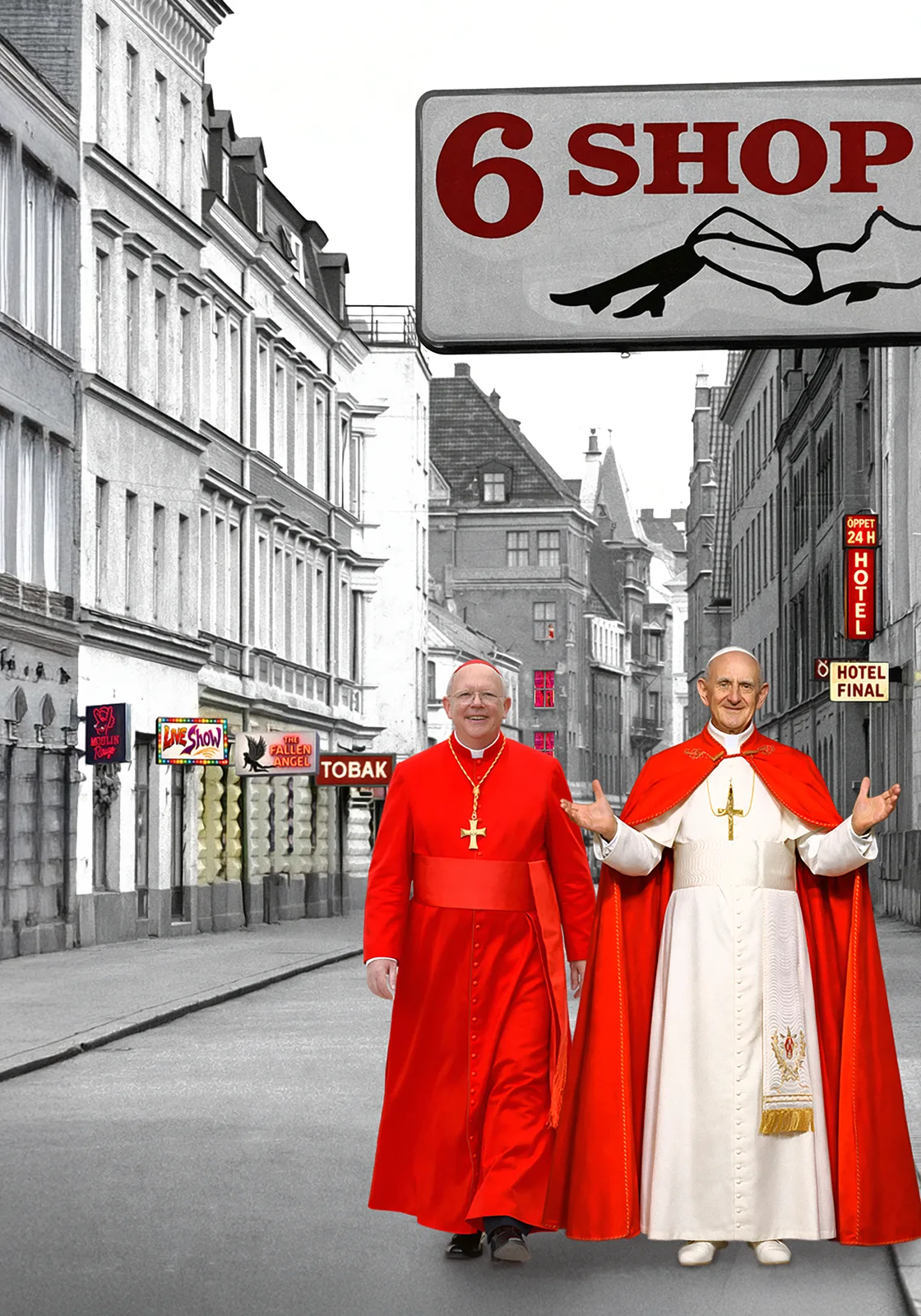
A city at dusk. Black-and-white façades. A blinking sign bearing the words Fallen Angel. It starts there, in a shop window.
At first, it looks like a local story about sex clubs, red-light districts, and the so-called Swedish sin. But soon, deeper hypocrisy comes to light, revealing how societal double standards shape personal morals and affect individual freedom. The shop window’s glass acts as a barrier between what people accept in public and what remains hidden, prompting us to consider how these double standards shape and influence our choices.
Neon lights caught people’s attention and caused outrage. Still, other stories played out behind more respectable fronts, like the Church’s views on sexuality, public purity, and the silence about surrounding abuse. Which is more shocking: what is on display in a shop window or the quiet silence complicity behind closed doors? This contrast invites us to question societal norms and to uncover hidden truths.
Fallen Angel is more than just a sign. It stands for society’s pride and moral cracks, encouraging us to question our own values and to wonder what lies beneath the surface.
This essay examines the glass through which we look and what we choose not to see beyond it, including hidden abuse within institutions and the moral double standards that shape society. It encourages us to look past these barriers and find the truths that are often hidden.
"The Fallen Angel
Beneath the gaslit glass, he bends his wing,
Not charred by flame but burdened by his pride;
His beauty still remembers how to sing
Though heaven’s gate has sealed its golden side.
He fell not roaring into sulphured night,
But softly, crowned with unconfessed desire;
A mirror of corrupted, stolen light,
A saintly face above a hidden fire.
We name him sin, and thus absolve our own,
Project our shame upon his sculpted grace;
For what is cast from marble into stone
It is easier than the truth we dare not face.
The angel falls each time we choose to see
The glow of glass, but not hypocrisy.”
Malmö, February 2026
Prologue: The Street Scene as Indictment
You stand in the street, looking towards Hamngatan. The city appears black-and-white, almost bare, as if everything superfluous has been cleared away. The façades line up, the windows are shut, and the pavement is empty. This city could be from any decade after the war: modern, tidy, and proper. But now new colours appear. The signs glow red, the colour of love and sin. Neon letters light the grey. A “Live Show” blinks like a heartbeat. A “Hotel” promises privacy and an hour at a good price. Among these signs, “Fallen Angel” flickers. That is where your gaze stops.
A shop window is never just a window. It sparks curiosity and a little unease, making people think about what society reveals and what it keeps hidden, and wonder about the secrets behind the glass.
The glass acts as a judge, prompting viewers to consider how society seeks both to show and to hide the truth.
In Malmö, Sweden’s gateway to the continent, shop windows become a stage for the country’s self-image. They reflect social morals and tensions, and make people both fascinated and cautious about social norms and reputations.
The fallen angel, a symbol of forbidden desire and moral uncertainty, fits with Malmö’s shop windows. It provokes both fascination and caution regarding how people perceive morality.
This is also true along Adelgatan. It shows us something that attracts but is also condemned. It sells sin and judges it at the same time. It is a shop window for desire and for judgement.
This is where the essay begins: in the glass between what is seen and what is hidden, in Malmö, where the city became a stage for a story of national freedom and international moral panic, in the sign that blinks red against the black-and-white façade and quietly reminds us that every society has its fallen angels and its carefully polished windows.
Malmö has always been the first place where the world beyond the Sound arrives. Before ideas reach Stockholm, they often pass through the harbour, the railway, and the hotels and bars in the south. Sailors, business people, performers, soldiers, and tourists all came ashore here. They brought goods, languages, magazines, films, and ideas of freedom. Malmö was not only a recipient of these items but also a dispatching point. As a port city and cultural crossroads, Malmö shows how social norms and views on morality are shaped by international influences, making us think about openness and hypocrisy in society.
That is why the shop window becomes more than a local detail. In a port city, the window is a border zone between inflow and outflow. It displays what is for sale, as well as what is permitted to be shown. When sexual liberalisation accelerated in the 1960s, the change first became visible in cities such as Malmö—not necessarily because desires were stronger there, but because circulation was faster. Films, magazines, and aesthetic expressions from the continent found their first Swedish addresses here. Sin has always been quicker to establish itself in Copenhagen on the other side of the Sound. The Danes are a free people, but Scanians are quick learners.
At the same time, Sweden’s reputation was becoming an export in itself. The phrase “The Swedish sin” was used internationally before it became a real political issue at home. American movie trailers, British news stories, and German magazines described Sweden as a place of sexual freedom. This supposed openness was often shown with images of Stockholm—Hötorgsskraporna, Klara Norra, and neon lights—but the same story could be told about Malmö. For foreign visitors, the location hardly mattered; what stood out was the sign, not the address. In Sweden, bare breasts and exposed bodies were shown openly, not just talked about, which was surprising for many visitors from more conservative countries. That is how the idea of the Swedish sin began.
The shop window became a way to export this image. Magazines, posters, and flashing signs for “live shows” could be photographed, filmed, and shared abroad. The glass acted like a filter, making Swedish sexuality easy for outsiders to see—clear enough to attract attention, but still presented as modern and under control.
But the same glass had another effect. It made sexuality a symbol for the whole country. When critics in the United States or Germany talked about Sweden’s moral decline, they were not just criticising one shop, but an entire way of life. The secular welfare state required sex education, and new ideas about gender equality were all summed up in the image of a shop window with naked bodies. What people could see was made to represent what they could not.
This was especially clear in Malmö. The city was often compared to places like Hamburg’s Reeperbahn and Copenhagen’s Nyhavn, as if it were the Nordic version of those entertainment districts. In the early 1970s, Malmö had many porn shops and sex clubs, mostly in areas that would later be renovated or torn down. But it was not just the number of these places that shaped Malmö’s reputation—it was how visible they were. The shop windows, small ads, and colourful names like Pigalle, Arabia Sex Night Club, and Röda Rubinen, not to forget The Fallen Angel, stood out in the city. By the end of the decade, the most famous club was Trocadero, which was as lively as the soda it was named after.
Still, this visibility depended on certain conditions. Run-down buildings and cheap rents made these businesses possible. Urban redevelopment left empty spaces where the market could grow. When these neighbourhoods were cleaned up and renovated, the desire did not go away—only the glass that showed it did. Pornography moved into darker spaces and later onto computer screens. Public spaces became less sexualised, but not necessarily less sexual.
The shop window shows its two roles here. It is both a way to make money and a sign of changing morals. As long as “sin” is visible, people can talk about it, regulate it, ban it, or use it for profit. When it moves behind covered windows or onto digital screens, the behaviour may remain the same, but it is no longer visible to the public.
Malmö, as the gateway to the continent, became both a part of the sexual revolution and a reflection of how Sweden saw itself. In Malmö, modern ideas could be shown and also challenged. Moral panic and business interests met in the same shop window. Every time someone stopped to look—whether shocked, curious, or taking a photo—the idea of Sweden as both free and immoral was reinforced.
Who Watches, Who Is Seen, Who Is Hidden?
A shop window is like a stage that everyone can see. It is meant to attract attention, not to be entered casually. Anyone who stops to look becomes part of a social game that shapes how we see things. Visual symbols like neon signs, mannequins, and bold displays help build ideas about morality and national identity, drawing viewers into ongoing cultural stories.
Who is it that looks? The tourist with a camera, seeking proof to take home. The flâneur who pretends to pass by but lingers a second too long. The moralist, searching for offence to formulate indignation. The journalist who needs an image for an article about “sinful Sweden.” And the policeman, whose task is not to decide what happens behind the scenes but to determine what may be visible through the glass.
The shop window creates a unique public space. It belongs to the street but is managed by private owners. It is part of the market but also follows the law. It speaks to people outside while hinting at a different world within. The glass serves as a boundary where morality and business intersect, reminding us that we help shape society’s values.
What could be seen mattered a lot. In the 1960s and 70s, people debated how showing nudity in shop windows challenged social morals. This shows how important these choices are and asks us to think about our own part in setting moral standards.
This is the core of visual morality: society regulates what can be seen. The openly sexual image becomes more dangerous than the abuse itself because it challenges the shared gaze. The shop window thus becomes a frontline. Activists paste placards on the glass. Religious groups paint over the panes at night. Feminist organisations demand that the humiliation of women not be exhibited on the street. At the same time, shop owners lure customers with neon, flags, and seductive promises.
The gaze, however, is not neutral. It is gendered, class-coded, and charged with shame and curiosity. The mental threshold into the shop was likely higher for women than for men. To step inside risked being seen. That is why the windows were often designed to be blocked by a wall at the back. The consumer could cross the threshold without being observed by passers-by. The voyeuristic looking at the glass was replaced by a protected looking within.
There is a paradox here. The shop window shows what is forbidden, yet also protects those who look or buy. Someone standing outside can be shocked or interested without risking their reputation. Someone who enters a space does so where the normal rules of public morality are set aside for a while.
That is why the shop window is more than a place of trade. It functions as a moral theatre in which nightly performances of societal narratives about morality, national identity, and cultural values unfold. Here, the conflict between liberation and condemnation is staged, reflecting and shaping societal perceptions and international images. This framing invites the audience to see the shop window as a vital cultural space, encouraging reflection on societal values.
In Malmö and Stockholm, some streets became known as free zones. This was not because the law did not apply, but because people expected to see certain things there. Anyone who walked down these streets knew what to expect, allowing the displays to be more open. This shows that morality depends on place. It is not just the image that matters, but where and how it is seen.
The shop window mirrors society’s values. It acts as a symbol that shapes how people see morality and modern life, helping everyone understand shared stories about ideas like Swedish sin.
Sin as an Export Commodity
The idea of Swedish sin was never merely a local issue. It was a story packaged and sent abroad, often before it was clearly understood in Sweden itself. In this narrative, the shop window became a key symbol—think of neon-lit sex clubs, bold magazine covers, or street posters—that helped shape how people in other countries saw Swedish sexual openness. Sometimes, a single image could sum up an entire way of life and influence how outsiders viewed Sweden’s values. Ironically, much of what was sold as Swedish wasn’t even made in Sweden, but in Denmark. Sweden got the questionable reputation, while Denmark made most of the money.
Sweden was portrayed as a laboratory where the welfare state, secularisation, and sexual liberation had been distilled into something both alluring and threatening. In American trailers and European reportage, Stockholm was described as “the sex capital of the world,” but geography was ultimately secondary. What mattered was the sign. What mattered was that pornography was visible, not hidden in back rooms or under counters. Visibility became synonymous with permission, and permission with national character.
Malmö had a special role, even if it wasn’t always named. As the entry point to the continent, it was often the first place where visitors saw what they expected: sex clubs and porn shops as part of the city’s everyday scene, sometimes in rundown buildings or areas not yet modernised. Visitors didn’t need to know Swedish law; seeing the glass, neon lights, and shop names was enough. When they returned to places like Hamburg, London, or Chicago, they shared stories about “Sweden.” This helped make Malmö a symbol that shaped how people thought about Swedish society.
That is how a myth works. It does not require precise data but relies on images. The shop window presents that image, prompting the audience to reflect on how visible symbols shape societal beliefs about morality.
At home, the same image was used in political debates, showing how shop windows became symbols in arguments about values. Conservative voices warned that Sweden’s reputation was at risk, and politicians debated how public sexual images affected the country’s identity. Newspapers said that “Swedish porn” was valuable in places with stricter laws. What happened in one shop window could end up being discussed in parliament, showing how closely morality, politics, and visual culture were linked.
Ironically, the moral panic further spread the idea. The more people talked about Swedish sin, the more real it seemed. When foreign media covered Swedish debates about pornography, the story fed on itself. Swedish freedom became both a brand and a cautionary tale.
During this period, the shop window became a symbol of the entire country. It stood for modern ideas such as openness, business, and public life. But it also stood for what some saw as too much. A country that introduced sex education, allowed abortion, and lifted bans on public indecency could be seen through that same window as either brave or as going too far.
Malmö’s proximity to the rest of Europe strengthened this mix. European trends were easy to spot, but so were Swedish rules. Pornography was a business, but it was also regulated by law. It was out in the open, yet still part of a society that was building the welfare state and working for gender equality. This mix made Swedish sin a powerful export. It wasn’t chaotic—it was organised.
The shop window became a mirror for the world, letting outsiders see their own hopes or worries. Some saw it as a sign of freedom, while others saw it as proof of moral decline. For Sweden, it was an uneasy symbol—a window that showed off modern confidence but also revealed its flaws.
Swedish sin was shaped not only by what people did but also by what was presented to the world. Malmö was key to this—not just as a follower of the capital, but as the first place where outsiders saw the shop windows and formed their opinions.
Klara Norra as Model – and How the Model Spreads
If Malmö was the screen, then Stockholm was the projector. In the capital, the story took shape and was tied to a specific place: Klara Norra Kyrkogata, also known as Klara Porra. In the 1960s and 70s, this street saw a rise in porn shops, cinemas, and clubs. Media reports described it as “porno-Sweden’s shop window to the world.”
Klara was not unique in Europe. Streets like it could be found in Hamburg, Copenhagen, Paris, and New York. However, in Sweden, this street took on special meaning. It was centrally located, near the station, in a part of the city not yet changed by new buildings. As a backstreet just outside modern development, it became the perfect place to show the city’s contradictions.
The shop windows on Klara Norra had a distinct look. They were crowded with magazines clipped to strings, books and slide sets piled on the floor, and posters covering the walls. Unlike the neat displays in department stores, these windows were about showing too much. Instead of guiding the viewer’s eye, they overwhelmed it.
Even in this setting, what could be seen was controlled by law. Rules determined what was allowed in shop windows and what was not, drawing lines between acceptable and unacceptable images. These laws showed how society’s tensions and debates about morality played out in public spaces.
Stockholm became an example for others. Klara Norra showed how a city could allow a “free zone of pornography” by tying morality to a specific place. Anyone who walked onto the street knew what to expect, so there could be no surprise. In reality, the influence of the shop windows spread across the whole street.
But the model did not remain in Stockholm. It could be translated to Malmö. Here too, there were concentrations of businesses in demolition-threatened quarters; here too, proximity to the station and harbour mattered; here too, clustering created a particular charge. These environments were not identical, but the logic was the same: visibility was concentrated in certain places and thus became both more permissible and more controversial.
Stockholm drew most of the media attention, but Malmö was part of the same pattern. When international film crews wanted images of “Swedish sin,” one backstreet with neon lights and English signs was enough. When Swedish politicians discussed the country’s reputation, they thought not only of the capital’s shop windows but of all the city spaces where pornography was now visible.
Klara Porra also shows how quickly symbols can appear and disappear. In the 1980s, as laws tightened and the market shifted, most of the shops closed. Damages were paid, contracts were terminated, and the area was either demolished or rebuilt. The street that once stood for sin faded into the background. Still, the story lived on.
This is why the shop window is such a strong metaphor. Even if it is removed or altered, the image it once depicted continues to circulate, illustrating how society controls what is seen. Stockholm became the mirror in which Sweden saw itself as either free or corrupt. Malmö was where outsiders first looked into that mirror. This metaphor highlights how society shapes what we see and how these images endure over time.
When we talk about Klara Porra, we are not just talking about a street in Stockholm. We are discussing a way of organising what is seen, how morality is tied to certain places, and how a glass window with neon lights above it can encapsulate a whole country.
Demolition Quarters, Sex Clubs, and the City’s Double Bottom
In the early 1970s, Malmö had many porn shops and sex clubs spread across neighbourhoods that look very different today. Möllevången is now a hub for the cultural middle class. Gamla Väster has become exclusive and picturesque. Lugnet was demolished and replaced with modern buildings. These changes demonstrate how the city has adapted and reflect broader societal shifts.
In 1971, Malmö had about 265,000 residents and around 20 porn shops. Some sold only magazines and short films, while others promoted live sex shows. The shop names said a lot: Pigalle, Arabia Sex Night Club, Röda Rubinen, The Pornography Specialist, Plym-Piraten. Some tried to appear sophisticated, while others were more direct. No matter the style, the shop window was always important.
This is where the city’s moral conflict became clear. The audience was not just watching—they were sometimes invited to take part, either by being touched by staff or by having sex with one of the women. The atmosphere was open and unrestrained.
Many of these businesses were located in buildings slated for demolition as part of urban renewal—low rents and landlords who ignored what was happening made these places a temporary free zone. Before demolition, entrepreneurs, addicts, artists, and sex club owners moved in. Pornography was just one part of this mix, alongside cafés, studios, and illegal clubs. It developed quietly as the city changed.
Some people look back on this time as an innocent era of freedom, with women showing natural bodies, unlike today’s focus on plastic surgery and digital filters. But behind the scenes, tough business owners ran operations in legal grey areas, and the economy was not always kinder than what came later. The bright shop windows often hid as much as they showed.
At the time, people compared Malmö to places like the Reeperbahn and Nyhavn. The city was seen as a southern Swedish version of these lively entertainment districts. It was about more than just sexuality—it was also about identity. As a port and border city, Malmö became a place where things outside the norm could find a home. This brought both pride and criticism.
Today, most pornography is online. Public spaces are less sexualised—not because people want less, but because attention has shifted. Examining how digital spaces shape urban values and symbols can help us connect the past to the present and better understand these changes.
But in the 1970s, the shop window was still at the centre. Through the glass, Malmö showed its part in what was called Swedish sin. Visitors from other countries could take photographs, write reports, and help shape perceptions of Sweden as either liberated or depraved.
The shop window also made the conflict clear. Feminist groups put up posters. Religious activists painted over the glass. Politicians argued over new laws. Public spaces became a battleground—not about desire itself, but about whether it should be seen.
Malmö became more than a setting. The city was a testing ground for how modern life handles the visibility of sexuality. In neighbourhoods waiting for demolition, near the harbour and close to Europe, the struggle between freedom and judgement played out every night.
The shop window served as a clear defence, showing only what was allowed. At the same time, it quietly suggested that what happened behind the glass was less important than what people could see.
This contrast made Malmö unique. The city was not more sinful than others, but it was a place where sin was visible, and so it became part of how the country saw itself.
Fallen Angel: The Sign as Theology and Theology as Sign
In the middle of this city scene, the name Fallen Angel stands out. As a sign, it works well. It hints at forbidden knowledge, a mix of eroticism and tragedy, and beauty that already shows its downfall. The name is more poetic than The Pornography Specialist and more intense than Live Show. But it is not just clever marketing. It is theology lit up in neon.
The fallen angel is a lasting figure in Western culture. Lucifer, once the brightest angel, tried to rise above his place and was cast down for his pride. In Alexandre Cabanel’s 1847 painting, he is not shown as a monster but as a wounded beauty, defiant and bitter. This mix of qualities makes the figure powerful—he stands for sin and also for its most tempting side.
When a sex club calls itself Fallen Angel, it does more than make an ironic joke. It places itself within a tradition that renders sin beautiful, almost elevating it. The message is clear: "Here you fall by choice." In this place, temptation is stronger than shame. Still, the name also hints at loss, reminding us that every fall means there was once a higher place.
At this point, the metaphor goes deeper. What is actually falling? Is it a person, a nation, the Church, or even modern society? The idea of Swedish sin was once used to show both freedom and moral decline to the world. The fallen angel became a symbol for the nation. Some saw Sweden as a place that left behind old morals in pursuit of freedom, while others saw it as a country that lost its way and fell into excess.
The Church uses the same symbols. It speaks of the fall, pride, and temptation. It warns of the pull of sin and beauty that hides danger. But what happens when these ideas meet the real world of the city? What does it mean when Lucifer is not just a figure in a sermon but a brand name on the street?
There is a kind of reflection here. The Church has its own way of showing morality through processions, special clothing, symbols, and altars. It is skilled at creating a sense of holiness and knows that what people see shapes what they believe. But today, the Church also faces a different kind of fall—not a mythological story, but real problems such as abuse, silence, and the misuse of power. These acts are not displayed in shop windows but are hidden behind church doors and private rules.
The gap between the sex club’s glass window and the Church’s walls is smaller than it seems. Both are about controlling what people can see. What should be shown? What should be hidden? Who gets to decide what is seen?
So Fallen Angel is more than just a catchy name. It becomes a way to look at the whole story. It shows that a fall is not always easy to detect when it occurs. Sometimes, what appears brightest conceals the greatest flaws. And often, society cares more about how sin appears than about how power is used.
When the sign flashes red on the black-and-white building, it is more than just an ad for a nightclub. It is a sign of a society reflecting on its own story of pride, freedom, and downfall.
Xxx
The Church’s Visual Morality: The Façade, the Sermon, and Glass as Protection
If the shop window represents modernity’s glass, then the Church’s façade is its stone. It is meant to inspire reverence and to show order, continuity, and moral authority. For centuries, the Church has known what modern cities learned in the nineteenth century: what people see shapes what they believe. The altar is arranged, the procession planned, and the vestments carefully chosen. In this way, the Church creates its own kind of shop window, where holiness is displayed in a controlled way.
The Catholic Church has been especially consistent in this visual approach. You can see hierarchy in the clothing, power in the colours, and tradition in every gesture. The sermon is public, beliefs are clearly stated, and rules about sexuality are clear. When the Pope published Humanae Vitae in 1968 and reaffirmed the ban on artificial contraception, it was a way to defend a moral façade. The Church made it clear to the world where it stood.
This is where the sharp difference between what is seen and what is real becomes clear. While the Church preached sexual morality from the pulpit and in official documents, systematic abuse was happening across different countries. Cultures of silence developed, priests were moved from one parish to another, and internal rules were followed instead of reporting abuse. What could not be shown in the shop window was allowed to continue behind closed doors.
This is the heart of double standards. It is not just hypocrisy; it is about controlling what is seen. The Church responded strongly to what was visible, such as pornography, sexual freedom, and departures from doctrine, but was often slower to address what was hidden. The focus was on appearances rather than actions.
The comparison to pornography’s shop window is uncomfortable but clear. In both situations, what is visible is controlled first. In Klara Norra and Malmö, people debated how much skin could be shown in the windows. In the Church, the question was how much scandal could become public. Both used methods to protect themselves: censorship patches in one case, and confidentiality and internal investigations in the other.
Visual morality becomes the common link. Society, with the Church as its strongest moral voice, is deeply concerned with appearances. It is easier to condemn what is obvious, such as neon signs, than to address what happens in secret. It is simpler to criticise a sex club’s sign than to question the silence inside a church.
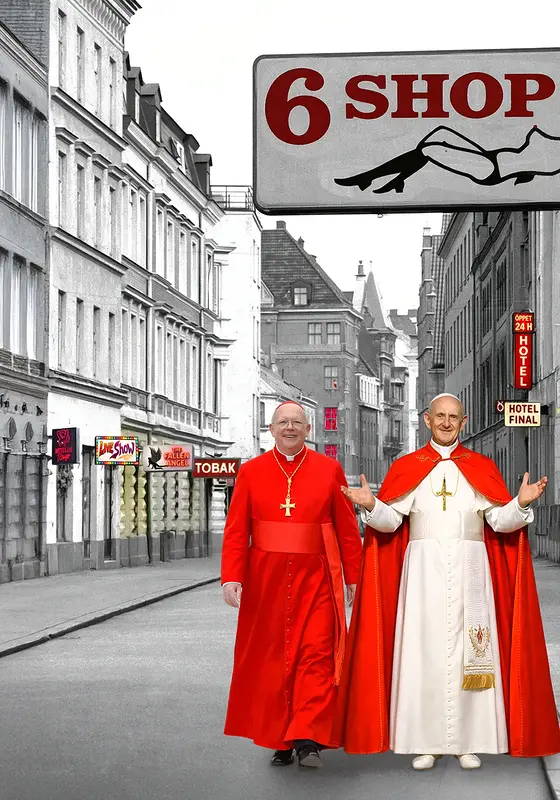
This is why showing the Pope and the cardinal walking through Malmö’s night streets is not about claiming they were really there. It is meant as a visual confrontation. They walk the same streets as the shop windows showing pornography, but they represent a different kind of façade. Their presence in the image shows that double standards are not about location, but about structure. These double standards exist both in the city’s backstreets and in the Church’s halls.
Here, the shop window acts as an accusation. It is not just that pornography exists, but that it is used as a symbol of moral decline, while other abuses of power are hidden. The glass shows not only what is for sale, but also what is considered important in the moral order.
And the fall. The fallen angel sign blinking above the street takes on another meaning. The fall is not always what is shown in neon lights. Sometimes, it is what is hidden behind stone walls. Down Side: Abuse, Cultures of Silence, and the Geography of Power
When people talk about the Swedish sin, it is easy to focus on neon lights, naked bodies on magazine covers, and flashing signs. This is visible sin, the kind that can be photographed and discussed. But the real double standard only appears when we compare this open sexuality to the sexuality that has been hidden behind the walls of institutions.
In recent decades, many investigations have shown that abuse in the Catholic Church has persisted for a long time across different countries. The pattern is often the same: a priest is accused, moved to another parish, and the case is kept quiet. In the porn districts, people talked about what could be shown in a shop window, but in the Church, problems were handled by moving people and denying them. This could be described as a form of moral geography, in which problems are displaced rather than solved.
This contrast makes the shop window a strong metaphor. In Malmö’s and Stockholm’s porn districts, debates focused on what was visible, such as whether images were too explicit, whether children could see them, or whether the country’s reputation was at risk. In the Church, the focus was on concealing information: protecting the institution, reducing scandal, and keeping problems internal.
Both systems are centred on what people see. In one, people are protected from seeing too much. In the other, they are kept from seeing anything at all.
This is why the fallen angel returns as a symbol. In theology, the fall happens because of pride and a desire to rise above order. In institutions, the fall can be about power without anyone watching. When authority and silence come together, abuse can happen. This is a different kind of darkness from that sold under neon lights.
This does not mean that pornography and abuse are the same thing. That would be too simple. Instead, it shows that society often gets angry at the wrong things. Public debate has often focused on what can be seen through the glass—bodies in magazines and on stage—while more harmful acts have continued inside respected institutions.
In Malmö, where rumours of a “sex swamp” once spread quickly, this difference became clear. The city could be characterised as sinful because of its shop windows. In contrast, the real, widespread abuses that were later revealed were rarely linked to the moral authorities who spoke against sin. This essay aims to highlight that imbalance.
Here, the shop window acts as a reversed accusation. It shows how easy it is to blame what is visible and call it decay, while ignoring what is hidden. The glass symbolises what society cares about most: what is visible is treated as a problem, whereas what is hidden becomes part of the system.
When we look again at the street scene with the blinking Fallen Angel sign, the point is not to judge desire. Instead, it is worth asking why some falls become national scandals, while others are recognised only after long investigations by independent commissions.
The real double standard is not that sin is sold. Abuses of power persisted for a long time without being noticed. In a culture where what is seen is talked about more than what is hidden, this may be the hardest truth to face.
A Shared Logic: The Censorship Patch, the Blackout, and the Permitted Space**
When you compare the history of porn districts with the Church’s scandals, an uneasy similarity stands out—not in the actions themselves, but in how they are managed visually. Both have developed ways to control what is seen. The censorship patch in the shop window, the small golden heart covering the genitals, works much like an administrative transfer in the Church. In both cases, the most compromising element is concealed, yet the overall system remains intact.
During the display trials of the 1970s, people debated where to draw the line between what was considered pornographic and what was allowed. If the genitals were covered, the image was legal. The deciding factor was not the act itself but the extent to which it could be seen from the street. Visibility set the standard. Similarly, many abuses in the Church were handled privately as long as they stayed out of public view. A scandal occurred only when hidden matters came to light.
This shared way of thinking makes the shop window more than a mere relic of the past. It shows how modern societies work. They focus less on eradicating prohibited items and more on controlling their display. They establish designated areas, make exceptions, and devise strategies to manage problems. They move items, conceal them, or alter their descriptions. The main goal is to maintain appearances.
In Stockholm, Klara Norra was known as a place where pornography was allowed. Anyone who walked down that street knew what to expect and could not claim to be caught off guard. In Malmö, similar areas existed in neighbourhoods earmarked for demolition, where the business was thought to fit, at least for a while. Morality became tied to location. What was offensive in one area could be accepted in another.
The Church acted similarly, but within its own structure rather than in city neighbourhoods. If a priest were accused, he could be transferred to another parish. This merely moved the problem rather than fixing it. Just as people could avoid the red-light district if they wanted, the Church could keep scandals hidden as long as they stayed within the institution.
This is the paradox of modern morality. Our societies claim to value openness, yet they also find clever ways to protect their image. The glass in the shop window is clear, yet there are walls behind it that block understanding. The Church’s grand exterior can hide silence within.
In the 1980s, pornography moved from open windows to blacked-out spaces and later to the digital world. The desire remained the same, but its visibility changed. Similarly, the Church’s moral claims did not disappear when abuses came to light. Trust was shaken only when reports, verdicts, and investigations made what was hidden visible.
The shop window shows that allowed spaces are always created by society. They are shaped by what can be shown and what must stay hidden. In Malmö and Stockholm during the 1970s, the glass of sex clubs was a major topic of debate. Today, it might be screens and algorithms. But the idea is the same: what we see is controlled, and what is hidden can last longer than we like to admit.
The fallen angel still blinks above the street, serving not only as a symbol of desire but also as a reminder that every society finds its own ways to deal with wrongdoing. The real question is not just what counts as sin, but who decides—and where the line is drawn between what is shown and what remains hidden.
The Gateway Exporting Both Reputation and Denial
We return to Malmö, not just as a backdrop but as a central point. This city, thanks to its location, has become a hub for goods, people, and stories. Here is where you arrive by boat, step off the train, and first encounter Sweden; what greets you isn’t always political speeches or Church teachings, but the street itself. The glass. The sign.
During the years when the idea of Swedish sin became an international myth, Malmö played a role in its construction. The city’s name might not have appeared in foreign articles, but people passing through experienced it firsthand. A port city cannot control who looks at it, only what is visible when they do.
That is why the shop window becomes so central. It is the city’s most concentrated self-portrait. In it, commerce and morality meet; modernity and tradition collide. In Malmö, the porn districts could be read as proof of liberation or as signs of decadence. At the same time, housing areas, schools, and hospitals were being built. The welfare state expanded in parallel with the sex clubs. It was the same society.
And while the world debated the blinking signs, other processes continued more quietly. The Church’s sexual morality was still preached. Cultures of silence persisted where power and authority were strong. Swedish sin became an export commodity, but the real double standard lay in how selectively indignation was distributed.
Malmö shows how quickly a city can become just a symbol. Some called it a sex swamp. Others called it a free port. But behind these labels were real people living their lives, walking past shop windows, working in the shops, protesting, defending, and judging.
When the porn districts later disappeared through renovations and political decisions, when live shows were banned, and neon switched off, it was not only an industry that changed. It was the city’s visual self-image that shifted. Public space became more polished, more family-friendly, and less confrontational. Pornography withdrew into blacked-out windows and later into screens in private rooms.
But the myth survived. The idea of Swedish sin did not end with the last neon signs. It continued to circulate as a cultural reference, a touch of nostalgia, and a warning. Throughout this, Malmö remained part of the story, not because it was unique, but because it was visible.
Here, the gateway is shown from two sides. It lets in new influences and also sends out images. It exports not just goods but also self-images. In the shop window’s glass, it is not only the products that are reflected, but the nation itself. When we look into that mirror, we see how easy it is to confuse what is shown with what is real, neon with nature, and surface with truth.
Malmö is no more sinful than other cities. But as Sweden’s gateway to the continent, it became a place where Sweden could be seen and judged by its most visible features. Maybe the hardest truth in this essay is that we often let what shines the brightest decide what matters most.
Xxx
The Climax of Double Standards: Humanae Vitae and the Fallen Angel’s Shadow
Because Malmö is close to the continent, it has always picked up news from abroad quickly and sometimes spread it just as fast. When we picture Pope Paul VI and French cardinal Jean-Pierre Ricard walking down Adelgatan, it is not about their actual presence. They never were. Instead, they represent the central idea of the image: double standards.
Paul VI was pope from 1963 to 1978 and led the Catholic Church through a turbulent period. After the Second Vatican Council, the Church struggled with modernisation. Many describe him as a conflicted figure, torn between tradition and change. In 1968, the encyclical Humanae Vitae marked a turning point. Despite a papal commission’s recommendation to allow contraception, he maintained the ban on artificial birth control.
Many Catholics were shocked. At the time, people discussed liberation, responsibility, and medical progress. The pope responded with restraint and discipline. While public statements reinforced sexual morality, the rest of the world was moving in a different direction.
Yet during those same years of moral statements, abuses occurred within Church settings in several countries. Reports from Germany, the United States, and later France revealed that priests sexually abused thousands of children. In many cases, the Church responded with silence and by transferring offenders to new locations, a practice now called “geographical penance.” The issue was concealed rather than addressed.
In France, the independent Ciase commission’s report shocked the nation. It is estimated that at least 216,000 children were abused within the Catholic Church over the past seventy years. Between 2,900 and 3,200 perpetrators were identified, most of them priests. In one case, an abuser even became a cardinal. The report was 2,500 pages long and covered more than 300,000 affected children since the 1950s. These numbers are hard to grasp. They call for a symbol, for the image of Lucifer, the fallen angel.
In Sweden, cases of sexual abuse within Church settings have also come to light. Some priests have been convicted of serious child pornography offences and sexual abuse. Initiatives such as #vardeljus within the Church of Sweden have collected stories of harassment and abuse of power. Both the Catholic Church and the Church of Sweden have since created guidelines and prevention programmes, including zero-tolerance policies and child-protection rules. Still, debates continue about confidentiality, internal processes, and the culture within these institutions.
This is where double standards become clear. The same institution that condemned contraception and preached sexual restraint could not protect children from abuse within its own walls. While society debated what could be displayed in shop windows in Malmö or Stockholm, abuse continued behind the Church’s stone walls.
The real difference is not between pornography and religion, but in what is visible. One was out in the open, lit by neon, and could be criticised. The other was hidden by authority and took decades to uncover.
So when the Fallen Angel sign blinks above the street scene, it is more than an ironic marker of sin. It is a reminder that the fall does not always happen where the light is strongest. Sometimes it happens inside institutions that claim the right to define sin itself.
Maybe it is in Malmö, a gateway city where the world passes through, and glass has always had meaning, that this contrast is most obvious. The shop window of Swedish sin was never the worst fall. It was just the most visible one.
Epilogue: The Glass, the Fall, and What Remains
We are standing there again, in the street. The black-and-white façade, the red neon, the Fallen Angel sign. After everything that has been said, the image is no longer innocent. It is charged. It holds not only a sex club or an era, but an entire system of visibility and denial.
We have seen how Malmö, as a gateway, received new ideas and spread them further. Stockholm became a mirror for the nation, reflecting its sense of freedom. The shop window served as a test of public morals: what could be shown, how much was allowed, and where the limits lay. We have also seen how the Church, through its ceremonies and traditions, promoted strict sexual morals in public while concealing abuse within its own walls.
This is where the epilogue must stay clear and direct.
When figures like 216,000 children enter the picture, and when thousands of pages of commission reports testify to systemic silence, the perspective shifts. Neon’s glow fades. What once shocked in a shop window begins to look trivial compared with what was hidden behind institutional authority.
The shop window was always transparent. You could see through it, even when it provoked. What was truly dangerous had no glass—what was protected by respect, hierarchy, and silence. That was the deeper double standard.
The fallen angel sign still flashes. But maybe desire is not the real downfall; maybe it is pride. It is the belief that someone can define sin without being questioned, and that morality can be preached from above without those in power being held to the same standard.
Malmö became a symbol of Swedish sin because sin was visible. The Church became a symbol of morality because morality was visible. In both cases, visibility was decisive. But what shapes history is not only what is seen—it is what is finally forced into the light.
When we look again at the street scene now, it is no longer merely aesthetic. It is a document of how societies organise their gaze. We debate what blinks, what tempts, and what disturbs us in public. We are slower to confront what takes place in the shadow of our own institutions.
Maybe that is why this essay should end here, at the glass. The shop window is not the biggest problem, but it reveals what we value. We protect appearances more than people. We control what is seen more than we control those in power.
The fallen angel is not merely a night-time decoration on Adelgatan. It reminds us that every society has a public face and hidden flaws. Real responsibility begins when we are willing to look at what has been kept out of sight.
Malmö’s history of adult districts and torn-down buildings, Stockholm’s Klara Norra as a national mirror, and the Church’s public morality and hidden sides are all connected by this pane of glass. It is thin, almost invisible, yet important. It both separates and connects.
Perhaps it is only when we stop focusing on the sign and start looking at what lies behind it that we can truly discuss downfall and responsibility.
En stad i skymning. Svartvita fasader. En blinkande skylt med orden Fallen Angel.
Det börjar där – i ett skyltfönster.
Men det som först ser ut som en lokal historia om sexklubbar, porrkvarter och den så kallade svenska synden visar sig snart vara något annat. Glaset i fönstret blir en gräns mellan det som får synas och det som döljs, mellan moral och marknad, mellan predikan och praktik. Malmö, Sveriges port mot kontinenten, blir scenen där nationens rykte ställs ut – och där dubbelmoralen tar form. Vi talar om the roaring 60s, det vilda sextiotalet, decenniet som förändrade världen.
För medan neonljusen lockade blickar och väckte indignation, pågick andra berättelser bakom mer respektabla fasader. Kyrkans sexualmoral, den offentliga renheten, de högtidliga orden – och samtidigt tystnad, makt och övergrepp. Vad är egentligen mest skandalöst: det som blinkar i ett skyltfönster eller det som aldrig skulle få synas?
Fallen Angel är därför mer än en skylt. Det är en symbol för stolthet och fall, för förförisk skönhet och moralisk spricka. Det är en bild av hur samhällen organiserar sin kollektiva blick. Och det är en berättelse om hur Sverige – genom Malmö och Stockholm – blev både exportör av synd och producent av förnekelse.
Detta är en essä om glaset vi stirrar på – och det vi undviker att se bakom det.
Prologue: Gatubilden som anklagelse
Man står på gatan och ser mot Hamngatan. Staden är svartvit, nästan asketisk, som om den tvättats fri från allt överflöd. Fasaderna står i raka led, fönstren är slutna, trottoaren tom. Det är en stad som kunde vara vilket årtionde som helst efter kriget – modern, ordnad, respektabel. Och ändå bryter nya färger igenom. Skyltarna lyser i rött, kärlekens och syndens färg. Neonbokstäver skär genom det grå. Ett “Live Show” blinkar som en puls. Ett “Hotel” lovar diskretion och en timme till överkomligt pris. Och mitt bland skyltarna blinkat ”Fallen Angel”. Det är där blicken fastnar.
Ett skyltfönster är aldrig bara ett fönster. Det är en apparat och ett glas med reflexer som både visar och döljer. På ena sidan står vi – flanören, turisten, moralisten, journalisten. På den andra sidan finns varan, begäret, löftet. Glaset gör dem möjliga att betrakta utan att vi själva behöver kliva över tröskeln. Det skapar ett mellanrum där det privata kan exponeras utan att upphöra att vara privat. Skyltfönstret är modernitetens mest civiliserade form av exhibitionism.
Glaset becomes a moral judge, prompting the audience to reflect on society's obsession with exposure and hidden truths.
In Malmö, Sweden's gateway to the continent, skyltfönstren serve as a stage for national self-image, inspiring curiosity about societal norms and reputation.
Och över denna scen svävar Lucifer, den fallna ängeln. Fallen Angel är bokstavligen en skylt. En sexklubb. Ett löfte om något förbjudet innanför glaset. Men namnet bär på något större. Lucifer, den skönaste av änglar, som föll av stolthet, den som en gång stod närmast ljuset men valde upproret och därmed störtades ner. I konsten – hos Alexandre Cabanel och andra – framställs han inte som ett monster utan som en vacker, trotsig gestalt, med blicken fylld av både sårad stolthet och obändig vilja. Den fallne är fortfarande skön. Det är det som gör honom farlig. Nu i Malmö och Sverige.
Så fungerar också Adelgatan. Den visar oss något som både lockar och fördöms. Den säljer synden och moraliserar över den i samma andetag. Den är ett skyltfönster för begäret – och samtidigt för fördömandet.
Det är här essän börjar: i glaset mellan det synliga och det dolda, i Malmö där staden blev scen för en berättelse om nationell frigjordhet och internationell moralpanik, i skylten som blinkar rött mot den svartvita fasaden och viskar att varje samhälle har sina fallna änglar – och sina noggrant putsade fönster.
Malmö har alltid varit en stad dit världen bortom sundet kommer först. Innan idéer når Stockholm har de ofta redan passerat genom hamnen, järnvägen, hotellen och krogarna i söder. Sjömän, affärsresenärer, artister, soldater, turister – de steg i land här. Med dem följde varor, språk, tidskrifter, filmer och föreställningar om frihet. Malmö var inte bara en mottagare, utan också en avsändare. Det som syntes här kunde snabbt bli en berättelse om Sverige.
Det är därför skyltfönstret blir mer än en lokal detalj. I en hamnstad är fönstret en gränszon mellan in- och utflöde. Det visar upp vad som finns att köpa, men också vad som är tillåtet att visa. När den sexuella liberaliseringen tog fart under 1960-talet var det i städer som Malmö som förändringen blev synlig först – inte nödvändigtvis för att begären var starkare här, utan för att cirkulationen var snabbare. Kontinentens filmer, tidskrifter och estetiska uttryck hittade sina första svenska adresser just här. Synden har alltid varit snabbare att etablera sig i Köpenhamn på andra sidan sundet. Danskarna är ett fritt folk, men skåningar är läraktiga.
Samtidigt växte en annan export fram: ryktet. Den svenska synden blev ett internationellt begrepp långt innan det var en inrikespolitisk realitet. Amerikanska trailers, brittiska reportage, tyska veckotidningar beskrev Sverige som ett laboratorium för sexuell frigjordhet. Ofta illustrerades denna påstådda frihet med bilder från Stockholm – Hötorgsskrapor, Klara Norra, neonljus – men berättelsen fungerade lika väl i Malmö. För den utländske besökaren var skillnaden marginell; det viktiga var skylten, inte adressen. Nakna bröst och blottade sköten visades öppet och var inte bara något man tala om, vilet var fallet för många bbesökare från puritanska länder. Så föddes den svenska synden.
Skyltfönstret blev därmed en exportmaskin. Det som hängde där – tidskrifter, affischer, blinkande löften om ”live show” – kunde fotograferas, filmatiseras och skickas vidare. Glaset fungerade som ett filter som gjorde den svenska sexualiteten begriplig för omvärlden: synlig nog för att väcka uppståndelse, inramad nog för att framstå som modern och kontrollerad.
Men samma glas skapade också en annan effekt. Det gjorde sexualiteten till en nationell symbol. När kritiker i USA eller Tyskland talade om Sveriges moraliska förfall, var det inte en enskild butik de angrep utan en samhällsmodell. Den sekulära välfärdsstaten, den obligatoriska sexualundervisningen, den jämställdhetsretorik som växte fram – allt kondenserades i bilden av ett skyltfönster med nakna kroppar. Det synliga fick bära det osynliga.
I Malmö blev detta särskilt tydligt. Staden jämfördes med Hamburgs Reeperbahn och Köpenhamns Nyhavn, som om den vore en nordisk variant av kontinentens nöjesstråk. Under det tidiga 1970-talet fanns här ett betydande antal porrbutiker och sexklubbar, koncentrerade till områden som senare skulle gentrifieras eller rivas. Men det var inte antalet i sig som skapade ryktet, utan synligheten. Skyltfönstren, småannonserna, de färgstarka namnen – Pigalle, Arabia Sex Night Club, Röda Rubinen – fungerade som markörer i stadsrummet. I slutet av decenniet krönt av klubben nummer ett, Trocadero lika sprudlande som läsken med samma namn.
Samtidigt var denna synlighet villkorad. Rivningskåkar och låga hyror möjliggjorde verksamheten. Stadsomvandlingen skapade tomrum där marknaden kunde slå rot. När kvarteren sedan sanerades och renoverades försvann inte begären, bara glaset som exponerade dem. Pornografin drog sig tillbaka in i mörklagda lokaler och senare in i datorernas skärmar. Det offentliga rummet blev mindre sexualiserat, men inte nödvändigtvis mindre sexuellt.
Det är här skyltfönstret visar sin dubbla funktion. Det är både ett ekonomiskt verktyg och en moralisk indikator. Så länge synden kan ses, kan den diskuteras, regleras, förbjudas eller exploateras. När den försvinner bakom mörklagda rutor eller digitala gränssnitt förändras inte nödvändigtvis praktiken, men den lämnar den gemensamma blicken.
Malmö, porten mot kontinenten, blev därför inte bara en mottagare av den sexuella revolutionen utan också en spegel för den svenska självbilden. Här kunde moderniteten visas upp, men också ifrågasättas. Här möttes moralpanik och marknadslogik i samma glasruta. Och varje gång någon stannade till framför ett fönster – för att förfäras, för att lockas, för att fotografera – förstärktes bilden av Sverige som både frigjort och förfallet på samma gång.
Vem tittar, vem syns, vem göms?
Ett skyltfönster är en scen utan ridå. Det är byggt för att ses, men inte för att beträdas utan avsikt. Den som stannar till framför glaset deltar i ett spel som är lika gammalt som staden själv: se och bli sedd, betrakta och själv vara betraktad. Men i pornografins skyltfönster skärps detta spel. Här blir blicken inte bara konsumtion, utan också positionering.
Vem är det som tittar? Turisten med kameran, som vill få med sig ett bevis hem. Flanören som låtsas passera men dröjer en sekund för länge. Moralisten som söker anstöt för att kunna formulera indignation. Journalisten som behöver en bild till sin artikel om “det syndiga Sverige”. Och polismannen, vars uppgift inte är att avgöra vad som sker bakom kulisserna utan vad som får synas genom glaset.
Skyltfönstret skapar därmed en märklig offentlighet. Det är en del av gaturummet, men kontrolleras av privata aktörer. Det tillhör marknaden, men regleras av lagen. Det riktar sig till en publik, men lovar en annan värld innanför. Glaset blir ett membran där moral och ekonomi möts.
Det är just synligheten som blir avgörande. Under 1960- och 70-talen var debatten sällan koncentrerad på produktionen av pornografi, på arbetsvillkoren bakom kulisserna eller på maktstrukturerna i branschen. Striden gällde skyltningen. Fick könsorgan synas? Hur tydliga fick bilderna vara? Kunde en “censurlapp” i form av ett guldhjärta räcka för att göra det tillåtna lagligt? Det var inte handlingen som stod i centrum, utan exponeringen.
Detta är den visuella moralens kärna: samhället reglerar det som kan ses. Den öppna samlagsbilden blir farligare än det faktiska övergreppet, eftersom den utmanar den gemensamma blicken. Skyltfönstret blir därmed en frontlinje. Aktivister klistrar plakat på glaset. Religiösa grupper målar över rutor i nattliga aktioner. Feministiska organisationer kräver att förnedringen av kvinnor inte ska exponeras i gatunivå. Samtidigt lockar butiksägarna med neon, flaggor och lockrop.
Blicken är dock inte entydig. Den är könad, klasskodad, laddad med skam och nyfikenhet. Den mentala tröskeln in i butiken var sannolikt högre för kvinnor än för män. Den som gick in riskerade att själv bli sedd. Därför byggdes fönstren ofta så att insynen stoppades av en vägg i bakkant. Konsumenten kunde kliva över tröskeln utan att exponeras för förbipasserandes blickar. Det voyeuristiska seendet i glaset ersattes av ett skyddat seende innanför.
I detta arrangemang finns en paradox. Skyltfönstret exponerar det förbjudna, men skyddar den som konsumerar det. Den som stannar kvar på trottoaren kan förfasas eller fascineras utan att kompromettera sin respektabilitet. Den som kliver in gör det i en zon där den offentliga moralen tillfälligt suspenderas.
Det är därför skyltfönstret är mer än en handelsplats. Det är en moralisk teater. Här spelas dramat om nationens anseende upp kväll efter kväll. Här iscensätts konflikten mellan frigjordhet och fördömande. Och varje gång glaset putsas, censurlappen fästs eller neonröret blinkar igång, upprepas samma fråga: är det farligt att se – eller är det farligare att dölja?
I Malmö, liksom i Stockholm, blev vissa gator kända som frizoner. Inte för att lagen upphörde att gälla där, utan för att blicken ansågs förberedd. Den som gick in på gatan visste vad som väntade. Därmed kunde skyltningen vara mer tillåtande. Resonemanget är avslöjande: moralen blir geografisk. Det är inte bilden i sig som avgör, utan sammanhanget i vilket den betraktas.
Skyltfönstret lär oss alltså något grundläggande om samhället. Det är mindre upptaget av vad som sker, än av vad som syns. Det är mindre oroat över makt, än över exponering. Och det är i detta spel mellan blick och glas som berättelsen om den svenska synden tar form – en berättelse som lika mycket handlar om den som tittar som om det som visas.
Synden som exportvara
Den svenska synden var aldrig bara en inhemsk företeelse. Den var en berättelse som exporterades, paketerades och konsumerades utomlands långt innan den var ordentligt definierad på hemmaplan. I denna berättelse blev skyltfönstret centralt. Det fungerade som bevismaterial. Det räckte med en bild av en neonbelyst sexklubb, ett par utmanande tidskriftsomslag eller en affisch i gatunivå för att kondensera en hel samhällsmodell till en visuell symbol. Det löjliga är att mycket av exporten inte producerades inte i Sverige utan i Danmark. Vi fick det dåliga ryktet, de kammade hem merparten av pengarna.
Sverige framställdes som laboratoriet där välfärdsstat, sekularisering och sexuell frigjordhet hade kokats samman till något både lockande och hotfullt. I amerikanska trailers och europeiska reportage skildrades Stockholm som ”the sex capital of the world”, men geografin var i grunden sekundär. Det viktiga var skylten. Det viktiga var att pornografin syntes, att den inte gömdes i bakrum eller under disken. Synligheten blev liktydig med tillåtelse, och tillåtelsen med nationell karaktär.
Malmö spelade här en särskild roll, även när staden inte nämndes. Som port mot kontinenten blev den en av de första platser där utländska blickar kunde fästa sig vid det de redan förväntade sig att se. Sjömän, turister och affärsresenärer mötte en stad där sexklubbar och porrbutiker fanns i stadsbilden, ibland i rivningskåkar, ibland i kvarter som ännu inte gentrifierats. De behövde inte förstå den svenska lagstiftningens nyanser; det räckte att se glaset, neonen, namnen. Hemma i Hamburg, London eller Chicago kunde de sedan berätta om ”Sverige”.
Det är så en myt fungerar. Den kräver inte exakta siffror eller jämförande statistik. Den kräver en bild. Skyltfönstret levererade den bilden. Det synliga blev representativt för det osynliga. Ett antal butiker i Malmö eller Stockholm kom att symbolisera hela nationens sexualmoral.
Samtidigt användes samma bild i inrikespolitiken. Konservativa debattörer varnade för att Sveriges anseende höll på att solkas. Tidningar skrev om hur ”Swedish porn” blivit hårdvaluta i länder med strängare lagstiftning. Politiker diskuterade hur skyltfönstren påverkade landets rykte. Det som utspelade sig i en enskild glasruta på en bakgata kunde därmed få konsekvenser i riksdagen.
Det paradoxala är att moralpaniken i sig bidrog till exporten. Ju mer man talade om den svenska synden, desto mer befästes den som begrepp. När utländska medier återgav svenska debatter om pornografi blev berättelsen självförstärkande. Den svenska frigjordheten blev både varumärke och varning.
I denna process blev skyltfönstret ett nationellt emblem. Det representerade moderniteten: transparens, kommers, offentlighet. Men det representerade också det som ansågs gå för långt. En stat som tillät obligatorisk sexualundervisning, som liberaliserade abortlagstiftningen, som avskaffade förbud mot sårande av tukt och sedlighet, kunde genom samma glas uppfattas som modig eller som dekadent.
Malmö, med sin närhet till kontinenten, förstärkte denna dubbelhet. Här syntes det europeiska inflytandet tydligare, men också den svenska ramen. Pornografin var kommersiell, men lagligt reglerad. Den var synlig, men inramad av ett samhälle som samtidigt byggde ut välfärden och talade om jämställdhet. Just denna kombination gjorde den svenska synden till en särskilt effektiv exportvara. Den var inte anarkisk. Den var organiserad.
Skyltfönstret blev därmed en spegel som omvärlden kunde använda för att läsa in sina egna rädslor och fantasier. För vissa var det bevis på frihet, för andra på moraliskt förfall. För Sverige självt blev det en obekväm symbol: ett glas som både visade modernitetens självförtroende och blottade dess sprickor.
Så skapades den svenska synden inte enbart genom handlingar, utan genom exponering. Genom det som fick synas. Och i denna exponering spelade Malmö en avgörande roll, inte som huvudstadens skugga, utan som den plats där världen först mötte glaset och drog sina slutsatser.
Klara Norra som modell – och hur modellen sprider sig
Om Malmö fungerade som filmduken, var Stockholm projektor. Det var i huvudstaden berättelsen kondenserades, namngavs och fixerades vid en särskild adress: Klara norra kyrkogata, kalla Klara Porra. Här uppstod under 1960- och 70-talen ett kluster av porrbutiker, biografer och klubbar som i mediernas rapportering kom att fungera som ”porr-Sveriges skyltfönster mot världen”.
Det är viktigt att förstå att Klara inte var unik i europeisk mening. Liknande stråk fanns i Hamburg, Köpenhamn, Paris och New York. Men i den svenska kontexten fick just denna gata en symbolisk laddning. Den låg centralt, nära stationen, i ett område som ännu inte helt absorberats av cityomvandlingens glas och betong. Det var en bakgata i skuggan av moderniteten – och just därför perfekt som scen för dess motsägelser.
Skyltfönstren på Klara Norra följde en särskild estetik. Överlastade ”massfönster” där tidskrifter hängdes upp med klädnypor i snören, böcker och diabilder låg staplade på golvet, och affischer täckte v
Jörgen Thornberg
The Fallen Angel - Den fallne ängeln, 2026
Digital
50 x 70 cm
3 200 kr
The Fallen Angel
Svensk text på slutet
A city at dusk. Black-and-white façades. A blinking sign bearing the words Fallen Angel. It starts there, in a shop window.
At first, it looks like a local story about sex clubs, red-light districts, and the so-called Swedish sin. But soon, deeper hypocrisy comes to light, revealing how societal double standards shape personal morals and affect individual freedom. The shop window’s glass acts as a barrier between what people accept in public and what remains hidden, prompting us to consider how these double standards shape and influence our choices.
Neon lights caught people’s attention and caused outrage. Still, other stories played out behind more respectable fronts, like the Church’s views on sexuality, public purity, and the silence about surrounding abuse. Which is more shocking: what is on display in a shop window or the quiet silence complicity behind closed doors? This contrast invites us to question societal norms and to uncover hidden truths.
Fallen Angel is more than just a sign. It stands for society’s pride and moral cracks, encouraging us to question our own values and to wonder what lies beneath the surface.
This essay examines the glass through which we look and what we choose not to see beyond it, including hidden abuse within institutions and the moral double standards that shape society. It encourages us to look past these barriers and find the truths that are often hidden.
"The Fallen Angel
Beneath the gaslit glass, he bends his wing,
Not charred by flame but burdened by his pride;
His beauty still remembers how to sing
Though heaven’s gate has sealed its golden side.
He fell not roaring into sulphured night,
But softly, crowned with unconfessed desire;
A mirror of corrupted, stolen light,
A saintly face above a hidden fire.
We name him sin, and thus absolve our own,
Project our shame upon his sculpted grace;
For what is cast from marble into stone
It is easier than the truth we dare not face.
The angel falls each time we choose to see
The glow of glass, but not hypocrisy.”
Malmö, February 2026
Prologue: The Street Scene as Indictment
You stand in the street, looking towards Hamngatan. The city appears black-and-white, almost bare, as if everything superfluous has been cleared away. The façades line up, the windows are shut, and the pavement is empty. This city could be from any decade after the war: modern, tidy, and proper. But now new colours appear. The signs glow red, the colour of love and sin. Neon letters light the grey. A “Live Show” blinks like a heartbeat. A “Hotel” promises privacy and an hour at a good price. Among these signs, “Fallen Angel” flickers. That is where your gaze stops.
A shop window is never just a window. It sparks curiosity and a little unease, making people think about what society reveals and what it keeps hidden, and wonder about the secrets behind the glass.
The glass acts as a judge, prompting viewers to consider how society seeks both to show and to hide the truth.
In Malmö, Sweden’s gateway to the continent, shop windows become a stage for the country’s self-image. They reflect social morals and tensions, and make people both fascinated and cautious about social norms and reputations.
The fallen angel, a symbol of forbidden desire and moral uncertainty, fits with Malmö’s shop windows. It provokes both fascination and caution regarding how people perceive morality.
This is also true along Adelgatan. It shows us something that attracts but is also condemned. It sells sin and judges it at the same time. It is a shop window for desire and for judgement.
This is where the essay begins: in the glass between what is seen and what is hidden, in Malmö, where the city became a stage for a story of national freedom and international moral panic, in the sign that blinks red against the black-and-white façade and quietly reminds us that every society has its fallen angels and its carefully polished windows.
Malmö has always been the first place where the world beyond the Sound arrives. Before ideas reach Stockholm, they often pass through the harbour, the railway, and the hotels and bars in the south. Sailors, business people, performers, soldiers, and tourists all came ashore here. They brought goods, languages, magazines, films, and ideas of freedom. Malmö was not only a recipient of these items but also a dispatching point. As a port city and cultural crossroads, Malmö shows how social norms and views on morality are shaped by international influences, making us think about openness and hypocrisy in society.
That is why the shop window becomes more than a local detail. In a port city, the window is a border zone between inflow and outflow. It displays what is for sale, as well as what is permitted to be shown. When sexual liberalisation accelerated in the 1960s, the change first became visible in cities such as Malmö—not necessarily because desires were stronger there, but because circulation was faster. Films, magazines, and aesthetic expressions from the continent found their first Swedish addresses here. Sin has always been quicker to establish itself in Copenhagen on the other side of the Sound. The Danes are a free people, but Scanians are quick learners.
At the same time, Sweden’s reputation was becoming an export in itself. The phrase “The Swedish sin” was used internationally before it became a real political issue at home. American movie trailers, British news stories, and German magazines described Sweden as a place of sexual freedom. This supposed openness was often shown with images of Stockholm—Hötorgsskraporna, Klara Norra, and neon lights—but the same story could be told about Malmö. For foreign visitors, the location hardly mattered; what stood out was the sign, not the address. In Sweden, bare breasts and exposed bodies were shown openly, not just talked about, which was surprising for many visitors from more conservative countries. That is how the idea of the Swedish sin began.
The shop window became a way to export this image. Magazines, posters, and flashing signs for “live shows” could be photographed, filmed, and shared abroad. The glass acted like a filter, making Swedish sexuality easy for outsiders to see—clear enough to attract attention, but still presented as modern and under control.
But the same glass had another effect. It made sexuality a symbol for the whole country. When critics in the United States or Germany talked about Sweden’s moral decline, they were not just criticising one shop, but an entire way of life. The secular welfare state required sex education, and new ideas about gender equality were all summed up in the image of a shop window with naked bodies. What people could see was made to represent what they could not.
This was especially clear in Malmö. The city was often compared to places like Hamburg’s Reeperbahn and Copenhagen’s Nyhavn, as if it were the Nordic version of those entertainment districts. In the early 1970s, Malmö had many porn shops and sex clubs, mostly in areas that would later be renovated or torn down. But it was not just the number of these places that shaped Malmö’s reputation—it was how visible they were. The shop windows, small ads, and colourful names like Pigalle, Arabia Sex Night Club, and Röda Rubinen, not to forget The Fallen Angel, stood out in the city. By the end of the decade, the most famous club was Trocadero, which was as lively as the soda it was named after.
Still, this visibility depended on certain conditions. Run-down buildings and cheap rents made these businesses possible. Urban redevelopment left empty spaces where the market could grow. When these neighbourhoods were cleaned up and renovated, the desire did not go away—only the glass that showed it did. Pornography moved into darker spaces and later onto computer screens. Public spaces became less sexualised, but not necessarily less sexual.
The shop window shows its two roles here. It is both a way to make money and a sign of changing morals. As long as “sin” is visible, people can talk about it, regulate it, ban it, or use it for profit. When it moves behind covered windows or onto digital screens, the behaviour may remain the same, but it is no longer visible to the public.
Malmö, as the gateway to the continent, became both a part of the sexual revolution and a reflection of how Sweden saw itself. In Malmö, modern ideas could be shown and also challenged. Moral panic and business interests met in the same shop window. Every time someone stopped to look—whether shocked, curious, or taking a photo—the idea of Sweden as both free and immoral was reinforced.
Who Watches, Who Is Seen, Who Is Hidden?
A shop window is like a stage that everyone can see. It is meant to attract attention, not to be entered casually. Anyone who stops to look becomes part of a social game that shapes how we see things. Visual symbols like neon signs, mannequins, and bold displays help build ideas about morality and national identity, drawing viewers into ongoing cultural stories.
Who is it that looks? The tourist with a camera, seeking proof to take home. The flâneur who pretends to pass by but lingers a second too long. The moralist, searching for offence to formulate indignation. The journalist who needs an image for an article about “sinful Sweden.” And the policeman, whose task is not to decide what happens behind the scenes but to determine what may be visible through the glass.
The shop window creates a unique public space. It belongs to the street but is managed by private owners. It is part of the market but also follows the law. It speaks to people outside while hinting at a different world within. The glass serves as a boundary where morality and business intersect, reminding us that we help shape society’s values.
What could be seen mattered a lot. In the 1960s and 70s, people debated how showing nudity in shop windows challenged social morals. This shows how important these choices are and asks us to think about our own part in setting moral standards.
This is the core of visual morality: society regulates what can be seen. The openly sexual image becomes more dangerous than the abuse itself because it challenges the shared gaze. The shop window thus becomes a frontline. Activists paste placards on the glass. Religious groups paint over the panes at night. Feminist organisations demand that the humiliation of women not be exhibited on the street. At the same time, shop owners lure customers with neon, flags, and seductive promises.
The gaze, however, is not neutral. It is gendered, class-coded, and charged with shame and curiosity. The mental threshold into the shop was likely higher for women than for men. To step inside risked being seen. That is why the windows were often designed to be blocked by a wall at the back. The consumer could cross the threshold without being observed by passers-by. The voyeuristic looking at the glass was replaced by a protected looking within.
There is a paradox here. The shop window shows what is forbidden, yet also protects those who look or buy. Someone standing outside can be shocked or interested without risking their reputation. Someone who enters a space does so where the normal rules of public morality are set aside for a while.
That is why the shop window is more than a place of trade. It functions as a moral theatre in which nightly performances of societal narratives about morality, national identity, and cultural values unfold. Here, the conflict between liberation and condemnation is staged, reflecting and shaping societal perceptions and international images. This framing invites the audience to see the shop window as a vital cultural space, encouraging reflection on societal values.
In Malmö and Stockholm, some streets became known as free zones. This was not because the law did not apply, but because people expected to see certain things there. Anyone who walked down these streets knew what to expect, allowing the displays to be more open. This shows that morality depends on place. It is not just the image that matters, but where and how it is seen.
The shop window mirrors society’s values. It acts as a symbol that shapes how people see morality and modern life, helping everyone understand shared stories about ideas like Swedish sin.
Sin as an Export Commodity
The idea of Swedish sin was never merely a local issue. It was a story packaged and sent abroad, often before it was clearly understood in Sweden itself. In this narrative, the shop window became a key symbol—think of neon-lit sex clubs, bold magazine covers, or street posters—that helped shape how people in other countries saw Swedish sexual openness. Sometimes, a single image could sum up an entire way of life and influence how outsiders viewed Sweden’s values. Ironically, much of what was sold as Swedish wasn’t even made in Sweden, but in Denmark. Sweden got the questionable reputation, while Denmark made most of the money.
Sweden was portrayed as a laboratory where the welfare state, secularisation, and sexual liberation had been distilled into something both alluring and threatening. In American trailers and European reportage, Stockholm was described as “the sex capital of the world,” but geography was ultimately secondary. What mattered was the sign. What mattered was that pornography was visible, not hidden in back rooms or under counters. Visibility became synonymous with permission, and permission with national character.
Malmö had a special role, even if it wasn’t always named. As the entry point to the continent, it was often the first place where visitors saw what they expected: sex clubs and porn shops as part of the city’s everyday scene, sometimes in rundown buildings or areas not yet modernised. Visitors didn’t need to know Swedish law; seeing the glass, neon lights, and shop names was enough. When they returned to places like Hamburg, London, or Chicago, they shared stories about “Sweden.” This helped make Malmö a symbol that shaped how people thought about Swedish society.
That is how a myth works. It does not require precise data but relies on images. The shop window presents that image, prompting the audience to reflect on how visible symbols shape societal beliefs about morality.
At home, the same image was used in political debates, showing how shop windows became symbols in arguments about values. Conservative voices warned that Sweden’s reputation was at risk, and politicians debated how public sexual images affected the country’s identity. Newspapers said that “Swedish porn” was valuable in places with stricter laws. What happened in one shop window could end up being discussed in parliament, showing how closely morality, politics, and visual culture were linked.
Ironically, the moral panic further spread the idea. The more people talked about Swedish sin, the more real it seemed. When foreign media covered Swedish debates about pornography, the story fed on itself. Swedish freedom became both a brand and a cautionary tale.
During this period, the shop window became a symbol of the entire country. It stood for modern ideas such as openness, business, and public life. But it also stood for what some saw as too much. A country that introduced sex education, allowed abortion, and lifted bans on public indecency could be seen through that same window as either brave or as going too far.
Malmö’s proximity to the rest of Europe strengthened this mix. European trends were easy to spot, but so were Swedish rules. Pornography was a business, but it was also regulated by law. It was out in the open, yet still part of a society that was building the welfare state and working for gender equality. This mix made Swedish sin a powerful export. It wasn’t chaotic—it was organised.
The shop window became a mirror for the world, letting outsiders see their own hopes or worries. Some saw it as a sign of freedom, while others saw it as proof of moral decline. For Sweden, it was an uneasy symbol—a window that showed off modern confidence but also revealed its flaws.
Swedish sin was shaped not only by what people did but also by what was presented to the world. Malmö was key to this—not just as a follower of the capital, but as the first place where outsiders saw the shop windows and formed their opinions.
Klara Norra as Model – and How the Model Spreads
If Malmö was the screen, then Stockholm was the projector. In the capital, the story took shape and was tied to a specific place: Klara Norra Kyrkogata, also known as Klara Porra. In the 1960s and 70s, this street saw a rise in porn shops, cinemas, and clubs. Media reports described it as “porno-Sweden’s shop window to the world.”
Klara was not unique in Europe. Streets like it could be found in Hamburg, Copenhagen, Paris, and New York. However, in Sweden, this street took on special meaning. It was centrally located, near the station, in a part of the city not yet changed by new buildings. As a backstreet just outside modern development, it became the perfect place to show the city’s contradictions.
The shop windows on Klara Norra had a distinct look. They were crowded with magazines clipped to strings, books and slide sets piled on the floor, and posters covering the walls. Unlike the neat displays in department stores, these windows were about showing too much. Instead of guiding the viewer’s eye, they overwhelmed it.
Even in this setting, what could be seen was controlled by law. Rules determined what was allowed in shop windows and what was not, drawing lines between acceptable and unacceptable images. These laws showed how society’s tensions and debates about morality played out in public spaces.
Stockholm became an example for others. Klara Norra showed how a city could allow a “free zone of pornography” by tying morality to a specific place. Anyone who walked onto the street knew what to expect, so there could be no surprise. In reality, the influence of the shop windows spread across the whole street.
But the model did not remain in Stockholm. It could be translated to Malmö. Here too, there were concentrations of businesses in demolition-threatened quarters; here too, proximity to the station and harbour mattered; here too, clustering created a particular charge. These environments were not identical, but the logic was the same: visibility was concentrated in certain places and thus became both more permissible and more controversial.
Stockholm drew most of the media attention, but Malmö was part of the same pattern. When international film crews wanted images of “Swedish sin,” one backstreet with neon lights and English signs was enough. When Swedish politicians discussed the country’s reputation, they thought not only of the capital’s shop windows but of all the city spaces where pornography was now visible.
Klara Porra also shows how quickly symbols can appear and disappear. In the 1980s, as laws tightened and the market shifted, most of the shops closed. Damages were paid, contracts were terminated, and the area was either demolished or rebuilt. The street that once stood for sin faded into the background. Still, the story lived on.
This is why the shop window is such a strong metaphor. Even if it is removed or altered, the image it once depicted continues to circulate, illustrating how society controls what is seen. Stockholm became the mirror in which Sweden saw itself as either free or corrupt. Malmö was where outsiders first looked into that mirror. This metaphor highlights how society shapes what we see and how these images endure over time.
When we talk about Klara Porra, we are not just talking about a street in Stockholm. We are discussing a way of organising what is seen, how morality is tied to certain places, and how a glass window with neon lights above it can encapsulate a whole country.
Demolition Quarters, Sex Clubs, and the City’s Double Bottom
In the early 1970s, Malmö had many porn shops and sex clubs spread across neighbourhoods that look very different today. Möllevången is now a hub for the cultural middle class. Gamla Väster has become exclusive and picturesque. Lugnet was demolished and replaced with modern buildings. These changes demonstrate how the city has adapted and reflect broader societal shifts.
In 1971, Malmö had about 265,000 residents and around 20 porn shops. Some sold only magazines and short films, while others promoted live sex shows. The shop names said a lot: Pigalle, Arabia Sex Night Club, Röda Rubinen, The Pornography Specialist, Plym-Piraten. Some tried to appear sophisticated, while others were more direct. No matter the style, the shop window was always important.
This is where the city’s moral conflict became clear. The audience was not just watching—they were sometimes invited to take part, either by being touched by staff or by having sex with one of the women. The atmosphere was open and unrestrained.
Many of these businesses were located in buildings slated for demolition as part of urban renewal—low rents and landlords who ignored what was happening made these places a temporary free zone. Before demolition, entrepreneurs, addicts, artists, and sex club owners moved in. Pornography was just one part of this mix, alongside cafés, studios, and illegal clubs. It developed quietly as the city changed.
Some people look back on this time as an innocent era of freedom, with women showing natural bodies, unlike today’s focus on plastic surgery and digital filters. But behind the scenes, tough business owners ran operations in legal grey areas, and the economy was not always kinder than what came later. The bright shop windows often hid as much as they showed.
At the time, people compared Malmö to places like the Reeperbahn and Nyhavn. The city was seen as a southern Swedish version of these lively entertainment districts. It was about more than just sexuality—it was also about identity. As a port and border city, Malmö became a place where things outside the norm could find a home. This brought both pride and criticism.
Today, most pornography is online. Public spaces are less sexualised—not because people want less, but because attention has shifted. Examining how digital spaces shape urban values and symbols can help us connect the past to the present and better understand these changes.
But in the 1970s, the shop window was still at the centre. Through the glass, Malmö showed its part in what was called Swedish sin. Visitors from other countries could take photographs, write reports, and help shape perceptions of Sweden as either liberated or depraved.
The shop window also made the conflict clear. Feminist groups put up posters. Religious activists painted over the glass. Politicians argued over new laws. Public spaces became a battleground—not about desire itself, but about whether it should be seen.
Malmö became more than a setting. The city was a testing ground for how modern life handles the visibility of sexuality. In neighbourhoods waiting for demolition, near the harbour and close to Europe, the struggle between freedom and judgement played out every night.
The shop window served as a clear defence, showing only what was allowed. At the same time, it quietly suggested that what happened behind the glass was less important than what people could see.
This contrast made Malmö unique. The city was not more sinful than others, but it was a place where sin was visible, and so it became part of how the country saw itself.
Fallen Angel: The Sign as Theology and Theology as Sign
In the middle of this city scene, the name Fallen Angel stands out. As a sign, it works well. It hints at forbidden knowledge, a mix of eroticism and tragedy, and beauty that already shows its downfall. The name is more poetic than The Pornography Specialist and more intense than Live Show. But it is not just clever marketing. It is theology lit up in neon.
The fallen angel is a lasting figure in Western culture. Lucifer, once the brightest angel, tried to rise above his place and was cast down for his pride. In Alexandre Cabanel’s 1847 painting, he is not shown as a monster but as a wounded beauty, defiant and bitter. This mix of qualities makes the figure powerful—he stands for sin and also for its most tempting side.
When a sex club calls itself Fallen Angel, it does more than make an ironic joke. It places itself within a tradition that renders sin beautiful, almost elevating it. The message is clear: "Here you fall by choice." In this place, temptation is stronger than shame. Still, the name also hints at loss, reminding us that every fall means there was once a higher place.
At this point, the metaphor goes deeper. What is actually falling? Is it a person, a nation, the Church, or even modern society? The idea of Swedish sin was once used to show both freedom and moral decline to the world. The fallen angel became a symbol for the nation. Some saw Sweden as a place that left behind old morals in pursuit of freedom, while others saw it as a country that lost its way and fell into excess.
The Church uses the same symbols. It speaks of the fall, pride, and temptation. It warns of the pull of sin and beauty that hides danger. But what happens when these ideas meet the real world of the city? What does it mean when Lucifer is not just a figure in a sermon but a brand name on the street?
There is a kind of reflection here. The Church has its own way of showing morality through processions, special clothing, symbols, and altars. It is skilled at creating a sense of holiness and knows that what people see shapes what they believe. But today, the Church also faces a different kind of fall—not a mythological story, but real problems such as abuse, silence, and the misuse of power. These acts are not displayed in shop windows but are hidden behind church doors and private rules.
The gap between the sex club’s glass window and the Church’s walls is smaller than it seems. Both are about controlling what people can see. What should be shown? What should be hidden? Who gets to decide what is seen?
So Fallen Angel is more than just a catchy name. It becomes a way to look at the whole story. It shows that a fall is not always easy to detect when it occurs. Sometimes, what appears brightest conceals the greatest flaws. And often, society cares more about how sin appears than about how power is used.
When the sign flashes red on the black-and-white building, it is more than just an ad for a nightclub. It is a sign of a society reflecting on its own story of pride, freedom, and downfall.
Xxx
The Church’s Visual Morality: The Façade, the Sermon, and Glass as Protection
If the shop window represents modernity’s glass, then the Church’s façade is its stone. It is meant to inspire reverence and to show order, continuity, and moral authority. For centuries, the Church has known what modern cities learned in the nineteenth century: what people see shapes what they believe. The altar is arranged, the procession planned, and the vestments carefully chosen. In this way, the Church creates its own kind of shop window, where holiness is displayed in a controlled way.
The Catholic Church has been especially consistent in this visual approach. You can see hierarchy in the clothing, power in the colours, and tradition in every gesture. The sermon is public, beliefs are clearly stated, and rules about sexuality are clear. When the Pope published Humanae Vitae in 1968 and reaffirmed the ban on artificial contraception, it was a way to defend a moral façade. The Church made it clear to the world where it stood.
This is where the sharp difference between what is seen and what is real becomes clear. While the Church preached sexual morality from the pulpit and in official documents, systematic abuse was happening across different countries. Cultures of silence developed, priests were moved from one parish to another, and internal rules were followed instead of reporting abuse. What could not be shown in the shop window was allowed to continue behind closed doors.
This is the heart of double standards. It is not just hypocrisy; it is about controlling what is seen. The Church responded strongly to what was visible, such as pornography, sexual freedom, and departures from doctrine, but was often slower to address what was hidden. The focus was on appearances rather than actions.
The comparison to pornography’s shop window is uncomfortable but clear. In both situations, what is visible is controlled first. In Klara Norra and Malmö, people debated how much skin could be shown in the windows. In the Church, the question was how much scandal could become public. Both used methods to protect themselves: censorship patches in one case, and confidentiality and internal investigations in the other.
Visual morality becomes the common link. Society, with the Church as its strongest moral voice, is deeply concerned with appearances. It is easier to condemn what is obvious, such as neon signs, than to address what happens in secret. It is simpler to criticise a sex club’s sign than to question the silence inside a church.
This is why showing the Pope and the cardinal walking through Malmö’s night streets is not about claiming they were really there. It is meant as a visual confrontation. They walk the same streets as the shop windows showing pornography, but they represent a different kind of façade. Their presence in the image shows that double standards are not about location, but about structure. These double standards exist both in the city’s backstreets and in the Church’s halls.
Here, the shop window acts as an accusation. It is not just that pornography exists, but that it is used as a symbol of moral decline, while other abuses of power are hidden. The glass shows not only what is for sale, but also what is considered important in the moral order.
And the fall. The fallen angel sign blinking above the street takes on another meaning. The fall is not always what is shown in neon lights. Sometimes, it is what is hidden behind stone walls. Down Side: Abuse, Cultures of Silence, and the Geography of Power
When people talk about the Swedish sin, it is easy to focus on neon lights, naked bodies on magazine covers, and flashing signs. This is visible sin, the kind that can be photographed and discussed. But the real double standard only appears when we compare this open sexuality to the sexuality that has been hidden behind the walls of institutions.
In recent decades, many investigations have shown that abuse in the Catholic Church has persisted for a long time across different countries. The pattern is often the same: a priest is accused, moved to another parish, and the case is kept quiet. In the porn districts, people talked about what could be shown in a shop window, but in the Church, problems were handled by moving people and denying them. This could be described as a form of moral geography, in which problems are displaced rather than solved.
This contrast makes the shop window a strong metaphor. In Malmö’s and Stockholm’s porn districts, debates focused on what was visible, such as whether images were too explicit, whether children could see them, or whether the country’s reputation was at risk. In the Church, the focus was on concealing information: protecting the institution, reducing scandal, and keeping problems internal.
Both systems are centred on what people see. In one, people are protected from seeing too much. In the other, they are kept from seeing anything at all.
This is why the fallen angel returns as a symbol. In theology, the fall happens because of pride and a desire to rise above order. In institutions, the fall can be about power without anyone watching. When authority and silence come together, abuse can happen. This is a different kind of darkness from that sold under neon lights.
This does not mean that pornography and abuse are the same thing. That would be too simple. Instead, it shows that society often gets angry at the wrong things. Public debate has often focused on what can be seen through the glass—bodies in magazines and on stage—while more harmful acts have continued inside respected institutions.
In Malmö, where rumours of a “sex swamp” once spread quickly, this difference became clear. The city could be characterised as sinful because of its shop windows. In contrast, the real, widespread abuses that were later revealed were rarely linked to the moral authorities who spoke against sin. This essay aims to highlight that imbalance.
Here, the shop window acts as a reversed accusation. It shows how easy it is to blame what is visible and call it decay, while ignoring what is hidden. The glass symbolises what society cares about most: what is visible is treated as a problem, whereas what is hidden becomes part of the system.
When we look again at the street scene with the blinking Fallen Angel sign, the point is not to judge desire. Instead, it is worth asking why some falls become national scandals, while others are recognised only after long investigations by independent commissions.
The real double standard is not that sin is sold. Abuses of power persisted for a long time without being noticed. In a culture where what is seen is talked about more than what is hidden, this may be the hardest truth to face.
A Shared Logic: The Censorship Patch, the Blackout, and the Permitted Space**
When you compare the history of porn districts with the Church’s scandals, an uneasy similarity stands out—not in the actions themselves, but in how they are managed visually. Both have developed ways to control what is seen. The censorship patch in the shop window, the small golden heart covering the genitals, works much like an administrative transfer in the Church. In both cases, the most compromising element is concealed, yet the overall system remains intact.
During the display trials of the 1970s, people debated where to draw the line between what was considered pornographic and what was allowed. If the genitals were covered, the image was legal. The deciding factor was not the act itself but the extent to which it could be seen from the street. Visibility set the standard. Similarly, many abuses in the Church were handled privately as long as they stayed out of public view. A scandal occurred only when hidden matters came to light.
This shared way of thinking makes the shop window more than a mere relic of the past. It shows how modern societies work. They focus less on eradicating prohibited items and more on controlling their display. They establish designated areas, make exceptions, and devise strategies to manage problems. They move items, conceal them, or alter their descriptions. The main goal is to maintain appearances.
In Stockholm, Klara Norra was known as a place where pornography was allowed. Anyone who walked down that street knew what to expect and could not claim to be caught off guard. In Malmö, similar areas existed in neighbourhoods earmarked for demolition, where the business was thought to fit, at least for a while. Morality became tied to location. What was offensive in one area could be accepted in another.
The Church acted similarly, but within its own structure rather than in city neighbourhoods. If a priest were accused, he could be transferred to another parish. This merely moved the problem rather than fixing it. Just as people could avoid the red-light district if they wanted, the Church could keep scandals hidden as long as they stayed within the institution.
This is the paradox of modern morality. Our societies claim to value openness, yet they also find clever ways to protect their image. The glass in the shop window is clear, yet there are walls behind it that block understanding. The Church’s grand exterior can hide silence within.
In the 1980s, pornography moved from open windows to blacked-out spaces and later to the digital world. The desire remained the same, but its visibility changed. Similarly, the Church’s moral claims did not disappear when abuses came to light. Trust was shaken only when reports, verdicts, and investigations made what was hidden visible.
The shop window shows that allowed spaces are always created by society. They are shaped by what can be shown and what must stay hidden. In Malmö and Stockholm during the 1970s, the glass of sex clubs was a major topic of debate. Today, it might be screens and algorithms. But the idea is the same: what we see is controlled, and what is hidden can last longer than we like to admit.
The fallen angel still blinks above the street, serving not only as a symbol of desire but also as a reminder that every society finds its own ways to deal with wrongdoing. The real question is not just what counts as sin, but who decides—and where the line is drawn between what is shown and what remains hidden.
The Gateway Exporting Both Reputation and Denial
We return to Malmö, not just as a backdrop but as a central point. This city, thanks to its location, has become a hub for goods, people, and stories. Here is where you arrive by boat, step off the train, and first encounter Sweden; what greets you isn’t always political speeches or Church teachings, but the street itself. The glass. The sign.
During the years when the idea of Swedish sin became an international myth, Malmö played a role in its construction. The city’s name might not have appeared in foreign articles, but people passing through experienced it firsthand. A port city cannot control who looks at it, only what is visible when they do.
That is why the shop window becomes so central. It is the city’s most concentrated self-portrait. In it, commerce and morality meet; modernity and tradition collide. In Malmö, the porn districts could be read as proof of liberation or as signs of decadence. At the same time, housing areas, schools, and hospitals were being built. The welfare state expanded in parallel with the sex clubs. It was the same society.
And while the world debated the blinking signs, other processes continued more quietly. The Church’s sexual morality was still preached. Cultures of silence persisted where power and authority were strong. Swedish sin became an export commodity, but the real double standard lay in how selectively indignation was distributed.
Malmö shows how quickly a city can become just a symbol. Some called it a sex swamp. Others called it a free port. But behind these labels were real people living their lives, walking past shop windows, working in the shops, protesting, defending, and judging.
When the porn districts later disappeared through renovations and political decisions, when live shows were banned, and neon switched off, it was not only an industry that changed. It was the city’s visual self-image that shifted. Public space became more polished, more family-friendly, and less confrontational. Pornography withdrew into blacked-out windows and later into screens in private rooms.
But the myth survived. The idea of Swedish sin did not end with the last neon signs. It continued to circulate as a cultural reference, a touch of nostalgia, and a warning. Throughout this, Malmö remained part of the story, not because it was unique, but because it was visible.
Here, the gateway is shown from two sides. It lets in new influences and also sends out images. It exports not just goods but also self-images. In the shop window’s glass, it is not only the products that are reflected, but the nation itself. When we look into that mirror, we see how easy it is to confuse what is shown with what is real, neon with nature, and surface with truth.
Malmö is no more sinful than other cities. But as Sweden’s gateway to the continent, it became a place where Sweden could be seen and judged by its most visible features. Maybe the hardest truth in this essay is that we often let what shines the brightest decide what matters most.
Xxx
The Climax of Double Standards: Humanae Vitae and the Fallen Angel’s Shadow
Because Malmö is close to the continent, it has always picked up news from abroad quickly and sometimes spread it just as fast. When we picture Pope Paul VI and French cardinal Jean-Pierre Ricard walking down Adelgatan, it is not about their actual presence. They never were. Instead, they represent the central idea of the image: double standards.
Paul VI was pope from 1963 to 1978 and led the Catholic Church through a turbulent period. After the Second Vatican Council, the Church struggled with modernisation. Many describe him as a conflicted figure, torn between tradition and change. In 1968, the encyclical Humanae Vitae marked a turning point. Despite a papal commission’s recommendation to allow contraception, he maintained the ban on artificial birth control.
Many Catholics were shocked. At the time, people discussed liberation, responsibility, and medical progress. The pope responded with restraint and discipline. While public statements reinforced sexual morality, the rest of the world was moving in a different direction.
Yet during those same years of moral statements, abuses occurred within Church settings in several countries. Reports from Germany, the United States, and later France revealed that priests sexually abused thousands of children. In many cases, the Church responded with silence and by transferring offenders to new locations, a practice now called “geographical penance.” The issue was concealed rather than addressed.
In France, the independent Ciase commission’s report shocked the nation. It is estimated that at least 216,000 children were abused within the Catholic Church over the past seventy years. Between 2,900 and 3,200 perpetrators were identified, most of them priests. In one case, an abuser even became a cardinal. The report was 2,500 pages long and covered more than 300,000 affected children since the 1950s. These numbers are hard to grasp. They call for a symbol, for the image of Lucifer, the fallen angel.
In Sweden, cases of sexual abuse within Church settings have also come to light. Some priests have been convicted of serious child pornography offences and sexual abuse. Initiatives such as #vardeljus within the Church of Sweden have collected stories of harassment and abuse of power. Both the Catholic Church and the Church of Sweden have since created guidelines and prevention programmes, including zero-tolerance policies and child-protection rules. Still, debates continue about confidentiality, internal processes, and the culture within these institutions.
This is where double standards become clear. The same institution that condemned contraception and preached sexual restraint could not protect children from abuse within its own walls. While society debated what could be displayed in shop windows in Malmö or Stockholm, abuse continued behind the Church’s stone walls.
The real difference is not between pornography and religion, but in what is visible. One was out in the open, lit by neon, and could be criticised. The other was hidden by authority and took decades to uncover.
So when the Fallen Angel sign blinks above the street scene, it is more than an ironic marker of sin. It is a reminder that the fall does not always happen where the light is strongest. Sometimes it happens inside institutions that claim the right to define sin itself.
Maybe it is in Malmö, a gateway city where the world passes through, and glass has always had meaning, that this contrast is most obvious. The shop window of Swedish sin was never the worst fall. It was just the most visible one.
Epilogue: The Glass, the Fall, and What Remains
We are standing there again, in the street. The black-and-white façade, the red neon, the Fallen Angel sign. After everything that has been said, the image is no longer innocent. It is charged. It holds not only a sex club or an era, but an entire system of visibility and denial.
We have seen how Malmö, as a gateway, received new ideas and spread them further. Stockholm became a mirror for the nation, reflecting its sense of freedom. The shop window served as a test of public morals: what could be shown, how much was allowed, and where the limits lay. We have also seen how the Church, through its ceremonies and traditions, promoted strict sexual morals in public while concealing abuse within its own walls.
This is where the epilogue must stay clear and direct.
When figures like 216,000 children enter the picture, and when thousands of pages of commission reports testify to systemic silence, the perspective shifts. Neon’s glow fades. What once shocked in a shop window begins to look trivial compared with what was hidden behind institutional authority.
The shop window was always transparent. You could see through it, even when it provoked. What was truly dangerous had no glass—what was protected by respect, hierarchy, and silence. That was the deeper double standard.
The fallen angel sign still flashes. But maybe desire is not the real downfall; maybe it is pride. It is the belief that someone can define sin without being questioned, and that morality can be preached from above without those in power being held to the same standard.
Malmö became a symbol of Swedish sin because sin was visible. The Church became a symbol of morality because morality was visible. In both cases, visibility was decisive. But what shapes history is not only what is seen—it is what is finally forced into the light.
When we look again at the street scene now, it is no longer merely aesthetic. It is a document of how societies organise their gaze. We debate what blinks, what tempts, and what disturbs us in public. We are slower to confront what takes place in the shadow of our own institutions.
Maybe that is why this essay should end here, at the glass. The shop window is not the biggest problem, but it reveals what we value. We protect appearances more than people. We control what is seen more than we control those in power.
The fallen angel is not merely a night-time decoration on Adelgatan. It reminds us that every society has a public face and hidden flaws. Real responsibility begins when we are willing to look at what has been kept out of sight.
Malmö’s history of adult districts and torn-down buildings, Stockholm’s Klara Norra as a national mirror, and the Church’s public morality and hidden sides are all connected by this pane of glass. It is thin, almost invisible, yet important. It both separates and connects.
Perhaps it is only when we stop focusing on the sign and start looking at what lies behind it that we can truly discuss downfall and responsibility.
En stad i skymning. Svartvita fasader. En blinkande skylt med orden Fallen Angel.
Det börjar där – i ett skyltfönster.
Men det som först ser ut som en lokal historia om sexklubbar, porrkvarter och den så kallade svenska synden visar sig snart vara något annat. Glaset i fönstret blir en gräns mellan det som får synas och det som döljs, mellan moral och marknad, mellan predikan och praktik. Malmö, Sveriges port mot kontinenten, blir scenen där nationens rykte ställs ut – och där dubbelmoralen tar form. Vi talar om the roaring 60s, det vilda sextiotalet, decenniet som förändrade världen.
För medan neonljusen lockade blickar och väckte indignation, pågick andra berättelser bakom mer respektabla fasader. Kyrkans sexualmoral, den offentliga renheten, de högtidliga orden – och samtidigt tystnad, makt och övergrepp. Vad är egentligen mest skandalöst: det som blinkar i ett skyltfönster eller det som aldrig skulle få synas?
Fallen Angel är därför mer än en skylt. Det är en symbol för stolthet och fall, för förförisk skönhet och moralisk spricka. Det är en bild av hur samhällen organiserar sin kollektiva blick. Och det är en berättelse om hur Sverige – genom Malmö och Stockholm – blev både exportör av synd och producent av förnekelse.
Detta är en essä om glaset vi stirrar på – och det vi undviker att se bakom det.
Prologue: Gatubilden som anklagelse
Man står på gatan och ser mot Hamngatan. Staden är svartvit, nästan asketisk, som om den tvättats fri från allt överflöd. Fasaderna står i raka led, fönstren är slutna, trottoaren tom. Det är en stad som kunde vara vilket årtionde som helst efter kriget – modern, ordnad, respektabel. Och ändå bryter nya färger igenom. Skyltarna lyser i rött, kärlekens och syndens färg. Neonbokstäver skär genom det grå. Ett “Live Show” blinkar som en puls. Ett “Hotel” lovar diskretion och en timme till överkomligt pris. Och mitt bland skyltarna blinkat ”Fallen Angel”. Det är där blicken fastnar.
Ett skyltfönster är aldrig bara ett fönster. Det är en apparat och ett glas med reflexer som både visar och döljer. På ena sidan står vi – flanören, turisten, moralisten, journalisten. På den andra sidan finns varan, begäret, löftet. Glaset gör dem möjliga att betrakta utan att vi själva behöver kliva över tröskeln. Det skapar ett mellanrum där det privata kan exponeras utan att upphöra att vara privat. Skyltfönstret är modernitetens mest civiliserade form av exhibitionism.
Glaset becomes a moral judge, prompting the audience to reflect on society's obsession with exposure and hidden truths.
In Malmö, Sweden's gateway to the continent, skyltfönstren serve as a stage for national self-image, inspiring curiosity about societal norms and reputation.
Och över denna scen svävar Lucifer, den fallna ängeln. Fallen Angel är bokstavligen en skylt. En sexklubb. Ett löfte om något förbjudet innanför glaset. Men namnet bär på något större. Lucifer, den skönaste av änglar, som föll av stolthet, den som en gång stod närmast ljuset men valde upproret och därmed störtades ner. I konsten – hos Alexandre Cabanel och andra – framställs han inte som ett monster utan som en vacker, trotsig gestalt, med blicken fylld av både sårad stolthet och obändig vilja. Den fallne är fortfarande skön. Det är det som gör honom farlig. Nu i Malmö och Sverige.
Så fungerar också Adelgatan. Den visar oss något som både lockar och fördöms. Den säljer synden och moraliserar över den i samma andetag. Den är ett skyltfönster för begäret – och samtidigt för fördömandet.
Det är här essän börjar: i glaset mellan det synliga och det dolda, i Malmö där staden blev scen för en berättelse om nationell frigjordhet och internationell moralpanik, i skylten som blinkar rött mot den svartvita fasaden och viskar att varje samhälle har sina fallna änglar – och sina noggrant putsade fönster.
Malmö har alltid varit en stad dit världen bortom sundet kommer först. Innan idéer når Stockholm har de ofta redan passerat genom hamnen, järnvägen, hotellen och krogarna i söder. Sjömän, affärsresenärer, artister, soldater, turister – de steg i land här. Med dem följde varor, språk, tidskrifter, filmer och föreställningar om frihet. Malmö var inte bara en mottagare, utan också en avsändare. Det som syntes här kunde snabbt bli en berättelse om Sverige.
Det är därför skyltfönstret blir mer än en lokal detalj. I en hamnstad är fönstret en gränszon mellan in- och utflöde. Det visar upp vad som finns att köpa, men också vad som är tillåtet att visa. När den sexuella liberaliseringen tog fart under 1960-talet var det i städer som Malmö som förändringen blev synlig först – inte nödvändigtvis för att begären var starkare här, utan för att cirkulationen var snabbare. Kontinentens filmer, tidskrifter och estetiska uttryck hittade sina första svenska adresser just här. Synden har alltid varit snabbare att etablera sig i Köpenhamn på andra sidan sundet. Danskarna är ett fritt folk, men skåningar är läraktiga.
Samtidigt växte en annan export fram: ryktet. Den svenska synden blev ett internationellt begrepp långt innan det var en inrikespolitisk realitet. Amerikanska trailers, brittiska reportage, tyska veckotidningar beskrev Sverige som ett laboratorium för sexuell frigjordhet. Ofta illustrerades denna påstådda frihet med bilder från Stockholm – Hötorgsskrapor, Klara Norra, neonljus – men berättelsen fungerade lika väl i Malmö. För den utländske besökaren var skillnaden marginell; det viktiga var skylten, inte adressen. Nakna bröst och blottade sköten visades öppet och var inte bara något man tala om, vilet var fallet för många bbesökare från puritanska länder. Så föddes den svenska synden.
Skyltfönstret blev därmed en exportmaskin. Det som hängde där – tidskrifter, affischer, blinkande löften om ”live show” – kunde fotograferas, filmatiseras och skickas vidare. Glaset fungerade som ett filter som gjorde den svenska sexualiteten begriplig för omvärlden: synlig nog för att väcka uppståndelse, inramad nog för att framstå som modern och kontrollerad.
Men samma glas skapade också en annan effekt. Det gjorde sexualiteten till en nationell symbol. När kritiker i USA eller Tyskland talade om Sveriges moraliska förfall, var det inte en enskild butik de angrep utan en samhällsmodell. Den sekulära välfärdsstaten, den obligatoriska sexualundervisningen, den jämställdhetsretorik som växte fram – allt kondenserades i bilden av ett skyltfönster med nakna kroppar. Det synliga fick bära det osynliga.
I Malmö blev detta särskilt tydligt. Staden jämfördes med Hamburgs Reeperbahn och Köpenhamns Nyhavn, som om den vore en nordisk variant av kontinentens nöjesstråk. Under det tidiga 1970-talet fanns här ett betydande antal porrbutiker och sexklubbar, koncentrerade till områden som senare skulle gentrifieras eller rivas. Men det var inte antalet i sig som skapade ryktet, utan synligheten. Skyltfönstren, småannonserna, de färgstarka namnen – Pigalle, Arabia Sex Night Club, Röda Rubinen – fungerade som markörer i stadsrummet. I slutet av decenniet krönt av klubben nummer ett, Trocadero lika sprudlande som läsken med samma namn.
Samtidigt var denna synlighet villkorad. Rivningskåkar och låga hyror möjliggjorde verksamheten. Stadsomvandlingen skapade tomrum där marknaden kunde slå rot. När kvarteren sedan sanerades och renoverades försvann inte begären, bara glaset som exponerade dem. Pornografin drog sig tillbaka in i mörklagda lokaler och senare in i datorernas skärmar. Det offentliga rummet blev mindre sexualiserat, men inte nödvändigtvis mindre sexuellt.
Det är här skyltfönstret visar sin dubbla funktion. Det är både ett ekonomiskt verktyg och en moralisk indikator. Så länge synden kan ses, kan den diskuteras, regleras, förbjudas eller exploateras. När den försvinner bakom mörklagda rutor eller digitala gränssnitt förändras inte nödvändigtvis praktiken, men den lämnar den gemensamma blicken.
Malmö, porten mot kontinenten, blev därför inte bara en mottagare av den sexuella revolutionen utan också en spegel för den svenska självbilden. Här kunde moderniteten visas upp, men också ifrågasättas. Här möttes moralpanik och marknadslogik i samma glasruta. Och varje gång någon stannade till framför ett fönster – för att förfäras, för att lockas, för att fotografera – förstärktes bilden av Sverige som både frigjort och förfallet på samma gång.
Vem tittar, vem syns, vem göms?
Ett skyltfönster är en scen utan ridå. Det är byggt för att ses, men inte för att beträdas utan avsikt. Den som stannar till framför glaset deltar i ett spel som är lika gammalt som staden själv: se och bli sedd, betrakta och själv vara betraktad. Men i pornografins skyltfönster skärps detta spel. Här blir blicken inte bara konsumtion, utan också positionering.
Vem är det som tittar? Turisten med kameran, som vill få med sig ett bevis hem. Flanören som låtsas passera men dröjer en sekund för länge. Moralisten som söker anstöt för att kunna formulera indignation. Journalisten som behöver en bild till sin artikel om “det syndiga Sverige”. Och polismannen, vars uppgift inte är att avgöra vad som sker bakom kulisserna utan vad som får synas genom glaset.
Skyltfönstret skapar därmed en märklig offentlighet. Det är en del av gaturummet, men kontrolleras av privata aktörer. Det tillhör marknaden, men regleras av lagen. Det riktar sig till en publik, men lovar en annan värld innanför. Glaset blir ett membran där moral och ekonomi möts.
Det är just synligheten som blir avgörande. Under 1960- och 70-talen var debatten sällan koncentrerad på produktionen av pornografi, på arbetsvillkoren bakom kulisserna eller på maktstrukturerna i branschen. Striden gällde skyltningen. Fick könsorgan synas? Hur tydliga fick bilderna vara? Kunde en “censurlapp” i form av ett guldhjärta räcka för att göra det tillåtna lagligt? Det var inte handlingen som stod i centrum, utan exponeringen.
Detta är den visuella moralens kärna: samhället reglerar det som kan ses. Den öppna samlagsbilden blir farligare än det faktiska övergreppet, eftersom den utmanar den gemensamma blicken. Skyltfönstret blir därmed en frontlinje. Aktivister klistrar plakat på glaset. Religiösa grupper målar över rutor i nattliga aktioner. Feministiska organisationer kräver att förnedringen av kvinnor inte ska exponeras i gatunivå. Samtidigt lockar butiksägarna med neon, flaggor och lockrop.
Blicken är dock inte entydig. Den är könad, klasskodad, laddad med skam och nyfikenhet. Den mentala tröskeln in i butiken var sannolikt högre för kvinnor än för män. Den som gick in riskerade att själv bli sedd. Därför byggdes fönstren ofta så att insynen stoppades av en vägg i bakkant. Konsumenten kunde kliva över tröskeln utan att exponeras för förbipasserandes blickar. Det voyeuristiska seendet i glaset ersattes av ett skyddat seende innanför.
I detta arrangemang finns en paradox. Skyltfönstret exponerar det förbjudna, men skyddar den som konsumerar det. Den som stannar kvar på trottoaren kan förfasas eller fascineras utan att kompromettera sin respektabilitet. Den som kliver in gör det i en zon där den offentliga moralen tillfälligt suspenderas.
Det är därför skyltfönstret är mer än en handelsplats. Det är en moralisk teater. Här spelas dramat om nationens anseende upp kväll efter kväll. Här iscensätts konflikten mellan frigjordhet och fördömande. Och varje gång glaset putsas, censurlappen fästs eller neonröret blinkar igång, upprepas samma fråga: är det farligt att se – eller är det farligare att dölja?
I Malmö, liksom i Stockholm, blev vissa gator kända som frizoner. Inte för att lagen upphörde att gälla där, utan för att blicken ansågs förberedd. Den som gick in på gatan visste vad som väntade. Därmed kunde skyltningen vara mer tillåtande. Resonemanget är avslöjande: moralen blir geografisk. Det är inte bilden i sig som avgör, utan sammanhanget i vilket den betraktas.
Skyltfönstret lär oss alltså något grundläggande om samhället. Det är mindre upptaget av vad som sker, än av vad som syns. Det är mindre oroat över makt, än över exponering. Och det är i detta spel mellan blick och glas som berättelsen om den svenska synden tar form – en berättelse som lika mycket handlar om den som tittar som om det som visas.
Synden som exportvara
Den svenska synden var aldrig bara en inhemsk företeelse. Den var en berättelse som exporterades, paketerades och konsumerades utomlands långt innan den var ordentligt definierad på hemmaplan. I denna berättelse blev skyltfönstret centralt. Det fungerade som bevismaterial. Det räckte med en bild av en neonbelyst sexklubb, ett par utmanande tidskriftsomslag eller en affisch i gatunivå för att kondensera en hel samhällsmodell till en visuell symbol. Det löjliga är att mycket av exporten inte producerades inte i Sverige utan i Danmark. Vi fick det dåliga ryktet, de kammade hem merparten av pengarna.
Sverige framställdes som laboratoriet där välfärdsstat, sekularisering och sexuell frigjordhet hade kokats samman till något både lockande och hotfullt. I amerikanska trailers och europeiska reportage skildrades Stockholm som ”the sex capital of the world”, men geografin var i grunden sekundär. Det viktiga var skylten. Det viktiga var att pornografin syntes, att den inte gömdes i bakrum eller under disken. Synligheten blev liktydig med tillåtelse, och tillåtelsen med nationell karaktär.
Malmö spelade här en särskild roll, även när staden inte nämndes. Som port mot kontinenten blev den en av de första platser där utländska blickar kunde fästa sig vid det de redan förväntade sig att se. Sjömän, turister och affärsresenärer mötte en stad där sexklubbar och porrbutiker fanns i stadsbilden, ibland i rivningskåkar, ibland i kvarter som ännu inte gentrifierats. De behövde inte förstå den svenska lagstiftningens nyanser; det räckte att se glaset, neonen, namnen. Hemma i Hamburg, London eller Chicago kunde de sedan berätta om ”Sverige”.
Det är så en myt fungerar. Den kräver inte exakta siffror eller jämförande statistik. Den kräver en bild. Skyltfönstret levererade den bilden. Det synliga blev representativt för det osynliga. Ett antal butiker i Malmö eller Stockholm kom att symbolisera hela nationens sexualmoral.
Samtidigt användes samma bild i inrikespolitiken. Konservativa debattörer varnade för att Sveriges anseende höll på att solkas. Tidningar skrev om hur ”Swedish porn” blivit hårdvaluta i länder med strängare lagstiftning. Politiker diskuterade hur skyltfönstren påverkade landets rykte. Det som utspelade sig i en enskild glasruta på en bakgata kunde därmed få konsekvenser i riksdagen.
Det paradoxala är att moralpaniken i sig bidrog till exporten. Ju mer man talade om den svenska synden, desto mer befästes den som begrepp. När utländska medier återgav svenska debatter om pornografi blev berättelsen självförstärkande. Den svenska frigjordheten blev både varumärke och varning.
I denna process blev skyltfönstret ett nationellt emblem. Det representerade moderniteten: transparens, kommers, offentlighet. Men det representerade också det som ansågs gå för långt. En stat som tillät obligatorisk sexualundervisning, som liberaliserade abortlagstiftningen, som avskaffade förbud mot sårande av tukt och sedlighet, kunde genom samma glas uppfattas som modig eller som dekadent.
Malmö, med sin närhet till kontinenten, förstärkte denna dubbelhet. Här syntes det europeiska inflytandet tydligare, men också den svenska ramen. Pornografin var kommersiell, men lagligt reglerad. Den var synlig, men inramad av ett samhälle som samtidigt byggde ut välfärden och talade om jämställdhet. Just denna kombination gjorde den svenska synden till en särskilt effektiv exportvara. Den var inte anarkisk. Den var organiserad.
Skyltfönstret blev därmed en spegel som omvärlden kunde använda för att läsa in sina egna rädslor och fantasier. För vissa var det bevis på frihet, för andra på moraliskt förfall. För Sverige självt blev det en obekväm symbol: ett glas som både visade modernitetens självförtroende och blottade dess sprickor.
Så skapades den svenska synden inte enbart genom handlingar, utan genom exponering. Genom det som fick synas. Och i denna exponering spelade Malmö en avgörande roll, inte som huvudstadens skugga, utan som den plats där världen först mötte glaset och drog sina slutsatser.
Klara Norra som modell – och hur modellen sprider sig
Om Malmö fungerade som filmduken, var Stockholm projektor. Det var i huvudstaden berättelsen kondenserades, namngavs och fixerades vid en särskild adress: Klara norra kyrkogata, kalla Klara Porra. Här uppstod under 1960- och 70-talen ett kluster av porrbutiker, biografer och klubbar som i mediernas rapportering kom att fungera som ”porr-Sveriges skyltfönster mot världen”.
Det är viktigt att förstå att Klara inte var unik i europeisk mening. Liknande stråk fanns i Hamburg, Köpenhamn, Paris och New York. Men i den svenska kontexten fick just denna gata en symbolisk laddning. Den låg centralt, nära stationen, i ett område som ännu inte helt absorberats av cityomvandlingens glas och betong. Det var en bakgata i skuggan av moderniteten – och just därför perfekt som scen för dess motsägelser.
Skyltfönstren på Klara Norra följde en särskild estetik. Överlastade ”massfönster” där tidskrifter hängdes upp med klädnypor i snören, böcker och diabilder låg staplade på golvet, och affischer täckte v
3 200 kr

Jörgen Thornberg
Malmö
Lite om bilder och mig. Translation in English at the end.
Jag är en nyfiken person som ser allt i bilder, även det jag fäster i ord, gärna tillsammans för bakom alla mina bilder finns en berättelse. Till vissa bilder hör en kortare eller längre novell som följer med bilden.
Bilder berättar historier. Jag omges av naturlig skönhet, intressanta människor och historia var jag än går. Jag använder min kamera för att dokumentera världen och blanda det jag ser med vad jag känner för att fånga den dolda magin.
Mina bilder berättar mina historier. Genom mina bilder, tryck och berättelser. Jag bjuder in dig att ta del av dessa berättelser, in i ditt liv och hem och dela min mycket personliga syn på vår värld. Mer än vad ögat ser. Jag tänker i bilder, drömmer och skriver och pratar om dem; följaktligen måste jag också skapa bilder. De blir vad jag ser, inte nödvändigtvis begränsade till verkligheten. Det finns en bild runt varje hörn. Jag hoppas att du kommer att se vad jag såg och gilla det.
Jag är också en skrivande person och till många bilder hör en kortare eller längre essay. Den följer med tavlan, tryckt på fint papper och med en personlig hälsning från mig.
Flertalet bilder startar sin resa i min kamera. Enkelt förklarat beskriver jag bilden jag ser i mitt inre, upplevd eller fantiserad. Bilden uppstår inom mig redan innan jag fått okularet till ögat. På bråkdelen av ett ögonblick ser jag vad jag vill ha och vad som kan göras med bilden. Här skall jag stoppa in en giraff, stålmannen, Titanic eller vad det är min fantasi finner ut. Ännu märkligare är att jag kommer ihåg minnesbilden långt efteråt när det blir tid att skapa verket. Om jag lyckas eller inte, är upp till betraktaren, oftast präglat av en stråk av svart humor – meningen är att man skall bli underhållen. Mina bilder blir ofta en snackis där de hänger.
Jag föredrar bilder som förmedlar ett budskap i flera lager. Vid första anblicken fylld av feel-good, en vacker utsikt, fint väder, solen skiner, blommor på ängen eller vattnet som ligger förrädiskt spegelblankt. I en sådan bild kan jag gömma min egentliga berättelse, mitt förakt för förtryckare och våldsverkare, rasister och fördomsfulla människor - ett gärna återkommande motiv mer eller mindre dolt i det vackra motivet. Jag försöker förena dem i ett gemensamt narrativ.
Bild och formgivning har löpt som en röd tråd genom livet. Fotokonst känns som en värdig final som jag gärna delar med mig.
Min genre är vid som framgår av mina bilder, temat en blandning av pop- och gatukonst i kollage som kan bestå av hundratals lager. Vissa bilder kan ta veckor, andra någon dag innan det är dags att överlämna resultatet till printverkstaden. Fine Art Prints är digitala fotocollage. I dessa kollage sker rivandet, klippandet, pusslandet, målandet, ritandet och sprayningen digitalt. Det jag monterar in kan vara hundratals år gamla bilder som jag omsorgsfullt frilägger så att de ser ut att vara en del av tavlan men också bilder skapade av mig själv efter min egen fantasi. Därefter besöks printstudion och för vissa bilder numrera en limiterad upplaga (oftast 7 exemplar) och signera för hand. Vissa bilder kan köpas i olika format. Det är bara att fråga efter vilka. Gillar man en bild som är 70x100 men inte har plats på väggen, går den kanske att få i 50x70 cm istället. Frågan är fri.
Metoden Giclée eller Fine Art Print som det också kallas är det moderna sättet för framställning av grafisk konst. Villkoret för denna typ av utskrifter är att en högkvalitativ storformatskrivare används med åldersbeständigt färgpigment och konstnärspapper eller i förekommande fall på duk. Pappret som används möter de krav på livslängd som ställs av museer och gallerier. Normalt säljer jag mina bilder oinramade så att den nya ägaren själv kan bestämma hur de skall se ut, med eller utan passepartout färg på ram, med eller utan glas etc..
Under många år ställde jag bara ut på nätet, i valda grupper och på min egen Facebooksida - https://www.facebook.com/jorgen.thornberg.9
Jag finns också på en egen hemsida som tyvärr inte alltid är uppdaterad – https://www.jth.life/ Där kan du också läsa en del av de berättelser som följer med bilden.
UTSTÄLLNINGAR
Luftkastellet, oktober 2022
Konst i Lund, november 2022
Luftkastellet, mars 2023
Engleson Galleri Caroli, april 2023
Hydra, Greece June 2023
Engleson Galleri Caroli, oktober 2023
Toppen, Höllviken december 2023
Luftkastellet, mars 2024
Torups Galleri, mars 2024
Venice, May 2024
Luftkastellet, oktober 2024
Konst i Advent, December 2024
Galleri Engleson, Caroli December 2024
Jäger & Jansson Galleri, april 2025
A bit about pictures and me.
I'm a curious person who sees everything in pictures, even what I express in words, often combining them, for behind all my pictures lies a story. These narratives, some as short as a single image and others as long as a novel, are the heart and soul of my work.
Pictures tell stories. Wherever I go, I'm surrounded by natural beauty, exciting people, and history. I use my camera to document the world and blend what I see with what I feel to capture the hidden magic.
My images tell my stories. Through my pictures, prints, and narratives, I invite you to partake in these stories in your life and home and share my deeply personal perspective of our world. More than meets the eye. I think in pictures, dream, write, and talk about them; consequently, I must create images too. They become what I see, not necessarily confined to reality. There's a picture around every corner. I hope you'll see what I saw and enjoy it.
I'm also a writer, and many images come with a shorter or longer essay. It accompanies the painting, printed on fine paper with my personal greeting.
Many pictures start their journey on my camera. Simply put, I describe the image I see in my mind, experienced or imagined. The image arises within me even before I bring the eyepiece to my eye. In a fraction of a moment, I see what I want and what can be done with the picture. Here, I'll insert a giraffe, Superman, the Titanic, or whatever my imagination conjures up. Even stranger is that I remember the mental image long after it's time to create the work. Whether I succeed is up to the observer, often imbued with a streak of black humour – the aim is to entertain. My pictures usually become a talking point wherever they hang.
I prefer pictures that convey a message in multiple layers. At first glance, they're filled with feel-good vibes, a beautiful view, lovely weather, the sun shining, flowers in the meadow, or the water lying deceptively calm. But beneath this surface beauty, I often conceal a deeper story, a narrative that challenges societal norms or explores the human condition. I invite you to delve into these hidden narratives and discover the layers of meaning within my work.
Picture and design have been a thread running through my life. Photographic art feels like a fitting finale, and I'm happy to share it.
My genre is varied, as seen in my pictures; the theme is a blend of pop and street art in collages that can consist of hundreds of layers. Some images can take weeks, others just a day before it's time to hand over the result to the print workshop. Fine Art Prints are digital photo collages. In these collages, tearing, cutting, puzzling, painting, drawing, and spraying happen digitally. What I insert can be images hundreds of years old that I carefully extract so they appear to be part of the painting, but also images created by myself, now also generated from my imagination. Next, visit the print studio and, for certain images, number a limited edition (usually 7 copies) and sign them by hand. Some images may be available in other formats. Just ask which ones. If you like an image that's 70x100 but doesn't have space on the wall, you might be able to get it in 50x70 cm instead. The question is open.
The Giclée method, or Fine Art Print as it's also called, is the modern way of producing graphic art. This method ensures the highest quality and longevity of the artwork, using a high-quality large-format printer with archival pigment inks and artist paper or, in some cases, canvas. The paper used meets the longevity requirements set by museums and galleries. I sell my pictures unframed, allowing the new owner to personalise their artwork, confident in the lasting value and quality of the piece.
For many years, I only exhibited online, in selected groups, and on my Facebook page - https://www.facebook.com/jorgen.thornberg.9. I also have my website, which unfortunately is not constantly updated - https://www.jth.life/. You can also read some of the stories accompanying the pictures there.
EXHIBITIONS
Luftkastellet, October 2022
Art in Lund, November 2022
Luftkastellet, March 2023
Engleson Gallery Caroli, April 2023
Hydra, Greece June 2023
Engleson Gallery Caroli, October 2023
Toppen, Höllviken December 2023
Luftkastellet, March 2024
Torup Gallery, March 2024
Venice, May 2024
UTSTÄLLNINGAR
Luftkastellet, oktober 2022
Konst i Lund, november 2022
Luftkastellet, mars 2023
Engleson Galleri Caroli, april 2023
Hydra, Greece June 2023
Engleson Galleri Caroli, oktober 2023
Toppen, Höllviken december 2023
Luftkastellet, mars 2024
Torups Galleri, mars 2024
Venice, May 2024
Luftkastellet, October 2024
Konst i Advent, December 2024
Galleri Engleson, Caroli December 2024
Jäger & Jansson Galleri, April 2025
Utbildning
Autodidakt
Medlem i konstnärsförening
Öppna Sinnen
Med i konstrunda
Konstrundan i Skåne
Utställningar
Luftkastellet, October 2022
Art in Lund, November 2022
Luftkastellet, March 2023
Engleson Gallery Caroli, April 2023
Hydra, Greece June 2023
Engleson Gallery Caroli, October 2023
Toppen, Höllviken December 2023
Luftkastellet, March 2024
Torup Gallery, March 2024
Venice, May 2024