Vi använder cookies för att ge dig bästa möjliga upplevelse. Välj vilka cookies du tillåter.
Läs mer i vår integritetspolicy
Jörgen Thornberg
Sunshower - Sommarregn, 2026
Digital
50 x 70 cm
3 200 kr
Sunshower - Sommarregn
"Sunshower
It rains women
from a sky that pretends to be blue.
No thunder.
No clouds are willing to admit guilt.
Only light.
And falling.
They do not arrive as storms,
not as protests,
not as alarms.
They fall like thoughts
we no longer remember when they were born.
Their coats are heavy with history,
their hats carry shadows of rooms
they were never allowed to own.
Shoes that learned to stand still
even while moving.
They fall without disappearing.
They disappear without dying.
Some look straight ahead,
as if the ground were already familiar.
Some turn their backs on us,
as if even the viewer were a system.
Some fall in profile,
so the whole face is not given away at once.
The summer rain is warm.
It smells of grass, asphalt, memory.
It is a rain that does not wish to harm,
only to remind.
That even what seems light
has weight.
That even what seems ordered
can collapse.
That even what seems chosen
may have been shaped.
They never land violently.
They land slowly inside us.
And the sky remains blue.
As if nothing happened.
As if everything were normal.
But somewhere, in every drop,
there is a voice that does not shout,
but stays.
It rains women.
And the world pretends it is only weather."
Malmö, January 2026
Sunshower - Sommarregn
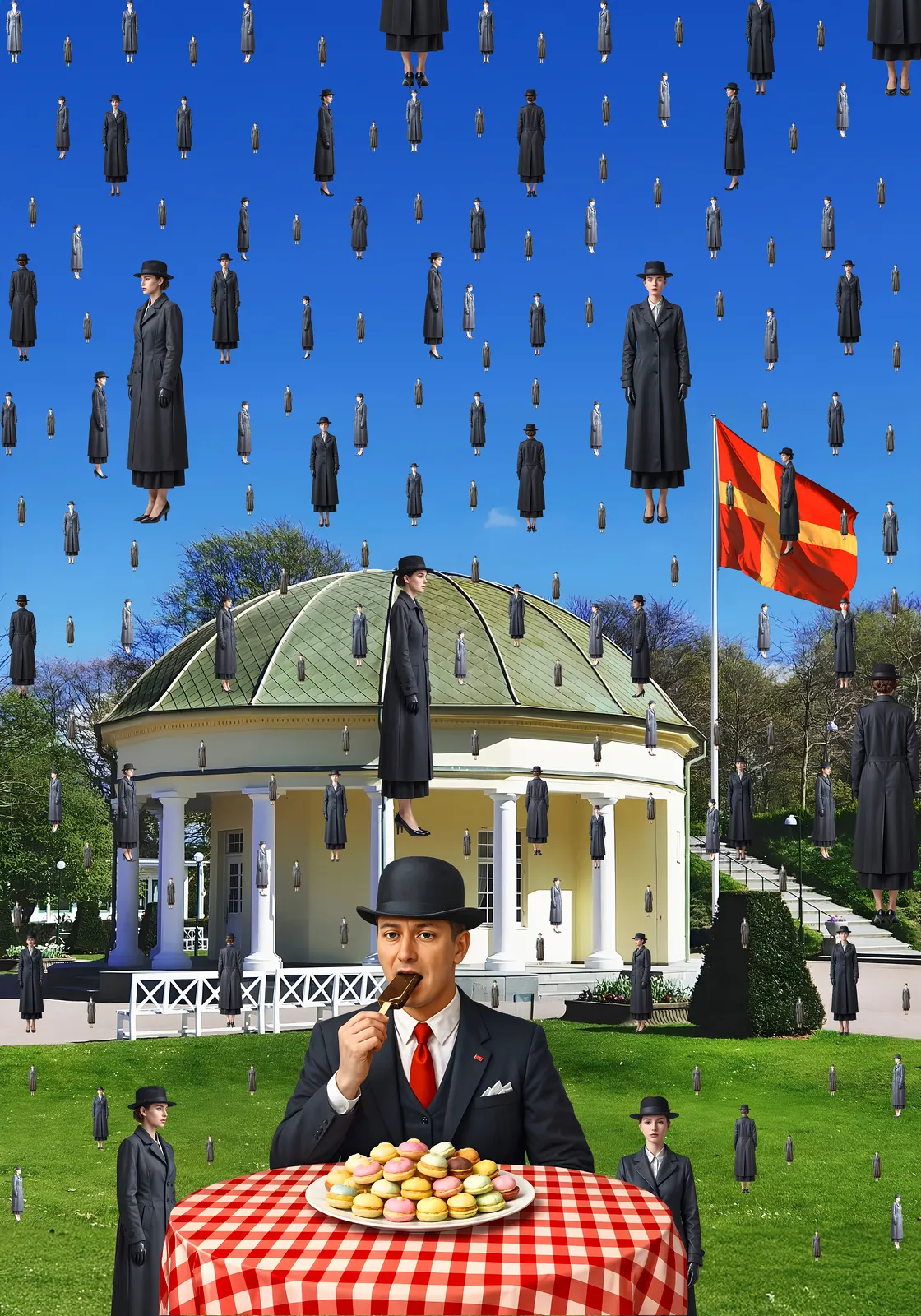
I have created a single, elegant woman, inspired by René Magritte’s surreal realism and early 1950s style, set against a light, sun shower from the blue sky above. The same woman is shown in four full-body views: front, three-quarter, strict side profile, and back. She wears a classy, dark grey to charcoal long overcoat, mid-calf length, with a subtle wool texture, black leather gloves, classic low-heel pumps, and a small, early-1950s felt hat. Her posture is upright, calm, neutral, and slightly distant. She represents all women on earth. Lighting is soft, even studio light with no shadows. The background is Margaretapaviljongen i Malmö i Pildammsparken.
Her body is visible from head to toe, and the colour palette matches Magritte's men: muted greys, cool blues, soft blacks, elegant yet anonymous. This is surreal realism: painterly yet photorealistic textures, delicate brushwork, and a timeless atmosphere.
My inspiration, René Magritte's Golconda (1953), depicts a rain of identical men in bowler hats descending on a bourgeois cityscape. They float, fall, or hover — never quite landing, never quite leaving. The image is at once playful and oppressive. These men are not individuals; they are repetitions. Their hats, coats, postures, and expressions dissolve into a visual system. The sky is filled not with weather but with conformity.
Magritte created Golconda in a Europe rebuilding itself through industrial discipline, bureaucratic order, and social standardisation. The bowler-hatted man was the uniform of the modern citizen: respectable, efficient, anonymous. In that sense, the painting is often read as a critique of capitalist conformity, alienation, and mechanised existence — a bourgeois army without a battlefield, floating in a sky that no longer belongs to nature.
Yet Magritte himself resisted symbolic interpretation. He claimed his images concealed nothing, that they were visible mysteries. Perhaps that is where his power lies: not in moral instruction, but in poetic disturbance. The men do not explain themselves. They exist in impossible repetition.
But something is missing. Half of humanity is absent.
In Summer Rain, that sky finally opens, symbolising a shift in which the sky itself participates in the scene's themes of societal normalisation and inclusion, inviting viewers to reflect on these concepts beyond the visual, much like Magritte's Golconda explores conformity and the role of societal symbols like the bowler hat.
My picture expands Magritte's men by including women, symbolising hope for societal inclusion and inspiring viewers to believe in progress.
Where Magritte's men resemble clerks, your women resemble witnesses.
They fall through a clear blue sky. This sunshower, a meteorological contradiction, gently symbolises invisible societal pressures, encouraging calm reflection on their unseen influence.
Below, a classical pavilion anchors the scene—a reminder of reason, order, and tradition—a national flag flutters, suggesting identity, belonging, and authority. In the foreground, a man sits calmly at a table covered in red-and-white checks, eating pastel-coloured almond pastries with ceremonial indifference. He tastes sweetness while surrounded by falling humanity.
He does not look alarmed. He does not look guilty. He looks accustomed. The rain does not disturb him. It has become background noise.
In Summer Rain, the scene emphasises how societal normalisation shapes our habits and perceptions, fostering awareness and a sense of responsibility in viewers.
Its calm blue hue reassures the audience, fostering a sense of peace and inviting reflection on how societal normalisation quietly influences us all, which is essential for promoting empathy.
They introduce quiet vulnerability, inviting the audience to feel empathy and consider aspects of societal inclusion that go unseen.
They introduce vulnerability without melodrama. Presence without explanation. They do not rebel, yet neither do they disappear. They claim equal gravity in the fall.
In Magritte's painting, the men appear interchangeable. In Summer Rain, repetition becomes multiplication rather than erasure, sparking curiosity about who is seen, remembered, and allowed to fall, which encourages engagement.
My picture is not a feminist correction in the political sense. It is a historical correction in the poetic mind. The painting does not accuse. It observes.
It shows us a world where human beings fall from a cloudless sky, while someone quietly eats sweets, illustrating how conformity becomes habitual and comforted through politeness, inviting reflection.
The title' Summer Rain' matters because summer rain is gentle, warm, and almost welcome. It does not threaten—it refreshes. This metaphorical rain, like societal pressures, is subtle yet persistent, symbolising the ongoing, often unnoticed forces of normalisation that quietly influence us all.
And so does humanity.
Summer Rain is not about despair. It is about recognition. It is about noticing what has been normalised. It is about seeing that the sky can be blue and unjust at the same time.
Magritte asked us to look at the mystery.
You ask us to look at absence—and then to fill it.
And in doing so, you do not contradict Golconda.
You complete it.
Jörgen Thornberg
Sunshower - Sommarregn, 2026
Digital
50 x 70 cm
3 200 kr
Sunshower - Sommarregn
"Sunshower
It rains women
from a sky that pretends to be blue.
No thunder.
No clouds are willing to admit guilt.
Only light.
And falling.
They do not arrive as storms,
not as protests,
not as alarms.
They fall like thoughts
we no longer remember when they were born.
Their coats are heavy with history,
their hats carry shadows of rooms
they were never allowed to own.
Shoes that learned to stand still
even while moving.
They fall without disappearing.
They disappear without dying.
Some look straight ahead,
as if the ground were already familiar.
Some turn their backs on us,
as if even the viewer were a system.
Some fall in profile,
so the whole face is not given away at once.
The summer rain is warm.
It smells of grass, asphalt, memory.
It is a rain that does not wish to harm,
only to remind.
That even what seems light
has weight.
That even what seems ordered
can collapse.
That even what seems chosen
may have been shaped.
They never land violently.
They land slowly inside us.
And the sky remains blue.
As if nothing happened.
As if everything were normal.
But somewhere, in every drop,
there is a voice that does not shout,
but stays.
It rains women.
And the world pretends it is only weather."
Malmö, January 2026
Sunshower - Sommarregn
I have created a single, elegant woman, inspired by René Magritte’s surreal realism and early 1950s style, set against a light, sun shower from the blue sky above. The same woman is shown in four full-body views: front, three-quarter, strict side profile, and back. She wears a classy, dark grey to charcoal long overcoat, mid-calf length, with a subtle wool texture, black leather gloves, classic low-heel pumps, and a small, early-1950s felt hat. Her posture is upright, calm, neutral, and slightly distant. She represents all women on earth. Lighting is soft, even studio light with no shadows. The background is Margaretapaviljongen i Malmö i Pildammsparken.
Her body is visible from head to toe, and the colour palette matches Magritte's men: muted greys, cool blues, soft blacks, elegant yet anonymous. This is surreal realism: painterly yet photorealistic textures, delicate brushwork, and a timeless atmosphere.
My inspiration, René Magritte's Golconda (1953), depicts a rain of identical men in bowler hats descending on a bourgeois cityscape. They float, fall, or hover — never quite landing, never quite leaving. The image is at once playful and oppressive. These men are not individuals; they are repetitions. Their hats, coats, postures, and expressions dissolve into a visual system. The sky is filled not with weather but with conformity.
Magritte created Golconda in a Europe rebuilding itself through industrial discipline, bureaucratic order, and social standardisation. The bowler-hatted man was the uniform of the modern citizen: respectable, efficient, anonymous. In that sense, the painting is often read as a critique of capitalist conformity, alienation, and mechanised existence — a bourgeois army without a battlefield, floating in a sky that no longer belongs to nature.
Yet Magritte himself resisted symbolic interpretation. He claimed his images concealed nothing, that they were visible mysteries. Perhaps that is where his power lies: not in moral instruction, but in poetic disturbance. The men do not explain themselves. They exist in impossible repetition.
But something is missing. Half of humanity is absent.
In Summer Rain, that sky finally opens, symbolising a shift in which the sky itself participates in the scene's themes of societal normalisation and inclusion, inviting viewers to reflect on these concepts beyond the visual, much like Magritte's Golconda explores conformity and the role of societal symbols like the bowler hat.
My picture expands Magritte's men by including women, symbolising hope for societal inclusion and inspiring viewers to believe in progress.
Where Magritte's men resemble clerks, your women resemble witnesses.
They fall through a clear blue sky. This sunshower, a meteorological contradiction, gently symbolises invisible societal pressures, encouraging calm reflection on their unseen influence.
Below, a classical pavilion anchors the scene—a reminder of reason, order, and tradition—a national flag flutters, suggesting identity, belonging, and authority. In the foreground, a man sits calmly at a table covered in red-and-white checks, eating pastel-coloured almond pastries with ceremonial indifference. He tastes sweetness while surrounded by falling humanity.
He does not look alarmed. He does not look guilty. He looks accustomed. The rain does not disturb him. It has become background noise.
In Summer Rain, the scene emphasises how societal normalisation shapes our habits and perceptions, fostering awareness and a sense of responsibility in viewers.
Its calm blue hue reassures the audience, fostering a sense of peace and inviting reflection on how societal normalisation quietly influences us all, which is essential for promoting empathy.
They introduce quiet vulnerability, inviting the audience to feel empathy and consider aspects of societal inclusion that go unseen.
They introduce vulnerability without melodrama. Presence without explanation. They do not rebel, yet neither do they disappear. They claim equal gravity in the fall.
In Magritte's painting, the men appear interchangeable. In Summer Rain, repetition becomes multiplication rather than erasure, sparking curiosity about who is seen, remembered, and allowed to fall, which encourages engagement.
My picture is not a feminist correction in the political sense. It is a historical correction in the poetic mind. The painting does not accuse. It observes.
It shows us a world where human beings fall from a cloudless sky, while someone quietly eats sweets, illustrating how conformity becomes habitual and comforted through politeness, inviting reflection.
The title' Summer Rain' matters because summer rain is gentle, warm, and almost welcome. It does not threaten—it refreshes. This metaphorical rain, like societal pressures, is subtle yet persistent, symbolising the ongoing, often unnoticed forces of normalisation that quietly influence us all.
And so does humanity.
Summer Rain is not about despair. It is about recognition. It is about noticing what has been normalised. It is about seeing that the sky can be blue and unjust at the same time.
Magritte asked us to look at the mystery.
You ask us to look at absence—and then to fill it.
And in doing so, you do not contradict Golconda.
You complete it.
3 200 kr

Jörgen Thornberg
Malmö
Lite om bilder och mig. Translation in English at the end.
Jag är en nyfiken person som ser allt i bilder, även det jag fäster i ord, gärna tillsammans för bakom alla mina bilder finns en berättelse. Till vissa bilder hör en kortare eller längre novell som följer med bilden.
Bilder berättar historier. Jag omges av naturlig skönhet, intressanta människor och historia var jag än går. Jag använder min kamera för att dokumentera världen och blanda det jag ser med vad jag känner för att fånga den dolda magin.
Mina bilder berättar mina historier. Genom mina bilder, tryck och berättelser. Jag bjuder in dig att ta del av dessa berättelser, in i ditt liv och hem och dela min mycket personliga syn på vår värld. Mer än vad ögat ser. Jag tänker i bilder, drömmer och skriver och pratar om dem; följaktligen måste jag också skapa bilder. De blir vad jag ser, inte nödvändigtvis begränsade till verkligheten. Det finns en bild runt varje hörn. Jag hoppas att du kommer att se vad jag såg och gilla det.
Jag är också en skrivande person och till många bilder hör en kortare eller längre essay. Den följer med tavlan, tryckt på fint papper och med en personlig hälsning från mig.
Flertalet bilder startar sin resa i min kamera. Enkelt förklarat beskriver jag bilden jag ser i mitt inre, upplevd eller fantiserad. Bilden uppstår inom mig redan innan jag fått okularet till ögat. På bråkdelen av ett ögonblick ser jag vad jag vill ha och vad som kan göras med bilden. Här skall jag stoppa in en giraff, stålmannen, Titanic eller vad det är min fantasi finner ut. Ännu märkligare är att jag kommer ihåg minnesbilden långt efteråt när det blir tid att skapa verket. Om jag lyckas eller inte, är upp till betraktaren, oftast präglat av en stråk av svart humor – meningen är att man skall bli underhållen. Mina bilder blir ofta en snackis där de hänger.
Jag föredrar bilder som förmedlar ett budskap i flera lager. Vid första anblicken fylld av feel-good, en vacker utsikt, fint väder, solen skiner, blommor på ängen eller vattnet som ligger förrädiskt spegelblankt. I en sådan bild kan jag gömma min egentliga berättelse, mitt förakt för förtryckare och våldsverkare, rasister och fördomsfulla människor - ett gärna återkommande motiv mer eller mindre dolt i det vackra motivet. Jag försöker förena dem i ett gemensamt narrativ.
Bild och formgivning har löpt som en röd tråd genom livet. Fotokonst känns som en värdig final som jag gärna delar med mig.
Min genre är vid som framgår av mina bilder, temat en blandning av pop- och gatukonst i kollage som kan bestå av hundratals lager. Vissa bilder kan ta veckor, andra någon dag innan det är dags att överlämna resultatet till printverkstaden. Fine Art Prints är digitala fotocollage. I dessa kollage sker rivandet, klippandet, pusslandet, målandet, ritandet och sprayningen digitalt. Det jag monterar in kan vara hundratals år gamla bilder som jag omsorgsfullt frilägger så att de ser ut att vara en del av tavlan men också bilder skapade av mig själv efter min egen fantasi. Därefter besöks printstudion och för vissa bilder numrera en limiterad upplaga (oftast 7 exemplar) och signera för hand. Vissa bilder kan köpas i olika format. Det är bara att fråga efter vilka. Gillar man en bild som är 70x100 men inte har plats på väggen, går den kanske att få i 50x70 cm istället. Frågan är fri.
Metoden Giclée eller Fine Art Print som det också kallas är det moderna sättet för framställning av grafisk konst. Villkoret för denna typ av utskrifter är att en högkvalitativ storformatskrivare används med åldersbeständigt färgpigment och konstnärspapper eller i förekommande fall på duk. Pappret som används möter de krav på livslängd som ställs av museer och gallerier. Normalt säljer jag mina bilder oinramade så att den nya ägaren själv kan bestämma hur de skall se ut, med eller utan passepartout färg på ram, med eller utan glas etc..
Under många år ställde jag bara ut på nätet, i valda grupper och på min egen Facebooksida - https://www.facebook.com/jorgen.thornberg.9
Jag finns också på en egen hemsida som tyvärr inte alltid är uppdaterad – https://www.jth.life/ Där kan du också läsa en del av de berättelser som följer med bilden.
UTSTÄLLNINGAR
Luftkastellet, oktober 2022
Konst i Lund, november 2022
Luftkastellet, mars 2023
Engleson Galleri Caroli, april 2023
Hydra, Greece June 2023
Engleson Galleri Caroli, oktober 2023
Toppen, Höllviken december 2023
Luftkastellet, mars 2024
Torups Galleri, mars 2024
Venice, May 2024
Luftkastellet, oktober 2024
Konst i Advent, December 2024
Galleri Engleson, Caroli December 2024
Jäger & Jansson Galleri, april 2025
A bit about pictures and me.
I'm a curious person who sees everything in pictures, even what I express in words, often combining them, for behind all my pictures lies a story. These narratives, some as short as a single image and others as long as a novel, are the heart and soul of my work.
Pictures tell stories. Wherever I go, I'm surrounded by natural beauty, exciting people, and history. I use my camera to document the world and blend what I see with what I feel to capture the hidden magic.
My images tell my stories. Through my pictures, prints, and narratives, I invite you to partake in these stories in your life and home and share my deeply personal perspective of our world. More than meets the eye. I think in pictures, dream, write, and talk about them; consequently, I must create images too. They become what I see, not necessarily confined to reality. There's a picture around every corner. I hope you'll see what I saw and enjoy it.
I'm also a writer, and many images come with a shorter or longer essay. It accompanies the painting, printed on fine paper with my personal greeting.
Many pictures start their journey on my camera. Simply put, I describe the image I see in my mind, experienced or imagined. The image arises within me even before I bring the eyepiece to my eye. In a fraction of a moment, I see what I want and what can be done with the picture. Here, I'll insert a giraffe, Superman, the Titanic, or whatever my imagination conjures up. Even stranger is that I remember the mental image long after it's time to create the work. Whether I succeed is up to the observer, often imbued with a streak of black humour – the aim is to entertain. My pictures usually become a talking point wherever they hang.
I prefer pictures that convey a message in multiple layers. At first glance, they're filled with feel-good vibes, a beautiful view, lovely weather, the sun shining, flowers in the meadow, or the water lying deceptively calm. But beneath this surface beauty, I often conceal a deeper story, a narrative that challenges societal norms or explores the human condition. I invite you to delve into these hidden narratives and discover the layers of meaning within my work.
Picture and design have been a thread running through my life. Photographic art feels like a fitting finale, and I'm happy to share it.
My genre is varied, as seen in my pictures; the theme is a blend of pop and street art in collages that can consist of hundreds of layers. Some images can take weeks, others just a day before it's time to hand over the result to the print workshop. Fine Art Prints are digital photo collages. In these collages, tearing, cutting, puzzling, painting, drawing, and spraying happen digitally. What I insert can be images hundreds of years old that I carefully extract so they appear to be part of the painting, but also images created by myself, now also generated from my imagination. Next, visit the print studio and, for certain images, number a limited edition (usually 7 copies) and sign them by hand. Some images may be available in other formats. Just ask which ones. If you like an image that's 70x100 but doesn't have space on the wall, you might be able to get it in 50x70 cm instead. The question is open.
The Giclée method, or Fine Art Print as it's also called, is the modern way of producing graphic art. This method ensures the highest quality and longevity of the artwork, using a high-quality large-format printer with archival pigment inks and artist paper or, in some cases, canvas. The paper used meets the longevity requirements set by museums and galleries. I sell my pictures unframed, allowing the new owner to personalise their artwork, confident in the lasting value and quality of the piece.
For many years, I only exhibited online, in selected groups, and on my Facebook page - https://www.facebook.com/jorgen.thornberg.9. I also have my website, which unfortunately is not constantly updated - https://www.jth.life/. You can also read some of the stories accompanying the pictures there.
EXHIBITIONS
Luftkastellet, October 2022
Art in Lund, November 2022
Luftkastellet, March 2023
Engleson Gallery Caroli, April 2023
Hydra, Greece June 2023
Engleson Gallery Caroli, October 2023
Toppen, Höllviken December 2023
Luftkastellet, March 2024
Torup Gallery, March 2024
Venice, May 2024
UTSTÄLLNINGAR
Luftkastellet, oktober 2022
Konst i Lund, november 2022
Luftkastellet, mars 2023
Engleson Galleri Caroli, april 2023
Hydra, Greece June 2023
Engleson Galleri Caroli, oktober 2023
Toppen, Höllviken december 2023
Luftkastellet, mars 2024
Torups Galleri, mars 2024
Venice, May 2024
Luftkastellet, October 2024
Konst i Advent, December 2024
Galleri Engleson, Caroli December 2024
Jäger & Jansson Galleri, April 2025
Utbildning
Autodidakt
Medlem i konstnärsförening
Öppna Sinnen
Med i konstrunda
Konstrundan i Skåne
Utställningar
Luftkastellet, October 2022
Art in Lund, November 2022
Luftkastellet, March 2023
Engleson Gallery Caroli, April 2023
Hydra, Greece June 2023
Engleson Gallery Caroli, October 2023
Toppen, Höllviken December 2023
Luftkastellet, March 2024
Torup Gallery, March 2024
Venice, May 2024