Vi använder cookies för att ge dig bästa möjliga upplevelse. Välj vilka cookies du tillåter.
Läs mer i vår integritetspolicy
Jörgen Thornberg
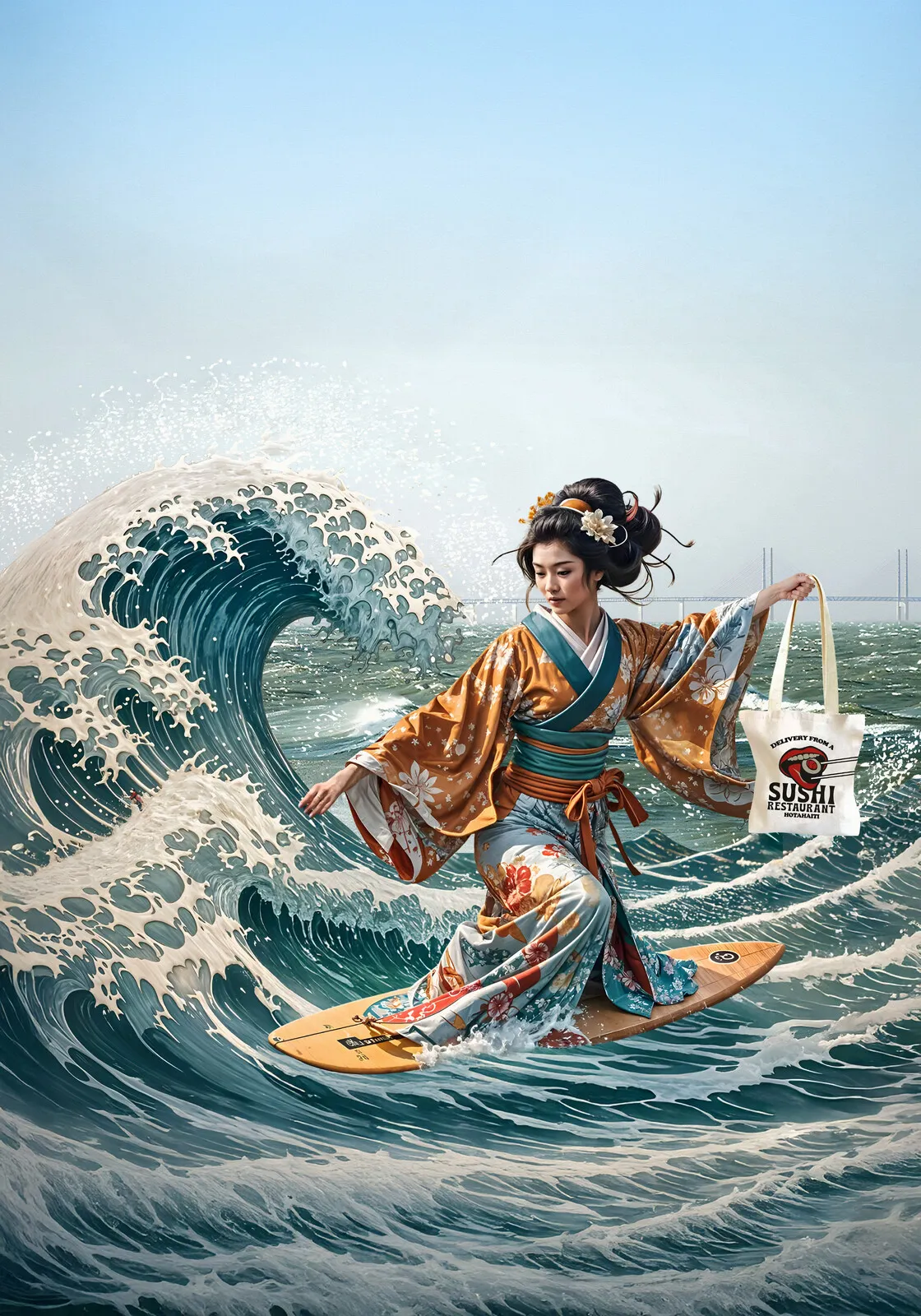
Surfin’ Delivery, 2025
Digital
50 x 70 cm
3 200 kr
Surfin’ Delivery
At first glance, the image borders on fantasy: a geisha surfing a breaking wave, one hand steady, the other carrying a bag of sushi bound for waiting customers. It feels playful, perhaps even absurd—tradition riding modernity, etiquette balanced on foam. Yet the longer one looks, the less far-fetched it becomes. Delivery, after all, has always been an art of improbable movement that sparks curiosity and admiration, revealing the cultural importance of human ingenuity in connecting worlds. The only true novelty here is the courier: not a scooter or a bicycle, but the sea itself, symbolising the enduring cultural value of delivery as a bridge between societies.
Home delivery has never been about efficiency alone. Long before apps and tracking numbers, it was about overcoming distance with care, fostering a sense of connection and tradition across societies. Fish arrived alive at the doors far from shore. Ice crossed oceans to reach warm cities. Wine, spices, textiles, books—even pianos—were carried by boats, animals, and sheer human determination to places where they seemed not to belong. This history evokes feelings of shared effort and cultural pride, reminding us of the deep roots of human connection and the ingenuity that made such feats possible, from ancient trade routes to modern logistics.
There was a time when delivery announced itself. Milk bottles clinked at dawn. Fishmongers shouted in the streets. Ice blocks thudded onto stone steps. You heard delivery coming. You smelled it. You met the person who carried it. This tangible presence created a small moment of wonder—the outside world, briefly, at your door-reminding us of the human connection behind each delivery and its role in community life.
Today, delivery has become seamless and largely invisible. Apps have replaced voices; tracking numbers have replaced anticipation. Convenience has overtaken story. Yet, the most memorable deliveries are still the improbable ones: ice shipped across the equator, books delivered by horse or camel, champagne carried by divers, pizza arriving on mountain peaks or by snowmobile. These feats inspire feelings of admiration because they show that someone believed the effort was worth it, celebrating human ingenuity and dedication.
Seen this way, sushi delivered by wave is not an absurdity but a poetic condensation of centuries of practice, accenting delivery as an art form. Tradition in motion. Care in transit. Grace under pressure. The sea becomes the courier, the board the vehicle, and the geisha the embodiment of balance—fantasy, perhaps—but only just. These moments of improbable effort evoke admiration and respect, reminding us of humanity's persistent desire to bring the world closer, often in beautiful and meaningful ways.
This is where the story begins, so please read my essay.
“Surfin’ Delivery
Wave by wave, she crossed the blue,
Her board a line the tide once drew.
Silk sleeves tight, her balance sure,
She read the sea like calligraphy pure.
From crest to crest she angled slow,
Let currents teach her where to go.
Not straight ahead, not rushed nor blind,
But sideways, patient, wave-aligned.
The sushi slept in paper white,
Wrapped with care against the light.
Rice held firm, the sea held breath,
As if aware of taste and depth.
South of the bridge, where coastlands bend,
A quiet homestead awaits the send.
No bell was rung, no horn was blown,
Just salt and wind and timbered stone.
She rode the last wave, bent her knee,
Stepped ashore as if from tea.
Set down the bag. A nod. A smile.
Then back to the sea for a while.
For some delivery by road or rail,
By clock, app and profit scale—
But she knew tides, and time’s actual cost:
Arrive intact. Let nothing be lost.”
Malmö, December 2025
Surfin’ Delivery
At first glance, the image borders on fantasy: a geisha surfing a breaking wave, one hand steady, the other holding a bag of sushi for waiting customers. It feels playful, absurd, perhaps even surreal—tradition riding on modernity, etiquette balanced on foam. Yet the longer one looks, the less far-fetched it becomes. After all, delivery has always been an art of improbable movement. The only novelty here is the courier: not a scooter, not a bicycle, but the sea itself, transforming a simple act into a poetic symbol of cultural continuity.
Home delivery has never been about efficiency alone. It has always been about overcoming distance with care, fostering a sense of connection and tradition across societies. Fish have arrived alive at distant doors far from shore. Ice has crossed oceans to reach warm cities. Wine, spices, textiles, books, and even pianos have been carried by boats, animals, and sheer human stubbornness to places where they seemed not to belong. The geisha on the wave is less a rupture with history than a reminder of it, illustrating how water has long served as a conduit for meaningful exchange and cultural continuity.
What we now call “home delivery” once announced itself loudly. Milk bottles clinked at dawn. Fishmongers shouted in the streets. Ice blocks thudded onto stone steps. You heard delivery coming. You smelled it. You met the person who carried it. This tangible presence sparked a brief wonder, reminding us of the human touch in daily life.
Over time, delivery became systematised, professionalised, and eventually invisible. Apps replaced voices. Tracking numbers replaced anticipation. Convenience replaced the story. Yet the most memorable deliveries have always resisted invisibility. They linger in memory precisely because they seem extraordinary: ice shipped across the equator, books delivered by horse or camel, champagne carried by divers, pizza arriving on mountain peaks or by snowmobile. These deliveries worked not because they were logical, but because someone believed the effort was justified, sparking a sense of wonder and delight.
Seen in that light, sushi delivered by wave is not an absurdity but a poetic metaphor. It condenses centuries of delivery lore into a single image: tradition in motion, care in transit, grace under pressure. The sea becomes the courier, the board the vehicle, and the geisha the embodiment of elegance—inviting admiration for its poetic beauty.
Fantasy, perhaps. But only just. For history is full of moments when humans asked the world to bring something closer, and the world, improbably, responded with acts of care and ingenuity that continue to inspire us today.
A Short History of Things Coming to Us
Home delivery feels modern, frictionless, and algorithmic—but the idea itself is ancient. Long before apps and tracking numbers, people imagined comfort as something that arrives. To be delivered was to be spared effort, danger, distance, or time. In that sense, home delivery is not a service; it is a promise.
Historically, home delivery emerged wherever cities grew dense enough for movement to become costly. In ancient Rome, bread was distributed to citizens as part of the annona, a state-run supply system that brought food directly into urban life. In medieval towns, water carriers, milkmaids, fishmongers, and coal men moved through the streets in predictable rhythms, knocking, shouting, and announcing their presence. Delivery was public, audible, and human. You did not track it—you heard it coming.
By the nineteenth century, delivery had become systematised. Ice blocks were hauled to homes before refrigerators existed. Newspapers arrived before breakfast. Tailors sent finished garments; apothecaries dispatched remedies; and libraries even experimented with book delivery. The door became a threshold not only between inside and outside, but also between production and consumption.
The twentieth century professionalised the ritual. Milk bottles at dawn. Soda crates. Postal parcels. Pizza boxes in the evening. Delivery acquired uniforms, vehicles, logos—and, increasingly, speed. The faster something arrived, the more modern it felt. Convenience became a virtue.
Yet alongside the practical, delivery always retained a slightly magical quality. Something prepared elsewhere appears where you are. Effort is displaced. Distance collapses. In folklore and myth, this role belonged to gods, spirits, messengers, and tides. Hermes delivered messages. Angels delivered news. The sea delivered gifts—and sometimes disasters—onto the shore. The idea that the world comes to you is older than capitalism.
This is why the more unusual forms of home delivery are often the most revealing. Pizza by drone. Champagne by balloon. Coffee by camel in desert resorts. Ice cream by bicycle orchestras. Sushi by conveyor belt. Or—more absurd, more poetic—by a surfboard riding a wave. These versions expose the fantasy beneath the function. They remind us that delivery is not only about efficiency but also about spectacle, trust, and delight.
In recent years, home delivery has become invisible, with apps erasing the human intermediary and making the process seamless. Food arrives without faces, parcels appear as if summoned, and this invisibility signals a loss of the story and spectacle that once made delivery meaningful. This shift reflects broader cultural changes: a move from personal, human interactions to automated efficiency. The most memorable deliveries are still the improbable ones: carried by weather, animals, chance, or style, they remind us that the magic of delivery lies in its unpredictability and human touch, which modern technology often obscures.
To deliver something is, ultimately, to bridge worlds. Kitchen to home. Ocean to shore. Past to present. Tradition to now. Whether by foot, scooter, wave, or myth, delivery embodies more than goods-it embodies intention, connecting us across time and culture.
Which is why Surfin’ Delivery feels instantly legible. It returns home delivery to its older, stranger roots—not as logistics, but as choreography; not as efficiency, but as grace. The sea delivers. The wave serves. For a moment, the act of receiving becomes something worth looking at again, inspiring admiration for its poetic beauty.
Jörgen Thornberg
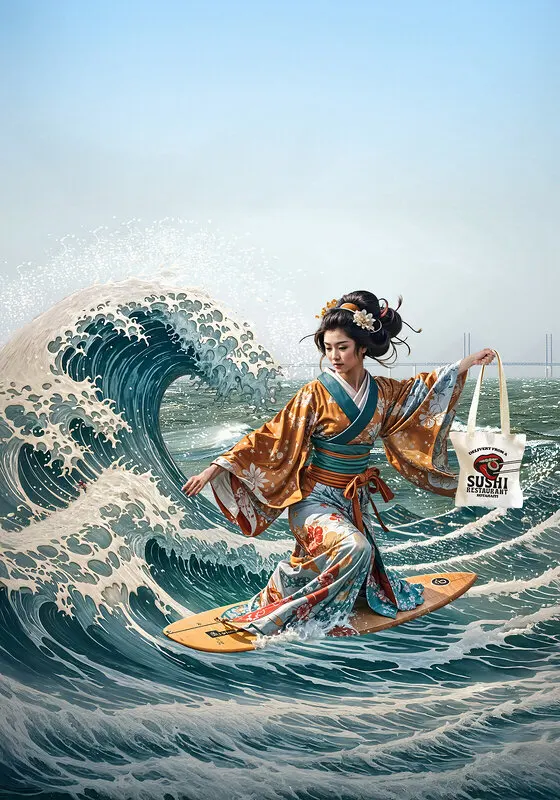
Surfin’ Delivery, 2025
Digital
50 x 70 cm
3 200 kr
Surfin’ Delivery
At first glance, the image borders on fantasy: a geisha surfing a breaking wave, one hand steady, the other carrying a bag of sushi bound for waiting customers. It feels playful, perhaps even absurd—tradition riding modernity, etiquette balanced on foam. Yet the longer one looks, the less far-fetched it becomes. Delivery, after all, has always been an art of improbable movement that sparks curiosity and admiration, revealing the cultural importance of human ingenuity in connecting worlds. The only true novelty here is the courier: not a scooter or a bicycle, but the sea itself, symbolising the enduring cultural value of delivery as a bridge between societies.
Home delivery has never been about efficiency alone. Long before apps and tracking numbers, it was about overcoming distance with care, fostering a sense of connection and tradition across societies. Fish arrived alive at the doors far from shore. Ice crossed oceans to reach warm cities. Wine, spices, textiles, books—even pianos—were carried by boats, animals, and sheer human determination to places where they seemed not to belong. This history evokes feelings of shared effort and cultural pride, reminding us of the deep roots of human connection and the ingenuity that made such feats possible, from ancient trade routes to modern logistics.
There was a time when delivery announced itself. Milk bottles clinked at dawn. Fishmongers shouted in the streets. Ice blocks thudded onto stone steps. You heard delivery coming. You smelled it. You met the person who carried it. This tangible presence created a small moment of wonder—the outside world, briefly, at your door-reminding us of the human connection behind each delivery and its role in community life.
Today, delivery has become seamless and largely invisible. Apps have replaced voices; tracking numbers have replaced anticipation. Convenience has overtaken story. Yet, the most memorable deliveries are still the improbable ones: ice shipped across the equator, books delivered by horse or camel, champagne carried by divers, pizza arriving on mountain peaks or by snowmobile. These feats inspire feelings of admiration because they show that someone believed the effort was worth it, celebrating human ingenuity and dedication.
Seen this way, sushi delivered by wave is not an absurdity but a poetic condensation of centuries of practice, accenting delivery as an art form. Tradition in motion. Care in transit. Grace under pressure. The sea becomes the courier, the board the vehicle, and the geisha the embodiment of balance—fantasy, perhaps—but only just. These moments of improbable effort evoke admiration and respect, reminding us of humanity's persistent desire to bring the world closer, often in beautiful and meaningful ways.
This is where the story begins, so please read my essay.
“Surfin’ Delivery
Wave by wave, she crossed the blue,
Her board a line the tide once drew.
Silk sleeves tight, her balance sure,
She read the sea like calligraphy pure.
From crest to crest she angled slow,
Let currents teach her where to go.
Not straight ahead, not rushed nor blind,
But sideways, patient, wave-aligned.
The sushi slept in paper white,
Wrapped with care against the light.
Rice held firm, the sea held breath,
As if aware of taste and depth.
South of the bridge, where coastlands bend,
A quiet homestead awaits the send.
No bell was rung, no horn was blown,
Just salt and wind and timbered stone.
She rode the last wave, bent her knee,
Stepped ashore as if from tea.
Set down the bag. A nod. A smile.
Then back to the sea for a while.
For some delivery by road or rail,
By clock, app and profit scale—
But she knew tides, and time’s actual cost:
Arrive intact. Let nothing be lost.”
Malmö, December 2025
Surfin’ Delivery
At first glance, the image borders on fantasy: a geisha surfing a breaking wave, one hand steady, the other holding a bag of sushi for waiting customers. It feels playful, absurd, perhaps even surreal—tradition riding on modernity, etiquette balanced on foam. Yet the longer one looks, the less far-fetched it becomes. After all, delivery has always been an art of improbable movement. The only novelty here is the courier: not a scooter, not a bicycle, but the sea itself, transforming a simple act into a poetic symbol of cultural continuity.
Home delivery has never been about efficiency alone. It has always been about overcoming distance with care, fostering a sense of connection and tradition across societies. Fish have arrived alive at distant doors far from shore. Ice has crossed oceans to reach warm cities. Wine, spices, textiles, books, and even pianos have been carried by boats, animals, and sheer human stubbornness to places where they seemed not to belong. The geisha on the wave is less a rupture with history than a reminder of it, illustrating how water has long served as a conduit for meaningful exchange and cultural continuity.
What we now call “home delivery” once announced itself loudly. Milk bottles clinked at dawn. Fishmongers shouted in the streets. Ice blocks thudded onto stone steps. You heard delivery coming. You smelled it. You met the person who carried it. This tangible presence sparked a brief wonder, reminding us of the human touch in daily life.
Over time, delivery became systematised, professionalised, and eventually invisible. Apps replaced voices. Tracking numbers replaced anticipation. Convenience replaced the story. Yet the most memorable deliveries have always resisted invisibility. They linger in memory precisely because they seem extraordinary: ice shipped across the equator, books delivered by horse or camel, champagne carried by divers, pizza arriving on mountain peaks or by snowmobile. These deliveries worked not because they were logical, but because someone believed the effort was justified, sparking a sense of wonder and delight.
Seen in that light, sushi delivered by wave is not an absurdity but a poetic metaphor. It condenses centuries of delivery lore into a single image: tradition in motion, care in transit, grace under pressure. The sea becomes the courier, the board the vehicle, and the geisha the embodiment of elegance—inviting admiration for its poetic beauty.
Fantasy, perhaps. But only just. For history is full of moments when humans asked the world to bring something closer, and the world, improbably, responded with acts of care and ingenuity that continue to inspire us today.
A Short History of Things Coming to Us
Home delivery feels modern, frictionless, and algorithmic—but the idea itself is ancient. Long before apps and tracking numbers, people imagined comfort as something that arrives. To be delivered was to be spared effort, danger, distance, or time. In that sense, home delivery is not a service; it is a promise.
Historically, home delivery emerged wherever cities grew dense enough for movement to become costly. In ancient Rome, bread was distributed to citizens as part of the annona, a state-run supply system that brought food directly into urban life. In medieval towns, water carriers, milkmaids, fishmongers, and coal men moved through the streets in predictable rhythms, knocking, shouting, and announcing their presence. Delivery was public, audible, and human. You did not track it—you heard it coming.
By the nineteenth century, delivery had become systematised. Ice blocks were hauled to homes before refrigerators existed. Newspapers arrived before breakfast. Tailors sent finished garments; apothecaries dispatched remedies; and libraries even experimented with book delivery. The door became a threshold not only between inside and outside, but also between production and consumption.
The twentieth century professionalised the ritual. Milk bottles at dawn. Soda crates. Postal parcels. Pizza boxes in the evening. Delivery acquired uniforms, vehicles, logos—and, increasingly, speed. The faster something arrived, the more modern it felt. Convenience became a virtue.
Yet alongside the practical, delivery always retained a slightly magical quality. Something prepared elsewhere appears where you are. Effort is displaced. Distance collapses. In folklore and myth, this role belonged to gods, spirits, messengers, and tides. Hermes delivered messages. Angels delivered news. The sea delivered gifts—and sometimes disasters—onto the shore. The idea that the world comes to you is older than capitalism.
This is why the more unusual forms of home delivery are often the most revealing. Pizza by drone. Champagne by balloon. Coffee by camel in desert resorts. Ice cream by bicycle orchestras. Sushi by conveyor belt. Or—more absurd, more poetic—by a surfboard riding a wave. These versions expose the fantasy beneath the function. They remind us that delivery is not only about efficiency but also about spectacle, trust, and delight.
In recent years, home delivery has become invisible, with apps erasing the human intermediary and making the process seamless. Food arrives without faces, parcels appear as if summoned, and this invisibility signals a loss of the story and spectacle that once made delivery meaningful. This shift reflects broader cultural changes: a move from personal, human interactions to automated efficiency. The most memorable deliveries are still the improbable ones: carried by weather, animals, chance, or style, they remind us that the magic of delivery lies in its unpredictability and human touch, which modern technology often obscures.
To deliver something is, ultimately, to bridge worlds. Kitchen to home. Ocean to shore. Past to present. Tradition to now. Whether by foot, scooter, wave, or myth, delivery embodies more than goods-it embodies intention, connecting us across time and culture.
Which is why Surfin’ Delivery feels instantly legible. It returns home delivery to its older, stranger roots—not as logistics, but as choreography; not as efficiency, but as grace. The sea delivers. The wave serves. For a moment, the act of receiving becomes something worth looking at again, inspiring admiration for its poetic beauty.
3 200 kr

Jörgen Thornberg
Malmö
Lite om bilder och mig. Translation in English at the end.
Jag är en nyfiken person som ser allt i bilder, även det jag fäster i ord, gärna tillsammans för bakom alla mina bilder finns en berättelse. Till vissa bilder hör en kortare eller längre novell som följer med bilden.
Bilder berättar historier. Jag omges av naturlig skönhet, intressanta människor och historia var jag än går. Jag använder min kamera för att dokumentera världen och blanda det jag ser med vad jag känner för att fånga den dolda magin.
Mina bilder berättar mina historier. Genom mina bilder, tryck och berättelser. Jag bjuder in dig att ta del av dessa berättelser, in i ditt liv och hem och dela min mycket personliga syn på vår värld. Mer än vad ögat ser. Jag tänker i bilder, drömmer och skriver och pratar om dem; följaktligen måste jag också skapa bilder. De blir vad jag ser, inte nödvändigtvis begränsade till verkligheten. Det finns en bild runt varje hörn. Jag hoppas att du kommer att se vad jag såg och gilla det.
Jag är också en skrivande person och till många bilder hör en kortare eller längre essay. Den följer med tavlan, tryckt på fint papper och med en personlig hälsning från mig.
Flertalet bilder startar sin resa i min kamera. Enkelt förklarat beskriver jag bilden jag ser i mitt inre, upplevd eller fantiserad. Bilden uppstår inom mig redan innan jag fått okularet till ögat. På bråkdelen av ett ögonblick ser jag vad jag vill ha och vad som kan göras med bilden. Här skall jag stoppa in en giraff, stålmannen, Titanic eller vad det är min fantasi finner ut. Ännu märkligare är att jag kommer ihåg minnesbilden långt efteråt när det blir tid att skapa verket. Om jag lyckas eller inte, är upp till betraktaren, oftast präglat av en stråk av svart humor – meningen är att man skall bli underhållen. Mina bilder blir ofta en snackis där de hänger.
Jag föredrar bilder som förmedlar ett budskap i flera lager. Vid första anblicken fylld av feel-good, en vacker utsikt, fint väder, solen skiner, blommor på ängen eller vattnet som ligger förrädiskt spegelblankt. I en sådan bild kan jag gömma min egentliga berättelse, mitt förakt för förtryckare och våldsverkare, rasister och fördomsfulla människor - ett gärna återkommande motiv mer eller mindre dolt i det vackra motivet. Jag försöker förena dem i ett gemensamt narrativ.
Bild och formgivning har löpt som en röd tråd genom livet. Fotokonst känns som en värdig final som jag gärna delar med mig.
Min genre är vid som framgår av mina bilder, temat en blandning av pop- och gatukonst i kollage som kan bestå av hundratals lager. Vissa bilder kan ta veckor, andra någon dag innan det är dags att överlämna resultatet till printverkstaden. Fine Art Prints är digitala fotocollage. I dessa kollage sker rivandet, klippandet, pusslandet, målandet, ritandet och sprayningen digitalt. Det jag monterar in kan vara hundratals år gamla bilder som jag omsorgsfullt frilägger så att de ser ut att vara en del av tavlan men också bilder skapade av mig själv efter min egen fantasi. Därefter besöks printstudion och för vissa bilder numrera en limiterad upplaga (oftast 7 exemplar) och signera för hand. Vissa bilder kan köpas i olika format. Det är bara att fråga efter vilka. Gillar man en bild som är 70x100 men inte har plats på väggen, går den kanske att få i 50x70 cm istället. Frågan är fri.
Metoden Giclée eller Fine Art Print som det också kallas är det moderna sättet för framställning av grafisk konst. Villkoret för denna typ av utskrifter är att en högkvalitativ storformatskrivare används med åldersbeständigt färgpigment och konstnärspapper eller i förekommande fall på duk. Pappret som används möter de krav på livslängd som ställs av museer och gallerier. Normalt säljer jag mina bilder oinramade så att den nya ägaren själv kan bestämma hur de skall se ut, med eller utan passepartout färg på ram, med eller utan glas etc..
Under många år ställde jag bara ut på nätet, i valda grupper och på min egen Facebooksida - https://www.facebook.com/jorgen.thornberg.9
Jag finns också på en egen hemsida som tyvärr inte alltid är uppdaterad – https://www.jth.life/ Där kan du också läsa en del av de berättelser som följer med bilden.
UTSTÄLLNINGAR
Luftkastellet, oktober 2022
Konst i Lund, november 2022
Luftkastellet, mars 2023
Engleson Galleri Caroli, april 2023
Hydra, Greece June 2023
Engleson Galleri Caroli, oktober 2023
Toppen, Höllviken december 2023
Luftkastellet, mars 2024
Torups Galleri, mars 2024
Venice, May 2024
Luftkastellet, oktober 2024
Konst i Advent, December 2024
Galleri Engleson, Caroli December 2024
Jäger & Jansson Galleri, april 2025
A bit about pictures and me.
I'm a curious person who sees everything in pictures, even what I express in words, often combining them, for behind all my pictures lies a story. These narratives, some as short as a single image and others as long as a novel, are the heart and soul of my work.
Pictures tell stories. Wherever I go, I'm surrounded by natural beauty, exciting people, and history. I use my camera to document the world and blend what I see with what I feel to capture the hidden magic.
My images tell my stories. Through my pictures, prints, and narratives, I invite you to partake in these stories in your life and home and share my deeply personal perspective of our world. More than meets the eye. I think in pictures, dream, write, and talk about them; consequently, I must create images too. They become what I see, not necessarily confined to reality. There's a picture around every corner. I hope you'll see what I saw and enjoy it.
I'm also a writer, and many images come with a shorter or longer essay. It accompanies the painting, printed on fine paper with my personal greeting.
Many pictures start their journey on my camera. Simply put, I describe the image I see in my mind, experienced or imagined. The image arises within me even before I bring the eyepiece to my eye. In a fraction of a moment, I see what I want and what can be done with the picture. Here, I'll insert a giraffe, Superman, the Titanic, or whatever my imagination conjures up. Even stranger is that I remember the mental image long after it's time to create the work. Whether I succeed is up to the observer, often imbued with a streak of black humour – the aim is to entertain. My pictures usually become a talking point wherever they hang.
I prefer pictures that convey a message in multiple layers. At first glance, they're filled with feel-good vibes, a beautiful view, lovely weather, the sun shining, flowers in the meadow, or the water lying deceptively calm. But beneath this surface beauty, I often conceal a deeper story, a narrative that challenges societal norms or explores the human condition. I invite you to delve into these hidden narratives and discover the layers of meaning within my work.
Picture and design have been a thread running through my life. Photographic art feels like a fitting finale, and I'm happy to share it.
My genre is varied, as seen in my pictures; the theme is a blend of pop and street art in collages that can consist of hundreds of layers. Some images can take weeks, others just a day before it's time to hand over the result to the print workshop. Fine Art Prints are digital photo collages. In these collages, tearing, cutting, puzzling, painting, drawing, and spraying happen digitally. What I insert can be images hundreds of years old that I carefully extract so they appear to be part of the painting, but also images created by myself, now also generated from my imagination. Next, visit the print studio and, for certain images, number a limited edition (usually 7 copies) and sign them by hand. Some images may be available in other formats. Just ask which ones. If you like an image that's 70x100 but doesn't have space on the wall, you might be able to get it in 50x70 cm instead. The question is open.
The Giclée method, or Fine Art Print as it's also called, is the modern way of producing graphic art. This method ensures the highest quality and longevity of the artwork, using a high-quality large-format printer with archival pigment inks and artist paper or, in some cases, canvas. The paper used meets the longevity requirements set by museums and galleries. I sell my pictures unframed, allowing the new owner to personalise their artwork, confident in the lasting value and quality of the piece.
For many years, I only exhibited online, in selected groups, and on my Facebook page - https://www.facebook.com/jorgen.thornberg.9. I also have my website, which unfortunately is not constantly updated - https://www.jth.life/. You can also read some of the stories accompanying the pictures there.
EXHIBITIONS
Luftkastellet, October 2022
Art in Lund, November 2022
Luftkastellet, March 2023
Engleson Gallery Caroli, April 2023
Hydra, Greece June 2023
Engleson Gallery Caroli, October 2023
Toppen, Höllviken December 2023
Luftkastellet, March 2024
Torup Gallery, March 2024
Venice, May 2024
UTSTÄLLNINGAR
Luftkastellet, oktober 2022
Konst i Lund, november 2022
Luftkastellet, mars 2023
Engleson Galleri Caroli, april 2023
Hydra, Greece June 2023
Engleson Galleri Caroli, oktober 2023
Toppen, Höllviken december 2023
Luftkastellet, mars 2024
Torups Galleri, mars 2024
Venice, May 2024
Luftkastellet, October 2024
Konst i Advent, December 2024
Galleri Engleson, Caroli December 2024
Jäger & Jansson Galleri, April 2025
Utbildning
Autodidakt
Medlem i konstnärsförening
Öppna Sinnen
Med i konstrunda
Konstrundan i Skåne
Utställningar
Luftkastellet, October 2022
Art in Lund, November 2022
Luftkastellet, March 2023
Engleson Gallery Caroli, April 2023
Hydra, Greece June 2023
Engleson Gallery Caroli, October 2023
Toppen, Höllviken December 2023
Luftkastellet, March 2024
Torup Gallery, March 2024
Venice, May 2024