Vi använder cookies för att ge dig bästa möjliga upplevelse. Välj vilka cookies du tillåter.
Läs mer i vår integritetspolicy
Jörgen Thornberg
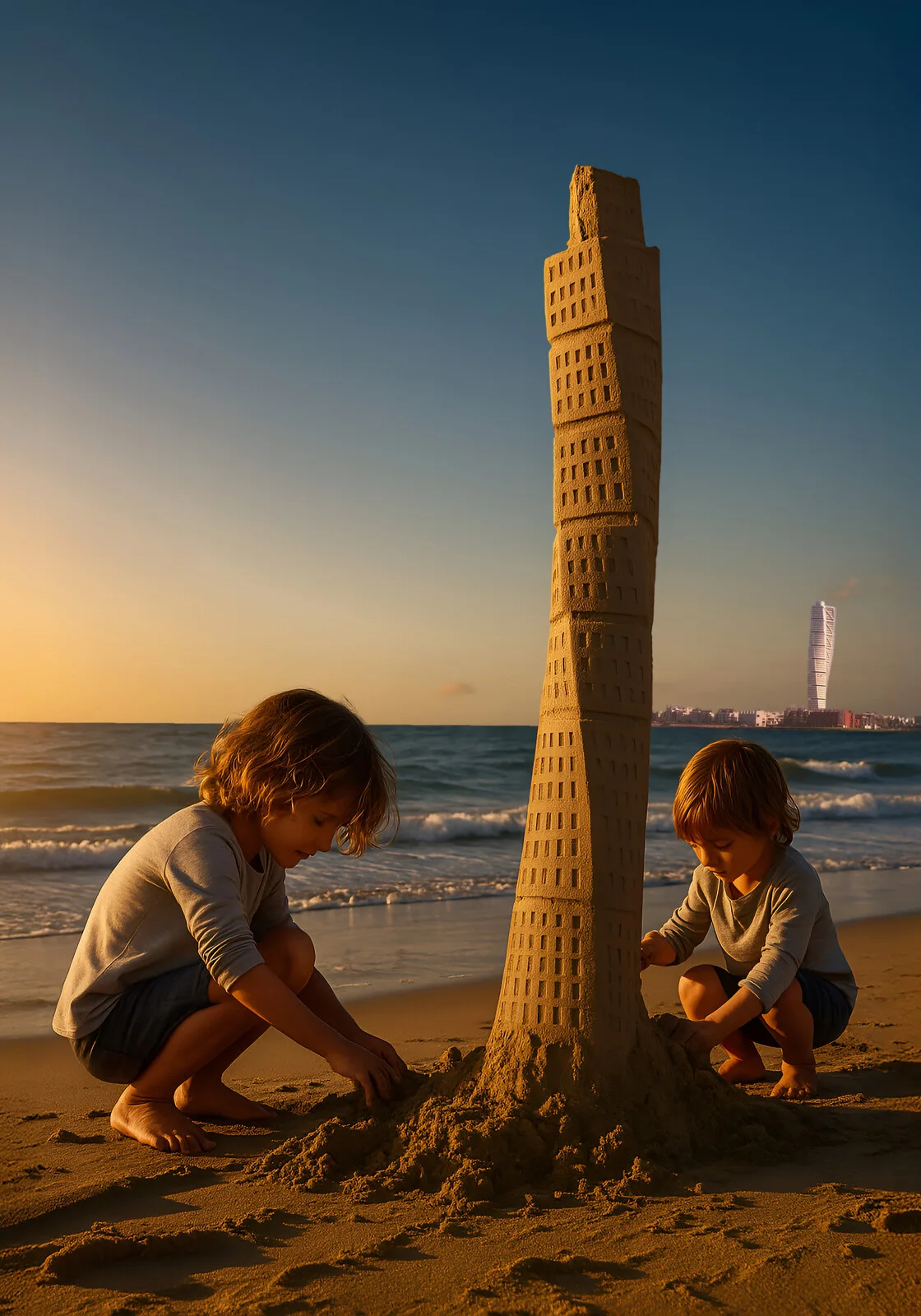
Turning Torso built on Sand, 2025
Digital
50 x 70 cm
3 200 kr
Turning Torso built on Sand
Evening light leans in from the west, and two boys kneel at the tide line with wet hands and solemn purpose. Their bucket is a plumb bob, their fingers a trowel; grain by grain, they build today’s castle—not a keep from fairy tales, but Turning Torso itself, reborn in sand where a real shoreline once receded before Kockums pushed the city out into the sea. In the distance, the Øresund Bridge stretches across the horizon like a drawn breath; in front of them, the moat absorbs the next small wave.
Children elsewhere might imagine Hogwarts Castle, the school that teaches miracles. Here in Malmö, the miracle already stands a kilometre away, twisting skyward in glass and steel—so they build the thing that has come true. For an hour, it is perfect: a helical wall, a window scored with a thumbnail, a base tamped down enough to believe in. Then the water alters, as water always does. What remains is not loss but a lesson: that we make, unmake, and make again—learning the shore by heart. And in this cycle of creation and dissolution, the children's learning process, their ability to adapt and grow, becomes a powerful metaphor for the impermanence of life and the resilience of the human spirit.
“Sandcastle
The wave arrives like a contract.
No one signed.
And yet it binds.
The wind reads it aloud,
the rain adds its crooked signature.
The child works in backlight,
hands as warm moulds,
the bucket’s shadow a plumb and rule.
From grit and dream, a line is drawn across the shore.
A tower rises, twists,
a window is scored with a thumbnail,
a moat drinks its first wave
and asks for another.
The elements don’t resist—
They teach.
Each fallen bridge
schools the hand in weight, wet, time.
Sometimes a gust lifts the plan whole
and sets it back as sand.
Sometimes the ocean comes close and whispers:
Not like this, not yet.
We are like that—
We build on shaky ground,
stubbornness for mortar,
imagination for scaffolding.
And when the brim is blurred
and the beach lies smooth as memory,
a blueprint remains in the body:
Next time we’ll start further in,
pack the layers tighter,
close enough to the water to glitter,
far enough to stand for a while.”
Malmö. October 2025
Turning Torso built on Sand - Sandcastles — From Play to Monument
In the picture, two boys are building today’s sandcastle: an iconic structure, in fact, raised from the very shore where a sandy beach once stretched before Kockums moved its shipyard out into the Øresund. Children today might well choose Hogwarts School of Witchcraft and Wizardry, the magical boarding school of the Harry Potter books. But if you are born in Malmö, perhaps the truly magical thing is the Turning Torso, standing just a kilometre from Ribersborg’s strand—a real tower that already looks like a dream.
The history of the sandcastle is both more recent and more revealing than we often think. People have played on beaches for as long as beaches have existed; what we cannot demonstrate through reliable sources is the classic castle design—turrets, curtain walls, moats—that appeared in ancient times. Archaeology and historical imagery show children playing in the sand, but not the “castle iconography.” The castle aspect is a modern invention. It belongs to the era of railways, postcards, and holidays. This historical analysis of sandcastle culture provides a fascinating insight into the evolution of this beloved pastime.
From the mid-nineteenth century, rail links suddenly made coastal resorts in Britain, France, Germany, Sweden, and the United States accessible. A commercial seaside culture flourished—promenades, bandstands, striped tents, and a rising trade in bucket-and-spade sets. Department-store catalogues from the 1870s–1890s show these tools becoming standard children’s items, and by the late 1800s and early 1900s, the first photographs and postcards clearly showing sandcastles—with towers, walls, and moats—appear from European resorts and the American East Coast. This period can be described as the 'grammar of summer', a time when the elements of water, sand, a container, a mould, and a child came together to form the basis of sandcastle building.
At the turn of the twentieth century, the pastime discovered its practitioners. Newspapers and picture postcards record “professional sand men” on popular beaches—especially Atlantic City, Coney Island, and other New Jersey/New York beaches—creating elaborate figurative works for coins and crowds: biblical scenes, portraits, and even “palaces.” These 'professional sand men' were skilled artisans who played a significant role in the evolution of sandcastle building, transforming it from a simple children's play to a form of public entertainment. Similar scenes are documented in British and French resorts. Municipalities sometimes imposed restrictions due to congestion and safety concerns, indirectly confirming that the activity was already widespread. By around 1900, sandcastle and sand-sculpture culture was firmly established: children’s play for some, public entertainment for many.
Two techniques were developed in parallel, each contributing to the evolution of the sandcastle. The first is the classic castle: compacted sand shaped with moulds to form walls and bastions, a moat channelling the tide. The second is the drip castle: very wet sand trickled into spires and buttresses, architecture that seems to grow on its own. Early photographs and press notes in Europe and the U.S. show both styles thriving. The tools were modest—buckets, spades, simple moulds; later, small trowels and knives. The principles remain the same today: compaction, moisture control, and layering. This evolution of techniques has transformed sandcastle building from a simple pastime to a sophisticated art form.
After the Second World War, seaside tourism revived, bringing with it local sandcastle contests—municipal festivals and charity events across Europe, North America, and Japan. In the 1970s and 80s, these competitions became more formalised: rules restricted materials to sand and water (no binders), juries awarded prizes, and teams were formed with various skills. Borrowing methods from masonry and concrete work—shuttering, tamping, lifting forms in stages—specialists expanded the scale and precision of what sand could achieve.
From the 1990s onwards, a significant shift in the practice of sandcastle building occurred, marking what can be considered the 'true era of sand sculpture'. This period saw the emergence of international festivals and world championships dedicated to the art of sandcastle building. These events, which now occur regularly in many locations, focus on technical precision and artistic expression, elevating sandcastle building from a simple pastime to a sophisticated art form. The technical core of sandcastle building remains consistent: you need angular grains (broken quartz binds better than rounded beach sand), systematic layer-by-layer compaction, and precise water content. Work forms are stacked like a wedding cake, filled and pounded, then removed to reveal sharp verticals. A good team reads the shore as engineers read a blueprint—considering sun, wind, evaporation, and the temperament of that day’s sand.
Aesthetically, the field expanded from castles to grand figurative works—myth, cinema, history—yet the castle still represents the people’s form, especially for children. The word has also become a metaphor. In English, we speak of projects “built on sand” (weak foundations), “houses of cards” (fragile structures), or “sandcastles at high tide” (beautiful, doomed). This metaphor offers a warning but also an ethic: create something knowing it won’t last, and learn the shore while you can. This deeper metaphorical meaning of sandcastles, as symbols of impermanence and creativity, enriches our understanding of this art form.
Sweden’s contribution to the art of sandcastle building is deeply rooted in its history, evident in images and local newspapers. With the rise of seaside bathing and bathhouses—Ribersborg in Malmö, Mölle, Varberg, Halmstad—bucket-and-spade play is already visible in early-1900s photographs and postcards. After the war, municipal summer events in many towns included organised building days; the sandcastle became a staple in Swedish culture as both childhood icon and moral lesson—something beautiful and fleeting, sometimes “built on sand,” but worth creating nonetheless. This rich historical background of sandcastle building in Sweden helps us connect to local traditions and understand the cultural importance of this art form.
The scale, however, did not end with childhood. Sand eventually grew enormous. As of this writing, the tallest sandcastle recognised by Guinness World Records measures 21.16 metres—built in Blokhus, Denmark (2 July 2021). Guinness also records the tallest sand sculpture (not necessarily a “castle”) at 22.43 metres, created for the Zhoushan festival in China (2010). Meanwhile, the longest sand sculpture stretched for 27.3 kilometres along Schaabe beach on Rügen, Germany, involving about 11,000 volunteers (2011). Even at these scales, the same principles apply: angular sand, compaction, water control; at most, a sacrificial skin to withstand weather for a season—a miracle—but one that remains legible.
Seen from Malmö, the story takes on local importance. Ribersborg’s beach is not just a pretty postcard view; it is a layered palimpsest. Where the boys now stamp and pat their Turning Torso into shape, the historic shoreline once extended before Kockums pushed the working city further into the sea. Today, the actual tower rises like a helix of glass and steel behind them, while the sand-Torso lifts into the golden air—ephemeral, precise, and sincere. The boys are using the same techniques that created the modern discipline: a tapered base, layered compaction, a patient edge-cut to suggest windows, and a steady hand reading the grit’s cohesion. Their structure will fall—perhaps tonight, perhaps with the next tide. But for now, it stands as both model and memory: a child’s replay of a city’s transformation.
If we widen the lens, the sandcastle reveals what most seaside stories show us: that culture is a choreography between time and touch. The railway attracts crowds; the postcard captures a moment; the photograph takes us back to it. Professionals shaped saints and palaces for coins; engineers documented formwork and moisture; festival juries crowned the winners. And the essential triad still refuses to change: sand, water, hand. The castle belongs to the nineteenth century; the impulse belongs to everyone who has ever drawn a line on the shoreline and asked the ocean to wait.
So the boys at Ribersborg choose Turning Torso over Hogwarts. It’s a lovely decision. Hogwarts is a fantasy; Turning Torso is the realisation of a fantasy—one that also began, in a sense, on sand. Their tower will be gone by morning; the real one will continue to catch the light above Västra Hamnen. Between them runs the entire history of the sandcastle: from play to performance to profession; from postcards to records; from the simple joy of a bucket’s lift to the tensile logic of a 20-metre wall.
And if the tide has the final say, that too is part of the pattern. The sea, our patient teacher, refines our ambitions. It teaches us about foundation, timing, and grace. We build until the water clarifies what will remain. Then we start afresh—wiser with the sand, gentler with the touch, and still, despite ourselves, captivated by a tower rising where a wave is already approaching.
Sandcastles at High Tide — On Fragile Plans and Beautiful Failures
We build because we must. Children press wet sand into turrets and crenellations, engineers draw lines across the sea, and politicians form coalitions from smiles and handshakes. The shapes differ, the impulse remains the same: to give form to a wish before the tide returns. In English, the word that bears this dual life of beauty and ruin is sandcastle—a toy, a metaphor, a warning. It's a reminder that the fragility of our plans is not a failure, but a natural part of the process.
A sandcastle is charming precisely because it is fleeting. You can see the fingerprints in its walls, the shimmer of shells set like windows, the moat already sipping the next wave. As a metaphor, it maintains that tenderness but introduces a new edge: a project built on sand—beautiful, visible, and doomed. The phrase belongs to a family of fragilities. A house of cards will collapse with a single breath; castles in the air require no storm at all, only gravity and time. Each idiom highlights a different flaw: building on sand undermines the foundation; a house of cards flaws the structure; castles in the air challenge the premise. Together, they illustrate the ways we falter.
Journalists turn to the image when markets overheat: a sandcastle economy, shimmering in the late sun, built on credit and wishful thinking. This metaphor refers to an economy that appears strong and prosperous, but is actually built on unstable foundations, much like a sandcastle that will crumble when the tide comes in. Urban planners mumble about sandcastle promises that disintegrate in procurement. In diplomacy, a sandcastle coalition holds until the first real wave: an election, a scandal, a sudden shift of wind. And in personal life, we also recognise the feeling—the relationship is on fragile ground. This grand life plan looks perfect on paper, but falls apart the moment reality touches its edges.
The strongest form of the metaphor involves time and pressure: building sandcastles at high tide. Here, the critique is not only of what is built but also of the timing and hubris involved. You can pile the walls higher, fetch more buckets, plead with the ocean; the outcome remains the same. The work is washed away not because it lacked beauty, but because it disregarded the conditions of the shore.
Yet, the metaphor is not solely scornful. Sandcastles also embody an ethic: create something knowing it will not last. Sometimes, the point is to learn the shoreline. Children explore gradients and grain, how water bonds and unbinds; adults should understand budgets and boundaries, the difference between signal and mirage. If the ocean is a teacher, it is also a partner. We build until the wave reshapes us, and within that cycle, there is a discipline as ancient as play. The beauty lies not in the permanence of our creations, but in the process of building and learning, a process that is inherently beautiful and inspiring.
So when we write—a sandcastle policy, a house-of-cards narrative, a vision built on sand—we should hear the undertow of mercy within the warning. Fragility is not failure; denial is. The honest builder checks the ground, reads the weather, and knows which dreams must be lifted onto rock and which may live, beautifully, for an afternoon. It's not the collapse of our plans that should concern us, but the invaluable lessons we can learn from them, lessons that can enlighten and empower us for future endeavours.
In the evening, the beach is smooth once more. No battlements, no flags, no moat—only the memory of hands and the quiet knowledge that tomorrow, with better sand and a wiser tide, we might build something that lasts a little longer. This realisation should fill us with hope and optimism for the future, knowing that with each lesson learned, we are better equipped to build something more enduring.
Castles That Won’t Last — Sand in Literature, Art, Film, and Theatre
A sandcastle is a paradox made visible: form and formlessness in a handshake. No wonder writers and artists keep returning to it. The object is simple—a child’s architecture of turrets and walls—but the idea is boundless: it embodies a unique beauty that knows it will end. From novels to stage plays, from gallery pieces to beach epics, the sandcastle symbolises desire, play, hubris, memory, and time, and above all, it celebrates the beauty of impermanence, inspiring us with its fleeting yet exquisite existence.
Literature — Fiction’s Temporary Cities
Novelists have long used sand to test what characters believe will last. Iris Murdoch’s The Sandcastle (1957) makes this image clear: adult lives built on shifting ground, love affairs and ambitions worn away by the tide of consequence. In Scandinavian tones, Tove Jansson’s The Summer Book revisits the shore as a workshop and classroom: the child and the grandmother build and abandon small empires, learning that care does not ensure permanence. Elsewhere, modern allegories reflect the same lesson—Italo Calvino’s imagined cities often seem like sandcastles of language, precise yet temporary; Shelley’s “Ozymandias” depicts a king whose monument survives only as fragments in the sand, a desert version of the beach’s daily erasure. Even children’s picture books treat the castle as a moral symbol: the moat fills, the tower collapses, the page turns—and acceptance becomes a skill.
Visual Art — From Bucket to Monument
In imagery, the sandcastle easily traverses the line between kitsch and sublime. Early-1900s postcards already portrayed “palaces” for the promenade crowd. A century later, professional sand sculptors employ the precision of masonry—formwork, tamping, and layer compaction to carve figures and facades with remarkable sharpness, fully aware that wind and spray hold the final veto. Contemporary land artists take the idea further: Jim Denevan and Andres Amador create tidal mandalas across entire beaches, works designed to self-erase; the photograph becomes the reliquary of an event. Museums and festivals now commission large-scale sand installations precisely because they cannot be owned—monuments that rehearse their disappearance.
Film — The Cut That Washes Away
Cinema adores the poetic shift from castle to wave. In documentaries about sand-sculpture contests, the tension is not only competitive but existential: deadlines aren’t just clocks; they are coming tides. Narrative films rely on metaphor to indicate fragile plans—a honeymoon dream built on sand, a criminal empire that seems strong until the first wave of truth. Music videos and concert films return to the beach for the same reason: the choreography of making and unmaking is immediately visible on camera, the audience feeling time as a rising tide at the edge of the frame.
Theatre & Performance — Bodies in the Dune
On stage, sand functions both as scenery and language. Samuel Beckett’s Happy Days sinks Winnie waist-deep (and later neck-deep) in sand; the grains embody time itself, swallowing a life that chatters bravely on. Dance and physical theatre often spread real sand across the floor: footprints, slumps, and collapses become part of the choreography, each step a visible edit. Site-specific works by the shoreline borrow the tide as a collaborator, rehearsing until the sea delivers the final blackout.
Why the Motif Endures
The sandcastle endures because it addresses a narrative challenge: how to depict impermanence without feeling despair. Its structure is delicate, not tragic; it encourages touch, teamwork, and revision. It also makes the agency clearer. If a marble statue breaks, we blame the accident; when a sandcastle collapses, we recognise design, weather, and time sharing authorship. That humility—craft without ownership—explains why artists in many media keep shaping sand into meaning. The collaborative nature of sandcastle building fosters a sense of unity and shared experience, making it a powerful symbol of human connection and collective creativity.
Local Lens — Malmö as Stage
Seen from Ribersborg, the scene gains depth. Children construct a Turning Torso from wet sand while the real tower shines across the water. Between the model and the skyline lies the entire cultural story: postcard play, professional craftsmanship, festival spectacle, and the metaphysics of things that can’t and shouldn’t last. The boys’ castle will be gone by morning, but the gesture remains—the most modern of rituals, repeated since the railway invented summer. Literature names it, art displays it, film edits it, and theatre sinks into it. And still we return with bucket and spade, not to defeat the tide but to learn its rhythm.
Jörgen Thornberg
Turning Torso built on Sand, 2025
Digital
50 x 70 cm
3 200 kr
Turning Torso built on Sand
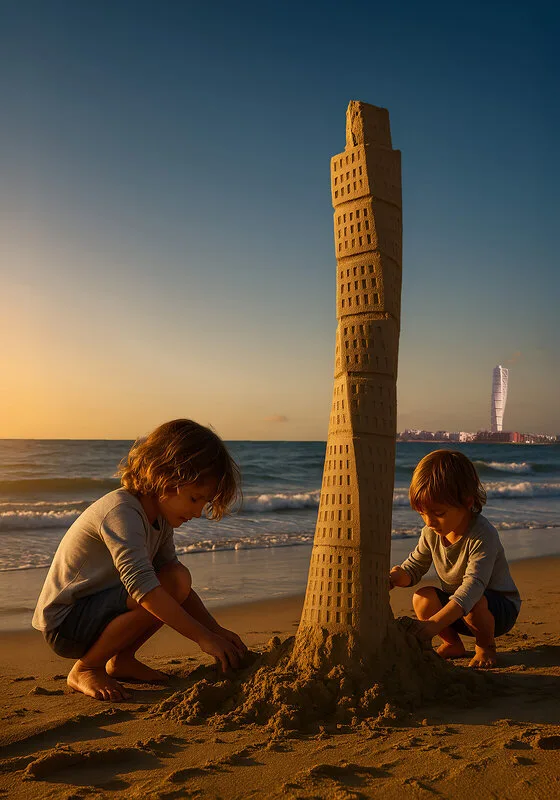
Evening light leans in from the west, and two boys kneel at the tide line with wet hands and solemn purpose. Their bucket is a plumb bob, their fingers a trowel; grain by grain, they build today’s castle—not a keep from fairy tales, but Turning Torso itself, reborn in sand where a real shoreline once receded before Kockums pushed the city out into the sea. In the distance, the Øresund Bridge stretches across the horizon like a drawn breath; in front of them, the moat absorbs the next small wave.
Children elsewhere might imagine Hogwarts Castle, the school that teaches miracles. Here in Malmö, the miracle already stands a kilometre away, twisting skyward in glass and steel—so they build the thing that has come true. For an hour, it is perfect: a helical wall, a window scored with a thumbnail, a base tamped down enough to believe in. Then the water alters, as water always does. What remains is not loss but a lesson: that we make, unmake, and make again—learning the shore by heart. And in this cycle of creation and dissolution, the children's learning process, their ability to adapt and grow, becomes a powerful metaphor for the impermanence of life and the resilience of the human spirit.
“Sandcastle
The wave arrives like a contract.
No one signed.
And yet it binds.
The wind reads it aloud,
the rain adds its crooked signature.
The child works in backlight,
hands as warm moulds,
the bucket’s shadow a plumb and rule.
From grit and dream, a line is drawn across the shore.
A tower rises, twists,
a window is scored with a thumbnail,
a moat drinks its first wave
and asks for another.
The elements don’t resist—
They teach.
Each fallen bridge
schools the hand in weight, wet, time.
Sometimes a gust lifts the plan whole
and sets it back as sand.
Sometimes the ocean comes close and whispers:
Not like this, not yet.
We are like that—
We build on shaky ground,
stubbornness for mortar,
imagination for scaffolding.
And when the brim is blurred
and the beach lies smooth as memory,
a blueprint remains in the body:
Next time we’ll start further in,
pack the layers tighter,
close enough to the water to glitter,
far enough to stand for a while.”
Malmö. October 2025
Turning Torso built on Sand - Sandcastles — From Play to Monument
In the picture, two boys are building today’s sandcastle: an iconic structure, in fact, raised from the very shore where a sandy beach once stretched before Kockums moved its shipyard out into the Øresund. Children today might well choose Hogwarts School of Witchcraft and Wizardry, the magical boarding school of the Harry Potter books. But if you are born in Malmö, perhaps the truly magical thing is the Turning Torso, standing just a kilometre from Ribersborg’s strand—a real tower that already looks like a dream.
The history of the sandcastle is both more recent and more revealing than we often think. People have played on beaches for as long as beaches have existed; what we cannot demonstrate through reliable sources is the classic castle design—turrets, curtain walls, moats—that appeared in ancient times. Archaeology and historical imagery show children playing in the sand, but not the “castle iconography.” The castle aspect is a modern invention. It belongs to the era of railways, postcards, and holidays. This historical analysis of sandcastle culture provides a fascinating insight into the evolution of this beloved pastime.
From the mid-nineteenth century, rail links suddenly made coastal resorts in Britain, France, Germany, Sweden, and the United States accessible. A commercial seaside culture flourished—promenades, bandstands, striped tents, and a rising trade in bucket-and-spade sets. Department-store catalogues from the 1870s–1890s show these tools becoming standard children’s items, and by the late 1800s and early 1900s, the first photographs and postcards clearly showing sandcastles—with towers, walls, and moats—appear from European resorts and the American East Coast. This period can be described as the 'grammar of summer', a time when the elements of water, sand, a container, a mould, and a child came together to form the basis of sandcastle building.
At the turn of the twentieth century, the pastime discovered its practitioners. Newspapers and picture postcards record “professional sand men” on popular beaches—especially Atlantic City, Coney Island, and other New Jersey/New York beaches—creating elaborate figurative works for coins and crowds: biblical scenes, portraits, and even “palaces.” These 'professional sand men' were skilled artisans who played a significant role in the evolution of sandcastle building, transforming it from a simple children's play to a form of public entertainment. Similar scenes are documented in British and French resorts. Municipalities sometimes imposed restrictions due to congestion and safety concerns, indirectly confirming that the activity was already widespread. By around 1900, sandcastle and sand-sculpture culture was firmly established: children’s play for some, public entertainment for many.
Two techniques were developed in parallel, each contributing to the evolution of the sandcastle. The first is the classic castle: compacted sand shaped with moulds to form walls and bastions, a moat channelling the tide. The second is the drip castle: very wet sand trickled into spires and buttresses, architecture that seems to grow on its own. Early photographs and press notes in Europe and the U.S. show both styles thriving. The tools were modest—buckets, spades, simple moulds; later, small trowels and knives. The principles remain the same today: compaction, moisture control, and layering. This evolution of techniques has transformed sandcastle building from a simple pastime to a sophisticated art form.
After the Second World War, seaside tourism revived, bringing with it local sandcastle contests—municipal festivals and charity events across Europe, North America, and Japan. In the 1970s and 80s, these competitions became more formalised: rules restricted materials to sand and water (no binders), juries awarded prizes, and teams were formed with various skills. Borrowing methods from masonry and concrete work—shuttering, tamping, lifting forms in stages—specialists expanded the scale and precision of what sand could achieve.
From the 1990s onwards, a significant shift in the practice of sandcastle building occurred, marking what can be considered the 'true era of sand sculpture'. This period saw the emergence of international festivals and world championships dedicated to the art of sandcastle building. These events, which now occur regularly in many locations, focus on technical precision and artistic expression, elevating sandcastle building from a simple pastime to a sophisticated art form. The technical core of sandcastle building remains consistent: you need angular grains (broken quartz binds better than rounded beach sand), systematic layer-by-layer compaction, and precise water content. Work forms are stacked like a wedding cake, filled and pounded, then removed to reveal sharp verticals. A good team reads the shore as engineers read a blueprint—considering sun, wind, evaporation, and the temperament of that day’s sand.
Aesthetically, the field expanded from castles to grand figurative works—myth, cinema, history—yet the castle still represents the people’s form, especially for children. The word has also become a metaphor. In English, we speak of projects “built on sand” (weak foundations), “houses of cards” (fragile structures), or “sandcastles at high tide” (beautiful, doomed). This metaphor offers a warning but also an ethic: create something knowing it won’t last, and learn the shore while you can. This deeper metaphorical meaning of sandcastles, as symbols of impermanence and creativity, enriches our understanding of this art form.
Sweden’s contribution to the art of sandcastle building is deeply rooted in its history, evident in images and local newspapers. With the rise of seaside bathing and bathhouses—Ribersborg in Malmö, Mölle, Varberg, Halmstad—bucket-and-spade play is already visible in early-1900s photographs and postcards. After the war, municipal summer events in many towns included organised building days; the sandcastle became a staple in Swedish culture as both childhood icon and moral lesson—something beautiful and fleeting, sometimes “built on sand,” but worth creating nonetheless. This rich historical background of sandcastle building in Sweden helps us connect to local traditions and understand the cultural importance of this art form.
The scale, however, did not end with childhood. Sand eventually grew enormous. As of this writing, the tallest sandcastle recognised by Guinness World Records measures 21.16 metres—built in Blokhus, Denmark (2 July 2021). Guinness also records the tallest sand sculpture (not necessarily a “castle”) at 22.43 metres, created for the Zhoushan festival in China (2010). Meanwhile, the longest sand sculpture stretched for 27.3 kilometres along Schaabe beach on Rügen, Germany, involving about 11,000 volunteers (2011). Even at these scales, the same principles apply: angular sand, compaction, water control; at most, a sacrificial skin to withstand weather for a season—a miracle—but one that remains legible.
Seen from Malmö, the story takes on local importance. Ribersborg’s beach is not just a pretty postcard view; it is a layered palimpsest. Where the boys now stamp and pat their Turning Torso into shape, the historic shoreline once extended before Kockums pushed the working city further into the sea. Today, the actual tower rises like a helix of glass and steel behind them, while the sand-Torso lifts into the golden air—ephemeral, precise, and sincere. The boys are using the same techniques that created the modern discipline: a tapered base, layered compaction, a patient edge-cut to suggest windows, and a steady hand reading the grit’s cohesion. Their structure will fall—perhaps tonight, perhaps with the next tide. But for now, it stands as both model and memory: a child’s replay of a city’s transformation.
If we widen the lens, the sandcastle reveals what most seaside stories show us: that culture is a choreography between time and touch. The railway attracts crowds; the postcard captures a moment; the photograph takes us back to it. Professionals shaped saints and palaces for coins; engineers documented formwork and moisture; festival juries crowned the winners. And the essential triad still refuses to change: sand, water, hand. The castle belongs to the nineteenth century; the impulse belongs to everyone who has ever drawn a line on the shoreline and asked the ocean to wait.
So the boys at Ribersborg choose Turning Torso over Hogwarts. It’s a lovely decision. Hogwarts is a fantasy; Turning Torso is the realisation of a fantasy—one that also began, in a sense, on sand. Their tower will be gone by morning; the real one will continue to catch the light above Västra Hamnen. Between them runs the entire history of the sandcastle: from play to performance to profession; from postcards to records; from the simple joy of a bucket’s lift to the tensile logic of a 20-metre wall.
And if the tide has the final say, that too is part of the pattern. The sea, our patient teacher, refines our ambitions. It teaches us about foundation, timing, and grace. We build until the water clarifies what will remain. Then we start afresh—wiser with the sand, gentler with the touch, and still, despite ourselves, captivated by a tower rising where a wave is already approaching.
Sandcastles at High Tide — On Fragile Plans and Beautiful Failures
We build because we must. Children press wet sand into turrets and crenellations, engineers draw lines across the sea, and politicians form coalitions from smiles and handshakes. The shapes differ, the impulse remains the same: to give form to a wish before the tide returns. In English, the word that bears this dual life of beauty and ruin is sandcastle—a toy, a metaphor, a warning. It's a reminder that the fragility of our plans is not a failure, but a natural part of the process.
A sandcastle is charming precisely because it is fleeting. You can see the fingerprints in its walls, the shimmer of shells set like windows, the moat already sipping the next wave. As a metaphor, it maintains that tenderness but introduces a new edge: a project built on sand—beautiful, visible, and doomed. The phrase belongs to a family of fragilities. A house of cards will collapse with a single breath; castles in the air require no storm at all, only gravity and time. Each idiom highlights a different flaw: building on sand undermines the foundation; a house of cards flaws the structure; castles in the air challenge the premise. Together, they illustrate the ways we falter.
Journalists turn to the image when markets overheat: a sandcastle economy, shimmering in the late sun, built on credit and wishful thinking. This metaphor refers to an economy that appears strong and prosperous, but is actually built on unstable foundations, much like a sandcastle that will crumble when the tide comes in. Urban planners mumble about sandcastle promises that disintegrate in procurement. In diplomacy, a sandcastle coalition holds until the first real wave: an election, a scandal, a sudden shift of wind. And in personal life, we also recognise the feeling—the relationship is on fragile ground. This grand life plan looks perfect on paper, but falls apart the moment reality touches its edges.
The strongest form of the metaphor involves time and pressure: building sandcastles at high tide. Here, the critique is not only of what is built but also of the timing and hubris involved. You can pile the walls higher, fetch more buckets, plead with the ocean; the outcome remains the same. The work is washed away not because it lacked beauty, but because it disregarded the conditions of the shore.
Yet, the metaphor is not solely scornful. Sandcastles also embody an ethic: create something knowing it will not last. Sometimes, the point is to learn the shoreline. Children explore gradients and grain, how water bonds and unbinds; adults should understand budgets and boundaries, the difference between signal and mirage. If the ocean is a teacher, it is also a partner. We build until the wave reshapes us, and within that cycle, there is a discipline as ancient as play. The beauty lies not in the permanence of our creations, but in the process of building and learning, a process that is inherently beautiful and inspiring.
So when we write—a sandcastle policy, a house-of-cards narrative, a vision built on sand—we should hear the undertow of mercy within the warning. Fragility is not failure; denial is. The honest builder checks the ground, reads the weather, and knows which dreams must be lifted onto rock and which may live, beautifully, for an afternoon. It's not the collapse of our plans that should concern us, but the invaluable lessons we can learn from them, lessons that can enlighten and empower us for future endeavours.
In the evening, the beach is smooth once more. No battlements, no flags, no moat—only the memory of hands and the quiet knowledge that tomorrow, with better sand and a wiser tide, we might build something that lasts a little longer. This realisation should fill us with hope and optimism for the future, knowing that with each lesson learned, we are better equipped to build something more enduring.
Castles That Won’t Last — Sand in Literature, Art, Film, and Theatre
A sandcastle is a paradox made visible: form and formlessness in a handshake. No wonder writers and artists keep returning to it. The object is simple—a child’s architecture of turrets and walls—but the idea is boundless: it embodies a unique beauty that knows it will end. From novels to stage plays, from gallery pieces to beach epics, the sandcastle symbolises desire, play, hubris, memory, and time, and above all, it celebrates the beauty of impermanence, inspiring us with its fleeting yet exquisite existence.
Literature — Fiction’s Temporary Cities
Novelists have long used sand to test what characters believe will last. Iris Murdoch’s The Sandcastle (1957) makes this image clear: adult lives built on shifting ground, love affairs and ambitions worn away by the tide of consequence. In Scandinavian tones, Tove Jansson’s The Summer Book revisits the shore as a workshop and classroom: the child and the grandmother build and abandon small empires, learning that care does not ensure permanence. Elsewhere, modern allegories reflect the same lesson—Italo Calvino’s imagined cities often seem like sandcastles of language, precise yet temporary; Shelley’s “Ozymandias” depicts a king whose monument survives only as fragments in the sand, a desert version of the beach’s daily erasure. Even children’s picture books treat the castle as a moral symbol: the moat fills, the tower collapses, the page turns—and acceptance becomes a skill.
Visual Art — From Bucket to Monument
In imagery, the sandcastle easily traverses the line between kitsch and sublime. Early-1900s postcards already portrayed “palaces” for the promenade crowd. A century later, professional sand sculptors employ the precision of masonry—formwork, tamping, and layer compaction to carve figures and facades with remarkable sharpness, fully aware that wind and spray hold the final veto. Contemporary land artists take the idea further: Jim Denevan and Andres Amador create tidal mandalas across entire beaches, works designed to self-erase; the photograph becomes the reliquary of an event. Museums and festivals now commission large-scale sand installations precisely because they cannot be owned—monuments that rehearse their disappearance.
Film — The Cut That Washes Away
Cinema adores the poetic shift from castle to wave. In documentaries about sand-sculpture contests, the tension is not only competitive but existential: deadlines aren’t just clocks; they are coming tides. Narrative films rely on metaphor to indicate fragile plans—a honeymoon dream built on sand, a criminal empire that seems strong until the first wave of truth. Music videos and concert films return to the beach for the same reason: the choreography of making and unmaking is immediately visible on camera, the audience feeling time as a rising tide at the edge of the frame.
Theatre & Performance — Bodies in the Dune
On stage, sand functions both as scenery and language. Samuel Beckett’s Happy Days sinks Winnie waist-deep (and later neck-deep) in sand; the grains embody time itself, swallowing a life that chatters bravely on. Dance and physical theatre often spread real sand across the floor: footprints, slumps, and collapses become part of the choreography, each step a visible edit. Site-specific works by the shoreline borrow the tide as a collaborator, rehearsing until the sea delivers the final blackout.
Why the Motif Endures
The sandcastle endures because it addresses a narrative challenge: how to depict impermanence without feeling despair. Its structure is delicate, not tragic; it encourages touch, teamwork, and revision. It also makes the agency clearer. If a marble statue breaks, we blame the accident; when a sandcastle collapses, we recognise design, weather, and time sharing authorship. That humility—craft without ownership—explains why artists in many media keep shaping sand into meaning. The collaborative nature of sandcastle building fosters a sense of unity and shared experience, making it a powerful symbol of human connection and collective creativity.
Local Lens — Malmö as Stage
Seen from Ribersborg, the scene gains depth. Children construct a Turning Torso from wet sand while the real tower shines across the water. Between the model and the skyline lies the entire cultural story: postcard play, professional craftsmanship, festival spectacle, and the metaphysics of things that can’t and shouldn’t last. The boys’ castle will be gone by morning, but the gesture remains—the most modern of rituals, repeated since the railway invented summer. Literature names it, art displays it, film edits it, and theatre sinks into it. And still we return with bucket and spade, not to defeat the tide but to learn its rhythm.
3 200 kr

Jörgen Thornberg
Malmö
Lite om bilder och mig. Translation in English at the end.
Jag är en nyfiken person som ser allt i bilder, även det jag fäster i ord, gärna tillsammans för bakom alla mina bilder finns en berättelse. Till vissa bilder hör en kortare eller längre novell som följer med bilden.
Bilder berättar historier. Jag omges av naturlig skönhet, intressanta människor och historia var jag än går. Jag använder min kamera för att dokumentera världen och blanda det jag ser med vad jag känner för att fånga den dolda magin.
Mina bilder berättar mina historier. Genom mina bilder, tryck och berättelser. Jag bjuder in dig att ta del av dessa berättelser, in i ditt liv och hem och dela min mycket personliga syn på vår värld. Mer än vad ögat ser. Jag tänker i bilder, drömmer och skriver och pratar om dem; följaktligen måste jag också skapa bilder. De blir vad jag ser, inte nödvändigtvis begränsade till verkligheten. Det finns en bild runt varje hörn. Jag hoppas att du kommer att se vad jag såg och gilla det.
Jag är också en skrivande person och till många bilder hör en kortare eller längre essay. Den följer med tavlan, tryckt på fint papper och med en personlig hälsning från mig.
Flertalet bilder startar sin resa i min kamera. Enkelt förklarat beskriver jag bilden jag ser i mitt inre, upplevd eller fantiserad. Bilden uppstår inom mig redan innan jag fått okularet till ögat. På bråkdelen av ett ögonblick ser jag vad jag vill ha och vad som kan göras med bilden. Här skall jag stoppa in en giraff, stålmannen, Titanic eller vad det är min fantasi finner ut. Ännu märkligare är att jag kommer ihåg minnesbilden långt efteråt när det blir tid att skapa verket. Om jag lyckas eller inte, är upp till betraktaren, oftast präglat av en stråk av svart humor – meningen är att man skall bli underhållen. Mina bilder blir ofta en snackis där de hänger.
Jag föredrar bilder som förmedlar ett budskap i flera lager. Vid första anblicken fylld av feel-good, en vacker utsikt, fint väder, solen skiner, blommor på ängen eller vattnet som ligger förrädiskt spegelblankt. I en sådan bild kan jag gömma min egentliga berättelse, mitt förakt för förtryckare och våldsverkare, rasister och fördomsfulla människor - ett gärna återkommande motiv mer eller mindre dolt i det vackra motivet. Jag försöker förena dem i ett gemensamt narrativ.
Bild och formgivning har löpt som en röd tråd genom livet. Fotokonst känns som en värdig final som jag gärna delar med mig.
Min genre är vid som framgår av mina bilder, temat en blandning av pop- och gatukonst i kollage som kan bestå av hundratals lager. Vissa bilder kan ta veckor, andra någon dag innan det är dags att överlämna resultatet till printverkstaden. Fine Art Prints är digitala fotocollage. I dessa kollage sker rivandet, klippandet, pusslandet, målandet, ritandet och sprayningen digitalt. Det jag monterar in kan vara hundratals år gamla bilder som jag omsorgsfullt frilägger så att de ser ut att vara en del av tavlan men också bilder skapade av mig själv efter min egen fantasi. Därefter besöks printstudion och för vissa bilder numrera en limiterad upplaga (oftast 7 exemplar) och signera för hand. Vissa bilder kan köpas i olika format. Det är bara att fråga efter vilka. Gillar man en bild som är 70x100 men inte har plats på väggen, går den kanske att få i 50x70 cm istället. Frågan är fri.
Metoden Giclée eller Fine Art Print som det också kallas är det moderna sättet för framställning av grafisk konst. Villkoret för denna typ av utskrifter är att en högkvalitativ storformatskrivare används med åldersbeständigt färgpigment och konstnärspapper eller i förekommande fall på duk. Pappret som används möter de krav på livslängd som ställs av museer och gallerier. Normalt säljer jag mina bilder oinramade så att den nya ägaren själv kan bestämma hur de skall se ut, med eller utan passepartout färg på ram, med eller utan glas etc..
Under många år ställde jag bara ut på nätet, i valda grupper och på min egen Facebooksida - https://www.facebook.com/jorgen.thornberg.9
Jag finns också på en egen hemsida som tyvärr inte alltid är uppdaterad – https://www.jth.life/ Där kan du också läsa en del av de berättelser som följer med bilden.
UTSTÄLLNINGAR
Luftkastellet, oktober 2022
Konst i Lund, november 2022
Luftkastellet, mars 2023
Engleson Galleri Caroli, april 2023
Hydra, Greece June 2023
Engleson Galleri Caroli, oktober 2023
Toppen, Höllviken december 2023
Luftkastellet, mars 2024
Torups Galleri, mars 2024
Venice, May 2024
Luftkastellet, oktober 2024
Konst i Advent, December 2024
Galleri Engleson, Caroli December 2024
Jäger & Jansson Galleri, april 2025
A bit about pictures and me.
I'm a curious person who sees everything in pictures, even what I express in words, often combining them, for behind all my pictures lies a story. These narratives, some as short as a single image and others as long as a novel, are the heart and soul of my work.
Pictures tell stories. Wherever I go, I'm surrounded by natural beauty, exciting people, and history. I use my camera to document the world and blend what I see with what I feel to capture the hidden magic.
My images tell my stories. Through my pictures, prints, and narratives, I invite you to partake in these stories in your life and home and share my deeply personal perspective of our world. More than meets the eye. I think in pictures, dream, write, and talk about them; consequently, I must create images too. They become what I see, not necessarily confined to reality. There's a picture around every corner. I hope you'll see what I saw and enjoy it.
I'm also a writer, and many images come with a shorter or longer essay. It accompanies the painting, printed on fine paper with my personal greeting.
Many pictures start their journey on my camera. Simply put, I describe the image I see in my mind, experienced or imagined. The image arises within me even before I bring the eyepiece to my eye. In a fraction of a moment, I see what I want and what can be done with the picture. Here, I'll insert a giraffe, Superman, the Titanic, or whatever my imagination conjures up. Even stranger is that I remember the mental image long after it's time to create the work. Whether I succeed is up to the observer, often imbued with a streak of black humour – the aim is to entertain. My pictures usually become a talking point wherever they hang.
I prefer pictures that convey a message in multiple layers. At first glance, they're filled with feel-good vibes, a beautiful view, lovely weather, the sun shining, flowers in the meadow, or the water lying deceptively calm. But beneath this surface beauty, I often conceal a deeper story, a narrative that challenges societal norms or explores the human condition. I invite you to delve into these hidden narratives and discover the layers of meaning within my work.
Picture and design have been a thread running through my life. Photographic art feels like a fitting finale, and I'm happy to share it.
My genre is varied, as seen in my pictures; the theme is a blend of pop and street art in collages that can consist of hundreds of layers. Some images can take weeks, others just a day before it's time to hand over the result to the print workshop. Fine Art Prints are digital photo collages. In these collages, tearing, cutting, puzzling, painting, drawing, and spraying happen digitally. What I insert can be images hundreds of years old that I carefully extract so they appear to be part of the painting, but also images created by myself, now also generated from my imagination. Next, visit the print studio and, for certain images, number a limited edition (usually 7 copies) and sign them by hand. Some images may be available in other formats. Just ask which ones. If you like an image that's 70x100 but doesn't have space on the wall, you might be able to get it in 50x70 cm instead. The question is open.
The Giclée method, or Fine Art Print as it's also called, is the modern way of producing graphic art. This method ensures the highest quality and longevity of the artwork, using a high-quality large-format printer with archival pigment inks and artist paper or, in some cases, canvas. The paper used meets the longevity requirements set by museums and galleries. I sell my pictures unframed, allowing the new owner to personalise their artwork, confident in the lasting value and quality of the piece.
For many years, I only exhibited online, in selected groups, and on my Facebook page - https://www.facebook.com/jorgen.thornberg.9. I also have my website, which unfortunately is not constantly updated - https://www.jth.life/. You can also read some of the stories accompanying the pictures there.
EXHIBITIONS
Luftkastellet, October 2022
Art in Lund, November 2022
Luftkastellet, March 2023
Engleson Gallery Caroli, April 2023
Hydra, Greece June 2023
Engleson Gallery Caroli, October 2023
Toppen, Höllviken December 2023
Luftkastellet, March 2024
Torup Gallery, March 2024
Venice, May 2024
UTSTÄLLNINGAR
Luftkastellet, oktober 2022
Konst i Lund, november 2022
Luftkastellet, mars 2023
Engleson Galleri Caroli, april 2023
Hydra, Greece June 2023
Engleson Galleri Caroli, oktober 2023
Toppen, Höllviken december 2023
Luftkastellet, mars 2024
Torups Galleri, mars 2024
Venice, May 2024
Luftkastellet, October 2024
Konst i Advent, December 2024
Galleri Engleson, Caroli December 2024
Jäger & Jansson Galleri, April 2025
Utbildning
Autodidakt
Medlem i konstnärsförening
Öppna Sinnen
Med i konstrunda
Konstrundan i Skåne
Utställningar
Luftkastellet, October 2022
Art in Lund, November 2022
Luftkastellet, March 2023
Engleson Gallery Caroli, April 2023
Hydra, Greece June 2023
Engleson Gallery Caroli, October 2023
Toppen, Höllviken December 2023
Luftkastellet, March 2024
Torup Gallery, March 2024
Venice, May 2024