Vi använder cookies för att ge dig bästa möjliga upplevelse. Välj vilka cookies du tillåter.
Läs mer i vår integritetspolicy
Jörgen Thornberg
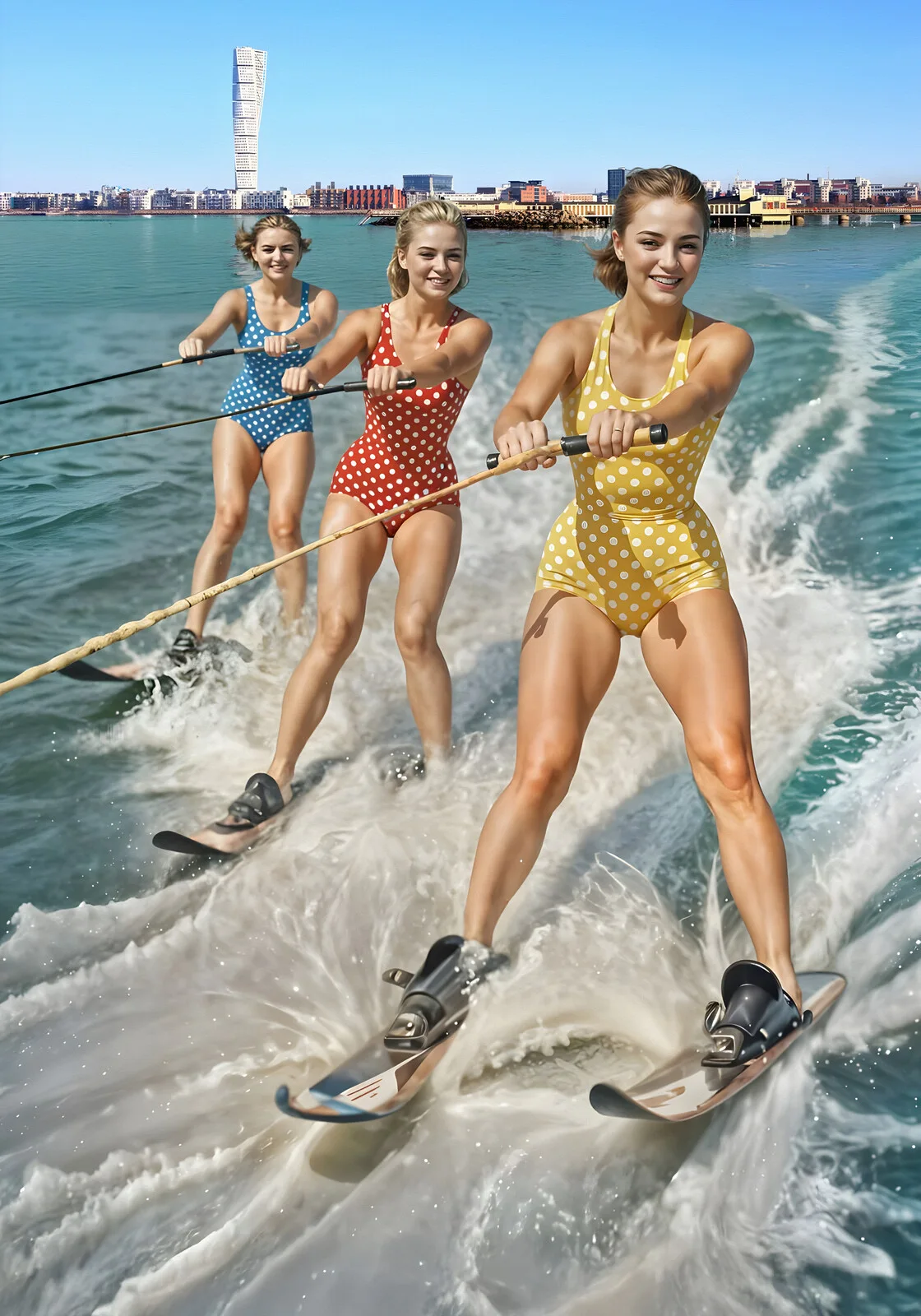
Ribban on Skis, 2025
Digital
50 x 70 cm
3 200 kr
Ribban on Skis
From wave to wake – A thousand years between surfing and water skiing. Polka dots, sunlight, and spray — three women glide across the Øresund on a bright summer morning. Their laughter drifts above the hum of the motorboat, past the long wooden pier and the pale outline of the cold bathhouse at Ribersborg. Behind them, Turning Torso twists like a sculpted wave of steel, echoing the motion of their bodies. The sea captures their reflections, breaking them into shards of blue and gold. For a moment, everything aligns — the harmony of grace and gravity, rhythm and freedom, art and innovation.
Since the dawn of time, humans have dreamed of walking on water — of gliding above its mirrored surface without sinking, of becoming one with its rhythm rather than its danger. Surfing was born from nature’s breath, a sacred dance between body and tide. Water skiing, by contrast, arose from the roar of engines — a 20th-century creation driven by speed, balance, and confidence in human ingenuity. One stemmed from respect for the ocean, the other from a fascination with control. Yet both originate from the same desire: a shared human longing to move with the world instead of against it, to find stillness in motion and flight in fluidity.
And then, in the last century, these two traditions — ancient and modern, spiritual and mechanical — converged on the same horizon. Their meeting was not a collision but a harmonious blend, a shared rhythm of sun, salt, and motion. Together, they birthed a new language of liberation — a dance of equilibrium and surrender, where humanity rediscovered the art of gliding across the living skin of the sea.
“Afloat
I skim and slide, I sway and spin,
the wave begins where I begin.
The sea’s a mirror, smooth and thin,
that laughs each time I fall back in.
I chase the balance, miss, then catch,
a fleeting dance, no rules to match.
The sun applauds, the wind keeps time,
the water hums its silent rhyme.
Some glide with grace, some get wetter,
some trust the rope, some trust the letter.
And some — with faith as grand as fashion —
believe they walk on waves with passion.
But let’s be fair, when truth comes knockin’:
great faith — and even greater shoes —
can keep you from the shockin’.”
Malmö. October 2025
From Wave to Wake – A Millennium Between Surfing and Water Skiing. Two Movements, One Sea. This breathtaking journey through water sports history spans a millennium, rich with remarkable stories and cultural importance.
Since the dawn of time, humankind has dreamed of walking on water — of gliding over its shifting mirror, upright and free. To ride a wave or a wake is to borrow, for a fleeting moment, the ocean’s own rhythm — to balance between gravity and grace, between surrender and control.
Surfing was born from nature’s breath, a dance between body and tide. Water skiing, by contrast, was created in the age of engines — an invention driven by curiosity and speed, using wood, rope, and horsepower. One grew from communion with the sea, the other from modernity’s desire for motion. Yet both express the same longing: to move with the element that shaped us, to play upon the surface of the deep.
And on a summer morning at Ribersborg, this long human dream appears to shimmer into being. Three women — one red-haired, one blonde, one dark — cut across the water in perfect parallel lines. Their 1950s swimsuits shine in the sunlight: yellow and white, red and white, blue and white polka dots. Behind them rises the pale outline of the cold bathhouse, its wooden arches smelling faintly of salt and pine. Further out, Turning Torso, a modern architectural marvel, curves against the sky like a modern totem, overseeing the Baltic’s tranquil swell. Spray catches the light; laughter blends with the hum of the motorboat. For a moment, the sea itself seems to smile — as if the ancient wave and the modern wake have finally become one. This scene, a beautiful blend of past and present, captures the essence of water sports and their enduring appeal.
It is here, in this meeting of pulse and power, that the story begins — the thousand-year conversation between surfing and water skiing, a dialogue that has evolved over centuries. It's a conversation between nature and invention, between what flows and what propels. This ongoing dialogue, marked by innovation and tradition, remains a source of endless fascination and intrigue.
The Heritage of the Wave – The Spiritual History of Surfing
Long before engines hummed or ropes tightened, there was only the wave — and the body that dared to meet it. In ancient Polynesia, surfing was not a sport but a sacred dialogue between humans and the sea. The first surfers did not conquer the ocean; they conversed with it. Each wave was a moving mountain, a living spirit whose crest could lift the rider toward the gods.
In Hawaii, the art of heʻe nalu — “wave sliding” — was once exclusive to chiefs and kings. Their surfboards, carved from the koa tree, were anointed with coconut oil and prayers before entering the water. To ride a wave was to embody harmony — to read the wind, the tide, and the heartbeat of the earth itself. The surfer’s balance was not just physical; it was spiritual, an act of alignment between body, soul, and ocean, a tradition that connects us to the profound spiritual history of surfing.
When European explorers arrived in the 18th century, they observed with awe — and unease. Captain James Cook’s crew described men and women who appeared to defy nature, standing upright on rolling water, laughing as they moved towards the shore. To the Western eye, it resembled magic, even blasphemy — the body made weightless, the rules of gravity broken, a feat that inspired both admiration and fear.
For centuries afterwards, colonial powers suppressed this practice. Missionaries regarded it as pagan, indecent, and a sin of pleasure. The waves grew silent, and the sacred boards were forgotten. But the ocean remembered. In the early 20th century, surfing made a comeback — first as nostalgia, then as rebellion. Modern boards replaced koa wood; wax and fibreglass replaced prayer. Yet the essence remained unchanged: a quiet, wordless pursuit of balance, a testament to the enduring spirit of surfing.
Surfing remains a form of listening — surrendering to the breathing sea and recognising rhythm as language. It involves accepting that mastery is found not in control but in flow. Every wave offers a lesson: nothing endures, everything shifts, and happiness is found solely in the moment between rising and falling.
The Awakening of the Engine – The Invention of Water Skiing
If surfing was born from the pulse of the sea, water skiing was born from the hum of invention. It appeared not on the shores of the Pacific but in the heartland of America — far from salt and coral, in the fresh waters of Minnesota. The year was 1922, the Jazz Age had begun, and a young man named Ralph Samuelson stood on a pair of ordinary wooden planks and decided that if one could ski on snow, one might also ski on water.
What he created on Lake Pepin was remarkably new — a blend of body and machine, of balance and propulsion. He heated the tips of his planks over a fire to make them bend, a technique that allowed for better control and manoeuvrability. He strapped his feet down with leather belts, ensuring a secure connection to the skis, and held tightly to a rope tied to a roaring motorboat. His discovery was as much instinct as science. Lean back, he realised, and let the water lift you. Keep your arms straight and your faith steady. The wake beneath you is not your enemy but your path.
Unlike surfing, which emerged from myth and ritual, water skiing was a product of modern curiosity — a child of speed, summer, and the American dream. It grew up alongside radios and convertibles, with picnics and optimism. The boat’s engine became a kind of modern deity: a mechanical wave that could be summoned at will. Water skiing became a symbol of the American spirit, a testament to the nation's love for adventure and innovation.
By the 1930s, others joined in. Wooden skis were polished, metal bindings added, and competitions began, marking a significant shift in the sport's evolution. Soon, the sport migrated south, finding its paradise in Florida’s endless sunshine.
In the years following the war, water skiing evolved into a display of movement and glamour — sequinned costumes, synchronised formations, pyramids of smiling women balancing on each other’s shoulders. At Cypress Gardens, America’s aquatic stage, it became not just a sport but a theatre.
Where the surfer sought solitude, the skier sought jubilation. Where the surfboard whispered, the motorboat thundered. Yet beneath the noise, both concealed the same secret: the thrill of defying gravity with grace, the joy of movement between resistance and release. This is the poetry of water sports, a dance with the elements that brings exhilaration and satisfaction to those who participate in it.
And in time, these two lineages — the ancient and the modern — would meet again, their wakes crossing like ripples on the same endless water. This unity in diversity makes water sports culture both rich and fascinating. It celebrates the human spirit's capacity to adapt and innovate, generating new experiences and expanding the limits of what can be achieved, inspiring us all to push our boundaries.
Aquaplaning – The Meeting of Two Worlds
Before the surfboard met the motorboat, there was the aquaplane — a wide, flat plank pulled behind early speedboats in the 1910s and 1920s. It served as the missing link between ancient ritual and modern recreation, a bridge of varnished wood gliding between eras. The aquaplane, with its straightforward approach, played a significant role in the evolution of water sports. The rider stood upright, knees bent, hair flowing, as the water turned to silver beneath them. It was a pivotal moment in the history of water sports, a new form of recreation shimmering between eras.
These early aquaplaners were showpeople and experimenters — wealthy holidaymakers on American lakes and European resorts who pursued the illusion of flight. Photographs from the 1920s show women in bathing caps and men in striped trunks standing proudly on their planks, smiling towards the camera as the wake fans out behind them. They had no idea they were rehearsing a reunion — the reunion of surfing’s balance with engineering’s drive, a significant event that would shape the future of water sports.
As engines became more powerful and skis transformed into paired boards, the aquaplane’s role diminished — yet its spirit persisted. Decades later, when surfers started to seek out waves too large to paddle into, they rediscovered the same principle: to be towed into motion. This led to the emergence of tow-in surfing in the 1990s, a stunning fusion where jet skis replaced boats and bravery replaced limitations. The evolution of water sports was marked by this awe-inspiring fusion, a moment that filled the water sports community with excitement and wonder. Surfers could now ride enormous waves once deemed impossible, thanks to the courage and technological advancements in tow-in surfing.
What Ralph Samuelson did on his lake in 1922 resonated across oceans seventy years later. The rope that once symbolised control became, once again, a lifeline between human and element — a thread connecting the ancient sea-riders of Polynesia to the machine-riders of the modern world.
It was no longer about who invented what or which came first. The real story was one of return — of how technology, after centuries of trying to control nature, found itself once more drawn into her rhythm.
On every aquaplane, ski, or surfboard towed into the deep, the same truth is revealed: we progress by surrendering. In water sports, 'surrendering' means releasing control and letting the natural forces of the water steer the movement. We only rise when the water consents, emphasising the deep bond between the human spirit and the elements.
The 1950s – Sun, Speed, and Freedom
The 1950s arrived like a postcard from paradise — bright, glossy, and filled with motion—the world, weary from war, rediscovered pleasure in leisure. The beach became the new cathedral, its altar the horizon, and its gospel the sound of engines and surf. On both sides of the Atlantic, people flocked to the water seeking renewal, and there, beneath the vast blue sky, two once-separate dreams began to merge, uniting a generation in a shared love for water sports, creating a sense of unity and shared experience that transcended borders.
In California, surfboards stood like symbols of rebellion. Barefoot youth, tanned and carefree, carried them down to Malibu’s gentle waves, where the Pacific rolled in slow, golden curves. Surfing, once a sacred ritual, became a symbol of freedom — sun-bleached, cinematic, alive with guitar chords and salt spray. Its image was effortless grace: balance as beauty, risk as style.
Meanwhile, across the continent, Florida shimmered with the sparkle of motorboats and activity. At Cypress Gardens, synchronised skiers built stunning human pyramids, with sequined girls waving from the top tier, faces framed by the spray of their own speed. Hollywood arrived with its cameras; postcards and travel posters promoted the scene to the world. Water skiing embodied modernity’s promise in motion — precision, glamour, teamwork, and the hum of machinery.
Even Europe caught the fever. On the French Riviera, in Lake Garda’s shimmering light, and along Sweden’s southern coastlines, summer scenes unfolded with a familiar rhythm — striped swimsuits, polished boats, the laughter of a new, confident generation. At Ribersborg in Malmö, the northern light played a subtler tune: three women in polka-dot swimsuits gliding across the Øresund, the wooden outline of the cold bathhouse behind them, and far beyond, Turning Torso spiralling upward like a sculpted wave of steel and glass. The modern and the timeless met in one frame — the pulse of the sea beneath, the dream of progress above.
The media of the decade played a pivotal role in weaving these images together — surfboards and skis, salt and freshwater, youth and invention — into a shared mythology of movement. Surf songs and travel adverts promised happiness at high speed. To move was to live; to stand still was to vanish. The wave and the wake, the ritual and the rehearsal, had finally found each other in a choreography of light and sound, shaping a cultural narrative that resonated with a generation and significantly influenced their perception of the era.
Yet beneath the glamour, something more human remained — an awareness that both sports, despite originating in different centuries, fulfilled the same unspoken desire: to feel the boundary between self and sea dissolve. Whether drawn by wind or engine, the dream remained the same — to let the water carry us, borrowing its freedom for a little while. This universal longing for freedom and connection with nature is what made the 1950s water sports culture so appealing and enduring, evoking a sense of nostalgia and appreciation for the era.
From Show to Self-Expression
By the 1960s, the pursuit of perfection in choreography began to wane. The synchronised smiles of Florida’s water ski pyramids gave way to something more contemplative — the solitary figure on the wave. The world was changing; so was the water. The post-war brightness faded, and a new generation, including figures like [specific individual or group], sought not spectacle but authenticity.
In California, surfing underwent a profound transformation, evolving from a mere spectacle into a powerful philosophy that rebelled against conformity and consumerism. The Beach Boys' tunes still echoed with promises of fun and sunshine, but beneath the harmonies, a deeper story was emerging — the surfer as a seeker, poet, and wanderer. Long hair replaced sequins; silence replaced applause. Surfing became a form of meditation, a protest against the ordinary. The ocean no longer just served as a stage — it became a teacher, a canvas for personal expression and freedom.
Water skiing, by contrast, remained resolute in its emphasis on precision and display — the physics of motion carefully measured by rope length and angle. However, even within this framework, individuality began to flourish. Trick skiing and freestyle moves replaced the once-rigid routines. The sport’s beauty shifted from mere symmetry to the spontaneity of creativity. The skier, once just a part of a pyramid, now carved her own unique signature across the wake, tracing fleeting calligraphy on the surface of the lake. This was a testament to the beauty of individuality in a sport long associated with precision and uniformity.
What united these transformations was a subtle yet profound shift: the return of the body as interpreter, not performer. This shift, which was [specific details about the change], blurred the line between art and sport. Both surfers and skiers began to seek not applause but presence — that perfect, weightless moment when control and surrender become one.
And in this transformation, a deeper reconciliation occurred. The engine no longer opposed the wave; instead, it complemented it. Human invention became an extension of nature’s rhythm rather than its rival. The mechanical hum softened into a kind of harmony — the sound of modernity learning, at last, to breathe in time with the sea. This reflected the beauty of human ingenuity in harmony with nature, serving as a reminder of our profound connection to the natural world.
Today’s Hybrids – Wakeboard, Foil, and Flight
In the late twentieth and early twenty-first centuries, the dialogue between wave and wake reached its final synthesis. This journey, which began with the ancient Polynesian surf priests and continued through the 1950s showgirls, saw the evolution of water sports from traditional surfing to the modern wakeboard, hydrofoil, and e-foil. Technology, once a force of separation, became the bridge. The sea, ever adaptable, welcomed new forms — shorter boards, hydrofoils, ropes, wings, and electric dreams. From this convergence, a new generation of riders emerged who no longer saw boundaries between surfing and skiing, between tradition and invention.
The wakeboard, the pioneer of hybrids, was a surfboard reimagined for the age of speed. Compact, curved, and nimble, it blended the elegance of surfing with the precision of skiing. Behind the thunderous wake of a boat, riders carved arcs that mimicked ocean swells, executing mid-air spins and flips that transformed lakes into liquid arenas. The wake replaced the wave, yet the essence remained unchanged: equilibrium, rhythm, and submission to motion.
Then emerged the hydrofoil, a marvel of engineering that hoisted the board entirely above the water. With its sleek, submerged wings, the rider appeared to float through the air, gliding noiselessly over the surface — the body a blend of angelic grace and engineering finesse. Once again, humanity reached for its age-old aspiration: to transcend gravity without forsaking its pact with the sea.
Some dared to go further. The e-foil — silent, battery-powered, and self-propelled — blurred the boundaries between surfing, skiing, and flying. It carried the rider not through the water but above it, a solitary figure gliding through dawn mist like a thought in motion. Others revisited the ocean’s behemoths, using jet skis to tow themselves into waves so colossal they resembled moving cliffs. Tow-in surfing was both a renaissance and an advancement — the rope reborn, the connection reestablished.
These modern hybrids do not replace their predecessors; they complete them. The rope that once connected the skier to the boat now connects technology to heritage. Every new craft, every board that cuts or hovers, carries within it both the chant of Polynesian surf priests and the laughter of 1950s showgirls. The cultural significance of water sports, from their ancient roots in Polynesian rituals to their modern-day popularity, is a testament to their enduring appeal. What was once separate — ritual and machinery, silence and applause — has become a single, flowing continuum.
In this way, the story returns to its beginning. Whether on a Polynesian beach a thousand years ago or outside the cold bathhouse at Ribersborg, the dream remains the same: to stand above the deep and move as water moves — effortlessly, joyfully, eternally alive.
Sound, Vision, and the Sea – Surfing and Water Skiing in Music, Art, and Literature
When motion becomes myth, it always finds its way into art. Surfing and water skiing, those twin gestures of balance and release, have transcended time and space to inhabit the languages of music, painting, and literature. Each medium transforms movement into rhythm, colour, and metaphor, creating a timeless allure that resonates across generations and cultures. Their influence is not bound by a specific era or location, but enriches the artistic landscape with a heritage that spans centuries.
The Music of Motion
Few eras captured the joy of the sea quite like the 1960s, when California became both a coastline and a dream. The Beach Boys distilled the essence of surfing into harmony — that strange, sunlit blend of innocence and melancholy. Their songs, like Surfin’ USA and Catch a Wave, were not merely anthems of youth; they were hymns to endless summer, to the illusion that time itself could be outrun. Surf rock, with its transformative power, turned the guitar into a wave — its tremolo strings mimicking the shimmer of sunlight on water, its rhythm section echoing the push and pull of the tide.
But water skiing, too, had its soundtrack — not rebellion, but celebration. Big-band orchestras of the 1950s and early television shows often featured exuberant aquatic performances, where brass instruments complemented the sparkle of sequins and the crescendo of spray. This joyful celebration of water and rhythm, from Elvis films set on sunlit coasts to Swedish schlager melodies that transformed Ribersborg or Tylösand into Nordic equivalents of Malibu, is a nostalgic reminder of the happiness that water sports bring.
The Painter’s Sea
In visual art, the image of a figure gliding over water has sustained its power. From Hokusai’s woodcuts to David Hockney’s swimming pools, artists have been drawn to that liminal surface — the space where reflection and reality blend. Surfing captures this paradox: the human body balanced between immersion and transcendence, both within the sea and above it.
In the 1950s and 1960s, the Californian light school — painters like Billy Al Bengston and Ed Ruscha — captured surfing’s graphic purity: clean lines, sun-bleached colours, horizon as minimalism. Simultaneously, European modernists toyed with the geometry of motion; in postwar Sweden, where the sea was colder and the light more diffused, photographers turned vattenskidor into symbols of vitality and optimism — emblems of the welfare state’s promise that every citizen might, one day, stand on water.
Contemporary artists continue to reinterpret this mythology, drawing inspiration from the curve of the wave and the gleam of the wake. Digital art, performance, and even architecture are all influenced by the enduring legacy of water sports. Turning Torso in Malmö — twisting like a vertical breaker of steel — can be seen as a frozen surf, a monument to movement held in suspension. This ongoing influence of water sports on contemporary art is a testament to the enduring power of these activities to inspire new forms of artistic expression.
Words on Water
Writers, too, have long been haunted by the idea of standing on water. Jack London described the sea as both master and mirror; Albert Camus depicted the swimmer’s revolt against absurdity; Joan Didion turned the Californian surf into a metaphor for beauty on the brink of collapse. Each recognised that to ride a wave — literal or metaphoric — is to exist within the delicate rhythm of time.
In fiction and poetry alike, the surfer or skier becomes a symbol of the modern identity — balanced between control and surrender, risk and grace. The image of the human gliding across water recurs as a symbol of freedom but also of denial: the refusal to sink, the will to move forward regardless of circumstances. From the haiku of Bashō to the existential prose of Hemingway’s The Old Man and the Sea, the ocean has endured as both companion and challenge.
And somewhere within this lineage — between Polynesian chant and pop lyric, between ancient ritual and Technicolour fantasy — Imagine the figures from Ribersborg: three women in polka-dot swimsuits, slicing the Øresund into shimmering ribbons of light. They feel as much a part of art as they do of life — brushstrokes on a moving canvas, musical notes on a blue score.
The Return of the Sea as Muse
In our own era, as climate change redraws coastlines and seasons, the sea has reclaimed its voice in both art and activism. Surfers and skiers now share a common language of ecology, understanding the importance of preserving the environment that allows them to practice their sports. “The wave” is no longer just a thrill, but a duty. The culture of water sports has evolved into a culture of awareness, featuring exhibitions, films, and installations that convey both the fragility of our oceans and the freedom they provide.
Thus, from Polynesian myth to pop song, from woodcut to wakeboard, the story of standing on water is not just a story about water sports. It is a story of art itself — our endless effort to freeze movement, to turn the fleeting into form, and to find inspiration in the natural world around us.
And still, the sea refuses to be captured. It continues returning, whispering its rhythm into each new generation of artists and dreamers. As long as humans create, they will paint, write, and sing the same refrain: the longing to rise, to glide, to be carried by what cannot be owned.
Walking on Water – From Miracle to Motion
Since the dawn of civilisation, the aspiration to walk on water has been a recurring motif, deeply rooted in the historical and cultural fabric of humanity. This powerful image permeates myth, religion, and art, symbolising transcendence and the ability to rise above the ebb and flow of life-giving waters. Long before the iconic moment when Christ traversed the Sea of Galilee, other figures — gods, sages, and heroes — were said to have achieved this feat, each driven by the unique ethos of their time: faith, wisdom, or the pursuit of harmony with the natural world.
Before Christ – The Sacred Predecessors
In ancient India, legends spoke of Vishnu, who measured the universe in three cosmic strides, his feet touching both sky and sea. In Buddhist tradition, enlightened beings could walk upon lotus-covered waters — symbols of the mind’s serenity above illusion. In China, the Daoist immortals, the xian, were said to cross rivers by aligning perfectly with the flow of nature. And in Greece, only the children of Poseidon — Triton, or Perseus with his winged sandals — could skim the sea’s surface, bridging the divine and the human through balance and grace.
Across these diverse traditions, the act of walking on water was not a defiance of nature, but a profound harmony with it. The miracle was not about dominance, but about unity. The tranquillity of the body mirrored the tranquillity of the mind; the impossible became possible because the will and the world were in perfect sync, fostering a sense of connection and peace.
Christ and the Power of Faith
When Jesus walked upon the stormy waters of Galilee, the gesture brought together all these older symbols into a single act of revelation. It was not a display of power but of faith. As Peter stepped towards him and began to sink, the meaning became clear: doubt pulls us under, belief keeps us afloat. The sea in the Gospels is not just a body of water — it represents the abyss of fear, the chaos of the world. This understanding of the sea as a symbol of fear and confusion in the Gospels adds depth to the story of Jesus walking on water, highlighting the transformative power of faith and belief, inspiring hope and courage in the readers.
Hence, the Christian miracle changed an ancient symbol of harmony into a parable of trust. Where earlier myths described union with nature, Christ’s act introduced a new element — moral courage, inner conviction, the will to rise above despair.
After Christ – The Secular Heirs
In later centuries, saints, mystics, and visionaries carried on this image. Stories of Francis of Assisi or Russian ascetics floating above the sea reflected a desire to reconnect with the divine through simplicity and love. Artists transformed the miracle into metaphor; poets used it to describe inspiration — the artist as one who walks upon the unstable surface of existence without sinking into it.
In the modern era, this dream of walking on water transitioned from the divine realm to the earthly realm, or more precisely, to the water’s edge. The surfer and the water skier emerged as the secular heirs to this miraculous act, not through faith, but through balance, precision, and rhythm. They, too, walk upon the waves — not to command them, but to share their movement. What was once a divine revelation has now evolved into a human art form, crafted not through prayer but through practice, not rooted in holiness but in harmony.
Each figure who stands upon the water — saint, sage, or athlete — exemplifies the same truth: that freedom begins where fear ends, that grace resides in motion, and that transcendence is not an escape from the world, but full engagement with it.
And so, the miracle persists — no longer limited to scripture, but rewritten each summer across the face of the sea.
Epilogue – The Eternal Surface
In the end, every water story becomes a tale about time. The wave rises, the wake fades, yet the longing to stand on it — that trembling moment of balance — persists. Across a thousand years, from the sacred boards of Polynesia to the shimmering mornings at Ribersborg, humanity has repeatedly returned to the same impossible question: how to stay upright on what refuses to stay still.
Standing on water is to believe, however briefly, that harmony exists between surrender and control. The surfer listens to the tide; the skier trusts the rope. One follows nature’s breath, the other the rhythm of the engine — yet both discover that mastery is not in power, but in timing. The moment you force it, you fall. The moment you yield, you fly. This delicate balance, this dance with the elements, is a thing of beauty that inspires us all.
Perhaps that is why these sports have become metaphors far beyond their shores. They speak of art, of love, of life itself — each an attempt to stay in motion while the world shifts beneath us. We paint waves to hold them still, write poems to slow their breaking, compose songs to echo their rise and fall. But the truth of water resists permanence. It teaches us to move, not to cling.
At Ribersborg, the sea is calm now. Autumn has arrived, bringing storm and rain. The motorboat has disappeared beyond the horizon; the air carries only a faint scent of salt and summer. Yet if you listen closely, you can still hear it — the hum of an engine mingling with the whisper of the tide, the laughter of three women carved in light and spray. For a moment, the ancient and the modern, the sacred and the playful, are one. This unity, this connection between past and present, is a reminder of our shared human experience.
And in that moment — fleeting as a heartbeat — the dream reaches its end. We stand on the eternal surface, neither above nor below, but precisely in the middle: where freedom starts, where balance is everything, and where the sea, forever shifting, allows us — just once — to move with it. This moment, so brief and yet so profound, is a reminder of the urgency of living in the present, of seizing the opportunities that life presents us.
And so the circle concludes. The wave and the wake meet silently, merging the boundaries between nature and machine, ritual and recreation. What persists is the shimmer of sunlight on water — timeless, indifferent, forgiving. It is there that we rediscover ourselves, momentarily suspended above the depths, straddling the delicate line between earth and sky.
For a moment — just a moment — we stand upon the water.
Jörgen Thornberg
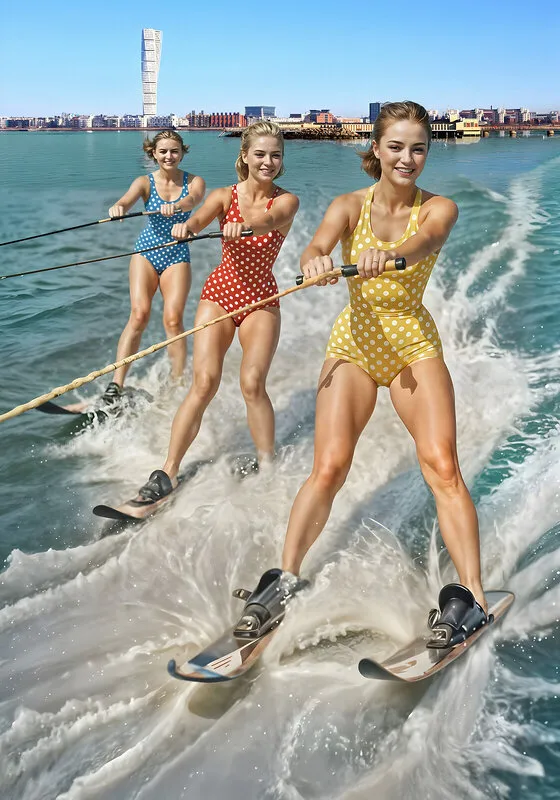
Ribban on Skis, 2025
Digital
50 x 70 cm
3 200 kr
Ribban on Skis
From wave to wake – A thousand years between surfing and water skiing. Polka dots, sunlight, and spray — three women glide across the Øresund on a bright summer morning. Their laughter drifts above the hum of the motorboat, past the long wooden pier and the pale outline of the cold bathhouse at Ribersborg. Behind them, Turning Torso twists like a sculpted wave of steel, echoing the motion of their bodies. The sea captures their reflections, breaking them into shards of blue and gold. For a moment, everything aligns — the harmony of grace and gravity, rhythm and freedom, art and innovation.
Since the dawn of time, humans have dreamed of walking on water — of gliding above its mirrored surface without sinking, of becoming one with its rhythm rather than its danger. Surfing was born from nature’s breath, a sacred dance between body and tide. Water skiing, by contrast, arose from the roar of engines — a 20th-century creation driven by speed, balance, and confidence in human ingenuity. One stemmed from respect for the ocean, the other from a fascination with control. Yet both originate from the same desire: a shared human longing to move with the world instead of against it, to find stillness in motion and flight in fluidity.
And then, in the last century, these two traditions — ancient and modern, spiritual and mechanical — converged on the same horizon. Their meeting was not a collision but a harmonious blend, a shared rhythm of sun, salt, and motion. Together, they birthed a new language of liberation — a dance of equilibrium and surrender, where humanity rediscovered the art of gliding across the living skin of the sea.
“Afloat
I skim and slide, I sway and spin,
the wave begins where I begin.
The sea’s a mirror, smooth and thin,
that laughs each time I fall back in.
I chase the balance, miss, then catch,
a fleeting dance, no rules to match.
The sun applauds, the wind keeps time,
the water hums its silent rhyme.
Some glide with grace, some get wetter,
some trust the rope, some trust the letter.
And some — with faith as grand as fashion —
believe they walk on waves with passion.
But let’s be fair, when truth comes knockin’:
great faith — and even greater shoes —
can keep you from the shockin’.”
Malmö. October 2025
From Wave to Wake – A Millennium Between Surfing and Water Skiing. Two Movements, One Sea. This breathtaking journey through water sports history spans a millennium, rich with remarkable stories and cultural importance.
Since the dawn of time, humankind has dreamed of walking on water — of gliding over its shifting mirror, upright and free. To ride a wave or a wake is to borrow, for a fleeting moment, the ocean’s own rhythm — to balance between gravity and grace, between surrender and control.
Surfing was born from nature’s breath, a dance between body and tide. Water skiing, by contrast, was created in the age of engines — an invention driven by curiosity and speed, using wood, rope, and horsepower. One grew from communion with the sea, the other from modernity’s desire for motion. Yet both express the same longing: to move with the element that shaped us, to play upon the surface of the deep.
And on a summer morning at Ribersborg, this long human dream appears to shimmer into being. Three women — one red-haired, one blonde, one dark — cut across the water in perfect parallel lines. Their 1950s swimsuits shine in the sunlight: yellow and white, red and white, blue and white polka dots. Behind them rises the pale outline of the cold bathhouse, its wooden arches smelling faintly of salt and pine. Further out, Turning Torso, a modern architectural marvel, curves against the sky like a modern totem, overseeing the Baltic’s tranquil swell. Spray catches the light; laughter blends with the hum of the motorboat. For a moment, the sea itself seems to smile — as if the ancient wave and the modern wake have finally become one. This scene, a beautiful blend of past and present, captures the essence of water sports and their enduring appeal.
It is here, in this meeting of pulse and power, that the story begins — the thousand-year conversation between surfing and water skiing, a dialogue that has evolved over centuries. It's a conversation between nature and invention, between what flows and what propels. This ongoing dialogue, marked by innovation and tradition, remains a source of endless fascination and intrigue.
The Heritage of the Wave – The Spiritual History of Surfing
Long before engines hummed or ropes tightened, there was only the wave — and the body that dared to meet it. In ancient Polynesia, surfing was not a sport but a sacred dialogue between humans and the sea. The first surfers did not conquer the ocean; they conversed with it. Each wave was a moving mountain, a living spirit whose crest could lift the rider toward the gods.
In Hawaii, the art of heʻe nalu — “wave sliding” — was once exclusive to chiefs and kings. Their surfboards, carved from the koa tree, were anointed with coconut oil and prayers before entering the water. To ride a wave was to embody harmony — to read the wind, the tide, and the heartbeat of the earth itself. The surfer’s balance was not just physical; it was spiritual, an act of alignment between body, soul, and ocean, a tradition that connects us to the profound spiritual history of surfing.
When European explorers arrived in the 18th century, they observed with awe — and unease. Captain James Cook’s crew described men and women who appeared to defy nature, standing upright on rolling water, laughing as they moved towards the shore. To the Western eye, it resembled magic, even blasphemy — the body made weightless, the rules of gravity broken, a feat that inspired both admiration and fear.
For centuries afterwards, colonial powers suppressed this practice. Missionaries regarded it as pagan, indecent, and a sin of pleasure. The waves grew silent, and the sacred boards were forgotten. But the ocean remembered. In the early 20th century, surfing made a comeback — first as nostalgia, then as rebellion. Modern boards replaced koa wood; wax and fibreglass replaced prayer. Yet the essence remained unchanged: a quiet, wordless pursuit of balance, a testament to the enduring spirit of surfing.
Surfing remains a form of listening — surrendering to the breathing sea and recognising rhythm as language. It involves accepting that mastery is found not in control but in flow. Every wave offers a lesson: nothing endures, everything shifts, and happiness is found solely in the moment between rising and falling.
The Awakening of the Engine – The Invention of Water Skiing
If surfing was born from the pulse of the sea, water skiing was born from the hum of invention. It appeared not on the shores of the Pacific but in the heartland of America — far from salt and coral, in the fresh waters of Minnesota. The year was 1922, the Jazz Age had begun, and a young man named Ralph Samuelson stood on a pair of ordinary wooden planks and decided that if one could ski on snow, one might also ski on water.
What he created on Lake Pepin was remarkably new — a blend of body and machine, of balance and propulsion. He heated the tips of his planks over a fire to make them bend, a technique that allowed for better control and manoeuvrability. He strapped his feet down with leather belts, ensuring a secure connection to the skis, and held tightly to a rope tied to a roaring motorboat. His discovery was as much instinct as science. Lean back, he realised, and let the water lift you. Keep your arms straight and your faith steady. The wake beneath you is not your enemy but your path.
Unlike surfing, which emerged from myth and ritual, water skiing was a product of modern curiosity — a child of speed, summer, and the American dream. It grew up alongside radios and convertibles, with picnics and optimism. The boat’s engine became a kind of modern deity: a mechanical wave that could be summoned at will. Water skiing became a symbol of the American spirit, a testament to the nation's love for adventure and innovation.
By the 1930s, others joined in. Wooden skis were polished, metal bindings added, and competitions began, marking a significant shift in the sport's evolution. Soon, the sport migrated south, finding its paradise in Florida’s endless sunshine.
In the years following the war, water skiing evolved into a display of movement and glamour — sequinned costumes, synchronised formations, pyramids of smiling women balancing on each other’s shoulders. At Cypress Gardens, America’s aquatic stage, it became not just a sport but a theatre.
Where the surfer sought solitude, the skier sought jubilation. Where the surfboard whispered, the motorboat thundered. Yet beneath the noise, both concealed the same secret: the thrill of defying gravity with grace, the joy of movement between resistance and release. This is the poetry of water sports, a dance with the elements that brings exhilaration and satisfaction to those who participate in it.
And in time, these two lineages — the ancient and the modern — would meet again, their wakes crossing like ripples on the same endless water. This unity in diversity makes water sports culture both rich and fascinating. It celebrates the human spirit's capacity to adapt and innovate, generating new experiences and expanding the limits of what can be achieved, inspiring us all to push our boundaries.
Aquaplaning – The Meeting of Two Worlds
Before the surfboard met the motorboat, there was the aquaplane — a wide, flat plank pulled behind early speedboats in the 1910s and 1920s. It served as the missing link between ancient ritual and modern recreation, a bridge of varnished wood gliding between eras. The aquaplane, with its straightforward approach, played a significant role in the evolution of water sports. The rider stood upright, knees bent, hair flowing, as the water turned to silver beneath them. It was a pivotal moment in the history of water sports, a new form of recreation shimmering between eras.
These early aquaplaners were showpeople and experimenters — wealthy holidaymakers on American lakes and European resorts who pursued the illusion of flight. Photographs from the 1920s show women in bathing caps and men in striped trunks standing proudly on their planks, smiling towards the camera as the wake fans out behind them. They had no idea they were rehearsing a reunion — the reunion of surfing’s balance with engineering’s drive, a significant event that would shape the future of water sports.
As engines became more powerful and skis transformed into paired boards, the aquaplane’s role diminished — yet its spirit persisted. Decades later, when surfers started to seek out waves too large to paddle into, they rediscovered the same principle: to be towed into motion. This led to the emergence of tow-in surfing in the 1990s, a stunning fusion where jet skis replaced boats and bravery replaced limitations. The evolution of water sports was marked by this awe-inspiring fusion, a moment that filled the water sports community with excitement and wonder. Surfers could now ride enormous waves once deemed impossible, thanks to the courage and technological advancements in tow-in surfing.
What Ralph Samuelson did on his lake in 1922 resonated across oceans seventy years later. The rope that once symbolised control became, once again, a lifeline between human and element — a thread connecting the ancient sea-riders of Polynesia to the machine-riders of the modern world.
It was no longer about who invented what or which came first. The real story was one of return — of how technology, after centuries of trying to control nature, found itself once more drawn into her rhythm.
On every aquaplane, ski, or surfboard towed into the deep, the same truth is revealed: we progress by surrendering. In water sports, 'surrendering' means releasing control and letting the natural forces of the water steer the movement. We only rise when the water consents, emphasising the deep bond between the human spirit and the elements.
The 1950s – Sun, Speed, and Freedom
The 1950s arrived like a postcard from paradise — bright, glossy, and filled with motion—the world, weary from war, rediscovered pleasure in leisure. The beach became the new cathedral, its altar the horizon, and its gospel the sound of engines and surf. On both sides of the Atlantic, people flocked to the water seeking renewal, and there, beneath the vast blue sky, two once-separate dreams began to merge, uniting a generation in a shared love for water sports, creating a sense of unity and shared experience that transcended borders.
In California, surfboards stood like symbols of rebellion. Barefoot youth, tanned and carefree, carried them down to Malibu’s gentle waves, where the Pacific rolled in slow, golden curves. Surfing, once a sacred ritual, became a symbol of freedom — sun-bleached, cinematic, alive with guitar chords and salt spray. Its image was effortless grace: balance as beauty, risk as style.
Meanwhile, across the continent, Florida shimmered with the sparkle of motorboats and activity. At Cypress Gardens, synchronised skiers built stunning human pyramids, with sequined girls waving from the top tier, faces framed by the spray of their own speed. Hollywood arrived with its cameras; postcards and travel posters promoted the scene to the world. Water skiing embodied modernity’s promise in motion — precision, glamour, teamwork, and the hum of machinery.
Even Europe caught the fever. On the French Riviera, in Lake Garda’s shimmering light, and along Sweden’s southern coastlines, summer scenes unfolded with a familiar rhythm — striped swimsuits, polished boats, the laughter of a new, confident generation. At Ribersborg in Malmö, the northern light played a subtler tune: three women in polka-dot swimsuits gliding across the Øresund, the wooden outline of the cold bathhouse behind them, and far beyond, Turning Torso spiralling upward like a sculpted wave of steel and glass. The modern and the timeless met in one frame — the pulse of the sea beneath, the dream of progress above.
The media of the decade played a pivotal role in weaving these images together — surfboards and skis, salt and freshwater, youth and invention — into a shared mythology of movement. Surf songs and travel adverts promised happiness at high speed. To move was to live; to stand still was to vanish. The wave and the wake, the ritual and the rehearsal, had finally found each other in a choreography of light and sound, shaping a cultural narrative that resonated with a generation and significantly influenced their perception of the era.
Yet beneath the glamour, something more human remained — an awareness that both sports, despite originating in different centuries, fulfilled the same unspoken desire: to feel the boundary between self and sea dissolve. Whether drawn by wind or engine, the dream remained the same — to let the water carry us, borrowing its freedom for a little while. This universal longing for freedom and connection with nature is what made the 1950s water sports culture so appealing and enduring, evoking a sense of nostalgia and appreciation for the era.
From Show to Self-Expression
By the 1960s, the pursuit of perfection in choreography began to wane. The synchronised smiles of Florida’s water ski pyramids gave way to something more contemplative — the solitary figure on the wave. The world was changing; so was the water. The post-war brightness faded, and a new generation, including figures like [specific individual or group], sought not spectacle but authenticity.
In California, surfing underwent a profound transformation, evolving from a mere spectacle into a powerful philosophy that rebelled against conformity and consumerism. The Beach Boys' tunes still echoed with promises of fun and sunshine, but beneath the harmonies, a deeper story was emerging — the surfer as a seeker, poet, and wanderer. Long hair replaced sequins; silence replaced applause. Surfing became a form of meditation, a protest against the ordinary. The ocean no longer just served as a stage — it became a teacher, a canvas for personal expression and freedom.
Water skiing, by contrast, remained resolute in its emphasis on precision and display — the physics of motion carefully measured by rope length and angle. However, even within this framework, individuality began to flourish. Trick skiing and freestyle moves replaced the once-rigid routines. The sport’s beauty shifted from mere symmetry to the spontaneity of creativity. The skier, once just a part of a pyramid, now carved her own unique signature across the wake, tracing fleeting calligraphy on the surface of the lake. This was a testament to the beauty of individuality in a sport long associated with precision and uniformity.
What united these transformations was a subtle yet profound shift: the return of the body as interpreter, not performer. This shift, which was [specific details about the change], blurred the line between art and sport. Both surfers and skiers began to seek not applause but presence — that perfect, weightless moment when control and surrender become one.
And in this transformation, a deeper reconciliation occurred. The engine no longer opposed the wave; instead, it complemented it. Human invention became an extension of nature’s rhythm rather than its rival. The mechanical hum softened into a kind of harmony — the sound of modernity learning, at last, to breathe in time with the sea. This reflected the beauty of human ingenuity in harmony with nature, serving as a reminder of our profound connection to the natural world.
Today’s Hybrids – Wakeboard, Foil, and Flight
In the late twentieth and early twenty-first centuries, the dialogue between wave and wake reached its final synthesis. This journey, which began with the ancient Polynesian surf priests and continued through the 1950s showgirls, saw the evolution of water sports from traditional surfing to the modern wakeboard, hydrofoil, and e-foil. Technology, once a force of separation, became the bridge. The sea, ever adaptable, welcomed new forms — shorter boards, hydrofoils, ropes, wings, and electric dreams. From this convergence, a new generation of riders emerged who no longer saw boundaries between surfing and skiing, between tradition and invention.
The wakeboard, the pioneer of hybrids, was a surfboard reimagined for the age of speed. Compact, curved, and nimble, it blended the elegance of surfing with the precision of skiing. Behind the thunderous wake of a boat, riders carved arcs that mimicked ocean swells, executing mid-air spins and flips that transformed lakes into liquid arenas. The wake replaced the wave, yet the essence remained unchanged: equilibrium, rhythm, and submission to motion.
Then emerged the hydrofoil, a marvel of engineering that hoisted the board entirely above the water. With its sleek, submerged wings, the rider appeared to float through the air, gliding noiselessly over the surface — the body a blend of angelic grace and engineering finesse. Once again, humanity reached for its age-old aspiration: to transcend gravity without forsaking its pact with the sea.
Some dared to go further. The e-foil — silent, battery-powered, and self-propelled — blurred the boundaries between surfing, skiing, and flying. It carried the rider not through the water but above it, a solitary figure gliding through dawn mist like a thought in motion. Others revisited the ocean’s behemoths, using jet skis to tow themselves into waves so colossal they resembled moving cliffs. Tow-in surfing was both a renaissance and an advancement — the rope reborn, the connection reestablished.
These modern hybrids do not replace their predecessors; they complete them. The rope that once connected the skier to the boat now connects technology to heritage. Every new craft, every board that cuts or hovers, carries within it both the chant of Polynesian surf priests and the laughter of 1950s showgirls. The cultural significance of water sports, from their ancient roots in Polynesian rituals to their modern-day popularity, is a testament to their enduring appeal. What was once separate — ritual and machinery, silence and applause — has become a single, flowing continuum.
In this way, the story returns to its beginning. Whether on a Polynesian beach a thousand years ago or outside the cold bathhouse at Ribersborg, the dream remains the same: to stand above the deep and move as water moves — effortlessly, joyfully, eternally alive.
Sound, Vision, and the Sea – Surfing and Water Skiing in Music, Art, and Literature
When motion becomes myth, it always finds its way into art. Surfing and water skiing, those twin gestures of balance and release, have transcended time and space to inhabit the languages of music, painting, and literature. Each medium transforms movement into rhythm, colour, and metaphor, creating a timeless allure that resonates across generations and cultures. Their influence is not bound by a specific era or location, but enriches the artistic landscape with a heritage that spans centuries.
The Music of Motion
Few eras captured the joy of the sea quite like the 1960s, when California became both a coastline and a dream. The Beach Boys distilled the essence of surfing into harmony — that strange, sunlit blend of innocence and melancholy. Their songs, like Surfin’ USA and Catch a Wave, were not merely anthems of youth; they were hymns to endless summer, to the illusion that time itself could be outrun. Surf rock, with its transformative power, turned the guitar into a wave — its tremolo strings mimicking the shimmer of sunlight on water, its rhythm section echoing the push and pull of the tide.
But water skiing, too, had its soundtrack — not rebellion, but celebration. Big-band orchestras of the 1950s and early television shows often featured exuberant aquatic performances, where brass instruments complemented the sparkle of sequins and the crescendo of spray. This joyful celebration of water and rhythm, from Elvis films set on sunlit coasts to Swedish schlager melodies that transformed Ribersborg or Tylösand into Nordic equivalents of Malibu, is a nostalgic reminder of the happiness that water sports bring.
The Painter’s Sea
In visual art, the image of a figure gliding over water has sustained its power. From Hokusai’s woodcuts to David Hockney’s swimming pools, artists have been drawn to that liminal surface — the space where reflection and reality blend. Surfing captures this paradox: the human body balanced between immersion and transcendence, both within the sea and above it.
In the 1950s and 1960s, the Californian light school — painters like Billy Al Bengston and Ed Ruscha — captured surfing’s graphic purity: clean lines, sun-bleached colours, horizon as minimalism. Simultaneously, European modernists toyed with the geometry of motion; in postwar Sweden, where the sea was colder and the light more diffused, photographers turned vattenskidor into symbols of vitality and optimism — emblems of the welfare state’s promise that every citizen might, one day, stand on water.
Contemporary artists continue to reinterpret this mythology, drawing inspiration from the curve of the wave and the gleam of the wake. Digital art, performance, and even architecture are all influenced by the enduring legacy of water sports. Turning Torso in Malmö — twisting like a vertical breaker of steel — can be seen as a frozen surf, a monument to movement held in suspension. This ongoing influence of water sports on contemporary art is a testament to the enduring power of these activities to inspire new forms of artistic expression.
Words on Water
Writers, too, have long been haunted by the idea of standing on water. Jack London described the sea as both master and mirror; Albert Camus depicted the swimmer’s revolt against absurdity; Joan Didion turned the Californian surf into a metaphor for beauty on the brink of collapse. Each recognised that to ride a wave — literal or metaphoric — is to exist within the delicate rhythm of time.
In fiction and poetry alike, the surfer or skier becomes a symbol of the modern identity — balanced between control and surrender, risk and grace. The image of the human gliding across water recurs as a symbol of freedom but also of denial: the refusal to sink, the will to move forward regardless of circumstances. From the haiku of Bashō to the existential prose of Hemingway’s The Old Man and the Sea, the ocean has endured as both companion and challenge.
And somewhere within this lineage — between Polynesian chant and pop lyric, between ancient ritual and Technicolour fantasy — Imagine the figures from Ribersborg: three women in polka-dot swimsuits, slicing the Øresund into shimmering ribbons of light. They feel as much a part of art as they do of life — brushstrokes on a moving canvas, musical notes on a blue score.
The Return of the Sea as Muse
In our own era, as climate change redraws coastlines and seasons, the sea has reclaimed its voice in both art and activism. Surfers and skiers now share a common language of ecology, understanding the importance of preserving the environment that allows them to practice their sports. “The wave” is no longer just a thrill, but a duty. The culture of water sports has evolved into a culture of awareness, featuring exhibitions, films, and installations that convey both the fragility of our oceans and the freedom they provide.
Thus, from Polynesian myth to pop song, from woodcut to wakeboard, the story of standing on water is not just a story about water sports. It is a story of art itself — our endless effort to freeze movement, to turn the fleeting into form, and to find inspiration in the natural world around us.
And still, the sea refuses to be captured. It continues returning, whispering its rhythm into each new generation of artists and dreamers. As long as humans create, they will paint, write, and sing the same refrain: the longing to rise, to glide, to be carried by what cannot be owned.
Walking on Water – From Miracle to Motion
Since the dawn of civilisation, the aspiration to walk on water has been a recurring motif, deeply rooted in the historical and cultural fabric of humanity. This powerful image permeates myth, religion, and art, symbolising transcendence and the ability to rise above the ebb and flow of life-giving waters. Long before the iconic moment when Christ traversed the Sea of Galilee, other figures — gods, sages, and heroes — were said to have achieved this feat, each driven by the unique ethos of their time: faith, wisdom, or the pursuit of harmony with the natural world.
Before Christ – The Sacred Predecessors
In ancient India, legends spoke of Vishnu, who measured the universe in three cosmic strides, his feet touching both sky and sea. In Buddhist tradition, enlightened beings could walk upon lotus-covered waters — symbols of the mind’s serenity above illusion. In China, the Daoist immortals, the xian, were said to cross rivers by aligning perfectly with the flow of nature. And in Greece, only the children of Poseidon — Triton, or Perseus with his winged sandals — could skim the sea’s surface, bridging the divine and the human through balance and grace.
Across these diverse traditions, the act of walking on water was not a defiance of nature, but a profound harmony with it. The miracle was not about dominance, but about unity. The tranquillity of the body mirrored the tranquillity of the mind; the impossible became possible because the will and the world were in perfect sync, fostering a sense of connection and peace.
Christ and the Power of Faith
When Jesus walked upon the stormy waters of Galilee, the gesture brought together all these older symbols into a single act of revelation. It was not a display of power but of faith. As Peter stepped towards him and began to sink, the meaning became clear: doubt pulls us under, belief keeps us afloat. The sea in the Gospels is not just a body of water — it represents the abyss of fear, the chaos of the world. This understanding of the sea as a symbol of fear and confusion in the Gospels adds depth to the story of Jesus walking on water, highlighting the transformative power of faith and belief, inspiring hope and courage in the readers.
Hence, the Christian miracle changed an ancient symbol of harmony into a parable of trust. Where earlier myths described union with nature, Christ’s act introduced a new element — moral courage, inner conviction, the will to rise above despair.
After Christ – The Secular Heirs
In later centuries, saints, mystics, and visionaries carried on this image. Stories of Francis of Assisi or Russian ascetics floating above the sea reflected a desire to reconnect with the divine through simplicity and love. Artists transformed the miracle into metaphor; poets used it to describe inspiration — the artist as one who walks upon the unstable surface of existence without sinking into it.
In the modern era, this dream of walking on water transitioned from the divine realm to the earthly realm, or more precisely, to the water’s edge. The surfer and the water skier emerged as the secular heirs to this miraculous act, not through faith, but through balance, precision, and rhythm. They, too, walk upon the waves — not to command them, but to share their movement. What was once a divine revelation has now evolved into a human art form, crafted not through prayer but through practice, not rooted in holiness but in harmony.
Each figure who stands upon the water — saint, sage, or athlete — exemplifies the same truth: that freedom begins where fear ends, that grace resides in motion, and that transcendence is not an escape from the world, but full engagement with it.
And so, the miracle persists — no longer limited to scripture, but rewritten each summer across the face of the sea.
Epilogue – The Eternal Surface
In the end, every water story becomes a tale about time. The wave rises, the wake fades, yet the longing to stand on it — that trembling moment of balance — persists. Across a thousand years, from the sacred boards of Polynesia to the shimmering mornings at Ribersborg, humanity has repeatedly returned to the same impossible question: how to stay upright on what refuses to stay still.
Standing on water is to believe, however briefly, that harmony exists between surrender and control. The surfer listens to the tide; the skier trusts the rope. One follows nature’s breath, the other the rhythm of the engine — yet both discover that mastery is not in power, but in timing. The moment you force it, you fall. The moment you yield, you fly. This delicate balance, this dance with the elements, is a thing of beauty that inspires us all.
Perhaps that is why these sports have become metaphors far beyond their shores. They speak of art, of love, of life itself — each an attempt to stay in motion while the world shifts beneath us. We paint waves to hold them still, write poems to slow their breaking, compose songs to echo their rise and fall. But the truth of water resists permanence. It teaches us to move, not to cling.
At Ribersborg, the sea is calm now. Autumn has arrived, bringing storm and rain. The motorboat has disappeared beyond the horizon; the air carries only a faint scent of salt and summer. Yet if you listen closely, you can still hear it — the hum of an engine mingling with the whisper of the tide, the laughter of three women carved in light and spray. For a moment, the ancient and the modern, the sacred and the playful, are one. This unity, this connection between past and present, is a reminder of our shared human experience.
And in that moment — fleeting as a heartbeat — the dream reaches its end. We stand on the eternal surface, neither above nor below, but precisely in the middle: where freedom starts, where balance is everything, and where the sea, forever shifting, allows us — just once — to move with it. This moment, so brief and yet so profound, is a reminder of the urgency of living in the present, of seizing the opportunities that life presents us.
And so the circle concludes. The wave and the wake meet silently, merging the boundaries between nature and machine, ritual and recreation. What persists is the shimmer of sunlight on water — timeless, indifferent, forgiving. It is there that we rediscover ourselves, momentarily suspended above the depths, straddling the delicate line between earth and sky.
For a moment — just a moment — we stand upon the water.
3 200 kr

Jörgen Thornberg
Malmö
Lite om bilder och mig. Translation in English at the end.
Jag är en nyfiken person som ser allt i bilder, även det jag fäster i ord, gärna tillsammans för bakom alla mina bilder finns en berättelse. Till vissa bilder hör en kortare eller längre novell som följer med bilden.
Bilder berättar historier. Jag omges av naturlig skönhet, intressanta människor och historia var jag än går. Jag använder min kamera för att dokumentera världen och blanda det jag ser med vad jag känner för att fånga den dolda magin.
Mina bilder berättar mina historier. Genom mina bilder, tryck och berättelser. Jag bjuder in dig att ta del av dessa berättelser, in i ditt liv och hem och dela min mycket personliga syn på vår värld. Mer än vad ögat ser. Jag tänker i bilder, drömmer och skriver och pratar om dem; följaktligen måste jag också skapa bilder. De blir vad jag ser, inte nödvändigtvis begränsade till verkligheten. Det finns en bild runt varje hörn. Jag hoppas att du kommer att se vad jag såg och gilla det.
Jag är också en skrivande person och till många bilder hör en kortare eller längre essay. Den följer med tavlan, tryckt på fint papper och med en personlig hälsning från mig.
Flertalet bilder startar sin resa i min kamera. Enkelt förklarat beskriver jag bilden jag ser i mitt inre, upplevd eller fantiserad. Bilden uppstår inom mig redan innan jag fått okularet till ögat. På bråkdelen av ett ögonblick ser jag vad jag vill ha och vad som kan göras med bilden. Här skall jag stoppa in en giraff, stålmannen, Titanic eller vad det är min fantasi finner ut. Ännu märkligare är att jag kommer ihåg minnesbilden långt efteråt när det blir tid att skapa verket. Om jag lyckas eller inte, är upp till betraktaren, oftast präglat av en stråk av svart humor – meningen är att man skall bli underhållen. Mina bilder blir ofta en snackis där de hänger.
Jag föredrar bilder som förmedlar ett budskap i flera lager. Vid första anblicken fylld av feel-good, en vacker utsikt, fint väder, solen skiner, blommor på ängen eller vattnet som ligger förrädiskt spegelblankt. I en sådan bild kan jag gömma min egentliga berättelse, mitt förakt för förtryckare och våldsverkare, rasister och fördomsfulla människor - ett gärna återkommande motiv mer eller mindre dolt i det vackra motivet. Jag försöker förena dem i ett gemensamt narrativ.
Bild och formgivning har löpt som en röd tråd genom livet. Fotokonst känns som en värdig final som jag gärna delar med mig.
Min genre är vid som framgår av mina bilder, temat en blandning av pop- och gatukonst i kollage som kan bestå av hundratals lager. Vissa bilder kan ta veckor, andra någon dag innan det är dags att överlämna resultatet till printverkstaden. Fine Art Prints är digitala fotocollage. I dessa kollage sker rivandet, klippandet, pusslandet, målandet, ritandet och sprayningen digitalt. Det jag monterar in kan vara hundratals år gamla bilder som jag omsorgsfullt frilägger så att de ser ut att vara en del av tavlan men också bilder skapade av mig själv efter min egen fantasi. Därefter besöks printstudion och för vissa bilder numrera en limiterad upplaga (oftast 7 exemplar) och signera för hand. Vissa bilder kan köpas i olika format. Det är bara att fråga efter vilka. Gillar man en bild som är 70x100 men inte har plats på väggen, går den kanske att få i 50x70 cm istället. Frågan är fri.
Metoden Giclée eller Fine Art Print som det också kallas är det moderna sättet för framställning av grafisk konst. Villkoret för denna typ av utskrifter är att en högkvalitativ storformatskrivare används med åldersbeständigt färgpigment och konstnärspapper eller i förekommande fall på duk. Pappret som används möter de krav på livslängd som ställs av museer och gallerier. Normalt säljer jag mina bilder oinramade så att den nya ägaren själv kan bestämma hur de skall se ut, med eller utan passepartout färg på ram, med eller utan glas etc..
Under många år ställde jag bara ut på nätet, i valda grupper och på min egen Facebooksida - https://www.facebook.com/jorgen.thornberg.9
Jag finns också på en egen hemsida som tyvärr inte alltid är uppdaterad – https://www.jth.life/ Där kan du också läsa en del av de berättelser som följer med bilden.
UTSTÄLLNINGAR
Luftkastellet, oktober 2022
Konst i Lund, november 2022
Luftkastellet, mars 2023
Engleson Galleri Caroli, april 2023
Hydra, Greece June 2023
Engleson Galleri Caroli, oktober 2023
Toppen, Höllviken december 2023
Luftkastellet, mars 2024
Torups Galleri, mars 2024
Venice, May 2024
Luftkastellet, oktober 2024
Konst i Advent, December 2024
Galleri Engleson, Caroli December 2024
Jäger & Jansson Galleri, april 2025
A bit about pictures and me.
I'm a curious person who sees everything in pictures, even what I express in words, often combining them, for behind all my pictures lies a story. These narratives, some as short as a single image and others as long as a novel, are the heart and soul of my work.
Pictures tell stories. Wherever I go, I'm surrounded by natural beauty, exciting people, and history. I use my camera to document the world and blend what I see with what I feel to capture the hidden magic.
My images tell my stories. Through my pictures, prints, and narratives, I invite you to partake in these stories in your life and home and share my deeply personal perspective of our world. More than meets the eye. I think in pictures, dream, write, and talk about them; consequently, I must create images too. They become what I see, not necessarily confined to reality. There's a picture around every corner. I hope you'll see what I saw and enjoy it.
I'm also a writer, and many images come with a shorter or longer essay. It accompanies the painting, printed on fine paper with my personal greeting.
Many pictures start their journey on my camera. Simply put, I describe the image I see in my mind, experienced or imagined. The image arises within me even before I bring the eyepiece to my eye. In a fraction of a moment, I see what I want and what can be done with the picture. Here, I'll insert a giraffe, Superman, the Titanic, or whatever my imagination conjures up. Even stranger is that I remember the mental image long after it's time to create the work. Whether I succeed is up to the observer, often imbued with a streak of black humour – the aim is to entertain. My pictures usually become a talking point wherever they hang.
I prefer pictures that convey a message in multiple layers. At first glance, they're filled with feel-good vibes, a beautiful view, lovely weather, the sun shining, flowers in the meadow, or the water lying deceptively calm. But beneath this surface beauty, I often conceal a deeper story, a narrative that challenges societal norms or explores the human condition. I invite you to delve into these hidden narratives and discover the layers of meaning within my work.
Picture and design have been a thread running through my life. Photographic art feels like a fitting finale, and I'm happy to share it.
My genre is varied, as seen in my pictures; the theme is a blend of pop and street art in collages that can consist of hundreds of layers. Some images can take weeks, others just a day before it's time to hand over the result to the print workshop. Fine Art Prints are digital photo collages. In these collages, tearing, cutting, puzzling, painting, drawing, and spraying happen digitally. What I insert can be images hundreds of years old that I carefully extract so they appear to be part of the painting, but also images created by myself, now also generated from my imagination. Next, visit the print studio and, for certain images, number a limited edition (usually 7 copies) and sign them by hand. Some images may be available in other formats. Just ask which ones. If you like an image that's 70x100 but doesn't have space on the wall, you might be able to get it in 50x70 cm instead. The question is open.
The Giclée method, or Fine Art Print as it's also called, is the modern way of producing graphic art. This method ensures the highest quality and longevity of the artwork, using a high-quality large-format printer with archival pigment inks and artist paper or, in some cases, canvas. The paper used meets the longevity requirements set by museums and galleries. I sell my pictures unframed, allowing the new owner to personalise their artwork, confident in the lasting value and quality of the piece.
For many years, I only exhibited online, in selected groups, and on my Facebook page - https://www.facebook.com/jorgen.thornberg.9. I also have my website, which unfortunately is not constantly updated - https://www.jth.life/. You can also read some of the stories accompanying the pictures there.
EXHIBITIONS
Luftkastellet, October 2022
Art in Lund, November 2022
Luftkastellet, March 2023
Engleson Gallery Caroli, April 2023
Hydra, Greece June 2023
Engleson Gallery Caroli, October 2023
Toppen, Höllviken December 2023
Luftkastellet, March 2024
Torup Gallery, March 2024
Venice, May 2024
UTSTÄLLNINGAR
Luftkastellet, oktober 2022
Konst i Lund, november 2022
Luftkastellet, mars 2023
Engleson Galleri Caroli, april 2023
Hydra, Greece June 2023
Engleson Galleri Caroli, oktober 2023
Toppen, Höllviken december 2023
Luftkastellet, mars 2024
Torups Galleri, mars 2024
Venice, May 2024
Luftkastellet, October 2024
Konst i Advent, December 2024
Galleri Engleson, Caroli December 2024
Jäger & Jansson Galleri, April 2025
Utbildning
Autodidakt
Medlem i konstnärsförening
Öppna Sinnen
Med i konstrunda
Konstrundan i Skåne
Utställningar
Luftkastellet, October 2022
Art in Lund, November 2022
Luftkastellet, March 2023
Engleson Gallery Caroli, April 2023
Hydra, Greece June 2023
Engleson Gallery Caroli, October 2023
Toppen, Höllviken December 2023
Luftkastellet, March 2024
Torup Gallery, March 2024
Venice, May 2024