Vi använder cookies för att ge dig bästa möjliga upplevelse. Välj vilka cookies du tillåter.
Läs mer i vår integritetspolicy
Jörgen Thornberg
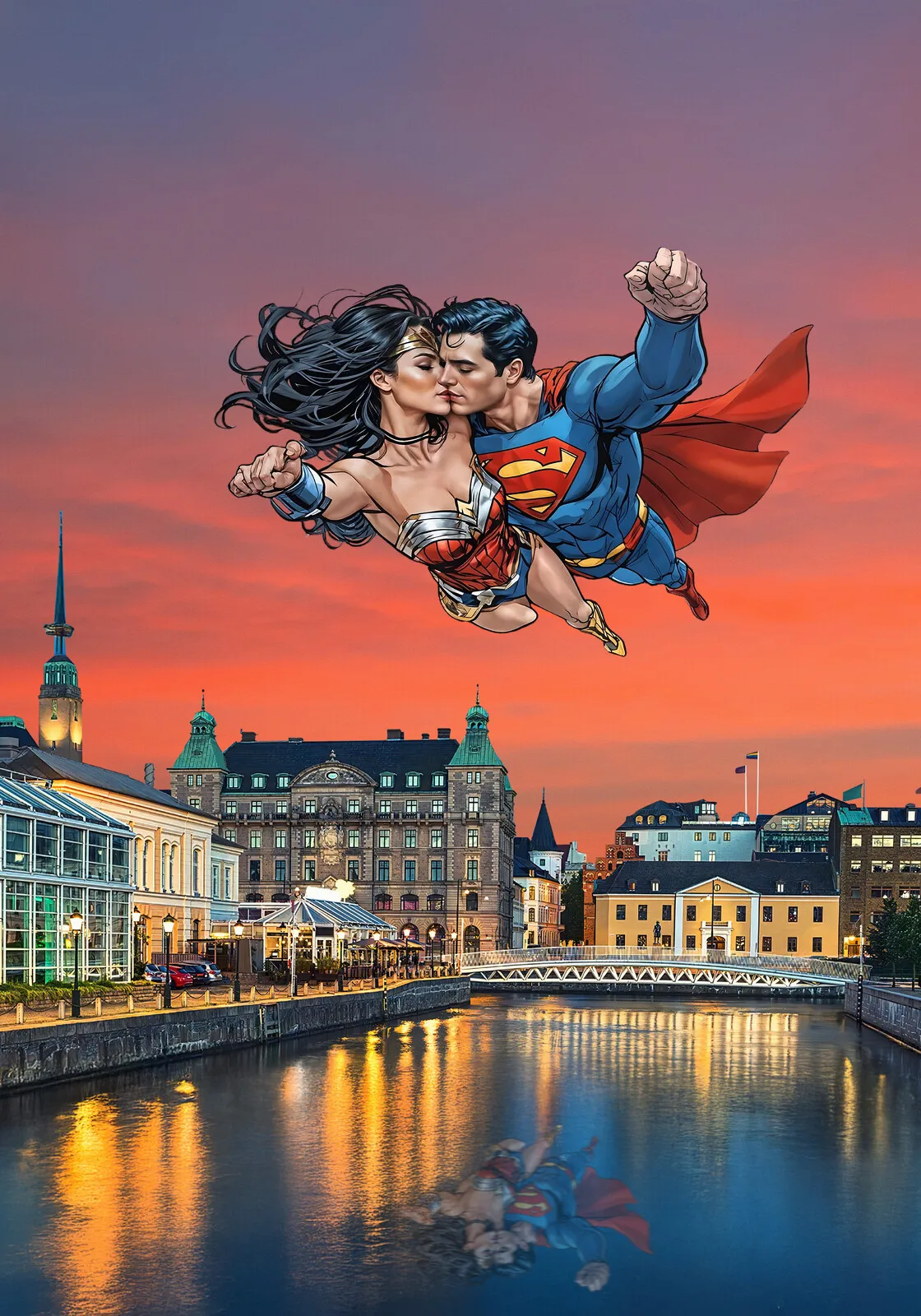
Love in the Air, 2025
Digital
50 x 70 cm
3 200 kr
Love in the Air
This is an essay about a phrase that everyone knows, yet its history is rarely explored. Love in the Air is more than just a saying – it is an image, a feeling, a rhythm that has persisted from the earliest myths to contemporary popular culture. When I started writing about the topic, I realised how the words held a duality: they are as light as a whisper and as weighty as tradition. They guide us from Adam and Eve in Eden, through Elizabeth Barrett Browning and Shakespeare, to Banksy, Taylor Swift, and John Paul Young. It's a phrase that unites us all in its universal appeal.
The essay oscillates between art, music, poetry, and film – spanning Malmö and Broadway, from the moon in Moonstruck to heart-shaped balloons drifting above New York's rooftops. It explores how love has been depicted through language and imagery, elevating us beyond the mundane and making the unseen visible.
I chose to retain the title in English because 'Love in the Air' has become a cultural heritage in itself, encompassing everything from pop songs to works of art, from political actions to wedding ceremonies. It is an expression that conveys both expectation and promise – something felt in the air long before it manifests in action.
Join me as we step through the portal of this essay to explore the captivating words of love, deeply connected with themes of romance and affection. This essay is not just a piece of writing, but a gateway to both entertain and enlighten you about the symbolic link between romance and love. We will examine the historical significance and profound cultural impact of these words across various societies, offering you a deeper understanding of this timeless wonder and its role in conveying human emotions.
“Love in the Air
It drifts unseen on a summer breeze,
a murmur woven through the trees,
a trembling hush before the rain,
a touch that heals, a tender flame.
It hovers low above the street,
where strangers pass and lovers meet,
a fleeting glance, a sudden smile,
the world transformed for just a while.
It lifts the heart, it bends the sky,
it teaches stone and steel to fly,
a song that blooms in silent air,
and makes the city light and fair.
No chains can bind, no walls contain,
the pulse of love, its sweet refrain.
It moves unseen, yet everywhere—
forever timeless, in the air.”
Malmö. August 2025
Love in the Air – an Essay on an Expression Filled with Love and Expectation
Some words are all it takes to change the atmosphere of a room. ‘Love in the Air’ is one of those words. It is more than a phrase – it is a feeling, a promise, a premonition that something is about to happen. When we say that love is in the air, we don’t mean it can be touched or measured. We mean that it can be felt – like electricity before a thunderstorm, like the scent of the sea before the waves appear.
In the image where Superman kisses Wonder Woman above the waterways of Malmö, the expression becomes literal. They hover in the air, supported by both strength and passion, as the city’s daily rhythm continues below. The reflection in the canal affirms the moment – it is not merely a dream, but a shimmer between reality and fantasy. That is precisely what the phrase captures: the instant when everything feels possible, when love is no longer just a feeling in the heart but something that fills the room, the city, the world.
The same transformative power of love is vividly depicted in art. Banksy's 'Love is in the Air' shows a masked man throwing not a Molotov cocktail but a bouquet, turning protest into an act of love. David Drebin’s heart-shaped balloons drift over big cities, transforming dull urban scenes into visions of magic. In the film Moonstruck, the full moon itself becomes the stage for passion’s irresistible force. And in John Paul Young’s disco anthem from 1977, 'Love is in the Air' became a worldwide hit – so infectious it was later revived in Baz Luhrmann’s Strictly Ballroom. These artistic expressions remind us of the transformative power of love, showing how it can turn the ordinary into the extraordinary and inspire us to view the world through the lens of love.
What all these expressions share is not a portrayal of love as safe or predictable – on the contrary. Love in the air is fleeting, surprising, and inexplicable. It strikes rather than being planned. It is like the wind: invisible, yet unmistakable in everything it stirs.
Speaking of love in the air also means speaking of the collective. Love is not solely private; it can fill a square, a nation, or even a generation. When the people of Malmö, on a summer evening, see two lovers on a bridge or a kiss reflected in the canal at sunset, they share in the same atmosphere. Love in the air is precisely that: something experienced by more than just the two who kiss. It is a shared experience that transcends individual relationships and becomes an integral part of the cultural and societal fabric, making us all part of a larger whole, a part of a shared love story.
That is why the expression feels timeless. Expectation, hope, infatuation – all of this is already in the air before it becomes words or actions. Just as a storm is sensed before it breaks, love is sensed before it is spoken. Love in the Air thus becomes a reminder that we live as much on moods as on facts, as much on dreams as on reality.
The Language of Love in Poetry
Love, like a fragrance, a whisper, an ever-present force, has always been in the air. It is a universal theme that transcends time and culture, a thread that binds us all. In one of the oldest texts we know, the Old Testament, we encounter the story of Adam and Eve in the Garden of Eden – the primal love story that has shaped our imagination ever since. From that moment onward, poetry has remained the best way to express love: sometimes to capture a fleeting moment, sometimes to share an experience too grand for ordinary speech.
Poetry has taken many forms – letters, narratives, reflections – but the theme has remained the same: love. Love for a child, a parent, a partner, or the first bittersweet taste of passion. Poetry speaks the language of love more closely than any other.
“How do I love thee? Let me count the ways.”
With these immortal words, Elizabeth Barrett Browning opens her Sonnet 43 in the sequence Sonnets from the Portuguese, addressed to her husband Robert Browning. She wrote 44 sonnets in this cycle, which took its title from Robert’s tender nickname for her, “my little Portuguese,” a reference to her dark complexion. Here she expresses a passion so pure and uncompromising that it extends beyond death itself.
In Sonnet 43, Elizabeth Barrett Browning describes her love with clarity and tenderness. The octave (the first eight lines) uses images ranging from the brightness of the sun to the flicker of a candle flame. The sestet (the final six lines) reflects on her childhood and promises that her love will endure even after death. The repetition of 'I love thee' creates a refrain, culminating in the ultimate vow: 'I shall love thee'. The rhythm is a classic iambic pentameter, with a Petrarchan rhyme scheme; however, the power comes from the emotion. The result is a declaration of love that still feels as natural today as it did in the 19th century, a testament to the enduring nature of love that can bring reassurance and comfort in our lives.
Shakespeare – Master of the Sonnet
William Shakespeare, too, set love in the air. His sonnets and plays have perhaps made him the world’s most renowned love poet. Who does not instantly recognise the echoes of lines, the course of such as:
“O Romeo, Romeo, wherefore art thou Romeo?”
“What’s in a name? That which we call a rose / By any other name would smell as sweet.”
Shakespeare's sonnets, a collection of 154 poems, are a testament to his mastery of the sonnet form. The first 126 are dedicated to a young man, while the latter ones address the dark-haired woman known as the Dark Lady. Sonnet 18 – “Shall I compare thee to a summer’s day?” – is perhaps the most quoted love poem worldwide, where the beloved’s beauty is granted eternal life through verse. Sonnet 116 is another well-known poem, often recited at weddings, depicting true love as everlasting and unshakeable, unaffected by time or physical decay. The sonnet form, with its 14 lines and strict rhyme scheme, allowed Shakespeare to explore the complexities of love in a structured yet deeply emotional way.
Shakespeare also pioneered the English sonnet, consisting of three quatrains followed by a closing couplet – abab cdcd efef gg – in consistent iambic pentameter. The form allowed contradictions to accumulate and then be resolved in a final, memorable conclusion. His influence remains evident today, from numerous stage productions and film adaptations to popular music.
Even in Taylor Swift’s "Love Story", we hear echoes of Romeo and Juliet. It is not a sonnet, but a contemporary pop ballad in free verse, and yet the essence remains the same: longing, obstacles, reconciliation. This demonstrates the enduring influence of classic love stories on modern pop culture and how they continue to shape our understanding and expression of love.
The Ballad, Pop, and the Refrain of Love
Not all modern texts are written in free verse. Some still follow the simplicity of the ballad. John Paul Young’s 'Love is in the Air' from 1977 is one such example: quatrains, ABAB rhyme scheme, a refrain that soars. Simple, yet precisely for that reason, universal. The song became a soundtrack for both everyday romance and the euphoria of the dance floor, resonating with people from all walks of life.
In the film ‘Strictly Ballroom’, the song was revitalised as a symbol of both romance and rebellion. Just like poetry, a pop song can serve both privately and collectively – a single refrain capable of uniting an entire crowd on the dance floor.
Modern Poetry – Between Tenderness and Death
The Australian poet Judith Wright also contributed to the modern portrayal of love. In "The Company of Lovers" and "Woman to Man," she portrays the intimacy of two people meeting, while also evoking the constant shadow of death that looms in the background. Death is personified as a commander, drums thunder, footsteps approach – while the lovers seek a fleeting respite.
The forms are both strict and free: blank verse, personifications, and rich imagery. The result is poetry in which love feels both everyday and mythic, fragile and powerful, always marked by the passage of time.
A Bridge from Eden to Pop Culture
Thus, a complete arc unfolds: from Adam and Eve in Eden, through Browning’s Petrarchan sonnets and Shakespeare’s English form, to the refrains of pop lyrics and modern poetry. The forms evolve, reflecting the changing societal attitudes towards love – but the core question of love persists: how can one articulate something greater than language itself?
For centuries, poetry’s response has remained unchanged: through rhythm, imagery, repetition, and voice.
This is why 'Love in the Air' works so well as both a title and a theme. It encompasses everything: Eden and Broadway, Shakespeare and Swift, Banksy and John Paul Young, Malmö and the moon. Love flows effortlessly across time and genre; it can be spiritual, playful, defiant, solemn – but always human.
As Aristotle once put it:
“Poetry is superior to history because poetry employs words to their fullest potential and creates representations that are more complete and meaningful than what nature can ever offer in its raw form.”
The language of love has therefore always been present. Every time we hear the phrase Love in the Air, we sense the tradition behind it – centuries of poetry, images, songs, and dreams. And perhaps that is why we still use these words: to remind ourselves of what makes life possible, bearable, and worth living.
Det här är en essä om ett uttryck som alla känner till, men som sällan får sin historia berättad. Love in the Air är mer än en fras – det är en bild, en känsla, en rytm som har följt oss från de äldsta myterna till dagens populärkultur. När jag började skriva om ämnet märkte jag hur orden bar på en dubbelhet: de är både lätta som en viskning och tunga av tradition. De leder från Adam och Eva i Eden, via Elizabeth Barrett Browning och Shakespeare, till Banksy, Taylor Swift och John Paul Young.
Essäen rör sig mellan konst, musik, poesi och film – mellan Malmö och Broadway, mellan månen i Moonstruck och hjärtballonger över New Yorks takåsar. Den söker spåren av hur kärleken har gestaltats i språket och i bilderna, hur den har lyft oss över vardagen och gjort det osynliga påtagligt.
Jag valde att behålla titeln på engelska, eftersom Love in the Air i sig har blivit ett slags kulturarv: från poplåtar till konstverk, från politiska aktioner till bröllopsceremonier. Det är ett uttryck som bär på både förväntan och löfte – något som känns i luften långt innan det blir till handling.
Love in the Air – en essä om ett uttryck fyllt av kärlek och förväntan
Det finns ord som bara behöver uttalas för att förändra ett rum. ’Love in the Air’ är ett sådant. Det är mer än en fras – det är en känsla, ett löfte, en förnimmelse av att något håller på att ske. När vi säger att kärleken ligger i luften, menar vi inte att den går att ta på eller mäta. Vi menar att den känns – som elektricitet före ett åskväder, som doften av havet innan vågorna syns.
I bilden där Superman kysser Wonder Woman över Malmös vattenvägar blir uttrycket bokstavligt. De svävar i luften, burna av både styrka och passion, medan stadens vardag fortsätter nedanför. Reflektionen i kanalen bekräftar ögonblicket, det är inte bara en dröm, utan ett skimmer mellan verklighet och fantasi. Det är just detta som frasen fångar: det ögonblick när allt känns möjligt, när kärleken inte längre bara är en känsla i hjärtat utan något som fyller rummet, staden, världen.
Samma vibration återkommer i konsten. Banksy låter en maskerad man kasta en blombukett i stället för en molotovcocktail, och gör protesten till en kärlekshandling – ’Love is in the Air’ heter verket. David Drebins hjärtballonger svävar över storstäder och förvandlar det monotona urbansceneriet till magi. I filmen Moonstruck blir fullmånen självklar scenograf för passionens oemotståndliga kraft. Och i John Paul Youngs discolåt från 1977 blev Love is in the Air en världshit – så smittande att den återupplivades i Baz Luhrmanns Strictly Ballroom.
Gemensamt för alla dessa uttryck är inte att kärleken skildras som trygg och förutsägbar, utan tvärtom. Kärleken i luften är flyktig, överrumplande, oförklarlig. Den drabbar snarare än planeras. Den är som vinden: osynlig, men märkbar i allt den rör vid.
Att tala om kärlek i luften är också att tala om det kollektiva. Kärleken är inte bara privat, den kan fylla ett helt torg, ett helt land, en hel generation. Malmöbor som en ljummen kväll ser två älskande på en bro, eller en kyss i solnedgången speglad i kanalen, delar samma stämning. Kärleken i luften är just detta: något som berör fler än de två som kysser varandra.
Därför känns uttrycket tidlöst. Förväntan, hopp, förälskelse – allt detta ligger i luften innan det blir ord eller handling. Precis som stormen märks innan den bryter ut, anas kärleken innan den uttalas. Love in the Air blir en påminnelse om att vi lever lika mycket av stämningar som av fakta, lika mycket av drömmar som av verklighet.
Kärlekens språk i poesin
Kärleken har alltid funnits i luften. Så länge människan har berättat historier finns den där, som en doft, en viskning, en ständig närvaro. I en av de äldsta texter vi känner, Gamla testamentet, möter vi berättelsen om Adam och Eva i Edens lustgård – en urhistoria som präglat vår föreställningsvärld. Sedan dess har poesin varit människans främsta redskap för att uttrycka kärleken: ibland för att bevara ett ögonblick, ibland för att dela en erfarenhet som annars inte fick plats i vardagligt språk.
Poesin har skiftat form – brev, berättelser, reflektioner – men temat har förblivit detsamma: barnet, föräldern, livspartnern, den första förälskelsens blandning av sötma och smärta. Poesin är kärlekens närmaste språk.
“How do I love thee? Let me count the ways.”
Med dessa odödliga ord öppnar Elizabeth Barrett Browning sin Sonnet 43 i sviten Sonnets from the Portuguese, riktad till maken Robert Browning. Hon skrev 44 sonetter i denna cykel, som fick sitt namn eftersom Robert kärleksfullt kallade henne “my little Portuguese” för hennes mörka drag. Här uttrycks en passion så ren och kompromisslös att den sträcker sig bortom döden.
I Sonnet 43 beskriver hon sin kärlek med innerlighet och precision. Oktaven (de första åtta raderna) målar med bilder som spänner från solens ljus till stearinljusets flämtande låga. Sestetten (de sista sex raderna) blickar tillbaka på barndomen och lovar att kärleken kommer att bestå även efter döden. Upprepningen I love thee skapar en refräng, som sedan kulminerar i det avgörande slutlöftet: I shall love thee. Rytmen är den klassiska jambiska pentametern, rimflätan petrarkistisk – men styrkan ligger i känslan. Resultatet blir en kärleksförklaring som känns lika självklar i dag som på 1800-talet.
Shakespeare – sonettens mästare
Även William Shakespeare placerar kärleken i luften. Hans sonetter och pjäser har gjort honom till världens kanske främsta kärlekspoet. Vem känner inte ekot i rader som:
“O Romeo, Romeo, wherefore art thou Romeo?”
“What’s in a name? That which we call a rose / By any other name would smell as sweet.”
Shakespeare skrev 154 sonetter under flera år. De 126 första är riktade till en ung man, de följande kretsar kring den mörkhåriga kvinna vi kallar the Dark Lady. Sonett 18 – “Shall I compare thee to a summer’s day?” – är kanske världens mest citerade kärleksdikt, där den älskades skönhet försäkrades ett evigt liv genom versen. Sonett 116 är en annan klassiker, ofta reciterad vid bröllop, där sann kärlek framställs som evig och orubblig, oberörd av tidens och kroppens förfall.
Shakespeare utvecklade också den engelska sonetten, med tre fyraradingar och en avslutande kuplett – abab cdcd efef gg – i stadig jambisk pentameter. Formen tillät motsägelser att byggas upp och lösas i en slutlig poäng. Hans inflytande märks än i dag, från otaliga teateruppsättningar och filmatiseringar till populärmusik.
Till och med i Taylor Swifts Love Story hör vi Romeo och Julia. Det är ingen sonett, utan en modern popballad i fri vers, men kärnan är densamma: längtan, hinder, försoning.
Balladen, popen och kärlekens refräng
Alla moderna texter är förstås inte fria i formen. Vissa följer fortfarande balladens enkelhet. John Paul Youngs Love is in the Air från 1977 är ett exempel: fyraradiga strofer, ABAB-rim, en refräng som lyfter. Enkel, men just därför universell. Låten blev ett soundtrack för både vardaglig förälskelse och dansgolvets eufori. Titeln har i sig blivit en symbol som återkommer i konsten – från Banksys blombukett till Drebins ballonger.
I filmen Strictly Ballroom fick låten nytt liv som symbol för romantik och revolt på samma gång. Precis som poesin kan poplåten fungera både privat och kollektivt – en enda refräng kan binda samman en hel dansande folkmassa.
Modern poesi – mellan ömhet och död
Den australiensiska poeten Judith Wright bidrog också till kärlekens moderna register. I The Company of Lovers och Woman to Man gestaltar hon intimiteten i mötet mellan två människor, men också närvaron av döden som en ständig skugga. Döden personifieras som en härförare, trummor dånar, fotsteg närmar sig – samtidigt söker de älskande en kort nåd.
Formerna är strama men ändå fria: blankvers, personifieringar, stark bildvärld. Resultatet är en poesi där kärleken både är vardaglig och mytisk, skör och stark, alltid präglad av tidens gång.
En båge från Eden till popkultur
Så tecknas en hel båge: från Adam och Eva i Eden, via Brownings petrarkistiska sonetter och Shakespeares engelska form, till poplyrikens refränger och modern poesi. Formen skiftar – men kärlekens grundfråga består: hur uttrycka något som egentligen är större än språket självt?
Poesins svar har i århundraden varit detsamma: genom rytm, bild, upprepning, röst.
Just därför fungerar Love in the Air som titel och tema. Det rymmer allt: Eden och Broadway, Shakespeare och Swift, Banksy och John Paul Young, Malmö och månen. Kärleken svävar över tid och genre; den kan vara andlig, lekfull, trotsig, allvarlig – men alltid mänsklig.
Som Aristoteles formulerade det:
“Poesin är överlägsen historien, eftersom den använder orden i deras fulla potential och skapar framställningar mer fullständiga och meningsfulla än vad naturen kan ge oss i rå form.”
Kärlekens språk har alltså alltid legat i luften. Varje gång vi hör frasen Love in the Air anar vi traditionen bakom – årtusenden av dikt, bild, sång och dröm. Och kanske är det just därför vi fortfarande använder orden: för att påminna oss om det som gör livet möjligt, bärbart, och värt att leva.
Jörgen Thornberg
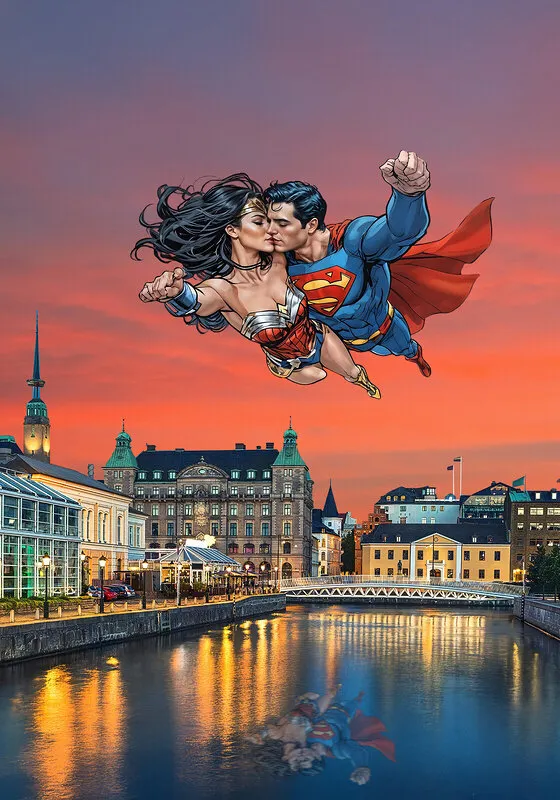
Love in the Air, 2025
Digital
50 x 70 cm
3 200 kr
Love in the Air
This is an essay about a phrase that everyone knows, yet its history is rarely explored. Love in the Air is more than just a saying – it is an image, a feeling, a rhythm that has persisted from the earliest myths to contemporary popular culture. When I started writing about the topic, I realised how the words held a duality: they are as light as a whisper and as weighty as tradition. They guide us from Adam and Eve in Eden, through Elizabeth Barrett Browning and Shakespeare, to Banksy, Taylor Swift, and John Paul Young. It's a phrase that unites us all in its universal appeal.
The essay oscillates between art, music, poetry, and film – spanning Malmö and Broadway, from the moon in Moonstruck to heart-shaped balloons drifting above New York's rooftops. It explores how love has been depicted through language and imagery, elevating us beyond the mundane and making the unseen visible.
I chose to retain the title in English because 'Love in the Air' has become a cultural heritage in itself, encompassing everything from pop songs to works of art, from political actions to wedding ceremonies. It is an expression that conveys both expectation and promise – something felt in the air long before it manifests in action.
Join me as we step through the portal of this essay to explore the captivating words of love, deeply connected with themes of romance and affection. This essay is not just a piece of writing, but a gateway to both entertain and enlighten you about the symbolic link between romance and love. We will examine the historical significance and profound cultural impact of these words across various societies, offering you a deeper understanding of this timeless wonder and its role in conveying human emotions.
“Love in the Air
It drifts unseen on a summer breeze,
a murmur woven through the trees,
a trembling hush before the rain,
a touch that heals, a tender flame.
It hovers low above the street,
where strangers pass and lovers meet,
a fleeting glance, a sudden smile,
the world transformed for just a while.
It lifts the heart, it bends the sky,
it teaches stone and steel to fly,
a song that blooms in silent air,
and makes the city light and fair.
No chains can bind, no walls contain,
the pulse of love, its sweet refrain.
It moves unseen, yet everywhere—
forever timeless, in the air.”
Malmö. August 2025
Love in the Air – an Essay on an Expression Filled with Love and Expectation
Some words are all it takes to change the atmosphere of a room. ‘Love in the Air’ is one of those words. It is more than a phrase – it is a feeling, a promise, a premonition that something is about to happen. When we say that love is in the air, we don’t mean it can be touched or measured. We mean that it can be felt – like electricity before a thunderstorm, like the scent of the sea before the waves appear.
In the image where Superman kisses Wonder Woman above the waterways of Malmö, the expression becomes literal. They hover in the air, supported by both strength and passion, as the city’s daily rhythm continues below. The reflection in the canal affirms the moment – it is not merely a dream, but a shimmer between reality and fantasy. That is precisely what the phrase captures: the instant when everything feels possible, when love is no longer just a feeling in the heart but something that fills the room, the city, the world.
The same transformative power of love is vividly depicted in art. Banksy's 'Love is in the Air' shows a masked man throwing not a Molotov cocktail but a bouquet, turning protest into an act of love. David Drebin’s heart-shaped balloons drift over big cities, transforming dull urban scenes into visions of magic. In the film Moonstruck, the full moon itself becomes the stage for passion’s irresistible force. And in John Paul Young’s disco anthem from 1977, 'Love is in the Air' became a worldwide hit – so infectious it was later revived in Baz Luhrmann’s Strictly Ballroom. These artistic expressions remind us of the transformative power of love, showing how it can turn the ordinary into the extraordinary and inspire us to view the world through the lens of love.
What all these expressions share is not a portrayal of love as safe or predictable – on the contrary. Love in the air is fleeting, surprising, and inexplicable. It strikes rather than being planned. It is like the wind: invisible, yet unmistakable in everything it stirs.
Speaking of love in the air also means speaking of the collective. Love is not solely private; it can fill a square, a nation, or even a generation. When the people of Malmö, on a summer evening, see two lovers on a bridge or a kiss reflected in the canal at sunset, they share in the same atmosphere. Love in the air is precisely that: something experienced by more than just the two who kiss. It is a shared experience that transcends individual relationships and becomes an integral part of the cultural and societal fabric, making us all part of a larger whole, a part of a shared love story.
That is why the expression feels timeless. Expectation, hope, infatuation – all of this is already in the air before it becomes words or actions. Just as a storm is sensed before it breaks, love is sensed before it is spoken. Love in the Air thus becomes a reminder that we live as much on moods as on facts, as much on dreams as on reality.
The Language of Love in Poetry
Love, like a fragrance, a whisper, an ever-present force, has always been in the air. It is a universal theme that transcends time and culture, a thread that binds us all. In one of the oldest texts we know, the Old Testament, we encounter the story of Adam and Eve in the Garden of Eden – the primal love story that has shaped our imagination ever since. From that moment onward, poetry has remained the best way to express love: sometimes to capture a fleeting moment, sometimes to share an experience too grand for ordinary speech.
Poetry has taken many forms – letters, narratives, reflections – but the theme has remained the same: love. Love for a child, a parent, a partner, or the first bittersweet taste of passion. Poetry speaks the language of love more closely than any other.
“How do I love thee? Let me count the ways.”
With these immortal words, Elizabeth Barrett Browning opens her Sonnet 43 in the sequence Sonnets from the Portuguese, addressed to her husband Robert Browning. She wrote 44 sonnets in this cycle, which took its title from Robert’s tender nickname for her, “my little Portuguese,” a reference to her dark complexion. Here she expresses a passion so pure and uncompromising that it extends beyond death itself.
In Sonnet 43, Elizabeth Barrett Browning describes her love with clarity and tenderness. The octave (the first eight lines) uses images ranging from the brightness of the sun to the flicker of a candle flame. The sestet (the final six lines) reflects on her childhood and promises that her love will endure even after death. The repetition of 'I love thee' creates a refrain, culminating in the ultimate vow: 'I shall love thee'. The rhythm is a classic iambic pentameter, with a Petrarchan rhyme scheme; however, the power comes from the emotion. The result is a declaration of love that still feels as natural today as it did in the 19th century, a testament to the enduring nature of love that can bring reassurance and comfort in our lives.
Shakespeare – Master of the Sonnet
William Shakespeare, too, set love in the air. His sonnets and plays have perhaps made him the world’s most renowned love poet. Who does not instantly recognise the echoes of lines, the course of such as:
“O Romeo, Romeo, wherefore art thou Romeo?”
“What’s in a name? That which we call a rose / By any other name would smell as sweet.”
Shakespeare's sonnets, a collection of 154 poems, are a testament to his mastery of the sonnet form. The first 126 are dedicated to a young man, while the latter ones address the dark-haired woman known as the Dark Lady. Sonnet 18 – “Shall I compare thee to a summer’s day?” – is perhaps the most quoted love poem worldwide, where the beloved’s beauty is granted eternal life through verse. Sonnet 116 is another well-known poem, often recited at weddings, depicting true love as everlasting and unshakeable, unaffected by time or physical decay. The sonnet form, with its 14 lines and strict rhyme scheme, allowed Shakespeare to explore the complexities of love in a structured yet deeply emotional way.
Shakespeare also pioneered the English sonnet, consisting of three quatrains followed by a closing couplet – abab cdcd efef gg – in consistent iambic pentameter. The form allowed contradictions to accumulate and then be resolved in a final, memorable conclusion. His influence remains evident today, from numerous stage productions and film adaptations to popular music.
Even in Taylor Swift’s "Love Story", we hear echoes of Romeo and Juliet. It is not a sonnet, but a contemporary pop ballad in free verse, and yet the essence remains the same: longing, obstacles, reconciliation. This demonstrates the enduring influence of classic love stories on modern pop culture and how they continue to shape our understanding and expression of love.
The Ballad, Pop, and the Refrain of Love
Not all modern texts are written in free verse. Some still follow the simplicity of the ballad. John Paul Young’s 'Love is in the Air' from 1977 is one such example: quatrains, ABAB rhyme scheme, a refrain that soars. Simple, yet precisely for that reason, universal. The song became a soundtrack for both everyday romance and the euphoria of the dance floor, resonating with people from all walks of life.
In the film ‘Strictly Ballroom’, the song was revitalised as a symbol of both romance and rebellion. Just like poetry, a pop song can serve both privately and collectively – a single refrain capable of uniting an entire crowd on the dance floor.
Modern Poetry – Between Tenderness and Death
The Australian poet Judith Wright also contributed to the modern portrayal of love. In "The Company of Lovers" and "Woman to Man," she portrays the intimacy of two people meeting, while also evoking the constant shadow of death that looms in the background. Death is personified as a commander, drums thunder, footsteps approach – while the lovers seek a fleeting respite.
The forms are both strict and free: blank verse, personifications, and rich imagery. The result is poetry in which love feels both everyday and mythic, fragile and powerful, always marked by the passage of time.
A Bridge from Eden to Pop Culture
Thus, a complete arc unfolds: from Adam and Eve in Eden, through Browning’s Petrarchan sonnets and Shakespeare’s English form, to the refrains of pop lyrics and modern poetry. The forms evolve, reflecting the changing societal attitudes towards love – but the core question of love persists: how can one articulate something greater than language itself?
For centuries, poetry’s response has remained unchanged: through rhythm, imagery, repetition, and voice.
This is why 'Love in the Air' works so well as both a title and a theme. It encompasses everything: Eden and Broadway, Shakespeare and Swift, Banksy and John Paul Young, Malmö and the moon. Love flows effortlessly across time and genre; it can be spiritual, playful, defiant, solemn – but always human.
As Aristotle once put it:
“Poetry is superior to history because poetry employs words to their fullest potential and creates representations that are more complete and meaningful than what nature can ever offer in its raw form.”
The language of love has therefore always been present. Every time we hear the phrase Love in the Air, we sense the tradition behind it – centuries of poetry, images, songs, and dreams. And perhaps that is why we still use these words: to remind ourselves of what makes life possible, bearable, and worth living.
Det här är en essä om ett uttryck som alla känner till, men som sällan får sin historia berättad. Love in the Air är mer än en fras – det är en bild, en känsla, en rytm som har följt oss från de äldsta myterna till dagens populärkultur. När jag började skriva om ämnet märkte jag hur orden bar på en dubbelhet: de är både lätta som en viskning och tunga av tradition. De leder från Adam och Eva i Eden, via Elizabeth Barrett Browning och Shakespeare, till Banksy, Taylor Swift och John Paul Young.
Essäen rör sig mellan konst, musik, poesi och film – mellan Malmö och Broadway, mellan månen i Moonstruck och hjärtballonger över New Yorks takåsar. Den söker spåren av hur kärleken har gestaltats i språket och i bilderna, hur den har lyft oss över vardagen och gjort det osynliga påtagligt.
Jag valde att behålla titeln på engelska, eftersom Love in the Air i sig har blivit ett slags kulturarv: från poplåtar till konstverk, från politiska aktioner till bröllopsceremonier. Det är ett uttryck som bär på både förväntan och löfte – något som känns i luften långt innan det blir till handling.
Love in the Air – en essä om ett uttryck fyllt av kärlek och förväntan
Det finns ord som bara behöver uttalas för att förändra ett rum. ’Love in the Air’ är ett sådant. Det är mer än en fras – det är en känsla, ett löfte, en förnimmelse av att något håller på att ske. När vi säger att kärleken ligger i luften, menar vi inte att den går att ta på eller mäta. Vi menar att den känns – som elektricitet före ett åskväder, som doften av havet innan vågorna syns.
I bilden där Superman kysser Wonder Woman över Malmös vattenvägar blir uttrycket bokstavligt. De svävar i luften, burna av både styrka och passion, medan stadens vardag fortsätter nedanför. Reflektionen i kanalen bekräftar ögonblicket, det är inte bara en dröm, utan ett skimmer mellan verklighet och fantasi. Det är just detta som frasen fångar: det ögonblick när allt känns möjligt, när kärleken inte längre bara är en känsla i hjärtat utan något som fyller rummet, staden, världen.
Samma vibration återkommer i konsten. Banksy låter en maskerad man kasta en blombukett i stället för en molotovcocktail, och gör protesten till en kärlekshandling – ’Love is in the Air’ heter verket. David Drebins hjärtballonger svävar över storstäder och förvandlar det monotona urbansceneriet till magi. I filmen Moonstruck blir fullmånen självklar scenograf för passionens oemotståndliga kraft. Och i John Paul Youngs discolåt från 1977 blev Love is in the Air en världshit – så smittande att den återupplivades i Baz Luhrmanns Strictly Ballroom.
Gemensamt för alla dessa uttryck är inte att kärleken skildras som trygg och förutsägbar, utan tvärtom. Kärleken i luften är flyktig, överrumplande, oförklarlig. Den drabbar snarare än planeras. Den är som vinden: osynlig, men märkbar i allt den rör vid.
Att tala om kärlek i luften är också att tala om det kollektiva. Kärleken är inte bara privat, den kan fylla ett helt torg, ett helt land, en hel generation. Malmöbor som en ljummen kväll ser två älskande på en bro, eller en kyss i solnedgången speglad i kanalen, delar samma stämning. Kärleken i luften är just detta: något som berör fler än de två som kysser varandra.
Därför känns uttrycket tidlöst. Förväntan, hopp, förälskelse – allt detta ligger i luften innan det blir ord eller handling. Precis som stormen märks innan den bryter ut, anas kärleken innan den uttalas. Love in the Air blir en påminnelse om att vi lever lika mycket av stämningar som av fakta, lika mycket av drömmar som av verklighet.
Kärlekens språk i poesin
Kärleken har alltid funnits i luften. Så länge människan har berättat historier finns den där, som en doft, en viskning, en ständig närvaro. I en av de äldsta texter vi känner, Gamla testamentet, möter vi berättelsen om Adam och Eva i Edens lustgård – en urhistoria som präglat vår föreställningsvärld. Sedan dess har poesin varit människans främsta redskap för att uttrycka kärleken: ibland för att bevara ett ögonblick, ibland för att dela en erfarenhet som annars inte fick plats i vardagligt språk.
Poesin har skiftat form – brev, berättelser, reflektioner – men temat har förblivit detsamma: barnet, föräldern, livspartnern, den första förälskelsens blandning av sötma och smärta. Poesin är kärlekens närmaste språk.
“How do I love thee? Let me count the ways.”
Med dessa odödliga ord öppnar Elizabeth Barrett Browning sin Sonnet 43 i sviten Sonnets from the Portuguese, riktad till maken Robert Browning. Hon skrev 44 sonetter i denna cykel, som fick sitt namn eftersom Robert kärleksfullt kallade henne “my little Portuguese” för hennes mörka drag. Här uttrycks en passion så ren och kompromisslös att den sträcker sig bortom döden.
I Sonnet 43 beskriver hon sin kärlek med innerlighet och precision. Oktaven (de första åtta raderna) målar med bilder som spänner från solens ljus till stearinljusets flämtande låga. Sestetten (de sista sex raderna) blickar tillbaka på barndomen och lovar att kärleken kommer att bestå även efter döden. Upprepningen I love thee skapar en refräng, som sedan kulminerar i det avgörande slutlöftet: I shall love thee. Rytmen är den klassiska jambiska pentametern, rimflätan petrarkistisk – men styrkan ligger i känslan. Resultatet blir en kärleksförklaring som känns lika självklar i dag som på 1800-talet.
Shakespeare – sonettens mästare
Även William Shakespeare placerar kärleken i luften. Hans sonetter och pjäser har gjort honom till världens kanske främsta kärlekspoet. Vem känner inte ekot i rader som:
“O Romeo, Romeo, wherefore art thou Romeo?”
“What’s in a name? That which we call a rose / By any other name would smell as sweet.”
Shakespeare skrev 154 sonetter under flera år. De 126 första är riktade till en ung man, de följande kretsar kring den mörkhåriga kvinna vi kallar the Dark Lady. Sonett 18 – “Shall I compare thee to a summer’s day?” – är kanske världens mest citerade kärleksdikt, där den älskades skönhet försäkrades ett evigt liv genom versen. Sonett 116 är en annan klassiker, ofta reciterad vid bröllop, där sann kärlek framställs som evig och orubblig, oberörd av tidens och kroppens förfall.
Shakespeare utvecklade också den engelska sonetten, med tre fyraradingar och en avslutande kuplett – abab cdcd efef gg – i stadig jambisk pentameter. Formen tillät motsägelser att byggas upp och lösas i en slutlig poäng. Hans inflytande märks än i dag, från otaliga teateruppsättningar och filmatiseringar till populärmusik.
Till och med i Taylor Swifts Love Story hör vi Romeo och Julia. Det är ingen sonett, utan en modern popballad i fri vers, men kärnan är densamma: längtan, hinder, försoning.
Balladen, popen och kärlekens refräng
Alla moderna texter är förstås inte fria i formen. Vissa följer fortfarande balladens enkelhet. John Paul Youngs Love is in the Air från 1977 är ett exempel: fyraradiga strofer, ABAB-rim, en refräng som lyfter. Enkel, men just därför universell. Låten blev ett soundtrack för både vardaglig förälskelse och dansgolvets eufori. Titeln har i sig blivit en symbol som återkommer i konsten – från Banksys blombukett till Drebins ballonger.
I filmen Strictly Ballroom fick låten nytt liv som symbol för romantik och revolt på samma gång. Precis som poesin kan poplåten fungera både privat och kollektivt – en enda refräng kan binda samman en hel dansande folkmassa.
Modern poesi – mellan ömhet och död
Den australiensiska poeten Judith Wright bidrog också till kärlekens moderna register. I The Company of Lovers och Woman to Man gestaltar hon intimiteten i mötet mellan två människor, men också närvaron av döden som en ständig skugga. Döden personifieras som en härförare, trummor dånar, fotsteg närmar sig – samtidigt söker de älskande en kort nåd.
Formerna är strama men ändå fria: blankvers, personifieringar, stark bildvärld. Resultatet är en poesi där kärleken både är vardaglig och mytisk, skör och stark, alltid präglad av tidens gång.
En båge från Eden till popkultur
Så tecknas en hel båge: från Adam och Eva i Eden, via Brownings petrarkistiska sonetter och Shakespeares engelska form, till poplyrikens refränger och modern poesi. Formen skiftar – men kärlekens grundfråga består: hur uttrycka något som egentligen är större än språket självt?
Poesins svar har i århundraden varit detsamma: genom rytm, bild, upprepning, röst.
Just därför fungerar Love in the Air som titel och tema. Det rymmer allt: Eden och Broadway, Shakespeare och Swift, Banksy och John Paul Young, Malmö och månen. Kärleken svävar över tid och genre; den kan vara andlig, lekfull, trotsig, allvarlig – men alltid mänsklig.
Som Aristoteles formulerade det:
“Poesin är överlägsen historien, eftersom den använder orden i deras fulla potential och skapar framställningar mer fullständiga och meningsfulla än vad naturen kan ge oss i rå form.”
Kärlekens språk har alltså alltid legat i luften. Varje gång vi hör frasen Love in the Air anar vi traditionen bakom – årtusenden av dikt, bild, sång och dröm. Och kanske är det just därför vi fortfarande använder orden: för att påminna oss om det som gör livet möjligt, bärbart, och värt att leva.
3 200 kr

Jörgen Thornberg
Malmö
Lite om bilder och mig. Translation in English at the end.
Jag är en nyfiken person som ser allt i bilder, även det jag fäster i ord, gärna tillsammans för bakom alla mina bilder finns en berättelse. Till vissa bilder hör en kortare eller längre novell som följer med bilden.
Bilder berättar historier. Jag omges av naturlig skönhet, intressanta människor och historia var jag än går. Jag använder min kamera för att dokumentera världen och blanda det jag ser med vad jag känner för att fånga den dolda magin.
Mina bilder berättar mina historier. Genom mina bilder, tryck och berättelser. Jag bjuder in dig att ta del av dessa berättelser, in i ditt liv och hem och dela min mycket personliga syn på vår värld. Mer än vad ögat ser. Jag tänker i bilder, drömmer och skriver och pratar om dem; följaktligen måste jag också skapa bilder. De blir vad jag ser, inte nödvändigtvis begränsade till verkligheten. Det finns en bild runt varje hörn. Jag hoppas att du kommer att se vad jag såg och gilla det.
Jag är också en skrivande person och till många bilder hör en kortare eller längre essay. Den följer med tavlan, tryckt på fint papper och med en personlig hälsning från mig.
Flertalet bilder startar sin resa i min kamera. Enkelt förklarat beskriver jag bilden jag ser i mitt inre, upplevd eller fantiserad. Bilden uppstår inom mig redan innan jag fått okularet till ögat. På bråkdelen av ett ögonblick ser jag vad jag vill ha och vad som kan göras med bilden. Här skall jag stoppa in en giraff, stålmannen, Titanic eller vad det är min fantasi finner ut. Ännu märkligare är att jag kommer ihåg minnesbilden långt efteråt när det blir tid att skapa verket. Om jag lyckas eller inte, är upp till betraktaren, oftast präglat av en stråk av svart humor – meningen är att man skall bli underhållen. Mina bilder blir ofta en snackis där de hänger.
Jag föredrar bilder som förmedlar ett budskap i flera lager. Vid första anblicken fylld av feel-good, en vacker utsikt, fint väder, solen skiner, blommor på ängen eller vattnet som ligger förrädiskt spegelblankt. I en sådan bild kan jag gömma min egentliga berättelse, mitt förakt för förtryckare och våldsverkare, rasister och fördomsfulla människor - ett gärna återkommande motiv mer eller mindre dolt i det vackra motivet. Jag försöker förena dem i ett gemensamt narrativ.
Bild och formgivning har löpt som en röd tråd genom livet. Fotokonst känns som en värdig final som jag gärna delar med mig.
Min genre är vid som framgår av mina bilder, temat en blandning av pop- och gatukonst i kollage som kan bestå av hundratals lager. Vissa bilder kan ta veckor, andra någon dag innan det är dags att överlämna resultatet till printverkstaden. Fine Art Prints är digitala fotocollage. I dessa kollage sker rivandet, klippandet, pusslandet, målandet, ritandet och sprayningen digitalt. Det jag monterar in kan vara hundratals år gamla bilder som jag omsorgsfullt frilägger så att de ser ut att vara en del av tavlan men också bilder skapade av mig själv efter min egen fantasi. Därefter besöks printstudion och för vissa bilder numrera en limiterad upplaga (oftast 7 exemplar) och signera för hand. Vissa bilder kan köpas i olika format. Det är bara att fråga efter vilka. Gillar man en bild som är 70x100 men inte har plats på väggen, går den kanske att få i 50x70 cm istället. Frågan är fri.
Metoden Giclée eller Fine Art Print som det också kallas är det moderna sättet för framställning av grafisk konst. Villkoret för denna typ av utskrifter är att en högkvalitativ storformatskrivare används med åldersbeständigt färgpigment och konstnärspapper eller i förekommande fall på duk. Pappret som används möter de krav på livslängd som ställs av museer och gallerier. Normalt säljer jag mina bilder oinramade så att den nya ägaren själv kan bestämma hur de skall se ut, med eller utan passepartout färg på ram, med eller utan glas etc..
Under många år ställde jag bara ut på nätet, i valda grupper och på min egen Facebooksida - https://www.facebook.com/jorgen.thornberg.9
Jag finns också på en egen hemsida som tyvärr inte alltid är uppdaterad – https://www.jth.life/ Där kan du också läsa en del av de berättelser som följer med bilden.
UTSTÄLLNINGAR
Luftkastellet, oktober 2022
Konst i Lund, november 2022
Luftkastellet, mars 2023
Engleson Galleri Caroli, april 2023
Hydra, Greece June 2023
Engleson Galleri Caroli, oktober 2023
Toppen, Höllviken december 2023
Luftkastellet, mars 2024
Torups Galleri, mars 2024
Venice, May 2024
Luftkastellet, oktober 2024
Konst i Advent, December 2024
Galleri Engleson, Caroli December 2024
Jäger & Jansson Galleri, april 2025
A bit about pictures and me.
I'm a curious person who sees everything in pictures, even what I express in words, often combining them, for behind all my pictures lies a story. These narratives, some as short as a single image and others as long as a novel, are the heart and soul of my work.
Pictures tell stories. Wherever I go, I'm surrounded by natural beauty, exciting people, and history. I use my camera to document the world and blend what I see with what I feel to capture the hidden magic.
My images tell my stories. Through my pictures, prints, and narratives, I invite you to partake in these stories in your life and home and share my deeply personal perspective of our world. More than meets the eye. I think in pictures, dream, write, and talk about them; consequently, I must create images too. They become what I see, not necessarily confined to reality. There's a picture around every corner. I hope you'll see what I saw and enjoy it.
I'm also a writer, and many images come with a shorter or longer essay. It accompanies the painting, printed on fine paper with my personal greeting.
Many pictures start their journey on my camera. Simply put, I describe the image I see in my mind, experienced or imagined. The image arises within me even before I bring the eyepiece to my eye. In a fraction of a moment, I see what I want and what can be done with the picture. Here, I'll insert a giraffe, Superman, the Titanic, or whatever my imagination conjures up. Even stranger is that I remember the mental image long after it's time to create the work. Whether I succeed is up to the observer, often imbued with a streak of black humour – the aim is to entertain. My pictures usually become a talking point wherever they hang.
I prefer pictures that convey a message in multiple layers. At first glance, they're filled with feel-good vibes, a beautiful view, lovely weather, the sun shining, flowers in the meadow, or the water lying deceptively calm. But beneath this surface beauty, I often conceal a deeper story, a narrative that challenges societal norms or explores the human condition. I invite you to delve into these hidden narratives and discover the layers of meaning within my work.
Picture and design have been a thread running through my life. Photographic art feels like a fitting finale, and I'm happy to share it.
My genre is varied, as seen in my pictures; the theme is a blend of pop and street art in collages that can consist of hundreds of layers. Some images can take weeks, others just a day before it's time to hand over the result to the print workshop. Fine Art Prints are digital photo collages. In these collages, tearing, cutting, puzzling, painting, drawing, and spraying happen digitally. What I insert can be images hundreds of years old that I carefully extract so they appear to be part of the painting, but also images created by myself, now also generated from my imagination. Next, visit the print studio and, for certain images, number a limited edition (usually 7 copies) and sign them by hand. Some images may be available in other formats. Just ask which ones. If you like an image that's 70x100 but doesn't have space on the wall, you might be able to get it in 50x70 cm instead. The question is open.
The Giclée method, or Fine Art Print as it's also called, is the modern way of producing graphic art. This method ensures the highest quality and longevity of the artwork, using a high-quality large-format printer with archival pigment inks and artist paper or, in some cases, canvas. The paper used meets the longevity requirements set by museums and galleries. I sell my pictures unframed, allowing the new owner to personalise their artwork, confident in the lasting value and quality of the piece.
For many years, I only exhibited online, in selected groups, and on my Facebook page - https://www.facebook.com/jorgen.thornberg.9. I also have my website, which unfortunately is not constantly updated - https://www.jth.life/. You can also read some of the stories accompanying the pictures there.
EXHIBITIONS
Luftkastellet, October 2022
Art in Lund, November 2022
Luftkastellet, March 2023
Engleson Gallery Caroli, April 2023
Hydra, Greece June 2023
Engleson Gallery Caroli, October 2023
Toppen, Höllviken December 2023
Luftkastellet, March 2024
Torup Gallery, March 2024
Venice, May 2024
UTSTÄLLNINGAR
Luftkastellet, oktober 2022
Konst i Lund, november 2022
Luftkastellet, mars 2023
Engleson Galleri Caroli, april 2023
Hydra, Greece June 2023
Engleson Galleri Caroli, oktober 2023
Toppen, Höllviken december 2023
Luftkastellet, mars 2024
Torups Galleri, mars 2024
Venice, May 2024
Luftkastellet, October 2024
Konst i Advent, December 2024
Galleri Engleson, Caroli December 2024
Jäger & Jansson Galleri, April 2025
Utbildning
Autodidakt
Medlem i konstnärsförening
Öppna Sinnen
Med i konstrunda
Konstrundan i Skåne
Utställningar
Luftkastellet, October 2022
Art in Lund, November 2022
Luftkastellet, March 2023
Engleson Gallery Caroli, April 2023
Hydra, Greece June 2023
Engleson Gallery Caroli, October 2023
Toppen, Höllviken December 2023
Luftkastellet, March 2024
Torup Gallery, March 2024
Venice, May 2024