Vi använder cookies för att ge dig bästa möjliga upplevelse. Välj vilka cookies du tillåter.
Läs mer i vår integritetspolicy
Jörgen Thornberg
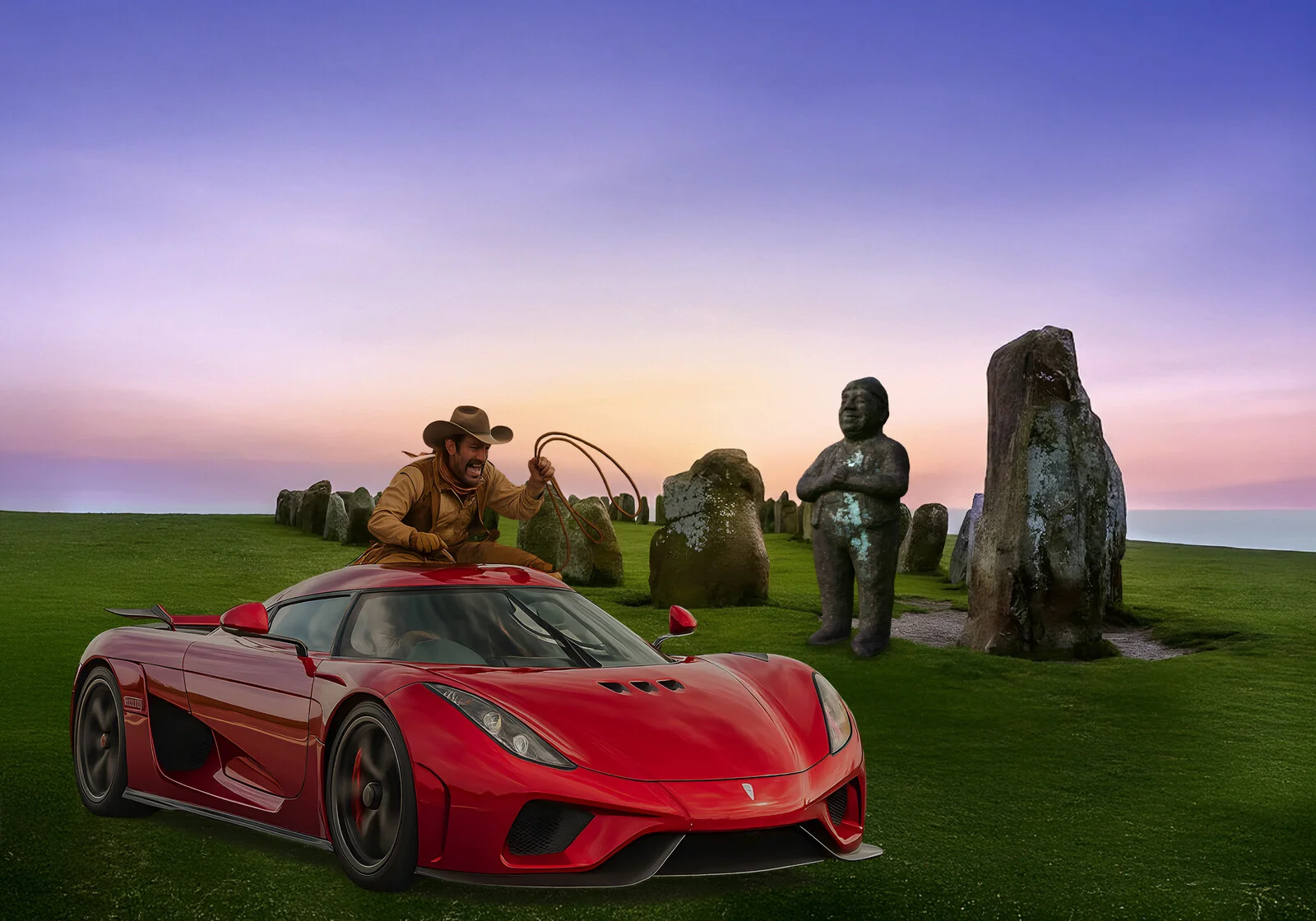
Rodeo at Ales Stenar, 2025
Digital
70 x 50 cm
3 200 kr
Rodeo at Ales Stenar
A red Koenigsegg, a symbol of speed and luxury, parked at Ales Stenar, a historical site in Sweden. This juxtaposition of modernity and ancient history sets the stage for our exploration of the cultural and artistic significance of cars.
A rodeo rider, a symbol of wildness and freedom, straddling the bodywork of the car as if it were a wild stallion, lasso swinging in the evening light. This imagery, a fusion of man and machine, sets the stage for our exploration of the cultural and artistic significance of cars.
The scene is, of course, a fantasy – but it is precisely in this meeting between myth and machine, between history, art, and local patriotic humour, that our journey begins. For the car is more than a vehicle. It is a work of art, a mirror of its age, a dream of freedom, and a reminder of its cost, connecting us to the past and present.
From the Futurists’ furious manifestos, which celebrated the speed and dynamism of the car and its role in shaping the modern world, to contemporary eco-critical installations that critique its environmental impact, the car has left an indelible mark on our culture. It has been painted, crushed, petrified, and turned into rolling sculptures. It has been hailed as a symbol of freedom and criticised as an environmental villain.
This is the story of the automobile in art – from rodeo riders and Koenigseggs to the artistic interpretations of Warhol and Dalí, and today’s neon-glinting cathedrals of wreckage. These artists and installations have reimagined the car as a cultural symbol, and their work now awaits your exploration.
Join me on a journey to explore the captivating world of cars. This essay aims to both entertain and inform you about the past eras. Prepare to be educated, inspired, and entertained as we delve into the history and cultural significance of these unforgettable vehicles, ensuring you leave with a wealth of knowledge and a deeper understanding of the subject.
“Ballad of Cars in Art
A red Koenigsegg by Ales Stenar’s line,
a cowboy astride as the engines whine.
His lasso spins in the twilight’s glow,
while Persson sings what the Skåne winds know.
The Futurists hailed speed’s furious flame,
they shattered the past in progress’s name.
“A roaring car outshines Nike’s grace,”
their manifest thundered through time and space.
Lempicka in Bugatti, daring and free,
Delaunay’s patterns in geometry.
Warhol repeated the crash in despair,
Rosenquist mixed chrome, flesh, and fare.
Dalí let snails in a taxi remain,
while rain from its roof fell steadily as pain.
Kinder’s Trabant burst the Wall apart,
Chamberlain twisted wrecks into art.
Burden was nailed to a Volkswagen’s hood,
a martyr who warned where humanity stood.
Persson transformed a car into the sea,
with drowned-out creatures of sad poetry.
Koenigsegg harnessed two thousand steeds,
Bugatti and Pagani fulfilled their creeds.
Sjöbäck built towers of neon and steel,
ruins that glimmer with futures unreal.
In novels and music, on stages of play,
the car rolls on through night and day.
It tempts, it burns, it dazzles, it scars,
a freedom-dream bound to the fate of the stars.
As long as wheels spin and engines roar,
the car in art will endure evermore.
It is armour and mirror, desire and doom,
a temple of iron, a soul in full bloom.”
Malmö. August 2025
Rodeo at Ales Stenar
A red Koenigsegg races across the grass at Ales Stenar in Skåne, a ship setting from the 6th century. A place where you might neither drive a car nor ride a rodeo – yet here, in the enchanting light of dusk, the rules have briefly been relaxed. On the roof of the car sits a rodeo rider, mounted on the sleek bodywork as if it were a herd of wild stallions charging ahead. With lasso in hand and eyes burning with fierce determination, he reins in the 2,300-horsepower engine roaring beneath the bonnet.
It is a vision that belongs to a saga or a dream, yet it feels strangely true. Perhaps because Ales Stenar, with its ship setting and massive stones raised by unknown hands some fifteen hundred years ago, exudes an awe-inspiring force field that both connects and dissolves. Here, past becomes present, and myths step out of the shadows. The site is well chosen, for ships were the pinnacle of transport in their day – something like a Koenigsegg on keel, one might say.
And this evening, yet another figure emerged from eternity: Edvard Persson, actor, singer, eternal local patriot. To avoid attention, he had taken on the guise of a stone – a round, jovial figure among the other blocks. But when he saw the spectacle before him, he could not hold back. His voice carried across the plain, warm and resonant, as he began to sing ‘Lite grann från ovan’ (A little bit from above) from the film ‘Kalle på Spången’ (Spången is a famous inn). An echo from the silver screen of the 1930s, now engraved among stones that had stood here for millennia.
Edvard loved cars. He owned many, and his taste for the grand and imposing was clear in a Chrysler so massive that in 1937 it ended in a head-on crash and a month in hospital. But had he lived today, the choice would have been obvious. He would have driven a Koenigsegg – a car born on Skåne soil, as much an engineering feat as a work of art. For Persson was not only car-crazy, he was also a man who carried Skåne in his heart, as fiercely as he ever did on the silver screen.
So this scene – the rodeo rider taming the Koenigsegg, the ancient force field of Ales Stenar, and Edvard Persson disguised as a stone singing of his beloved Skåne – is not just a perfect beginning. It's a timeless moment where myth meets machine, past meets future, and art meets culture. This marks the start of the story, a bridge that connects us to the history of the car in art.
Chapter 1. The Car Drives into Art
As long as the car remains central to human life, it will also stay central in art. It does not merely roll on the roads – it roars into art history, transforming the way we perceive the world and inspiring new artistic expressions.
The first significant impact occurs in 1909 when Futurism erupts – the Italian avant-garde determined to discard the old and forge a new world of speed, technology, and violent energy. In its manifesto, Filippo Tommaso Marinetti articulates the words that define the movement:
“A roaring automobile that seems to run on machine-gun fire is more beautiful than the Victory of Samothrace.”
With a single sentence, the ancient winged goddess of victory is dismissed in favour of a gasoline-driven machine. The Futurists want museums, libraries, and academies demolished. Everything must be sacrificed so that humanity can surge into the future like a howling racecar.
Here, the car is, from the beginning, linked to masculinity, power, and destructive energy. It becomes a symbol of aggressive progress. Yet we must remember that cars at that time looked quite different from today’s roaring beasts. They resembled horseless carriages more than shiny sports cars. And yet, they were imbued with violent eroticism and raw masculine strength.
Meanwhile, something decisive was unfolding in America. In 1913, the first Model T rolled off the assembly line in Detroit. Henry Ford’s car was more than just a vehicle – it became a symbol of aspiration for ordinary people, a promise that the automobile was for everyone, not just the privileged few. It marked the start of the car’s democratisation, shifting from a luxury for elites to a possession accessible to the masses.
Art had already adopted the car as its inspiration. Still, with Futurism and Ford’s mass production, it also became a part of daily life – shaping and mirroring modern existence in a way that was previously unimaginable.
Chapter 2. Gender, Power and the Automobile
The fact that the automobile was early associated with raw masculinity is hardly a coincidence. For millennia, men have ridden, raced, and driven chariots and war wagons – from the pharaohs of Egypt to the triumphs of Rome. The horse was man’s extension, a symbol of power, control, and speed. When the engine replaced the horse, the automobile inherited the same symbolic function. That men would also straddle the car, tame its force, and measure their strength in competition was therefore inevitable. It was a continuation of the ancient dream: to push boundaries, conquer the realm of speed, and master the power within.
But already early on, women began to claim this masculine bastion. In the 1920s, the garçonne sat confidently behind the wheel. Tamara de Lempicka’s Self-Portrait in a Green Bugatti is more than a portrait – it is a manifesto. The woman takes the driver’s seat. She steers. She commands. Sonia Delaunay, too, adorned cars with her geometric patterns, demonstrating that design and aesthetics were not a male monopoly.
Over time, women’s increasing participation in the automotive world is a testament to their empowerment. Today, racing circuits are no longer exclusive to men. Female drivers compete at the highest levels, and the car’s aesthetics have become a means of exploring female identity, desire, and freedom.
It is within this meeting – between the automobile’s patriarchal heritage and the woman’s act of conquest – that one of the most compelling stories unfolds. The car becomes both a battleground of gender and a symbol of liberation—male desire to push boundaries clashes with female resolve to break barriers.
Therefore, the automobile continues to mirror our culture not only in terms of speed, status, and aesthetics, but also in the struggle over gender, power, and freedom.
Chapter 3. The Woman Takes the Wheel
After the Futurists celebrated the automobile as a machine, war symbol, and masculine projection, something new emerged in the 1920s. A new figure emerged from the mist: the garçonne – the independent, modern professional woman who claimed her place behind the wheel.
She drove with cropped hair, a straight posture, and effortless elegance. She embodied a break from the past – no longer the passenger, but the driver. Few captured her aura better than the Polish artist Tamara de Lempicka.
In 1929, she was commissioned by the German fashion magazine Die Dame to create an image celebrating women’s independence. The result was Self-Portrait (Tamara in a Green Bugatti). There, she sits at the wheel with helmet and gloves on, a grey scarf sharply contrasting with the shimmering green paintwork. The portrait is as much a declaration of intent as a painting: a woman steering her own destiny, as boldly as she steers her car. Daring, sensual, aloof.
At the same time, artist, designer, and entrepreneur Sonia Delaunay embodied the same modernity. In her abstract paintings and geometric patterns, she captured the spirit of her era: electricity, poetry, and modern ballet. She managed her own fashion and interior design boutique and even created patterns for Citroën and Bugatti. Her vision was to transform life itself – the streets, the everyday, the people – into a luminous total work of art.
At Skissernas Museum in Lund, you can still see her monumental murals created for the Aviation Pavilion at the 1937 Paris World Exhibition. They radiate the same fascination: cars, aeroplanes, and the technological optimism of the era.
Tamara de Lempicka’s Bugatti self-portrait has, in modern times, been reborn as the cover of Unda Hörner’s book 1919 – The Year of Women. It is no coincidence. She did not simply paint herself at the wheel – she painted the dream of a generation.
From the garçonne and Delaunay, we can read another chapter in the history of the car in art: the vehicle no longer as a masculine domain, but as a medium of female emancipation and modern identity, thanks to their pioneering contributions.
Chapter 4. Visionaries and Engineers
As the car became part of everyday life during the interwar years, engineers and visionaries also made their mark on art history. The machine was no longer solely a symbol of violence and gender but also a platform for technical innovation and futuristic visions.
In the United States, architect and inventor Buckminster Fuller experimented with his Dymaxion car (1933–34). Streamlined, futuristic, almost more spaceship than automobile. Like his geodesic domes and modular houses, it belonged to the same realm of radical innovation. Fuller’s car never achieved commercial success – but it became a work of art in its own right, a prototype of a future that never fully materialised, yet continues to captivate.
When the Guggenheim Museum in Bilbao staged its grand exhibition 'Motion, Autos, Art, Architecture' in 2022, it aimed to showcase the intersection of these disciplines and how they influenced each other. Fuller’s Dymaxion car was a key exhibit, standing beside Jean Bugatti’s early racing cars – as elegant as they were technically advanced. Together, they offered a panorama of how the automobile was not only a vehicle, but also an aesthetic and cultural idea.
It is easy to see how the automotive design of the 1930s, 40s, and 50s reflected the same formal language as sculptors like Constantin Brâncuși, Barbara Hepworth, and Henry Moore: rounded forms, organic lines, and a blend of simplicity and strength. The car became 'rolling modernism' – a term used to describe the incorporation of modernist design principles into the automotive industry, creating a sculpture in steel, glass, and chrome.
Here, automotive aesthetics were just as important as function. The car was not merely transport – it was art in motion, proof of humanity’s belief in technology and the future.
Chapter 5. Pop Art at the Crossroads
As postwar optimism increased in the United States, the car became the most obvious motif in pop art. Here, the boundary between advertising, consumption, and art blurred – most clearly seen in the works of the 1960s.
James Rosenquist was among those who used car iconography most deliberately. His monumental painting I Love You with My Ford (1961), now housed at Moderna Museet in Stockholm, consists of three horizontal panels: an intimate female profile, a close-up of a chrome-shining car front, and a plate of spaghetti in tomato sauce. The combination is absurd yet sharply pointed – a commentary on a society where everything can be marketed and consumed: love, desire, status, and fast food. A Hollywood profile, car advertising, and everyday fare merge into one contemporary document.
Andy Warhol took a different approach. He looked back at the early history of the car. In the silkscreen Benz Patent Motor Car (1886), the three-wheeled pioneering automobile appears eight times, surrounded by pastel blocks streaked with black. It lingers in the image like a ghost, suggesting that automobility carries darkness from the very beginning.
Even more brutal is Warhol’s Orange Car Crash Fourteen Times (1963), part of his Death & Disasters series. Here, the American dream dies in the mangled wreckage. The image, taken from a news photograph, is repeated until the details dissolve into darkness. The catastrophe loses its concrete form and becomes a pure structure of accident and death. Warhol borrows the aesthetics of advertising but infuses them with cynicism, transforming consumer culture into tragedy.
However, the artistic importance of the car isn't solely about consumer culture. It also embodies the dream of freedom, adventure, and the myth of the road trip. This is where John E. Franzén comes in – the Swedish painter who, in 1966, moved to California, captivated by American cars and motorcycles.
Even before the move, he had begun work on his masterpiece, the Cadillac Eldorado, a painting almost life-size: 160 x 645 cm. For fifty years, it hung in the foyer of Lund’s Technical University until a digital reproduction replaced it, and the original was transferred to Moderna Museet. Critic Ulf Linde described the work as “a euphoric daydream of male potency and female libido.”
At his death in 2022, Franzén left behind not only images of gleaming bodywork but also scenes of America’s backstreets, the wear of daily life, and broken dreams. He captured car culture in its entirety – not only its glamour, but also its melancholy and shadow.
Here, at the intersection of Rosenquist, Warhol, and Franzén, pop art functions like a road sign: the car is no longer transport, but an emblem of an entire era. It embodies desire, consumption, death, and the aspiration for freedom.
Chapter 6. Cars in Art – An Overview
Throughout the 20th century, the automobile has served both as a motif and a medium in art. It can be painted, sculpted, photographed – but it can also be transformed into art in itself. It is both canvas and brush, both subject and material.
Artists have used the car as a symbol of progress, status, and freedom. From Futurism’s hymns to speed and the machine to today’s more reflective gestures. Among the most famous examples are Picasso’s decorated car, John Chamberlain’s sculptures of crushed steel, the iconic installation Cadillac Ranch in Texas, and the rolling masterpieces BMW commissioned from artists like Warhol and Lichtenstein.
The car as subject
Painters and draughtsmen have depicted the car’s speed, power, and beauty as a way to explore modernity, glamour, and nostalgia. Sculptors like John Chamberlain compressed wrecked bodywork into monuments of debris. Public installations like Cadillac Ranch, with its nose-dived cars buried in the Texas soil, have become landmarks of modern art. In photography and illustration, the car has also taken a leading role. Fitz and Van, for example, created stylised images for General Motors, where advertising became art and art became advertising.
The car as a medium
But the automobile is not just a motif – it is also a physical object. A vehicle can be turned into an Art Car through painting, reconstruction, upholstery, beadwork, or complete transformation into sculpture. BMW’s Art Cars are arguably the most renowned examples. When artists like Alexander Calder, David Hockney, Jeff Koons, and Andy Warhol left their mark on car bodies, they became moving artworks with their own presence.
Other artists explored the same idea through more personal expressions. Yayoi Kusama adorned her cars with her signature polka dots, and John Lennon had his Rolls-Royce painted in psychedelic colours. The car became a stage for self-expression, a private canvas in motion.
Symbolism and cultural significance
Through art, the car has also become a reflection of cultural values. For the Futurists, it epitomised modernity and progress. For postwar consumers, it symbolised freedom, status, and aspiration. And today, it can just as effectively serve as a critique – a symbol of climate crisis, consumer hysteria, or lost faith in the future.
The car embodies all these notions: utopia and dystopia, eroticism and eco-criticism, power and ruin. It has become a mirror of its era, a reminder that technology is always as much cultural as it is mechanical.
Chapter 7. Art Cars – Rolling Works of Art
There is art that hangs on museum walls, and there is art that rolls out onto the streets. Art Cars belong to the latter. Here, the automobile is no longer just a depicted motif but the artwork itself – a vehicle transformed into artistic expression. This feat inspires fascination and appreciation for the creativity involved.
An Art Car is never just painted; it is remade, reinterpreted, and sometimes completely transformed into a new form. The creator, often not a formally trained artist but an enthusiast, uses the car as their canvas. Many jokingly refer to themselves as Cartists. The main idea is freedom: the car becomes an extension of the self, blending dream, craft, and identity, inspiring a sense of personal expression and artistic freedom.
Most Art Cars are built and driven by ordinary people, often without formal art training. Self-taught, self-funded, and motivated by passion, they contribute significantly to the art world. However, established artists have also made their mark. Roy Lichtenstein and Andy Warhol, for example, painted BMW’s famous Art Cars, which were not only displayed but also raced.
A motley history
The phenomenon emerged at the crossroads of several movements: the hippie movement’s decorated VW vans of the 1960s, lowrider culture, and the Merry Pranksters’ legendary bus Furthur. John Lennon had his Rolls-Royce Phantom painted in psychedelic colours inspired by Romani wagons. Janis Joplin covered her Porsche 356 with swirling floral patterns. These vehicles were as much symbols of music, lifestyle, and protest as they were modes of transport.
Artist Larry Fuente took the idea to its extreme with Mad Cad, a Cadillac covered in thousands of tiny objects. Other pioneers like David Best and Jackie Harris paved the way for a new form of art. In the 1990s, filmmaker Harrod Blank became one of the movement’s most essential voices with documentaries such as Wild Wheels and Automorphosis. He also published books on the phenomenon and co-founded ArtCar Fest in San Francisco, the United Kingdom’s second-largest festival for Art Cars.
From hippie dream to light parades
The culture spread rapidly. In 2010, Gloworama in Houston hosted a New Year’s Eve parade featuring more than a hundred illuminated cars. Other examples include the Oscar Mayer Wienermobile, shaped like a giant hot dog in a bun. Once solely advertising, it now appears as pop art.
In Texas, where the movement established its strongest roots, significant events still take place today. But Art Car culture now extends across the United States, into Canada, and even into Europe. In Baltimore, annual parades attract thousands of visitors; in British Columbia and Saskatchewan, cars appear in small towns. Even rental car company Avis has sponsored initiatives on the European scene.
Styles and expressions
Art Cars can be simple paint jobs inspired by popular culture or monumental creations that obscure entirely the original vehicle. One of the most famous examples is Vochol, a Volkswagen covered with over 2.5 million beads in Huichol style – a fusion of Indigenous art and car culture.
Themes vary greatly: humour and satire, science fiction and surrealism, Gothic overtones, and political statements. Parades often feature cars alongside decorated bicycles, scooters, and even performers in costumes on roller skates. Sometimes, the entire event becomes street theatre, with music and performance integral to the spectacle.
The limits of freedom
But even art on wheels must obey the law. Turn signals must stay visible, licence plates unobscured, and width not exceeding legal limits. Within these boundaries, however, exists a world of freedom: vehicles transformed into dreams, philosophies, and fantasies.
An Art Car is therefore not just an object to behold – it is living proof that art can move into the street, take its place in traffic, and literally drive into the heart of society.
Chapter 8. Famous Cars in Art
Over the years, a select few cars have transcended their original purpose to become iconic artworks, marking significant milestones in both art and automotive history. These masterpieces, born from the creative minds of artists, showcase the diverse roles a vehicle can play-from an advertising symbol to a political commentary, or a surrealist dreamscape. The artistic innovation in these transformations is genuinely inspiring.
Andy Warhol – The Mercedes Series
It’s hardly surprising that Andy Warhol, the king of consumerist art, would take an interest in cars – even if he never drove one himself. In 1986, Mercedes-Benz commissioned him to depict the company’s evolution through paintings, silkscreens, and drawings.
He completed 49 of the planned 80 works before his death the following year. Most were based on photographs and executed in his characteristic pop art style. The series has only been exhibited in its entirety three times: 1988, 2010, and 2014, and today it belongs to Daimler’s collection. Here, commercial commission and artistic myth-making merge – Warhol’s cars are as much portraits of machines as they are pop icons.
Wolf Vostell – Concrete Traffic
In 1970, the German artist Wolf Vostell produced a piece that was as much about process as it was about the final form. A Cadillac was encased in concrete in a Chicago car park – an “instant happening” where the petrification itself became the art. It was only when parking fines began accumulating that it was moved. Since then, Concrete Traffic has remained at the University of Chicago as a significant monument both to the absurdity of gridlock and to concrete as an artistic material.
Birgit Kinder – Trabi
When the Berlin Wall fell, the Trabant – the people’s car of East Germany – became one of the most unlikely symbols of freedom. In 1990, Birgit Kinder painted a Trabant bursting straight through the Wall on one of its remaining sections, and the image quickly became one of the most famous in the East Side Gallery. The mural combines political commentary and humour: the car breaking through the Wall symbolises a nation moving towards unity, while also reminding viewers of the DDR’s limited means of production—a simple gesture, yet rich with history.
Salvador Dalí – Clothed Automobiles and Rainy Taxi
The master of Surrealism, Dalí, seldom drove himself, but the car frequently appeared in his work. He dressed Cadillacs in luxurious fabrics and crafted the legendary installation Rainy Taxi: two mannequins in a car, surrounded by lettuce, chicory, and snails, with a system of pipes that made it rain inside the vehicle. On the bonnet, he placed a full-sized bronze statue – as absurd as it was majestic.
When he was to give a lecture at the Sorbonne, he filled a Rolls-Royce to the brim with cauliflower. Later, the Thompson Twins sang Salvador Dalí’s Car. Whether or not one seeks deeper meaning, for Dalí, the car was always a symbol of modernity, progress, and the absurdity of humankind’s dream of control.
BMW Art Cars – A Tradition
As early as 1925, Sonia Delaunay painted a car as an extension of her textile patterns. However, it was not until the 1970s, when BMW started inviting contemporary artists, that the phenomenon really took hold. Artists like Alexander Calder, Andy Warhol, Roy Lichtenstein, David Hockney, and Jeff Koons are just a few who left their mark on the bodywork.
After a pause, BMW returned in 2024 with two new works: Julie Mehretu’s M Hybrid V8, first showcased in Paris before racing at Le Mans, and Esther Mahlangu, the first woman involved in the project back in 1992, who now created the high-tech i5 Flow Nostokana with electronic panels displaying animated patterns — a fusion of tradition, innovation, and futuristic vision.
Giacomo Balla – Speeding Automobile
For the Futurist Giacomo Balla, the car was not an object but a movement. Inspired by Marinetti, he painted not bodywork but speed, sound, and light. In works like Ritmo + rumore + velocità d’automobile, he aimed to capture the power of the car rather than its form.
Today, we interpret these paintings as both artworks and historical documents. Although Futurism became closely linked with Fascism, for Balla, the car primarily represented the light of the future – the very heartbeat of modernity.
Roy Lichtenstein – In the Car
Lichtenstein, renowned for his comic book style, painted In the Car in 1963. A panel from Girls’ Romances inspired the image, but without any text. What remains are only the expressions of the passengers, heightened by the cramped interior of the car as a frame of tension.
The painting sold in 2005 for £16.2 million – then the most expensive of his works – and remains one of his most iconic. Even though his Masterpiece later broke all records, In the Car still stands as one of the sharpest blends of automotive aesthetics and human emotion.
Chapter 9. Eco-Criticism and the Car’s Shadow Side
When the first Futurists celebrated the thrill of speed, they were heralding a new era. The car, then a symbol of the future, power, and modernity, was a beacon of hope for the 20th century. However, as we transitioned into the 21st century, the symbolism began to change. The car, once a sign of freedom, also became a looming threat.
Already in the 1970s, the green movement emerged, challenging dependence on fossil fuels. Artist Chris Burden, in 1974, created his most renowned performance piece, Trans-Fixed, in which he permitted himself to be crucified on a Volkswagen Beetle. Nailed through his hands onto the bonnet, he lay like a modern martyr. The act was about pain and transgression, but the photographs communicate just as much about humanity nailed to its own creation. The people’s car here becomes a cross – a foreshadowing of the climate crisis and ecological collapse.
In Malmö, the theme took shape in 2010 when Roland Persson created one of the city’s most memorable festival pieces. He transformed a parked car on Hamngatan into an aquarium filled with capsized sea creatures. It didn't resemble a warning sign—rather, it depicted a dreamlike underwater scene. But for that very reason, the impact was more profound. The car’s everyday body became a poignant monument to humanity’s influence on the sea and nature.
Here, in the tension between Burden’s painful crucifixion and Persson’s dreamlike installation, a new image emerges: the car as an embodiment of catastrophe. No longer merely a symbol of modernity and a dream, but a stark reminder that through our own machinery, we are driving ourselves towards the abyss. The emotional weight of this message is palpable.
As the climate crisis intensifies, this perspective becomes increasingly powerful. Where the Futurists saw ecstasy, we now witness burned-out engines, floods, and forests in flames. The automobile becomes the artists’ dark mirror – a shadow cast over our era.
Chapter 10. Contemporary Interpretations and the Aesthetics of the Car
Despite the looming threat of the climate crisis, the allure of car culture persists in new and intriguing forms. In 2020s Sweden, the bass-heavy rhythms of epadunk pulse from A-tractors on rural roads, street racing leaves its marks on the asphalt nights, and hypercars shine like jewels in urban streets. The symbols of status endure. The automobile remains a macho emblem, a vessel of desire, and an identity shaped in metal.
However, there is also another aesthetic, where the very form of the car transcends its function, turning it into a moving sculpture. Vintage cars shine like historical artefacts, while electric cars are seen as visions of the future. Nostalgia merges with technological optimism. The once-everyday car becomes as much a museum piece as a means of transport, inviting wonder and appreciation.
It is within this tension between nostalgia, represented by the historical artefacts of vintage cars, and futurism, embodied by the visions of the future in electric vehicles, that contemporary artists operate. Malmö-based Sara Sjöbäck has made the car her raw material. She dismantles, rebuilds, stacks, and transforms. In large-scale works like V70XIII, parts of Volvo family cars are assembled into towers of steel and aluminium, lit by neon lights that flicker as if borrowed from nightclubs or science-fiction films.
Sjöbäck’s works exhibit a compelling duality. They are powerful and menacing, yet also fragile and vulnerable. They can be viewed as tributes to industrial machine aesthetics, but also as ruins of a bygone era – monuments to the Swedish welfare state and an identity once centred around the family car as the household’s centre. This duality invites contemplation and intrigue.
In a piece at Inkonst in Malmö, she let the words I WANT YOU glow from a red-lacquered hood in the club’s dimly lit room. A promise, a demand, an erotic charge. Like a forbidden dream of fast cars and heated encounters. Here, the car becomes as much an erotic sign as a material object.
In this way, Sjöbäck links the car’s long symbolic history: from Futurism’s ecstasy and Pop Art’s consumer dreams to our own era’s ambivalence. The automobile remains a desire, not just a mode of transportation, but a symbol of freedom, power, and status — but also a symbol of a ruined future, a memory of what we once were, and a question of where we are heading.
Chapter 11. Luxury Travel as Art
When art and the car intersect, it often occurs at the extremes – in the everyday turned to decay, or in the luxurious turned into a dream. Luxury cars, in particular, have continued to embody the legacy of the automobile as an art form. Here, we see not only engineering but a conscious aesthetic, where every detail is crafted to attract the eye and delight the senses.
The luxury car is more than just transportation. It is a stage. An interior world where comfort, materials, and design combine into a complete experience. Wooden panels, hand-stitched leather seats, electronic instruments that blink like miniature art installations – all designed to make the journey more than a simple transfer from A to B.
Here, travel and art converge: in the feeling of moving through the world framed by a work that both rolls and speaks. A car can become a kind of mobile palace, a stage on which the traveller is also the spectator in their own drama.
Perhaps that is why the luxury car, more than any other, has become a motif for artists, designers, and filmmakers. It embodies abundance and allure, but also a dream of complete control over both time and space. And in that very dream, technology and aesthetics converge – the innermost longing of modernity.
Thus, the journey in a luxury car becomes an art form in itself: a voyage through the world, but also through the reflection of art.
Chapter 12. Creating a Car – Design as the Highest Art
So far, we have traced the car as a motif in art history, from the Futurists’ ecstasy to today’s eco-critical installations. But creating a car is itself an art form. Design, design, design – constantly fused with functionality, engineering, and law. It is not only about building a vehicle that moves, but about shaping a sculpture in steel, carbon fibre, and glass, where lines, proportions, and performance converge.
One of the modern masters of this craft is Swede Christian von Koenigsegg, who has spent nearly three decades successfully building some of the world’s most exclusive and technologically advanced cars. His creations are more than just vehicles – they are bold works of power and beauty, where every detail is meticulously considered. In one of his latest models, over 2,300 horsepower is packed beneath the bonnet – so much that it nearly defies belief. It is no surprise that in one image, a rodeo rider, straddling the car, appears to tame a roaring mechanical beast.
But Koenigsegg is not alone in this elite realm. His rivals include names like Bugatti, Pagani, McLaren, Ferrari, and Lamborghini. All excel in the same art: creating cars that straddle the line between technology and artistry, between raw velocity and refined elegance. Bugatti, with models such as the Veyron and Chiron, has crafted machines that are not only among the fastest in the world but also among the most refined in design. Pagani transforms cars into baroque sculptures, with interiors reminiscent of cathedral altarpieces fashioned in carbon fibre and titanium.
What these manufacturers share is the creation of dynamic works of art where aesthetics are never subordinate to technology—and technology never relinquishes its grip on aesthetics. The lines, the air intakes, the curvature of a headlamp: everything becomes part of a story. It is art on wheels, but also art in motion, where the dimension of speed adds something that paintings and sculptures can never provide.
One might say that the highest art of the automobile not only hangs on museum walls but also rolls on our roads. It carries its beauty at 300 km/h, and in that ecstasy between danger and design, humanity finds yet another mirror of its own creativity.
Chapter 13. The Automobile in Literature, on Stage, and in Music
The car, a versatile symbol, has not only been a motif for painters and sculptors but has also played diverse roles in literature, theatre, and music. It has become a story, a symbol, and a prop, seamlessly blending into popular culture and high art.
In Literature
In novels and poems, the car, often a symbol of freedom, danger, and desire, plays a significant role in storytelling. The American road trip novel, a genre in itself, uses the journey by car as a powerful metaphor for search, escape, and youthful rebellion.
In F. Scott Fitzgerald’s The Great Gatsby (1925), the car becomes a symbol of decadence and death. The yellow automobile that kills Myrtle is not just a vehicle – it is an image of lost control, a stark reminder of wealth’s destructive allure.
Even in Swedish literature, the car appears as a symbol of freedom and status. In working-class fiction, it sometimes signifies a way out of poverty but also a new burden to bear.
On Stage and in Film
Theatre and film have long used the car as charged scenography. On stage, a vehicle may remain motionless yet embody the entire drama – a confined space where emotions clash. Samuel Beckett’s short piece ‘Drive’ (1960s) is one such example, in which the car becomes a setting for absurd waiting and stationary movement.
In film, the car is arguably even more critical. All of Hollywood’s mythology depends on it – from James Dean in ‘Rebel Without a Cause’ (1955), to the chase scenes in Bullitt (1968), and the tire-burning franchise The Fast and the Furious (2001–). The car functions as both a weapon and an escape, symbolising characters’ desires and their capacity for destruction. In Swedish cinema, ‘Göta kanal’ (1981) offered the most populist celebration of the car’s (and boat’s) slapstick potential, while Bo Widerberg’s ‘Ådalen 31’ (1969) showed how a truck could carry an entire political tragedy.
In Music
Music might be the art form where the car is most deeply embedded in popular imagination. Rock history is full of vehicles: from Chuck Berry’s “Maybellene” (1955) and “No Particular Place to Go,” to Bruce Springsteen’s ballads, where the car is not just an escape route, but a powerful symbol of freedom.
In country music, the truck continues as a symbol of work and daily life. In the blues, the car is often both a woman and a symbol of loss. In Sweden, the epatraktor and the raggarbil created their own sonic landscape – from Eddie Meduza to today’s epadunk.
But the automobile has also entered the realm of art music. Composer Karlheinz Stockhausen used cars as sound sources in his Helikopter-Streichquartett (1995), where motor sounds blended with strings in a post-industrial crescendo.
The car in literature, on stage, and in music is therefore never just a prop. It is a language of its own – charged with symbolism, dreams, and downfall. It can be the setting of a novel, the stage of a film, the rhythm of a rock song, or even an instrument in a symphony.
Epilogue. The Motor in Art
From the Futurists’ manifestos to today’s neon-lit sculptures, the automobile has accompanied us as both dream and nightmare. It has been a machine and a muse, a symbol of raw masculinity, but also a tool for female emancipation. It has been celebrated as a symbol of freedom and criticised as an environmental offender. It has featured as a consumer icon in Pop Art and as a dystopian wreck in eco-critical installations.
We have seen it evolve into art itself – Art Cars painted by enthusiasts and world-famous stars alike, from Lennon and Janis Joplin to Warhol and Lichtenstein. We have seen it petrified in Vostell’s concrete, shattered through the Berlin Wall in Birgit Kinder’s Trabi, or rain from within in Dalí’s surreal taxi. We have traced its lines in Brâncuși and Hepworth, heard its rhythm in Springsteen and Chuck Berry, and felt its presence in novels, on stages, and on screens.
And we have seen how the very creation of a car can be regarded as art: Koenigsegg’s extreme feats of engineering, Bugatti’s sophisticated machines, Pagani’s baroque sculptures on wheels. Design that pays homage not only to function but also to beauty, harmony, and perfection.
Yet, amidst all this, a shadow persists: Burden’s crucifixion on a Volkswagen, Persson’s dreamlike sea creatures in a Malmö car, the climate crisis relentlessly approaching. The car is as much a ruin as a dream, as much a catastrophe as a symbol of freedom.
Perhaps that is why it continues to captivate us. No other everyday object evokes such strong emotions: desire and envy, anger and nostalgia, contempt and identity. It renders us both visible and anonymous, protected yet vulnerable. It is armour and mirror, an extension of the body and a reflection of the self.
As long as the car exists in human life, it will remain a symbol in art as well. A symbol that drives stories, myths, and images forward – as inexorably as it once thundered into the Futurists’ manifesto. And perhaps it is in this very meeting between speed and form, between the dream of freedom and the anxiety of collapse, that the automobile’s true artistic significance lies: in its paradox.
The car is not only a means of transport.
It is art.
It is contemporaneity.
It is us.
En röd Koenigsegg vid Ales Stenar. En rodeoryttare som grenslar karossen som om det vore en vildhingst, lasson svängande i kvällsljuset. Och där, bland stenarna, en välbekant gestalt: Edvard Persson, återvänd från sin stjärna, förklädd till sten men ändå bristande ut i sång. Lite grann från ovan ekar över slätten, där havet möter himlen och hästkrafterna mullrar under motorhuven.
Scenen är förstås en fantasi – men det är just i detta möte mellan myt och maskin, mellan historia, konst och lokalpatriotisk humor, som vår resa börjar. För bilen är mer än ett fordon. Den är ett konstverk, en spegel av sin tid, en dröm om frihet och en påminnelse om dess pris.
Från futuristernas rasande manifest till dagens ekokritiska installationer har bilen präglat vår kultur. Den har målats, krossats, förstenats och förvandlats till rullande skulpturer. Den har hyllats som frihetssymbol och smutskastats som miljöbov.
Det är berättelsen om bilen i konsten – från rodeoryttare och Koenigsegg till Warhol, Dalí och dagens neonblänkande skrotkatedraler – som nu väntar.
En röd Koenigsegg dånar fram över gräset vid Skånska Ales Stenar, en skeppssättning från 600-talet. En plats där man varken får köra bil eller rida rodeo – men här, i skymningens magiska ljus, har reglerna tillfälligt upphävts. På bilens tak sitter en rodeoryttare, grensle över karossen som om den vore en jätteflock med vilda hingstar. Med lasso i hand och ögon fyllda av kamplust tyglar han de 2300 hästkrafterna som vrålar under motorhuven.
Det är en syn som hör till sagans eller drömmens värld, men ändå känns den märkligt sann. Kanske för att Ales Stenar själv är en plats där tid och verklighet alltid stått och vacklat. Skeppssättningen, dessa väldiga block som rests av okända händer för femtonhundra år sedan, rymmer ett kraftfält som både förbinder och upplöser. Här blir forntid nutid, här kliver myter ur skuggorna. Platsen är välvald för skeppen var toppen av vad dåtiden kunde transportera sig i, något av dåtidens Koenigsegg på köl kan man säga.
Och denna kväll hade ytterligare en gestalt stigit ner från evigheten: Edvard Persson, skådespelaren, sångaren, den evige lokalpatrioten. För att inte väcka uppmärksamhet hade han antagit skepnaden av en sten – en rund, jovialisk gestalt bland de andra blocken. Men när han såg spektaklet framför sig kunde han inte hålla sig. Rösten bar över slätten, fylld av värme, när han började sjunga ’Lite grann från ovan’ ur filmen ’Kalle på Spången’. Ett eko från 1930-talets vita dukar, nu inskrivet bland stenar som stått här i tusentals år.
Edvard älskade bilar. Han ägde många, och hans förkärlek för det stora och pampiga tog sig bland annat uttryck i en Chrysler så massiv att den 1937 slutade i frontalkrock och en månad på sjukhus. Men hade han levt i dag, skulle valet varit givet. Han skulle ha kört Koenigsegg – en bil född på skånsk mark, lika mycket ingenjörskonst som konstverk. För Persson var inte bara biltokig, han var också en man som bar Skåne i hjärtat, lika starkt som någon gång på bioduken.
Så blir denna scen – rodeoryttaren tämjande Koenigseggen, Ales Stenars forntida kraftfält, och Edvard Persson förklädd till sten sjungande om sitt Skåne – en perfekt början. Här möts myt och maskin, forntid och framtid, konst och kultur. Här tar berättelsen sin början, innan vi kör vidare genom historien om bilen i konsten.
Kapitel 1. Bilen kör in i konsten
Så länge bilen är central i människans liv kommer den också vara central i konsten. Den rullar inte bara på vägarna – den vrålar in i konsthistorien och förändrar hur vi ser på världen.
Det första stora brakandet sker 1909. Då slår futurismen igenom, den italienska avantgardismen som vill kasta det gamla överbord och bygga en ny värld på fart, teknik och våldsam energi. I sitt manifest skriver Filippo Tommaso Marinetti orden som definierar rörelsen:
”En rytande automobil som verkar driven av en kulspruta är vackrare än Nike från Samothrake.”
Med en enda mening byts antikens bevingade segergudinna ut mot en bensindriven maskin. Futuristerna vill jämna museer, bibliotek och akademier med marken. Allt ska offras för att mänskligheten ska accelerera mot framtiden som en vrålande racerbil.
Här knyts bilen tidigt till manlighet, kraft och destruktiv energi. Den blir symbol för aggressiv framåtanda. Men vi måste minnas att bilarna vid denna tid inte liknade dagens vrålåk. De påminde mer om hästlösa droskor än om blänkande sportbilar. Ändå laddas de med våldsam erotik och maskulin råstyrka.
Samtidigt sker något avgörande i USA. År 1913 lämnar den första T-Forden det löpande bandet i Detroit. Henry Fords bil blir inte bara ett fordon – den blir en dröm för massorna, ett löfte om att bilen är till för alla, inte bara för de få. Det är början på bilens demokratisering, steget från elitens leksak till folkets ägodel.
Konsten hade redan utsett bilen till sin musa, men med futurismen och Fords massproduktion etableras den också som en del av vardagen, något som både formar och speglar det moderna livet.
Kapitel 2. Kön, makt och bilen
Att bilen tidigt laddades med rå manlighet är knappast en slump. Män har i årtusenden ridit, tävlat, kört vagnar och stridskärror – från egyptiernas faraoner till romerska triumftåg. Hästen har varit mannens förlängning, en symbol för makt, kontroll och fart. När hästen ersätts av motorn tar bilen över dess symboliska funktion. Att män skulle grensla även bilen, tämja dess kraft och mäta sin styrka i tävling, är därför självklart. Det är en förlängning av samma uråldriga dröm: att tänja på gränserna, erövra fartens rike och behärska kraften under sig.
Men redan tidigt började kvinnor att göra anspråk på denna manliga bastion. Redan på 1920-talet sätter sig garçonnen självsäkert bakom ratten. Tamara de Lempickas Självporträtt i grön Bugatti blir här mer än ett porträtt – det blir ett manifest. Kvinnan tar förarplatsen, hon styr, hon har kontroll. Sonia Delaunay klär bilar i sina geometriska mönster och visar att design och estetik inte är ett manligt monopol.
Med tiden har kvinnors intåg i bilens värld blivit allt mer påtagligt. I dag är racingbanorna inte längre enbart männens arena. Kvinnliga förare tävlar på högsta nivå och bilens estetik har också blivit ett verktyg för att utforska kvinnlig identitet, begär och frihet.
Det är i detta möte – mellan bilens patriarkala arv och kvinnans erövring – som en av de mest spännande historierna utspelar sig. Bilen blir både en arena för könskamp och en symbol för frigörelse. Den manliga driften att tänja gränserna möter den kvinnliga viljan att bryta barriärer.
Så fortsätter bilen att spegla vår kultur inte bara i termer av fart, status och estetik – utan också i kampen om kön, makt och frihet.
Kapitel 3. Kvinnan tar plats bakom ratten
Efter att futuristerna vrålat in bilen i konsten som maskin, krigssymbol och manlig projektion sker något nytt på 1920-talet. En ny figur kör fram ur dimman: garçonnen – den självständiga, moderna yrkeskvinnan som tar plats bakom ratten.
Hon kör med kortklippt page, rak hållning och en självklar elegans. Hon representerar ett brott med det gamla – kvinnan är inte längre passagerare, hon är förare. Och få har fångat hennes aura bättre än den polska konstnären Tamara de Lempicka.
År 1929 får hon uppdraget av det tyska modemagasinet Die Dame att skapa en bild som hyllar kvinnors oberoende. Resultatet blir Självporträtt (Tamara i en grön Bugatti). Där sitter hon bakom ratten, iklädd hjälm och handskar, en grå scarf som kontrast mot bilens gröna lack. Porträttet är lika mycket en programförklaring som en målning: kvinnan som styr sitt eget öde, med samma självklarhet som hon styr sin bil. Djärv, sexig, oberörd.
Samtidigt förkroppsligar konstnären, formgivaren och entreprenören Sonia Delaunay samma modernitet. I sina abstrakta målningar och geometriska mönster gestaltar hon tidens dynamik: elektriciteten, poesin, den moderna baletten. Hon driver egen mode- och inredningsbutik och mönstrar bilar för Citroën och Bugatti. Hennes vision är att göra hela livet – gatorna, vardagen, människorna – till ett färglysande allkonstverk.
När vi i dag vandrar genom Skissernas museum i Lund kan vi ännu se hennes monumentala målningar för Luftfartspaviljongen vid världsutställningen i Paris 1937. De bär samma puls: fascinationen för bilen, flyget och den nya tidens teknikoptimism.
Tamara de Lempickas Bugatti-porträtt har i vår tid fått nytt liv som omslag till Unda Hörners bok 1919 – kvinnornas år. Det är ingen slump. Hon målade inte bara sig själv vid ratten – hon målade en hel generations frihetsdröm.
Från garçonnen och Delaunay kan vi läsa ett annat kapitel i bilens konsthistoria: bilen som inte längre bara är ett maskulint kraftfält, utan ett medel för kvinnlig frigörelse och modern identitet.
Kapitel 4. Visionärer och ingenjörer
När bilen under mellankrigstiden blir en självklar del av vardagen tar också ingenjörerna och visionärerna plats i konsthistorien. Maskinen är inte längre bara en projektion av våld och kön, utan också en arena för teknisk fantasi och framtidsdrömmar.
I USA experimenterar arkitekten och uppfinnaren Buckminster Fuller med sin Dymaxionbil (1933–34). Den är strömlinjeformad, futuristisk, nästan mer rymdskepp än bil. Liksom hans geodetiska kupoler och modulhus hör den hemma i samma universum av radikal innovation. Fullers bil blev aldrig en kommersiell succé – men den blev ett konstverk i sig, en prototyp för en framtid som aldrig riktigt kom, men som fortsätter att fascinera.
När Guggenheim-museet i Bilbao 2022 visar den stora utställningen Motion. Autos, Art, Architecture finns Fullers Dymaxionbil på plats. Bredvid står Jean Bugattis tidiga racerbilar, lika eleganta som tekniskt avancerade. Tillsammans bildar de ett panorama över hur bilen inte bara var ett fordon, utan en estetisk och kulturell idé.
Det är inte svårt att se hur 1930-, 40- och 50-talens bildesign speglar samma formspråk som skulptörerna Constantin Brâncuși, Barbara Hepworth och Henry Moore utvecklade. Rundade former, organiska linjer, en kombination av enkelhet och kraft. Bilen blir till rullande modernism – en skulptur i stål, glas och krom.
Här blir bilens estetik lika viktig som dess funktion. Den är inte bara transport – den är konst i rörelse, ett bevis på människans tro på tekniken och framtiden.
Kapitel 5. Popkonstens vägkorsning
När efterkrigstidens optimism växlar upp i USA blir bilen popkonstens självklara motiv. Här upplöses gränsen mellan reklam, konsumtion och konst – och ingenstans sker det tydligare än i 1960-talets verk.
James Rosenquist hör till de som använder bilens ikonografi mest utstuderat. Hans monumentala målning I love you with my Ford (1961), i dag på Moderna museet i Stockholm, består av tre horisontella bildfält: en intim kvinnoprofil, en närbild på en kromglänsande bilfront och en tallrik spaghetti i tomatsås. Kombinationen är absurd och träffsäker på samma gång – en kommentar till ett samhälle där allt kan marknadsföras, allt kan konsumeras: kärlek, begär, status och snabbmat. Hollywoodprofil, bilreklam och vardagsvara sammanfogas till ett samtidsdokument.
Andy Warhol går i en annan riktning. Han vänder blicken bakåt, till bilens urhistoria. I silk screen-verket Benz Patent Motor Car (1886) återkommer den trehjuliga pionjärbilen åtta gånger, i pastellrutor strimmade av svart. Den tycks hemsöka bilden som en gengångare, som om bilismen redan från födelsen bär på ett mörker.
Ännu mer brutal är Warhol i verket Orange Car Crash Fourteen Times (1963), en del av serien Death & Disasters. Här är det den amerikanska drömmen som dör i den krockade karossen. Bilden, hämtad från ett nyhetsfoto, upprepas tills detaljerna upplöses i mörker. Katastrofen förlorar sin konkreta form och blir en ren struktur av olycka och död. Warhol använder reklamens estetik, men laddar den med en cynism som förvandlar konsumtionskulturen till tragedi.
Men bilens konstnärliga betydelse handlar inte bara om konsumtionens språk. Den rymmer också drömmen om frihet, äventyret, roadtripens myt. Här kommer John E. Franzén in – den svenske konstnären som 1966 flyttar till Kalifornien, besatt av amerikanska bilar och motorcyklar.
Redan innan flytten har han påbörjat sitt mästerverk Cadillac Eldorado, en målning i nästan naturlig storlek: 160 x 645 cm. I femtio år hänger den i foajén på Lunds Tekniska Högskola, tills den flyttas till Moderna museet. Kritiker Ulf Linde beskriver verket som ”en euforisk dagdröm om manlig potens och kvinnlig libido”.
Franzén efterlämnar vid sin död 2022 inte bara bilder av glänsande karosser, utan också av USA:s bakgator, av vardagens slitage och brustna drömmar. Han fångade bilkulturen i dess helhet – inte bara glamouren, utan också dess melankoli och mörker.
Här, i korsningen mellan Rosenquist, Warhol och Franzén, står popkonsten som vägskylt: bilen är inte bara transport, utan symbol för en hel epok. Den bär begäret, konsumtionen, döden och frihetsdrömmen i samma form.
Kapitel 6. Bilar i konsten – en översikt
Bilen har genom hela 1900-talet fungerat både som motiv och medium i konsten. Den kan målas, skulpteras, fotograferas – men den kan också förvandlas till konst i sig själv. Den är både duk och pensel, både ämne och material.
Genom historien har konstnärer använt bilen som en symbol för framsteg, status och frihet. Från futurismens hyllningar av hastighet och maskin till dagens mer reflekterande gestaltningar. Bland de mest kända exemplen finns Picassos dekorerade bil, John Chamberlains skulpturer av krossad plåt, den ikoniska installationen Cadillac Ranch i Texas, och de rullande mästerverk som BMW lät konstnärer som Warhol och Lichtenstein skapa.
Bilen som motiv
Konstnärer har i målningar och teckningar fångat bilens hastighet, kraft och skönhet – som ett sätt att utforska modernitet, glamour och nostalgi.
Skulptörer som John Chamberlain pressade samman krossade karosser och skapade monument av spillror. Offentliga installationer som Cadillac Ranch, där bilar står nedgrävda nosen först, har blivit ikoniska landmärken.
I fotografi och illustrationer har bilen också spelat huvudrollen. Fitz och Van skapade exempelvis stiliserade bilder för General Motors, där reklamen blev konst och konsten reklam.
Bilen som medium
Men bilen är inte bara motiv – den är också ett material. Ett fordon kan förvandlas till en Art Car genom att målas, byggas om, kläs i tyger, dekoreras med pärlor eller omformas till rena skulpturer. BMW:s Art Cars är kanske de mest kända exemplen. När namn som Alexander Calder, David Hockney, Jeff Koons och Andy Warhol satte sin prägel på bilarnas ytor blev det rullande konstverk med egen aura.
Andra konstnärer har gjort samma sak i mer personliga uttryck. Yayoi Kusama dekorerade sina bilar med prickmönster, och John Lennon lät sin Rolls Royce målas i psykedeliska färger. Bilen blev en scen för självuttryck, en privat canvas i rörelse.
Symbolik och kulturell betydelse
Genom konsten har bilen också blivit en spegel av kulturens idéer.
För futuristerna var den själva sinnebilden av modernitet och framsteg.
För efterkrigstidens konsumenter var den frihet, status, dröm.
Och i dag kan den lika gärna vara en kritisk kommentar – en symbol för klimatkris, konsumtionshysteri eller förlorad framtidstro.
Bilen rymmer alla dessa laddningar: utopi och dystopi, erotik och ekokritik, kraft och ruin. Den har blivit en spegel av sin tid, en påminnelse om att teknologin alltid är lika mycket kultur som maskin.
Kapitel 7. Art Cars – rullande konstverk
Det finns konst som hänger på museiväggar och det finns konst som rullar ut på gatorna. Art Cars tillhör den senare kategorin. Här är bilen inte längre ett avbildat motiv utan själva verket – ett fordon förvandlat till konstnärligt uttryck.
En Art Car är aldrig bara målad. Den är omgjord, omtolkad, ibland helt transformerad till en ny kropp. Skaparen är ofta ingen akademiskt skolad konstnär utan en entusiast som gör bilen till sin egen duk. Många kallar sig skämtsamt för Cartists. Friheten är själva poängen: bilen blir en utvidgning av jaget, en blandning av dröm, hantverk och identitet.
De flesta Art Cars byggs och körs av vanliga människor, ofta utan konstutbildning. Självlärda, självfinansierade, med passionen som drivkraft. Men även etablerade konstnärer har satt sin prägel. Roy Lichtenstein och Andy Warhol målade till exempel BMW:s berömda Art Cars, som inte bara ställdes ut utan också kördes på racerbanorna.
En brokig historia
Fenomenet föds i mötet mellan flera strömningar: hippierörelsens dekorerade Volkswagen-bussar på 1960-talet, lowrider-kulturen och Merry Pranksters legendariska buss Furthur. John Lennon lät måla sin Rolls Royce Phantom i psykedeliska färger inspirerade av romska vagnar. Janis Joplin hade sin Porsche 356 täckt av blommiga mönster. Det var bilar som lika mycket var musik, livsstil och protest som transport.
Konstnären Larry Fuente drev idén till sin spets med Mad Cad, en Cadillac täckt av tusentals små föremål. Andra pionjärer som David Best och Jackie Harris öppnade vägen för en ny konstform. På 1990-talet blev filmaren Harrod Blank en av rörelsens viktigaste röster med dokumentärer som Wild Wheels och Automorphosis. Han gav också ut böcker om fenomenet och var med och grundade ArtCar Fest i San Francisco, USA:s näst största festival för konstbilar.
Från hippiedröm till ljusparader
Kulturen spred sig snabbt. 2010 kördes Gloworama i Houston – en nyårsafton med över hundra ljusdekorerade bilar i parad. Andra exempel är Oscar Mayer Wienermobile, formad som en gigantisk varmkorv. Från början reklam, men i dag lika mycket popkonst.
I Texas, där rörelsen haft sitt starkaste fäste, arrangeras än i dag stora evenemang. Men art car-kulturen finns nu i hela USA, i Kanada och även i Europa. I Baltimore lockar årliga parader tusentals besökare, i British Columbia och Saskatchewan dyker bilarna upp i småstäder. Till och med hyrbilsföretaget Avis har sponsrat europeiska initiativ.
Stilar och uttryck
Art Cars kan vara enkla målningar inspirerade av populärkulturen, men också monumentala skapelser som helt döljer bilens ursprungliga kropp. Ett av de mest berömda exemplen är Vochol, en Volkswagen täckt av över 2,5 miljoner pärlor i huichol-stil – ett möte mellan urfolkskonst och bilkultur.
Teman varierar. Här finns humor och satir, science fiction och surrealism, gotiska övertoner och politiska budskap. Paraderna blandar bilar med dekorerade cyklar, mopeder och människor på rullskridskor i kostym. Ibland blir det hela till gatuteater, med musik och performance som en del av verket.
Frihetens gränser
Men även konst på hjul måste förhålla sig till lagen. Blinkers ska synas, registreringsskyltar får inte döljas, bilens bredd får inte överstiga vad som är tillåtet. Inom dessa ramar finns dock en hel värld av frihet: fordon som förvandlas till drömmar, filosofier och fantasier.
En Art Car är därför inte bara ett objekt att beskåda – den är ett levande bevis på att konsten kan kliva rakt ut på gatan, ta plats i trafiken och bokstavligen röra sig mitt i samhället.
Kapitel 8. Berömda bilar i konsten
Bland alla bilar som genom åren förvandlats till konstverk finns ett antal som blivit milstolpar – ikoner i både konst- och bilhistoria. De visar hur fordonet kan bli allt från reklamsymbol till politisk kommentar och surrealistiskt drömspel.
Andy Warhol – Mercedes-serien
Att konsumtionskonstens kung, Andy Warhol, skulle intressera sig för bilar är knappast förvånande – även om han själv aldrig körde. 1986 fick han av Mercedes-Benz i uppdrag att skildra märkets utveckling genom målningar, screentryck och teckningar.
Han hann fullborda 49 av de planerade 80 verken innan sin död året därpå. De flesta byggde på fotografier och utfördes i hans karaktäristiska popkonststil. Serien har bara visats i sin helhet tre gånger: 1988, 2010 och 2014, och ingår idag i Daimlers samlingar. Här möts kommersiellt uppdrag och konstnärlig mytbildning – Warhols bilar är lika mycket maskinporträtt som popikoner.
Wolf Vostell – Concrete Traffic
1970 skapade den tyske konstnären Wolf Vostell ett verk som var lika mycket process som resultat. En Cadillac göts in i betong på ett parkeringshus i Chicago – ett ”instant happening” där själva försteningen var konsten. Först när parkeringsböterna började hopa sig flyttades den. Sedan dess står Concrete Traffic vid University of Chicago som ett massivt monument över både trafikstockningens absurditet och betongen som material.
Birgit Kinder – Trabi
När Berlinmuren faller blir Trabanten – DDR:s folkbil – en av de märkligaste frihetssymbolerna. 1990 målar Birgit Kinder en Trabant som bryter rakt igenom muren på en kvarvarande sektion, och verket blir snabbt ett av East Side Gallerys mest kända.
Målningen förenar politiskt budskap och humoristisk kraft: bilen som forcerar muren står för en nation på väg mot enhet, samtidigt som den påminner om DDR:s begränsade produktionsmedel. En enkel gestaltning, men laddad med historiskt ögonblick.
Salvador Dalí – Clothed Automobiles och Rainy Taxi
Surrealismens mästare Dalí körde sällan själv, men bilen återkom gång på gång i hans verk. Han klädde Cadillacs i exklusiva tyger och skapade den legendariska installationen Rainy Taxi: två skyltdockor i en bil, omgivna av sallad, cikoria och sniglar, med ett rörsystem som fick regnet att falla inne i fordonet. På motorhuven placerade han en bronsstaty i naturlig storlek – lika absurd som majestätisk.
När han skulle föreläsa på Sorbonne fyllde han en Rolls Royce till brädden med blomkål. Thompson Twins sjöng senare Salvador Dali’s Car. Oavsett om man letar efter djupare mening eller inte är bilen för Dalí alltid en symbol för modernitet, framsteg – och det absurda i människans dröm om kontroll.
BMW Art Cars – en tradition
Redan 1925 målade Sonia Delaunay en bil som förlängning av sina textilmönster. Men det var först på 1970-talet, när BMW började bjuda in samtida konstnärer, som fenomenet blev etablerat. Alexander Calder, Andy Warhol, Roy Lichtenstein, David Hockney och Jeff Koons är bara några av dem som satt sin prägel på karossen.
Efter en paus återvände BMW 2024 med två nya verk: Julie Mehretus M Hybrid V8, som först ställdes ut i Paris och sedan tävlade på Le Mans, samt Esth
Jörgen Thornberg
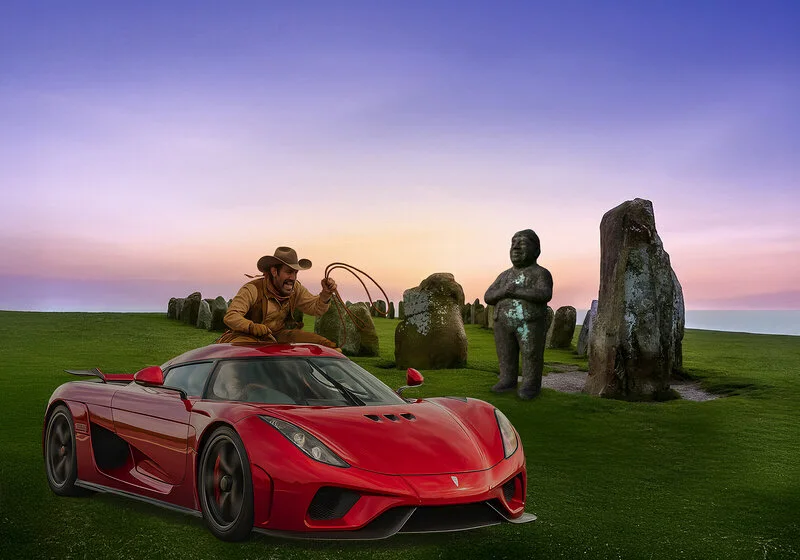
Rodeo at Ales Stenar, 2025
Digital
70 x 50 cm
3 200 kr
Rodeo at Ales Stenar
A red Koenigsegg, a symbol of speed and luxury, parked at Ales Stenar, a historical site in Sweden. This juxtaposition of modernity and ancient history sets the stage for our exploration of the cultural and artistic significance of cars.
A rodeo rider, a symbol of wildness and freedom, straddling the bodywork of the car as if it were a wild stallion, lasso swinging in the evening light. This imagery, a fusion of man and machine, sets the stage for our exploration of the cultural and artistic significance of cars.
The scene is, of course, a fantasy – but it is precisely in this meeting between myth and machine, between history, art, and local patriotic humour, that our journey begins. For the car is more than a vehicle. It is a work of art, a mirror of its age, a dream of freedom, and a reminder of its cost, connecting us to the past and present.
From the Futurists’ furious manifestos, which celebrated the speed and dynamism of the car and its role in shaping the modern world, to contemporary eco-critical installations that critique its environmental impact, the car has left an indelible mark on our culture. It has been painted, crushed, petrified, and turned into rolling sculptures. It has been hailed as a symbol of freedom and criticised as an environmental villain.
This is the story of the automobile in art – from rodeo riders and Koenigseggs to the artistic interpretations of Warhol and Dalí, and today’s neon-glinting cathedrals of wreckage. These artists and installations have reimagined the car as a cultural symbol, and their work now awaits your exploration.
Join me on a journey to explore the captivating world of cars. This essay aims to both entertain and inform you about the past eras. Prepare to be educated, inspired, and entertained as we delve into the history and cultural significance of these unforgettable vehicles, ensuring you leave with a wealth of knowledge and a deeper understanding of the subject.
“Ballad of Cars in Art
A red Koenigsegg by Ales Stenar’s line,
a cowboy astride as the engines whine.
His lasso spins in the twilight’s glow,
while Persson sings what the Skåne winds know.
The Futurists hailed speed’s furious flame,
they shattered the past in progress’s name.
“A roaring car outshines Nike’s grace,”
their manifest thundered through time and space.
Lempicka in Bugatti, daring and free,
Delaunay’s patterns in geometry.
Warhol repeated the crash in despair,
Rosenquist mixed chrome, flesh, and fare.
Dalí let snails in a taxi remain,
while rain from its roof fell steadily as pain.
Kinder’s Trabant burst the Wall apart,
Chamberlain twisted wrecks into art.
Burden was nailed to a Volkswagen’s hood,
a martyr who warned where humanity stood.
Persson transformed a car into the sea,
with drowned-out creatures of sad poetry.
Koenigsegg harnessed two thousand steeds,
Bugatti and Pagani fulfilled their creeds.
Sjöbäck built towers of neon and steel,
ruins that glimmer with futures unreal.
In novels and music, on stages of play,
the car rolls on through night and day.
It tempts, it burns, it dazzles, it scars,
a freedom-dream bound to the fate of the stars.
As long as wheels spin and engines roar,
the car in art will endure evermore.
It is armour and mirror, desire and doom,
a temple of iron, a soul in full bloom.”
Malmö. August 2025
Rodeo at Ales Stenar
A red Koenigsegg races across the grass at Ales Stenar in Skåne, a ship setting from the 6th century. A place where you might neither drive a car nor ride a rodeo – yet here, in the enchanting light of dusk, the rules have briefly been relaxed. On the roof of the car sits a rodeo rider, mounted on the sleek bodywork as if it were a herd of wild stallions charging ahead. With lasso in hand and eyes burning with fierce determination, he reins in the 2,300-horsepower engine roaring beneath the bonnet.
It is a vision that belongs to a saga or a dream, yet it feels strangely true. Perhaps because Ales Stenar, with its ship setting and massive stones raised by unknown hands some fifteen hundred years ago, exudes an awe-inspiring force field that both connects and dissolves. Here, past becomes present, and myths step out of the shadows. The site is well chosen, for ships were the pinnacle of transport in their day – something like a Koenigsegg on keel, one might say.
And this evening, yet another figure emerged from eternity: Edvard Persson, actor, singer, eternal local patriot. To avoid attention, he had taken on the guise of a stone – a round, jovial figure among the other blocks. But when he saw the spectacle before him, he could not hold back. His voice carried across the plain, warm and resonant, as he began to sing ‘Lite grann från ovan’ (A little bit from above) from the film ‘Kalle på Spången’ (Spången is a famous inn). An echo from the silver screen of the 1930s, now engraved among stones that had stood here for millennia.
Edvard loved cars. He owned many, and his taste for the grand and imposing was clear in a Chrysler so massive that in 1937 it ended in a head-on crash and a month in hospital. But had he lived today, the choice would have been obvious. He would have driven a Koenigsegg – a car born on Skåne soil, as much an engineering feat as a work of art. For Persson was not only car-crazy, he was also a man who carried Skåne in his heart, as fiercely as he ever did on the silver screen.
So this scene – the rodeo rider taming the Koenigsegg, the ancient force field of Ales Stenar, and Edvard Persson disguised as a stone singing of his beloved Skåne – is not just a perfect beginning. It's a timeless moment where myth meets machine, past meets future, and art meets culture. This marks the start of the story, a bridge that connects us to the history of the car in art.
Chapter 1. The Car Drives into Art
As long as the car remains central to human life, it will also stay central in art. It does not merely roll on the roads – it roars into art history, transforming the way we perceive the world and inspiring new artistic expressions.
The first significant impact occurs in 1909 when Futurism erupts – the Italian avant-garde determined to discard the old and forge a new world of speed, technology, and violent energy. In its manifesto, Filippo Tommaso Marinetti articulates the words that define the movement:
“A roaring automobile that seems to run on machine-gun fire is more beautiful than the Victory of Samothrace.”
With a single sentence, the ancient winged goddess of victory is dismissed in favour of a gasoline-driven machine. The Futurists want museums, libraries, and academies demolished. Everything must be sacrificed so that humanity can surge into the future like a howling racecar.
Here, the car is, from the beginning, linked to masculinity, power, and destructive energy. It becomes a symbol of aggressive progress. Yet we must remember that cars at that time looked quite different from today’s roaring beasts. They resembled horseless carriages more than shiny sports cars. And yet, they were imbued with violent eroticism and raw masculine strength.
Meanwhile, something decisive was unfolding in America. In 1913, the first Model T rolled off the assembly line in Detroit. Henry Ford’s car was more than just a vehicle – it became a symbol of aspiration for ordinary people, a promise that the automobile was for everyone, not just the privileged few. It marked the start of the car’s democratisation, shifting from a luxury for elites to a possession accessible to the masses.
Art had already adopted the car as its inspiration. Still, with Futurism and Ford’s mass production, it also became a part of daily life – shaping and mirroring modern existence in a way that was previously unimaginable.
Chapter 2. Gender, Power and the Automobile
The fact that the automobile was early associated with raw masculinity is hardly a coincidence. For millennia, men have ridden, raced, and driven chariots and war wagons – from the pharaohs of Egypt to the triumphs of Rome. The horse was man’s extension, a symbol of power, control, and speed. When the engine replaced the horse, the automobile inherited the same symbolic function. That men would also straddle the car, tame its force, and measure their strength in competition was therefore inevitable. It was a continuation of the ancient dream: to push boundaries, conquer the realm of speed, and master the power within.
But already early on, women began to claim this masculine bastion. In the 1920s, the garçonne sat confidently behind the wheel. Tamara de Lempicka’s Self-Portrait in a Green Bugatti is more than a portrait – it is a manifesto. The woman takes the driver’s seat. She steers. She commands. Sonia Delaunay, too, adorned cars with her geometric patterns, demonstrating that design and aesthetics were not a male monopoly.
Over time, women’s increasing participation in the automotive world is a testament to their empowerment. Today, racing circuits are no longer exclusive to men. Female drivers compete at the highest levels, and the car’s aesthetics have become a means of exploring female identity, desire, and freedom.
It is within this meeting – between the automobile’s patriarchal heritage and the woman’s act of conquest – that one of the most compelling stories unfolds. The car becomes both a battleground of gender and a symbol of liberation—male desire to push boundaries clashes with female resolve to break barriers.
Therefore, the automobile continues to mirror our culture not only in terms of speed, status, and aesthetics, but also in the struggle over gender, power, and freedom.
Chapter 3. The Woman Takes the Wheel
After the Futurists celebrated the automobile as a machine, war symbol, and masculine projection, something new emerged in the 1920s. A new figure emerged from the mist: the garçonne – the independent, modern professional woman who claimed her place behind the wheel.
She drove with cropped hair, a straight posture, and effortless elegance. She embodied a break from the past – no longer the passenger, but the driver. Few captured her aura better than the Polish artist Tamara de Lempicka.
In 1929, she was commissioned by the German fashion magazine Die Dame to create an image celebrating women’s independence. The result was Self-Portrait (Tamara in a Green Bugatti). There, she sits at the wheel with helmet and gloves on, a grey scarf sharply contrasting with the shimmering green paintwork. The portrait is as much a declaration of intent as a painting: a woman steering her own destiny, as boldly as she steers her car. Daring, sensual, aloof.
At the same time, artist, designer, and entrepreneur Sonia Delaunay embodied the same modernity. In her abstract paintings and geometric patterns, she captured the spirit of her era: electricity, poetry, and modern ballet. She managed her own fashion and interior design boutique and even created patterns for Citroën and Bugatti. Her vision was to transform life itself – the streets, the everyday, the people – into a luminous total work of art.
At Skissernas Museum in Lund, you can still see her monumental murals created for the Aviation Pavilion at the 1937 Paris World Exhibition. They radiate the same fascination: cars, aeroplanes, and the technological optimism of the era.
Tamara de Lempicka’s Bugatti self-portrait has, in modern times, been reborn as the cover of Unda Hörner’s book 1919 – The Year of Women. It is no coincidence. She did not simply paint herself at the wheel – she painted the dream of a generation.
From the garçonne and Delaunay, we can read another chapter in the history of the car in art: the vehicle no longer as a masculine domain, but as a medium of female emancipation and modern identity, thanks to their pioneering contributions.
Chapter 4. Visionaries and Engineers
As the car became part of everyday life during the interwar years, engineers and visionaries also made their mark on art history. The machine was no longer solely a symbol of violence and gender but also a platform for technical innovation and futuristic visions.
In the United States, architect and inventor Buckminster Fuller experimented with his Dymaxion car (1933–34). Streamlined, futuristic, almost more spaceship than automobile. Like his geodesic domes and modular houses, it belonged to the same realm of radical innovation. Fuller’s car never achieved commercial success – but it became a work of art in its own right, a prototype of a future that never fully materialised, yet continues to captivate.
When the Guggenheim Museum in Bilbao staged its grand exhibition 'Motion, Autos, Art, Architecture' in 2022, it aimed to showcase the intersection of these disciplines and how they influenced each other. Fuller’s Dymaxion car was a key exhibit, standing beside Jean Bugatti’s early racing cars – as elegant as they were technically advanced. Together, they offered a panorama of how the automobile was not only a vehicle, but also an aesthetic and cultural idea.
It is easy to see how the automotive design of the 1930s, 40s, and 50s reflected the same formal language as sculptors like Constantin Brâncuși, Barbara Hepworth, and Henry Moore: rounded forms, organic lines, and a blend of simplicity and strength. The car became 'rolling modernism' – a term used to describe the incorporation of modernist design principles into the automotive industry, creating a sculpture in steel, glass, and chrome.
Here, automotive aesthetics were just as important as function. The car was not merely transport – it was art in motion, proof of humanity’s belief in technology and the future.
Chapter 5. Pop Art at the Crossroads
As postwar optimism increased in the United States, the car became the most obvious motif in pop art. Here, the boundary between advertising, consumption, and art blurred – most clearly seen in the works of the 1960s.
James Rosenquist was among those who used car iconography most deliberately. His monumental painting I Love You with My Ford (1961), now housed at Moderna Museet in Stockholm, consists of three horizontal panels: an intimate female profile, a close-up of a chrome-shining car front, and a plate of spaghetti in tomato sauce. The combination is absurd yet sharply pointed – a commentary on a society where everything can be marketed and consumed: love, desire, status, and fast food. A Hollywood profile, car advertising, and everyday fare merge into one contemporary document.
Andy Warhol took a different approach. He looked back at the early history of the car. In the silkscreen Benz Patent Motor Car (1886), the three-wheeled pioneering automobile appears eight times, surrounded by pastel blocks streaked with black. It lingers in the image like a ghost, suggesting that automobility carries darkness from the very beginning.
Even more brutal is Warhol’s Orange Car Crash Fourteen Times (1963), part of his Death & Disasters series. Here, the American dream dies in the mangled wreckage. The image, taken from a news photograph, is repeated until the details dissolve into darkness. The catastrophe loses its concrete form and becomes a pure structure of accident and death. Warhol borrows the aesthetics of advertising but infuses them with cynicism, transforming consumer culture into tragedy.
However, the artistic importance of the car isn't solely about consumer culture. It also embodies the dream of freedom, adventure, and the myth of the road trip. This is where John E. Franzén comes in – the Swedish painter who, in 1966, moved to California, captivated by American cars and motorcycles.
Even before the move, he had begun work on his masterpiece, the Cadillac Eldorado, a painting almost life-size: 160 x 645 cm. For fifty years, it hung in the foyer of Lund’s Technical University until a digital reproduction replaced it, and the original was transferred to Moderna Museet. Critic Ulf Linde described the work as “a euphoric daydream of male potency and female libido.”
At his death in 2022, Franzén left behind not only images of gleaming bodywork but also scenes of America’s backstreets, the wear of daily life, and broken dreams. He captured car culture in its entirety – not only its glamour, but also its melancholy and shadow.
Here, at the intersection of Rosenquist, Warhol, and Franzén, pop art functions like a road sign: the car is no longer transport, but an emblem of an entire era. It embodies desire, consumption, death, and the aspiration for freedom.
Chapter 6. Cars in Art – An Overview
Throughout the 20th century, the automobile has served both as a motif and a medium in art. It can be painted, sculpted, photographed – but it can also be transformed into art in itself. It is both canvas and brush, both subject and material.
Artists have used the car as a symbol of progress, status, and freedom. From Futurism’s hymns to speed and the machine to today’s more reflective gestures. Among the most famous examples are Picasso’s decorated car, John Chamberlain’s sculptures of crushed steel, the iconic installation Cadillac Ranch in Texas, and the rolling masterpieces BMW commissioned from artists like Warhol and Lichtenstein.
The car as subject
Painters and draughtsmen have depicted the car’s speed, power, and beauty as a way to explore modernity, glamour, and nostalgia. Sculptors like John Chamberlain compressed wrecked bodywork into monuments of debris. Public installations like Cadillac Ranch, with its nose-dived cars buried in the Texas soil, have become landmarks of modern art. In photography and illustration, the car has also taken a leading role. Fitz and Van, for example, created stylised images for General Motors, where advertising became art and art became advertising.
The car as a medium
But the automobile is not just a motif – it is also a physical object. A vehicle can be turned into an Art Car through painting, reconstruction, upholstery, beadwork, or complete transformation into sculpture. BMW’s Art Cars are arguably the most renowned examples. When artists like Alexander Calder, David Hockney, Jeff Koons, and Andy Warhol left their mark on car bodies, they became moving artworks with their own presence.
Other artists explored the same idea through more personal expressions. Yayoi Kusama adorned her cars with her signature polka dots, and John Lennon had his Rolls-Royce painted in psychedelic colours. The car became a stage for self-expression, a private canvas in motion.
Symbolism and cultural significance
Through art, the car has also become a reflection of cultural values. For the Futurists, it epitomised modernity and progress. For postwar consumers, it symbolised freedom, status, and aspiration. And today, it can just as effectively serve as a critique – a symbol of climate crisis, consumer hysteria, or lost faith in the future.
The car embodies all these notions: utopia and dystopia, eroticism and eco-criticism, power and ruin. It has become a mirror of its era, a reminder that technology is always as much cultural as it is mechanical.
Chapter 7. Art Cars – Rolling Works of Art
There is art that hangs on museum walls, and there is art that rolls out onto the streets. Art Cars belong to the latter. Here, the automobile is no longer just a depicted motif but the artwork itself – a vehicle transformed into artistic expression. This feat inspires fascination and appreciation for the creativity involved.
An Art Car is never just painted; it is remade, reinterpreted, and sometimes completely transformed into a new form. The creator, often not a formally trained artist but an enthusiast, uses the car as their canvas. Many jokingly refer to themselves as Cartists. The main idea is freedom: the car becomes an extension of the self, blending dream, craft, and identity, inspiring a sense of personal expression and artistic freedom.
Most Art Cars are built and driven by ordinary people, often without formal art training. Self-taught, self-funded, and motivated by passion, they contribute significantly to the art world. However, established artists have also made their mark. Roy Lichtenstein and Andy Warhol, for example, painted BMW’s famous Art Cars, which were not only displayed but also raced.
A motley history
The phenomenon emerged at the crossroads of several movements: the hippie movement’s decorated VW vans of the 1960s, lowrider culture, and the Merry Pranksters’ legendary bus Furthur. John Lennon had his Rolls-Royce Phantom painted in psychedelic colours inspired by Romani wagons. Janis Joplin covered her Porsche 356 with swirling floral patterns. These vehicles were as much symbols of music, lifestyle, and protest as they were modes of transport.
Artist Larry Fuente took the idea to its extreme with Mad Cad, a Cadillac covered in thousands of tiny objects. Other pioneers like David Best and Jackie Harris paved the way for a new form of art. In the 1990s, filmmaker Harrod Blank became one of the movement’s most essential voices with documentaries such as Wild Wheels and Automorphosis. He also published books on the phenomenon and co-founded ArtCar Fest in San Francisco, the United Kingdom’s second-largest festival for Art Cars.
From hippie dream to light parades
The culture spread rapidly. In 2010, Gloworama in Houston hosted a New Year’s Eve parade featuring more than a hundred illuminated cars. Other examples include the Oscar Mayer Wienermobile, shaped like a giant hot dog in a bun. Once solely advertising, it now appears as pop art.
In Texas, where the movement established its strongest roots, significant events still take place today. But Art Car culture now extends across the United States, into Canada, and even into Europe. In Baltimore, annual parades attract thousands of visitors; in British Columbia and Saskatchewan, cars appear in small towns. Even rental car company Avis has sponsored initiatives on the European scene.
Styles and expressions
Art Cars can be simple paint jobs inspired by popular culture or monumental creations that obscure entirely the original vehicle. One of the most famous examples is Vochol, a Volkswagen covered with over 2.5 million beads in Huichol style – a fusion of Indigenous art and car culture.
Themes vary greatly: humour and satire, science fiction and surrealism, Gothic overtones, and political statements. Parades often feature cars alongside decorated bicycles, scooters, and even performers in costumes on roller skates. Sometimes, the entire event becomes street theatre, with music and performance integral to the spectacle.
The limits of freedom
But even art on wheels must obey the law. Turn signals must stay visible, licence plates unobscured, and width not exceeding legal limits. Within these boundaries, however, exists a world of freedom: vehicles transformed into dreams, philosophies, and fantasies.
An Art Car is therefore not just an object to behold – it is living proof that art can move into the street, take its place in traffic, and literally drive into the heart of society.
Chapter 8. Famous Cars in Art
Over the years, a select few cars have transcended their original purpose to become iconic artworks, marking significant milestones in both art and automotive history. These masterpieces, born from the creative minds of artists, showcase the diverse roles a vehicle can play-from an advertising symbol to a political commentary, or a surrealist dreamscape. The artistic innovation in these transformations is genuinely inspiring.
Andy Warhol – The Mercedes Series
It’s hardly surprising that Andy Warhol, the king of consumerist art, would take an interest in cars – even if he never drove one himself. In 1986, Mercedes-Benz commissioned him to depict the company’s evolution through paintings, silkscreens, and drawings.
He completed 49 of the planned 80 works before his death the following year. Most were based on photographs and executed in his characteristic pop art style. The series has only been exhibited in its entirety three times: 1988, 2010, and 2014, and today it belongs to Daimler’s collection. Here, commercial commission and artistic myth-making merge – Warhol’s cars are as much portraits of machines as they are pop icons.
Wolf Vostell – Concrete Traffic
In 1970, the German artist Wolf Vostell produced a piece that was as much about process as it was about the final form. A Cadillac was encased in concrete in a Chicago car park – an “instant happening” where the petrification itself became the art. It was only when parking fines began accumulating that it was moved. Since then, Concrete Traffic has remained at the University of Chicago as a significant monument both to the absurdity of gridlock and to concrete as an artistic material.
Birgit Kinder – Trabi
When the Berlin Wall fell, the Trabant – the people’s car of East Germany – became one of the most unlikely symbols of freedom. In 1990, Birgit Kinder painted a Trabant bursting straight through the Wall on one of its remaining sections, and the image quickly became one of the most famous in the East Side Gallery. The mural combines political commentary and humour: the car breaking through the Wall symbolises a nation moving towards unity, while also reminding viewers of the DDR’s limited means of production—a simple gesture, yet rich with history.
Salvador Dalí – Clothed Automobiles and Rainy Taxi
The master of Surrealism, Dalí, seldom drove himself, but the car frequently appeared in his work. He dressed Cadillacs in luxurious fabrics and crafted the legendary installation Rainy Taxi: two mannequins in a car, surrounded by lettuce, chicory, and snails, with a system of pipes that made it rain inside the vehicle. On the bonnet, he placed a full-sized bronze statue – as absurd as it was majestic.
When he was to give a lecture at the Sorbonne, he filled a Rolls-Royce to the brim with cauliflower. Later, the Thompson Twins sang Salvador Dalí’s Car. Whether or not one seeks deeper meaning, for Dalí, the car was always a symbol of modernity, progress, and the absurdity of humankind’s dream of control.
BMW Art Cars – A Tradition
As early as 1925, Sonia Delaunay painted a car as an extension of her textile patterns. However, it was not until the 1970s, when BMW started inviting contemporary artists, that the phenomenon really took hold. Artists like Alexander Calder, Andy Warhol, Roy Lichtenstein, David Hockney, and Jeff Koons are just a few who left their mark on the bodywork.
After a pause, BMW returned in 2024 with two new works: Julie Mehretu’s M Hybrid V8, first showcased in Paris before racing at Le Mans, and Esther Mahlangu, the first woman involved in the project back in 1992, who now created the high-tech i5 Flow Nostokana with electronic panels displaying animated patterns — a fusion of tradition, innovation, and futuristic vision.
Giacomo Balla – Speeding Automobile
For the Futurist Giacomo Balla, the car was not an object but a movement. Inspired by Marinetti, he painted not bodywork but speed, sound, and light. In works like Ritmo + rumore + velocità d’automobile, he aimed to capture the power of the car rather than its form.
Today, we interpret these paintings as both artworks and historical documents. Although Futurism became closely linked with Fascism, for Balla, the car primarily represented the light of the future – the very heartbeat of modernity.
Roy Lichtenstein – In the Car
Lichtenstein, renowned for his comic book style, painted In the Car in 1963. A panel from Girls’ Romances inspired the image, but without any text. What remains are only the expressions of the passengers, heightened by the cramped interior of the car as a frame of tension.
The painting sold in 2005 for £16.2 million – then the most expensive of his works – and remains one of his most iconic. Even though his Masterpiece later broke all records, In the Car still stands as one of the sharpest blends of automotive aesthetics and human emotion.
Chapter 9. Eco-Criticism and the Car’s Shadow Side
When the first Futurists celebrated the thrill of speed, they were heralding a new era. The car, then a symbol of the future, power, and modernity, was a beacon of hope for the 20th century. However, as we transitioned into the 21st century, the symbolism began to change. The car, once a sign of freedom, also became a looming threat.
Already in the 1970s, the green movement emerged, challenging dependence on fossil fuels. Artist Chris Burden, in 1974, created his most renowned performance piece, Trans-Fixed, in which he permitted himself to be crucified on a Volkswagen Beetle. Nailed through his hands onto the bonnet, he lay like a modern martyr. The act was about pain and transgression, but the photographs communicate just as much about humanity nailed to its own creation. The people’s car here becomes a cross – a foreshadowing of the climate crisis and ecological collapse.
In Malmö, the theme took shape in 2010 when Roland Persson created one of the city’s most memorable festival pieces. He transformed a parked car on Hamngatan into an aquarium filled with capsized sea creatures. It didn't resemble a warning sign—rather, it depicted a dreamlike underwater scene. But for that very reason, the impact was more profound. The car’s everyday body became a poignant monument to humanity’s influence on the sea and nature.
Here, in the tension between Burden’s painful crucifixion and Persson’s dreamlike installation, a new image emerges: the car as an embodiment of catastrophe. No longer merely a symbol of modernity and a dream, but a stark reminder that through our own machinery, we are driving ourselves towards the abyss. The emotional weight of this message is palpable.
As the climate crisis intensifies, this perspective becomes increasingly powerful. Where the Futurists saw ecstasy, we now witness burned-out engines, floods, and forests in flames. The automobile becomes the artists’ dark mirror – a shadow cast over our era.
Chapter 10. Contemporary Interpretations and the Aesthetics of the Car
Despite the looming threat of the climate crisis, the allure of car culture persists in new and intriguing forms. In 2020s Sweden, the bass-heavy rhythms of epadunk pulse from A-tractors on rural roads, street racing leaves its marks on the asphalt nights, and hypercars shine like jewels in urban streets. The symbols of status endure. The automobile remains a macho emblem, a vessel of desire, and an identity shaped in metal.
However, there is also another aesthetic, where the very form of the car transcends its function, turning it into a moving sculpture. Vintage cars shine like historical artefacts, while electric cars are seen as visions of the future. Nostalgia merges with technological optimism. The once-everyday car becomes as much a museum piece as a means of transport, inviting wonder and appreciation.
It is within this tension between nostalgia, represented by the historical artefacts of vintage cars, and futurism, embodied by the visions of the future in electric vehicles, that contemporary artists operate. Malmö-based Sara Sjöbäck has made the car her raw material. She dismantles, rebuilds, stacks, and transforms. In large-scale works like V70XIII, parts of Volvo family cars are assembled into towers of steel and aluminium, lit by neon lights that flicker as if borrowed from nightclubs or science-fiction films.
Sjöbäck’s works exhibit a compelling duality. They are powerful and menacing, yet also fragile and vulnerable. They can be viewed as tributes to industrial machine aesthetics, but also as ruins of a bygone era – monuments to the Swedish welfare state and an identity once centred around the family car as the household’s centre. This duality invites contemplation and intrigue.
In a piece at Inkonst in Malmö, she let the words I WANT YOU glow from a red-lacquered hood in the club’s dimly lit room. A promise, a demand, an erotic charge. Like a forbidden dream of fast cars and heated encounters. Here, the car becomes as much an erotic sign as a material object.
In this way, Sjöbäck links the car’s long symbolic history: from Futurism’s ecstasy and Pop Art’s consumer dreams to our own era’s ambivalence. The automobile remains a desire, not just a mode of transportation, but a symbol of freedom, power, and status — but also a symbol of a ruined future, a memory of what we once were, and a question of where we are heading.
Chapter 11. Luxury Travel as Art
When art and the car intersect, it often occurs at the extremes – in the everyday turned to decay, or in the luxurious turned into a dream. Luxury cars, in particular, have continued to embody the legacy of the automobile as an art form. Here, we see not only engineering but a conscious aesthetic, where every detail is crafted to attract the eye and delight the senses.
The luxury car is more than just transportation. It is a stage. An interior world where comfort, materials, and design combine into a complete experience. Wooden panels, hand-stitched leather seats, electronic instruments that blink like miniature art installations – all designed to make the journey more than a simple transfer from A to B.
Here, travel and art converge: in the feeling of moving through the world framed by a work that both rolls and speaks. A car can become a kind of mobile palace, a stage on which the traveller is also the spectator in their own drama.
Perhaps that is why the luxury car, more than any other, has become a motif for artists, designers, and filmmakers. It embodies abundance and allure, but also a dream of complete control over both time and space. And in that very dream, technology and aesthetics converge – the innermost longing of modernity.
Thus, the journey in a luxury car becomes an art form in itself: a voyage through the world, but also through the reflection of art.
Chapter 12. Creating a Car – Design as the Highest Art
So far, we have traced the car as a motif in art history, from the Futurists’ ecstasy to today’s eco-critical installations. But creating a car is itself an art form. Design, design, design – constantly fused with functionality, engineering, and law. It is not only about building a vehicle that moves, but about shaping a sculpture in steel, carbon fibre, and glass, where lines, proportions, and performance converge.
One of the modern masters of this craft is Swede Christian von Koenigsegg, who has spent nearly three decades successfully building some of the world’s most exclusive and technologically advanced cars. His creations are more than just vehicles – they are bold works of power and beauty, where every detail is meticulously considered. In one of his latest models, over 2,300 horsepower is packed beneath the bonnet – so much that it nearly defies belief. It is no surprise that in one image, a rodeo rider, straddling the car, appears to tame a roaring mechanical beast.
But Koenigsegg is not alone in this elite realm. His rivals include names like Bugatti, Pagani, McLaren, Ferrari, and Lamborghini. All excel in the same art: creating cars that straddle the line between technology and artistry, between raw velocity and refined elegance. Bugatti, with models such as the Veyron and Chiron, has crafted machines that are not only among the fastest in the world but also among the most refined in design. Pagani transforms cars into baroque sculptures, with interiors reminiscent of cathedral altarpieces fashioned in carbon fibre and titanium.
What these manufacturers share is the creation of dynamic works of art where aesthetics are never subordinate to technology—and technology never relinquishes its grip on aesthetics. The lines, the air intakes, the curvature of a headlamp: everything becomes part of a story. It is art on wheels, but also art in motion, where the dimension of speed adds something that paintings and sculptures can never provide.
One might say that the highest art of the automobile not only hangs on museum walls but also rolls on our roads. It carries its beauty at 300 km/h, and in that ecstasy between danger and design, humanity finds yet another mirror of its own creativity.
Chapter 13. The Automobile in Literature, on Stage, and in Music
The car, a versatile symbol, has not only been a motif for painters and sculptors but has also played diverse roles in literature, theatre, and music. It has become a story, a symbol, and a prop, seamlessly blending into popular culture and high art.
In Literature
In novels and poems, the car, often a symbol of freedom, danger, and desire, plays a significant role in storytelling. The American road trip novel, a genre in itself, uses the journey by car as a powerful metaphor for search, escape, and youthful rebellion.
In F. Scott Fitzgerald’s The Great Gatsby (1925), the car becomes a symbol of decadence and death. The yellow automobile that kills Myrtle is not just a vehicle – it is an image of lost control, a stark reminder of wealth’s destructive allure.
Even in Swedish literature, the car appears as a symbol of freedom and status. In working-class fiction, it sometimes signifies a way out of poverty but also a new burden to bear.
On Stage and in Film
Theatre and film have long used the car as charged scenography. On stage, a vehicle may remain motionless yet embody the entire drama – a confined space where emotions clash. Samuel Beckett’s short piece ‘Drive’ (1960s) is one such example, in which the car becomes a setting for absurd waiting and stationary movement.
In film, the car is arguably even more critical. All of Hollywood’s mythology depends on it – from James Dean in ‘Rebel Without a Cause’ (1955), to the chase scenes in Bullitt (1968), and the tire-burning franchise The Fast and the Furious (2001–). The car functions as both a weapon and an escape, symbolising characters’ desires and their capacity for destruction. In Swedish cinema, ‘Göta kanal’ (1981) offered the most populist celebration of the car’s (and boat’s) slapstick potential, while Bo Widerberg’s ‘Ådalen 31’ (1969) showed how a truck could carry an entire political tragedy.
In Music
Music might be the art form where the car is most deeply embedded in popular imagination. Rock history is full of vehicles: from Chuck Berry’s “Maybellene” (1955) and “No Particular Place to Go,” to Bruce Springsteen’s ballads, where the car is not just an escape route, but a powerful symbol of freedom.
In country music, the truck continues as a symbol of work and daily life. In the blues, the car is often both a woman and a symbol of loss. In Sweden, the epatraktor and the raggarbil created their own sonic landscape – from Eddie Meduza to today’s epadunk.
But the automobile has also entered the realm of art music. Composer Karlheinz Stockhausen used cars as sound sources in his Helikopter-Streichquartett (1995), where motor sounds blended with strings in a post-industrial crescendo.
The car in literature, on stage, and in music is therefore never just a prop. It is a language of its own – charged with symbolism, dreams, and downfall. It can be the setting of a novel, the stage of a film, the rhythm of a rock song, or even an instrument in a symphony.
Epilogue. The Motor in Art
From the Futurists’ manifestos to today’s neon-lit sculptures, the automobile has accompanied us as both dream and nightmare. It has been a machine and a muse, a symbol of raw masculinity, but also a tool for female emancipation. It has been celebrated as a symbol of freedom and criticised as an environmental offender. It has featured as a consumer icon in Pop Art and as a dystopian wreck in eco-critical installations.
We have seen it evolve into art itself – Art Cars painted by enthusiasts and world-famous stars alike, from Lennon and Janis Joplin to Warhol and Lichtenstein. We have seen it petrified in Vostell’s concrete, shattered through the Berlin Wall in Birgit Kinder’s Trabi, or rain from within in Dalí’s surreal taxi. We have traced its lines in Brâncuși and Hepworth, heard its rhythm in Springsteen and Chuck Berry, and felt its presence in novels, on stages, and on screens.
And we have seen how the very creation of a car can be regarded as art: Koenigsegg’s extreme feats of engineering, Bugatti’s sophisticated machines, Pagani’s baroque sculptures on wheels. Design that pays homage not only to function but also to beauty, harmony, and perfection.
Yet, amidst all this, a shadow persists: Burden’s crucifixion on a Volkswagen, Persson’s dreamlike sea creatures in a Malmö car, the climate crisis relentlessly approaching. The car is as much a ruin as a dream, as much a catastrophe as a symbol of freedom.
Perhaps that is why it continues to captivate us. No other everyday object evokes such strong emotions: desire and envy, anger and nostalgia, contempt and identity. It renders us both visible and anonymous, protected yet vulnerable. It is armour and mirror, an extension of the body and a reflection of the self.
As long as the car exists in human life, it will remain a symbol in art as well. A symbol that drives stories, myths, and images forward – as inexorably as it once thundered into the Futurists’ manifesto. And perhaps it is in this very meeting between speed and form, between the dream of freedom and the anxiety of collapse, that the automobile’s true artistic significance lies: in its paradox.
The car is not only a means of transport.
It is art.
It is contemporaneity.
It is us.
En röd Koenigsegg vid Ales Stenar. En rodeoryttare som grenslar karossen som om det vore en vildhingst, lasson svängande i kvällsljuset. Och där, bland stenarna, en välbekant gestalt: Edvard Persson, återvänd från sin stjärna, förklädd till sten men ändå bristande ut i sång. Lite grann från ovan ekar över slätten, där havet möter himlen och hästkrafterna mullrar under motorhuven.
Scenen är förstås en fantasi – men det är just i detta möte mellan myt och maskin, mellan historia, konst och lokalpatriotisk humor, som vår resa börjar. För bilen är mer än ett fordon. Den är ett konstverk, en spegel av sin tid, en dröm om frihet och en påminnelse om dess pris.
Från futuristernas rasande manifest till dagens ekokritiska installationer har bilen präglat vår kultur. Den har målats, krossats, förstenats och förvandlats till rullande skulpturer. Den har hyllats som frihetssymbol och smutskastats som miljöbov.
Det är berättelsen om bilen i konsten – från rodeoryttare och Koenigsegg till Warhol, Dalí och dagens neonblänkande skrotkatedraler – som nu väntar.
En röd Koenigsegg dånar fram över gräset vid Skånska Ales Stenar, en skeppssättning från 600-talet. En plats där man varken får köra bil eller rida rodeo – men här, i skymningens magiska ljus, har reglerna tillfälligt upphävts. På bilens tak sitter en rodeoryttare, grensle över karossen som om den vore en jätteflock med vilda hingstar. Med lasso i hand och ögon fyllda av kamplust tyglar han de 2300 hästkrafterna som vrålar under motorhuven.
Det är en syn som hör till sagans eller drömmens värld, men ändå känns den märkligt sann. Kanske för att Ales Stenar själv är en plats där tid och verklighet alltid stått och vacklat. Skeppssättningen, dessa väldiga block som rests av okända händer för femtonhundra år sedan, rymmer ett kraftfält som både förbinder och upplöser. Här blir forntid nutid, här kliver myter ur skuggorna. Platsen är välvald för skeppen var toppen av vad dåtiden kunde transportera sig i, något av dåtidens Koenigsegg på köl kan man säga.
Och denna kväll hade ytterligare en gestalt stigit ner från evigheten: Edvard Persson, skådespelaren, sångaren, den evige lokalpatrioten. För att inte väcka uppmärksamhet hade han antagit skepnaden av en sten – en rund, jovialisk gestalt bland de andra blocken. Men när han såg spektaklet framför sig kunde han inte hålla sig. Rösten bar över slätten, fylld av värme, när han började sjunga ’Lite grann från ovan’ ur filmen ’Kalle på Spången’. Ett eko från 1930-talets vita dukar, nu inskrivet bland stenar som stått här i tusentals år.
Edvard älskade bilar. Han ägde många, och hans förkärlek för det stora och pampiga tog sig bland annat uttryck i en Chrysler så massiv att den 1937 slutade i frontalkrock och en månad på sjukhus. Men hade han levt i dag, skulle valet varit givet. Han skulle ha kört Koenigsegg – en bil född på skånsk mark, lika mycket ingenjörskonst som konstverk. För Persson var inte bara biltokig, han var också en man som bar Skåne i hjärtat, lika starkt som någon gång på bioduken.
Så blir denna scen – rodeoryttaren tämjande Koenigseggen, Ales Stenars forntida kraftfält, och Edvard Persson förklädd till sten sjungande om sitt Skåne – en perfekt början. Här möts myt och maskin, forntid och framtid, konst och kultur. Här tar berättelsen sin början, innan vi kör vidare genom historien om bilen i konsten.
Kapitel 1. Bilen kör in i konsten
Så länge bilen är central i människans liv kommer den också vara central i konsten. Den rullar inte bara på vägarna – den vrålar in i konsthistorien och förändrar hur vi ser på världen.
Det första stora brakandet sker 1909. Då slår futurismen igenom, den italienska avantgardismen som vill kasta det gamla överbord och bygga en ny värld på fart, teknik och våldsam energi. I sitt manifest skriver Filippo Tommaso Marinetti orden som definierar rörelsen:
”En rytande automobil som verkar driven av en kulspruta är vackrare än Nike från Samothrake.”
Med en enda mening byts antikens bevingade segergudinna ut mot en bensindriven maskin. Futuristerna vill jämna museer, bibliotek och akademier med marken. Allt ska offras för att mänskligheten ska accelerera mot framtiden som en vrålande racerbil.
Här knyts bilen tidigt till manlighet, kraft och destruktiv energi. Den blir symbol för aggressiv framåtanda. Men vi måste minnas att bilarna vid denna tid inte liknade dagens vrålåk. De påminde mer om hästlösa droskor än om blänkande sportbilar. Ändå laddas de med våldsam erotik och maskulin råstyrka.
Samtidigt sker något avgörande i USA. År 1913 lämnar den första T-Forden det löpande bandet i Detroit. Henry Fords bil blir inte bara ett fordon – den blir en dröm för massorna, ett löfte om att bilen är till för alla, inte bara för de få. Det är början på bilens demokratisering, steget från elitens leksak till folkets ägodel.
Konsten hade redan utsett bilen till sin musa, men med futurismen och Fords massproduktion etableras den också som en del av vardagen, något som både formar och speglar det moderna livet.
Kapitel 2. Kön, makt och bilen
Att bilen tidigt laddades med rå manlighet är knappast en slump. Män har i årtusenden ridit, tävlat, kört vagnar och stridskärror – från egyptiernas faraoner till romerska triumftåg. Hästen har varit mannens förlängning, en symbol för makt, kontroll och fart. När hästen ersätts av motorn tar bilen över dess symboliska funktion. Att män skulle grensla även bilen, tämja dess kraft och mäta sin styrka i tävling, är därför självklart. Det är en förlängning av samma uråldriga dröm: att tänja på gränserna, erövra fartens rike och behärska kraften under sig.
Men redan tidigt började kvinnor att göra anspråk på denna manliga bastion. Redan på 1920-talet sätter sig garçonnen självsäkert bakom ratten. Tamara de Lempickas Självporträtt i grön Bugatti blir här mer än ett porträtt – det blir ett manifest. Kvinnan tar förarplatsen, hon styr, hon har kontroll. Sonia Delaunay klär bilar i sina geometriska mönster och visar att design och estetik inte är ett manligt monopol.
Med tiden har kvinnors intåg i bilens värld blivit allt mer påtagligt. I dag är racingbanorna inte längre enbart männens arena. Kvinnliga förare tävlar på högsta nivå och bilens estetik har också blivit ett verktyg för att utforska kvinnlig identitet, begär och frihet.
Det är i detta möte – mellan bilens patriarkala arv och kvinnans erövring – som en av de mest spännande historierna utspelar sig. Bilen blir både en arena för könskamp och en symbol för frigörelse. Den manliga driften att tänja gränserna möter den kvinnliga viljan att bryta barriärer.
Så fortsätter bilen att spegla vår kultur inte bara i termer av fart, status och estetik – utan också i kampen om kön, makt och frihet.
Kapitel 3. Kvinnan tar plats bakom ratten
Efter att futuristerna vrålat in bilen i konsten som maskin, krigssymbol och manlig projektion sker något nytt på 1920-talet. En ny figur kör fram ur dimman: garçonnen – den självständiga, moderna yrkeskvinnan som tar plats bakom ratten.
Hon kör med kortklippt page, rak hållning och en självklar elegans. Hon representerar ett brott med det gamla – kvinnan är inte längre passagerare, hon är förare. Och få har fångat hennes aura bättre än den polska konstnären Tamara de Lempicka.
År 1929 får hon uppdraget av det tyska modemagasinet Die Dame att skapa en bild som hyllar kvinnors oberoende. Resultatet blir Självporträtt (Tamara i en grön Bugatti). Där sitter hon bakom ratten, iklädd hjälm och handskar, en grå scarf som kontrast mot bilens gröna lack. Porträttet är lika mycket en programförklaring som en målning: kvinnan som styr sitt eget öde, med samma självklarhet som hon styr sin bil. Djärv, sexig, oberörd.
Samtidigt förkroppsligar konstnären, formgivaren och entreprenören Sonia Delaunay samma modernitet. I sina abstrakta målningar och geometriska mönster gestaltar hon tidens dynamik: elektriciteten, poesin, den moderna baletten. Hon driver egen mode- och inredningsbutik och mönstrar bilar för Citroën och Bugatti. Hennes vision är att göra hela livet – gatorna, vardagen, människorna – till ett färglysande allkonstverk.
När vi i dag vandrar genom Skissernas museum i Lund kan vi ännu se hennes monumentala målningar för Luftfartspaviljongen vid världsutställningen i Paris 1937. De bär samma puls: fascinationen för bilen, flyget och den nya tidens teknikoptimism.
Tamara de Lempickas Bugatti-porträtt har i vår tid fått nytt liv som omslag till Unda Hörners bok 1919 – kvinnornas år. Det är ingen slump. Hon målade inte bara sig själv vid ratten – hon målade en hel generations frihetsdröm.
Från garçonnen och Delaunay kan vi läsa ett annat kapitel i bilens konsthistoria: bilen som inte längre bara är ett maskulint kraftfält, utan ett medel för kvinnlig frigörelse och modern identitet.
Kapitel 4. Visionärer och ingenjörer
När bilen under mellankrigstiden blir en självklar del av vardagen tar också ingenjörerna och visionärerna plats i konsthistorien. Maskinen är inte längre bara en projektion av våld och kön, utan också en arena för teknisk fantasi och framtidsdrömmar.
I USA experimenterar arkitekten och uppfinnaren Buckminster Fuller med sin Dymaxionbil (1933–34). Den är strömlinjeformad, futuristisk, nästan mer rymdskepp än bil. Liksom hans geodetiska kupoler och modulhus hör den hemma i samma universum av radikal innovation. Fullers bil blev aldrig en kommersiell succé – men den blev ett konstverk i sig, en prototyp för en framtid som aldrig riktigt kom, men som fortsätter att fascinera.
När Guggenheim-museet i Bilbao 2022 visar den stora utställningen Motion. Autos, Art, Architecture finns Fullers Dymaxionbil på plats. Bredvid står Jean Bugattis tidiga racerbilar, lika eleganta som tekniskt avancerade. Tillsammans bildar de ett panorama över hur bilen inte bara var ett fordon, utan en estetisk och kulturell idé.
Det är inte svårt att se hur 1930-, 40- och 50-talens bildesign speglar samma formspråk som skulptörerna Constantin Brâncuși, Barbara Hepworth och Henry Moore utvecklade. Rundade former, organiska linjer, en kombination av enkelhet och kraft. Bilen blir till rullande modernism – en skulptur i stål, glas och krom.
Här blir bilens estetik lika viktig som dess funktion. Den är inte bara transport – den är konst i rörelse, ett bevis på människans tro på tekniken och framtiden.
Kapitel 5. Popkonstens vägkorsning
När efterkrigstidens optimism växlar upp i USA blir bilen popkonstens självklara motiv. Här upplöses gränsen mellan reklam, konsumtion och konst – och ingenstans sker det tydligare än i 1960-talets verk.
James Rosenquist hör till de som använder bilens ikonografi mest utstuderat. Hans monumentala målning I love you with my Ford (1961), i dag på Moderna museet i Stockholm, består av tre horisontella bildfält: en intim kvinnoprofil, en närbild på en kromglänsande bilfront och en tallrik spaghetti i tomatsås. Kombinationen är absurd och träffsäker på samma gång – en kommentar till ett samhälle där allt kan marknadsföras, allt kan konsumeras: kärlek, begär, status och snabbmat. Hollywoodprofil, bilreklam och vardagsvara sammanfogas till ett samtidsdokument.
Andy Warhol går i en annan riktning. Han vänder blicken bakåt, till bilens urhistoria. I silk screen-verket Benz Patent Motor Car (1886) återkommer den trehjuliga pionjärbilen åtta gånger, i pastellrutor strimmade av svart. Den tycks hemsöka bilden som en gengångare, som om bilismen redan från födelsen bär på ett mörker.
Ännu mer brutal är Warhol i verket Orange Car Crash Fourteen Times (1963), en del av serien Death & Disasters. Här är det den amerikanska drömmen som dör i den krockade karossen. Bilden, hämtad från ett nyhetsfoto, upprepas tills detaljerna upplöses i mörker. Katastrofen förlorar sin konkreta form och blir en ren struktur av olycka och död. Warhol använder reklamens estetik, men laddar den med en cynism som förvandlar konsumtionskulturen till tragedi.
Men bilens konstnärliga betydelse handlar inte bara om konsumtionens språk. Den rymmer också drömmen om frihet, äventyret, roadtripens myt. Här kommer John E. Franzén in – den svenske konstnären som 1966 flyttar till Kalifornien, besatt av amerikanska bilar och motorcyklar.
Redan innan flytten har han påbörjat sitt mästerverk Cadillac Eldorado, en målning i nästan naturlig storlek: 160 x 645 cm. I femtio år hänger den i foajén på Lunds Tekniska Högskola, tills den flyttas till Moderna museet. Kritiker Ulf Linde beskriver verket som ”en euforisk dagdröm om manlig potens och kvinnlig libido”.
Franzén efterlämnar vid sin död 2022 inte bara bilder av glänsande karosser, utan också av USA:s bakgator, av vardagens slitage och brustna drömmar. Han fångade bilkulturen i dess helhet – inte bara glamouren, utan också dess melankoli och mörker.
Här, i korsningen mellan Rosenquist, Warhol och Franzén, står popkonsten som vägskylt: bilen är inte bara transport, utan symbol för en hel epok. Den bär begäret, konsumtionen, döden och frihetsdrömmen i samma form.
Kapitel 6. Bilar i konsten – en översikt
Bilen har genom hela 1900-talet fungerat både som motiv och medium i konsten. Den kan målas, skulpteras, fotograferas – men den kan också förvandlas till konst i sig själv. Den är både duk och pensel, både ämne och material.
Genom historien har konstnärer använt bilen som en symbol för framsteg, status och frihet. Från futurismens hyllningar av hastighet och maskin till dagens mer reflekterande gestaltningar. Bland de mest kända exemplen finns Picassos dekorerade bil, John Chamberlains skulpturer av krossad plåt, den ikoniska installationen Cadillac Ranch i Texas, och de rullande mästerverk som BMW lät konstnärer som Warhol och Lichtenstein skapa.
Bilen som motiv
Konstnärer har i målningar och teckningar fångat bilens hastighet, kraft och skönhet – som ett sätt att utforska modernitet, glamour och nostalgi.
Skulptörer som John Chamberlain pressade samman krossade karosser och skapade monument av spillror. Offentliga installationer som Cadillac Ranch, där bilar står nedgrävda nosen först, har blivit ikoniska landmärken.
I fotografi och illustrationer har bilen också spelat huvudrollen. Fitz och Van skapade exempelvis stiliserade bilder för General Motors, där reklamen blev konst och konsten reklam.
Bilen som medium
Men bilen är inte bara motiv – den är också ett material. Ett fordon kan förvandlas till en Art Car genom att målas, byggas om, kläs i tyger, dekoreras med pärlor eller omformas till rena skulpturer. BMW:s Art Cars är kanske de mest kända exemplen. När namn som Alexander Calder, David Hockney, Jeff Koons och Andy Warhol satte sin prägel på bilarnas ytor blev det rullande konstverk med egen aura.
Andra konstnärer har gjort samma sak i mer personliga uttryck. Yayoi Kusama dekorerade sina bilar med prickmönster, och John Lennon lät sin Rolls Royce målas i psykedeliska färger. Bilen blev en scen för självuttryck, en privat canvas i rörelse.
Symbolik och kulturell betydelse
Genom konsten har bilen också blivit en spegel av kulturens idéer.
För futuristerna var den själva sinnebilden av modernitet och framsteg.
För efterkrigstidens konsumenter var den frihet, status, dröm.
Och i dag kan den lika gärna vara en kritisk kommentar – en symbol för klimatkris, konsumtionshysteri eller förlorad framtidstro.
Bilen rymmer alla dessa laddningar: utopi och dystopi, erotik och ekokritik, kraft och ruin. Den har blivit en spegel av sin tid, en påminnelse om att teknologin alltid är lika mycket kultur som maskin.
Kapitel 7. Art Cars – rullande konstverk
Det finns konst som hänger på museiväggar och det finns konst som rullar ut på gatorna. Art Cars tillhör den senare kategorin. Här är bilen inte längre ett avbildat motiv utan själva verket – ett fordon förvandlat till konstnärligt uttryck.
En Art Car är aldrig bara målad. Den är omgjord, omtolkad, ibland helt transformerad till en ny kropp. Skaparen är ofta ingen akademiskt skolad konstnär utan en entusiast som gör bilen till sin egen duk. Många kallar sig skämtsamt för Cartists. Friheten är själva poängen: bilen blir en utvidgning av jaget, en blandning av dröm, hantverk och identitet.
De flesta Art Cars byggs och körs av vanliga människor, ofta utan konstutbildning. Självlärda, självfinansierade, med passionen som drivkraft. Men även etablerade konstnärer har satt sin prägel. Roy Lichtenstein och Andy Warhol målade till exempel BMW:s berömda Art Cars, som inte bara ställdes ut utan också kördes på racerbanorna.
En brokig historia
Fenomenet föds i mötet mellan flera strömningar: hippierörelsens dekorerade Volkswagen-bussar på 1960-talet, lowrider-kulturen och Merry Pranksters legendariska buss Furthur. John Lennon lät måla sin Rolls Royce Phantom i psykedeliska färger inspirerade av romska vagnar. Janis Joplin hade sin Porsche 356 täckt av blommiga mönster. Det var bilar som lika mycket var musik, livsstil och protest som transport.
Konstnären Larry Fuente drev idén till sin spets med Mad Cad, en Cadillac täckt av tusentals små föremål. Andra pionjärer som David Best och Jackie Harris öppnade vägen för en ny konstform. På 1990-talet blev filmaren Harrod Blank en av rörelsens viktigaste röster med dokumentärer som Wild Wheels och Automorphosis. Han gav också ut böcker om fenomenet och var med och grundade ArtCar Fest i San Francisco, USA:s näst största festival för konstbilar.
Från hippiedröm till ljusparader
Kulturen spred sig snabbt. 2010 kördes Gloworama i Houston – en nyårsafton med över hundra ljusdekorerade bilar i parad. Andra exempel är Oscar Mayer Wienermobile, formad som en gigantisk varmkorv. Från början reklam, men i dag lika mycket popkonst.
I Texas, där rörelsen haft sitt starkaste fäste, arrangeras än i dag stora evenemang. Men art car-kulturen finns nu i hela USA, i Kanada och även i Europa. I Baltimore lockar årliga parader tusentals besökare, i British Columbia och Saskatchewan dyker bilarna upp i småstäder. Till och med hyrbilsföretaget Avis har sponsrat europeiska initiativ.
Stilar och uttryck
Art Cars kan vara enkla målningar inspirerade av populärkulturen, men också monumentala skapelser som helt döljer bilens ursprungliga kropp. Ett av de mest berömda exemplen är Vochol, en Volkswagen täckt av över 2,5 miljoner pärlor i huichol-stil – ett möte mellan urfolkskonst och bilkultur.
Teman varierar. Här finns humor och satir, science fiction och surrealism, gotiska övertoner och politiska budskap. Paraderna blandar bilar med dekorerade cyklar, mopeder och människor på rullskridskor i kostym. Ibland blir det hela till gatuteater, med musik och performance som en del av verket.
Frihetens gränser
Men även konst på hjul måste förhålla sig till lagen. Blinkers ska synas, registreringsskyltar får inte döljas, bilens bredd får inte överstiga vad som är tillåtet. Inom dessa ramar finns dock en hel värld av frihet: fordon som förvandlas till drömmar, filosofier och fantasier.
En Art Car är därför inte bara ett objekt att beskåda – den är ett levande bevis på att konsten kan kliva rakt ut på gatan, ta plats i trafiken och bokstavligen röra sig mitt i samhället.
Kapitel 8. Berömda bilar i konsten
Bland alla bilar som genom åren förvandlats till konstverk finns ett antal som blivit milstolpar – ikoner i både konst- och bilhistoria. De visar hur fordonet kan bli allt från reklamsymbol till politisk kommentar och surrealistiskt drömspel.
Andy Warhol – Mercedes-serien
Att konsumtionskonstens kung, Andy Warhol, skulle intressera sig för bilar är knappast förvånande – även om han själv aldrig körde. 1986 fick han av Mercedes-Benz i uppdrag att skildra märkets utveckling genom målningar, screentryck och teckningar.
Han hann fullborda 49 av de planerade 80 verken innan sin död året därpå. De flesta byggde på fotografier och utfördes i hans karaktäristiska popkonststil. Serien har bara visats i sin helhet tre gånger: 1988, 2010 och 2014, och ingår idag i Daimlers samlingar. Här möts kommersiellt uppdrag och konstnärlig mytbildning – Warhols bilar är lika mycket maskinporträtt som popikoner.
Wolf Vostell – Concrete Traffic
1970 skapade den tyske konstnären Wolf Vostell ett verk som var lika mycket process som resultat. En Cadillac göts in i betong på ett parkeringshus i Chicago – ett ”instant happening” där själva försteningen var konsten. Först när parkeringsböterna började hopa sig flyttades den. Sedan dess står Concrete Traffic vid University of Chicago som ett massivt monument över både trafikstockningens absurditet och betongen som material.
Birgit Kinder – Trabi
När Berlinmuren faller blir Trabanten – DDR:s folkbil – en av de märkligaste frihetssymbolerna. 1990 målar Birgit Kinder en Trabant som bryter rakt igenom muren på en kvarvarande sektion, och verket blir snabbt ett av East Side Gallerys mest kända.
Målningen förenar politiskt budskap och humoristisk kraft: bilen som forcerar muren står för en nation på väg mot enhet, samtidigt som den påminner om DDR:s begränsade produktionsmedel. En enkel gestaltning, men laddad med historiskt ögonblick.
Salvador Dalí – Clothed Automobiles och Rainy Taxi
Surrealismens mästare Dalí körde sällan själv, men bilen återkom gång på gång i hans verk. Han klädde Cadillacs i exklusiva tyger och skapade den legendariska installationen Rainy Taxi: två skyltdockor i en bil, omgivna av sallad, cikoria och sniglar, med ett rörsystem som fick regnet att falla inne i fordonet. På motorhuven placerade han en bronsstaty i naturlig storlek – lika absurd som majestätisk.
När han skulle föreläsa på Sorbonne fyllde han en Rolls Royce till brädden med blomkål. Thompson Twins sjöng senare Salvador Dali’s Car. Oavsett om man letar efter djupare mening eller inte är bilen för Dalí alltid en symbol för modernitet, framsteg – och det absurda i människans dröm om kontroll.
BMW Art Cars – en tradition
Redan 1925 målade Sonia Delaunay en bil som förlängning av sina textilmönster. Men det var först på 1970-talet, när BMW började bjuda in samtida konstnärer, som fenomenet blev etablerat. Alexander Calder, Andy Warhol, Roy Lichtenstein, David Hockney och Jeff Koons är bara några av dem som satt sin prägel på karossen.
Efter en paus återvände BMW 2024 med två nya verk: Julie Mehretus M Hybrid V8, som först ställdes ut i Paris och sedan tävlade på Le Mans, samt Esth
3 200 kr

Jörgen Thornberg
Malmö
Lite om bilder och mig. Translation in English at the end.
Jag är en nyfiken person som ser allt i bilder, även det jag fäster i ord, gärna tillsammans för bakom alla mina bilder finns en berättelse. Till vissa bilder hör en kortare eller längre novell som följer med bilden.
Bilder berättar historier. Jag omges av naturlig skönhet, intressanta människor och historia var jag än går. Jag använder min kamera för att dokumentera världen och blanda det jag ser med vad jag känner för att fånga den dolda magin.
Mina bilder berättar mina historier. Genom mina bilder, tryck och berättelser. Jag bjuder in dig att ta del av dessa berättelser, in i ditt liv och hem och dela min mycket personliga syn på vår värld. Mer än vad ögat ser. Jag tänker i bilder, drömmer och skriver och pratar om dem; följaktligen måste jag också skapa bilder. De blir vad jag ser, inte nödvändigtvis begränsade till verkligheten. Det finns en bild runt varje hörn. Jag hoppas att du kommer att se vad jag såg och gilla det.
Jag är också en skrivande person och till många bilder hör en kortare eller längre essay. Den följer med tavlan, tryckt på fint papper och med en personlig hälsning från mig.
Flertalet bilder startar sin resa i min kamera. Enkelt förklarat beskriver jag bilden jag ser i mitt inre, upplevd eller fantiserad. Bilden uppstår inom mig redan innan jag fått okularet till ögat. På bråkdelen av ett ögonblick ser jag vad jag vill ha och vad som kan göras med bilden. Här skall jag stoppa in en giraff, stålmannen, Titanic eller vad det är min fantasi finner ut. Ännu märkligare är att jag kommer ihåg minnesbilden långt efteråt när det blir tid att skapa verket. Om jag lyckas eller inte, är upp till betraktaren, oftast präglat av en stråk av svart humor – meningen är att man skall bli underhållen. Mina bilder blir ofta en snackis där de hänger.
Jag föredrar bilder som förmedlar ett budskap i flera lager. Vid första anblicken fylld av feel-good, en vacker utsikt, fint väder, solen skiner, blommor på ängen eller vattnet som ligger förrädiskt spegelblankt. I en sådan bild kan jag gömma min egentliga berättelse, mitt förakt för förtryckare och våldsverkare, rasister och fördomsfulla människor - ett gärna återkommande motiv mer eller mindre dolt i det vackra motivet. Jag försöker förena dem i ett gemensamt narrativ.
Bild och formgivning har löpt som en röd tråd genom livet. Fotokonst känns som en värdig final som jag gärna delar med mig.
Min genre är vid som framgår av mina bilder, temat en blandning av pop- och gatukonst i kollage som kan bestå av hundratals lager. Vissa bilder kan ta veckor, andra någon dag innan det är dags att överlämna resultatet till printverkstaden. Fine Art Prints är digitala fotocollage. I dessa kollage sker rivandet, klippandet, pusslandet, målandet, ritandet och sprayningen digitalt. Det jag monterar in kan vara hundratals år gamla bilder som jag omsorgsfullt frilägger så att de ser ut att vara en del av tavlan men också bilder skapade av mig själv efter min egen fantasi. Därefter besöks printstudion och för vissa bilder numrera en limiterad upplaga (oftast 7 exemplar) och signera för hand. Vissa bilder kan köpas i olika format. Det är bara att fråga efter vilka. Gillar man en bild som är 70x100 men inte har plats på väggen, går den kanske att få i 50x70 cm istället. Frågan är fri.
Metoden Giclée eller Fine Art Print som det också kallas är det moderna sättet för framställning av grafisk konst. Villkoret för denna typ av utskrifter är att en högkvalitativ storformatskrivare används med åldersbeständigt färgpigment och konstnärspapper eller i förekommande fall på duk. Pappret som används möter de krav på livslängd som ställs av museer och gallerier. Normalt säljer jag mina bilder oinramade så att den nya ägaren själv kan bestämma hur de skall se ut, med eller utan passepartout färg på ram, med eller utan glas etc..
Under många år ställde jag bara ut på nätet, i valda grupper och på min egen Facebooksida - https://www.facebook.com/jorgen.thornberg.9
Jag finns också på en egen hemsida som tyvärr inte alltid är uppdaterad – https://www.jth.life/ Där kan du också läsa en del av de berättelser som följer med bilden.
UTSTÄLLNINGAR
Luftkastellet, oktober 2022
Konst i Lund, november 2022
Luftkastellet, mars 2023
Engleson Galleri Caroli, april 2023
Hydra, Greece June 2023
Engleson Galleri Caroli, oktober 2023
Toppen, Höllviken december 2023
Luftkastellet, mars 2024
Torups Galleri, mars 2024
Venice, May 2024
Luftkastellet, oktober 2024
Konst i Advent, December 2024
Galleri Engleson, Caroli December 2024
Jäger & Jansson Galleri, april 2025
A bit about pictures and me.
I'm a curious person who sees everything in pictures, even what I express in words, often combining them, for behind all my pictures lies a story. These narratives, some as short as a single image and others as long as a novel, are the heart and soul of my work.
Pictures tell stories. Wherever I go, I'm surrounded by natural beauty, exciting people, and history. I use my camera to document the world and blend what I see with what I feel to capture the hidden magic.
My images tell my stories. Through my pictures, prints, and narratives, I invite you to partake in these stories in your life and home and share my deeply personal perspective of our world. More than meets the eye. I think in pictures, dream, write, and talk about them; consequently, I must create images too. They become what I see, not necessarily confined to reality. There's a picture around every corner. I hope you'll see what I saw and enjoy it.
I'm also a writer, and many images come with a shorter or longer essay. It accompanies the painting, printed on fine paper with my personal greeting.
Many pictures start their journey on my camera. Simply put, I describe the image I see in my mind, experienced or imagined. The image arises within me even before I bring the eyepiece to my eye. In a fraction of a moment, I see what I want and what can be done with the picture. Here, I'll insert a giraffe, Superman, the Titanic, or whatever my imagination conjures up. Even stranger is that I remember the mental image long after it's time to create the work. Whether I succeed is up to the observer, often imbued with a streak of black humour – the aim is to entertain. My pictures usually become a talking point wherever they hang.
I prefer pictures that convey a message in multiple layers. At first glance, they're filled with feel-good vibes, a beautiful view, lovely weather, the sun shining, flowers in the meadow, or the water lying deceptively calm. But beneath this surface beauty, I often conceal a deeper story, a narrative that challenges societal norms or explores the human condition. I invite you to delve into these hidden narratives and discover the layers of meaning within my work.
Picture and design have been a thread running through my life. Photographic art feels like a fitting finale, and I'm happy to share it.
My genre is varied, as seen in my pictures; the theme is a blend of pop and street art in collages that can consist of hundreds of layers. Some images can take weeks, others just a day before it's time to hand over the result to the print workshop. Fine Art Prints are digital photo collages. In these collages, tearing, cutting, puzzling, painting, drawing, and spraying happen digitally. What I insert can be images hundreds of years old that I carefully extract so they appear to be part of the painting, but also images created by myself, now also generated from my imagination. Next, visit the print studio and, for certain images, number a limited edition (usually 7 copies) and sign them by hand. Some images may be available in other formats. Just ask which ones. If you like an image that's 70x100 but doesn't have space on the wall, you might be able to get it in 50x70 cm instead. The question is open.
The Giclée method, or Fine Art Print as it's also called, is the modern way of producing graphic art. This method ensures the highest quality and longevity of the artwork, using a high-quality large-format printer with archival pigment inks and artist paper or, in some cases, canvas. The paper used meets the longevity requirements set by museums and galleries. I sell my pictures unframed, allowing the new owner to personalise their artwork, confident in the lasting value and quality of the piece.
For many years, I only exhibited online, in selected groups, and on my Facebook page - https://www.facebook.com/jorgen.thornberg.9. I also have my website, which unfortunately is not constantly updated - https://www.jth.life/. You can also read some of the stories accompanying the pictures there.
EXHIBITIONS
Luftkastellet, October 2022
Art in Lund, November 2022
Luftkastellet, March 2023
Engleson Gallery Caroli, April 2023
Hydra, Greece June 2023
Engleson Gallery Caroli, October 2023
Toppen, Höllviken December 2023
Luftkastellet, March 2024
Torup Gallery, March 2024
Venice, May 2024
UTSTÄLLNINGAR
Luftkastellet, oktober 2022
Konst i Lund, november 2022
Luftkastellet, mars 2023
Engleson Galleri Caroli, april 2023
Hydra, Greece June 2023
Engleson Galleri Caroli, oktober 2023
Toppen, Höllviken december 2023
Luftkastellet, mars 2024
Torups Galleri, mars 2024
Venice, May 2024
Luftkastellet, October 2024
Konst i Advent, December 2024
Galleri Engleson, Caroli December 2024
Jäger & Jansson Galleri, April 2025
Utbildning
Autodidakt
Medlem i konstnärsförening
Öppna Sinnen
Med i konstrunda
Konstrundan i Skåne
Utställningar
Luftkastellet, October 2022
Art in Lund, November 2022
Luftkastellet, March 2023
Engleson Gallery Caroli, April 2023
Hydra, Greece June 2023
Engleson Gallery Caroli, October 2023
Toppen, Höllviken December 2023
Luftkastellet, March 2024
Torup Gallery, March 2024
Venice, May 2024