Vi använder cookies för att ge dig bästa möjliga upplevelse. Välj vilka cookies du tillåter.
Läs mer i vår integritetspolicy
Jörgen Thornberg
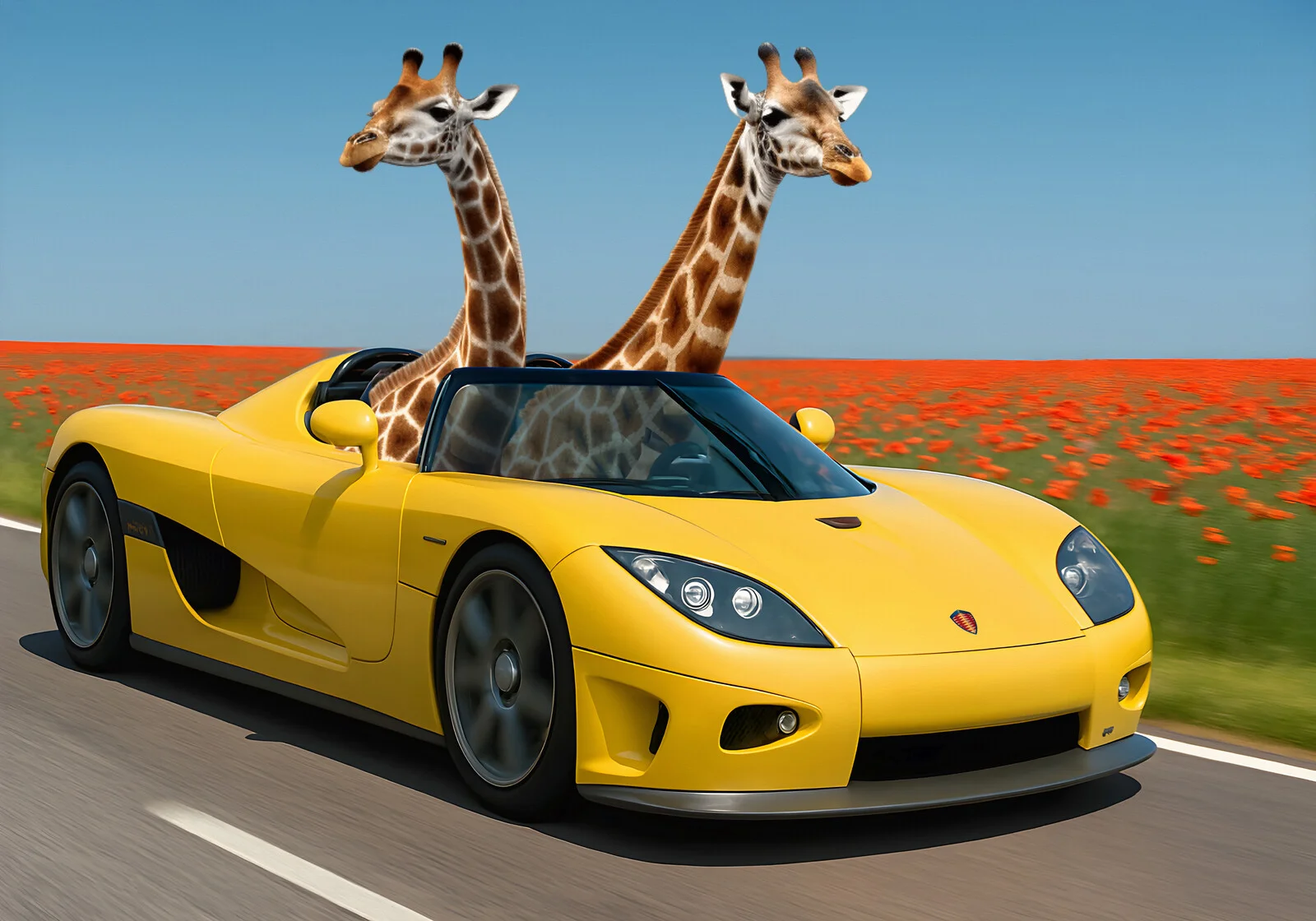
A Yellow and Red Day - En Gul och Röd Dag, 2025
Digital
70 x 50 cm
3 200 kr
A Yellow and Red Day – En Gul och Röd Dag
On an early summer Saturday in Skåne, an unexpected scene unfolds: two giraffes in a bright yellow Koenigsegg speeding past fields of red poppies. Despite lacking driver’s licences, their surprisingly proficient driving skills rival those of an F1 driver. The car – the world’s fastest with a targa top – had been “borrowed” from the Koenigsegg facility in Ängelholm. Thanks to their long necks, wide field of vision, and ability to distinguish colours, the giraffes spotted the unattended prize, kicked open a couple of locks, and set off. And what luck that proved to be.
They brazenly ignore speed cameras, fully aware that two giraffes in the cockpit would only confuse the police. On Glimmingevägen, they shatter a sixty-six-year-old local speed record and come close to Koenigsegg’s top times – a poor cow along the way drops dead from shock. Astrid, who watched the entire race from her garden, shared her account only with the ladies at the next day’s coffee gathering. Several of them had heard the high-speed run from a distance and therefore believed her story. A Koenigsegg driven like that sounds like a thunderstorm rolling in. Imagine that sound, and yet the morning sky had been clear as far as the eye could see.
The car was returned later the same morning, with a half-empty tank and no scratches, but with a few light and dark brown hairs on the seats. The giraffes, it seems, had a change of heart after their joyride and decided to return the car to its rightful place. Koenigsegg’s staff, in a move that added to the intrigue of the story, chose to remain silent about the discovery. Perhaps that’s for the best – some records, like some stories, are too improbable to explain, leaving us with a delightful mystery.
Join me on a journey to explore the fascinating world of images. This essay intends to entertain and enlighten you about the intricate process of driving fast without losing your driving licence. Get ready to be enlightened.
“Ode to the Unbeatable Beat
They said it was set in the days of old,
A record engraved in motoring gold.
Sixty-six years, the legend stood tall,
Fast as a comet, swift over all.
But out from Ängelholm, sleek and bright,
A Koenigsegg roared into morning light.
Yellow as the sun and sharp as a knife,
It ate up the road like it owed it its life.
At the wheel—oh, a sight to declare!—
A long-necked pilot with wind in his hair.
Beside him, his partner, serene yet bizarre,
An ungainly co-pilot in a car worth a star.
Through poppy-red fields and skies so wide,
They laughed at the wind on their targa-top ride.
The bend in the middle was barely a yawn,
By the time others blinked, the ‘Segg was long gone.
The Bugatti’s crown slipped into the past,
The “unbreakable” was beaten, and beaten fast.
Some say it was skill, some say it was luck—
But records are made for the brave to pluck.
Now whispers go round of the day it occurred,
How the King of the Road left history blurred.
And the moral? It’s simple—don’t bet on “forever,”
For a Koenigsegg’s roar means never say never.”
Malmö. August 2025
A Yellow and Red Day
It’s rare to see two giraffes out for a drive through Skåne's summer landscapes. Yet, it does happen – as shown by a perfectly composed photograph, with a bright yellow Koenigsegg making a striking contrast against the fields of red poppies and the distant blue horizon.
Naturally, anyone meticulous about rules would ask whether giraffes can actually drive a car – or are even permitted to – since they most certainly don’t possess driver’s licences. The first question is straightforward to answer, as I can confirm that the car handled beautifully on the winding road, and the cornering was comparable to that of F1 driver Lewis Hamilton. Of course, when you’re behind the wheel of this Skåne-built machine – the best car in the world – you have the advantage of something that seems to cling to the tarmac while cutting through the air like a spear. The cabriolet design is a necessity for those with long necks, or perhaps on their way to a wedding in a tall top hat. Still, driving a Koenigsegg with both hooves on the wheel isn’t just about flooring the accelerator – it also demands considerable focus. A giraffe’s tall neck has its perks, along with some drawbacks, but this was a naturally talented driver. And as for the hooves, well, let's say they had a few tricks up their sleeves, or should I say, hooves.
These two giraffes, let's call them George and Mildred, were quite the characters. George, the taller of the two, was the daredevil, always pushing the car to its limits. He had a mischievous glint in his eye and a love for adventure. Mildred, on the other hand, was the cautious one, constantly reminding George to watch his speed. She was the voice of reason, always thinking about the consequences of their actions. Their dynamic made for some entertaining moments on the road, with George's daring manoeuvres and Mildred's nervous but necessary interventions.
Persistent rule-keepers won’t give up easily and will undoubtedly question how giraffes can afford the world’s fastest targa-top car, with a top speed of 499 km/h. That, too, is simple to explain: they can’t. They stole it from Koenigsegg’s facility in Ängelholm, which also features a test track. They called it ‘borrow’. With their long necks, giraffes can not only spot lions from a mile and a half away – they can just as easily detect an unattended Koenigsegg from even further. This is thanks to their height and eyes positioned on the sides of their heads, which give them a wide field of vision. They also possess excellent night vision and can distinguish colours like red, yellow, and green – so spotting the yellow supercar was no trouble, even though it was parked inside a shed with a small window.
The padlock on the door didn’t stand a chance – a giraffe’s kick can easily kill a lion, so a heavy-duty Yale lock was gone with the first blow. The same applies to the gate at the entrance. On a scorching hot Saturday in July, most people are on holiday and not expecting car-thieving giraffes to be wandering about. The clever animals even closed up behind them properly, delaying discovery. Their drive took them along the winding roads of the Bjäre Peninsula, and it was hardly the first time a Koenigsegg had been caught speeding illegally there. They didn’t bother with speed cameras – no number plates, and with two giraffes in the cockpit, the images would be immediately discarded as a joke. So, they could calmly pass a camera at 400 km/h, assuming the radar beams could keep pace. The giraffes had planned their escape route meticulously, knowing every twist and turn of the road. They had even scouted the area beforehand, using their long necks to peer over fences and hedges.
Old Glimmingevägen, between Norra Kustvägen and Gösarpsvägen, features two perfectly straight stretches, each about one and a half kilometres long, with a forty-five-degree bend in the middle – a challenge for any speed enthusiast, including a giraffe with a heavy hoof on the gas.
That irritating middle bend prevented our giraffe from challenging Koenigsegg’s newly established 0–400–0 record, which requires a 3.2-kilometre straight. Koenigsegg achieved it in just 27.83 seconds, easily surpassing the previous record-holder – a Bugatti – to make history. The giraffe covered the distance in the Bugatti’s old record time of 42 seconds, which speaks volumes about both car and driver. And about the cow that dropped dead on the spot when the yellow streak thundered past.
It was so early in the morning that no farmers were yet about; only Astrid, a lively seventy-five-year-old farmwife, had seen the spectacle. She had been enjoying her first cup of coffee of the day in the peaceful morning quiet. From her garden table, right at the bend, she could see almost the entire stretch. Had the giraffe not navigated the bend so skillfully, tyres screeching, it might well have been Astrid’s last cup of coffee. No one would have believed her if she claimed that two giraffes had sprinted past faster than lightning. She kept the story for the next day’s coffee gathering. The stone-dead cow, along with a few other old ladies who had been startled awake by what sounded like thunder despite the cloudless blue sky, lent credibility to her account. The other old ladies, who had been peacefully snoozing in their rocking chairs, were now wide awake and gossiping excitedly about the 'giraffe racers' that had just zoomed past their windows.
The women were all at an age to remember the hot-rod boys of the sixties, who had challenged that very stretch of road many times. Yet not a single one of them had ever matched the giraffe’s performance; their cars barely made it halfway down the first straight before the giraffe was already braking on the other side. Astrid was married to the local record-holder, but she lacked the heart to risk her frail husband’s health by telling him that a giraffe was now the new champion. Since Astrid was no expert on giraffes—she’d only seen a couple at Copenhagen Zoo many years ago—she decided to Google the animal in question.
It quickly became evident that the giraffe was, in many ways, born to drive—at least when it comes to instincts. Like horses, giraffes are flight animals, shaped by millions of years on the savannah to react instantly when danger nears. Their height, which is otherwise impractical in cramped garages, provides them with an unbeatable view of the landscape—or, in this case, the road ahead. With a head rising well above the windscreen, a giraffe can see the bends from afar and plan its racing line like a rally driver who already knows every turn by heart. It's a sight to behold, a giraffe behind the wheel, or rather, above the wheel, navigating the road with such finesse and precision.
Its eyes are positioned on the sides of the head, offering a broader field of vision than any human driver could imagine. Combine this with excellent night vision and the ability to distinguish colours like red, yellow, and green, and you have a driver who will not miss a yellow Koenigsegg in a shed or a stop signal at the last second. It's a marvel of nature, the giraffe's vision, allowing it to see the world in ways we can only imagine.
Evolution’s principle is straightforward: those who survive reproduce. Over time, the individuals who adopt the strategy that gives them the best chance of living long enough to have offspring are the ones who pass on their genes. For giraffes, that strategy has been early detection and swift flight — not heroic combat. Their most potent kicks are thus more of a last resort when escaping is impossible—or, as in this instance, a practical means to break open a couple of heavy padlocks. They are, in other words, natural drivers, and Halldóra and Christian von Koenigsegg can be proud that their car now holds a record that has lasted sixty-six years and was long regarded as unbreakable. This record is a testament to the giraffe's instincts and their ability to adapt to new situations, even if it involves a high-speed car ride.
Astrid leaned back in her chair after finishing her search. She couldn’t decide whether it was finely honed instinct or sheer cheek that drove the two long necks through Skåne at 400 km/h. But one thing she was certain of: no hot-rodder in the district would ever beat that record—and if anyone attempted, they would unquestionably need both a wider field of vision and quite a few more legs. And their licence would be gone in a flash thanks to a well-placed camera.
Where did I get the picture from, wonders that same stickler for rules? Here’s the answer.
A good friend in the police force, who knows I collect unlikely photographs, has access to the discard pile where all unidentifiable individuals end up. He came across this unique picture and thought it would be a perfect addition to my collection. The previous “record” was held by a woman who was caught by a camera on the E22 doing 124 km/h in a 70 zone, while applying lipstick, her face mainly hidden by a mirror.
There is no legal obligation for a car owner to identify the driver when a camera records a speeding offence. If the police cannot establish who was driving from the photo, they send an enquiry to the owner, but the owner is not required to respond or to name the driver. In this case, the car had no plates. Even if Koenigsegg were contacted—the vehicle is hardly anonymous—no one at the company would admit that one of their vehicles had been on the loose.
The car was returned later that same morning, before the tank had been emptied. A half-full tank, a discrepancy in the odometer reading, and two broken locks revealed the whole story—someone had borrowed the car but returned it without so much as a scratch. The return of the vehicle was a surprise to everyone, and it left many questions unanswered. That someone had taken some animal along for the ride, because the seats contained light and dark brown hairs — not many, as the someone had been careful to clean up after themselves.
Giraffes are generally clean animals. They spend a significant amount of their time grooming themselves and each other, helping to keep their coats clean and free of parasites. However, a few hairs had been missed. A curious employee at Koenigsegg sent the hairs to the botanical department at Lund University. He chose to keep the results to himself, perhaps fearing he would become a laughingstock in the coffee room.
En tidig sommarlördag i Skåne fångas en osannolik syn på bild: två giraffer i en knallgul Koenigsegg som far fram längs röda vallmofält. Körkort har de förstås inte, men körförmågan matchar en F1-förares, och bilen – världens snabbaste med targatak – var ”lånad” från Koenigseggs anläggning i Ängelholm. Tack vare lång hals, vid synvinkel, och färgseende upptäckte girafferna det obevakade bytet, sparkade upp ett par lås och gav sig iväg. Och vilken tur det blev.
De ignorerar fartkameror, eftersom två giraffer i kupén ändå skulle hamna i polisens papperskorg för osannolika eller oidentifierbara förare. På Glimmingevägen krossar de ett sextiosexårigt lokalt fartrekord och når nästan Koenigseggs egna toppnoteringar – en stackars ko längs vägen får hjärtstillestånd. Vittnet Astrid, som sett hela racet från trädgården delar bara med sig av vad hon sett till kafferepets damer. Flera av dem hade hört framfarten på distans och trodde därför på hennes berättelse. En Koenigsegg som körs på det viset låter som när åskan går. Då skall man veta att morgonens himmel var utan ett moln så långt horisonten räckte.
Bilen återlämnas senare samma morgon, halvtom tank och utan repor men med några ljus- och mörkbruna hårstrån i sätena. Koenigseggs personal väljer att tiga om fyndet. Kanske är det bäst så – för vissa rekord, liksom vissa historier, är för osannolika för att förklaras.
Det är ganska ovanligt att se två giraffer på en biltur genom det skånska sommarlandskapet, men det händer uppenbarligen eftersom de fastnat på en bild, en välavstämd sådan, med en knallgul Koenigsegg som accent till det kringliggande fältets röda vallmo och den blå horisonten i väster.
Men vän av ordning frågar sig naturligtvis om giraffer kan köra bil, eller faktisk får det, för något körkort kan de knappast ha. Första frågan är lätt att besvara eftersom jag kan intyga att bilen löpte som smort på den kurviga vägen och kurvtekniken stod inte F1-föraren Lewis Hamilton efter. Visserligen har man som förare av detta skånska vrålåk mycket hjälp av den bästa bilen i världen, som formligen sugs fast i asfalten samtidigt som far som ett spjut genom luften. Denna cabriolet – en nödvändighet för de med långa halsar eller på väg till bröllop i hög hatt. Nu är det inte bara att trycka på gasen och ratta en Koenigsegg med båda hovarna på ratten, det fordras mycket uppmärksamhet också. Giraffers höga hals ger en hel del plusvärden, jämte vissa nackdelar men det här var uppenbarligen en riktigt naturbegåvad giraff.
Vänner av ordning brukar inte ge sig utan ifrågasätter självfallet hur giraffer kan ha råd med världens snabbast bil med targatak, med en toppfart på 499 kilometer i timmen. Även detta är lätt att besvara. De har de naturligtvis inte. De har snott bilen från Koenigseggs anläggning i Ängelholm, där företaget också har en testbana. De sluga girafferna med sin långa hals kan inte bara spåra lejon på en och en halv kilometers avstånd, de upptäcker med lätthet en obevakad Koenigsegg på större avstånd än så. Detta beror på deras höjd och ögonens placering på sidan av huvudet, vilket ger dem en bred synvinkel. De har också ett bra mörkerseende och kan urskilja färger som rött, gult och grönt, så den gula lyxbilen var inga problem, trots att den stod inne i ett skjul med ett litet fönster.
Hänglåset på dörren hade de sparkat upp, en giraffspark dödar med lätthet ett lejon så även en kraftigt Yalelås ryker med första sparken. Samma sak med grinden till entrén. En stekhet lördag i juli är de flesta på semester och inte inställda på att biltjuvande giraffer kan stryka omkring. Att de listiga djuren efter at ha norpat bilen stängde ordentligt efter sig försenade naturligtvis upptäckten. Färden gick längs slingrande vägar på Bjärehalvön och det var säkert inte första gången det passerade en Koenigsegg i olaglig hastighet. Inte brydde de sig om alla fartkameror, inga registreringsskyltar och med två giraffer i kupén skulle ändå bilderna hamna i papperskorgen som ett dåligt skämt. Sålunda kunde de lugnt passera en kamera i fyrahundra knutar, om nu radarstrålarna hängde med.
Gamla Glimmingevägen mellan Norra Kustvägen och Gösarpsvägen erbjuder två snörraka raksträckor, vardera halvannan kilometer med en fyrtiofemgraders böj i mitten. En utmaning för vilken fartdåre som helst, inkluderande en giraff med tung gaspedalsfot.
Den förargliga kurvan i mitten omöjliggjorde för vår giraff att utmana Koenigseggs nysatta rekord 0 till 400 och tillbaka till noll vilket kräver 3.2 kilometers raksträcka. Det tog Koenigseggen inte mer än 27,83 sekunder, vilket vida förpassade den tidigare rekordhållaren en Bugatti till historien. Att giraffen klarade sträckan på Bugattins gamla rekordtid 42 sekunder berättar en hel del om både bilen och föraren. Och om kon som fick hjärtslag på fläcken när den gula skuggan vrålade förbi. Det här var så tidigt att ingen bonde störde ännu helgen och bara Astrid, en morgonpigg sjuttiofemårig bondmora, hade noterat förbifarten. Hon hade tagit dagens första kopp kaffe i den ljuvlig morgonstunden. Från bordet i trädgården, precis i kurvan, såg hon nästa hela loppet. Hade inte giraffen varit så duktig och klarat kurvan med tjut i däcken, hade det blivit Astrids sista kopp i livet. Ingen skulle ta henne på allvar om Astrid berättade om två giraffer som farit förbi snabbare än blixten. Astrid sparade informationen till ett kafferep dagen efter. Den stendöda kon jämte några andra kärringar som vaknat till av att åskan gick trots en klarblå himmel ökade tilltron till hennes berättelse.
Kvinnorna var alla i åldern som upplevt sextiotalets raggare som utmanat just sträckan vid ett flertal tillfällen. Ingen raggare har emellertid varit i närheten av giraffens prestation, deras bilar hade knappt hunnit halvvägs på ena raksträckan innan giraffen hunnit bromsa in på andra sidan. Astrid var gift med den lokale rekordhållaren, men hade inte hjärta att riskera sin skröplige mans hälsa genom att berätta att en giraff var den nye rekordhållaren.
Eftersom Astrid inte var någon expert på giraffer, hon hade sett ett par på Köpenhamns zoo för många år sedan, googlade den nyfikna damen på djuret ifråga.
Det visade sig snabbt att giraffen i mångt och mycket var född till bilförare – åtminstone om man ser till instinkterna. Precis som hästar är giraffer flyktdjur, formade av miljontals år på savannen till att reagera blixtsnabbt när fara närmar sig. Höjden, som annars är opraktisk i trånga garage, ger dem en oslagbar överblick över landskapet – eller, i detta fall, vägbanan. Med huvudet högt ovanför vindrutans kant kan en giraff läsa av kurvorna långt i förväg och planera sin linje som en rallyförare som redan memorerat hela banan.
Dess ögon sitter på sidorna av huvudet, vilket ger ett bredare synfält än någon mänsklig förare kan drömma om. Lägg till ett bra mörkerseende och förmågan att urskilja färger som rött, gult och grönt, och du får en förare som varken missar en gul Koenigsegg i ett skjul eller en stoppsignal i sista ögonblicket.
Evolutionens princip är enkel: den som lever, reproducerar. I det långa loppet överlever och sprider sina gener de individer som väljer den strategi som ger störst chans att leva länge nog för att få ungar. För giraffer har detta varit tidig upptäckt och snabb flykt – inte heroisk kamp. De starkaste sparkarna är alltså mer en sista försvarslinje när flyktvägen är avskuren. Eller, som i det här fallet, ett praktiskt verktyg för att sparka upp ett par rejäla hänglås. De är alltså borna bilförare, och paret Halldóra och Christian von Koenigsegg kan vara stolta över att deras bil nu håller ett rekord som stått sig i sextiosex år och länge betraktats som oslagbart.
Astrid lutade sig tillbaka i stolen efter sin googling. Hon kunde inte avgöra om det var en välslipad instinkt eller ren och skär fräckhet som förde de två långa halsarna fram genom Skåne i fyra hundra knyck. Men en sak var hon säker på: ingen raggare i bygden skulle någonsin slå det rekordet – och om någon försökte, skulle det säkert behövas både längre synfält och betydligt fler ben. Och körkortet skulle ryka all väg på grund av en välplacerad kamera.
Varifrån fick jag bilden, undrar samme vän av ordning. Här kommer svaret.
En god vän på polisen som vet att jag samlar på osannolika bilder har tillgång till papperskorgen där alla icke identifierbara personer hamnar. Rekordet tidigare var en kvinna som passerade en kamera på E22an i etthundratjugofyra kilometer i timmen på en sjuttiosträcka. Hon målade läpparna och ansiktet doldes till stor del av en spegel.
Det finns ingen lagstadgad skyldighet för bilägaren att identifiera föraren vid en fortkörning som fångats av en fartkamera. Om polisen inte kan identifiera föraren utifrån bilden, skickas en förfrågan till bilens ägare, men denne är inte skyldig att svara eller ange vem som körde bilen. I det här fallet var dessutom bilen utan skyltar. Även om Koenigsegg skulle bli kontaktad i ärendet, bilen är ju inte speciellt anonym, skulle ingen på företaget tillstå att en av deras bilar skulle ha varit på drift.
Bilen hade lämnats tillbaka samma morgon innan tanken hunnit tömmas. En halvtom tank, diskrepans i mätarens vägsträcka jämte två uppbrutna lås talade klarspråk – ’någon’ hade lånat en bil men återställt den utan så mycket som en repa. Tydligen hade denne ’någon’ haft något slags djur med sig för sätena hade ljusbruna och mörkbruna hårstrån, inte många för ’någon’ verkade ha varit angelägen om städa upp efter sig.
Giraffer är generellt sett renliga djur. De tillbringar en betydande del av sin tid med att putsa sig själva och varandra, vilket hjälper till att hålla pälsen ren och fri från parasiter. Men några strån hade de missat. En nyfiken medarbetare på Koenigsegg skicka in håren till botaniska institutionen i Lund. Han bestämde sig för att hålla svaret för sig själv. Han ville väl inte bli allmänt löje i fikarummet.
Jörgen Thornberg
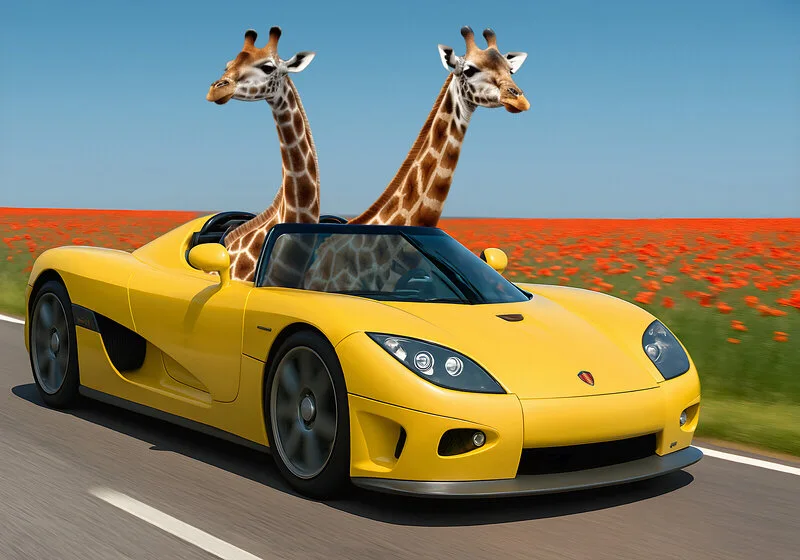
A Yellow and Red Day - En Gul och Röd Dag, 2025
Digital
70 x 50 cm
3 200 kr
A Yellow and Red Day – En Gul och Röd Dag
On an early summer Saturday in Skåne, an unexpected scene unfolds: two giraffes in a bright yellow Koenigsegg speeding past fields of red poppies. Despite lacking driver’s licences, their surprisingly proficient driving skills rival those of an F1 driver. The car – the world’s fastest with a targa top – had been “borrowed” from the Koenigsegg facility in Ängelholm. Thanks to their long necks, wide field of vision, and ability to distinguish colours, the giraffes spotted the unattended prize, kicked open a couple of locks, and set off. And what luck that proved to be.
They brazenly ignore speed cameras, fully aware that two giraffes in the cockpit would only confuse the police. On Glimmingevägen, they shatter a sixty-six-year-old local speed record and come close to Koenigsegg’s top times – a poor cow along the way drops dead from shock. Astrid, who watched the entire race from her garden, shared her account only with the ladies at the next day’s coffee gathering. Several of them had heard the high-speed run from a distance and therefore believed her story. A Koenigsegg driven like that sounds like a thunderstorm rolling in. Imagine that sound, and yet the morning sky had been clear as far as the eye could see.
The car was returned later the same morning, with a half-empty tank and no scratches, but with a few light and dark brown hairs on the seats. The giraffes, it seems, had a change of heart after their joyride and decided to return the car to its rightful place. Koenigsegg’s staff, in a move that added to the intrigue of the story, chose to remain silent about the discovery. Perhaps that’s for the best – some records, like some stories, are too improbable to explain, leaving us with a delightful mystery.
Join me on a journey to explore the fascinating world of images. This essay intends to entertain and enlighten you about the intricate process of driving fast without losing your driving licence. Get ready to be enlightened.
“Ode to the Unbeatable Beat
They said it was set in the days of old,
A record engraved in motoring gold.
Sixty-six years, the legend stood tall,
Fast as a comet, swift over all.
But out from Ängelholm, sleek and bright,
A Koenigsegg roared into morning light.
Yellow as the sun and sharp as a knife,
It ate up the road like it owed it its life.
At the wheel—oh, a sight to declare!—
A long-necked pilot with wind in his hair.
Beside him, his partner, serene yet bizarre,
An ungainly co-pilot in a car worth a star.
Through poppy-red fields and skies so wide,
They laughed at the wind on their targa-top ride.
The bend in the middle was barely a yawn,
By the time others blinked, the ‘Segg was long gone.
The Bugatti’s crown slipped into the past,
The “unbreakable” was beaten, and beaten fast.
Some say it was skill, some say it was luck—
But records are made for the brave to pluck.
Now whispers go round of the day it occurred,
How the King of the Road left history blurred.
And the moral? It’s simple—don’t bet on “forever,”
For a Koenigsegg’s roar means never say never.”
Malmö. August 2025
A Yellow and Red Day
It’s rare to see two giraffes out for a drive through Skåne's summer landscapes. Yet, it does happen – as shown by a perfectly composed photograph, with a bright yellow Koenigsegg making a striking contrast against the fields of red poppies and the distant blue horizon.
Naturally, anyone meticulous about rules would ask whether giraffes can actually drive a car – or are even permitted to – since they most certainly don’t possess driver’s licences. The first question is straightforward to answer, as I can confirm that the car handled beautifully on the winding road, and the cornering was comparable to that of F1 driver Lewis Hamilton. Of course, when you’re behind the wheel of this Skåne-built machine – the best car in the world – you have the advantage of something that seems to cling to the tarmac while cutting through the air like a spear. The cabriolet design is a necessity for those with long necks, or perhaps on their way to a wedding in a tall top hat. Still, driving a Koenigsegg with both hooves on the wheel isn’t just about flooring the accelerator – it also demands considerable focus. A giraffe’s tall neck has its perks, along with some drawbacks, but this was a naturally talented driver. And as for the hooves, well, let's say they had a few tricks up their sleeves, or should I say, hooves.
These two giraffes, let's call them George and Mildred, were quite the characters. George, the taller of the two, was the daredevil, always pushing the car to its limits. He had a mischievous glint in his eye and a love for adventure. Mildred, on the other hand, was the cautious one, constantly reminding George to watch his speed. She was the voice of reason, always thinking about the consequences of their actions. Their dynamic made for some entertaining moments on the road, with George's daring manoeuvres and Mildred's nervous but necessary interventions.
Persistent rule-keepers won’t give up easily and will undoubtedly question how giraffes can afford the world’s fastest targa-top car, with a top speed of 499 km/h. That, too, is simple to explain: they can’t. They stole it from Koenigsegg’s facility in Ängelholm, which also features a test track. They called it ‘borrow’. With their long necks, giraffes can not only spot lions from a mile and a half away – they can just as easily detect an unattended Koenigsegg from even further. This is thanks to their height and eyes positioned on the sides of their heads, which give them a wide field of vision. They also possess excellent night vision and can distinguish colours like red, yellow, and green – so spotting the yellow supercar was no trouble, even though it was parked inside a shed with a small window.
The padlock on the door didn’t stand a chance – a giraffe’s kick can easily kill a lion, so a heavy-duty Yale lock was gone with the first blow. The same applies to the gate at the entrance. On a scorching hot Saturday in July, most people are on holiday and not expecting car-thieving giraffes to be wandering about. The clever animals even closed up behind them properly, delaying discovery. Their drive took them along the winding roads of the Bjäre Peninsula, and it was hardly the first time a Koenigsegg had been caught speeding illegally there. They didn’t bother with speed cameras – no number plates, and with two giraffes in the cockpit, the images would be immediately discarded as a joke. So, they could calmly pass a camera at 400 km/h, assuming the radar beams could keep pace. The giraffes had planned their escape route meticulously, knowing every twist and turn of the road. They had even scouted the area beforehand, using their long necks to peer over fences and hedges.
Old Glimmingevägen, between Norra Kustvägen and Gösarpsvägen, features two perfectly straight stretches, each about one and a half kilometres long, with a forty-five-degree bend in the middle – a challenge for any speed enthusiast, including a giraffe with a heavy hoof on the gas.
That irritating middle bend prevented our giraffe from challenging Koenigsegg’s newly established 0–400–0 record, which requires a 3.2-kilometre straight. Koenigsegg achieved it in just 27.83 seconds, easily surpassing the previous record-holder – a Bugatti – to make history. The giraffe covered the distance in the Bugatti’s old record time of 42 seconds, which speaks volumes about both car and driver. And about the cow that dropped dead on the spot when the yellow streak thundered past.
It was so early in the morning that no farmers were yet about; only Astrid, a lively seventy-five-year-old farmwife, had seen the spectacle. She had been enjoying her first cup of coffee of the day in the peaceful morning quiet. From her garden table, right at the bend, she could see almost the entire stretch. Had the giraffe not navigated the bend so skillfully, tyres screeching, it might well have been Astrid’s last cup of coffee. No one would have believed her if she claimed that two giraffes had sprinted past faster than lightning. She kept the story for the next day’s coffee gathering. The stone-dead cow, along with a few other old ladies who had been startled awake by what sounded like thunder despite the cloudless blue sky, lent credibility to her account. The other old ladies, who had been peacefully snoozing in their rocking chairs, were now wide awake and gossiping excitedly about the 'giraffe racers' that had just zoomed past their windows.
The women were all at an age to remember the hot-rod boys of the sixties, who had challenged that very stretch of road many times. Yet not a single one of them had ever matched the giraffe’s performance; their cars barely made it halfway down the first straight before the giraffe was already braking on the other side. Astrid was married to the local record-holder, but she lacked the heart to risk her frail husband’s health by telling him that a giraffe was now the new champion. Since Astrid was no expert on giraffes—she’d only seen a couple at Copenhagen Zoo many years ago—she decided to Google the animal in question.
It quickly became evident that the giraffe was, in many ways, born to drive—at least when it comes to instincts. Like horses, giraffes are flight animals, shaped by millions of years on the savannah to react instantly when danger nears. Their height, which is otherwise impractical in cramped garages, provides them with an unbeatable view of the landscape—or, in this case, the road ahead. With a head rising well above the windscreen, a giraffe can see the bends from afar and plan its racing line like a rally driver who already knows every turn by heart. It's a sight to behold, a giraffe behind the wheel, or rather, above the wheel, navigating the road with such finesse and precision.
Its eyes are positioned on the sides of the head, offering a broader field of vision than any human driver could imagine. Combine this with excellent night vision and the ability to distinguish colours like red, yellow, and green, and you have a driver who will not miss a yellow Koenigsegg in a shed or a stop signal at the last second. It's a marvel of nature, the giraffe's vision, allowing it to see the world in ways we can only imagine.
Evolution’s principle is straightforward: those who survive reproduce. Over time, the individuals who adopt the strategy that gives them the best chance of living long enough to have offspring are the ones who pass on their genes. For giraffes, that strategy has been early detection and swift flight — not heroic combat. Their most potent kicks are thus more of a last resort when escaping is impossible—or, as in this instance, a practical means to break open a couple of heavy padlocks. They are, in other words, natural drivers, and Halldóra and Christian von Koenigsegg can be proud that their car now holds a record that has lasted sixty-six years and was long regarded as unbreakable. This record is a testament to the giraffe's instincts and their ability to adapt to new situations, even if it involves a high-speed car ride.
Astrid leaned back in her chair after finishing her search. She couldn’t decide whether it was finely honed instinct or sheer cheek that drove the two long necks through Skåne at 400 km/h. But one thing she was certain of: no hot-rodder in the district would ever beat that record—and if anyone attempted, they would unquestionably need both a wider field of vision and quite a few more legs. And their licence would be gone in a flash thanks to a well-placed camera.
Where did I get the picture from, wonders that same stickler for rules? Here’s the answer.
A good friend in the police force, who knows I collect unlikely photographs, has access to the discard pile where all unidentifiable individuals end up. He came across this unique picture and thought it would be a perfect addition to my collection. The previous “record” was held by a woman who was caught by a camera on the E22 doing 124 km/h in a 70 zone, while applying lipstick, her face mainly hidden by a mirror.
There is no legal obligation for a car owner to identify the driver when a camera records a speeding offence. If the police cannot establish who was driving from the photo, they send an enquiry to the owner, but the owner is not required to respond or to name the driver. In this case, the car had no plates. Even if Koenigsegg were contacted—the vehicle is hardly anonymous—no one at the company would admit that one of their vehicles had been on the loose.
The car was returned later that same morning, before the tank had been emptied. A half-full tank, a discrepancy in the odometer reading, and two broken locks revealed the whole story—someone had borrowed the car but returned it without so much as a scratch. The return of the vehicle was a surprise to everyone, and it left many questions unanswered. That someone had taken some animal along for the ride, because the seats contained light and dark brown hairs — not many, as the someone had been careful to clean up after themselves.
Giraffes are generally clean animals. They spend a significant amount of their time grooming themselves and each other, helping to keep their coats clean and free of parasites. However, a few hairs had been missed. A curious employee at Koenigsegg sent the hairs to the botanical department at Lund University. He chose to keep the results to himself, perhaps fearing he would become a laughingstock in the coffee room.
En tidig sommarlördag i Skåne fångas en osannolik syn på bild: två giraffer i en knallgul Koenigsegg som far fram längs röda vallmofält. Körkort har de förstås inte, men körförmågan matchar en F1-förares, och bilen – världens snabbaste med targatak – var ”lånad” från Koenigseggs anläggning i Ängelholm. Tack vare lång hals, vid synvinkel, och färgseende upptäckte girafferna det obevakade bytet, sparkade upp ett par lås och gav sig iväg. Och vilken tur det blev.
De ignorerar fartkameror, eftersom två giraffer i kupén ändå skulle hamna i polisens papperskorg för osannolika eller oidentifierbara förare. På Glimmingevägen krossar de ett sextiosexårigt lokalt fartrekord och når nästan Koenigseggs egna toppnoteringar – en stackars ko längs vägen får hjärtstillestånd. Vittnet Astrid, som sett hela racet från trädgården delar bara med sig av vad hon sett till kafferepets damer. Flera av dem hade hört framfarten på distans och trodde därför på hennes berättelse. En Koenigsegg som körs på det viset låter som när åskan går. Då skall man veta att morgonens himmel var utan ett moln så långt horisonten räckte.
Bilen återlämnas senare samma morgon, halvtom tank och utan repor men med några ljus- och mörkbruna hårstrån i sätena. Koenigseggs personal väljer att tiga om fyndet. Kanske är det bäst så – för vissa rekord, liksom vissa historier, är för osannolika för att förklaras.
Det är ganska ovanligt att se två giraffer på en biltur genom det skånska sommarlandskapet, men det händer uppenbarligen eftersom de fastnat på en bild, en välavstämd sådan, med en knallgul Koenigsegg som accent till det kringliggande fältets röda vallmo och den blå horisonten i väster.
Men vän av ordning frågar sig naturligtvis om giraffer kan köra bil, eller faktisk får det, för något körkort kan de knappast ha. Första frågan är lätt att besvara eftersom jag kan intyga att bilen löpte som smort på den kurviga vägen och kurvtekniken stod inte F1-föraren Lewis Hamilton efter. Visserligen har man som förare av detta skånska vrålåk mycket hjälp av den bästa bilen i världen, som formligen sugs fast i asfalten samtidigt som far som ett spjut genom luften. Denna cabriolet – en nödvändighet för de med långa halsar eller på väg till bröllop i hög hatt. Nu är det inte bara att trycka på gasen och ratta en Koenigsegg med båda hovarna på ratten, det fordras mycket uppmärksamhet också. Giraffers höga hals ger en hel del plusvärden, jämte vissa nackdelar men det här var uppenbarligen en riktigt naturbegåvad giraff.
Vänner av ordning brukar inte ge sig utan ifrågasätter självfallet hur giraffer kan ha råd med världens snabbast bil med targatak, med en toppfart på 499 kilometer i timmen. Även detta är lätt att besvara. De har de naturligtvis inte. De har snott bilen från Koenigseggs anläggning i Ängelholm, där företaget också har en testbana. De sluga girafferna med sin långa hals kan inte bara spåra lejon på en och en halv kilometers avstånd, de upptäcker med lätthet en obevakad Koenigsegg på större avstånd än så. Detta beror på deras höjd och ögonens placering på sidan av huvudet, vilket ger dem en bred synvinkel. De har också ett bra mörkerseende och kan urskilja färger som rött, gult och grönt, så den gula lyxbilen var inga problem, trots att den stod inne i ett skjul med ett litet fönster.
Hänglåset på dörren hade de sparkat upp, en giraffspark dödar med lätthet ett lejon så även en kraftigt Yalelås ryker med första sparken. Samma sak med grinden till entrén. En stekhet lördag i juli är de flesta på semester och inte inställda på att biltjuvande giraffer kan stryka omkring. Att de listiga djuren efter at ha norpat bilen stängde ordentligt efter sig försenade naturligtvis upptäckten. Färden gick längs slingrande vägar på Bjärehalvön och det var säkert inte första gången det passerade en Koenigsegg i olaglig hastighet. Inte brydde de sig om alla fartkameror, inga registreringsskyltar och med två giraffer i kupén skulle ändå bilderna hamna i papperskorgen som ett dåligt skämt. Sålunda kunde de lugnt passera en kamera i fyrahundra knutar, om nu radarstrålarna hängde med.
Gamla Glimmingevägen mellan Norra Kustvägen och Gösarpsvägen erbjuder två snörraka raksträckor, vardera halvannan kilometer med en fyrtiofemgraders böj i mitten. En utmaning för vilken fartdåre som helst, inkluderande en giraff med tung gaspedalsfot.
Den förargliga kurvan i mitten omöjliggjorde för vår giraff att utmana Koenigseggs nysatta rekord 0 till 400 och tillbaka till noll vilket kräver 3.2 kilometers raksträcka. Det tog Koenigseggen inte mer än 27,83 sekunder, vilket vida förpassade den tidigare rekordhållaren en Bugatti till historien. Att giraffen klarade sträckan på Bugattins gamla rekordtid 42 sekunder berättar en hel del om både bilen och föraren. Och om kon som fick hjärtslag på fläcken när den gula skuggan vrålade förbi. Det här var så tidigt att ingen bonde störde ännu helgen och bara Astrid, en morgonpigg sjuttiofemårig bondmora, hade noterat förbifarten. Hon hade tagit dagens första kopp kaffe i den ljuvlig morgonstunden. Från bordet i trädgården, precis i kurvan, såg hon nästa hela loppet. Hade inte giraffen varit så duktig och klarat kurvan med tjut i däcken, hade det blivit Astrids sista kopp i livet. Ingen skulle ta henne på allvar om Astrid berättade om två giraffer som farit förbi snabbare än blixten. Astrid sparade informationen till ett kafferep dagen efter. Den stendöda kon jämte några andra kärringar som vaknat till av att åskan gick trots en klarblå himmel ökade tilltron till hennes berättelse.
Kvinnorna var alla i åldern som upplevt sextiotalets raggare som utmanat just sträckan vid ett flertal tillfällen. Ingen raggare har emellertid varit i närheten av giraffens prestation, deras bilar hade knappt hunnit halvvägs på ena raksträckan innan giraffen hunnit bromsa in på andra sidan. Astrid var gift med den lokale rekordhållaren, men hade inte hjärta att riskera sin skröplige mans hälsa genom att berätta att en giraff var den nye rekordhållaren.
Eftersom Astrid inte var någon expert på giraffer, hon hade sett ett par på Köpenhamns zoo för många år sedan, googlade den nyfikna damen på djuret ifråga.
Det visade sig snabbt att giraffen i mångt och mycket var född till bilförare – åtminstone om man ser till instinkterna. Precis som hästar är giraffer flyktdjur, formade av miljontals år på savannen till att reagera blixtsnabbt när fara närmar sig. Höjden, som annars är opraktisk i trånga garage, ger dem en oslagbar överblick över landskapet – eller, i detta fall, vägbanan. Med huvudet högt ovanför vindrutans kant kan en giraff läsa av kurvorna långt i förväg och planera sin linje som en rallyförare som redan memorerat hela banan.
Dess ögon sitter på sidorna av huvudet, vilket ger ett bredare synfält än någon mänsklig förare kan drömma om. Lägg till ett bra mörkerseende och förmågan att urskilja färger som rött, gult och grönt, och du får en förare som varken missar en gul Koenigsegg i ett skjul eller en stoppsignal i sista ögonblicket.
Evolutionens princip är enkel: den som lever, reproducerar. I det långa loppet överlever och sprider sina gener de individer som väljer den strategi som ger störst chans att leva länge nog för att få ungar. För giraffer har detta varit tidig upptäckt och snabb flykt – inte heroisk kamp. De starkaste sparkarna är alltså mer en sista försvarslinje när flyktvägen är avskuren. Eller, som i det här fallet, ett praktiskt verktyg för att sparka upp ett par rejäla hänglås. De är alltså borna bilförare, och paret Halldóra och Christian von Koenigsegg kan vara stolta över att deras bil nu håller ett rekord som stått sig i sextiosex år och länge betraktats som oslagbart.
Astrid lutade sig tillbaka i stolen efter sin googling. Hon kunde inte avgöra om det var en välslipad instinkt eller ren och skär fräckhet som förde de två långa halsarna fram genom Skåne i fyra hundra knyck. Men en sak var hon säker på: ingen raggare i bygden skulle någonsin slå det rekordet – och om någon försökte, skulle det säkert behövas både längre synfält och betydligt fler ben. Och körkortet skulle ryka all väg på grund av en välplacerad kamera.
Varifrån fick jag bilden, undrar samme vän av ordning. Här kommer svaret.
En god vän på polisen som vet att jag samlar på osannolika bilder har tillgång till papperskorgen där alla icke identifierbara personer hamnar. Rekordet tidigare var en kvinna som passerade en kamera på E22an i etthundratjugofyra kilometer i timmen på en sjuttiosträcka. Hon målade läpparna och ansiktet doldes till stor del av en spegel.
Det finns ingen lagstadgad skyldighet för bilägaren att identifiera föraren vid en fortkörning som fångats av en fartkamera. Om polisen inte kan identifiera föraren utifrån bilden, skickas en förfrågan till bilens ägare, men denne är inte skyldig att svara eller ange vem som körde bilen. I det här fallet var dessutom bilen utan skyltar. Även om Koenigsegg skulle bli kontaktad i ärendet, bilen är ju inte speciellt anonym, skulle ingen på företaget tillstå att en av deras bilar skulle ha varit på drift.
Bilen hade lämnats tillbaka samma morgon innan tanken hunnit tömmas. En halvtom tank, diskrepans i mätarens vägsträcka jämte två uppbrutna lås talade klarspråk – ’någon’ hade lånat en bil men återställt den utan så mycket som en repa. Tydligen hade denne ’någon’ haft något slags djur med sig för sätena hade ljusbruna och mörkbruna hårstrån, inte många för ’någon’ verkade ha varit angelägen om städa upp efter sig.
Giraffer är generellt sett renliga djur. De tillbringar en betydande del av sin tid med att putsa sig själva och varandra, vilket hjälper till att hålla pälsen ren och fri från parasiter. Men några strån hade de missat. En nyfiken medarbetare på Koenigsegg skicka in håren till botaniska institutionen i Lund. Han bestämde sig för att hålla svaret för sig själv. Han ville väl inte bli allmänt löje i fikarummet.
3 200 kr

Jörgen Thornberg
Malmö
Lite om bilder och mig. Translation in English at the end.
Jag är en nyfiken person som ser allt i bilder, även det jag fäster i ord, gärna tillsammans för bakom alla mina bilder finns en berättelse. Till vissa bilder hör en kortare eller längre novell som följer med bilden.
Bilder berättar historier. Jag omges av naturlig skönhet, intressanta människor och historia var jag än går. Jag använder min kamera för att dokumentera världen och blanda det jag ser med vad jag känner för att fånga den dolda magin.
Mina bilder berättar mina historier. Genom mina bilder, tryck och berättelser. Jag bjuder in dig att ta del av dessa berättelser, in i ditt liv och hem och dela min mycket personliga syn på vår värld. Mer än vad ögat ser. Jag tänker i bilder, drömmer och skriver och pratar om dem; följaktligen måste jag också skapa bilder. De blir vad jag ser, inte nödvändigtvis begränsade till verkligheten. Det finns en bild runt varje hörn. Jag hoppas att du kommer att se vad jag såg och gilla det.
Jag är också en skrivande person och till många bilder hör en kortare eller längre essay. Den följer med tavlan, tryckt på fint papper och med en personlig hälsning från mig.
Flertalet bilder startar sin resa i min kamera. Enkelt förklarat beskriver jag bilden jag ser i mitt inre, upplevd eller fantiserad. Bilden uppstår inom mig redan innan jag fått okularet till ögat. På bråkdelen av ett ögonblick ser jag vad jag vill ha och vad som kan göras med bilden. Här skall jag stoppa in en giraff, stålmannen, Titanic eller vad det är min fantasi finner ut. Ännu märkligare är att jag kommer ihåg minnesbilden långt efteråt när det blir tid att skapa verket. Om jag lyckas eller inte, är upp till betraktaren, oftast präglat av en stråk av svart humor – meningen är att man skall bli underhållen. Mina bilder blir ofta en snackis där de hänger.
Jag föredrar bilder som förmedlar ett budskap i flera lager. Vid första anblicken fylld av feel-good, en vacker utsikt, fint väder, solen skiner, blommor på ängen eller vattnet som ligger förrädiskt spegelblankt. I en sådan bild kan jag gömma min egentliga berättelse, mitt förakt för förtryckare och våldsverkare, rasister och fördomsfulla människor - ett gärna återkommande motiv mer eller mindre dolt i det vackra motivet. Jag försöker förena dem i ett gemensamt narrativ.
Bild och formgivning har löpt som en röd tråd genom livet. Fotokonst känns som en värdig final som jag gärna delar med mig.
Min genre är vid som framgår av mina bilder, temat en blandning av pop- och gatukonst i kollage som kan bestå av hundratals lager. Vissa bilder kan ta veckor, andra någon dag innan det är dags att överlämna resultatet till printverkstaden. Fine Art Prints är digitala fotocollage. I dessa kollage sker rivandet, klippandet, pusslandet, målandet, ritandet och sprayningen digitalt. Det jag monterar in kan vara hundratals år gamla bilder som jag omsorgsfullt frilägger så att de ser ut att vara en del av tavlan men också bilder skapade av mig själv efter min egen fantasi. Därefter besöks printstudion och för vissa bilder numrera en limiterad upplaga (oftast 7 exemplar) och signera för hand. Vissa bilder kan köpas i olika format. Det är bara att fråga efter vilka. Gillar man en bild som är 70x100 men inte har plats på väggen, går den kanske att få i 50x70 cm istället. Frågan är fri.
Metoden Giclée eller Fine Art Print som det också kallas är det moderna sättet för framställning av grafisk konst. Villkoret för denna typ av utskrifter är att en högkvalitativ storformatskrivare används med åldersbeständigt färgpigment och konstnärspapper eller i förekommande fall på duk. Pappret som används möter de krav på livslängd som ställs av museer och gallerier. Normalt säljer jag mina bilder oinramade så att den nya ägaren själv kan bestämma hur de skall se ut, med eller utan passepartout färg på ram, med eller utan glas etc..
Under många år ställde jag bara ut på nätet, i valda grupper och på min egen Facebooksida - https://www.facebook.com/jorgen.thornberg.9
Jag finns också på en egen hemsida som tyvärr inte alltid är uppdaterad – https://www.jth.life/ Där kan du också läsa en del av de berättelser som följer med bilden.
UTSTÄLLNINGAR
Luftkastellet, oktober 2022
Konst i Lund, november 2022
Luftkastellet, mars 2023
Engleson Galleri Caroli, april 2023
Hydra, Greece June 2023
Engleson Galleri Caroli, oktober 2023
Toppen, Höllviken december 2023
Luftkastellet, mars 2024
Torups Galleri, mars 2024
Venice, May 2024
Luftkastellet, oktober 2024
Konst i Advent, December 2024
Galleri Engleson, Caroli December 2024
Jäger & Jansson Galleri, april 2025
A bit about pictures and me.
I'm a curious person who sees everything in pictures, even what I express in words, often combining them, for behind all my pictures lies a story. These narratives, some as short as a single image and others as long as a novel, are the heart and soul of my work.
Pictures tell stories. Wherever I go, I'm surrounded by natural beauty, exciting people, and history. I use my camera to document the world and blend what I see with what I feel to capture the hidden magic.
My images tell my stories. Through my pictures, prints, and narratives, I invite you to partake in these stories in your life and home and share my deeply personal perspective of our world. More than meets the eye. I think in pictures, dream, write, and talk about them; consequently, I must create images too. They become what I see, not necessarily confined to reality. There's a picture around every corner. I hope you'll see what I saw and enjoy it.
I'm also a writer, and many images come with a shorter or longer essay. It accompanies the painting, printed on fine paper with my personal greeting.
Many pictures start their journey on my camera. Simply put, I describe the image I see in my mind, experienced or imagined. The image arises within me even before I bring the eyepiece to my eye. In a fraction of a moment, I see what I want and what can be done with the picture. Here, I'll insert a giraffe, Superman, the Titanic, or whatever my imagination conjures up. Even stranger is that I remember the mental image long after it's time to create the work. Whether I succeed is up to the observer, often imbued with a streak of black humour – the aim is to entertain. My pictures usually become a talking point wherever they hang.
I prefer pictures that convey a message in multiple layers. At first glance, they're filled with feel-good vibes, a beautiful view, lovely weather, the sun shining, flowers in the meadow, or the water lying deceptively calm. But beneath this surface beauty, I often conceal a deeper story, a narrative that challenges societal norms or explores the human condition. I invite you to delve into these hidden narratives and discover the layers of meaning within my work.
Picture and design have been a thread running through my life. Photographic art feels like a fitting finale, and I'm happy to share it.
My genre is varied, as seen in my pictures; the theme is a blend of pop and street art in collages that can consist of hundreds of layers. Some images can take weeks, others just a day before it's time to hand over the result to the print workshop. Fine Art Prints are digital photo collages. In these collages, tearing, cutting, puzzling, painting, drawing, and spraying happen digitally. What I insert can be images hundreds of years old that I carefully extract so they appear to be part of the painting, but also images created by myself, now also generated from my imagination. Next, visit the print studio and, for certain images, number a limited edition (usually 7 copies) and sign them by hand. Some images may be available in other formats. Just ask which ones. If you like an image that's 70x100 but doesn't have space on the wall, you might be able to get it in 50x70 cm instead. The question is open.
The Giclée method, or Fine Art Print as it's also called, is the modern way of producing graphic art. This method ensures the highest quality and longevity of the artwork, using a high-quality large-format printer with archival pigment inks and artist paper or, in some cases, canvas. The paper used meets the longevity requirements set by museums and galleries. I sell my pictures unframed, allowing the new owner to personalise their artwork, confident in the lasting value and quality of the piece.
For many years, I only exhibited online, in selected groups, and on my Facebook page - https://www.facebook.com/jorgen.thornberg.9. I also have my website, which unfortunately is not constantly updated - https://www.jth.life/. You can also read some of the stories accompanying the pictures there.
EXHIBITIONS
Luftkastellet, October 2022
Art in Lund, November 2022
Luftkastellet, March 2023
Engleson Gallery Caroli, April 2023
Hydra, Greece June 2023
Engleson Gallery Caroli, October 2023
Toppen, Höllviken December 2023
Luftkastellet, March 2024
Torup Gallery, March 2024
Venice, May 2024
UTSTÄLLNINGAR
Luftkastellet, oktober 2022
Konst i Lund, november 2022
Luftkastellet, mars 2023
Engleson Galleri Caroli, april 2023
Hydra, Greece June 2023
Engleson Galleri Caroli, oktober 2023
Toppen, Höllviken december 2023
Luftkastellet, mars 2024
Torups Galleri, mars 2024
Venice, May 2024
Luftkastellet, October 2024
Konst i Advent, December 2024
Galleri Engleson, Caroli December 2024
Jäger & Jansson Galleri, April 2025
Utbildning
Autodidakt
Medlem i konstnärsförening
Öppna Sinnen
Med i konstrunda
Konstrundan i Skåne
Utställningar
Luftkastellet, October 2022
Art in Lund, November 2022
Luftkastellet, March 2023
Engleson Gallery Caroli, April 2023
Hydra, Greece June 2023
Engleson Gallery Caroli, October 2023
Toppen, Höllviken December 2023
Luftkastellet, March 2024
Torup Gallery, March 2024
Venice, May 2024