Vi använder cookies för att ge dig bästa möjliga upplevelse. Välj vilka cookies du tillåter.
Läs mer i vår integritetspolicy
Jörgen Thornberg
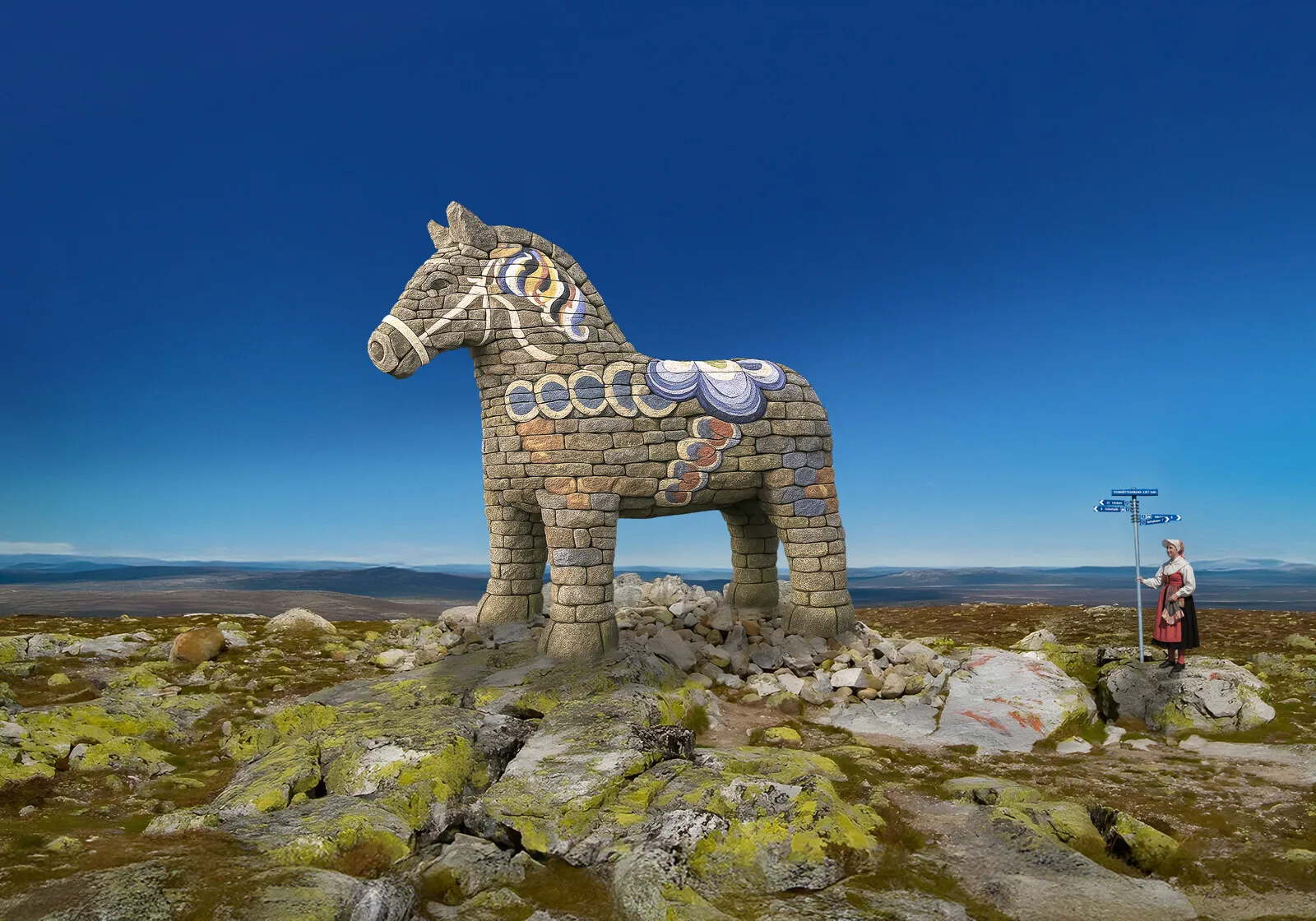
Storvätteshågna’s new height: 1,207 m a.s.l. - Storvätteshågnas nya höjd 1207 m.ö.h., 2025
Digital
70 x 50 cm
3 200 kr
Storvätteshågna’s new height: 1,207 m a.s.l. - Storvätteshågnas nya höjd 1207 m.ö.h.
There are peaks you climb for the view, others to say you’ve been there – and then there’s Storvätteshågna. The highest point in Dalarna, and all of Svealand, might not be the most awe-inspiring mountain in terms of metres above sea level, but in the hearts of many locals, it is a fell of mythical proportions. Here, among the wide open spaces and stone cairns, dreams arise that reach far beyond a simple experience of nature: the idea of using one’s own hands and back to raise the mountain until it can one day stand alongside the true giants. This fell or mountain, with its rich cultural and mythical significance, is a part of the local culture that you can't help but feel connected to.
Join me on a journey to explore the intriguing world of images. This essay aims to entertain and enlighten you about the complex process of building high with stones within a compelling story. Prepare to be enlightened.
“Stone by Stone
Through sleet and sun, through frost and rain,
we haul our loads uphill again.
Each aching back, each blistered toe,
adds one more stone to where we go.
The wind cuts sharply, the clouds hang low,
yet still we climb, still higher grow.
For every pebble, rock, or shard,
we pay in sweat, and call it hard.
But then comes he, the Engineer,
with graphs and laws we ought to hear:
“The cube law says, by heights of ten,
you’ll gain in years just half an inch, my friend.”
We nod, we smile, then haul once more—
for numbers never thrill the core.
A summit’s not just height and weight,
it’s hoped you choose to cultivate.
“Four thousand years!” he shakes his head,
“You’ll all be fossils, long since dead.”
But we laugh and pass him by,
our stones piled higher toward the sky.
For in the storm, the sleet, the sun,
a fell is born by everyone.
And facts may frown, and sums may groan,
but dreams are built—stone by stone.”
Malmö. August 2025
Storvätteshågna’s new height – 1,207 metres above sea level
Storvätteshågna, the highest mountain in Dalarna and Svealand, standing at 1,204 metres above sea level, boasts a panoramic view that is truly unparalleled. On a clear day, you can feast your eyes on the vast expanse of Grövelsjön and Idre, with the Helags massif glistening in the distance to the north. The summit of this fell offers a breathtaking panorama of the Dala mountains. While the journey to the top is a challenging day trip, the rewards are beyond measure – as we'll explore later, you might even carry something extra in your backpack, adding to the adventure.
The name Storvätteshågna is steeped in history and culture, calling for a deeper understanding. As Claes Grundsten’s book ‘Fjällvandra kring Grövelsjön’ reveals, the Sámi name for the summit is ‘Gealda’, which translates to ‘the highest peak of the high fell’. The dialect word ‘hågn’ in Storvätteshågna signifies ‘a larger mountain section with steep walls’. The middle element ‘vättes’ was added by 19th-century cartographers to distinguish it from the mountain Storhågnen in Jämtland, drawing inspiration from Norwegian mountain names. ‘Vätte’ in this context refers to a beacon fire, adding a touch of intrigue to the name's origin.
The Swedish fells here are not particularly high, but looking west into Norway tells a different story. Far on the horizon, the Sølen massif rises, with its highest peak reaching 1,755 metres above sea level.
Over the centuries, Storvätteshågna has not only grown taller due to post-glacial land uplift but also experienced a unique form of growth. Stone by stone, visitors have contributed to its height, creating a charming and straightforward form of popular participation. This ongoing process, where each stone represents a shared effort and a piece of human history, adds a layer of community to the mountain's geological evolution, making it a living testament to the connection between nature and culture.
A normally minded Dalecarlian might feel that the Lord was unfair when distributing Sweden’s mountain peaks. It is hard to understand why the neighbouring province of Jämtland received Storsylen, rising 1,728 metres above sea level – especially when Dalarna is so much more charming, with its popular authors and artists, Nobel laureates, world-famous symbols such as the Dala horse, and, not to forget, the most incredible variety of folk costumes in the country.
And no true Dalecarlian wants to compare themselves to Jämtlanders. It's better than looking east to the neighbouring country of Finland, whose highest mountain is not much lower in height: 1,324 metres, just 120 metres above Storvätteshågna. How can they catch up? The Swedish bedrock is far too stable to expect volcanic eruptions or fault shifts. That leaves only one course of action – to keep building upwards, stone by stone. Already, the summit has grown by more than two metres since the first stone was placed there. It's a race we're determined to win, one stone at a time!
A passionate local supporter of Dalarna conservatively estimated that annually between 100 and 300 tourists reached the summit. If two hundred of them each carried a ten-kilogram stone, Dalarna could, according to his calculations, eventually surpass Finland. It would only require 120 metres and a few more centimetres! On Facebook, the idea received cheers and support, with hearts and smiling emojis brightening up screens.
But the optimist was neither an engineer, an architect, nor exceptionally knowledgeable about history. The Great Pyramid of Cheops, one of the Seven Wonders of the Ancient World, was constructed thousands of years ago, without backpacks or supportive boots, and initially measured 146 metres tall with a base of 230 metres. While there was plenty of space around Storvätteshågna and the bedrock was solid, the laws of physics would still have their say.
In the enthusiast’s view, Dalarna could easily attract visitors to join in – perhaps through a kind of tourist tax – and the height would grow rapidly. He thought that smarter stacking could already have doubled the current height. The Facebook post received more agreement than criticism, and many new friends as a bonus. The humour in this ambitious plan, the sheer daring of it, is what makes it so entertaining. It's a bit like a tall tale, but with stones instead of words.
Then, like a character in a novel who appears just when the plot thickens, a moody secondary-school engineer entered the thread. He claimed to have studied the basics of pyramid building and insisted that it was not enough to pile stone upon stone. A 120-metre pillar is not something you raise. Stora Tuna Church’s 86 metres might be enough to reach heaven, according to the parish priest, but not when competing with Finland.
The killjoy explained in detail: “With 200 people each carrying about 10 kilos of stone, in the first year you could build a small pyramid about a metre high with Cheops’ type of slope. But already at 5–10 metres, the same stone volume only adds a few centimetres or millimetres in height per year. That’s the cube law: the required volume increases with height cubed. To keep a 51–52° slope with small blocks requires course-by-course masonry and packing; otherwise, you end up at the angle of repose, 30–35°, and get a lower pyramid for the same volume.”
He continued: “The total number of 10-kilo stones would be about 344,350,440. There are at most five suitable stones per square metre in the landscape, which corresponds to an area of nearly 69 km² – roughly the same as 24 towns the size of Mora. At 200 stones per person per day, that’s about 1.72 million tourist days, or just over 4,700 years if the same people worked every day. And that’s without considering that stones will soon be far away and ramps longer and longer.”
Furthermore, he claimed that 200 stones per day was nothing but a fantasy. Considering actual carrying distances, elevation changes, queues, and fatigue, the rate rapidly falls to just a few dozen stones daily. Longer journeys and higher elevations reduce it further. In reality, other tasks come into play: constructing ramps, lifting, supervision, and alignment. In summary, the tourist-supported pyramid is both logistically and temporally unfeasible, with the practical challenges of construction far outweighing the initial enthusiasm.
The comments section almost fell silent, apart from a few sharp-tongued jibes at the spoilsport, where insults came thick and fast. Time healed the wounds, and after a proper pause, the enthusiast returned – now with a revised project he claimed would put Dalarna on the global map: to build a giant Dala horse in stone on the roof of Dalarna. The humour in this situation, the enthusiast's unwavering optimism, and the community's willingness to entertain such ambitious ideas are what make this story so engaging and entertaining.
The pessimist has not been heard from since, so the project continues. Such a stone horse would raise the summit by at least three metres and would probably attract even more visitors to Storvätteshågna, benefiting both tourism and public health. Even those who couldn't reach the top could see Avesta’s giant steel-and-concrete horse or visit a maker of regular-sized versions. These now come in all the colours of the rainbow, but the enthusiast’s stone horse would be decorated with restraint and in a conservative style.
Since a stone horse requires cut stone and skilled artisans, a fundraiser – or crowdfunding – has been launched. No official figures have been released, but rumours suggest that the collection period, at the current rate, is approaching roughly the same duration as the pyramid’s construction. Only time will tell.
Jörgen Thornberg
Storvätteshågna’s new height: 1,207 m a.s.l. - Storvätteshågnas nya höjd 1207 m.ö.h., 2025
Digital
70 x 50 cm
3 200 kr
Storvätteshågna’s new height: 1,207 m a.s.l. - Storvätteshågnas nya höjd 1207 m.ö.h.
There are peaks you climb for the view, others to say you’ve been there – and then there’s Storvätteshågna. The highest point in Dalarna, and all of Svealand, might not be the most awe-inspiring mountain in terms of metres above sea level, but in the hearts of many locals, it is a fell of mythical proportions. Here, among the wide open spaces and stone cairns, dreams arise that reach far beyond a simple experience of nature: the idea of using one’s own hands and back to raise the mountain until it can one day stand alongside the true giants. This fell or mountain, with its rich cultural and mythical significance, is a part of the local culture that you can't help but feel connected to.
Join me on a journey to explore the intriguing world of images. This essay aims to entertain and enlighten you about the complex process of building high with stones within a compelling story. Prepare to be enlightened.
“Stone by Stone
Through sleet and sun, through frost and rain,
we haul our loads uphill again.
Each aching back, each blistered toe,
adds one more stone to where we go.
The wind cuts sharply, the clouds hang low,
yet still we climb, still higher grow.
For every pebble, rock, or shard,
we pay in sweat, and call it hard.
But then comes he, the Engineer,
with graphs and laws we ought to hear:
“The cube law says, by heights of ten,
you’ll gain in years just half an inch, my friend.”
We nod, we smile, then haul once more—
for numbers never thrill the core.
A summit’s not just height and weight,
it’s hoped you choose to cultivate.
“Four thousand years!” he shakes his head,
“You’ll all be fossils, long since dead.”
But we laugh and pass him by,
our stones piled higher toward the sky.
For in the storm, the sleet, the sun,
a fell is born by everyone.
And facts may frown, and sums may groan,
but dreams are built—stone by stone.”
Malmö. August 2025
Storvätteshågna’s new height – 1,207 metres above sea level
Storvätteshågna, the highest mountain in Dalarna and Svealand, standing at 1,204 metres above sea level, boasts a panoramic view that is truly unparalleled. On a clear day, you can feast your eyes on the vast expanse of Grövelsjön and Idre, with the Helags massif glistening in the distance to the north. The summit of this fell offers a breathtaking panorama of the Dala mountains. While the journey to the top is a challenging day trip, the rewards are beyond measure – as we'll explore later, you might even carry something extra in your backpack, adding to the adventure.
The name Storvätteshågna is steeped in history and culture, calling for a deeper understanding. As Claes Grundsten’s book ‘Fjällvandra kring Grövelsjön’ reveals, the Sámi name for the summit is ‘Gealda’, which translates to ‘the highest peak of the high fell’. The dialect word ‘hågn’ in Storvätteshågna signifies ‘a larger mountain section with steep walls’. The middle element ‘vättes’ was added by 19th-century cartographers to distinguish it from the mountain Storhågnen in Jämtland, drawing inspiration from Norwegian mountain names. ‘Vätte’ in this context refers to a beacon fire, adding a touch of intrigue to the name's origin.
The Swedish fells here are not particularly high, but looking west into Norway tells a different story. Far on the horizon, the Sølen massif rises, with its highest peak reaching 1,755 metres above sea level.
Over the centuries, Storvätteshågna has not only grown taller due to post-glacial land uplift but also experienced a unique form of growth. Stone by stone, visitors have contributed to its height, creating a charming and straightforward form of popular participation. This ongoing process, where each stone represents a shared effort and a piece of human history, adds a layer of community to the mountain's geological evolution, making it a living testament to the connection between nature and culture.
A normally minded Dalecarlian might feel that the Lord was unfair when distributing Sweden’s mountain peaks. It is hard to understand why the neighbouring province of Jämtland received Storsylen, rising 1,728 metres above sea level – especially when Dalarna is so much more charming, with its popular authors and artists, Nobel laureates, world-famous symbols such as the Dala horse, and, not to forget, the most incredible variety of folk costumes in the country.
And no true Dalecarlian wants to compare themselves to Jämtlanders. It's better than looking east to the neighbouring country of Finland, whose highest mountain is not much lower in height: 1,324 metres, just 120 metres above Storvätteshågna. How can they catch up? The Swedish bedrock is far too stable to expect volcanic eruptions or fault shifts. That leaves only one course of action – to keep building upwards, stone by stone. Already, the summit has grown by more than two metres since the first stone was placed there. It's a race we're determined to win, one stone at a time!
A passionate local supporter of Dalarna conservatively estimated that annually between 100 and 300 tourists reached the summit. If two hundred of them each carried a ten-kilogram stone, Dalarna could, according to his calculations, eventually surpass Finland. It would only require 120 metres and a few more centimetres! On Facebook, the idea received cheers and support, with hearts and smiling emojis brightening up screens.
But the optimist was neither an engineer, an architect, nor exceptionally knowledgeable about history. The Great Pyramid of Cheops, one of the Seven Wonders of the Ancient World, was constructed thousands of years ago, without backpacks or supportive boots, and initially measured 146 metres tall with a base of 230 metres. While there was plenty of space around Storvätteshågna and the bedrock was solid, the laws of physics would still have their say.
In the enthusiast’s view, Dalarna could easily attract visitors to join in – perhaps through a kind of tourist tax – and the height would grow rapidly. He thought that smarter stacking could already have doubled the current height. The Facebook post received more agreement than criticism, and many new friends as a bonus. The humour in this ambitious plan, the sheer daring of it, is what makes it so entertaining. It's a bit like a tall tale, but with stones instead of words.
Then, like a character in a novel who appears just when the plot thickens, a moody secondary-school engineer entered the thread. He claimed to have studied the basics of pyramid building and insisted that it was not enough to pile stone upon stone. A 120-metre pillar is not something you raise. Stora Tuna Church’s 86 metres might be enough to reach heaven, according to the parish priest, but not when competing with Finland.
The killjoy explained in detail: “With 200 people each carrying about 10 kilos of stone, in the first year you could build a small pyramid about a metre high with Cheops’ type of slope. But already at 5–10 metres, the same stone volume only adds a few centimetres or millimetres in height per year. That’s the cube law: the required volume increases with height cubed. To keep a 51–52° slope with small blocks requires course-by-course masonry and packing; otherwise, you end up at the angle of repose, 30–35°, and get a lower pyramid for the same volume.”
He continued: “The total number of 10-kilo stones would be about 344,350,440. There are at most five suitable stones per square metre in the landscape, which corresponds to an area of nearly 69 km² – roughly the same as 24 towns the size of Mora. At 200 stones per person per day, that’s about 1.72 million tourist days, or just over 4,700 years if the same people worked every day. And that’s without considering that stones will soon be far away and ramps longer and longer.”
Furthermore, he claimed that 200 stones per day was nothing but a fantasy. Considering actual carrying distances, elevation changes, queues, and fatigue, the rate rapidly falls to just a few dozen stones daily. Longer journeys and higher elevations reduce it further. In reality, other tasks come into play: constructing ramps, lifting, supervision, and alignment. In summary, the tourist-supported pyramid is both logistically and temporally unfeasible, with the practical challenges of construction far outweighing the initial enthusiasm.
The comments section almost fell silent, apart from a few sharp-tongued jibes at the spoilsport, where insults came thick and fast. Time healed the wounds, and after a proper pause, the enthusiast returned – now with a revised project he claimed would put Dalarna on the global map: to build a giant Dala horse in stone on the roof of Dalarna. The humour in this situation, the enthusiast's unwavering optimism, and the community's willingness to entertain such ambitious ideas are what make this story so engaging and entertaining.
The pessimist has not been heard from since, so the project continues. Such a stone horse would raise the summit by at least three metres and would probably attract even more visitors to Storvätteshågna, benefiting both tourism and public health. Even those who couldn't reach the top could see Avesta’s giant steel-and-concrete horse or visit a maker of regular-sized versions. These now come in all the colours of the rainbow, but the enthusiast’s stone horse would be decorated with restraint and in a conservative style.
Since a stone horse requires cut stone and skilled artisans, a fundraiser – or crowdfunding – has been launched. No official figures have been released, but rumours suggest that the collection period, at the current rate, is approaching roughly the same duration as the pyramid’s construction. Only time will tell.
3 200 kr

Jörgen Thornberg
Malmö
Lite om bilder och mig. Translation in English at the end.
Jag är en nyfiken person som ser allt i bilder, även det jag fäster i ord, gärna tillsammans för bakom alla mina bilder finns en berättelse. Till vissa bilder hör en kortare eller längre novell som följer med bilden.
Bilder berättar historier. Jag omges av naturlig skönhet, intressanta människor och historia var jag än går. Jag använder min kamera för att dokumentera världen och blanda det jag ser med vad jag känner för att fånga den dolda magin.
Mina bilder berättar mina historier. Genom mina bilder, tryck och berättelser. Jag bjuder in dig att ta del av dessa berättelser, in i ditt liv och hem och dela min mycket personliga syn på vår värld. Mer än vad ögat ser. Jag tänker i bilder, drömmer och skriver och pratar om dem; följaktligen måste jag också skapa bilder. De blir vad jag ser, inte nödvändigtvis begränsade till verkligheten. Det finns en bild runt varje hörn. Jag hoppas att du kommer att se vad jag såg och gilla det.
Jag är också en skrivande person och till många bilder hör en kortare eller längre essay. Den följer med tavlan, tryckt på fint papper och med en personlig hälsning från mig.
Flertalet bilder startar sin resa i min kamera. Enkelt förklarat beskriver jag bilden jag ser i mitt inre, upplevd eller fantiserad. Bilden uppstår inom mig redan innan jag fått okularet till ögat. På bråkdelen av ett ögonblick ser jag vad jag vill ha och vad som kan göras med bilden. Här skall jag stoppa in en giraff, stålmannen, Titanic eller vad det är min fantasi finner ut. Ännu märkligare är att jag kommer ihåg minnesbilden långt efteråt när det blir tid att skapa verket. Om jag lyckas eller inte, är upp till betraktaren, oftast präglat av en stråk av svart humor – meningen är att man skall bli underhållen. Mina bilder blir ofta en snackis där de hänger.
Jag föredrar bilder som förmedlar ett budskap i flera lager. Vid första anblicken fylld av feel-good, en vacker utsikt, fint väder, solen skiner, blommor på ängen eller vattnet som ligger förrädiskt spegelblankt. I en sådan bild kan jag gömma min egentliga berättelse, mitt förakt för förtryckare och våldsverkare, rasister och fördomsfulla människor - ett gärna återkommande motiv mer eller mindre dolt i det vackra motivet. Jag försöker förena dem i ett gemensamt narrativ.
Bild och formgivning har löpt som en röd tråd genom livet. Fotokonst känns som en värdig final som jag gärna delar med mig.
Min genre är vid som framgår av mina bilder, temat en blandning av pop- och gatukonst i kollage som kan bestå av hundratals lager. Vissa bilder kan ta veckor, andra någon dag innan det är dags att överlämna resultatet till printverkstaden. Fine Art Prints är digitala fotocollage. I dessa kollage sker rivandet, klippandet, pusslandet, målandet, ritandet och sprayningen digitalt. Det jag monterar in kan vara hundratals år gamla bilder som jag omsorgsfullt frilägger så att de ser ut att vara en del av tavlan men också bilder skapade av mig själv efter min egen fantasi. Därefter besöks printstudion och för vissa bilder numrera en limiterad upplaga (oftast 7 exemplar) och signera för hand. Vissa bilder kan köpas i olika format. Det är bara att fråga efter vilka. Gillar man en bild som är 70x100 men inte har plats på väggen, går den kanske att få i 50x70 cm istället. Frågan är fri.
Metoden Giclée eller Fine Art Print som det också kallas är det moderna sättet för framställning av grafisk konst. Villkoret för denna typ av utskrifter är att en högkvalitativ storformatskrivare används med åldersbeständigt färgpigment och konstnärspapper eller i förekommande fall på duk. Pappret som används möter de krav på livslängd som ställs av museer och gallerier. Normalt säljer jag mina bilder oinramade så att den nya ägaren själv kan bestämma hur de skall se ut, med eller utan passepartout färg på ram, med eller utan glas etc..
Under många år ställde jag bara ut på nätet, i valda grupper och på min egen Facebooksida - https://www.facebook.com/jorgen.thornberg.9
Jag finns också på en egen hemsida som tyvärr inte alltid är uppdaterad – https://www.jth.life/ Där kan du också läsa en del av de berättelser som följer med bilden.
UTSTÄLLNINGAR
Luftkastellet, oktober 2022
Konst i Lund, november 2022
Luftkastellet, mars 2023
Engleson Galleri Caroli, april 2023
Hydra, Greece June 2023
Engleson Galleri Caroli, oktober 2023
Toppen, Höllviken december 2023
Luftkastellet, mars 2024
Torups Galleri, mars 2024
Venice, May 2024
Luftkastellet, oktober 2024
Konst i Advent, December 2024
Galleri Engleson, Caroli December 2024
Jäger & Jansson Galleri, april 2025
A bit about pictures and me.
I'm a curious person who sees everything in pictures, even what I express in words, often combining them, for behind all my pictures lies a story. These narratives, some as short as a single image and others as long as a novel, are the heart and soul of my work.
Pictures tell stories. Wherever I go, I'm surrounded by natural beauty, exciting people, and history. I use my camera to document the world and blend what I see with what I feel to capture the hidden magic.
My images tell my stories. Through my pictures, prints, and narratives, I invite you to partake in these stories in your life and home and share my deeply personal perspective of our world. More than meets the eye. I think in pictures, dream, write, and talk about them; consequently, I must create images too. They become what I see, not necessarily confined to reality. There's a picture around every corner. I hope you'll see what I saw and enjoy it.
I'm also a writer, and many images come with a shorter or longer essay. It accompanies the painting, printed on fine paper with my personal greeting.
Many pictures start their journey on my camera. Simply put, I describe the image I see in my mind, experienced or imagined. The image arises within me even before I bring the eyepiece to my eye. In a fraction of a moment, I see what I want and what can be done with the picture. Here, I'll insert a giraffe, Superman, the Titanic, or whatever my imagination conjures up. Even stranger is that I remember the mental image long after it's time to create the work. Whether I succeed is up to the observer, often imbued with a streak of black humour – the aim is to entertain. My pictures usually become a talking point wherever they hang.
I prefer pictures that convey a message in multiple layers. At first glance, they're filled with feel-good vibes, a beautiful view, lovely weather, the sun shining, flowers in the meadow, or the water lying deceptively calm. But beneath this surface beauty, I often conceal a deeper story, a narrative that challenges societal norms or explores the human condition. I invite you to delve into these hidden narratives and discover the layers of meaning within my work.
Picture and design have been a thread running through my life. Photographic art feels like a fitting finale, and I'm happy to share it.
My genre is varied, as seen in my pictures; the theme is a blend of pop and street art in collages that can consist of hundreds of layers. Some images can take weeks, others just a day before it's time to hand over the result to the print workshop. Fine Art Prints are digital photo collages. In these collages, tearing, cutting, puzzling, painting, drawing, and spraying happen digitally. What I insert can be images hundreds of years old that I carefully extract so they appear to be part of the painting, but also images created by myself, now also generated from my imagination. Next, visit the print studio and, for certain images, number a limited edition (usually 7 copies) and sign them by hand. Some images may be available in other formats. Just ask which ones. If you like an image that's 70x100 but doesn't have space on the wall, you might be able to get it in 50x70 cm instead. The question is open.
The Giclée method, or Fine Art Print as it's also called, is the modern way of producing graphic art. This method ensures the highest quality and longevity of the artwork, using a high-quality large-format printer with archival pigment inks and artist paper or, in some cases, canvas. The paper used meets the longevity requirements set by museums and galleries. I sell my pictures unframed, allowing the new owner to personalise their artwork, confident in the lasting value and quality of the piece.
For many years, I only exhibited online, in selected groups, and on my Facebook page - https://www.facebook.com/jorgen.thornberg.9. I also have my website, which unfortunately is not constantly updated - https://www.jth.life/. You can also read some of the stories accompanying the pictures there.
EXHIBITIONS
Luftkastellet, October 2022
Art in Lund, November 2022
Luftkastellet, March 2023
Engleson Gallery Caroli, April 2023
Hydra, Greece June 2023
Engleson Gallery Caroli, October 2023
Toppen, Höllviken December 2023
Luftkastellet, March 2024
Torup Gallery, March 2024
Venice, May 2024
UTSTÄLLNINGAR
Luftkastellet, oktober 2022
Konst i Lund, november 2022
Luftkastellet, mars 2023
Engleson Galleri Caroli, april 2023
Hydra, Greece June 2023
Engleson Galleri Caroli, oktober 2023
Toppen, Höllviken december 2023
Luftkastellet, mars 2024
Torups Galleri, mars 2024
Venice, May 2024
Luftkastellet, October 2024
Konst i Advent, December 2024
Galleri Engleson, Caroli December 2024
Jäger & Jansson Galleri, April 2025
Utbildning
Autodidakt
Medlem i konstnärsförening
Öppna Sinnen
Med i konstrunda
Konstrundan i Skåne
Utställningar
Luftkastellet, October 2022
Art in Lund, November 2022
Luftkastellet, March 2023
Engleson Gallery Caroli, April 2023
Hydra, Greece June 2023
Engleson Gallery Caroli, October 2023
Toppen, Höllviken December 2023
Luftkastellet, March 2024
Torup Gallery, March 2024
Venice, May 2024