Vi använder cookies för att ge dig bästa möjliga upplevelse. Välj vilka cookies du tillåter.
Läs mer i vår integritetspolicy
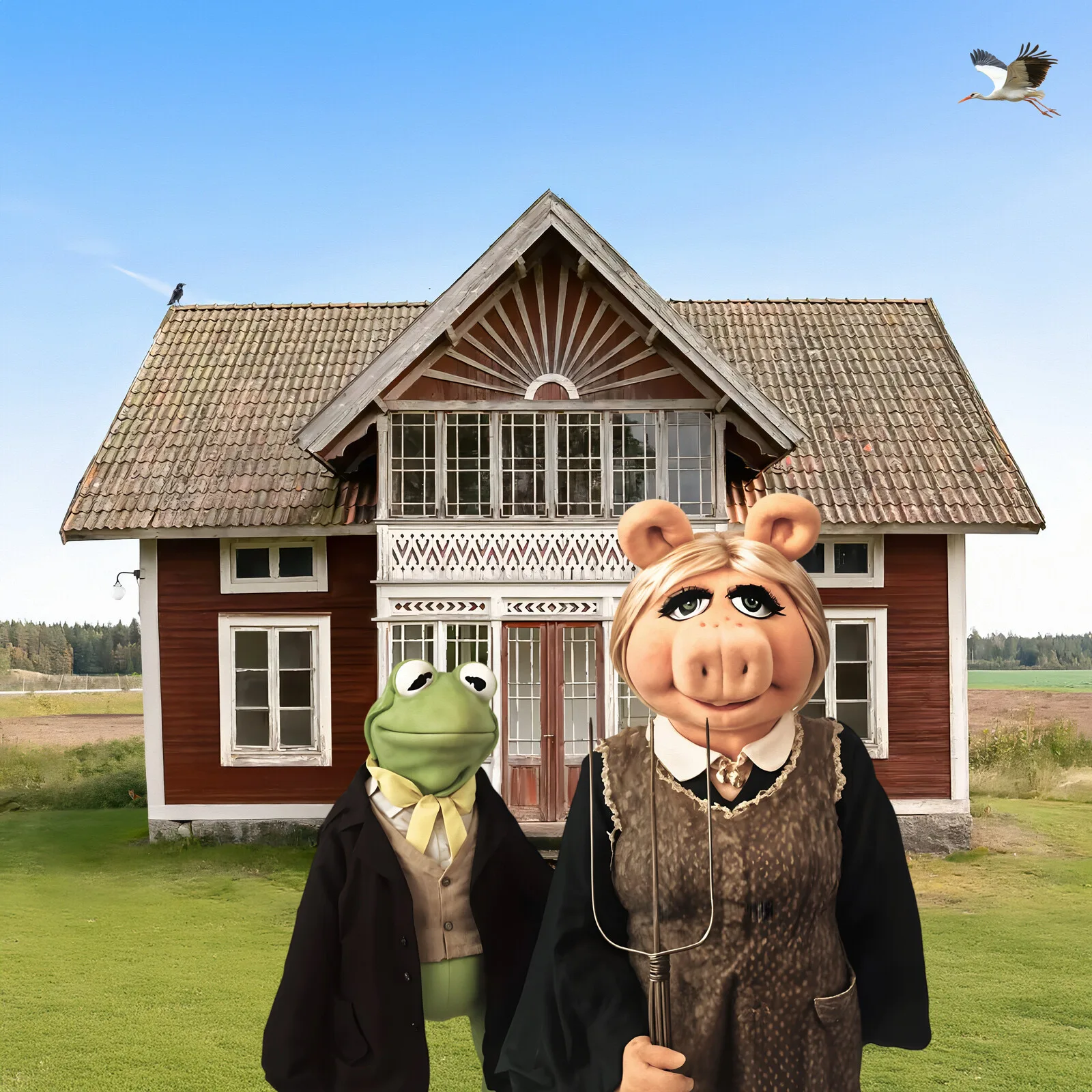
Jörgen Thornberg
Swedish Gothic, 2025
Digital
80 x 80 cm
3 500 kr
Swedish Gothic
A Gothic for Our Time
When Grant Wood painted American Gothic in 1930, he captured more than a rural couple in front of a house—he unveiled a hidden tension beneath society's calm surface. That same sense of abandonment now echoes across the Western world. From Iowa to Picardy, Småland to Silesia, those once overlooked have risen in protest and power. Their anger has fueled strongmen like Trump and Orbán, who exploit it with hollow promises and dangerous intent.
The Gothic, with its shadows and suppressed truths, is no longer just an artistic style—it’s a political mood. Understanding this mood is crucial in deciphering the underlying tensions in our society. Behind every populist surge lies a more profound fear: something precious has been lost, and no one in power cares. This understanding can make us more informed and aware of the political dynamics at play.
History never repeats itself, but the 2020s bear more than a passing resemblance to the 1930s. Please, read on to meet the dark forces shaping our present. These forces include economic instability, cultural division, and the rise of authoritarian leaders who exploit societal tensions for their own gain.
“The Swedish Gothic
No thunder rolls, no candles burn,
The Gothic here walks out at noon.
It leans against a moss-grown gate,
And watches silence swallow roads.
No shadowed spires, no ruined manors,
Just shuttered Konsum, blank timetables,
The bus that stopped, the school that closed,
The village green is overgrown with weeds.
Where spruce replaces pasture’s breath,
A quiet rage begins to form.
Not shouted—but withheld, withdrawn,
Like smoke beneath a frozen pond.
Here, spectres wear their Sunday fleece,
And hum the hymn of vacancy.
They clutch their pension forms like shields
And scroll for answers in the dark.
Once bells rang out from civic halls,
Now coffee makers hum alone.
A raven circles—not above
The dead, but what will not return.
In livestream glow, the basement blooms
With flags, with fury, with recall.
Not memory—but myth restored,
A longing dressed as politics.
This is the Gothic of the bus stop,
Of Systembolaget gone.
Of keyless doors, of guarded eyes,
Of people ranked and sorted.
No vampire haunts this northern land—
But Gråkappan still files the forms.
And somewhere in a drafty house
A young man curses, out of frame.
We do not fear the fall of night—
We dread the unreturned hello,
The sense that trust, once plain and shared,
Has turned to snow that does not melt.
Coda
This is our Gothic.
It wears no cape,
casts no shadow but our own.
It knocks not with thunder
but with the stillness
of a closed door,
a broken postbox,
a voice that once voted—
and now waits
with the pitchfork.”
Malmö May 2025
American Gothic- Relevance to Sweden and other places
When Grant Wood painted American Gothic in 1930, he little knew that his portrayal of two stern-faced rural Americans standing before a house with a pointed church window would hold profound significance for the modern Western world. The painting, iconic in its own right, possesses a power that transcends its visual appeal. It reveals a hidden truth: a sense of abandonment lies beneath the seemingly tranquil landscape. This sentiment has evolved into political upheaval in our era.
Across numerous free democracies—from the United States to France, Sweden to Poland—individuals who were once relegated to the fringes have emerged with a resolute and unmistakable message: We may be invisible to you, but we exist—and we vote. After deindustrialisation, a new political force emerged in rural areas where the future moved on, often exploited by strongmen with simplistic solutions and dubious motives. Donald Trump, Viktor Orbán, and other authoritarian populists have recognised what many mainstream leaders overlooked: that the forgotten are not just a problem—they're a political asset. By harnessing their anger, they become a source of power.
The gothic, as an aesthetic, atmosphere, and symbolic language, has consistently engaged with the return of the repressed, with what was buried returning to haunt. In today's political landscape, it serves as a powerful lens for understanding. Behind every nationalist outcry, every revenge of “the people,” and every fractured electoral map lies a sense of loss, historical grievance, and something broken. This understanding can enlighten us and keep us engaged in the political discourse.
History never repeats itself in the same way. But echoes of the 1930s are unmistakable in the politics of the 2020s: an economic crisis here, a culture war there, and a fast-talking demagogue rising to power on fury rather than ideas. Those who can't see the pattern may not want to. Those who believe it can't happen again have already taken the first step toward ensuring it does.
That's why we need to talk about American Gothic—not as a museum piece, but as a code to be cracked. What was once a portrait of a struggling America has become a window into a global present. And we need to look closely. Because it's not just the window that catches the eye; it's what they're holding in their hands—that heavy, threatening, silent object: the pitchfork. By looking closely, we can be part of the analysis and understanding of this iconic painting.
American Gothic Painting
The scene depicted in ‘American Gothic’ is based on a real location, actual people, and a specific historical time. The white farmhouse is in Eldon, Iowa, and still stands today. The house and its memorable windows are in the Carpenter Gothic style of the 1880s. This window style is more common in churches than in homes. Grant was visiting the town of Eldon when he saw the house and windows and felt inspired. It is understood that Grant named the painting in part due to this type of window and the notion that rural life tends not to keep up with modern times, as he saw in this particular dwelling. The man and woman represent strong rural Americans who were modelled after his dentist and sister. They were put explicitly in 19th-century dress to develop the narrative of the painting of the old world of the rural environment persevering in modern times. American Gothic was created during the early years of the Great Depression. Rural life was significantly impacted, and Grant sought to capture that message.
American Gothic and the Myths of Rural America
The scene in Grant Wood’s painting “American Gothic” isn’t invented. It’s based on a real house, real people, and a real moment in American history. The white farmhouse still stands in Eldon, Iowa, its iconic pointed window gleaming in Carpenter Gothic style—a church window in a modest home. Wood happened upon it while visiting Eldon, struck by how out of place the design looked. It made him wonder what kind of people might live in such a house. The man and woman he painted were his sister and his dentist, dressed in distinctly 19th-century clothing to emphasise the contrast between the lingering past and creeping modernity. He titled the painting after that Gothic window, perhaps due to the feeling that rural America was stuck in time. Painted in the early years of the Great Depression, “American Gothic” was Wood’s attempt to capture something essential about hardship, dignity, and survival in rural life.
But there’s more to the painting—and the story of rural America—than nostalgia. Many have debated its meaning. Was it satire? Sober realism? A tribute? Thomas Hoving, former director of the Metropolitan Museum of Art, famously called it a “Rorschach test for the nation's character.”
To Wood, however, the meaning wasn't ambiguous. Despite criticism from angry Iowa farm wives—one even threatened to “smash my head,” he recalled—Wood insisted the painting was sympathetic. Urban culture might dominate, but it wasn't authentically American to him. That title belonged to the countryside, whose spirit cities had hijacked. In 1935, Wood articulated his beliefs in a manifesto titled “Revolt Against the City.”
He had a point. In 1920, the U. S. census revealed that, for the first time, more Americans lived in cities than in rural areas. Urban dwellers were proud of their rising status. Magazines like H. L. Mencken's The American Mercury and even this publication celebrated metropolitan life with no small amount of snobbery. Sinclair Lewis captured the tone in his 1920 novel Main Street, where the heroine sees small-town life as undignified and tasteless—people eating bland food, sitting thoughtlessly in rocking chairs adorned with nonsense.
Wood had once agreed. He read Mencken, loved Main Street, and tried to bring a touch of the avant-garde to Cedar Rapids, Iowa, by creating a bohemian art colony. He visited France and returned with a Parisian beard—something his neighbours didn't appreciate. But the Great Depression changed his perspective. The cities lost their lustre. Wood blamed figures like Mencken and Main Street for glamorising an elite worldview. He decided a better example lay with farmers—their independence and rootedness. So he shaved his beard and donned overalls.
It was, in many ways, an overalls era. The 1930 s presented a parade of rural images that have since become iconic: Laura Ingalls Wilder's Little House on the Prairie, Dorothea Lange's “Migrant Mother,” Margaret Mitchell's Gone with the Wind, Zora Neale Hurston's Their Eyes Were Watching God, Thornton Wilder's Our Town, John Steinbeck's The Grapes of Wrath. It culminated in the 1939 film The Wizard of Oz, in which Dorothy famously returns from the glitz of the Emerald City and declares, “There 's no place like home.”
The longing for rootedness has not disappeared. In 2008, Sarah Palin insisted that small towns represented the “real America,” where hardworking, patriotic people lived. This sentiment has only grown stronger, especially as rural voters have gained political power. When Donald Trump was elected, Politico called it the “revenge of the rural voter.”
Sociologists like Katherine Cramer (The Politics of Resentment, 2016) and Robert Wuthnow (The Left Behind, 2018) have found that rural Americans feel alienated and misunderstood. As Grant Wood argued in 1935, many rural residents today see themselves as guardians of authenticity, threatened by an elite urban class that is out of touch with their values.
But is that self-image accurate? Steven Conn’s recent book The Lies of the Land challenges it head-on. A Miami University in Ohio historian, Conn, argues that rural America isn’t timeless, self-reliant, or natural. It is a product of government policy, corporate power, and industrial capitalism—no less constructed than any city. Yet, as Conn writes, many people—rural and urban, left and right—don’t want to admit it.
The word “rural” covers an enormous range: small towns, reservations, timberlands, and ranches. But these places are rarely seen as modern. In Adam Smith’s version of history, as laid out in The Wealth of Nations, agriculture precedes industry. Farming is the beginning; cities come later. Rural people are thus cast as living fossils, reminders of a pre-modern world. Sometimes that’s romanticised (“rooted”), other times dismissed (“backwards”).
However, the U.S. didn’t follow that path. While some rural communities have centuries of history, like the Acoma Pueblo in New Mexico, many others resulted from forced removal and colonial expansion. The Native people with the deepest roots were violently displaced. Their lands were taken and resettled by newcomers who imagined themselves pioneers, even though they benefited from state intervention and military force. Robert Lee estimates that Indigenous people fought 1,642 military battles with the U.S. government, and the treaties that followed cost billions.
The settlers liked to believe they won their land with grit and determination. That’s how it’s told in Little House on the Prairie, where the family pushes into Indian territory ahead of the law. However, as the literary scholar Frances W. Kaye once wrote, a more accurate title would be Little Squatter on the Osage Diminished Reserve. Most land came via the state. The Homestead Act of 1862 and similar laws divided and gave away land the size of Pakistan. This continued into living memory—the last homesteader received land in 1988.
Even towns that now seem traditional were state creations. Wasilla, Alaska—where Sarah Palin was mayor—was a New Deal settlement. Most of its farms were relocated there from the Upper Midwest. Palin’s Fargo-like accent stems from that Midwestern ancestry. In other words, her “real America” was Roosevelt-engineered.
And what about Eldon, Iowa, the town behind American Gothic? The house Wood painted was only a few decades old. Its famous window was mail-ordered from Sears, as were the models’ clothes. Eldon itself barely existed when the window was installed. Wood called the couple “tintypes from my family album.” While his parents had farmed, it wasn’t a deep tradition. His maternal grandparents were innkeepers, and his paternal ancestors had been Virginia slaveholders. Wood moved to Cedar Rapids by age ten to train as a jeweller.
Conn argues that farms like the one in American Gothic were never typical and haven’t survived. Most small general farms disappeared over fifty years ago. Today, agriculture is dominated by capital, technology, and global supply chains. Fields resemble factories. Over two-thirds of the hired workforce is foreign-born. Conn writes, “To call 1,500 acres of corn, genetically modified to withstand harsh chemical pesticides and intended for a high-fructose corn syrup factory, a ‘farm’ is a bit like calling a highly automated GM factory a ‘workshop.’”
Corporate control is obscured by branding. High-profile companies make Apple products. But actual apples come from firms like Zirkle Fruit or Gebbers Farms—private, anonymous, and massive. Many are called “family farms” for legal reasons, but that doesn’t mean they’re small. In food processing, the charade disappears. PepsiCo owns Quaker Oats, Sabra, Gatorade, Rold Gold, and Doritos.
This doesn’t even resemble a free market. Since the Great Depression, U.S. farm policy has managed supply, bolstered demand, and stabilised prices. In 1995, the head of Archer Daniels Midland put it bluntly: “There is no such thing as the free market in agriculture.”
Over time, agribusinesses consolidated, and the number of U.S. farms plummeted. Millions left the countryside. Black farmers suffered the most: in 1920, there were nearly a million; now, fewer than 35,000 remain.
Those who stayed often became charity cases. In 1985, Bob Dylan played at Live Aid and suggested that some funds be used to help U.S. farmers. That didn’t happen, but Farm Aid was born and continues to operate today. Conn notes how the word “crisis” has become meaningless. Small farmers have lived in crisis for decades.
Even when Wood painted American Gothic, the archetype it captured was already vanishing. The house had a troubled history. One owner lost it to taxes, and another tried to run a candy shop. Eldon was already shrinking to 1,800 people then, and now has fewer than 900.
That pitchfork-wielding farmer? Practically extinct. Today, more Americans work in landscaping than in agriculture. The modern rural symbol might be a leaf blower.
What does rural America look like now? Conn identifies another trend: rural land is used as a dumping ground for industry, the military, and retail chains. Appalachia is a stark example. Long seen as isolated and traditional, it was, in fact, central to timber and coal. Corporations devastated the land and left, resulting in a “postindustrial moonscape.”
The Hatfield-McCoy feud wasn’t about family honour but rather a logging dispute. Moonshining wasn’t quaint—it was a matter of survival. Railroads introduced industry into hollows; trucks and cars spread it nationwide. Companies relocated to the countryside to evade unions.
Consider slaughterhouses. Once urban, they moved as soon as refrigerated transport became feasible. Today, places like Gainesville, Georgia, process enormous volumes of poultry using poorly paid, non-unionised immigrant labour. Conn suggests a modern-day ‘The Jungle’ would be set there, not in Chicago.
The rural industrial boom started in the 1960s as farming jobs vanished. Towns courted factories with subsidies and lax regulations. But when globalisation hit, those jobs disappeared. This cycle devastated areas like Eldon. Ottumwa’s nearby meatpacking plant once supported the region. However, in 1973, it was shut down after a labour dispute, with production shifting to South Dakota.
The fallout was swift. Trucking firms, schools, and utilities—all were affected. The American Gothic house deteriorated. By 1977, it had broken windows and a bullet hole. A jobless former factory worker rented it in the 1980s, relying on assistance from his parents. Tourists peeking through the windows didn’t help.
That’s how rural economies operate, Conn argues. They depend on a single employer. When it leaves, everything collapses. Cities bounce back with diverse industries; rural areas do not. That’s why China’s WTO entry in 2001 was such a blow. Manufacturing left entirely. Rural deindustrialisation has arguably been more painful than the urban collapse of the 1970s.
What moved in to fill the void? Dollar General. It has over four times as many U.S. stores as Walmart. Its former CEO, Cal Turner Jr., published a memoir about “small-town values,” but the company exploits rural despair. It pays poorly, reduces staff, and closes stores without warning. Eldon has one, half a mile from the American Gothic house. It’s one of only two places to buy groceries—and could disappear tomorrow. “We’re kind of gypsies,” Turner once said. “We can close a store and be gone in 24 hours.”
A laid-off veteran buying Rice-A-Roni at Dollar General isn’t the rural image we prefer. But it’s much more accurate than Grant Wood’s tableau. And it’s politically urgent.
The rural-urban divide has solidified. Democrats dominate cities, while Republicans prevail in rural areas. Only two of the thirty most significant U.S. cities have Republican mayors. The real battle is for the suburbs—post-rural landscapes filled with relocated rural Americans.
Rural voters wield significant influence despite constituting only a fifth of the population. The Senate allocates two votes to every state, enhancing rural power. In the past six Senate elections, Democrats received 34 million more votes but held a majority only once. The Electoral College exacerbates the inequity. Democrats have won the popular vote five times in six presidential elections but have only held the presidency three times.
Yet rural voters aren’t thriving in life. They die younger, commit suicide more often, and face fewer economic options. In 2023, Oliver Anthony’s “Rich Men North of Richmond” topped the charts—a cry of rage from a former factory worker in Farmville, Virginia. Critics dismissed it, but the pain was genuine. Half the town lives on less than $37,000 a year.
In reshaping the Republican Party, rural voters have pushed aside elite candidates like Jeb Bush in favour of Trump. For all his quirks, Trump spoke to their reality: shuttered factories, lost jobs, broken promises. He turned the GOP against globalisation, and they rewarded him. In 2020, he lost the national vote by four points—but won Eldon’s county by twenty-four.
Grant Wood’s revolt against the city now resembles a war. To understand it, we have to abandon myths and look directly at what rural America has become. When we see ‘American Gothic’ today, it’s not the pointed window that draws the eye. It’s the pitchfork.e. It’s the pitchfork.
The American Landscape – and the World Beyond
The story unfolding around American Gothic, Eldon, Iowa, and the transformation of rural America is far from unique. It bears the markings of something much larger, resonating in many parts of the world. It’s not only rural Americans who feel forgotten, run over by the speed of globalisation, the march of technology, and a cultural elite that seems to speak an entirely different language. The same sentiment echoes through former mining towns in Britain, small cities in Italy, villages in eastern Germany, provinces in France, and even in parts of Sweden, where jobs have vanished and silence has taken over.
This is not solely about economics; it also plays a central role. It’s about lost status, meaning, and perhaps most importantly, a lost future. When you no longer recognise the society you inhabit, it’s easy to long for the past. For something you remember as more understandable, fair, and decent, even if it never truly was. It’s in that void that the idea of the strongman takes root. The one who speaks, names scapegoats, and promises to set everything right.
Donald Trump is the most prominent example of our time, but he is far from alone. Viktor Orbán in Hungary. Giorgia Meloni in Italy. Marine Le Pen in France. Javier Milei in Argentina. Rodrigo Duterte in the Philippines. Benjamin Netanyahu in Israel. And further afield, yet ever-present: Putin’s authoritarian model and China’s state-capitalism—a powerful, but ultimately dangerous blend of control and consumption.
None of this is new. German peasants and the petty bourgeoisie felt similarly during the Weimar Republic. Russian farmers felt just as powerless before Stalin took over. Often, it is precisely out of resentment, humiliation, and marginalisation that fascism is born, not as ideology first, but as feeling. And that is where the danger lies. Ordinary people are rarely historically observant. They don’t see that what is happening now—political polarisation, democratic fatigue, hostility toward elites, cries for the strongman—has occurred before. And every time, it has ended in disaster.
There are no simple solutions to complex societal transformations. And above all, there are no strong men who can fix them. No strong women either, for that matter. The only thing that has ever led to even roughly just societies is democracy, diversity, and the capacity to listen to those standing on the margins. Not only during elections, but all the time. Because when you stop listening for too long, the screams grow louder.
At the same time, authoritarian capitalism, as seen in China, currently holds the upper hand. Faster decisions, tighter control, no opposition. But that advantage can’t last. Without openness, critique, and accountability, all systems eventually slide into stagnation, corruption, and oppression. Democracies are slower and messier, but they have, in return, the ability to adapt and change from below.
But that demands that we understand what’s at stake. We must dare to see discontent not as something to mock, but as something to heed—before it turns into hatred, recognising that democracy is not inherently self-evident but requires constant care. And that we must never forget what happens when we turn our backs.
Swedish Gothics
Sweden has long viewed itself as the exception—the country that remained out of wars, built a welfare state while others repaired bombed cities, and placed its trust in the state, each other, and the future. The People’s Home (Folkhemmet) was not just a political vision but a cultural myth: a land where no one stood above, below, or outside.
But quietly, the map has changed. Post offices, once symbols of community, have disappeared. Small schools, where generations of families were educated, have closed. The bus, a lifeline for many, no longer comes. Most symbolically, even Systembolaget, the state liquor monopoly—once an altar of regulated indulgence—has closed its doors in some places. In towns where the front door key once hung openly on a nail, there are now surveillance cameras, motion alarms, and the quiet hum of mistrust. The countryside has lost its purpose. Industry has vanished. Local culture has withered. Residents have become voters—angry ones. Where people once swore quietly behind the barn, they now curse openly on TikTok and Facebook.
In this altered landscape, the Sweden Democrats have grown. Once a pariah party, they are now central in parliament. But it would be too simplistic to dismiss them as merely xenophobic. Their rise also reflects a desire for recognition, voicing a deep frustration that others have ignored for far too long. The rural backlash, the small-town return, and the muffled rage have seized the microphone while the rest of the country politely looked the other way.
While public debate has focused on migration, integration, and crime, something more profound has shifted: the very architecture of political culture. Dialogue has given way to slogans, thoughtfulness to instinct, and consensus to conflict. What once could not be said in parliament is now articulated without hesitation. The media is framed as an enemy. Art and culture are viewed with suspicion. People are ranked, sorted, and measured.
There is a Swedish Gothic, but it’s not melodramatic. It moves in silence. It lingers in shuttered train stations and moss-covered ruins among spruce plantations where villages used to thrive. It stirs in parents' quiet worry, in the apathy of young men with nothing to inherit, and in the cold offices of Gråkappan's, Charles the XI, descendants—the civil service elite whose files still hum with tidy certainties as the ground shifts beneath them.
It lives in the eerie sensation that something vital has been lost, and it hopes in vain that stronger hands, stricter laws, and more straightforward answers might restore it.
Swedish Gothic is a darkness not born of drama but of slow erosion. It is found in the absence of bells, in hymnals never opened, and in the hollowing of municipal halls that once rang with choir rehearsals and pensioners’ dances. The light remains, but the warmth is gone.
Its spectres wear fleece jackets and carry pension reports. Its ghosts are the missing shopkeeper, the sold tractor, and the kid who never returned from the city. It has its omens: the circling raven, yes—but the empty timetable at the village bus stop and the locked library. There is silence after a question is asked in the town hall when no one answers.
Swedish Gothic is not adorned with vampires or wailing ghosts. Monsters livestream in basements, their faces lit by screens, surrounded by flags and nostalgia. It mutters in the backrooms of kebab shops and behind pharmacy counters. It is not loud, but it is accumulating.
History teaches us that democracies rarely collapse overnight. They fray slowly through passive acquiescence, with power drained from the institutions that once earned trust, while the growing chorus says: I don't vote for what they say—I vote for what they awaken in me.
Sweden now stands at a critical crossroads. This discontent can be seen as a threat or a call for a deeper democracy. It demands more than quick fixes. It requires the courage to listen, even when it hurts; the discipline to understand without succumbing to fear; and the resolve to hold onto the principles that once built this country, not because they are flawless, but because they are better than the alternatives.
Swedish democracy has long been robust. But its strength has always rested on an unspoken covenant: that we belong to one another. If that feeling vanishes, we no longer live in a People’s Home—we are treading the creaking boards of a theatrical set, where the windows gape empty and the wind blows through hollow walls.
British Gothic: Brexit and the Longing for a Lost World
Suppose the American house in American Gothic carries its pointed arch as a symbol of an older world. In that case, Britain has taken its entire architecture, literature, and national self-image with a similar melancholic aura. Gothic may have been born as architecture in medieval France, but it was in England that it gained its most sentimental afterglow—as a form for dreams, ghosts, and nostalgia. It applies to church windows and novels alike, and perhaps to political choices as well.
It is no coincidence that Brexit—that epic self-inflicted wound—was, at its core, about the feeling that something had been lost. As its supporters claimed, not just sovereignty, but also pride, identity, and coherence. It was a rebellion against the promises of globalisation and the arrogance of elites. Against London, Brussels, and Oxford all at once. In northern England, in post-industrial towns, in coastal communities abandoned by shifting fisheries policy, people voted to do anything that might restore a sense of control.
The British countryside had long been a backdrop for an idealised national narrative: green fields, distant spires, afternoon tea, Jane Austen. But reality had changed. The mines were closed. Agriculture was strained under EU regulations and global prices. The young moved to cities. And into that vacuum crept a bitter romanticism—like a Gothic mist. It wasn’t just the EU that was the problem. It was the sense that nothing was in place anymore, that a culture had fallen apart.
Like in Eldon, Iowa, the British response became a kind of revolt and a dream of a “before” that never quite existed. It was as if a single vote could turn back the clock to the glory days of empire or some imagined communal harmony before Thatcher, immigration, and change. In this light, Brexit transformed into a gothic act: dramatic and dreamlike, haunted by the ghosts of a lost Britannia.
As in the American example, Brexit illustrates that when democracies stop listening to the marginalised, and when politics bypasses people’s everyday lives, other voices seize the mic—often simpler, louder, and frightening. But British gothic literature warns us, even through its narratives: what appears to be salvation can easily become a curse. There are no ghosts as persistent as those we have unleashed.
France: The Republic and Its Resentment
France’s republican self-image has long been intertwined with the idea of la grandeur—a grandeur that speaks not only of Versailles and Voltaire, but of an idea: the nation as the home of reason and the general will. However, during the Yellow Vest uprising—les gilets jaunes—that façade was torn down. There was no ideological platform, no clear program—only a cry: You don’t see us. People in suburbs, small towns, and rural communities rose against fuel taxes, rising costs, and a Parisian leadership that governed the country like a corporation.
Macron—urban, technocratic, globalist in his orientation—came to embody the elite that had lost touch with ordinary life. His attempts to listen afterwards came too late. The damage had been done: the feeling of not being heard or counted had become chronic. The old republican story of liberté, égalité, fraternité gave way to a new vocabulary—security, borders, identity. Marine Le Pen and other right-wing populists stepped forward, not with promises, but with fury.
As in the U.S. and Britain, a gothic energy stirs beneath the surface—a grief over a society slipping away and a desire to reclaim it, by any means necessary. Here, too, history echoes. Every time France sought comfort in authoritarianism, from Napoleon to Vichy, it ended in ruins.
Germany: The Burden of Memory and a New Kind of Fear
Germany carries its history like armour, and rightly so. The collective memory of Weimar, Nazism, war, and division has shaped a political culture rooted in consensus, reason, and trust in institutions. Yet, even here, the political ground has begun to shift. In eastern Germany, in cities like Chemnitz, Dresden, and Erfurt, the Afd has grown strong. Once seen as a fringe movement, it now poses a systemic threat.
What lies behind this? Partly economics—unemployment, depopulation, demographic decline. But also something more profound: a feeling of never truly having been included in the new Germany. People went from the iron grip of the GDR to the cold shoulder of Western capitalism without ever setting the terms. Now, conspiracy theories flourish, along with nationalism, anti-immigration rhetoric, and a political language that no longer hesitates to brand journalists and officials as enemies of the people.
It’s paradoxical, yet understandable: a country that built its modern identity on not repeating history now seems tempted by it again. German Gothic is less visible than the English kind. Still, its darkness lingers in the language, the simmering rage, the fear of chaos, and the dangerous seduction of choosing order over freedom once more.
Italy: Commedia dell'Arte' Arte Returns
Italy, a country that has always oscillated between passion and pragmatism, tragedy and farce, occupies a unique place in the annals of political history. Like a grand opera, its political landscape is charged with unpredictability and drama. Every new movement must grapple with the lingering ghosts of the past, including the birth of fascism in the marches of the Blackshirts, the mythologised Rome of Mussolini, and the yearning for national redemption that was cast as destiny.
That yearning still lingers today, though clad in a different costume. Giorgia Meloni, leader of the post- fascist Fratelli d' Italia, is now Prime Minister. She speaks of the people's voice, the nation's soul, and the need to defend tradition from foreign interference and global decadence. It is a rhetoric steeped in symbols, culture wars, and veiled threats: not a vampire's cloak, but a patriotic flag worn as armour.
Yet what unfolds beneath is less tragedy than farce—a rerun of Italy's eternal Commedia dell'Arte. Meloni plays La Signora, the fierce matron cloaked in virtue, commanding the stage with righteous indignation while scheming behind the curtain. Around her dances the familiar cast: Pantalone, the ageing patriarch clutching power and coin; Il Capitano, the chest-thumping braggart with little real courage; Arlecchino, the trickster advisor who flatters and deceives; and, of course, Pulcinella, the everyman cynic who sees it all and shrugs.
In this theatre of national identity, the North scorns the South, the cities ignore the provinces, the young flee and the old are left to applaud or despair. The Roman centre below; the periphery grows mute. Populism, like Commedia, is improvisational, responsive, performative, and expertly attuned to mood. But while it amuses and distracts, it rarely solves. It gives voice to pain, but not balm. And it is always easier to reach for Il Dottore with his pompous diagnoses than to build true institutions of care and competence.
In its current form, Italian politics is not a mere return to the stage. It is a reentry into the timeless world of Commedia dell'Arte. In this world, everything is familiar, everyone plays a role, and even the darkest truths can be concealed behind laughter. The masks may be new, but the roles remain the same, underscoring the enduring nature of Italy's political drama, which continues to captivate and intrigue.
Poland: Memory, the Church, and Power
In Poland, history is never just a backdrop—it walks the stage as a principal actor. The nation has been partitioned, occupied, and reborn again and again. Its identity was shaped in struggle: against the tsar, against Nazism, against communism. But today, something strange is unfolding. A country that once fought its way to democracy is now dismantling its democratic foundations through the ballot box.
The Law and Justice party (Pis) has used electoral legitimacy to challenge the independence of courts, the freedom of the press, and women ‘s rights. The Catholic Church—once a voice of solidarity against dictatorship—has become an ally of the state in the crusade against “Western decadence.” Dissent is branded as betrayal. Minorities are cast as threats. Loyalty is prized above law.
It is a kind of Gothic politics, where the darkness descends not in shock, but in twilight. This is no violent coup, but a velvet suffocation—administered through legal codes, state media, and budgetary decrees. Many Poles remember the brutal grip of communist repression. Fewer recognise how a new, more refined oppression is emerging, cloaked in the language of tradition and patriotism.
And again, it begins in the provinces—in the conservative towns and countryside, where Warsaw feels remote, Brussels alien, LGBTQ rights incomprehensible, and secularism suspect. From these shadows rises a familiar drama: part morality play, part nationalist theatre, echoing the Misteria and Passion plays once performed in church squares—ritualised spectacles of virtue and sin, martyrdom and redemption, where the roles are fixed and the audience is not meant to question, only to weep and cheer.
In this performance, the Church becomes both altar and tribunal. The state plays the stern confessor. The people, cast as Poland's eternal victims, are invited to feel holy in their hardship and righteous in their resentment. But when religion and nationalism blend into power, freedom ceases to be a shared space—it becomes a relic, held aloft like a sacred object but removed from use, underlining the weight of the Church's influence in Poland's political landscape.
The Polish Gothic does not scream. It intones. It wears vestments, not uniforms. But its silence is heavy, and the script, once again, is being rewritten in ink that refuses to fade.
Canada: The Fragile Art of Holding Together
Canada has long been seen as the soft-spoken counterpoint to stormier neighbours and divided allies. This country built its national character on compromise, not confrontation, where diversity is not just an ideal but a lived, complex reality. With two official languages, a strong Indigenous presence, a population shaped by immigration, and a geography so vast it strains cohesion, Canada has attempted to live democracy’s most profound paradox: unity without uniformity.
And yet, tensions have deepened. In the West, separatist murmurs have returned. In Quebec, the dream of French cultural distinctiveness persists. The demands of Indigenous nations for truth and reconciliation have forced the country to confront the violent colonial structures beneath its politeness. And during the pandemic, frustration erupted into the streets of Ottawa, where truck convoys protested not only vaccine mandates but also the remote authority of a distant elite and the speed of a world they no longer recognised.
Justin Trudeau stood for years as the avatar of Canada’s balancing act—at once admired and derided, eloquent yet increasingly brittle. In January 2025, faced with plummeting poll numbers and inner-party fatigue, he stepped down. It marked the end of an era defined by inclusive rhetoric and widening fault lines.
His successor, Mark Carney, who had helmed the Bank of Canada and the Bank of England, took the reins and led the Liberals to a surprise victory in April 2025. The election was swept up in a surge of national unity after Donald Trump, then President of the United States, threatened tariffs and made vague allusions to annexing Canada as a “strategic asset.” For a brief moment, Canada rediscovered its voice—not in deference, but in defiance.
But Carney’s task is far from over. Even in Canada—a land of snow, space, and seemingly eternal civility—the same subterranean currents swirl: distrust in institutions, a deep forgotten sense, and a growing anxiety about the future. Canadian democracy has not yet slipped into authoritarian tones, but it lives dangerously close to its silence.
This nation is stitched together more by the rhythm of negotiation than thunderous declarations. Its true anthem is not the roar of national triumph but the murmur of a winter wind through spruce and steel, asking: Can you still hear each other? In this landscape, democracy survives through perfect harmony and the painstaking, daily practice of listening across differences.
Canada shows us that the strength of democracy lies not in stillness but in motion—in the quiet, careful art of renegotiating the terms of togetherness, even when the snow has long since covered the map.
Epilogue: The Gothic Mirror
Maybe it is time to change the architecture to something more adapted to our time, a mix of traditional values and contemporary, not too fast or drastic, but adapting to the majority’s needs. We find ourselves in an era where the spectres of the past no longer haunt ancient castles; instead, they haunt our parliaments, newsfeeds, and ballots. The once-dormant fears have now taken the spotlight, and the pitchfork, once a symbol of labour, now gleams with menacing symbolism. Across the Western world, our democratic societies are not just drifting but slowly slipping away- not with a bang, but with a sigh, a shrug, a turning away.
The Gothic tradition has always understood this drift. It is the genre of return: of what was ignored coming back, of what was buried refusing to stay quiet. Today’s political Gothic is not only about lost jobs or shuttered stores; it is about the erosion of belonging, the hollowing out of the common good, and the seduction of certainty in a world that no longer offers it.
But if we have learned anything from history, literature, or Grant Wood’s haunted window, it is this: what looks familiar may already be strange. What feels safe may already be fractured. And what begins with silence can end in ruin.
This is not a call for panic but for vigilance. Democracies are not lost in a day or saved in one. They require repair, reinvention, and above all, your attention. Because if we look away too long, we may wake up to find ourselves not in the future, but in a beautifully lit replica of the past—surrounded by familiar architecture and holding, once again, the pitchfork.
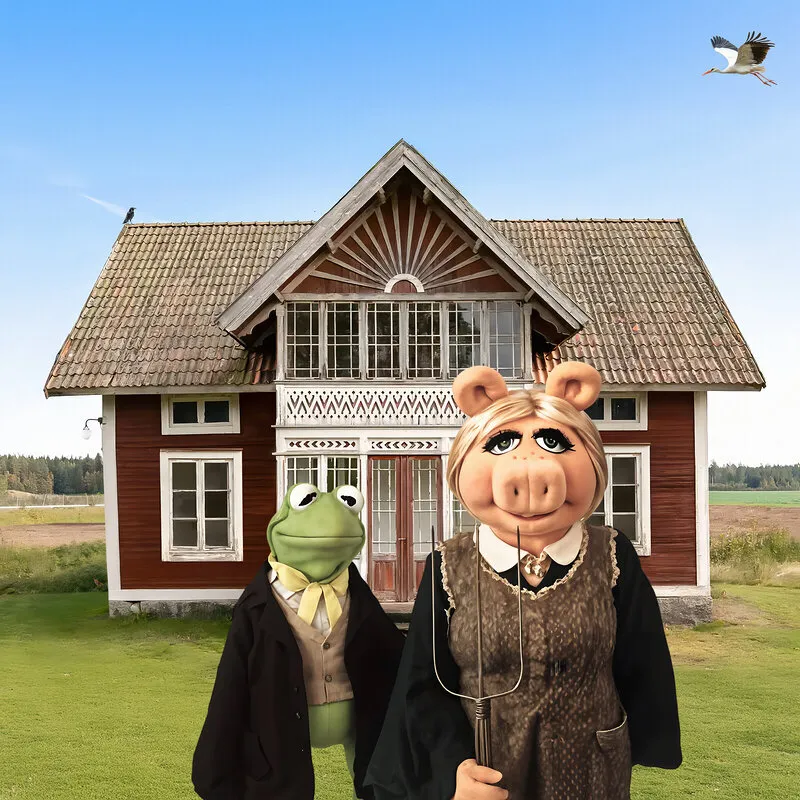
Jörgen Thornberg
Swedish Gothic, 2025
Digital
80 x 80 cm
3 500 kr
Swedish Gothic
A Gothic for Our Time
When Grant Wood painted American Gothic in 1930, he captured more than a rural couple in front of a house—he unveiled a hidden tension beneath society's calm surface. That same sense of abandonment now echoes across the Western world. From Iowa to Picardy, Småland to Silesia, those once overlooked have risen in protest and power. Their anger has fueled strongmen like Trump and Orbán, who exploit it with hollow promises and dangerous intent.
The Gothic, with its shadows and suppressed truths, is no longer just an artistic style—it’s a political mood. Understanding this mood is crucial in deciphering the underlying tensions in our society. Behind every populist surge lies a more profound fear: something precious has been lost, and no one in power cares. This understanding can make us more informed and aware of the political dynamics at play.
History never repeats itself, but the 2020s bear more than a passing resemblance to the 1930s. Please, read on to meet the dark forces shaping our present. These forces include economic instability, cultural division, and the rise of authoritarian leaders who exploit societal tensions for their own gain.
“The Swedish Gothic
No thunder rolls, no candles burn,
The Gothic here walks out at noon.
It leans against a moss-grown gate,
And watches silence swallow roads.
No shadowed spires, no ruined manors,
Just shuttered Konsum, blank timetables,
The bus that stopped, the school that closed,
The village green is overgrown with weeds.
Where spruce replaces pasture’s breath,
A quiet rage begins to form.
Not shouted—but withheld, withdrawn,
Like smoke beneath a frozen pond.
Here, spectres wear their Sunday fleece,
And hum the hymn of vacancy.
They clutch their pension forms like shields
And scroll for answers in the dark.
Once bells rang out from civic halls,
Now coffee makers hum alone.
A raven circles—not above
The dead, but what will not return.
In livestream glow, the basement blooms
With flags, with fury, with recall.
Not memory—but myth restored,
A longing dressed as politics.
This is the Gothic of the bus stop,
Of Systembolaget gone.
Of keyless doors, of guarded eyes,
Of people ranked and sorted.
No vampire haunts this northern land—
But Gråkappan still files the forms.
And somewhere in a drafty house
A young man curses, out of frame.
We do not fear the fall of night—
We dread the unreturned hello,
The sense that trust, once plain and shared,
Has turned to snow that does not melt.
Coda
This is our Gothic.
It wears no cape,
casts no shadow but our own.
It knocks not with thunder
but with the stillness
of a closed door,
a broken postbox,
a voice that once voted—
and now waits
with the pitchfork.”
Malmö May 2025
American Gothic- Relevance to Sweden and other places
When Grant Wood painted American Gothic in 1930, he little knew that his portrayal of two stern-faced rural Americans standing before a house with a pointed church window would hold profound significance for the modern Western world. The painting, iconic in its own right, possesses a power that transcends its visual appeal. It reveals a hidden truth: a sense of abandonment lies beneath the seemingly tranquil landscape. This sentiment has evolved into political upheaval in our era.
Across numerous free democracies—from the United States to France, Sweden to Poland—individuals who were once relegated to the fringes have emerged with a resolute and unmistakable message: We may be invisible to you, but we exist—and we vote. After deindustrialisation, a new political force emerged in rural areas where the future moved on, often exploited by strongmen with simplistic solutions and dubious motives. Donald Trump, Viktor Orbán, and other authoritarian populists have recognised what many mainstream leaders overlooked: that the forgotten are not just a problem—they're a political asset. By harnessing their anger, they become a source of power.
The gothic, as an aesthetic, atmosphere, and symbolic language, has consistently engaged with the return of the repressed, with what was buried returning to haunt. In today's political landscape, it serves as a powerful lens for understanding. Behind every nationalist outcry, every revenge of “the people,” and every fractured electoral map lies a sense of loss, historical grievance, and something broken. This understanding can enlighten us and keep us engaged in the political discourse.
History never repeats itself in the same way. But echoes of the 1930s are unmistakable in the politics of the 2020s: an economic crisis here, a culture war there, and a fast-talking demagogue rising to power on fury rather than ideas. Those who can't see the pattern may not want to. Those who believe it can't happen again have already taken the first step toward ensuring it does.
That's why we need to talk about American Gothic—not as a museum piece, but as a code to be cracked. What was once a portrait of a struggling America has become a window into a global present. And we need to look closely. Because it's not just the window that catches the eye; it's what they're holding in their hands—that heavy, threatening, silent object: the pitchfork. By looking closely, we can be part of the analysis and understanding of this iconic painting.
American Gothic Painting
The scene depicted in ‘American Gothic’ is based on a real location, actual people, and a specific historical time. The white farmhouse is in Eldon, Iowa, and still stands today. The house and its memorable windows are in the Carpenter Gothic style of the 1880s. This window style is more common in churches than in homes. Grant was visiting the town of Eldon when he saw the house and windows and felt inspired. It is understood that Grant named the painting in part due to this type of window and the notion that rural life tends not to keep up with modern times, as he saw in this particular dwelling. The man and woman represent strong rural Americans who were modelled after his dentist and sister. They were put explicitly in 19th-century dress to develop the narrative of the painting of the old world of the rural environment persevering in modern times. American Gothic was created during the early years of the Great Depression. Rural life was significantly impacted, and Grant sought to capture that message.
American Gothic and the Myths of Rural America
The scene in Grant Wood’s painting “American Gothic” isn’t invented. It’s based on a real house, real people, and a real moment in American history. The white farmhouse still stands in Eldon, Iowa, its iconic pointed window gleaming in Carpenter Gothic style—a church window in a modest home. Wood happened upon it while visiting Eldon, struck by how out of place the design looked. It made him wonder what kind of people might live in such a house. The man and woman he painted were his sister and his dentist, dressed in distinctly 19th-century clothing to emphasise the contrast between the lingering past and creeping modernity. He titled the painting after that Gothic window, perhaps due to the feeling that rural America was stuck in time. Painted in the early years of the Great Depression, “American Gothic” was Wood’s attempt to capture something essential about hardship, dignity, and survival in rural life.
But there’s more to the painting—and the story of rural America—than nostalgia. Many have debated its meaning. Was it satire? Sober realism? A tribute? Thomas Hoving, former director of the Metropolitan Museum of Art, famously called it a “Rorschach test for the nation's character.”
To Wood, however, the meaning wasn't ambiguous. Despite criticism from angry Iowa farm wives—one even threatened to “smash my head,” he recalled—Wood insisted the painting was sympathetic. Urban culture might dominate, but it wasn't authentically American to him. That title belonged to the countryside, whose spirit cities had hijacked. In 1935, Wood articulated his beliefs in a manifesto titled “Revolt Against the City.”
He had a point. In 1920, the U. S. census revealed that, for the first time, more Americans lived in cities than in rural areas. Urban dwellers were proud of their rising status. Magazines like H. L. Mencken's The American Mercury and even this publication celebrated metropolitan life with no small amount of snobbery. Sinclair Lewis captured the tone in his 1920 novel Main Street, where the heroine sees small-town life as undignified and tasteless—people eating bland food, sitting thoughtlessly in rocking chairs adorned with nonsense.
Wood had once agreed. He read Mencken, loved Main Street, and tried to bring a touch of the avant-garde to Cedar Rapids, Iowa, by creating a bohemian art colony. He visited France and returned with a Parisian beard—something his neighbours didn't appreciate. But the Great Depression changed his perspective. The cities lost their lustre. Wood blamed figures like Mencken and Main Street for glamorising an elite worldview. He decided a better example lay with farmers—their independence and rootedness. So he shaved his beard and donned overalls.
It was, in many ways, an overalls era. The 1930 s presented a parade of rural images that have since become iconic: Laura Ingalls Wilder's Little House on the Prairie, Dorothea Lange's “Migrant Mother,” Margaret Mitchell's Gone with the Wind, Zora Neale Hurston's Their Eyes Were Watching God, Thornton Wilder's Our Town, John Steinbeck's The Grapes of Wrath. It culminated in the 1939 film The Wizard of Oz, in which Dorothy famously returns from the glitz of the Emerald City and declares, “There 's no place like home.”
The longing for rootedness has not disappeared. In 2008, Sarah Palin insisted that small towns represented the “real America,” where hardworking, patriotic people lived. This sentiment has only grown stronger, especially as rural voters have gained political power. When Donald Trump was elected, Politico called it the “revenge of the rural voter.”
Sociologists like Katherine Cramer (The Politics of Resentment, 2016) and Robert Wuthnow (The Left Behind, 2018) have found that rural Americans feel alienated and misunderstood. As Grant Wood argued in 1935, many rural residents today see themselves as guardians of authenticity, threatened by an elite urban class that is out of touch with their values.
But is that self-image accurate? Steven Conn’s recent book The Lies of the Land challenges it head-on. A Miami University in Ohio historian, Conn, argues that rural America isn’t timeless, self-reliant, or natural. It is a product of government policy, corporate power, and industrial capitalism—no less constructed than any city. Yet, as Conn writes, many people—rural and urban, left and right—don’t want to admit it.
The word “rural” covers an enormous range: small towns, reservations, timberlands, and ranches. But these places are rarely seen as modern. In Adam Smith’s version of history, as laid out in The Wealth of Nations, agriculture precedes industry. Farming is the beginning; cities come later. Rural people are thus cast as living fossils, reminders of a pre-modern world. Sometimes that’s romanticised (“rooted”), other times dismissed (“backwards”).
However, the U.S. didn’t follow that path. While some rural communities have centuries of history, like the Acoma Pueblo in New Mexico, many others resulted from forced removal and colonial expansion. The Native people with the deepest roots were violently displaced. Their lands were taken and resettled by newcomers who imagined themselves pioneers, even though they benefited from state intervention and military force. Robert Lee estimates that Indigenous people fought 1,642 military battles with the U.S. government, and the treaties that followed cost billions.
The settlers liked to believe they won their land with grit and determination. That’s how it’s told in Little House on the Prairie, where the family pushes into Indian territory ahead of the law. However, as the literary scholar Frances W. Kaye once wrote, a more accurate title would be Little Squatter on the Osage Diminished Reserve. Most land came via the state. The Homestead Act of 1862 and similar laws divided and gave away land the size of Pakistan. This continued into living memory—the last homesteader received land in 1988.
Even towns that now seem traditional were state creations. Wasilla, Alaska—where Sarah Palin was mayor—was a New Deal settlement. Most of its farms were relocated there from the Upper Midwest. Palin’s Fargo-like accent stems from that Midwestern ancestry. In other words, her “real America” was Roosevelt-engineered.
And what about Eldon, Iowa, the town behind American Gothic? The house Wood painted was only a few decades old. Its famous window was mail-ordered from Sears, as were the models’ clothes. Eldon itself barely existed when the window was installed. Wood called the couple “tintypes from my family album.” While his parents had farmed, it wasn’t a deep tradition. His maternal grandparents were innkeepers, and his paternal ancestors had been Virginia slaveholders. Wood moved to Cedar Rapids by age ten to train as a jeweller.
Conn argues that farms like the one in American Gothic were never typical and haven’t survived. Most small general farms disappeared over fifty years ago. Today, agriculture is dominated by capital, technology, and global supply chains. Fields resemble factories. Over two-thirds of the hired workforce is foreign-born. Conn writes, “To call 1,500 acres of corn, genetically modified to withstand harsh chemical pesticides and intended for a high-fructose corn syrup factory, a ‘farm’ is a bit like calling a highly automated GM factory a ‘workshop.’”
Corporate control is obscured by branding. High-profile companies make Apple products. But actual apples come from firms like Zirkle Fruit or Gebbers Farms—private, anonymous, and massive. Many are called “family farms” for legal reasons, but that doesn’t mean they’re small. In food processing, the charade disappears. PepsiCo owns Quaker Oats, Sabra, Gatorade, Rold Gold, and Doritos.
This doesn’t even resemble a free market. Since the Great Depression, U.S. farm policy has managed supply, bolstered demand, and stabilised prices. In 1995, the head of Archer Daniels Midland put it bluntly: “There is no such thing as the free market in agriculture.”
Over time, agribusinesses consolidated, and the number of U.S. farms plummeted. Millions left the countryside. Black farmers suffered the most: in 1920, there were nearly a million; now, fewer than 35,000 remain.
Those who stayed often became charity cases. In 1985, Bob Dylan played at Live Aid and suggested that some funds be used to help U.S. farmers. That didn’t happen, but Farm Aid was born and continues to operate today. Conn notes how the word “crisis” has become meaningless. Small farmers have lived in crisis for decades.
Even when Wood painted American Gothic, the archetype it captured was already vanishing. The house had a troubled history. One owner lost it to taxes, and another tried to run a candy shop. Eldon was already shrinking to 1,800 people then, and now has fewer than 900.
That pitchfork-wielding farmer? Practically extinct. Today, more Americans work in landscaping than in agriculture. The modern rural symbol might be a leaf blower.
What does rural America look like now? Conn identifies another trend: rural land is used as a dumping ground for industry, the military, and retail chains. Appalachia is a stark example. Long seen as isolated and traditional, it was, in fact, central to timber and coal. Corporations devastated the land and left, resulting in a “postindustrial moonscape.”
The Hatfield-McCoy feud wasn’t about family honour but rather a logging dispute. Moonshining wasn’t quaint—it was a matter of survival. Railroads introduced industry into hollows; trucks and cars spread it nationwide. Companies relocated to the countryside to evade unions.
Consider slaughterhouses. Once urban, they moved as soon as refrigerated transport became feasible. Today, places like Gainesville, Georgia, process enormous volumes of poultry using poorly paid, non-unionised immigrant labour. Conn suggests a modern-day ‘The Jungle’ would be set there, not in Chicago.
The rural industrial boom started in the 1960s as farming jobs vanished. Towns courted factories with subsidies and lax regulations. But when globalisation hit, those jobs disappeared. This cycle devastated areas like Eldon. Ottumwa’s nearby meatpacking plant once supported the region. However, in 1973, it was shut down after a labour dispute, with production shifting to South Dakota.
The fallout was swift. Trucking firms, schools, and utilities—all were affected. The American Gothic house deteriorated. By 1977, it had broken windows and a bullet hole. A jobless former factory worker rented it in the 1980s, relying on assistance from his parents. Tourists peeking through the windows didn’t help.
That’s how rural economies operate, Conn argues. They depend on a single employer. When it leaves, everything collapses. Cities bounce back with diverse industries; rural areas do not. That’s why China’s WTO entry in 2001 was such a blow. Manufacturing left entirely. Rural deindustrialisation has arguably been more painful than the urban collapse of the 1970s.
What moved in to fill the void? Dollar General. It has over four times as many U.S. stores as Walmart. Its former CEO, Cal Turner Jr., published a memoir about “small-town values,” but the company exploits rural despair. It pays poorly, reduces staff, and closes stores without warning. Eldon has one, half a mile from the American Gothic house. It’s one of only two places to buy groceries—and could disappear tomorrow. “We’re kind of gypsies,” Turner once said. “We can close a store and be gone in 24 hours.”
A laid-off veteran buying Rice-A-Roni at Dollar General isn’t the rural image we prefer. But it’s much more accurate than Grant Wood’s tableau. And it’s politically urgent.
The rural-urban divide has solidified. Democrats dominate cities, while Republicans prevail in rural areas. Only two of the thirty most significant U.S. cities have Republican mayors. The real battle is for the suburbs—post-rural landscapes filled with relocated rural Americans.
Rural voters wield significant influence despite constituting only a fifth of the population. The Senate allocates two votes to every state, enhancing rural power. In the past six Senate elections, Democrats received 34 million more votes but held a majority only once. The Electoral College exacerbates the inequity. Democrats have won the popular vote five times in six presidential elections but have only held the presidency three times.
Yet rural voters aren’t thriving in life. They die younger, commit suicide more often, and face fewer economic options. In 2023, Oliver Anthony’s “Rich Men North of Richmond” topped the charts—a cry of rage from a former factory worker in Farmville, Virginia. Critics dismissed it, but the pain was genuine. Half the town lives on less than $37,000 a year.
In reshaping the Republican Party, rural voters have pushed aside elite candidates like Jeb Bush in favour of Trump. For all his quirks, Trump spoke to their reality: shuttered factories, lost jobs, broken promises. He turned the GOP against globalisation, and they rewarded him. In 2020, he lost the national vote by four points—but won Eldon’s county by twenty-four.
Grant Wood’s revolt against the city now resembles a war. To understand it, we have to abandon myths and look directly at what rural America has become. When we see ‘American Gothic’ today, it’s not the pointed window that draws the eye. It’s the pitchfork.e. It’s the pitchfork.
The American Landscape – and the World Beyond
The story unfolding around American Gothic, Eldon, Iowa, and the transformation of rural America is far from unique. It bears the markings of something much larger, resonating in many parts of the world. It’s not only rural Americans who feel forgotten, run over by the speed of globalisation, the march of technology, and a cultural elite that seems to speak an entirely different language. The same sentiment echoes through former mining towns in Britain, small cities in Italy, villages in eastern Germany, provinces in France, and even in parts of Sweden, where jobs have vanished and silence has taken over.
This is not solely about economics; it also plays a central role. It’s about lost status, meaning, and perhaps most importantly, a lost future. When you no longer recognise the society you inhabit, it’s easy to long for the past. For something you remember as more understandable, fair, and decent, even if it never truly was. It’s in that void that the idea of the strongman takes root. The one who speaks, names scapegoats, and promises to set everything right.
Donald Trump is the most prominent example of our time, but he is far from alone. Viktor Orbán in Hungary. Giorgia Meloni in Italy. Marine Le Pen in France. Javier Milei in Argentina. Rodrigo Duterte in the Philippines. Benjamin Netanyahu in Israel. And further afield, yet ever-present: Putin’s authoritarian model and China’s state-capitalism—a powerful, but ultimately dangerous blend of control and consumption.
None of this is new. German peasants and the petty bourgeoisie felt similarly during the Weimar Republic. Russian farmers felt just as powerless before Stalin took over. Often, it is precisely out of resentment, humiliation, and marginalisation that fascism is born, not as ideology first, but as feeling. And that is where the danger lies. Ordinary people are rarely historically observant. They don’t see that what is happening now—political polarisation, democratic fatigue, hostility toward elites, cries for the strongman—has occurred before. And every time, it has ended in disaster.
There are no simple solutions to complex societal transformations. And above all, there are no strong men who can fix them. No strong women either, for that matter. The only thing that has ever led to even roughly just societies is democracy, diversity, and the capacity to listen to those standing on the margins. Not only during elections, but all the time. Because when you stop listening for too long, the screams grow louder.
At the same time, authoritarian capitalism, as seen in China, currently holds the upper hand. Faster decisions, tighter control, no opposition. But that advantage can’t last. Without openness, critique, and accountability, all systems eventually slide into stagnation, corruption, and oppression. Democracies are slower and messier, but they have, in return, the ability to adapt and change from below.
But that demands that we understand what’s at stake. We must dare to see discontent not as something to mock, but as something to heed—before it turns into hatred, recognising that democracy is not inherently self-evident but requires constant care. And that we must never forget what happens when we turn our backs.
Swedish Gothics
Sweden has long viewed itself as the exception—the country that remained out of wars, built a welfare state while others repaired bombed cities, and placed its trust in the state, each other, and the future. The People’s Home (Folkhemmet) was not just a political vision but a cultural myth: a land where no one stood above, below, or outside.
But quietly, the map has changed. Post offices, once symbols of community, have disappeared. Small schools, where generations of families were educated, have closed. The bus, a lifeline for many, no longer comes. Most symbolically, even Systembolaget, the state liquor monopoly—once an altar of regulated indulgence—has closed its doors in some places. In towns where the front door key once hung openly on a nail, there are now surveillance cameras, motion alarms, and the quiet hum of mistrust. The countryside has lost its purpose. Industry has vanished. Local culture has withered. Residents have become voters—angry ones. Where people once swore quietly behind the barn, they now curse openly on TikTok and Facebook.
In this altered landscape, the Sweden Democrats have grown. Once a pariah party, they are now central in parliament. But it would be too simplistic to dismiss them as merely xenophobic. Their rise also reflects a desire for recognition, voicing a deep frustration that others have ignored for far too long. The rural backlash, the small-town return, and the muffled rage have seized the microphone while the rest of the country politely looked the other way.
While public debate has focused on migration, integration, and crime, something more profound has shifted: the very architecture of political culture. Dialogue has given way to slogans, thoughtfulness to instinct, and consensus to conflict. What once could not be said in parliament is now articulated without hesitation. The media is framed as an enemy. Art and culture are viewed with suspicion. People are ranked, sorted, and measured.
There is a Swedish Gothic, but it’s not melodramatic. It moves in silence. It lingers in shuttered train stations and moss-covered ruins among spruce plantations where villages used to thrive. It stirs in parents' quiet worry, in the apathy of young men with nothing to inherit, and in the cold offices of Gråkappan's, Charles the XI, descendants—the civil service elite whose files still hum with tidy certainties as the ground shifts beneath them.
It lives in the eerie sensation that something vital has been lost, and it hopes in vain that stronger hands, stricter laws, and more straightforward answers might restore it.
Swedish Gothic is a darkness not born of drama but of slow erosion. It is found in the absence of bells, in hymnals never opened, and in the hollowing of municipal halls that once rang with choir rehearsals and pensioners’ dances. The light remains, but the warmth is gone.
Its spectres wear fleece jackets and carry pension reports. Its ghosts are the missing shopkeeper, the sold tractor, and the kid who never returned from the city. It has its omens: the circling raven, yes—but the empty timetable at the village bus stop and the locked library. There is silence after a question is asked in the town hall when no one answers.
Swedish Gothic is not adorned with vampires or wailing ghosts. Monsters livestream in basements, their faces lit by screens, surrounded by flags and nostalgia. It mutters in the backrooms of kebab shops and behind pharmacy counters. It is not loud, but it is accumulating.
History teaches us that democracies rarely collapse overnight. They fray slowly through passive acquiescence, with power drained from the institutions that once earned trust, while the growing chorus says: I don't vote for what they say—I vote for what they awaken in me.
Sweden now stands at a critical crossroads. This discontent can be seen as a threat or a call for a deeper democracy. It demands more than quick fixes. It requires the courage to listen, even when it hurts; the discipline to understand without succumbing to fear; and the resolve to hold onto the principles that once built this country, not because they are flawless, but because they are better than the alternatives.
Swedish democracy has long been robust. But its strength has always rested on an unspoken covenant: that we belong to one another. If that feeling vanishes, we no longer live in a People’s Home—we are treading the creaking boards of a theatrical set, where the windows gape empty and the wind blows through hollow walls.
British Gothic: Brexit and the Longing for a Lost World
Suppose the American house in American Gothic carries its pointed arch as a symbol of an older world. In that case, Britain has taken its entire architecture, literature, and national self-image with a similar melancholic aura. Gothic may have been born as architecture in medieval France, but it was in England that it gained its most sentimental afterglow—as a form for dreams, ghosts, and nostalgia. It applies to church windows and novels alike, and perhaps to political choices as well.
It is no coincidence that Brexit—that epic self-inflicted wound—was, at its core, about the feeling that something had been lost. As its supporters claimed, not just sovereignty, but also pride, identity, and coherence. It was a rebellion against the promises of globalisation and the arrogance of elites. Against London, Brussels, and Oxford all at once. In northern England, in post-industrial towns, in coastal communities abandoned by shifting fisheries policy, people voted to do anything that might restore a sense of control.
The British countryside had long been a backdrop for an idealised national narrative: green fields, distant spires, afternoon tea, Jane Austen. But reality had changed. The mines were closed. Agriculture was strained under EU regulations and global prices. The young moved to cities. And into that vacuum crept a bitter romanticism—like a Gothic mist. It wasn’t just the EU that was the problem. It was the sense that nothing was in place anymore, that a culture had fallen apart.
Like in Eldon, Iowa, the British response became a kind of revolt and a dream of a “before” that never quite existed. It was as if a single vote could turn back the clock to the glory days of empire or some imagined communal harmony before Thatcher, immigration, and change. In this light, Brexit transformed into a gothic act: dramatic and dreamlike, haunted by the ghosts of a lost Britannia.
As in the American example, Brexit illustrates that when democracies stop listening to the marginalised, and when politics bypasses people’s everyday lives, other voices seize the mic—often simpler, louder, and frightening. But British gothic literature warns us, even through its narratives: what appears to be salvation can easily become a curse. There are no ghosts as persistent as those we have unleashed.
France: The Republic and Its Resentment
France’s republican self-image has long been intertwined with the idea of la grandeur—a grandeur that speaks not only of Versailles and Voltaire, but of an idea: the nation as the home of reason and the general will. However, during the Yellow Vest uprising—les gilets jaunes—that façade was torn down. There was no ideological platform, no clear program—only a cry: You don’t see us. People in suburbs, small towns, and rural communities rose against fuel taxes, rising costs, and a Parisian leadership that governed the country like a corporation.
Macron—urban, technocratic, globalist in his orientation—came to embody the elite that had lost touch with ordinary life. His attempts to listen afterwards came too late. The damage had been done: the feeling of not being heard or counted had become chronic. The old republican story of liberté, égalité, fraternité gave way to a new vocabulary—security, borders, identity. Marine Le Pen and other right-wing populists stepped forward, not with promises, but with fury.
As in the U.S. and Britain, a gothic energy stirs beneath the surface—a grief over a society slipping away and a desire to reclaim it, by any means necessary. Here, too, history echoes. Every time France sought comfort in authoritarianism, from Napoleon to Vichy, it ended in ruins.
Germany: The Burden of Memory and a New Kind of Fear
Germany carries its history like armour, and rightly so. The collective memory of Weimar, Nazism, war, and division has shaped a political culture rooted in consensus, reason, and trust in institutions. Yet, even here, the political ground has begun to shift. In eastern Germany, in cities like Chemnitz, Dresden, and Erfurt, the Afd has grown strong. Once seen as a fringe movement, it now poses a systemic threat.
What lies behind this? Partly economics—unemployment, depopulation, demographic decline. But also something more profound: a feeling of never truly having been included in the new Germany. People went from the iron grip of the GDR to the cold shoulder of Western capitalism without ever setting the terms. Now, conspiracy theories flourish, along with nationalism, anti-immigration rhetoric, and a political language that no longer hesitates to brand journalists and officials as enemies of the people.
It’s paradoxical, yet understandable: a country that built its modern identity on not repeating history now seems tempted by it again. German Gothic is less visible than the English kind. Still, its darkness lingers in the language, the simmering rage, the fear of chaos, and the dangerous seduction of choosing order over freedom once more.
Italy: Commedia dell'Arte' Arte Returns
Italy, a country that has always oscillated between passion and pragmatism, tragedy and farce, occupies a unique place in the annals of political history. Like a grand opera, its political landscape is charged with unpredictability and drama. Every new movement must grapple with the lingering ghosts of the past, including the birth of fascism in the marches of the Blackshirts, the mythologised Rome of Mussolini, and the yearning for national redemption that was cast as destiny.
That yearning still lingers today, though clad in a different costume. Giorgia Meloni, leader of the post- fascist Fratelli d' Italia, is now Prime Minister. She speaks of the people's voice, the nation's soul, and the need to defend tradition from foreign interference and global decadence. It is a rhetoric steeped in symbols, culture wars, and veiled threats: not a vampire's cloak, but a patriotic flag worn as armour.
Yet what unfolds beneath is less tragedy than farce—a rerun of Italy's eternal Commedia dell'Arte. Meloni plays La Signora, the fierce matron cloaked in virtue, commanding the stage with righteous indignation while scheming behind the curtain. Around her dances the familiar cast: Pantalone, the ageing patriarch clutching power and coin; Il Capitano, the chest-thumping braggart with little real courage; Arlecchino, the trickster advisor who flatters and deceives; and, of course, Pulcinella, the everyman cynic who sees it all and shrugs.
In this theatre of national identity, the North scorns the South, the cities ignore the provinces, the young flee and the old are left to applaud or despair. The Roman centre below; the periphery grows mute. Populism, like Commedia, is improvisational, responsive, performative, and expertly attuned to mood. But while it amuses and distracts, it rarely solves. It gives voice to pain, but not balm. And it is always easier to reach for Il Dottore with his pompous diagnoses than to build true institutions of care and competence.
In its current form, Italian politics is not a mere return to the stage. It is a reentry into the timeless world of Commedia dell'Arte. In this world, everything is familiar, everyone plays a role, and even the darkest truths can be concealed behind laughter. The masks may be new, but the roles remain the same, underscoring the enduring nature of Italy's political drama, which continues to captivate and intrigue.
Poland: Memory, the Church, and Power
In Poland, history is never just a backdrop—it walks the stage as a principal actor. The nation has been partitioned, occupied, and reborn again and again. Its identity was shaped in struggle: against the tsar, against Nazism, against communism. But today, something strange is unfolding. A country that once fought its way to democracy is now dismantling its democratic foundations through the ballot box.
The Law and Justice party (Pis) has used electoral legitimacy to challenge the independence of courts, the freedom of the press, and women ‘s rights. The Catholic Church—once a voice of solidarity against dictatorship—has become an ally of the state in the crusade against “Western decadence.” Dissent is branded as betrayal. Minorities are cast as threats. Loyalty is prized above law.
It is a kind of Gothic politics, where the darkness descends not in shock, but in twilight. This is no violent coup, but a velvet suffocation—administered through legal codes, state media, and budgetary decrees. Many Poles remember the brutal grip of communist repression. Fewer recognise how a new, more refined oppression is emerging, cloaked in the language of tradition and patriotism.
And again, it begins in the provinces—in the conservative towns and countryside, where Warsaw feels remote, Brussels alien, LGBTQ rights incomprehensible, and secularism suspect. From these shadows rises a familiar drama: part morality play, part nationalist theatre, echoing the Misteria and Passion plays once performed in church squares—ritualised spectacles of virtue and sin, martyrdom and redemption, where the roles are fixed and the audience is not meant to question, only to weep and cheer.
In this performance, the Church becomes both altar and tribunal. The state plays the stern confessor. The people, cast as Poland's eternal victims, are invited to feel holy in their hardship and righteous in their resentment. But when religion and nationalism blend into power, freedom ceases to be a shared space—it becomes a relic, held aloft like a sacred object but removed from use, underlining the weight of the Church's influence in Poland's political landscape.
The Polish Gothic does not scream. It intones. It wears vestments, not uniforms. But its silence is heavy, and the script, once again, is being rewritten in ink that refuses to fade.
Canada: The Fragile Art of Holding Together
Canada has long been seen as the soft-spoken counterpoint to stormier neighbours and divided allies. This country built its national character on compromise, not confrontation, where diversity is not just an ideal but a lived, complex reality. With two official languages, a strong Indigenous presence, a population shaped by immigration, and a geography so vast it strains cohesion, Canada has attempted to live democracy’s most profound paradox: unity without uniformity.
And yet, tensions have deepened. In the West, separatist murmurs have returned. In Quebec, the dream of French cultural distinctiveness persists. The demands of Indigenous nations for truth and reconciliation have forced the country to confront the violent colonial structures beneath its politeness. And during the pandemic, frustration erupted into the streets of Ottawa, where truck convoys protested not only vaccine mandates but also the remote authority of a distant elite and the speed of a world they no longer recognised.
Justin Trudeau stood for years as the avatar of Canada’s balancing act—at once admired and derided, eloquent yet increasingly brittle. In January 2025, faced with plummeting poll numbers and inner-party fatigue, he stepped down. It marked the end of an era defined by inclusive rhetoric and widening fault lines.
His successor, Mark Carney, who had helmed the Bank of Canada and the Bank of England, took the reins and led the Liberals to a surprise victory in April 2025. The election was swept up in a surge of national unity after Donald Trump, then President of the United States, threatened tariffs and made vague allusions to annexing Canada as a “strategic asset.” For a brief moment, Canada rediscovered its voice—not in deference, but in defiance.
But Carney’s task is far from over. Even in Canada—a land of snow, space, and seemingly eternal civility—the same subterranean currents swirl: distrust in institutions, a deep forgotten sense, and a growing anxiety about the future. Canadian democracy has not yet slipped into authoritarian tones, but it lives dangerously close to its silence.
This nation is stitched together more by the rhythm of negotiation than thunderous declarations. Its true anthem is not the roar of national triumph but the murmur of a winter wind through spruce and steel, asking: Can you still hear each other? In this landscape, democracy survives through perfect harmony and the painstaking, daily practice of listening across differences.
Canada shows us that the strength of democracy lies not in stillness but in motion—in the quiet, careful art of renegotiating the terms of togetherness, even when the snow has long since covered the map.
Epilogue: The Gothic Mirror
Maybe it is time to change the architecture to something more adapted to our time, a mix of traditional values and contemporary, not too fast or drastic, but adapting to the majority’s needs. We find ourselves in an era where the spectres of the past no longer haunt ancient castles; instead, they haunt our parliaments, newsfeeds, and ballots. The once-dormant fears have now taken the spotlight, and the pitchfork, once a symbol of labour, now gleams with menacing symbolism. Across the Western world, our democratic societies are not just drifting but slowly slipping away- not with a bang, but with a sigh, a shrug, a turning away.
The Gothic tradition has always understood this drift. It is the genre of return: of what was ignored coming back, of what was buried refusing to stay quiet. Today’s political Gothic is not only about lost jobs or shuttered stores; it is about the erosion of belonging, the hollowing out of the common good, and the seduction of certainty in a world that no longer offers it.
But if we have learned anything from history, literature, or Grant Wood’s haunted window, it is this: what looks familiar may already be strange. What feels safe may already be fractured. And what begins with silence can end in ruin.
This is not a call for panic but for vigilance. Democracies are not lost in a day or saved in one. They require repair, reinvention, and above all, your attention. Because if we look away too long, we may wake up to find ourselves not in the future, but in a beautifully lit replica of the past—surrounded by familiar architecture and holding, once again, the pitchfork.
3 500 kr

Jörgen Thornberg
Malmö
Lite om bilder och mig. Translation in English at the end.
Jag är en nyfiken person som ser allt i bilder, även det jag fäster i ord, gärna tillsammans för bakom alla mina bilder finns en berättelse. Till vissa bilder hör en kortare eller längre novell som följer med bilden.
Bilder berättar historier. Jag omges av naturlig skönhet, intressanta människor och historia var jag än går. Jag använder min kamera för att dokumentera världen och blanda det jag ser med vad jag känner för att fånga den dolda magin.
Mina bilder berättar mina historier. Genom mina bilder, tryck och berättelser. Jag bjuder in dig att ta del av dessa berättelser, in i ditt liv och hem och dela min mycket personliga syn på vår värld. Mer än vad ögat ser. Jag tänker i bilder, drömmer och skriver och pratar om dem; följaktligen måste jag också skapa bilder. De blir vad jag ser, inte nödvändigtvis begränsade till verkligheten. Det finns en bild runt varje hörn. Jag hoppas att du kommer att se vad jag såg och gilla det.
Jag är också en skrivande person och till många bilder hör en kortare eller längre essay. Den följer med tavlan, tryckt på fint papper och med en personlig hälsning från mig.
Flertalet bilder startar sin resa i min kamera. Enkelt förklarat beskriver jag bilden jag ser i mitt inre, upplevd eller fantiserad. Bilden uppstår inom mig redan innan jag fått okularet till ögat. På bråkdelen av ett ögonblick ser jag vad jag vill ha och vad som kan göras med bilden. Här skall jag stoppa in en giraff, stålmannen, Titanic eller vad det är min fantasi finner ut. Ännu märkligare är att jag kommer ihåg minnesbilden långt efteråt när det blir tid att skapa verket. Om jag lyckas eller inte, är upp till betraktaren, oftast präglat av en stråk av svart humor – meningen är att man skall bli underhållen. Mina bilder blir ofta en snackis där de hänger.
Jag föredrar bilder som förmedlar ett budskap i flera lager. Vid första anblicken fylld av feel-good, en vacker utsikt, fint väder, solen skiner, blommor på ängen eller vattnet som ligger förrädiskt spegelblankt. I en sådan bild kan jag gömma min egentliga berättelse, mitt förakt för förtryckare och våldsverkare, rasister och fördomsfulla människor - ett gärna återkommande motiv mer eller mindre dolt i det vackra motivet. Jag försöker förena dem i ett gemensamt narrativ.
Bild och formgivning har löpt som en röd tråd genom livet. Fotokonst känns som en värdig final som jag gärna delar med mig.
Min genre är vid som framgår av mina bilder, temat en blandning av pop- och gatukonst i kollage som kan bestå av hundratals lager. Vissa bilder kan ta veckor, andra någon dag innan det är dags att överlämna resultatet till printverkstaden. Fine Art Prints är digitala fotocollage. I dessa kollage sker rivandet, klippandet, pusslandet, målandet, ritandet och sprayningen digitalt. Det jag monterar in kan vara hundratals år gamla bilder som jag omsorgsfullt frilägger så att de ser ut att vara en del av tavlan men också bilder skapade av mig själv efter min egen fantasi. Därefter besöks printstudion och för vissa bilder numrera en limiterad upplaga (oftast 7 exemplar) och signera för hand. Vissa bilder kan köpas i olika format. Det är bara att fråga efter vilka. Gillar man en bild som är 70x100 men inte har plats på väggen, går den kanske att få i 50x70 cm istället. Frågan är fri.
Metoden Giclée eller Fine Art Print som det också kallas är det moderna sättet för framställning av grafisk konst. Villkoret för denna typ av utskrifter är att en högkvalitativ storformatskrivare används med åldersbeständigt färgpigment och konstnärspapper eller i förekommande fall på duk. Pappret som används möter de krav på livslängd som ställs av museer och gallerier. Normalt säljer jag mina bilder oinramade så att den nya ägaren själv kan bestämma hur de skall se ut, med eller utan passepartout färg på ram, med eller utan glas etc..
Under många år ställde jag bara ut på nätet, i valda grupper och på min egen Facebooksida - https://www.facebook.com/jorgen.thornberg.9
Jag finns också på en egen hemsida som tyvärr inte alltid är uppdaterad – https://www.jth.life/ Där kan du också läsa en del av de berättelser som följer med bilden.
UTSTÄLLNINGAR
Luftkastellet, oktober 2022
Konst i Lund, november 2022
Luftkastellet, mars 2023
Engleson Galleri Caroli, april 2023
Hydra, Greece June 2023
Engleson Galleri Caroli, oktober 2023
Toppen, Höllviken december 2023
Luftkastellet, mars 2024
Torups Galleri, mars 2024
Venice, May 2024
Luftkastellet, oktober 2024
Konst i Advent, December 2024
Galleri Engleson, Caroli December 2024
Jäger & Jansson Galleri, april 2025
A bit about pictures and me.
I'm a curious person who sees everything in pictures, even what I express in words, often combining them, for behind all my pictures lies a story. These narratives, some as short as a single image and others as long as a novel, are the heart and soul of my work.
Pictures tell stories. Wherever I go, I'm surrounded by natural beauty, exciting people, and history. I use my camera to document the world and blend what I see with what I feel to capture the hidden magic.
My images tell my stories. Through my pictures, prints, and narratives, I invite you to partake in these stories in your life and home and share my deeply personal perspective of our world. More than meets the eye. I think in pictures, dream, write, and talk about them; consequently, I must create images too. They become what I see, not necessarily confined to reality. There's a picture around every corner. I hope you'll see what I saw and enjoy it.
I'm also a writer, and many images come with a shorter or longer essay. It accompanies the painting, printed on fine paper with my personal greeting.
Many pictures start their journey on my camera. Simply put, I describe the image I see in my mind, experienced or imagined. The image arises within me even before I bring the eyepiece to my eye. In a fraction of a moment, I see what I want and what can be done with the picture. Here, I'll insert a giraffe, Superman, the Titanic, or whatever my imagination conjures up. Even stranger is that I remember the mental image long after it's time to create the work. Whether I succeed is up to the observer, often imbued with a streak of black humour – the aim is to entertain. My pictures usually become a talking point wherever they hang.
I prefer pictures that convey a message in multiple layers. At first glance, they're filled with feel-good vibes, a beautiful view, lovely weather, the sun shining, flowers in the meadow, or the water lying deceptively calm. But beneath this surface beauty, I often conceal a deeper story, a narrative that challenges societal norms or explores the human condition. I invite you to delve into these hidden narratives and discover the layers of meaning within my work.
Picture and design have been a thread running through my life. Photographic art feels like a fitting finale, and I'm happy to share it.
My genre is varied, as seen in my pictures; the theme is a blend of pop and street art in collages that can consist of hundreds of layers. Some images can take weeks, others just a day before it's time to hand over the result to the print workshop. Fine Art Prints are digital photo collages. In these collages, tearing, cutting, puzzling, painting, drawing, and spraying happen digitally. What I insert can be images hundreds of years old that I carefully extract so they appear to be part of the painting, but also images created by myself, now also generated from my imagination. Next, visit the print studio and, for certain images, number a limited edition (usually 7 copies) and sign them by hand. Some images may be available in other formats. Just ask which ones. If you like an image that's 70x100 but doesn't have space on the wall, you might be able to get it in 50x70 cm instead. The question is open.
The Giclée method, or Fine Art Print as it's also called, is the modern way of producing graphic art. This method ensures the highest quality and longevity of the artwork, using a high-quality large-format printer with archival pigment inks and artist paper or, in some cases, canvas. The paper used meets the longevity requirements set by museums and galleries. I sell my pictures unframed, allowing the new owner to personalise their artwork, confident in the lasting value and quality of the piece.
For many years, I only exhibited online, in selected groups, and on my Facebook page - https://www.facebook.com/jorgen.thornberg.9. I also have my website, which unfortunately is not constantly updated - https://www.jth.life/. You can also read some of the stories accompanying the pictures there.
EXHIBITIONS
Luftkastellet, October 2022
Art in Lund, November 2022
Luftkastellet, March 2023
Engleson Gallery Caroli, April 2023
Hydra, Greece June 2023
Engleson Gallery Caroli, October 2023
Toppen, Höllviken December 2023
Luftkastellet, March 2024
Torup Gallery, March 2024
Venice, May 2024
UTSTÄLLNINGAR
Luftkastellet, oktober 2022
Konst i Lund, november 2022
Luftkastellet, mars 2023
Engleson Galleri Caroli, april 2023
Hydra, Greece June 2023
Engleson Galleri Caroli, oktober 2023
Toppen, Höllviken december 2023
Luftkastellet, mars 2024
Torups Galleri, mars 2024
Venice, May 2024
Luftkastellet, October 2024
Konst i Advent, December 2024
Galleri Engleson, Caroli December 2024
Jäger & Jansson Galleri, April 2025
Utbildning
Autodidakt
Medlem i konstnärsförening
Öppna Sinnen
Med i konstrunda
Konstrundan i Skåne
Utställningar
Luftkastellet, October 2022
Art in Lund, November 2022
Luftkastellet, March 2023
Engleson Gallery Caroli, April 2023
Hydra, Greece June 2023
Engleson Gallery Caroli, October 2023
Toppen, Höllviken December 2023
Luftkastellet, March 2024
Torup Gallery, March 2024
Venice, May 2024