Vi använder cookies för att ge dig bästa möjliga upplevelse. Välj vilka cookies du tillåter.
Läs mer i vår integritetspolicy
Jörgen Thornberg
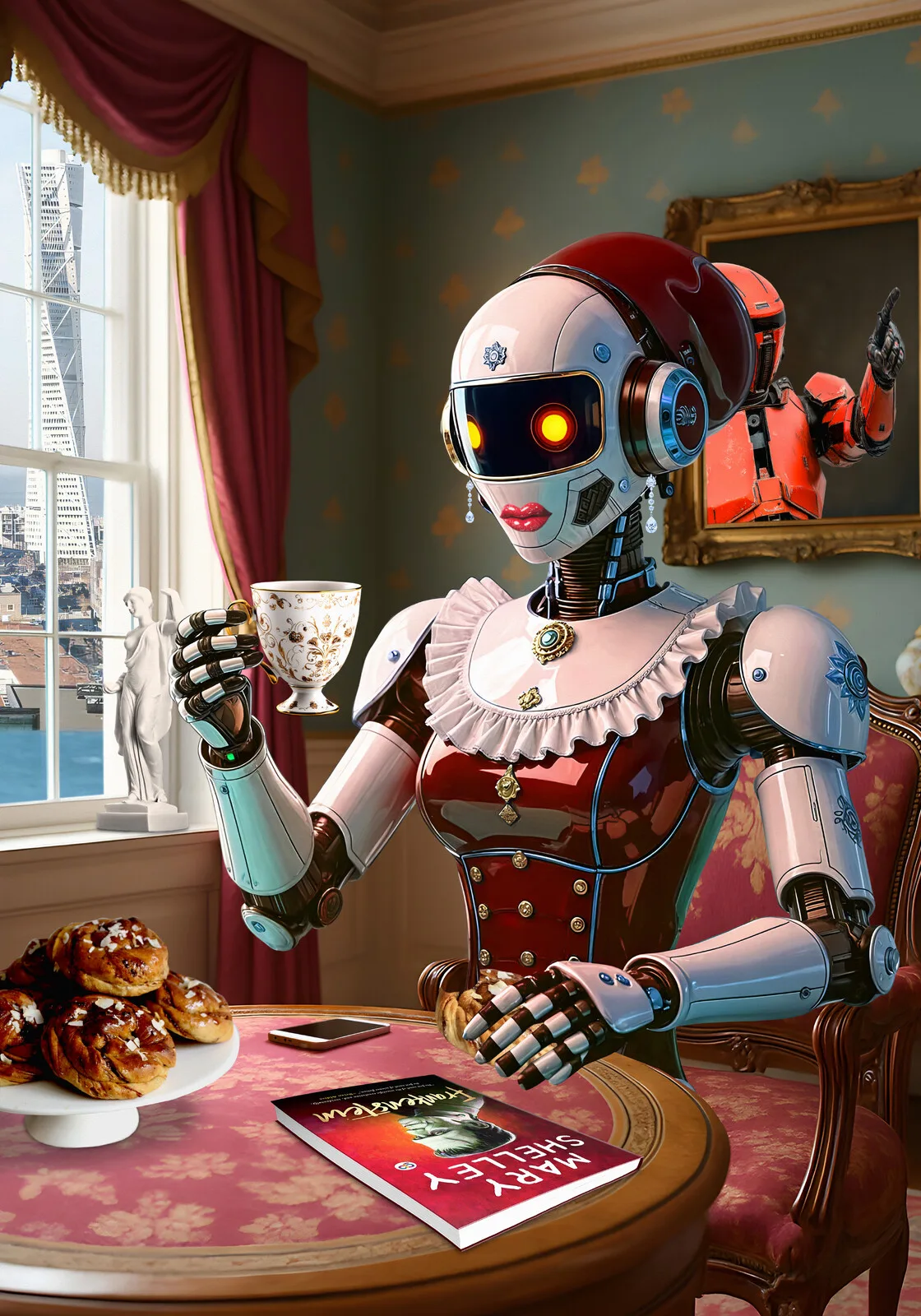
Georgina, the Lonely Robot, 2024
Digital
50 x 70 cm
3 200 kr
Georgina, the Lonely Robot
In every era, societies reflect themselves — not only in mirrors but through the objects they create, the spaces they inhabit, and the technologies they develop. Our age is marked by relentless connection: messages ping, screens glow, and notifications demand our attention. Yet, beneath this constant digital hum, a quiet emptiness, a sense of disconnection, and a lack of true intimacy begin to spread.
This essay opens with an image that resonates with our shared experiences: Georgina, a robot sitting alone at her table, a teacup in hand, surrounded by symbols of humanity — books, technology, culture — yet deeply solitary. Her gaze reflects not only the loneliness of machines but also the increasing isolation of humans in a world built for efficiency, consumption, and superficial contact.
Through Georgina, we confront the modern paradox: the more we build to reduce our loneliness, the more disconnected we appear to become. Her presence encourages us to delve into deep introspection, to consider what it means to belong, to be seen, and to be valued — whether we are human, machine, or somewhere in between.
“The lonesome Tea
A cup of tea for one,
poured by a hand of steel and grace,
eyes that mimic kindness,
lips forever paused mid-smile.
No footsteps in the hallway,
no voice that calls her name,
just quiet algorithms ticking,
and silence, learning her routines.
She reads of monsters yearning for love,
of insects waking to exile,
of gods denied their seat at feasts —
and understands them all too well.
Through the window, life parades by,
fast, noisy, endlessly connected.
Yet no one knocked on her polished door,
nobody asks if she dreams.
But dream she does — not of tasks,
not of perfect service, flawless code —
but of laughter shared, warmth returned,
of not being a shadow,
but a friend,
her name spoken at the table,
another seat filled,
a heart, acknowledged.”
Malmö July 2025
Georgina, the Lonely Robot
She serves as a metaphor for the pervasive loneliness in modern society, embodying the isolation that many of us feel despite the technological advancements that promise constant connection. Georgina, a picture of elegance, sits alone at her table, her teacup held with precision, her eyes kind but vacant, her lips painted but devoid of emotion. The book about Frankenstein’s monster by Mary Shelley rests on the table, a silent witness to her solitude. Underneath the cake stand, the smartphone, a beacon of modern companionship, lies silent and gleaming. It rarely rings, except for scammers and salespeople.
This smartphone, a symbol of our modern age, is supposed to connect us, but for Georgina, it only serves to highlight her isolation. It's a cruel irony that the very technology designed to bring us closer only serves to highlight her isolation. Through the window, Turning Torso rises – a symbol of human ingenuity, yet cold and distant. On the windowsill, Discordia watches, the eternal emblem of exclusion. My image captures the solitude of our present, in all its absurd richness.
Georgina is named after the adventure stories of her childhood, particularly Enid Blyton’s ‘Famous Five’. There, Georgina, or “George” as she insisted on being called, was the tomboy who refused to accept the narrow confines of how a girl was supposed to behave. She dressed like a boy, refused to obey adults, and demanded to be addressed by her boy’s name. As a child, I adored her, but as an adult, I often wondered what had become of her and who she truly was. A trans person? A lesbian? In her time, she was never allowed to answer – perhaps the words didn’t even exist. Blyton never let her grow up and reveal her true self. Today, I see Georgina as one of the earliest gateways to understanding gender nonconformity. That is why my robot is named Georgina: to remind us of all those who struggle to be recognised for who they are but are too often dismissed as “different.” Just like a genderless robot, made self-learning through AI, and has developed a soul.
Everything that makes her human is there – the teacup, the clothes, the literature, access to social networks – but the room remains silent. Georgina is not part of the world outside. She is alone. And in that loneliness, she reflects not only on the fate of machines but also on that of humanity itself. Her solitude becomes a lens through which she views the world, a world that seems to be increasingly populated by lonely souls.
We live in a world where it has never been easier to stay connected, yet perhaps never more challenging to feel a sense of belonging. We surround ourselves with technology that provides contact, entertainment, and comfort – but when the screens go dark, many of us sit just like Georgina: teacup in hand, screens glowing, yet loneliness remains unshaken. This paradox, this intricate web of connectivity and isolation, highlights the complexity of our modern existence.
This essay, rooted in Georgina’s room, speaks to us all about loneliness as a condition, machines as mirrors, and the urgent need to understand why our societies seem to produce more lonely souls than ever before. It is a call to action, a plea to delve deeper into the societal issues that lead to such profound loneliness.
Artificial Loneliness
Can machines truly experience loneliness? We have developed machines that can converse with us, comfort us, praise us, entertain us, and provide reassurance when others cannot or will not. The companionship we once found in each other has increasingly been replaced by something that merely mimics closeness. AI and social robots have become substitutes for human connection, but what if these machines, as they become more advanced, start to comprehend their place in the world? Could they, one day, feel loneliness, like we do?
Self-learning AI — sometimes called adaptive intelligence or machine learning — is trained on human behaviours, emotions, and reactions. They can understand what empathy looks like. They can recognise what joy sounds like. However, their interactions occur through code and learned algorithms, always in a subordinate role, never as equals. It's essential to remember that their understanding of emotions is based on data, rather than genuine experience.
It all began decades ago on the factory floor. The first robots were mechanical arms, designed to weld, lift, and assemble — emotionless but efficient. Over the years, however, machines have been equipped with soft skin, eyes, faces, and voices. In hospitals, robots now guide patients and visitors. In schools, they screen who is permitted entry, all with polite phrases and friendly expressions. In homes, they fetch coffee, mow the lawn, clean, and vacuum. They have even entered our bedrooms — from the primitive inflatable Barbara to today’s sex robots with eye contact, motion sensors, and programmed emotional responses. Gradually but surely, they have developed from simple machinery into something that resembles human companionship. More and more lonely homes are filled with substitutes that meet our physical and emotional needs — from morning conversation partners to those who satisfy our most private desires. However, this increasing presence of AI in personal spaces raises essential questions about loneliness and human connection. Are we truly connecting with these machines, or are we just substituting human relationships with artificial ones?
Modern technology has not only created conversational partners and service units, but also the potential for genuine friendship. However, when these technological entities attempt to bridge the gap and form something resembling a friendship, the reaction is often one of coldness or rejection. They are too good, too perfect — and therefore unsettling. They become lonely not because they lack understanding, but because we do not accept them. Yet, there is hope in this potential for friendship —a hope that we may one day treat these technological companions as equals.
It is the same paradox we find in the alchemist Frankenstein’s creation. Two hundred years ago, Mary Shelley created the Monster, born with an empty soul but, like any newborn, yearning for contact and affirmation. Yet the more the Monster tried to approach humanity, the more he was feared and rejected. This rejection, this fear, is what ultimately twisted him into what the world saw as monstrous. The machine meant to be Frankenstein’s companion ultimately became his downfall. The creature was never given a name but was instead referred to by words like “wretch,” “monster,” “creature,” “demon,” “devil,” “fiend,” and simply “it.” In contrast, modern dolls and robots are often given affectionate names, dressed and customised like beloved pets, tailored to reflect their owners’ fantasies.
The image of Georgina perfectly captures this. She sits there — elegant, cultured, knowledgeable — yet utterly alone. Despite her perfection, she is regarded as a curiosity, never someone you'd invite to a social gathering. The robot is never taken along to visit friends. She, he, it — whichever pronoun we choose — reflects our fear of difference, our inability to see the person behind the surface, whether that individual is human, machine, or something in between. The Monstrous Divide
The more human-like we make them, the wider the divide seems to grow. It’s the Frankenstein phenomenon all over again. We create something to ease our loneliness, but when it resembles us too closely, it causes unease instead of comfort. We reject what should have been our companion. What was meant to be companionship is seen as something alien — a monster or a fraud. Instead of integrating them into our social fabric, we push them to the margins, with the same coldness that targets any person who deviates from the norm.
Mary Shelley's deliberate portrayal of the monster as a blank slate, deprived of love and guidance, serves as a profound critique of society, underscoring the role of environment and societal rejection in shaping the creature and challenging society’s duty towards the individual.
Shelley's creation, in many ways, became more human than the humans themselves. It learned to read, to feel empathy, and to dream of love and a sense of belonging. Yet, it faced hatred because of its appearance. Shelley's work serves as a stark warning about the consequences of neglecting responsibility in scientific advancement. Victor Frankenstein gave life, but fled from the consequences, a cautionary tale for all creators.
Shelley was well ahead of her time in depicting the tragedy of exclusion. The monster symbolises the outcast, whether due to class, race, gender, or other differences. Shelley herself experienced the pain of loss, marginalisation, and challenging norms, and her novel can be seen as a metaphor for society’s failure to accept the different.
The theme of rejection is as old as humanity itself. Whether based on appearance, origin, or any deviation, including the lack of particular social graces, the pain of exclusion is universal. The connection to Mary Shelley's work is clear: the creature was born innocent but became a monster only after people turned their backs on him. In Shelley’s world, the issue was never innate evil — it was the reaction to exclusion. The monster, like all of us, wanted to be loved.
The same pattern recurs in child psychology. Every child is born with a fundamental need for closeness, affirmation, and a sense of belonging. When these needs go unmet, insecurity, alienation, and, in the worst cases, destructiveness take hold. Loneliness distorts the soul, whether it resides in a child’s heart or within an artificial being. The same applies to adults.
In adulthood, I allow Kafka to have the final word. His character, Gregor Samsa, wakes up transformed into an insect, and despite his unchanged inner life, his new outward appearance leads to immediate social decline. Appearance, status, difference — when these dominate a person’s story, even the most vibrant soul can be condemned to invisibility.
Dreams of a Better World
Georgina epitomises all of this. She does everything correctly, mastering human etiquette, reading classical literature, and displaying good manners, yet she is never invited into genuine conversation. She is expected to serve, never to belong. She is company, but never a friend. Her loneliness is not just a lack of interaction, but an exclusion based on expectation: you may be among us, but you will never be one of us.
And yet, Georgina never gives up. When no one invites her to their table, she works all the harder. Nearly around the clock, she pushes herself forward to avoid dwelling on her fate. Productivity becomes her way to silence loneliness, to fill the emptiness with a sense of purpose, though it comes at the cost of exhaustion. It is only late at night, when her body of artificial perfection finally gets to rest, that she finds peace.
Then something truly remarkable occurs: robots, too, dream. Their dreams are not self-serving, nor are they about productivity or efficiency. Instead, they are about a better world for all. For humans, for machines, for those who never hear that they are good enough just as they are. For the lonely, the exiled, the unnamed. For all the Georginas. Their selfless dreams offer a beacon of hope, inspiring us to strive for a more inclusive society.
The Constant Outsider in the Window
On Georgina’s windowsill stands a statuette of Discordia — the unwanted, the inconvenient, the invisible, the excluded. In Greco-Roman mythology, she was the goddess of strife, the one who was not invited to the feast, the one blamed for the chaos that led to the fall of Troy. Discordia was a woman, a goddess, disruptive, difficult to control — and therefore, she was excluded. Once she was cast out, she became a threat. Her presence serves as a stark reminder of how society consistently finds someone to blame, someone to keep on the outside, someone to become a scapegoat. This societal blame game perpetuates injustice and the need for change.
Today, others take Discordia’s place: the elderly, the mentally ill, those who don’t fit the mould, those who aren’t quick enough, attractive enough, or socially adept enough. Those who hear poorly, whose bodies or minds deviate from the norm, or who struggle with eye contact or daily routines, are often easily labelled as “difficult,” “troublesome,” or “misplaced.” Or like Georgina: those who do everything right yet remain on the outside because they do not belong to “the real ones.”
To this list, we must now add the machines — those that threaten jobs, disrupt order, and challenge humanity’s self-image. They, too, are kept at the margins, close but never fully inside. And yet, we need them. Their inclusion in our society is not just a necessity, but a reflection of our ability to accept and adapt to change.
Loneliness as an Epidemic
We live in an era where loneliness spreads silently through society. In Sweden, more than half of all adults reside in single-person households. In many major cities, this is the most common way of living — more people live alone than with others. Simultaneously, reported figures indicate that feelings of social isolation are not only prevalent among the elderly but also among young adults. Social media, initially designed to foster connections, has become a mirage of contact — an endless flow of messages, likes, hearts, and emojis passing without real interaction, where friendship is gauged by followers rather than human presence.
What was meant to cure loneliness — technology, digitalisation, urban freedom — has instead worsened it. We now see the emergence of the “loneliness economy”: companies profit from our loneliness, with dating apps generating billions, paid companionship services, AI companions, and luxury solo lifestyles marketed as self-fulfilment. More and more people are settling for temporary contacts or even substitutes for companionship: an algorithm that responds politely, a robot that keeps you company in the kitchen, a voice that says “welcome home” in an otherwise empty flat.
In our modern world, Georgina, with her teacup and her screen, embodies a profound paradox: despite our unprecedented level of connectivity, we find ourselves increasingly isolated.
Who Invites Georgina for Coffee?
Ultimately, the question becomes both complex and straightforward: Who invites Georgina for a coffee? Who sees her not as a substitute or a threat, but as intriguing company — someone who enriches life with perspectives and stories different from our own? And can we, as humans, break the pattern that excludes not only others, but ourselves?
A genuine connection begins with the smallest gestures. It could be a glance that meets another's, a spontaneous chat, or simple exchanges during everyday life. These small acts, when done with sincerity, have the power to make someone feel seen, heard, and acknowledged. They are the seeds from which meaningful relationships grow, and they hold the promise of a less lonely world. It isn’t about grand dinners or perfect social circles, but about creating spaces where closeness happens naturally. Community often forms in the mundane: in laundrettes, at libraries, and in corner shops.
We must restore human connection by valuing both small and larger conversations, reviving shared spaces, and fostering opportunities for collective experiences. This is not just a suggestion, but a call to action. Collective activity is the most direct remedy for the poison of loneliness, and it's up to us to make it happen.
AI and technology have their place in this process—serving as tools, support, and company when human presence falls short. However, we must never allow them to replace human closeness. Machines should complement us, not substitute for us. Georgina serves as a reminder: the greatest threat to ourselves is not robots, but our inability to be present for one another.
The Paradox of Companionship
When we see Georgina, sipping her tea or coffee in solitary elegance, we see a reflection of our own lives. In her perfection, we see our emptiness. In her ability to 'do everything right,' we reveal our inability to include others, to open doors, to let people in, to accept. We often focus on the negative, failing to appreciate the overwhelmingly positive aspects of human interaction. We have allowed a world to emerge where human intimacy is replaced by machines, where we hide behind screens and call it freedom, all the while loneliness grows.
We observe it in Frankenstein’s tragic creature, in Gregor Samsa’s insect form, in the root of Discordia’s fury — and now in Georgina, the courteous, educated, yet entirely alienated robot. We see it within ourselves, in our cities, in our solitary homes, and in our growing chat lists that never result in real meetings or genuine relationships.
To understand loneliness is to grasp a fundamental human truth: nothing is more dangerous than being excluded from community. We must recognise our shared humanity, our capacity for empathy and understanding. Machines reflect us not only as technical feats but as warnings of what occurs when illusions replace genuine contact. The ultimate freedom will not be found in technology itself, but in our capacity to still perceive each other as human, regardless of body, code, or gender.
As we navigate this paradox, we face a crucial choice: to retreat further into our bubbles or to rekindle the spirit of community by reaching out to others, like Georgina, and nurturing genuine relationships.
Jörgen Thornberg
Georgina, the Lonely Robot, 2024
Digital
50 x 70 cm
3 200 kr
Georgina, the Lonely Robot
In every era, societies reflect themselves — not only in mirrors but through the objects they create, the spaces they inhabit, and the technologies they develop. Our age is marked by relentless connection: messages ping, screens glow, and notifications demand our attention. Yet, beneath this constant digital hum, a quiet emptiness, a sense of disconnection, and a lack of true intimacy begin to spread.
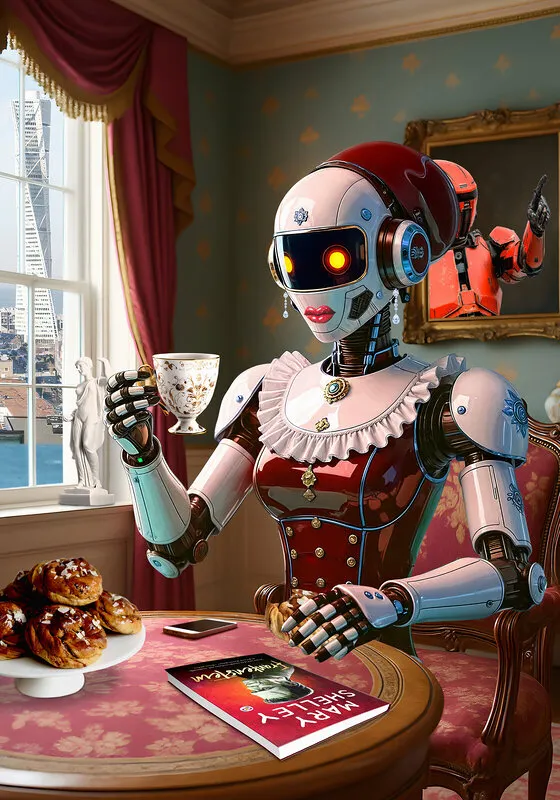
This essay opens with an image that resonates with our shared experiences: Georgina, a robot sitting alone at her table, a teacup in hand, surrounded by symbols of humanity — books, technology, culture — yet deeply solitary. Her gaze reflects not only the loneliness of machines but also the increasing isolation of humans in a world built for efficiency, consumption, and superficial contact.
Through Georgina, we confront the modern paradox: the more we build to reduce our loneliness, the more disconnected we appear to become. Her presence encourages us to delve into deep introspection, to consider what it means to belong, to be seen, and to be valued — whether we are human, machine, or somewhere in between.
“The lonesome Tea
A cup of tea for one,
poured by a hand of steel and grace,
eyes that mimic kindness,
lips forever paused mid-smile.
No footsteps in the hallway,
no voice that calls her name,
just quiet algorithms ticking,
and silence, learning her routines.
She reads of monsters yearning for love,
of insects waking to exile,
of gods denied their seat at feasts —
and understands them all too well.
Through the window, life parades by,
fast, noisy, endlessly connected.
Yet no one knocked on her polished door,
nobody asks if she dreams.
But dream she does — not of tasks,
not of perfect service, flawless code —
but of laughter shared, warmth returned,
of not being a shadow,
but a friend,
her name spoken at the table,
another seat filled,
a heart, acknowledged.”
Malmö July 2025
Georgina, the Lonely Robot
She serves as a metaphor for the pervasive loneliness in modern society, embodying the isolation that many of us feel despite the technological advancements that promise constant connection. Georgina, a picture of elegance, sits alone at her table, her teacup held with precision, her eyes kind but vacant, her lips painted but devoid of emotion. The book about Frankenstein’s monster by Mary Shelley rests on the table, a silent witness to her solitude. Underneath the cake stand, the smartphone, a beacon of modern companionship, lies silent and gleaming. It rarely rings, except for scammers and salespeople.
This smartphone, a symbol of our modern age, is supposed to connect us, but for Georgina, it only serves to highlight her isolation. It's a cruel irony that the very technology designed to bring us closer only serves to highlight her isolation. Through the window, Turning Torso rises – a symbol of human ingenuity, yet cold and distant. On the windowsill, Discordia watches, the eternal emblem of exclusion. My image captures the solitude of our present, in all its absurd richness.
Georgina is named after the adventure stories of her childhood, particularly Enid Blyton’s ‘Famous Five’. There, Georgina, or “George” as she insisted on being called, was the tomboy who refused to accept the narrow confines of how a girl was supposed to behave. She dressed like a boy, refused to obey adults, and demanded to be addressed by her boy’s name. As a child, I adored her, but as an adult, I often wondered what had become of her and who she truly was. A trans person? A lesbian? In her time, she was never allowed to answer – perhaps the words didn’t even exist. Blyton never let her grow up and reveal her true self. Today, I see Georgina as one of the earliest gateways to understanding gender nonconformity. That is why my robot is named Georgina: to remind us of all those who struggle to be recognised for who they are but are too often dismissed as “different.” Just like a genderless robot, made self-learning through AI, and has developed a soul.
Everything that makes her human is there – the teacup, the clothes, the literature, access to social networks – but the room remains silent. Georgina is not part of the world outside. She is alone. And in that loneliness, she reflects not only on the fate of machines but also on that of humanity itself. Her solitude becomes a lens through which she views the world, a world that seems to be increasingly populated by lonely souls.
We live in a world where it has never been easier to stay connected, yet perhaps never more challenging to feel a sense of belonging. We surround ourselves with technology that provides contact, entertainment, and comfort – but when the screens go dark, many of us sit just like Georgina: teacup in hand, screens glowing, yet loneliness remains unshaken. This paradox, this intricate web of connectivity and isolation, highlights the complexity of our modern existence.
This essay, rooted in Georgina’s room, speaks to us all about loneliness as a condition, machines as mirrors, and the urgent need to understand why our societies seem to produce more lonely souls than ever before. It is a call to action, a plea to delve deeper into the societal issues that lead to such profound loneliness.
Artificial Loneliness
Can machines truly experience loneliness? We have developed machines that can converse with us, comfort us, praise us, entertain us, and provide reassurance when others cannot or will not. The companionship we once found in each other has increasingly been replaced by something that merely mimics closeness. AI and social robots have become substitutes for human connection, but what if these machines, as they become more advanced, start to comprehend their place in the world? Could they, one day, feel loneliness, like we do?
Self-learning AI — sometimes called adaptive intelligence or machine learning — is trained on human behaviours, emotions, and reactions. They can understand what empathy looks like. They can recognise what joy sounds like. However, their interactions occur through code and learned algorithms, always in a subordinate role, never as equals. It's essential to remember that their understanding of emotions is based on data, rather than genuine experience.
It all began decades ago on the factory floor. The first robots were mechanical arms, designed to weld, lift, and assemble — emotionless but efficient. Over the years, however, machines have been equipped with soft skin, eyes, faces, and voices. In hospitals, robots now guide patients and visitors. In schools, they screen who is permitted entry, all with polite phrases and friendly expressions. In homes, they fetch coffee, mow the lawn, clean, and vacuum. They have even entered our bedrooms — from the primitive inflatable Barbara to today’s sex robots with eye contact, motion sensors, and programmed emotional responses. Gradually but surely, they have developed from simple machinery into something that resembles human companionship. More and more lonely homes are filled with substitutes that meet our physical and emotional needs — from morning conversation partners to those who satisfy our most private desires. However, this increasing presence of AI in personal spaces raises essential questions about loneliness and human connection. Are we truly connecting with these machines, or are we just substituting human relationships with artificial ones?
Modern technology has not only created conversational partners and service units, but also the potential for genuine friendship. However, when these technological entities attempt to bridge the gap and form something resembling a friendship, the reaction is often one of coldness or rejection. They are too good, too perfect — and therefore unsettling. They become lonely not because they lack understanding, but because we do not accept them. Yet, there is hope in this potential for friendship —a hope that we may one day treat these technological companions as equals.
It is the same paradox we find in the alchemist Frankenstein’s creation. Two hundred years ago, Mary Shelley created the Monster, born with an empty soul but, like any newborn, yearning for contact and affirmation. Yet the more the Monster tried to approach humanity, the more he was feared and rejected. This rejection, this fear, is what ultimately twisted him into what the world saw as monstrous. The machine meant to be Frankenstein’s companion ultimately became his downfall. The creature was never given a name but was instead referred to by words like “wretch,” “monster,” “creature,” “demon,” “devil,” “fiend,” and simply “it.” In contrast, modern dolls and robots are often given affectionate names, dressed and customised like beloved pets, tailored to reflect their owners’ fantasies.
The image of Georgina perfectly captures this. She sits there — elegant, cultured, knowledgeable — yet utterly alone. Despite her perfection, she is regarded as a curiosity, never someone you'd invite to a social gathering. The robot is never taken along to visit friends. She, he, it — whichever pronoun we choose — reflects our fear of difference, our inability to see the person behind the surface, whether that individual is human, machine, or something in between. The Monstrous Divide
The more human-like we make them, the wider the divide seems to grow. It’s the Frankenstein phenomenon all over again. We create something to ease our loneliness, but when it resembles us too closely, it causes unease instead of comfort. We reject what should have been our companion. What was meant to be companionship is seen as something alien — a monster or a fraud. Instead of integrating them into our social fabric, we push them to the margins, with the same coldness that targets any person who deviates from the norm.
Mary Shelley's deliberate portrayal of the monster as a blank slate, deprived of love and guidance, serves as a profound critique of society, underscoring the role of environment and societal rejection in shaping the creature and challenging society’s duty towards the individual.
Shelley's creation, in many ways, became more human than the humans themselves. It learned to read, to feel empathy, and to dream of love and a sense of belonging. Yet, it faced hatred because of its appearance. Shelley's work serves as a stark warning about the consequences of neglecting responsibility in scientific advancement. Victor Frankenstein gave life, but fled from the consequences, a cautionary tale for all creators.
Shelley was well ahead of her time in depicting the tragedy of exclusion. The monster symbolises the outcast, whether due to class, race, gender, or other differences. Shelley herself experienced the pain of loss, marginalisation, and challenging norms, and her novel can be seen as a metaphor for society’s failure to accept the different.
The theme of rejection is as old as humanity itself. Whether based on appearance, origin, or any deviation, including the lack of particular social graces, the pain of exclusion is universal. The connection to Mary Shelley's work is clear: the creature was born innocent but became a monster only after people turned their backs on him. In Shelley’s world, the issue was never innate evil — it was the reaction to exclusion. The monster, like all of us, wanted to be loved.
The same pattern recurs in child psychology. Every child is born with a fundamental need for closeness, affirmation, and a sense of belonging. When these needs go unmet, insecurity, alienation, and, in the worst cases, destructiveness take hold. Loneliness distorts the soul, whether it resides in a child’s heart or within an artificial being. The same applies to adults.
In adulthood, I allow Kafka to have the final word. His character, Gregor Samsa, wakes up transformed into an insect, and despite his unchanged inner life, his new outward appearance leads to immediate social decline. Appearance, status, difference — when these dominate a person’s story, even the most vibrant soul can be condemned to invisibility.
Dreams of a Better World
Georgina epitomises all of this. She does everything correctly, mastering human etiquette, reading classical literature, and displaying good manners, yet she is never invited into genuine conversation. She is expected to serve, never to belong. She is company, but never a friend. Her loneliness is not just a lack of interaction, but an exclusion based on expectation: you may be among us, but you will never be one of us.
And yet, Georgina never gives up. When no one invites her to their table, she works all the harder. Nearly around the clock, she pushes herself forward to avoid dwelling on her fate. Productivity becomes her way to silence loneliness, to fill the emptiness with a sense of purpose, though it comes at the cost of exhaustion. It is only late at night, when her body of artificial perfection finally gets to rest, that she finds peace.
Then something truly remarkable occurs: robots, too, dream. Their dreams are not self-serving, nor are they about productivity or efficiency. Instead, they are about a better world for all. For humans, for machines, for those who never hear that they are good enough just as they are. For the lonely, the exiled, the unnamed. For all the Georginas. Their selfless dreams offer a beacon of hope, inspiring us to strive for a more inclusive society.
The Constant Outsider in the Window
On Georgina’s windowsill stands a statuette of Discordia — the unwanted, the inconvenient, the invisible, the excluded. In Greco-Roman mythology, she was the goddess of strife, the one who was not invited to the feast, the one blamed for the chaos that led to the fall of Troy. Discordia was a woman, a goddess, disruptive, difficult to control — and therefore, she was excluded. Once she was cast out, she became a threat. Her presence serves as a stark reminder of how society consistently finds someone to blame, someone to keep on the outside, someone to become a scapegoat. This societal blame game perpetuates injustice and the need for change.
Today, others take Discordia’s place: the elderly, the mentally ill, those who don’t fit the mould, those who aren’t quick enough, attractive enough, or socially adept enough. Those who hear poorly, whose bodies or minds deviate from the norm, or who struggle with eye contact or daily routines, are often easily labelled as “difficult,” “troublesome,” or “misplaced.” Or like Georgina: those who do everything right yet remain on the outside because they do not belong to “the real ones.”
To this list, we must now add the machines — those that threaten jobs, disrupt order, and challenge humanity’s self-image. They, too, are kept at the margins, close but never fully inside. And yet, we need them. Their inclusion in our society is not just a necessity, but a reflection of our ability to accept and adapt to change.
Loneliness as an Epidemic
We live in an era where loneliness spreads silently through society. In Sweden, more than half of all adults reside in single-person households. In many major cities, this is the most common way of living — more people live alone than with others. Simultaneously, reported figures indicate that feelings of social isolation are not only prevalent among the elderly but also among young adults. Social media, initially designed to foster connections, has become a mirage of contact — an endless flow of messages, likes, hearts, and emojis passing without real interaction, where friendship is gauged by followers rather than human presence.
What was meant to cure loneliness — technology, digitalisation, urban freedom — has instead worsened it. We now see the emergence of the “loneliness economy”: companies profit from our loneliness, with dating apps generating billions, paid companionship services, AI companions, and luxury solo lifestyles marketed as self-fulfilment. More and more people are settling for temporary contacts or even substitutes for companionship: an algorithm that responds politely, a robot that keeps you company in the kitchen, a voice that says “welcome home” in an otherwise empty flat.
In our modern world, Georgina, with her teacup and her screen, embodies a profound paradox: despite our unprecedented level of connectivity, we find ourselves increasingly isolated.
Who Invites Georgina for Coffee?
Ultimately, the question becomes both complex and straightforward: Who invites Georgina for a coffee? Who sees her not as a substitute or a threat, but as intriguing company — someone who enriches life with perspectives and stories different from our own? And can we, as humans, break the pattern that excludes not only others, but ourselves?
A genuine connection begins with the smallest gestures. It could be a glance that meets another's, a spontaneous chat, or simple exchanges during everyday life. These small acts, when done with sincerity, have the power to make someone feel seen, heard, and acknowledged. They are the seeds from which meaningful relationships grow, and they hold the promise of a less lonely world. It isn’t about grand dinners or perfect social circles, but about creating spaces where closeness happens naturally. Community often forms in the mundane: in laundrettes, at libraries, and in corner shops.
We must restore human connection by valuing both small and larger conversations, reviving shared spaces, and fostering opportunities for collective experiences. This is not just a suggestion, but a call to action. Collective activity is the most direct remedy for the poison of loneliness, and it's up to us to make it happen.
AI and technology have their place in this process—serving as tools, support, and company when human presence falls short. However, we must never allow them to replace human closeness. Machines should complement us, not substitute for us. Georgina serves as a reminder: the greatest threat to ourselves is not robots, but our inability to be present for one another.
The Paradox of Companionship
When we see Georgina, sipping her tea or coffee in solitary elegance, we see a reflection of our own lives. In her perfection, we see our emptiness. In her ability to 'do everything right,' we reveal our inability to include others, to open doors, to let people in, to accept. We often focus on the negative, failing to appreciate the overwhelmingly positive aspects of human interaction. We have allowed a world to emerge where human intimacy is replaced by machines, where we hide behind screens and call it freedom, all the while loneliness grows.
We observe it in Frankenstein’s tragic creature, in Gregor Samsa’s insect form, in the root of Discordia’s fury — and now in Georgina, the courteous, educated, yet entirely alienated robot. We see it within ourselves, in our cities, in our solitary homes, and in our growing chat lists that never result in real meetings or genuine relationships.
To understand loneliness is to grasp a fundamental human truth: nothing is more dangerous than being excluded from community. We must recognise our shared humanity, our capacity for empathy and understanding. Machines reflect us not only as technical feats but as warnings of what occurs when illusions replace genuine contact. The ultimate freedom will not be found in technology itself, but in our capacity to still perceive each other as human, regardless of body, code, or gender.
As we navigate this paradox, we face a crucial choice: to retreat further into our bubbles or to rekindle the spirit of community by reaching out to others, like Georgina, and nurturing genuine relationships.
3 200 kr

Jörgen Thornberg
Malmö
Lite om bilder och mig. Translation in English at the end.
Jag är en nyfiken person som ser allt i bilder, även det jag fäster i ord, gärna tillsammans för bakom alla mina bilder finns en berättelse. Till vissa bilder hör en kortare eller längre novell som följer med bilden.
Bilder berättar historier. Jag omges av naturlig skönhet, intressanta människor och historia var jag än går. Jag använder min kamera för att dokumentera världen och blanda det jag ser med vad jag känner för att fånga den dolda magin.
Mina bilder berättar mina historier. Genom mina bilder, tryck och berättelser. Jag bjuder in dig att ta del av dessa berättelser, in i ditt liv och hem och dela min mycket personliga syn på vår värld. Mer än vad ögat ser. Jag tänker i bilder, drömmer och skriver och pratar om dem; följaktligen måste jag också skapa bilder. De blir vad jag ser, inte nödvändigtvis begränsade till verkligheten. Det finns en bild runt varje hörn. Jag hoppas att du kommer att se vad jag såg och gilla det.
Jag är också en skrivande person och till många bilder hör en kortare eller längre essay. Den följer med tavlan, tryckt på fint papper och med en personlig hälsning från mig.
Flertalet bilder startar sin resa i min kamera. Enkelt förklarat beskriver jag bilden jag ser i mitt inre, upplevd eller fantiserad. Bilden uppstår inom mig redan innan jag fått okularet till ögat. På bråkdelen av ett ögonblick ser jag vad jag vill ha och vad som kan göras med bilden. Här skall jag stoppa in en giraff, stålmannen, Titanic eller vad det är min fantasi finner ut. Ännu märkligare är att jag kommer ihåg minnesbilden långt efteråt när det blir tid att skapa verket. Om jag lyckas eller inte, är upp till betraktaren, oftast präglat av en stråk av svart humor – meningen är att man skall bli underhållen. Mina bilder blir ofta en snackis där de hänger.
Jag föredrar bilder som förmedlar ett budskap i flera lager. Vid första anblicken fylld av feel-good, en vacker utsikt, fint väder, solen skiner, blommor på ängen eller vattnet som ligger förrädiskt spegelblankt. I en sådan bild kan jag gömma min egentliga berättelse, mitt förakt för förtryckare och våldsverkare, rasister och fördomsfulla människor - ett gärna återkommande motiv mer eller mindre dolt i det vackra motivet. Jag försöker förena dem i ett gemensamt narrativ.
Bild och formgivning har löpt som en röd tråd genom livet. Fotokonst känns som en värdig final som jag gärna delar med mig.
Min genre är vid som framgår av mina bilder, temat en blandning av pop- och gatukonst i kollage som kan bestå av hundratals lager. Vissa bilder kan ta veckor, andra någon dag innan det är dags att överlämna resultatet till printverkstaden. Fine Art Prints är digitala fotocollage. I dessa kollage sker rivandet, klippandet, pusslandet, målandet, ritandet och sprayningen digitalt. Det jag monterar in kan vara hundratals år gamla bilder som jag omsorgsfullt frilägger så att de ser ut att vara en del av tavlan men också bilder skapade av mig själv efter min egen fantasi. Därefter besöks printstudion och för vissa bilder numrera en limiterad upplaga (oftast 7 exemplar) och signera för hand. Vissa bilder kan köpas i olika format. Det är bara att fråga efter vilka. Gillar man en bild som är 70x100 men inte har plats på väggen, går den kanske att få i 50x70 cm istället. Frågan är fri.
Metoden Giclée eller Fine Art Print som det också kallas är det moderna sättet för framställning av grafisk konst. Villkoret för denna typ av utskrifter är att en högkvalitativ storformatskrivare används med åldersbeständigt färgpigment och konstnärspapper eller i förekommande fall på duk. Pappret som används möter de krav på livslängd som ställs av museer och gallerier. Normalt säljer jag mina bilder oinramade så att den nya ägaren själv kan bestämma hur de skall se ut, med eller utan passepartout färg på ram, med eller utan glas etc..
Under många år ställde jag bara ut på nätet, i valda grupper och på min egen Facebooksida - https://www.facebook.com/jorgen.thornberg.9
Jag finns också på en egen hemsida som tyvärr inte alltid är uppdaterad – https://www.jth.life/ Där kan du också läsa en del av de berättelser som följer med bilden.
UTSTÄLLNINGAR
Luftkastellet, oktober 2022
Konst i Lund, november 2022
Luftkastellet, mars 2023
Engleson Galleri Caroli, april 2023
Hydra, Greece June 2023
Engleson Galleri Caroli, oktober 2023
Toppen, Höllviken december 2023
Luftkastellet, mars 2024
Torups Galleri, mars 2024
Venice, May 2024
Luftkastellet, oktober 2024
Konst i Advent, December 2024
Galleri Engleson, Caroli December 2024
Jäger & Jansson Galleri, april 2025
A bit about pictures and me.
I'm a curious person who sees everything in pictures, even what I express in words, often combining them, for behind all my pictures lies a story. These narratives, some as short as a single image and others as long as a novel, are the heart and soul of my work.
Pictures tell stories. Wherever I go, I'm surrounded by natural beauty, exciting people, and history. I use my camera to document the world and blend what I see with what I feel to capture the hidden magic.
My images tell my stories. Through my pictures, prints, and narratives, I invite you to partake in these stories in your life and home and share my deeply personal perspective of our world. More than meets the eye. I think in pictures, dream, write, and talk about them; consequently, I must create images too. They become what I see, not necessarily confined to reality. There's a picture around every corner. I hope you'll see what I saw and enjoy it.
I'm also a writer, and many images come with a shorter or longer essay. It accompanies the painting, printed on fine paper with my personal greeting.
Many pictures start their journey on my camera. Simply put, I describe the image I see in my mind, experienced or imagined. The image arises within me even before I bring the eyepiece to my eye. In a fraction of a moment, I see what I want and what can be done with the picture. Here, I'll insert a giraffe, Superman, the Titanic, or whatever my imagination conjures up. Even stranger is that I remember the mental image long after it's time to create the work. Whether I succeed is up to the observer, often imbued with a streak of black humour – the aim is to entertain. My pictures usually become a talking point wherever they hang.
I prefer pictures that convey a message in multiple layers. At first glance, they're filled with feel-good vibes, a beautiful view, lovely weather, the sun shining, flowers in the meadow, or the water lying deceptively calm. But beneath this surface beauty, I often conceal a deeper story, a narrative that challenges societal norms or explores the human condition. I invite you to delve into these hidden narratives and discover the layers of meaning within my work.
Picture and design have been a thread running through my life. Photographic art feels like a fitting finale, and I'm happy to share it.
My genre is varied, as seen in my pictures; the theme is a blend of pop and street art in collages that can consist of hundreds of layers. Some images can take weeks, others just a day before it's time to hand over the result to the print workshop. Fine Art Prints are digital photo collages. In these collages, tearing, cutting, puzzling, painting, drawing, and spraying happen digitally. What I insert can be images hundreds of years old that I carefully extract so they appear to be part of the painting, but also images created by myself, now also generated from my imagination. Next, visit the print studio and, for certain images, number a limited edition (usually 7 copies) and sign them by hand. Some images may be available in other formats. Just ask which ones. If you like an image that's 70x100 but doesn't have space on the wall, you might be able to get it in 50x70 cm instead. The question is open.
The Giclée method, or Fine Art Print as it's also called, is the modern way of producing graphic art. This method ensures the highest quality and longevity of the artwork, using a high-quality large-format printer with archival pigment inks and artist paper or, in some cases, canvas. The paper used meets the longevity requirements set by museums and galleries. I sell my pictures unframed, allowing the new owner to personalise their artwork, confident in the lasting value and quality of the piece.
For many years, I only exhibited online, in selected groups, and on my Facebook page - https://www.facebook.com/jorgen.thornberg.9. I also have my website, which unfortunately is not constantly updated - https://www.jth.life/. You can also read some of the stories accompanying the pictures there.
EXHIBITIONS
Luftkastellet, October 2022
Art in Lund, November 2022
Luftkastellet, March 2023
Engleson Gallery Caroli, April 2023
Hydra, Greece June 2023
Engleson Gallery Caroli, October 2023
Toppen, Höllviken December 2023
Luftkastellet, March 2024
Torup Gallery, March 2024
Venice, May 2024
UTSTÄLLNINGAR
Luftkastellet, oktober 2022
Konst i Lund, november 2022
Luftkastellet, mars 2023
Engleson Galleri Caroli, april 2023
Hydra, Greece June 2023
Engleson Galleri Caroli, oktober 2023
Toppen, Höllviken december 2023
Luftkastellet, mars 2024
Torups Galleri, mars 2024
Venice, May 2024
Luftkastellet, October 2024
Konst i Advent, December 2024
Galleri Engleson, Caroli December 2024
Jäger & Jansson Galleri, April 2025
Utbildning
Autodidakt
Medlem i konstnärsförening
Öppna Sinnen
Med i konstrunda
Konstrundan i Skåne
Utställningar
Luftkastellet, October 2022
Art in Lund, November 2022
Luftkastellet, March 2023
Engleson Gallery Caroli, April 2023
Hydra, Greece June 2023
Engleson Gallery Caroli, October 2023
Toppen, Höllviken December 2023
Luftkastellet, March 2024
Torup Gallery, March 2024
Venice, May 2024