Vi använder cookies för att ge dig bästa möjliga upplevelse. Välj vilka cookies du tillåter.
Läs mer i vår integritetspolicy
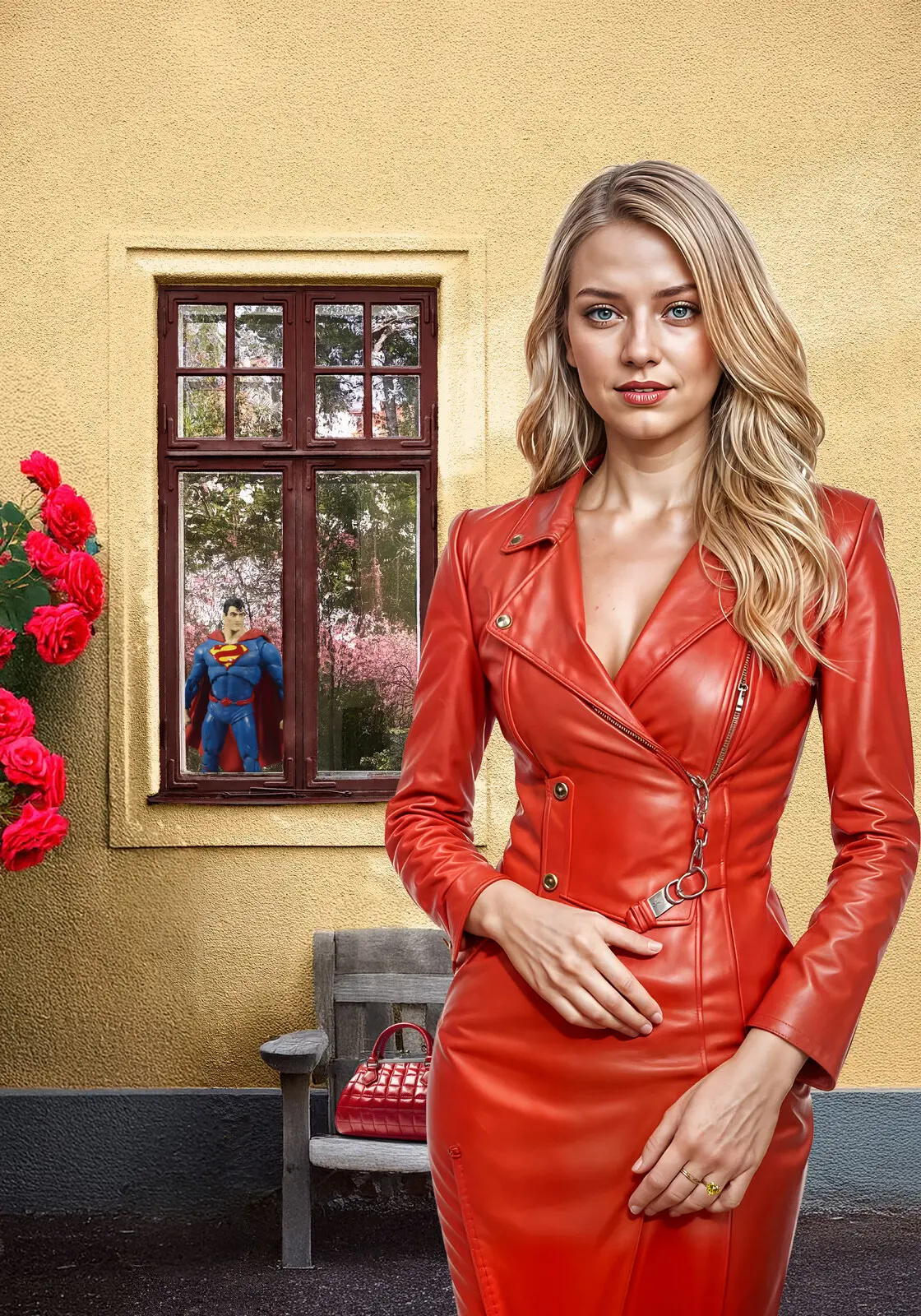
Jörgen Thornberg
Lady in Red, 2025
Digital
50 x 70 cm
3 200 kr
Lady in Red
It all began with a captivating image. A woman, draped in a vibrant red, standing before a yellow wall in the enigmatic city of Malmö. She seemed to radiate like a flame against the ochre hue, a sight that could be from any time, any culture, any place. In the reflection of a nearby window, a fleeting glimpse of blue: sky, water, memory, and perhaps the man of her dreams. This image, seemingly simple yet charged with an inexplicable allure, ignited a profound exploration of a phenomenon both ancient and eternally reborn: the woman in red. It led me to unravel the cultural, historical, and symbolic significance of this enigmatic figure, and to contemplate the myriad interpretations and representations she has inspired over the ages.
What is it about this color, this figure, this gesture? The red dress is more than just fabric; it is a statement, a memory, a challenge. Across cultures and centuries, from cave walls to couture runways, she appears again and again – as goddess, martyr, lover, ghost. Sometimes worshipped, sometimes feared. Always seen. Never quite pinned down, yet always a part of our collective history, a thread that connects us to our ancestors. The woman in red, in her ubiquity, is not just a symbol, but a unifying force that transcends time and culture, binding us all in a shared human experience.
The colors red and yellow are no coincidence. In Malmö, they mirror the flag of Skåne. But on a deeper level, they evoke earth and sun, blood and fire – the elemental palette of life itself. And within that palette, the woman in red continues to move. She embodies the passion of fire, the vitality of blood, the warmth of the sun, and the stability of the earth. Her presence, like the elements she represents, is a testament to the vitality and energy that courses through life.
“Ancient Lady in Red
I have never seen you burning so ancient as you do tonight,
never known your footsteps echo through so many centuries of light.
I’ve watched men pause mid-sentence, as if your silence asked to dance—
not for love, but for a glimmer, a flicker, a trance.
And I have never seen that gown—was it velvet? Silk? Or flame?
Nor the way your shadow moves before your name.
I was blind—
and you, timeless.
You ladies in red
are dancing with ghosts I cannot see.
It’s not just you and me—
It’s every woman who ever stood beside
a burning throne, a burial stone,
and would not step aside.
I’ll never forget the way you turn tonight—
like myth, like warning,
like the first blush of morning
after centuries of night.
This poem follows her trail.”
Malmö July 2025
Lady in Red
A woman dressed in red, set against a yellow wall in Malmö, a city renowned for its vibrant art scene and cultural diversity, with a hint of blue reflected in a window, is the focus of a deep exploration into the phenomenon of women wearing red. This phenomenon is both ancient and multifaceted, with the choice of red and yellow, the colours of Skåne, the region where Malmö is located, holding significant cultural and historical importance. The 'Lady in Red' concept, with its roots in ancient traditions and its evolution through various eras, provides a comprehensive understanding of its significance.
The expression 'Lady in Red' is, for many, best known through the romantic song by Chris de Burgh – but the concept is both broader and older than that. It is a cultural, art historical, and emotional phenomenon that ranges from religious icons like the Virgin Mary, to mythological figures like Aphrodite, to gangster films like 'The Godfather', ghost stories like 'The Woman in Red', and fashion magazines like Vogue. Its historical and cultural significance is a fascinating aspect to explore.
The Irish singer Chris de Burgh wrote 'Lady in Red' for his wife Diane, and it became a global hit in 1986. With its wistful synths, slow tempo, and nostalgic lyrics about the moment he first saw her in a red dress, it became an iconic love ballad that resonated with people worldwide. The song, with its universal theme of love and longing, topped the charts in the UK, Norway, and Canada and became a staple at weddings and slow dance parties throughout the 1980s and 1990s.
Thematically, the song centres around memory, gratitude, and the everyday miracle of love. The most famous line, “I’ve never seen you looking so lovely as you did tonight,” captures the mood perfectly.
The Woman in Red – Symbolism
Wearing red has always been charged: passion, power, sexual attraction, sin, danger – all are contained within the colour. A 'Lady in Red' is not only a woman in a dress; she is a captivating figure, a physical embodiment of desire or control. Her presence typically signals a shift in power dynamics, whether in a romantic or professional setting.
In Hollywood, the image of the woman in red as a femme fatale repeats, from classic film noir to modern thrillers. Some well-known examples:
Jessica Rabbit in "Who Framed Roger Rabbit". One of my personal favourites.
The Woman in Red in The Matrix – an illusion created to distract Neo.
Julia Roberts in a red dress in Pretty Woman, a more romantically iconic variant.
Fashion and Visual Power
In art and popular culture, red dresses are used to challenge conventions, indicate status, or transform a scene into something magical. The red dress frequently serves as the showstopper – the garment that causes the entire scene to pause. This transformative power of the 'Lady in Red' concept is genuinely inspiring and deserving of appreciation.
Lady in Red in Myth and Popular Culture
The phrase has also been adopted in broader contexts, such as in ghost stories. "The Lady in Red" is sometimes depicted as a female ghost, often featured in hotel legends—a woman who died from jealousy or heartbreak.
Occasionally, a woman in red appears in TV shows, games, mysteries, and puzzles—someone who knows more than she reveals.
As you will see later, several artists have used the title; it’s an attractive concept.
Psychological and Sexual Charge
Research indicates that red clothing is regarded as more attractive, both subconsciously and culturally. The colour signifies seduction, but also strength and confidence. In dating experiments, women wearing red receive more invitations. However, the colour can also evoke respect, distance, or threat, depending on the context. This psychological and sexual association with the colour red is a fascinating aspect to explore.
A Cultural Phenomenon
"Lady in Red" is more than a song; it’s an archetypal expression of: a meeting one never forgets; a glance that changes something; a woman who takes up space, for better or worse. Often, it’s the story of desire, identity, memory, or power.
"The Lady in Red" (1979) – Film
A gangster film by Lewis Teague, where the title refers to Anna Sage, the woman who betrayed John Dillinger to the FBI. Her red dress helped the agents identify him. Roger Corman produced the film and features its theme song by Joel Hirschhorn, not Chris de Burgh’s version.
Surprisingly, the popular song 'Lady in Red' is not featured in Pretty Woman.
Contrary to popular belief, Chris de Burgh’s song 'Lady in Red' does not appear in Pretty Woman. The scene where Julia Roberts wears her red dress is accompanied by Verdi’s opera La Traviata – Dammi tu forza, o cielo!
The film’s soundtrack features "Oh, Pretty Woman" by Roy Orbison and Roxette’s "It Must Have Been Love." The latter, in particular, plays a crucial role in the film's narrative, underscoring the emotional journey of the characters.
Why do people confuse this film with de Burgh’s song?
Perhaps the reason for this confusion is the iconic status of Julia Roberts’ red dress in the film. This garment, along with the romantic lighting and the almost sacred aura, is a nostalgic symbol of the moment of falling in love, much like the song by de Burgh.
“The Lady in Red” – earlier song (1935)
An earlier song with the same title, written by Mort Dixon and Allie Wrubel, gained popularity in the 1930s and appeared in cartoons and revues. This song, with its romantic lyrics and catchy melody, became a cultural phenomenon of its time.
Lady in Red in Art
The motif “Lady in Red” is a staple of art history, often depicted as a woman in vivid red clothing. Its influence can be seen in a wide range of art, from religious scenes to sensual portraits, and it remains a powerful symbol in contemporary art.
In Jan van Eyck’s Lucca Madonna from 1437, the Virgin Mary sits on a wooden throne, dressed in a majestic red garment that flows over her entire body. The colour here carries not only aesthetic but also theological significance: red as a symbol of Christ’s suffering, vitality, and sacrifice. The child on her lap holds a fruit, a recurring motif that alludes to the Fall and the need for salvation. The throne is adorned with lion heads, referencing not only King Solomon but also the Last Judgement. The entire scene presents a complex interaction between everyday intimacy and celestial symbolism, where the red robe unites life, blood, motherhood, and eternity.
Rembrandt’s Portrait of Hendrickje Stoffels from 1656 appears darker, more straightforward, and more intimate on the surface. The model wears an informal red-shimmering housecoat, casually tied over a white undergarment. It is a portrait that suggests closeness, perhaps love, but also social controversy. Her relaxed pose and gentle gaze are heightened by the ring she wears – a symbol of commitment in a relationship not recognised by the Church. Compositionally, Rembrandt alludes to Italian courtesan portraits, especially the paintings of Palma Vecchio, a reference confirmed by technical analysis of the arm’s original position.
Pierre-Auguste Renoir painted his housekeeper, nanny, and lifelong model Gabrielle Renard more than 200 times. In "Gabrielle in a Red Dress" from 1908, we see her in an informal, square-cut gown, which he often reused in his later works. The gold, brown, and red palette reflects Renoir’s fascination with ancient murals, particularly the use of red in Pompeii and Herculaneum, which he had seen during his travels. Gabrielle appears not as a muse but as a living, physical presence: warm, everyday, eternal.
Dante Gabriel Rossetti’s The Loving Cup from 1867 is both a tribute to a woman and a mythic love story. The model is Alexa Wilding, Rossetti’s devoted muse. She holds an ornate goblet, traditionally used for toasting between lovers, while the frame bears an inscription suggesting a knight who has gone off to war. The colour red has a dual significance here: symbolising both the fire of love and the pain of parting. Rossetti, immersed in Arthurian legend and medieval ideals, transforms the woman in red into a contemporary icon of both desire and fidelity, a symbol of love that endures even in the face of separation.
In Rippl-Rónai’s embroidered image "Lady in Red" from 1898, created for Count Andrássy’s dining room in Budapest, we see a woman in a red dress turning away, holding a small flower in one hand and extending her other hand behind her in a gesture reminiscent of those found in Japanese woodblock prints. The image is outlined with dark contours and floral decorations, and the entire tapestry was embroidered by the artist’s French wife, Lazarine Boudrion. The red here transforms into a sense of stillness, focus, and a poetic harmony between the contemporary and the historic, evoking a feeling of tranquillity and balance.
Egon Schiele’s Kneeling Female in Orange-Red from 1910 exemplifies how red in modernism becomes more invasive, almost aggressive. The woman is anonymous, not Edith (his wife) nor Wally (his long-time muse), and her body twists into a pose that is both sensual and vulnerable. The colour makes the body glow, capturing the viewer’s attention. The red here is physically intrusive, both alive and perilous, evoking a sense of intensity and raw emotion.
Edvard Munch’s The Dance of Life from 1899 is arguably the most symbolically rich work in this red suite. A couple dances in the centre, the woman’s red dress wrapping around the man’s legs and extending as a line of colour into his clothing. On either side stand two women: one in white, youthful and radiant; one in black, stiff with sorrow. Red signifies the fiery midpoint of life, desire, and the painful yet beautiful aspects of existence. The colour symbolism is clear: white for innocence, black for death, and red for everything in between that draws us closer to one another.
Otto Dix’s Portrait of Sylvia von Harden from 1926 presents a strikingly different 'Lady in Red': a journalist and intellectual, smoking and solitary. Her red-and-black patterned dress serves as a symbol of her as the modern woman of 1920s Germany: liberated, dismissive of tradition, in command. She disregards marriage and societal norms, embodying the authority and power that red can symbolise. Here, red becomes a colour for someone who knows exactly who she is, intriguing in its symbolism.
Early forerunners – the woman in red before the Renaissance
Before artists like Rembrandt, Rossetti, and Renoir captured her in oil, the woman in red had already featured in older myths, rites, and iconography. She was a goddess, a courtesan, a saint, and an empress – often dressed in red garments of silk, wool, or painted pigment, sometimes symbolic, sometimes literal. The colour connected her to blood, the earth, power, and desire.
In ancient Egypt, red symbolised both life and danger, a duality that is both fascinating and enlightening. The goddess Sekhmet, a lioness with blazing eyes, wore red as the colour of war and disease. She was feared, but could be placated with red-colored drinks. Hathor, being more seductive by nature, was sometimes depicted wearing red jewellery or dance attire. Red also appears in funerary paintings, particularly on high-ranking women, where it often accentuates the breasts, hips, or veils. The historical and cultural significance of red in ancient Egypt is a testament to its enduring power as a symbol.
In ancient Greece, hetaerae – the educated courtesans – often wore bright garments, especially red, purple, and saffron. Aristophanes, Plato, and vase paintings all attest to their visual presence at public banquets and processions. Respectable women wore pale tunics, but the hetaera in red was the one who stood out, caught the eye, challenged norms, and sometimes mingled in the halls of the gods. The role of the colour red in the symbolism of the woman in ancient Greece is a captivating and intriguing cultural implication.
Even earlier in Mesopotamia, Inanna – later known as Ishtar – danced across temple altars in blood-red clothing and jewellery. She was the goddess of love and war, connected to both fertility and destruction. When she descended into the underworld, she took off one red garment at each gate – a ritual of shedding power. In her cult, desire and transcendence were fused – a body clothed in red that was both the centre of the cosmos and a reflection of humanity.
During the Middle Ages, the red archetype reappeared in Mary Magdalene, often depicted wearing a red cloak, symbolising both a sinner and a beloved disciple. In frescoes by Giotto and Fra Angelico, red flames flicker around her as she searches for Christ in the garden – a visual symbol of redemption. Red thus becomes not only the colour of passion but also of penitence.
The female martyrs, such as Saint Lucy and Saint Ursula, are also depicted in red in their saintly images, sometimes wearing a dress, sometimes stained with blood. Their sacrificial garments became their crowns, red as a symbol of transcendence, a denial of the flesh, and a representation of the spirit's survival.
Long before anyone sang of slow dancing in the 1980s, she was already there–in alabaster, in temples, in frescoes-the woman in red, between spirit and flesh, between power and longing.
But the red woman didn’t stop at the Mediterranean. In Byzantine icon painting – where every colour was measured with theological precision – the Virgin Mary often wore a red undergarment beneath her blue mantle. The red symbolised the human, the flesh and blood of the body, while blue represented the divine. In the strict golden world of Russian icons, there was always a glowing core of life – a Mary who bled, gave birth, and carried. Female saints such as Saint Catherine of Alexandria also often wore a red tunic as a symbol of martyrdom.
In Islamic art, which traditionally eschews figural representations, red mainly appears in ornamentation and calligraphy. However, in Persian and Mughal miniature paintings, women dressed in red are often depicted as dancers, lovers, or queens. Poems by Hafez, Rumi, and Sa’di describe her in flaming garments that ignite the pious man’s prayer mat. In Sufi thought, love is a fire, and the red woman symbolises the soul’s yearning for God, masked as desire. The use of red in Islamic art, particularly in the context of Persian and Mughal miniature paintings, serves as a powerful symbol of love and spiritual longing.
In Indian temple art, from the sensual stone reliefs of Khajuraho to the vibrant hues of Rajput paintings, red takes on a transformative role. It symbolises not just marriage, but also ecstasy. Gods like Krishna and Shiva are often depicted surrounded by women in red saris—Radha, who loves without possession, or Parvati, who unites body and cosmos. In wedding ceremonies, the woman dons red not as a symbol of submission, but as Shakti, the force that heralds the transition into a new existence. In Tantric imagery, the red veil serves as a gateway to transcendence, and the woman becomes a living symbol of the sacred.
The Glow of Origin – the Woman in Red in Prehistory
Before the advent of writing, silk, or even names, the red woman was already a powerful presence. She was depicted with earth pigments on cave walls, buried in ochre, and carved into stone. Her body was a canvas of symbols that we are still deciphering today, and the colour red, a fundamental part of her language, continues to recur, bridging the gap between our modern world and our ancient past.
In graves from the Palaeolithic period, dated between 30,000 and 100,000 years ago, female skeletons have been discovered coated with red ochre, especially in Europe, the Middle East, and Siberia. Some findings from Qafzeh in Israel (c. 92,000 BCE) and Skhul Cave indicate that red ochre was used in burial rituals even before Homo sapiens left Africa. When humans arrived in Europe, around 45,000 BCE, the practice persisted.
However, the most mysterious traces are found in caves in southern France and Spain, such as La Pasiega, El Castillo, and Maltravieso, where red handprints and symbols have been dated to over 64,000 years ago, suggesting they were likely not created by Homo sapiens but by Neanderthals. This indicates that even before our species emerged, a visual language using red pigment existed. Perhaps for protection. Perhaps for prayer. Perhaps as an expression of loss.
And on the walls of the Chauvet Cave (c. 32,000 BCE), Lascaux (c. 15,000 BCE), and Pech Merle, among bison, deer, and handprints, feminine forms also emerge: curves, triangles, spiral motifs. Sometimes in black, sometimes in yellow – but often in red ochre, blown through hollow bones or painted with fingers. The Venus figurines from that period – such as the Venus of Willendorf (c. 28,000 BCE) or those from Dolní Věstonice in the Czech Republic (c. 27,000 BCE) – sometimes show traces of red pigment around the belly, breasts, and hips. They wear no clothing, but perhaps they were painted to be clothed in meaning. Red as a primal fabric: bleeding, birthing, eternal.
Meanwhile, on the other side of the world, the woman in red danced along temple stairs and sun cults. Among the Aztecs (1300–1521 CE), goddesses such as Tlazolteotl and Coyolxauhqui wore red garments and ritual jewellery that symbolised desire, death, motherhood, and reconciliation. Tlazolteotl was the goddess of sin and purification, dressed in red and black, with lips sometimes painted blood-red to signify her dual nature. Coyolxauhqui was dismembered by her brother but returned in the moonlight: a female martyr in a red cosmic orbit. The power of red in these cultural symbols is genuinely fascinating.
Among the Inca (c. 1400–1533 CE), the mamakuna, or temple virgins, played a significant role in religious ceremonies and were revered as daughters of the earth. They wore sacred robes woven from alpaca wool, dyed crimson with cochineal. They lived in ascetic chastity but were honoured as daughters of the world. In ceremonial dances, their red garments became a living symbol of the sun, fertility, and the power of the feminine principle. Red was not associated with eroticism – it symbolised force. The female bodies were not objects but carriers of the cosmos, links between humanity and the divine.
Even in Aboriginal cultures in Australia, where artistic traditions date back at least 40,000 years, red ochre has been used in body painting, rock art, and ceremonial masks. Women have often worn red patterns in fertility rites, “women’s business” ceremonies, and initiations. Here, the colour red links the body to the land, the blood to the ancestors – a living echo in the Dreaming, the spiritual world that is always present. In Aboriginal culture, the Dreaming is a complex network of knowledge, faith, and practices that explain the creation of the world and the laws that govern life. Ochre is not merely colour – it embodies memory and belonging.
Even long before paintings, writings, and icons named her, she existed — the woman in red. She carried her colour as life, mystery, and reverence. She emerged from cave darkness, temple stone, and blood-ritual chambers – red as earth, red as fire, red as the body from which all things are born. The role of women in associating the colour red with life and mystery is truly significant and deserves our respect and appreciation.
Thus, across north, south, east, and west, women have worn red, their gazes impossible to fully capture in words or images: goddesses, martyrs, lovers, and visionaries. She who wore red could be both a guide, leading others with her strength and passion, and a destroyer, with her fiery nature consuming all in her path – embodied, cosmic, forbidden, eternal, and always seen, never fully understood.
“Lady in Red” is more than a song – it is a cross-cultural phenomenon. She appears in ballads, artworks, ghost stories, and glossy adverts. The 'Lady in Red' is a symbol of power, passion, and mystery. She is both object and subject, muse and monster, saint and sinner. The red is a cry in the crowd, a glance that lingers, a feeling that burns into memory. And perhaps that is why she still dances, slowly, through the salons of time – in slow motion, in red.
Epilogue – She Who Wears the Red
It's as if she has never truly left the stage. She changes shape, voice, and fabric – but remains. Across every era and civilisation, she has stepped forward in red: sometimes in velvet, sometimes in blood, sometimes in a dress stitched to be remembered. Her enduring presence connects us to a timeless cultural symbol.
She was Sekhmet, devouring the world in wrath, and Inanna descending naked through the gates of the underworld. She was Mary Magdalene, neither fully loved nor thoroughly condemned. She was a vestal with a red border on her toga, a Florentine bride in scarlet silk, a hetaera dancing before gods and men. She was a martyr on her way to the pyre and a courtesan in Titian’s studio. Her diverse roles intrigue us with her complexity.
She appeared as Hendrickje in Rembrandt’s dusky light, as Gabrielle in Renoir’s Pompeian memory, and as Alexa Wilding with the goblet of love raised. She turned away in Rippl-Rónai’s textile poetry, knelt for Schiele, merged in Munch’s dance, smoked in Otto Dix’s Weimar portrait.
And in the East? She burned in Hafez's verses, moved in ink and colour in Mughal miniatures, wore a sari in Shiva temples, and cried out for Krishna through steam-red nights. She was Parvati, Radha, a red-clad divine gift and absence.
Always the red one. Always the woman who awakens, disturbs, seduces, and connects. Who walks through the halls of history without apology? Once she was painted to warn. Another time to glorify. But always—always—she was seen. And perhaps it is precisely that—to be seen, but never captured—that makes her eternal. Her mystery and allure captivate us.
She is the Lady in Red,
And she has never ceased dancing.
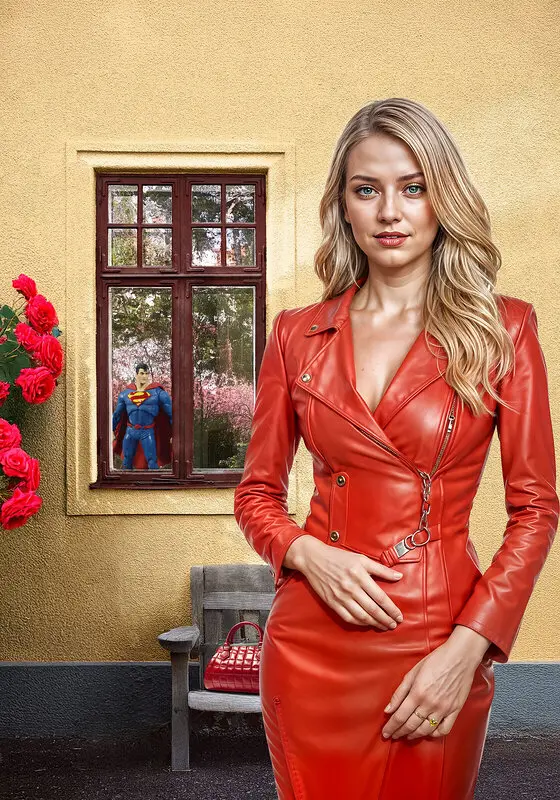
Jörgen Thornberg
Lady in Red, 2025
Digital
50 x 70 cm
3 200 kr
Lady in Red
It all began with a captivating image. A woman, draped in a vibrant red, standing before a yellow wall in the enigmatic city of Malmö. She seemed to radiate like a flame against the ochre hue, a sight that could be from any time, any culture, any place. In the reflection of a nearby window, a fleeting glimpse of blue: sky, water, memory, and perhaps the man of her dreams. This image, seemingly simple yet charged with an inexplicable allure, ignited a profound exploration of a phenomenon both ancient and eternally reborn: the woman in red. It led me to unravel the cultural, historical, and symbolic significance of this enigmatic figure, and to contemplate the myriad interpretations and representations she has inspired over the ages.
What is it about this color, this figure, this gesture? The red dress is more than just fabric; it is a statement, a memory, a challenge. Across cultures and centuries, from cave walls to couture runways, she appears again and again – as goddess, martyr, lover, ghost. Sometimes worshipped, sometimes feared. Always seen. Never quite pinned down, yet always a part of our collective history, a thread that connects us to our ancestors. The woman in red, in her ubiquity, is not just a symbol, but a unifying force that transcends time and culture, binding us all in a shared human experience.
The colors red and yellow are no coincidence. In Malmö, they mirror the flag of Skåne. But on a deeper level, they evoke earth and sun, blood and fire – the elemental palette of life itself. And within that palette, the woman in red continues to move. She embodies the passion of fire, the vitality of blood, the warmth of the sun, and the stability of the earth. Her presence, like the elements she represents, is a testament to the vitality and energy that courses through life.
“Ancient Lady in Red
I have never seen you burning so ancient as you do tonight,
never known your footsteps echo through so many centuries of light.
I’ve watched men pause mid-sentence, as if your silence asked to dance—
not for love, but for a glimmer, a flicker, a trance.
And I have never seen that gown—was it velvet? Silk? Or flame?
Nor the way your shadow moves before your name.
I was blind—
and you, timeless.
You ladies in red
are dancing with ghosts I cannot see.
It’s not just you and me—
It’s every woman who ever stood beside
a burning throne, a burial stone,
and would not step aside.
I’ll never forget the way you turn tonight—
like myth, like warning,
like the first blush of morning
after centuries of night.
This poem follows her trail.”
Malmö July 2025
Lady in Red
A woman dressed in red, set against a yellow wall in Malmö, a city renowned for its vibrant art scene and cultural diversity, with a hint of blue reflected in a window, is the focus of a deep exploration into the phenomenon of women wearing red. This phenomenon is both ancient and multifaceted, with the choice of red and yellow, the colours of Skåne, the region where Malmö is located, holding significant cultural and historical importance. The 'Lady in Red' concept, with its roots in ancient traditions and its evolution through various eras, provides a comprehensive understanding of its significance.
The expression 'Lady in Red' is, for many, best known through the romantic song by Chris de Burgh – but the concept is both broader and older than that. It is a cultural, art historical, and emotional phenomenon that ranges from religious icons like the Virgin Mary, to mythological figures like Aphrodite, to gangster films like 'The Godfather', ghost stories like 'The Woman in Red', and fashion magazines like Vogue. Its historical and cultural significance is a fascinating aspect to explore.
The Irish singer Chris de Burgh wrote 'Lady in Red' for his wife Diane, and it became a global hit in 1986. With its wistful synths, slow tempo, and nostalgic lyrics about the moment he first saw her in a red dress, it became an iconic love ballad that resonated with people worldwide. The song, with its universal theme of love and longing, topped the charts in the UK, Norway, and Canada and became a staple at weddings and slow dance parties throughout the 1980s and 1990s.
Thematically, the song centres around memory, gratitude, and the everyday miracle of love. The most famous line, “I’ve never seen you looking so lovely as you did tonight,” captures the mood perfectly.
The Woman in Red – Symbolism
Wearing red has always been charged: passion, power, sexual attraction, sin, danger – all are contained within the colour. A 'Lady in Red' is not only a woman in a dress; she is a captivating figure, a physical embodiment of desire or control. Her presence typically signals a shift in power dynamics, whether in a romantic or professional setting.
In Hollywood, the image of the woman in red as a femme fatale repeats, from classic film noir to modern thrillers. Some well-known examples:
Jessica Rabbit in "Who Framed Roger Rabbit". One of my personal favourites.
The Woman in Red in The Matrix – an illusion created to distract Neo.
Julia Roberts in a red dress in Pretty Woman, a more romantically iconic variant.
Fashion and Visual Power
In art and popular culture, red dresses are used to challenge conventions, indicate status, or transform a scene into something magical. The red dress frequently serves as the showstopper – the garment that causes the entire scene to pause. This transformative power of the 'Lady in Red' concept is genuinely inspiring and deserving of appreciation.
Lady in Red in Myth and Popular Culture
The phrase has also been adopted in broader contexts, such as in ghost stories. "The Lady in Red" is sometimes depicted as a female ghost, often featured in hotel legends—a woman who died from jealousy or heartbreak.
Occasionally, a woman in red appears in TV shows, games, mysteries, and puzzles—someone who knows more than she reveals.
As you will see later, several artists have used the title; it’s an attractive concept.
Psychological and Sexual Charge
Research indicates that red clothing is regarded as more attractive, both subconsciously and culturally. The colour signifies seduction, but also strength and confidence. In dating experiments, women wearing red receive more invitations. However, the colour can also evoke respect, distance, or threat, depending on the context. This psychological and sexual association with the colour red is a fascinating aspect to explore.
A Cultural Phenomenon
"Lady in Red" is more than a song; it’s an archetypal expression of: a meeting one never forgets; a glance that changes something; a woman who takes up space, for better or worse. Often, it’s the story of desire, identity, memory, or power.
"The Lady in Red" (1979) – Film
A gangster film by Lewis Teague, where the title refers to Anna Sage, the woman who betrayed John Dillinger to the FBI. Her red dress helped the agents identify him. Roger Corman produced the film and features its theme song by Joel Hirschhorn, not Chris de Burgh’s version.
Surprisingly, the popular song 'Lady in Red' is not featured in Pretty Woman.
Contrary to popular belief, Chris de Burgh’s song 'Lady in Red' does not appear in Pretty Woman. The scene where Julia Roberts wears her red dress is accompanied by Verdi’s opera La Traviata – Dammi tu forza, o cielo!
The film’s soundtrack features "Oh, Pretty Woman" by Roy Orbison and Roxette’s "It Must Have Been Love." The latter, in particular, plays a crucial role in the film's narrative, underscoring the emotional journey of the characters.
Why do people confuse this film with de Burgh’s song?
Perhaps the reason for this confusion is the iconic status of Julia Roberts’ red dress in the film. This garment, along with the romantic lighting and the almost sacred aura, is a nostalgic symbol of the moment of falling in love, much like the song by de Burgh.
“The Lady in Red” – earlier song (1935)
An earlier song with the same title, written by Mort Dixon and Allie Wrubel, gained popularity in the 1930s and appeared in cartoons and revues. This song, with its romantic lyrics and catchy melody, became a cultural phenomenon of its time.
Lady in Red in Art
The motif “Lady in Red” is a staple of art history, often depicted as a woman in vivid red clothing. Its influence can be seen in a wide range of art, from religious scenes to sensual portraits, and it remains a powerful symbol in contemporary art.
In Jan van Eyck’s Lucca Madonna from 1437, the Virgin Mary sits on a wooden throne, dressed in a majestic red garment that flows over her entire body. The colour here carries not only aesthetic but also theological significance: red as a symbol of Christ’s suffering, vitality, and sacrifice. The child on her lap holds a fruit, a recurring motif that alludes to the Fall and the need for salvation. The throne is adorned with lion heads, referencing not only King Solomon but also the Last Judgement. The entire scene presents a complex interaction between everyday intimacy and celestial symbolism, where the red robe unites life, blood, motherhood, and eternity.
Rembrandt’s Portrait of Hendrickje Stoffels from 1656 appears darker, more straightforward, and more intimate on the surface. The model wears an informal red-shimmering housecoat, casually tied over a white undergarment. It is a portrait that suggests closeness, perhaps love, but also social controversy. Her relaxed pose and gentle gaze are heightened by the ring she wears – a symbol of commitment in a relationship not recognised by the Church. Compositionally, Rembrandt alludes to Italian courtesan portraits, especially the paintings of Palma Vecchio, a reference confirmed by technical analysis of the arm’s original position.
Pierre-Auguste Renoir painted his housekeeper, nanny, and lifelong model Gabrielle Renard more than 200 times. In "Gabrielle in a Red Dress" from 1908, we see her in an informal, square-cut gown, which he often reused in his later works. The gold, brown, and red palette reflects Renoir’s fascination with ancient murals, particularly the use of red in Pompeii and Herculaneum, which he had seen during his travels. Gabrielle appears not as a muse but as a living, physical presence: warm, everyday, eternal.
Dante Gabriel Rossetti’s The Loving Cup from 1867 is both a tribute to a woman and a mythic love story. The model is Alexa Wilding, Rossetti’s devoted muse. She holds an ornate goblet, traditionally used for toasting between lovers, while the frame bears an inscription suggesting a knight who has gone off to war. The colour red has a dual significance here: symbolising both the fire of love and the pain of parting. Rossetti, immersed in Arthurian legend and medieval ideals, transforms the woman in red into a contemporary icon of both desire and fidelity, a symbol of love that endures even in the face of separation.
In Rippl-Rónai’s embroidered image "Lady in Red" from 1898, created for Count Andrássy’s dining room in Budapest, we see a woman in a red dress turning away, holding a small flower in one hand and extending her other hand behind her in a gesture reminiscent of those found in Japanese woodblock prints. The image is outlined with dark contours and floral decorations, and the entire tapestry was embroidered by the artist’s French wife, Lazarine Boudrion. The red here transforms into a sense of stillness, focus, and a poetic harmony between the contemporary and the historic, evoking a feeling of tranquillity and balance.
Egon Schiele’s Kneeling Female in Orange-Red from 1910 exemplifies how red in modernism becomes more invasive, almost aggressive. The woman is anonymous, not Edith (his wife) nor Wally (his long-time muse), and her body twists into a pose that is both sensual and vulnerable. The colour makes the body glow, capturing the viewer’s attention. The red here is physically intrusive, both alive and perilous, evoking a sense of intensity and raw emotion.
Edvard Munch’s The Dance of Life from 1899 is arguably the most symbolically rich work in this red suite. A couple dances in the centre, the woman’s red dress wrapping around the man’s legs and extending as a line of colour into his clothing. On either side stand two women: one in white, youthful and radiant; one in black, stiff with sorrow. Red signifies the fiery midpoint of life, desire, and the painful yet beautiful aspects of existence. The colour symbolism is clear: white for innocence, black for death, and red for everything in between that draws us closer to one another.
Otto Dix’s Portrait of Sylvia von Harden from 1926 presents a strikingly different 'Lady in Red': a journalist and intellectual, smoking and solitary. Her red-and-black patterned dress serves as a symbol of her as the modern woman of 1920s Germany: liberated, dismissive of tradition, in command. She disregards marriage and societal norms, embodying the authority and power that red can symbolise. Here, red becomes a colour for someone who knows exactly who she is, intriguing in its symbolism.
Early forerunners – the woman in red before the Renaissance
Before artists like Rembrandt, Rossetti, and Renoir captured her in oil, the woman in red had already featured in older myths, rites, and iconography. She was a goddess, a courtesan, a saint, and an empress – often dressed in red garments of silk, wool, or painted pigment, sometimes symbolic, sometimes literal. The colour connected her to blood, the earth, power, and desire.
In ancient Egypt, red symbolised both life and danger, a duality that is both fascinating and enlightening. The goddess Sekhmet, a lioness with blazing eyes, wore red as the colour of war and disease. She was feared, but could be placated with red-colored drinks. Hathor, being more seductive by nature, was sometimes depicted wearing red jewellery or dance attire. Red also appears in funerary paintings, particularly on high-ranking women, where it often accentuates the breasts, hips, or veils. The historical and cultural significance of red in ancient Egypt is a testament to its enduring power as a symbol.
In ancient Greece, hetaerae – the educated courtesans – often wore bright garments, especially red, purple, and saffron. Aristophanes, Plato, and vase paintings all attest to their visual presence at public banquets and processions. Respectable women wore pale tunics, but the hetaera in red was the one who stood out, caught the eye, challenged norms, and sometimes mingled in the halls of the gods. The role of the colour red in the symbolism of the woman in ancient Greece is a captivating and intriguing cultural implication.
Even earlier in Mesopotamia, Inanna – later known as Ishtar – danced across temple altars in blood-red clothing and jewellery. She was the goddess of love and war, connected to both fertility and destruction. When she descended into the underworld, she took off one red garment at each gate – a ritual of shedding power. In her cult, desire and transcendence were fused – a body clothed in red that was both the centre of the cosmos and a reflection of humanity.
During the Middle Ages, the red archetype reappeared in Mary Magdalene, often depicted wearing a red cloak, symbolising both a sinner and a beloved disciple. In frescoes by Giotto and Fra Angelico, red flames flicker around her as she searches for Christ in the garden – a visual symbol of redemption. Red thus becomes not only the colour of passion but also of penitence.
The female martyrs, such as Saint Lucy and Saint Ursula, are also depicted in red in their saintly images, sometimes wearing a dress, sometimes stained with blood. Their sacrificial garments became their crowns, red as a symbol of transcendence, a denial of the flesh, and a representation of the spirit's survival.
Long before anyone sang of slow dancing in the 1980s, she was already there–in alabaster, in temples, in frescoes-the woman in red, between spirit and flesh, between power and longing.
But the red woman didn’t stop at the Mediterranean. In Byzantine icon painting – where every colour was measured with theological precision – the Virgin Mary often wore a red undergarment beneath her blue mantle. The red symbolised the human, the flesh and blood of the body, while blue represented the divine. In the strict golden world of Russian icons, there was always a glowing core of life – a Mary who bled, gave birth, and carried. Female saints such as Saint Catherine of Alexandria also often wore a red tunic as a symbol of martyrdom.
In Islamic art, which traditionally eschews figural representations, red mainly appears in ornamentation and calligraphy. However, in Persian and Mughal miniature paintings, women dressed in red are often depicted as dancers, lovers, or queens. Poems by Hafez, Rumi, and Sa’di describe her in flaming garments that ignite the pious man’s prayer mat. In Sufi thought, love is a fire, and the red woman symbolises the soul’s yearning for God, masked as desire. The use of red in Islamic art, particularly in the context of Persian and Mughal miniature paintings, serves as a powerful symbol of love and spiritual longing.
In Indian temple art, from the sensual stone reliefs of Khajuraho to the vibrant hues of Rajput paintings, red takes on a transformative role. It symbolises not just marriage, but also ecstasy. Gods like Krishna and Shiva are often depicted surrounded by women in red saris—Radha, who loves without possession, or Parvati, who unites body and cosmos. In wedding ceremonies, the woman dons red not as a symbol of submission, but as Shakti, the force that heralds the transition into a new existence. In Tantric imagery, the red veil serves as a gateway to transcendence, and the woman becomes a living symbol of the sacred.
The Glow of Origin – the Woman in Red in Prehistory
Before the advent of writing, silk, or even names, the red woman was already a powerful presence. She was depicted with earth pigments on cave walls, buried in ochre, and carved into stone. Her body was a canvas of symbols that we are still deciphering today, and the colour red, a fundamental part of her language, continues to recur, bridging the gap between our modern world and our ancient past.
In graves from the Palaeolithic period, dated between 30,000 and 100,000 years ago, female skeletons have been discovered coated with red ochre, especially in Europe, the Middle East, and Siberia. Some findings from Qafzeh in Israel (c. 92,000 BCE) and Skhul Cave indicate that red ochre was used in burial rituals even before Homo sapiens left Africa. When humans arrived in Europe, around 45,000 BCE, the practice persisted.
However, the most mysterious traces are found in caves in southern France and Spain, such as La Pasiega, El Castillo, and Maltravieso, where red handprints and symbols have been dated to over 64,000 years ago, suggesting they were likely not created by Homo sapiens but by Neanderthals. This indicates that even before our species emerged, a visual language using red pigment existed. Perhaps for protection. Perhaps for prayer. Perhaps as an expression of loss.
And on the walls of the Chauvet Cave (c. 32,000 BCE), Lascaux (c. 15,000 BCE), and Pech Merle, among bison, deer, and handprints, feminine forms also emerge: curves, triangles, spiral motifs. Sometimes in black, sometimes in yellow – but often in red ochre, blown through hollow bones or painted with fingers. The Venus figurines from that period – such as the Venus of Willendorf (c. 28,000 BCE) or those from Dolní Věstonice in the Czech Republic (c. 27,000 BCE) – sometimes show traces of red pigment around the belly, breasts, and hips. They wear no clothing, but perhaps they were painted to be clothed in meaning. Red as a primal fabric: bleeding, birthing, eternal.
Meanwhile, on the other side of the world, the woman in red danced along temple stairs and sun cults. Among the Aztecs (1300–1521 CE), goddesses such as Tlazolteotl and Coyolxauhqui wore red garments and ritual jewellery that symbolised desire, death, motherhood, and reconciliation. Tlazolteotl was the goddess of sin and purification, dressed in red and black, with lips sometimes painted blood-red to signify her dual nature. Coyolxauhqui was dismembered by her brother but returned in the moonlight: a female martyr in a red cosmic orbit. The power of red in these cultural symbols is genuinely fascinating.
Among the Inca (c. 1400–1533 CE), the mamakuna, or temple virgins, played a significant role in religious ceremonies and were revered as daughters of the earth. They wore sacred robes woven from alpaca wool, dyed crimson with cochineal. They lived in ascetic chastity but were honoured as daughters of the world. In ceremonial dances, their red garments became a living symbol of the sun, fertility, and the power of the feminine principle. Red was not associated with eroticism – it symbolised force. The female bodies were not objects but carriers of the cosmos, links between humanity and the divine.
Even in Aboriginal cultures in Australia, where artistic traditions date back at least 40,000 years, red ochre has been used in body painting, rock art, and ceremonial masks. Women have often worn red patterns in fertility rites, “women’s business” ceremonies, and initiations. Here, the colour red links the body to the land, the blood to the ancestors – a living echo in the Dreaming, the spiritual world that is always present. In Aboriginal culture, the Dreaming is a complex network of knowledge, faith, and practices that explain the creation of the world and the laws that govern life. Ochre is not merely colour – it embodies memory and belonging.
Even long before paintings, writings, and icons named her, she existed — the woman in red. She carried her colour as life, mystery, and reverence. She emerged from cave darkness, temple stone, and blood-ritual chambers – red as earth, red as fire, red as the body from which all things are born. The role of women in associating the colour red with life and mystery is truly significant and deserves our respect and appreciation.
Thus, across north, south, east, and west, women have worn red, their gazes impossible to fully capture in words or images: goddesses, martyrs, lovers, and visionaries. She who wore red could be both a guide, leading others with her strength and passion, and a destroyer, with her fiery nature consuming all in her path – embodied, cosmic, forbidden, eternal, and always seen, never fully understood.
“Lady in Red” is more than a song – it is a cross-cultural phenomenon. She appears in ballads, artworks, ghost stories, and glossy adverts. The 'Lady in Red' is a symbol of power, passion, and mystery. She is both object and subject, muse and monster, saint and sinner. The red is a cry in the crowd, a glance that lingers, a feeling that burns into memory. And perhaps that is why she still dances, slowly, through the salons of time – in slow motion, in red.
Epilogue – She Who Wears the Red
It's as if she has never truly left the stage. She changes shape, voice, and fabric – but remains. Across every era and civilisation, she has stepped forward in red: sometimes in velvet, sometimes in blood, sometimes in a dress stitched to be remembered. Her enduring presence connects us to a timeless cultural symbol.
She was Sekhmet, devouring the world in wrath, and Inanna descending naked through the gates of the underworld. She was Mary Magdalene, neither fully loved nor thoroughly condemned. She was a vestal with a red border on her toga, a Florentine bride in scarlet silk, a hetaera dancing before gods and men. She was a martyr on her way to the pyre and a courtesan in Titian’s studio. Her diverse roles intrigue us with her complexity.
She appeared as Hendrickje in Rembrandt’s dusky light, as Gabrielle in Renoir’s Pompeian memory, and as Alexa Wilding with the goblet of love raised. She turned away in Rippl-Rónai’s textile poetry, knelt for Schiele, merged in Munch’s dance, smoked in Otto Dix’s Weimar portrait.
And in the East? She burned in Hafez's verses, moved in ink and colour in Mughal miniatures, wore a sari in Shiva temples, and cried out for Krishna through steam-red nights. She was Parvati, Radha, a red-clad divine gift and absence.
Always the red one. Always the woman who awakens, disturbs, seduces, and connects. Who walks through the halls of history without apology? Once she was painted to warn. Another time to glorify. But always—always—she was seen. And perhaps it is precisely that—to be seen, but never captured—that makes her eternal. Her mystery and allure captivate us.
She is the Lady in Red,
And she has never ceased dancing.
3 200 kr

Jörgen Thornberg
Malmö
Lite om bilder och mig. Translation in English at the end.
Jag är en nyfiken person som ser allt i bilder, även det jag fäster i ord, gärna tillsammans för bakom alla mina bilder finns en berättelse. Till vissa bilder hör en kortare eller längre novell som följer med bilden.
Bilder berättar historier. Jag omges av naturlig skönhet, intressanta människor och historia var jag än går. Jag använder min kamera för att dokumentera världen och blanda det jag ser med vad jag känner för att fånga den dolda magin.
Mina bilder berättar mina historier. Genom mina bilder, tryck och berättelser. Jag bjuder in dig att ta del av dessa berättelser, in i ditt liv och hem och dela min mycket personliga syn på vår värld. Mer än vad ögat ser. Jag tänker i bilder, drömmer och skriver och pratar om dem; följaktligen måste jag också skapa bilder. De blir vad jag ser, inte nödvändigtvis begränsade till verkligheten. Det finns en bild runt varje hörn. Jag hoppas att du kommer att se vad jag såg och gilla det.
Jag är också en skrivande person och till många bilder hör en kortare eller längre essay. Den följer med tavlan, tryckt på fint papper och med en personlig hälsning från mig.
Flertalet bilder startar sin resa i min kamera. Enkelt förklarat beskriver jag bilden jag ser i mitt inre, upplevd eller fantiserad. Bilden uppstår inom mig redan innan jag fått okularet till ögat. På bråkdelen av ett ögonblick ser jag vad jag vill ha och vad som kan göras med bilden. Här skall jag stoppa in en giraff, stålmannen, Titanic eller vad det är min fantasi finner ut. Ännu märkligare är att jag kommer ihåg minnesbilden långt efteråt när det blir tid att skapa verket. Om jag lyckas eller inte, är upp till betraktaren, oftast präglat av en stråk av svart humor – meningen är att man skall bli underhållen. Mina bilder blir ofta en snackis där de hänger.
Jag föredrar bilder som förmedlar ett budskap i flera lager. Vid första anblicken fylld av feel-good, en vacker utsikt, fint väder, solen skiner, blommor på ängen eller vattnet som ligger förrädiskt spegelblankt. I en sådan bild kan jag gömma min egentliga berättelse, mitt förakt för förtryckare och våldsverkare, rasister och fördomsfulla människor - ett gärna återkommande motiv mer eller mindre dolt i det vackra motivet. Jag försöker förena dem i ett gemensamt narrativ.
Bild och formgivning har löpt som en röd tråd genom livet. Fotokonst känns som en värdig final som jag gärna delar med mig.
Min genre är vid som framgår av mina bilder, temat en blandning av pop- och gatukonst i kollage som kan bestå av hundratals lager. Vissa bilder kan ta veckor, andra någon dag innan det är dags att överlämna resultatet till printverkstaden. Fine Art Prints är digitala fotocollage. I dessa kollage sker rivandet, klippandet, pusslandet, målandet, ritandet och sprayningen digitalt. Det jag monterar in kan vara hundratals år gamla bilder som jag omsorgsfullt frilägger så att de ser ut att vara en del av tavlan men också bilder skapade av mig själv efter min egen fantasi. Därefter besöks printstudion och för vissa bilder numrera en limiterad upplaga (oftast 7 exemplar) och signera för hand. Vissa bilder kan köpas i olika format. Det är bara att fråga efter vilka. Gillar man en bild som är 70x100 men inte har plats på väggen, går den kanske att få i 50x70 cm istället. Frågan är fri.
Metoden Giclée eller Fine Art Print som det också kallas är det moderna sättet för framställning av grafisk konst. Villkoret för denna typ av utskrifter är att en högkvalitativ storformatskrivare används med åldersbeständigt färgpigment och konstnärspapper eller i förekommande fall på duk. Pappret som används möter de krav på livslängd som ställs av museer och gallerier. Normalt säljer jag mina bilder oinramade så att den nya ägaren själv kan bestämma hur de skall se ut, med eller utan passepartout färg på ram, med eller utan glas etc..
Under många år ställde jag bara ut på nätet, i valda grupper och på min egen Facebooksida - https://www.facebook.com/jorgen.thornberg.9
Jag finns också på en egen hemsida som tyvärr inte alltid är uppdaterad – https://www.jth.life/ Där kan du också läsa en del av de berättelser som följer med bilden.
UTSTÄLLNINGAR
Luftkastellet, oktober 2022
Konst i Lund, november 2022
Luftkastellet, mars 2023
Engleson Galleri Caroli, april 2023
Hydra, Greece June 2023
Engleson Galleri Caroli, oktober 2023
Toppen, Höllviken december 2023
Luftkastellet, mars 2024
Torups Galleri, mars 2024
Venice, May 2024
Luftkastellet, oktober 2024
Konst i Advent, December 2024
Galleri Engleson, Caroli December 2024
Jäger & Jansson Galleri, april 2025
A bit about pictures and me.
I'm a curious person who sees everything in pictures, even what I express in words, often combining them, for behind all my pictures lies a story. These narratives, some as short as a single image and others as long as a novel, are the heart and soul of my work.
Pictures tell stories. Wherever I go, I'm surrounded by natural beauty, exciting people, and history. I use my camera to document the world and blend what I see with what I feel to capture the hidden magic.
My images tell my stories. Through my pictures, prints, and narratives, I invite you to partake in these stories in your life and home and share my deeply personal perspective of our world. More than meets the eye. I think in pictures, dream, write, and talk about them; consequently, I must create images too. They become what I see, not necessarily confined to reality. There's a picture around every corner. I hope you'll see what I saw and enjoy it.
I'm also a writer, and many images come with a shorter or longer essay. It accompanies the painting, printed on fine paper with my personal greeting.
Many pictures start their journey on my camera. Simply put, I describe the image I see in my mind, experienced or imagined. The image arises within me even before I bring the eyepiece to my eye. In a fraction of a moment, I see what I want and what can be done with the picture. Here, I'll insert a giraffe, Superman, the Titanic, or whatever my imagination conjures up. Even stranger is that I remember the mental image long after it's time to create the work. Whether I succeed is up to the observer, often imbued with a streak of black humour – the aim is to entertain. My pictures usually become a talking point wherever they hang.
I prefer pictures that convey a message in multiple layers. At first glance, they're filled with feel-good vibes, a beautiful view, lovely weather, the sun shining, flowers in the meadow, or the water lying deceptively calm. But beneath this surface beauty, I often conceal a deeper story, a narrative that challenges societal norms or explores the human condition. I invite you to delve into these hidden narratives and discover the layers of meaning within my work.
Picture and design have been a thread running through my life. Photographic art feels like a fitting finale, and I'm happy to share it.
My genre is varied, as seen in my pictures; the theme is a blend of pop and street art in collages that can consist of hundreds of layers. Some images can take weeks, others just a day before it's time to hand over the result to the print workshop. Fine Art Prints are digital photo collages. In these collages, tearing, cutting, puzzling, painting, drawing, and spraying happen digitally. What I insert can be images hundreds of years old that I carefully extract so they appear to be part of the painting, but also images created by myself, now also generated from my imagination. Next, visit the print studio and, for certain images, number a limited edition (usually 7 copies) and sign them by hand. Some images may be available in other formats. Just ask which ones. If you like an image that's 70x100 but doesn't have space on the wall, you might be able to get it in 50x70 cm instead. The question is open.
The Giclée method, or Fine Art Print as it's also called, is the modern way of producing graphic art. This method ensures the highest quality and longevity of the artwork, using a high-quality large-format printer with archival pigment inks and artist paper or, in some cases, canvas. The paper used meets the longevity requirements set by museums and galleries. I sell my pictures unframed, allowing the new owner to personalise their artwork, confident in the lasting value and quality of the piece.
For many years, I only exhibited online, in selected groups, and on my Facebook page - https://www.facebook.com/jorgen.thornberg.9. I also have my website, which unfortunately is not constantly updated - https://www.jth.life/. You can also read some of the stories accompanying the pictures there.
EXHIBITIONS
Luftkastellet, October 2022
Art in Lund, November 2022
Luftkastellet, March 2023
Engleson Gallery Caroli, April 2023
Hydra, Greece June 2023
Engleson Gallery Caroli, October 2023
Toppen, Höllviken December 2023
Luftkastellet, March 2024
Torup Gallery, March 2024
Venice, May 2024
UTSTÄLLNINGAR
Luftkastellet, oktober 2022
Konst i Lund, november 2022
Luftkastellet, mars 2023
Engleson Galleri Caroli, april 2023
Hydra, Greece June 2023
Engleson Galleri Caroli, oktober 2023
Toppen, Höllviken december 2023
Luftkastellet, mars 2024
Torups Galleri, mars 2024
Venice, May 2024
Luftkastellet, October 2024
Konst i Advent, December 2024
Galleri Engleson, Caroli December 2024
Jäger & Jansson Galleri, April 2025
Utbildning
Autodidakt
Medlem i konstnärsförening
Öppna Sinnen
Med i konstrunda
Konstrundan i Skåne
Utställningar
Luftkastellet, October 2022
Art in Lund, November 2022
Luftkastellet, March 2023
Engleson Gallery Caroli, April 2023
Hydra, Greece June 2023
Engleson Gallery Caroli, October 2023
Toppen, Höllviken December 2023
Luftkastellet, March 2024
Torup Gallery, March 2024
Venice, May 2024