Vi använder cookies för att ge dig bästa möjliga upplevelse. Välj vilka cookies du tillåter.
Läs mer i vår integritetspolicy
Jörgen Thornberg
People's Bun Park, 2025
Digital
70 x 50 cm
3 200 kr
People's Bun Park
It may seem odd that the world has attached so much meaning to a creature so small, quiet, and gentle. Yet, from ancient fertility symbols to 1950s centrepieces, from mythological tricksters to velvet-clad waitresses with sculpted busts and numbered ears – the rabbit, with its pervasive presence, has found its way into nearly every aspect of culture, enlightening and intriguing us with its ubiquity.
This is not a scientific treatise. It is an exploration, at times playful and at times serious, of the meanings we have given to these animals – how language, fashion, desire, and absurdity have shaped the long-eared icon that keeps resurfacing. Sometimes in burrows. Sometimes on elegant dance floors. This blend of playfulness and seriousness will keep you engaged and entertained throughout the journey.
We follow the rabbit down its many holes – literary, zoological, erotic, and embroidered – and we ask, with a nod to both Alice and Bugs:
What’s up, Doc?, Doc?
“A Hop Through History
A rabbit’s not a hare, they say,
though both will often leap away.
One digs a hole and hides inside,
the other likes a wilder ride.
The hare is fierce, aloof and fast,
a loner with a windswept past.
The rabbit’s plump, with softer grace—
and often found in a stranger’s place.
In Sweden, folks will raise a brow
and mutter, “He's a bunny now!”
For “horny as a rabbit” (bless the phrase),
means lust runs wild in woodland ways.
In English, rabbits breed like mad,
a fact both charming and quite sad.
They multiply with fluffy flair—
No wonder Hefner took it there.
With cuffs and ears and satin sheen,
his Bunnies graced the magazine.
But those who reached to stroke the fluff
were told (quite firmly), "That’s enough."
The Easter Bunny brings us joy,
to every child (and naughty boy).
But if you ask a scholar, 'Why?'
They’ll say, "Rebirth... and maybe thigh."
Poor Bugs, that long-eared war machine,
said "What’s up, Doc?" and turned real mean.
He straddled hare and rabbit's fate—
In holes by day, by night, a date.
And Alice chased a suited gent
whose ears were trimmed at a perfect bent.
She fell through time, through logic’s fence—
The first recorded Bunny-sense.
So here’s to rabbits, hares, and more—
from Gotland’s brush to clubland floor.
They bounce through myths and Sunday brunch,
with lust, confusion, and a punch.
A creature small? Perhaps, at glance.
But never doubt its relevance.
For though its voice is barely heard,
it changed the world… with just one word.
Hop.”
Malmö June 2025
People's Bun Park
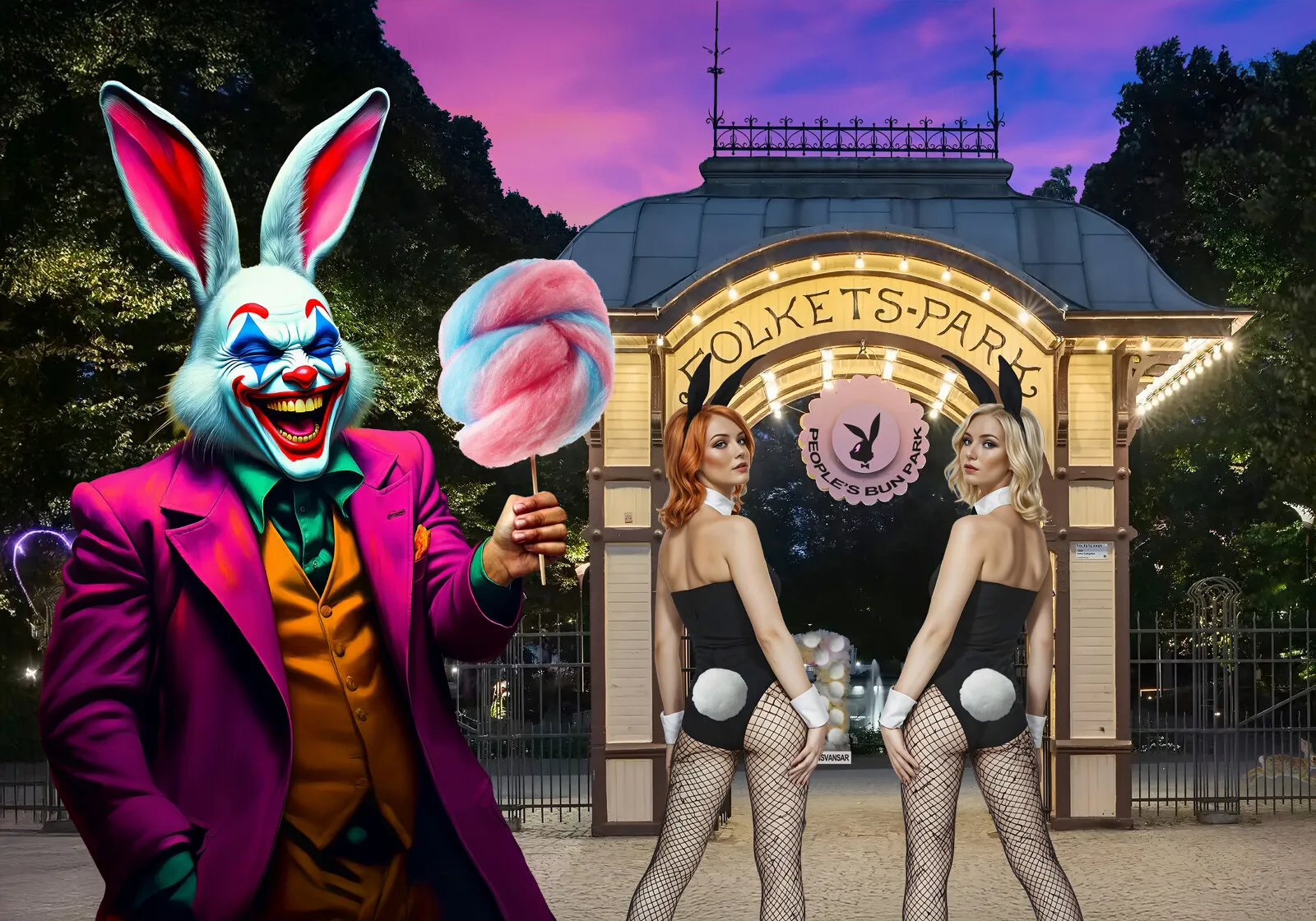
The drama in the image was merely a whisper compared to how the evening unfolded. When someone like The Joker Rabbit, a notorious trickster, hosts, you can be certain it won't be a quiet affair. This distant cousin, like the Joker himself, is an unappealing creature, so don’t be fooled by the cotton candy or the soft white fur. His deceptive nature, always at play, is more alarming than his sugar addiction. The Joker Rabbit, a symbol of deceit and manipulation, is the central figure in this narrative, orchestrating a plan that will test the moral compass of the characters involved.
The Joker Rabbit isn’t a new creation but an evolution of the classic trickster archetype—from the Norse Loki to Bugs Bunny on steroids. He’s the one who distorts reality until everything falls apart. He speaks in riddles, grins sideways, and knows there’s nothing that drops a person’s guard quite like pastel colours. He’s buzzing with sugar and as slippery as an eel—a rabbit with blackmail in his eyes, his cunning nature always one step ahead. His past deeds, from the infamous 'Carrot Caper' to the 'Easter Egg Scandal', have cemented his reputation as a master of deception and manipulation.
The thirteen young women had been invited under false pretences. The fictitious event was to take place in Folkets Park, a place that held a special place in their hearts. In Sweden’s oldest public park, they had all once played as children, ridden the carousel, danced as teenagers, and as adults, relaxed and socialised. The most dangerous element there had always been an overly intoxicated drinker, and such individuals were certainly unconscious by this late hour. But tonight, the park was about to witness a challenge to its peaceful norms.
No Joker of any kind ever acts by chance. From the opposite side, through the entrance at the far end of the park, the real Joker had simultaneously admitted an equal number of men, prosperous businessmen, and promised an evening in the company of Malmö Opera’s ballet dancers— entirely chaste unless otherwise agreed upon, as the invitation explained. The men were all dressed in tuxedos to set the right tone and show seriousness, their presence adding a layer of tension to the unfolding events.
Even if the invitation didn’t hint at it, the men were likely anticipating the women to arrive in elegant evening gowns. But the sight of them showing up as Playboy bunnies was beyond anyone's imagination. The question lingers-would they have dared to show up had they known? Each of them had a reputation to uphold and a marriage to protect, which was precisely the profile the Joker had in mind. He was on the lookout for potential blackmail targets, a simple setup used by spy recruiters for generations. Being caught, quite literally, with your pants down is no trivial matter. Every tree around the paddling pool was equipped with high-resolution cameras, ensuring every possible angle was covered.
The cameras were cleverly disguised—camouflaged as birdhouses, ice cream signs, and even a blinking animal in a toy dispenser. Folkets Park had not seen a surveillance upgrade since 1969. The Joker has always had an eye for technology—and two for other people’s secrets.
The location was selected for its suitability to the plan: a voluntary dip in the pond followed by the necessary removal of wet clothes. The reader has probably already guessed the Joker’s sinister scheme: to embarrass and blackmail the unsuspecting guests. Lightly dressed women in bunny ears and men in nothing but boxers make for quite the spectacle and charming pictures, a part of the Joker's plan to humiliate and exploit his victims.
But how do you persuade a group of upright—more or less—citizens to don tuxedos and appear in the dead of night? Surprisingly, it's easier than you might think.
Money is a language no businessman fails to understand. Plenty of money—thirteen brown packages with white string, each containing between ten thousand and a million euros. What’s a ruined tuxedo compared to that? No one could resist—at the very least, you’d leave Folkets Park with ten grand, and at best, as a multimillionaire in tax-free euros. The problem was that no one, apart from the Joker and the Rabbit Joker, knew the money was just as fake as the evening’s hosts. All of the bills looked convincingly like real hundred-euro notes but weren’t worth the paper they were printed on.
The amusing thing about money is that you don’t need to prove it’s real, as long as everyone believes it is. The brown packages tied with white string were childishly tempting, like Christmas presents for adults, and once the chance of receiving one with seven zeros became real, morality and common sense were swiftly tucked away in the tuxedo’s inner pocket.
But don’t seasoned businessmen check such things? Of course, they do—and the Joker had, naturally, prepared a fourteenth package filled with genuine bills. That one was quietly removed before the rest were tossed into the pond with weights attached, ensuring the guests' greed overcame their caution.
Everything went according to plan. The guests arrived punctually at their respective entrances—Norra Parkgatan and Falsterbogatan—and were ushered straight to the paddling pool, freshly chlorinated and ready for splashing children—and cash-hungry men. A sign posted by the municipality outlined the rules:
Bathing in the paddling pool is at your own risk, and adults are asked to supervise children, and "Dogs are not allowed in the paddling pool." Nothing was said about rabbits, but he wasn’t planning to bathe anyway. Nor was it forbidden to throw money packages or to swim in tuxedos. It was all systems go.
Champagne was served with light refreshments, allowing the guests to get to know one another, which was, of course, the unspoken goal. The pictures turned out better if the guests got a little cosy. After just the right number of glasses, the mood was cheerful, and everything progressed exactly as the Joker had foreseen. The pictures kept getting better.
There’s something peculiar about the bunny outfit. It appears revealing but is, in fact, a velvet-lined prison—an illusion of availability that simultaneously screams: “Don’t touch.” Most of the men couldn’t decide what was more unsettling—that the women wore those costumes, or that they wore them with such effortless poise.
Things picked up when it was time to stop the foreplay and toss the packages into the pond. Suddenly, there was a rush of movement. As if on cue, the men plunged into the shallow water, trying every swimming style they knew to reach the package they had their eyes on. Within minutes, each had claimed a parcel and was, of course, soaking wet. Back on dry land, the women helped them undress, peeling off wet clothes—some even removed their boxers to wring them out. Needless to say, the photos that resulted were explosive and would soon start to appear in the men’s inboxes.
And perhaps that’s what makes the Joker truly dangerous—not because he ever physically harms you, but because he knows how to penetrate everything you are. His most potent weapon isn’t a knife or a gun—it’s the photo you believed no one had taken. And when the bunny ears fall silent, and the champagne flutes are empty, it’s not the men who are left questioning what just happened. They already understand—but they’ll never be able to explain it. The men's sudden realisation adds an intriguing twist to the story.
I will leave the epilogue to my readers, as there are, of course, many possible endings—none particularly flattering to the men. They were undoubtedly furious and humiliated once they returned home and opened their packages. By then, both the Joker and his accomplice, the Rabbit Joker, had already departed Malmö for new locations—and new victims. The Joker's cunning and ability to outsmart his victims are truly impressive.
It should be noted that the women were hardly clueless damsels. Unlike the men, they had secured payment in advance, and each received a necklace, a bracelet, and matching earrings. All quite acceptable items, allegedly part of a “misplaced” shipment from the Joker’s hometown—nothing the women needed to worry about. Their names were Bettan, Maggan, Mia, and similar nicknames, but otherwise they remain anonymous—and quietly fade from this story, because it wasn’t their money the Joker duo was after. Their cunning and foresight in this situation are truly inspiring.
“What’s Up Doc?! Of course, you realise this means war!"
One of Bunny Joker’s pranks
Given the widespread confusion surrounding the 'Rabbit' and 'Hare', especially in cultural references like the Joker Rabbit, it's worth examining their significance. In comics, hares are often depicted as cunning, a trait that aligns well with their longer ears and suits their image. This paves the way for a deeper exploration of their cultural importance, from field hares to Playboy bunnies.
‘Bun’—a shortened form of ‘Bunny’—can refer to either a rabbit or a hare, both familiar residents of Malmö’s parks and suburban gardens, as well as areas like Västra Hamnen with its many green spaces. Folkets Park, Malmö’s central amusement park, is usually a paradise for bunnies too. One exception was a week ago, when the Rabbit Joker threw a surprise party for his followers. That particular gathering will be remembered for a long time among the city’s rabbits, regardless of species.
“Rabbit” is used much more frequently than “Hare” in everyday English, especially in children’s books, popular culture, and casual conversations. Most English speakers do not distinguish much between the words, even though they refer to different animals biologically.
The difference between rabbits and hares is not merely semantic. While a rabbit might argue otherwise, they are biologically distinct species. Rabbits, of the species Oryctolagus cuniculus, and hares, such as Lepus europaeus (the European brown hare), belong to the same family (Leporidae) but are not in the same genus. This genetic difference prevents successful interbreeding, despite their similar appearances.
‘Rabbit’ is by far the most commonly used term, both in speech and writing, and applies to domestic rabbits (as pets or in hutches). It also refers to wild European rabbits, which often live in colonies and dig elaborate tunnel systems (burrows).
The Easter Bunny is a rabbit, not a hare. However, ‘Hare’ is rarely used in everyday language unless you’re a hunter or an enthusiastic outdoorsperson—it’s more common in scientific or nature-related contexts.
The hare is larger, faster, with longer ears and hind legs than rabbits. It lives alone, nesting above ground in shallow depressions called “forms.” The brown hare is quite common in the English countryside.
In popular culture, the distinction between 'Rabbit' and 'Hare' is often blurred. Even when a character is more accurately described as a hare, they are almost always called a rabbit. This widespread mislabeling not only confuses but also offers a fascinating cultural phenomenon to explore, adding an intriguing layer to our understanding of literature and cultural studies.
In Winnie the Pooh, the character is called “Rabbit,” even though his behaviour and movement are more hare-like. In Alice in Wonderland, Alice meets “The White Rabbit,” not “The White Hare.” But are we talking about a rabbit or a hare? What follows is an underground taxonomy.
When Alice falls down her now-famous hole in Alice’s Adventures in Wonderland, it’s no accident—she follows a white rabbit. “Oh dear! Oh dear! I shall be too late!” he exclaims as he hurries past, wearing a waistcoat and checking his pocket watch. It’s a scene etched into Western cultural memory. Still, it raises a zoological question that escapes most readers: Is this time-obsessed creature a rabbit—or could he be a hare? This literary conundrum adds a layer of enlightenment and appreciation for the literary nuances of Carroll's work.
Lewis Carroll leaves no doubt. He calls him The White Rabbit, not The White Hare. But why such precision? Couldn’t he have chosen any long-eared mammal? The truth is, the choice is anything but random.
First, the White Rabbit lives in a hole. That’s where he disappears—down the tunnel that Alice follows into Wonderland. And here comes the first scientific clue. Rabbits live in underground tunnel systems and often in colonies. Hares, however, sleep above ground in shallow nests called “forms” and lead solitary lives. A hare with a complex burrow system would be groundbreaking.
Second, his behaviour. The White Rabbit is nervous, punctual, and almost bureaucratic in nature. He worries about time, punctuality, and how the Duchess will receive him. What we see is an anthropomorphic, neurotic etiquette, not the wild, mad trickster we associate with hares. Carroll makes a clever distinction here because, in the same book, a hare does appear: The March Hare, who in the tea party chapter signifies madness, impulse, and unrestrained drive.
In short, White Rabbit signifies structure, and March Hare implies chaos.
This reflects deeply rooted cultural archetypes. In European folklore, hares are often linked with cyclical madness (hence the phrase “mad as a March hare”) and unpredictability. The rabbit, on the other hand, is generally a symbol of transitions and transformation, especially in Easter traditions, where the bunny is often depicted carrying eggs from one world to the next.
Carroll knew precisely what he was doing. By letting the rabbit act as the portal to absurdity—and the hare as part of that absurdity—he crafted a zoological metaphor for balance and breakdown. The rabbit, dressed in a waistcoat and holding a timepiece, serves as the guide—the gatekeeper to a world where rules are about to be overturned. The hare, on the other hand, represents what happens once those rules are broken.
So, the next time you hear someone refer to the White Rabbit as “a hare,” correct them. But do so with a smile and an “I’m late!”—and perhaps keep an eye on the nearest rabbit hole. Because identifying the species is one thing, but following it underground is quite another.
That rabbit/hare—or, as he calls himself, a wabbit—is, of course, Bugs Bunny, the most combative of all beloved cartoon characters, the one who coined the phrases “What’s up, Doc?” and the nearly as famous “Of course, you realise this means war!” Both are iconic Bugs Bunny catchphrases, and he’s always called a rabbit—not a hare—even though he looks and behaves more like the latter. This playful mislabeling, popularised by Bugs Bunny, adds an element of entertainment and amusement to our understanding of the cultural significance of rabbits and hares.
So, why call him a rabbit? Because “rabbit” is more familiar in American slang. “What’s up, hare?” doesn’t quite roll off the tongue with the same bounce or comedic rhythm. The show was intended for a broad audience, and “rabbit” was the more universally understood word. In English, such linguistic drift is quite common, especially in humour, children’s media, and animation.
There are, however, exceptions. In certain fixed expressions, the hare still endures, such as:
“Mad as a March hare,” and “The Tortoise and the Hare”, the latter one of Aesop’s most famous fables.
Indeed, it’s true that “Rabbit” is often used carelessly to refer to both species, especially in informal speech and popular culture. But if you want to be biologically accurate or write about nature without embarrassment, it’s best to keep them separate.
Horny as a Rabbit – An Essay on Small Creatures with Big Reputations
There’s something about rabbits. Not just their ears, their soft fur, or their expressions that range from innocently curious to borderline hysterical. No, it’s something more profound—something that’s turned this little digging machine with its fluffy tail into a symbol of everything from Easter’s innocent hope to the eternal cycle of lust. In Sweden, we say someone is “horny as a rabbit,” sometimes even “like a wild rabbit on Gotland,” which makes you wonder what exactly’s happening in the Gotlandian bushes come summer. But is it only in Sweden that this tiny creature is associated with erotic overtones?
Not at all. English is just as rabbit-crazy—and equally inclined to turn innocent animals into metaphors for humanity’s most basic urges. “Breed like rabbits,” they say. Multiply like rabbits. It’s used about young couples, Catholic families, and classrooms where new children arrive faster than anyone can learn their names. Sometimes the phrase is accompanied by a knowing chuckle, sometimes with a hint of concern about overpopulation. In bolder contexts, someone might even be described as “like a rabbit in heat,” which leaves little to the imagination.
But why the rabbit? Because it mates often, quickly, and shamelessly—preferably in public, if an audience is present. A female can become pregnant again within a day of giving birth, and many do their best to prove that stamina is rewarded. Rabbits live in colonies, making their behaviour far more visible than that of more discreet relatives. The hare, for instance, acts far more quietly. It keeps to itself, mates in secret, and has never become a sex symbol in language or culture. No one says “horny as a hare”—and rightly so. The hare doesn’t have time. It’s too busy running.
The rabbit, on the other hand, has become an icon. From Bugs Bunny to Hugh Hefner’s silky logo, from the Easter Bunny’s egg deliveries to the role of plush toys in nursery rooms, no other species wears innocence and lust quite so comfortably. The Playboy Bunny even sports a bow tie—a creature ready for both ballroom and burlesque, for storytime and high society—the sweetest symbol with the most adult undertones.
Perhaps it’s precisely the rabbit's role in challenging societal norms that makes it so culturally significant. Innocent enough to adorn a chocolate egg yet fertile enough to make grown-ups choke on their laughter when children talk about “bunny love.” It hops, digs, reproduces, and follows no script. It embodies life’s unstoppable force—and maybe, if we’re honest, reminds us that sometimes it’s enough just to be yourself, ears up and tail fluffy.
So next time someone calls you “horny as a rabbit”—take it as a compliment. You’re in good company. And who knows—maybe you’re the one living the most genuine life of us all.
The bunny-armoured girls and the Joker Rabbit in the image are part of Hugh Hefner’s vision, in black and white and colour. It all started with an idea—a dream of sophistication, sex, and journalism all in one. When Hugh Hefner launched Playboy in 1953, he wasn’t just introducing a men’s magazine, but creating an entire universe—a world where conversations about jazz, existentialism, and dry martinis coexisted with nude female bodies, where Marilyn Monroe graced the first cover, and where the man of the future—according to Hefner—wore a tuxedo, read Nabokov, and smoked a pipe. The Playboy Bunny, a symbol of both innocence and sexuality, became a central part of this universe, further cementing the rabbit's cultural significance. Over the years, the Playboy brand has continued to shape cultural perceptions of sexuality and innocence, with the rabbit remaining a key symbol in this narrative.
But it was with the Playboy Club that the dream materialised. In 1960, the first club opened in Chicago, soon followed by venues in New York, London, Tokyo, and Manila. They were exclusive lounges for men (and occasionally women) aspiring to feel like James Bond—and where waitresses were known as ‘Bunnies,’ not waitresses.
Here, among red carpets, carefully assigned tables, and discreet glances, we enter the realm of myth—the bunny girls in their “sheaths.” For that’s what they were often called: sheaths. But no floating silk pearls or satin gowns drifted through the air. No, this was armour. Each Bunny costume was bespoke, strictly regulated, and required licensed manufacturing. Improvisation was not permitted—Hefner had rules. Many rules. And strict ones.
Hefner might have sold the dream of free love, but his clubs were run like the U.S. Marines—with rigorous discipline. The Bunny Rules (as they were called) dictated everything from how the bunny ears were to be worn (the angle was measured!) to how drinks were to be served with the “Bunny Dip”—a sort of curtsy technique to keep the bust area properly positioned. It might sound absurd today, but in context, it was a choreography of control, glamour, and seduction—all at once.
The Angle of a Pair of Ears
It sounds like a detail from a comic strip—to consider precisely how a pair of bunny ears should be tilted for maximum effect. But in the reality of the Playboy Club, this was no trivial matter. It was protocol. Part of the uniform. A precisely measured beauty standard, maintained with the same care as the cocktail glasses behind the bar.
The ears, attached to a headband, were not meant to stand straight up like a Disney hare, nor to droop after a long night of passion. Instead, they were to tilt backwards at a precisely chosen angle—flirtatious enough to suggest playfulness, but not so much as to distort the silhouette. This was carefully controlled. The “Bunny Mother,” the club’s chief Bunny, could use a small protractor to measure the ear tilt before a Bunny was allowed on the floor.
It’s through this small detail that we see something essential about Hefner’s world: even spontaneity was carefully planned. Everything was a performance, executed with millimetre accuracy. Wearing the ears correctly was a sign of loyalty, not just to the club, but to the brand's mythology. The ears weren’t just accessories—they were badges of identity.
And you might chuckle at the idea of cloth ears being checked like military epaulettes — but therein lies the brilliance of Hefner’s theatrical craft. He didn’t just create a venue — he crafted a role. And in that role, all aspects — glance, gait, and yes, ear angle — mattered.
It wasn’t a uniform in the traditional sense. It was a bespoke story in satin and plastic. And the ears? They were the opening line.
So, how did he come up with it? The idea for the Bunny Girl is said to have been inspired by the rabbit in the Playboy logo, designed by Art Paul, whose ears somehow became the embodiment of flirtation, lightness, and temptation. The rabbit, as we’ve established, has long been associated with rapid reproduction and erotic play. But here, it was stylised. It wore a bow tie. It became a service staff uniform — with high integrity — and a bonus for every drink sold.
As a journalist and commentator, I was once an honorary member of the Park Lane Club in London — just a stone’s throw from Hilton Park Lane, about as fine an address as you could get, with London’s largest park right across the street. It was one of the most exclusive venues, where Bunnies were chosen carefully, where champagne bottles queued behind the curtains, and where the in-crowd mingled with showbiz and wannabes. I ran into both Sean Connery and Roman Polanski there, and plenty of men who just wanted to forget daily life and pretend, for one night, to be Hugh himself.
But behind the smile, the fluffy tail, and the ears, there was armour — literally. The tiny outfit, often romanticised as delicate or sexy, was a moulded shell of satin and plastic, cut to shape the body into curvaceous perfection — and equally to protect the wearer. There was nothing flimsy in the construction — instead, a kind of choreographed dignity. And any fingers that ended up where they shouldn’t? They were swiftly dealt with. Groping men were immediately escorted out, and sometimes permanently banned.
While Hefner’s private residence in Los Angeles might have been his hedonistic headquarters, where silk robes and morning mimosas were the dress code, his international clubs were quite another affair. They may have toyed with erotic aesthetics, but in reality, they more closely resembled a convent dressed in latex and fishnets. Here, discipline, control, and to some degree, celibacy—at least during working hours—were the norm. Believing every Bunny was for sale is like thinking flight attendants privately serve whisky in the cockpit. They may appear glamorous, but behind the scenes, there’s a captain—Hefner in this case—who rules with an iron fist.
The Last Hop
In the end, whether a rabbit or a hare, a fluff-tailed seductress or a nervous watch-checker, the long-eared creature remains one of our most enduring cultural symbols. We dress it in velvet and lace, give it wristwatches and witty one-liners, press it into chocolate moulds, make it carry eggs, dreams, or trays of martinis. We chuckle at its libido, admire its agility, and pretend – just for a moment – that our anxieties or appetites might be explained by something as simple as species.
And perhaps that’s the secret of the Bunny’s charm. She – or he – carries our contradictions. At once wild and tame, innocent and knowing, hunted and worshipped. A creature that lives underground and yet remains strangely above it all.
So let us toast the Bunny – the icon in ears. May she forever strut through our myths, hips swaying, ears at the perfect angle, tail held high.
Because in a world that so often demands seriousness, logic, and obedience…
Sometimes all you need is a little wiggle.
Jörgen Thornberg
People's Bun Park, 2025
Digital
70 x 50 cm
3 200 kr
People's Bun Park
It may seem odd that the world has attached so much meaning to a creature so small, quiet, and gentle. Yet, from ancient fertility symbols to 1950s centrepieces, from mythological tricksters to velvet-clad waitresses with sculpted busts and numbered ears – the rabbit, with its pervasive presence, has found its way into nearly every aspect of culture, enlightening and intriguing us with its ubiquity.
This is not a scientific treatise. It is an exploration, at times playful and at times serious, of the meanings we have given to these animals – how language, fashion, desire, and absurdity have shaped the long-eared icon that keeps resurfacing. Sometimes in burrows. Sometimes on elegant dance floors. This blend of playfulness and seriousness will keep you engaged and entertained throughout the journey.
We follow the rabbit down its many holes – literary, zoological, erotic, and embroidered – and we ask, with a nod to both Alice and Bugs:
What’s up, Doc?, Doc?
“A Hop Through History
A rabbit’s not a hare, they say,
though both will often leap away.
One digs a hole and hides inside,
the other likes a wilder ride.
The hare is fierce, aloof and fast,
a loner with a windswept past.
The rabbit’s plump, with softer grace—
and often found in a stranger’s place.
In Sweden, folks will raise a brow
and mutter, “He's a bunny now!”
For “horny as a rabbit” (bless the phrase),
means lust runs wild in woodland ways.
In English, rabbits breed like mad,
a fact both charming and quite sad.
They multiply with fluffy flair—
No wonder Hefner took it there.
With cuffs and ears and satin sheen,
his Bunnies graced the magazine.
But those who reached to stroke the fluff
were told (quite firmly), "That’s enough."
The Easter Bunny brings us joy,
to every child (and naughty boy).
But if you ask a scholar, 'Why?'
They’ll say, "Rebirth... and maybe thigh."
Poor Bugs, that long-eared war machine,
said "What’s up, Doc?" and turned real mean.
He straddled hare and rabbit's fate—
In holes by day, by night, a date.
And Alice chased a suited gent
whose ears were trimmed at a perfect bent.
She fell through time, through logic’s fence—
The first recorded Bunny-sense.
So here’s to rabbits, hares, and more—
from Gotland’s brush to clubland floor.
They bounce through myths and Sunday brunch,
with lust, confusion, and a punch.
A creature small? Perhaps, at glance.
But never doubt its relevance.
For though its voice is barely heard,
it changed the world… with just one word.
Hop.”
Malmö June 2025
People's Bun Park
The drama in the image was merely a whisper compared to how the evening unfolded. When someone like The Joker Rabbit, a notorious trickster, hosts, you can be certain it won't be a quiet affair. This distant cousin, like the Joker himself, is an unappealing creature, so don’t be fooled by the cotton candy or the soft white fur. His deceptive nature, always at play, is more alarming than his sugar addiction. The Joker Rabbit, a symbol of deceit and manipulation, is the central figure in this narrative, orchestrating a plan that will test the moral compass of the characters involved.
The Joker Rabbit isn’t a new creation but an evolution of the classic trickster archetype—from the Norse Loki to Bugs Bunny on steroids. He’s the one who distorts reality until everything falls apart. He speaks in riddles, grins sideways, and knows there’s nothing that drops a person’s guard quite like pastel colours. He’s buzzing with sugar and as slippery as an eel—a rabbit with blackmail in his eyes, his cunning nature always one step ahead. His past deeds, from the infamous 'Carrot Caper' to the 'Easter Egg Scandal', have cemented his reputation as a master of deception and manipulation.
The thirteen young women had been invited under false pretences. The fictitious event was to take place in Folkets Park, a place that held a special place in their hearts. In Sweden’s oldest public park, they had all once played as children, ridden the carousel, danced as teenagers, and as adults, relaxed and socialised. The most dangerous element there had always been an overly intoxicated drinker, and such individuals were certainly unconscious by this late hour. But tonight, the park was about to witness a challenge to its peaceful norms.
No Joker of any kind ever acts by chance. From the opposite side, through the entrance at the far end of the park, the real Joker had simultaneously admitted an equal number of men, prosperous businessmen, and promised an evening in the company of Malmö Opera’s ballet dancers— entirely chaste unless otherwise agreed upon, as the invitation explained. The men were all dressed in tuxedos to set the right tone and show seriousness, their presence adding a layer of tension to the unfolding events.
Even if the invitation didn’t hint at it, the men were likely anticipating the women to arrive in elegant evening gowns. But the sight of them showing up as Playboy bunnies was beyond anyone's imagination. The question lingers-would they have dared to show up had they known? Each of them had a reputation to uphold and a marriage to protect, which was precisely the profile the Joker had in mind. He was on the lookout for potential blackmail targets, a simple setup used by spy recruiters for generations. Being caught, quite literally, with your pants down is no trivial matter. Every tree around the paddling pool was equipped with high-resolution cameras, ensuring every possible angle was covered.
The cameras were cleverly disguised—camouflaged as birdhouses, ice cream signs, and even a blinking animal in a toy dispenser. Folkets Park had not seen a surveillance upgrade since 1969. The Joker has always had an eye for technology—and two for other people’s secrets.
The location was selected for its suitability to the plan: a voluntary dip in the pond followed by the necessary removal of wet clothes. The reader has probably already guessed the Joker’s sinister scheme: to embarrass and blackmail the unsuspecting guests. Lightly dressed women in bunny ears and men in nothing but boxers make for quite the spectacle and charming pictures, a part of the Joker's plan to humiliate and exploit his victims.
But how do you persuade a group of upright—more or less—citizens to don tuxedos and appear in the dead of night? Surprisingly, it's easier than you might think.
Money is a language no businessman fails to understand. Plenty of money—thirteen brown packages with white string, each containing between ten thousand and a million euros. What’s a ruined tuxedo compared to that? No one could resist—at the very least, you’d leave Folkets Park with ten grand, and at best, as a multimillionaire in tax-free euros. The problem was that no one, apart from the Joker and the Rabbit Joker, knew the money was just as fake as the evening’s hosts. All of the bills looked convincingly like real hundred-euro notes but weren’t worth the paper they were printed on.
The amusing thing about money is that you don’t need to prove it’s real, as long as everyone believes it is. The brown packages tied with white string were childishly tempting, like Christmas presents for adults, and once the chance of receiving one with seven zeros became real, morality and common sense were swiftly tucked away in the tuxedo’s inner pocket.
But don’t seasoned businessmen check such things? Of course, they do—and the Joker had, naturally, prepared a fourteenth package filled with genuine bills. That one was quietly removed before the rest were tossed into the pond with weights attached, ensuring the guests' greed overcame their caution.
Everything went according to plan. The guests arrived punctually at their respective entrances—Norra Parkgatan and Falsterbogatan—and were ushered straight to the paddling pool, freshly chlorinated and ready for splashing children—and cash-hungry men. A sign posted by the municipality outlined the rules:
Bathing in the paddling pool is at your own risk, and adults are asked to supervise children, and "Dogs are not allowed in the paddling pool." Nothing was said about rabbits, but he wasn’t planning to bathe anyway. Nor was it forbidden to throw money packages or to swim in tuxedos. It was all systems go.
Champagne was served with light refreshments, allowing the guests to get to know one another, which was, of course, the unspoken goal. The pictures turned out better if the guests got a little cosy. After just the right number of glasses, the mood was cheerful, and everything progressed exactly as the Joker had foreseen. The pictures kept getting better.
There’s something peculiar about the bunny outfit. It appears revealing but is, in fact, a velvet-lined prison—an illusion of availability that simultaneously screams: “Don’t touch.” Most of the men couldn’t decide what was more unsettling—that the women wore those costumes, or that they wore them with such effortless poise.
Things picked up when it was time to stop the foreplay and toss the packages into the pond. Suddenly, there was a rush of movement. As if on cue, the men plunged into the shallow water, trying every swimming style they knew to reach the package they had their eyes on. Within minutes, each had claimed a parcel and was, of course, soaking wet. Back on dry land, the women helped them undress, peeling off wet clothes—some even removed their boxers to wring them out. Needless to say, the photos that resulted were explosive and would soon start to appear in the men’s inboxes.
And perhaps that’s what makes the Joker truly dangerous—not because he ever physically harms you, but because he knows how to penetrate everything you are. His most potent weapon isn’t a knife or a gun—it’s the photo you believed no one had taken. And when the bunny ears fall silent, and the champagne flutes are empty, it’s not the men who are left questioning what just happened. They already understand—but they’ll never be able to explain it. The men's sudden realisation adds an intriguing twist to the story.
I will leave the epilogue to my readers, as there are, of course, many possible endings—none particularly flattering to the men. They were undoubtedly furious and humiliated once they returned home and opened their packages. By then, both the Joker and his accomplice, the Rabbit Joker, had already departed Malmö for new locations—and new victims. The Joker's cunning and ability to outsmart his victims are truly impressive.
It should be noted that the women were hardly clueless damsels. Unlike the men, they had secured payment in advance, and each received a necklace, a bracelet, and matching earrings. All quite acceptable items, allegedly part of a “misplaced” shipment from the Joker’s hometown—nothing the women needed to worry about. Their names were Bettan, Maggan, Mia, and similar nicknames, but otherwise they remain anonymous—and quietly fade from this story, because it wasn’t their money the Joker duo was after. Their cunning and foresight in this situation are truly inspiring.
“What’s Up Doc?! Of course, you realise this means war!"
One of Bunny Joker’s pranks
Given the widespread confusion surrounding the 'Rabbit' and 'Hare', especially in cultural references like the Joker Rabbit, it's worth examining their significance. In comics, hares are often depicted as cunning, a trait that aligns well with their longer ears and suits their image. This paves the way for a deeper exploration of their cultural importance, from field hares to Playboy bunnies.
‘Bun’—a shortened form of ‘Bunny’—can refer to either a rabbit or a hare, both familiar residents of Malmö’s parks and suburban gardens, as well as areas like Västra Hamnen with its many green spaces. Folkets Park, Malmö’s central amusement park, is usually a paradise for bunnies too. One exception was a week ago, when the Rabbit Joker threw a surprise party for his followers. That particular gathering will be remembered for a long time among the city’s rabbits, regardless of species.
“Rabbit” is used much more frequently than “Hare” in everyday English, especially in children’s books, popular culture, and casual conversations. Most English speakers do not distinguish much between the words, even though they refer to different animals biologically.
The difference between rabbits and hares is not merely semantic. While a rabbit might argue otherwise, they are biologically distinct species. Rabbits, of the species Oryctolagus cuniculus, and hares, such as Lepus europaeus (the European brown hare), belong to the same family (Leporidae) but are not in the same genus. This genetic difference prevents successful interbreeding, despite their similar appearances.
‘Rabbit’ is by far the most commonly used term, both in speech and writing, and applies to domestic rabbits (as pets or in hutches). It also refers to wild European rabbits, which often live in colonies and dig elaborate tunnel systems (burrows).
The Easter Bunny is a rabbit, not a hare. However, ‘Hare’ is rarely used in everyday language unless you’re a hunter or an enthusiastic outdoorsperson—it’s more common in scientific or nature-related contexts.
The hare is larger, faster, with longer ears and hind legs than rabbits. It lives alone, nesting above ground in shallow depressions called “forms.” The brown hare is quite common in the English countryside.
In popular culture, the distinction between 'Rabbit' and 'Hare' is often blurred. Even when a character is more accurately described as a hare, they are almost always called a rabbit. This widespread mislabeling not only confuses but also offers a fascinating cultural phenomenon to explore, adding an intriguing layer to our understanding of literature and cultural studies.
In Winnie the Pooh, the character is called “Rabbit,” even though his behaviour and movement are more hare-like. In Alice in Wonderland, Alice meets “The White Rabbit,” not “The White Hare.” But are we talking about a rabbit or a hare? What follows is an underground taxonomy.
When Alice falls down her now-famous hole in Alice’s Adventures in Wonderland, it’s no accident—she follows a white rabbit. “Oh dear! Oh dear! I shall be too late!” he exclaims as he hurries past, wearing a waistcoat and checking his pocket watch. It’s a scene etched into Western cultural memory. Still, it raises a zoological question that escapes most readers: Is this time-obsessed creature a rabbit—or could he be a hare? This literary conundrum adds a layer of enlightenment and appreciation for the literary nuances of Carroll's work.
Lewis Carroll leaves no doubt. He calls him The White Rabbit, not The White Hare. But why such precision? Couldn’t he have chosen any long-eared mammal? The truth is, the choice is anything but random.
First, the White Rabbit lives in a hole. That’s where he disappears—down the tunnel that Alice follows into Wonderland. And here comes the first scientific clue. Rabbits live in underground tunnel systems and often in colonies. Hares, however, sleep above ground in shallow nests called “forms” and lead solitary lives. A hare with a complex burrow system would be groundbreaking.
Second, his behaviour. The White Rabbit is nervous, punctual, and almost bureaucratic in nature. He worries about time, punctuality, and how the Duchess will receive him. What we see is an anthropomorphic, neurotic etiquette, not the wild, mad trickster we associate with hares. Carroll makes a clever distinction here because, in the same book, a hare does appear: The March Hare, who in the tea party chapter signifies madness, impulse, and unrestrained drive.
In short, White Rabbit signifies structure, and March Hare implies chaos.
This reflects deeply rooted cultural archetypes. In European folklore, hares are often linked with cyclical madness (hence the phrase “mad as a March hare”) and unpredictability. The rabbit, on the other hand, is generally a symbol of transitions and transformation, especially in Easter traditions, where the bunny is often depicted carrying eggs from one world to the next.
Carroll knew precisely what he was doing. By letting the rabbit act as the portal to absurdity—and the hare as part of that absurdity—he crafted a zoological metaphor for balance and breakdown. The rabbit, dressed in a waistcoat and holding a timepiece, serves as the guide—the gatekeeper to a world where rules are about to be overturned. The hare, on the other hand, represents what happens once those rules are broken.
So, the next time you hear someone refer to the White Rabbit as “a hare,” correct them. But do so with a smile and an “I’m late!”—and perhaps keep an eye on the nearest rabbit hole. Because identifying the species is one thing, but following it underground is quite another.
That rabbit/hare—or, as he calls himself, a wabbit—is, of course, Bugs Bunny, the most combative of all beloved cartoon characters, the one who coined the phrases “What’s up, Doc?” and the nearly as famous “Of course, you realise this means war!” Both are iconic Bugs Bunny catchphrases, and he’s always called a rabbit—not a hare—even though he looks and behaves more like the latter. This playful mislabeling, popularised by Bugs Bunny, adds an element of entertainment and amusement to our understanding of the cultural significance of rabbits and hares.
So, why call him a rabbit? Because “rabbit” is more familiar in American slang. “What’s up, hare?” doesn’t quite roll off the tongue with the same bounce or comedic rhythm. The show was intended for a broad audience, and “rabbit” was the more universally understood word. In English, such linguistic drift is quite common, especially in humour, children’s media, and animation.
There are, however, exceptions. In certain fixed expressions, the hare still endures, such as:
“Mad as a March hare,” and “The Tortoise and the Hare”, the latter one of Aesop’s most famous fables.
Indeed, it’s true that “Rabbit” is often used carelessly to refer to both species, especially in informal speech and popular culture. But if you want to be biologically accurate or write about nature without embarrassment, it’s best to keep them separate.
Horny as a Rabbit – An Essay on Small Creatures with Big Reputations
There’s something about rabbits. Not just their ears, their soft fur, or their expressions that range from innocently curious to borderline hysterical. No, it’s something more profound—something that’s turned this little digging machine with its fluffy tail into a symbol of everything from Easter’s innocent hope to the eternal cycle of lust. In Sweden, we say someone is “horny as a rabbit,” sometimes even “like a wild rabbit on Gotland,” which makes you wonder what exactly’s happening in the Gotlandian bushes come summer. But is it only in Sweden that this tiny creature is associated with erotic overtones?
Not at all. English is just as rabbit-crazy—and equally inclined to turn innocent animals into metaphors for humanity’s most basic urges. “Breed like rabbits,” they say. Multiply like rabbits. It’s used about young couples, Catholic families, and classrooms where new children arrive faster than anyone can learn their names. Sometimes the phrase is accompanied by a knowing chuckle, sometimes with a hint of concern about overpopulation. In bolder contexts, someone might even be described as “like a rabbit in heat,” which leaves little to the imagination.
But why the rabbit? Because it mates often, quickly, and shamelessly—preferably in public, if an audience is present. A female can become pregnant again within a day of giving birth, and many do their best to prove that stamina is rewarded. Rabbits live in colonies, making their behaviour far more visible than that of more discreet relatives. The hare, for instance, acts far more quietly. It keeps to itself, mates in secret, and has never become a sex symbol in language or culture. No one says “horny as a hare”—and rightly so. The hare doesn’t have time. It’s too busy running.
The rabbit, on the other hand, has become an icon. From Bugs Bunny to Hugh Hefner’s silky logo, from the Easter Bunny’s egg deliveries to the role of plush toys in nursery rooms, no other species wears innocence and lust quite so comfortably. The Playboy Bunny even sports a bow tie—a creature ready for both ballroom and burlesque, for storytime and high society—the sweetest symbol with the most adult undertones.
Perhaps it’s precisely the rabbit's role in challenging societal norms that makes it so culturally significant. Innocent enough to adorn a chocolate egg yet fertile enough to make grown-ups choke on their laughter when children talk about “bunny love.” It hops, digs, reproduces, and follows no script. It embodies life’s unstoppable force—and maybe, if we’re honest, reminds us that sometimes it’s enough just to be yourself, ears up and tail fluffy.
So next time someone calls you “horny as a rabbit”—take it as a compliment. You’re in good company. And who knows—maybe you’re the one living the most genuine life of us all.
The bunny-armoured girls and the Joker Rabbit in the image are part of Hugh Hefner’s vision, in black and white and colour. It all started with an idea—a dream of sophistication, sex, and journalism all in one. When Hugh Hefner launched Playboy in 1953, he wasn’t just introducing a men’s magazine, but creating an entire universe—a world where conversations about jazz, existentialism, and dry martinis coexisted with nude female bodies, where Marilyn Monroe graced the first cover, and where the man of the future—according to Hefner—wore a tuxedo, read Nabokov, and smoked a pipe. The Playboy Bunny, a symbol of both innocence and sexuality, became a central part of this universe, further cementing the rabbit's cultural significance. Over the years, the Playboy brand has continued to shape cultural perceptions of sexuality and innocence, with the rabbit remaining a key symbol in this narrative.
But it was with the Playboy Club that the dream materialised. In 1960, the first club opened in Chicago, soon followed by venues in New York, London, Tokyo, and Manila. They were exclusive lounges for men (and occasionally women) aspiring to feel like James Bond—and where waitresses were known as ‘Bunnies,’ not waitresses.
Here, among red carpets, carefully assigned tables, and discreet glances, we enter the realm of myth—the bunny girls in their “sheaths.” For that’s what they were often called: sheaths. But no floating silk pearls or satin gowns drifted through the air. No, this was armour. Each Bunny costume was bespoke, strictly regulated, and required licensed manufacturing. Improvisation was not permitted—Hefner had rules. Many rules. And strict ones.
Hefner might have sold the dream of free love, but his clubs were run like the U.S. Marines—with rigorous discipline. The Bunny Rules (as they were called) dictated everything from how the bunny ears were to be worn (the angle was measured!) to how drinks were to be served with the “Bunny Dip”—a sort of curtsy technique to keep the bust area properly positioned. It might sound absurd today, but in context, it was a choreography of control, glamour, and seduction—all at once.
The Angle of a Pair of Ears
It sounds like a detail from a comic strip—to consider precisely how a pair of bunny ears should be tilted for maximum effect. But in the reality of the Playboy Club, this was no trivial matter. It was protocol. Part of the uniform. A precisely measured beauty standard, maintained with the same care as the cocktail glasses behind the bar.
The ears, attached to a headband, were not meant to stand straight up like a Disney hare, nor to droop after a long night of passion. Instead, they were to tilt backwards at a precisely chosen angle—flirtatious enough to suggest playfulness, but not so much as to distort the silhouette. This was carefully controlled. The “Bunny Mother,” the club’s chief Bunny, could use a small protractor to measure the ear tilt before a Bunny was allowed on the floor.
It’s through this small detail that we see something essential about Hefner’s world: even spontaneity was carefully planned. Everything was a performance, executed with millimetre accuracy. Wearing the ears correctly was a sign of loyalty, not just to the club, but to the brand's mythology. The ears weren’t just accessories—they were badges of identity.
And you might chuckle at the idea of cloth ears being checked like military epaulettes — but therein lies the brilliance of Hefner’s theatrical craft. He didn’t just create a venue — he crafted a role. And in that role, all aspects — glance, gait, and yes, ear angle — mattered.
It wasn’t a uniform in the traditional sense. It was a bespoke story in satin and plastic. And the ears? They were the opening line.
So, how did he come up with it? The idea for the Bunny Girl is said to have been inspired by the rabbit in the Playboy logo, designed by Art Paul, whose ears somehow became the embodiment of flirtation, lightness, and temptation. The rabbit, as we’ve established, has long been associated with rapid reproduction and erotic play. But here, it was stylised. It wore a bow tie. It became a service staff uniform — with high integrity — and a bonus for every drink sold.
As a journalist and commentator, I was once an honorary member of the Park Lane Club in London — just a stone’s throw from Hilton Park Lane, about as fine an address as you could get, with London’s largest park right across the street. It was one of the most exclusive venues, where Bunnies were chosen carefully, where champagne bottles queued behind the curtains, and where the in-crowd mingled with showbiz and wannabes. I ran into both Sean Connery and Roman Polanski there, and plenty of men who just wanted to forget daily life and pretend, for one night, to be Hugh himself.
But behind the smile, the fluffy tail, and the ears, there was armour — literally. The tiny outfit, often romanticised as delicate or sexy, was a moulded shell of satin and plastic, cut to shape the body into curvaceous perfection — and equally to protect the wearer. There was nothing flimsy in the construction — instead, a kind of choreographed dignity. And any fingers that ended up where they shouldn’t? They were swiftly dealt with. Groping men were immediately escorted out, and sometimes permanently banned.
While Hefner’s private residence in Los Angeles might have been his hedonistic headquarters, where silk robes and morning mimosas were the dress code, his international clubs were quite another affair. They may have toyed with erotic aesthetics, but in reality, they more closely resembled a convent dressed in latex and fishnets. Here, discipline, control, and to some degree, celibacy—at least during working hours—were the norm. Believing every Bunny was for sale is like thinking flight attendants privately serve whisky in the cockpit. They may appear glamorous, but behind the scenes, there’s a captain—Hefner in this case—who rules with an iron fist.
The Last Hop
In the end, whether a rabbit or a hare, a fluff-tailed seductress or a nervous watch-checker, the long-eared creature remains one of our most enduring cultural symbols. We dress it in velvet and lace, give it wristwatches and witty one-liners, press it into chocolate moulds, make it carry eggs, dreams, or trays of martinis. We chuckle at its libido, admire its agility, and pretend – just for a moment – that our anxieties or appetites might be explained by something as simple as species.
And perhaps that’s the secret of the Bunny’s charm. She – or he – carries our contradictions. At once wild and tame, innocent and knowing, hunted and worshipped. A creature that lives underground and yet remains strangely above it all.
So let us toast the Bunny – the icon in ears. May she forever strut through our myths, hips swaying, ears at the perfect angle, tail held high.
Because in a world that so often demands seriousness, logic, and obedience…
Sometimes all you need is a little wiggle.
3 200 kr

Jörgen Thornberg
Malmö
Lite om bilder och mig. Translation in English at the end.
Jag är en nyfiken person som ser allt i bilder, även det jag fäster i ord, gärna tillsammans för bakom alla mina bilder finns en berättelse. Till vissa bilder hör en kortare eller längre novell som följer med bilden.
Bilder berättar historier. Jag omges av naturlig skönhet, intressanta människor och historia var jag än går. Jag använder min kamera för att dokumentera världen och blanda det jag ser med vad jag känner för att fånga den dolda magin.
Mina bilder berättar mina historier. Genom mina bilder, tryck och berättelser. Jag bjuder in dig att ta del av dessa berättelser, in i ditt liv och hem och dela min mycket personliga syn på vår värld. Mer än vad ögat ser. Jag tänker i bilder, drömmer och skriver och pratar om dem; följaktligen måste jag också skapa bilder. De blir vad jag ser, inte nödvändigtvis begränsade till verkligheten. Det finns en bild runt varje hörn. Jag hoppas att du kommer att se vad jag såg och gilla det.
Jag är också en skrivande person och till många bilder hör en kortare eller längre essay. Den följer med tavlan, tryckt på fint papper och med en personlig hälsning från mig.
Flertalet bilder startar sin resa i min kamera. Enkelt förklarat beskriver jag bilden jag ser i mitt inre, upplevd eller fantiserad. Bilden uppstår inom mig redan innan jag fått okularet till ögat. På bråkdelen av ett ögonblick ser jag vad jag vill ha och vad som kan göras med bilden. Här skall jag stoppa in en giraff, stålmannen, Titanic eller vad det är min fantasi finner ut. Ännu märkligare är att jag kommer ihåg minnesbilden långt efteråt när det blir tid att skapa verket. Om jag lyckas eller inte, är upp till betraktaren, oftast präglat av en stråk av svart humor – meningen är att man skall bli underhållen. Mina bilder blir ofta en snackis där de hänger.
Jag föredrar bilder som förmedlar ett budskap i flera lager. Vid första anblicken fylld av feel-good, en vacker utsikt, fint väder, solen skiner, blommor på ängen eller vattnet som ligger förrädiskt spegelblankt. I en sådan bild kan jag gömma min egentliga berättelse, mitt förakt för förtryckare och våldsverkare, rasister och fördomsfulla människor - ett gärna återkommande motiv mer eller mindre dolt i det vackra motivet. Jag försöker förena dem i ett gemensamt narrativ.
Bild och formgivning har löpt som en röd tråd genom livet. Fotokonst känns som en värdig final som jag gärna delar med mig.
Min genre är vid som framgår av mina bilder, temat en blandning av pop- och gatukonst i kollage som kan bestå av hundratals lager. Vissa bilder kan ta veckor, andra någon dag innan det är dags att överlämna resultatet till printverkstaden. Fine Art Prints är digitala fotocollage. I dessa kollage sker rivandet, klippandet, pusslandet, målandet, ritandet och sprayningen digitalt. Det jag monterar in kan vara hundratals år gamla bilder som jag omsorgsfullt frilägger så att de ser ut att vara en del av tavlan men också bilder skapade av mig själv efter min egen fantasi. Därefter besöks printstudion och för vissa bilder numrera en limiterad upplaga (oftast 7 exemplar) och signera för hand. Vissa bilder kan köpas i olika format. Det är bara att fråga efter vilka. Gillar man en bild som är 70x100 men inte har plats på väggen, går den kanske att få i 50x70 cm istället. Frågan är fri.
Metoden Giclée eller Fine Art Print som det också kallas är det moderna sättet för framställning av grafisk konst. Villkoret för denna typ av utskrifter är att en högkvalitativ storformatskrivare används med åldersbeständigt färgpigment och konstnärspapper eller i förekommande fall på duk. Pappret som används möter de krav på livslängd som ställs av museer och gallerier. Normalt säljer jag mina bilder oinramade så att den nya ägaren själv kan bestämma hur de skall se ut, med eller utan passepartout färg på ram, med eller utan glas etc..
Under många år ställde jag bara ut på nätet, i valda grupper och på min egen Facebooksida - https://www.facebook.com/jorgen.thornberg.9
Jag finns också på en egen hemsida som tyvärr inte alltid är uppdaterad – https://www.jth.life/ Där kan du också läsa en del av de berättelser som följer med bilden.
UTSTÄLLNINGAR
Luftkastellet, oktober 2022
Konst i Lund, november 2022
Luftkastellet, mars 2023
Engleson Galleri Caroli, april 2023
Hydra, Greece June 2023
Engleson Galleri Caroli, oktober 2023
Toppen, Höllviken december 2023
Luftkastellet, mars 2024
Torups Galleri, mars 2024
Venice, May 2024
Luftkastellet, oktober 2024
Konst i Advent, December 2024
Galleri Engleson, Caroli December 2024
Jäger & Jansson Galleri, april 2025
A bit about pictures and me.
I'm a curious person who sees everything in pictures, even what I express in words, often combining them, for behind all my pictures lies a story. These narratives, some as short as a single image and others as long as a novel, are the heart and soul of my work.
Pictures tell stories. Wherever I go, I'm surrounded by natural beauty, exciting people, and history. I use my camera to document the world and blend what I see with what I feel to capture the hidden magic.
My images tell my stories. Through my pictures, prints, and narratives, I invite you to partake in these stories in your life and home and share my deeply personal perspective of our world. More than meets the eye. I think in pictures, dream, write, and talk about them; consequently, I must create images too. They become what I see, not necessarily confined to reality. There's a picture around every corner. I hope you'll see what I saw and enjoy it.
I'm also a writer, and many images come with a shorter or longer essay. It accompanies the painting, printed on fine paper with my personal greeting.
Many pictures start their journey on my camera. Simply put, I describe the image I see in my mind, experienced or imagined. The image arises within me even before I bring the eyepiece to my eye. In a fraction of a moment, I see what I want and what can be done with the picture. Here, I'll insert a giraffe, Superman, the Titanic, or whatever my imagination conjures up. Even stranger is that I remember the mental image long after it's time to create the work. Whether I succeed is up to the observer, often imbued with a streak of black humour – the aim is to entertain. My pictures usually become a talking point wherever they hang.
I prefer pictures that convey a message in multiple layers. At first glance, they're filled with feel-good vibes, a beautiful view, lovely weather, the sun shining, flowers in the meadow, or the water lying deceptively calm. But beneath this surface beauty, I often conceal a deeper story, a narrative that challenges societal norms or explores the human condition. I invite you to delve into these hidden narratives and discover the layers of meaning within my work.
Picture and design have been a thread running through my life. Photographic art feels like a fitting finale, and I'm happy to share it.
My genre is varied, as seen in my pictures; the theme is a blend of pop and street art in collages that can consist of hundreds of layers. Some images can take weeks, others just a day before it's time to hand over the result to the print workshop. Fine Art Prints are digital photo collages. In these collages, tearing, cutting, puzzling, painting, drawing, and spraying happen digitally. What I insert can be images hundreds of years old that I carefully extract so they appear to be part of the painting, but also images created by myself, now also generated from my imagination. Next, visit the print studio and, for certain images, number a limited edition (usually 7 copies) and sign them by hand. Some images may be available in other formats. Just ask which ones. If you like an image that's 70x100 but doesn't have space on the wall, you might be able to get it in 50x70 cm instead. The question is open.
The Giclée method, or Fine Art Print as it's also called, is the modern way of producing graphic art. This method ensures the highest quality and longevity of the artwork, using a high-quality large-format printer with archival pigment inks and artist paper or, in some cases, canvas. The paper used meets the longevity requirements set by museums and galleries. I sell my pictures unframed, allowing the new owner to personalise their artwork, confident in the lasting value and quality of the piece.
For many years, I only exhibited online, in selected groups, and on my Facebook page - https://www.facebook.com/jorgen.thornberg.9. I also have my website, which unfortunately is not constantly updated - https://www.jth.life/. You can also read some of the stories accompanying the pictures there.
EXHIBITIONS
Luftkastellet, October 2022
Art in Lund, November 2022
Luftkastellet, March 2023
Engleson Gallery Caroli, April 2023
Hydra, Greece June 2023
Engleson Gallery Caroli, October 2023
Toppen, Höllviken December 2023
Luftkastellet, March 2024
Torup Gallery, March 2024
Venice, May 2024
UTSTÄLLNINGAR
Luftkastellet, oktober 2022
Konst i Lund, november 2022
Luftkastellet, mars 2023
Engleson Galleri Caroli, april 2023
Hydra, Greece June 2023
Engleson Galleri Caroli, oktober 2023
Toppen, Höllviken december 2023
Luftkastellet, mars 2024
Torups Galleri, mars 2024
Venice, May 2024
Luftkastellet, October 2024
Konst i Advent, December 2024
Galleri Engleson, Caroli December 2024
Jäger & Jansson Galleri, April 2025
Utbildning
Autodidakt
Medlem i konstnärsförening
Öppna Sinnen
Med i konstrunda
Konstrundan i Skåne
Utställningar
Luftkastellet, October 2022
Art in Lund, November 2022
Luftkastellet, March 2023
Engleson Gallery Caroli, April 2023
Hydra, Greece June 2023
Engleson Gallery Caroli, October 2023
Toppen, Höllviken December 2023
Luftkastellet, March 2024
Torup Gallery, March 2024
Venice, May 2024