Vi använder cookies för att ge dig bästa möjliga upplevelse. Välj vilka cookies du tillåter.
Läs mer i vår integritetspolicy
Jörgen Thornberg
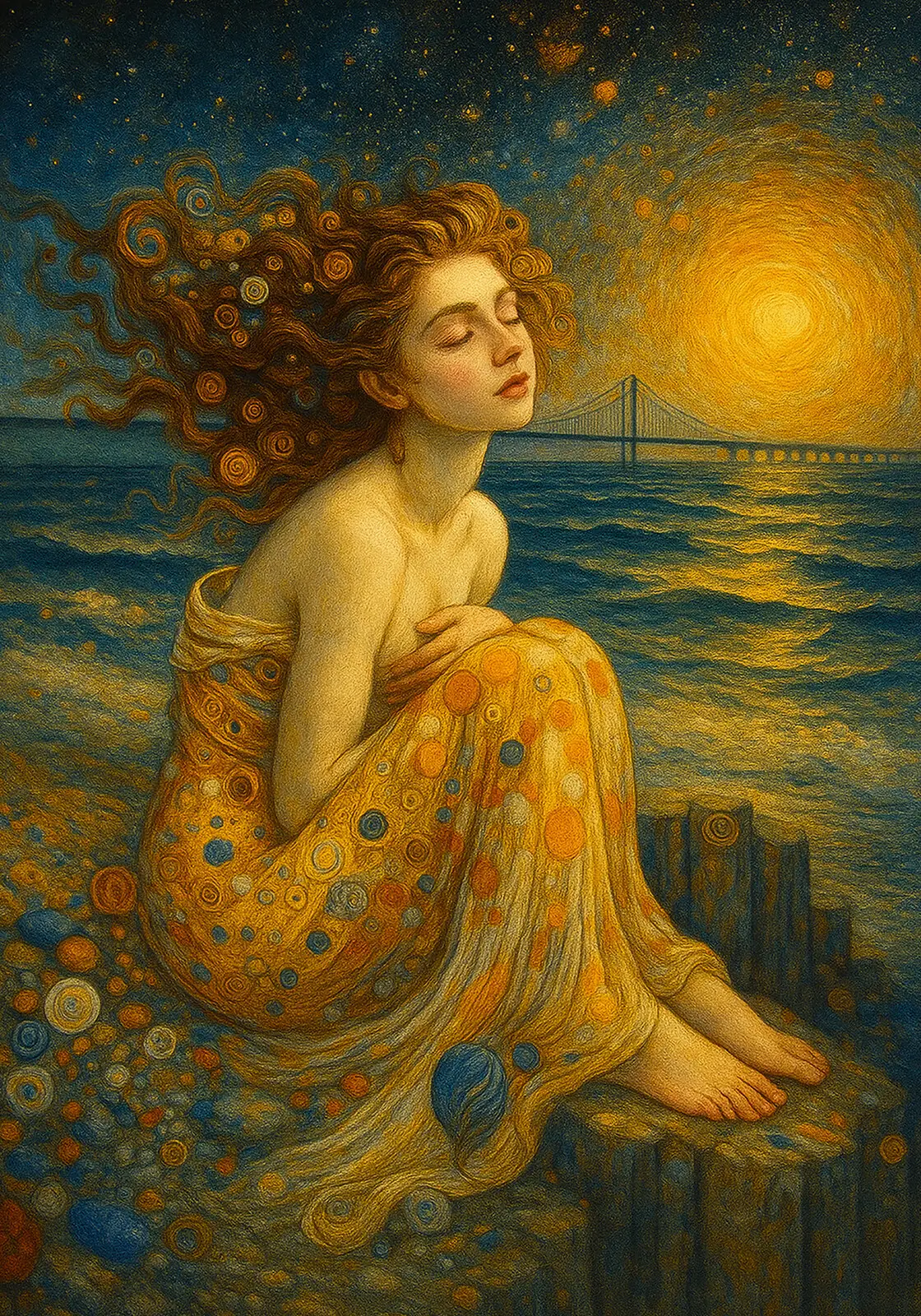
Väktartimmen – The Watcher's Hour, 2025
Digital
50 x 70 cm
3 200 kr
Väktartimmen – The Watcher's Hour
Luftkastellet, 9:46 PM – Late June 2025
Imagine a Nordic version of what is sometimes called late twilight – that elusive hour when the world holds its breath, suspended between the known and the unknown. It's a scene of unparalleled beauty, a moment that captivates the senses and stirs the soul.
The light is no longer warm, yet not entirely cold. The sea moves at its own pace, indifferent to whether it is night or day. The sun does not simply bid a final farewell across the Sound – It reflects something within the girl as well, an inner glow that radiates warmth and comfort against the deep indigo spilling in from the east.
And behind her, the Öresund Bridge stretches out like a thread spun between reality and reverie, between Malmö and what lies beyond – perhaps Copenhagen,
or maybe something more distant still:
a memory,
a dream,
a beginning we have yet to name.
“In the Last Breath of Light
She sits, not as an answer
but as a query.
Between tide and hush,
between day and dream,
She wears dusk’s silence
like a crown of golden dust.
She keeps watch –
not over the world,
but over the possibility
that it might begin again.”
Malmö June 2025
The Watcher’s Hour – and the Light of Transition
There are moments in the Nordic summer landscape that belong neither to day nor night. These moments serve no practical purpose — they are meant for neither work nor rest. They exist like cracks in time, pauses in the cosmos where the very heartbeat of the world seems to hesitate. It's within such moments that we become our most observant selves, feeling a sense of calm and tranquillity.
The image is saturated with atmosphere and charged with symbolism. It captures that midsummer moment when the light lingers on the horizon as if refusing to relent. The sun still glows in the west, like a burning heart, a farewell from the departing day. At the same time, darkness begins to draw in from the east — not as a threat, but as an invitation to stillness and dreams. The stars, those ancient witnesses, already shimmer faintly above the Sound. It is as if they are whispering to the woman seated by the rocks, her eyes closed, turned inward toward the realm of dreams.
What we witness here is Väktartimmen — The Watcher’s Hour. A word that may not exist in dictionaries but ought to. It’s a moment of transition, a time when the veil between the seen and the unseen is at its thinnest, and the natural world seems to hold its breath. It's a moment that fills us with awe and wonder, inviting us to contemplate the mysteries of the natural world. The Watcher's Hour is a time of profound stillness and transition, a moment when the boundaries between day and night, light and darkness, become blurred, inviting us to reflect on the transient nature of life and the beauty of these in-between moments.
It is also the hour when the golden light still clings to the stones while the blue from the eastern sky begins to creep in — tentatively, hesitantly. The light is neither warm nor cold, and precisely because of that, it is fragile. Human. A light that no longer explains the world but gently reminds us of its mystery.
The girl in the image sits still, yet in her stillness, something moves. Perhaps a farewell. Perhaps a promise. Her soft, Klimt-inspired skirt cascades like a fragment of art history down toward the shore, full of golden circles and cosmic motifs. Her hair mirrors the sea — billowing, untamed, an echo of starwinds. The sun behind her does not merely cast shadows — it kindles something within her — a glow in answer to what is soon to be extinguished out there. She is not just a figure in the landscape but a symbol of the human experience in the face of nature's transitions. She embodies our connection to the natural world, reminding us that we are part of a larger, ever-changing universe.
And in the background, the Öresund Bridge stretches like a nearly unreal link between worlds. It is not merely a passage between Malmö and Copenhagen; it embodies an idea, a condition, a boundary, and a transition—a bridge between reality and reverie, between what we know and what we sense. The bridge, with its sleek design and modern construction, signifies the intersection of past and future, tradition and innovation, and the physical and the metaphysical. It's a symbol of transition, a physical manifestation of the Watcher's Hour, and a key element in the narrative of this moment. The bridge, in its grandeur and purpose, serves as a metaphor for the transitions we experience in life, connecting the known to the unknown, the past to the future.
It is not a bridge one needs to cross. It is enough to see it. To know that it exists. To feel that something lies beyond.
In the Watcher’s Hour, one does not need to go anywhere. It is sufficient to sit still. To wait. To listen. And, like the girl, allow the twilight to speak on your behalf.
But this is not just any place. She sits there, at the southernmost edge of Malmö — at Luftkastellet, where the bridge both begins and ends, where the shoreline faces the wider world. From here, one observes how the Öresund Bridge narrows across the Sound and nearly disappears into the dusk, as if it leads not merely to another city, but to another time, beyond the horizon of time.
Malmö is a city of transitions. Of bridges — outer and inner. Here, fishing villages and visions of the future have coexisted; here, industrial harbours yield to flowerbeds; and here, the wind still carries echoes of languages from all corners of the world. But this particular moment — this Watcher’s Hour — belongs not to the city as such, but to the spirit of the place. And a little, too, to the woman in the image.
It is an hour when ancient beliefs return, like shadows among seaweed and grass. In old Nordic folklore, twilight was both dangerous and sacred. It was when the elves danced in the meadows, when the Näcken tuned his violin, and when sailors saw lights in the water that had no business being there. But it was also the hour of guardians and dream-sisters — feminine figures who, like the girl here, sat between worlds. Not to wander, but to watch.
Such figures were sometimes referred to as sun women. They were said to keep watch over the sun’s journey, guiding it to rest. They carried the memory of the day in their eyes but bore the riddles of the night in their presence. And surely, there is something of that in this young woman’s expression. She is not afraid of the dark. She is not in love with the sun. She exists in that which lies between—a resting awareness in the breath of dusk.
As so often in Malmö — where history, future, and folktale overlap — the place itself becomes a story, the bridge behind her tells a tale. Her dress is both a textile and a text. And the sky becomes a page, filled with constellations and unwritten lines.
When the sun finally dips beneath the horizon and the blue of night sweeps in from the west as well, the hour will be over. But it leaves something behind — a tone, a quiet knowing, a trace in the body. As if the light itself were saying:
“I will return. But you must keep watch.”
And she does.
In the image.
In the hour.
In us.
Even on days when the sky is full of clouds.
Colours are both the beginning and the birth of everything.
The golden rays of the sun are not merely celestial light — they speak of fire, warmth, and life. They cling to her skin like a final caress before the night takes over. The same gold reappears in her dress, in the spiral dance of the fabric, and in the whorls of her hair, as if she were an extension of the sun’s glow — and its messenger.
Art history has long celebrated the woman as the bearer of light, from the solar goddesses of antiquity to Klimt’s many golden portraits of feminine mystique. In my image, you encounter a light-bearer at rest. She no longer holds the light in her hands — she broods over it. She keeps it within her. Like a seed rooting itself in the darkness, waiting for Aurora to coax it toward the next dawn. Her stillness is not a lack of action, but a captivating beauty that draws you in.
For it is in darkness that all things grow. The ancients understood this — that night was not merely an absence of light, but a condition—a space for metamorphosis. The Watcher’s Hour, that fleeting point of transition, is not only beautiful — it is charged. In this hour, something happens to perception: colours shift, sounds soften, and thoughts deepen. It is an hour of passage, but also resistance against haste, overexposure, and forgetting.
And here, to the sea’s rhythmic breathing, the future also breathes.
Perhaps that is what the image wishes to convey: that there is a responsibility in carrying the light forward, not as a spotlight, but as an ember. In a world that — quite literally — is burning in many places, a still image of a woman by the sea, on twilight’s boundary, becomes a form of silent resistance. She doesn’t scream. She doesn’t flee. She stays. And in doing so, she reminds us of the value of standing still.
Even the Öresund Bridge seems to hesitate in this light. The bridge that usually rushes from point to point is here frozen into a silhouette. A line between worlds, suddenly imbued with a new function: to carry dreams, not just traffic. It is a bridge between the present and what comes next, between reality and possible form. It invites us to pause and reflect on our transitions.
And the woman—yes, she is no longer merely a body in the landscape. She is the landscape. A shoreline between light and dark. A border — or perhaps: a sentinel of borderlands, standing guard and providing a sense of security amid transition. She is not separate from the environment, but an integral part of it, embodying the unity of light and darkness.
The element which cannot be seen, yet holds us.
When night finally arrives, it doesn’t fall — it drapes. It veils the landscape slowly, gently. But something remains hidden beneath it, something we cannot see, yet it still supports us. Perhaps it is the warmth of the stone she sits on. Maybe the salt in the wind. Or perhaps it is simply the certainty that the light will return, not as triumph, but as promise. This promise of the returning light is a symbol of hope, a reminder that even in the darkest of times, there is always the potential for a brighter future.
We live our lives between these Watcher’s Hours. Moments when something opens, when something shifts shape. They are rare, but defining — and this image has captured one with near-religious precision.
It is not the sun that is the protagonist. Not the bridge. Not even the woman. It is the transition. And the willingness to remain within it. Not to rush. Not to numb. To stay — one breath longer.
For it may be in that very breath that we begin to remember what it means to be human.
Jörgen Thornberg
Väktartimmen – The Watcher's Hour, 2025
Digital
50 x 70 cm
3 200 kr
Väktartimmen – The Watcher's Hour
Luftkastellet, 9:46 PM – Late June 2025
Imagine a Nordic version of what is sometimes called late twilight – that elusive hour when the world holds its breath, suspended between the known and the unknown. It's a scene of unparalleled beauty, a moment that captivates the senses and stirs the soul.
The light is no longer warm, yet not entirely cold. The sea moves at its own pace, indifferent to whether it is night or day. The sun does not simply bid a final farewell across the Sound – It reflects something within the girl as well, an inner glow that radiates warmth and comfort against the deep indigo spilling in from the east.
And behind her, the Öresund Bridge stretches out like a thread spun between reality and reverie, between Malmö and what lies beyond – perhaps Copenhagen,
or maybe something more distant still:
a memory,
a dream,
a beginning we have yet to name.
“In the Last Breath of Light
She sits, not as an answer
but as a query.
Between tide and hush,
between day and dream,
She wears dusk’s silence
like a crown of golden dust.
She keeps watch –
not over the world,
but over the possibility
that it might begin again.”
Malmö June 2025
The Watcher’s Hour – and the Light of Transition
There are moments in the Nordic summer landscape that belong neither to day nor night. These moments serve no practical purpose — they are meant for neither work nor rest. They exist like cracks in time, pauses in the cosmos where the very heartbeat of the world seems to hesitate. It's within such moments that we become our most observant selves, feeling a sense of calm and tranquillity.
The image is saturated with atmosphere and charged with symbolism. It captures that midsummer moment when the light lingers on the horizon as if refusing to relent. The sun still glows in the west, like a burning heart, a farewell from the departing day. At the same time, darkness begins to draw in from the east — not as a threat, but as an invitation to stillness and dreams. The stars, those ancient witnesses, already shimmer faintly above the Sound. It is as if they are whispering to the woman seated by the rocks, her eyes closed, turned inward toward the realm of dreams.
What we witness here is Väktartimmen — The Watcher’s Hour. A word that may not exist in dictionaries but ought to. It’s a moment of transition, a time when the veil between the seen and the unseen is at its thinnest, and the natural world seems to hold its breath. It's a moment that fills us with awe and wonder, inviting us to contemplate the mysteries of the natural world. The Watcher's Hour is a time of profound stillness and transition, a moment when the boundaries between day and night, light and darkness, become blurred, inviting us to reflect on the transient nature of life and the beauty of these in-between moments.
It is also the hour when the golden light still clings to the stones while the blue from the eastern sky begins to creep in — tentatively, hesitantly. The light is neither warm nor cold, and precisely because of that, it is fragile. Human. A light that no longer explains the world but gently reminds us of its mystery.
The girl in the image sits still, yet in her stillness, something moves. Perhaps a farewell. Perhaps a promise. Her soft, Klimt-inspired skirt cascades like a fragment of art history down toward the shore, full of golden circles and cosmic motifs. Her hair mirrors the sea — billowing, untamed, an echo of starwinds. The sun behind her does not merely cast shadows — it kindles something within her — a glow in answer to what is soon to be extinguished out there. She is not just a figure in the landscape but a symbol of the human experience in the face of nature's transitions. She embodies our connection to the natural world, reminding us that we are part of a larger, ever-changing universe.
And in the background, the Öresund Bridge stretches like a nearly unreal link between worlds. It is not merely a passage between Malmö and Copenhagen; it embodies an idea, a condition, a boundary, and a transition—a bridge between reality and reverie, between what we know and what we sense. The bridge, with its sleek design and modern construction, signifies the intersection of past and future, tradition and innovation, and the physical and the metaphysical. It's a symbol of transition, a physical manifestation of the Watcher's Hour, and a key element in the narrative of this moment. The bridge, in its grandeur and purpose, serves as a metaphor for the transitions we experience in life, connecting the known to the unknown, the past to the future.
It is not a bridge one needs to cross. It is enough to see it. To know that it exists. To feel that something lies beyond.
In the Watcher’s Hour, one does not need to go anywhere. It is sufficient to sit still. To wait. To listen. And, like the girl, allow the twilight to speak on your behalf.
But this is not just any place. She sits there, at the southernmost edge of Malmö — at Luftkastellet, where the bridge both begins and ends, where the shoreline faces the wider world. From here, one observes how the Öresund Bridge narrows across the Sound and nearly disappears into the dusk, as if it leads not merely to another city, but to another time, beyond the horizon of time.
Malmö is a city of transitions. Of bridges — outer and inner. Here, fishing villages and visions of the future have coexisted; here, industrial harbours yield to flowerbeds; and here, the wind still carries echoes of languages from all corners of the world. But this particular moment — this Watcher’s Hour — belongs not to the city as such, but to the spirit of the place. And a little, too, to the woman in the image.
It is an hour when ancient beliefs return, like shadows among seaweed and grass. In old Nordic folklore, twilight was both dangerous and sacred. It was when the elves danced in the meadows, when the Näcken tuned his violin, and when sailors saw lights in the water that had no business being there. But it was also the hour of guardians and dream-sisters — feminine figures who, like the girl here, sat between worlds. Not to wander, but to watch.
Such figures were sometimes referred to as sun women. They were said to keep watch over the sun’s journey, guiding it to rest. They carried the memory of the day in their eyes but bore the riddles of the night in their presence. And surely, there is something of that in this young woman’s expression. She is not afraid of the dark. She is not in love with the sun. She exists in that which lies between—a resting awareness in the breath of dusk.
As so often in Malmö — where history, future, and folktale overlap — the place itself becomes a story, the bridge behind her tells a tale. Her dress is both a textile and a text. And the sky becomes a page, filled with constellations and unwritten lines.
When the sun finally dips beneath the horizon and the blue of night sweeps in from the west as well, the hour will be over. But it leaves something behind — a tone, a quiet knowing, a trace in the body. As if the light itself were saying:
“I will return. But you must keep watch.”
And she does.
In the image.
In the hour.
In us.
Even on days when the sky is full of clouds.
Colours are both the beginning and the birth of everything.
The golden rays of the sun are not merely celestial light — they speak of fire, warmth, and life. They cling to her skin like a final caress before the night takes over. The same gold reappears in her dress, in the spiral dance of the fabric, and in the whorls of her hair, as if she were an extension of the sun’s glow — and its messenger.
Art history has long celebrated the woman as the bearer of light, from the solar goddesses of antiquity to Klimt’s many golden portraits of feminine mystique. In my image, you encounter a light-bearer at rest. She no longer holds the light in her hands — she broods over it. She keeps it within her. Like a seed rooting itself in the darkness, waiting for Aurora to coax it toward the next dawn. Her stillness is not a lack of action, but a captivating beauty that draws you in.
For it is in darkness that all things grow. The ancients understood this — that night was not merely an absence of light, but a condition—a space for metamorphosis. The Watcher’s Hour, that fleeting point of transition, is not only beautiful — it is charged. In this hour, something happens to perception: colours shift, sounds soften, and thoughts deepen. It is an hour of passage, but also resistance against haste, overexposure, and forgetting.
And here, to the sea’s rhythmic breathing, the future also breathes.
Perhaps that is what the image wishes to convey: that there is a responsibility in carrying the light forward, not as a spotlight, but as an ember. In a world that — quite literally — is burning in many places, a still image of a woman by the sea, on twilight’s boundary, becomes a form of silent resistance. She doesn’t scream. She doesn’t flee. She stays. And in doing so, she reminds us of the value of standing still.
Even the Öresund Bridge seems to hesitate in this light. The bridge that usually rushes from point to point is here frozen into a silhouette. A line between worlds, suddenly imbued with a new function: to carry dreams, not just traffic. It is a bridge between the present and what comes next, between reality and possible form. It invites us to pause and reflect on our transitions.
And the woman—yes, she is no longer merely a body in the landscape. She is the landscape. A shoreline between light and dark. A border — or perhaps: a sentinel of borderlands, standing guard and providing a sense of security amid transition. She is not separate from the environment, but an integral part of it, embodying the unity of light and darkness.
The element which cannot be seen, yet holds us.
When night finally arrives, it doesn’t fall — it drapes. It veils the landscape slowly, gently. But something remains hidden beneath it, something we cannot see, yet it still supports us. Perhaps it is the warmth of the stone she sits on. Maybe the salt in the wind. Or perhaps it is simply the certainty that the light will return, not as triumph, but as promise. This promise of the returning light is a symbol of hope, a reminder that even in the darkest of times, there is always the potential for a brighter future.
We live our lives between these Watcher’s Hours. Moments when something opens, when something shifts shape. They are rare, but defining — and this image has captured one with near-religious precision.
It is not the sun that is the protagonist. Not the bridge. Not even the woman. It is the transition. And the willingness to remain within it. Not to rush. Not to numb. To stay — one breath longer.
For it may be in that very breath that we begin to remember what it means to be human.
3 200 kr

Jörgen Thornberg
Malmö
Lite om bilder och mig. Translation in English at the end.
Jag är en nyfiken person som ser allt i bilder, även det jag fäster i ord, gärna tillsammans för bakom alla mina bilder finns en berättelse. Till vissa bilder hör en kortare eller längre novell som följer med bilden.
Bilder berättar historier. Jag omges av naturlig skönhet, intressanta människor och historia var jag än går. Jag använder min kamera för att dokumentera världen och blanda det jag ser med vad jag känner för att fånga den dolda magin.
Mina bilder berättar mina historier. Genom mina bilder, tryck och berättelser. Jag bjuder in dig att ta del av dessa berättelser, in i ditt liv och hem och dela min mycket personliga syn på vår värld. Mer än vad ögat ser. Jag tänker i bilder, drömmer och skriver och pratar om dem; följaktligen måste jag också skapa bilder. De blir vad jag ser, inte nödvändigtvis begränsade till verkligheten. Det finns en bild runt varje hörn. Jag hoppas att du kommer att se vad jag såg och gilla det.
Jag är också en skrivande person och till många bilder hör en kortare eller längre essay. Den följer med tavlan, tryckt på fint papper och med en personlig hälsning från mig.
Flertalet bilder startar sin resa i min kamera. Enkelt förklarat beskriver jag bilden jag ser i mitt inre, upplevd eller fantiserad. Bilden uppstår inom mig redan innan jag fått okularet till ögat. På bråkdelen av ett ögonblick ser jag vad jag vill ha och vad som kan göras med bilden. Här skall jag stoppa in en giraff, stålmannen, Titanic eller vad det är min fantasi finner ut. Ännu märkligare är att jag kommer ihåg minnesbilden långt efteråt när det blir tid att skapa verket. Om jag lyckas eller inte, är upp till betraktaren, oftast präglat av en stråk av svart humor – meningen är att man skall bli underhållen. Mina bilder blir ofta en snackis där de hänger.
Jag föredrar bilder som förmedlar ett budskap i flera lager. Vid första anblicken fylld av feel-good, en vacker utsikt, fint väder, solen skiner, blommor på ängen eller vattnet som ligger förrädiskt spegelblankt. I en sådan bild kan jag gömma min egentliga berättelse, mitt förakt för förtryckare och våldsverkare, rasister och fördomsfulla människor - ett gärna återkommande motiv mer eller mindre dolt i det vackra motivet. Jag försöker förena dem i ett gemensamt narrativ.
Bild och formgivning har löpt som en röd tråd genom livet. Fotokonst känns som en värdig final som jag gärna delar med mig.
Min genre är vid som framgår av mina bilder, temat en blandning av pop- och gatukonst i kollage som kan bestå av hundratals lager. Vissa bilder kan ta veckor, andra någon dag innan det är dags att överlämna resultatet till printverkstaden. Fine Art Prints är digitala fotocollage. I dessa kollage sker rivandet, klippandet, pusslandet, målandet, ritandet och sprayningen digitalt. Det jag monterar in kan vara hundratals år gamla bilder som jag omsorgsfullt frilägger så att de ser ut att vara en del av tavlan men också bilder skapade av mig själv efter min egen fantasi. Därefter besöks printstudion och för vissa bilder numrera en limiterad upplaga (oftast 7 exemplar) och signera för hand. Vissa bilder kan köpas i olika format. Det är bara att fråga efter vilka. Gillar man en bild som är 70x100 men inte har plats på väggen, går den kanske att få i 50x70 cm istället. Frågan är fri.
Metoden Giclée eller Fine Art Print som det också kallas är det moderna sättet för framställning av grafisk konst. Villkoret för denna typ av utskrifter är att en högkvalitativ storformatskrivare används med åldersbeständigt färgpigment och konstnärspapper eller i förekommande fall på duk. Pappret som används möter de krav på livslängd som ställs av museer och gallerier. Normalt säljer jag mina bilder oinramade så att den nya ägaren själv kan bestämma hur de skall se ut, med eller utan passepartout färg på ram, med eller utan glas etc..
Under många år ställde jag bara ut på nätet, i valda grupper och på min egen Facebooksida - https://www.facebook.com/jorgen.thornberg.9
Jag finns också på en egen hemsida som tyvärr inte alltid är uppdaterad – https://www.jth.life/ Där kan du också läsa en del av de berättelser som följer med bilden.
UTSTÄLLNINGAR
Luftkastellet, oktober 2022
Konst i Lund, november 2022
Luftkastellet, mars 2023
Engleson Galleri Caroli, april 2023
Hydra, Greece June 2023
Engleson Galleri Caroli, oktober 2023
Toppen, Höllviken december 2023
Luftkastellet, mars 2024
Torups Galleri, mars 2024
Venice, May 2024
Luftkastellet, oktober 2024
Konst i Advent, December 2024
Galleri Engleson, Caroli December 2024
Jäger & Jansson Galleri, april 2025
A bit about pictures and me.
I'm a curious person who sees everything in pictures, even what I express in words, often combining them, for behind all my pictures lies a story. These narratives, some as short as a single image and others as long as a novel, are the heart and soul of my work.
Pictures tell stories. Wherever I go, I'm surrounded by natural beauty, exciting people, and history. I use my camera to document the world and blend what I see with what I feel to capture the hidden magic.
My images tell my stories. Through my pictures, prints, and narratives, I invite you to partake in these stories in your life and home and share my deeply personal perspective of our world. More than meets the eye. I think in pictures, dream, write, and talk about them; consequently, I must create images too. They become what I see, not necessarily confined to reality. There's a picture around every corner. I hope you'll see what I saw and enjoy it.
I'm also a writer, and many images come with a shorter or longer essay. It accompanies the painting, printed on fine paper with my personal greeting.
Many pictures start their journey on my camera. Simply put, I describe the image I see in my mind, experienced or imagined. The image arises within me even before I bring the eyepiece to my eye. In a fraction of a moment, I see what I want and what can be done with the picture. Here, I'll insert a giraffe, Superman, the Titanic, or whatever my imagination conjures up. Even stranger is that I remember the mental image long after it's time to create the work. Whether I succeed is up to the observer, often imbued with a streak of black humour – the aim is to entertain. My pictures usually become a talking point wherever they hang.
I prefer pictures that convey a message in multiple layers. At first glance, they're filled with feel-good vibes, a beautiful view, lovely weather, the sun shining, flowers in the meadow, or the water lying deceptively calm. But beneath this surface beauty, I often conceal a deeper story, a narrative that challenges societal norms or explores the human condition. I invite you to delve into these hidden narratives and discover the layers of meaning within my work.
Picture and design have been a thread running through my life. Photographic art feels like a fitting finale, and I'm happy to share it.
My genre is varied, as seen in my pictures; the theme is a blend of pop and street art in collages that can consist of hundreds of layers. Some images can take weeks, others just a day before it's time to hand over the result to the print workshop. Fine Art Prints are digital photo collages. In these collages, tearing, cutting, puzzling, painting, drawing, and spraying happen digitally. What I insert can be images hundreds of years old that I carefully extract so they appear to be part of the painting, but also images created by myself, now also generated from my imagination. Next, visit the print studio and, for certain images, number a limited edition (usually 7 copies) and sign them by hand. Some images may be available in other formats. Just ask which ones. If you like an image that's 70x100 but doesn't have space on the wall, you might be able to get it in 50x70 cm instead. The question is open.
The Giclée method, or Fine Art Print as it's also called, is the modern way of producing graphic art. This method ensures the highest quality and longevity of the artwork, using a high-quality large-format printer with archival pigment inks and artist paper or, in some cases, canvas. The paper used meets the longevity requirements set by museums and galleries. I sell my pictures unframed, allowing the new owner to personalise their artwork, confident in the lasting value and quality of the piece.
For many years, I only exhibited online, in selected groups, and on my Facebook page - https://www.facebook.com/jorgen.thornberg.9. I also have my website, which unfortunately is not constantly updated - https://www.jth.life/. You can also read some of the stories accompanying the pictures there.
EXHIBITIONS
Luftkastellet, October 2022
Art in Lund, November 2022
Luftkastellet, March 2023
Engleson Gallery Caroli, April 2023
Hydra, Greece June 2023
Engleson Gallery Caroli, October 2023
Toppen, Höllviken December 2023
Luftkastellet, March 2024
Torup Gallery, March 2024
Venice, May 2024
UTSTÄLLNINGAR
Luftkastellet, oktober 2022
Konst i Lund, november 2022
Luftkastellet, mars 2023
Engleson Galleri Caroli, april 2023
Hydra, Greece June 2023
Engleson Galleri Caroli, oktober 2023
Toppen, Höllviken december 2023
Luftkastellet, mars 2024
Torups Galleri, mars 2024
Venice, May 2024
Luftkastellet, October 2024
Konst i Advent, December 2024
Galleri Engleson, Caroli December 2024
Jäger & Jansson Galleri, April 2025
Utbildning
Autodidakt
Medlem i konstnärsförening
Öppna Sinnen
Med i konstrunda
Konstrundan i Skåne
Utställningar
Luftkastellet, October 2022
Art in Lund, November 2022
Luftkastellet, March 2023
Engleson Gallery Caroli, April 2023
Hydra, Greece June 2023
Engleson Gallery Caroli, October 2023
Toppen, Höllviken December 2023
Luftkastellet, March 2024
Torup Gallery, March 2024
Venice, May 2024