Vi använder cookies för att ge dig bästa möjliga upplevelse. Välj vilka cookies du tillåter.
Läs mer i vår integritetspolicy
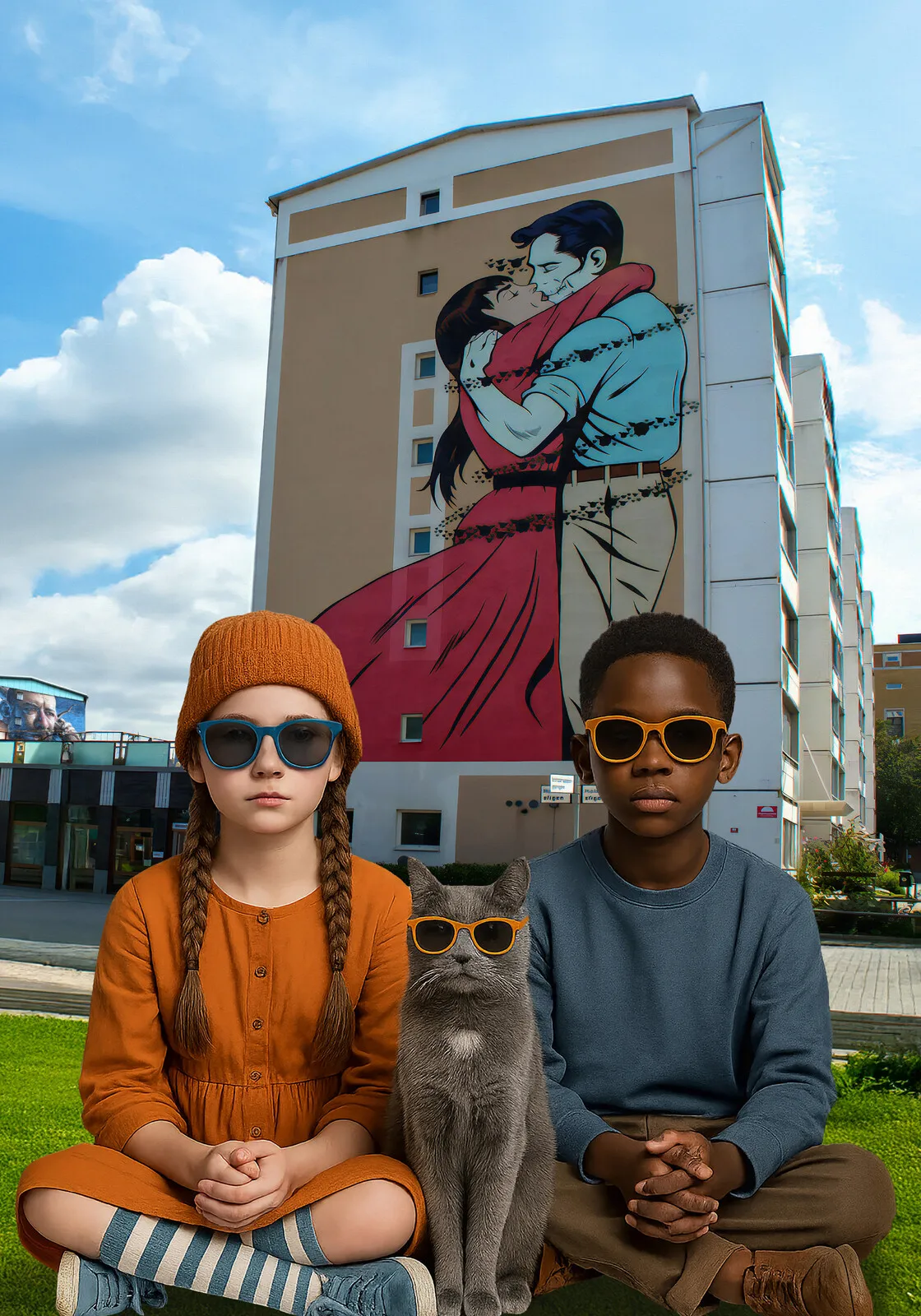
Jörgen Thornberg
The Last Embrace, 2020
Digital
50 x 70 cm
3 200 kr
The Last Embrace
In a suburb of Malmö, at Holma Square, two children sit beneath a towering mural that speaks louder than a thousand words. The artwork behind them is called "The Last Embrace," and like the city itself, it’s full of layers of love and loss, of leaving and belonging.
Dora and John, both twelve, have been shaped by life in unique ways. Dora, born in Malmö to parents who fled Kosovo during the war, and John, a boy of barely six, who arrived alone after violence in Sudan left him without a family. Despite their different paths, they now share a language, a schoolyard, and a cat named Frans, who tolerates no nonsense.
Their friendship isn’t loud, but it’s deep, built on stories, questions, laughter, and listening. Today, the sun lights up the mural like a stained-glass window. And as always, Dora starts to explain. John has heard it before, but he leans in anyway. Because her voice, like the painting, makes memory and meaning bloom again.
”The Last Embrace
(a poem for Dora, John, and Frans)
In Malmö’s heart, where borders blur,
Two voices rise where colours stir.
A painted wall, a story told,
Of love held tight, then left to fold.
She speaks of loss with grown-up grace,
A war-born fire behind her face.
He listens closely, with stardust eyes,
Still dreaming paths between the skies.
A red bouquet, a ghostly kiss,
A shadow cast in urban bliss.
Yet here they sit, not far from war,
With Frans the cat and hope in store.
Their hands don’t match, their gods don’t meet,
But laughter echoes through the street.
She talks of grief, the wall cannot hide,
He speaks of stars on the other side.
For some, embrace and then must part,
But others stay, heart pressed to heart.
And in this square, beneath the sky,
They hold a world that won’t say goodbye.”
Malmö, June 2025
A Girl, a Boy, and the Wall of Stories
A girl and a boy sit symbolically in Holma Square in Malmö, directly in front of one of the city’s many monumental pieces of street art. The mural behind them, a vibrant depiction of the city's multicultural fabric, is not just a painting, but a living testament to the diversity of Sweden’s most immigrant-rich city. It tells countless stories, each more compelling than the last. However, love is universal and has little to do with ethnicity or cultural background, as long as priests, imams, and shamans stay out of it. Even if this autumn day is lovely, the painting doesn't reflect the Scania weather, which isn’t always akin to that of warmer countries. Take it or leave it. That’s called assimilation.
Let us listen in on the conversation between the girl and the boy as she shares her insightful interpretation of the mural behind them. He’s heard it before, but she delights in telling it, and he, with his open mind, enjoys listening—a perfect match.
The girl’s name is Dora, and the boy is John. She was born in Malmö to parents who fled from Kosovo and are, at least on paper, Muslims. Neither she nor her parents care much about religion—it’s more of a hindrance than a source of comfort in their very secular new homeland. John arrived as an unaccompanied refugee from Sudan, not even six years old. Both his parents were killed in the ongoing conflict between North and South Sudan. They were Christians—murdered for it. These personal experiences with migration and the challenges they faced navigating the Swedish system have shaped their perspectives and resilience. Both Dora and John successfully navigated the complex and often daunting Swedish migration system, a process that involves numerous legal and bureaucratic hurdles, and they now hold permanent residency.
The cat, by the way, is hers. His name is Frans—because every cat should have a name.
Some background: Malmö is home to people from 187 different countries, not counting Sweden. This signifies a remarkable diversity of ethnicities and languages. The city is renowned for its multicultural character, and in truth, it has always been that way—it’s Sweden’s gateway to Europe. Refugees began arriving in the town during World War II, and its history is reflected in the street names. Frans Suell, who built Malmö’s harbour, was an immigrant from Germany and is immortalised in bronze not far from the city’s most extravagant private residence—the Kock House. He and Jörgen Kock, also from Germany, were both exceedingly successful. Under Kock’s leadership in the 1500s, Malmö entered a golden age. Two and a half centuries later, Suell dedicated over forty years and much of his fortune to give Malmö a harbour worthy of its name.
Today, Malmö stands as a vibrant tapestry of cultures, with over fifty per cent of its population boasting a foreign background—either born abroad or having at least one foreign-born parent. The most common countries of origin include Syria, Denmark, the former Yugoslavia, Poland, and Bosnia and Herzegovina. More than 150 languages are spoken in the city, a testament to its rich cultural diversity. As of 31 December 2019, Malmö’s population stood at 344,166. Of those, just over 160,726 people (46.7%) had a foreign background.
But now, let’s turn to Dora’s explanation of the embrace on the wall behind them, titled The Last Embrace. It’s worth listening to.
Everyone in the neighbourhood knew the mural was painted by D*Face, an English multimedia street artist known for employing spray paint, stickers, posters, and stencils. Most people had stopped by to watch him complete the towering artwork back in 2019.
Dora conveys it in an almost grown-up tone—but then again, she’s turning thirteen this autumn. “Big Lady,” as her father calls her. Dora is a little more mature than her peers, a quality she has developed through the challenges she has faced as an immigrant child. As a girl, she has to speak up to get ahead. She understands that being the best in class is the way to succeed in the adult world.
John, although the same age, admires her determination and the depth of her knowledge. He prefers spending time with her rather than with the boys, who still want to play. He dreams of becoming an astronaut—of going higher than anyone, of becoming the first African in space. His aspirations and dreams, influenced by his hero Mandla Maseko, who tragically died before his space flight, add depth to his character and motivations.
His hero was Mandla Maseko from South Africa, who was meant to become the first black African in space—but tragically died in a motorcycle accident in 2019 before the flight ever happened.
A few years from now, it will be John’s turn. He’s decided. That’s why he absorbs all the knowledge he can.
DORA:
"The last embrace," she begins, her voice carrying the weight of the words. “It's not just a regular hug, but a farewell in its truest sense. A hug that signifies the end of a chapter, the finality of a goodbye.”
JOHN:
“You mean like forever?”
DORA:
“Exactly. Like, someone’s leaving. Or dying. Or just… disappearing.”
She pauses and strokes her cat, Frans, who is purring against her knee as if he knows this is a profound moment. The scent of freshly cut grass and distant city sounds fills the air, adding to the tranquillity of the moment.
JOHN:
“But isn’t it just a mural? I mean, it’s paint. On a wall.”
DORA:
“Yeah, but look.” She points at the wall behind them, the mural looming large. “You see how they’re holding each other? That’s not just a hug. That’s the kind of hug you remember forever.”
JOHN:
“You talk like my social studies teacher.”
DORA (grinning):
“I’m going to be better than your social studies teacher. Just wait.”
JOHN (smiling):
“I bet you will.”
He leans back on the grass, watching her as if he’s memorising everything she says, their connection palpable in the air.
DORA:
“There was this man from Delhi; I read about him. His wife died, and the last time he hugged her, he didn’t know it would be the last. And now he can’t forget it. That’s the point, John. You never know when something is the last time. And hugs… they tell stories. Even without words.”
JOHN:
“Like when my mum hugged me before the soldiers came.”
DORA (quietly):
“I know.”
There’s a pause. The cat shifts in Dora’s lap.
JOHN:
“She knew too. That she wouldn’t see me again.”
DORA:
“Just like the man’s wife. She hugged him like she was saying goodbye, even though he didn’t get it then.”
JOHN:
“I think about it sometimes. Like… I should have held on longer.”
DORA:
“You were a child. You were six.”
JOHN:
“You still remember things when you’re six.”
DORA:
“I remember hiding under the stairs when the bombs fell on our block. I was five. I even remember the smell. My mum said I screamed so loud the neighbour thought we were all dead.”
JOHN:
“We’re still here, though.”
DORA:
“Yep. That’s what counts.” She scratches behind Frans’s ears. “And that we get to sit here. In Malmö. In front of D*Face’s giant sad lovers.”
JOHN:
“It’s not really about the painting, is it?”
DORA:
“No. It’s about what it reminds you of—all the last hugs in the world. Yours. Mine. His. Hers. All of them. It’s like… memory paint.”
JOHN:
“Wow.” He blinks. “That’s deep.”
DORA:
“Sometimes I think everything important in life is either a hug or a question.”
JOHN (after a pause):
“What’s the question then?”
DORA:
“Do you know it’s the last time… while it’s still happening?”
He doesn’t answer right away. Just stares at the mural, thoughtful. Then he says, almost in a whisper:
JOHN:
“I’m gonna be the first African in space, Dora. I’ll hug the Earth from up there. I’ll wave to all the mums and dads and kids and mural lovers.”
DORA (smiling):
“Just don’t forget to come back for one last hug.”
JOHN:
"Next time," he says, gently scratching Frans behind the ear, "I’m gonna tell you something you probably don’t know as much about."
Frans lets out a satisfied prrrr, eyes half-closed, as if he approves of where this is going.
JOHN (grinning):
"Like why black holes are blacker than my skin—and how come black matter is way more common in space than white, whatever that even looks like."
He chuckles, just a little. Dora raises an eyebrow, intrigued.
JOHN:
"Maybe the universe already figured out something we haven’t. Maybe it knows... black matters."
Frans purrs louder.
DORA (softly):
"I’m listening."
JOHN (smiling, almost whispering):
"You better. ‘Cause next time, I’ll be the one telling the story."
And for a moment, beneath a painting about last goodbyes, two kids sit quietly on a Malmö square, already dreaming forward.st goodbyes, two kids sit quietly on a Malmö square, already dreaming forward.
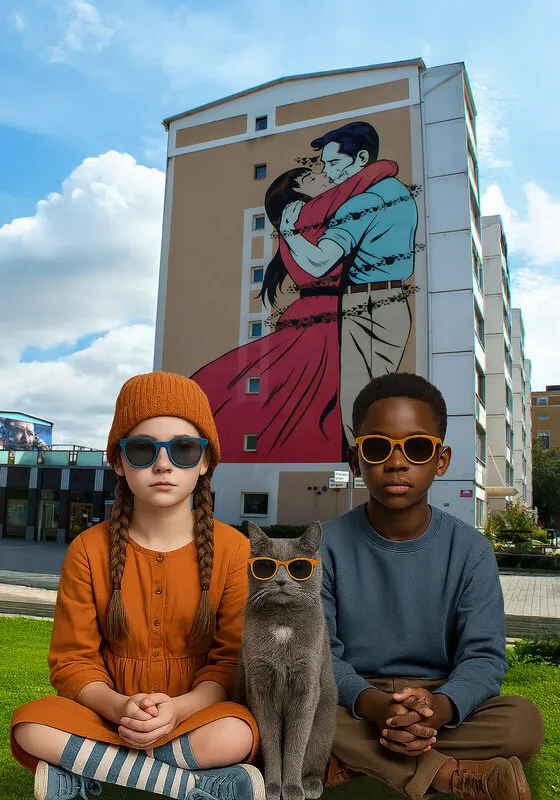
Jörgen Thornberg
The Last Embrace, 2020
Digital
50 x 70 cm
3 200 kr
The Last Embrace
In a suburb of Malmö, at Holma Square, two children sit beneath a towering mural that speaks louder than a thousand words. The artwork behind them is called "The Last Embrace," and like the city itself, it’s full of layers of love and loss, of leaving and belonging.
Dora and John, both twelve, have been shaped by life in unique ways. Dora, born in Malmö to parents who fled Kosovo during the war, and John, a boy of barely six, who arrived alone after violence in Sudan left him without a family. Despite their different paths, they now share a language, a schoolyard, and a cat named Frans, who tolerates no nonsense.
Their friendship isn’t loud, but it’s deep, built on stories, questions, laughter, and listening. Today, the sun lights up the mural like a stained-glass window. And as always, Dora starts to explain. John has heard it before, but he leans in anyway. Because her voice, like the painting, makes memory and meaning bloom again.
”The Last Embrace
(a poem for Dora, John, and Frans)
In Malmö’s heart, where borders blur,
Two voices rise where colours stir.
A painted wall, a story told,
Of love held tight, then left to fold.
She speaks of loss with grown-up grace,
A war-born fire behind her face.
He listens closely, with stardust eyes,
Still dreaming paths between the skies.
A red bouquet, a ghostly kiss,
A shadow cast in urban bliss.
Yet here they sit, not far from war,
With Frans the cat and hope in store.
Their hands don’t match, their gods don’t meet,
But laughter echoes through the street.
She talks of grief, the wall cannot hide,
He speaks of stars on the other side.
For some, embrace and then must part,
But others stay, heart pressed to heart.
And in this square, beneath the sky,
They hold a world that won’t say goodbye.”
Malmö, June 2025
A Girl, a Boy, and the Wall of Stories
A girl and a boy sit symbolically in Holma Square in Malmö, directly in front of one of the city’s many monumental pieces of street art. The mural behind them, a vibrant depiction of the city's multicultural fabric, is not just a painting, but a living testament to the diversity of Sweden’s most immigrant-rich city. It tells countless stories, each more compelling than the last. However, love is universal and has little to do with ethnicity or cultural background, as long as priests, imams, and shamans stay out of it. Even if this autumn day is lovely, the painting doesn't reflect the Scania weather, which isn’t always akin to that of warmer countries. Take it or leave it. That’s called assimilation.
Let us listen in on the conversation between the girl and the boy as she shares her insightful interpretation of the mural behind them. He’s heard it before, but she delights in telling it, and he, with his open mind, enjoys listening—a perfect match.
The girl’s name is Dora, and the boy is John. She was born in Malmö to parents who fled from Kosovo and are, at least on paper, Muslims. Neither she nor her parents care much about religion—it’s more of a hindrance than a source of comfort in their very secular new homeland. John arrived as an unaccompanied refugee from Sudan, not even six years old. Both his parents were killed in the ongoing conflict between North and South Sudan. They were Christians—murdered for it. These personal experiences with migration and the challenges they faced navigating the Swedish system have shaped their perspectives and resilience. Both Dora and John successfully navigated the complex and often daunting Swedish migration system, a process that involves numerous legal and bureaucratic hurdles, and they now hold permanent residency.
The cat, by the way, is hers. His name is Frans—because every cat should have a name.
Some background: Malmö is home to people from 187 different countries, not counting Sweden. This signifies a remarkable diversity of ethnicities and languages. The city is renowned for its multicultural character, and in truth, it has always been that way—it’s Sweden’s gateway to Europe. Refugees began arriving in the town during World War II, and its history is reflected in the street names. Frans Suell, who built Malmö’s harbour, was an immigrant from Germany and is immortalised in bronze not far from the city’s most extravagant private residence—the Kock House. He and Jörgen Kock, also from Germany, were both exceedingly successful. Under Kock’s leadership in the 1500s, Malmö entered a golden age. Two and a half centuries later, Suell dedicated over forty years and much of his fortune to give Malmö a harbour worthy of its name.
Today, Malmö stands as a vibrant tapestry of cultures, with over fifty per cent of its population boasting a foreign background—either born abroad or having at least one foreign-born parent. The most common countries of origin include Syria, Denmark, the former Yugoslavia, Poland, and Bosnia and Herzegovina. More than 150 languages are spoken in the city, a testament to its rich cultural diversity. As of 31 December 2019, Malmö’s population stood at 344,166. Of those, just over 160,726 people (46.7%) had a foreign background.
But now, let’s turn to Dora’s explanation of the embrace on the wall behind them, titled The Last Embrace. It’s worth listening to.
Everyone in the neighbourhood knew the mural was painted by D*Face, an English multimedia street artist known for employing spray paint, stickers, posters, and stencils. Most people had stopped by to watch him complete the towering artwork back in 2019.
Dora conveys it in an almost grown-up tone—but then again, she’s turning thirteen this autumn. “Big Lady,” as her father calls her. Dora is a little more mature than her peers, a quality she has developed through the challenges she has faced as an immigrant child. As a girl, she has to speak up to get ahead. She understands that being the best in class is the way to succeed in the adult world.
John, although the same age, admires her determination and the depth of her knowledge. He prefers spending time with her rather than with the boys, who still want to play. He dreams of becoming an astronaut—of going higher than anyone, of becoming the first African in space. His aspirations and dreams, influenced by his hero Mandla Maseko, who tragically died before his space flight, add depth to his character and motivations.
His hero was Mandla Maseko from South Africa, who was meant to become the first black African in space—but tragically died in a motorcycle accident in 2019 before the flight ever happened.
A few years from now, it will be John’s turn. He’s decided. That’s why he absorbs all the knowledge he can.
DORA:
"The last embrace," she begins, her voice carrying the weight of the words. “It's not just a regular hug, but a farewell in its truest sense. A hug that signifies the end of a chapter, the finality of a goodbye.”
JOHN:
“You mean like forever?”
DORA:
“Exactly. Like, someone’s leaving. Or dying. Or just… disappearing.”
She pauses and strokes her cat, Frans, who is purring against her knee as if he knows this is a profound moment. The scent of freshly cut grass and distant city sounds fills the air, adding to the tranquillity of the moment.
JOHN:
“But isn’t it just a mural? I mean, it’s paint. On a wall.”
DORA:
“Yeah, but look.” She points at the wall behind them, the mural looming large. “You see how they’re holding each other? That’s not just a hug. That’s the kind of hug you remember forever.”
JOHN:
“You talk like my social studies teacher.”
DORA (grinning):
“I’m going to be better than your social studies teacher. Just wait.”
JOHN (smiling):
“I bet you will.”
He leans back on the grass, watching her as if he’s memorising everything she says, their connection palpable in the air.
DORA:
“There was this man from Delhi; I read about him. His wife died, and the last time he hugged her, he didn’t know it would be the last. And now he can’t forget it. That’s the point, John. You never know when something is the last time. And hugs… they tell stories. Even without words.”
JOHN:
“Like when my mum hugged me before the soldiers came.”
DORA (quietly):
“I know.”
There’s a pause. The cat shifts in Dora’s lap.
JOHN:
“She knew too. That she wouldn’t see me again.”
DORA:
“Just like the man’s wife. She hugged him like she was saying goodbye, even though he didn’t get it then.”
JOHN:
“I think about it sometimes. Like… I should have held on longer.”
DORA:
“You were a child. You were six.”
JOHN:
“You still remember things when you’re six.”
DORA:
“I remember hiding under the stairs when the bombs fell on our block. I was five. I even remember the smell. My mum said I screamed so loud the neighbour thought we were all dead.”
JOHN:
“We’re still here, though.”
DORA:
“Yep. That’s what counts.” She scratches behind Frans’s ears. “And that we get to sit here. In Malmö. In front of D*Face’s giant sad lovers.”
JOHN:
“It’s not really about the painting, is it?”
DORA:
“No. It’s about what it reminds you of—all the last hugs in the world. Yours. Mine. His. Hers. All of them. It’s like… memory paint.”
JOHN:
“Wow.” He blinks. “That’s deep.”
DORA:
“Sometimes I think everything important in life is either a hug or a question.”
JOHN (after a pause):
“What’s the question then?”
DORA:
“Do you know it’s the last time… while it’s still happening?”
He doesn’t answer right away. Just stares at the mural, thoughtful. Then he says, almost in a whisper:
JOHN:
“I’m gonna be the first African in space, Dora. I’ll hug the Earth from up there. I’ll wave to all the mums and dads and kids and mural lovers.”
DORA (smiling):
“Just don’t forget to come back for one last hug.”
JOHN:
"Next time," he says, gently scratching Frans behind the ear, "I’m gonna tell you something you probably don’t know as much about."
Frans lets out a satisfied prrrr, eyes half-closed, as if he approves of where this is going.
JOHN (grinning):
"Like why black holes are blacker than my skin—and how come black matter is way more common in space than white, whatever that even looks like."
He chuckles, just a little. Dora raises an eyebrow, intrigued.
JOHN:
"Maybe the universe already figured out something we haven’t. Maybe it knows... black matters."
Frans purrs louder.
DORA (softly):
"I’m listening."
JOHN (smiling, almost whispering):
"You better. ‘Cause next time, I’ll be the one telling the story."
And for a moment, beneath a painting about last goodbyes, two kids sit quietly on a Malmö square, already dreaming forward.st goodbyes, two kids sit quietly on a Malmö square, already dreaming forward.
3 200 kr

Jörgen Thornberg
Malmö
Lite om bilder och mig. Translation in English at the end.
Jag är en nyfiken person som ser allt i bilder, även det jag fäster i ord, gärna tillsammans för bakom alla mina bilder finns en berättelse. Till vissa bilder hör en kortare eller längre novell som följer med bilden.
Bilder berättar historier. Jag omges av naturlig skönhet, intressanta människor och historia var jag än går. Jag använder min kamera för att dokumentera världen och blanda det jag ser med vad jag känner för att fånga den dolda magin.
Mina bilder berättar mina historier. Genom mina bilder, tryck och berättelser. Jag bjuder in dig att ta del av dessa berättelser, in i ditt liv och hem och dela min mycket personliga syn på vår värld. Mer än vad ögat ser. Jag tänker i bilder, drömmer och skriver och pratar om dem; följaktligen måste jag också skapa bilder. De blir vad jag ser, inte nödvändigtvis begränsade till verkligheten. Det finns en bild runt varje hörn. Jag hoppas att du kommer att se vad jag såg och gilla det.
Jag är också en skrivande person och till många bilder hör en kortare eller längre essay. Den följer med tavlan, tryckt på fint papper och med en personlig hälsning från mig.
Flertalet bilder startar sin resa i min kamera. Enkelt förklarat beskriver jag bilden jag ser i mitt inre, upplevd eller fantiserad. Bilden uppstår inom mig redan innan jag fått okularet till ögat. På bråkdelen av ett ögonblick ser jag vad jag vill ha och vad som kan göras med bilden. Här skall jag stoppa in en giraff, stålmannen, Titanic eller vad det är min fantasi finner ut. Ännu märkligare är att jag kommer ihåg minnesbilden långt efteråt när det blir tid att skapa verket. Om jag lyckas eller inte, är upp till betraktaren, oftast präglat av en stråk av svart humor – meningen är att man skall bli underhållen. Mina bilder blir ofta en snackis där de hänger.
Jag föredrar bilder som förmedlar ett budskap i flera lager. Vid första anblicken fylld av feel-good, en vacker utsikt, fint väder, solen skiner, blommor på ängen eller vattnet som ligger förrädiskt spegelblankt. I en sådan bild kan jag gömma min egentliga berättelse, mitt förakt för förtryckare och våldsverkare, rasister och fördomsfulla människor - ett gärna återkommande motiv mer eller mindre dolt i det vackra motivet. Jag försöker förena dem i ett gemensamt narrativ.
Bild och formgivning har löpt som en röd tråd genom livet. Fotokonst känns som en värdig final som jag gärna delar med mig.
Min genre är vid som framgår av mina bilder, temat en blandning av pop- och gatukonst i kollage som kan bestå av hundratals lager. Vissa bilder kan ta veckor, andra någon dag innan det är dags att överlämna resultatet till printverkstaden. Fine Art Prints är digitala fotocollage. I dessa kollage sker rivandet, klippandet, pusslandet, målandet, ritandet och sprayningen digitalt. Det jag monterar in kan vara hundratals år gamla bilder som jag omsorgsfullt frilägger så att de ser ut att vara en del av tavlan men också bilder skapade av mig själv efter min egen fantasi. Därefter besöks printstudion och för vissa bilder numrera en limiterad upplaga (oftast 7 exemplar) och signera för hand. Vissa bilder kan köpas i olika format. Det är bara att fråga efter vilka. Gillar man en bild som är 70x100 men inte har plats på väggen, går den kanske att få i 50x70 cm istället. Frågan är fri.
Metoden Giclée eller Fine Art Print som det också kallas är det moderna sättet för framställning av grafisk konst. Villkoret för denna typ av utskrifter är att en högkvalitativ storformatskrivare används med åldersbeständigt färgpigment och konstnärspapper eller i förekommande fall på duk. Pappret som används möter de krav på livslängd som ställs av museer och gallerier. Normalt säljer jag mina bilder oinramade så att den nya ägaren själv kan bestämma hur de skall se ut, med eller utan passepartout färg på ram, med eller utan glas etc..
Under många år ställde jag bara ut på nätet, i valda grupper och på min egen Facebooksida - https://www.facebook.com/jorgen.thornberg.9
Jag finns också på en egen hemsida som tyvärr inte alltid är uppdaterad – https://www.jth.life/ Där kan du också läsa en del av de berättelser som följer med bilden.
UTSTÄLLNINGAR
Luftkastellet, oktober 2022
Konst i Lund, november 2022
Luftkastellet, mars 2023
Engleson Galleri Caroli, april 2023
Hydra, Greece June 2023
Engleson Galleri Caroli, oktober 2023
Toppen, Höllviken december 2023
Luftkastellet, mars 2024
Torups Galleri, mars 2024
Venice, May 2024
Luftkastellet, oktober 2024
Konst i Advent, December 2024
Galleri Engleson, Caroli December 2024
Jäger & Jansson Galleri, april 2025
A bit about pictures and me.
I'm a curious person who sees everything in pictures, even what I express in words, often combining them, for behind all my pictures lies a story. These narratives, some as short as a single image and others as long as a novel, are the heart and soul of my work.
Pictures tell stories. Wherever I go, I'm surrounded by natural beauty, exciting people, and history. I use my camera to document the world and blend what I see with what I feel to capture the hidden magic.
My images tell my stories. Through my pictures, prints, and narratives, I invite you to partake in these stories in your life and home and share my deeply personal perspective of our world. More than meets the eye. I think in pictures, dream, write, and talk about them; consequently, I must create images too. They become what I see, not necessarily confined to reality. There's a picture around every corner. I hope you'll see what I saw and enjoy it.
I'm also a writer, and many images come with a shorter or longer essay. It accompanies the painting, printed on fine paper with my personal greeting.
Many pictures start their journey on my camera. Simply put, I describe the image I see in my mind, experienced or imagined. The image arises within me even before I bring the eyepiece to my eye. In a fraction of a moment, I see what I want and what can be done with the picture. Here, I'll insert a giraffe, Superman, the Titanic, or whatever my imagination conjures up. Even stranger is that I remember the mental image long after it's time to create the work. Whether I succeed is up to the observer, often imbued with a streak of black humour – the aim is to entertain. My pictures usually become a talking point wherever they hang.
I prefer pictures that convey a message in multiple layers. At first glance, they're filled with feel-good vibes, a beautiful view, lovely weather, the sun shining, flowers in the meadow, or the water lying deceptively calm. But beneath this surface beauty, I often conceal a deeper story, a narrative that challenges societal norms or explores the human condition. I invite you to delve into these hidden narratives and discover the layers of meaning within my work.
Picture and design have been a thread running through my life. Photographic art feels like a fitting finale, and I'm happy to share it.
My genre is varied, as seen in my pictures; the theme is a blend of pop and street art in collages that can consist of hundreds of layers. Some images can take weeks, others just a day before it's time to hand over the result to the print workshop. Fine Art Prints are digital photo collages. In these collages, tearing, cutting, puzzling, painting, drawing, and spraying happen digitally. What I insert can be images hundreds of years old that I carefully extract so they appear to be part of the painting, but also images created by myself, now also generated from my imagination. Next, visit the print studio and, for certain images, number a limited edition (usually 7 copies) and sign them by hand. Some images may be available in other formats. Just ask which ones. If you like an image that's 70x100 but doesn't have space on the wall, you might be able to get it in 50x70 cm instead. The question is open.
The Giclée method, or Fine Art Print as it's also called, is the modern way of producing graphic art. This method ensures the highest quality and longevity of the artwork, using a high-quality large-format printer with archival pigment inks and artist paper or, in some cases, canvas. The paper used meets the longevity requirements set by museums and galleries. I sell my pictures unframed, allowing the new owner to personalise their artwork, confident in the lasting value and quality of the piece.
For many years, I only exhibited online, in selected groups, and on my Facebook page - https://www.facebook.com/jorgen.thornberg.9. I also have my website, which unfortunately is not constantly updated - https://www.jth.life/. You can also read some of the stories accompanying the pictures there.
EXHIBITIONS
Luftkastellet, October 2022
Art in Lund, November 2022
Luftkastellet, March 2023
Engleson Gallery Caroli, April 2023
Hydra, Greece June 2023
Engleson Gallery Caroli, October 2023
Toppen, Höllviken December 2023
Luftkastellet, March 2024
Torup Gallery, March 2024
Venice, May 2024
UTSTÄLLNINGAR
Luftkastellet, oktober 2022
Konst i Lund, november 2022
Luftkastellet, mars 2023
Engleson Galleri Caroli, april 2023
Hydra, Greece June 2023
Engleson Galleri Caroli, oktober 2023
Toppen, Höllviken december 2023
Luftkastellet, mars 2024
Torups Galleri, mars 2024
Venice, May 2024
Luftkastellet, October 2024
Konst i Advent, December 2024
Galleri Engleson, Caroli December 2024
Jäger & Jansson Galleri, April 2025
Utbildning
Autodidakt
Medlem i konstnärsförening
Öppna Sinnen
Med i konstrunda
Konstrundan i Skåne
Utställningar
Luftkastellet, October 2022
Art in Lund, November 2022
Luftkastellet, March 2023
Engleson Gallery Caroli, April 2023
Hydra, Greece June 2023
Engleson Gallery Caroli, October 2023
Toppen, Höllviken December 2023
Luftkastellet, March 2024
Torup Gallery, March 2024
Venice, May 2024