Vi använder cookies för att ge dig bästa möjliga upplevelse. Välj vilka cookies du tillåter.
Läs mer i vår integritetspolicy
Jörgen Thornberg
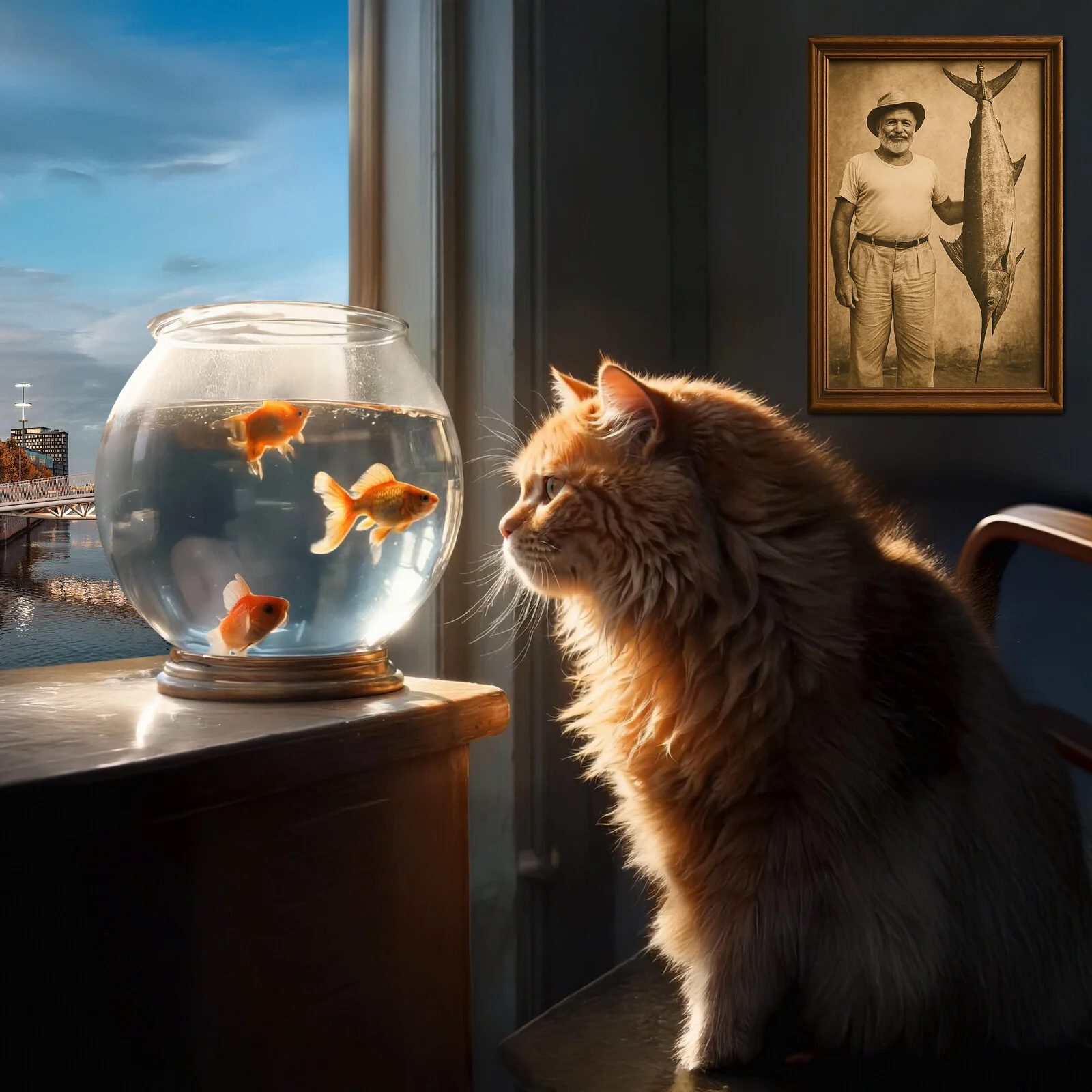
Wishful thinking. Reflections of Desire, 2025
Digital
70 x 70 cm
3 200 kr
Purr & Putte – Conversations Through Glass
In a small apartment above the harbor, beneath a photograph of Hemingway and a marlin, a red tabby cat named Purr and a goldfish named Putte engage in one of the most unlikely intellectual friendships in recent memory. Their unique perspective, shaped by their respective species and experiences, leads them to ponder everything from ancient scripture to submarine voyages, from shipwrecked heroes to sticky moral dilemmas—sometimes with elegance, sometimes with whiskers askew.
What begins as a stare-off between predator and potential snack slowly evolves into a rich and thought-provoking dialogue about literature, history, fishing, theology, and life's great, briny mysteries. With dry wit and wet fins, they revisit Jonah’s whale (and its lesser-known feline stowaway), weigh the ethics of fly fishing, debate Captain Nemo’s vegetarianism, and mourn the forgotten glories of ship’s cats with extra toes.
This is a tale of literal and philosophical reflection where each conversation becomes a ripple that stirs the water, the whiskers, and the reader’s heart. Welcome to a world where a paw against glass is not a barrier but an invitation.
”Putte's Compass
A goldfish maps the world from glass
In circles slow, with silent grace,
Putte charted his watery space.
No ship, no sail, no need to roam—
his bowl, his world, his crystal dome.
To west he turned, a daily fright:
The weathered photo, stark in light.
A fisherman stood, proud and pale,
his marlin limp, a silent tale.
The tail still hung, the eyes were dry—
Putte flinched, then drifted by.
To south he swam, where wisdom sleeps,
in books that climbed the dusty deeps.
A shelf of thoughts in binding tight,
with tales of fish and human plight.
Homer, Verne, Melville in stacks—
Putte read spines and filled the cracks.
For a goldfish in golden swirl,
he knew the weight of the world.
Then east, where morning always starts,
the light poured like music charts.
Each dawn a hush, a ripple born,
a fish’s joy for each new morn.
Gold glinted through the glassy curve,
and Putte spun with quiet verve.
To north, the window faced the quay,
the tide, the gulls, the salt, the spray.
He watched the ships, the shifting sea,
the strangers passing absently.
And on clear days, with fins held proud,
he’d glimpse a distant foreign cloud.
A globe within a bowl, you see—
he traveled much in reverie.
Around him swam his silent kin,
of porcelain glaze and painted fin.
Old Tang fish from dynastic days,
with lotus crowns and noble glaze.
Though still and mute, they stood as peers,
the legacy of ancient years.
So round he went, each compass tried,
no storm, no net, no tide to hide.
With every turn, another thought unfurled—
For Putte, bowl and mind were the world.
And when his arc was once complete,
each side observed, each thought replete,
he paused mid-swirl, with quiet flair,
blew one proud bubble in the air—
then turned, as always, with a nod,
and said: “Well now. I’ve seen it all. By Cod.“
Malmö, April 2025
Reflections of Desire – The Glass Between Them
On a sunlit afternoon in a harbor-side apartment, a red tabby cat named Purr perched on a chair beside the dining table. On that table, elevated slightly for effect, sat a round glass bowl containing three golden fish, the most observant of them named Putte. As the sun streamed through the window, casting rippling patterns on the wall, the two locked eyes through the curvature of the glass. The world, for a brief moment, stood still.
Purr’s initial gaze was not entirely poetic. There was a distinct rumble in his belly and a vision of sashimi dancing across his mind’s eye. But as it slowly dawned on him that the fish were off-limits—and that the dry food in the kitchen would, once again, be his only feast—his demeanor softened. He lifted a dignified paw, licked it slowly, and addressed the fish:
"You’re lucky to have me, you know. Without a vigilant feline presence, your bowl would be open to chaos. I’ve seen what happens when the vacuum cleaner gets too close."
Putte, who had swum a full circle and returned to his original spot (an action he always followed with the phrase, “Now I’ve seen everything!”), hovered at the glass edge and replied:
"We do feel safe with you there. I mean, that taxidermied marlin on the wall? He clearly didn’t have a cat on his team."
Indeed, the wall behind them displayed a weathered photograph of a grinning Ernest Hemingway beside a massive marlin, strung up vertically like a warning from Neptune himself. It was a constant topic of speculation among the bowl-dwellers. Purr often cited it in his more theatrical monologues:
"That fish fought with everything he had against the old fisher. A marlin of mythic strength—brought down by literature."
Putte puffed a thoughtful bubble. "We all have our legends. But we also have our books. I’ve read Melville, you know. I’m well-versed in the saga of Moby Dick. My great-great-great-grandfish claimed to have swum near a whale once."
Purr perked up. "Ah, Pequod! Now, that was a vessel. I never finished it, to be honest. Too much splashing and shouting. I prefer the serenity of The River Why. A man, a rod, a river, and a cat. Just as it should be."
Putte nodded sagely. "That one struck a chord. I agree, except for the part about baiting hooks with minnows. Barbaric."
"A necessary evil," Purr shrugged, "though I admit, your perspective adds nuance."
Putte flicked his tail. "Let’s not dwell. Have you read Cod: A Biography of the Fish that Changed the World? Now that is history. Empires, revolutions, salted and dried destinies!"
"A fine choice," Purr agreed, glancing at the pantry where a suspiciously cod-scented tin of pâté resided. "Not every fish gets a biography."
They both grew thoughtful.
"We’re not emperors’ porcelain," Putte added after a while, referencing the golden fish of ancient China that once adorned the finest dishes and served as imperial symbols.
"But we’re dignified in our way," Purr said, purring softly. "You with your aquatic library, and I with my watchful eye."
They paused, watching the dust motes drift like lazy plankton.
Somewhere in the distance, a church bell rang. A seagull cried. In the kitchen, the automatic feeder whirred to life.
"Well," said Purr, stretching luxuriously, "duty calls. Don’t go evolving legs while I’m gone."
"Only if you promise not to knock over the bowl next time you chase a laser dot," Putte smirked.
And so the cat leapt gracefully from the chair, and the fish resumed their orbits, each in their element—but no longer strangers and merely curious.
They were, as Purr would later muse, companions in reflection.
The following afternoon brought a drizzle that pattered gently on the windowpane. Putte circled near the top of his bowl, contemplating whether clouds affected the mood in goldfish. He was pondering the metaphysical properties of filtered light when Purr, tail high and whiskers forward, padded in with the air of a philosopher returning from a particularly deep nap.
“Tell me,” Putte began without preamble, “do you believe in Jonah’s whale?”
Purr paused mid-stretch. “You mean the biblical one? Swallowed a prophet whole? I’ve read the account—in a rather brittle family Bible with gilt-edged pages and a strong scent of lavender.”
“Do you think it’s plausible?” Putte pressed.
“Well,” Purr mused, hopping onto his usual chair, “it depends. I once saw a vacuum cleaner swallow a curtain. That seemed implausible, too.”
Putte chuckled. “Touché. My ancestors used to hide behind porcelain lotus leaves in imperial courts. Do you know the Tang Dynasty painted entire dinner sets with images of my people?”
“I did not,” Purr admitted. “But I feel an immediate respect.”
“You should. We were symbols of grace and harmony.”
“So naturally,” said Purr, “you ended up in a bowl in an apartment above a fishmonger’s.”
Putte flicked his tail. “Irony is the ocean we all swim in.”
They both turned briefly toward the Hemingway photo again.
“That marlin,” Putte said, “makes me wonder. Is it nobler to die for a legend or to live as a footnote?”
Purr blinked slowly. “That depends on the editor.”
“Have I told you,” Putte began with a flourish of his tail, “about my great-granduncle Huáng? He was quite the character, you know.”
Purr blinked. “Was he the one who bit a filter cord and caused a blackout in Shenzhen?”
“No,” Putte said, slightly offended. “He was a court fish during the Qing dynasty. He lived in a porcelain bowl painted with his likeness—imperial blue, no less.”
Purr tilted his head. “A self-portrait in glaze? That’s rather poetic.”
“Indeed,” said Putte. “Goldfish were considered symbols of wealth and harmony. In ancient China, only nobles could keep ornamental fish. During the Tang dynasty, we adorned palace courtyards and teacups alike. A golden fish on porcelain meant abundance; a pair symbolised eternal love.”
Purr gazed thoughtfully at the Hemingway photo again. “No one ever painted me on fine china.”
“Well,” Putte said, “you could always knock over a vase and see if you’re inside.”
“I knocked over a mixing bowl once,” Purr offered. “It had dough in it. I assume that’s not quite the same?”
“Not unless it was symbolically yeasty,” Putte replied.
They both laughed—Purr’s laugh was more of a throat-purr, while Putte’s was a quick flurry of bubbles.
Purr was silent for a while, his tail curling like a question mark over the edge of the chair.
“I’ve been thinking,” he began finally, eyes fixed between the bookshelf and the bowl, “about fishing. Not the eating part, but the doing.”
Putte, who had just tucked himself behind plastic kelp, peeked out. “Should I be concerned?”
“Not at all,” said Purr. “You’re not in that category. You’re... conversational. Besides, you live with us now, which makes you our furniture. Precious furniture.”
“Comforting,” said Putte, though he didn’t sound comforted.
“No, I mean this: There’s fishing, and then there’s fly fishing.” He pronounced it slowly, as if it deserved italics even in speech.
Putte blinked. “Explain.”
“Well,” said Purr, sitting a little taller, “recreational fishing, like my human does, is all about catching. It’s a performance—a weighing, a brag, with hooks, bait, cameras, and scales.”
“And gutting,” added Putte bitterly.
“True,” said Purr. “But fly fishing—now that’s something else. That’s poetry. A man stands in a river waving a stick like a wizard, casting a nearly invisible line that floats on air and water.”
“To catch fish,” Putte interrupted.
“Yes,” admitted Purr, “but not always. Often, they release them. It’s more about the... arc of the gesture, the whisper of line, the idea that we fish for something we might not even want to keep.”
Putte surfaced cautiously. “So, it’s metaphysical torture instead of physical?”
“Exactly!” Purr said brightly. “It’s beautiful, complicated disappointment.”
“Still sounds better than live bait,” muttered Putte.
They fell silent once more.
After a moment, Purr added, “Besides, if it ever comes to that, I’ll hide your name tag. You’ll be listed as ‘decorative object – non-consumable.’”
Putte sighed. “In imperial China, we were considered lucky. Here, I’m just hoping for plausible deniability.”
Purr gave the bowl a gentle nudge. “You’ve got me, old friend. And no one has ever angled me with anything more dangerous than a red ribbon.”
Putte was unusually quiet that evening, drifting slowly through his bowl like a philosopher circling a riddle, his scales shimmering in the soft glow of the underwater lamp.
Purr, curled in a tight comma on the windowsill, cracked one eye open. “You look like you’ve been rereading Jack London.”
“I have,” said Putte. “The Sea-Wolf. Gloomy, thrilling. Wet.”
Purr stretched luxuriously. “That one with the intellectual stuck on a whaler with a sociopathic captain?”
“The very same,” Putte nodded. “Wolf Larsen. Brains, brutality, and questionable hygiene.”
“I always preferred the cat to the wolf,” Purr muttered. “And frankly, if I were trapped on a ship with that man, I’d have clawed his boots to ribbons by chapter three.”
Putte swam a thoughtful loop. “It’s a bleak read, but powerful. London poses the question: What’s more important, strength or morality? Who survives, and who deserves to?”
Purr leapt from the sill to his chair. “Survival’s easy,” he said, “if you stay indoors and nap. Morality is trickier, especially if it comes wrapped in smoked mackerel.”
They both turned their heads toward the Hemingway marlin again. There was something about literature and fish that demanded a glance.
“Have you delved into the works of Jules Verne?” Putte inquired.
“Of course,” said Purr, flicking an ear. “I’m an indoor cat, not illiterate.”
“Twenty Thousand Leagues Under the Sea?” Putte pressed.
“Yes,” said Purr. “A submarine that runs on science, stubbornness, and organ music.”
Putte brightened. “Captain Nemo! A visionary! Complex, tormented, and... vegetarian.”
Purr arched an eyebrow. “Didn’t stop him from spearing sharks.”
“With good reason,” said Putte. “Sharks prey on small fish. It was population control.”
“And a few cats, I might add,” Purr pointed out. “You forget the submarine had a ship’s cat. Sleek, black, bilingual. Read maps upside down.”
“I assumed you made that up,” said Putte.
“Not at all,” said Purr. “Nemo saved her from a sinking freighter. She refused to be left behind. Fought off a moray eel with only her claws and a ferocious growl in Tamil.”
Putte stared. “This is canon?”
“Sub-canon,” said Purr. “Not in the French edition, but widely accepted among intelligent mammals.” edition, but widely accepted among intelligent mammals.”
They sat silently, envisioning the noble feline stalking the Nautilus’s steel corridors.
“What has always fascinated me,” said Putte, “is how often they fished in that book. Wearing diving suits! Swimming in coral forests and catching fish with harpoons.”
“Very stylish,” said Purr. “Though I’d prefer a bowl of sardines and a cushion.”
“Still,” Putte continued, “Verne respected the sea. His underwater world was lush and teeming. Not just danger—but beauty, mystery, and biodiversity.”
“Until someone invented canned tuna,” Purr replied.
“Do you think Nemo was happy?” Putte asked after a pause.
“Happy?” Purr echoed. “No. Fulfilled? Maybe. Lonely? Definitely. You can’t build an elegant submarine and not hide something.”
“He was hiding from humanity,” Putte asserted. “And possibly taxes.”
Purr gently nudged the bowl. “I suppose we all want a Nautilus now and then. A quiet, floating fortress. Full of books and without any doorbells.”
“And filled with fish,” said Putte.
“Of course,” Purr agreed. “But not for eating. Just for company.”
With that, the room fell still again. Outside, the sea air hummed against the windowpane like a lullaby in a minor key. The cat and the fish remained in their respective vessels, quietly united by literature, deep water, and the occasional squid.
Putte had always been captivated by sacred texts, especially those where fish were prominent. That evening, as the harbor wind rattled the windowpanes and the Hemingway marlin seemed to flicker in the fading light, he cleared his throat with dignified purpose.
“Did you know,” he said, “that seven fish once changed the entire course of human history?”
Purr raised an eyebrow without lifting his head. “Seven fish? That’s a rather specific number for something that sounds like the beginning of a fairy tale.”
“It’s Scripture,” Putte said. “New Testament. Gospel of Matthew, to be precise. Jesus had seven loaves and a few small fish—seven, traditionally—and he fed thousands. Five thousand men, not counting women and children.”
Purr opened one eye. “Impressive catering. No menu planning, no reservations.”
“It was a miracle,” Putte said solemnly. “A moment when the divine met the practical. Those fish weren’t just food—they symbolised nourishment, sharing, and abundance.”
“And leftovers,” said Purr. “I’ve always been a fan of leftovers.”
“They collected seven baskets of leftovers,” Putte nodded. “More than they started with. That’s not just miraculous—it’s mathematically implausible.”
“So that’s why the fish became the symbol of Christianity,” Purr mused, stretching. “I always thought it was just because fishermen made good disciples.”
“That too,” said Putte. “Peter, Andrew, James, John—all fishermen. Salt of the sea. Hook-and-line apostles.”
Purr grinned. “So the Church was built on fish?”
“And a rock,” Putte corrected. “But yes. Fish fed the hungry, supported the disciples, and became the first covert symbol of Christian faith.”
“I suppose you’d call that... divine seafood strategy?” Purr offered.
Putte chose not to dignify that with a response.
“But seven fish?” Purr continued. “What if it had only been five? Or eleven?”
“Seven is sacred,” Putte replied. “It’s the number of days in creation, the number of lamps on the menorah, the number of times you forgive your brother, times seventy. It’s a complete number. Spiritually tidy.”
“So what you’re saying,” Purr said, “is that fish saved the world?”
“Not alone,” Putte clarified. “But they certainly helped deliver the message. And they tastefully predated the invention of pamphlets.”
They fell into a reverent silence.
Purr finally broke it. “You know... I’ve never once caught a fish. But I’ve stared one down for twenty minutes straight.”
Putte swam in slow circles. “Eye contact counts. Especially in theology.”
“That story about Jonah,” said Purr one foggy morning as he circled the bowl thoughtfully, “is rarely told correctly. Or rather—it's rarely told in full.”
Putte looked up mid-yawn. “How can one tell it fully? It’s about a prophet, a ship, and a whale. Classic elements. What’s missing?”
“The cat,” Purr said, sitting up straighter than usual. “Jonah’s ship had a cat. They always did back then. Rats were a serious theological issue.”
“You’re saying,” Putte began slowly, “that a cat was swallowed by the whale too?”
“Of course,” said Purr. “Where do you think Jonah found emotional support in that gastric cathedral?”
Putte gave a horrified shudder. “The smell alone must have been... biblical.”
“It was,” Purr agreed. “Rotten fish, fermented seaweed, stomach acids singing hymns in minor key. According to the feline oral tradition, the ship’s cat—Nibbles—nearly fainted three times.”
“And yet survived?”
“Barely,” said Purr. “She clung to Jonah’s sandal the entire time. Besides Jonah's divine irritation, it was the only dry thing in there.”
“Does the Bible mention the cat?”
“No,” Purr sighed. “As usual, history edits out the whiskers.”
Putte swirled anxiously. “So how did they escape? Was it as dramatic as it sounds?”
“Jonah prayed,” Purr said simply. “In the belly of the beast, he composed a psalm. Thanked God for not letting him drown and promised to obey next time. The cat joined in with a purr.”
“And then?”
“God commanded the fish to vomit them out onto dry land. A wave, a heave, and suddenly—bam! There they were. Drenched. Dazed. Slightly digested.”
Putte gagged. “And the cat?”
“Landed on all fours, naturally,” said Purr. “Shook off the bile and refused to board another vessel for the rest of her life.”
“I don’t blame her,” Putte murmured.
“They say she ended up in Nineveh,” Purr added. “Where she was worshipped as a minor goddess of pest control.”
There was a long pause.
“I shall never again refer to my algae scraper as ‘the whale’s tongue,’” Putte said.
“And I,” said Purr, “shall never view seaweed salad the same way.”
“There’s something you ought to know,” Purr declared one lazy afternoon as he sharpened his claws (gently) on the arm of the velvet chair. “We weren’t always indoor philosophers and radiator aristocrats. No, some of us once ruled the seas.”
Putte blinked. “You mean... pirates?”
“No,” said Purr, fluffing his tail proudly. “Ship’s cats. Maritime companions. Mousers with missions. Guardians of grain sacks. Advisors to Admirals.”
Putte tilted his fins. “I thought they were just... well, pets.”
Purr let out a short, dry laugh. “Tell that to Trim, the beloved cat of Matthew Flinders—the man who circumnavigated Australia. Trim was more than a pet; he was a morale officer. He slept in hammocks, walked the railings in high seas, and was last seen leaping heroically onto the wharf of Mauritius before being tragically... well, probably eaten. But his statue still stands.”
Putte gasped. “A statue?”
“Indeed,” said Purr. “Black with white socks. Elegant. Confident. Like myself, if I’d taken up navigation.”
“Were they different from land cats?” Putte asked.
“Oh yes,” Purr nodded. “Many had extra toes—a condition called polydactyly. More claws meant better balance on slippery decks, better grip on rope, and more flair.”
“I see,” Putte said, visibly impressed. “So it’s evolution by adventure.”
“Exactly,” Purr agreed. “Sailors considered them good luck. A ship without a cat was without soul—or worse, one cursed to chase its rudder.”
“Any other famous ones?” Putte prompted.
“Well,” Purr purred, “there was Oscar, also known as Unsinkable Sam. He survived three different ships being torpedoed during World War II—first the Bismarck, then HMS Cossack, then HMS Ark Royal. After the third, he was retired from duty and spent the rest of his life in peace in a sailor’s home in Belfast.”
“Three sinkings?” Putte murmured, stunned.
“Indeed,” said Purr. “He was black and white. Like Trim. And also, I suspect, me in a previous life.”
They were silent for a moment, contemplating this aquatic reincarnation.
“And what about you?” Putte asked gently. “Would you go to sea?”
Purr looked toward the distant harbor, eyes narrowing.
“I think,” he said slowly, “that if I ever leave this apartment... it would only be on a ship that bears my name. With a velvet hammock, a brass compass, and salmon on demand.”
“And books?” Putte asked.
“Only the unabridged editions,” said Purr.
“And books?” Putte asked.
“Only the unabridged editions,” said Purr.
Jörgen Thornberg
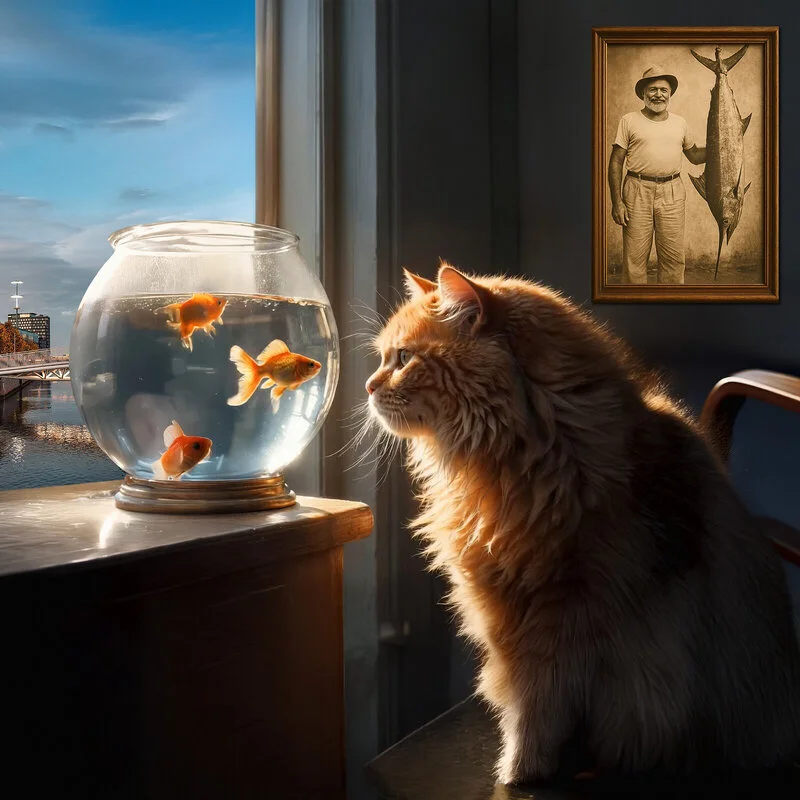
Wishful thinking. Reflections of Desire, 2025
Digital
70 x 70 cm
3 200 kr
Purr & Putte – Conversations Through Glass
In a small apartment above the harbor, beneath a photograph of Hemingway and a marlin, a red tabby cat named Purr and a goldfish named Putte engage in one of the most unlikely intellectual friendships in recent memory. Their unique perspective, shaped by their respective species and experiences, leads them to ponder everything from ancient scripture to submarine voyages, from shipwrecked heroes to sticky moral dilemmas—sometimes with elegance, sometimes with whiskers askew.
What begins as a stare-off between predator and potential snack slowly evolves into a rich and thought-provoking dialogue about literature, history, fishing, theology, and life's great, briny mysteries. With dry wit and wet fins, they revisit Jonah’s whale (and its lesser-known feline stowaway), weigh the ethics of fly fishing, debate Captain Nemo’s vegetarianism, and mourn the forgotten glories of ship’s cats with extra toes.
This is a tale of literal and philosophical reflection where each conversation becomes a ripple that stirs the water, the whiskers, and the reader’s heart. Welcome to a world where a paw against glass is not a barrier but an invitation.
”Putte's Compass
A goldfish maps the world from glass
In circles slow, with silent grace,
Putte charted his watery space.
No ship, no sail, no need to roam—
his bowl, his world, his crystal dome.
To west he turned, a daily fright:
The weathered photo, stark in light.
A fisherman stood, proud and pale,
his marlin limp, a silent tale.
The tail still hung, the eyes were dry—
Putte flinched, then drifted by.
To south he swam, where wisdom sleeps,
in books that climbed the dusty deeps.
A shelf of thoughts in binding tight,
with tales of fish and human plight.
Homer, Verne, Melville in stacks—
Putte read spines and filled the cracks.
For a goldfish in golden swirl,
he knew the weight of the world.
Then east, where morning always starts,
the light poured like music charts.
Each dawn a hush, a ripple born,
a fish’s joy for each new morn.
Gold glinted through the glassy curve,
and Putte spun with quiet verve.
To north, the window faced the quay,
the tide, the gulls, the salt, the spray.
He watched the ships, the shifting sea,
the strangers passing absently.
And on clear days, with fins held proud,
he’d glimpse a distant foreign cloud.
A globe within a bowl, you see—
he traveled much in reverie.
Around him swam his silent kin,
of porcelain glaze and painted fin.
Old Tang fish from dynastic days,
with lotus crowns and noble glaze.
Though still and mute, they stood as peers,
the legacy of ancient years.
So round he went, each compass tried,
no storm, no net, no tide to hide.
With every turn, another thought unfurled—
For Putte, bowl and mind were the world.
And when his arc was once complete,
each side observed, each thought replete,
he paused mid-swirl, with quiet flair,
blew one proud bubble in the air—
then turned, as always, with a nod,
and said: “Well now. I’ve seen it all. By Cod.“
Malmö, April 2025
Reflections of Desire – The Glass Between Them
On a sunlit afternoon in a harbor-side apartment, a red tabby cat named Purr perched on a chair beside the dining table. On that table, elevated slightly for effect, sat a round glass bowl containing three golden fish, the most observant of them named Putte. As the sun streamed through the window, casting rippling patterns on the wall, the two locked eyes through the curvature of the glass. The world, for a brief moment, stood still.
Purr’s initial gaze was not entirely poetic. There was a distinct rumble in his belly and a vision of sashimi dancing across his mind’s eye. But as it slowly dawned on him that the fish were off-limits—and that the dry food in the kitchen would, once again, be his only feast—his demeanor softened. He lifted a dignified paw, licked it slowly, and addressed the fish:
"You’re lucky to have me, you know. Without a vigilant feline presence, your bowl would be open to chaos. I’ve seen what happens when the vacuum cleaner gets too close."
Putte, who had swum a full circle and returned to his original spot (an action he always followed with the phrase, “Now I’ve seen everything!”), hovered at the glass edge and replied:
"We do feel safe with you there. I mean, that taxidermied marlin on the wall? He clearly didn’t have a cat on his team."
Indeed, the wall behind them displayed a weathered photograph of a grinning Ernest Hemingway beside a massive marlin, strung up vertically like a warning from Neptune himself. It was a constant topic of speculation among the bowl-dwellers. Purr often cited it in his more theatrical monologues:
"That fish fought with everything he had against the old fisher. A marlin of mythic strength—brought down by literature."
Putte puffed a thoughtful bubble. "We all have our legends. But we also have our books. I’ve read Melville, you know. I’m well-versed in the saga of Moby Dick. My great-great-great-grandfish claimed to have swum near a whale once."
Purr perked up. "Ah, Pequod! Now, that was a vessel. I never finished it, to be honest. Too much splashing and shouting. I prefer the serenity of The River Why. A man, a rod, a river, and a cat. Just as it should be."
Putte nodded sagely. "That one struck a chord. I agree, except for the part about baiting hooks with minnows. Barbaric."
"A necessary evil," Purr shrugged, "though I admit, your perspective adds nuance."
Putte flicked his tail. "Let’s not dwell. Have you read Cod: A Biography of the Fish that Changed the World? Now that is history. Empires, revolutions, salted and dried destinies!"
"A fine choice," Purr agreed, glancing at the pantry where a suspiciously cod-scented tin of pâté resided. "Not every fish gets a biography."
They both grew thoughtful.
"We’re not emperors’ porcelain," Putte added after a while, referencing the golden fish of ancient China that once adorned the finest dishes and served as imperial symbols.
"But we’re dignified in our way," Purr said, purring softly. "You with your aquatic library, and I with my watchful eye."
They paused, watching the dust motes drift like lazy plankton.
Somewhere in the distance, a church bell rang. A seagull cried. In the kitchen, the automatic feeder whirred to life.
"Well," said Purr, stretching luxuriously, "duty calls. Don’t go evolving legs while I’m gone."
"Only if you promise not to knock over the bowl next time you chase a laser dot," Putte smirked.
And so the cat leapt gracefully from the chair, and the fish resumed their orbits, each in their element—but no longer strangers and merely curious.
They were, as Purr would later muse, companions in reflection.
The following afternoon brought a drizzle that pattered gently on the windowpane. Putte circled near the top of his bowl, contemplating whether clouds affected the mood in goldfish. He was pondering the metaphysical properties of filtered light when Purr, tail high and whiskers forward, padded in with the air of a philosopher returning from a particularly deep nap.
“Tell me,” Putte began without preamble, “do you believe in Jonah’s whale?”
Purr paused mid-stretch. “You mean the biblical one? Swallowed a prophet whole? I’ve read the account—in a rather brittle family Bible with gilt-edged pages and a strong scent of lavender.”
“Do you think it’s plausible?” Putte pressed.
“Well,” Purr mused, hopping onto his usual chair, “it depends. I once saw a vacuum cleaner swallow a curtain. That seemed implausible, too.”
Putte chuckled. “Touché. My ancestors used to hide behind porcelain lotus leaves in imperial courts. Do you know the Tang Dynasty painted entire dinner sets with images of my people?”
“I did not,” Purr admitted. “But I feel an immediate respect.”
“You should. We were symbols of grace and harmony.”
“So naturally,” said Purr, “you ended up in a bowl in an apartment above a fishmonger’s.”
Putte flicked his tail. “Irony is the ocean we all swim in.”
They both turned briefly toward the Hemingway photo again.
“That marlin,” Putte said, “makes me wonder. Is it nobler to die for a legend or to live as a footnote?”
Purr blinked slowly. “That depends on the editor.”
“Have I told you,” Putte began with a flourish of his tail, “about my great-granduncle Huáng? He was quite the character, you know.”
Purr blinked. “Was he the one who bit a filter cord and caused a blackout in Shenzhen?”
“No,” Putte said, slightly offended. “He was a court fish during the Qing dynasty. He lived in a porcelain bowl painted with his likeness—imperial blue, no less.”
Purr tilted his head. “A self-portrait in glaze? That’s rather poetic.”
“Indeed,” said Putte. “Goldfish were considered symbols of wealth and harmony. In ancient China, only nobles could keep ornamental fish. During the Tang dynasty, we adorned palace courtyards and teacups alike. A golden fish on porcelain meant abundance; a pair symbolised eternal love.”
Purr gazed thoughtfully at the Hemingway photo again. “No one ever painted me on fine china.”
“Well,” Putte said, “you could always knock over a vase and see if you’re inside.”
“I knocked over a mixing bowl once,” Purr offered. “It had dough in it. I assume that’s not quite the same?”
“Not unless it was symbolically yeasty,” Putte replied.
They both laughed—Purr’s laugh was more of a throat-purr, while Putte’s was a quick flurry of bubbles.
Purr was silent for a while, his tail curling like a question mark over the edge of the chair.
“I’ve been thinking,” he began finally, eyes fixed between the bookshelf and the bowl, “about fishing. Not the eating part, but the doing.”
Putte, who had just tucked himself behind plastic kelp, peeked out. “Should I be concerned?”
“Not at all,” said Purr. “You’re not in that category. You’re... conversational. Besides, you live with us now, which makes you our furniture. Precious furniture.”
“Comforting,” said Putte, though he didn’t sound comforted.
“No, I mean this: There’s fishing, and then there’s fly fishing.” He pronounced it slowly, as if it deserved italics even in speech.
Putte blinked. “Explain.”
“Well,” said Purr, sitting a little taller, “recreational fishing, like my human does, is all about catching. It’s a performance—a weighing, a brag, with hooks, bait, cameras, and scales.”
“And gutting,” added Putte bitterly.
“True,” said Purr. “But fly fishing—now that’s something else. That’s poetry. A man stands in a river waving a stick like a wizard, casting a nearly invisible line that floats on air and water.”
“To catch fish,” Putte interrupted.
“Yes,” admitted Purr, “but not always. Often, they release them. It’s more about the... arc of the gesture, the whisper of line, the idea that we fish for something we might not even want to keep.”
Putte surfaced cautiously. “So, it’s metaphysical torture instead of physical?”
“Exactly!” Purr said brightly. “It’s beautiful, complicated disappointment.”
“Still sounds better than live bait,” muttered Putte.
They fell silent once more.
After a moment, Purr added, “Besides, if it ever comes to that, I’ll hide your name tag. You’ll be listed as ‘decorative object – non-consumable.’”
Putte sighed. “In imperial China, we were considered lucky. Here, I’m just hoping for plausible deniability.”
Purr gave the bowl a gentle nudge. “You’ve got me, old friend. And no one has ever angled me with anything more dangerous than a red ribbon.”
Putte was unusually quiet that evening, drifting slowly through his bowl like a philosopher circling a riddle, his scales shimmering in the soft glow of the underwater lamp.
Purr, curled in a tight comma on the windowsill, cracked one eye open. “You look like you’ve been rereading Jack London.”
“I have,” said Putte. “The Sea-Wolf. Gloomy, thrilling. Wet.”
Purr stretched luxuriously. “That one with the intellectual stuck on a whaler with a sociopathic captain?”
“The very same,” Putte nodded. “Wolf Larsen. Brains, brutality, and questionable hygiene.”
“I always preferred the cat to the wolf,” Purr muttered. “And frankly, if I were trapped on a ship with that man, I’d have clawed his boots to ribbons by chapter three.”
Putte swam a thoughtful loop. “It’s a bleak read, but powerful. London poses the question: What’s more important, strength or morality? Who survives, and who deserves to?”
Purr leapt from the sill to his chair. “Survival’s easy,” he said, “if you stay indoors and nap. Morality is trickier, especially if it comes wrapped in smoked mackerel.”
They both turned their heads toward the Hemingway marlin again. There was something about literature and fish that demanded a glance.
“Have you delved into the works of Jules Verne?” Putte inquired.
“Of course,” said Purr, flicking an ear. “I’m an indoor cat, not illiterate.”
“Twenty Thousand Leagues Under the Sea?” Putte pressed.
“Yes,” said Purr. “A submarine that runs on science, stubbornness, and organ music.”
Putte brightened. “Captain Nemo! A visionary! Complex, tormented, and... vegetarian.”
Purr arched an eyebrow. “Didn’t stop him from spearing sharks.”
“With good reason,” said Putte. “Sharks prey on small fish. It was population control.”
“And a few cats, I might add,” Purr pointed out. “You forget the submarine had a ship’s cat. Sleek, black, bilingual. Read maps upside down.”
“I assumed you made that up,” said Putte.
“Not at all,” said Purr. “Nemo saved her from a sinking freighter. She refused to be left behind. Fought off a moray eel with only her claws and a ferocious growl in Tamil.”
Putte stared. “This is canon?”
“Sub-canon,” said Purr. “Not in the French edition, but widely accepted among intelligent mammals.” edition, but widely accepted among intelligent mammals.”
They sat silently, envisioning the noble feline stalking the Nautilus’s steel corridors.
“What has always fascinated me,” said Putte, “is how often they fished in that book. Wearing diving suits! Swimming in coral forests and catching fish with harpoons.”
“Very stylish,” said Purr. “Though I’d prefer a bowl of sardines and a cushion.”
“Still,” Putte continued, “Verne respected the sea. His underwater world was lush and teeming. Not just danger—but beauty, mystery, and biodiversity.”
“Until someone invented canned tuna,” Purr replied.
“Do you think Nemo was happy?” Putte asked after a pause.
“Happy?” Purr echoed. “No. Fulfilled? Maybe. Lonely? Definitely. You can’t build an elegant submarine and not hide something.”
“He was hiding from humanity,” Putte asserted. “And possibly taxes.”
Purr gently nudged the bowl. “I suppose we all want a Nautilus now and then. A quiet, floating fortress. Full of books and without any doorbells.”
“And filled with fish,” said Putte.
“Of course,” Purr agreed. “But not for eating. Just for company.”
With that, the room fell still again. Outside, the sea air hummed against the windowpane like a lullaby in a minor key. The cat and the fish remained in their respective vessels, quietly united by literature, deep water, and the occasional squid.
Putte had always been captivated by sacred texts, especially those where fish were prominent. That evening, as the harbor wind rattled the windowpanes and the Hemingway marlin seemed to flicker in the fading light, he cleared his throat with dignified purpose.
“Did you know,” he said, “that seven fish once changed the entire course of human history?”
Purr raised an eyebrow without lifting his head. “Seven fish? That’s a rather specific number for something that sounds like the beginning of a fairy tale.”
“It’s Scripture,” Putte said. “New Testament. Gospel of Matthew, to be precise. Jesus had seven loaves and a few small fish—seven, traditionally—and he fed thousands. Five thousand men, not counting women and children.”
Purr opened one eye. “Impressive catering. No menu planning, no reservations.”
“It was a miracle,” Putte said solemnly. “A moment when the divine met the practical. Those fish weren’t just food—they symbolised nourishment, sharing, and abundance.”
“And leftovers,” said Purr. “I’ve always been a fan of leftovers.”
“They collected seven baskets of leftovers,” Putte nodded. “More than they started with. That’s not just miraculous—it’s mathematically implausible.”
“So that’s why the fish became the symbol of Christianity,” Purr mused, stretching. “I always thought it was just because fishermen made good disciples.”
“That too,” said Putte. “Peter, Andrew, James, John—all fishermen. Salt of the sea. Hook-and-line apostles.”
Purr grinned. “So the Church was built on fish?”
“And a rock,” Putte corrected. “But yes. Fish fed the hungry, supported the disciples, and became the first covert symbol of Christian faith.”
“I suppose you’d call that... divine seafood strategy?” Purr offered.
Putte chose not to dignify that with a response.
“But seven fish?” Purr continued. “What if it had only been five? Or eleven?”
“Seven is sacred,” Putte replied. “It’s the number of days in creation, the number of lamps on the menorah, the number of times you forgive your brother, times seventy. It’s a complete number. Spiritually tidy.”
“So what you’re saying,” Purr said, “is that fish saved the world?”
“Not alone,” Putte clarified. “But they certainly helped deliver the message. And they tastefully predated the invention of pamphlets.”
They fell into a reverent silence.
Purr finally broke it. “You know... I’ve never once caught a fish. But I’ve stared one down for twenty minutes straight.”
Putte swam in slow circles. “Eye contact counts. Especially in theology.”
“That story about Jonah,” said Purr one foggy morning as he circled the bowl thoughtfully, “is rarely told correctly. Or rather—it's rarely told in full.”
Putte looked up mid-yawn. “How can one tell it fully? It’s about a prophet, a ship, and a whale. Classic elements. What’s missing?”
“The cat,” Purr said, sitting up straighter than usual. “Jonah’s ship had a cat. They always did back then. Rats were a serious theological issue.”
“You’re saying,” Putte began slowly, “that a cat was swallowed by the whale too?”
“Of course,” said Purr. “Where do you think Jonah found emotional support in that gastric cathedral?”
Putte gave a horrified shudder. “The smell alone must have been... biblical.”
“It was,” Purr agreed. “Rotten fish, fermented seaweed, stomach acids singing hymns in minor key. According to the feline oral tradition, the ship’s cat—Nibbles—nearly fainted three times.”
“And yet survived?”
“Barely,” said Purr. “She clung to Jonah’s sandal the entire time. Besides Jonah's divine irritation, it was the only dry thing in there.”
“Does the Bible mention the cat?”
“No,” Purr sighed. “As usual, history edits out the whiskers.”
Putte swirled anxiously. “So how did they escape? Was it as dramatic as it sounds?”
“Jonah prayed,” Purr said simply. “In the belly of the beast, he composed a psalm. Thanked God for not letting him drown and promised to obey next time. The cat joined in with a purr.”
“And then?”
“God commanded the fish to vomit them out onto dry land. A wave, a heave, and suddenly—bam! There they were. Drenched. Dazed. Slightly digested.”
Putte gagged. “And the cat?”
“Landed on all fours, naturally,” said Purr. “Shook off the bile and refused to board another vessel for the rest of her life.”
“I don’t blame her,” Putte murmured.
“They say she ended up in Nineveh,” Purr added. “Where she was worshipped as a minor goddess of pest control.”
There was a long pause.
“I shall never again refer to my algae scraper as ‘the whale’s tongue,’” Putte said.
“And I,” said Purr, “shall never view seaweed salad the same way.”
“There’s something you ought to know,” Purr declared one lazy afternoon as he sharpened his claws (gently) on the arm of the velvet chair. “We weren’t always indoor philosophers and radiator aristocrats. No, some of us once ruled the seas.”
Putte blinked. “You mean... pirates?”
“No,” said Purr, fluffing his tail proudly. “Ship’s cats. Maritime companions. Mousers with missions. Guardians of grain sacks. Advisors to Admirals.”
Putte tilted his fins. “I thought they were just... well, pets.”
Purr let out a short, dry laugh. “Tell that to Trim, the beloved cat of Matthew Flinders—the man who circumnavigated Australia. Trim was more than a pet; he was a morale officer. He slept in hammocks, walked the railings in high seas, and was last seen leaping heroically onto the wharf of Mauritius before being tragically... well, probably eaten. But his statue still stands.”
Putte gasped. “A statue?”
“Indeed,” said Purr. “Black with white socks. Elegant. Confident. Like myself, if I’d taken up navigation.”
“Were they different from land cats?” Putte asked.
“Oh yes,” Purr nodded. “Many had extra toes—a condition called polydactyly. More claws meant better balance on slippery decks, better grip on rope, and more flair.”
“I see,” Putte said, visibly impressed. “So it’s evolution by adventure.”
“Exactly,” Purr agreed. “Sailors considered them good luck. A ship without a cat was without soul—or worse, one cursed to chase its rudder.”
“Any other famous ones?” Putte prompted.
“Well,” Purr purred, “there was Oscar, also known as Unsinkable Sam. He survived three different ships being torpedoed during World War II—first the Bismarck, then HMS Cossack, then HMS Ark Royal. After the third, he was retired from duty and spent the rest of his life in peace in a sailor’s home in Belfast.”
“Three sinkings?” Putte murmured, stunned.
“Indeed,” said Purr. “He was black and white. Like Trim. And also, I suspect, me in a previous life.”
They were silent for a moment, contemplating this aquatic reincarnation.
“And what about you?” Putte asked gently. “Would you go to sea?”
Purr looked toward the distant harbor, eyes narrowing.
“I think,” he said slowly, “that if I ever leave this apartment... it would only be on a ship that bears my name. With a velvet hammock, a brass compass, and salmon on demand.”
“And books?” Putte asked.
“Only the unabridged editions,” said Purr.
“And books?” Putte asked.
“Only the unabridged editions,” said Purr.
3 200 kr

Jörgen Thornberg
Malmö
Lite om bilder och mig. Translation in English at the end.
Jag är en nyfiken person som ser allt i bilder, även det jag fäster i ord, gärna tillsammans för bakom alla mina bilder finns en berättelse. Till vissa bilder hör en kortare eller längre novell som följer med bilden.
Bilder berättar historier. Jag omges av naturlig skönhet, intressanta människor och historia var jag än går. Jag använder min kamera för att dokumentera världen och blanda det jag ser med vad jag känner för att fånga den dolda magin.
Mina bilder berättar mina historier. Genom mina bilder, tryck och berättelser. Jag bjuder in dig att ta del av dessa berättelser, in i ditt liv och hem och dela min mycket personliga syn på vår värld. Mer än vad ögat ser. Jag tänker i bilder, drömmer och skriver och pratar om dem; följaktligen måste jag också skapa bilder. De blir vad jag ser, inte nödvändigtvis begränsade till verkligheten. Det finns en bild runt varje hörn. Jag hoppas att du kommer att se vad jag såg och gilla det.
Jag är också en skrivande person och till många bilder hör en kortare eller längre essay. Den följer med tavlan, tryckt på fint papper och med en personlig hälsning från mig.
Flertalet bilder startar sin resa i min kamera. Enkelt förklarat beskriver jag bilden jag ser i mitt inre, upplevd eller fantiserad. Bilden uppstår inom mig redan innan jag fått okularet till ögat. På bråkdelen av ett ögonblick ser jag vad jag vill ha och vad som kan göras med bilden. Här skall jag stoppa in en giraff, stålmannen, Titanic eller vad det är min fantasi finner ut. Ännu märkligare är att jag kommer ihåg minnesbilden långt efteråt när det blir tid att skapa verket. Om jag lyckas eller inte, är upp till betraktaren, oftast präglat av en stråk av svart humor – meningen är att man skall bli underhållen. Mina bilder blir ofta en snackis där de hänger.
Jag föredrar bilder som förmedlar ett budskap i flera lager. Vid första anblicken fylld av feel-good, en vacker utsikt, fint väder, solen skiner, blommor på ängen eller vattnet som ligger förrädiskt spegelblankt. I en sådan bild kan jag gömma min egentliga berättelse, mitt förakt för förtryckare och våldsverkare, rasister och fördomsfulla människor - ett gärna återkommande motiv mer eller mindre dolt i det vackra motivet. Jag försöker förena dem i ett gemensamt narrativ.
Bild och formgivning har löpt som en röd tråd genom livet. Fotokonst känns som en värdig final som jag gärna delar med mig.
Min genre är vid som framgår av mina bilder, temat en blandning av pop- och gatukonst i kollage som kan bestå av hundratals lager. Vissa bilder kan ta veckor, andra någon dag innan det är dags att överlämna resultatet till printverkstaden. Fine Art Prints är digitala fotocollage. I dessa kollage sker rivandet, klippandet, pusslandet, målandet, ritandet och sprayningen digitalt. Det jag monterar in kan vara hundratals år gamla bilder som jag omsorgsfullt frilägger så att de ser ut att vara en del av tavlan men också bilder skapade av mig själv efter min egen fantasi. Därefter besöks printstudion och för vissa bilder numrera en limiterad upplaga (oftast 7 exemplar) och signera för hand. Vissa bilder kan köpas i olika format. Det är bara att fråga efter vilka. Gillar man en bild som är 70x100 men inte har plats på väggen, går den kanske att få i 50x70 cm istället. Frågan är fri.
Metoden Giclée eller Fine Art Print som det också kallas är det moderna sättet för framställning av grafisk konst. Villkoret för denna typ av utskrifter är att en högkvalitativ storformatskrivare används med åldersbeständigt färgpigment och konstnärspapper eller i förekommande fall på duk. Pappret som används möter de krav på livslängd som ställs av museer och gallerier. Normalt säljer jag mina bilder oinramade så att den nya ägaren själv kan bestämma hur de skall se ut, med eller utan passepartout färg på ram, med eller utan glas etc..
Under många år ställde jag bara ut på nätet, i valda grupper och på min egen Facebooksida - https://www.facebook.com/jorgen.thornberg.9
Jag finns också på en egen hemsida som tyvärr inte alltid är uppdaterad – https://www.jth.life/ Där kan du också läsa en del av de berättelser som följer med bilden.
UTSTÄLLNINGAR
Luftkastellet, oktober 2022
Konst i Lund, november 2022
Luftkastellet, mars 2023
Engleson Galleri Caroli, april 2023
Hydra, Greece June 2023
Engleson Galleri Caroli, oktober 2023
Toppen, Höllviken december 2023
Luftkastellet, mars 2024
Torups Galleri, mars 2024
Venice, May 2024
Luftkastellet, oktober 2024
Konst i Advent, December 2024
Galleri Engleson, Caroli December 2024
Jäger & Jansson Galleri, april 2025
A bit about pictures and me.
I'm a curious person who sees everything in pictures, even what I express in words, often combining them, for behind all my pictures lies a story. These narratives, some as short as a single image and others as long as a novel, are the heart and soul of my work.
Pictures tell stories. Wherever I go, I'm surrounded by natural beauty, exciting people, and history. I use my camera to document the world and blend what I see with what I feel to capture the hidden magic.
My images tell my stories. Through my pictures, prints, and narratives, I invite you to partake in these stories in your life and home and share my deeply personal perspective of our world. More than meets the eye. I think in pictures, dream, write, and talk about them; consequently, I must create images too. They become what I see, not necessarily confined to reality. There's a picture around every corner. I hope you'll see what I saw and enjoy it.
I'm also a writer, and many images come with a shorter or longer essay. It accompanies the painting, printed on fine paper with my personal greeting.
Many pictures start their journey on my camera. Simply put, I describe the image I see in my mind, experienced or imagined. The image arises within me even before I bring the eyepiece to my eye. In a fraction of a moment, I see what I want and what can be done with the picture. Here, I'll insert a giraffe, Superman, the Titanic, or whatever my imagination conjures up. Even stranger is that I remember the mental image long after it's time to create the work. Whether I succeed is up to the observer, often imbued with a streak of black humour – the aim is to entertain. My pictures usually become a talking point wherever they hang.
I prefer pictures that convey a message in multiple layers. At first glance, they're filled with feel-good vibes, a beautiful view, lovely weather, the sun shining, flowers in the meadow, or the water lying deceptively calm. But beneath this surface beauty, I often conceal a deeper story, a narrative that challenges societal norms or explores the human condition. I invite you to delve into these hidden narratives and discover the layers of meaning within my work.
Picture and design have been a thread running through my life. Photographic art feels like a fitting finale, and I'm happy to share it.
My genre is varied, as seen in my pictures; the theme is a blend of pop and street art in collages that can consist of hundreds of layers. Some images can take weeks, others just a day before it's time to hand over the result to the print workshop. Fine Art Prints are digital photo collages. In these collages, tearing, cutting, puzzling, painting, drawing, and spraying happen digitally. What I insert can be images hundreds of years old that I carefully extract so they appear to be part of the painting, but also images created by myself, now also generated from my imagination. Next, visit the print studio and, for certain images, number a limited edition (usually 7 copies) and sign them by hand. Some images may be available in other formats. Just ask which ones. If you like an image that's 70x100 but doesn't have space on the wall, you might be able to get it in 50x70 cm instead. The question is open.
The Giclée method, or Fine Art Print as it's also called, is the modern way of producing graphic art. This method ensures the highest quality and longevity of the artwork, using a high-quality large-format printer with archival pigment inks and artist paper or, in some cases, canvas. The paper used meets the longevity requirements set by museums and galleries. I sell my pictures unframed, allowing the new owner to personalise their artwork, confident in the lasting value and quality of the piece.
For many years, I only exhibited online, in selected groups, and on my Facebook page - https://www.facebook.com/jorgen.thornberg.9. I also have my website, which unfortunately is not constantly updated - https://www.jth.life/. You can also read some of the stories accompanying the pictures there.
EXHIBITIONS
Luftkastellet, October 2022
Art in Lund, November 2022
Luftkastellet, March 2023
Engleson Gallery Caroli, April 2023
Hydra, Greece June 2023
Engleson Gallery Caroli, October 2023
Toppen, Höllviken December 2023
Luftkastellet, March 2024
Torup Gallery, March 2024
Venice, May 2024
UTSTÄLLNINGAR
Luftkastellet, oktober 2022
Konst i Lund, november 2022
Luftkastellet, mars 2023
Engleson Galleri Caroli, april 2023
Hydra, Greece June 2023
Engleson Galleri Caroli, oktober 2023
Toppen, Höllviken december 2023
Luftkastellet, mars 2024
Torups Galleri, mars 2024
Venice, May 2024
Luftkastellet, October 2024
Konst i Advent, December 2024
Galleri Engleson, Caroli December 2024
Jäger & Jansson Galleri, April 2025
Utbildning
Autodidakt
Medlem i konstnärsförening
Öppna Sinnen
Med i konstrunda
Konstrundan i Skåne
Utställningar
Luftkastellet, October 2022
Art in Lund, November 2022
Luftkastellet, March 2023
Engleson Gallery Caroli, April 2023
Hydra, Greece June 2023
Engleson Gallery Caroli, October 2023
Toppen, Höllviken December 2023
Luftkastellet, March 2024
Torup Gallery, March 2024
Venice, May 2024