Vi använder cookies för att ge dig bästa möjliga upplevelse. Välj vilka cookies du tillåter.
Läs mer i vår integritetspolicy
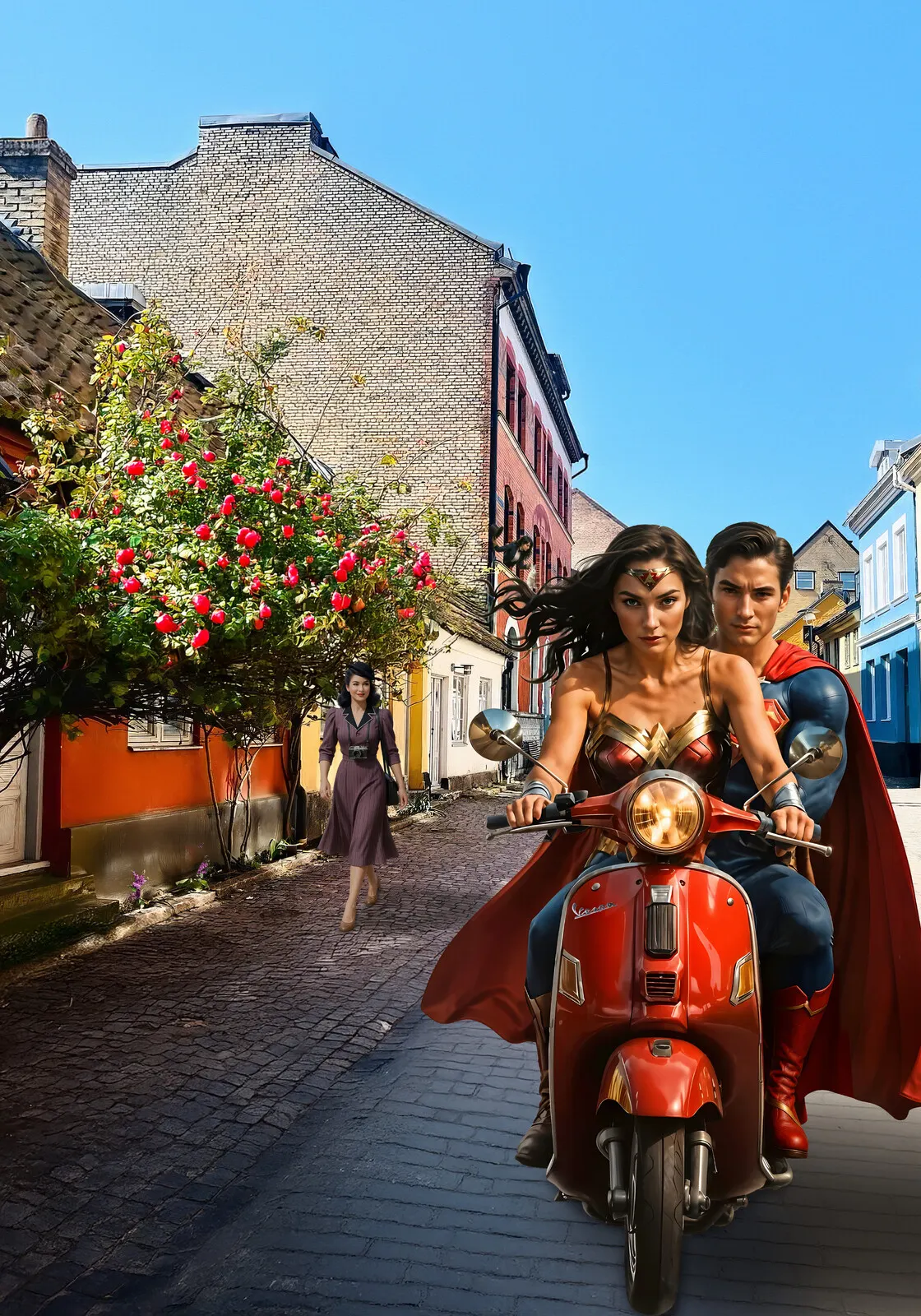
Jörgen Thornberg
Malmö Holiday, 2025
Digital
50 x 70 cm
3 200 kr
Malmö Holiday
In memory of a Sunday not long ago,
when reality blinked, and the streetlamps hummed like lullabies.
Where Malmö met Metropolis,
and fiction strolled hand in hand with history.
Some scenes don’t need orchestras.
A rented Vespa and a man in tights will do.
Add a rabbit in a hat, a woman on a balcony,
and you’ve got the kind of tableau Fellini might have whispered about,
or that Audrey Hepburn could have waltzed through
without anyone batting an eye.
This is not a superhero story.
Nor is it exactly a fairytale.
It’s something in between—
a quiet moment in the multiverse
when every woman had a reason to love Superman,
and he, poor soul, had no idea where to land.
Please read on to see how this classic scene continues to resonate with our modern lives.
”A Vespa flirt
Up the street and down again,
with winds that flirt and whisper when
a Vespa hums through evening’s glow,
where cobblestones still steal the show.
A princess rides with grace and flair,
her golden locket catching air.
Behind her clings a man of might—
in tights, no less, and holding tight.
A hat is tipped, a lens clicks twice,
Miss Lane strolls by with practised ice.
A rabbit twitches, quite unsure,
why Malmö’s bricks feel so obscure.
The cats keep watch from windows high,
while clouds drift slowly across the sky.
A café sighs, the lights grow dim,
a cappuccino meets its brim.
A wand, a lasso, heels that gleam—
this city dances like a dream.
No villains here, no cosmic blight,
just lovers spinning through the night.
And though this town’s no Rome or Nile,
its streets still hold that secret smile:
a holiday where nothing’s planned,
but magic waits on every hand.”
Malmö, June 2025
On a Rental Vespa
Wonder Woman, riding a rented Vespa with Superman pillion, radiates romance on a super level and immediately evokes a classic film: Roman Holiday. In this 1953 romantic comedy, a princess escapes her royal duties and falls in love with a journalist. More on that later, because right now we need to discuss a particular encounter on Jacob Nilsgatan not long ago. This encounter, which mirrors a scene from 'Roman Holiday', is a key moment in the narrative that we'll explore in more detail.
Note the other women in the scene – a strolling Lois Lane, Superman's long-time love interest and the woman on the second floor pulling a rabbit out of a top hat, a magician who can manipulate reality. They’re minding their own business – but make no mistake, they’re not alone. The others are never farther away than behind a fence, around the corner, or a telepathic thought away. In other words, they’re fully in the loop.
Because, despite the idyllic scene, Superman has a super-sized problem: one man, a thousand gazes (some of them magical). It's like a cosmic game of 'Where's Waldo?', but instead of a striped shirt, it's a red cape that everyone's trying to spot. These 'others' in Superman's life, including his love interests and potential rivals, play a significant role in shaping his character and the narrative of his love life. They serve as constant reminders of his dual identity and the sacrifices he must make for his duty as a superhero.
It’s not easy being Superman. Sure, he can fly faster than celebrity gossip, lift the moon with a yawn, and hear a mosquito sneeze from miles away – but when it comes to romance, it’s as if the entire DC Universe leans in with twinkling eyes and whispers: “Hey there, lonely hero, what are you doing tonight?”
The comic book world is full of hopeful superwomen who harbour dreams and plans for him. According to all the multiverses, of course, these are virtuous fantasies—because the comic book realm is holier than a monastery. The heroines' love for Superman is often portrayed as pure and selfless, serving as a moral compass for the readers. That the heroines are scantily clad and seductive is just for the readers’ benefit; they may have their steamy daydreams, but among superheroes, boundaries are sacred. Still, holding hands is perfectly acceptable.
First, of course, there’s Lois Lane—eternally suspicious, eternally smitten, and always half a pair of glasses away from figuring out his secret. She’s both his journalist colleague and life’s great mystery. A woman who can write razor-sharp columns and yet miss the fact that her boyfriend lifts train cars on his lunch break.
Then comes Lana Lang, the red-haired nostalgia from Smallville. She embodies comfort and poses an eternal threat to Lois’ emotional dominance. Cue triangular drama on crystalline screens.
But it doesn’t stop there. Superman also has a cousin, Kara, a.k.a. Supergirl. And while they’re family (and therefore strictly off-limits—hopefully), she keeps appearing as a reminder that even Kryptonian family reunions require emotional GPS and clear boundaries. At times, it doesn’t feel as though her intentions are entirely innocent.
Next, we have Maxima—intergalactic queen and self-declared Mrs. Superman. She’s crossed galaxies to breed the ultimate child—immaculate conception if comic book morality has its say. Think of it as interstellar Tinder, where swiping left might start a planetary war.
Then, swooping in, is Wonder Woman—divine and ambivalent in equal measure. In some timelines, she kisses him passionately among the clouds; in others, she smacks him with her lasso for hesitating between duty and desire. Diana is both best friend and potential partner, and no one quite knows in which form she’ll next appear.
And let’s not forget Superwoman, the ever-changing entity—sometimes Lois endowed with powers, sometimes Lana, occasionally a morally ambiguous version from a mirror universe where everyone sports a goatee. Superwoman embodies the danger of giving your ex superpowers.
But wait—there’s more. Just when you thought Superman's love life couldn't get any more complicated, a new contender swoops in.
Zatanna, the magician with a top hat and backwards-spoken spells, is another contender. She whispers, “Tegrof reh,” and poof—Superman forgets Lois entirely. She’s the most dangerous type: gorgeous, witty, and capable of rewriting reality. Dating her would necessitate earplugs and a strong will.
And who could forget Catwoman? Sure, she usually has her claws in Batman, but in Elseworld scenarios, she’s been known to eye Superman, tempted by his power and the thrill of trying to escape someone who can outrun the moon. She could easily claw out the eyes of her rivals, so they’d better watch their backs. She has the assistance of every cat on Earth, a resource the others lack.
Adding to that is Big Barda, the warrior queen from Apokolips, who occasionally appears in Superman’s orbit. She’s married to Mister Miracle, yes—but her gaze can rival the laser beams in Superman’s eyes. She’d never fall for a mortal—but a Kryptonian? Perhaps. Under specific cosmic constellations, a reference to the complex and often convoluted relationships in the DC Universe. These cosmic constellations usually dictate the fate and dynamics of the superheroes' relationships, adding another layer of complexity to their love lives.
Let’s not forget Captain Marvel (Carol Danvers, from Marvel’s corner of the multiverse). Could it happen? Not impossible. Should it happen? Not. Not yet. But imagine two living nuclear reactors with flight abilities, poor impulse control, and a fondness for saving planets. If they were ever to date, it would be akin to pairing two galaxies. The supernova would be epic.
Superman may be a man of steel, but when it comes to women, he’s surrounded by elements he can’t control: fire, magic, politics, nostalgia, cosmic reproduction—and sometimes a truly effective magic hat.
Who needs Lex Luthor when half the galaxy is queuing up to love you to death?
And maybe—just maybe—he isn’t soaring up through the clouds to save humanity from doom, but rather to dodge yet another date with someone who can lasso a meteor—emotionally. His love life is a constant juggling act, a series of challenges that he must navigate with grace and understanding. It's a side of Superman that often goes unnoticed, but it's a part of his story that we can all relate to.
Now, a few words about the film that inspired Wonder Woman to invite Superman on a tour of Malmö while they were in town: Roman Holiday. A classic that continues to captivate with its romantic escapades, much like the enduring allure of Superman's own love life. It's a narrative that never fails to intrigue and fascinate, drawing us in with its complexities and ever-changing dynamics.
In 1953, "Roman Holiday" pirouetted onto the silver screen and into cinematic immortality. Rome, in all its enchanting glory, was the true star of the film. Audrey Hepburn, as the wide-eyed Princess Ann, was a captivating presence, and Gregory Peck, suavely American as Joe Bradley, completed the enchanting duo. Together, they delivered a story that still sparkles like prosecco on a summer evening. This wasn’t just a film; it was a flirtation with freedom, a scooter ride through fantasy, and an irresistible ode to spontaneity. Filmed on location, the city of Rome didn’t just provide a backdrop—it was a character in its own right.
Iconic Scenes and Famous Locations
Let’s be honest: the Vespa scene alone earned the film a place in the Hall of Fame. Hepburn clinging to Peck as they zip through cobbled streets has become a metaphor for escaping your own life, if only for a moment. The Trevi Fountain glistens with unspoken wishes, and the Spanish Steps seem to rise out of a dream. Every location is a postcard, a love letter, a cinematic sigh. Rome, in this film, is more than a city; it’s an accomplice to transformation.
A Film That Sparked Global Success
'Roman Holiday' wasn’t just a hit; it was a phenomenon. Hepburn took home an Oscar, and the film’s global resonance has only grown stronger with time. For millions, this was the first taste of Italy’s capital—not through dusty textbooks but through windblown hair and stolen gelato. And while Joe and Ann flirt with romance, the film flirts with revolution. Ann doesn’t need a prince; she needs a Vespa. This film's revolutionary approach to romance and its influence on future films is something the audience can appreciate and be inspired by.
The Ending That Launched a Thousand Debates
No kiss. No fairytale wedding. No violins swelling into eternity. Instead, Joe and Ann part with smiles and aching hearts. He stays behind; she returns to duty. It shocked audiences then and still tugs at us now. That press conference? Iceberg-level tension beneath royal composure. When Ann picks Rome as her favourite city, the subtext all but weeps. Joe says nothing, but his face performs an aria. And when he walks out alone, we feel every step.
Why didn’t he run after her? Why didn’t she fling off her tiara and leap into his arms? Because this is a grown-up fairy tale, and grown-ups know that sometimes love means letting go. Besides, he did lie to her—he was a journalist chasing a scoop, after all. But did she care? If she did, it wasn’t visible beneath her perfectly poised smile.
Speculations, Fantasies, and the Unwritten Epilogue
Viewers have spent decades imagining a sequel that never arrived. Perhaps they met again. Maybe she sent secret letters. Possibly Joe finally used that Vespa to chase down a plane. This ambiguity is a gift, an open ending we can all rewrite on rainy afternoons.
Rom-Com Revolution
Before "Roman Holiday," romantic comedies followed the same tired script: boy meets girl, girl giggles, boy gets girl, curtain drops. The man had agency; the woman had wardrobe changes. Enter Audrey Hepburn, radiant and unpredictable. Her Ann is a royal fugitive from duty, a woman who longs to eat gelato and dance barefoot. The plot revolves around her liberation, not his conquest.
And that ending? No vows. No picket fence. Just a memory shared by two people from different worlds. It paved the way for bittersweet masterpieces like 'La La Land' and 'The Graduate', where love isn’t always tidy, but it’s always transformative. 'Roman Holiday' revolutionised the romantic comedy genre, shifting the focus from the man's conquest to the woman's liberation, and inspiring a new wave of films that embraced the bittersweetness of love. This shift in focus enlightened the audience about the potential of the genre, making them appreciate the film's influence.
Roman Holiday vs Casablanca: A Love and Let Go Duel
Both films end in heartbreak, but in very different ways. In 'Roman Holiday,' Joe allows Ann to return to her throne without a fuss. It’s quiet. It’s noble. It’s personal. In 'Casablanca,' Rick sends Ilsa away to save the world. That’s war. That’s patriotism. That’s a trench coat and fog machine. The comparison between the two films highlights the varying types of sacrifice and heartbreak portrayed in each, enriching the audience's understanding of the films' themes.
Joe’s sacrifice is intimate, born of respect. Rick’s is epic, soaked in gin and revolution. One makes you sigh. The other makes you salute. Both make you cry.
The Real Message
'Roman Holiday' isn’t about eternal love. It’s about fleeting freedom. Joe begins as a cynic and ends as a gentleman. Ann starts as a porcelain doll and finishes as a woman who knows who she is. Their romance doesn’t last, but its impact does. Love, in this film, is not a destination. It’s a detour that changes everything. This powerful message about the enduring relevance of fleeting freedom is what makes 'Roman Holiday' a timeless classic, resonating with audiences across generations and inspiring them with its enduring significance.
Have a bonus round with ‘Breakfast at Tiffany's’ because it crashes the Party. If you think the other films are too serious, let’s invite Holly Golightly to the table. She’d toast with champagne, call everyone darling, and remind us that date movies shouldn’t just make us weep into popcorn. They should dazzle. They should dance. Because if you’re comparing your relationship to Joe and Ann’s, or Rick and Ilsa’s, you’ll end up glum. But if you’re watching Audrey in a black dress with a cat on her shoulder and a pastry in her hand, maybe you’ll fall in love with the movies all over again.
"Roman Holiday" doesn’t promise forever. It promises one perfect day. And honestly, that might be more romantic than happily ever after. Maybe Wonder Woman’s tour in Malmö will end the same way.
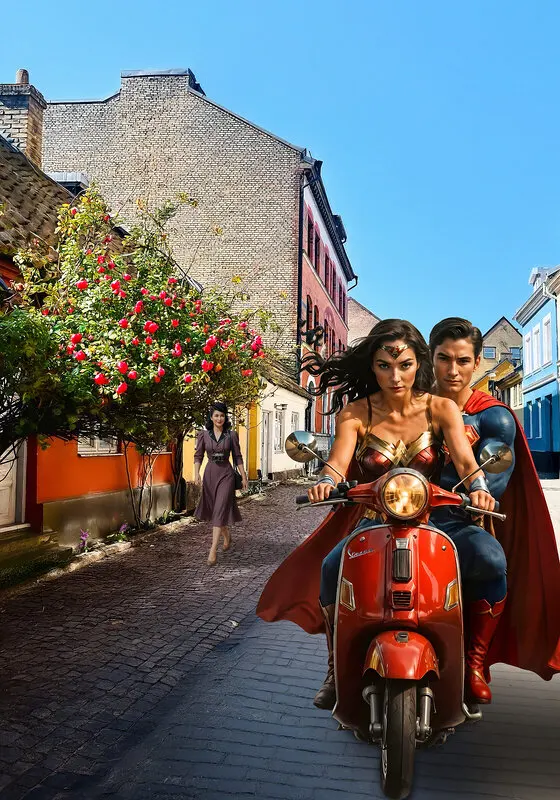
Jörgen Thornberg
Malmö Holiday, 2025
Digital
50 x 70 cm
3 200 kr
Malmö Holiday
In memory of a Sunday not long ago,
when reality blinked, and the streetlamps hummed like lullabies.
Where Malmö met Metropolis,
and fiction strolled hand in hand with history.
Some scenes don’t need orchestras.
A rented Vespa and a man in tights will do.
Add a rabbit in a hat, a woman on a balcony,
and you’ve got the kind of tableau Fellini might have whispered about,
or that Audrey Hepburn could have waltzed through
without anyone batting an eye.
This is not a superhero story.
Nor is it exactly a fairytale.
It’s something in between—
a quiet moment in the multiverse
when every woman had a reason to love Superman,
and he, poor soul, had no idea where to land.
Please read on to see how this classic scene continues to resonate with our modern lives.
”A Vespa flirt
Up the street and down again,
with winds that flirt and whisper when
a Vespa hums through evening’s glow,
where cobblestones still steal the show.
A princess rides with grace and flair,
her golden locket catching air.
Behind her clings a man of might—
in tights, no less, and holding tight.
A hat is tipped, a lens clicks twice,
Miss Lane strolls by with practised ice.
A rabbit twitches, quite unsure,
why Malmö’s bricks feel so obscure.
The cats keep watch from windows high,
while clouds drift slowly across the sky.
A café sighs, the lights grow dim,
a cappuccino meets its brim.
A wand, a lasso, heels that gleam—
this city dances like a dream.
No villains here, no cosmic blight,
just lovers spinning through the night.
And though this town’s no Rome or Nile,
its streets still hold that secret smile:
a holiday where nothing’s planned,
but magic waits on every hand.”
Malmö, June 2025
On a Rental Vespa
Wonder Woman, riding a rented Vespa with Superman pillion, radiates romance on a super level and immediately evokes a classic film: Roman Holiday. In this 1953 romantic comedy, a princess escapes her royal duties and falls in love with a journalist. More on that later, because right now we need to discuss a particular encounter on Jacob Nilsgatan not long ago. This encounter, which mirrors a scene from 'Roman Holiday', is a key moment in the narrative that we'll explore in more detail.
Note the other women in the scene – a strolling Lois Lane, Superman's long-time love interest and the woman on the second floor pulling a rabbit out of a top hat, a magician who can manipulate reality. They’re minding their own business – but make no mistake, they’re not alone. The others are never farther away than behind a fence, around the corner, or a telepathic thought away. In other words, they’re fully in the loop.
Because, despite the idyllic scene, Superman has a super-sized problem: one man, a thousand gazes (some of them magical). It's like a cosmic game of 'Where's Waldo?', but instead of a striped shirt, it's a red cape that everyone's trying to spot. These 'others' in Superman's life, including his love interests and potential rivals, play a significant role in shaping his character and the narrative of his love life. They serve as constant reminders of his dual identity and the sacrifices he must make for his duty as a superhero.
It’s not easy being Superman. Sure, he can fly faster than celebrity gossip, lift the moon with a yawn, and hear a mosquito sneeze from miles away – but when it comes to romance, it’s as if the entire DC Universe leans in with twinkling eyes and whispers: “Hey there, lonely hero, what are you doing tonight?”
The comic book world is full of hopeful superwomen who harbour dreams and plans for him. According to all the multiverses, of course, these are virtuous fantasies—because the comic book realm is holier than a monastery. The heroines' love for Superman is often portrayed as pure and selfless, serving as a moral compass for the readers. That the heroines are scantily clad and seductive is just for the readers’ benefit; they may have their steamy daydreams, but among superheroes, boundaries are sacred. Still, holding hands is perfectly acceptable.
First, of course, there’s Lois Lane—eternally suspicious, eternally smitten, and always half a pair of glasses away from figuring out his secret. She’s both his journalist colleague and life’s great mystery. A woman who can write razor-sharp columns and yet miss the fact that her boyfriend lifts train cars on his lunch break.
Then comes Lana Lang, the red-haired nostalgia from Smallville. She embodies comfort and poses an eternal threat to Lois’ emotional dominance. Cue triangular drama on crystalline screens.
But it doesn’t stop there. Superman also has a cousin, Kara, a.k.a. Supergirl. And while they’re family (and therefore strictly off-limits—hopefully), she keeps appearing as a reminder that even Kryptonian family reunions require emotional GPS and clear boundaries. At times, it doesn’t feel as though her intentions are entirely innocent.
Next, we have Maxima—intergalactic queen and self-declared Mrs. Superman. She’s crossed galaxies to breed the ultimate child—immaculate conception if comic book morality has its say. Think of it as interstellar Tinder, where swiping left might start a planetary war.
Then, swooping in, is Wonder Woman—divine and ambivalent in equal measure. In some timelines, she kisses him passionately among the clouds; in others, she smacks him with her lasso for hesitating between duty and desire. Diana is both best friend and potential partner, and no one quite knows in which form she’ll next appear.
And let’s not forget Superwoman, the ever-changing entity—sometimes Lois endowed with powers, sometimes Lana, occasionally a morally ambiguous version from a mirror universe where everyone sports a goatee. Superwoman embodies the danger of giving your ex superpowers.
But wait—there’s more. Just when you thought Superman's love life couldn't get any more complicated, a new contender swoops in.
Zatanna, the magician with a top hat and backwards-spoken spells, is another contender. She whispers, “Tegrof reh,” and poof—Superman forgets Lois entirely. She’s the most dangerous type: gorgeous, witty, and capable of rewriting reality. Dating her would necessitate earplugs and a strong will.
And who could forget Catwoman? Sure, she usually has her claws in Batman, but in Elseworld scenarios, she’s been known to eye Superman, tempted by his power and the thrill of trying to escape someone who can outrun the moon. She could easily claw out the eyes of her rivals, so they’d better watch their backs. She has the assistance of every cat on Earth, a resource the others lack.
Adding to that is Big Barda, the warrior queen from Apokolips, who occasionally appears in Superman’s orbit. She’s married to Mister Miracle, yes—but her gaze can rival the laser beams in Superman’s eyes. She’d never fall for a mortal—but a Kryptonian? Perhaps. Under specific cosmic constellations, a reference to the complex and often convoluted relationships in the DC Universe. These cosmic constellations usually dictate the fate and dynamics of the superheroes' relationships, adding another layer of complexity to their love lives.
Let’s not forget Captain Marvel (Carol Danvers, from Marvel’s corner of the multiverse). Could it happen? Not impossible. Should it happen? Not. Not yet. But imagine two living nuclear reactors with flight abilities, poor impulse control, and a fondness for saving planets. If they were ever to date, it would be akin to pairing two galaxies. The supernova would be epic.
Superman may be a man of steel, but when it comes to women, he’s surrounded by elements he can’t control: fire, magic, politics, nostalgia, cosmic reproduction—and sometimes a truly effective magic hat.
Who needs Lex Luthor when half the galaxy is queuing up to love you to death?
And maybe—just maybe—he isn’t soaring up through the clouds to save humanity from doom, but rather to dodge yet another date with someone who can lasso a meteor—emotionally. His love life is a constant juggling act, a series of challenges that he must navigate with grace and understanding. It's a side of Superman that often goes unnoticed, but it's a part of his story that we can all relate to.
Now, a few words about the film that inspired Wonder Woman to invite Superman on a tour of Malmö while they were in town: Roman Holiday. A classic that continues to captivate with its romantic escapades, much like the enduring allure of Superman's own love life. It's a narrative that never fails to intrigue and fascinate, drawing us in with its complexities and ever-changing dynamics.
In 1953, "Roman Holiday" pirouetted onto the silver screen and into cinematic immortality. Rome, in all its enchanting glory, was the true star of the film. Audrey Hepburn, as the wide-eyed Princess Ann, was a captivating presence, and Gregory Peck, suavely American as Joe Bradley, completed the enchanting duo. Together, they delivered a story that still sparkles like prosecco on a summer evening. This wasn’t just a film; it was a flirtation with freedom, a scooter ride through fantasy, and an irresistible ode to spontaneity. Filmed on location, the city of Rome didn’t just provide a backdrop—it was a character in its own right.
Iconic Scenes and Famous Locations
Let’s be honest: the Vespa scene alone earned the film a place in the Hall of Fame. Hepburn clinging to Peck as they zip through cobbled streets has become a metaphor for escaping your own life, if only for a moment. The Trevi Fountain glistens with unspoken wishes, and the Spanish Steps seem to rise out of a dream. Every location is a postcard, a love letter, a cinematic sigh. Rome, in this film, is more than a city; it’s an accomplice to transformation.
A Film That Sparked Global Success
'Roman Holiday' wasn’t just a hit; it was a phenomenon. Hepburn took home an Oscar, and the film’s global resonance has only grown stronger with time. For millions, this was the first taste of Italy’s capital—not through dusty textbooks but through windblown hair and stolen gelato. And while Joe and Ann flirt with romance, the film flirts with revolution. Ann doesn’t need a prince; she needs a Vespa. This film's revolutionary approach to romance and its influence on future films is something the audience can appreciate and be inspired by.
The Ending That Launched a Thousand Debates
No kiss. No fairytale wedding. No violins swelling into eternity. Instead, Joe and Ann part with smiles and aching hearts. He stays behind; she returns to duty. It shocked audiences then and still tugs at us now. That press conference? Iceberg-level tension beneath royal composure. When Ann picks Rome as her favourite city, the subtext all but weeps. Joe says nothing, but his face performs an aria. And when he walks out alone, we feel every step.
Why didn’t he run after her? Why didn’t she fling off her tiara and leap into his arms? Because this is a grown-up fairy tale, and grown-ups know that sometimes love means letting go. Besides, he did lie to her—he was a journalist chasing a scoop, after all. But did she care? If she did, it wasn’t visible beneath her perfectly poised smile.
Speculations, Fantasies, and the Unwritten Epilogue
Viewers have spent decades imagining a sequel that never arrived. Perhaps they met again. Maybe she sent secret letters. Possibly Joe finally used that Vespa to chase down a plane. This ambiguity is a gift, an open ending we can all rewrite on rainy afternoons.
Rom-Com Revolution
Before "Roman Holiday," romantic comedies followed the same tired script: boy meets girl, girl giggles, boy gets girl, curtain drops. The man had agency; the woman had wardrobe changes. Enter Audrey Hepburn, radiant and unpredictable. Her Ann is a royal fugitive from duty, a woman who longs to eat gelato and dance barefoot. The plot revolves around her liberation, not his conquest.
And that ending? No vows. No picket fence. Just a memory shared by two people from different worlds. It paved the way for bittersweet masterpieces like 'La La Land' and 'The Graduate', where love isn’t always tidy, but it’s always transformative. 'Roman Holiday' revolutionised the romantic comedy genre, shifting the focus from the man's conquest to the woman's liberation, and inspiring a new wave of films that embraced the bittersweetness of love. This shift in focus enlightened the audience about the potential of the genre, making them appreciate the film's influence.
Roman Holiday vs Casablanca: A Love and Let Go Duel
Both films end in heartbreak, but in very different ways. In 'Roman Holiday,' Joe allows Ann to return to her throne without a fuss. It’s quiet. It’s noble. It’s personal. In 'Casablanca,' Rick sends Ilsa away to save the world. That’s war. That’s patriotism. That’s a trench coat and fog machine. The comparison between the two films highlights the varying types of sacrifice and heartbreak portrayed in each, enriching the audience's understanding of the films' themes.
Joe’s sacrifice is intimate, born of respect. Rick’s is epic, soaked in gin and revolution. One makes you sigh. The other makes you salute. Both make you cry.
The Real Message
'Roman Holiday' isn’t about eternal love. It’s about fleeting freedom. Joe begins as a cynic and ends as a gentleman. Ann starts as a porcelain doll and finishes as a woman who knows who she is. Their romance doesn’t last, but its impact does. Love, in this film, is not a destination. It’s a detour that changes everything. This powerful message about the enduring relevance of fleeting freedom is what makes 'Roman Holiday' a timeless classic, resonating with audiences across generations and inspiring them with its enduring significance.
Have a bonus round with ‘Breakfast at Tiffany's’ because it crashes the Party. If you think the other films are too serious, let’s invite Holly Golightly to the table. She’d toast with champagne, call everyone darling, and remind us that date movies shouldn’t just make us weep into popcorn. They should dazzle. They should dance. Because if you’re comparing your relationship to Joe and Ann’s, or Rick and Ilsa’s, you’ll end up glum. But if you’re watching Audrey in a black dress with a cat on her shoulder and a pastry in her hand, maybe you’ll fall in love with the movies all over again.
"Roman Holiday" doesn’t promise forever. It promises one perfect day. And honestly, that might be more romantic than happily ever after. Maybe Wonder Woman’s tour in Malmö will end the same way.
3 200 kr

Jörgen Thornberg
Malmö
Lite om bilder och mig. Translation in English at the end.
Jag är en nyfiken person som ser allt i bilder, även det jag fäster i ord, gärna tillsammans för bakom alla mina bilder finns en berättelse. Till vissa bilder hör en kortare eller längre novell som följer med bilden.
Bilder berättar historier. Jag omges av naturlig skönhet, intressanta människor och historia var jag än går. Jag använder min kamera för att dokumentera världen och blanda det jag ser med vad jag känner för att fånga den dolda magin.
Mina bilder berättar mina historier. Genom mina bilder, tryck och berättelser. Jag bjuder in dig att ta del av dessa berättelser, in i ditt liv och hem och dela min mycket personliga syn på vår värld. Mer än vad ögat ser. Jag tänker i bilder, drömmer och skriver och pratar om dem; följaktligen måste jag också skapa bilder. De blir vad jag ser, inte nödvändigtvis begränsade till verkligheten. Det finns en bild runt varje hörn. Jag hoppas att du kommer att se vad jag såg och gilla det.
Jag är också en skrivande person och till många bilder hör en kortare eller längre essay. Den följer med tavlan, tryckt på fint papper och med en personlig hälsning från mig.
Flertalet bilder startar sin resa i min kamera. Enkelt förklarat beskriver jag bilden jag ser i mitt inre, upplevd eller fantiserad. Bilden uppstår inom mig redan innan jag fått okularet till ögat. På bråkdelen av ett ögonblick ser jag vad jag vill ha och vad som kan göras med bilden. Här skall jag stoppa in en giraff, stålmannen, Titanic eller vad det är min fantasi finner ut. Ännu märkligare är att jag kommer ihåg minnesbilden långt efteråt när det blir tid att skapa verket. Om jag lyckas eller inte, är upp till betraktaren, oftast präglat av en stråk av svart humor – meningen är att man skall bli underhållen. Mina bilder blir ofta en snackis där de hänger.
Jag föredrar bilder som förmedlar ett budskap i flera lager. Vid första anblicken fylld av feel-good, en vacker utsikt, fint väder, solen skiner, blommor på ängen eller vattnet som ligger förrädiskt spegelblankt. I en sådan bild kan jag gömma min egentliga berättelse, mitt förakt för förtryckare och våldsverkare, rasister och fördomsfulla människor - ett gärna återkommande motiv mer eller mindre dolt i det vackra motivet. Jag försöker förena dem i ett gemensamt narrativ.
Bild och formgivning har löpt som en röd tråd genom livet. Fotokonst känns som en värdig final som jag gärna delar med mig.
Min genre är vid som framgår av mina bilder, temat en blandning av pop- och gatukonst i kollage som kan bestå av hundratals lager. Vissa bilder kan ta veckor, andra någon dag innan det är dags att överlämna resultatet till printverkstaden. Fine Art Prints är digitala fotocollage. I dessa kollage sker rivandet, klippandet, pusslandet, målandet, ritandet och sprayningen digitalt. Det jag monterar in kan vara hundratals år gamla bilder som jag omsorgsfullt frilägger så att de ser ut att vara en del av tavlan men också bilder skapade av mig själv efter min egen fantasi. Därefter besöks printstudion och för vissa bilder numrera en limiterad upplaga (oftast 7 exemplar) och signera för hand. Vissa bilder kan köpas i olika format. Det är bara att fråga efter vilka. Gillar man en bild som är 70x100 men inte har plats på väggen, går den kanske att få i 50x70 cm istället. Frågan är fri.
Metoden Giclée eller Fine Art Print som det också kallas är det moderna sättet för framställning av grafisk konst. Villkoret för denna typ av utskrifter är att en högkvalitativ storformatskrivare används med åldersbeständigt färgpigment och konstnärspapper eller i förekommande fall på duk. Pappret som används möter de krav på livslängd som ställs av museer och gallerier. Normalt säljer jag mina bilder oinramade så att den nya ägaren själv kan bestämma hur de skall se ut, med eller utan passepartout färg på ram, med eller utan glas etc..
Under många år ställde jag bara ut på nätet, i valda grupper och på min egen Facebooksida - https://www.facebook.com/jorgen.thornberg.9
Jag finns också på en egen hemsida som tyvärr inte alltid är uppdaterad – https://www.jth.life/ Där kan du också läsa en del av de berättelser som följer med bilden.
UTSTÄLLNINGAR
Luftkastellet, oktober 2022
Konst i Lund, november 2022
Luftkastellet, mars 2023
Engleson Galleri Caroli, april 2023
Hydra, Greece June 2023
Engleson Galleri Caroli, oktober 2023
Toppen, Höllviken december 2023
Luftkastellet, mars 2024
Torups Galleri, mars 2024
Venice, May 2024
Luftkastellet, oktober 2024
Konst i Advent, December 2024
Galleri Engleson, Caroli December 2024
Jäger & Jansson Galleri, april 2025
A bit about pictures and me.
I'm a curious person who sees everything in pictures, even what I express in words, often combining them, for behind all my pictures lies a story. These narratives, some as short as a single image and others as long as a novel, are the heart and soul of my work.
Pictures tell stories. Wherever I go, I'm surrounded by natural beauty, exciting people, and history. I use my camera to document the world and blend what I see with what I feel to capture the hidden magic.
My images tell my stories. Through my pictures, prints, and narratives, I invite you to partake in these stories in your life and home and share my deeply personal perspective of our world. More than meets the eye. I think in pictures, dream, write, and talk about them; consequently, I must create images too. They become what I see, not necessarily confined to reality. There's a picture around every corner. I hope you'll see what I saw and enjoy it.
I'm also a writer, and many images come with a shorter or longer essay. It accompanies the painting, printed on fine paper with my personal greeting.
Many pictures start their journey on my camera. Simply put, I describe the image I see in my mind, experienced or imagined. The image arises within me even before I bring the eyepiece to my eye. In a fraction of a moment, I see what I want and what can be done with the picture. Here, I'll insert a giraffe, Superman, the Titanic, or whatever my imagination conjures up. Even stranger is that I remember the mental image long after it's time to create the work. Whether I succeed is up to the observer, often imbued with a streak of black humour – the aim is to entertain. My pictures usually become a talking point wherever they hang.
I prefer pictures that convey a message in multiple layers. At first glance, they're filled with feel-good vibes, a beautiful view, lovely weather, the sun shining, flowers in the meadow, or the water lying deceptively calm. But beneath this surface beauty, I often conceal a deeper story, a narrative that challenges societal norms or explores the human condition. I invite you to delve into these hidden narratives and discover the layers of meaning within my work.
Picture and design have been a thread running through my life. Photographic art feels like a fitting finale, and I'm happy to share it.
My genre is varied, as seen in my pictures; the theme is a blend of pop and street art in collages that can consist of hundreds of layers. Some images can take weeks, others just a day before it's time to hand over the result to the print workshop. Fine Art Prints are digital photo collages. In these collages, tearing, cutting, puzzling, painting, drawing, and spraying happen digitally. What I insert can be images hundreds of years old that I carefully extract so they appear to be part of the painting, but also images created by myself, now also generated from my imagination. Next, visit the print studio and, for certain images, number a limited edition (usually 7 copies) and sign them by hand. Some images may be available in other formats. Just ask which ones. If you like an image that's 70x100 but doesn't have space on the wall, you might be able to get it in 50x70 cm instead. The question is open.
The Giclée method, or Fine Art Print as it's also called, is the modern way of producing graphic art. This method ensures the highest quality and longevity of the artwork, using a high-quality large-format printer with archival pigment inks and artist paper or, in some cases, canvas. The paper used meets the longevity requirements set by museums and galleries. I sell my pictures unframed, allowing the new owner to personalise their artwork, confident in the lasting value and quality of the piece.
For many years, I only exhibited online, in selected groups, and on my Facebook page - https://www.facebook.com/jorgen.thornberg.9. I also have my website, which unfortunately is not constantly updated - https://www.jth.life/. You can also read some of the stories accompanying the pictures there.
EXHIBITIONS
Luftkastellet, October 2022
Art in Lund, November 2022
Luftkastellet, March 2023
Engleson Gallery Caroli, April 2023
Hydra, Greece June 2023
Engleson Gallery Caroli, October 2023
Toppen, Höllviken December 2023
Luftkastellet, March 2024
Torup Gallery, March 2024
Venice, May 2024
UTSTÄLLNINGAR
Luftkastellet, oktober 2022
Konst i Lund, november 2022
Luftkastellet, mars 2023
Engleson Galleri Caroli, april 2023
Hydra, Greece June 2023
Engleson Galleri Caroli, oktober 2023
Toppen, Höllviken december 2023
Luftkastellet, mars 2024
Torups Galleri, mars 2024
Venice, May 2024
Luftkastellet, October 2024
Konst i Advent, December 2024
Galleri Engleson, Caroli December 2024
Jäger & Jansson Galleri, April 2025
Utbildning
Autodidakt
Medlem i konstnärsförening
Öppna Sinnen
Med i konstrunda
Konstrundan i Skåne
Utställningar
Luftkastellet, October 2022
Art in Lund, November 2022
Luftkastellet, March 2023
Engleson Gallery Caroli, April 2023
Hydra, Greece June 2023
Engleson Gallery Caroli, October 2023
Toppen, Höllviken December 2023
Luftkastellet, March 2024
Torup Gallery, March 2024
Venice, May 2024