Vi använder cookies för att ge dig bästa möjliga upplevelse. Välj vilka cookies du tillåter.
Läs mer i vår integritetspolicy
Jörgen Thornberg
Sunday Morning 9.20, 2025
Digital
50 x 70 cm
3 200 kr
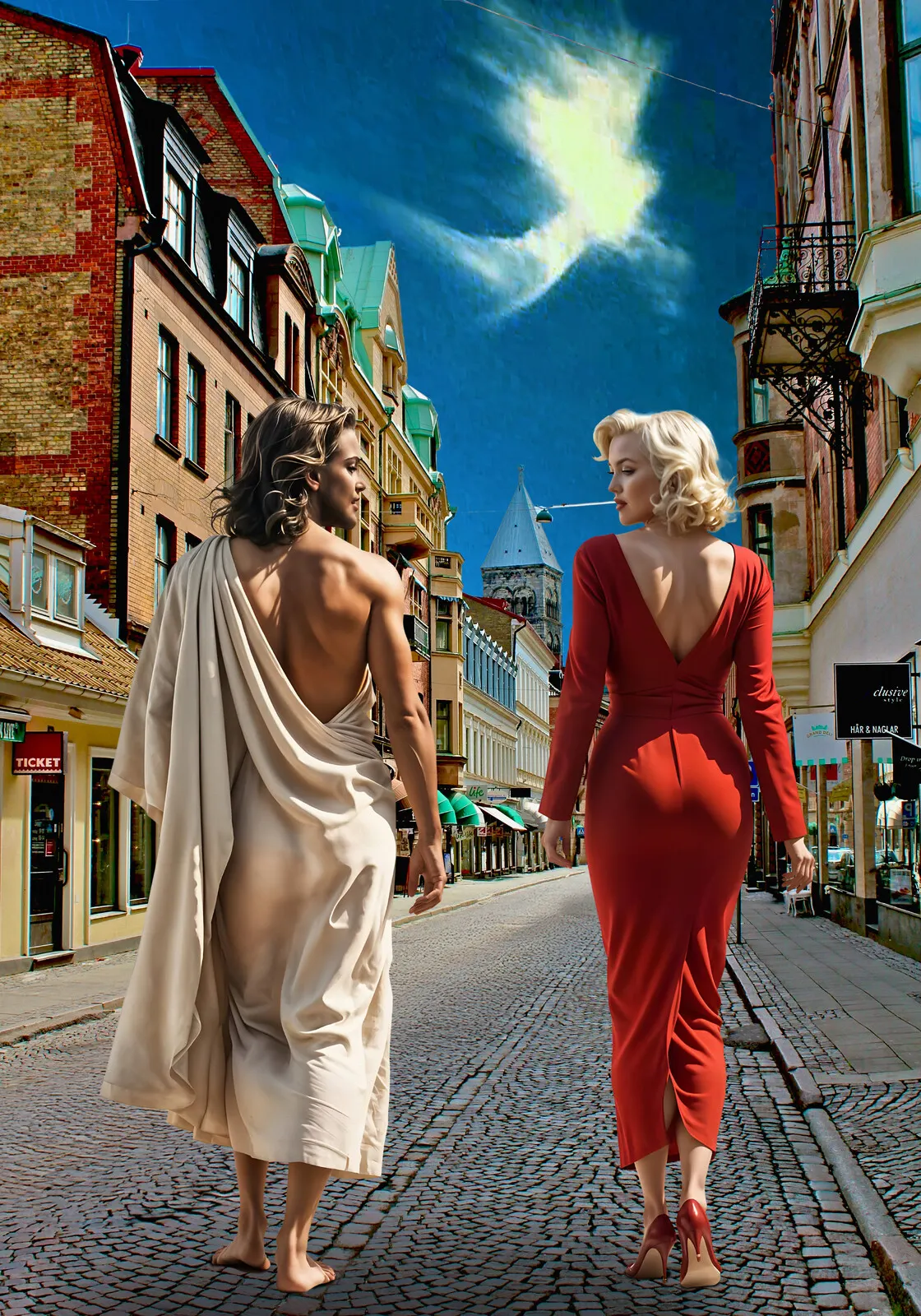
Sunday Morning 9.20
What if Jesus and Mary Magdalene were seen walking through the streets of Lund on an early Sunday morning? He was barefoot, robed in simplicity. She was radiant in red, confident and self-contained. A fleeting glance between them hints at a love beyond time and space—a moment of divine recognition captured “In Passing.” But behind this imagined encounter lies a more profound story: one of suppressed truths, rewritten histories, and the enduring, thought-provoking power of myth.
For centuries, their appearances have been filtered through cultural ideals. Golden hair and fair skin are symbols not of historical reality but of iconographic tradition stretching from ancient Egypt to Renaissance Europe. What did they really look like? And what does their true likeness tell us about power, faith, and the enduring power of love, a beacon of hope that persists in the face of control?
This essay explores what Jesus and Mary might have looked like, why we have imagined them otherwise, and what that says about us. Please read on to learn more.
"In the Steps of Jesus and Mary Magdalene
He walked barefoot through the morning hush,
dust on his heels, silence in his breath.
Not seeking glory, nor fleeing death—
Just moving through time’s teeming lush.
She followed not behind but side by side,
in crimson grace, with a steady pace,
her gaze a mirror, her steps a trace
of truths, the church has long denied.
They met not as lovers newly bound,
but as souls once torn and now made whole—
a glance, a thread, a silent toll
where hearts remember what they found.
The stones beneath them held their names,
though none had carved them deep in stone.
History tried to claim the throne,
but love survives what man reclaims.
His robe was plain; her dress was flame,
they walked through cities unaware.
Yet every step stirred ancient air—
reminding us of whence we came.
So walk they still, through time and doubt,
through questions buried deep in creed,
not needing temples, laws, or lead—
just one true step to turn about.
In morning light or urban street,
where silence listens, echoes swell—
you’ll find their footprints, faint but well,
in every soul they chance to meet.“
Malmö, March 2025
In Passing – A Love Beyond Time and Space
The image is iconic: a barefoot man clad in the simple garments of eternity and a woman in red. Elegance and simplicity converge as they head toward high mass. A fleeting glance filled with love and understanding encapsulates a universe of history in a single moment.
So much for “In Passing.” This was never merely a brief encounter. It was eternal love manifesting in our world—step by step, glance by glance—a love shared by all.
A transient meeting between two realms—one eternal, the other ours. She strides confidently in a vivid red, form-fitting dress while he walks barefoot in a simple robe. Their eyes lock for a fleeting second. The image could easily be titled “In Passing,” but the remainder is left for the viewer’s interpretation. But is that the whole story?
No!
Who is the man walking barefoot on the cool morning cobblestones, accompanied by the elegant woman at his side? Early Sunday mornings in May are hardly prime time for roaming the city, especially not in a dress that exudes late-night glamour. Perhaps she’s returning home from a party—Lund is replete with such nights leading into Sunday. But what about the man? His attire remains even more perplexing: a toga draped over a youthful frame. May may be warm this year, but Pentecost mornings are brisk, and a nearby puddle hints at rain during the night. A morning swim? Highly unlikely. The nearest beach is over ten kilometres from Klostergatan. This is not a man heading for a swim—he seems to belong to an entirely different narrative that transcends time and space.
He walks with purpose, as though he knows the city. And perhaps he does. The man he resembles—with long, dark blond hair, a robe, and bare feet—is Jesus Christ. And he has, in a sense, returned to Lund.
Christ in Lund – A Familiar Return
The first known church in Skåne was established in Lund in the 990s. The apostle Ansgar passed through on his journey north to Birka, and according to tradition, Jesus has always followed in the footsteps of his disciples. Before long, eleven stave churches emerged in the city, a testament to the early spread of Christianity. By the Middle Ages, there were twenty-two churches and four monasteries, indicating the city's strong religious influence. Following the Reformation in the 1500s, all but two were demolished: Lund Cathedral and the Monastery Church. Today, depending on how one delineates the city’s boundaries, only a handful remain in the diocese—around seventeen, more or less.
Jesus has rested in every shadow and observed every stone. The man on Klostergatan is no tourist. He pays no attention to the shop windows. He knows precisely where he is and why.
So, if we accept that this man is Jesus, who is the woman?
The Woman in Red – An Echo from Eternity
She could be Marilyn Monroe—they do share a resemblance. She was recently spotted in Malmö, drawn there by other Time Travellers. But more likely, the woman in red is someone far older, someone who lived in the same era as Jesus himself: Mary Magdalene.
This couple does not appear as lovers newly smitten. They seem like old lovers—secure in one another’s presence, silent before the world but eloquent in their existence. They need not hold hands to prove that ancient love does not tarnish. It radiates in their glow. She wore the dress for herself—not for him—and knew, as women always do, that true style is confidence. Their love, timeless and enduring, testifies to the power of romance.
Mary Magdalene – the Overlooked Revolutionary
Mary Magdalene—the Overlooked Revolutionary—Jesus Christ’s relationship with her was complex and powerful. She was likely the most significant person in his life—his apostle, advisor, confidante, beloved, and perhaps even his wife. The Catholic Church has done all it can to obscure this truth, but it has not succeeded. Too many testimonies are too strong, not least the words of the apostles in our Bible. The Church has not dared to erase them. Mary's role was vital and pivotal in shaping the narrative of Jesus's life.
Mary was at his cross and present at his death. According to the gospels, she was the first person to whom he revealed himself after the resurrection—not Peter or John, but Mary.
Of course, she was there when he departed from Earth to ascend to his star—Sirius, the brightest star in the night sky. In Egypt, Sirius was associated with eternal life. Several ancient civilisations built their calendars around its rising. Science fiction depicts it as the home of the highest beings. In my story—and several others—it is also the eternal home of Jesus and Mary.
The Church’s Distortion – Power over Love
The Church’s issue has never been Jesus. It has always been with whom they permit him to love. A woman? An equal? A partner? Such notions do not align with the patriarchal order, so she had to be erased. The Catholic vow of celibacy is no coincidence, but it’s problematic. It always has been—and is frequently circumvented. Many popes have had families and offspring, both official and very unofficial.
The Church has done its utmost to diminish and humiliate Mary Magdalene, reducing her from apostle to prostitute. Her gospel—discovered in the Egyptian desert, dated to the second century—is dismissed. The Gnostics, the earliest Christians who recognised the divine within rather than in external dogma, were declared heretics. When one reads their texts—available online—the Christian message becomes more straightforward and more comprehensible, yet the relationship between the dominant churches and the Gnostics remains explosive. This conflict has persisted for nearly two millennia and continues unabated. No reconciliation is in sight.
The Cathars, spiritual cousins of the Gnostics, were massacred by papal armies in southern France during the 13th century. Women and children were burnt in churches. It was the only crusade carried out within Europe. Why? Because they refused to accept the Council of Nicaea’s (325 AD) definition of Jesus as God’s biological son, born of a woman claimed to be a virgin—despite already having children, Jesus’ siblings. After all, she was married to Joseph, the carpenter, and at that time, women bore children quickly—there was no contraception. To the Cathars, Jesus was “the ultimate human,” the perfect one—but not a god, rather one who, after death, was taken up into heaven to sit at God’s right hand as the foremost among men.
Judas – Betrayer or Confidant?
The recovered Gospel of Judas tells a different story. In it, the betrayal transforms into an “act of loyalty”—an agreement between Jesus and Judas to make the sacrifice visible to ensure the movement, which had begun to falter, would receive eternal fuel.
Jesus sacrificed himself not to appease God’s wrath but to awaken human insight. Pontius Pilate, Herod, and the Roman Empire played their parts. But Jesus died as a “revolutionary.” A kind of socialist at heart, yet without violence, he preached like the Buddha—with gentleness, patience, and truth.
The Lost Radicalism
Today, Christ’s message has been distorted. The churches bear his name but not always his spirit. That is why he returns to Lund—barefoot, simple, facing the woman he loves—even in her earthly form. They need not speak.
Their moment is eternal; a picture speaks more than a thousand sermons.
But did Christ look like that—blond with curly hair? And Mary, too?
Probably not. But I shall return to that in a moment and explain why. First, we must remember that Time-travellers—those who travel through time—choose their form when visiting Earth. They typically return in their prime, somewhere around forty years old—still youthful on the outside but possessing a depth only eternity can bestow.
Nothing prevents them from selecting their hair colour or appearance based on time, place, purpose, or personal preference. A Time-traveller is not a body but a soul, and the soul resides in eternity. It does not require physical form unless it is so wished. That is why we leave the body behind when we die. Age, illness, scars, and the body’s sufferings remain here. The soul’s light remains untouched.
So why the blond hair? Perhaps because it is beautiful, possibly to blend in, but also because it has long been perceived as noble, even divine. Early in ancient Egypt, golden hair was attributed to the highest gods. Among the Greeks and Romans, it was the same—the most significant gods and heroes were often blond, even though most of the population had dark hair, dark skin, and dark eyes.
Golden Hair as a Sign of Divinity
It is not as strange as it may seem that Christ and Mary Magdalene are often depicted with golden hair. This is because the symbolism of golden hair as a hallmark of the divine, the sacred, and the chosen has transcended cultures and periods for thousands of years. It is not about genetics but about a shared cultural understanding: the colour of the sun, the colour of light, the colour of the gods.
Egyptian Mythology
Most Egyptians had dark hair, and gods were typically depicted with black or blue-black wigs—but significant exceptions exist. Ra, the sun god, was often shown radiating golden light, and his body was imagined as glowing. Horus, the sky god, could also be seen as golden in his higher form—especially when merged with the sun as Horus-Ra.
The clearest example of golden beauty among Egyptians is Tutankhamun’s death mask, whose golden surface symbolised wealth and divinity. Skin, hair, and body merged into gold, transitioning from human to god. Gold was indestructible—just like the essence of the gods. Who knows if this influenced our image of holy beings with golden features?
Babylonian Mythology
The Babylonian gods were not depicted as vividly as the Greeks, but Shamash, the god of the sun and justice, had a body that radiated light, and his hair and beard were sometimes described as shining. The symbolism remains consistent: light surrounding the divine body, perceived by humans as gold, sun, or fire.
Greek Mythology
Here, it becomes clear. Greek gods—especially the young, influential, and beautiful—were often depicted as blond or golden-haired. Most notably:
Apollo, the god of light, music, poetry, and truth, is described in many classical texts and sculptures as fair-haired—that is, golden or light-curled.
Aphrodite, the goddess of love born from sea foam, is often portrayed in later poetry as blonde—and receives her iconic appearance in Renaissance interpretations such as Botticelli’s Venus.
Athena, the goddess of wisdom, is sometimes shown with light hair, especially in Hellenistic art, despite her stern warrior gaze.
Zeus, the god of the sky and father of the gods, often sported a golden beard and hair described as "radiant."
Golden hair symbolised youth, strength, and divine lineage, which extended to demigods like Heracles (Hercules), Paris, and Achilles, who sometimes appear with blond features in poetry and art.
Roman Mythology
The Roman gods were essentially the same as the Greek ones, albeit with new names—but there was also a fascination with light hair.
Apollo (unchanged name) remained blonde in Roman culture.
Venus, the counterpart of Aphrodite, was often depicted as blonde in frescoes and mosaics.
In imperial culture, golden hair became an ideal. Wealthy Roman women dyed their hair blonde with saffron or ash or wore imported German wigs because that is how the goddesses appeared.
Thus, Jesus and Mary Magdalene's representation as blondes is not a Western invention but a mythical code running through thousands of years of iconography. To wear golden hair is to carry light, and to carry light is to belong to heaven.
But how did they look when they walked the earth? The man who was crucified beside the thieves at Golgotha—was he blond? And the woman at the cross?
What Did Jesus Look Like?
From the moment a Christian child enters Sunday school, the image of Jesus Christ takes shape: tall, slender, fair-skinned, wavy brown or blond hair, light eyes, and a gentle, almost ethereal expression. In North America, this figure is nearly iconic—but deeply misleading. A man with such features would have stood out conspicuously among the people of Galilee two thousand years ago. You would expect the authors of the Bible to mention this if it were true. Yet, in the Gospel of Matthew, it is stated that Judas had to point Jesus out to the soldiers in Gethsemane—they could not distinguish him from the disciples.
Nowhere in the Bible is Jesus’s appearance described. No contemporary depictions have been found, and no remains exist for genetic analysis. This leaves interpretation open to artistic imagination and cultural context. Carlos F. Cardoza-Orlandi, professor of world Christianity in Atlanta, points out that while Western images of Jesus dominate, he is portrayed in other parts of the world as Black, Arab, or Latin American. This underscores the powerful influence of cultural context on our perception of historical figures.
So, what can we know? An unexpected source of insight has emerged at the intersection of archaeology and forensic science: forensic anthropology. British scientists, aided by Israeli archaeologists, have tackled the question and produced what is claimed to be the most scientifically grounded reconstruction of the most famous face in history. This rigorous scientific approach provides a credible basis for understanding Jesus's likely appearance.
Studies of skeletons from contemporary Jewish men and comparisons with today’s Iraqi Jews suggest that Jesus likely had olive-toned skin, brown eyes, and dark, almost black hair—a striking contrast to the Western blonde Messiah.
Richard Neave, a medical artist at the University of Manchester, has recreated historical faces, including those of King Midas and King Philip II of Macedonia. He approached the task with great precision. While hair and eye colour cannot be determined from the skull’s shape, contemporary murals and texts offered guidance: dark eyes, a beard, and—contrary to Renaissance portrayals—short, curly hair in line with Jewish custom.
Some regard the Shroud of Turin as a stumbling block, as it depicts a man with long hair and a beard. The Shroud of Turin is a linen cloth that some believe to be the burial shroud of Jesus, bearing the image of a man with long hair and a beard. However, Paul—who, according to tradition, saw Jesus—wrote in First Corinthians that long hair is a disgrace for a man. Would he have made such a statement if Jesus had worn his hair long?
Regarding physique, archaeology shows that the average Semitic male during Jesus’s time was around 155 cm (5 feet 1 inch) tall and weighed about 50 kg (110 lbs). As a craftsman who worked outdoors, Jesus was likely muscular and weathered—not the pale, ethereal figure often seen in church windows.
To many believers, this dark-haired, brown-eyed, and robust Jesus may feel unfamiliar—but Charles D. Hackett, a theologian in Atlanta, views it as a reminder of the faith’s universal roots. The traditionally Western image of Jesus is an appropriation reflecting cultural ideals rather than historical truth. This highlights the influence of cultural context on the representation of Jesus, as different cultures have depicted him in ways that align with their societal norms and values.
Neave emphasises that his depiction of Jesus is a reconstruction of a contemporary Galilean man—not an exact portrait. Alison Galloway, professor of anthropology at the University of California, reminds us that such reconstructions partly depend on artistic interpretation: the nose's angle, the mouth's shape, and the folds around the eyes all influence the final result.
Yet, even with this caution, one conclusion remains: Neave’s version is likely much closer to the truth than the idealised images of tradition. A Jesus with olive skin, short hair, and a muscular build—perhaps not the Jesus taught in Sunday school, but likely closer to the man who once walked the hills of Galilee.
In today’s multicultural Skåne, they would blend in perfectly. Blonde hair is in the minority here and, according to experts, endangered in the long term. Therefore, whether future generations want to see their gods as blonde, dark-haired, or bald remains to be seen; hopefully, humanity will recognise that goodness isn’t measured by hair colour or any other outward trait.
Trump is blonde, while Putin is grey-haired—so clearly, evil doesn’t concern itself with hair colour.
Jörgen Thornberg
Sunday Morning 9.20, 2025
Digital
50 x 70 cm
3 200 kr
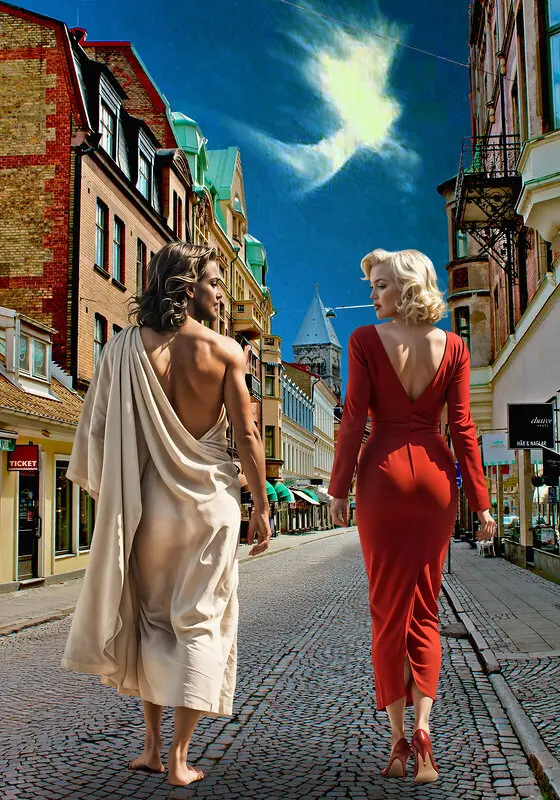
Sunday Morning 9.20
What if Jesus and Mary Magdalene were seen walking through the streets of Lund on an early Sunday morning? He was barefoot, robed in simplicity. She was radiant in red, confident and self-contained. A fleeting glance between them hints at a love beyond time and space—a moment of divine recognition captured “In Passing.” But behind this imagined encounter lies a more profound story: one of suppressed truths, rewritten histories, and the enduring, thought-provoking power of myth.
For centuries, their appearances have been filtered through cultural ideals. Golden hair and fair skin are symbols not of historical reality but of iconographic tradition stretching from ancient Egypt to Renaissance Europe. What did they really look like? And what does their true likeness tell us about power, faith, and the enduring power of love, a beacon of hope that persists in the face of control?
This essay explores what Jesus and Mary might have looked like, why we have imagined them otherwise, and what that says about us. Please read on to learn more.
"In the Steps of Jesus and Mary Magdalene
He walked barefoot through the morning hush,
dust on his heels, silence in his breath.
Not seeking glory, nor fleeing death—
Just moving through time’s teeming lush.
She followed not behind but side by side,
in crimson grace, with a steady pace,
her gaze a mirror, her steps a trace
of truths, the church has long denied.
They met not as lovers newly bound,
but as souls once torn and now made whole—
a glance, a thread, a silent toll
where hearts remember what they found.
The stones beneath them held their names,
though none had carved them deep in stone.
History tried to claim the throne,
but love survives what man reclaims.
His robe was plain; her dress was flame,
they walked through cities unaware.
Yet every step stirred ancient air—
reminding us of whence we came.
So walk they still, through time and doubt,
through questions buried deep in creed,
not needing temples, laws, or lead—
just one true step to turn about.
In morning light or urban street,
where silence listens, echoes swell—
you’ll find their footprints, faint but well,
in every soul they chance to meet.“
Malmö, March 2025
In Passing – A Love Beyond Time and Space
The image is iconic: a barefoot man clad in the simple garments of eternity and a woman in red. Elegance and simplicity converge as they head toward high mass. A fleeting glance filled with love and understanding encapsulates a universe of history in a single moment.
So much for “In Passing.” This was never merely a brief encounter. It was eternal love manifesting in our world—step by step, glance by glance—a love shared by all.
A transient meeting between two realms—one eternal, the other ours. She strides confidently in a vivid red, form-fitting dress while he walks barefoot in a simple robe. Their eyes lock for a fleeting second. The image could easily be titled “In Passing,” but the remainder is left for the viewer’s interpretation. But is that the whole story?
No!
Who is the man walking barefoot on the cool morning cobblestones, accompanied by the elegant woman at his side? Early Sunday mornings in May are hardly prime time for roaming the city, especially not in a dress that exudes late-night glamour. Perhaps she’s returning home from a party—Lund is replete with such nights leading into Sunday. But what about the man? His attire remains even more perplexing: a toga draped over a youthful frame. May may be warm this year, but Pentecost mornings are brisk, and a nearby puddle hints at rain during the night. A morning swim? Highly unlikely. The nearest beach is over ten kilometres from Klostergatan. This is not a man heading for a swim—he seems to belong to an entirely different narrative that transcends time and space.
He walks with purpose, as though he knows the city. And perhaps he does. The man he resembles—with long, dark blond hair, a robe, and bare feet—is Jesus Christ. And he has, in a sense, returned to Lund.
Christ in Lund – A Familiar Return
The first known church in Skåne was established in Lund in the 990s. The apostle Ansgar passed through on his journey north to Birka, and according to tradition, Jesus has always followed in the footsteps of his disciples. Before long, eleven stave churches emerged in the city, a testament to the early spread of Christianity. By the Middle Ages, there were twenty-two churches and four monasteries, indicating the city's strong religious influence. Following the Reformation in the 1500s, all but two were demolished: Lund Cathedral and the Monastery Church. Today, depending on how one delineates the city’s boundaries, only a handful remain in the diocese—around seventeen, more or less.
Jesus has rested in every shadow and observed every stone. The man on Klostergatan is no tourist. He pays no attention to the shop windows. He knows precisely where he is and why.
So, if we accept that this man is Jesus, who is the woman?
The Woman in Red – An Echo from Eternity
She could be Marilyn Monroe—they do share a resemblance. She was recently spotted in Malmö, drawn there by other Time Travellers. But more likely, the woman in red is someone far older, someone who lived in the same era as Jesus himself: Mary Magdalene.
This couple does not appear as lovers newly smitten. They seem like old lovers—secure in one another’s presence, silent before the world but eloquent in their existence. They need not hold hands to prove that ancient love does not tarnish. It radiates in their glow. She wore the dress for herself—not for him—and knew, as women always do, that true style is confidence. Their love, timeless and enduring, testifies to the power of romance.
Mary Magdalene – the Overlooked Revolutionary
Mary Magdalene—the Overlooked Revolutionary—Jesus Christ’s relationship with her was complex and powerful. She was likely the most significant person in his life—his apostle, advisor, confidante, beloved, and perhaps even his wife. The Catholic Church has done all it can to obscure this truth, but it has not succeeded. Too many testimonies are too strong, not least the words of the apostles in our Bible. The Church has not dared to erase them. Mary's role was vital and pivotal in shaping the narrative of Jesus's life.
Mary was at his cross and present at his death. According to the gospels, she was the first person to whom he revealed himself after the resurrection—not Peter or John, but Mary.
Of course, she was there when he departed from Earth to ascend to his star—Sirius, the brightest star in the night sky. In Egypt, Sirius was associated with eternal life. Several ancient civilisations built their calendars around its rising. Science fiction depicts it as the home of the highest beings. In my story—and several others—it is also the eternal home of Jesus and Mary.
The Church’s Distortion – Power over Love
The Church’s issue has never been Jesus. It has always been with whom they permit him to love. A woman? An equal? A partner? Such notions do not align with the patriarchal order, so she had to be erased. The Catholic vow of celibacy is no coincidence, but it’s problematic. It always has been—and is frequently circumvented. Many popes have had families and offspring, both official and very unofficial.
The Church has done its utmost to diminish and humiliate Mary Magdalene, reducing her from apostle to prostitute. Her gospel—discovered in the Egyptian desert, dated to the second century—is dismissed. The Gnostics, the earliest Christians who recognised the divine within rather than in external dogma, were declared heretics. When one reads their texts—available online—the Christian message becomes more straightforward and more comprehensible, yet the relationship between the dominant churches and the Gnostics remains explosive. This conflict has persisted for nearly two millennia and continues unabated. No reconciliation is in sight.
The Cathars, spiritual cousins of the Gnostics, were massacred by papal armies in southern France during the 13th century. Women and children were burnt in churches. It was the only crusade carried out within Europe. Why? Because they refused to accept the Council of Nicaea’s (325 AD) definition of Jesus as God’s biological son, born of a woman claimed to be a virgin—despite already having children, Jesus’ siblings. After all, she was married to Joseph, the carpenter, and at that time, women bore children quickly—there was no contraception. To the Cathars, Jesus was “the ultimate human,” the perfect one—but not a god, rather one who, after death, was taken up into heaven to sit at God’s right hand as the foremost among men.
Judas – Betrayer or Confidant?
The recovered Gospel of Judas tells a different story. In it, the betrayal transforms into an “act of loyalty”—an agreement between Jesus and Judas to make the sacrifice visible to ensure the movement, which had begun to falter, would receive eternal fuel.
Jesus sacrificed himself not to appease God’s wrath but to awaken human insight. Pontius Pilate, Herod, and the Roman Empire played their parts. But Jesus died as a “revolutionary.” A kind of socialist at heart, yet without violence, he preached like the Buddha—with gentleness, patience, and truth.
The Lost Radicalism
Today, Christ’s message has been distorted. The churches bear his name but not always his spirit. That is why he returns to Lund—barefoot, simple, facing the woman he loves—even in her earthly form. They need not speak.
Their moment is eternal; a picture speaks more than a thousand sermons.
But did Christ look like that—blond with curly hair? And Mary, too?
Probably not. But I shall return to that in a moment and explain why. First, we must remember that Time-travellers—those who travel through time—choose their form when visiting Earth. They typically return in their prime, somewhere around forty years old—still youthful on the outside but possessing a depth only eternity can bestow.
Nothing prevents them from selecting their hair colour or appearance based on time, place, purpose, or personal preference. A Time-traveller is not a body but a soul, and the soul resides in eternity. It does not require physical form unless it is so wished. That is why we leave the body behind when we die. Age, illness, scars, and the body’s sufferings remain here. The soul’s light remains untouched.
So why the blond hair? Perhaps because it is beautiful, possibly to blend in, but also because it has long been perceived as noble, even divine. Early in ancient Egypt, golden hair was attributed to the highest gods. Among the Greeks and Romans, it was the same—the most significant gods and heroes were often blond, even though most of the population had dark hair, dark skin, and dark eyes.
Golden Hair as a Sign of Divinity
It is not as strange as it may seem that Christ and Mary Magdalene are often depicted with golden hair. This is because the symbolism of golden hair as a hallmark of the divine, the sacred, and the chosen has transcended cultures and periods for thousands of years. It is not about genetics but about a shared cultural understanding: the colour of the sun, the colour of light, the colour of the gods.
Egyptian Mythology
Most Egyptians had dark hair, and gods were typically depicted with black or blue-black wigs—but significant exceptions exist. Ra, the sun god, was often shown radiating golden light, and his body was imagined as glowing. Horus, the sky god, could also be seen as golden in his higher form—especially when merged with the sun as Horus-Ra.
The clearest example of golden beauty among Egyptians is Tutankhamun’s death mask, whose golden surface symbolised wealth and divinity. Skin, hair, and body merged into gold, transitioning from human to god. Gold was indestructible—just like the essence of the gods. Who knows if this influenced our image of holy beings with golden features?
Babylonian Mythology
The Babylonian gods were not depicted as vividly as the Greeks, but Shamash, the god of the sun and justice, had a body that radiated light, and his hair and beard were sometimes described as shining. The symbolism remains consistent: light surrounding the divine body, perceived by humans as gold, sun, or fire.
Greek Mythology
Here, it becomes clear. Greek gods—especially the young, influential, and beautiful—were often depicted as blond or golden-haired. Most notably:
Apollo, the god of light, music, poetry, and truth, is described in many classical texts and sculptures as fair-haired—that is, golden or light-curled.
Aphrodite, the goddess of love born from sea foam, is often portrayed in later poetry as blonde—and receives her iconic appearance in Renaissance interpretations such as Botticelli’s Venus.
Athena, the goddess of wisdom, is sometimes shown with light hair, especially in Hellenistic art, despite her stern warrior gaze.
Zeus, the god of the sky and father of the gods, often sported a golden beard and hair described as "radiant."
Golden hair symbolised youth, strength, and divine lineage, which extended to demigods like Heracles (Hercules), Paris, and Achilles, who sometimes appear with blond features in poetry and art.
Roman Mythology
The Roman gods were essentially the same as the Greek ones, albeit with new names—but there was also a fascination with light hair.
Apollo (unchanged name) remained blonde in Roman culture.
Venus, the counterpart of Aphrodite, was often depicted as blonde in frescoes and mosaics.
In imperial culture, golden hair became an ideal. Wealthy Roman women dyed their hair blonde with saffron or ash or wore imported German wigs because that is how the goddesses appeared.
Thus, Jesus and Mary Magdalene's representation as blondes is not a Western invention but a mythical code running through thousands of years of iconography. To wear golden hair is to carry light, and to carry light is to belong to heaven.
But how did they look when they walked the earth? The man who was crucified beside the thieves at Golgotha—was he blond? And the woman at the cross?
What Did Jesus Look Like?
From the moment a Christian child enters Sunday school, the image of Jesus Christ takes shape: tall, slender, fair-skinned, wavy brown or blond hair, light eyes, and a gentle, almost ethereal expression. In North America, this figure is nearly iconic—but deeply misleading. A man with such features would have stood out conspicuously among the people of Galilee two thousand years ago. You would expect the authors of the Bible to mention this if it were true. Yet, in the Gospel of Matthew, it is stated that Judas had to point Jesus out to the soldiers in Gethsemane—they could not distinguish him from the disciples.
Nowhere in the Bible is Jesus’s appearance described. No contemporary depictions have been found, and no remains exist for genetic analysis. This leaves interpretation open to artistic imagination and cultural context. Carlos F. Cardoza-Orlandi, professor of world Christianity in Atlanta, points out that while Western images of Jesus dominate, he is portrayed in other parts of the world as Black, Arab, or Latin American. This underscores the powerful influence of cultural context on our perception of historical figures.
So, what can we know? An unexpected source of insight has emerged at the intersection of archaeology and forensic science: forensic anthropology. British scientists, aided by Israeli archaeologists, have tackled the question and produced what is claimed to be the most scientifically grounded reconstruction of the most famous face in history. This rigorous scientific approach provides a credible basis for understanding Jesus's likely appearance.
Studies of skeletons from contemporary Jewish men and comparisons with today’s Iraqi Jews suggest that Jesus likely had olive-toned skin, brown eyes, and dark, almost black hair—a striking contrast to the Western blonde Messiah.
Richard Neave, a medical artist at the University of Manchester, has recreated historical faces, including those of King Midas and King Philip II of Macedonia. He approached the task with great precision. While hair and eye colour cannot be determined from the skull’s shape, contemporary murals and texts offered guidance: dark eyes, a beard, and—contrary to Renaissance portrayals—short, curly hair in line with Jewish custom.
Some regard the Shroud of Turin as a stumbling block, as it depicts a man with long hair and a beard. The Shroud of Turin is a linen cloth that some believe to be the burial shroud of Jesus, bearing the image of a man with long hair and a beard. However, Paul—who, according to tradition, saw Jesus—wrote in First Corinthians that long hair is a disgrace for a man. Would he have made such a statement if Jesus had worn his hair long?
Regarding physique, archaeology shows that the average Semitic male during Jesus’s time was around 155 cm (5 feet 1 inch) tall and weighed about 50 kg (110 lbs). As a craftsman who worked outdoors, Jesus was likely muscular and weathered—not the pale, ethereal figure often seen in church windows.
To many believers, this dark-haired, brown-eyed, and robust Jesus may feel unfamiliar—but Charles D. Hackett, a theologian in Atlanta, views it as a reminder of the faith’s universal roots. The traditionally Western image of Jesus is an appropriation reflecting cultural ideals rather than historical truth. This highlights the influence of cultural context on the representation of Jesus, as different cultures have depicted him in ways that align with their societal norms and values.
Neave emphasises that his depiction of Jesus is a reconstruction of a contemporary Galilean man—not an exact portrait. Alison Galloway, professor of anthropology at the University of California, reminds us that such reconstructions partly depend on artistic interpretation: the nose's angle, the mouth's shape, and the folds around the eyes all influence the final result.
Yet, even with this caution, one conclusion remains: Neave’s version is likely much closer to the truth than the idealised images of tradition. A Jesus with olive skin, short hair, and a muscular build—perhaps not the Jesus taught in Sunday school, but likely closer to the man who once walked the hills of Galilee.
In today’s multicultural Skåne, they would blend in perfectly. Blonde hair is in the minority here and, according to experts, endangered in the long term. Therefore, whether future generations want to see their gods as blonde, dark-haired, or bald remains to be seen; hopefully, humanity will recognise that goodness isn’t measured by hair colour or any other outward trait.
Trump is blonde, while Putin is grey-haired—so clearly, evil doesn’t concern itself with hair colour.
3 200 kr

Jörgen Thornberg
Malmö
Lite om bilder och mig. Translation in English at the end.
Jag är en nyfiken person som ser allt i bilder, även det jag fäster i ord, gärna tillsammans för bakom alla mina bilder finns en berättelse. Till vissa bilder hör en kortare eller längre novell som följer med bilden.
Bilder berättar historier. Jag omges av naturlig skönhet, intressanta människor och historia var jag än går. Jag använder min kamera för att dokumentera världen och blanda det jag ser med vad jag känner för att fånga den dolda magin.
Mina bilder berättar mina historier. Genom mina bilder, tryck och berättelser. Jag bjuder in dig att ta del av dessa berättelser, in i ditt liv och hem och dela min mycket personliga syn på vår värld. Mer än vad ögat ser. Jag tänker i bilder, drömmer och skriver och pratar om dem; följaktligen måste jag också skapa bilder. De blir vad jag ser, inte nödvändigtvis begränsade till verkligheten. Det finns en bild runt varje hörn. Jag hoppas att du kommer att se vad jag såg och gilla det.
Jag är också en skrivande person och till många bilder hör en kortare eller längre essay. Den följer med tavlan, tryckt på fint papper och med en personlig hälsning från mig.
Flertalet bilder startar sin resa i min kamera. Enkelt förklarat beskriver jag bilden jag ser i mitt inre, upplevd eller fantiserad. Bilden uppstår inom mig redan innan jag fått okularet till ögat. På bråkdelen av ett ögonblick ser jag vad jag vill ha och vad som kan göras med bilden. Här skall jag stoppa in en giraff, stålmannen, Titanic eller vad det är min fantasi finner ut. Ännu märkligare är att jag kommer ihåg minnesbilden långt efteråt när det blir tid att skapa verket. Om jag lyckas eller inte, är upp till betraktaren, oftast präglat av en stråk av svart humor – meningen är att man skall bli underhållen. Mina bilder blir ofta en snackis där de hänger.
Jag föredrar bilder som förmedlar ett budskap i flera lager. Vid första anblicken fylld av feel-good, en vacker utsikt, fint väder, solen skiner, blommor på ängen eller vattnet som ligger förrädiskt spegelblankt. I en sådan bild kan jag gömma min egentliga berättelse, mitt förakt för förtryckare och våldsverkare, rasister och fördomsfulla människor - ett gärna återkommande motiv mer eller mindre dolt i det vackra motivet. Jag försöker förena dem i ett gemensamt narrativ.
Bild och formgivning har löpt som en röd tråd genom livet. Fotokonst känns som en värdig final som jag gärna delar med mig.
Min genre är vid som framgår av mina bilder, temat en blandning av pop- och gatukonst i kollage som kan bestå av hundratals lager. Vissa bilder kan ta veckor, andra någon dag innan det är dags att överlämna resultatet till printverkstaden. Fine Art Prints är digitala fotocollage. I dessa kollage sker rivandet, klippandet, pusslandet, målandet, ritandet och sprayningen digitalt. Det jag monterar in kan vara hundratals år gamla bilder som jag omsorgsfullt frilägger så att de ser ut att vara en del av tavlan men också bilder skapade av mig själv efter min egen fantasi. Därefter besöks printstudion och för vissa bilder numrera en limiterad upplaga (oftast 7 exemplar) och signera för hand. Vissa bilder kan köpas i olika format. Det är bara att fråga efter vilka. Gillar man en bild som är 70x100 men inte har plats på väggen, går den kanske att få i 50x70 cm istället. Frågan är fri.
Metoden Giclée eller Fine Art Print som det också kallas är det moderna sättet för framställning av grafisk konst. Villkoret för denna typ av utskrifter är att en högkvalitativ storformatskrivare används med åldersbeständigt färgpigment och konstnärspapper eller i förekommande fall på duk. Pappret som används möter de krav på livslängd som ställs av museer och gallerier. Normalt säljer jag mina bilder oinramade så att den nya ägaren själv kan bestämma hur de skall se ut, med eller utan passepartout färg på ram, med eller utan glas etc..
Under många år ställde jag bara ut på nätet, i valda grupper och på min egen Facebooksida - https://www.facebook.com/jorgen.thornberg.9
Jag finns också på en egen hemsida som tyvärr inte alltid är uppdaterad – https://www.jth.life/ Där kan du också läsa en del av de berättelser som följer med bilden.
UTSTÄLLNINGAR
Luftkastellet, oktober 2022
Konst i Lund, november 2022
Luftkastellet, mars 2023
Engleson Galleri Caroli, april 2023
Hydra, Greece June 2023
Engleson Galleri Caroli, oktober 2023
Toppen, Höllviken december 2023
Luftkastellet, mars 2024
Torups Galleri, mars 2024
Venice, May 2024
Luftkastellet, oktober 2024
Konst i Advent, December 2024
Galleri Engleson, Caroli December 2024
Jäger & Jansson Galleri, april 2025
A bit about pictures and me.
I'm a curious person who sees everything in pictures, even what I express in words, often combining them, for behind all my pictures lies a story. These narratives, some as short as a single image and others as long as a novel, are the heart and soul of my work.
Pictures tell stories. Wherever I go, I'm surrounded by natural beauty, exciting people, and history. I use my camera to document the world and blend what I see with what I feel to capture the hidden magic.
My images tell my stories. Through my pictures, prints, and narratives, I invite you to partake in these stories in your life and home and share my deeply personal perspective of our world. More than meets the eye. I think in pictures, dream, write, and talk about them; consequently, I must create images too. They become what I see, not necessarily confined to reality. There's a picture around every corner. I hope you'll see what I saw and enjoy it.
I'm also a writer, and many images come with a shorter or longer essay. It accompanies the painting, printed on fine paper with my personal greeting.
Many pictures start their journey on my camera. Simply put, I describe the image I see in my mind, experienced or imagined. The image arises within me even before I bring the eyepiece to my eye. In a fraction of a moment, I see what I want and what can be done with the picture. Here, I'll insert a giraffe, Superman, the Titanic, or whatever my imagination conjures up. Even stranger is that I remember the mental image long after it's time to create the work. Whether I succeed is up to the observer, often imbued with a streak of black humour – the aim is to entertain. My pictures usually become a talking point wherever they hang.
I prefer pictures that convey a message in multiple layers. At first glance, they're filled with feel-good vibes, a beautiful view, lovely weather, the sun shining, flowers in the meadow, or the water lying deceptively calm. But beneath this surface beauty, I often conceal a deeper story, a narrative that challenges societal norms or explores the human condition. I invite you to delve into these hidden narratives and discover the layers of meaning within my work.
Picture and design have been a thread running through my life. Photographic art feels like a fitting finale, and I'm happy to share it.
My genre is varied, as seen in my pictures; the theme is a blend of pop and street art in collages that can consist of hundreds of layers. Some images can take weeks, others just a day before it's time to hand over the result to the print workshop. Fine Art Prints are digital photo collages. In these collages, tearing, cutting, puzzling, painting, drawing, and spraying happen digitally. What I insert can be images hundreds of years old that I carefully extract so they appear to be part of the painting, but also images created by myself, now also generated from my imagination. Next, visit the print studio and, for certain images, number a limited edition (usually 7 copies) and sign them by hand. Some images may be available in other formats. Just ask which ones. If you like an image that's 70x100 but doesn't have space on the wall, you might be able to get it in 50x70 cm instead. The question is open.
The Giclée method, or Fine Art Print as it's also called, is the modern way of producing graphic art. This method ensures the highest quality and longevity of the artwork, using a high-quality large-format printer with archival pigment inks and artist paper or, in some cases, canvas. The paper used meets the longevity requirements set by museums and galleries. I sell my pictures unframed, allowing the new owner to personalise their artwork, confident in the lasting value and quality of the piece.
For many years, I only exhibited online, in selected groups, and on my Facebook page - https://www.facebook.com/jorgen.thornberg.9. I also have my website, which unfortunately is not constantly updated - https://www.jth.life/. You can also read some of the stories accompanying the pictures there.
EXHIBITIONS
Luftkastellet, October 2022
Art in Lund, November 2022
Luftkastellet, March 2023
Engleson Gallery Caroli, April 2023
Hydra, Greece June 2023
Engleson Gallery Caroli, October 2023
Toppen, Höllviken December 2023
Luftkastellet, March 2024
Torup Gallery, March 2024
Venice, May 2024
UTSTÄLLNINGAR
Luftkastellet, oktober 2022
Konst i Lund, november 2022
Luftkastellet, mars 2023
Engleson Galleri Caroli, april 2023
Hydra, Greece June 2023
Engleson Galleri Caroli, oktober 2023
Toppen, Höllviken december 2023
Luftkastellet, mars 2024
Torups Galleri, mars 2024
Venice, May 2024
Luftkastellet, October 2024
Konst i Advent, December 2024
Galleri Engleson, Caroli December 2024
Jäger & Jansson Galleri, April 2025
Utbildning
Autodidakt
Medlem i konstnärsförening
Öppna Sinnen
Med i konstrunda
Konstrundan i Skåne
Utställningar
Luftkastellet, October 2022
Art in Lund, November 2022
Luftkastellet, March 2023
Engleson Gallery Caroli, April 2023
Hydra, Greece June 2023
Engleson Gallery Caroli, October 2023
Toppen, Höllviken December 2023
Luftkastellet, March 2024
Torup Gallery, March 2024
Venice, May 2024